Page | 2
Contents
Introduction 3
Part 1: Strategic Context 3
General Duty 3
Broads Plan 4
Strategic Priorities 2013/14 4
Strategic Priorities for 2014/15 5
Table 1: Strategic Priorities 2014/15 6
Part 2: Resource Plans 11
Financial Overview 11
Financial Strategy 2014/15 – 2016/17 11
Table 2: Financial Strategy 2014/15 – 2016/17 12
People Strategy 13
Figure 1: Organisational Structure 2014/15 13
Table 3: Full Time Equivalent Staff Numbers 14
Part 3: Measuring our Performance 15
Conservation of the Natural Environment 16
Conservation of Cultural Heritage 17
Recreation Management 18
Estate Services / Volunteers 19
Promoting Understanding 19
Navigation 20
Development Management 21
Page | 3
Introduction
The Broads Authority has a duty to manage the unique mosaic of lakes, land and rivers that make up the Norfolk and Suffolk Broads, and to have regard to the interests of those who live, work and visit the area. The Broads is the UK's largest protected wetland, extending over an area of 303km2. It is a member of the UK National Parks family, with a wide range of national and international designations in recognition of its landscape, nature conservation and cultural features.
This Business Plan consolidates information from a range of sources to provide an overview of the Authority’s planned activities for the period 2014/15–2016/17 and its performance in delivering its strategic objectives in the previous year.
The Business Plan, along with the underlying policies and strategies that inform it, has been developed in the context of continuing change for the Authority, driven largely by significant and ongoing reductions in the level of National Park Grant allocation since 2010/11. In particular, the Authority’s current Financial Strategy sets out how the organisation will continue to adapt in the period up to 2016/17 to address these changes in funding. Against this backdrop, however, activities to deliver strategic objectives for the management of the Broads have continued, and this Business Plan sets out details of progress made in 2013/14.
In setting its current Financial Strategy, the Authority reaffirmed its commitment to an integrated approach to the management of the Broads. This includes working with a range of partners, from public bodies to local communities, to deliver the objectives set out in the Broads Plan1, the key strategic management plan for the Broads.
Part 1: Strategic Context
General Duty
The Broads Authority has a duty to manage the Broads for the following purposes:
Conserving and enhancing the natural beauty, wildlife and cultural heritage of the Broads;
Promoting opportunities for the understanding and enjoyment of the special qualities of the Broads by the public; and
Protecting the interests of navigation. While having regard to:
The national importance of the Broads as an area of natural beauty and one which affords opportunities for open air recreation;
The desirability of protecting the natural resources of the Broads from damage; and
The needs of agriculture and forestry and the economic and social interests of those who live and work in the Broads.
In respect of its navigation area, the Authority is required to (a) maintain the navigation area for the purposes of navigation to such standard as appears to it to be reasonably required; and (b) take such steps to improve and develop it as it thinks fit.
1
Page | 4
Broads Plan
The Broads Plan is the key strategic management plan for the Broads. It sets out a vision, aims and objectives for the Broads and coordinates and integrates a wide range of strategies, plans and policies relevant to the area with the purposes and duties set out in the Broads Acts.
The Authority is required to review the Broads Plan at least every five years. Broads Plan 2011 was prepared following a comprehensive review of the Broads Plan 2004 and consideration of the issues, challenges, and opportunities facing the Broads now and in the future – in particular the impacts of climate change and sea level rise. It updates the long-term vision and aims for the Broads and refreshes short-term strategic objectives to be delivered during the life of the Plan (5–7 years). Objectives are set out under three key themes, covering the following range of topics:
Planning for the long-term future of the Broads in response to climate change and sea level rise: Understanding and responding to the key challenges facing the Broads over the next 50 – 100 years presented by climate change and sea level rise.
Working in partnership on the sustainable management of the Broads: Landscape and Cultural Heritage; Agriculture and Land Management; Biodiversity; and Management of the Navigation Area.
Encouraging the sustainable use and enjoyment of the Broads: Promoting Understanding, Enjoyment and Wellbeing; and Tourism, Recreation and Access.
The Broads Plan is a plan for the Broads, and not just for the Broads Authority. Its successful delivery therefore involves joint working with a range of other organisations and local interests, who in many cases will contribute to the funding of activities.
Strategic Priorities 2013/14
The Authority sets a small number of ‘Strategic Priorities’ each year, which fall under the three key themes in the Broads Plan, and a fourth theme relating to governance and organisational development. Progress against the Strategic Priorities is reported regularly to the full Broads Authority within the Strategic Direction report, which may be viewed in the Committee papers section of the Authority’s website.2
Of the 33 objectives identified for 2013/14, 18 had been completed by the end of March 2014, with a number of outstanding objectives carried forward into the Strategic Priorities for 2014/15 (Table 1). All remaining outstanding 2013/14 priorities are being pursued to completion.
Strategic Priorities delivered in 2013/14 include:
Production of individual Action Plans for all mills;
Provision of support to landowners through species and habitat enhancement projects;
Development and delivery of the 3rd Biodiversity and Water Forum in conjunction with partners;
Award of the Hydrographic Survey term contract, with surveys completed and informing the development of the 2014/15 dredging programme;
Redevelopment of the Authority’s corporate website;
2
Page | 5
Development of modules for the Broads curriculum in conjunction with the Broads Environmental Education Network; and
Development and trialling of the programme of Area Parish Forum meetings.
Strategic Priorities for 2014/15
The Authority agreed its Strategic Priorities for 2014/15 in March 2014. Details of the priorities, including key milestones and outcomes, are set out in Table 1. Work to deliver these priorities is underway, with progress reported at each full Authority meeting.
Following a decision by the Authority in May 2014, Strategic Priority 3.2 has been deferred and staff resources transferred to developing a potential Heritage Lottery Fund (HLF) bid for a £3 million Landscape Partnership Scheme project. The project focuses on the Lower Yare, and is based around the themes of archaeology, mill restoration and biodiversity. The proposal recognises the archaeological importance of the area and is being developed with partners with a target of submitting a bid to the HLF in May 2015. The project will involve engagement with local communities, skills training and partnership with the Norfolk Archaeological Trust, Norfolk Windmills and Pumps Trust, and the RSPB.
Page | 6 Table 1: Strategic Priorities 2014/15
Theme 1 - Planning for the long-term future of the Broads in response to climate change and sea-level rise
This priority continues to be identified by others, including the Broads Forum, as a high priority, and the Authority has embarked on a major public consultation exercise which should lead to a revised Adaptation Plan and a new Action Plan.
Ser Objective Lead Officer Projects and Key Milestones Outcome
1.1 Furthering community involvement to understand vulnerabilities and inform adaptation planning (Broads Plan Objective CC2)
Head of Strategy and Projects
Continue to take opportunities to discuss with differing interests in the Broads the climate impacts and choices for getting the best for the broads throughout 2014
Prepare revised climate adaptation plan for consultation with stakeholders by October 2014
Use consultation responses to guide revised climate adaptation plan to be adopted by Authority & partners by January 2015
Submit revised plan to Defra by March 2015
Greater awareness of the local public about climate impacts and future adaptation choices Adaptation Plan consultation draft Adaptation Plan draft for adoption by BA and partners
Adaptation Plan submitted to Government
Page | 7 Theme 2 - Working in Partnership on the Sustainable Management of the Broads
There are two main strands identified within this area:
The Biodiversity Audit and the Biodiversity and Water Strategy completed in 2012 should provide the guide for future action and concentration should be given, working with partners, for a major project, or series of projects, to continue to protect and enhance biodiversity in the area.
In conjunction with partners, the Catchment Plan for the Broads should be developed to seek long-term benefits to the whole area.
Ser Objective Lead Officer Projects and Key Milestones Outcome
2.1 Deliver Biodiversity and water Strategy (Broads Plan Objective BD1) Head of Construction, Maintenance and Environment Senior Ecologist
Develop a proposal and seek funding for the restoration of Hickling and its catchment:
Initial proposal to the Broads Authority in September 2014
Feasibility and funding plan complete and reported to the Broad Authority in January 2015 Report on Strategy whole work programme for 2014/15 in July 2014
Prioritisation of approach to restoring a lake and its catchment
Progress on delivering the Biodiversity & Water Strategy
2.2 Continue the
improvement of water quality and water resource (Broads Plan Objective BD3)
Senior Ecologist Hold research seminar on fen hydrology in autumn 2014 and work with partners to agree a research programme by end of 2014
Agreed programme of research into hydrology of fens
2.3 Develop landscape-scale initiatives (Broads Plan Objective BD5)
Senior Ecologist Implement Broadland Catchment Plan
Seek and confirm external funding to enable continuation of Catchment Partnership Officer till at least the end of 2014/15 by May 2014
Gain partner adoption of Broadland Catchment Plan by July 2014
Closer partnership working to enable catchment restoration
Page | 8
Ser Objective Lead Officer Projects and Key Milestones Outcome
Identify 3 key projects and funding by September 2014
Report on status of 3 projects by March 2015
elements of the catchment
Theme 3 - Encouraging the Sustainable Use of the Broads There are two main strands identified within this area:
In conjunction with the Whitlingham Charitable Trust, the Trustees of the Arminghall Settlement and the Youth Hostel Association, develop a project to improve the public facilities in the Whitlingham Country Park. This was likely to involve applications for external funding.
Following the completion of the STEP programme, work with partners to further promote tourism and economic development within the area.
Ser Objective Lead Officer Projects and Key Milestones Outcome
3.1 Promote a clear and consistent Broads ‘brand’ that defines the special qualities and status of the area as a resource for all (Broads Plan Objective PE1)
Head of
Communications
Use the 25 year anniversary of the Broads Authority to focus on the profile of the Broads and the Authority to galvanise support for future objectives. Generate a programme of promotional events to highlight the work of the Broads Authority and its 25th anniversary. Report to the Broads Authority in May for delivery during 2014. Assist Broads Tourism to relaunch ‘Enjoy the Broads’ brand to businesses in June 2014
Undertake bilateral discussions with all key stakeholders to gauge level of support for greater use of the National Park brand and the Authority’s long term ambition of achieving full National Park status. Report to BA in January 2015.
Increase understanding of the work undertaken by the Authority
Increased profile of the Broads as a holiday destination
Greater understanding of the issues around use of the ‘national park’ brand
Page | 9
Ser Objective Lead Officer Projects and Key Milestones Outcome
Produce report and action plan on the positive steps that can be taken to raise the profile of the Broads through clear area signage and promotion outside of Norfolk & Suffolk by December 2014.
Increased profile for the Broads
3.23 Develop the network of information provision to enable people to better understand the special qualities of the Broads and enjoy them in a sustainable way. (Broads Plan Objective PE2) Director of Operations/ BA Project Manager/ Historic Environment Manager
Continue to work with the WCT on the major project to enhance the public facilities at Whitlingham.
Working with partners develop and submit stage 1 HLF bid – October 2014
Subject to Stage 1 success develop a Stage 2 HLF bid for submission in 2015/16
Providing an enhanced visitor experience in the Park via improved public facilities with funding secured from the HLF and partners
3.3 Continue to improve the quality of the visitor experience, providing a consistent standard of facilities, services and welcome. (Broads Plan Objective TR2) Head of Communications Senior Waterways and Recreation Officer Head of Communications
Produce development strategies for the yacht stations and visitor hubs to create direction of travel and main milestones for the coming five years by autumn 2014.
Survey boat owners, hirers and hire boat yards to gain a clearer picture of their views and aspirations.
Boat owners’ survey complete and reported to the BA by autumn 2014.
Hire yards and hirers surveys in summer 2014. Organise 4th Broads Outdoors Festival, May 2014
Enables overview of how each hub fits together, allows scanning for opportunities, allocation over time of resources Establish evidence base for future tolls and
management decisions
Raising the profile of the Broads locally and
3 Following an Authority decision in July 2014, Strategic Priority 3.2 has been deferred, with staff resources transferred to a project focused on the development of a
Page | 10
Ser Objective Lead Officer Projects and Key Milestones Outcome
nationally. Encouraging more Broads businesses to participate in promotion Theme 4 - Governance/Organisational Development of the Authority
Ser Objective Lead Officer Projects and Key Milestones Outcome
4.1 Review opportunities for income generation and further efficiencies
Head of Finance
Chief Executive
Management Team
Investigate the opportunities to benchmark costs of the Authority’s services with national parks, local government and other relevant organisations.
Work with National Parks UK to raise income for the family from corporate sponsorship. Report to the Chairs of the National Parks in summer 2014
Identify potential income generation from sources such as Europe, the Lottery and the New Anglia together with potential further efficiencies by Autumn 2014.
Evidence base to inform 2015/16 budget setting
Increased income above the £50,000 from Reckitt Benckiser
Financial support for the Authority’s key strategic priorities
Page | 11
Part 2: Resource Plans
The Broads Authority’s resource plans encompass strategies for both financial and human resources. This Business Plan summarises the key aspects of these strategies and the wider economic outlook for the Authority.
The Authority sets an annual budget before the start of the financial year, along with a three-year Financial Strategy. Detailed budgetary information is published within Committee papers and on the Authority’s website4.
Financial Overview
The Authority’s allocation of National Park Grant has been reduced annually since the 2010/11 financial year, with a reduction of 8.5% announced for 2014/15 and 1.7% for 2015/16. The Government has also signalled the uncertainty around the wider fiscal outlook for public finances and the likelihood of continued downward pressure on Government spending in future years. In response, the Authority has sought to identify ways to raise income, make efficiencies and find further savings. This has resulted in a number of proposals, including a further minor organisational restructure planned for April 2015.
Financial Strategy 2014/15 – 2016/17
The wider financial environment in which the Authority operates has required some difficult decisions about service levels and challenging reductions in support services. The Authority’s guiding principles in setting the Financial Strategy to 2016/17 have been to:
minimise the impact on staff;
protect front-line services; and
continue with an integrated approach to the management of the Broads.
The Financial Strategy therefore sets out how the organisation will continue to adapt in the period up to 2016/17 to address changes in funding. It includes key plans to:
develop the Authority’s commercial approach to income generation, sponsorship and fundraising;
revise the Authority’s approach to project funding and end the provision of Sustainable Development Fund grants;
restructure the Authority’s Communications, Governance, Human Resources and Legal services to reduce costs while ensuring that a high standard of provision is retained; and
review the allocation of Operations Directorate time between National Park and Navigation activities.
The Authority’s Financial Strategy for the period 2014/15–2016/17, alongside comparative actual figures for 2013/14, is set out on the following page.
4
Page | 12 Table 2: Financial Strategy 2014/15 – 2016/17
2013/14 (Actual - Unaudited) 2014/15 (Budget) 2015/16 (Financial Strategy) 2016/17 (Financial Strategy) N ation al Par k N av ig ation Co n soli d ate d N ation al Par k N av ig ation Co n soli d ate d N ation al Par k N av ig ation Co n soli d ate d N ation al Par k N av ig ation Co n soli d ate d Income National Park Grant (3,580,545) 0 (3,580,545) (3,245,393) 0 (3,245,393) (3,188,952) 0 (3,188,952) (3,188,952) 0 (3,188,952) Toll Income 0 (2,892,005) (2,892,005) 0 (2,966,871) (2,966,871) 0 (3,055,315) (3,055,315) 0 (3,146,412) (3,146,412) Interest (10,773) (10,773) (21,546) (15,000) (15,000) (30,000) (17,500) (17,500) (35,000) (20,000) (20,000) (40,000) Total Income (3,591,318) (2,902,778) (6,494,096) (3,260,393) (2,981,871) (6,242,264) (3,206,452) (3,072,815) (6,279,267) (3,208,952) (3,166,412) (6,375,364) Expenditure Operations 892,221 2,004,058 2,896,280 1,063,750 1,966,965 3,030,715 1,041,085 2,076,391 3,117,475 1,027,839 2,180,397 3,208,235 Planning and Resources 2,359,569 860,760 3,220,330 1,941,835 787,169 2,729,004 1,872,992 765,968 2,638,961 1,904,418 777,049 2,681,467 Chief Executive 261,071 160,723 421,794 254,058 150,982 405,040 216,002 129,223 345,225 222,794 133,291 356,085 Corporate Items and Use of Reserves (153,891) (80,250) (234,141) 55,800 37,200 93,000 67,200 44,800 112,000 82,200 54,800 137,000 Total Net Expenditure 3,358,971 2,945,291 6,304,262 3,315,443 2,942,316 6,257,759 3,197,279 3,016,382 6,213,661 3,237,251 3,145,537 6,382,787 (Surplus) / Deficit
for the Year (232,348) 42,513 (189,834) 55,050 (39,555) 15,495 (9,173) (56,433) (65,606) 28,299 (20,875) 7,423
Interest transfer
to reserves 6,166 8,036 14,202 7,500 7,500 15,000 8,750 8,750 17,500 10,000 10,000 20,000
General Reserves
Page | 13
People Strategy
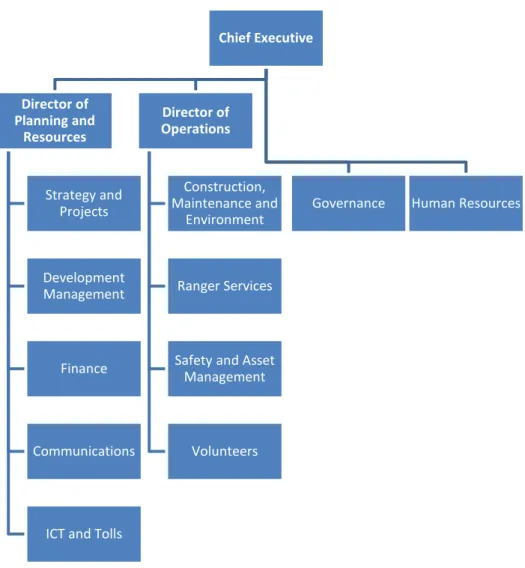
The delivery of the Authority’s work programme is dependent on its staff resources. Following an organisational restructure completed in 2013, the Authority operates a two-Directorate structure, with the Governance and Human Resources teams reporting directly to the Chief Executive. Plans for a further restructure from April 2015 will involve the creation of an in-house Legal function, but no fundamental changes to the Directorates. The Authority’s organisational structure for the 2014/15 financial year is set out below.
Figure 1: Organisational Structure 2014/15
The Authority’s long-term policy has been to seek to maintain total salary costs at less than 55% of net expenditure. The current Financial Strategy anticipates a reduction in the Authority’s overall staff establishment over the life of the Strategy, and makes a prudent allowance of 2% annually for salary inflation. The Authority has made budget provision for changes in National Insurance, which will result in additional staff related costs to the organisation in 2016/17. The net result of these changes is that the total staffing cost is forecast to be broadly stable over the three years of the Strategy but, due to reductions in other budgeted expenditure, total salary costs will remain at a level of around 62-63% of net expenditure during the period.
Chief Executive Director of Planning and Resources Strategy and Projects Development Management Finance Communications
ICT and Tolls
Director of Operations Construction, Maintenance and Environment Ranger Services
Safety and Asset Management
Volunteers
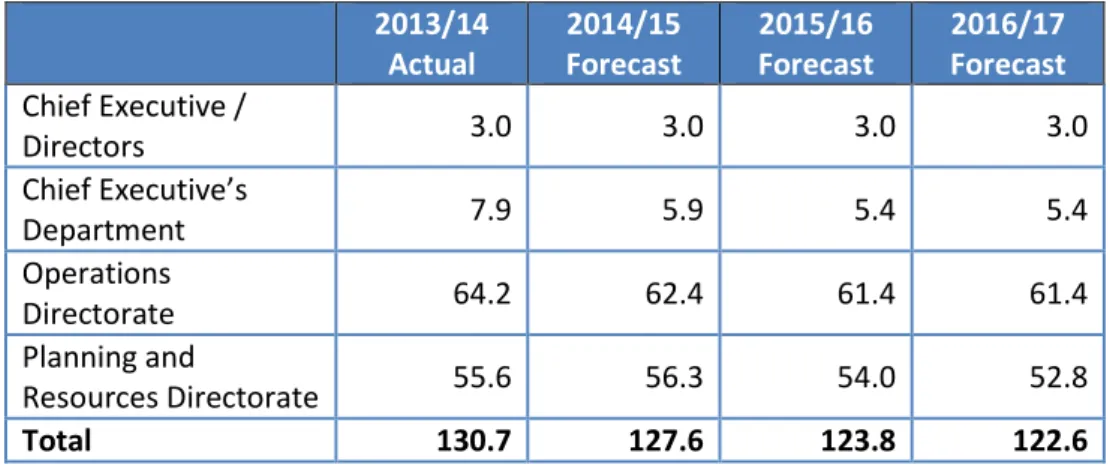
Page | 14 Details of the expected Staff Establishment (Full Time Equivalent) for the period 2013/14 to 2016/17 are set out in the table below.
Table 3: Full Time Equivalent Staff Numbers
2013/14 Actual 2014/15 Forecast 2015/16 Forecast 2016/17 Forecast Chief Executive / Directors 3.0 3.0 3.0 3.0 Chief Executive’s Department 7.9 5.9 5.4 5.4 Operations Directorate 64.2 62.4 61.4 61.4 Planning and Resources Directorate 55.6 56.3 54.0 52.8 Total 130.7 127.6 123.8 122.6
In setting the Financial Strategy for 2014/15–2016/17, the Authority noted that staff were its most important resource, and recognised the vital role they play in delivering both Strategic Priorities and key ongoing activities. Efforts have therefore been made both to minimise the impact of funding reductions on staff and to protect front line services as far as possible.
Page | 15
Part 3: Measuring our Performance
The Broads Authority collects and publishes data to indicate how well it is performing, both year-on-year and in comparison with other members of the English National Park Authorities. The dataset includes NPA family indicators (headed ‘PI’) and Broads-specific indicators (headed ‘BA’). A number of the NPA family indicators were amended by the NPA Joint Improvement Group, with effect from 2014/15.
Key
BA progress English NPA comparison
↑ Above expectation (> 3% above previous year) NPA Top Quartile
→ In line with expectation (within 3% of previous year) NPA Mid-Quartiles
↓ Below expectation (> 3% below previous year) NPA Bottom Quartile
Page | 16
Conservation of the Natural Environment
Performance indicators Performance 12-month progress
NPA family: BA relative performance 3-year target (to 2016/17) 2011/12 2012/13 2013/14
PI NE1a (AMENDED): % of SSSI land in ‘favourable’ condition and % in ‘unfavourable/recovering’ condition in BA management
95% (combined figure) 96% (combined figure) 94% (combined figure)
→
65% 35% PI NE1b (AMENDED): % of SSSI land in ‘favourable’ condition and % in‘unfavourable/recovering’ condition in the Broads as a whole
88% (combined figure) 87% (combined figure) 87% (combined figure)
→
65% 29% PI NE2 (NEW): % length of water courses with “high” or “good”ecological status - - -
-
- -Context for indicators 2011/12 2012/13 2013/14
PI Ctx 1a Area of SSSI land in the Broads 6247ha 7480ha 7480ha - - -
PI Ctx 1b Area of SSSI land in BA management 891ha 1058ha 267ha - - -
PI Ctx 1c (NEW): Total length (km) of water courses in the Broads - - - - -
Note: PI NE1b: The lake SSSIs, which form 40% of the SSSI area in the Norfolk part of the Broads area, are failing to achieve favourable or recovering status as a result of existing and historic pollution from large catchments covering intensively arable farmed and populated landscape. The Broads is at the lower end of the river catchment.
Page | 17
Conservation of Cultural Heritage
Performance indicators Performance Year-on-year progress NPA family: BA relative performance 3-year target (to 2016/17) 2011/12 2012/13 2013/14
PI CH1 PI CH2a (AMENDED): Number of listed buildings ‘at risk’
conserved during the year 7 6 5
→
12PI CH2 PI CH3a (AMENDED): Number of scheduled monuments
‘at high or medium risk’ conserved during the year 0 2 1
→
0BA B1 % of conservation areas with up-to-date character
appraisals 48% 68% 68%
→
- 88%BA B2 % of conservation areas with published management
proposals 40% 68% 68%
→
- 88%BA B3 Listed buildings ‘at risk’ as % of the total number of listed
buildings 14% 11% 14%
→
- 12%Context for indicators 2011/12 2012/13 2013/14
BA Ctx1 Number of conservation areas 25 25 25
→
- -PI Ctx 2a Number of listed buildings 271 272 271
-
-
-PI Ctx 2b Number of listed buildings ‘at risk’ 37 29 29
→
-
-PI Ctx3a Number of scheduled monuments 12 14 14
-
-
-PI Ctx 3b Number of scheduled monuments ‘at risk’ 4 1 1
→
-
-Page | 18
Recreation Management
Performance indicators Performance Year-on-year progress NPA family: BA relative performance 3-year target (to 2016/17) 2011/12 2012/13 2013/14 PI RM1% of total length of footpaths and other rights of way that were easy to use by the general public (even though they may not follow the exact definitive line)
87% 87% 72%
↓
85%BA C1 Length of path improved to allow for easier access for those
with disabilities, as a percentage of the total network 7% 7% 7%
→
- 10%Context for indicators 2011/12 2012/13 2013/14
BA Ctx 2 % of land within the Broads open for public access 4.9% 4.9% 4.9% - - -
PI Ctx4 Total length of footpaths and other rights of way 336km 336km 336km
-
- -Note: The Broads Authority's Rights of Way maintenance programme now focusses on permissive paths and promoted routes, with a total of 30km cut three times a year. Norfolk County Council is proactively managing the Norfolk Trails network, including its long distance footpaths; the remaining Rights of Way network is cut only on a reactive basis. The Rights of Way network in Suffolk is subject to programmed maintenance.
Page | 19
Estate Services / Volunteers
Performance indicators Performance Year-on-year progress NPA family: BA relative performance 3-year target (to 2016/17) 2011/12 2012/13 2013/14PI RM3a Total number of volunteer days organised or supported by the
Broads Authority 2637 2500 1931
↓
- 3000PI RM3b (NEW) Value of volunteer days organised or supported by the
Broads Authority - - - - -
To be determined
PI RM3c Number of those days attended by ‘under represented’ groups (and % of total number of days)
95 (3.6%) 120 (4.8%) 69 (3.6%)
→
- 200 (6.6%) Note: The Broads Authority’s volunteer operational and administrative procedures have been comprehensively reviewed and updated, producing more accurate database and time recording systems for 2013/14 onwards.Promoting Understanding
Performance indicators Performance Year-on-year progress NPA family: BA relative performance 3-year target (to 2016/17) 2011/12 2012/13 2013/14BA C4 Number of passengers on BA sustainable boat trips 5192 5598 7028
↑
- 8000BA C5 Number of visits to BA website 220,577 227,564 233,648
↑
- 240,000Context for indicators 2011/12 2012/13 2013/14
PI Ctx5 Number of users of ‘promoting understanding’ services 515,385 543,586 530,824
-
- - Note: The NPA family indicators for Promoting Understanding have been deleted. Instead, from 2014/15 each NPA will submit a brief ‘case study’ snapshot of what has been achieved over the previous year, identifying strategic purposes, key activities and outputs.Page | 20
Navigation
Performance indicators Performance Year-on-year progress NPA family: BA relative performance 3-year target (to 2016/17) 2011/12 2012/13 2013/14BA D1 % compliance with the specified river patrolling service level 100% 100% 100%
→
- 100%BA D2 Number of weeks dredging effort 57 57 58
→
- 57BA D3 % of total navigation budget applied to dredging and river works 38.4% 43.5% 43.1%
→
- 42% BA D4 Length of frontage provided for public short term/ overnightmooring owned or operated by BA 7824.6m 7847.6m 7814.5m
→
- -Note: The length of frontage provided for public short stay moorings is expected to reduce, due to leases not being renewed where the Broads Authority is likely to have to take on responsibility for re-piling sites and structural liability for the piling. Work to assess current mooring provision and identify priority sites for retention, disposal or acquisition is planned for mid-2014, to support the development of an updated mooring asset strategy.
Page | 21
Development Management
Performance indicators Performance Year-on-year progress NPA family: BA relative performance 3-year target (to 2016/17) 2011/12 2012/13 2013/14PI DC0 (NEW): % of all planning applications approved
-
- - - -PI DC1a % of major planning applications determined within 13 weeks 91% 66% 42%
↓
60%PI DC1b % of minor planning applications determined within 8 weeks 83% 73% 74%
→
65%PI DC1c % of other planning applications determined within 8 weeks 90% 80% 83%
→
80%PI DC2 % of planning applicants satisfied with the quality of service
received 100%
Not
collected 80%
↓
85%BA E1 % of new homes built on previously developed land 55% 96.5% 75%
↓
- 80%BA E2 % of appeals allowed against the Authority’s decision to refuse
planning permission 6% 26% 18%
↓
- 20%Context for indicators 2011/12 2012/13 2013/14
PI Ctx6 Number of planning applications received 433 364 183
-
- -Note: PI DC1a: Nine major planning applications received, of which five where delayed due to S106 Agreement negotiations, committee cycle timescales and committee deferred decisions. The remaining four applications were determined within the specified time.
Page | 22
Support Services
Performance indicators Performance
Year-on-year progress NPA family: BA relative performance 3-year target (to 2016/17) 2011/12 2012/13 2013/14
PI CD3 CO2 reduction from BA operations +13.2% -22.7% +19.6%
↓
10%BA F1
The level (if any) of the Equality Standard for Local Government to which the Authority conforms in respect of gender, race and disability
Level 1 collected Data not collected Data not - - Developing
BA F2 Member participation in attending committees 83% 78% 81%
→
-Notes:
PI CD3: This indicator will now be reported every three years. The increase in CO2 emissions in 2013/14 is due primarily to an increased level of electricity at the Authority’s headquarters at Yare House, to which it moved in December 2012.
BA F1: Equality Standard levels are now ranked as Developing, Achieving and Excellent. The Broads Authority has not yet carried out the self-assessment process.
01603 610734