MANAGING
WOUNDS
AS A TEAM
Exploring the
concept of a
team approach
to wound care
© EWMA 2014 All rights reserved. No reproduction, transmission or copying of this publication is allowed without written permission. No part of this publication may be reproduced, stored in a retrieval system, or transmitted in any form or by any means, mechanical, electronic, photocopying, recording, or otherwise, without the prior written permission of the European Wound Management Association (EWMA) or in accordance with the relevant copyright legislation. Although the editor, MA Healthcare Ltd. and EWMA have taken great care to ensure accuracy, neither MA Healthcare Ltd. nor EWMA will be liable for any errors of omission or inaccuracies in this publication. Published on behalf of EWMA by MA Healthcare Ltd. Publisher: Anthony Kerr Editor: Karina Huynh Designer: Milly McCulloch Published by: MA Healthcare Ltd, St Jude’s Church, Dulwich Road, London, SE24 0PB, UK Tel: +44 (0)20 7738 5454 Email: [email protected] Web: www.markallengroup.com
Zena Moore,1 (Editor) PhD, MSc, FFNMRCSI, PG Dip, Dip Management, RGN, Professor, Head of School, Chair of the
document Author Group; Former President, European Wound Management Association,
Gillian Butcher,2 B App Sc (Pod), Adv Dip Bus Mgmt, Senior Podiatry Manager; Australian Wound Management Association,
Lisa Q. Corbett,3 MSN, APRN, DNPc, CWOCN, Nurse Practitioner Wound Care; Association for the Advancement of
Wound Care,
William McGuiness,4 PhD, MSN, Associate Professor; Australian Wound Management Association,
Robert J. Snyder,5 DPM, MSc, CWS Professor and Director of Clinical Research; President, Association for the Advancement
of Wound Care,
Kristien van Acker,6 Md , PhD Diabetologist; European Wound Management Association, Chair International Working
Group on the Diabetic Foot, Chair Consultative Section Diabetic Foot of the International Diabetes Federation (IDF) 1 School of Nursing & Midwifery, Royal College of Surgeons in Ireland, 123 St Stephens Green, Dublin 2, Ireland; 2 Monash Health, 246 Clayton Rd, Clayton VIC 3168, Australia; 3 Hartford HealthCare, Hartford CT and Yale University School of Nursing, New Haven, CT, USA; 4 La Trobe University, Alfred Health Clinical School, Level 4, The Alfred Centre, 99 Commercial Road, Prahran VIC 3181, Australia; 5 Barry University, 11300 NE 2nd Avenue, Miami Shores, FL 33161, USA; 6 Hospital H Familie, Rumst and Centre de Santé des Fagnes- Chimay, Belgium. Editorial support and coordination: EWMA Secretariat Corresponding author: Editor, Professor Zena Moore [email protected] The document is supported by an unrestricted grant from BSN Medical, Flen Pharma, KCI, Lohmann & Rauscher and Nutricia. This article has not undergone double-blind peer review;
This article should be referenced as: Moore, Z., Butcher, G., Corbett, L. Q., et al. AAWC, AWMA, EWMA Position Paper: Managing Wounds as a Team. J Wound Care 2014; 23 (5 Suppl.): S1–S38.
Contents
Abstract
4
Introduction
5
Project aim
5
Project objectives
5
Overview of the document
6
The problem of wounds
7
Teamwork – a historical overview
7
Definition of commonly used terms
8
The definitions as they apply to wound care
9
Clinical evidence for managing wounds as a team
11
Introduction
11
Literature search outcomes
11
A team approach in wound care – methods of included studies
11
A team approach in wound care – study populations
13
A team approach in wound care – care settings
13
A team approach in wound care – team interventions
14
A team approach in wound care – primary outcomes measures
16
A team approach in wound care-– secondary outcomes
16
A team approach in wound care – methodological issues within studies
17
Summary
17
Barriers & facilitators
19
The ‘will’ of participating clinicians
19
The pragmatics of service delivery
22
Determining client need
22
Team location
22
Team communication
23
Accessing the medical record
24
Clinician remuneration
24
Reported changes to the cost-benefit ratios
25
Conclusions
25
Universal model for the team approach to wound care
26
Summary
31
Summary and conclusion
32
Abstract
Background
The growing prevalence and incidence of non-healing acute and chronic wounds is a worrying concern. A major challenge is the lack of united services aimed at addressing the complex needs of individuals with wounds. However, the WHO argues that interprofessional collaboration in education and practice is key to providing the best patient care, enhancing clinical and health-related outcomes and strengthening the health system. It is based on this background that the team approach to wound care project was conceptualised. The project was jointly initiated and realised by the Association for the Advancement of Wound Care (AAWC-USA), the Australian Wound Management Association (AWMA) and the European Wound Management Association (EWMA).Aim
The aim of this project was to develop a universal model for the adoption of a team approach to wound care.Objective
The overarching objective of this project was to provide recommendations for implementing a team approach to wound care within all clinical settings and through this to develop a model for advocating the team approach toward decision makers in national government levels.Method
An integrative literature review was conducted. Using this knowledge, the authors arrived at a consensus on the most appropriate model to adopt and realise a team approach to wound care.Results
Eighty four articles met the inclusion criteria. Following data extraction, it was evident that none of the articles provided a definition for the terms multidisciplinary, interdisciplinary or transdisciplinary in the context of wound care. Given this lack of clarity within the wound care literature, the authors have here developed a Universal Model for the Team Approach to Wound Care to fill this gap in our current understanding.Conclusion
We advocate that the patient should be at the heart of all decision-making, as working with the Universal Model for the Team Approach to Wound Care begins with the needs of the patient. To facilitate this, we suggest use of a wound navigator who acts as an advocate for the patient. Overall, we feel that the guidance provided within this document serves to illuminate the importance of a team approach to wound care, in addition to providing a clear model on how to achieve such an approach to care. We look forward to gathering evidence of the impact of this model of care on clinical and financial outcomes and will continue to share updates over time.Introduction
C
hanging population demographics resulting in an increased prevalence and incidence of multisystem chronic diseases means that health care services are continuously challenged to provide increasingly complex interventions with limited resources, coupled with a decreasing availability of suitably qualified health professionals.1 Patient safety is at the centre of all health-care interventions, meaning that health care providers have to demonstrate an evidence-based, cost-effective and efficient rationale for the choice of specific care pathways for individual patient groups.2 The WHO argues that professionals who actively bring the skills of different individuals together, with the aim of clearly addressing the health-care needs of patients and the community, will strengthen the health system and lead to enhanced clinical and health-related outcomes.3 Indeed, a number of systematic reviews have noted a positive impact in the use of multidisciplinary interventions for chronic diseases such as heart failure and mental illness, and in individuals at risk of poor nutrition.4-6 These positive outcomes relate to reduction in hospital admissions, mortality and incidence of heart failure as well as fewer suicide-related deaths, less dissatisfaction with care, fewer drop-outs and an overall reduction in the length of hospital stay. It is based on this background that the team approach to wound care project was conceptualised. The project was jointly initiated and realised by the Association for the Advancement of Wound Care (AAWC-USA), the Australian Wound Management Association (AWMA) and the European Wound Management Association (EWMA).Project Aim
The aim of this project was to provide a universal model for the adoption of a team approach to wound care.Project objectives
The project objectives were to: • Conduct a systematic review of the literature to identify the advantages and disadvantages of adopting a team approach to wound care; • Identify the definition of a team approach to wound care; • Identify the barriers and facilitators to adopting a team approach to wound care; • Provide recommendations for implementing a team approach to wound care within the clinical setting; • Provide a tool for advocating a team approach to wound care towards decision-makers at national government levels; • Create a basis for collaboration between organisations and institutions working with clinical conditions that benefit from the team approach to wound care;• Contribute to current initiatives aiming to strengthen integrated care processes such as the European Innovation Partnership on Active and Healthy Aging.
Overview of the Document
This document is divided into four sections; the first section provides an overview of the interdisciplinary team approach. In doing so, this section begins by addressing the problem of wounds, followed by a historical overview of teamwork. A definition of commonly used terms is then provided with a discussion of how these definitions apply to wound care. Section two explores the clinical evidence for managing wounds as a team. In this section, the methods of the included studies in this document are outlined. This is followed by a discussion of the study populations, care settings, team interventions, primary and secondary outcomes and methodological challenges within the included studies. Section three addresses the barriers and facilitators to achieving a team approach to wound care. The focus of this section is on the will of participating clinicians and the pragmatics of service delivery. The fourth section proposes a universal model for a team approach to wound care and in doing so, elaborates on the key considerations in striving for such a model of care. Finally a summary and conclusion is provided, bringing the salient points of the document together.
The problem
of wounds
F
rom a wound care perspective, the growing prevalence and incidence of non-healing acute and chronic wounds is a worrying concern. Indeed, the incidence of wounds in the EU-27 is approximately 4 million and a further 2 million patients acquire nosocomial (hospital-acquired) infections each year.7 Additionally, is it estimated that more than 23% of all hospital in-patients have a pressure ulcer and most pressure ulcers occur during hospitalisation for an acute episode of illness/injury.8 The cost of just one problematic wound is between €6650–€10000 per patient, and the total cost of wound care accounts for 2–4 % of European health care budgets.9 Furthermore, 27–50% of acute hospital beds are likely to be occupied on any day by patients with a wound.9 One of the biggest challenges in wound care is the lack of united services aimed at addressing all the health care needs of individuals with wounds.10 Indeed, more than a decade ago, Lindholm et al.11 warned that lack of integrated wound care services compounds the suffering of those with wounds, which in turn substantially increases associated costs arising due to poorer outcomes than could be expected with use of targeted wound care interventions. Conversely, focussed patient screening, followed by implementation of appropriate care pathways, with close follow up and monitoring by relevant members of the wound care team can substantially improve clinical outcomes and reduce unnecessary morbidity and mortality.12, 13 However, despite this evidence, reports on the use of focussed interdisciplinary wound care teams is scarce within the literature, with disparity existing as to what the term ‘interdisciplinary’ means, and who exactly is eligible to be a member of this interdisciplinary wound care team.14Teamwork – A historical
overview
An interesting paper by Hasler15 provides a historical overview of the development and integration of the concept of health care teams within primary care services in the UK. Hasler argues that development of teamwork arose for many reasons beyond the actual desire of individuals to start working together. For example, legislation surrounding the enhancement of the scope of practice of different team members enhanced the potential for other team members to engage more actively in a team approach to care delivery. Furthermore, reimbursement systems provided specific funding for employing other members of the team. Changes were also made in the contractual systems which made enhanced competiveness a central component of ongoing funding and patient willingness to engage with services offering such a team approach.In the US, the Institute of Medicine16 has identified an urgent need for high-functioning teams to address the increasing complexity of information and interpersonal connections required in contemporary healthcare. The transition of practitioners’ from soloists to members of an orchestra has gained national momentum through healthcare reform with substantial interprofessional policy and practice development in recent years.17 Best practice collaborations have identified the basic principles and values for team based care, and support for inter-professional learning strategies is increasing16, 17. From a wider legislative perspective, a greater focus on patient safety, combined with reduced resources available for health-care services has demanded a re-evaluation of the approaches to care delivery.18 One of the most important drivers for this change is the increasing emphasis being placed on the adoption of person-centred approaches to care delivery.19 At its essence, the adoption of a team approach is argued as being fundamental to achieving these goals.18 However, one of the major challenges in moving from promoted to lived adoption of team work lies in the use of confusing, often interchangeable terminology that is poorly understood, and even more poorly implemented in practice.20 The terms multidisciplinary, interdisciplinary, crossdisciplinary and transdisciplinary are common terms found in the literature used to describe working in a team, yet each term suggest different approaches and thus cannot and should not be used interchangeably.18
Definition of commonly
used terms
Multidisciplinary
“A multidisciplinary team is a group of health care workers who are members of different disciplines (professions e.g. psychiatrists, social workers), each providing specific services to the patient. The team members independently treat various issues a patient may have, focusing on the issues in which they specialise”.21Interdisciplinary
“An interdisciplinary clinical team is a consistent grouping of people from relevant clinical disciplines, ideally inclusive of the patient, whose interactions are guided by specific team functions and processes to achieve team-defined favourable patient outcomes”.22Transdisciplinary
“Transdisciplinary is the most advanced level, and includes scientists, non-scientists, and other stakeholders who go beyond or transcend the disciplinary boundaries through role release and expansion”.18 The concept of multidisciplinarity therefore suggests the use of different disciplines to answer a particular clinical problem, but rather than coming together, each discipline stays within their own boundaries.20 Conversely, the concept of interdisciplinarity suggests that there is a link between the disciplines where each moves from their own position into one collective group. This group is then engaged in creating and applying new knowledge which exists outside of the disciplines involved.20 The fundamental difference between the concept of transdisciplinary care and interdisciplinary care is the actual bringing of new knowledge into the group through a transdisciplinary approach, and as such, this is seen as the union of all interdisciplinary efforts.20 Fundamentally, the central issue is that the group of relevant disciplines is such that the needs of the patient group can be addressed appropriately. Additionally, the group needs to truly work as a team to ensure that all the available skills and expertise can be targeted in an appropriate fashion. Importantly, the focus should be onthe patients’ needs and expectations. It is here therefore, that the significance of the word “team” becomes evident. A team is defined as “A number of people with complementary skills who are committed to a common purpose, performance goals, and approach for which they are mutually accountable”.23 Whereas, a team-based health care is defined as: “Team based health-care is the provision of health services to individuals, families and or their communities by at least two health providers who work collaboratively with patients and their caregivers – to the extent preferred by each patient – to accomplish shared goals within and across settings to achieve coordinated, high quality care”16 Therefore, the reason why the term “team” is important is because it is within this concept that the members are focussed on working in such a way to achieve a mutually agreed goal. Furthermore, the work of the team is interdependent and team members share responsibility and are accountable for attaining the desired results.1
The definitions as they apply to
wound care
A systematic search of the literature was conducted as follows: • Database(s): Medline, PUBMED, CINAHL • Language: English • Search words: (((((((“Leg Ulcer”[Mesh]) OR “Pressure Ulcer”[Mesh])) OR ((“pressure ulcer*” OR “pressure sore*” OR “bed sore*” OR “bed ulcer*” OR “decubitus” OR “pressure area*”)))) OR (“leg ulcer*” OR “diabetic foot”))) AND (((((((((“multidisciplinary”[All Fields]) OR “interdisciplinary”[All Fields]) OR collaborat*) OR interprofessional) OR “patient care team*”) OR “care pathway*”) OR “care bundle*”)) OR “Patient Care Team”[Mesh]) Eighty four articles met the inclusion criteria (original research) and were data extracted using the following headings: • Author • Title • Journal • Year • Country • Wound Type • Definition of the Multidisciplinary Treatment Team (MDT) • MDT Composition • Other Following data extraction, it was evident that none of the articles provided a definition for what was meant by multidisciplinary, interdisciplinary or transdisciplinary in the context of wound care. The focus of the articles tended to be on who exactly comprised the members of the team, rather than the model upon which the composition of the team was based. Thus, there is a significant lack of clarity within the wound care literature, meaning that individual interpretation of the concepts is highly likely and as such largely unhelpful in guiding practice in the area.Owing to this lack of clarity, the authors of this document propose the following terminology: “Managing Wounds as a Team”. The rationale for the choice of this terminology lies in the thought that there is evidence within the literature of an understanding of the meaning of the concept of “team”. Furthermore, all members of the team are equally important, and this includes the patient, as in the absence of this understanding, the team will not function effectively. In addition, from a health and social gain perspective, patients report higher levels of satisfaction, better acceptance of care and improved health outcomes following treatment by a collaborative team.24
Clinical evidence
for managing
wounds as a team
Introduction
Since the original 1990 Saint Vincent Declaration mission to reduce the amputation rate in patients with diabetes by 50%, diabetes care delivery by organised teams have been promoted as best practice, with many international guidelines on the care of diabetes and diabetic foot care following suit. From a pressure ulcer perspective, recent quality initiatives suggest that the prevention and treatment of pressure ulcers should also be undertaken using a team approach. 11 In addition, team interventions for leg ulcer care have been advocated by clinical practice guidelines. 11 An analysis of the recent literature on team intervention depicted the current state of wound care practice and suggests a vision for future wound team development. The following section elaborates on the outcomes of the literature search, providing a synthesis of the published literature obtained.Literature search outcomes
We conducted a literature search as described in the introduction. The search produced 84 articles, with additional sources identified in index searches. Two reviewers screened the identified titles, abstracts and then full text of all potentially relevant reports to reach consensus on 76 included publications. Publication years spanned 1995–2013, with a notable increase in the frequency of articles relating to managing wounds as a team (MWT) in the past six years. Journals which published MWT articles included nearly every wound-related specialty and represented multiple professional sectors. Primary authorship ranged across specialties with the highest first author group noted as physicians for diabetic foot ulcers and nurses for pressure ulcers. The studies originated from 23 different countries representing nearly every continent. The literature included diabetic foot ulcer care (n=31), pressure ulcer care (n=24), chronic wound care (n=11) and leg ulcer care (n=10). In the following part of this chapter, the literature search outcomes will be described in more detail.
A Team Approach in Wound Care –
Methods of Included Studies
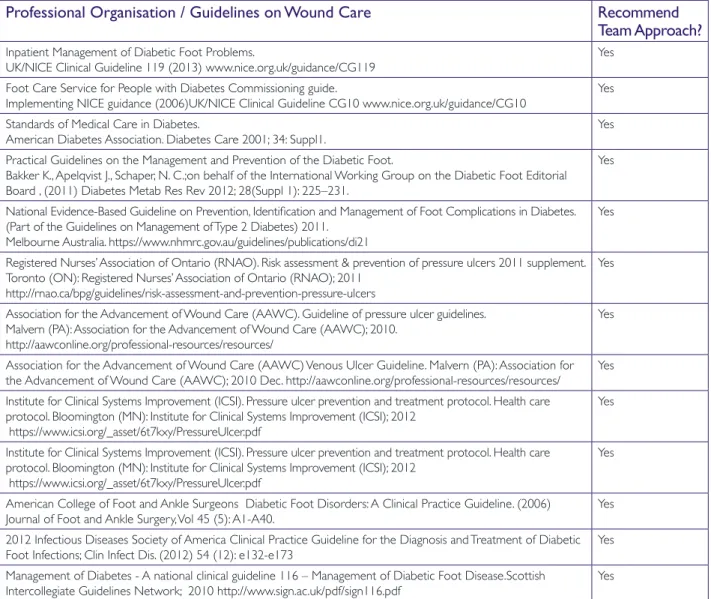
Studies pertaining to diabetic foot ulcers (DFU) represented most of studies (n=31). Of these, the majority explored outcomes in relation to the implementation of a team approach to DFU care guided by professional standards or guidelines.25–44 Study methodology varied considerably and included case control studies, prospective and
retrospective cohort studies, case series, retrospective longitudinal observation, and descriptive approaches. Since the team approach has long been established as the standard, withholding team intervention would not be feasible, and therefore no randomised controlled studies were found. Several cohort studies measured outcomes before and after implementing or reorganising some form of team approach to care. Study periods ranged from 1–11 years. Pressure ulcers (n=24) were the next most common wound type in the literature search. The majority of studies were descriptive and observational with the exception of one randomised intervention trial. Chronic wounds studies (n=11) as an entity
Professional Organisation / Guidelines on Wound Care
Recommend
Team Approach?
Inpatient Management of Diabetic Foot Problems.
UK/NICE Clinical Guideline 119 (2013) www.nice.org.uk/guidance/CG119
Yes
Foot Care Service for People with Diabetes Commissioning guide.
Implementing NICE guidance (2006)UK/NICE Clinical Guideline CG10 www.nice.org.uk/guidance/CG10
Yes
Standards of Medical Care in Diabetes.
American Diabetes Association. Diabetes Care 2001; 34: Suppl1.
Yes
Practical Guidelines on the Management and Prevention of the Diabetic Foot.
Bakker K., Apelqvist J., Schaper, N. C.;on behalf of the International Working Group on the Diabetic Foot Editorial Board , (2011) Diabetes Metab Res Rev 2012; 28(Suppl 1): 225–231.
Yes
National Evidence-Based Guideline on Prevention, Identification and Management of Foot Complications in Diabetes. (Part of the Guidelines on Management of Type 2 Diabetes) 2011.
Melbourne Australia. https://www.nhmrc.gov.au/guidelines/publications/di21
Yes
Registered Nurses’ Association of Ontario (RNAO). Risk assessment & prevention of pressure ulcers 2011 supplement. Toronto (ON): Registered Nurses’ Association of Ontario (RNAO); 2011
http://rnao.ca/bpg/guidelines/risk-assessment-and-prevention-pressure-ulcers
Yes
Association for the Advancement of Wound Care (AAWC). Guideline of pressure ulcer guidelines. Malvern (PA): Association for the Advancement of Wound Care (AAWC); 2010.
http://aawconline.org/professional-resources/resources/
Yes
Association for the Advancement of Wound Care (AAWC) Venous Ulcer Guideline. Malvern (PA): Association for the Advancement of Wound Care (AAWC); 2010 Dec. http://aawconline.org/professional-resources/resources/
Yes
Institute for Clinical Systems Improvement (ICSI). Pressure ulcer prevention and treatment protocol. Health care protocol. Bloomington (MN): Institute for Clinical Systems Improvement (ICSI); 2012
https://www.icsi.org/_asset/6t7kxy/PressureUlcer.pdf
Yes
Institute for Clinical Systems Improvement (ICSI). Pressure ulcer prevention and treatment protocol. Health care protocol. Bloomington (MN): Institute for Clinical Systems Improvement (ICSI); 2012
https://www.icsi.org/_asset/6t7kxy/PressureUlcer.pdf
Yes
American College of Foot and Ankle Surgeons Diabetic Foot Disorders: A Clinical Practice Guideline. (2006)
Journal of Foot and Ankle Surgery, Vol 45 (5): A1-A40. Yes
2012 Infectious Diseases Society of America Clinical Practice Guideline for the Diagnosis and Treatment of Diabetic
Foot Infections; Clin Infect Dis. (2012) 54 (12): e132-e173 Yes
Management of Diabetes - A national clinical guideline 116 – Management of Diabetic Foot Disease.Scottish
Intercollegiate Guidelines Network; 2010 http://www.sign.ac.uk/pdf/sign116.pdf Yes
have been clustered together by some study authors. The methodology in these studies varied from descriptive program reports, review articles, a retrospective review, a systematic review and a pseudo-randomised cluster trial. Articles pertaining to the management of those with leg ulcers were also included (n=10). The study methodology varied from a randomised controlled trial, a controlled clinical trial, a randomized controlled pilot study, prospective risk analysis study, retrospective reviews, case series and descriptive reports.
A Team Approach in Wound Care –
Study Populations
Together, the studies related to DFU27, 33, 34, 36, 44, 45 described over 3000 subjects and all reported positive clinical outcomes after wound care team interventions. Similarity was noted in gender distribution (mean 62% male), age (mean=66), duration of diabetes (mean years = 15), HbA1C levels (mean 8.3) and percentage with a neuropathic involvement (88%). Otherwise, there was considerable heterogeneity in comorbidities, ulcer location, ulcer depth and infection of subjects. Comparable variability has been seen in other multi-center reports46, which underscores the inherent heterogeneity of the disease. Because most reports of pressure ulcer team interventions were related to institutional program changes rather than individual patient effects, descriptions of the patient characteristics are vague. Pooled patient characteristics from the skilled nursing or rehabilitation settings revealed a mean age of 79, majority female, greater than 85% with mobility restrictions, greater than 70% incontinent of urine and greater than 50% with feeding dependence.47-50 This reflects a representative population similar to the institutionalised elderly.51 Study participant characteristics in acute care were sparse. The pooled study population for chronic wounds includes over 6000 patients, with widely variable characteristics. The mean age in the skilled nursing setting study was 83 years,52 while the mean age for ambulatory settings was 50 years.53, 54 All reports treated multiple wound types, with pressure ulcers being the primary type in the skilled nursing study52 whereas diabetic –related ulcers were the dominant wound type treated in community55 and integrated programs.56 Venous ulcers were most prevalent in other ambulatory samples.53, 54 Gender distribution was equitable in ambulatory settings53, 57 and the majority of patients were female in the skilled nursing setting.14 With many missing demographic variables in these reports, it is difficult to summarise, but from available data, the heterogeneity of chronic wound populations is evident. Pooling of the studies on leg ulcer patients together led to the inclusion of over 1500 patients. Although there were missing demographic data, the estimated mean age was 65, with approximately 50% of the participants being female.58 Mean ulcer duration, pooled from 4 studies prior to intervention was approximately 40 weeks, indicating a sample with longer duration ulcers.59-62A Team Approach in Wound Care –
Care Settings
The team approach to diabetic foot ulcer care has been studied in many clinical settings across the care continuum. Much of the evidence comes from integrated programs that manage patients from primary prevention through to acute hospital episodes and subsequent recovery.30–34 Of these, most centres were based in university or medical centre hospitals where grouping of professionals from multiple specialties is more easily accomplished. Other authors described the team approach as a consultation service in an acute hospital setting25, 29 and in ambulatory diabetic foot ulcer clinics, and others described the standardisation of a team approach to foot care across a network of ambulatory care clinics, which included urban, suburban and rural settings.27, 36, 63, 64The benefit of a team approach to diabetic foot ulcer care has also been demonstrated irrespective of the setting. In a claim-based analysis of Medicare recipients in the U.S., Sloan et al.65 studied 189,598 individuals with diabetes-related lower extremity conditions for over 6 years. The authors found that patients who visited a podiatrist, in combination with one other lower extremity specialist, were less likely to undergo an amputation than those who did not have multiple care providers. Underlying these results is the assumption that receiving care from multiple specialists results in more coordinated care. Financial outcome is also promoted as a benefit to team intervention in the care of chronic wounds. Cost reduction has been achieved through saving clinician time,52 consolidation of services56, 57, 66 and
downstream revenue production.67 The majority of pressure ulcer studies took place in acute care hospitals (n=15) or skilled nursing rehabilitation centers (n=7), other settings were paediatric (n=1) and a spinal cord outpatient clinic (n=1). For venous leg ulcers all of the included studies were conducted in an outpatient setting, either in a wound centre or in the home care setting. Several investigators explored the site of care delivery as a variable in leg ulcer healing. For example, Edwards et al.,61 in a randomised controlled pilot study, found significantly increased healing rates in an intervention group treated within a team approach to ulcer care, including group community support, when compared with ulcer care delivered by a team in the home setting. Harrison et al.60 established a team of specialised nurses with equipment and referral linkages and examined leg ulcer healing rates in the home setting, before and after the new team deployment, and found statistically significant differences in leg ulcer healing rates in the post intervention cohort. In a subsequent trial Harrison et al.68 found that specialised nurse team outcomes were similar in patients randomised to the home care setting or clinic based care. The investigators therefore, concluded that it was the organisation of care, delivered by evidence based trained teams that influenced healing rates, rather than the setting of care itself. Chronic wound care teams have been assembled in settings across the continuum of care delivery. In this review, five programs were described in the outpatient setting.53–55, 66, 67 Other settings were the acute care hospital,56, 69 a continuum between hospital, rehabilitation and home, and a nursing home setting.57
A Team Approach in Wound Care –
Team Interventions
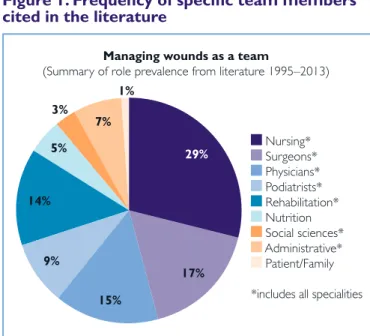
A summary of the frequency of specific team members cited in the evidence within this
document is seen in Table 2. From the diabetic foot
Figure 1. Frequency of specific team members
cited in the literature
Nursing* Surgeons* Physicians* Podiatrists* Rehabilitation* Nutrition Social sciences* Administrative* Patient/Family *includes all specialities 29% 17% 15% 9% 14% 5% 3% 7% 1%
Managing wounds as a team
ulcer perspective, team membership varied from 2 to 10 members and often included additional collaborators such as “primary care team”, “home care nursing service” “research team” and “administrators”. The types of team intervention varied across the spectrum, i.e. the joint surgical approach, service model approach, integrated disease management and various lean approaches. Armstrong et al.28 conceptualised the team as a podiatric and vascular surgery, “toe and flow” Dyad, with this collaborative model being supported by some researchers.43 Conversely, others employed a wider team support network, such as case management, diabetes education, endocrinology, hospitalists, infectious disease, nursing, prosthetics and social work.30 Importantly, it was stressed that this collaboration should follow the DFU patient through their complete episode of ulceration and across all care settings, in order to ensure maximum outcomes.32, 35 Another approach is termed a “service model”31 where intervention components arise from broad standards and a clear patient focus. Combined with performance measures, clinical research and education, the model claims an association between interventions and decreased lower extremity amputations. This approach is supported by others who employed flow sheets, standing orders and algorithms to guide care.63 A further approach using a minimal, intermediate and maximal model of diabetic foot care have been described by the International Working Group for the Diabetic Foot.70, 71 This model centres around the specific needs of the diabetic patient, beginning with the provision of preventative care and minor wound care in the minimal domain, moving to more advanced assessment, diagnosis, prevention and treatment in the intermediate domain, with the maximal domain concentrating on advanced prevention and management strategies for complex cases, including the use of innovative technologies and the provision of education and training for other centres. Within the pressure ulcer literature, the majority of studies described team facilitation of a new pressure ulcer prevention program.47, 72-80 All the programs were multifaceted, often “bundle focused”, and used quality improvement methodology without a control group. Team functions included risk assessment, conducting surveys, product evaluation, education, documentation, providing wound care treatments and planning continuity of care. Multiple interventions were undertaken, but little attempt was made to ascertain what elements, or group of elements, contributed most to the outcome. Therefore, other concurrent factors may have influenced pressure ulcer reduction, for example, changes in clinical practice, electronic medical records, and new technology or specialtybeds. For chronic wounds, in general, the team approach focussed on centralisation and standardisation of expertise and services.98 Team interventions were described as clinical (assessment, diagnosis, provision of care), preventive, scientific and educational.14, 53-56, 66, 67, 69 Preventive services involved primary care telemedicine screening56, compliance monitoring55 and quality improvement monitoring.69 Consistent clinical data collection provided outcome management and scientific research opportunities to assess evaluation of interventions and team impact53-56, 67. Knowledge, skills and clinical expertise of the team was fostered through education, provided both internally and externally to the organisation.56, 69, 81 The size and arrangement of teams related to leg ulcer care tend to be leaner than other teams. In the studies reviewed it was common for care to be planned and delivered by specialty nurse teams with expanded skills and referral linkages both within
the community and home care settings.61, 82, 83 Other studies59, 60, 68, 82, 84 demonstrated that partnerships among different specialities such as nursing, podiatry, dermatology or gerontology, yielded favourable healing rates, when compared with care delivered by a single team speciality.
A Team Approach in Wound Care –
Primary Outcomes Measures
For studies related to the diabetic foot, the primary outcome measure was the rate of lower extremity amputation. The included studies all identified a reduction in amputation rates; for example, in one study,37 total amputation rate per 10,000 people with diabetes fell by 70% (from 53.2% to 16.0%) and major amputations fell by 82% (from 36.4% to 6.7%). A further study26 found a progressive decrease in the total incidence of amputations per 100,000 general populations from 10.7 in 1999 to 6.24 in 2003. In yet another study,27 the high/low amputation ratio decreased from 0.35 to 0.27 due to an increase in low level (midfoot) amputations (8.2% vs 26.1%, p<0.0001; OR=4.0, 95% CI 2.0–83.3). A 45.7% reduction in below-knee amputations was also observed. Weck et al.85 studied the outcome of a structured system of diabetic foot care encompassing outpatient, inpatient and rehabilitative treatments. Participants were followed prospectively over 8 years and compared to control subjects treated without interdisciplinary care in another region of Germany. The structured integrated team care resulted in a 75% reduction of major amputations compared to standard care. Finally Yesil et al.44 reduced major amputations from 20.4% to 12.6% (p=0.026) with the use of a team approach. A number of published studies describe the organisation of pressure ulcer teams with the primary outcome assessed by pressure ulcer rates measured before and after team initiation. These rates tended to be measured by point prevalence surveys, undertaken either annually or quarterly.47, 72-76, 86-88 A reduction in pressure ulcer prevalence after team intervention was reported in all of the studies, with a wide range of variation in starting prevalence (4.85-41%) and in post prevalence (0-22%) and no reported statistical significance levels. A group of reports from chronic wounds report healing rates as a primary outcome. For example, Brown-Maher53 described an overall 34% wound healing rate for 398 patients over 2 years. Similarly, Sholar et al.54 reported an overall 38% wound healing rate over 7 years. Other reports claim healing rates by aetiology such as 60% over 12 months for recalcitrant leg ulcers56 and an 8-week average healing time for venous ulcers.55 Leg ulcer outcomes were primarily measured by healing rates.59, 60, 68, 82, 84, 89 For example, Akesson59 found a pre healing rate of 23%, compared with an 82% healing after a team approach. A further study84 found that 72% of patients healed with an average time of 12.1 weeks following a team approach.
A Team Approach in Wound Care -–
Secondary Outcomes
Additional outcome measures have been studied to determine the benefits of team intervention on DFU care within specific foot clinics.33-36 DFU healing rates of 50%90, 55%, 65.7%36 70%90, 76.19%35 and 90%34 were reported after follow up periodsof 10 weeks90 and 6, 1236 and 2935 months across
a number of studies. Reference healing rates in DFU have been shown to be 48%–58% healed at 20 weeks91, as evidenced from a trial of 74 wound centres. By comparison, the largest two studies that followed healing rates until healing or death,33, 34 reported healing rates of 74% and 90%, over a mean of 27 and 18 weeks, respectively. For the diabetic foot, two studies explored the outcome of self-care behaviour performance after an outpatient team approach to patient education. Anselmo et al.92 found that 90% of patients
performed all suggested ulcer prevention care, but less than 10% wore the provided footwear. A further study93 found that foot care behaviour improved after 2 years (p<0.01) following patient education, supplies provision and skills practice on a daily foot care regimen, compared to conventional diabetic foot care and just 2 hours of education. Patient satisfaction was another dimension explored as a secondary outcome.63, 94 Hjelm et al.94 found
that patients preferred the team structure and the accessibility and cooperation of the foot team. Furthermore, another study found that health related quality of life (HRQOL) was enhanced in terms of physical and emotional functioning63 following a team intervention. Patient satisfaction was also a secondary outcome measures explored among those with venous ulceration with patient perception of services being the outcome measure in one survey analysis of a wound centre in Denmark.62 Indeed, in this single study, 91% of patients were satisfied with quality of technical care and empathy being the most valued by patients.
A Team Approach in Wound Care –
Methodological Issues within Studies
Attribution of the consistently strong positive clinical outcomes solely to team interventions remains difficult. As with most medical phenomena, outcomes are likely to be associated with a vast array of contributing factors, including patient characteristics, site of care, composition of the team and the precise measurement variables. Furthermore, in diabetes care, comparison of amputation rates may be challenging as result of variation in service provision, regional health practice, access to care and specialization density.95 Global variation, ethnicity and population heterogeneity have been shown to influence variation in amputation incidence.96, 97 The duration of the study also influences the reduction of amputation incidence over time, with longer duration studies confounded by coincident initiatives,97 such as improvements in diagnostic services and pharmaceuticals. Evidence for the effect of the PU team is based mostly upon descriptive studies with PU prevalence outcome data. Even though the reports are rich with detail about methods of team interventions and interactions, the attribution of clinical outcome solely to PU team involvement is not possible. Further, most of the studies focused on pressure ulcer prevention programs and not as much on treatment approaches by the team. Despite the acknowledged limitations, the evidence reviewed here provides a consistently positive measure of enhanced outcomes for patients with wounds of varying aetiologies when they are managed using a team approach. Thus, it seems to be evident that a team approach is the best option for managing individuals with the complex problem of wounds. Furthermore, with the availability of well-defined clinical practice guidelines and the existence of a large body of clinical studies, the team approach to wound care should be amenable to standardisation.
Summary
A review and analysis of 18 years of literature related to managing wounds as a team revealed mounting evidence to support a team approach. When analysed according to wound types, literature related to diabetic foot ulcers comprises the largest body of knowledge, with many retrospective and prospective reviews of long term programs, all demonstrating a positive team effect. Outcomes related to leg ulcer team care is supported by the highest quality of evidence. Pressure ulcer team benefits are mostly supported by descriptive reports of program outcomes. The team effect on chronic wound care is supported by a systematic review with emerging additional literature describing positiveeffects from care delivered by teams in dedicated wound centres. Outcome measures for all wound types are generally related to wound healing and amputation rates with some additional qualitative, quantitative and patient-centred endpoints. All outcomes have been reported positively, with no reports of negative consequences of a team intervention. Furthermore, the use of a team approach has been demonstrated in all healthcare settings across the continuum. Overall, study populations have been representative of the wound population at large. In addition, the methodological issues noted in this literature review are reflective of the research limitations and challenges in wound research as an aggregate. Additional research is needed to clearly demonstrate the effect of the team approach to wound healing, particularly relating to financial and clinical outcomes, owing to the current challenges regarding reduced health budgets. Patient sensitive outcome measures should also be investigated with specific focus on patient safety. Finally, exploration of the inter-professional educational opportunities in wound care will help differentiate the skill set required to maximize team function.
Barriers &
facilitators
T
he use of the multidisciplinary team in the provision of cancer services has been mandated in the UK, Australia, USA, Canada and Hong Kong.98, 99 As a result, there is a growing body of literature describing the development of such teams and the outcomes realised. It would appear that the development of a multidisciplinary approach to care is strongly influenced by the ’will’ of the participating clinician, the pragmatics of providing the service and the identified changes to the cost-benefit ratio reference. It is also evident that failing to address all three aspects simultaneously will result in, at best, clinician dissatisfaction and, at worst, long-term client complications reference. As we move towards the delivery of multidisciplinary services for clients suffering from a wound, it is prudent to examine each of the above aspects and explore strategies to ensure that positive outcomes are realised.The ‘will’ of participating
clinicians
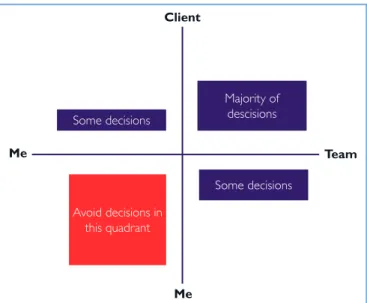
The will of clinicians to participate in multidisciplinary care is influenced by their educational preparation and professional socialisation.3 The former will determine their skills when they have to act as a member of a multidisciplinary team, while the latter will determine their perception of other team members and their role within the multidisciplinary team reference. Undergraduate programs tend to dedicate considerable resources to developing the technical skills of the graduate.100 For some professions (e.g. medicine, pharmacy) the ability to examine, investigate, diagnose and treat the condition often forms the focus of undergraduate endeavours. Less time is spent on the non-technical components including communication techniques, teamwork practices and client-focussed care models. As these non-technical skills form the key foundations for multidisciplinary practice it can be postulated that some contemporary health care practitioners receive inadequate preparation for this form of care. Equally, professions who give a greater focus to the non-technical skills (e.g. nursing) may in turn prevent their graduates from being an active member of the decision-making processes within a multidisciplinary team.101, 102 It is evident that if future graduates are to provide multidisciplinary care they will need opportunities within their undergraduate study programmes to develop the necessary skills. While many education providers strive to achieve such experiences for their students, the pragmatics and funding constraints often limit the potentials. When Gardner et al.103 surveyed the attitudes of administrators responsible forprofession preparation within the United States, they identified a number of barriers to providing opportunities for students to participate in multidisciplinary teams. Pragmatics such as aligning scheduled classes, the willingness of students to work with other disciplines at a perceived cost to their own studies, and the different levels of student preparation were frequently cited. Interestingly, the costs of providing such opportunities were often seen as an challenge that was difficult to meet within contemporary budgets. As multidisciplinary wound care teams are formed, time and resources to train health professions to work within a team will be needed. Roleplays, simulations and moderated case discussion are strategies that enable the participant to focus on the non-technical skills whilst communicating the technical data of the client being discussed.104–106 The goal of interprofessional learning is to prepare and encourage team members to work towards the common goal of achieving safer and more patient-centred outcomes.17 Although the content should be present in all health professional undergraduate programs, opportunities for experienced wound care clinicians to participate in such programs also need to be provided. As Barr stated,102 the clinicians need to be ‘competent to collaborate’. Many competencies are common or overlap with more than one health profession and therefore, enhancement of these collaborative competencies can extend the reach and effectiveness of the entire team.107 Whilst educational preparation of clinicians participating in a multidisciplinary team is important, of equal importance is the attitude and respect team members bring to the encounter. It is generally agreed that a key fundamental to achieving multidisciplinary care is to ensure participant safety.108 This is achieved when inter-professional respect and subsequent trust is developed between members. Established hierarchical structures that perceive the dominance of one profession over another (e.g. medicine over allied health or nursing) often prevents participants from expressing an alternative view for fear of being ridiculed.102, 108 In contrary, members of a profession participating in multidisciplinary activities may be ‘punished’ by their professional peers for venturing beyond their discipline and potentially undermining established power bases.109 Health service organisations based on the political framework described above create contests between participants, resulting in ‘winners and losers’.110 The different funding models used for health care services provide an example of this disparity. Population-based funding models incorporating salaried health care workers is believed to have the highest potential for supporting multidisciplinary teamwork.108 A focus Some decisions Majority of descisions Some decisions Avoid decisions in this quadrant Client Team Me Me
Figure 2. Narcissistic-Me Model (Modified from
Dorahy & Hamilton 2009)
116of generating income to support the organisation is reduced with a population-based funding model and clinicians are more inclined to dedicate time to client interactions and team meetings required for multidisciplinary practice. A ‘fee for service’ model changes the focus to one of income generation. This model often reduces time spent with clients in order to maximise throughput and perceives time dedicated to team meetings as a cost to the organisation. A fee for service model may also result in ‘gaming’ the system. Activities that could reliably be performed by one health professional such as the nurse are undertaken by another health professional (doctor) as the fee for the latter is higher.108 This clearly works against multidisciplinary practice where team members are able to contribute to the care of the client based on their expertise. Multidisciplinary teams formed within a political frame are more likely to be impacted by other gaming strategies. The transfer of hierarchical structures and attitudes to the team often results in meetings structured as information dissemination from the leader to the followers than a genuine sharing and discussing of ideas.109, 111–113 As a result, participants report that they learn to ‘play the game’ in an effort to have their opinion incorporated. The team member makes subtle suggestions implying that it was derived from the comments of the leader and the leader then incorporates the suggestion and presents it as their own idea.111–115 Having emphasised the importance of mutual respect within multidisciplinary teams, it is equally important that the team members are able to maintain separate identities. Members are invited to the group to share their professional opinion. As a result, consensus may be reached about treatment strategies or conversely, members may agree to disagree. Being comfortable with differing opinions from the team helps to ensure that the group remains open to alternative approaches to care. If groups become too harmonious, there is a risk of “groupthink” developing. This occurs when members have a strong feeling of solidarity and are prepared to defend the group from internal and external ‘attack’.116, 117 Maintaining the group at all cost reduces the responsiveness of the group to external opinion and internal difference of opinion. Furthermore, “groupthink” may prevent innovative approaches to client problems and hamper effective referral mechanisms. Dorahy and Hamilton116 suggested a method for maintaining a professional identity whilst adopting a team identity. The model called ‘The Narcissistic-We’ suggests that multidisciplinary teams operate on two continuums. The first is a “me-to-team” continuum and the second is a “me-to-client” continuum. The two continuums are placed at right angles to form four quadrants of decision-making (Figure 2). The authors suggests that most decision should come from the “Client-Team” quadrant, but on occasions, some decisions will be required from the “Me-Client” and the “Me-Team” quadrants. In short, most decisions should be made by team and client collaborations, but at times, health professionals will be required to make decisions between themselves and the client alone, or between themselves and the team alone. This suggests that effective multidisciplinary teams incorporate dynamics that work towards a team approach to client problems but maintain the right of individual members of the team (professional or clients) to operate independent of “groupthink” when required. Maintenance of professional identity is distinctly different than clinging to a single vision about a clinical view. The “silo” approach suggests a narrow and self-sufficient treatment system, able to stand alone without interference from other disciplines. Contemporary healthcare complexities, patient centred care and rapid advances in knowledge preclude this approach from survival.
According to the 2012 Institute of Medicine report, several core personal values are necessary for individuals to function as effective members of high-functioning teams. Described through “reality check” interviews with team members in a US collaborative, these values included honesty, discipline, creativity, humility and curiosity.16 Maintenance of individual integrity and ethics harmonises with collaborative competency for effective team functioning. Cleary, as multidisciplinary wound teams are formed, attention should be paid to educate members on how to function as a team. Equally, a regular review of the team dynamic will be needed to ensure that traditional professional boundaries do not inhibit participation and that opportunities to maintain a professional identity, while adopting a team identity, are incorporated. If this can be achieved, the research suggests that client satisfactions will be higher, as is job satisfaction for the health professionals.118 Forming the multidisciplinary team is only one aspect of providing a multidisciplinary wound care service. Developing systems and resources that ensure the team function effectively is also essential.
The pragmatics of service delivery
A multidisciplinary wound care service requires access to a range of health professionals and communication structures to facilitate inter-professional consultation. While the concept is easy to understand, the pragmatics of delivering such a service are complex. Establishing the services required for a given client will require health care personnel that are familiar with the services provided by various team members and have an ability to construct individual care plans. Health professionals, by definition, are autonomous. While the need to collaborate with other professionals is recognised, the work of each professional is structured around an independent practice. A multidisciplinary wound care service will require team-based systems that may at times conflict with the above systems. The geographic location of team members, the manner in which they communicate, the time given to communication and the system of remuneration requires innovative approaches to meet the needs of the client and the multidisciplinary team.
Determining client need
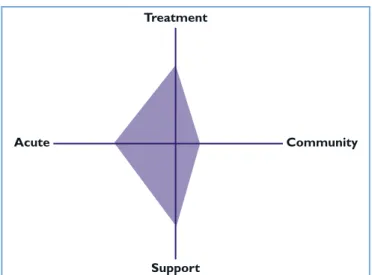
The ability to assess multidisciplinary needs of a client will require personnel with a broad understanding of the services offered by different professions and tools that facilitate accurate assessment of client need. Whilst each profession is able to determine how best they are able to meet the client’s needs, their ability to determine the multidisciplinary needs of the client are limited. Further research is needed to develop assessment tools that accurately identify the services required by individual clients and the quantum required for each service. Tools similar to the Kolb119 learning style inventory could be developed to determine the type and amount of service required (Figure 3). Once automated such systems could also generate referrals and booking requests for the�