ResearchOnline@JCU
This file is part of the following work:
Russo, Kerry (2019) Conquering the digital divide: with a digital native who never
was. PhD Thesis, James Cook University.
Access to this file is available from:
https://doi.org/10.25903/5ecde7ffe069f
Copyright © 2019 Kerry Russo.
The author has certified to JCU that they have made a reasonable effort to gain
permission and acknowledge the owners of any third party copyright material
included in this document. If you believe that this is not the case, please email
CONQUERING THE DIGITAL DIVIDE: WITH A DIGITAL NATIVE WHO NEVER WAS
Kerry Russo
College of Business, Law and Governance James Cook University
Townsville, Australia
“Access without support is not opportunity” Vincent Tinto, Syracuse University
This thesis is submitted in fulfilment of the requirements for the degree of
Doctor of Philosophy (PhD), Management and Commerce,
at James Cook University
Advisory Panel:
Professor Lynne Eagle (Principal Supervisor)
Professor David Low (Associate Supervisor)
i
Research Outputs From Thesis
Peer reviewed conference papers
Russo, K., Eagle, L., Emtage, N. & Low, D. (2018) Mind the Divide: Digital Fluency and Disadvantage. Proceedings of the Australian and New Zealand Marketing Academy Conference. In: ANZMAC 2018: Australian and New Zealand Marketing Academy Conference: Connect, Engage, Transform December 2018, Adelaide, South Australia
Russo, K., Low, D., & Eagle, L. (2017) The Death of the Digital Native. Proceedings of the Australian and New Zealand Marketing Academy Conference. In: ANZMAC 2017: Australian and New Zealand Marketing Academy Conference: marketing for impact, 4-6 December 2017, Melbourne, Vic., Australia
Russo, K., Eagle, L., Emtage, N., & Low, D., (2016) The Digital Divide and Higher
Education. Presented at 37th HERDSA Annual International Conference. In: HERDSA 2016: 39th Higher Education Research and Development Society of Australasia Annual
International Conference: the shape of higher education, 4-7 July 2016, Freemantle, Western Australia
ii
Statement of Original Authorship
The work contained in this thesis has not been previously submitted to meet the
requirements for an award at this or any other higher education institution. To the best of my knowledge and belief, the material included in this thesis is original and is an intellectual product of the author of this thesis. Proper citation/ acknowledgment has been made to the work of other authors contained in this thesis.
________________________ Kerry Russo
Author
iii
Acknowledgments
A PhD was always part of my life plan. But like many rural women from farming families, finding a way in which to achieve such a feat was challenging. One cannot just move a farm closer to a university. One cannot ask a third-generation farmer to leave the land and relocate near a university. So as one must, I waited until my sons, Jack and Harry, had finished their schooling then obtained a position at a university 120km from home. I lead a fragmented life, working as an academic at a regional university during the week and being a farmer’s wife on the weekends. But this is what farming families do. We make sacrifices to access opportunity.
This opportunity came in the form of Professor Lynne Eagle, Professor David Low and Dr Nicholas Emtage, my supervisors. I have been incredibly lucky to have these people in my life. Their friendship, support, wisdom and commitment to progressing my PhD has been immeasurable. Lynne’s structure, organisation, feedback and encouragement facilitated my thesis. David is an incredible mentor who has had significant influence on my academic career. Both Lynne and David are skilled researchers who shaped the research and thesis through their knowledge, insight and experience. Nick’s perception and knowledge in statistics and quantitative research was instrumental to the research design. That I
completed this thesis is testament to my supervisors’ experience, support and knowledge. I’d also like to thank my husband John. John is one of those laid-back farmers who just says “yes, go do what you’ve got to do” and then refocuses on the weather and its impact on the crop. Thank you to Jack, Harry, Renee, Terrie and Maureen who have been incredibly supportive and just amazing people. And of course to my parents Lex and Matina, who always think I can do anything.
I dedicate this thesis to my grandmother
who lived a long life filled with many friendships, laughter and love of her family. Kerry Kanakis
iv
Statement of Contributions of Others Name of
Assistance
Contribution Names, Titles and
Affiliation of Contributors
Supervision Primary Supervisor Professor Lynne Eagle,
James Cook University
Secondary Supervisor Professor David Low,
James Cook University
Additional Supervisor Dr Nicholas Emtage
James Cook University Financial
Support
James Cook University Postgraduate Research Scholarship (JCUPRS)
College of Business Law and Governance, JCU, Australia
James Cook University Townsville, Australia
Editing Support
Copyediting and proofreading services according to the protocols in the university-endorsed
National Guidelines for Editing Research Theses
Dr John Cokley PhD, EduPreneur Services International
v Abstract
As higher education moves to blended learning environments, a digital divide is emerging in the Australian higher education sector. This divide is predicated on differing digital skills and usage patterns, not access to digital devices. Access is not perceived to be the issue as numerous Australian secondary schools offer a school-issued laptop scheme. Yet many students transitioning to university are grappling with the necessary digital skills required to participate in a digital setting. Referred to as “digital natives”, these young people were expected to be digitally proficient. This thesis challenges the existence of Mark Prensky’s (2001) Digital Native and provides an analysis of how differing digital fluency stages influence perceived preparedness for university study. Conceptualising the growing inequalities arising from a widening digital divide, the thesis investigates impacts on the student experience, digital fluency and secondary schooling digital opportunities. The thesis reports on three studies drawn from three research questions. Using a mixed-mode
approach centred on Critical Theory and Ajzen’s Theory of Planned Behaviour (TPB), the thesis provides an analysis of the digital divide in Australian higher education. Study 1 reports on RQ1: “What is the relationship between socioeconomic, sociocultural/ geographic indicators and the digital divide?” Four hundred and nine first-year business students were surveyed at regional and urban Australian universities. This study provides empirical data on the digital divide and determines a link between digital fluency, socioeconomic status,
sociocultural capital, digital identity and student self-reported preparedness and digital skills. Study 2 reports on RQ2: “Is digital fluency a precursor to preparedness for university study?” Fifteen of the surveyed respondents completed a digital test with usability testing software prior to an in-depth interview. Study 2 provides a link between access and application of digital environments in schooling and the development of digital fluency. This study presents data showing disadvantage indicators can be alleviated through access to digital learning environments during schooling. Study 3 reports on RQ3: “What enhances and develops digital fluencies?” and examines the digital divide from a student’s perceptive. Case studies were developed from in-depth interviews and presented as techno-biographies to determine respondents’ digital fluency stage. These techno-biographies outline differing experiences and opportunities for digital skills development between secondary schools. Study 3
explores prior digital experience to identify digital influences, skills, knowledge, attitude and mindset. The study suggests that influences and prior digital experiences contribute to digital fluency and perceived preparedness for university study. The three studies are intertwined in their investigation of an association between disadvantage indicators, prior digital experience and stages of digital fluency. Particular attention is placed on examining the distribution and allocation of digitally resourcing in secondary schools. The three studies culminate in a
vi
concept model to illustrate the link between the distribution of resources, digital fluency and preparedness for university study. The thesis demonstrates a link between access to a learning management system (LMS) or digital curriculum during secondary school and disadvantage indicators. Access to a school LMS consistently produced higher self-reported digital skills than those without, even when disadvantage indicators were present. The issue of perceived preparedness for university study and/or a digital learning environment was also linked to participants who had access to a school LMS. Rural, regional, low
socioeconomic, low sociocultural capital and state-school participants were less likely to have had access to a digital curriculum during secondary schooling and therefore less likely to report preparedness for university study. Conversely, these disadvantage indicators were overcome if participants had access to an LMS or digital curriculum. The thesis identifies a digital divide in higher education emanating from the distribution, use and allocation of secondary schooling digital resources and prior experience. The resourcing of secondary schools with school-issued laptops did not increase digital fluency or perceived
preparedness for university study. However, the implementation of a digital curriculum or LMS produced significant outcomes in the development of digital fluency. These findings illustrate the influence of digital immersion in the formation of fluency. Resourcing schools without a clear digital curriculum does not increase digital fluency. If the digital divide is to be conquered, the appropriate application of digital resources in secondary schools must be implemented to enable the development of digital fluency.
vii
Table of Contents
Research Outputs ... i
Table of Contents ... vii
Glossary of Terms ... xvii
Table of Acronyms... xix
Chapter 1 Introduction ... 1
1.1. Introduction ... 1
1.2. Research Rationale ... 5
1.3. Research Gaps... 6
1.4. Research overview ... 7
1.5. Theoretical and practical contribution of the thesis... 9
1.6. Outline of the Thesis ... 13
1.7. Conclusion ... 17
Chapter 2 Literature Review ... 18
2.1 Introduction ... 18
2.2. Historical perspective... 18
2.3. The Digital Native ... 19
2.4. Student learning expectations ... 20
2.5. Learning as a Social Construct ... 23
2.6. Digital literacy ... 23
2.7. Digital fluency ... 27
2.8. 21st Century Skills ... 29
2.10. The digital divide and disadvantage ... 30
2.11. Widening participation ... 31
2.12 Impact of geographic location ... 32
2.13. Conclusion ... 34
Chapter 3: Research Methodology and Key Theories ... 36
3.1 Introduction ... 36
viii
3.3 Social Justice Framework ... 38
3.4 Theory of Planned Behaviour ... 39
3.5 Research conceptual map ... 41
3.6 Methodological and Analytical Approaches ... 42
3.7 Data Collection Tools... 43
3.8 Study 1 – The Questionnaire ... 44
3.9 The survey sample group ... 45
3.10 Survey questionnaire ... 45
3.11 Digital fluency test ... 48
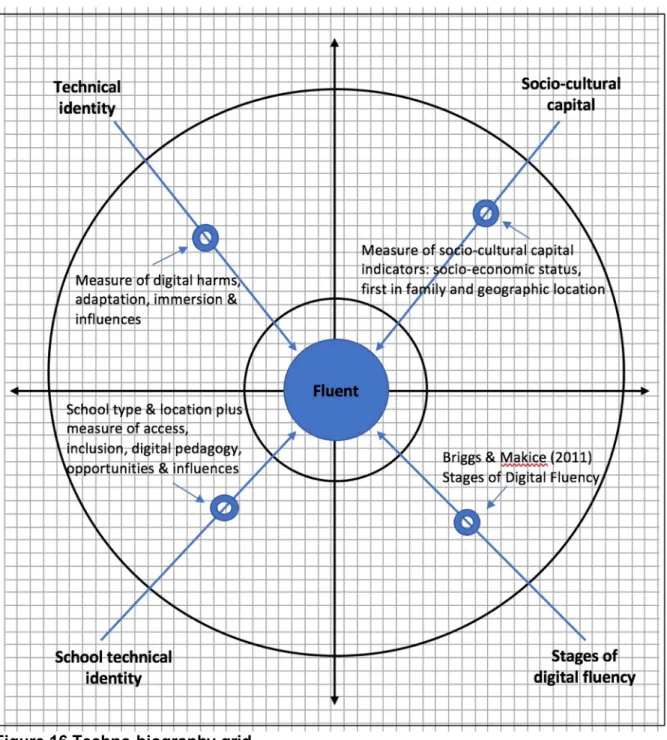
3.12 Techno-biography Grid ... 50
3.13 Case studies: Techno-biographies ... 51
3.14 Techno-biography concept map... 53
3.15 Staging and measuring Fluency... 54
3.16 Conclusion ... 55
Chapter 4 The Digital Divide ... 56
4.1 Introduction ... 56
4.2 Statistical tests... 56
4.3 The Digital Divide: Study 1 Results ... 60
4.4 Demographic and digital access results ... 62
4.5 Comparison of University Demographics ... 63
4.6 Participants’ access to digital technologies ... 65
4.7 Comparison of university online enrolment experiences ... 65
4.8 Summary of univariate tests of relationships between demographic, geographic and school variables ... 67
4.9 Factor analysis overview ... 77
4.10 Reliability Scales ... 78
4.11 Final Factor Analysis after reliability testing ... 79
4.12 Digital Fluency Scales Profiles ... 81
ix
4.13 Conclusion ... 96
Chapter 5 Digital Fluency: Study 2 ... 98
5.1 Introduction ... 98
5.2 Digital test format and design ... 98
5.3 The study 2 sample group ... 98
5.4 Study 2 – digital test ... 99
5.5 Comparison of digital test participants ... 101
5.6 Study 2 – digital test results ... 107
5.7 Study 2 – participants’ digital access ... 109
5.8 Conclusion ... 111
Chapter 6 Digital Influences: Study 3 ... 112
6.1 Introduction ... 112
6.2 Study 3 – The Interview ... 112
6.3 Study 3 – Case studies ... 114
6.3.1 Lily – Case study 1 ... 114
6.3.2 Max – Case study 2 ... 115
6.3.3 Laura – Case study 3 ... 116
6.3.4 Paula – Case study 4 ... 117
6.3.5 Ben – Case study 5 ... 118
6.3.6 Luke – Case study 6 ... 119
6.3.7 Cam – Case study 7 ... 120
6.3.8 Emily – Case study 8 ... 122
6.3.9 Gina – Case study 9 ... 122
6.3.10 Jake – Case study 10 ... 124
6.3.11 Michelle – Case study 11 ... 125
6.3.12 Michael – Case study 12... 126
6.3.13 Suzy – Case study 13 ... 128
6.3.14 Sara – Case study 14 ... 129
x
6.4 School digital experiences ... 132
6.5 Study 3 participants’ access to digital technologies ... 133
6.6 Comparison of university online enrolment experiences ... 136
6.7 Demographics and digital access ... 136
6.8 Techno-biography outcomes ... 137
6.9 Study 3 Results and Implications ... 140
6.10 Conclusion ... 141
Chapter 7 Discussion and Conclusionsion ... 143
7.1 Introduction ... 143
7.2 Discussion and results ... 143
7.3 Key findings of the thesis ... 145
7.4 Theoretical and practical contribution ... 148
7.5 Limitations of thesis ... 149
7.6 Areas for further research ... 150
7.7 Implications for theory and practice ... 150
7.8 Conclusion ... 151
References ... 152
xi
Table of Figures
Figure 1. The Digital Divide ... 2
Figure 2 The Digital Divide ... 3
Figure 3. Distributions across proficiency levels for Year 10 students from 2005 to 2014 ... 4
Figure 4. PISA Australian average score in scientific literacy ... 5
Figure 5 Research Question 1 Map ... 10
Figure 6. Research Question 2 Map ... 11
Figure 7. Research Question 3 Map ... 12
Figure 8. Research questions mapped to practical contributions ... 12
Figure 9 Student Support for Learning ... 22
Figure 10 JISC Seven Elements of Digital Literacies... 24
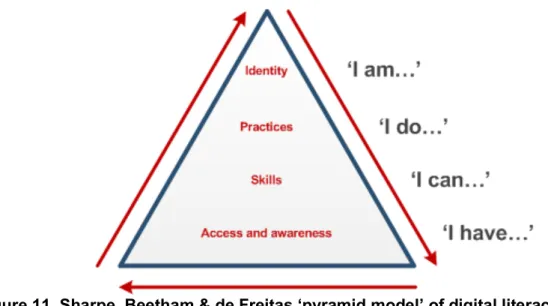
Figure 11. Sharpe, Beetham & de Freitas ‘pyramid model’ of digital literacy development model (2010) ... 25
Figure 12. Elements of Creative Classroom Research Model (Bocconi et al., 2012)... 26
Figure 13. The four stages of digital fluency (Briggs & Makice, 2012), p. 75) ... 28
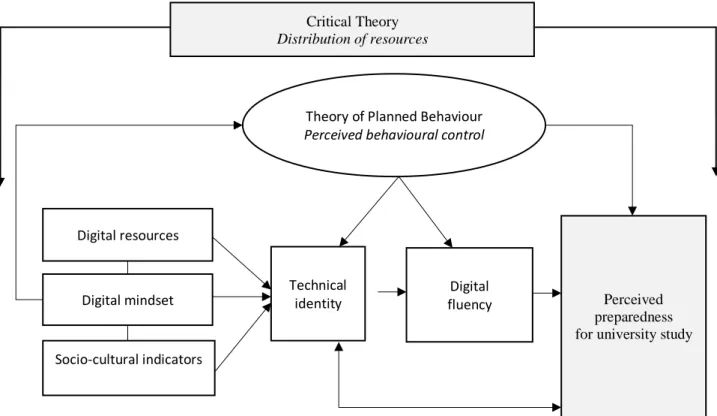
Figure 14 Preparedness for university proposed concept model ... 40
Figure 15 Research Conceptual Map Source: author originated ... 41
xii
Figure 17 Technobiography concept map ... 53
Figure 18 Student reported school technical Identity concept map ... 54
Figure 19 SPSS Statistical tests for study 1 ... 58
Figure 20 SPSS Statistical variable tests flowchart ... 59
Figure 21 Interrelationship between variables ... 61
Figure 22 Access to digital devices ... 65
Figure 23 Study 1 University online enrolment experience with disadvantage indicators ... 66
Figure 24 Access to LMS and disadvantage indicators tree ... 68
Figure 25 Access to a School LMS with disadvantaged indicators ... 69
Figure 26 Preparedness by school type and geographic location ... 74
Figure 27 Preparedness and access to a school LMS ... 75
Figure 28 Preparedness for university concept model within a digital fluency context ... 76
Figure 29 Digital Fluency Indicator Scales ... 81
Figure 30 Digital fluency indicators scales with parental and school influences... 82
Figure 31 Group secondary schooling ... 89
Figure 32 Group demographics ... 90
Figure 33 Group digital access and experiences ... 91
xiii
Figure 35 Perceived prepared by secondary school for university-level
study ... 94
Figure 36 Preparedness for university model with digital fluency indicators ... 95
Figure 37 The cycle of digital fluency ... 96
Figure 38 Usability software: TechSmith Morae interface ... 101
Figure 39 Minimum and maximum time on tasks ... 103
Figure 40 Minimum and maximum mouse clicks per task ... 103
Figure 41 Minimum and maximum mouse movements per task ... 103
Figure 42. Time spend on tasks by participants ... 104
Figure 43. Mouse clicks on tasks by participants ... 105
Figure 44. Mouse movement by participants... 106
Figure 45 Access to digital technologies at school ... 135
Figure 46 Student reported school technical identity concept map ... 136
Figure 47 Enrolment experience ... 136
Figure 48 Mapped Techno-biography ... 139
Figure 49 Considerations for building digital fluency ... 144
Figure 50 Blended and online considerations to build digital fluency ... 145
Figure 51 Preparedness for university concept model ... 147
xiv
Table of Tables
Table 1. Overview of research design and methodology ... 8
Table 2. Outline of Chapter Structure ... 13
Table 3. Overview of thesis contribution ... 15
Table 4 Stages of Digital Fluency (adapted by author from Briggs & Makice, 2012) ... 27
Table 5. Basic beliefs of alternative inquiry paradigms ... 37
Table 6. Paradigm positions of selected practical issues ... 38
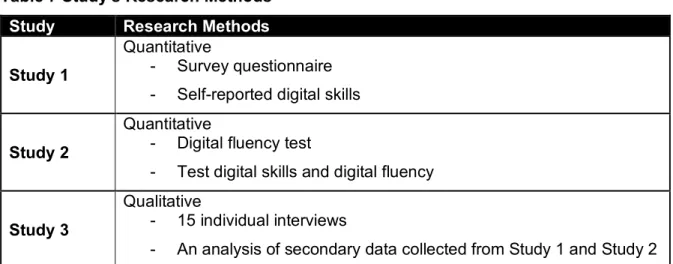
Table 7 Study's Research Methods... 42
Table 8 Research Design Methodologies ... 43
Table 9 Study 1 Digital Divide Questions ... 46
Table 10 Digital Fluency Test... 48
Table 11 Study 3 Digital Fluency Interview Questions ... 52
Table 12 Study 1 Demographics ... 62
Table 13 Summary table of statistical significance for digital attitude, mindset and perceived digital skills non-categorical variables... 70
Table 14 Summary table of statistical significance for perceived preparedness by school for university study categorical variables ... 73
Table 15 Principal Component Analysis of the question blocks ... 77
Table 16 Final Factor Analysis ... 78
Table 17 Cronbach's Alpha, Source (To, 2019)... 79
xv
Table 19 Final Factor Analysis after reliability testing ... 80
Table 20 Group Characteristics Test Profiles ... 83
Table 21 Group 1 Rural and Low SES... 84
Table 22 Group 2 Rural and non-state school educated school leavers . 85 Table 23 Group 3 International non-school leavers without access to LMS ... 85
Table 24 Group 4 Highest recorded access to digital technologies ... 86
Table 25 Group 5 First-in-family female school leavers ... 87
Table 28 Participants' digital test results... 107
Table 29 Student comparison of preparedness and resources to digital test task completion ... 110
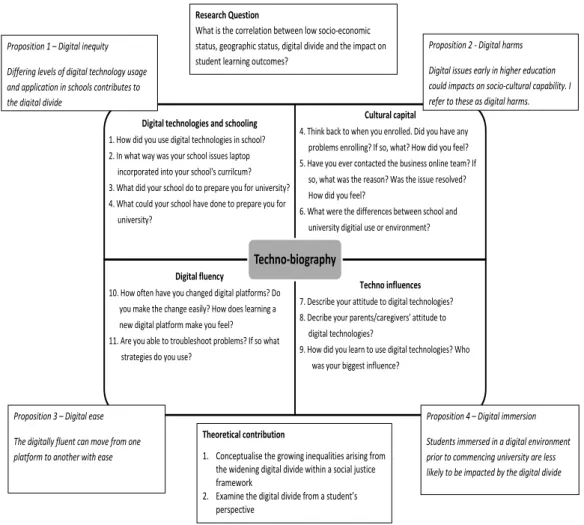
Table 30 Study 3. Propositions ... 113
Table 31 Digital experience & preparedness ... 134
Table 32 Techno-biography results ... 138
Table 35 Theoretical contributions of thesis ... 148
xvi
Table of Appendices
Appendix 1 Theoretical Concept Table for Study 1... 158
Appendix 2 Study 1 Questionnaire ... 163
Appendix 3 Theoretical Concept Table for Study 3... 165
Appendix 4 Pearson Chi-square for Significance ... 170
Appendix 5 Factor Analysis ... 176
Appendix 6 Reliability Scales ... 182
Appendix 7 Lily’s Digital Test and Results... 194
Appendix 8 Max’s Digital Test and Results ... 196
Appendix 9 Laura’s Digital Test and Results ... 198
Appendix 10 Paula’s Digital Test and Results... 200
Appendix 11 Ben’s Digital Test and Results ... 202
Appendix 12 Luke’s Digital Test and Results ... 203
Appendix 13 Cam’s Digital Test and Results ... 205
Appendix 14 Emily’s Digital Test and Results ... 207
Appendix 15 Gina’s Digital Test and Results ... 209
Appendix 16 Michelle’s Digital Test and Results ... 211
Appendix 17 Michael’s Digital Test and Results ... 213
Appendix 18 Suzy’s Digital Test and Results ... 215
Appendix 19 Sara’s Digital Test and Results ... 217
xvii
Glossary of Terms
21st Century Skills Critical thinking, collaboration, digital literacies, information literacies and media literacies Andragogy The science of teaching adults
Australian Tertiary Admission Rank (ATAR)
Since the late 1990s, all Australian states and territories (except Queensland until 2019) have used a common measure to rank Year 12 students relative to their peers for university admission
Blended learning The use of multi-modes of delivery including digital technologies and face-to-face teaching
Constructivism A learning theory related to the construction of knowledge through meaningful experiences
Digital curriculum A curriculum designed to enable opportunities to learn in a digital environment
Digital equity Access to digital devices, broadband and networks Digital divide Previously the divide was focused on digital access and
ownership. In this thesis the digital divide refers to the gap between those who know how to use digital technologies and those who do not.
Digital harms Negative digital experiences
Digital fluency The ability to move with ease in a digital environment Digital Knowledge Ability to use digital technologies to create knowledge Digital Native A term used to describe young people who grew up using
digital technologies
Digital Pedagogy A pedagogical approach to the science of teaching and learning using digital technologies
Generation Y/ Millennials/ Net Generation
The generation born between 1980-2000, also called Millennials or the Net generation
Instructivism A pedagogical theory relating to didactic instruction Learning Management
System (LMS)
An online platform for accessing and using learning material
Massification A significant increase in access and participation in higher education is often referred to as the massification of higher education
xviii
Platform A technology-enabled combination of hardware and software to provide a digital media service
Pedagogy The science of teaching
Social constructivism A pedagogical approach based on Vygotsky’s Zone of Proximity and the Theory of Social Learning
Social justice framework A framework of social justice and human rights Social learning Vygotsky’s Social Learning Theory based on the
scaffolding of knowledge Zone of Proximal
Development
Vygotsky’s Social Learning Theory refers to the zone of proximal development, an area of individual learning and where guidance may be required
xix
Table of Acronyms
ACARA Australian Curriculum, Assessment and Reporting Authority
ATAR Australian Tertiary Admission Rank
BYOD Bring Your Own Device
CAI Computer Assisted Instruction
CCR Creative Classroom Research
CMS Content Management System
COAG Council of Australian Governments
DEEWR Department of Education, Employment and Workplace
Relations
DER Digital Education Revolution
DigEULit A European Framework for Digital Literacy
HEPPP Higher Education Participation Program
ICT Information and Communications Technology
IPTS Institute for Prospective Technological Studies
IRRRRE Independent Review into Regional, Rural and Remote Education
IT Information Technology
LMS Learning Management System
NAPLAN National Assessment Program – Literacy and Numeracy
OLT Office of Learning & Teaching
OP Overall Position
QCS Queensland Core Skills
PISA Program for International Student Assessment
SES Socioeconomic Status
SNS Social Networking System
Chapter 1 Introduction 1.1. Introduction
If education is to be transformative it needs to be accessible. This thesis investigates
whether a digital inequality exists within the Australian higher-education sector. This chapter provides an outline of the scope of the thesis, introduces the research rationale and
identified research gaps and presents the overall thesis structure. The thesis aims to examine the impact of a digital divide on business students in higher education and
ascertain whether the student’s prior experience influences digital fluency. The digital divide is defined in this thesis as a gap in digital knowledge and a gap in opportunity, ability and efficacy. Commencing with a discussion of the concepts of the digital divide and digital fluency, the research rationale and gaps in research on the digital divide from an Australian higher-education perspective form the body of the first sections of this chapter. The chapter then discusses the magnitude and impact of the digital divide challenges before concluding with the theoretical and practical contribution of the thesis.
The notion of a digital divide was first brought to the researcher’s attention when employed at James Cook University, a regional Australian university, as an online educational
designer. In 2013, the university’s Bachelor of Business moved to an online/ blended delivery mode. It was assumed the students would respond positively to the digital learning environment. However, students began to flounder with their digital learning tasks. Students had difficulties accessing online tutorials, uploading assignments to the Learning
Management System (LMS), recording/editing videos and presenting in an online conference format. A team was employed called Business Online to help support the students. The Business Online team assisted internal and external students to engage with the digital learning environment and troubleshoot problems for students as their problems arose. In 2017 the Business Online team responded to more than 10,000 email requests for assistance from students and staff. This was an astonishing number of requests when one considers fewer than 2000 students were enrolled in the Bachelor of Business during 2017. It became evident that navigating the digital divide with students ill-equipped to participate in a digital environment was fraught with challenges. The Bachelor of Business LMS had been designed to encourage easy navigation and numerous help instructions and videos were available to assist students. Nevertheless, external and internal students enrolled in the online/blended program continued to seek assistance from the Business Online team. A review of the available literature revealed real concern was being raised that while digital technologies are becoming increasingly accessible, a new digital divide is emerging
(Ragnedda & Muschert, 2013; White, 2013; Bartlett & Miller, 2012 and Resnick, 2002). Rather than a divide centred only on access to digital tools, this new digital divide is based on ability to use those tools effectively. The ability to create knowledge using technology
2
rather than passively consuming knowledge created by others has been identified as vital for social inclusion (Warschauer, 2004). Many researchers now acknowledge a digital divide is contributing to societal inequity and impacting on social inclusion, communities and
education (White, 2013; Bartlett & Miller, 2012; Resnick, 2002). An analysis of the influence this divide is having on business education in the Australian higher-education sector is the focus of this thesis.
Terms such as “disadvantage”, “social exclusion” and “isolation” set the narrative for the divide in an Australian study (Broadbent & Papadopoulos, 2013) on the digital divide. The study asserted that “being a part of the digital divide in the twentieth century disconnects you from a part of your world that now exists for others” (p.4). The digital divide is changing from one of accessibility to one of a knowledge gap generated by differing levels of digital competencies (Q. Wang, Myers, & Sundaram, 2013).
The definition of the digital divide in this thesis is therefore centred on the meaningful use of technology to create knowledge, rather than a narrative of computer ownership or
accessibility and connectivity. There are three components within the new digital divide: digital access which incorporates digital ownership and internet access; digital literacy which focuses on the use of technology tools; and digital fluency which is knowledge creation through digital environments (Figure 1).
Figure 1. The Digital Divide Source: Author Originated
The digital divide is a range of these competing elements that is greater than access to computers, internet and digital resources. This divide has broadened to encompass social relationships, communities, education and the meaningful way we use information
technology and communication (Broadbent & Papadopoulos, 2013; Peña-López, 2010; van Digital Fluency
Create & reformulate knowledge in a digital environment
Interpret & evaluate information
Move with ease across digital platforms Digital Literacy Technology skills Use of IT tools Digital competencies Digital Access Internet broadband access Computer or digital device ownership
3
Dijk, 2006; Warschauer, 2004; Wei & Hindman, 2011). While digital access, defined in Figure 1 as access to digital resources, remains an issue in rural and remote locations and individuals from low socioeconomic backgrounds, it is the gap in digital knowledge and usage that is the thesis’s focus (Hasley, 2018). It is now acknowledged that access to and/or ownership of technology alone does not generate knowledge. This rise of the digitally fluent who can move with ease across digital platforms is creating a digital divide, leaving behind those who cannot effectively navigate across these platforms.
Figure 2 The Digital Divide
Figure 2 illustrates division between technological haves and have-nots as a gap in digital knowledge (Wei & Hindman, 2011). This gap in digital knowledge is the digital divide. Tertiary institutions continue to grapple with levelling the playing field, particularly with students who are the first in their family to study at tertiary level and those who are from low socioeconomic backgrounds (Johnston, Lee, Shah, Shields, & Spinks, 2014; Luzeckyj, Scutter, King, & Brinkworth, 2011; O'Shea, 2015).
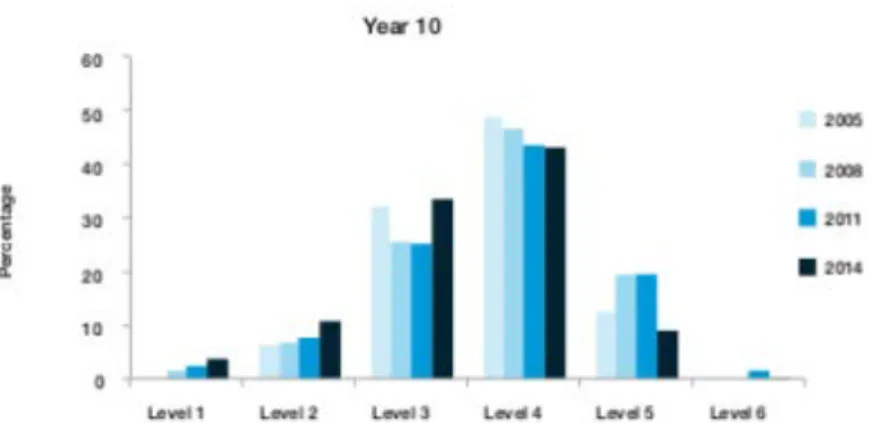
Robert Randall, CEO of the Australian Curriculum Assessment and Reporting Authority (ACARA), stated that student’s digital skills should not be assumed (ABC report, November, 2015). In comparing the computer technology literacy of Year 6 and Year 10 secondary-school students in the Australian National Assessment Program Literacy and Numeracy (NAPLAN) annual competency assessments, ACARA identified a fall in Information Computer Technology (ICT) proficiency levels from 2011 to 2014 (Figure 3).
4
Figure 3. Distributions across proficiency levels for Year 10 students from 2005 to 2014
(Key: Level 1 lowest level of ICT proficiency to Level 6 highest level of ICT proficiency) Source: (Fraillon, Schulz, Gebhardt & Ainley, 2015) NAPLAN ICT 2014 Public Report (p.32) The NAPLAN ICT 2014 Public Report demonstrates a 13-percentage point fall in ICT proficiency standards between 2011 to 2014. The 2014 proficiency standard was the lowest recorded of all NAPLAN ICT tests. This reduction in digital literacies is significant and raises concern about the preparation of students entering higher education.
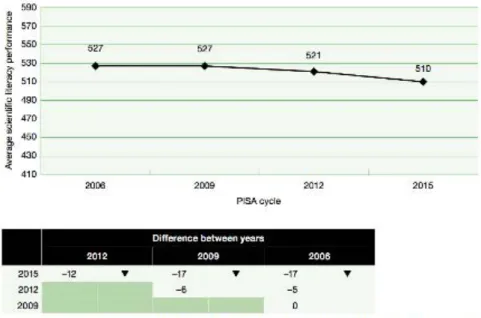
A decline in other literacies was also evident in the Australian Program for International Student Assessment (PISA). Thomson, De Bortoli, and Underwood (2017) discuss the ramifications of the decline in PISA scores within Australia. The PISA scientific literacy assessment framework is comprised of three competencies that link to digital fluency. Competency is based on “logic, reasoning and critical analysis” and includes the ability to scientifically explain, evaluate, design and interpret data and evidence (Thomson et al., 2017, p. 18).
Figure 4 illustrates a significant 17-point decline in the Australian PISA average score in scientific literacy performance between 2009-2015. A further breakdown of factors such as socioeconomic, geographic and socioeducation relating to the Australian PISA results is provided in Chapter 2.
5
Figure 4. PISA Australian average score in scientific literacy Source: PISA 2015 Reporting Australia’s results (Thomson et al., 2017)
The literature review examines past and recent scholarly thought on barriers to navigating the digital learning environment and digital fluency. This digital competence or efficacy is known as digital fluency and differs from digital literacy in that digital literacy is defined in this thesis, drawing on the available literature, as the ability to use technology tools. Digital fluency is the ability to reformulate knowledge through the use of technology. This thesis argues that unless appropriate effective student support structures which build digital fluencies are embedded in both secondary and tertiary educational practice, digital inequity across the student body will continue to increase.
1.2. Research Rationale
As noted in the introduction, Haycock (2004) contends differing digital proficiency levels are creating inequality within our society. Leading Wei and Hindman (2011) to state that “the social consequences of the digital divide have not yet received adequate attention” (p. 216). A widening gap between those who have knowledge and those who do not is beginning to emerge with the technological haves and have-nots in terms of the ability to effectively utilise technology (Wei & Hindman, 2011). Selwyn (2009) reinforces this gap or divide with the assertion:
concerns are beginning to be raised that digital technologies may be contributing to an increased disengagement, disenchantment and alienation of young people from formal institutions and activities (p. 369).
Is this widening societal gap in the use of digital environments reflected in the higher
6
the ways in which students use technology to generate and create knowledge is impacting students’ preparedness for higher education. The research examines three factors: Whether a digital divide exists in higher education and if so, whether the divide is related to
socioeconomic, sociocultural and/or geographic status; Whether the divide is predicated on the distribution of secondary-school digital technologies resources e.g. school-issued laptops, LMS provision and the development of digital fluency; And whether digital fluency leads to self-reported or perceived preparedness for university studies. From these
investigations, the thesis provides evidence to suggest that the lack of digital fluency is creating a barrier in higher education. The thesis concludes with recommendations for further research on bridging the digital divide to improve the student learning experience and promote positive student opportunities.
1.3. Research Gaps
The researcher has identified two gaps in extant literature that the thesis addresses. 1.3.1. Research Gap 1: The Digital Divide
The research addresses whether online and blended learning business undergraduate programs are impacting the student experience due to unrealistic assumptions regarding students’ digital fluency. Blended learning is defined as bringing together face-to-face teaching with learning technologies to deliver a program in one or more delivery modes (McGee & Carmean, 2012). In the context of university undergraduate degrees, the research reported in this thesis aimed to:
a) Identify whether and in what ways socioeconomic, sociocultural and/or geographic status influences students’ digital readiness to participate in tertiary business studies b) Research the development of digital fluencies through student self-reporting and
testing of digital skills
c) Establish whether digital fluency impacts on university students’ experience in business education.
The overall aim of determining whether the use of digital technologies in education has contributed to inequality and a broadening of a digital divide into the tertiary sector underpins this research. Inequality in this context is not just access to digital resources but also access to the development of digital knowledge and skills.
1.3.2. Research Gap 2: Digital Fluency
Minimising the negative impact of the digital divide on the student experience is another aim of this study. The research investigated factors that influence the development of digital
7
fluency to ultimately improve student preparedness for university study, enhance the student experience and enable students to cross the digital divide. The research aimed to:
a) Examine the digital divide from a student’s perspective to give insight into the impact of the divide in higher education and the development of digital fluency
b) Investigate factors that influence the development of digital fluency. 1.4. Research overview
The research design and methodology overview shown in Table 1 outlines the research questions, research methodologies and analysis techniques used. The three studies and methodological approaches are expanded on in Chapter 3.
Table 1. Overview of research design and methodology
Research Question Study Research Methods Analysis
programs
Methodological approach RQ1.
What is the relationship between socioeconomic, sociocultural/ geographic indicators and the digital divide?
Study 1
The Digital Divide n=409
Quantitative – Questionnaire Compare first-year Bachelor of Business cohorts
• Self-reported digital skills, information fluency and online enrolment experiences
• Correlate against location, demographic factors & access to digital devices SPSS Critical Theory Theory of Planned Behaviour (Ajzen, 1991) RQ2.
Is digital fluency a precursor to preparedness for university study?
Study 2
Digital Fluency n=15
Mixed mode
Quantitative –15 x Digital tests Compare participants’ digital test results against Study 1 and 3 responses • time on task • mouse clicks • mouse movements TechSmith Morae RQ3.
What enhances and develops digital fluencies? Study 3 Digital Influences n=15 Mixed mode
Qualitative – 15 x Individual in-depth interviews
• Determine digital influences • Case studies
• Build a techno-biography of each participant
• Identify digital harms • Analysis of secondary data collected from Study 1 and 2 • Compare participants’ responses against Study 1 and 2 results
SPSS
The digital tests in Study 2 were conducted with TechSmith Morae. Morae is an online usability testing platform. This platform enabled the researcher to track participants’ progress through the digital test and is described in Chapter 3.
1.5. Theoretical and practical contribution of the thesis
Chapter 2 provides an overview and critical evaluation of existing theories, noting that they do not provide a comprehensive means of analysing the impact on academic participation and performance of the range of factors within the digital learning environment as identified in this chapter.
Building on the widening participation and social justice work of Gale and Tranter (2011) and Devlin (2013b), the thesis is situated in a social justice framework. Australia’s focus on access to higher education has not been matched with attention to student participation and success (Devlin, 2013b). This disconnect between access in higher education and student participation and success will be discussed in further detail in Chapter 3 (Devlin, 2013a). Gale and Tranter (2011) describe social justice in terms of “distributive, retributive and recognitive” and perceive recognitive justice as missing from Australian higher-education policy (p. 29). They conclude that:
To be socially just in recognitive terms, higher-education policy must recognise the interests of the least advantaged by developing a deeper understanding of the knowledges, values and understandings of those who are underrepresented and excluded from higher education, especially people from lower socioeconomic backgrounds (Gale & Tranter, 2011, p. 30).
The social justice framework and its implications are discussed in more detail in Chapter 3. Two key theories are introduced: Ajzen (1991) Theory of Planned Behaviour (TPB) and Critical Theory with its origin in sociology and Marxist philosophy, enable the consideration of structural inequality and they provide the thesis’ foundation. Applying the aforementioned theories and perspectives, the thesis provides theoretical contributions to create a critical consciousness of the digital divide and to inform the narrative of inequality in higher education.
1.5.1 Theoretical Contribution 1
a) Provides an analysis of a digital learning environment’s impact on the student experience.
b) Conceptualises the growing inequalities arising from the widening digital divide within a social justice framework.
10
c) Applies Critical Theory to the examination of the distribution and allocation of resourcing in secondary schools.
d) Applies TPB to the examination of the distribution and allocation of resourcing in secondary schools.
Figure 5 Research Question 1 Map
Figure 5 maps Research Question 1 to the research gap and illustrates the thesis’s first theoretical contribution.
1.5.2 Theoretical Contribution 2
a) Provides empirical data on the link between digital fluencies, socioeconomic and geographic status and positive student experiences and opportunities.
b) Examines the digital divide from a student’s perspective.
c) Develops a critical consciousness of the impact of the digital divide on student preparedness. RQ1: What is the relationship between socioeconomic, sociocultural/ geographic indicators and the digital divide?
Research Gap: Limited literature examining the relationship between socioeconomic, sociocultural /geographic status and the digital divide
Theoretical Contributions
An analysis of each digital-learning environment’s impact on the student experience
Conceptualise the growing inequalities arising from the widening digital divide within a social justice framework
Applies critical theory to the examination of the distribution and allocation of resourcing in secondary schools Applies TPB to the examination of the distribution and allocation of resourcing in secondary schools.
11
Figure 6. Research Question 2 Map
In Figure 6 Research Question 2 is mapped to the research gap and illustrates the theoretical contribution of the thesis.
1.5.3 Theoretical Contribution 3
a) Applies a student’s perspective to identify purposeful support strategies. b) Recommends approaches to build student digital capacities.
c) Situates the work of Devlin (2013b) and Gale and Tranter (2011) on social justice in higher education and the widening participation agenda in the digital divide.
RQ2. Is digital fluency a precursor to preparedness for university study? Research Gap There is a lack of literature investigating digital fluency's impact on student perceived preparedness for university study Theoretical contributions
Provides empirical data on the link between digital fluencies, socioeconomic status and positive student experience and opportunity
Examines the digital divide from a student’s perceptive
Develops a critical
consciousness of the impact of the digital divide on student preparedness.
RQ3.
What enhances and develops digital fluencies?
Research Gap
Minimal Australian research has identified influences that enhance and develop digital fluency
Theoretical contributions
Apply a student’s lens to identify purposeful strategies to build digital fluency
Determine the types of influences that build student digital
capacities
Situate the work of Devlin (2013) and Gale & Tranter (2011) on social justice in higher education and the widening participation agenda in the digital divide.
12
Figure 7. Research Question 3 Map
Figure 7 addresses how Research Question 3 is linked to the research gap and mapped to the theoretical contribution of the thesis.
The thesis’s practical contributions are listed below and link to the theoretical contributions above. The thesis’ intent is to draw on theoretical conceptualisations, tested using a series of studies, to then develop a set of recommendations for both further research and possible actions to mitigate negative influences from the digital divide on the Australian higher-education sector.
1.5.4 Practical Contribution
a) Contributes to the development of strategies within the “widening participation” agenda.
b) Contributes to the improvement of preparation of students with 21st century skills to take their place in a globalised business world.
c) Provides recommendations for further research on effective structures to enhance digital fluencies and improve the student experience.
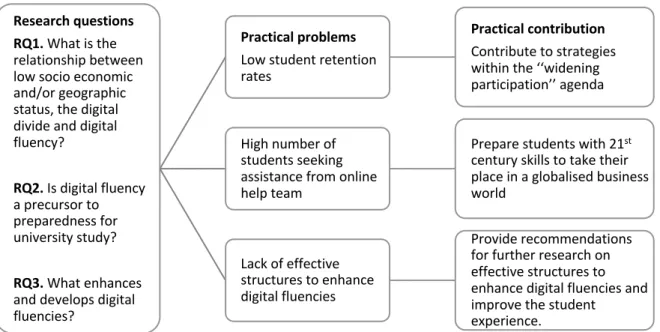
In Figure 8 all three research questions are mapped to practical problems to illustrate the practical contribution of the thesis.
Research questions RQ1.What is the relationship between low socio economic and/or geographic status, the digital divide and digital fluency? RQ2.Is digital fluency a precursor to preparedness for university study? RQ3. What enhances and develops digital fluencies?
Practical problems
Low student retention rates
Practical contribution
Contribute to strategies within the ‘‘widening participation’’ agenda
High number of students seeking assistance from online help team
Prepare students with 21st century skills to take their place in a globalised business world
Lack of effective structures to enhance digital fluencies
Provide recommendations for further research on effective structures to enhance digital fluencies and improve the student
experience. Figure 8. Research questions mapped to practical contributions
13
1.6. Outline of the Thesis
The thesis has seven chapters: the structure of these is outlined below in Table 2. Table 2. Outline of Chapter Structure
Chapter 1 Introduction Introduction Research Rationale Research Gaps Research overview
Theoretical and practical contribution of the thesis Outline of the Thesis
Conclusion Chapter 2 The Digital Native Introduction Historical perspective The Digital Native
Student learning expectations Learning as a Social Construct Digital literacy
Digital fluency 21st Century Skills
The digital divide and disadvantage Widening participation
Impact of geographic location Conclusion Chapter 3 Research metho-dologies Introduction Philosophical Perspective Social Justice Perspective Theory of Planned Behaviour Research conceptual map
Methodological and Analytical Approaches Data Collection Tools
Study 1 – The Questionnaire The survey sample group Survey questionnaire Digital fluency test Techno-biography Grid
Case studies: Techno-biographies Techno-biography concept map Staging and measuring Fluency Conclusion Chapter 4 The Digital Divide Introduction Statistical tests
The Digital Divide: Study 1 - Results Demographic and digital access results Comparison of University Demographics Participants’ access to digital technologies
Comparison of university online enrolment experiences
Summary of univariate tests of relationships between demographic, geographic and school variables
Factor analysis overview Reliability Scales
Final Factor Analysis after reliability testing Digital Fluency Scales Profiles
Group Profiles Conclusion
14 Chapter 5 Digital Fluencies
Introduction
Digital test format and design The study 2 sample group Study 2 – digital test
Comparison of digital test participants Study 2 – digital test results
Study 2 – participants’ digital access Conclusion
Chapter 6 Digital Influences
Introduction
Study 3 – The Interview Study 3 – Case studies School digital experiences
Study 3 - participants’ access to digital technologies Comparison of university online enrolment experiences Demographics and digital access
Techno-biography outcomes
Study 3 - Results and Implications Conclusion
Chapter7 Conclusion
Introduction
Discussion and results Key findings of the thesis
Theoretical and practical contribution Limitations of thesis
Areas for further research
Implications for theory and practice Conclusion
An overview of the thesis contribution is provided in Table 3. This overview maps the practical problem to the research gaps and research questions before moving to the theoretical and practical contributions.
Table 3. Overview of thesis contribution Practical
Problem
Research Gap Research Question Theoretical Contribution Practical Contribution
Low
socioeconomic and “first in family" student cohort
There is a lack of literature examining the interplay between socioeconomic, sociocultural and
geographic indicators and the impact of the digital divide RQ1. What is the relationship between socioeconomic, sociocultural/ geographic indicators and the digital divide?
a) Provide an analysis of a digital learning environment’s impact on the student experience
b) Conceptualise the growing inequalities arising from the widening digital divide within a social justice framework
c) Apply Critical Theory to the examination of the distribution and allocation of resourcing secondary schools
d) Apply TPB to the examination of the distribution and allocation of
resourcing secondary schools
Contribute to strategies within the “widening participation” agenda Support the need for the establishment of a digital curriculum in secondary schools
Support the need for the introduction of learning management systems in secondary schools Support the need for
professional development of secondary school teachers in technology pedagogies.
High number of students
seeking
assistance from the online help team
There is a lack of literature investigating whether digital fluency prepares students for university study RQ2. Is digital fluency a precursor to preparedness for university study?
a) Provide empirical data on the link between digital fluencies,
socioeconomic status and positive academic achievement and opportunities
Prepare students with 21st century skills to take their place in a globalised business world.
b) Examine the digital divide from a student’s perceptive
c) Develop a critical consciousness of the impact of the digital divide on student preparedness
Lack of effective structures to enhance digital fluencies
Minimal research has identified the types of approaches that build students’ digital fluency
RQ3. What enhances and develops digital fluencies?
a) Apply a student’s lens to identify purposeful strategies to build digital fluency
b) Determine the types of approaches required to build student digital capacities
c) Build on Devlin (2013a) and Gale and Tranter (2011) work on social justice in higher education and the widening participation agenda
Provide recommendations for further research on effective structures to enhance digital fluencies and improve student preparedness for university study.
1.7. Conclusion
The studies that form part of this thesis aim to identify whether a digital divide exists in higher education and to investigate the impact of digital fluency on student preparedness and learning experience. The thesis’s proposition is that digital fluency, not access or connectivity to digital devices, is contributing to a widening gap between the technological “haves” and “have-nots” (Wei & Hindman, 2011). This thesis expects that its findings will enhance online/blended tertiary business education programs by identifying the impact of the digital divide on the student experience and perceived preparation for university study. The findings can be used to strengthen and expand existing theoretical foundations, with implications for a range of academic institutions and policymaking bodies. The analysis of the digital learning environment focusing on the students’ perspective can assist in
identifying barriers to student success.
Chapter 2’s literature review provides an historical perceptive of learning technologies, identifies gaps in the current body of knowledge and examines the digital divide. Chapter 3 then discusses research methodologies and the study design with further discussions on the contributions of the thesis to existing knowledge.
18
Chapter 2 Literature Review 2.1 Introduction
Chapter 2 begins with an historical perspective focusing on the digital native. The digital native is a term coined to describe people born after 1980 who grew up with technology (Prensky, 2001). It was predicted the digital native would be able to use technologies and would demand a technologically advanced learning environment. This chapter explores gaps in the digital native research and discuss the pedagogical complexities that have arisen from the use of a digital learning environment and the students’ learning expectations. A focus on 21st century skills and the need for a digital pedagogy forms part of this discussion before moving to a focus on digital literacies and student retention models. The chapter concludes with discussion on the digital divide and disadvantage.
Pedagogy is defined in this thesis as the overall science of teaching. The term andragogy, described as the theory and practice of teaching adult learners, is not used in this thesis. The term digital pedagogy does not refer to a new form of pedagogy but rather to a
pedagogical approach utilising digital technologies. Pedagogical approaches could include projected based learning, collaborative learning, real world simulations or authentic
assessment (Scott, 2015). Often more than one pedigogical approach would be used in education.
2.2. Historical perspective
The explosion of digital device ownership and social media in the first part of this century was to lead to a wired and connected student cohort (D. G. Oblinger, 2010; Palfrey & Gasser, 2008). This student cohort, born after 1980, grew up with technology and were identified by Prensky (2001) as “digital natives”. However, ownership of an array of digital devices and social media engagement does not of itself develop digital fluency, nor does it provide the skills necessary to complete tertiary studies successfully (Bennett & Maton, 2010).
The assumption in the early “noughties” (2000-2009) was that students had been radically changed into hyper-connected and experiential learners by society’s fast uptake of digital technologies. This meant that schools, universities and workplaces expected to be inundated with students who had grown up immersed in technology (D. Oblinger, Oblinger, &
Lippincott, 2005; Palfrey & Gasser, 2008; Prensky, 2001). These students were variously called Generation Y, the Net Generation or Millennials but it was Prensky’s term “the digital native” that struck a chord with educators. Prensky (2001) defined the digital native as “our students today are all ‘native speakers’ of the digital language of computers, video games and the internet” (p. 2).
19
2.3. The Digital Native
The concept and predicted consequences of the emergence of the “digital native” (Prensky, 2001) was formed against a backdrop of rapid change and emerging technologies that challenged educators. Suddenly educators were to be strangers in their own land, referred to as immigrants (Prensky, 2001), the “digital immigrant”. These digital immigrant educators were purported to be the biggest problem facing education (Prensky, 2001). Educators needed to develop digital learning environments to meet the needs of these digital natives (Prensky, 2001). It seemed to make sense: navigating a digital environment would require a level of digital ease that the digital native would achieve because, after all, the digital native grew up immersed in technologies.
The digital native’s arrival was claimed to be about to revolutionise education but the uprising did not occur (Bennett & Maton, 2010; Margaryan, Littlejohn, & Vojt, 2011; Selwyn, 2009). There was little or no empirical evidence to support the digital native rhetoric
(Margaryan et al., 2011; Selwyn, 2009). In the flurry to prepare for the arrival of the digital native, the lack of empirical data to support the existence of the digital native or the
assumptions on which the term was based were not considered by many educators (Bennett & Maton, 2010).
The concept envisioned of the digital native was based on generational factors and did not take into account socioeconomic, geographic, cultural, education backgrounds nor critical thinking skills (Selwyn, 2009). Sharpe, Beetham, and de Freitas (2010) refer to Prensky’s digital native and digital immigrant terms as an oversimplified “classification scheme” and note that sometimes there is not enough information to assign a category label (p. 66). Consequently Prensky (2001) assumption of the digital native with superior technology skills based on their generation was deemed to be flawed, with critics such as Bennett and Maton (2010) proclaiming that visions of a brave new world in education have not been realised. Nonetheless, the term digital native continues to drive debate in education (Bennett & Maton, 2010). A cursory glance at educational research literature and multiple media modes reveals continued use of the term digital native. For example, a search of scholarly articles revealed more than 363 results from 2018 of the term “digital native”. While a search of news articles in 2018-2019 showed more than 9000 results for the “digital native”. Even when Prensky began to distance himself from the term after 2009 Jones, Ramanau, Cross, and Healing (2010), the concept of the digital native continued to be reproduced at conferences, policy and literature. Jones et al, (2010) cites Bayne and Ross (2007) in reference to the persistence of the term digital native and suggests the marketing and cultural enterprises around the concept maintained its relevance.
20
In advancing an examination of digital natives Bennett and Maton (2010) refer to an
“academic moral panic” surrounding the term and suggest that the supposed technological transformations of students continue to drive policy debate in education (p. 328). Bennett and Maton (2010) go on to equate this moral panic to the policy debates of the 1960s about the introduction of large numbers of working-class students to higher education.
The lack of evidence for the existence of an entire generation of digital natives seriously undermines arguments made for radical change to education because of a proclaimed disjuncture between the needs of young people and their educational institutions. This is not to say that education should not change at all, but merely that the basis of the argument, as it is currently made, is fundamentally flawed (Bennett & Maton, 2010, p. 325).
Therefore, the alarm created by the prediction of the education sector not being ready for an influx of digital natives had not been realised (Bennett & Maton, 2010). It appears that many students are not ready to study in a digital educational environment. Even in the latter years of the second decade of the 21st century, many university students are still neither prepared for, nor proficient at, navigating the digital environment and lack the technical skills to effectively participate in online and blended educational programs (Manca, 2013; Kirschner & DeBruyckere 2017)
Further evidence has arisen that the use of social networking technologies does not prepare students to participate in the academic sector (Bennett & Maton, 2010). Manca and Ranieri (2013) conducted a thematic analysis to investigate the continued focus by many authors on students’ presumed desire to be immersed in a digital learning environment. What emerged from this study was that students’ expectations differ according to cultural and local
educational contexts. Manca and Ranieri (2013) call for the focus to be on encouraging new roles for both educators and students in a digital education environment.
2.4. Student learning expectations
A paradigm shift is needed to upskill the student and the educator to effective digital fluency levels. A study by Margaryan et. al. (2011) found an association between learning disciplines and the use of technology. In comparing engineering with social work studies, engineering students made greater use of technology tools across different learning and social contexts (p.435). These authors noted that social work students had clear boundaries between learning technology and social or recreational technologies. Research D. Oblinger et al. (2005) indicates engineering and business major students prefer the use of learning
21
technologies to promote understanding and enable “opportunities for practice and reinforcement” (p. 92).
The principal finding of the Margaryan et al. (2011) study is that students continue to conform to traditional pedagogies with limited use of learning technologies. Students in the Margaryan, et al. (2011) study:
emphasised that they expected to be ‘taught’ in traditional ways. On this basis, previous claims of a growing and uniform generation of young students entering higher education with radically different expectations about how they will learn seem unwarranted (p.439).
Coldwell-Neilson (2018) found that there is a significant mismatch between academic staff expectations and their observations of students’ digital literacy capabilities. Student learning expectations appear to be vastly different to what was foretold to be digital natives’
expectations (Prensky, 2001). Further evidence regarding the complex relationship between students and learning technologies can be found in Educating the Net Generation, the Australian Government Office for Learning and Teaching (OLT) report which states:
students appear to hold fairly traditional views of teaching and learning, preferring face-to-face interactions with teachers and other students, and valuing teachers’ expertise as the primary source of information (Lohnes & Kinzer, 2007 as cited in the OLT Report, p. 9).
The OLT Report case study found successful integrated learning technologies required “pedagogical, technical and administrative components” to be “designed, managed and integrated”within a learning task (Gray, 2009, p.19). Educational relevance and support for the development of technical-based skills underpinned successful programs and enabled a positive learning experience for both the student and the educator (D. G. Oblinger, 2010). The report also found alignment of task to technology used, integration within the
educational design, and clear communicated student responsibilities and expectations were some of the significant challenges facing education in the digital space (Gray, 2009). Confirming that new technological skills were required for students and staff to engage with the digital learning environment, the OLT Report states:
… there are significant challenges associated with clearly communicating what is expected of students and what their responsibilities are when using new learning technologies, particularly when unfamiliar technologies and learning activities are being employed (Gray, 2009, p.19).
22
The OLT report asserts the time and effort required for students to engage with a digital learning environment should not be underestimated.
Guidance and time is needed to develop these two sets of skills; both in the design and development of learning tasks that employ new and emerging technologies and also in their implementation in undergraduate studies (Gray, 2009, p. 19).
These findings are further summarised in the Australian universities research Technological Pedagogical Content Knowledge (TPACK). TPACK is a framework for incorporating
technology in teachers’ training (Mishra & Koehler, 2006).
Sharpe et al. (2010)’s discussion on the satisfaction levels of the Net Generation’s
relationship and interaction with technology is “one of the most active research agendas in online learning” (p. 57). Certainly, student satisfaction needs to be a consideration within digital pedagogy but is it the driver? In Figure 9, Lee, Srinivasan, Trail, Lewis & Lopez’s (2011) framework of student support incorporates instructional support, peer support and technical support and illustrates the collaborative nature of the new learning pedagogies The results from their study demonstrated a strong relationship between the students’ perceived support and their overall satisfaction (Lee, et al., 2011).
Figure 9 Student Support for Learning
Source: S. J. Lee et al. (2011) adapted by author
Lee (2010) also concluded that communication remains the central premise for establishing student support. Students’ awareness of what is available and how to access these supports is perceived to be a basic tenet for online educational practice. Furthermore S. J. Lee et al.
Peer Support
Collaboration with
other students
Technical
Support
Instructors,
technical staff
etc
Instructional
Support
Instructors,
tutors etc
Student Support for Learning23
(2011) confirm the need for “constructive feedback, responsive communication, tailored review/help sessions, and relevant instructional resources and activities”(p. 162).
This ability to individualise support, responsiveness and communication is clearly reiterated in a literature review (J.-W. Lee, 2010) of the quality of online education services. Technical support, feedback and flexibility all contribute to student’s satisfaction (J.-W. Lee, 2010).
2.5. Learning as a Social Construct
The discussion in the previous sections indicates that, though change continues to be ever present with widespread adoption of technologies and cultural change, students continue to expect traditional learning opportunities (Coldwell-Neilson, 2018 ; Dahl, 2015; Margaryan et al., 2011). The rise of social media platforms such as Facebook, Twitter, Tumbler and Snapchat has fundamentally changed the way in which people communicate but not
necessarily how we educate. Dahl (2015) refers to the adoption of information technology as a “lucky combination of technological advancement combined with postmodern consumption behaviour”(p.12). Perhaps students wanting to engage with learning technologies are still holding on to traditional passive learning behaviours because of the perception that social media is consumption or personal and therefore not part of the formal learning process. Several authors highlight the social characteristics of learning, such as peer-to-peer/lecturer interaction, building relationships and establishing trust (Hoskins, (2013); (Garrison,
Anderson, & Archer, 2010; Palloff, Pratt, & Stockley, 2001; Salmon, 2013). However, many authors perceive a role for social networking systems (SNS) as a support tool rather than as a primary delivery mechanism (Khan, Wohn, & Ellison, 2014) .
In the early part of the 21st century, digital pedagogy, social constructivism, social presence and collaborative learning dominated research in the tertiary education sector. Hoskins (2013), Garrison (2011), Palloff & Pratt (1999), Salmon (2005) all speak to the social characteristics of learning such as peer to peer/lecturer interaction, building relationships and establishing trust.
Digital pedagogy was to create meaningful, authentic learning opportunities within a social construct and cultivate self-directed learners and learning ownership (Porcaro, 2011). But what if this digital pedagogy created inequality in the higher education sector? Minimal attention was still being applied to digital literacy or fluency. It was assumed the digital native could navigate the digital learning environment with ease.
2.6. Digital literacy
Digital literacy, the foundation for digital fluency, is the ability to identify and use technology confidently, creatively and critically to effectively meet the demands and challenges of living, learning and working in a digital society (Coldwell-Neilson, 2017). The term “digital literacy”
24
was first defined by Gilster and Glister (1997) as “mastering ideas not keystrokes”. Terms such “digital literacy” and “digital fluency” began to gain currency in higher education around 2010.
Definitions of digital literacy now abound. However, the Joint Information Systems
Committee (JISC), a United Kingdom Higher, Further Education and Skills Sectors’ not-for-profit organisation, provides the seminal work on digital literacies. JISC describes digital literacy as “those capabilities which fit an individual for living, learning and working in a digital society” (JISC, 2014). The JISC digital literacies definition goes beyond information technology skills to depict digital literacy as a “richer set of digital behaviours, practices and identities” (JISC, 2014).