Exchange
Doctoral Dissertations Graduate School
8-2014
More Myself: Exploring Students' Perceptions of
Self-Authorship Development
Benjamin B. Stubbs
University of Tennessee - Knoxville, [email protected]
This Dissertation is brought to you for free and open access by the Graduate School at Trace: Tennessee Research and Creative Exchange. It has been accepted for inclusion in Doctoral Dissertations by an authorized administrator of Trace: Tennessee Research and Creative Exchange. For more information, please [email protected].
Recommended Citation
Stubbs, Benjamin B., "More Myself: Exploring Students' Perceptions of Self-Authorship Development. " PhD diss., University of Tennessee, 2014.
Students' Perceptions of Self-Authorship Development." I have examined the final electronic copy of this dissertation for form and content and recommend that it be accepted in partial fulfillment of the
requirements for the degree of Doctor of Philosophy, with a major in Higher Education Administration. Norma T. Mertz, Major Professor We have read this dissertation and recommend its acceptance:
Dorian L. McCoy, Tricia McClam, J. Patrick Biddix
Accepted for the Council: Dixie L. Thompson Vice Provost and Dean of the Graduate School (Original signatures are on file with official student records.)
More Myself: Exploring Students’ Perceptions of Self-Authorship Development
A Dissertation Presented for the
Doctor of Philosophy
Degree
The University of Tennessee, Knoxville
Benjamin B. Stubbs
Copyright © 2014 by Benjamin B. Stubbs
DEDICATION
This dissertation is dedicated to my amazing family: Jennifer, Adalay, Olive, Simon,
James, Wayne, Luelle, Jim, Linda, John, & Sandra. They have supported, funded, challenged,
encouraged, humored, tolerated, motivated, and loved me more than I probably deserve, and this
ACKNOWLEDGEMENTS
Thank you, Dr. Norma Mertz, for being the most honest, insightful, and empowering
advisor I have ever had. Your ability to cut through all of my, uh, layers has helped me persevere
in this effort, and become a better person and professional. I am indebted to you, and look
forward to asking students “So what?” for years to come.
Thank you, Dr. McCoy, Dr. McClam, and Dr. Biddix. Your willingness to serve on my
committee is a testament to your care and dedication to students, and I am extremely grateful for
how much you have accommodated me during the past year.
Thank you, Rex, Matt, and all of my UTK and UWF colleagues, for your support,
flexibility, and understanding. I have been incredibly fortunate to work with so many amazing
people, and I have been encouraged and motivated by your support and interest in this effort.
Thank you, Dr. Sallee, for your guidance, support, and challenge over the years. You
have taught me much of what I know about research, and about the scholarly world, and I look
forward to learning more. You are a wonderful example, resource, and colleague, and are
certainly to blame for my frequent bouts of gender-issue soapboxing.
Thank you, Mom, Pop, and Jimmy, for providing a world of opportunity, of learning, of
beauty, and of love. I cannot possibly acknowledge the impact of your support, faith, and
approach to life in such a small section, but suffice to say that I feel like an arrow in flight, well
drawn and well aimed.
Thank you, Jen, for being the person most responsible for my perseverance in this effort.
You understood when I needed support, asked questions when I needed clarity, and told me to
get to it when tried to talk myself out of it. I may have started this program for me, and for my
ABSTRACT
Increasingly, the challenges of modern adult life include the responsibility for ambiguous
tasks, the need to work as a team with diverse others and the expectation to make important
decisions in the face of competing interests. Research suggests that individuals able to meet these
challenges demonstrate self-authorship, a way of knowing that allows them to exert control over
their lives. Existing research provides insight into college students’ self-authorship and the
influence of situational, environmental and personal factors on self-authorship development.
However, the literature has yet to explore students’ own understanding of their self-authorship
development. The purpose of this study was to explore the ways students make meaning of their
self-authorship and self-authorship development.
This study utilized a qualitative approach and a narrative inquiry design to collect data
from recent college graduates. Eleven graduates from a public, comprehensive university in the
Southeast participated in the study. Participants represented a variety of ethnic backgrounds,
ages, and academic disciplines. Each participated in two in-depth, semi-structured interviews.
The study utilized a constant comparative approach to analysis, and open, axial, and selective
coding, to identify themes that would inform the findings of the study.
The findings of the study include the following: (1) nine of the eleven participants
demonstrated authored perspectives and processes, (2) participants viewed their
self-authorship development not as a series of developmental experiences or transitions, but as a
singular experience of continuous development, (3) participants made meaning of their
self-authorship in the context of their independence and purpose, and (4) participants’ understanding
TABLE OF CONTENTS
Chapter One – Introduction ... 1
Background ... 1
Statement of the Problem ... 9
Statement of the Purpose ... 11
Significance of the Study ... 11
Theoretical Framework ... 12
Organization of the Study ... 12
Chapter Two – Review of the Literature ... 14
History of the Construct ... 14
Baxter Magolda’s Theory of Self-authorship Development ... 19
Following External Formulas ... 20
The Crossroads ... 21
Becoming the Author of One’s Life ... 24
Internal Foundations ... 25
Development Through the Phases ... 27
Factors That Influence Self-Authorship Development ... 27
Situational factors influencing development ... 27
Environmental factors influencing development ... Personal factors influencing development ... 39
College Students’ Self-Authorship ... 46
The Learning Partnerships Model ... 47
Summary ... 49
Chapter Three – Methods and Procedures ... 52
Epistemological Stance ... 52
Research Design ... 53
Research Site and Population ... 54
Sources of Data ... 55
Procedures ... 56
Participants ... 56
Data Collection ... 58
Data Analysis ... 59
Dependability and Trustworthiness ... 60
Ethical Considerations ... 62
Limitations and Delimitations ... 62
Chapter Four – Findings ... 64
Participant Data ... 64
Findings ... 65
Research Question #1 ... 65
Research Question #2 ... 97
Summary ... 119
Chapter Five – Summary, Discussion, and Recommendations ... 120
Summary of the Findings ... 121
Discussion ... 122
Self-authorship development in college ... 122
Problems with identity ... 124
Participants’ understanding of their development ... 127
Developmental factors ... 128
Conclusion ... 130
Recommendations for Future Research ... 130
References ... 133
Appendices ... 140
Appendix A: Email solicitations ... 141
Appendix B: Interview protocols ... 143
Appendix C: Informed Consent Form ... 146
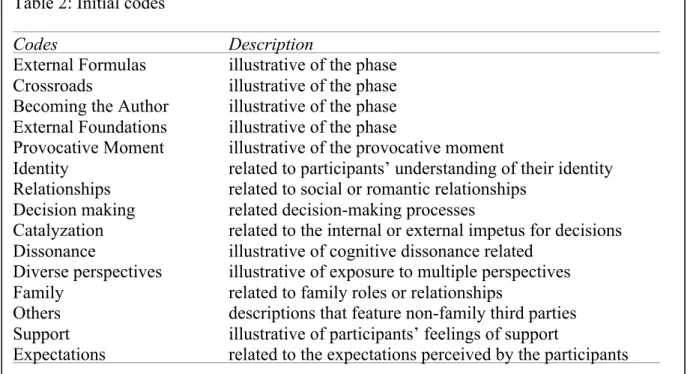
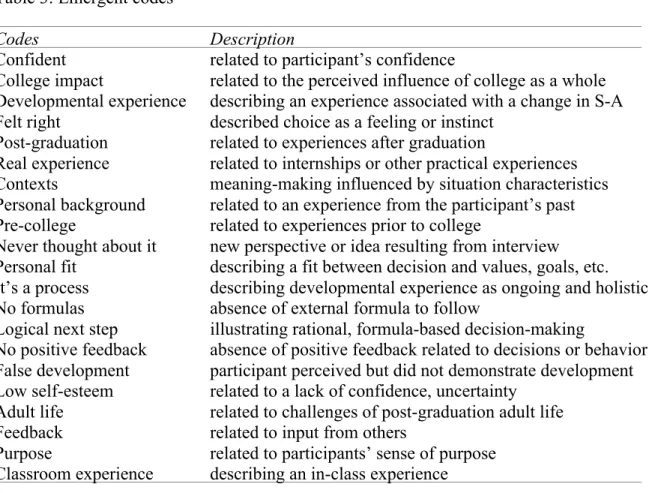
Appendix D: Codes and Themes ... 147
Appendix E: IRB Documentation ... 150
CHAPTER ONE Introduction Background
At work and at home, adults are challenged to seek out and analyze information from a
variety of sources, weigh competing interests, make difficult decisions, work in teams with
diverse others, argue their positions, communicate effectively, and more (Association of
American Colleges and Universities, 2007; Atkinson, 2010; Baxter Magolda, 2001; Kegan,
2004). Research suggests that individuals able to meet these challenges recognize the contextual
nature of knowledge, direct their lives based on internal values and priorities, and actively
manage their relationships with others (Baxter Magolda, 1998, 2001; Pizzolato, 2003, 2005,
2006). These are the hallmarks of self-authorship; a way of knowing that allows individuals to
exert control over their lives (Baxter Magolda, 1998; Kegan, 1994).
Self-authorship is a developmental achievement requiring the integration of cognitive,
intrapersonal, and interpersonal complexity (Baxter Magolda, 1998; Wildman, 2007). Cognitive
complexity, as discussed here, refers to the individual’s ability to recognize knowledge as
socially constructed, while intrapersonal complexity requires the individual to develop an
understanding of his or her own goals, values, and identity. Individuals demonstrate
interpersonal complexity by actively managing relationships with others and engaging with
multiple perspectives without abandoning personal autonomy (Baxter Magolda, 1998).
Self-authorship, as a way of knowing, emphasizes the intertwining of these dimensions (Kegan,
1994). For instance, an individual’s sense of self is incomplete without an understanding of his
or her identity in relation to others (Torres & Hernandez, 2007), and the recognition of the
constructed nature of knowledge can help an individual gain confidence in his or her own
dimensions is “necessary for adults to build complex belief systems, to form a coherent sense of
identity, and to develop authentic, mature relations with diverse others” (Baxter Magolda, 2001,
p. 269).
The development of these dimensions toward self-authorship occurs in four phases
according to Baxter Magolda (2001): Following External Formulas, The Crossroads, Becoming
the Author of One’s Own Life, and Internal Foundations. These four phases track the emergence
of an internal voice that allows the individual to actively manage his or her life rather than
simply experience it (Baxter Magolda, 1998). Individuals who Follow External Formulas rely
“on perspectives they have uncritically accepted from others” (Hodge, Baxter Magolda, &
Haynes, 2009, p. 16) to inform their decision-making and behavior. As the individual encounters
situations where these external perspectives and formulas do not yield positive outcomes and
begins to recognize that knowledge is uncertain, and even contextual, the individual moves into
The Crossroads phase (Baxter Magolda, 2001; Hodge, Baxter Magolda, & Haynes, 2009).
The Crossroads is characterized by the departure from recommendations of authority
figures and the attempt to redefine dependent relationships, such as those with advisors, romantic
partners, or parents. Individuals in the Crossroads phase begin to recognize the need to develop
their own perspectives and their own internal values, beliefs, and goals, but may still be heavily
influenced by external formulas. Becoming the Author of One’s Own Life requires individuals to
construct their own internally defined beliefs about knowledge, about themselves, and about the
nature of their relationships with others (Baxter Magolda, 2001). Individuals Becoming the
Authors of their lives focus almost entirely on their internal perspectives, at the expense of
potentially valuable external sources of information. Realizing that their internal beliefs may not
phase. Internal Foundations balances these new internally-defined ways of knowing with the
perspectives of others and with other external realities. For instance, individuals in the Internal
Foundations phase are able to accept and consider advice from authority figures without being
controlled by that advice. As individuals progress through these phases, they become
increasingly self-authored. Individuals in the Becoming the Author of One’s Own Life and
Internal Foundations phases tend to be described as having a self-authored perspective (Laughlin
& Creamer, 2007; Pizzolato, 2005, 2006).
Movement through these phases occurs as individuals seek new, better ways to make
meaning of their world. When faced with new knowledge that undermines previously held
perspectives, one may begin to recognize that knowledge is constructed (Piaget, 1950). When
forced to choose between competing values, the individual may reflect on what each value
means to him or her. When relationships with others diminish one’s sense of self, the individual
may seek new relationships that foster the sense of self instead. The literature related to
self-authorship identifies such dissonance as a key catalyst for self-self-authorship development.
Participants in Baxter Magolda’s (1998, 2001) longitudinal study of recent college graduates’
development moved toward self-authorship as a result of dissonance in the workplace or in
graduate school, where they were faced with complex tasks, challenged to work independently,
and expected to complete tasks without detailed instructions. In addition, individuals who
experience dissonance when faced with stereotypes related to their racial or sexual orientation
may feel compelled to rethink their understanding of themselves and their relationships with
others (Torres & Hernandez, 2007). The literature is replete with examples of
self-authorship-promoting dissonance stemming from nearly every aspect of individuals’ personal and
Hernandez, 2007). However, whether or not experiences of dissonance result in self-authorship
development depends largely on a variety of factors.
As individuals manage dissonance, situational, environmental, and personal factors
determine whether self-authorship development occurs, or whether the individual retreats to the
comfort of Following External Formulas. For instance, Pizzolato (2005) found that students were
more likely to demonstrate self-authorship if they demonstrated high volitional efficacy and self-
regulation, two personal characteristics. Situational factors, such as exposure to diverse
perspectives (King, Baxter Magolda, Barber, Kendall Brown, & Lindsay, 2009), and
environmental factors, such as support structures (Torres & Hernandez, 2007), have been
identified as influencing self-authorship development. However, any of these situational,
environmental, or personal factors alone are unlikely to promote self-authorship development
(Taylor, 2008).
Even though interaction with diverse peers is indicated as an experience that can promote
self-authorship (King et al., 2009), Torres & Hernandez (2007) and Pizzolato (2004) found that
participants who were marginalized due to language barriers or their status as high-risk students
(respectively) retreated from internally defined beliefs and goals in favor of conforming to more
immediately beneficial external expectations. These students likely lacked the necessary coping
skills (a personal characteristic) and support from others (an environmental factor) to effectively
manage their marginalization in ways that allowed for their continued development (Pizzolato,
2004). Many students face difficult choices related to their choice of majors and careers, a form
of dissonance identified as a prompt for self-authorship development (Pizzolato, 2005).
However, absent the kind of advising practices that promote self-authorship, some students
their own internal values or the others’ qualifications related to the decision at hand (Creamer &
Laughlin, 2005). Just as individuals may progress through the four phases toward
self-authorship, it is also possible to stagnate in a phase, or even retreat to an earlier phase (Taylor,
2008).
Considering the personal and environmental chemistry required for self-authorship
development, it may come as little surprise that, as presented in the literature, most college
students do not graduate with a self-authored perspective (Baxter Magolda, 1992, 2001; Baxter
Magolda, King, Stephenson, King & Kitchener, 1994; King et al., 2009; Torres & Hernandez,
2007). Baxter Magolda’s (1992) study of college students’ epistemological development found
that her participants persisted in the Following External Formulas phase, focusing on becoming
what they thought society wanted them to become. Laughlin and Creamer (2007) found a
“reluctance, if not inability, to genuinely consider input from diverse others” amongst their
college participants (p. 48). Indeed, Baxter Magolda (2001) estimates that most college graduates
develop a self-authored perspective closer to their 30’s than in their college years.
The lack of self-authorship development in college is particularly relevant as several new
findings and voices suggest that college graduates lack the skills and knowledge vital to success
in the twenty-first century (Arum & Roksa, 2011; Atkinson, 2010; Carey, 2011; Jaschik, 2007).
Atkinson (2010) described recent graduates as being vastly unprepared for employment in
entry-level positions that require them to know “how to think, how to write, how to speak intelligently,
how to find information and make sense of it, and how to argue coherently…” (para. 7). In a
survey of 302 employers, the American Association of Colleges & Universities (AAC&U)
(2007) found that a majority of employers wanted more emphasis placed on a variety of skills
teamwork, and analytic reasoning. These skills require the integration of cognitive, intrapersonal
and interpersonal complexity that defines self-authorship.
The development of a self-authored way of knowing by more college graduates “is a
broad and ambitious educational goal – as demanding as the problems we as a nation face in the
21st century” (Baxter Magolda, 2004, p. 304). The skills and abilities associated with
self-authorship would not only help graduates succeed in the workplace, but also to develop goals
and build relationships that are more satisfying at work and at home (Pizzolato, 2006). The
development of strong internal values and the skill to manage relationships, rather than be
managed by them, would likely help graduates steer away from behaviors and decisions that
would lead to negative outcomes, such as legal troubles or interpersonal conflict (Baxter
Magolda, 2003; Piper, 1997). In her study, Baxter Magolda (2001) noted that many of her
participants
had significant responsibility in society in their early twenties – they held responsible
jobs in both the public and private sector; they became community leaders; they had
children. They are our children’s teachers, our accountants, our lawyers and doctors.
Many had these responsibilities before they had traversed The Crossroads to Become the
Authors of the Own Lives. They would have been better prepared for these roles, and
have struggled less, had the conditions for self-authorship been created during their
college experience (p. xxii).
Self-authored graduates would let their internal beliefs and values guide their understanding of
truth (Hodge, Baxter Magolda & Haynes, 2009), reflect on how their actions impact themselves
and others, and “see their individual decisions within a context of goals and situations...larger
the kinds of internal processes needed by participants and leaders in a democratic, multicultural
society. Self-authorship is clearly emerging as a developmental achievement that benefits
individuals, employers, and society at large. Promoting self-authorship development in a greater
number of college students would thus serve the interests of institutions of higher education as
well as those of students.
Despite being a relatively new concept, a growing body of literature describes college
students’ self-authorship development. These studies provide insight into the conditions and
factors that promote or disrupt self-authorship development. Several studies have established the
link between self-authorship and personal traits, such as coping strategies, volitional efficacy,
and ethnic identity (Pizzolato, 2004, 2005; Torres & Hernandez, 2007). Others have assessed the
positive impact of intentionally designed experiences on students’ self-authorship development,
such as residence hall community models (Piper, 1997) and service learning courses (Jones &
Abes, 2004). Pizzolato (2006) found that academic advisors who demonstrated techniques
described in the Learning Partnerships Model (Baxter Magolda, 1998; Baxter Magolda & King,
2004) helped their students develop self-authorship. In addition, several characteristics of
students’ experiences have been found to promote self-authorship, including interaction with
diverse others and exposure to different perspectives (King et al., 2009).
The existing research provides information about college students’ self-authorship
development, as well as the opportunities and implications thereof, but is limited by the
prominent use of a methodological approach that may limit the amount and kinds of data
available to the researcher. Most of the research related to college students’ self-authorship
utilizes an interview approach which prompts students to describe an important decision or
2005, 2006). Researchers then interpret the response to determine whether the student
demonstrates a self-authored perspective, and if so, to go back to analyze the text for factors that
might have affected the students’ decision-making process. For instance, Pizzolato (2006)
analyzed comments about the role of the academic advisor in students’ accounts of their
selection of an academic major, and used these data to find relationships between advising
practices and self-authored approaches to major selection. Jones and Abes (2004) asked students
to describe the influence of their experience in a service-learning course on their understanding
of their own identity. From these descriptions, the authors drew conclusions about the students’
degree of self-authorship and how the service-learning experience contributed to it.
Despite the prevalence of its use, there are several potential weaknesses associated with
this approach (Baxter Magolda, 2007; Laughlin & Creamer, 2007). For instance, the description
of an experience in which the student did not demonstrate a self-authored way of knowing does
not necessarily indicate that the student is not self-authored, particularly when describing past
experiences. Pizzolato (2005) notes that the provocative moment that signifies the shift from The
Crossroads to Becoming the Author of One’s Own Life might take place within a single
experience, or might represent the culmination of a variety of experiences. Studies that examine
a student’s description of only a specific experience, like Pizzolato’s (2005), cannot consider the
latter. Finally, interview studies in which self-authorship is merely an analytical framework, such
as Torres and Hernandez (2007) and Jones and Abes (2004), are heavily influenced by the
participants’ ability to identify the relevant characteristics of that experience. Barber and King
(2007) indicated that their study of the demands that create developmentally effective experience
was, more accurately, a study of the way students make meaning of those demands. Their study
In short, what we know about college students’ self-authorship is rooted not in data explicitly
about self-authorship. Rather, self-authorship is teased from the data, and findings are heavily
dependent on whether or not the student has chosen to describe an experience that yields relevant
information.
Statement of the Problem
Self-authorship is a way of knowing that allows individuals to exert control over their
lives, and is instrumental in helping individuals succeed as adults in modern society (Baxter
Magolda, 1998; Kegan, 1994). In addition, the development of self-authorship by students in
their college years is significant due to the benefits of such development for the individual,
employers, and society at large. Present literature describes the development of self-authorship as
a complex process that requires a variety of personal and environmental characteristics rooted in
the individual’s ability to synthesize and learn from multiple experiences across three
developmental domains. Development can occur in college, and several aspects of the college
experience are well suited for the intentional development of self-authorship. However, and
despite the congruence between several intended outcomes associated with higher education and
self-authorship, few college students graduate with a self-authored perspective (Baxter Magolda,
2001).
The research related to college students’ self-authorship is primarily informed by
students’ accounts of (a) experiences deemed by either the student or researcher as relevant, and
how those experiences affected them generally, or (b) their experience as members of identity
groups or participants in developmental programs. From these accounts, researchers draw
conclusions about the students’ demonstration or development of self-authorship, and about the
present students’ descriptions of a specific choice (e.g., Pizzolato, 2006), of their experience as a
member of a minority group (e.g., Torres & Hernandez, 2007), or their experience in a program
designed or perceived to influence self-authorship (e.g., Egart & Healy, 2004), or of an
experience that the student identified as having been developmentally significant (e.g., King et
al., 2009). As such, our understanding of self-authorship development in college is rooted in data
limited to moments in time or to a priori themes (e.g., high risk students in Pizzolato, 2003;
service learning in Jones & Abes, 2004).
We lack holistic descriptions of students’ self-authorship development that trace
development through a variety of college experiences over time, despite evidence that change
occurs slowly, and as a culmination of a variety of personal experiences (Baxter Magolda, 2001,
Kegan, 1994; Pizzolato, 2005). Furthermore, students have previously not been asked directly
about their self-authorship. Asking students to reflect on and discuss their self-authorship
development, rather than an experience identified as being related to self-authorship, allows
participants to provide information outside of the constraints imposed by the specific focus of
existing studies. Students’ stories of their development, free of parameters related to their
identity or their involvement in a specific program, may provide a more holistic understanding of
the relationship between college and self-authorship.
In addition, most of our understanding of college students’ self-authorship development
is derived from students’ prompted descriptions of an academic experience, of their interactions
with an advisor, or of their interactions with peers. These data provide valuable information, but
not knowing how students themselves describe and make meaning of their holistic development
over time represents a significant gap in the literature. Students’ own words regarding their
Statement of the Purpose
The purpose of this study was to explore the ways students make meaning of their
self-authorship development in college. The study was guided by three research questions.
1. What degree of self-authorship is reflected in students’ discussion of their college
experiences?
2. How do students describe their self-authorship development during college?
3. How do students’ descriptions of their self-authorship development during college
compare to existing findings related to situational, environmental, and personal
characteristics?
Significance of the Study
This study of students’ own understanding of their self-authorship development makes a
significant contribution to the self-authorship literature. A rich description of the way students
understand their journey toward self-authorship during college provides a more holistic view of
college students’ development than exists in the current self-authorship literature, provides a
college student analog to Baxter Magolda’s (2001) study of college graduates, and responds to
the call in the literature for a “more holistic framework for understanding and fostering students’
intellectual growth” (Meszaros, 2007, p. 13). In addition, gaining insight into students’ own ways
of making meaning of their development, in their own words, addresses a significant gap in the
literature, and provides findings that enhance our understanding of college students’
authorship. The study also raised a number of questions related to our understanding of
self-authorship and its development, which led to several recommendations for future research. These
Theoretical Framework
The study is informed by Baxter Magolda’s (2001) theory of Self-Authorship
Development. The theory suggests that individuals develop through four phases of development
as they recognize new ways of understanding their world. Individuals are initially beholden to
external formulas for engaging in cognitive, interpersonal and intrapersonal understanding,
become unsatisfied with the utility of these formulas in their day-to-day lives, begin to identify
and trust in their internal voice, and finally rely on internally defined core beliefs to make
meaning of their world, their relationships, and their identity. A detailed description of the theory
is provided in Chapter Two.
Organization of the Study
The study is organized into five chapters. Chapter One described the challenges facing
college graduates in modern society, the need for students to be able to self-author as they
navigate their adult lives, and the need to know more about how students develop
self-authorship. This chapter also identified a gap in the literature related to students’ own
understanding of their self-authorship and their description of the self-authorship development,
and identified the problem, purpose and research questions, and significance of the study.
Chapter Two provides a critical review of the research and literature related to college students’
authorship, including the origin of the concept, Baxter Magolda’s (2001) theory of
self-authorship development, the situational, environmental, and personal characteristics that
influence development, and findings related to self-authorship development among college
students. Chapter Three details the methods and procedures used to conduct the study. Chapter
provides a review of the study’s findings, a discussion of the findings in relationship to extant
CHAPTER TWO Review of the Literature
This chapter describes the current body of literature related to college students’
self-authorship, including the origin of the concept, Baxter Magolda’s (2001) Self-Authorship
Development theory, movement through the phases, the situational, environmental, and personal
characteristics that influence development, and findings related to self-authorship development
among college students.
History of the Construct
Based on observations made during years of teaching and therapy, Robert Kegan (1982)
presented a constructivist-developmental theory of human development rooted in the individual’s
meaning-making processes. Constructive-developmental theory emphasizes the importance of
the individual’s experience on their development, and posits that development occurs as
experiences provide the individual with information that disrupts his or her current way of seeing
the world. Kegan (1982) described his work as “empirically grounded speculation” (p. ix), but
expanded on the theory in 1994 using cross-sectional literature analysis and Subject-Object
Interview research. Specifics related the participants or methodology used were not reported,
however. Kegan (1994) focused on the mismatch between the demands of adult life and the
curriculum by which educational and social structures influence human development. He
articulated five orders of consciousness. While Kegan did not specifically name these orders,
Love and Guthrie (1999) label these as, from the first order to the fifth, Single Point, Durable
Categories, Cross-categorical Thinking, Cross-categorical Constructing, and Transystem.
While individuals’ progress through the orders is unique to their experiences, the first and
second orders are usually present in children, the third order usually defines adolescence, and the
Single Point order of consciousness are motivated by immediate feelings and struggle to
recognize the consistency of rules, natural laws, and identity from moment to moment. As they
experience the outcomes of following or not following rules (such as being rewarded with desert
for eating their vegetables), and as they recognize patterns in the behaviors and needs of others,
the first order of consciousness becomes less useful. In response to the need to develop a new
way of seeing their world, children move into the Durable Categories order of consciousness. In
the second order, they understand rules and the autonomy of others, but only as barriers or aids
in the achievement of their desires. As they experience negative consequences of lashing out
against individuals or rules which bar them from their desires, individuals gain the ability to
manage their desires and impulses, mostly out of subordination to the expectations of others.
This shift signifies the third order of consciousness, Cross-categorical Thinking. Individuals in
this stage adopt behaviors and personality traits according to their perceived utility in fitting into
a certain group or institution.
In the fourth order of consciousness, called Cross-categorical Construction by Guthrie
and Love (1999), adults begin to develop a sense of self that is independent of the desires and
expectations of others. Individuals in this stage are empathetic, and consider the expectations and
perspectives of others. They utilize internal belief systems to mediate conflicting perspectives
and ambiguous decisions. Rather than experiencing their lives as a character in a story,
individuals in the fourth order act as the authors of their lives, hence Kegan’s term
“self-authorship.” Kegan (1994) described the shift into the fourth order of consciousness as a slow
one in which the individual begins to consider and then eventually practice self-authorship in his
or her cognitive processes, sense of self, and interactions with others, but not necessarily
become able to successfully manage their lives. Fifth-order or Transystem consciousness
requires the individual to embrace paradox and uncertainty, and to recognize their place in the
context of complex systems and relationships, and rarely occurs.
Because development occurs as a result of individuals’ experiences, progress is not
certain. According to Kegan, absent experiences that cause individuals to reframe their
meaning-making, and the personal traits that allow them to do so, the individual will stagnate and struggle
to succeed in increasingly demanding situations (1982). Conversely, individuals whose
experiences compel them to seek new ways of understanding their world progress to the next
order of consciousness.
Kegan (1994) identified three distinct, but integrated, domains that comprise the fourth
order of consciousness: epistemological (more commonly referred to as the cognitive domain),
intrapersonal, and interpersonal. Self-authored individuals demonstrate fourth order
meaning-making not only through seeking out and constructing knowledge (cognitive domain), but also in
cultivating an autonomous sense of self (intrapersonal domain), and managing relationships
according to internally-defined goals and values (interpersonal domain). Kegan wrote that
individuals develop self-authorship as they are able to make these domains object rather than
subject. An individual’s approach to relationships, for instance, is subject if the individual is
unaware of the elements of their interpersonal skills; if she is unaware that other approaches to
relationships are possible. The individual has made relationship-building object, however, if she
“can reflect on, handle, look at, be responsible for, …take control of, internalize, assimilate, or
otherwise operate upon” (Kegan, 1994, p. 32) the way she approaches relationships.
Self-authorship, according to Kegan, requires that individuals make their sense of self, their approach
Building on Kegan’s (1994) work, and her own exploration of college students’ cognitive
development, Baxter Magolda (2001) provided empirical support for Kegan’s claims and
described the development of self-authorship, effectively transforming Kegan’s (1994)
developmental stage into a fully-realized theory of development. As Baxter Magolda (1992,
1998, 2001) sought to understand the data from her ongoing, longitudinal study of recent college
graduates, she recognized in self-authorship a suitable framework for her analysis. Baxter
Magolda (1992) engaged college students in a longitudinal study of their meaning-making in
college. The findings of this study, which involved annual in-depth, semi-structured interviews
related to their cognitive development, were presented in the book, Knowing and Reasoning in
College. Thirty-nine of the participants continued to be studied for 10 years after graduation. As
the recent graduates began to initiate conversations about intrapersonal and interpersonal issues,
Baxter Magolda (1998, 2001) adapted her interview protocol to investigate not only the
meaning-making dimension of individuals’ development, but also the emergence of
internally-defined values and behaviors. In these interviews, Baxter Magolda (1998, 2001) focused on
“important learning experiences” (1998, p. 147) as identified by the participant from the past
year. Baxter Magolda asked participants to also discuss the most relevant and demanding aspects
of their lives, and how their ways of making meaning of their world had changed since the
previous interview.
During the study, participants worked in the areas of business (19), education (7), social
work, law, homemaking, and ministry (a total of 13 in the latter four categories). It should be
noted that only three of Baxter Magolda’s (1992) original participants were members of
underrepresented or minority groups, and none of these participants persisted in the study
are derived from what could be considered a relatively narrow range of perspectives and
backgrounds.
The findings of this study included the identification of traits associated with
self-authorship (1998), the existence and interrelationship of three domains of self-self-authorship (1998,
2001), and the development of a four-phase theory of self-authorship development (2001).
Baxter Magolda (1998) found that individuals who self-authored demonstrated four traits: trust
in their ability to internally define knowledge and personal priorities, the confidence to act in
accordance with priorities, the ability to balance interpersonal and environmental realities with
personal priorities, and the ability to prioritize personal knowledge claims and goals over the
needs of others in relationships. Utilizing the same data, Baxter Magolda (2001), also found that
three questions were central to her participants’ development in their 20’s: “How do I know?”
“Who am I?” and “What relationships do I want to have with others?” (Baxter Magolda, 2001, p.
4).
These findings provided empirical evidence of Kegan’s (1994) concept of
self-authorship, his assertions regarding subject/object orientation, and his identification of the
cognitive, intrapersonal, and interpersonal domains as dimensions of self-authorship. Baxter
Magolda (1998, 2001) advanced the understanding of these domains as well. As participants
reflected on issues related to workplace challenges or personal decisions, they frequently referred
to more than one of the domains as weighing on their decisions. As such, Baxter Magolda (2001)
found that the three domains “intertwine” (p. 36), noting, “[the participants] could not address
the epistemological dimension, or the ‘how you know’ question, without working with the other
Pizzolato and Ozaki (2007) provided support for Baxter Magolda’s concept of
intertwined domains in their study of 18 students’ experience in an academic advising program
designed to foster self-authorship. Pizzolato and Ozaki (2007) assessed the impact of an
academic advising model based on the Learning Partnerships Model (LPM, described in detail
later in this chapter) using an exploratory, qualitative, grounded study approach involving 18
participants at a large, public, Midwestern university. The researchers analyzed audio recordings
of students’ advising meetings, and conducted two one-hour interviews with each student
focusing on the student’s college experiences and academic planning and decision-making. In
addition to other findings described later in the chapter, Pizzolato and Ozaki (2007) found that
students’ intrapersonal reflections often resulted from interpersonal conflicts. Further support
was provided by King, Baxter Magolda, Barber, Brown, and Lindsay (2009), who found that
self-authorship development outcomes, including awareness and openness to diversity, exploring
beliefs and choices, identity development, and responsibility for learning, were interrelated. King
et al. (2009) found that participants’ interactions with diverse others often led to the exploration
of personal beliefs. Similarly, they found that experiences that contribute to identity development
compelled their participants to take responsibility for their increased learning and development.
These findings support the contention that the three domains intertwine as individuals develop
self-authorship.
Baxter Magolda’s Theory of Self-Authorship Development
As Baxter Magolda (1998, 2001) engaged her participants regarding the developmental
experiences in their lives, she identified similarities in the their journey toward self-authorship.
She found that her participants demonstrated an increasing commitment to an “internal voice”
“What relationships do I want to have with others?” Based on the changing nature of individuals’
responses to their annual interviews, Baxter Magolda (2001) found four distinct phases of
self-authorship development: Following External Formulas, The Crossroads, Becoming the Author of
One’s Own Life, and Internal Foundations. The following sections will describe each phase in
detail, drawing from Baxter Magolda’s (2001) original theory as well as the findings from other
self-authorship research.
Following External Formulas. In the first phase, Following External Formulas,
individuals seek to accommodate the expectations and demands of others (Baxter Magolda,
2001). Many of Baxter Magolda’s (2001) participants’ career plans reflected their reliance on
external formulas, having been provided by parents, siblings, mentors, or older students.
Individuals are able to develop their own responses to challenges, and to reason autonomously,
but may become insecure absent external validation and approval. External formula followers
may use language that reflects their control over their lives, their commitment to a unique
identity, and their independence, but only as mimics, emulating the behaviors of self-authored
others (Torres & Hernandez, 2007). Such language may also reveal a desire to portray the
externally defined image of adulthood. For instance, one participant in Baxter Magolda’s (2001)
study decided to marry his girlfriend in order to acquiesce her. Another expressed shock when
she became pregnant before her detailed life plan called for such a development. In their careers,
individuals expected success to result from “doing what one was supposed to do to” (p. 78).
Baxter Magolda (2001) assessed these and other responses as evidence of participants’
commitment to “the standard plan for adult life” (p. 76).
Even when individuals in this phase recognize the conflict between their internal desires
a new external voice that supports their perspective (Baxter Magolda, 2001). In their longitudinal
study of Latino/a students’ development during college, Torres and Hernandez (2007) found that
individuals following external formulas often avoid experiences or perspectives disruptive to
their worldview. In an exploratory, qualitative study of 27 college freshmen designated by their
institution as “high-risk,” Pizzolato (2004) found that students relied on external formulas to fit
in and that the characteristics of this phase were well suited for achieving short-term social goals,
particularly for individuals who felt different from their peers. The priority in this phase is not to
identify the best course of action or perspective, but to discern the course of action or perspective
that is advocated by trusted individuals or authorities (Creamer & Laughlin, 2005; Torres &
Hernandez, 2007). Creamer and Laughlin (2005) examined the career decision-making processes
of 40 undergraduate college women based on interview responses, and found that their parents,
not career counselors, served as the primary influence on their career interests. This practice of
“relying on such a circumscribed circle of acquaintances for career information” (Creamer &
Laughlin, 2005, p. 19) and other advice, as opposed to trained professionals, poses many
challenges for individuals working to succeed the modern world. Following External Formulas
makes individuals vulnerable to buying into stereotypes, even stereotypes linking to one’s own
culture (Torres & Hernandez, 2007), limiting their ability to engage with diverse others. .
The Crossroads and the provocative moment.Individuals shift from Following
External Formulas into The Crossroads as they recognize the inadequacy of reliance on the
advice, expectations, and demands of others. Recognition may follow negative experiences, such
as the derailment of career paths, failed relationships, a lack of fulfillment despite faithful
adherence to external formulas for success (Baxter Magolda, 2001), or exposure to conflicting
case-study of 29 female teachers participating in two graduate programs designed to contribute to the
teachers’ self-authorship, Collay and Cooper (2008) found that individuals may feel incapable of
making difficult decisions between desirable options, such as career and parenting dilemmas.
Torres and Hernandez (2007) found that participants in a longitudinal qualitative study of Latino
students’ development in college began to recognize that a single correct answer may not exist,
and that there were multiple paths to their success. This realization helped students to “recognize
negative stereotypes as racist and, as a result, [make] deliberate choices about how these negative
images would influence how they saw themselves as Latinos/as” (p. 564). These choices, and
others, represented new challenges for individuals who previously made decisions based on the
example or advice of trusted others.
The Crossroads is defined by the realized need for “internal sources of belief and
definition” (Baxter Magolda, 2001, p. 93). Faced with competing external interests, parental
expectations, or unfulfilling career prospects, individuals recognize the need to assert
themselves, to develop the means to manage these challenges rather than be managed by them.
However, individuals in this phase lacking the “internal mechanism” (Baxter Magolda, 2001, p.
97) to consider these challenges from an internal perspective, may adopt defeatist attitudes (e.g.,
Baxter Magolda, p. 97; Pizzolato, 2004, p. 434) or turn inward, hiding their desire to act and
reason in ways that honor their internal perspective (Baxter Magolda, 2001).
Just as Kegan (1994) suggested that individuals may practice self-authorship cognitively
but continue to rely on third-order consciousness in their interactions and behaviors, individuals
in The Crossroads begin to recognize their ability to articulate their own beliefs, and to make
knowledge claims, but may lack the confidence to consistently assert their emerging internal
These individuals decided when and how to act on their perceptions and beliefs based primarily
on their assessment of how others would respond. In Torres and Hernandez (2007) study, one
participant spoke out against racist remarks, but stopped short of internalizing his rejection of
racism in principle by excusing the offenders on the grounds of their perceived ignorance. For
individuals at The Crossroads, all that is standing between them and self-authorship is the
decision to commit to their internal voice. This decision comes following what is called the
provocative moment (Pizzolato, 2003, 2005, 2006).
Described by Pizzolato (2003, 2005, 2006) as the gateway to self-authorship, the
individual’s commitment to an internal voice indicates the experience of a provocative moment.
The provocative moment results from the “jarring disequilibrium” experienced as external
formulas fail to satisfy (Pizzolato, 2005, p. 625). Pizzolato conducted three studies related to
students’ self authorship development: Pizzolato (2003) drew findings from 35 high-risk
students’ descriptions of “important experiences” (p. 801); Pizzolato (2005) analyzed 613
students’ narratives about two important decisions in order to identify relationships between
students’ experience of a provocative moment and personal or situational factors; Pizzolato
(2006) analyzed 132 student narratives related to academic advising experiences. Pizzolato
(2006) found a relationship between individuals’ refusal to follow unsatisfactory external
formulas, and their subsequent attempt to discover new options and to develop their internal
voice. Rejection of external formulas, such as parental expectations, unwanted romantic
relationships, and “the plan” (p. 635) for school and career success allowed individuals to look
inward, to what participants in this study verbalized as their heart, their pride, and their
independence. Once individuals committed to their internal voice, they began to author their own
Becoming the Author of One’s Life. As individuals enter the third phase, Becoming the
Author of One’s Life, they begin to assert there internal voice in everyday life, take a more
active role in constructing knowledge and managing relationships, and develop a more complex
awareness of their sense of self (Baxter Magolda, 2001). This is a phase of changes, as
individuals renegotiate existing relationships and take new approaches to their work and careers.
Baxter Magolda’s (2001) participants discussed a newfound awareness of their world and their
reasoning processes. This awareness allowed them to manage their world rather than be managed
by it (Kegan, 1994). For instance, Baxter Magolda’s (2001) participants described a redoubling
of effort in the face of obstacles that might have daunted them in the past, exploring their faith in
personal ways as opposed to “going through the motions” (p. 125), and being intentional about
assuming new family roles as they recognized their subservience to their family’s needs and
expectations. Torres and Hernandez (2007) found that Latino/a students’ emerging internal voice
compelled them to give back to their community and serve others, suggesting a total
commitment to their beliefs and values.
These behaviors reveal the individuals’ commitment to “developing an internal system
for making meaning of oneself, relations with others, and knowledge” (Baxter Magolda, p. 154).
Pizzolato and Ozaki (2007) found that, in service of working toward more gratifying outcomes,
individuals “place increasing emphasis on incorporating self-knowledge and goals in their
meaning making” (p. 208). For instance, one of Baxter Magolda’s (2001) participants came to
terms with his company’s partnership with a factory in China of dubious ethical standards by
framing the ill treatment of workers as the natural byproduct of progress, reflecting on our own
history of similar practices, and emphasizing national sovereignty. In this instance, the
the practices, and did not mention his company’s stance on the issue. He described his opinion as
being rooted in “deep feelings” (Baxter Magola, p. 147) on the issue. However, the participant
framed his position not in terms of values and beliefs, but in terms of historical and cultural
precedence. This, too, is an aspect of Becoming the Author of One’s Life. Individuals in this
phase may not have enough confidence to assert their internal voice on its own merits, an
indicator that the convictions are “in their heads rather than in their hearts” (Baxter Magola,
2008, p. 280).
Internal Foundations. The integration of cognitive complexity with the development of
a more complex understanding of self provides the Internal Foundation on which to make
decisions, manage dissonance, and understand one’s identity (Baxter Magolda, 2008). Baxter
Magolda (2008) utilized the same data set as in Baxter Magolda (1998, 2001) to explore in detail
the nature of self-authorship achievement. Individuals’ internal voices, which tend to take the
form of confidence in one’s reasoning, skill in the previous phase, or authority, become belief
systems more adaptable to external realities. Individuals Becoming the Author of One’s Life
might commit to a self-authored position, but through logic and reasoning. Having Internal
Foundations allows individuals to articulate the core values or beliefs that drive their behavior,
using simple language rooted not in financial factors, timing, and precedent, but in terms of
feelings, vision, and being able to “tell” (Baxter Magola, 2001, p. 171) which decision is right.
Baxter Magolda (2008) reported participants’ descriptions of a “blurring of their knowledge and
their sense of self” (p. 281). The Internal Foundation led a sense of peace, and to the confidence
to make decisions that might not be popular or respected by family members, friends, or
students’ ability to confront social pressure in the pursuit of their college aspirations was made
possible only by the confidence in their internally defined beliefs, values, and goals.
In this final phase of self-authorship development, individuals employ the same
commitment to the internal voice as in the Becoming the Author of One’s Life phase, but with
the ability to manage and embrace uncertainty, divergent perspectives, and ambiguity (Baxter
Magolda, 2001; Torres & Hernandez, 2007). Baxter Magolda (2001) described this as the
participants’ “acceptance of life as it unfolded,” (p. 180). Such acceptance led not to
complacency, however, but to more confident engagement in careers, relationships, and their
world. “In the process of becoming authors of their own lives, participants realized that they
could not control the external world; rather they could control how they made meaning of the
external world” (Baxter Magolda, 2001, p. 183).
Possessed of a newfound comfort with divergent perspectives and confidence in the
internal voice, self-authoring individuals welcome opportunities to see the world in new ways,
and to reconsider their perspectives (Baxter Magolda, 2001, 2008). In her study of high-risk
college students, Pizzolato (2004) found that self-authoring participants weighed others’
perspectives against their beliefs and values, and other external factors. Having an internal
foundation did not reduce decisions to instinctive, or “gut” (p. 429) reactions, but rather allowed
for the careful consideration of how the opinions and needs of others fit, conflicted, or
undermined established beliefs and values. Individuals whose internal voice guided their
construction of knowledge, exploration of self, and relations with others, and who welcomed
new perspectives, but who rejected the safety of following external formulas, were confident of
their ability to manage the ambiguity and challenge of adult life (Baxter Magolda, 2001, 2008;
Development Through the Phases
While Kegan (1994) and Baxter Magolda (1998, 2001) suggest that individuals who
demonstrate self-authorship will not regress to earlier phases, some research contradicts this
suggestion. Pizzolato (2004), for instance, found that, faced with sufficient “external hostility
…toward outward expression of their internal foundations” (p. 439), individuals can abandon
their internal voice in favor of more immediately gratifying external formulas. In addition, there
is evidence that individuals can progress to the next phase in one of the three domains, while
lagging behind in the others (Baxter Magolda, 2001; Pizzolato, 2004). However, Torres and
Hernandez (2007) found that the three domains develop within one phase of each other,
reflecting the interrelationship of the domains. For instance, an individual Becoming the Author
of One’s Own Life in the interpersonal domain must have at least reached The Crossroads (the
previous phase) in the other two domains.
Factors That Influence Self-Authorship Development
Three types of factors have been found to influence self-authorship development:
situational factors, environmental factors, and personal factors. In many cases, specific
situational, environmental, and personal characteristics are, in and of themselves, insufficient for
progress to the next phase of development. A discussion of the intermediary effects of various
factors will follow presentation of the three types.
Situational factors influencing development. A variety of factors related to specific
situations and experiences contribute to individuals’ self-authorship development. These factors
include the experience of dissonance (Abes & Jones, 2004; Baxter Magolda, 2001; Jehengir,
Williams, & Pete, 2011; Jones & Abes, 2004; King et al, 2009; Pizzolato, 2003, 2004; Taylor,
Magolda, 2001; Jehengir et al, 2011; Piper & Buckley, 2004; Pizzolato, 2003, 2006), internal vs.
external catalyzation (Pizzolato, 2005), and reflection (Jones & Abes, 2004; Pizzolato, 2006;
Rhoads, 2000).
Dissonance.Perhaps the most prominent theme in the self-authorship development
literature is the role of dissonance (Abes & Jones, 2004; Baxter Magolda, 2001; Jehengir,
Williams, & Pete, 2011; Jones & Abes, 2004; King et al., 2009; Pizzolato, 2003, 2004; Taylor,
2008; Torres & Hernandez, 2007). According to Taylor (2008), who conducted a meta-analysis
of present self-authorship research, “for progression of forward movement to occur, an
individual must have a sense of dissonance and disequilibrium, which disrupts his or her current
way of making meaning” (p. 230). King et al. (2009) found that development “often involved
learning from negative experiences and relationships” (p. 114). Baxter Magolda (1998, 2001)
described the tension her participants felt between conflicting values, competing goals, and the
recognition that their education did not provide the answers to many of their challenges.
Individuals also experienced dissonance as their adherence to external formulas in terms of
career and relationship choices failed to yield personal satisfaction (Baxter Magolda, 2001). She
found that engaging with these types of dissonance produced a “heightened…interest in multiple
perspectives and the process through which one (chooses) among them” (Baxter Magolda, 2001,
p. 196). In addition, dissonance can compel individuals to develop new approaches to challenges,
abandon external formulas, and reflect on their own identities in the context of diverse
perspectives (Baxter Magolda, 2001; Jehengir, Williams, & Pete, 2011; Jones & Abes, 2004;
Torres & Hernandez, 2007).
King, Baxter Magolda, Barber, Brown and Lindsay (2009) conducted 174 interviews
Study of Liberal Arts Education (WNS). The WNS was designed to “examine the practices and
conditions supporting liberal arts education” (p. 109), and engaged 600 students in a variety of
surveys and assessments. Data from the follow-up interviews examined in this study revealed a
relationship between students’ self-authorship and dissonance resulting from in a variety of
curricular and co-curricular experiences: participants who described exposure to diverse
perspectives and ambiguous challenges tended to also demonstrate self-authorship in their
problem-solving and meaning-making. More self-authored participants began to take risks in
class in order to enhance their learning, or sought to apply concepts from the classroom or
co-curricular experience to their personal lives and their views of themselves. These findings
suggest that dissonance is a necessary but insufficient factor leading to progression from one
self-authorship phase to the next.
Dissonance arising from exposure to new knowledge or perspectives weakens the
individual’s commitment to external formulas, and fosters self-authorship development (Baxter
Magolda, 2001; Jehengir, Williams, & Pete, 2011; Jones & Abes, 2004; Pizzolato, 2004; Taylor,
2008). In Baxter Magolda (2001), a participant described the dissonance resulting from his
exposure to the living conditions in Mexico. Seeing families burn tires for warmth first-hand
caused him to rethink his former rejection of the practice on environmental grounds. Jones and
Abes (2004) conducted in-depth interviews with eight students who had taken part in a
service-learning experience two to four years prior to the study in order to assess the long-term
developmental impact of the experience. All of the participants were previously enrolled in a
leadership theories course that required three hours per week of community service with either a
food pantry or an AIDS service organization. During the interviews, participants were asked to
as well as other influences related to personal development. Findings suggested that nearly all of
the students gained an “awareness of economic and education privilege and the advantages
accompanying such privilege” (p. 155), which disrupted their understanding of their own
background in comparison with the backgrounds of others. The diversity of individuals both
working in and served by the service sites also disrupted students’ previously held beliefs. These
experiences of dissonance caused them to recognize the inadequacy of their previously held
external formulas, and to be more open-minded about new people and new ideas, suggesting
cognitive development toward a self-authored perspective.
Experiences of dissonance appear to harken the individual’s departure from the
Following External Formulas phase of self-authorship development. Jehangir, Williams, and
Pete (2011) found that students experience dissonance when challenged to engage topics such as
religion, race, and gender with diverse others. As students struggled to meet the challenge, they
discovered unexpected commonalities and differences, and began to abandon externally
informed stereotypes. These findings emerged from a case study designed to explore the
influence of a multicultural learning community on students’ self-authorship development at a
large Midwestern research university. The authors conducted interviews with 24 first-generation
college students three to four years after their experience in the learning community, and found
that the integration of social and academic experiences in the learning community fostered their
self-authorship development over time.
Abes and Jones (2004) conducted three in-depth interviews with ten women at a large,
public research university in the Midwest in order to examine the relationship between
Their findings indicated that the participants’ sexual orientation identity development occurred
independent from that of other identities. Also, they identified the dissonance the participants
experienced as they attempted to make meaning of stereotypes, labels, and expectations related
to their sexual orientation identity as a contributing factor in their development. Pizzolato (2004)
and Torres and Hernandez (2007) also found students’ recognition of and discomfort with racial,
ethnic, and performance labels to be a significant factor in their self-authorship development.
Rejecting or reconstituting these external formulas allowed the participants to develop an
internally defined identity (Abes & Jones, 2004; Torres & Hernandez, 2007).
While the experience and management of dissonance is an important catalyst for
self-authorship development (Baxter Magolda, 2001), individuals may not always possess the ability
to manage dissonance in constructive ways, causing them to retreat to the safety of practiced
External Formulas. For instance, one of Torres and Hernandez’s (2007) participants changed her
major to Spanish in order to avoid being mocked for her accent in courses required for teaching,
her original field. Pizzolato (2003, 2004) found that first-year high-risk students may enter
college with self-authored ways of knowing. Pizzolato (2003) conducted one interview each with
35 students participating in support programs for high-risk students at a large Midwestern
university designed to explore and contrast students’ pre-college and early-college ways of
processing their experiences. Pizzolato (2004) examined the ways first-year, high-risk students
made sense of and coped with their college experiences. For high-risk students, making it to
college in the face of lesser expectations and limited social and./or academic support required
self-authorship. In fact, students with less college admissions privilege, defined by Pizzolato
(2003) as “the unsolicited benefit of not having to figure out how to apply to or pay for college”
Despite their development prior to college, their college experiences created significant
disequilibrium in their confidence, and their trust in their internal voice. Feeling less prepared
than their classmates and recognizing the different treatment they received from advisors and
teachers caused these students to “stop acting in ways that fit with their entering goals and beliefs
– their internal foundations. They opted instead to fit in” (p. 432). Just as dissonance may
instigate individuals’ commitment to developing their internal voice, it may also cause
individuals to retreat to the comfort of external definitions. Dissonance is a necessary but
insufficient factor in self-authorship development. Other personal, environmental, and situational
characteristics are at play as well.
Responsibility for knowledge construction. Situations that task individuals with taking
part in the meaning-making process promote self-authorship development (Baxter Magolda,
2001; Egart & Healy, 2004; Jehengir et al, 2011; Piper & Buckley, 2004). Baxter Magolda
(2001) found that recent college graduates did not anticipate, and were ill-prepared for, the
degree of autonomy experienced in their adult lives. At multiple levels of employment (i.e. –
entry-level, management), participants discussed the lack of specific instructions and their
employers’ expectations of autonomy, which, while challenging for the participants, compelled
them to discern the best way to work toward their goals on their own, rather than simply carrying
out an external formula for success. Egart and Healy (2004) examined the assignments, journals,
and interviews of participants in an internship program designed to foster student development.
“One of the most noticeable contrasts that students identified regarding the classroom experience
and the internship experience was the expectation that they be the knowers – that what they