Open Research Online
The Open University’s repository of research publications
and other research outputs
The possible impact of the organisation on the
effectiveness of workplace learning
Thesis
How to cite:
Palmer, Christina Louisa (2014). The possible impact of the organisation on the effectiveness of workplace learning. EdD thesis The Open University.
For guidance on citations see FAQs.
c
2013 The Author Version: Version of Record
Copyright and Moral Rights for the articles on this site are retained by the individual authors and/or other copyright owners. For more information on Open Research Online’s data policy on reuse of materials please consult the policies page.
I
II .
I
I
!
Christina Louisa Palmer
SA, MA, MEd
The Possible Impact of the
Organisation on the Effectiveness
of Workplace Learning
Doctorate in Education
The Open University
January 2013
1
D
ate
OJ
Su.brv\.ls5l
o~,' ~
60
J()l\Ua~
2013
Abstract
This thesis explores how dimensions of workplace learning are influenced by
organisational practices and the features of organisat!ons where workplace
learning is perceived to be effective. Its particular focus is higher education
workplace learning programmes that are tailored to meet organisational needs.
The thesis considers the literature that surrounds workplace learning and notes
the breadth of definitions relating to it, including learning which is work related,
learning which takes place within work or learning where the curriculum is
devised around work. Key authors included in the conceptual framework are
Billett (2000, 2001, 2004, 2006a, 2006b, 2008) in relation to affordances, Fuller
and Unwin (2003,2004,2006) in relation to the expansiveness and
restrictiveness of the organisation with regard to workplace learning and Eraut
.
(2004, 2007) in relation to informal learning in the workplace. Literature
examining the relationship between organisational and individual learning is also
considered.
The research is qualitative in nature, a social constructionist approach having a
predominant influence. Two case studies are used in the research project: a
multinational logistics company and a regional public sector emergency service.
Managers who were undertaking higher education workplace learning
programmes and representatives within their employing organisations who
-
n.~
'e~
{ .
i
2 0 MAY 2014
C)!
The
library
\" 318.
0\3 2Vl3
DONATION
.
Cchsu\t®'OY\
Cow
2commissioned workplace learning programmes participated in semi-structured interviews.
The findings of the research indicated that there are two major factors which impact on manager participants' perceptions of effective workplace learning:
1 Their experiences of workplace learning are closely linked to their perceptions of the time, autonomy and support they are afforded (or not) in order to engage in workplace learning activities.
2 For this particular group, effectiveness is also related to the level of synergy they feel exists between the workplace learning programme, the ., organisation and themselves.
...
Contents
Abstract ... 2
Acknowledgements ... 7
1 Introduction ... 8
1.1 Introduction ... ; ... 8
1.2 The background to the research ... 8
1.3 The context of workplace learning ... 9
1.4 Current policy perspectives ... 12
1.5 Workplace learning and higher education ... 14
1.6 Focus of the research ... 22
1.7 The case studies and research participants ... 23
1.8 Research questions ... 24
1.9 Structure of the thesis ... 25
1.10 Conclusion ... : ... 26
2 Literature Review ... 27
2.1 Introduction ... · ... 27
2.2 Definitions and context of workplace learning ... 28
2.3 How learning occurs ... 44
2.4 How organisations enable or restrict access to and participation in workplace learning. 52 . "2.5 Informal or non-formal learning ... : ... 62
2.6 Organisational factors affecting impact and effectiveness ... 69
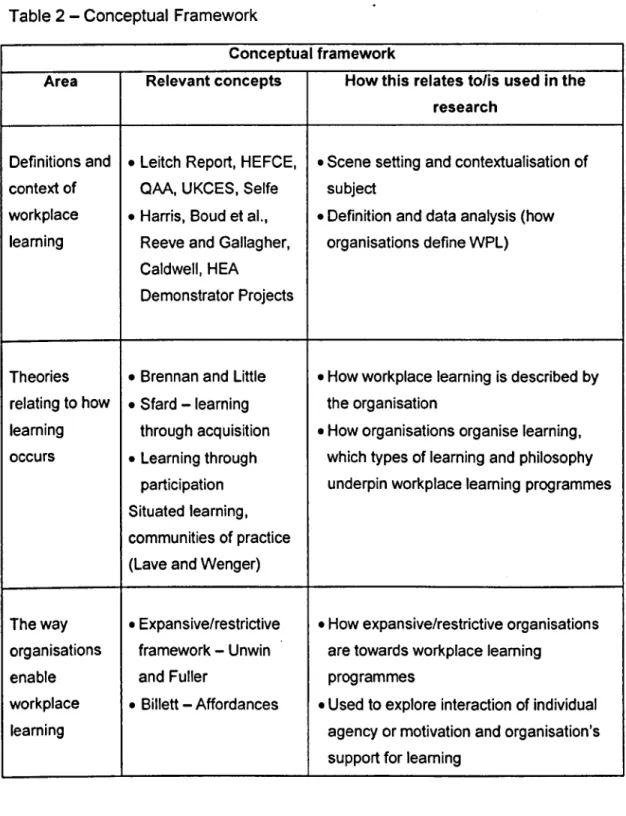
2.7 Conceptual framework ... 74
2.8 Research questions emerging from the literature review ... 76
2.9 Conclusion ... 78 3 Methodology ... 80 3.1 Introduction ... 80 3.2 Methodological approach ... 80 3.3 Qualitative/Quantitative debates ... 81 4
3.4 Constructivism ... 85
3.5 Case study approach ... 86
3.6 Choice of methods ... 92
3.7 Ethics ... 95
3.8 Validity and generalisation of the findings ... 96
3.9 The role/impact of the researcher and insider/outsider debates ... 97
3.10 Concl usi on ... 101
4 Data Collection and the Process of Analysis ... 103
4.1 Introduction ... 103
4.2 Rationale for choosing the organisations ... 103
4.3 logistics ... 104 4.4 Case study 1 ... 106 4.5 Case study 2 ... 108 4.6 Process of analysis ... :: ... 110 4.7 Validity ... 114 4.8 Reflections ... 114 4.9 Conclusion ... 116
5 Main Findings/Theme - Time ... 117
5.1 Introduction ... 117
5.2 Recap on the case studies ... 118
5.3 Demands of workplace learning and time ... 119
5.4 Autonomy ... 127
5.5 Personal circumstances ... 133
5.6 Views of 'time management' ... 139
5. 7 Conclusion ... 149
..
6 Main Findings/Theme - Synergy Between Programme, Organisation and learners ... 152
6.1 Introduction ... 152
6.2 Organisationa I strategy ... 153
6.3 learning in the social context of work ... 167
6.4 Participants position in the lifecourse ... 184
6.5 Measures of success ... 189 5
6.6 Synchronisation between work and programme ... 198
6.7 Conclusion ... 206
7 Conclusions, Reflections and Recommendations ... 209
7.1 Introduction ... 209
7.2 Conceptual framework ... 210
7.3 Research questions and how these were addressed ... 214
7.4 Claim to new knowledge ... 22S 7.5 Wider implications ... 230
7.6 Recommendations ... 231
7.7 Future work ... 237
7.8 Final reflection on my learning ... 238
References ... 242
Appendices ... 262
list of Tables Table 1- Fuller and Unwin's Expansive and Restrictive Framework (Workforce Development). S3 Table 2 - Conceptual Framework ... 75
Acknowledgements
Thanks goes to the organisations and individual participants who were involved
in the research; without their support and time the research would not have been
possible.
I would like to thank my supervisors, Dr Fiona Reeve and Dr Ann Pegg for their
unstinting support throughout the EdD programme.
I would also like to thank my partner Sean and my mother Carole for keeping me
motivated and allowing me the time to write up the thesis.
Thanks also to Maureen McHale and Gary Lister for their support with
transcribing and proof reading.
I would like to thank my friends for giving me the motivation to continue on the
EdD path.
.'
Finally, I would like to thank all the workplace learners I have worked with over
the years whose experiences inspired me to undertake this research.
1
Introduction
1.1
Introduction
The intention of the research project detailed in this thesis was to explore the context and effectiveness of higher education workplace learning. The research focused on how employees either involved in or undertaking workplace learning programmes within two organisations described effective workplace learning. It also considered their perceptions regarding organisational factors which might influence the implementation, integration and impact of workplace learning programmes.
This first chapter will introduce the research discussed in this thesis. It will explain the background to the research and offer a brief introduction to both the context of workplace learning and current policy perspectives. Workplace
learning in the higher education context will also be considered. The focus of the research will then be explored and this will be followed by an introduction to the . case studies and the research participants. The chapter will conclude with a brief
outline of the individual chapters within the thesis.
1.2 The background to the research
My interest in workplace learning emerged over a number of years, initially from .. designing and delivering learning programmes in a variety of workplaces and
latterly from delivering higher education workplace learning programmes. I was intrigued as to why the impact and outcomes achieved of similar learning programmes, delivered in a similar way were different depending on the setting within which they were delivered.
An initial study was undertaken to sample employers' views of workplace
learning, its context and definitions. This indicated that a range of understandings and approaches to workplace learning were in use. I wanted to focus on a
particular aspect of this range, namely workplace learning provided by higher education institutions. The main research project involved organisations whose
.,
employees were undertaking a higher education workplace learning programme delivered by an education provider that is a wholly owned subsidiary of auniversity. My relationship with the education provider is that I currently
undertake consultancy work on their behalf and used to be employed by them on a permanent basis. However, I had not met any of the research participants in the main study prior to the research commencing and had not been involved in delivering their workplace learning programme.
1.3 The context of workplace learning
Learning at work has a variety of different facets with a wide range of purposes, levels, interest groups and delivery methods. Employers, employees, providers and policymakers may have different perspectives on these facets and this section will provide a brief overview of the importance of learning in the
workplace for occupational formation and policy perspectives on workplace learning. These issues will also be considered further in the literature review.
Learning in the workplace can encompass many different types of learning at work. With regard to one definition, Lester and Costly (2009, p. 2) suggest that:
The term 'work-based learning' logically refers to all and any learning that is situated in the workplace or arises directly out of workplace concerns .... It includes learning that takes place at work as a normal part of development and problem-solving, in response to specific work issues, as a result of workplace training or coaching, or to further work-related aspirations and interests.
The literature review will explore further definitions of learning at work.
Although there is a long history of workplace learning in the UK, opportunities to engage in learning at work have been utilised more in some occupational sectors than others, for example nursing, engineering, and the building trades. In higher . education programmes, placements have been utilised as part of an academic
programme of learning, often leading to accreditation as a professional worker. However, for accredited post-qualifying study less workplace learning is
employed. There may also be differences within sectors whereby some roles require workers to undertake training in the workplace via apprenticeship and NVQ programmes, whereas others are more likely to favour academic
programmes. The location of the learning offered may differ, with some learning
being seen as work-related rather than work-based and delivered away from the
workplace. This was noted in the 2006 Higher Education Academy (HEA) report
into work-based learning which suggested that 'Work-based learning in health
tends to be at NVQ level, and competence-based ... there is a drift towards
"work-related" foundation degrees, based in HEls' (p. 17).
Participants from the initial study defined workplace learning as 'sitting next to
Nellie' and, learning from watching more experienced colleagues, they also noted
how it can be unplanned, occurring through interaction with colleagues. It might
tv
include elements of coaching, mentoring and reflective practice. Planned
workplace learning programmes might include one-day workshops or action
learning sets as well as programmes of learning leading to vocational and/or
academic qualifications, for example foundation degrees, NVQs, and this variety
of definitions will be explored further in the literature review.
Access to workplace learning opportunities, either informal or planned, can
depend on the type of work undertaken. For example, being on duty with limited
time to engage in learning activities or alternatively being able to manage one's
own time at work can provide more or fewer opportunities to workers and
therefore impact on engagement and related perceptions of effectiveness.
1.4 Current policy perspectives
Workplace learning has been given greater prominence over recent years due to the emerging recognition of the intrinsic link between learning and work and the importance of this in improving the predicted skills deficit over the next decade. These were highlighted in The Leitch Review of Skills, hereafter referred to as the Leitch Report (Leitch, 2006), which predicted that the average age of the workforce will increase as people work for longer. This means that new knowledge and skills are less likely to be entering the workforce, thus
precipitating a need to increase the opportunities for older workers to build on existing knowledge and gain new skills. The Report also suggested that there will be a decline in those considered to be of prime working age, that is, people aged between 25 and 49. However, it goes on to say that this group are seen as less likely to participate in training than younger workers, which can further inhibit new skills and knowledge being brought into the workplace (Leitch, 2006).
,The Ambition 2020: World Class Skills and Jobs for the UK report also found 'skills gaps' in the workforce (UKCES, 2009). The report notes that these were predominantly at level 4 for paraprofessional groups, stating that:
it is Associate professional, Skilled trades and Professional occupations where the largest volumes of skill shortage vacancies are reported. As a proportion of employment, the 'density' of skill shortage vacancies ... is far
..
higher for Associate professionals and Skill trade occupations (14 per 1,000 staff) than is the average for all vacancies.
(UKCES, 2009, p. 106)
In The National Strategic Skills Audit for England 2010 UKCES noted that this perceived skills gap and the underlying factors which led to this deficit appear to affect some sectors more than others: 'Distinct sectors experience a specific combination of drivers of demand, with particular consequences for businesses, jobs, and in turn skills' (UKCES, 2010a, p. 38). Sectors which are identified as having higher skills shortages include health and social care, the computer and software sector, manufacturing (incloding oil, gas and electricity),
pharmaceuticals and engineering. The Audit also indicated that skills shortages are experienced differently within different parts of England, noting that there are 'considerable variations across the regions in the pattern of skills demand and nature of skills imbalances. Such regional distinctiveness also needs to be recognised in terms of shaping action' (UKCES, 2010a, p. 38).
It is worth noting that these perceived skills deficits are often seen by
policymakers as being partly an individual problem rather than a national issue relating to opportunities to develop new skills in the workforce. This is echoed in
A
Theoretical Review of Skill Shortages and Skill Needs, Evidence Report 20which stated that 'the existence of skill shortages can be explained partly in terms of factor substitution: that is to say, the unwillingness or inability of individuals and employers to consider switches between different occupations
and also different locations and industries' (UKCES, 2010b, p. 4). This implies that the potential skills shortage might partly be due to individuals' reluctance to move to different areas in order to gain work which is matched to their particular skills and potentially that they may choose work less aligned to their skills in order to remain in their current geographical location.
Therefore, workplace learning is seen as being linked to promoting a more successful national and global economy for the UK and within this individual employees and employers are seen as having a major role to play.
1.5 Workplace learning and higher education
With regard to workplace learning and higher education, a number of factors have impacted on the desire for higher education institutions (HEls) to become more involved. As well as highlighting potential skills deficits within the workforce, Leitch (2006) also suggested that HEls needed to consider the provision of higher education for people already in the workplace but noted that relatively few HEls had experience within this area. The 2006 HEA report into work-based learning also noted that:
Education policy has for the past few years emphasised widening access and participation as part of a drive for lifelong learning at all levels ... Engaging in workforce development is therefore seen as one means by which HE can work towards the 50% participation target and encourage non-traditional
..
students to access higher education, while helping to address demand for higher level skills.
(HEA, 2006, p. 10) Although Leitch (2006) recommended that universities consider providing higher education to people in the workplace, few universities had extensive experience of this (Tallantyre, 2010a, p. 2).
There was also a lack of experience in providing flexible, employer-responsive higher education workplace learning provision (Tallantyre, 2010b). Tallantyre notes the concerns from some critics regarding the potential quality of such provision, and whether QM (Quality,Assurance Agency) quality frameworks were appropriate. With regard to this she suggests that 'such elements [of workplace learning] appeared to present a greater risk to quality and standards
... as the latter were defined in protocols conceived of in the context of more traditional provision' (Tallantyre, 2010a, p. 2). There was therefore an identified need to establish how workplace learning could be undertaken by HEAs while ensuring QM standards were upheld.
With this aim in mind in 2007 HEFCE (Higher Education Funding Council for England) and QM established a task force and following an extensive review of practice produced a report. Further collaboration followed which resulted in nine key areas for investigation being identified. Known as the 'Demonstrator
Projects', the nine areas can be grouped into two broad categories:
1 Design of workplace learning programmes
• Rapid response and fit-for-purpose solutions for employer-responsive provision.
• Assessment of employer-responsive provision. • Accreditation of company-based learning.
• Designing, accrediting and assuring bitesize provision. • Accreditation of Prior Experiential Learning (APEL). • Determining credit volumes for negotiated learning. 2 Support for workplace learning and working in partnership
• Supporting academic staff who contribute to employer-responsive provision.
• Managing employer and cross- institutional partnerships.
• Supporting workplace staff who contribute to the mentoring process within work-based academic awards.
Each of the associated research or 'Demonstrator Projects' were designed to take 'snapshots' of practitioner thinking and subsequently those involved produced detailed reports of their findings. While some of the reports relate to issues outside the scope of this research, two of the reports are of particular relevance: 'Managing employer and cross-institutional partnerships' (Lange and Dawson, 2010) and 'Supporting employer-based staff who contribute to
academic awards through design, delivery and assessment' (Fielding, 2010). These reports will be explored in more detail in the literature review.
Tallantyre (2010b) suggests that engaging employers in higher education workplace learning requires a large degree of flexibility from HEls. Areas that would need to be considered include flexible programme content which is negotiated with employers and employees and includes distance learning. Additionally, Tallantyre suggests that learning should usually take place in the workplace and be delivered at times to suit learners. It was also suggested that the assessment attached to higher education credit bearing learning should be relevant to learners' work activities (Tallantyre, 2010b). However, this has the potential to create tension between [peeting the needs of individual learners, organisational expectations and meeting the academic quality assurance requirements of HEls.
Brennan and Little acknowledge the relevance of workplace learning to the major functions of higher education. They note that 'at the institutional level, there is a strong argument for adopting a holistic view of the relationship of workplace learning to the full range of the institution's activities' (Brennan and Little, 2006, p. 15). However, from a higher education perspective, workplace learning can present many challenges to established university protocols, as noted by OM: 'There are many positive aspects to the growth of this activity, but it is recognised that it can be considered as more complex and potentially present different challenges compared to more traditional provision' (2010, p. 1).
17
One of the reasons for this might be the potentially complex tripartite relationship between the HEI workplace learning provider, the learner and the employer. From my own experience of workplace learning it appears that it is essential to balance the needs of each party in order to ensure workplace learning activities meet the requirements of 'academic rigour', the desired outcomes for
participating organisations and the individual needs of learners. This may be complex as each party may have different agendas: the learner may want increased job security and to gain a qualification; the organisation is likely to require improved performance and productivity as an outcome of the workplace learning programme; and the HEI will want to ensure completion to potentially meet funding targets. As Reeve and Gallacher point out, differences in priorities and culture which exist between employers and HEls often 'impinge on attempts to implement WBL programmes ... partnership of the fully integrated kind that is sometimes described in the literature, will be difficult to achieve' (2005, p. 230). Managing these often competing requirements can require a large investment in time by the HEI and is an activity not necessarily associated with more traditional higher education provision. Potentially there is a skills development need for some higher education workplace learning providers to enable them to manage relationships and contracting procedures. Even the language used by HEI representatives can create a barrier in creating partnerships, as Kinman and Kinman, drawing on the work of Salaman and Butler (1995), note: 'the language of academia is devalued and seen as negative, even pejorative' (2000, p. 15).
•
A predicted decline in the 18- to 21-year-old population indicates a possible reduction in the number of young people entering higher education (Leitch, 2006). The impact of this is that in order to maintain student numbers higher education providers may look to increase the number of mature students accessing higher education programmes. Workplace learning, therefore, is potentially a contributor to securing financial stability for HEls, as QAA suggests, 'the skills required of the future workforce and the predicted demographic
changes are encouraging [HE] institutions to become more flexible in the types of
learner they recruit, the range of learning opportunities they make available and the modes of study they offer' (2010" p. 1).
In 2008 HEFCE, mainly in response to the Leitch Report (Leitch, 2006), awarded funding to HEls to support 'Employer Engagement'. In a circular letter to Heads
. .
of HEFCE-funded higher education institutions HEFCE stated:
following the Leitch Review of Skills ... the higher education [HE] sector has responded very positively to the skills agenda ... we brought together a total Employer Engagement Fund package of up to £148 million over three years, of which up to £103 million was available for capacity building funding. This has enabled us to support a range of projects that will develop the capacity of institutions in working with diverse employers, provide learning programmes for employees, many of whom will not have previously experienced HE.
(HEFCE, 2008)
This injection of funding potentially appeared an attractive proposition to many HEls, with 45 Employer Engagement projects (over a third of which were HEls) . being awarded funding. However, as suggested previously, workplace learning and employee engagement require a different approach to traditional higher education programmes of learning (Tallantyre, 2010b) and some HEls may not have appreciated the specialist nature of this provision and the time required to build relationships with employers (this will be explored further in the literature review). The Wilson report suggests that 'The UK has outstanding potential in the field of business-university collaboration; it develops and attracts some of the best talent' (Wilson, 2012, p. 4). In a set of both 'formal' and 'reflective'
recommendations the report set out how universities can improve and increase their work with industry. Noting, however, the difficulties that may exist, the report stated: 'Collaboration between universities in supplying business needs can only benefit the university sector as a whole. Universities may wish to reflect upon the concepts of collaborative advantage in meeting business needs and review their policies on the referral of business enquiries to other universities or relevant agencies' (Wilson, 2012, p. 10).
A further factor which might make workplace learning an attractive proposition to HEls is the Government's introduction of a cap on the number of places available on higher education courses, and because university fees have increased (8IS, 2011), many young people may feel that they have reduced opportunities to participate in traditional academic programmes. This may not initially affect the
numbers accessing university courses but might increase the demand for work-based learning programmes, particularly where employers may fund all or part of the fees.
A synergy of work and learning can be seen to lead to a more productive and skilled workforce as opposed to learning being separate from work; therefore workplace learning can act as a bridge between the two. However, the
implementation of successful workplace learning relies on a number of factors, including the motivations and amount of input provided by key stakeholders. As Brennan and Little (2006, p. 27) note:
Workplace learning as part of a 'higher education programme involves a number of players: the individual learner, their workplace/employer, and an external educational authority that recognises the learning as being valid in higher education terms .... [These stakeholders] are strategically placed to determine the extent and effectiveness of workplace learning, and their actions may constitute 'enablers' or 'inhibitors' of workplace learning.
This may highlight the tension between policy commentary supporting the move for HEls into more workplace learning, and employer engagement more
generally. The academic research which identifies some of the problematic aspects discussed here will be explored in more detail in Chapter 2.
1.6
Focus of the research
Anecdotally, through having designed and delivered higher education workplace learning programmes to both commercial and public sector organisations, I have noted differences in how the programme has been communicated, supported, implemented and reflected upon within each of the organisations. The impact and effectiveness of programmes has differed not only in depth but in type of impact.
My research was intended to explore the context and effectiveness of workplace learning, focusing on how specific organisational practices influence the
implementation, integration and impact of workplace learning programmes and what factors impacted on the perceived effectiveness of workplace learning. I wanted to find out why workplace learning programmes worked so well in some organisations and identify why they were less effective in others.
Workplace learning programmes are increasingly being offered by higher
education providers and therefore knowledge within this area has much currency. My motivations for undertaking the research were that within H Els that offer workplace learning, the results of the proposed research project might helpfully:
• Provide an indication of factors within organisations which might make the implementation of workplace learning more effective. This information
could provide a foundation for providers of workplace learning to negotiate a programme which accurately meets their organisation's needs.
• Provide a basis for providers to identify preparatory work which might need to take place within the organisation before a particular workplace learning programme can/should begin.
• Contribute to my understanding of how organisations which engage in workplace learning differ in the way they commission implement and support it.
1.7 The case studies and research participants
.,
Two organisations were used as case studies for the research. Case study 1 focuses on a regional public sector organisation and case study 2 on a
multinational company. In total, 17 participants were interviewed who were all managers. 15 of these were participants undertaking workplace learning programmes in leadership: one a certificate programme; the other a longer foundation degree programme (referred to henceforth as participants). The remaining 2 (1 from each case study), were employees of the organisations that had commissioned the workplace learning programme (referred to henceforth as the 'managers'). I have chosen these cases as the organisations have
experience of workers undertaking higher education workplace learning
programmes, delivered by the organisation I have previously worked for. Semi-structured interviews were used.
23
Both programmes were either developed or tailored to meet the needs of each organisation. Delivery methods included workshops, one-to-one coaching sessions, self- study materials accessed via an online learning portal and completion of case studies which were written specifically for each organisation by the workplace learning provider in conjunction with representatives from each organisation. These focused on particular issues facing the organisations and were related to programme content. Access to a university's online and physical library was also provided. Additionally, both organisations provided support systems which included support from line managers (formally and informally organised), mentors and 'master classes' where subject experts from the
organisations presented to learners or the learners presented their own learning derived from engagement with the workplace learning programme. The
organisational support systems which were in place differed between the two case stUdies and this will be considered further in later chapters.
1.8 Research questions
The research questions which emerged from the literature review are presented here for the convenience of the reader:
1 In what ways is workplace learning perceived as effective or not effective by employers and employees?
2 What are the features of organisations which impact on this perception of effectiveness and non-effectiveness?
3 What organisational practices might influence the effectiveness of workplace learning?
1.9 Structure of the thesis
Chapter 2 looks at the literature relating to how workplace learning is defined by its various stakeholders and how learning occurs considered from· acquisition, participation and situated perspectives. It also looks at how organisations can expand or restrict employees' participation in workplace learning programmes, drawing on the work of Fuller and Unwin (2003, 2004, 2006). Informal or non-formal learning is also considered through an exploration of Eraut's research (2004, 2007). Following this is a discussion regarding relevant literature relating to the organisational factors that relate to effective workplace learning. This includes an explor~tion of the work of Billett (2002) and how individual agency impacts on the effectiveness of workplace learning.
Chapter 3 focuses on research methodology used in the study and the ethical approval process is explained.
In Chapter 4 the two case studies used in the study are explained and the process used for data collection and analysis is also discussed.
The data gathered from the research is illustrated from the findings across both case studies to explain the themes which emerged. Chapter 5 focuses on time
and Chapter 6 explores the findings relating to synergy between programme,
organisation and learners.
Chapter 7 states my claim to new knowledge concerning the unique role and
position of managers within workplace learning initiatives and reflects upon the
extent to which I addressed the research questions associated with the study.
The application of the conceptual framework as discussed in Chapter 2 is also
explored. This is followed by a discussion into the potential implications for
stakeholders in workplace learning and recommendations for further research.
·1.10 Conclusion
This first chapter of this thesis has considered the context and aspirations of the
research. It situates the research within the policy context that surrounds higher
education workplace learning, introducing the key stakeholders and exploring the
increase in HEls offering workplace learning. The case studies used in the
research and participants involved were briefly introduced and the research
questions identified. Finally the structure of the thesis was briefly explained and
the subject of each chapter identified. Having provided an introduction to the
thesis, the next chapter will consider the literature associated with the research
questions.
2
Literature Review
2.1
Introduction
This chapter will consider the literature linked to workplace learning and its
effectiveness. The literature can be categorised into five main areas:
• Definitions and context of workplace learning.
• Theories relating to how learning occurs.
• The way organisations enable workplace learning and individual agency.
• Informal or non-scheduled learning.
• Organisational factors and practices which might impact on the
effectiveness of workplace learning.
This chapter, therefore, will be structured around these five areas.
The review of the literature concentrated on workplace learning in general but,
where possible, considered higher education workplace learning specifically. It
noted wide variations in how workplace learning was defined. This was partly due
to perceptions of workplace learning but also to differences in terminology.
'Work-based', 'work-related' and 'workplace learning' are often used
interchangeably and can have the same but also different meanings.
The literature review draws from a variety of different sources including research
literature, practitioner enquiry, government reports and papers and material
which leans towards advocacy; hence there is a need to be cautious about the
ways in which published sources are deployed in this new field of enquiry. Each
of these sources has strengths and weaknesses and can contribute different
perceptions to the research. The review, however, tends to prioritise academic
research as these sources tended to align more to the research questions,
although government papers are heavily used in contextualising the workplace
learning/higher education landscape and for defining key terms.
2.2
Definitions and context of workplace learning
Workplace learning in higher education can be defined in a number of different
ways and arriving at a consistent and encompassing definition is problematic.
With regard to this, Brennan (2005, p. 4) suggests that:
The term 'work-based learning' is becoming ubiquitous, particularly in the
context of discussions about vocational education at all levels. It is part of a
cluster of concepts, including 'lifelong learning', 'employability' and 'flexibility',
which are similarly ubiquitous, often employed rhetorically, and in
consequence run the risk of being regarded as meaningless.
Brennan, therefore, is not only highlighting the complexity of defining workplace
learning but also pointing to the risk of workplace learning being lost in an array
of other types of adult learning delivery or concepts.
..
Definitions of workplace learning often focus on the differences between
traditional learning which takes place within a location separate to work, that is, a college or a university, and that which is 'commissioned' or 'contracted in' by an employer from a learning provider, which is sometimes referred to by
government- funded institutions as 'Employer Engagement'. The focus of HEls working with employers was fostered by the
Leitch Review's
recommendation that there was a need to widen 'the focus of HE targets to encompass both young people and adults via workplace delivery. This will dramatically improve engagement between HE and employers' (Leitch, 2006, p. 140). Hogarth et al. (2007) identified five ways in which H,Els can engage with employers and their local communities:1 Through graduate recruitment (as a supplier of highly skilled labour). 2 As a source of labour demand (many HEls are among the largest
employers in their localities).
3 As a source of lifelong learning (through continuous professional development and training (CPO).
4 As a supplier of research and development (R&D), and the provision of support for the knowledge economy.
5 As a key player in a variety of economic development-related networks and partnerships (typically publicly funded through the UKlEU), and an important means of building new partnerships.
Leitch's primary focus, however, was lifelong learning for those already in work
and therefore workplace learning was concerned with how HEls engaged with
employers and their level of responsiveness to employers' requirements.
Drawing on the earlier work of others, for example HEFCE (2005), DfES (2000)
and Brennan and Little (1996), Harris takes a broad view when defining
workplace learning. She suggests that it includes learning, support and
assessment which
takes place in the workplace, through direct experience of the workplace
environment and face to face contact with tutorial or workplace staff (HEFCE);
Learning through work which is accredited and embedded within a [higher
education] programme [HEFCE]; Learning [at higher levels] which is
integrated with work [HEFCE]; Organised work experience as part of a
programme of study [DfES]; Experience-led learning in the workplace i.e. the
skills and knowledge which people acquire while doing their jobs ... [Brennan
and Little]
(Harris, 2006, p. 89)
This indicates a breadth of learning activities that might encompass or support
workplace learning, such as shadowing colleagues, reflecting on work
experiences, workshops and opportunities to learn new skills via demonstration
or instruction. The key overarching facet, however, is that for these activities to
be deemed as workplace learning the content would need to be deeply rooted in
the context of the learner's/worker's workplace. However, learning
forwork and
learning
fromwork could relate to other forms of learning such as training
courses and therefore is not exclusive to workplace learning.
Caldwell's explanation of workplace learning is equally broad, noting that
'''workplace learning" includes learning opportunities physically located in the
workplace ... and those organised in a workplace context ... that may encourage
and support participation in courses provided outside the workplace' (Caldwell,
2000, p. 245). However, this wide definition concludes that the learning which is
linked to work can take place away from the workplace. Although Caldwell
acknowledges the link to work
practi~es,there is less emphasis here on work
being the curriculum and the programme of learning being designed around the
workplace. Therefore, it is questionable whether this can be regarded as
workplace learning and is perhaps better defined as work-related learning.
Boud et al. define workplace learning as 'the term being used to describe a class
of university programmes that bring together universities and work organisations
to create new learning opportunities in workplaces. Such programmes meet the
needs of learners, contribute to the longer-term development of the organisation
and are formally accredited as university courses' (2001, p. 4). This places a
more speCific emphasis on the benefits to both the organisation and the
individual learner undertaking accredited workplace learning. Boud et al. (2001,
pp.
4-7)expand on this by suggesting six key characteristics of workplace
learning. These are:
(1) A partnership between organisation and university to foster learning. (2) Learners are employed in a contractual relationship with the external
organisation.
(3) The programme followed derives from the needs of the workplace and the learner's work is the curriculum.
(4) Learners engage in a process of recognition of current competencies prior to negotiation of programme of study.
(5) A significant element of the programme is through learning projects undertaken in the workplace.
(6) The University assesses the learning outcomes against a trans-disciplinary framework of standards and levels.
An important facet of Boud et al.'s definition that sets workplace learning apart from work-related learning is the intrinsic link between the work tasks and role of the learner and the curriculum of the learning programme, resulting in the
majority of learning taking place in the workplace. Implicit within this is an
expected positive contribution to the organisation and its development as well as the learner's anticipated personal growth. However, the characteristics of
workplace learning which Boud et al. suggest are potentially problematic in two respects: that relating to partnership and that relating to how learning occurs. There is an assumption that a partnership exists between the organisation and university which encourages and enables learning. My own experience indicates that this may not always be the case, with there being just a contractual
arrangement in place. In relation to how learning occurs, Boud suggests that 'the
..
defining characteristic of work-place learning is that working and learning are
coincident. Learning tasks are influenced by the nature of work and, in turn, work
is influenced by the nature of the learning that occurs. The two are
complementary' (2001, p. 34). Boud is suggesting here that working and learning
occur or operate at the same time; however, this may not always be the case.
Learning is also likely to require some facilitation (see Eraut's suggestion below
on p. 64 that informal learning requires a person to enable the learning to be
recognised and contextualised) and if this is not available the learning may not
occur. In addition, some workplace learning might be in preparation for the future,
for example to enable workers to
ta~eon leadership roles, and therefore does
not reflect current work roles or situations. Therefore, work and learning may not
always be coincident.
Boud et aL's characteristics of workplace learning above are also problematiC in
that it is assumed learners/workers will undertake an assessment of their current
competencies. This may occur in some workplace learning programmes where
there is an element of reflection on one's skills; however, this may not be
common practice in all programmes, for example in some post-qualifying
programmes where the content may be set by a professional body. Who
facilitates this exercise can also be problematiC especially if undertaken by the
employer, whose definitions of valued competencies may differ from those of the
employee. There is also potential conflict between who decides what workplace
learning is required. Additionally, other stakeholders, such as unions or in some
cases service users/customer groups, may have a view on what constitutes useful workplace skills and therefore what is useful and effective workplace learning.
The differing power relations between stakeholders will undoubtedly impact on the partnerships and subsequent workplace learning programmes that are developed. With regard to workplace learning Gallacher and Reeve (2002) suggest that there are four concepts which are of particular importance. These are:
1 Partnership. 2 Flexibility. 3 Relevance. 4 Accreditation.
According to Gallacher and Reeve, perhaps the most crucial of these is
partnership - the partnership between the organisation and HEI, which requires flexibility.
Effective workplace learning therefore requires a commitment from the organisation and also flexibility from the HEI. In a later review of research on workplace learning partnerships, Reeve and Gallacher noted that 'the picture that emerges, from a number of sources, is one in which a very limited number of employers seem prepared to commit themselves to WBL programmes, and as we have seen, there is little indication that current trends in workplace
organization will change this' (2005, p. 227). The picture here may have changed
'.
in recent times due to the emphasis on workplace learning as being the panacea to the UK predicted skills shortage (see Chapter 1). Additionally, government funding for organisations to help fund the costs of workplace learning may make it a more essential and attractive proposal than other forms of learning.
Employers may underestimate the input required from them in terms of releasing employees from their work duties and giving them the support they need in order to make the workplace learning opportunity effective. They may also have to consider issues of time in relation to how much employees are required to contribute in order to engage fully in workplace learning programmes. This will undoubtedly impact on the success of a programme and how learning is assimilated into the workplace. Reeve and Gallacher suggest that 'While these practical differences are significant, they are very often compounded by
.
'
differences in the professional languages and associated values that partners work within. Work-based learning partnerships, through their attempts to bring together employers and universities, are, of course, subject to just these pressures' (2005, p. 227). Furthermore, these difficulties with language and
values can also extend to potential differences underpinning the philosophies ... , held by both HEls and employers regarding what is seen as valuable or essential
learning. The 2010 QAA report into how responsive HEls had been to employers with regard to workplace learning noted that tensions still exist, with one HEI representative highlighting the difference in philosophy in relation to the training versus education debate by stating that: 'Companies want control because they
are paying for a "service" and expect to get what they want, but the university is responsible for the development of its student cohorts. There is a tension
between what is training and what education is'
(aM,
2010, p. 30). The different priorities of learning providers and employers are also cited as a potential tension with one employer noting: 'To an extent there is a clash of cultures; HEls have to get things properly approved; employers' priorities are the bottom line Oust get it approved) - the expectations of HEls in relation to OA[Quality Assurance]
are not clearly understood by employers'(aM,
2010, p. 15).As discussed in Chapter 1, the HEFCE and
OM
Demonstrator Projects(aM,
2010) explored higher education workplace learning. Of particular relevance to my research project is Lange and Dawson's report entitled 'Managing employer and cross-institutional partnerships' (2010), which explored six case studies involving the delivery of higher education work-based learning programmes and the partnership arrangement which supported these. Lange and Dawson noted that challenges were present in partnership arrangements, and they reflected on the ways in which partners worked together to resolve them. They also noted the need to be willing to 'change and adopt a more flexible approach to the delivery of teaching, learning and academic administration. To assure a quality learning experience, in the work-based learning context, amendments to traditional processes needed to be made' (Lange and Dawson, 2010, p. 69).
Specifically in the Thames Valley University and Exeter case studies, the need to
consider work schedules and work routines when planning workplace learning
activities was highlighted as important. The UCLan and Manchester case studies
noted the importance of responsive administration systems 'capable of dealing
with non-standard partnerships and programmes delivered outside of the
traditional academic calendar ... with dedicated staff (Lange and Dawson, 2010,
p.70).
The need for academic staff who are delivering workplace learning programmes
to have experience 'of workplace pr&ctice or, on occasions, to undertake
additional training to prepare them for employer-responsive learning' (Lange and
Dawson, 2010, p. 71) was highlighted in the Manchester and Exeter case
studies.
Lange and Dawson noted that across all case studies, there was a recognition of
the CPO needs of workplace partners, which included the manager's experience
of providing mentoring (2010, p. 71).The authors' reflections, across all the case
studies, include a call for 'promoting the capacity for local interpretation of the
QAA guidelines at institutional level while maintaining nationally recognised
standards, establishing a national database of partnerships to be used for
comparative and dissemination purposes
(and)making available resources for
developing and extending partnership provision' (Lange and Dawson, 2010. p.
72).
Fielding (2010), in the report entitled 'Supporting employer-based staff who contribute to academic awards through design, delivery and assessment' explores the role of the mentor and how this supports workplace learning. She acknowledges the often complex position the workplace learner might find themselves in, suggesting that 'Students undertaking work-based learning are frequently balancing the demands of work, family and a new educational experience, which requires cultural acclimatisation and identity shifts for the learner. ,., [They also have] to manage the differing expectations of other workplace learning stakeholders such as their employer and the HEI' (Fielding, 2010, p. 171).
Fielding postulates that mentors have a crucial role to play in supporting the workplace learner and uses the term to describe a range of employer-based staff who support a workplace learner through their academic programme. However, she notes that 'Where possible, mentees should not be matched with a mentor who will also be their line manager, as this can lead to .. , conflicts when mentors are involved in formal assessment' (Fielding, 2010, p. 175). This links to the well-established debates in the caring professions (for example social work) about the dangers of being an employee's learning advisor and their assessor. She also notes differences between formal and informal mentoring schemes, and indicates the difficulties of informal arrangements with regard to equity and accessibility
tolfor
workplace learners.The Demonstrator Projects briefly discussed above provide useful practitioner
insights into how leading providers in the higher education workplace learning
field support workplace learning programmes. However, at this time, and also in
response perhaps to the need for relatively urgent action, the focus of the
Demonstrator Projects was on employer responsiveness rather than perceptions
from workplace learners themselves. This initial lack of focus on workplace
learners may have arisen from Leitch's assertion that the widening of
participation in higher education to include workplace learners would
'dramatically improve engagement between HE and employers' (2006, p. 140),
.,
with the workplace learner or employee being absent from the discourse
surrounding the workplace learning relationship. My own research differs in this
respect because although it includes some perceptions from employers, its
predominant focus' is the perception of workplace learners themselves.
There is, therefore, the potential for conflict between the differing perspectives
and needs of stakeholders, and ultimately certain criteria have to be met in order
to meet the academic requirements of the university which may not necessarily
meet the requirements of the workplace.
Definitions of workplace learning often focus around formal programmes of
learning. Rainbird acknowledges this as one type of learning which occurs in the
workplace but also highlights the significance of informal learning opportunities:
'[T]he workplace is enormously significant as a site of learning, both for accessing formal learning opportunities and for many informal learning
opportunities which result from the nature of work and from social interaction with work groups' (2000, p. 1). However, she goes on to note the contested nature of defining learning at work, stating that it is 'highly problematic: its primary purpose is not learning, but the production of goods and services, involving the creation of profit in the private sector, or delivery within budget in the case of the public sector' (Rainbird, 2000, p. 1). Here Rainbird is acknowledging the potential for tension between the purpose of the workplace as a provider of services or producer of goods and being a site for learning. The primary focus of the
workplace is the former with the site for learning being secondary. For workplace learners, therefore, their learning may be seen as secondary, whereas when workers are attending more traditional forms of learning away from the
workplace, for example at college, learning is the primary focus and as a result may be given more value and priority. Learning within the workplace also means that the learner/worker is more accessible and may become involved in work-related tasks, whereas learning away from the workplace means these interruptions may be less likely or infrequent.
With regard to this and the research I have undertaken 'effectiveness' can have a multiplicity of meanings for workplace learning stakeholders and therefore needs to be defined and contextualised to the organisation, individual parts of the organisation, teams and workplace learners themselves. Definitions and
perceptions of effectiveness will also be held by workplace learning providers
and may be more aligned to academic achievement, an issue which needs to be
considered in relation to organisational expectations. However, this may mean
some level of compromise for all stakeholders involved.
Views regarding what activities constitute workplace
I~arningcan be influenced
by the particular agendas which sit behind the definitions offered. Policymakers
and employers may wish to take a broad view of workplace learning as informal
learning and learning 'on the job' that has little or no cost and can therefore be
seen as an attractive and cost-effective propOSition. Workplace learning
.
,
providers may be reluctant to acknowledge less formal types of learning without
.
rigorous recording and assessment to prove its worth, particularly in relation to
accredited courses. Also, the value given to more informal types of learning may
differ depending on the role taken within an organisation. Coetzer's research into
attitudes towards learning and work (2007) noted that most workers, with the
exception of managers, believed they learnt most from their colleagues. This
indicates that my own research instruments will need to be mindful of the broad
meanings participants might give to workplace learning, rather than focusing on
formal learning only. Participants in Coetzer's study who were workers operating
at lower grades within the organisations may have placed higher value on
informal learning, whereas middle and senior managers participating in the
research may, according to Coetzer, have seen this type of activity as having
lower value. This might be because the social aspects of learning seem to be
more important for more junior workers or could relate to the perceived higher
value of formally recognised qualifications by managers.
Having considered various definitions of workplace learning, my own definition
for the purposes of this research is most closely aligned to that of Boud et al.
(2001). Concurring with my own experiences of workplace learning, their
research relates specifically to higher education and encompasses the tripartite
relationship within workplace learning between the organisation, the university
and the learner. Furthermore, it also considers the role of workplace learning in
organisational development by noting that programmes of this type 'contribute to
the longer-term development of the organisation' (Boud et aI., 2001, p. 4). Thus,
it is Boud et aL's definition that has been the major influence on the initial and
main study in formulating the research instruments used.
To summarise, then, the review of the literature thus far has considered
definitions of workplace learning and demonstrated the myriad of different
definitions that exist. The review also indicates the multiplicity of meanings that
surround workplace learning, suggesting that this type of learning can
encompass a programme situated within work where the core elements of work
and the student's employing organisation are central to both the content and the
structure of delivery. The term workplace learning can also be used to define
programmes which are delivered away from the workplace but use work as a
focus for learning. It can also be used to refer to learning derived from
..
undertaking day-to-day work tasks or instruction from/reflection with colleagues.
In addition to this, a variety of activities can be associated with workplace
learning including informal learning with colleagues, which is often valued as an
important vehicle for learning within the workplace.
The complexities associated with defining workplace learning influenced the
design of the initial study and therefore participants were asked to give their own
definition of workplace learning. Analysis of the data on the initial study led me to
question who has the power to define workplace learning and its purpose within
the workplace. Broad definitions continue to be used because this serves the
,
,
interests of each stakeholder in the workplace learning relationship <learner,
organisation and provider) equally well. Potentially, a definition that allows the
employer to use a more blended approach towards learning which might include
more self-study and less time 'off the job' could serve their interests better but
place more responsibility and demands on employeesllearners. Less time off the
job might mean that organisational operations are less affected as workers can
participate more in their usual work activities, but it does shift more of the
workload attached to the workplace learning programme to participants, meaning
that learning may have to be accommodated into the learner's non-work hours.
This aspect was considered further in the main study as it was important to
ascertain the participants' own definitions and perceptions of workplace learning
and the activities associated with it so that their responses to other questions
about the workplace learning programme and organisation could be seen in
context.
2.3
How learning occurs
How one chooses to define workplace learning will depend on the philosophical
stance which sits behind each definition and therefore it is important to
understand some of the debates around how learning takes place. Brennan and
Little (2006) suggest that there are three schools of thought: learning by
acquisition, where knowledge is seen as being independent to the person and
therefore needs to be acquired; learning through participation, whereby learning
is perceived as taking place when others are involved; and situated learning,
which focuses on communities of practice and a more informal approach to
learning. Clearly the latter two are related to each other as they both involve
interaction with others. The first school of thought is often referred to as the
cognitive approach, that is, learning occurs in the brain (for example through
memory, knowledge), while the other two are both seen as situated approaches,
which is learning that takes place with the involvement of others.
With regard to how learning occurs, Sfard (1998) identifies two metaphors in
relation to learning: acquisition and participation. The acquisition metaphor (AM)
is concerned with the idea that knowledge is an object which can be acquired
and developed, therefore owned by the individual and can be shared and applied
to relevant situations. This is perhaps the traditional way of learning and can be
seen in the way learning was, and sometimes still is, facilitated by a 'teacher'
who is seen as giving knowledge to the learner. The participation metaphor (PM)
replaces having knowledge with knowing ... and knowledge with being able to
undertake an activity (Sfard, 1998). It is important to note as does Sfard below
that these metaphors do not simply try to separate individual and social views of
learning:
[T]heories that speak about reception of knowledge and those that view
learning as internalization of socially established concepts belong to the same
category (AM), whereas on the individual/social axis, they must be placed at
opposite poles. Whereas the social dimension is salient in the PM, it is not
\necessarBy absent from the theories dominated by the AM.
(Sfard, 1998, p.7)
The acquisition and participation metaphors therefore should not be seen as in
opposition but complementary, with Sfard pointing out that 'to have just one
metaphor would be problematic' (1998, p. 7).
Sfard's metaphors Interpret the essential features of learning differently. For
example, the acquisition metaphor would view the teacher as the provider or
." ,
facilitator. Using the partiCipation metaphor, the teacher is seen as a participant
(with greater expertise), preserving relevant discourse. Using the acquisition
metaphor, knowledge is seen as a commodity or property, the participation
metaphor views knowledge as a part of activity (Sfard, 1998).
Sfard's model of two metaphors to explain how learning occurs is perhaps limited in its explanation of learning via participation. As stated previously (page 44), Brennan and Little (2006) suggest a third dimension of 'situated learning' which focuses on communities of practice and therefore places higher value on the interactions between learners as a vehicle for learning. Other authors (Hager, 2004; Elkjaer, 2003) have suggested that Sfard's theory does not consider other metaphors to explain this type of learning. Hager suggests that Sfard's theory needs expanding to include
'construction
(orre-construction),
and postulates that this metaphor 'includes the construction of the learning, of the self, and of the environment (world) which includes the self (2004, p. 29). He expands on this by suggesting that this metaphor 'with its tripartite focus on the construction of learning, of learners, and of the environments in which they operate, has a wider scope. One in which change, learning and human flourishing are inextricably enmeshed' (Hager, 2004, p. 30).Elkjaer suggests that an inquiry metaphor exists and could be used as a way of creating organisational learning and learning organisations. This builds on the knowledge acquisition and the participation metaphors and can be used to explain how organisations might create an 'experimental arena for learning in which employees are able to engage in inquiry into workplace problems and, by doing so, develop their experiences with work and workplaces' (Elkjaer, 2003, p. 481).
In relation to how learning occurs, and drawing on his research undertaken with
engineers, Senker (2000, p. 230) noted:
Learning and performance are highly dependent on contextual factors and
cognitive processes are tied to the context at the time of knowledge
acquisition. Learning does not occur naturally; it involves active mastery,
which is a process of internalization ... The acquisition of some types of
knowledge and skills tends to be more context-dependent than the acquisition
of other types of knowledge. In particular, the acquisition of articulated
knowledge may be less context-de'pendent than the acquisition of tacit
knowledge.
Although he is a cognitivist, Senker here is demonstrating empathy with a
situated approach to learning and suggesting that knowledge acquisition may
have a situational perspective.
While acknowledging that the metaphors outlined above should not be polarised,
my own view regarding how learning occurs favours a more participative or
situated approach, rather than learning through acquisition. However, the
purpose of workplace learning also requires consideration in that it can be seen
as being for organisational development or individual benefit which then leads to
positive organisational changes. This was a theme highlighted in the initial study
with regard to how organisations perceived the benefits of workplace learning.
However, many organisations may not feel a need to separate out individual and
organisational learning. Additionally, there may be tension between content
knowledge and situated knowledge specific to each workplace. Organisations
may guard against generic skills development as it may attract workers to other
employees and increase the individual's career prospects. On the other hand,
situated knowledge development may be seen as more valuable to the
organisation but potentially perceived as less valuable by individual workers.
Elkjaer's inquiry metaphor (2003) demonstrates the importance that some
workplace learning commentators place on organisational learning and this
resonates with my own views.
One of the seminal contributions to the situated knowledge debate and how
people learn within work has been made by Lave and Wenger (1991). They
consider the role of the apprentice or newcomer within a learning (or work)
context which they refer to as a 'community of practice' and define as 'a set of
relations among persons, activity and world, over time and in relation with other
tangential and overlapping communities of practice' (Lave and Wenger, 1991, p.
98). They consider how 'new-comers' learn from existing, more accomplished
colleagues and argue that apprentices need to learn not only the skills of a
particular trade or profession but also the social dynamiCS of a particular work or
learning situation. In a later article entitled 'Communities of practice and social
learning systems' (2002), Wenger expands on his earlier work with Lave and
discusses the concept of 'Social learning theory', which suggests that learning is
a much broader concept than traditional, educationally based learning. He