Reducing techno-anxiety in high school teachers by improving their ICT
problem-solving skills
Olga Revilla Muñoza , Francisco Alpiste Penalbaa, Joaquín Fernández Sánchezaand Olga C. Santosb AQ1
¶a
Laboratori d’Aplicacions Multimèdia, Universitat Politécnica de Catalunya, Barcelona, Spain;baDeNu Research Group, Artificial Intelligence Depto, Computer Science School, UNED, Madrid, Spain
ABSTRACT
Teachers need to continuously update their information and communication technologies (ICT) knowledge, but they are usually not trained to deal with the problems arising from their use. In fact, studies in the literature report techno-anxiety (i.e. unpleasant physiological activation and discomfort due to present or future use of ICT) in teachers. Thus, the goal of this action research is to study if teachers’ techno-anxiety can be reduced by increasing their ability to solve technological problems. An inter-subject experiment has been carried out with 46 teachers. High school teachers were chosen because they are digital immigrants, while at the moment of this research their students are digital natives (born around year 2000). Since we could not find any specific training for teachers to increase their resolution skills of technological problems, in order to apply the treatment for our study, we have designed and deployed an online course about ICT problem-solving skills based on the 70/20/10 model for learning and development. Results show the success of the course when it comes to increasing the ICT problem-solving skills and to reducing techno-anxiety. ARTICLE HISTORY Received 1 November 2015 Revised 24 April 2016 Accepted 1 August 2016 KEYWORDS Techno-anxiety; computer anxiety; teachers; problem-solving skills; affective computing
1. Introduction and background
Computer anxiety is a widely occurring phenomenon that has been studied in the literature since the introduc-tion of computers into workplaces, showing that users who know little about computers are more likely to have anxiety about them (Torkzadeh and Angulo
1992). When Information and Communication Tech-nologies (ICT) were introduced in schools, teachers were very much concerned with using them in class, specifically learning to use them and dealing with their failures (Rosen and Weil 1995). The literature has for long reported that very often teachers do not have posi-tive attitudes towards computers because they fear using them in their classes (Hardy1998), do not feel well pre-pared to integrate technology into classroom instruction and have low level of confidence in using the technology (Becta2004). In fact, teachers are worried about showing their students their lack of technological competence (Larner and Timberlake 1995), while students (who experience daily interaction with a wide range of tech-nology) are increasingly placing demands on teachers, expecting them to be experts and a role model in the area of computer usage (Guha2000).
There exist many survey-based studies in the litera-ture that have reported along time that teachers suffer from computer anxiety (also called techno-anxiety), an
unpleasant physiological activation and discomfort due to the present or future use of ICT and which is con-sidered one of the components of stress (Salanova, Llorens, and Cifre 2013). These studies are carried out from responses of teachers to questionnaires and they focus on understanding the phenomenon (e.g. Kotrlik and Smith1988; Russell and Bradley 1997; Chou2003; Paraskeva, Bouta, and Papagianni 2008; Agbatogun
2010; Rahimi and Yadollahi 2011; Bolandifar and Noordin2015). Similar studies are also carried on pre-service teachers–or teachers under training (e.g. Rovai and Childress2003; Ursava and Karal2009).
ICT usage creates new situations in which teachers do not always have the required skills to deal with them. Thus, teachers cannot help students develop a compe-tence that they themselves do not possess in depth (Fernandez-Cruz and Fernandez-Diaz 2016). Continu-ous adaptation is required, and to be and to feel in con-trol, this requires strategies for detecting and solving problems in an efficient and effective manner (Lazarus
2007). Simply introducing ICT in the classroom is use-less unuse-less teachers know how to use them and take advantage of their abilities (Sabzian and Gilakjani2013). In order to reduce techno-anxiety in teachers, training programmes that provide them with technology skills during their professional development have been
CE: RK QA: MSK Col l: RP
© 2016 Informa UK Limited, trading as Taylor & Francis Group
CONTACT Olga Revilla Muñoz [email protected] AQ2 ¶ 5 10 15 20 25 30 35 40 45 50 55 60 65 70 75 80 85 90 95 100
Proof
only
suggested by several authors (e.g. Russell and Bradley
1997; Bolandifar and Noordin 2015), with special emphasis in explaining problem-solving techniques (Paraskeva, Bouta, and Papagianni 2008). However, we have not found any study in the literature that has demonstrated benefits on reducing techno-anxiety by training teachers on ICT problem-solving skills and res-olution techniques.
Recent studies with a large sample of teachers (i.e. 80 schools and 1433 teachers in the Community of Madrid, Spain) show a significant difference between optimal ICT skills and the low skills that teachers really have to develop learning activities with technological tools for their students, showing the need for teachers to be trained in the application of digital competence in the classroom (Fernandez-Cruz and Fernandez-Diaz2016). In our view, if teachers are given the skills to solve ICT problems (and not only ‘recipes’ to solve very specific technological problems), they can improve not only their level of competence, but also their level of confi-dence in using the technology and thus, reduce their physiological activation and discomfort associated with their fear of using technology in class. Thus, in this research we have tested the following hypothesis:
If high school teachers improve their ICT problem-sol-ving skills, their techno-anxiety level is reduced.
The selection of high school teachers as target group is due to the fact that their students (13–18 years old) are digital natives at the moment of this research; that is, they have grown in contact with technology along their whole life, and thus, belong to the so-called Generation Z (Schroer2008). In turn, teachers are digital immigrants (Prensky2001). In addition, secondary school teachers are also the target of some of the previous question-naire-based studies (Chou 2003; Paraskeva, Bouta, and Papagianni2008; Agbatogun2010).
From 2012 to 2014 we carried out a survey of ICT support programmes available for teachers in Spain. The programmes reviewed are reported in theAppendix
classified into the following 5 categories (seeTable A1for their description): (i) initial education for teachers (13 subjects in the Masters from 5 universities randomly selected from the website of the Spanish Ministry of Edu-cation, as compiled inTable A2), (ii) lifelong learning for teachers (24 programmes grouped in 4 categories, as compiled in Table A3), (iii) governmental ICT pro-motion in schools (6 programmes, as compiled in
Table A4), (iv) private ICT promotion for teachers (2 programmes, as compiled inTable A5); and (v) commu-nities of practice (10 commucommu-nities of practices, as com-piled inTable A6). None of these programmes focused on ICT problem-solving. Hence, since we could not
find any specific training for teachers to increase their resolution skills of technological problems, we have designed and deployed an online course about how to train ICT problem-solving skills, which is described in this paper.
In addition, an online support programme based on questions and answers has been created, where teachers can pose their problems on ICT and they can receive per-sonalised solutions from other teachers taking into account their ICT profile, which consists in (i) the tea-cher’s skills in ICT problem-solving (i.e. level, copying technique in terms of active vs. passive, and priority pre-ference in terms of time vs. easiness), (ii) the teacher’s competences in ICT (i.e. digital illiterate, basic, advanced, and proficient), and (iii) the teacher’s attitude towards ICT (i.e. innovation predisposition, techno-anxiety, and techno-fatigue), as well as specific features of the solution, such as (a) efficacy (number of users who resolved the problem with the solution), (b) dur-ation (time taken to complete the instructions), (c) diffi-culty (how complicated it is to follow the instructions for an average user), and (d) needed attitude (i.e. how should the mind-set of the person be to apply the solution: active vs. passive). A detailed description of the support pro-gramme is reported elsewhere (Revilla Muñoz, Alpiste Penalba, and Fernández Sánchez2016).
The paper is structured as follows. In the next section, we describe the methodology followed to design the online course. After that, the resulting online course is presented and the results from an inter-subject exper-iment are shown and discussed in relation to the hypoth-esis posed. Finally, conclusions, limitations, and open issues are summarised, followed by a description of future work aimed to integrate affective computing to detect anxiety states in teachers during their ICT pro-blem-solving process and allow the system to react accordingly.
2. Methodology
The investigation carried out consists in action research, an approach focused on social change, where partici-pants are involved in the study to improve their social situation at the same time that they are aware that the treatment (Lewin 1946) helps them to improve. Among the different types of AQ3

action research (Carr and Kemmis 1986), this work follows the types ‘technique’ and‘practice’: ‘Technique’, because the researcher is an external expert who teaches her premises to the partici-pants; ‘Practice’, because it also aims to transform participants’ awareness, promoting participation and self-reflection. This type of research is iterative, which
105 110 115 120 125 130 135 140 145 150 155 160 165 170 175 180 185 190 195 200
Proof
only
means that the results of the research feed the planning of the next research back.
The treatment consists in an online course on ICT problem-solving. The aim of the course is to teach how to solve both convergent and divergent problems regard-ing ICT use. Accordregard-ing to Fogler, Leblanc, and Rizzo (2013), problems can be classified into convergent (hav-ing only one or a reduced set of defined solutions) and divergent (the number of solutions is unknown, and depend on the creativity of the person, and they are usually related to the use of technology). The Mathemat-ics Approach (Polya 2014) and the Information Pro-blem-Solving Approach (the Big6 skills) (Eisenberg and Berkowitz 2011) have been used in the course to teach strategies for solving convergent problems. For divergent problems, the Creative Problem-Solving strategy (Osborn2007) has been taught.
The goal of the course is that participants achieve abil-ities and knowledge that allow them to apply resolution strategies as well as to modify their perception and feel-ings towards the technology. Thus, it follows a cognitive restructure approach, increasing the resources and capa-bilities of the teachers by making the teachers reduce their perception of problems’ impact and severity, and at the same time increase the coping skills. The course does not only focus on achieving the correct solution for the problem, but also on making the participant understand the process to solve it. The goal is that the participant assimilates a way of acting by solving pro-blems that she can use in different aspects of her life, including her work activity as a teacher.
The course combines technological alphabetisation (i.e. to know and use ICT properly) and problem resol-ution skills (for both convergent and divergent pro-blems). Framed in the lifelong learning paradigm (Aspin and Chapman 2007), the course was delivered online. In order to facilitate the learning process as suggested in Muresan and Gogu (2013), the course was developed as follows: (i) using a simple design (so people with low technological abilities could follow it), (ii) real problems were used and described in an enjoyable way, (iii) participants were allowed to follow their own pace, and (iv) communication tools (both with the organisers and the other participants) were provided. In addition, the course (as well as the aforementioned Q&A support programme) were delivered and designed in an accessi-ble and responsive way, following World Wide Web Consortium (W3C)
AQ4
¶types of devices, systems, and browsers (Revillastandards so it can be taken in all2010; Marcotte2011).
The course follows the 70/20/10 model for learning and development (Lombardo and Eichinger 1996) that applies the problem-based learning approach and
focuses on adult learning. It grounds on that the edu-cational and emotional development usually starts by discovering a need and continues with the motivation required to satisfy it. It implies an independent and self-directed learning, typical of online learning and adult learning. It defines the ratio 70:20:10, which states that knowledge is acquired through three ways: 10% through classical learning, 20% through feedback, and mainly (70%) through experience. Thus, this model pushes students to experiment independently and self-directed in solving problems through different tech-niques. According to Jennings and Wargnier (2011), the success of the model relies in that participants inter-nalise and apply what they have learnt in their own con-text, and thus, it requires an active role by participants. This means that it can be learnt‘how to solve problems’ by ‘solving problems’. In the end, it fosters internal reflection. Nonetheless, it needs to be noted that the model should not be considered to be a prescriptive model and the given ratio ‘is neither a scientific fact nor a recipe for how best to develop people’ (Jefferson and Pollock 2014), and it is difficult to measure the real impact and effectiveness of this methodology in comparison with other approaches (Kajewski and Valerie 2013), resulting in the lack of empirical data that support its effectiveness.
An action research methodological approach involves iteration cycles. Besides, our contributions follow the User-centred Design (UCD) methodology (ISO 2010), which is also iterative. Each UCD cycle considers the fol-lowing steps: (1) identify users’ needs; (2) specify the context of use; (3) produce requirements; (4) produce design solutions; and (5) evaluate solutions to verify that the requirements are met. At this point in our research, we have carried out two iterations (an online course and a support programme), and we are planning the next one (non-obtrusive affective data gathering and personalised support delivery). This paper focuses on the first iteration, that is, the online course.
3. Online course on resolution skills for ICT problems
The first iteration carried out following the research action methodology consisted in the design and delivery of an online course to teach high school teachers resol-ution skills for technological problems. The course is based on the 70:20:10 model for learning and develop-ment (Lombardo and Eichinger 1996) that facilitates internalising problem-solving skills. As summarised in
Table 1, the course consists in 3 units (i.e. the technol-ogy, the problems, and the solutions), and it is designed to take about 100 hours. There is a practical activity for
205 210 215 220 225 230 235 240 245 250 255 260 265 270 275 280 285 290 295 300
Proof
only
each lesson where participants have to reflect on the contents explained in it, applying them to their life and real context. Each activity was corrected in less than 24 hours, providing a comment analysing the work done. In order to pass the course, participants have to carry out all practical activities and score over 50% in a final exam.
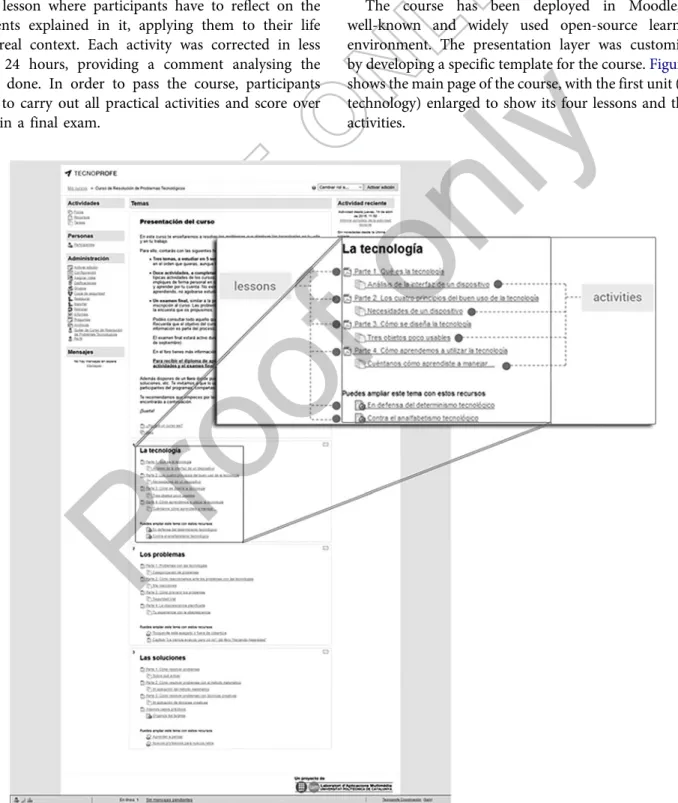
The course has been deployed in Moodle, a well-known and widely used open-source learning environment. The presentation layer was customised by developing a specific template for the course.Figure 1
shows the main page of the course, with the first unit (the technology) enlarged to show its four lessons and their activities.
Table 1.Course design.
Course elements Goal Model 70/20/10
Contents Unit 1. The technology Technological alphabetisation Learning and Experience Unit 2. The problems
Unit 3. The solutions
Problem resolution skills
Practical activities Unit 1. The technology Technological alphabetisation Experience and Feedback Unit 2. The problems
Unit 3. The solutions
Problem resolution skills
Additional contents Technological alphabetisation Learning
Forum Problem resolution skills Feedback
Final exam Problem resolution skills Experience and Feedback
Figure 1.First unit with four lessons and corresponding activities.
305 310 315 320 325 330 335 340 345 350 355 360 365 370 375 380 385 390 395 400
Proof
only
The course was passed by 23 participants, who made a total of 7785 interactions in the Moodle platform while browsing and downloading contents, activities delivery, forum participation, and accessing user data. These par-ticipants who passed the course were asked for feedback at the end of the course. On a 5-point Likert scale, par-ticipants liked the course (Avg = 4.57; StD = 0.51), con-sidered that contents were new and have not been seen in other courses (Avg = 4.52; StD = 0.51), and found the contents useful (Avg = 4.57; StD = 0.51). In addition, the Net Promoter Score (Reichheld2003) was computed for all participants, with the result that all students who passed the course scored as promotors (i.e. loyal and enthusiast users who will go back to take the course and recommend it to a friend). Qualitative information was also recorded through a questionnaire. Feedback received showed positive perceptions for the course (interesting, useful, and well organised). The most valu-able aspects of the course were easiness to understand the course and the success of the methodology to achieve course objectives.
3.1. Evaluation design
We have analysed the benefits of this online course with a study that involved 46 high school teachers. For the experimentation, 2 groups were formed, with 23 teachers in each one: (1) the experimental group that received the treatment (i.e. the online course) and (2) the control group that did not receive it. Both groups had a pretest (initial) and a post-test (final) that were filled out, respectively, before and after the online course was car-ried out in the experimental group. These tests measured (i) the skills for solving technological problems, and (ii) the techno-anxiety level.
In order to measure the ICT problem resolution skills, participants were asked to propose solutions to six ICT-related problems, four convergent ICT-related to technology operation and two divergent on the impact of people. Since questions are open, the analysis of the responses (i.e. solution proposed to the given problem) was done using the methodology proposed in Méndez et al. (2011), which consists in the analysis and evaluation of the following six competence criteria: (1) comprehension of the problem, (2) application of the method, (3) justi-fication and clarity, (4) results, (5) efficiency of the sol-ution, and (6) critical analysis. The numerical scoring scale used to evaluate each criterion for a given response was the following: insufficient (0–4 points); sufficient (4– 6 points); advanced (6–8 points); and excellent (8–10). Final scoring for each response is the average of the scores per each of the six indicators. The ICT skill resol-ution capability of each participant is the average of the
scores of the six responses, ranging this final score from 0 to 10.
Techno-anxiety level was measured using the RED model (Resources–Experiences–Demands) (Salanova et al.2007). Although there are several instruments to measure different dimensions related to techno-stress, and in particular, the Computer Anxiety Rating Scale (Heinssen, Glass, and Knight1987), the RED question-naire was chosen for this research because of its technol-ogy agnosticism, methodological validity (Cronbach alpha between 0.70 and 0.96) according to Ventura, Llo-rens, and Salanova (2006), and simplicity. Indeed, this tool is used and recommended by the Spanish Work and Social Affairs Ministry to measure techno-stress in Spanish workers (Salanova et al. 2007). The question-naire consists of 16 items grouped into 4 concepts focused on the consequences of the use of technology: scepticism, fatigue, anxiety, and ineffectiveness. A 7-point Likert scale (0 = never/nothing to 6 = always/every-day) is used to measure each item. The score of each concept is the average of its four items. Techno-anxiety level is computed by adding the values of three of these concepts, namely, anxiety, scepticism, and ineffective-ness. Thus, the range of techno-anxiety level goes from 0 to 18.
The course was run during six weeks. Participants were recruited using social networks and personal con-tacts and they gave their consent to data gathering fol-lowing the Spanish Law 15/1999 (Gobierno de España
1999). Demographics of the participants (n= 46) were the following: experimental group (n= 23; male = 43%; age range = 23–55 years; no children = 39%; 96% with more than 5 years of teaching experience; 74% with low or none level of English; majority and lazy technol-ogy adopters1= 70%); control group (n= 23; male = 57%; age range 23–60 years; no children = 49%; 83% with more than 5 years of teaching experience; 78% with low or none level of English; majority and lazy tech-nology adopters = 61%).
3.2. Results
Two aspects have been analysed: (1) the impact of the course on the problem resolution skills and (2) the impact on the techno-anxiety level.
Table 2shows the results of the statistical analysis car-ried out with the data collected in the corresponding four sets of samples: experimental (exp) vs. control (crl); initial (1) vs. final (2); and for these two aspects analysed
(i.e. problem resolution skills and techno-anxiety level). Normality of the data was assessed with the Shapiro– Wilk test. In five of the eight sets, the null hypothesis is rejected and, thus, there is evidence that the data tested
405 410 415 420 425 430 435 440 445 450 455 460 465 470 475 480 485 490 495 500
Proof
only
are not from a normally distributed population. Never-theless, when computing the difference between the means at the end and at the beginning (final–initial), then samples do not pass the Shapiro–Wilk test and can be considered from a normal distribution. For those samples for which the Shapiro–Wilk test was not significant, and thus, normality could be assumed, para-metric analysis with the Student’s t-test is carried out. When samples are not from a normal distribution, non-parametric analysis is carried out. In particular, the Kruskal–Wallis test was used to compare the control and experimental groups in each of the moments where the variables were measured (initial and final), since in this case samples were independent. The confidence level used is 95%. Statistical significance is considered ifp< .05.
3.2.1. Impact of the course on the technological problem solving skills
Regarding the impact of the course on the ICT problem resolution skills, measures taken in both groups before the course started are not statistically significant with the Kruskal–Wallis test (Mexp1= 5.50; SDexp1= 1.35;
Mcrl1= 5.17; SDcrl1= 1.33;p= .583), showing that both
groups have similar initial values, but there is a statisti-cally significant difference when compared at the end (Mexp2= 6.31; SDexp2= 1.15; Mcrl2= 5.06; SDcrl2=
1.06; p= .001), showing that only the experimental group improved. In addition, when analysing the statisti-cal significance of the difference of the means in each of the groups with the one-sample Student’st-test, there is a significant difference in the evolution of the experimen-tal group (Mexp = 0.81; SDexp = 1.86;p= .048) but not
Figure 2.Total scores for problem resolution skills in each group.
Table 2.Statistical analysis carried out on the data.
AQ25
¶ Experimental group Control group
Initial Final Final–Initial Initial Final Final–Initial Problem resolution skills
Total 126.40 145.05 18.65 118.80 116.34 -2.46
M(mean) 5.50 6.31 0.81 5.17 5.06 -0.11
SD 1.35 1.15 1.86 1.33 1.06 1.68
Shapiro–Wilk test p= .626 p= .561 p= .806 p= .580 p= .030* p= .505 One-sample Student’st-test (p= .048*) x* One-sample Student’st-test (p= .762) x Kruskal–Wallis (p= .583) x x Kruskal-Wallis (p= .001*) x* x* Techno-anxiety level Total 58.25 37.50 -20.75 55.25 63.50 8.25 M(mean) 2.53 1.63 -0.90 2.40 2.76 0.36 SD 2.77 1.74 2.04 2.58 2.45 3.68
Shapiro–Wilk test p= .001* p= .003* p= .448 p= .002* p= .027* p= .410 One-sample Student’st-test (p= .046*) x* One-sample Student’st-test (p= .645) x Kruskal–Wallis (p= .741) x x Kruskal–Wallis (p= .092) x x
Notes: * = Significance levelp< .05;‘x’identifies the group (or pair of groups) compared in the corresponding statistical test.
505 510 515 520 525 530 535 540 545 550 555 560 565 570 575 580 585 590 595 600
Proof
only
in the evolution of the control group (Mcrl =−0.11; SDcrl = 1.68; p= .762). Thus, it can be said that the course has an impact on the ICT problem resolution skills.
Figure 2shows the total scores in both groups at the beginning (initial) and at the end (final) of the study. It can be seen that while the scores in the problem resol-ution skills in the control group do not change much (−2.46), in fact, they decrease slightly; but in the exper-imental group they increase in a larger amount (+18.65), which is in line with the statistical significance obtained above.
3.2.2. Impact of the course on the techno-anxiety level
Regarding the techno-anxiety level, both groups also have a similar initial level since measures taken in both groups before the course started are not statistically sig-nificant with the Kruskal–Wallis test (Mexp1= 2.53;
SDexp1= 2.77; Mcrl1= 2.40; SDcrl1= 2.58; p= .741). In
turn, there is some difference at the end of the course as the techno-anxiety level is lower in the experimental group, but not significantly different with p< .05 (Mexp2= 1.63; SDexp2= 1.74; Mcrl2= 2.76; SDcrl2=
2.45;p= .092). Nonetheless, when analysing the statisti-cal significance of the difference of the means in each of the groups with the one-sample Student’st-test, there is a significant difference in the evolution of the experimen-tal group (Mexp =−0.90; SDexp = 2.04;p= .46), and not in the evolution of the control group (Mcrl =−0.36; SDcrl = 3.68; p= .645). Thus, it can be said that the course has also an impact on the techno-anxiety level, causing its reduction.
The total scores in both groups show a decrease in the experimental group (−20.75), while in the control group there is a small increase (+8.25), as shown inFigure 3. This confirms previous analysis, accounting that the experimental group has decreased their techno-anxiety level with statistical significance, suggesting that the treat-ment (i.e. the course) was responsible for this impact.
4. Discussion
Although the findings obtained in the evaluation of the course are to be taken into account with care due to the small number of participants (n= 46) and the con-venience sample (i.e. participants collected through social networks), they can suggest that the course was
Figure 3.Total scores for techno-anxiety in each group.
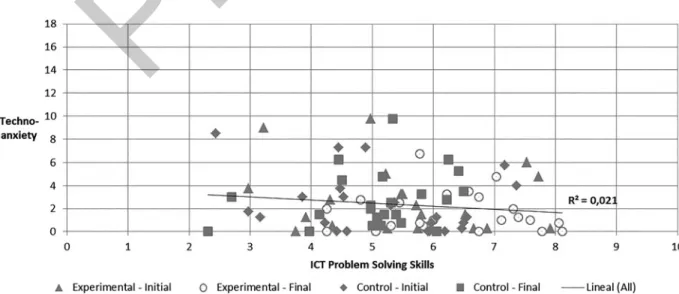
Figure 4.Relationship between techno-anxiety (range 0–18) and resolution skills of technological problems (range 0–10).
605 610 615 620 625 630 635 640 645 650 655 660 665 670 675 680 685 690 695 700
Proof
only
useful to increase the problem resolution skills and, thus, to reduce techno-anxiety. This can validate the research hypothesis as it has been possible to reduce the level of techno-anxiety in a sample of 23 high school teachers by improving their ICT problem resolution skills (com-pared to the other group that was not treated with pro-blem-solving training).
A simple correlation analysis was carried out using linear regression to show how the skill resolution capa-bilities of problems related to ICT influence the techno-anxiety level. The regression analysis uses the minimum squares estimation. Figure 4 shows the dis-persion diagram for the aggregated values (N= 92) of participants in both groups (control and experimental) and moments (pre- and post-treatment/course). The correlation coefficient (R) is−0.1460, and the coefficient of determination (R2) is 0.021. The dots corresponding to the post-test results of the experimental group (rep-resented as a circle) are closer to the regression line. In any case, none of the participants are highly techno-stressed and they all have some skill resolution capabili-ties (although these capabilicapabili-ties can be improved).
If we compare the normative results as defined in Salanova et al. (2007), average and standard deviation obtained here are lower. This may suggest that techno-anxiety might be getting reduced in society probably due to the influence of ICT in life, and an improvement of usability and user experience in these technologies. Nonetheless, further studies are required to clarify this assumption.
5. Conclusions
The research hypothesis proposed in this work, that is, it is possible to reduce the level of techno-anxiety in high school teachers if their ICT problem-solving skills are improved (see Section 1), was validated by designing and running an online course on ICT problems resol-ution, evaluating its benefits in an inter-subject exper-iment (control vs. experexper-imental group). The rationale behind this was that an online course on ICT problems resolution will make high school teachers improve their resolution capabilities and this would reduce their techno-anxiety. Here we summarise the contributions and comment on the limitations and open research issues. In addition, next steps in the action research pro-cess taking advantage of emerging technologies have been proposed as future work.
5.1. Contributions
The main objective of the course was to provide cogni-tive and attitudinal tools to allow participants in the
study (i.e. high school teachers) solve and prevent ICT problems by reducing the impact perception and sever-ity. The 70/20/10 model for learning and development (specific for adult online learning) was used to make par-ticipants internalise and apply what they have learnt in their lives, as 70% comes from their own experience, 20% from others’ experience, and 10% from classical learning. The course is grounded in two pillars: techno-logical alphabetisation (as a reflexion point on technol-ogy and as a tool to adapt to the environment) and problem resolution skills (where participants learned to choose and apply the most appropriate resolution method in each case).
In the study reported, 23 participants carried out the course. Problem-solving skills and techno-anxiety level were compared to another 23 participants who did not take the course. Statistically significant differences were obtained, showing that the problem resolution skills improved and the techno-anxiety level decreased in the group that took the course.
5.2. Limitations and open issues
Several limitations have been identified in this study. First, the number of participants might be considered low (at least compared to those questionnaire-based studies) and were selected with convenience sample from social networks. The reason for this was AQ5

the need to gather high school teachers who would like to be involved in a long-term course during a longitudinal field study. This makes the difference from the question-naire-based studies reported in Section 1, where the effort required to fill in a questionnaire is much lower, and thus the number of participants is usually several hundreds and is usually collected from large databases of teachers. One consequence of this small and conven-ience sample could be that all participants scored as pro-motors, as well as the low levels of techno-anxiety measured. Further studies with a larger number of par-ticipants would be needed to clarify these issues. It would also be of interest to identify in more detail the user profile of those who followed and successfully fin-ished the course, so specific efforts can be made to attract those not willing to take the course.
As a second limitation, the study was carried out in Spain, but in our view it can extrapolate to other countries with a similar situation to Spanish high school teachers. In this respect, one of the main causes of sick leave among high school teachers in Spain is psychologi-cal aspects (12.2%) (Sánchez2008). In fact, among the psychological illnesses more common in this group are those resulting from stress (Moriana Elvira and Herruzo Cabrera2004). 705 710 715 720 725 730 735 740 745 750 755 760 765 770 775 780 785 790 795 800
Proof
only
In the third place, the teachers sample belonged to high school degree, where the gap between digital natives (students) and digital immigrants (teachers) is higher. There might be differences when this barrier is reduced (e.g. when teachers are digital natives in the future). Thus, studies with other teachers of other educational levels would be desirable.
Fourth, it might be of interest to research if there are also benefits of problem skill resolution in other pro-fessions such as social workers (Choi, Ligon, and Ward
2002).
Fifth, this study has focused on techno-anxiety, but other variables related to techno-stress can also be measured (e.g. techno-fatigue) with the RED question-naire (Salanova et al. 2007). In fact, although there was a statistically significant difference regarding the improvement of the problem resolution skills and the techno-anxiety level in the group that took the course, a low and negative correlation was found between both variables. This may suggest that there might be other variables involved that also affect techno-anxiety in high school teachers, which should be considered in further studies. In this sense, the approach for the follow-ing action research step is to take into account affective computing, which means that a wider sample of affective states can be automatically detected (Santos2016).
In addition, it might be of interest to analyse self-effi-cacy feelings (Wilfong 2006) in the teachers since, according to Salanova, Llorens, and Cifre (2013), when workers get social support from colleagues while work-ing with ICT, they feel inefficacious, but reasons are not clear (they could not solve the problems by them-selves, or they are obliged to reciprocate when the person who helped has a problem in the future). The analysis of self-efficacy feelings might also show an attitude change
‘ICT is hard’vs.‘I can manage with ICT problems’if the training is successful. The content itself may not be so important, as ICT changes all the time, thus appropriate attitude and self-learning skills might result to be key to cope with the new technology that is constantly being introduced in the classrooms.
5.3. Future work
In our view, future research should take into account affective computing and emerging technologies around Internet of Things, such as wearable devices and ambient intelligence, to support teachers in scenarios such as the following:
A teacher, who wears a smartwatch that measures her pulse (heart rate) and sweeting (galvanic skin response), gets close to a printer with the intention to gather a document she has sent to print, but the paper does
not appear and the printer shows an error message. The system can detect–using a multimodal data mining approach that processes the signals collected with the smartwatch (i.e., heart rate, galvanic skin response) – changes in her physiological signals which correspond to a significant increase in her anxiety level. In addition, taking advantage of the Internet of Things connectivity, the system knows that the printer nearby the teacher is not working properly and has displayed an error mess-age. The teachers’physiological reaction might suggest that she is not emotionally prepared to deal with the ICT related problem in the printer and would require a personalized support to deal with it, which can be pro-vided in a multisensorial way taking advantage of ambi-ent intelligence (for instance, in order to take the teacher to a more relaxed situation, the light of the room can be changed to blue which is the favourite colour of the tea-cher, and her smartphone can play a chill-out song from the teachers’playlist).
This scenario suggests that biofeedback technology can be used to detect anxiety in the teacher without disturb-ing her (Wilfong2006). In this way, the way the teacher interacts with the environment can be drastically chan-ged, as the environment might be able to identify the tea-cher’s need and the reason for help by its own. In particular, affective states can be automatically detected by combining several data sources (Calvo and D’Mello
2010), which can take advantage of multimodal data mining techniques (Salmeron-Majadas et al.2015). Con-tinuous and context-aware monitoring of human phys-iological parameters in a non-intrusive way has only been possible with the recent development of wearable sensors such as smart watches, bracelets, and t-shirts (Mukhopadhyay2015).
Automatic detection of affective states can allow pro-viding personalised support at work for stress manage-ment (Bakker et al.2012). For this, strategies to reduce techno-anxiety are to be provided while the teacher is trying to solve the problem with the printer. As proposed in Santos et al. (2016), sensorial feedback can be pro-vided through the environment with ambient intelli-gence techniques to modify the teacher’s emotional state without interrupting her activity (i.e. trying to solve the technological problem, in this case, using the printer). In particular, the environment itself could inter-act with the user through different sensorial channels, such as sight (lights), hearing (sound), or touch (vibration). In addition, problem resolution strategies and instructions on how to use the printer could be dis-played with augmented reality. Support opportunities in this scenario can be identified with Tutor Oriented Rec-ommendations Modeling for Educational Systems (TORMES) AQ6

methodology (Santos and Boticario 2015) by involving teachers in the elicitation process using UCD techniques and (big) data mining analysis.
805 810 815 820 825 830 835 840 845 850 855 860 865 870 875 880 885 890 895 900
Proof
only
Note
1. According to the Innovation Diffusion Theory (Rogers
1962).
Disclosure statement AQ7

No potential conflict of interest was reported by the authors.
ORCiD
Olga Revilla Muñoz http://orcid.org/0000-0001-8605-2861
Olga C. Santos http://orcid.org/0000-0002-9281-4209
References AQ8

Agbatogun, A. 2010. “Self-concept, Computer Anxiety,
Gender and Attitude towards Interactive Computer
Technologies: A Predictive Study among Nigerian
Teachers.” International Journal of Education and
Development Using ICT6 (2): 55–68.
Aspin, D. N., and J. D. Chapman. 2007. “Lifelong Learning Concepts and Conceptions.”In Philosophical Perspectives on Lifelong Learning, edited by David N. Aspin 19–38. Springer. http://link.springer.com/chapter/10.1007%2F978-1-4020-6193-6_1
AQ9
¶Bakker, J., L. Holenderski, R. Kocielnik, M. Pechenizkiy, and
N. Sidorova. 2012. “Stess@Work: From Measuring Stress
to its Understanding, Prediction and Handling with
Personalized Coaching.” In Proceedings of the 2nd ACM
SIGHIT International Health Informatics Symposium (IHI
‘12), 673–678. New York, NY: ACM.
Becta.2004.A Review of the Research Literature on Barriers to the Uptake of Ict by Teachers. British Educational
Communications and Technology Agency. http://dera.ioe.
ac.uk/1603/1/becta_2004_barrierstouptake_litrev.pdf. Bolandifar, S., and N. Noordin.June 2015.“Computer Anxiety
and Attitudes toward Using Internet in English Language
Classes among Iranian Postgraduate Student Teachers.”
Pertanika Journal of Social Sciences & Humanities 23 (2): 355–374.
Calvo, R. A., and S. K. D’Mello.2010. “Affect Detection: An Interdisciplinary Review of Models, Methods, and Their Applications.” IEEE Transactions on Affective Computing 1 (1): 18–37.
Carr, W., and S. Kemmis.1986.Becoming Critical: Education Knowledge and Action Research. London: Falmer.
Choi, G., J. Ligon, and J. Ward.2002.“Computer Anxiety and Social Workers: Differences by Access, Use, and Training.” Journal of Technology in Human Services19 (1): 1–2. AQ12
¶Chou, C.2003.“Incidences and Correlates of Internet Anxiety
among High School Teachers in Taiwan.” Computers in
Human Behavior19 (6): 731–749.
Eisenberg, M., and R. Berkowitz. 2011. The Big6 Workshop
Handbook: Implementation & Impact. Santa Barbara, CA: Linworth.
AQ13
¶Fernandez-Cruz, F. J., and M. J. Fernandez-Diaz. 2016.
“Generation Z’s Teachers and their Digital Skills.”
Comunicar46: 97–105.
Fogler, H. S., S. E. Leblanc, and B. Rizzo. 2013. Strategies for Creative Problem Solving. 3rd ed. Prentice Hall.
https://www.pearsonhighered.com/program/Fogler-Strategies-for-Creative-Problem-Solving-3rd-Edition/
PGM300967.html. AQ14

Gobierno de España.14 de 12 de 1999.“Ley Orgánica 15/1999, de 13 de diciembre, de Protección de Datos de Carácter Personal.”Boletín Oficial del Estado298: 43088–43099. Guha, S. 2000. “Are we all Technically Prepared? Teachers’
Perspectives on the Causes of Comfort or Discomfort in
Using Computers at Elementary Grade Teaching.”Paper
presented at the annual meeting of the National Association for the Education of Young Children, Atlanta, GA, November 8–11.
Hardy, J. V.1998.“Teacher Attitudes toward and Knowledge
of Computer Technology.” Computers in the Schools 14:
119–136.
Heinssen, R., C. Glass, and L. Knight.1987.“Assessing Computer Anxiety: Development and Validation of the Computer Anxiety Rating Scale.”Computers in Human Behavior3: 49–59. ISO. 2010. Ergonomics of Human-System Interaction – Part 210: Human-centred Design for Interactive Systems. ISO 9241-210:201.
Jefferson, A., and R. Pollock. 2014. 70:20:10: Where is the Evidence? Association for Talen Development. https:// www.td.org/Publications/Blogs/Science-of-Learning-Blog/ 2014/07/70-20-10-Where-Is-the-Evidence.
Jennings, C., and J. Wargnier.2011.“Effective Learning with 70:20:10. The New Frontier for the Extended Enterprise.” CrossKnowledge.
Kajewski, K., and M. Valerie. 2013. Demystifying 70:20:10 White Paper. Deakin University.
Kotrlik, J. W., and M. N. Smith. 1988. “Computer anxiety Levels of Vocational Teachers.” Journal of Agricultural Education30 (2): 41–48.
Larner, D., and L. Timberlake.1995. Teachers with Limited Computer Knowledge: Variables Affecting Use and Hints to Increase Use. Curry School of Education, University of
Virginia.http://eric.ed.gov/?id=ED384595. AQ15

Lazarus, R. S.2007.Emotion and Adaptation. London: Oxford University Press.
Lewin, K. 1946. “Action Research and Minority Problems.” Journal of Social Issues2 (4): 34–46.
Lombardo, M. M., and R. W. Eichinger.1996. “The Career
Architect Development Planner. Minneapolis, MN: Lominge. Marcotte, E.2011.“Responsive Web Design.”A Book Apart. Méndez, A., B. Jimenez de Cisneros, C. Fernández, C. Molleda,
E. Sadornil, E. Manrique, T. Montoro, and R. Torres.2011.
“A Model for Evaluation of Generic Competences in
Engineering: Application to the Problem. Solving
compe-tence at the technical University of Madrid.” In
EDULEARN11, 135–143, October 4–6, Barcelona, España. ISBN 978-84-615-0441-1.
Moriana Elvira, J. A., and J. Herruzo Cabrera.2004.“Estrés y burnout en profesores.” International Journal of Clinical and Health Psychology3 (4): 597–621.
Mukhopadhyay, S. C. 2015. “Wearable Sensors for Human
Activity Monitoring: A Review.” IEEE Sensors Journal 15 (3): 1321–1330.
Muresan, M., and E. Gogu.2013.“E-learning Challenges and Provisions.”Procedia –Social and Behavioral Sciences92: 600–605.
Osborn, A. 2007. Your Creative Power. How to Use
Imagination. Nueva York: Myers Press.
905 910 915 920 925 930 935 940 945 950 955 960 965 970 975 980 985 990 995 1000
Proof
only
Paraskeva, F., H. Bouta, and A. Papagianni. April 2008.
“Individual Characteristics and Computer Self-efficacy in Secondary Education Teachers to Integrate Technology in Educational Practice.” Computers & Education 50 (3): 1084–1091.
Polya, G.2014.How to Solve it: A New Aspect of Mathematical Method. Princeton, NJ: Princeton University Press. AQ16
¶Prensky, M.2001. “Digital Natives, Digital Immigrants.”On the Horizon7 (5): 1–6.
Rahimi, M., and S. Yadollahi.2011.“Computer Anxiety and ICT Integration in English Classes among Iranian EFL Teachers.”Procedia Computer Science3: 203–209.
Reichheld, F. F.2003.“The One Number You Need to Grow.” Harvard Business Review81: 46–54.
Revilla, O.2010.WCAG 2 Made Easy. Madrid: Itakora Press. Revilla Muñoz, O., F. Alpiste Penalba, J. Fernández Sánchez.
2016. “The SCAT-ICT Recommender System: An online
support program for teachers with personalized
recommen-dations.” New Review of Hypermedia and Multimedia 22
(1-2): 83–110. AQ18
¶Rogers, E.1962.Diffusion of Innovations. New York: Free Press. Rosen, L., and M. Weil.1995.“Computer Availability, Computer Experience and Technophobia among Public School Teachers.”Computers in Human Behavior11 (11): 9–31. Rovai, A. P., and M. D. Childress. 2003. “Explaining and
Predicting Resistance to Computer Anxiety Reduction
among Teacher Education Students.” Journal of Research
on Technology in Education35: 226–235.
Russell, F., and G. Bradley. 1997. “Teachers’ Computer
Anxiety: Implications for Professional Development.”
Education and Information Technologies2 (1): 17–30. Sabzian, F., and A. P. Gilakjani. 2013. “Teachers’ Attitudes
about Computer Technology Training, Professional
Development, Integration, Experience, Anxiety, and
Literacy in English Language Teaching and Learning.”
International Journal of Applied Science and Technology3 (1): 67–75.
Salanova, M., S. Llorens, and E. Cifre.2013.“The Dark Side of Technologies: Technostress among Users of Information
and Communication Technologies.”International Journal
of Psychology48: 422–436.
Salanova, M., S. Llorens, E. Cifre, C. Nogareda, and E. d. WoNT.
2007.Nota Técnica de Prevención 730: Tecnoestrés: concepto, medida e intervención psicosocial. Madrid: INSHT.
Salmeron-Majadas, S., M. Arevalillo-Herráez, O. C. Santos, M. Saneiro, R. Cabestrero, P. Quirós, D. Arnau, and J. G.
Boticario. 2015. “Filtering of Spontaneous and Low
Intensity Emotions in Educational Contexts.” In AIED.
LNCS 9112, edited by Cristina Conati, Neil Heffernan,
Antonija Mitrovic, and M. Felisa Verdejo, 429–438.
Springer International Publishing. http://link.springer. com/chapter/10.1007%2F978-3-319-19773-9_43.
AQ19
¶Sánchez, L. Y.2008.Las condiciones de salud laboral del colec-tivo de trabajadores de la enseñanza de la Comunidad de Madrid. Madrid: FETE-UGT.
Santos, O. C.2016.“Emotions and Personality in Adaptive e-Learning Systems: An Affective Computing Perspective.”In Emotions and Personality in Personalized Systems, edited by M. Tkalčič, B. De Carolis, M. de Gemmis, A. Odić, and A. Košir, 278–279. Cham: Springer.
Santos, O. C., and J. G. Boticario.2015.“Practical Guidelines for Designing and Evaluating Educationally Oriented
Recommendations.”Computers & Education81: 354–374. ISSN 0360-1315.
Santos, O. C., M. Saneiro, J. G. Boticario, and M. C.
Rodriguez-Sanchez. 2016. “Toward Interactive Context-aware
Affective Educational Recommendations in
Computer-assisted Language Learning.” New Review of Hypermedia
and Multimedia22 (1-2): 27–57. AQ20

Schroer, W. 2008. Defining, Managing, and Marketing to
Generations X, Y, and Z. The Portal, 10, 9. Accessed February 2, 2015.http://goo.gl/Fc40dB.
Torkzadeh, G., and I. E. Angulo. 1992. “The Concept and
Correlates of Computer Anxiety.” Behaviour and
Information Technology11 (2): 99–108.
Ursava, Ö. F., and H. Karal.2009.“Assessing Pre-service Teachers’ Computer Phobia Levels in terms of Gender and Experience,
Turkish Sample.” International Journal of Behavioural,
Cognitive, Educational and Psychological Sciences1: 71–75. Ventura, M., S. Llorens, and M. Salanova.2006. El tecnoestrés:
un estudio del desarrollo de diferentes instrumentos de medida. 11 Jornades de Foment de la Investigació. Wilfong, J. D.2006.“Computer Anxiety and Anger: The Impact
of Computer Use, Computer Experience, and Self-efficacy Beliefs.”Computers in Human Behavior22 (6): 1001–1011.
Appendix. Analysis of ICT support programmes for teachers in Spain
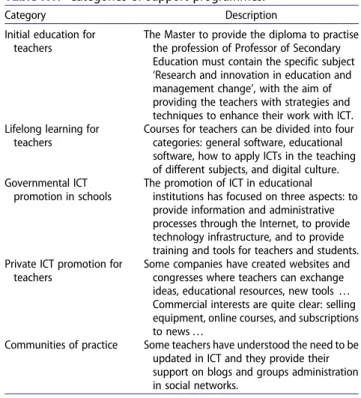
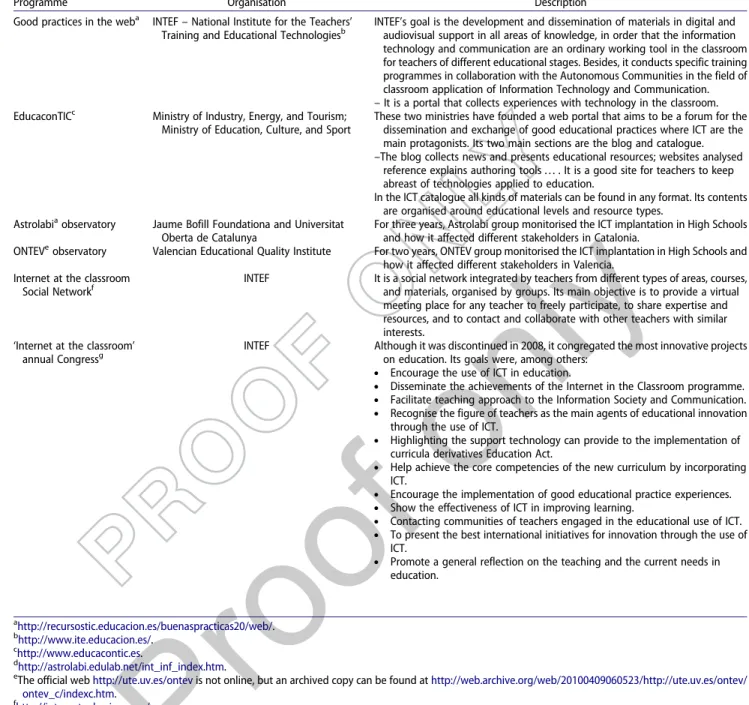
There are five categories of support programmes in Spain for teachers, as shown in Table A1. Each category is oriented towards a different profile and their goals and resources are different. InTables A2–A6, initiatives are reported and sum-marised in terms of these five categories, as follows: (i) initial education for teachers (Table A2), (ii) lifelong learning for tea-chers (Table A3), (iii) governmental ICT promotion in schools (Table A4), (iv) private ICT promotion for teachers (Table A5); and (v) communities of practice (Table A6).
Table A1. Categories of support programmes.
Category Description
Initial education for teachers
The Master to provide the diploma to practise the profession of Professor of Secondary Education must contain the specific subject
‘Research and innovation in education and management change’, with the aim of providing the teachers with strategies and techniques to enhance their work with ICT. Lifelong learning for
teachers
Courses for teachers can be divided into four categories: general software, educational software, how to apply ICTs in the teaching of different subjects, and digital culture. Governmental ICT
promotion in schools
The promotion of ICT in educational institutions has focused on three aspects: to provide information and administrative processes through the Internet, to provide technology infrastructure, and to provide training and tools for teachers and students. Private ICT promotion for
teachers
Some companies have created websites and congresses where teachers can exchange ideas, educational resources, new tools… Commercial interests are quite clear: selling equipment, online courses, and subscriptions to news…
Communities of practice Some teachers have understood the need to be updated in ICT and they provide their support on blogs and groups administration in social networks. 1005 1010 1015 1020 1025 1030 1035 1040 1045 1050 1055 1060 1065 1070 1075 1080 1085 1090 1095 1100
Proof
only
Table A2. Initial education for teachers.
Institution Review Subjects analysed Universitat
Politècnica de Catalunyaa
It does not offer a certain ICT-centred subject, but introduces ICT transversely within the subjects.
. Introduction to educational innovation and research in the field of mathematics
. Society, family, and education
. Mathematics for the twenty-first century
Universitat Autònoma de Barcelonab
It focuses the ICT syllabus in two subjects, one of psychology and other specialty didactic apart of the traineeship. ICT are introduced transversely.
. Training in pedagogical and social psychology
. Biology, and geology and its teaching
Universidad Nacional de Educación a Distanciac
It does not offer a certain ICT-centred subject, but introduces ICT transversely within the subjects. . Learning and motivation in the classroom . Teaching innovation and introduction to educational research . Design and development of the curriculum Universidad de La Riojad
It does not offer any subject in ICT. It is part of the syllabus of certain subjects.
. Learning and teaching geography and history
. Learning and teaching a foreign language . Teaching innovation and introduction to educational research. Universidad de Almeríae
It has two subjects focused on acquiring competences in ICT. Besides its subjects enclose transversal education in ICT.
. Teaching innovation and introduction to educational research
. ICT resources in the classroom a http://mfp.masters.upc.edu/informacio-academica. b http://www.uab.es/servlet/Satellite/informacion-academica-de-los-masteres -oficiales/la-oferta-de-masteres-oficiales/plan-de-estudios/formacion-del-pr ofesorado-de-educacion-secundaria-obligatoria-y-bachillerato-formacion-p rofesional-y-ensenanzas-de-idiomas-1096480309783.html?param1=123606 5658068. chttp://portal.uned.es/portal/page?_pageid=93,27108104&_dad=portal&_sc hema=PORTAL&idMaster=230401. d www.unirioja.es/estudios/master/2012_13/M0nA.shtml. e http://cvirtual.ual.es/guiado/servlet/bin?id=6287_CAS.
Table A3. Lifelong learning for teachers.
Category Programmes
Digital culture . Electronic administration and information managementa
. Data privacyb
Instrumental applications not necessarily linked to the educational world, but focused on education
. Web 2.0 for educational centresc
. Webdesign with Photoshopd
. Open Officee
. Web 2.0 as a tool for educationf
. Social Networksg
. Building and programming robots with Lego Mindstormsh
. Robots to teach technology and sciencei
. Internet as an educational toolj
. Introduction to Adobe Flashk
Instrumental applications related to the educational world
. Electronic whiteboards as interactive educational toolsl
. Learning communitiesm
. Webquestn
. Librarianship and Web 2.0o
Teaching methodology in which ICTs are applied
. ICT in the classroomsp
. How to teach with Internetq
. Master in ICT and educationr
. Master in ICT and knowledges
. E-learning educationt
. Teaching Grammaru
. Teaching Mathsv
. ICT in educationw
. European Master in ICT and educationx a http://gestion.forem.es/fee2012/utiles/documentos/ADMINISTRACI%C3% 93N%20ELECTR%C3%93NICA,GESTI%C3%93N%20DE%20LA%20INFORMA CI%C3%93N.pdf. b http://www.fsie.es/archivos/LEY%20PROT%20DATOS.pdf. c http://gestion.forem.es/fee2012/utiles/documentos/WEB%202.0%20EDICI% C3%93N%20DE%20P%C3%81GINAS%20EN%20LOS%20CENTROS%20EDU CATIVOS.pdf. d http://www.fsie.es/archivos/PHOTOSHOP.pdf. e http://www.fsie.es/archivos/OPEN%20OFFICE.pdf. fhttp://www.fsie.es/archivos/WEB%2020.pdf. g http://www.formacionpermanentedelprofesorado.es/Curso-Redes-Sociales. h http://gcice.upc.edu/fitxa_cursos.asp?id=52842&np=1. i http://gcice.upc.edu/fitxa_cursos.asp?id=52723&np=1. jhttp://gestion.forem.es/fee2012/utiles/documentos/EL%20USO%20DE%20IN TERNET%20COMO%20HERRAMIENTA%20DIDACTICA.pdf. k http://gestion.forem.es/fee2012/utiles/documentos/INTRODUCCI%C3%93N %20A%20ADOBE%20FLASH.pdf. lhttp://www.fsie.es/archivos/PIZARRA%20DIGITAL.pdf. m http://www.formacionpermanentedelprofesorado.es/Curso-de-Experto-en-Comunidades-de-Aprendizaje-Learning-Community. n http://gestion.forem.es/fee2012/utiles/documentos/WEBQUEST.%20DISE% C3%91O%20Y%20UTILIZACI%C3%93N%20DID%C3%81CTICA.pdf. o http://www.formacionpermanentedelprofesorado.es/Curso-de-Aplicacion-de-las-Bibliotecas-Escolares-y-Web-20. p http://www.formacionpermanentedelprofesorado.es/Aplicacion-Didactica-Tic. qhttps://adenu.ia.uned.es/web/es/members/jgb/teaching/ongoing_education/ aprender_formar_internet/temario. r http://www.uned.es/infoedu/planes.htm. s http://www.uned.es/infoedu/i-planes.htm. thttp://www.formacionpermanentedelprofesorado.es/Curso-Formacion-Elearning. u http://www.fsie.es/archivos/DIDAC%20LENGUA.pdf. v http://www.fsie.es/archivos/DIDAC%20MATEMATICAS.pdf. w http://gestion.forem.es/fee2012/utiles/documentos/NUEVAS%20TECNOLOG% C3%8DAS%20APLICADAS%20A%20LA%20EDUCACI%C3%93N.pdf. x http://www.formacionpermanentedelprofesorado.es/Curso-de-Master-Europe o-en-Nuevas-Tecnologias-Aplicadas-la-Educacion. 1105 1110 1115 1120 1125 1130 1135 1140 1145 1150 1155 1160 1165 1170 1175 1180 1185 1190 1195 1200
Proof
only
Table A4. Governmental ICT promotion in schools.
Programme Organisation Description
Good practices in the weba INTEF–National Institute for the Teachers’
Training and Educational Technologiesb
INTEF’s goal is the development and dissemination of materials in digital and audiovisual support in all areas of knowledge, in order that the information technology and communication are an ordinary working tool in the classroom for teachers of different educational stages. Besides, it conducts specific training programmes in collaboration with the Autonomous Communities in the field of classroom application of Information Technology and Communication.
–It is a portal that collects experiences with technology in the classroom. EducaconTICc Ministry of Industry, Energy, and Tourism;
Ministry of Education, Culture, and Sport
These two ministries have founded a web portal that aims to be a forum for the dissemination and exchange of good educational practices where ICT are the main protagonists. Its two main sections are the blog and catalogue.
–The blog collects news and presents educational resources; websites analysed reference explains authoring tools…. It is a good site for teachers to keep abreast of technologies applied to education.
In the ICT catalogue all kinds of materials can be found in any format. Its contents are organised around educational levels and resource types.
Astrolabiaobservatory Jaume Bofill Foundationa and Universitat Oberta de Catalunya
For three years, Astrolabi group monitorised the ICT implantation in High Schools and how it affected different stakeholders in Catalonia.
ONTEVeobservatory Valencian Educational Quality Institute For two years, ONTEV group monitorised the ICT implantation in High Schools and how it affected different stakeholders in Valencia.
Internet at the classroom
Social Networkf INTEF It is a social network integrated by teachers from different types of areas, courses,and materials, organised by groups. Its main objective is to provide a virtual
meeting place for any teacher to freely participate, to share expertise and resources, and to contact and collaborate with other teachers with similar interests.
‘Internet at the classroom’ annual Congressg
INTEF Although it was discontinued in 2008, it congregated the most innovative projects on education. Its goals were, among others:
. Encourage the use of ICT in education.
. Disseminate the achievements of the Internet in the Classroom programme.
. Facilitate teaching approach to the Information Society and Communication.
. Recognise the figure of teachers as the main agents of educational innovation through the use of ICT.
. Highlighting the support technology can provide to the implementation of curricula derivatives Education Act.
. Help achieve the core competencies of the new curriculum by incorporating ICT.
. Encourage the implementation of good educational practice experiences.
. Show the effectiveness of ICT in improving learning.
. Contacting communities of teachers engaged in the educational use of ICT.
. To present the best international initiatives for innovation through the use of ICT.
. Promote a general reflection on the teaching and the current needs in education. a http://recursostic.educacion.es/buenaspracticas20/web/. bhttp://www.ite.educacion.es/. c http://www.educacontic.es. dhttp://astrolabi.edulab.net/int_inf_index.htm. e
The official webhttp://ute.uv.es/ontevis not online, but an archived copy can be found athttp://web.archive.org/web/20100409060523/http://ute.uv.es/ontev/
ontev_c/indexc.htm.
f
http://internetaula.ning.com/.
gAlthough the official web http://www.congresointernetenelaula.es is not online, an archived copy can be found at https://web.archive.org/web/
20090428031348/http://www.congresointernetenelaula.es/virtual/?. 1205 1210 1215 1220 1225 1230 1235 1240 1245 1250 1255 1260 1265 1270 1275 1280 1285 1290 1295 1300
Proof
only
Table A5. Private ICT promotion for teachers.
Programme Organisation Description Educareda Telefonica
Foundation
It focuses on the interplay of three key components: technology, pedagogy, and educational content. Its goal is to promote interaction between teachers, students, parents, and schools to boost the search for quality cited in non-university education.
It is organised around three sections:
. Updates with information on events, awards, and announcements.
. Resources, publications, research, and teaching aids.
. Community Foundation projects, learning environments, and user blogs.
The purpose of the Portal Educared lies in promoting a new educational model that can be extended and replicated globally and that includes both the advantages and changes, and innovations in technologies induce new way to learn. Profes.net
-Conectadosb SM Editorial Profes.net was a vertical online portalthat offers communication
resources, information, and support to teachers of different levels. It is an interesting area for the teachers’ computer advisor‘where teachers raise questions about computer and internet portal and an expert answers them’c. It became SM Conectados in 2013.
ahttp://www.fundaciontelefonica.com/educacion_innovacion/.
b
http://www.profes.net/info.html, currentlyhttp://www.smconectados.com/.
chttp://www.smconectados.com/Soporte_tecnico.html.
Table A6. Communities of practice.
Programme Description
Blogs There are hundreds of teachers who share their thoughts on the net. For this research, we have reviewed the following:
. http://ticsunivo.blogspot.com.es/ . http://edumorfosis.blogspot.com.es/ . http://www.iesgrancapitan.org/blog05/ . http://www.profesorjano.biz/ . http://www.profesorjano.info/ . http://profesorjano.org/ . http://lindacastaneda.com/mushware . http://villaves56.blogspot.com.es/ Social network groups
There are several groups in social networks of high school teachers, as‘Secondary Education Teachers’or
‘Secondary Teachers of Andalusia’, both from the social network Facebook. Both have a high activity (the first 450 users and 875 the second).
–The first group is defined and functions as a meeting place, information and discussion about the needs of all types having Secondary Education Teachers in Spanish-speaking countries: labour, union, and legal aspects; educational content in different formats, relationships with parents, educational methods…
–The second one is defined as a support group, where opinions, complaints, suggestions, and
recommendations from personal and political exchanged court‘because no one understands us better than ourselves’.
1305 1310 1315 1320 1325 1330 1335 1340 1345 1350 1355 1360 1365 1370 1375 1380 1385 1390 1395 1400