Document-Level Machine Translation
as a Re-translation Process
∗Traducci´on Autom´atica a Nivel de Documento como Proceso de Retraducci´on
Eva Mart´ınez Garcia
Cristina Espa˜na-Bonet
TALP Research Center Univesitat Polit`ecnica de Catalunya Jordi Girona, 1-3, 08034 Barcelona, Spain [email protected] y [email protected]
Llu´ıs M`arquez
Qatar Computing Research Institute Qatar Foundation
Tornado Tower, Floor 10, P.O. Box 5825, Doha, Qatar
Resumen: Los sistemas de Traducci´on Autom´atica suelen estar dise˜nados para traducir un texto oraci´on por oraci´on ignorando la informaci´on del discurso y provo-cando as´ı la aparici´on de incoherencias en las traducciones. En este art´ıculo se presentan varios sistemas que detectan incoherencias a nivel de documento y pro-ponen nuevas traducciones parciales para mejorar el nivel de cohesi´on y coherencia global. El estudio se centra en dos casos: palabras con traducciones inconsistentes en un texto y la concordancia de g´enero y n´umero entre palabras. Dado que se trata de fen´omenos concretos, los cambios no se ven reflejados en una evaluaci´on autom´atica global pero una evaluaci´on manual muestra mejoras en las traducciones.
Palabras clave: Traducci´on Autom´atica Estad´ıstica, Discurso, Coreferencia, Co-herencia
Abstract: Most of the current Machine Translation systems are designed to trans-late a document sentence by sentence ignoring discourse information and producing incoherencies in the final translations. In this paper we present some document-level-oriented post-processes to improve translations’ coherence and consistency. In-coherences are detected and new partial translations are proposed. The work focuses on studying two phenomena: words with inconsistent translations throughout a text and also, gender and number agreement among words. Since we deal with specific phenomena, an automatic evaluation does not reflect significant variations in the translations. However, improvements are observed through a manual evaluation.
Keywords: Statistical Machine Translation, Discourse, Coreference, Coherence
1 Introduction
There are many different Machine Transla-tion (MT) systems available. Differences among systems depend on their usage, lin-guistic analysis or architecture, but all of them translate documents sentence by sen-tence. For instance, in rule-based MT sys-tems, rules are defined at sentence level. In data-based MT systems, the translation of a document as a whole make the prob-lem computationally unfeasible. Under this approach, the wide-range context and the discourse information (coreference relations,
∗
Supported by an FPI grant within the OpenMT2 project (TIN2009-14675-C03) from the Spanish Min-istry of Science and Innovation (MICINN) and by the TACARDI project (TIN2012-38523-C02) of the Spanish Ministerio de Econom´ıa y Competitividad (MEC).
contextual coherence, etc.) are lost during translation.
Since this is one of the limitations for cur-rent MT systems, it is interesting to explore the possibility of improving the quality of the translations at document level. There are several phenomena that confer coherence to final translations that cannot be seen in an intra-sentence scope, for instance, some pronouns or corefered words spanning several sentences, or words that depend on a specific topic and should be translated in the same way through a document.
Following the path of some recent works (Nagard and Koehn, 2010; Hardmeier and Federico, 2010; Xiao et al., 2011; Hardmeier, Nivre, and Tiedemann, 2012), we study some phenomena paying special attention to lexi-cal, semantic and topic cohesion, coreference
and agreement. In general, these tasks can be done following two different approaches. On the one hand, discourse information can be integrated inside a decoder, this is, trying to improve translations quality at translation time. On the other hand, the translation can be thought as a two-pass process where the characteristic phenomena are detected in a first step and re-translated afterwards.
In this work we start from a standard phrase-based Statistical Machine Translation system (SMT) from English to Spanish, and design and develop post-process architectures focusing on the phenomena just mentioned. We introduce a method to detect inconsis-tent translations of the same word through a document and propose possible corrections. We also present an approach to detect gen-der and number disagreements among coref-ered words, which is extended to deal with intra-sentence disagreements.
The paper is organized as follows. We re-visit briefly the related work in Section 2. Section 3 contains the description of the re-sources that we used to design and run the experiments explained in Section 4. Section 5 shows the results of the different translation systems together with a complete manual evaluation of the selected phenomena. Fi-nally, we draw our conclusions and describe some lines of future work in Section 6.
2 Related Work
In the last years approaches to document-level translation have started to emerge. The earliest approaches dealt with pronominal anaphora within an SMT system (Hardmeier and Federico, 2010; Nagard and Koehn, 2010). These authors develop models that, with the help of coreference resolution meth-ods, identify links among words in a text and use them for a better translation of pronouns. The authors in (Gong, Zhang, and Zhou, 2011) approach the problem of topic cohesion by making available the previous translations at decoding time by using a cache system. In this way, one can bias easily the system to-wards the lexicon already used.
Document-level translation can be also seen as the post-process of an already trans-lated document. In (Xiao et al., 2011), the authors study the translation consistency of a document and re-translate source words that have been translated in different ways within a same document. The aim is to incorporate document contexts into an existing SMT
sys-tem following 3 steps. First, they identify the ambiguous words; then, they obtain a set of consistent translations for each word accord-ing to the distribution of the word over the target document; and finally, generate the new translation taking into account the re-sults of the first two steps.
All of these works are devoted to im-prove the translation in one particular aspect (anaphora, lexicon, ambiguities) but do not report relevant improvements as measured by an automatic metric, BLEU (Papineni et al., 2002).
Recently, the authors in (Hardmeier,
Nivre, and Tiedemann, 2012) presented Do-cent, an SMT document-level decoder. The decoder is built on top of an open-source phrase-based SMT decoder, Moses (Koehn et al., 2007). The authors present a stochas-tic local search decoding method for phrase-based SMT systems which allows decoding complete documents. Docent starts from an initial state (translation) given by Moses and this one is improved by the application of a hill climbing strategy to find a (local) maxi-mum of the score function. The score func-tion and some defined change operafunc-tions are the ones encoding the document level infor-mation. The Docent decoder is introduced in (Hardmeier et al., 2013).
3 Experimental Setup
In order to evaluate the performance of a sys-tem that deals with document-level phenom-ena, one needs to consider an adequate set-ting where the involved phenomena appear.
3.1 Corpora and systems
Most of the parallel corpora used to train SMT systems consist of a collection of paral-lel sentences without any information about the document structure. An exception is the News Commentary corpus given within the context of the workshops on Statistical Ma-chine Translation1. The corpus is build up with news, that is, coherent texts with a con-sistent topic throughout a document. Be-sides, one can take advantage from the XML tags of the documents that identify the limits of the document, paragraphs and sentences.
This corpus is still not large enough to train an SMT system, so, for our baseline system we used the Europarl corpus (Koehn, 2005) in its version 7. All the experiments
1 http://www.statmt.org/wmt14/translation-task.html
are carried out over translations from English to Spanish.The different morphology between these two languages should contribute to ob-tain troublesome translations which can be tackled with our methodology.
Our baseline system is a Moses de-coder trained with the Europarl corpus. For estimating the language model we use SRILM (Stolcke, 2002) and calculate a 5-gram language model using interpolated Kneser-Ney discounting on the target side of the Europarl corpus. Word alignment is done with GIZA++ (Och and Ney, 2003) and both phrase extraction and decoding are done with the Moses package. The optimization of the weights of the model is trained with MERT (Och, 2003) against the BLEU mea-sure on the News Commentary corpus of 2009 (NC-2009, see Table 1 for the concrete figures of the data).
3.2 Data annotation
Besides the aforementioned markup, the 110 documents in the test set have been anno-tated with several linguistic processors. In particular, we used the Part-of-Speech (PoS) tagger and dependency parser provided by the Freeling library (Padr´o et al., 2010), the coreference resolutor RelaxCor (Sapena, Padr´o, and Turmo, 2010) and the named en-tity recognizer of BIOS (Surdeanu, Turmo, and Comelles, 2005). Whereas the PoS has been annotated in both the source (English) and the target (Spanish) sides of the test set, named entities, dependency trees and corefer-ences have been annotated in the source side and projected into the target via the transla-tion alignments (see Sectransla-tion 5).
4 Systems Description
4.1 Document-level phenomena
4.1.1 Lexical coherence
The first characteristic we want to improve is the lexical coherence of the translation. Am-biguous words are source words with more than one possible translation with different meanings. Choosing the right translation is,in this case, equivalent to disambiguate the word in its context. Taking the assumption of “one-sense-per-discourse”, the translation of a word must be the same through a docu-ment. So, our problem is not related to Word Sense Disambiguation, but we want to iden-tify the words in the source document that are translated in different ways in the tar-get. For example, the English word “desk”
appearing in the first News can be trans-lated as “ventanilla”, “escritorio”, “mesa” or “mostrador” according to the translation ta-ble of our baseline system, where the different options are not exact synonyms. The aim of our system is to translate “desk’ as “mesa” homogeneously throughout the document as explained in Section 4.2.1. This is an exam-ple from the 488 instances of words whit in-consistent translations that we found in our corpus using our baseline system.
4.1.2 Coreference and agreement
It is easy to find words that corefer in a text. A word corefers with another if both refer to the same entity. These words must in prin-ciple agree in gender and number since they are representing the same concept (person, object, etc.). For instance, if the term “the engineer” appears referring to a girl as it is the case in News 5, the correct translation in Spanish would be “la ingeniera” and not “el ingeniero”.
Once we identify and try to fix incoher-ences in gender or number inside coreference chains, we can take advantage of the analy-sis and the applied strategies in the corefer-ence problem to correct agreement errors in the intra-sentential scope. This is, in fact, a simpler problem because it is not affected by possible errors given by the coreference reso-lutor. However, since dependencies among words are shorter, the expressions tend to be translated correctly by standard SMT en-gines. In our corpus, we only found two in-stances where the agreement processing could be applied to coreference chains, so most of our analysis finally corresponds to the intra-sentence agreement case.
4.2 Re-translation systems
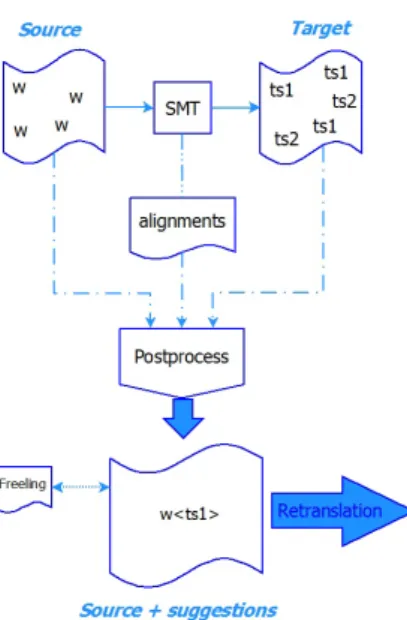
Given these phenomena we design two main post-processes to detect, re-translate and fix the interesting cases. Figure 1 shows the ba-sic schema of the post-processes.
4.2.1 Lexical coherence
The first step of the post-process that deals with lexical coherence is to identify those words from the source document translated in more than one way. We use the PoS tags to filter out only the nouns, adjectives and main verbs in English. Then, the word align-ments given by a first-pass Moses’ transla-tion are used to link every candidate token to its translation, so those tokens aligned with more than one different form in the target
Corpus News Sentences English Tokens Spanish Tokens
Training Europarl-v7 – 1,965,734 49,093,806 51,575,748
Development NC-2009 136 2,525 65,595 68,089
Test NC-2011 110 3,003 65,829 69,889
Table 1: Figures on the corpora used for training, development and test.
Figure 1: Structure of the post-processes that rewrite the source document in order to pre-pare it to a retranslation step.
side can be identified. Following the example of Section 4.1.1, if the word “desk” appears three times in the text and it is translated two times as “mesa” and one as “mostrador”, then the pair (desk, desk) (mesa, mostrador) will be selected for re-translation.
Re-translation is done in two different ways: restrictive and probabilistic. The re-strictive way forces2 as a possible transla-tion the most used optransla-tion in the current doc-ument; in case of tie, there is no sugges-tion in order to avoid biasing the result in a wrong way. By doing this, we somehow con-trol the noise introduced by the post-process but we also lose information given by the de-coder in the available translation. On the other hand, the probabilistic way suggests the most used options as possible transla-tions assigning them a probability estimated by frequency counts within the options. So, in this case, one feeds the decoder with the most suitable options and let it choose among them. This option introduces more noise
be-2
Forcing or suggesting a translation is a feature available in the Moses decoder that involves an XML markup of the source sentence with the information of translation options.
cause the system is managing more possible translations than in the previous situation, sometimes as many as in the initial state translation.
4.2.2 Gender and number agreement
The post-process for disagreements in gen-der and number analyses every source doc-ument and annotates it with PoS, corefer-ence chains, and dependency trees. The main structure in this case is the tree since it is the one that allows to link the elements that need to agree. A tree traversal is performed in order to detect nouns in the source. When a noun is found and its children are deter-miners and/or adjectives, the matching sub-tree is projected into the target via the SMT word alignments. In the target side, one can check the agreement among tokens by using the PoS tags. If there is a disagreement, the correct tag for the adjective or determiner is built using the corresponding Freeling li-brary, which allows to get the correct form in the target language for the translation.
The system implements a similar strategy to check the agreement among subject and verb. A tree traversal allows to detect the node that represents the verb of the sentence and the child corresponding to the subject. The structure is projected into the target via the alignments and the agreement is verified using the PoS information. If the subject is a noun, we assume that the verb must be conjugated in third person plural or singular depending on the number of the noun; if it is a pronoun, gender, person and number must agree. As before, if there is a disagreement, the system assigns the correct tag to the verb, and the form is generated using the Freeling library.
In both cases (determiner–adjective(s)– noun(s) and subject–verb) the output of the pre-process is a proposed new translation for translations that show a disagreement. Sim-ilarly to the restrictive and probabilistic sys-tems of the previous subsections, here we run the re-translation step in two ways: forc-ing an output with new translation or al-lowing the interaction of this new translation
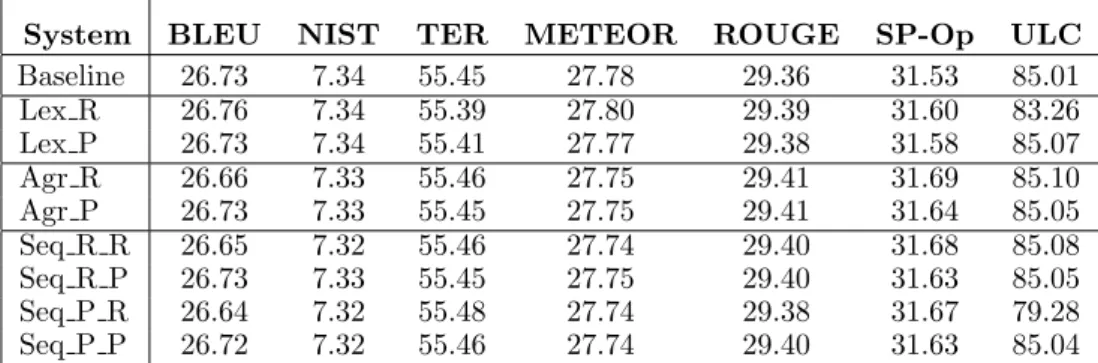
System BLEU NIST TER METEOR ROUGE SP-Op ULC Baseline 26.73 7.34 55.45 27.78 29.36 31.53 85.01 Lex R 26.76 7.34 55.39 27.80 29.39 31.60 83.26 Lex P 26.73 7.34 55.41 27.77 29.38 31.58 85.07 Agr R 26.66 7.33 55.46 27.75 29.41 31.69 85.10 Agr P 26.73 7.33 55.45 27.75 29.41 31.64 85.05 Seq R R 26.65 7.32 55.46 27.74 29.40 31.68 85.08 Seq R P 26.73 7.33 55.45 27.75 29.40 31.63 85.05 Seq P R 26.64 7.32 55.48 27.74 29.38 31.67 79.28 Seq P P 26.72 7.32 55.46 27.74 29.40 31.63 85.04
Table 2: Automatic evaluation of the systems. See text for the system and metrics definition.
with the remaining translation options of the phrase table. In both cases, the full sentence can be re-translated to accommodate the new options.
The following section shows an automatic and manual evaluation of these systems for the English–Spanish language pair.
5 Experimental Results
The most straightforward way to evaluate translation engines is using automatic met-rics on the full test sets. However, in our case, the measures are not informative enough considering that we apply small modifica-tions to previous translamodifica-tions. As an exam-ple, Table 2 shows the automatic evaluation obtained with the Asiya toolkit (Gonz´alez, Gim´enez, and M`arquez, 2012) for several lex-ical metrics (BLEU, NIST, TER, METEOR and ROUGE), a syntactic metric based on the overlap of PoS elements (SP-Op), and an average of a set of 27 lexical and syntactic metrics (ULC).
The first row shows the results for the baseline system built with Moses without any re-translation step (Baseline). The second block includes the experiments on lexical co-herence alone both restrictive and probabilis-tic (Lex R and Lex P) and the third block the experiments on agreement alone also in the two cases (Agr R and Agr P). Finally, the last block shows the result of the se-quential process with the four combination of systems (Seq R R, Seq R P, Seq P R,
Seq P P). As it can be seen, the scores do not show any systematic preference for a sys-tem and it is necessary a manual evaluation of the outputs to study the performance of the re-translation systems.
System BLEU tags words OK/ch linTags linDif
News20bl 13.40 News20 R 13.56 26 8 5/9 13 6 News20 P 13.22 45 15 7/11 19 8 News25bl 14.42 News25 R 14.45 18 4 4/4 16 3 News25 P 14.52 38 10 5/5 28 7 News39bl 28.49 News39 R 28.20 16 5 5/5 15 4 News39 P 28.56 34 11 6/8 25 7 News48bl 30.05 News48 R 30.06 42 3 3/3 23 10 News48 P 29.83 53 7 4/5 24 15 News49bl 25.54 News49 R 25.87 24 5 5/5 17 8 News49 P 25.83 42 12 7/8 23 10
Table 3: Manual evaluation of the system for lexical coherence (Lex in Table 2) for a sub-set of news with restrictive and probabilistic systems. See text for column’s meaning.
5.1 Manual evaluation
In order to manually evaluate the output of the previous systems, we chose those doc-uments where we include more suggestions into the re-translation step.
In Table 3, one can see the results of evaluating the system devoted to improve the global lexical coherence for the five news where the post-process introduces more changes. For every document, the News*bl
row represents the scores for the translations obtained using the baseline system. Col-umn tags shows the number of introduced tags,words the number of different words in-volved in the tags, OK/ch shows the num-ber of changes made with respect to the first translation and how many are correct attend-ing to our criteria of havattend-ing one-sense-per-discourse and the word appearing in the ref-erence translation. Note that the tags in the probabilistic approach ( P) include the ones of the restrictive approach ( R) since the first strategy allows us to suggest possi-ble new translations of a word in more cases,
not only when we find the strictly most used translation option for a word. In order to see the scope of the introduced changes, lin-Tags shows the number of tagged lines in the source text and linDif shows the num-ber of different lines between the final trans-lation and the transtrans-lation the system uses at the beginning. In general, in all our exper-iments we could see very local changes due to the retranslation step that affected mostly the tagged words without changing the main structure of the target sentence nor the sur-rounding ones.
We observe that as with the full automatic evaluation, the BLEU scores of our exper-iments differ in a non-significant way from the baseline and this is because we are in-troducing only a few changes in a document. For instance, when we re-translate News20, the one that makes the largest number of changes, we only change 9 words using the
restrictive approach and 11 using the prob-abilistic one. In this concrete document the accuracy of our changes is above the 50%, but in general, the restrictive approach obtains a high performance and, in the rest of the doc-uments evaluated (News25, News39, News48 and News49), the accuracy in the changes is of a 100%. The probabilistic approach shows a slightly lower performance with accuracies around 80%.
A clear example of how our system works can be observed in a document that talks about a judgement. The document contains the phrase “the trial coverage” translated in first place as “la cobertura de prueba” where the baseline system is translating wrongly the word “trial”. But, our post-process sees this word translated more times through the doc-ument as “juicio”, identifies it as an ambigu-ous word and tags it with the good transla-tion form “juicio”. But not all the changes are positive as we have seen. For example, in a document appears the word “building” five times, being translated three times as “con-strucci´on” and two times as “edificio”. For our system, the first option is better as long as it appears more times in the translation than the second one. So, we suggested the de-coder to use “construcci´on” when translates “building” in the document. Doing that, we produce two changes in the final trans-lation that generate two errors with respect to the reference translation although both translation options are synonyms. So, in this case our system moves away the translation
system BLEU OK/ch dets adjs verbs
News5bl 13.74 News5 R 14.06 23/26 17/19 6/7 0/0 News5 P 13.79 15/26 12/19 3/7 0/0 News6bl 11.06 News6 R 11.22 19/23 8/11 11/11 0/1 News6 P 11.10 10/23 4/11 6/11 0/1 News22bl 16.23 News22 R 14.74 17/25 4/8 13/17 0/0 News22 P 14.89 10/25 2/8 8/17 0/0 News27bl 13.15 News27 R 12.35 22/28 14/19 7/8 1/1 News27 P 12.76 21/28 14/19 7/8 0/1 News33bl 15.09 News33 R 16.05 18/22 14/16 3/3 1/3 News33 P 15.97 11/22 7/16 2/3 2/3
Table 4: Manual evaluation of the system that deals with the agreement (Agr in Ta-ble 2) for a subset of news with restrictive and probabilistic systems. See text for col-umn’s meaning.
from the reference although both translations should be correct.
Regarding to the errors introduced by the systems, we find that they are caused mainly by bad alignments which provoke an erro-neous projection of the structures annotated on the source, errors in the PoS tagging, un-translated words, or, finally, a consequence of the fact that the most frequent translation for a given word in the initial state is wrong. If we move on now to the agreement exper-iment, we observe the results from the man-ual evaluation of checking number and
gen-der agreement in Table 4. Column OK/ch
shows the number of introduced changes (correct/total), the dets column shows the changes over determiners, adjs over adjec-tives and verbs over verb forms.
In this set of experiments, we observe that the changes induced by our post-process have an impact in the BLEU score of the final translation because in this case the number of changes is higher. For instance, in News22, we observe a drop of almost two points in the BLEU score after applying the post-process although many of the changes made after the re-translation are correct. We observe the same behaviour in News27, although in the rest of news is shown an opposite trend. Ac-cording to the manual evaluation, the restric-tive system is better than the probabilistic one and reaches accuracies above 80% in the selected news.
A positive example of the performance of the system is the re-translation of the source
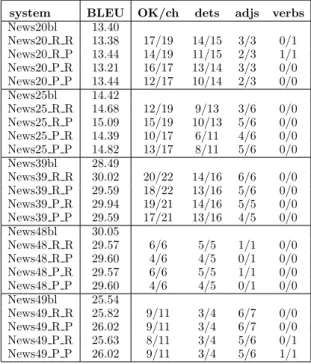
system BLEU OK/ch dets adjs verbs News20bl 13.40 News20 R R 13.38 17/19 14/15 3/3 0/1 News20 R P 13.44 14/19 11/15 2/3 1/1 News20 P R 13.21 16/17 13/14 3/3 0/0 News20 P P 13.44 12/17 10/14 2/3 0/0 News25bl 14.42 News25 R R 14.68 12/19 9/13 3/6 0/0 News25 R P 15.09 15/19 10/13 5/6 0/0 News25 P R 14.39 10/17 6/11 4/6 0/0 News25 P P 14.82 13/17 8/11 5/6 0/0 News39bl 28.49 News39 R R 30.02 20/22 14/16 6/6 0/0 News39 R P 29.59 18/22 13/16 5/6 0/0 News39 P R 29.94 19/21 14/16 5/5 0/0 News39 P P 29.59 17/21 13/16 4/5 0/0 News48bl 30.05 News48 R R 29.57 6/6 5/5 1/1 0/0 News48 R P 29.60 4/6 4/5 0/1 0/0 News48 P R 29.57 6/6 5/5 1/1 0/0 News48 P P 29.60 4/6 4/5 0/1 0/0 News49bl 25.54 News49 R R 25.82 9/11 3/4 6/7 0/0 News49 R P 26.02 9/11 3/4 6/7 0/0 News49 P R 25.63 8/11 3/4 5/6 0/1 News49 P P 26.02 9/11 3/4 5/6 1/1
Table 5: Manual evaluation of the transla-tion after combining sequentially both post-processes, first applying the disambiguation post-process and, afterwards, checking for the agreement. The notation is the same as in previous tables.
phrase “the amicable meetings”. This phrase is translated by the baseline as “el amis-tosa reuniones”, where one can find disagree-ments of gender and number among the de-terminer, the adjective and the noun. The system detects these disagreements and af-ter tagging the source with the correct forms and re-translating, one obtains the correct final translation “las reuniones amistosas”, where we observe also that the decoder has reordered the sentence.
Regarding to the errors introduced by the system, we observe again that many of them are caused by wrong analysis. For instance, in the sentence “all (the) war cries” which should be translated as “todos los gritos de guerra”, the dependence tree shows that the determiner depends on the noun “war” and not on “cries”, so, according to this rela-tion, our method identifies that the deter-miner and the translation do not agree and produces the wrong translation “todos (la) guerra gritos”.
These results also show that for our ap-proach it is easier to detect and fix dis-agreements among determiners or adjectives and nouns than among subjects and their
related verbs. In general, this is because our current system does not take into ac-count subordinated sentences, agent subjects and other complex grammatical structures, and therefore the number of detected cases is smaller than for the determiner–adjective– noun cases. Further work can be done here to extend this post-process in order to iden-tify disagreements among noun phrases and other structures in the sentence that appear after the verb.
In order to complete this set of exper-iments, we run sequentially both systems. Table 5 shows the results for the combina-tion of systems in the same format as in the previous experiment. Once again, we ob-serve only slight variations in BLEU scores but, manually, we see that when the sys-tems introduce changes, they are able to fix more translations than the ones they dam-age. Also as before, it is easier to detect and fix disagreements among determiners, adjec-tives and nouns than those regarding verbs because of the same reason as in the inde-pendent system.
6 Conclusions and Future Work
This work presents a methodology to include document-level information within a transla-tion system. The method performs a two-pass translation. In the first one, incorrect translations according to predefined criteria are detected and new translations are sug-gested. The re-translation step uses this in-formation to promote the correct translations in the final output.
A common post-process is applied to deal with lexical coherence at document level and intra- and inter-sentence agreement. The source documents are annotated with lin-guistic processors and the interesting struc-tures are projected on the translation where inconsistencies can be uncovered. In or-der to handle lexical coherence, we devel-oped a post-process that identifies words translated with different meanings through the same document. For treating disagree-ments, we developed a post-process that looks for inconsistencies in gender, number and person within the structures determiner– adjective(s)–noun(s) and subject–verb.
Because we are treating concrete phenom-ena, an automatic evaluation of our systems does not give us enough information to
as-sess the performance of the systems. A
shows that we only introduce local changes. The lexical-coherence-oriented post-process induces mostly correct translation’s changes when using our restrictive system, improving the final coherence of the translation. On the other hand, for the post-process focused on the analysis of the number and gender agree-ment, it achieves more than 80% of accuracy over the introduced changes in the manually-evaluated news documents. We also observed that some of the negative changes are conse-quence of bad word alignments which intro-duce noise when proposing new translations. A natural continuation of this work is to complete the post-processes by including in the study new document-level phenomena like discourse markers or translation of pro-nouns. On the other hand, we aim to refine the methods of suggestion of new possible translations and to detect bad word align-ments. As a future work, we plan to intro-duce the analysis of these kind of document-level phenomena at translation time, using a document-level oriented decoder like Docent. References
Gong, Z., M. Zhang, and G. Zhou.
2011. Cache-based document-level statis-tical machine translation. In Proc. of the 2011 Conference on Empirical Methods in NLP, pages 909–919, UK.
Gonz´alez, M., J. Gim´enez, and L. M`arquez. 2012. A graphical interface for MT eval-uation and error analysis. In Proc. of the 50th ACL Conference, System Demon-strations, pages 139–144, Korea.
Hardmeier, C. and M. Federico. 2010. Mod-elling pronominal anaphora in statistical machine translation. In Proc. of the 7th International Workshop on Spoken Lan-guage Translation, pages 283–289, France. Hardmeier, C., J. Nivre, and J. Tiede-mann. 2012. Document-wide decoding for phrase-based statistical machine transla-tion. In Proc. of the Joint Conference on Empirical Methods in NLP and Computa-tional Natural Language Learning, pages 1179–1190, Korea.
Hardmeier, C., S. Stymne, J. Tiedemann, and J. Nivre. 2013. Docent: A document-level decoder for phrase-based statisti-cal machine translation. In Proc. of the 51st ACL Conference, pages 193–198, Bul-garia.
Koehn, P. 2005. Europarl: A Parallel Cor-pus for Statistical Machine Translation. In Conference Proc.: the tenth Machine Translation Summit, pages 79–86. AAMT. Koehn, P., H. Hoang, A. Birch, C.
Callison-Burch, M. Federico, N. Bertoldi,
B. Cowan, W. Shen, C. Moran, R. Zens, C. Dyer, O. Bojar, A. Constantin, and
E. Herbst. 2007. Moses: open source
toolkit for statistical machine translation. In Proc. of the 45th ACL Conference, pages 177–180, Czech Republic.
Nagard, R. Le and P. Koehn. 2010. Aid-ing pronouns translation with co-reference resolution. In Proc. of Joint 5th Work-shop on Statistical Machine Translation and MetricsMATR, pages 252–261, Swe-den.
Och, F. 2003. Minimum error rate training in statistical machine translation. InProc. of the ACL Conference.
Och, F. and H. Ney. 2003. A systematic com-parison of various statistical alignment models. Computational Linguistics. Padr´o, L., S. Reese, E. Agirre, and A. Soroa.
2010. Semantic services in freeling 2.1:
Wordnet and ukb. In Principles,
Con-struction, and Application of Multilingual Wordnets, pages 99–105, India. Global Wordnet Conference.
Papineni, K., S. Roukos, T. Ward, and W.J.
Zhu. 2002. Bleu: a method for
auto-matic evaluation of machine translation. In Proc. of the 40th ACL Conference, pages 311–318.
Sapena, E., L. Padr´o, and J. Turmo. 2010. A global relaxation labeling approach to coreference resolution. In Proceedings of 23rd COLING, China.
Stolcke, A. 2002. SRILM – An extensible language modeling toolkit. In Proc. Intl. Conf. on Spoken Language Processing. Surdeanu, M., J. Turmo, and E. Comelles.
2005. Named entity recognition from
spontaneous open-domain speech. In
Proc. of the 9th Interspeech.
Xiao, T., J. Zhu, S. Yao, and H. Zhang. 2011. Document-level consistency verification in machine translation. InProc. of Machine Translation Summit XIII, pages 131–138, China.