Winthrop University
Winthrop University
Digital Commons @ Winthrop
Digital Commons @ Winthrop
University
University
Winthrop Faculty and Staff Publications
2017
Faculty Development and Student-Centered Online Learning:
Faculty Development and Student-Centered Online Learning:
Issues, Perspectives and Lessons Learned from Integrating an
Issues, Perspectives and Lessons Learned from Integrating an
Exemplary Course Program
Exemplary Course Program
Patrick Guilbaud
Winthrop University, [email protected]
Kimarie Whetstone
Winthrop University
Follow this and additional works at: https://digitalcommons.winthrop.edu/fac_pub
Part of the Educational Technology Commons, Higher Education and Teaching Commons, and the
Online and Distance Education Commons
Publisher Citation
Publisher Citation
Guilbaud, P. & Whetstone, K. (2017). Faculty Development and Student-Centered Online Learning: Issues, Perspectives and Lessons Learned from Integrating an Exemplary Course Program. In J. Dron & S. Mishra (Eds.), Proceedings of E-Learn: World Conference on E-Learning in Corporate, Government, Healthcare, and Higher Education (pp. 152-158). Vancouver, BC, Canada: AACE.
This Article is brought to you for free and open access by Digital Commons @ Winthrop University. It has been accepted for inclusion in Winthrop Faculty and Staff Publications by an authorized administrator of Digital Commons @ Winthrop University. For more information, please contact [email protected].
Faculty Development and Student-Centered Online Learning: Issues,
Perspectives and Lessons Learned from Integrating an Exemplary Course
Program
Patrick Guilbaud, PhD, MSE, MBA
Director Extended Education and Associate Professor, Winthrop University, Rock Hill SC
[email protected] Kimarie Whetstone, PhD
Director of Online Learning and Assistant Professor Winthrop University, Rock Hill SC
Abstract:During the spring of 2017, Winthrop University rolled-out a new faculty training and development program, called Winthrop Exemplary Online Course (WEOC), to increase the number and diversity of online course offerings at the school during the summer sessions. Grounded in andragogical principles, the WEOC program also had the aim of providing participating faculty members with the requisite skills to develop more student-centered, engaging, and user-friendly online courses. Preliminary results indicate that the WEOC program achieved its key goals and objectives. Moreover, faculty participants noted that the program stands to build upon existing teaching and learning efforts and approaches at the University to foster increased levels of students’ achievement, retention, and persistence. In this paper, we present the development, design, and roll-out of the WEOC program. We will also highlight educational outcomes, faculty reactions, and lessons learned from integrating the exemplary online course program at the University.
Introduction
Research shows that many higher education institutions across the USA face the challenge of securing suitable levels of enrollment, particularly during the summer sessions, to meet their target student population mix and their annual tuition revenue goals (Hoskins, 2011; Hannover Research, 2015). According to Papandrea (2015), one of the major reasons for the enrollment shortfall at those institutions is the unavailability of courses that meet the academic needs and intellectual interests of their students. In addition, the data shows that many higher educational institutions and most specifically those with a population of 7,000 or fewer enrolled students do not have the capacity to offer a wide diversity of course offerings to keep the students at their campus year-round (Hannover Research, 2015).
With the rise and wide acceptance of Online Education, most higher education institutions are able to leverage the Internet to broaden their course offerings (Balula & Moreira, 2014; Lin, 2008). Online offerings are not location-based. Consequently, colleges and universities can use the medium to provide students new and more convenient pathways to pursue their academic studies while they are engaged in other activities such as: working, doing an internship, engaging in a service learning effort, or even while participating in a study abroad trip.
Our study investigated the impacts and outcomes of introducing the Winthrop exemplary online course (WEOC) program in faculty development. We specifically wanted to gauge whether the curriculum of the WEOC program helps in providing faculty the necessary skills, know-how and inclination to create online courses that promote active and engaged learning. Further, we sought to examine faculty members’ reactions and behavioral changes to online instruction as a result of their involvement in the WEOC program.
Faculty Development and Online Learning
Online learning currently represents a strategic opportunity for many higher education institutions across the country seeking to meet students’ demand for flexible and convenient access to courses that are required by their academic colleges, schools or programs. Yet, a key barrier for colleges and universities to broadening their mix of course offerings is the lack of in-house know-how to build new courses or repurpose existing ones for online or hybrid delivery (Murray, 2008; Austin and Sorcinelli, 2013). Given that faculty members must juggle many
priorities to include teaching, research, and service, there is usually little time left to focus on skills-building and self-development activities (Brunk-Chavez & Palsole, 2011).
Another major challenge for institutions that are new to online course delivery is the creation of learning activities that promote student interaction while offering a clear and consistent user experience to both students and instructors. Numerous studies have shown that there is a strong need to place faculty at the center of campus-wide online learning initiatives (Balula & Moreira, 2014). This is to ensure that the desired learning goals, instructional objectives and academic rigor of such efforts are achieved.
Unfortunately, many academic institutions are not well-versed in andragogical principles and practices (Austin and Sorcinelli, 2013; Guilbaud, 2007; Levine, 2005). As a result, professional development opportunities that are offered to faculty members most often follow very traditional instructional methods and approaches that rely primarily on lectures and presentations. Yet, faculty members, as adult learners, need to see a clear link between any training received and the application of that training in a real world context (Guilbaud, 2007; Knowles, 1984.) Therefore, a professional development program or initiatives that seek full and direct engagement of faculty members must be connected to a tangible outcome such as the creation of course, redesign of a program of study, a research activity or the submission of a grant proposal.
Online Quality Assurance Models
A fundamental aspect of online program delivery is maintaining course quality to include: setting clear learning objectives, ensuring cognitive presence, embedding peer-to-peer interactions, and using appropriate tools and technology (Bowser, Davis, Singleton, & Small, 2017; Holsombach-Ebner, 2013; Kanuka, Liam, & Laflamme, 2007). Online quality assurance models provide a framework for measuring quality in course design. Models such as the California State University Quality Learning and Teaching (CSU QLT) program, the Quality Matters (QM) program, and the Blackboard Exemplary Course Program (ECP) include the following characteristics:
• professional development approach for course design and delivery; • research-based and pedagogically informed instrument;
• systematic review process (self and then peer);
• official course review process, leading to certification of online courses; and • student survey.
Selecting a Quality Assurance Model
Faculty engagement with an online quality assurance model has the potential for improving their capacity for online teaching and the design and development of student-centered online learning experiences. While the online quality assurance models share many similarities, each must be carefully examined prior to adoption. The California State University Quality Learning and Teaching (CSU QLT) Model
The CSU QLT evaluation instrument, developed by California State University in 2011, is designed for the review of blended and online courses by certified peer reviewers, faculty, faculty developers, and instructional designers (California State University, 2015). CSU QLT contains 10 sections and 57 objectives, including a section on Mobile Platform Readiness. The CSU QLT evaluation instrument is offered under a Creative Commons License. The Quality Matters (QM) Rubric
The QM Rubric, developed by the MarylandOnline, Inc. consortium in 2003, is focused on continuous improvement and is designed for the certification of blended and online courses, and online programs by trained master reviewers, program reviewers, faculty, and course developers (Quality Matters, 2017a). The QM Rubric contains 8 general standards and 43 specific review standards (Standards from the Quality Matters Higher Education Rubric, 5th Edition).
The Blackboard Exemplary Course Program (ECP) Rubric
The Blackboard ECP Rubric, developed by Blackboard, Inc. in 2000, is designed for the review of blended and online courses by ECP experts, faculty, and instructional designers (Blackboard, 2017). The ECP Rubric contains 4 categories and 17 sub-categories, including Course Design, Interaction and Collaboration, Assessment, and Learner Support. Scores for each subcategory align with four levels of mastery, including Exemplary, Accomplished, Promising, Incomplete, and Not Evident. The Blackboard ECP Rubric assists faculty with identifying and engaging in best practices for quality course design (Blackboard, 2017). The Blackboard ECP rubric is offered under a Creative Commons License. Winthrop University adopted the Blackboard ECP Rubric for use in
its faculty training and development program because it is faculty-centered, encouraging greater faculty participation and engagement in the course design and development process.
Challenges in Implementing a Quality Assurance Model
Institutions face certain challenges during the process of selecting an online quality assurance model. During the development of its online program in Education, Arkansas State University identified three challenges that influenced their decision to adopt CSU QLT. These include other rubrics not covering everything that was necessary to be evaluated, the potential for issues with interrater reliability, and concerns of academic freedom (Bowser, Davis, Singleton, & Small, 2017). Financial cost is another challenge that influences adoption. The QM model, for example, has fees associated with obtaining access to the annotated version of the rubric, which provides explanations for how to apply the QM standards. These costs increase depending on the engagement level of adoption selected by the institution, beginning with ad-hoc, individual faculty engagement through institutional engagement with QM consortium membership (Quality Matters Process, 2017b). A study on the application of QM standards to the online MSW program at Virginia Commonwealth University revealed that it is necessary to complement the QM standards with student feedback to facilitate the design and development of student-centered online learning experiences (Secret, Bentley, & Kadolph, 2016).
The Winthrop Exemplary Online Course Project
The Winthrop Exemplary Online Course project was introduced in spring 2017 to increase overall enrollment during the summer sessions and to catalyze the development of more engaging online learning experiences at the University. The WEOC program, which is based on the Blackboard Exemplary Course Program Rubric, also had the aim to foster more innovation and experimentation in the development and creation of online courses at the University.
The entire WEOC program was centered on the following four major aspects and orientations: 1. Partnership between the offices of Summer Programs and Online Learning of the University
2. Call for proposals for high demand in-seat courses during the regular academic semesters, which had trouble meeting enrollment requirements during the summer sessions, to be newly designed or repurposed for online delivery
3. Targeted training of faculty members whose courses were selected for the program
4. The development of a new online course or and significant redesign of an existing online course to adhere to the standards of the Blackboard Exemplary Course Program Rubric by all participants in WEOC Another major aspect of the program is that faculty members whose course proposals were selected had to commit to stay for its entire duration. In recognition of time spent in the program, a cash incentive was provided to all faculty members who agreed to participate in the program.
WEOC Program Implementation
As a new initiative, the WEOC program had a total of 13 faculty members representing all four colleges of the University. In addition, the decision was made to include more participants from the College of Arts and Sciences of the University, which had the greatest number of students and offered the most courses during the University’s summer sessions.
Pre-entry Survey
A pre-entry survey was administered to the 13 faculty participants to identify entry skills and training needs. The results of the survey indicated that 64% have taught fully online or hybrid courses, and 73% did not have the experience of participating in an online/hybrid course as a student. In addition, close to 91% of participants had basic technical skills and less than 10% of the participants indicated that they were not confident with creating hyperlinks and installing software. The survey indicated that the largest training needs (greater than 90% of participants) were as follows:
• Establishing presence
• Building an online community
• Providing audio feedback
• Designing learner support and scaffolding strategies • Understanding Universal Design principles for learning Training
The selected faculty members for the WEOC program participated in a fully online training course to provide them with the student experience of online learning. The course was designed using the Blackboard Exemplary Course Program (ECP) Rubric and consisted of three online modules in online learning theory, online course design, and online course management. The faculty completed a series of activities, which were graded using a rubric. Participants also interacted with their peers through blog and discussion board posts in each module. Additional modules were available covering various online course tools in the Blackboard Learning Management System. The online course was designed to be a model for faculty to follow in their own online courses. The faculty were required to earn 80% or more on assessments in the three online modules, meet with an instructional designer several times during the program, and earn a rating of Accomplished on all ECP Rubric categories prior to course delivery. A certificate of participation and badge were awarded for participants earning a course review rating of Exemplary. To reduce bias, an instructional designer other than the individual who assisted with the design of the course was responsible for the course review.
Program Results and Outcomes
Changes in Student Enrollment
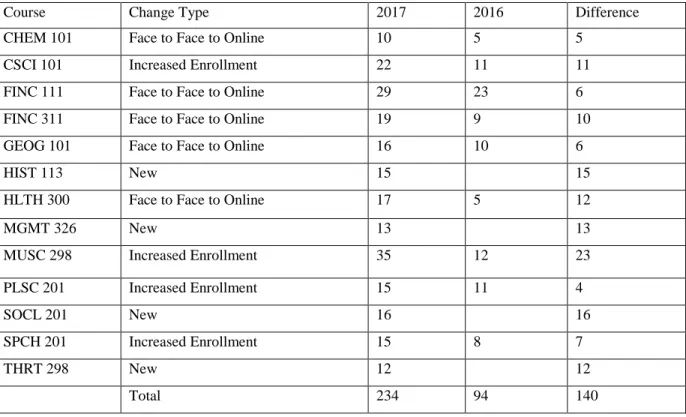
As noted in the table below, all of the courses in the program either had a positive enrollment change from the previous year or had a maximum number of enrollees (new offerings).
Course Change Type 2017 2016 Difference
CHEM 101 Face to Face to Online 10 5 5
CSCI 101 Increased Enrollment 22 11 11
FINC 111 Face to Face to Online 29 23 6
FINC 311 Face to Face to Online 19 9 10
GEOG 101 Face to Face to Online 16 10 6
HIST 113 New 15 15
HLTH 300 Face to Face to Online 17 5 12
MGMT 326 New 13 13
MUSC 298 Increased Enrollment 35 12 23
PLSC 201 Increased Enrollment 15 11 4
SOCL 201 New 16 16
SPCH 201 Increased Enrollment 15 8 7
THRT 298 New 12 12
Total 234 94 140
Table 1: Summer 2017 Exemplary Enrollment Analysis
The enrollment table that is presented in this section of the paper shows a net increase of 140 students for the WEOC program. Moreover, each individual course in the program had at least a 25% increase in enrollment over the previous year’s offering of that course. We believe therefore that the WEOC program achieved its key goals and objectives.
Two instructional designers supported the faculty participants during the program. Faculty and instructional designer reactions were collected during the course, during instructional design meetings, and during the program wrap-up meeting. The comments in Tables 2 and 3 reflect that the faculty and instructional designers had a meaningful experience.
Faculty Comments
“We are learning things that we did not know or had not considered before, even after having taught online for a while.”
“One faculty member’s prior courses did not utilize the discussion board at all, but that faculty member is ‘burning it up’ on the discussion board in this course.”
“I came kicking and screaming, but there is always something new to learn with regard to online learning.” “The training course required a lot of reading. It would be helpful to have a built-in checklist that automatically tracks where we left off with the readings.”
Table 2: Faculty Reactions
Instructional Designer and Course Facilitator Comments
“Participants are working at a consistent pace in the training modules, in course development, and are meeting with the instructional designers with priority given to Summer A and B session courses.” –Instructional Designer One participant was presented with two ideas for creating an extra credit practice activity (interactive PowerPoint or online quiz) and implemented it immediately in the spring as a test case for her summer course. –Course Facilitator
Table 3: Instructional Designer and Course Facilitator Reactions
Conclusion
Winthrop University is a student-centered institution with a teaching and instruction approach that is grounded in the Liberal Arts tradition. The University is also focused on preparing students for their post-collegiate lives and their future careers. Consequently, the Winthrop Exemplary Online Course project was able to build upon existing teaching and learning approaches to assist faculty in creating online courses that support active learning and student engagement.
Moreover, through the implementation and roll-out of the WEOC project, the following three key takeaways have emerged:
1. Need to focus learner-learner engagement – Faculty members were able to leverage the tools available through Blackboard, the Learning Management System (LMS) to encourage collaboration, knowledge sharing, communications and teamwork. For example, the interactive tools of the LMS was used to facilitate peer to peer educational exchanges during the program.
2. Diversification of the learning experience – It is essential for students to have hands- and minds-on activities to foster mastery of education concepts. We found that faculty members were able to experiment with different assignment types to help create assignments of their own that develop higher order thinking skills. These include: blogs, wikis, online simulations, educational games, and digital flash cards.
3. Leveraging the educational affordances of online learning systems – A key advantage of online education is the opportunity for self-paced learning. As a result, faculty members have been able to integrate podcasting, conferencing, and adaptive online testing to apply a Universal Design for Learning approach that considers the diverse needs and levels of preparation of all learners in the course.
Given that the enrollment of the WEOC program was fully attained, there is great anticipation that additional resources will be offered by University leadership to broaden the program’s reach within the University. In addition, faculty members who participated in the WEOC program will be provided the opportunity to promote all best practices that were identified during the implementation and roll-out of the program within and without the University.
Austin, A. E. & Sorcinelli, M. D. (2013). The future of faculty development: Where are we going? New Directions for Teaching and Learning, 2013: 85–97. doi:10.1002/tl.20048
Balula, A., & Moreira, A. (2014). Evaluation of online higher education: Learning, interaction and technology. SpringerBriefs in Education. Switzerland: Springer International Publishing. doi:10.1007/978-3-319-05425-4.
Blackboard, Inc. (2017). Blackboard Exemplary Course Program. Retrieved from http://www.blackboard.com/consulting-training/training-technical-services/exemplary-course-program.aspx
Bowser, A., Davis, K., Singleton, J., & Small, T. (2017). Professional learning: a collaborative model for online teaching and development. SRATE Journal, 26(1), 1-8.
Brindley, J.E., Walti, C., & Blaschke, L.M. (2009). Creating effective collaborative learning groups in an online environment. The International Review of Research in Open and Distance Learning, 10(3)
Brunk-Chavez, B., & Palsole, S.V. (2011). The digital academy: Preparing faculty for digital course development. To Improve the Academy. Vol 30 (pp. 17-30).
California State University. (2015). QLT program background. Retrieved from http://courseredesign.csuprojects.org/wp/qualityassurance/qolt/.
Hanover Research (2015). 2016 Trends in higher education marketing, enrollment, and technology.
Holsombach-Ebner, C. (2013). Quality assurance in large scale online course production. Online Journal of Distance Learning
Administration, 16(2).
Hoskins, B. (2011). Demand, growth and evolution. The Journal of Continuing Higher Education, 59(1), 57-60. doi:10.1080/07377363.2011.546267
Guilbaud, P. (2007). Andragogy and online learning: Towards a systematic instruction framework. Unpublished dissertation, University of Virginia, Charlottesville.
Kanuka, H., Liam, R. & Laflamme, E. (2007). The influence of instructional methods on the quality of online discussion. British
Journal of Educational Technology, 38(2), 260 – 271.
Knowles, M. (1984). The adult learner: A neglected species (3rd Ed.). Houston: Gulf Publishing.
Levine, S. J. (2005). Creating a foundation for learning relationships. In S. J. Levine (Ed.), Making distance education work: Understanding learning and learners at a distance (pp. 17–25). Michigan: Learner Associates.net.
Lin, L. (2008). An online learning model to facilitate learners’ rights to education. (pp. 127-143). Journal of Asynchronous
Learning Networks, 12(1).
Ouellet, M. L. (2010). Overview of faculty development. In K. J. Gillespie, D. L. Robertson, & Associates (Eds.), A guide to faculty development (pp. 3-20). San Francisco, CA: Jossey-Bass.
Papandrea, D. (2015) Outlook on enrollment: Perfect storm of challenges ahead. University Business, January 2015. Quality Matters. (2017a). About Quality Matters. Retrieved from https://www.qualitymatters.org
Quality Matters. (2017b). Quality Matters process. Retrieved from https://www.qualitymatters.org
Secret, M., Bentley, K. J., & Kadolph, J. C. (2016). Student voices speak quality assurance: continual improvement in online social work education. Journal of Social Work Education, 52(1), 30-42.
Standards from the Quality Matters Higher Education Rubric, 5th Edition. Quality Matters. Retrieved from https://www.qualitymatters.org/