Supervisor’s Role as an Antecedent of Training Transfer
and Motivation to Learn in Training Programs
Research Associate Professor Dr Azman Ismail, PhD National Defence University of Malaysia [email protected] Hasan Al Banna Mohamed, B.A (Edu) Hons; M.Sc National Defence University of Malaysia
[email protected] Ahmad Zaidi Sulaiman, Bsc (Maths); Dip in Education; M.B.A
National Defence University of Malaysia [email protected] Suriawati Sabhi, Bsc (HRD) National Defence University of Malaysia [email protected]
Abstract: Training and development program literature highlights two major characteristics of supervisor’s role: support and communication. The ability of supervisors to provide adequate support and practice good communication style in relation to training programs may lead to increased training transfer and motivation to learn. Though the nature of this relationship is significant, little is known about the predictive properties of supervisor’s roles in training program literatures. Therefore, this study was conducted to measure the effect of supervisor’s role on training transfer and motivation to learn using 110 usable questionnaires gathered from employees who have attended training programs in a state public work agency in East Malaysia, Malaysia. The results of exploratory factor analysis confirmed that the measurement scales used in this study satisfactorily met the acceptable standards of validity and reliability analyses. Further, the outcomes of stepwise regression analysis showed four important findings: first, support insignificantly correlated with motivation to learn. Second, communication significantly correlated with motivation to learn. Third, support significantly correlated with transfer of training. Finally, communication significantly correlated with transfer of learning. Statistically, this result confirms that support is an important antecedent of motivation to learn and communication is an important antecedent of motivation to learn. Conversely, support and communication are important antecedents of training transfer in the studied organization. In addition, discussion, implications and conclusion are elaborated.
Keywords: supervisor’s role; transfer of training; motivation to learn; public work agency JEL Classification: M53; M52
1. Introduction
Supervisors act as a vital link between top management and shop floor employees where they are given important duties and responsibilities to lead and monitor the development of work groups (Elangovan & Karakowsky, 1999) (Goldstein & Ford, 2002) (Noe 2008), and often work together with their employers to design, implement and monitor the execution of organizational policies, procedures and plans, including training programs (Comstock, 1994) (Robbins & DeCenzo, 2004) (Ellinger et al., 2005). In many organizations, the role of a supervisor is much affected by managerial perspectives. From the traditional management perspective, supervisors are given the important responsibility by the employer to identify the daily, routine and short-term employee deficiencies, as well as report such deficiencies to the top management who will then identify the training requirements or training needs to overcome such employee deficiencies (Pfeffer, 1998) (Rodrígues & Gregory, 2005).
In an era of global competition, organizations have now shifted their paradigms from traditional job-based training to organizational business strategies and cultures (MacNeil, 2004) (Ellinger et al., 2005) (Ismail et al., 2007). Under this approach, a training program is viewed as a strategic function of human capital management, where supervisors are empowered to effectively design and administer training programs for the employees to develop useful competencies not only to overcome daily problems, but also support the development and future growth of the organization (DeSimone, Warner & Harris, 2002) (MacNeil, 2004). In the designing stage of training programs, supervisors often work together with the management and senior employees in conducting training needs analyses (TNA), establishing training objectives, developing effective lesson plans, selecting suitable trainers, determining program methods and techniques, preparing course materials, and scheduling the program (Golemen, 2000) (Goldstein & Ford, 2002) (Nijman, 2004). In the course of running the training programs, supervisors would consult the management and experienced employees to ensure that the training activities achieve the set objectives (Elangovan & Karakowsky, 1999) (Yamnill & McLean, 2001) (DeSimone et al., 2002). The role of supervisors in administering training programs does not stop at providing support in financial and physical facility, they also have the capabilities to establish realistic and achievable learning expectations, provide positive reinforcements, create positive impetus for the training program, make employees feel comfortable to undergo training to
improve and develop their competencies (Brinkerhoff & Montesino, 1995) (Golemen, 2000).
In organizational context, the supervisors has a critical role in that they have the capacity and propensity to influence their subordinates whether or not to participate in training programs (Noe, 1986, 2008; Blanchard & Thackers, 2007). Scholars have identified that support and communication are two salient features of a supervisor’s role that can affect the overall effectiveness of training programs (Facteau et al., 1995) (Chiaburu & Tekleab, 2005) (Ismail et al., 2007) (Eisenberger et al., 2002) (Robbins & DeCenzo, 2004) (Tai, 2006) (Dawley, Andrews & Bucklew, 2008) view support as a supervisor who provides encouragement and opportunities to improve employee performance in organizations. In the workplace training, it is often defined as supervisors encouraging the employees to attend training programs, helping them before, during and after, in terms of time, budgetary support and resources, involving employees in decision-making, and guiding them in applying competencies that they have learned in the workplace (Chiaburu & Tekleab, 2005) (Ismail et al., 2007).
On the issue of communication, it is the activity or process of expressing ideas or feelings for the purpose of exchanging ideas and information between persons or groups of people through the use of symbols, actions, be it written or spoken words in order to impart information and ideas effectively (Harris, Simon & Bone, 2000) (Hornby, 2000) (Lumsden & Lumsden, 1993) (Harris et al., 2000). In the workplace training, it is defined as supervisors deliver information about the objectives of training program, suitable knowledge to be gained (procedures, content and tasks), appropriate skills to be acquired, the importance of attending training programs and performance feedback (Harris et. al., 2000) (Sisson, 2001). Recent studies in this area highlight the ability of supervisors to provide sufficient support and use comfortable communication style in training programs having significant impact on employee outcomes, especially motivation to learn (Chiaburu & Tekleab, 2005) (Ismail et al., 2009), and training transfer (Ismail et al., 2007) (Lim & Johnson, 2002). According to Knowles (1989), Klien, Noe, and Wang (2006), Noe (2008) and Blanchard and Thacker (2007) there are two distinct components to motivation to learn: motivation and learning. Motivation is defined as direction, persistence and amount of effort expanded by an individual to achieve his/her particular objective. Learning is usually viewed from the human, cognitive and behavior perspectives. Cognitive theorists define learning as a relatively
permanent change in cognition occurring as a result of experience. Meanwhile, behavior theorists define learning as relatively permanent change in behavior in response to a particular stimulus or set of stimuli (Noe, 1986). Based on the cognitive and behavioral perspectives, motivation to learn may be defined as an intense, persistence and direction of learning the necessary knowledge, up to date skills, new abilities and positive attitudes by an individual who has clear goals, high desire to learn course contents, puts a high value on outcomes, has high self-efficacy and satisfied with supervisors’ treatments (Klien, Noe & Wang, 2006) (Locke & Latham, 1990) (Maurer & Tarulli, 1994) (Quifiones, 1997) (Wood & Bandura, 1989). A person with high level of motivation to learn would boost his/her will to overcome discouraging learning factors. Consequently, the individual will follow, involve and commit him/herself to learning activities in order to improve his/her attitude and behavior in the workplace (Axtell et al., 1997) (Guerrero & Sire, 2001) (Nijman, 2004).
According to management scholars, transfer of training is a combination of two words: transfer and training (Blanchard & Thackers, 2007) (Goldstein & Ford, 2002). Transfer is defined as the act of moving something from one form to another (e.g., an individual uses the skills and knowledge learned in training on the job) while training refers to a person getting many exercises in order to improve at something (e.g., the ability of individuals to acquire knowledge, skills, abilities and attitudes by attending training settings and utilize them when returning to the workplace) (Baldwin & Ford, 1988) (Ismail & Bongogoh, 2007) (Lim, 2000). Laker (1990) and Goldstein & Ford (2002) classify transfer of training in two major forms: near transfer and far transfer. While near transfer, also called direct transfer, refers to trainees learning and applying knowledge, skills, and abilities gained from training programs to similar situations (i.e., at training place), far transfer, also known as indirect transfer, refers to trainees doing the same to dissimilar situations (i.e., at the workplace). Both training transfers lead to increased professional development in organizations. In the context of this study, training transfer is defined as individuals changing their cognitive, affective and psychomotor skills to meet organizational requirements. This definition is in agreement with Baldwin & Ford (1988) and Laker’s (1990) that trainees gain necessary knowledge, up to date skills, new abilities and positive attitudes by undergoing training programs and they can apply the same to accomplish daily job. In a training model, many scholars are of the view that support, communication, training transfer and motivation to learn are distinct constructs but highly
interrelated. For example, the ability of supervisors to provide adequate support and practice comfortable communication style in training programs may strongly lead to an enhanced training transfer and motivation to learn. Although this relationship is significant, little is known about the predictive properties of supervisor’s role in training management literature (Ismail et al., 2007) (Lim & Morris, 2006). There are arguments that supervisor’s role has been less emphasized in previous training program studies because of the over emphasized on internal properties of constructs (i.e., definition, purpose, and significance of supervisor’s role in training programs) and through the use of segmented approach in analyzing supervisor’s role, training programs, training transfer and motivation to learn. As a result, they may not be able to highlight the importance of supervisor’s role in developing training program models (Chiaburu & Tekleab, 2005; Ismail et al., 2007; Ismail et al., 2009; Lim & Johnson, 2002). Hence, the motivation for the researchers to further explores the nature of this relationship.
2. Objective of the Study
This study has four major objectives: 1) to measure the relationship between supervisor support and motivation to learn, 2) to measure the relationship between supervisor communication and motivation to learn, 3) to measure the relationship between supervisor support and training transfer, and 4) to measure the relationship between supervisor communication and training transfer. The location of this study is a state public work agency in East Malaysia, Malaysia. For confidential reason, the name of the studied organization is kept anonymous.
2.1. Literature Review
The Relationship between Supervisor’s Role and Motivation to Learn
Direct effects model were employed in recent studies to investigate supervisor’s role in training programs. Such studies include 119 employees who underwent training programs in a large organization in the United States (Chiaburu & Tekleab, 2005) and 100 technical employees who are serving in a city-based local authority in Malaysia (Ismail et al., 2009). Findings from these studies posit the ability of supervisors to provide adequate support (e.g., supervisory encouragement to attend training, encouragement to apply training onto the job and feedbacks) and use comfortable communication style (i.e., openly delivered information on
training, conducted discussion of what to be learned in training, explained training benefits, and provided feedbacks) are both major determinants of motivation to learn in the organizations (Chiaburu & Tekleab, 2005) (Ismail et al., 2009).
The findings of these studies are consistent with the notion of motivation to learn theories. The combination and application of Shannon’s (1940) mathematical theory of communication that communication channel consists of a sender (a source of information), a transmission medium (with noise and distortion), and a receiver (whose goal is to reconstruct the sender's messages), Vrooms’ (1964, 1973) expectancy theory that an individual will perform certain actions if he/she perceives such actions may bring valued outcomes, Locke and Latham’s (1990) goal setting theory that goals direct individuals to perform a task, indicate that the ability of supervisors to openly communicate the advantages and importance of undergoing training programs, as well as clearly explain the procedures of attaining training goals may strongly motivate employees to acquire new knowledge, up to date skills and positive attitudes and apply these in the workplace (Ismail et al., 2009) (Lim & Johnson, 2002).
Relationship between Supervisor’s Role and Training Transfer
Recent studies using direct effects model in investigating supervisor’s role in training programs include 10 Korean human resource practitioners in Korea (Lim, 2000) and 81 employees from 15 sister companies of a Korean conglomerate (Lim & Morris, 2006). Findings from these studies show that the ability of supervisors to provide adequate support (e.g., supervisory encouragement to attend training and apply the knowledge, skills and attitude acquired onto the job and use comfortable communication style (e.g., supervisor provide clear feedbacks) had been a major determinant of transfer of training in the organizations (Lim, 2000) (Lim & Morris, 2006).
The studies support the notion of Skinner’s (1938, 1963) reinforcement theory, which posits that an animal or human behavior is influenced by a combination of positive reinforcer (rewards) and negative reinforcer (punishment). Application of this theory in a training and development program model shows that the ability of supervisors to provide adequate support and use of comfortable communication style may positively reinforce employees’ motivation to acquire new knowledge, up to date skills and positive attitudes (Festner & Gruber, 2008) (Lim, 2000) (Lim & Morris, 2006) (Velada et al., 2007).
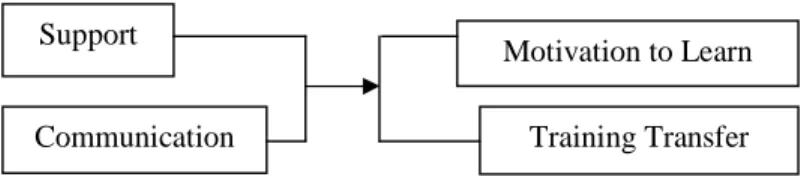
These literatures have been used as foundation to establish a conceptual framework for this study as shown in Figure 1.
Figure 1. Conceptual framework
From this framework, it can be hypothesized that:
H1: There is a positive relationship between supervisor support and motivation to learn.
H2: There is a positive relationship between supervisor communication and motivation to learn.
H3: There is a positive relationship between supervisor support and training transfer.
H4: There is a positive relationship between supervisor communication and training transfer.
3. Methodology
3.1. Research Design
Cross-sectional research design was employed in this study that allows the researchers to integrate training management literature, in-depth interview, pilot study and the actual survey to gather data. The use of this method would lead to accurate and less biased data (Cresswell, 1998) (Sekaran, 2003). This study was conducted in a public work agency, Sarawak, Malaysia. This organization has a vision to be the consultant of choice and a leading agency for infrastructure development in the state. The study begins with an in-depth interview involving two supervisors, the head of training unit and two supporting workers from the
Independent Variables Dependent Variable
Support
Communication Training Transfer
technical department who have been working for more than ten years in the organization. The interviewees were selected using a purposive sampling where they have good knowledge and experience about the design and administration of training programs. The information gathered aided the researchers to understand the nature of supervisor’s role, motivation to learn characteristics, training transfer features, as well as the relationship between these variables in the studied organization. After transcribing, categorizing and comparing the information with relevant theoretical and empirical evidence, the triangulated outcomes were used as a guideline to develop the content of the survey questionnaire for the pilot study. The next step in the study was a discussion with the above interviewees on the items in the survey questionnaire in order to verify the content and format of the questionnaire for the actual study. The back translation technique was used to translate the survey questionnaires in Malay and English to increase the validity and reliability of the instrument (Van Maanen, 1983) (Wright, 1996).
3.2. Measures
The survey questionnaire consists of four sections. First, supervisor support was measured using six items that were modified from the training research literature (Chiaburu & Takleab, 2005) (DeSimone et al., 2002) (Tsai & Tai, 2003). The sample items include: “My supervisor views employee development as an important aspect of his/her job” and “My supervisor provides me with the time I need to practice the skills learned in training”. Second, supervisor communication was measured using six items that were modified from the transfer of training literature (Xiao, 1996) (Yamnill & McLean, 2001). The items include: “My supervisors communicate the value of training program”. Third, motivation to learn was measured using seven items that were modified from the training programs literature (Tsai & Tai, 2003) (Rodríguez & Gregory, 2005). The sample items include: “I am trying to learn as much as I can from this course” and “I believe I tend to learn more from training programs than most people.” Fourth, transfer of training was measured using six items taken from Xiao (1996). The items include: “I can accomplish the job tasks better by using new knowledge acquired from the training course” and “Since I complete this training program, I have motivated subordinates employee’s considerably better than before the program”. All the items used in the questionnaire were measured using 7-item scale ranging from ‘strongly disagree’ (1) to ‘strongly agree’ (7). Demographic variables were used as the controlling variable because the study also focuses on employees’ attitude.
3.3. Unit of Analysis and Sampling
Official approval was first obtained to conduct the study from the head of the target organization who also gave advice on the procedures of conducting the survey at his organization. The targeted population for this study was 297 employees who have attended in-house training programs. After considering organizational rules, a convenience sampling technique was used and the questionnaires were distributed to participants through the training coordinator. Of the number, 110 usable questionnaires were returned yielding a response rate of 37 percent. Respondents answered these questionnaires of their own accord and on voluntarily basis. Statistically, the number of this sample met the requirements of inferential statistics The number of respondents in this sample exceeds the minimum number of 30 as required by probability sampling technique enabling it to be analyzed using inferential statistics (Sekaran, 2003) (Leedy & Ormrod, 2005).
3.4. Data Analysis
The Statistical Package for Social Science (SPSS) version 16.0 was used to analyse the data from the questionnaire. Exploratory Factor Analysis (EFA) was used to assess the validity and reliability of measurement scales (Nunally & Bernstein, 1994) (Hair et al, 1998). Based on the guidelines set up by these statisticians, factor analysis with direct oblimin rotation was performed on the research variables, followed by Kaiser-Mayer-Olkin Test (KMO), Bartlett’s Test of Sphericity (BTS), Eigenvalue, Variance Explained and Cronbach Alpha (α). The factor analysis yielded the value of 0.4 and more for all items representing each research variable, indicating that the items met the acceptable standard of validity analysis. All research variables have exceeded the acceptable standard of Kaiser-Meyer-Olkin’s value of 0.6 and were significant in Bartlett’s test of sphericity, showing that the measure of sampling adequacy for each variable was acceptable. All research variables had Eigenvalues larger than 1, signifying that the variables met the acceptable standard of validity analysis (Hair et al, 2006). All research variables exceeded the acceptable standard of reliability analysis of 0.70, indicating the variables met the acceptable standard of reliability analysis (Nunally & Bernstein, 1994). Variables that meet the acceptable standard of validity and reliability analyses were used in testing the hypotheses.
Next analysis of variance, Pearson Correlation analysis and descriptive statistics were conducted to analyze the constructs and the usefulness of the data set
(Tabachnick et al., 2001) (Yaacob, 2008). Finally, Stepwise Regression analysis was undertaken to assess the magnitude of each independent variable, the relationship between many independent variables and one dependent variable, and the contribution and influence of each independent variable on dependent variable (Baron & Kenny, 1986) (Foster et al., 1998). In this regression analysis, standardized coefficients (Standardized Beta) were used for all analyses (Jaccard et al., 1990).
4. Findings
4.1. Participant Characteristics
Table 1 shows the demography of the participants who were mostly males (53.6%), ages 46 and above years old (40.9%), non-management workers (56.4%), degree holders (39.1%), and workers who worked more than 21 (37.3%).
Table 1. Participant characteristic (N=110)
Note: SPM-Sijil Pelajaran Malaysia
STPM-Sijil Tinggi Pelajaran Malaysia Gender (%) Male = 53.6 Female = 46.4 Age (%) 18-25 = 5.5 26-35 = 29.1 36-46 = 24.5 > 46 = 40.9 Position (%) Management = 43.6 Non-management = 56.4 Education (%) Degree = 39.1 Diploma = 12.7 STPM = 5.5 SPM = 32.7 Competency Certificates = 10.0 Length of Service (%) < 1 years = 1.8 1-5 years = 12.7 6-10 years = 17.3 11-15 years = 20.0 16-20 years = 10.9 > 21 years = 37.3
Validity and Reliability Analyses for the Measurement Scales
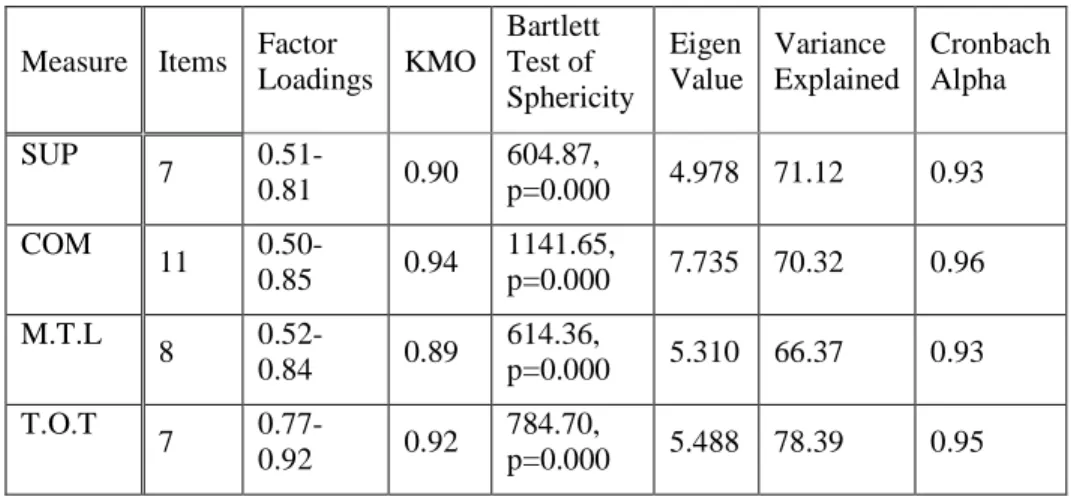
Table 2 shows the results of the validity and reliability analyses for measurement scales. The survey questionnaires consisted of 39 items covering five variables: supervisor support (7 items), supervisor communication (11 items), supervisor delivery modes selection (6 items), motivation to learn (8 items), and transfer of training (7 items). Based on Hair et al. (2006) guidelines, these statistical analyses showed that: (1) all research variables exceeded the acceptable standard of Kaiser-Meyer-Olkin’s value of 0.6, (2) all research variables were significant in Bartlett’s Test of Sphericity, (3) all research variables had Eigenvalues larger than 1, and (4) the items for each research variable exceeded factor loadings of 0.50 (Hair et al., 2006). All research variables also exceeded the acceptable standard of Reliability Analysis of 0.70 (Nunally & Bernstein, 1994). These statistical analyses confirm that the measurement scales met the acceptable standard of validity and reliability analyses as shown in Table 2.
Table 2. Validity & Reliability of Data
Measure Items Factor
Loadings KMO Bartlett Test of Sphericity Eigen Value Variance Explained Cronbach Alpha SUP 7 0.51-0.81 0.90 604.87, p=0.000 4.978 71.12 0.93 COM 11 0.50-0.85 0.94 1141.65, p=0.000 7.735 70.32 0.96 M.T.L 8 0.52-0.84 0.89 614.36, p=0.000 5.310 66.37 0.93 T.O.T 7 0.77-0.92 0.92 784.70, p=0.000 5.488 78.39 0.95
4.2. Analysis of the Constructs
The variance analysis, Pearson Correlation analysis and descriptive statistics were used to analyze the research variables used in this study. The analysis of variance techniques were used to compare the mean scores between two or more groups in the studied organization. In this case, independent samples t-tests were used to compare two different (independent) groups of people (i.e., gender) and
ANOVA is used to compare three and more different (independent) groups of people (i.e., age) (Hair et al., 2006) (Yaacob, 2008). Outcomes of one-way ANOVA showed that demographic variables were found not to have a significant difference with support (SUP), communication (COM), motivation to learn (M.T.L) and training transfer (T.O.T), showing that support, communication, delivery mode, motivation to learn and training transfer were found not to be differently perceived by different demographic variables.
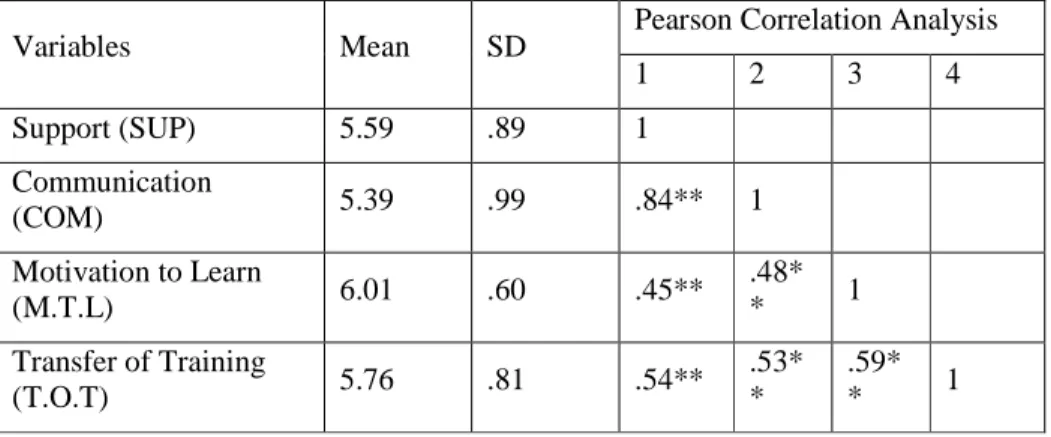
Table 3 shows the results of Pearson Correlation analysis and descriptive statistics. The mean values for the variables are from 5.39 to 6.01, signifying that the levels of SUP, COM, M.T.L. and T.O.T ranging from high (4) to highest level (7). The correlation coefficients for the relationship between the independent variable (support, communication and delivery mode) and the mediating variable (M.T.L) and the dependent variable (T.O.T) were less than 0.90, indicating that the data were not affected by serious collinearity problem (Hair, et al., 2006).
Table 3. Pearson correlation and descriptive analysis
Variables Mean SD Pearson Correlation Analysis
1 2 3 4 Support (SUP) 5.59 .89 1 Communication (COM) 5.39 .99 .84** 1 Motivation to Learn (M.T.L) 6.01 .60 .45** .48* * 1 Transfer of Training (T.O.T) 5.76 .81 .54** .53* * .59* * 1 Note: Significant at *p<0.05;***p<0.01
4.3. Outcomes of Testing Hypothesis 1 & Hypothesis 2
Table 4 shows demographic variables were entered in Step 1 and followed by entering independent variable (i.e., SUP and COM) in Step 2, and mediating variable (i.e., M.T.L) in Step 3. Motivation to learn was used as the dependent
variable. An examination of multicollinearity in the coefficients table shows that the tolerance value for the relationship between the independent variable (i.e., SUP, and COM) and the dependent variable (i.e., M.T.L) were 0.96 and 0.95, respectively. These tolerance values were more than the established tolerance value of .20 (as a rule of thumb), indicating the variables were not affected by multicollinearity problems (Fox, 1991) (Tabachnick et al., 2001).
Table 4. Results of the stepwise regression analysis
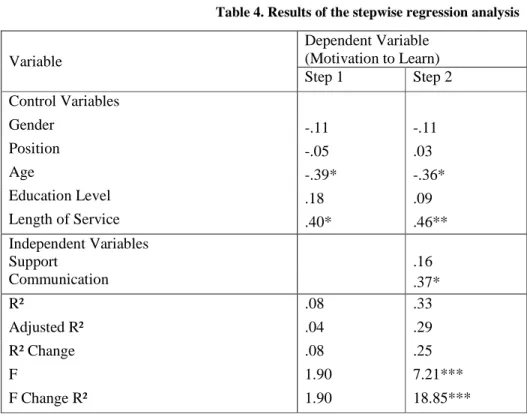
Variable Dependent Variable (Motivation to Learn) Step 1 Step 2 Control Variables Gender -.11 -.11 Position -.05 .03 Age -.39* -.36* Education Level .18 .09 Length of Service .40* .46** Independent Variables Support .16 Communication .37* R² .08 .33 Adjusted R² .04 .29 R² Change .08 .25 F 1.90 7.21*** F Change R² 1.90 18.85*** Note: Significant at *p<0.05, **<0.01, ***p<0.000
Table 4 shows the results of stepwise regression analysis in the two steps. Step 1 displayed that age and length of service were found to be significant predictors of motivation to learn (ß=.39, p<0.05; ß=.40, p<0.05, respectively), accounting for 8 percent of the variance in t dependent variable. Step 2 revealed that support was not found to be a significant predictor of motivation to learn (ß=.16, p>0.05), therefore H1 was not supported. Conversely, communication was found to be a significant predictor of motivation to learn (ß=.37, p<0.05), therefore H2 was supported. In terms of exploratory power, the inclusion of supervisor’s role in Step 2 had explained 33 percent of the variance in the dependent variable. Further, this
result confirms that support does not act as an important antecedent of motivation to learn and communication does act as an important antecedent of motivation to learn in the studied organization.
4.4. Outcomes of Testing Hypothesis 3 & Hypothesis 4
Table 6 shows that demographic variables were entered in Step 1 and then followed by entering independent variable (i.e., support and communication) in Step 2, and mediating variable (i.e., motivation to learn) in Step 3. Training transfer was used as the dependent variable. An examination of multicollinearity in the coefficients table shows that the tolerance value for the relationship between the independent variable (i.e., support, and communication) and the dependent variable (i.e., training transfer) were 0.96 and 0.95, respectively. These tolerance values were more than the established tolerance value of 0.20 (as a rule of thumb), indicating the variables were not affected by multicollinearity problems (Fox, 1991) (Tabachnick et al., 2001).
Table 5. Results of the stepwise regression analysis
Variable Dependent Variable (Motivation to Learn) Step 1 Step 2 Control Variables Gender .08 .07 Position -.04 .04 Age -.15 -.11 Education Level .21 .12 Length of Service .25 .32* Independent Variables Support .29* Communication .33* R² .09 .42 Adjusted R² .04 .38 R² Change .09 .33 F 2.0 10.48*** F Change R² 2.0 28.98*** Note: Significant at *p<0.05, **<0.01, ***p<0.000
Table 6 shows the results of stepwise regression analysis in the three steps. Step 1 revealed that length of service was found to be a significant predictor of training transfer (ß=0.32, p<0.05), accounting for 9 percent of the variance in the dependent variable. Step 2 displayed that the support and communication were found to be significant predictors of training transfer (ß=0.29, p<0.05; ß=.33, p<0.05, respectively), therefore H1 and H2 were supported. In terms of exploratory power, the inclusion of supervisor’s role in the Step 2 has explained 42 percent of the variance in the dependent variable, signaling that support and communication are important antecedents of training transfer in the studied organization.
5. Discussion and Implications
The findings of this study demonstrate that supervisor’s role act as a partial antecedent of motivation to learn and supervisor’s role act as a full antecedent of training transfer in the training program model of the studied organization. In the context of this study, supervisors have provided adequate support (e.g. encourage employees to attend training programs and apply newly acquired knowledge and skills that they gain from training programs in their jobs), and have practiced comfortable communication style (e.g. provide feedback, encourage discussion and openly deliver information on training) when implementing training programs. The majority of employees perceive that the inability of supervisors to provide adequate support in training programs may lead to lower motivation to learn, but the ability of supervisors to use comfortable communication practice in training programs may lead to higher motivation to learn. Conversely, the ability of supervisors to provide adequate support and use comfortable communication style may lead to an enhanced training transfer.
This study provides significant impact on three major aspects: theoretical contribution, robustness of research methodology, and contribution to the human resource development practitioners. In terms of theoretical contribution, this study produces three important outcomes. First, the ability of supervisors to use comfortable communication in training programs has been an important determinant of motivation to learn. This finding is consistent with the studies by Chiaburu and Tekleab (2005), and Ismail et al., (2009). Second, the ability of supervisors to provide adequate support and use of comfortable communication in training programs has been an important determinant of motivation to learn. This finding is consistent with that of Lim (2000), and Lim and Morris (2006).
With respect to the robustness of the research methodology, the survey questionnaire data used in this study have satisfactorily met the standards required for validity and reliability. This would lead to the production of accurate and reliable findings.
In the matter of practical contributions, the findings of this study can be used as a guideline by managers to improve the management of training programs in their organizations. Hence the following suggestions: 1) customize training contents and methods according to organizational expectations and needs. For example, the content of training programs for management employees should impart advanced human skills that may help them to understand individuals’ cognitive, emotion, psychomotor and superior moral values. In order to realize the training contents, professional trainers should be hired to teach management employees on how to properly implement interpersonal communication skills, managing change, conflict and problem solving techniques in the workplace. 2) allow supervisors to be involved in higher level training committees so that they may be able to channel or voice the needs and expectations of employees at the grass root level. In this manner, appropriate training modules that would support human resource management’s strategies to meet organizational goal can be properly designed and established. 3) change the human resource policies from hiring employees merely based on conformance to organizational policies and procedures to hiring employees based on creativity and innovations. This hiring system would hire knowledgeable and experienced employees who can train operational employees to improve attitude and working styles, as well as to handle employees’ demands with better treatments like showing more respect, be honest and accountable. 4) review monetary and non monetary rewards for supervisors based on current organizational strategy and goals. For example, internal organizational changes may increase supervisors’ list of duties and responsibilities, which may affect their health, safety and productivity at the workplace. These problems could be alleviate lessened if the type, level and/or amount of rewards (e.g., the structure and level of pay) are reviewed so that the quantum commensurate with the supervisors’ workloads and performance. Should organizations willing to seriously consider and implement these suggestions, employees motivation could be heightened this may positively motivate employees to sustain and support organizational and human resource department’s strategies and goals.
6. Conclusion
This study proposed a conceptual framework based on training research literatures. The measurement used in this study met the acceptable standards of validity and reliability. The outcomes of stepwise regression analysis also confirmed that supervisor communication in training programs is an important determinant of motivation to learn, and supervisor’s support and communication are an important determinant of training transfer in the studied organization. This result supports and broadened training research literature mostly published in Western organizational settings. Therefore, current research and practice within training management models need to consider supervisor’s support and communication as a key element of the workplace training system where increasing the capability of supervisors to provide adequate support and use comfortable communication style in training programs may motivate employees to sustain and increase organizational competitiveness in a global economy.
7. References
Axtell, C. M. & Maitlis, S. (1997). Predicting Immediate and Longer-Term Transfer of Training. Personnel Review, Vol. 26, No. 2, pp. 201-213.
Baldwin, T. T. & Ford, J. K. (1988). Transfer of Training: A Review and Directions for Future Research. Personnel Psychology, Vol. 41, No. 1, pp. 63-103.
Baron, R. M. & Kenny, D. A. (1986). This Moderator-Mediator Variable Distinction In Social Psychological Research: Conceptual, Strategic and Statistical Considerations. Journal of Personality and Social Psychology, Vol. 51, No. 6, pp. 1173-1182.
Blanchard, N. P. & Thackers, J. (2007). Effective Training: Systems, Strategies and Practices. New Jersey: Prentice Hall.
Brinkerhoff, R. O. & Montesino, M. U. (1995). Partnerships for Training Transfer: Lessons From a Corporate Study. Human Resource Development Quarterly, Vol. 6, No. 3, pp. 263-274. Chiaburu, D. S. & Tekleab, A. G. (2005). Individual and Contextual Influences on Multiple Dimension of Training Effectiveness. Journal of European Industrial Training, Vol. 29, No. 8, pp. 604-626.
Comstock, T. W. (1994). Fundamentals of Supervision: The-First Line Manager at Work. Columbia: Delmar Publishers Inc.
Cresswell, J. W. (1998). Qualitative Inquiry and Research Design: Choosing Among Five Traditions. London: SAGE publications.
Dawley, M. C. & Andrews, N. S. B. (2008). Mentoring, Supervisor Support And Perceived Organizational Support: What Matters Most?. Leadership & Organization Development Journal, Vol. 29, No. 3, pp. 235 – 247.
DeSimone, R. L.; Werner, J. M. & Harris, D. M. (2002). Human Resource Development. Thomson Learning, Inc.
Eisenberger, R.; Stinglhamber, F.; Vandenberghe, C.;, Sucharski, I. L. & Rhodes, L. (2002). Perceived Supervisor Support: Contributions to Perceived Organizational Support and Employee Retention. Journal of Applied Psychology, Vol. 87, No. 3, pp. 565-573.
Elangovan, A. R. & Karakowsky, L. (1999). The Role of Trainee and Environmental Factors in Transfer of Training: An Exploratory Framework. Leadership and Organization Development Journal, Vol. 20, pp. 268-275.
Ellinger, A. E.; Ellinger, A. D. & Keller, S. B. (2005). Supervisory Coaching in a Logistics Context. International Journal of Physical Distribution & Logistics Management, Vol. 35, No. 9, pp. 620-636.
Facteau, J. D.; Dobbins, G. H.; Russell, J. E. A.; Ladd, R. T. & Kudisch, J. D. (1995). The Influence of General Perceptions of The Training Environment on Pertaining Motivation and Perceived Training Transfer. Journal of Management, Vol. 21, No. 1, pp. 1-25.
Festner, D. & Gruber, H. (2008). Conditions of Work Environments in Fostering Transfer of Training. In S. Billet, C. Harteis and A. Etelapelto (Eds.), Emerging Perspectives on Learning through Work (pp. 215-231). Rotterdam, Netherlands: Sense.
Foster, D. P.; Stine, B. & Waterman, R. (1998). Business Analysis Using Regression: A Casebook. Springer-Verlag.
Fox, J. (1991). Regression Diagnostics. Newbury Park: Sage Publications.
Georgenson, D. L. (1982). The Problem of Transfer Calls for Partnership. Training and Development Journal, Vol. 36, No. 10, pp. 75-78.
Goldstein, I. L. & Ford, J. K. (2002). Training in Organization: Needs Assessment, Development and Evaluation. CA: Wadsworth Group, Thomson Learning, Inc.
Golemen, D. (2000). Leadership That Gets Results. Harvard Business Review, Vol. 78, No. 2, pp. 78-90.
Hair, J. F.; Anderson, R. E.; Tatham, R. L. & Black, W. C. (2006). Multivariate Data Analysis. New Jersey: Prentice Hall International, Inc.
Harris, R.; Simon, M. & Bone, J. (2000). More Than Meets The Eye? Rethinking the Role of Workplace Trainer. Australian National Training Authority.
Hornby, A. S. (2000). Oxford Advanced Learner’s Dictionary. (6th ed.). NY: Oxford University Press.
Jaccard, J.; Turrisi, R. & Wan, C. K. (1990). Interaction Effects in Multiple Regression. Newsbury Park, California: SAGE Publications, Inc.
Ismail, A.; Bongogoh, S.; Segaran, S. C. C; Tudin, R.; Ajis, M. N. & Wan Ismail, W. K. (2009). Supervisor Communication and Motivation to Learn as a Predictor of Positive Individual Attitudes and Behaviours: A Study in One City-Based Local Authority. Jurnal Kemanusiaan, Vol. 13, pp. 19-29.
Ismail, A.; Chandra Segaran, S. C.; Cheekiong, T. & Ong, G. (2007). The Mediating Role of Motivation to Learn in The Relationship Between Supervisors’s Role and Job Performance. The Sixth Asian Conference of the Academy of HRD, Dec 3-5, 2007, Beijing, China.
Klein, H. J.; Noe, R. A. & Wang, C. (2006). Motivation to Learn and Course Outcomes: The Impact of Delivery Mode, Learning Goal Orientation and Perceive Barriers and Enablers. Personnel Psychology, Vol. 59, pp. 665-702.
Knowles, M. (1989). The Adult Learner: The Definitive Classic in Adult Education and Human Resource Development. Houston: Gulf Publication Company.
Laker, D. R. (1990). Dual Dimensionality of Training Transfer. Human Resource Development Quarterly. Vol. 1, No. 3, pp. 209-224.
Leedy, P. D. & Ormrod, J. E. (2005). Practical Research: Planning and Design. Upper Saddle River, NJ: Pearson Education Inc.
Lim, D. H. (2000). Training Design Factors Influencing Transfer of Training to The Workplace Within an International Context. Journal of Vocational Education and Training. Vol. 52, No. 2, pp. 243-257.
Lim, D. H. & Johnson, S. D. (2002). Trainee Perceptions of Factors That Influence Learning Transfer. International Journal of Training and Development, Vol. 6, No. 1, pp. 36-48.
Lim, D. H.& Morris, M. L. (2006). Influence of Trainee Characteristics, Instructional Satisfaction and Organizational Climate on Perceived Learning and Training Transfer. Human Resource Development Quarterly, Vol. 17, No. 1, pp. 85-115.
Locke, E. A., & Latham, G. P. (1990). Work Motivation and Satisfaction: Light at the End of The Tunnel. Psychological Science, Vol. 1, No. 4, pp. 240-246.
Lumsden, G. & Lumsden, D. (1993). Communicating in Groups and Teams: Sharing Leadership, CA, USA: Wadsworth, Inc.
Macneil, M. C. (2004). Exploring the Supervisor Role as a Facilitator of Knowledge Sharing In Teams. Journal of European Industrial Training, Vol. 28, No. 1, pp. 93-102.
Maurer, T. J. & Tarulli, B. A. (1994). Investigation of Perceived Environment, Perceived Outcome and Person Variables in Relationship to Voluntary Development Activity by Employees. Journal of Applied Psychology, Vol. 79, No. 1, pp. 3-14.
Nijman, D. J .J. (2004). Differential Effects of Supervisor Support on Transfer of Training, University of Twente, Enschede.
Noe, R. A. (1986). Trainee Attributes and Attitudes: Neglected Influences on Training Effectiveness. Academy of Management Review, Vol. 11, pp. 736-749.
Noe, R. A. (2008). Employee Training and Development, New York: McGraw Hill. Nunally, J.C. & Bernstein, I. H. (1994). Psychometric Theory. New York: McGraw-Hill. Pfeffer, J. (1998). Seven Practices of Successful Organizations. California Management Review, Vol. 40, No. 2, pp. 96-123.
Robbins, S. P. & DeCenzo, D. A. (2004) Supervision today. USA: Pearson Prentice Hall. Quinones, M. A. (1997). Contextual influences on training effectiveness. In M. A. Quinones & A. Ehrenstein (Eds.), Training for a rapidly changing workplace: Applications of Psychological research (177-199). Washington, DC: American Psychological Association.
Rodrígues, C. M. & Gregory, S. (2005). Qualitative Study of Transfer of Training of Student Employees in a Service Industry. Journal of Hospitality and Tourism Research, Vol. 29, No. 1, pp. 42-66.
Sekaran, U. (2003). Research Methods for Business: A Skill Building Approach. New York: John Wiley & Sons, Inc.
Sisson, G.R. (2001). Hands-on-Training: A Simple and Effectiveness Method of on The-Job Training. San Francisco: Berret-Koehler.
Skinner, B. F. (1938). Behavior of Organisms. New York: Appleton-Century-Crofts. Skinner, B. F. (1963). Behaviorism at Fifty. Science, Vol. 134, pp. 566-602.
Tabachnick, B. G.; Barbara, G. & Fidell, L.S. (2001). Using Multivariate Statistics. Sydney: Allyn & Bacon.
Tai, W. T. (2006). Effects of Training Framing, General Self-Efficacy and Training Motivation on Trainee’s Training Effectiveness. Personal Review, Vol. 35, No. 1, pp. 51-65.
Tsai, W. C. & Tai, W. T. (2003). Perceived Importance as a Mediator of the Relationship between Training Assignment and Training Motivation. Personal Review, Vol. 31, No. 2, pp. 151-163.
Velada, R.; Caetano, A.; Michel, J. W.; Lyons, B. D. & Kavanagh, M. J. (2007). The Effects of Training Design, Individual Characteristics and Work Environment on Transfer of Training. International Journal of Training and Development, Vol. 11, No. 4, pp. 282-294.
Van Maanen, J. (1983). Qualitative Methodology. Beverly Hills, CA: Sage Publications. Vroom, V. H. (1964). Work and Motivation. New York: John Wiley & Sons.
Vroom, V. H. (1973). A New Look at Managerial Decision Making. Organizational Dynamics, pp. 69-70.
Wood, R. and Bandura, A. (1989). Social Cognitive Theory of Organizational Management. Academy of Management Review, Vol. 14, pp. 361-384.
Wright, L. L. (1996). Qualitative International Management Research. In Punnett, B.J., & Shenkar, O. Handbook for International Management Research, pp. 63-81. Oxford, UK: Blackwell Publishers Inc.
Xiao, J. (1996). The Relationship between Organizational Factors and the Transfer of Training in the Electronics Industry in Shenzhen, China. Human Resource Development Quarterly, Vol. 7, No. 1, pp. 55-73.
Yamnill, S.& Mclean, G.N. (2001). Theories Supporting Transfer of Training. Human Resource Development Quarterly. Vol. 12, pp. 195-208.