Evaluation of possible applications of dynamic routing protocols for load balancing in computer networks
KRZYSZTOFZAJDAa aInstitute of Computer Science
Silesian Technical University [email protected]
Received date1. Revised date2. Accepted date3.
Abstract: The load balancing issue in computer networks has been known for many years. It can be done in many ways: duplicated routes can be rigidly configured via the use of costly hardware load balancers or use dynamic routing. The subject of this research was made using possibilities of computer networks with dynamic routing for load balancing. Three dynamic routing protocols were considered: RIP, OSPF, EIGRP. The research was conducted for two simultaneous links with the same or different bandwidths. The research was carried out to confirm, which protocols to use, and which are the most efficient for load balancing for links with equal and unequal costs. It was also a trial to answer the question, what kind of link parameters (bandwidth, delay) have an impact on load balancing.
Keywords:Load balancing, dynamic routing protocols
1. Introduction
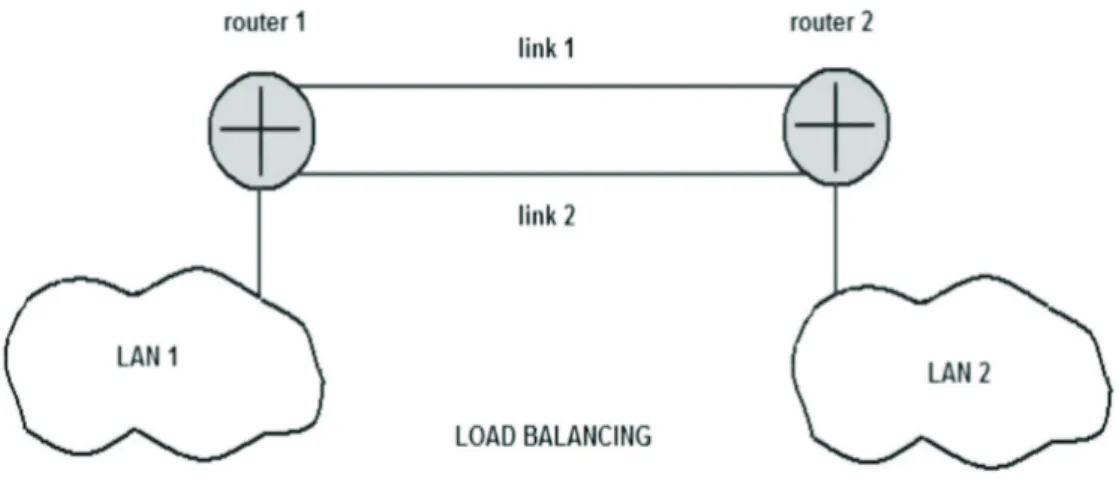
Load balancing is a router ability to send packets to the destination IP address, us-ing more than one route, figure 1. Routes can be set statically or dynamically through protocols such as RIP, OSPF, EIGRP.
If the router supports more than one dynamic routing protocol, then the concept of administrative distance is introduced. It is a number representing a level of trust in relation to information source about the route. The principle is quite simple, the smaller administrative distance is (smaller number), the more trustworthy the data source about the route is. If the router recognizes some routes to a destination network (the routes detailed in the routing table), it choose the one which has the smallest administrative distance. Sometimes there is a situation, that the router must choose one route from among several which have the same administrative distance. In this case the router chooses the route with the smallest cost which is calculated based on the routing protocol
Fig. 1. A general scheme of load balancing.
metric. If the router knows some routes with the same administrative distance and the same cost than it is possible a transmission with load balancing. Mostly routing protocols default install maximum four equivalent routes.
2. RIP protocol
A type of dynamic routing protocol distance vector. The routing algorithm of the distance vector periodically copies a routing table from one router to another. These regular updates between routers communicate about topology changes. Distance vector algorithms are also known as Bellman-Ford algorithms. Each router gets the routing table from the directly connected neighbor. Algorithm can store the value of the distance, creating and maintaining a database of network topology. However, these algorithms do not allow the router to became familiar with the exact network topology, each router “sees" only directly connected neighbors.
2.1. RIP metric
The measure used by the RIP protocol to measure the distance between the source and destination is hop counting. Each hop on the way from source to its destination is usually assigned one value. When the router receives the routing table update that
contains a new or changed an entry for the destination in the network, it adds 1 to the measurement values indicated in the update and enters a change in a routing table. Next hop address is the IP address of sender. RIP protocol reduces the number of hops that may occur between the source and destination, preventing a transmission data stream without the end in a the loop. The maximum number of hops in the path is 15. If the router accept routing update that include new or changes entry, and if the measure will be increased in one, and will be exceeded 15 hops, such destination on the network is considered as unavailable.
2.2. RIP load balancing
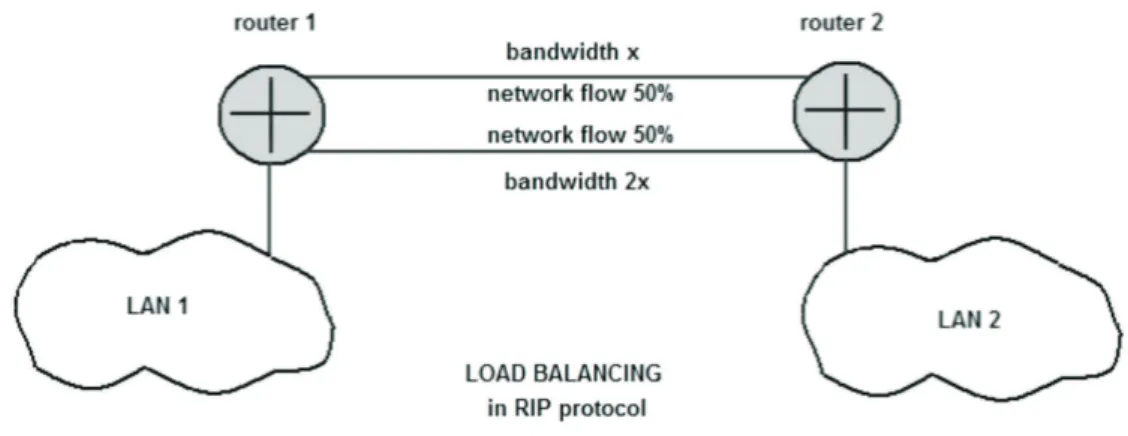
This type of load balancing allows the router to select more than one route to the destination IP address. RIP protocol can set a maximum of six simultaneous routes for the packages, but the default is set four paths. The RIP protocol as a metric uses number of hops and based on that, calculates the best routes for packets. Therefore it is possi-ble to route using symmetrical and asymmetrical links that have different bandwidths, however the total bandwidth is shared, in proportion to the number of links, figure 2 (if there are 2 links, the distribution is 50%/50%). This is not an effective solution, because it does not take into consideration the fact that one link may have better parameters than second link.
3. OSPF protocol
OSPF (Open Shortest Path First) dynamic routing protocol is designed to work with IP based networks. It is an internal protocol within a single Autonomous System (AS). Its rise has been forced due to underperformance of the RIP protocol, which could not satisfactorily handle the ever growing IP supporting networks. Action protocol is based on the algorithm SFP (Shortest Path First), sometimes known as Dijkstra’s algorithm. OSPF is a link state protocol type, it means that every short time is sent notification (LSA Link State Advertisement) to all routers located in the autonomous zone. LSA contains information about available interfaces, metrics and other network parameters. Based on this information, routers calculate efficient traffic routes using the SPF algorithm. Each router periodically sends out LSA packets containing information about availability or change of router status. Therefore, fast changes are detected in the network topology which enables efficient adaptation of routing to the existing conditions. Sending the LSA gives the possibility to build a topology of network. Based on this, using the SPF algorithm, routes tables are created.
3.1. OSPF metric
OSPF supports a system of penalty tables. Networks systems assign a metric de-pending on the setting of OSPF-enabled applications and tools for configuration options, related to network interfaces and connections. Most often these are: the link bandwidth, the delay on the link and the individual preferences of the network system administrator. In practice however, the value metric depends only on the bandwidth, according to the formula:
metric= 108/bandwidth (1)
3.2. OSPF load balancing
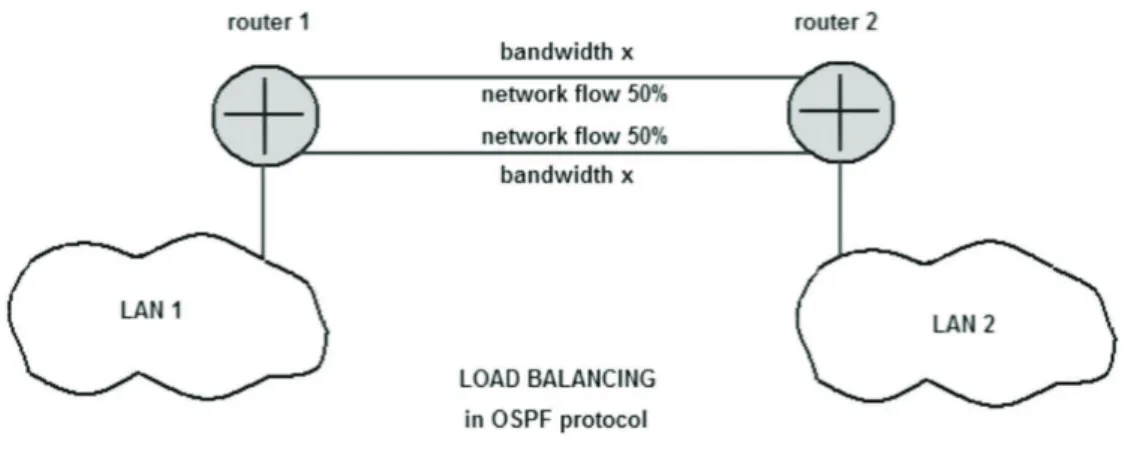
If to the network lead two or more routes with equal metric value, the protocol shared traffic between 4 routes (maximum 6 routes). Unfortunately, when to the network lead two or more routes with different metric values, then all traffic goes through the route with the lowest metric value. Therefore, the OSPF load balancing is possible, but only for routes with identical parameters, Figure 3.
In specific cases, where we want to force a transmission on routes with lower band-width, we can manually modify the OSPF metric.
Fig. 3. Load balancing in OSPF protocol.
4. EIGRP protocol
EIGRP (Enhanced Interior Gateway Routing Protocol) was introduced by Cisco as a scalable and improved version of its own routing protocol running based on distance vector – IGRP. EIGRP is often described as a hybrid protocol, because it combines the best features of routing algorithms using distance vector and link state. EIGRP protocol uses typical functions for link state routing protocols and some key features of OSPF, such as partial updates and discovering of neighboring devices. One important advantage of EIGRP protocol is DUAL (Diffusing Update Algorithm) algorithm, which enables the identification and rejection of looped routes, and allows to find alternative routes without waiting for update from other routers. EIGRP does not send periodic updates. Instead, it refreshes the relationship with nearby neighboring routers through sending small packets and sending partial updates, when it detects changes in network topology. Therefore it consumes much less bandwidth than distance vector protocol (RIP).
4.1. EIGRP metric
Its value depends on bandwidth and delay, although it is possible to extend: the average load, reliability and MTU (Maximum Transmission Unit). Link metric value is calculated by the formula:
metric= 256∗[K1∗Bandwith+ (K2∗Bandwith)/(256−Load)+
Where the parameters K1 . . . K5 take the value 0 or 1 depending on whether the characterization is used and they correspond to the characteristics of: bandwidth, load, delay, reliability,MTU. The valuebandwidthmeans metric of the lowest bandwidth link, and is calculated from the formula:
bandwidth= [10000000/(lowestbandwidthinkbps)]∗256 (3) delay= (interf acedelay/10)∗256 (4) Very often we assumed K1=K3=1 and K2=K4=K5=0 to simplify some calculation, then the metric is calculated:
metric= 256∗(bandwidth+delay) (5) 4.2. EIGRP load balancing
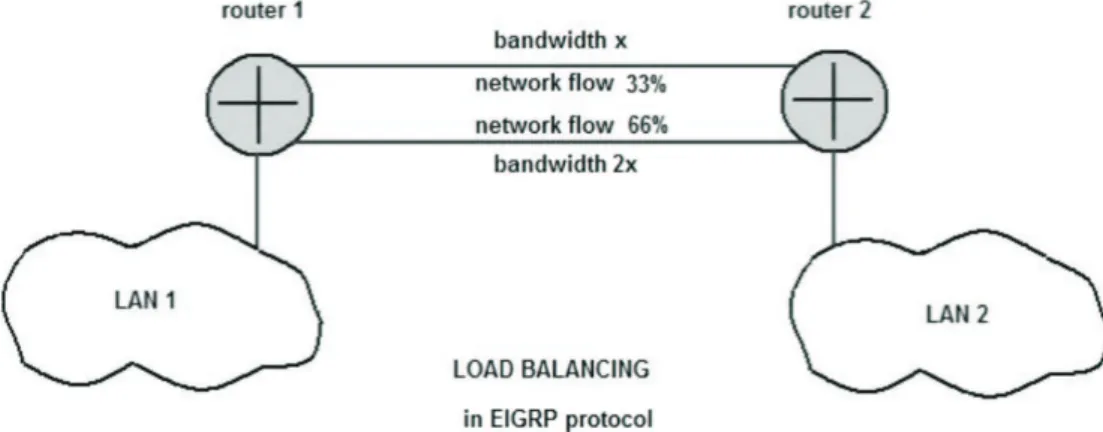
If the EIGRP protocol finds some routes with the same cost it will automatically start to distribute the traffic between them. Using the variance command it can also distribute traffic to link with a higher cost.Multiplier, in this case must be between 1 to 128 and the default is 1. This means only the distribution of traffic between links has the same cost, the cost is directly connected with the metric. If we have links with different bandwidth, with different costs, then a route metric with a lower cost must be multiplied by themultipliervalue and we obtain a cost, which is the same as the cost of link with a higher cost. Therefore we obtain (though extortion) two links with the same cost and a possible load balancing mechanism, Figure 4.
This function seems to be the best, if we consider load balancing with different costs routes, however it has one major defect, EIGRP protocol is a commercial solution used only in Cisco routers, which obviously limits its application.
5. Tabular assess possibilities of load balancing in dynamic routing protocols Table 1 consists a theoretical comparison of load balancing possibilities in dynamic routing protocols.
Load balancing
RIP OSPF EIGRP
The same cost links Yes Yes Yes
Different cost links, traffic
shared 50%/50% Yes No No
Different cost links, traffic
proportionally shared No No Yes Limitation of OS platform No No Only Cisco Network scalability Small
network
Medium network
Medium network Tab 1. Comparison of load balancing possibilities
6. The research bench
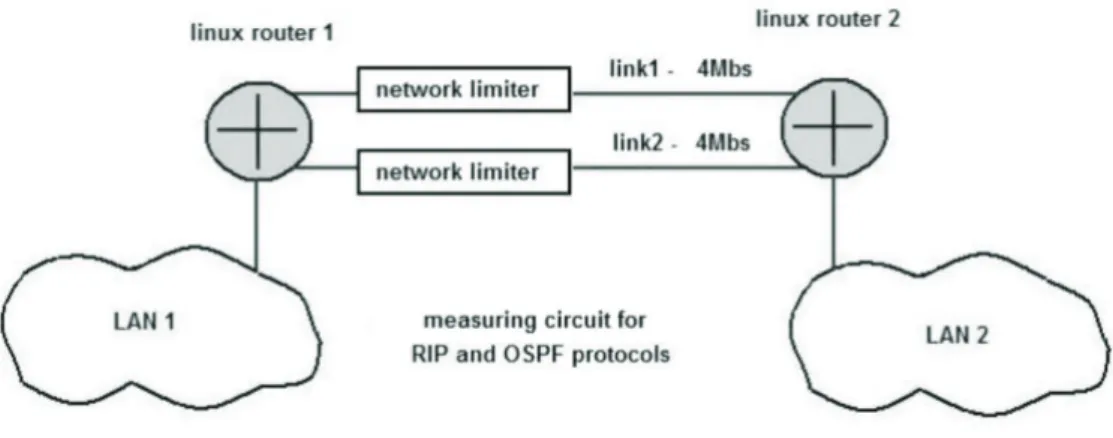
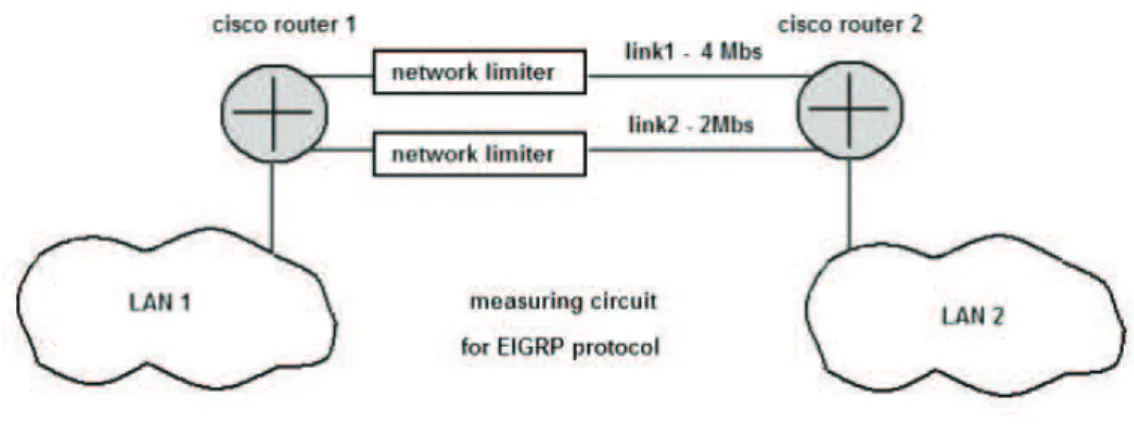
The research was shared into two parts. In the first part of research where RIP and OSPF protocols were studied, the research bench was built on the linux operating system in which the ZEBRA system was installed. Zebra allows dynamic routing protocols RIP and OSPF to run, Figure 5. The research used two different 4 Mbs links, in which, during the tests it reduced bandwidth, if it was necessary, using network limiters (CBQ packet in linux). In the second part of research, load balancing was studied in EIGRP protocol. Because EIGRP protocol can run only on Cisco routers, tests were carried out using Cisco 2801 routers, Figure 8. In both cases, the measurement of bandwidth and load were done by MRTG software.
7. Load balancing research in RIP protocol
The routers had the software in which the RIP dynamic routing was working. Then begins transmission of a large number of files, about 1000 between LAN1 and LAN2. Using network limiters a different network bandwidth was set on link1 and link2. It was observed that load balancing appeared and traffic is always distibuted 50%/50%,
Fig. 5. Measuring circuit for testing load balancing in RIP and OSPF protocols
regardless of bandwidth, limited to the link with lower bandwidth. It was also noticed that if one of the link has very small bandwidth, compared to the second link bandwidth: bandwidthlink1/bandwidthlink2 =about25 (6) load balancing does not occur, and the transmission goes through larger bandwidth link.
Fig. 6. Distribution of transmission between link1 and link2 with different bandwidth for RIP protocol.
The research shows that load balancing in dynamic routing protocol RIP is possible and transmission is always divided in half, regardless of whether links have different or the same bandwidth as detailed in Figure 6. It also appears that the large difference in links bandwidth causes that load balancing does not occur. In small networks, where
the RIP protocol is used, you can use the alternative link (backup) and start the load balancing in a very easy way.
8. Load balancing research in OSPF protocol
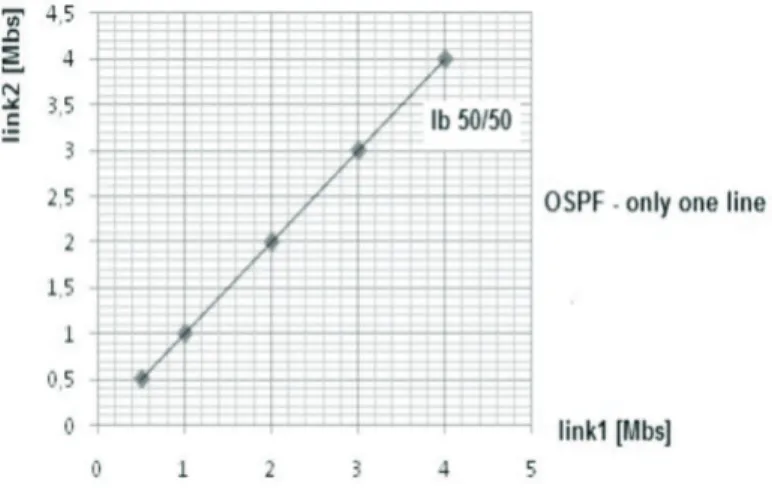
The routers had the software in which the OSPF dynamic routing was working. Then began transmission large number of files, about 1000 between LAN1 and LAN2. Using network limiters set a different network bandwidth on link1 and link2. It turned out, that load balancing is possible only for routes with the same bandwidth that are equal 50%/50%.
Fig. 7. Distribution of transmission between link1 and link2, for OSPF protocol.
OSPF is very flexible, if we take into account, the hardware platform and operating system, but shows small possibilities in load balancing, Figure 7. In principle, it is possible only for routes with identical parameters, then the transmission is divided in half.
9. Load balancing research in EIGRP protocol
On Cisco 2801 routers run the EIGRP dynamic routing, which enables running load balancing, Figure 8. Bandwidth link1 was 4 Mbs, but bandwidth link2 was limited to 2 Mbs. For link2variancevalue was set to 2. This configuration allowes load balancing on 4Mbs and 2Mbs links. Then began the transmission of a large number of files, about 1000 between LAN1 and LAN2, using 2Mbs and 4Mbs links. In such settings, load balancing was not present, MRTG measurement showed transmission only on 4 Mbs link. By increasing a variance to 3 transmission occurred on both links (Figure 10) and
Fig. 8. Measuring circuit for testing load balancing in EIGRP protocol.
distribution was in proportion: 35% 2Mbs link and 65% 4Mbs link. You can guess that, when the variance was set to 2, a problem with various dalays on link1 and link2 appeared, which resulted in another metric in the calculation by the router. A few tests were performed by limitings the bandwidth on link1 and link2. By empirical selection of valuevariance, load balancing occurred and a traffic was proportionally distributed on two links, Figure 9.
Fig. 9. Distribution of transmission between link1 and link2 with different bandwidth for EIGRP protocol.
The research shows that load balancing in dynamic routing protocol EIGRP is possi-ble and that traffic is distributed proportionally to each links bandwidth. The downside,
which limits this solution is that the EIGRP protocol can only run on one hardware platform (Cisco), which is very expensive.
10. Conclusions
The research have confirmed the theoretical function (chapter 5) regarding the possi-bilities of using the load balancing in dynamic routing protocols. After each experiment are summarized, in detail, the practical possibilities (chapter 7,8,9). Generally speaking, studies confirmed the theoretical possibilities of dynamic routing protocols with regard to load balancing using. The EIGRP protocol has the greatest possibilities because, load ballancing can be run on various cost links, but works only on one platform, Cisco. RIP and OSPF protocols slightly worse deal with this subject but the load balancing is possible. In studies tried to also answer the question, whether the link parameters (bandwidth, delay) affect the load balancing. The bandwidth parameter has a significant impact on the load balancing in all protocols, while the delay parameter was important in the EIGRP protocol. Although OSPF has the smallest possibilities when it comes to load balancing, it has tremendous flexibility when it comes to platform (different type of operating systems) and is widely used. You could focus on the topic of load balancing in OSPF protocol for different bandwidth links (different cost links), which could be the subject of futher research.
References
1. R. Malhotra: IP routing, O’Reilly Media, 2002.
2. T. Slattery: Advanced IP Routing in Cisco Networks, Paperback, 2000. 3. R. Wright: IP routing primer, Cisco Press, 1998.
4. T. Moy: OSPF Anatomy of an Internet Routing Protocol, Addison-Wesley, 1998. 5. R. Breyer, S. Rileyi: Switched, Fast i Gigabit Ethernet, Helion, 2001.
Ocena mo˙zliwo´sci zastosowa ´n protokołów trasowania dynamicznego do równowa˙zenia obci ˛a˙zenia w sieciach komputerowych
Streszczenie
Znane jest zagadnienie równowa˙zenia obci ˛a˙zenia w sieciach komputerowych. Mo˙zna je realizowa´c na wiele sposobów: na sztywno konfigurowa´c zdublowane trasy, u˙zywa´c kosztownych mechanizmów równowa˙zenia obci ˛a˙zenia lub zastosowa´c sowanie dynamiczne. Przedmiotem bada´n były mo˙zliwo´sci zastosowa´n sieci z tra-sowaniem dynamicznym do równowa˙zenia obci ˛a˙zenia. Pod uwag˛e wzi˛eto trzy pro-tokoły: RIP, OSPF, EIGRP. Badania przeprowadzono na dwu jednoczesnych ł ˛aczach o identycznych i ró˙znych przepustowo´sciach. Badania miały empirycznie potwierdzi´c które protokoły i w jakim stopniu nadaj ˛a si˛e do równowa˙zenia obci ˛a˙zenia na ł ˛aczach o tych samym i ró˙znych kosztach. Próbowano te˙z odpowiedzie´c na pytanie jak parame-try ł ˛acza (obci ˛a˙zenie, przepustowo´s´c) wpływaj ˛a na równowa˙zenie obci ˛a˙zenia.