Technical Specifications
Manual for Online
Testing
For Technology Coordinators
2014–2015
Published December 4, 2014
Table of Contents
Introduction to the Technical Specifications Manual ... 1
Manual Content ... 1
Other Resources ... 1
Section I. Network and Internet Requirements ... 3
General Requirements ... 3
Common Network Performance Bottlenecks... 3
Bandwidth ... 4
Determining Bandwidth Requirements ... 5
Total Number of Students Simultaneously Testing ... 5
Size of the Test Content... 5
Secure Browser Installation ... 6
Network Configuration ... 6
Protocols ... 6
Domain Name Resolution... 6
Content Filter, Firewalls, and Proxy Servers ... 6
Quality of Service (QoS)/Traffic Shaping ... 7
Certificate Revocation List ... 7
Symantec Recommendations ... 7
Wireless Networking ... 8
Wireless Access Points ... 8
Recommendations on the optimal number of student workstations per wireless connection ... 8
Network Diagnostic Tools ... 9
AIR’s Network/Bandwidth Diagnostic Tool ... 9
Microsoft Windows Specific Tools ... 9
Mac OS X Specific Tools ... 10
Multi‐Platform Tools ... 10
Section II. General Software Requirements ... 11
Requirements for All Systems ... 11
Enabling Pop-Up Windows ... 11
Flash Information ... 12
Windows Requirements ... 13
Disabling Fast User Switching ... 13
Disabling Fast User Switching in Windows XP ... 13
Enabling Web Fonts in Internet Explorer 10 and 11 ... 17
Installing Windows Media Pack for Windows 8.1 N and KN ... 18
Mac OS X Requirements ... 18
Mission Control and Spaces ... 18
Function Keys and Application Launches ... 20
Linux Requirements ... 21
Installing Festival and Sound eXchange (SoX) Software ... 21
Mobile Requirements ... 21
iOS Requirements ... 21
Guided Access ... 21
Enabling Guided Access ... 22
Android Requirements ... 23
Enabling the Secure Browser Keyboard ... 24
Chrome OS Requirements ... 25
Google Documentation ... 26
Section III. Text-to-Speech Requirements ... 27
Overview of Text-to-Speech ... 27
Using Text-to-Speech ... 27
How the Secure Browsers Work With Voice Packs ... 27
Desktop Secure Browsers... 27
Mobile Secure Browsers ... 28
About NeoSpeech™ Voice Packs for Windows ... 28
Windows Text-to-Speech Settings ... 29
Mac OS X Text-to-Speech Settings ... 30
Linux Text-to-Speech Settings ... 31
Voice Packs Recognized by Desktop Secure Browsers ... 32
Windows ... 32
Mac OS X ... 33
Linux ... 34
Appendix A. Systems and URLs Provided by AIR ... 35
Non-Testing Sites ... 35
Testing Sites ... 35
TA and Student Testing Sites ... 35
Appendix B. Technology Coordinator Checklist ... 36
List of Tables
Table 1. Key Symbols and Elements ... 1
Table 2. Average Bandwidth Used by Secure Browser for Testing ... 4
Table 3. Ports for Test Delivery System ... 6
Table 4. Wireless Access Points ... 8
Table 5. Flash Requirements ... 12
Table 6. Packages that Include Supported Voice Packs on Linux Distributions ... 31
Table 7. Voice Packs Recognized by Secure Browsers—Windows... 32
Table 8. Voice Packs Recognized by Secure Browsers—Mac OS X ... 33
Introduction to the Technical Specifications Manual
This manual provides information about supported operating systems and related requirements, network and Internet requirements, general hardware and software requirements, and text-to-speech information.
Manual Content
Below is a brief description of each section in this manual, as well as common symbols and elements used throughout the document.
Section I, Network and Internet Requirements, provides information about bandwidth, networking, and available diagnostic tools.
Section II, General Software Requirements, outlines required configurations for desktop operating systems (Windows, Mac, and Linux).
Section III, Text-to-Speech Requirements, contains information for ensuring text-to-speech settings are enabled on desktop operating systems. Information about voice packs for Windows is also included.
The appendices contain URLs for systems provided by the American Institutes for Research and a checklist for system administrators and technology coordinators.
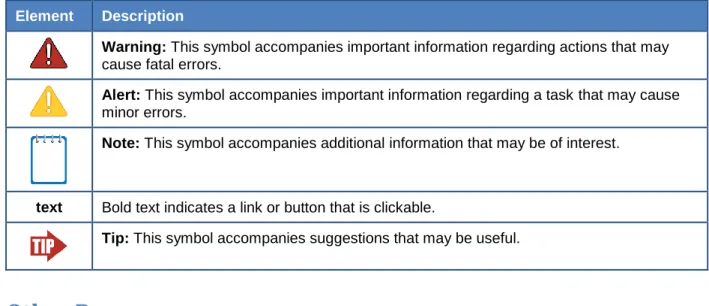
Table 1. Key Symbols and Elements
Element Description
Warning: This symbol accompanies important information regarding actions that may cause fatal errors.
Alert: This symbol accompanies important information regarding a task that may cause minor errors.
Note: This symbol accompanies additional information that may be of interest.
text Bold text indicates a link or button that is clickable.
Tip: This symbol accompanies suggestions that may be useful.
Other Resources
For information about operating system and general hardware requirements, refer to the Online System Requirements for Ohio Science and Social Studies Tests.
The above resources as well as test administration manuals and user guides for other systems are available on the OCBA (Ohio Computer Based Assessments) portal
Section I.
Network and Internet Requirements
The information in this section provides an overview of network and Internet configuration requirements and available diagnostic tools.
General Requirements
A stable, high-speed (wired or wireless) Internet connection is required for online testing. The response time for each assessment depends on the reliability and speed of your school’s Internet network.
If your Internet connection is not working or stops working, students will need to complete their tests at a later time or on another day. Any answers they have already submitted will be saved, and students will resume their tests where they left off.
For the online testing applications to work properly, you may need to verify your network settings. If you are not sure whether your network is properly configured or you have
questions, contact your network administrator or technology specialist to find the right contact person in your area. You may also contact the Ohio Help Desk.
Network configuration settings should include the following:
Content filters, firewalls, and proxy servers should be configured to allow traffic on the protocols and to the servers listed below.
Session timeouts on proxy servers and other devices should be set to values greater than the average scheduled testing time. If testing sessions are scheduled for 60 minutes, consider session timeouts of 65–70 minutes. This will help limit network interruptions during testing.
Data cannot be cached.
If your client network uses any devices that perform traffic shaping, packet prioritization, or Quality of Service, the URLs for the systems provided by AIR should be given a high priority to guarantee the highest level of performance.
For information about URLs that should be open or whitelisted, refer to Systems and URLs Provided by AIR.
Common Network Performance Bottlenecks
The Test Delivery System is delivered directly through the Internet. Students must access their tests using the appropriate secure browser. For testing to take place, all workstations where tests will be administered must have reliable Internet connectivity.
In general, the performance of the Test Delivery System will depend on a number of factors, including bandwidth, total number of students simultaneously testing, size of test content, secure browser installation, proxy server (if used), and the wireless networking solution (if used).
Bandwidth
Bandwidth is the measure of the capacity of a network. Utilized bandwidth measures the amount of data traveling across the network at a given point in time. Bandwidth performance can be affected on either the internal network (LAN) traffic or the Internet traffic from the router. Regardless of hardware or network topology, the LAN should be analyzed to determine the potential for traffic bottlenecks.
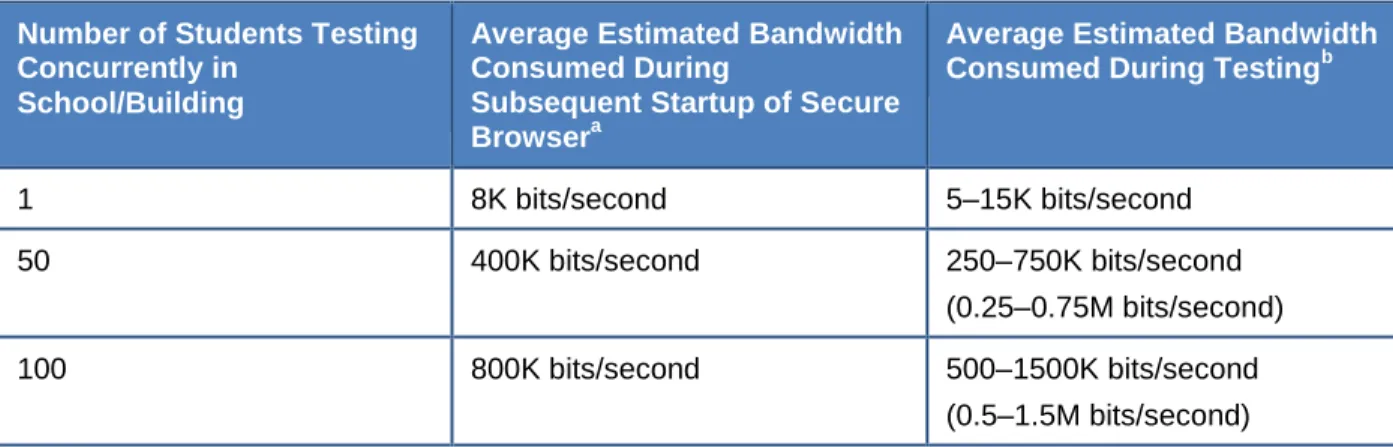
The following table displays the estimated average bandwidth used by the secure browser for testing. (Note that there is a one-time exception to these averages; during initial secure browser startup, the load can be greater, leading to a longer load time.) All numbers provided are based on rigorous testing using Wireshark.
Table 2. Average Bandwidth Used by Secure Browser for Testing Number of Students Testing
Concurrently in School/Building
Average Estimated Bandwidth Consumed During
Subsequent Startup of Secure
Browsera
Average Estimated Bandwidth
Consumed During Testingb
1 8K bits/second 5–15K bits/second 50 400K bits/second 250–750K bits/second (0.25–0.75M bits/second) 100 800K bits/second 500–1500K bits/second (0.5–1.5M bits/second) a
Bandwidth consumed when opening the secure browser and accessing an assessment for the first time is significantly higher than when opening the secure browser and accessing an assessment
subsequently. The reason for this is that the initial launch of the secure browser downloads non-secure cacheable content (not test content) that can be immediately accessed upon opening the secure browser at a later time.
b Bandwidth will vary during a student’s testing experience, as some pages contain low-bandwidth
content, such as multiple-choice items, and other pages contain higher-bandwidth content, such as animations. Consequently, the estimated average values in this column are based on computing averages from multiple assessments and subjects.
Determining Bandwidth Requirements
Schools need to factor the bandwidth requirements of each assessment along with all other non-testing-related Internet traffic in order to determine how many concurrent test sessions their Internet connections can support.
Some assessments include animations and interactive item types. These may increase the bandwidth required, but the bandwidth should not exceed the peak usage experienced when the test initially loads. We encourage you to run the diagnostics on your network to determine how many students you can reasonably test at one time. For information about running diagnostics on your network, refer to the Network Diagnostic Tools section.
For wired networks, internal bandwidth is typically not a problem, because new switches generally operate at speeds of between 100M bits per second and 1000M bits per second. However, LAN performance can be hindered in cases where hubs are used instead of switches. A hub device will allow broadcast signals from various network devices to propagate across the network, potentially saturating the network and causing traffic competition and/or collisions of data.
For Internet networks, the most common bottleneck is the ISP’s router connection, which typically operates at speeds of between 1.5M bits per second and 100M bits per second. Network administrators should spend time prior to test administration determining whether their Internet infrastructure has the capacity to accommodate current and future growth.
Analyzing Infrastructure
Determining whether infrastructure is capable of current and future growth involves a number of steps, including but not limited to: (1) the analysis of the current number of users; (2) current day-to-day Internet bandwidth statistics; and (3) the desired response time for applications. Total Number of Students Simultaneously Testing
As the number of students testing at one time increases, competition for network bandwidth increases. Network bandwidth resembles highway traffic; as the number of cars traveling on a given road increases, the speed of traffic flow decreases.
Size of the Test Content
The size of the test is determined by two factors: (1) the number of items on the test and (2) the average size of each item. The more items a test contains and the larger the average size of a test item, the higher the bandwidth requirement for a given test. For example, ELA tests typically deliver all items associated with a passage at one time, and this may slightly impact the bandwidth for these tests.
Secure Browser Installation
The recommended installation of the secure browser is local installation on each individual testing workstation. It is possible to install the secure browser on a network or shared drive and then have the testing workstations run the secure browser from that drive, but there may be some performance impacts under this configuration. There will be competition for network bandwidth, and the network or shared disk drive will also be subject to some resource
competition as there will be multiple clients reading from the network drive, thus slowing the overall processing speed. See the Secure Browser Installation Manual for guidance.
Network Configuration
Protocols
All communication with the Test Delivery System takes place over the following Internet
port/protocol combinations. Please ensure that the following ports are open for these systems. Table 3. Ports for Test Delivery System
Port/Protocol Purpose
80/tcp HTTP (initial connection only)
443/tcp HTTPS (secure connection)
Domain Name Resolution
All system URLs must be resolvable by all client hosts attempting to connect to the Test Delivery System. This means that the client workstations should be able to convert the friendly names (URLs) to their corresponding IP address by requesting the information from the DNS server. For a list of URLs, refer to Appendix A, Systems and URLs Provided by AIR.
Content Filter, Firewalls, and Proxy Servers
Content filters, firewalls, and proxy servers should be configured to allow traffic on the protocols listed above to the applications’ servers.
In addition, session timeouts on proxy servers and other devices should be set to values greater than the average duration it takes a student to participate in a test session or complete a given test. For example, if your school determines that students will test in 75-minute sessions, then consider setting the session timeout to 80 or 85 minutes.
System administrators will need to make sure that information is not blocked in their content filters and that data are not cached. The URLs listed in Appendix A should be open for these systems.
Quality of Service (QoS)/Traffic Shaping
If the client network utilizes any devices that perform traffic shaping, packet prioritization, or Quality of Service, the URLs should be given a high level of priority in order to guarantee the highest level of performance.
Certificate Revocation List
Schools should open their firewalls to allow the secure browser to check the certificate authenticity at Symantec Certificate Revocation List (CRL) at http://crl.verisign.com/. Symantec Recommendations
Note: The following information was provided by Symantec.
It is strongly recommended that any firewall policies and/or access control devices use URLs and not IP addresses. Symantec can change these IP addresses at any time without notification. If possible, white list the following entries on your firewall policies and/or access control
devices to ensure seamless access to our Online Certificate Status Protocol (OCSP) services:
*.thawte.com
*.geotrust.com
*.ws.symantec.com
Note: If white listing wildcard entries is not permitted, you can white list the following specific fully qualified domain names (FQDNs):
oscp.ws.symantec.com
oscp.geotrust.com
oscp.thawte.com
If your firewall is configured to allow only a certain set of IP addresses to be accessed from your network, you will need to take the following actions:
Get the full list of IP addresses for the new sites. Complete a short form and then you will gain access to the site list.
Install or add the IP addresses to your existing list. Do not replace the old IP addresses and do not delete your existing rules for Symantec OCSP IP addresses.
Wireless Networking
Over the past several years, there have been several revisions to wireless networking technology.
802.11n is the fastest and most recent IEEE wireless standard, with a throughput of up to 300M bits per second.
802.11g has a theoretical throughput of up to 54M bits per second.
802.11b has a theoretical throughput of 11M bits per second. Wireless Security
Due to the sensitivity of test-related data, it is highly recommended that wireless traffic use WPA2/AES data encryption. Because encryption/decryption is part of the data exchange process, there may be a slight decrease in the overall speed of the network. A properly configured wireless network should provide adequate bandwidth for the testing applications.
Wireless Access Points
AIR recommends that schools maintain a ratio of wireless systems to wireless access points (WAPs) of no more than 20 to 1. Typically, the test performance begins to deteriorate after that threshold has been reached. In some instances, older WAPs may also see performance
degradation when more than 15 devices are concurrently connected.
Recommendations on the optimal number of student workstations per wireless connection
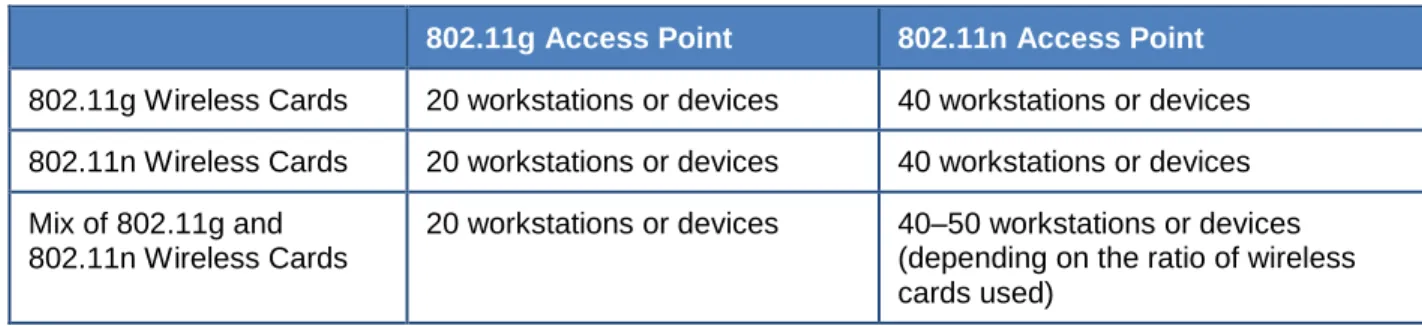
The optimal (or maximum) number of student workstations (computers and tablets) supported by a single wireless connection will depend on the type of networking standard being used for the connection. The two most common networking standards are 802.11g (54Mbps) and the newer and faster standard, 802.11n (300Mbps). Both the access point, which emits the wireless signal, and the computer’s wireless card, which receives the signal, will use one of these two standards. The recommendations in Table 4 are based on the standard in use.
Table 4. Wireless Access Points
802.11g Access Point 802.11n Access Point
802.11g Wireless Cards 20 workstations or devices 40 workstations or devices 802.11n Wireless Cards 20 workstations or devices 40 workstations or devices Mix of 802.11g and
802.11n Wireless Cards
20 workstations or devices 40–50 workstations or devices (depending on the ratio of wireless cards used)
Note: Refer to your WAP documentation for specific recommendations and guidelines. Networks using wireless standards other than 802.11g and 802.11n may also work, but early testing using the practice tests is recommended.
Network Diagnostic Tools
A performance analysis of the LAN/Internet infrastructure is recommended in order to identify any bottlenecks that may impact test performance. Identifying the diagnostic tool most
appropriate for a network depends on the testing operating system, the network
administrator’s knowledge base and the desired level of network analysis. A number of network diagnostic tools are available. These include the following:
AIR’s Network/Bandwidth Diagnostic Tool
AIR provides a diagnostic tool that can be directly accessed from the student practice test login page.
1. On the practice test login page, click the Run Diagnostics link. The Diagnostic Screen page will display.
2. In the Network Diagnostics section, select a test.
3. Select the approximate number of students who may take that test at one time. 4. Click the Run Network Diagnostics Tests button.
The results will display your current upload and download speed as well as a general idea of whether you can reliably test the given number of students (the number entered in step 3). You may want to run this test several times throughout the day to verify that your upload and download speeds remain relatively consistent.
Microsoft Windows Specific Tools
PRTG Traffic Grapher
PRTG (www.paessler.com/prtg) monitors bandwidth usage and other network parameters via Simple Network Management Protocol (SNMP). It also contains a built‐in packet sniffer. A freeware version is available.
NTttcp
NTttcp (www.microsoft.com/whdc/device/network/TCP_tool.mspx) is a multithreaded, asynchronous application that sends and receives data between two or more endpoints and reports the network performance for the duration of the transfer.
Pathping
Pathping is a network utility included in the Windows operating system. It combines the
functionality of Ping with that of Traceroute (Windows filename: tracert) by providing details of the path between two hosts and Ping‐like statistics for each node in the path based on samples taken over a time period.
Mac OS X Specific Tools
Network Utility.app
This tool is built into Mac OS X software.
Multi‐Platform Tools
Wireshark
Wireshark (www.wireshark.org) is a network protocol analyzer. It has a large feature set and runs on most computing platforms including Windows, OS X, Linux, and UNIX.
TCPDump
TCPdump (http://sourceforge.net/projects/tcpdump) is a common packet sniffer that runs under the command line and is compatible with most major operating systems (UNIX, Linux, Mac OS X). It allows the user to intercept and display data packets being transmitted or received over a network.
A Windows port WinDump is also available (www.winpcap.org/windump/).
Ping, NSLookup, Netstat, Traceroute
This is a set of standard UNIX network utilities. Versions of these utilities are included in all major operating systems (UNIX, Linux, Windows, and Mac OS X).
Iperf
Iperf (http://sourceforge.net/projects/iperf/) measures maximum TCP bandwidth, allowing the tuning of various parameters and User Datagram Protocol (UDP) characteristics. Iperf reports bandwidth, delay jitter, and datagram loss.
Section II.
General Software Requirements
In addition to installing the secure browser, you may need to adjust operating system settings or install additional software on students’ machines that are used for testing.
Requirements for All Systems
Enabling Pop-Up Windows
All systems provided by AIR except for the secure browser require pop-up windows to be enabled. These systems use pop-up windows to provide warning or error messages to users. Navigate to the appropriate menu option to globally disable pop-up blockers.
To globally enable pop-up windows:
Firefox: Tools > Options > Content > clear Block pop-up windows.
Google Chrome: Menu > Settings > Show advanced settings (at the bottom of the screen) > Privacy > Content Settings > Pop-ups > mark Allow all sites to show pop-ups.
Chrome browser on Android tablets: Menu > Settings > Advanced > Content Settings > Block pop-ups > clear checkbox.
Internet Explorer: Tools > Pop-up Blocker > Turn Off Pop-up Blocker.
Safari: Application Menu (Safari) > clear Block Pop-Up Windows.
If you want only allow certain sites to have pop-up windows, you can add exceptions and whitelist AIR’s systems. For URLs and information about whitelisting, refer to Appendix A, Systems and URLs Provided by AIR.
To add exceptions to the pop-up blocker:
Firefox: Tools > Options > Content > click Exceptions. Enter the URL or whitelist protocol for each system.
Google Chrome: Menu > Settings > Show advanced settings (at the bottom of the screen) > Privacy > Content Settings > Pop-ups > click Manage Exceptions. Enter the URL or whitelist protocol for each system and select Allow. This option is not available for the Chrome browser on Android tablets.
Internet Explorer: Tools > Pop-up Blocker > Pop-up Blocker Settings. Enter the URL or whitelist protocol for each system and click Add. Configure other settings as desired.
Safari and iOS Safari: N/A
Flash Information
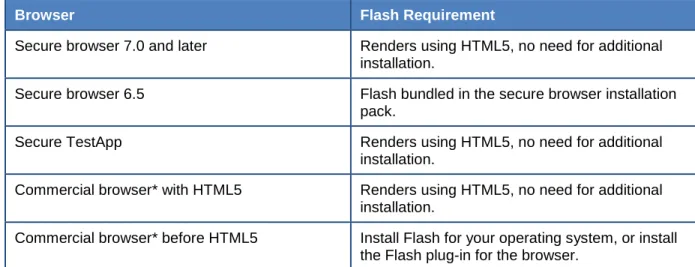
Some test items include animations. Animations can be rendered in Flash or HTML5. Table 5 lists the requirements for installing Flash on the testing computers.
Table 5. Flash Requirements
Browser Flash Requirement
Secure browser 7.0 and later Renders using HTML5, no need for additional installation.
Secure browser 6.5 Flash bundled in the secure browser installation pack.
Secure TestApp Renders using HTML5, no need for additional installation.
Commercial browser* with HTML5 Renders using HTML5, no need for additional installation.
Commercial browser* before HTML5 Install Flash for your operating system, or install the Flash plug-in for the browser.
*Commercial browsers—the versions of Internet Explorer, Firefox, Chrome, Safari, and mobile browsers listed in the Online System Requirements for Ohio Science and Social Studies Tests.
Windows Requirements
This section contains information specific to Windows users.
Disabling Fast User Switching
Microsoft Windows (XP, Vista, 7, 8.0, and 8.1) allows computers to be configured to allow multiple users to log in to a computer without requiring one user to log out before another logs in. This feature is called “Fast User Switching” and presents a test security risk if it is enabled. If a student can access multiple user accounts from a single computer, you are required to disable the Fast User Switching function. Instructions for disabling Fast User Switching in Windows XP, 7, and 8 follow.
Disabling Fast User Switching in Windows XP 1. Click Start, click Control Panel, then click User
Accounts.
2. Click Change the Way Users Log On or Off. a. Mark the Use the Welcome Screen
checkbox.
b. Clear the Use Fast User Switching
checkbox. 3. Click Apply Options.
*Please note that Fast User Switching is not an option if joined to a domain.
Disabling Fast User Switching in Windows 7
Option A: Access the Group Policy Editor
1. Click Start, type gpedit.msc in the Start Search
dialog box, and press Enter.
2. Navigate to the following location: Local Computer Policy > Computer Configuration > Administrative Templates > System > Logon.
3. Click Hide entry points for Fast User Switching, select Enabled, and click OK.
4. Close the Fast User Switching window. 5. Close the Local Group Policy Editor window. Note: Because the Group Policy Editor does not exist in certain editions of Windows Vista, you may need to configure these settings via the registry if the above method is unavailable. See below for registry instructions.
Option B: Access the Registry
1. Click Start, type regedit.exe in the Start Search
dialog box, and press Enter. 2. Navigate to the following location:
HKEY_LOCAL_MACHINE > SOFTWARE > Microsoft > Windows > CurrentVersion > Policies > System.
3. Right-click the System folder. 4. Click New, DWORD (32-bit) value.
5. Type in HideFastUserSwitching and press Enter.
6. Click the HideFastUserSwitching value. 7. Type 1 into the Value data box and click OK. 8. Close the Registry Editor window.
Disabling Fast User Switching in Windows 8.0 and 8.1 1. Navigate to the Search option. (From the
home screen, mouse to the lower right corner and then click the Search icon.) 2. In the search box, type gpedit.msc.
Double-click the gpedit icon in the Apps pane. The Local Group Policy Editor window will open. 3. Navigate to the following location: Computer
Configuration > Administrative Templates > System > Logon.
4. In the Setting pane, double-click Hide entry points for Fast User Switching.
5. Select Enabled and then click OK.
6. Navigate to the Search option (from the home screen, mouse to the lower right corner and then click the Search icon.
7. In the search box, type run. The Run dialogue box will open.
8. Enter the command gpupdate /force into the text box and then click OK. (Note the space before the backslash.)
9. The Windows system command box will open. When you see the message Computer Policy update has completed successfully, then Fast User Switching has been
Enabling Web Fonts in Internet Explorer 10 and 11
If students use Internet Explorer 10 or 11 to access the practice tests, web fonts may need to be enabled in order for some item types to display properly.
Enabling Web Fonts in Internet Explorer: 1. Open the Tools menu in Internet Explorer
and click Internet Options. The Internet Options window will open.
2. Click the Security tab.
3. Click the Custom Level button. The Security Settings window will open.
4. Scroll to Font Download in the Settings list and click the Enable radio button.
5. Click OK. The Security Settings Window will close.
6. Click OK. The Internet Options window will close.
Installing Windows Media Pack for Windows 8.1 N and KN
Some versions of Windows 8.1 are not shipped with media software installed. As a result, you may need to install software in order for students to listen to audio.
Microsoft provides additional information as well as a download package for computers with the following Windows 8.1 versions:
Windows 8.1 N
Windows 8.1 N/K with Bing
Windows 8.1 Enterprise N
Windows 8.1 Pro N
Windows 8.1 Pro N/K for EDU
AIR encourages downloading this software and ensuring it works with sample websites and video and audio files prior to installing the Windows secure browser. Installation instructions are provided on Microsoft’s download page.
Microsoft Resources:
About the Media Feature Pack for Windows 8.1 N and Windows 8.1 KN Editions: April 2014 (http://support.microsoft.com/kb/2929699/en-us)
Download Media Feature Pack for N and KN Versions of Windows 8.1 (http://www.microsoft.com/en-us/download/details.aspx?id=42503)
Mac OS X Requirements
This section contains information specific to Mac OS X users. These settings can be configured before or after installing the secure browser.
Mission Control and Spaces
For security purposes, Spaces must be disabled on computers that students will use for online testing. If Spaces is not disabled, students will be unable to test.
Mission Control and Spaces must be disabled on computers running Mac 10.7 through 10.10. Note: The instructions in this section are for disabling Spaces on individual Mac computers.
To disable Spaces in Mission Control:
1. Navigate to Apple System Preferences.
2. In System Preferences, click Keyboard. The Keyboard window will be displayed.
3. Click the Keyboard Shortcuts or Shortcuts
tab. The Keyboard Shortcuts options will be displayed.
4. In the left panel, click Mission Control. The right panel will show all Mission Control options.
5. In the right panel, clear the following checkboxes:
o Move left a space
o Move right a space
o Switch to Desktop 1 (this may already be unchecked)
6. To re-enable Spaces, follow steps 1–5 again, and mark the checkboxes for spaces.
Function Keys and Application Launches
When students use the secure browser for testing, the Test Delivery System conducts regular checks to ensure that other applications are not open. These checks help maintain the integrity of the secure test environment.
Some Mac computers are configured to launch iTunes and other applications by pressing the function keys (e.g., F8) on the keyboard. This section contains information on how to prevent the function keys from directly launching applications, including iTunes. This action will help prevent students from accidentally pressing a function key instead of a key in the number row. These instructions are based on Mac 10.9 and should be similar for other supported Macs. To modify the function keys:
1. Open System Preferences.
2. In the Hardware row, click Keyboard. The Keyboard window opens.
3. In the Keyboard window, mark the Use all F1, F2, etc. keys as standard function keys. You should no longer be able to launch
applications with just the function keys. If you need to launch iTunes or another application, press the Fn key and then press the desired function key. This combination will launch the application.
Important: If a student is testing with the secure browser and presses the Fn key and a function key, this action will open the linked application and result in the test being paused. Source: http://support.apple.com/kb/ht3399
Linux Requirements
This section contains information specific to Linux users.
Installing Festival and Sound eXchange (SoX) Software
The following two software programs must be installed on Linux machines: Festival and Sound eXchange (SoX). If this software is not installed, students will not be able to hear the audio in the online assessments even when text-to-speech is enabled.
To download Festival, click here: http://www.cstr.ed.ac.uk/projects/festival/.
To download SoX, click here: http://sox.sourceforge.net.
For more information on enabling text-to-speech settings on Linux machines, refer to Section V, Text-to-Speech Requirements, Linux.
Mobile Requirements
This section provides a brief overview of the requirements for student testing on tablets and Chromebooks. Complete instructions are provided in the Secure Browser Installation Manual. The AIRSecureTest mobile secure browsers for iOS and Android tablets and Chromebooks are designed to support a secure testing environment. In addition to installing the secure browser, some device settings may need to be adjusted.
iOS Requirements
Guided Access
To ensure a secure test environment, Guided Access must be enabled and activated before students can log in to a test session. Guided Access is an iOS feature that allows users to restrict activity to a single application and also prevents taking screenshots or changing to another application. Students will not be able to log in if Guided Access is not enabled and activated.
About Guided Access and Single App Mode
Single App Mode is not the same as Guided Access. Even if Single App Mode is turned on via an iOS device manager, Guided Access must still be enabled on iPads before students can log in to a secure test session.
Guided Access and Single App Mode are different features provided by Apple. While they both lock iOS devices to a single application and prevent hardware buttons from being used, Guided Access requires a passcode for security.
Guided Access
Guided Access is enabled on individual iPads and requires a security passcode. Guided Access must be activated before students can log in to the secure browser. It is not possible to
remotely activate Guided Access via Apple Configurator or another mobile device management (MDM) software program.
Single App Mode
Single App Mode for managed iPads is enabled and managed using a MDM software program, such as Apple Configurator. Enabling Single App Mode does NOT enable or activate Guided Access on managed iPads.
For more information about Guided Access and Single App Mode, refer to the following document developed by Apple:
Assessment with iPad
(http://images.apple.com/education/docs/assessment_with_ipad_mar2013_v2.pdf) Enabling Guided Access
1. Tap the Settings icon to open the Settings application.
2. Navigate to General > Accessibility > Learning and tap Guided Access.
3. Tap Off; it will change to On (enabled). 4. Set the passcode for Guided Access. This
passcode is required to deactivate Guided Access after students are finished testing. (If you do not set the passcode now, you will be prompted to set it later.) To set the passcode:
a. Tap Set Passcode. b. Enter a passcode.
c. Confirm the passcode. (You may want to write down or save this number in a safe place. There is no ability to “retrieve” a forgotten passcode.)
Android Requirements
The mobile secure browser for Android tablets requires the secure browser keyboard to be selected before students can access the login page. The reason for this is that the default Android keyboard allows predictive text, which would unduly aid students when entering written responses to test items. The secure browser keyboard is a basic keyboard, with no row for predictive text functionality.
The first time you open the Mobile Secure Browser on an Android tablet, you will be prompted to select the secure browser keyboard.
Instructions for enabling the secure browser keyboard follow.
About the Secure Browser Keyboard and General Settings
Once the secure browser keyboard is set, it becomes the default keyboard for all Android tablet applications, not just the secure browser. If you want to return to the default Android keyboard after using the secure browser, you will need to navigate to Settings > Language & Input and uncheck the secure browser keyboard.
If you change back to the default Android keyboard, you will be prompted to select the secure browser keyboard the next time you open the secure browser. The secure browser will not allow you to access the student login page until the secure browser keyboard has been selected.
Enabling the Secure Browser Keyboard
Note: All screenshots in this section were taken with a Samsung Galaxy Tab 2. 1. Select the secure browser icon on the home
screen.
2. You will be prompted to change the keyboard. Select Close.
3. Select Set up input methods. The Language and Input settings screen will automatically open.
4. Select the checkbox next to AIRSecureTest
so that a checkmark appears.
5. You will be prompted to acknowledge that this selection is okay. Select OK to continue. Note: This action allows the mobile secure browser to use the secure browser
keyboard.
6. Navigate to the secure browser to open it. (You can use the application switcher or go back to “Home” and select the secure browser icon.)
7. You will be prompted to change the keyboard. Select Close.
8. The Android tablet’s default keyboard will still be selected.
9. Select the checkmark or circle for the
AIRSecureTest keyboard.
10.Select Continue. You will be prompted to complete the application launch using the preferred method.
11.Select AIRSecureTest (ensure it is shaded and highlighted blue) and then select
Always.
12.You will need to acknowledge that the secure browser’s default settings have changed. (This is a result of selecting the secure browser keyboard.)
13.Select OK.
Chrome OS Requirements
The American Institutes for Research has worked with Google to develop a secure browser kiosk application that can be downloaded onto Chromebooks from the Chrome Web Store. Using the AIRSecureTest kiosk application requires Chromebooks to run in kiosk mode.
About the AIRSecureTest Kiosk App
The AIRSecureTest browser is not a hosted app. In order to support all test features, AIR developed a packaged kiosk application. As a result, this app must be deployed onto managed Chromebooks via the Chrome Management Console as a kiosk application rather than via a public session. (You may still use public sessions for other applications.)
Instructions for installing the kiosk application are in the Secure Browser Installation Manual. Google Documentation
The following references are for users who need to ensure that managed Chromebooks are configured correctly prior to installing the AIRSecureTest kiosk app.
Managed Chromebooks
Using Chromebooks for Student Assessments
(https://support.google.com/chrome/a/answer/3273084)
o Refer to “Scenario 1: School sets up Chromebook to run as a Single App Kiosk running the exam app.”
o Do NOT follow the instructions for Scenarios 2 and 3.
Managing Device Settings (https://support.google.com/chrome/a/answer/1375678)
Non-Managed Chromebooks
Non-managed Chromebooks must not already be configured with user accounts before you enable kiosk mode. If you have already added user accounts to Chromebooks, you will need to wipe the devices.
Google has provided instructions for wiping Chromebooks: https://support.google.com/chrome/a/answer/1360642?hl=en.
After you wipe the Chromebooks, follow the instructions in the Secure Browser Installation Manual to enable kiosk mode and install the AIRSecureTest app.
Section III.
Text-to-Speech Requirements
This section contains information about text-to-speech requirements.Overview of Text-to-Speech
Using text-to-speech requires at least one voice pack to be pre-installed on computers that will be used for testing. For Windows, Mac, Android, and Chrome operating systems, default voice packs are typically pre-installed. For computers running a Linux distribution, voice packs may need to be downloaded and installed.
A number of voice packs are available for desktop computers, and AIR researches and tests voice packs for compatibility with the secure browsers. Additionally, not all voice packs that come pre-installed with operating systems are approved for use with online testing. The voice packs listed at the end of this section have been tested and are whitelisted by the secure browser.
Using Text-to-Speech
Students using text-to-speech for the practice tests must log in using a supported secure browser. Students can also verify that text-to-speech works on their computers by logging in to a practice test session and selecting text-to-speech on the Choose Settings screen.
Note: We strongly encourage schools to test the text-to-speech settings before students take operational tests. You can check these settings through the diagnostic page. From the student practice test login screen, click the Run Diagnostics link, and then click the Text-to-Speech Check button.
How the Secure Browsers Work With Voice Packs
Desktop Secure Browsers
The secure browsers are configured to recognize several known voice packs to provide the text-to-speech accommodation. The secure browsers detect pre-installed voice packs on the
students’ machines. When a student who is using text-to-speech logs in to a test session and has been approved for testing, the secure browser will look for voice packs on the student’s machine. When it recognizes an approved voice pack, the one with the highest priority rating will be used.
If any of the approved voice packs has also been set as the default voice on the computer, then that voice pack will always get the highest priority.
Mobile Secure Browsers
The mobile secure browser uses either the device’s native voice pack or a voice pack embedded in the secure browser. If additional voice packs are downloaded to a tablet or Chromebook, they will not be recognized by the mobile secure browser.
iOS
Mobile Secure Browser version 2.2
iOS 6.0–6.1: The embedded NeoSpeech voice pack will be used.
iOS 7.0–7.1: The native iOS voice pack will be used.
Android
The AIRSecureTest app for Android uses the native voice pack available on the supported Android tablet being used.
Chrome OS
The AIRSecureTest kiosk app for Chromebooks uses the native voice pack available on the Chromebook device being used.
About NeoSpeech™ Voice Packs for Windows
Pursuant to an agreement between NeoSpeech™ and the American Institutes for Research (AIR), authorized users may download and install specific licensed NeoSpeech™ voice packs for use on supported Windows computers (Windows XP Service Pack 3, Vista, 7, 8.0, and 8.1). These voice packs can be used instead of the default Windows voice packs for English and the commercial Spanish voice packs from Cepstral. (The default Windows voice packs as well as the Cepstral voice packs for Windows may still be used for text-to-speech, if desired.)
The Julie voice pack is for English text-to-speech users.
The Violeta voice pack is for Spanish text-to-speech users.
The NeoSpeech™ voice pack is to be used only in conjunction with, and not separate from, the online assessments provided by AIR's Test Delivery System.
The NeoSpeech™ voice packs can be downloaded from TIDE. Installation instructions are also available in TIDE.
Windows Text-to-Speech Settings
This section explains how to configure Windows for using text-to-speech with the secure browser. The text-to-speech feature is available on Windows versions as listed in the Online System Requirements for Ohio Science and Social Studies Tests.
The instructions in this section are for Windows 7. The process is similar for other versions of Windows.
1. Open the Control Panel window, and select Speech Recognition.
2. In the Speech Recognition window, select
Text to Speech.
3. Configure default text-to-speech preferences.
a. Voice selection: If multiple voice packs are available, select the default voice. b. Select Preview Voice to see whether
the selected voice requires a rate adjustment.
c. Voice speed: If necessary, adjust the voice speed. Drag the slider to make the voice speak slower or faster. To listen to the rate, select Audio Output. d. When you are done, click OK to save
your settings and then close the Speech Properties window.
Mac OS X Text-to-Speech Settings
This section explains how to configure Mac OS X for using text-to-speech with the secure browser. The text-to-speech feature is available on OS X versions as listed in the Online System Requirements for Ohio Science and Social Studies Tests.
The instructions in this section are for OS X 10.9. The process is similar for other versions of OS X.
1. Open System Preferences, and select
Dictation & Speech.
2. In the Text to Speech section, configure your default text-to-speech preferences.
o System Voice: If multiple voice packs are available, select the default voice.
o Select Play to see whether the selected voice requires a rate adjustment.
o Speaking Rate: If necessary, adjust the voice speed. Drag the slider to make the voice speak slower or faster. To listen to the rate, select Play.
o When you are done, click the red X in the upper left corner to save your settings and close the Speech window.
Linux Text-to-Speech Settings
This section explains how to install voice packs on the supported Linux distributions. 1. Install Festival for text-to-speech:
o Ubuntu: sudo apt-get install festival
o Fedora, RedHat: yum install festival
o openSUSE: zypper install festival
2. Install SoX for text-to-speech:
o Ubuntu: sudo apt-get install sox
o Fedora, RedHat: yum install sox
o openSUSE: zypper install festival
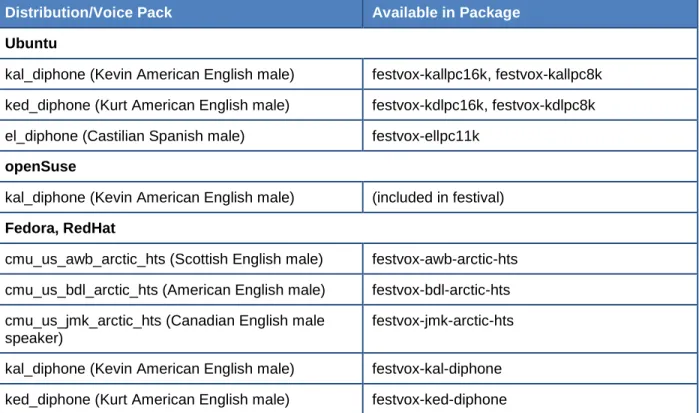
3. Using Table 6 as a reference, install voice packs from the indicated packages. (These are the supported voice packs.)
Table 6. Packages that Include Supported Voice Packs on Linux Distributions
Distribution/Voice Pack Available in Package
Ubuntu
kal_diphone (Kevin American English male) festvox-kallpc16k, festvox-kallpc8k ked_diphone (Kurt American English male) festvox-kdlpc16k, festvox-kdlpc8k el_diphone (Castilian Spanish male) festvox-ellpc11k
openSuse
kal_diphone (Kevin American English male) (included in festival)
Fedora, RedHat
cmu_us_awb_arctic_hts (Scottish English male) festvox-awb-arctic-hts cmu_us_bdl_arctic_hts (American English male) festvox-bdl-arctic-hts cmu_us_jmk_arctic_hts (Canadian English male
speaker)
festvox-jmk-arctic-hts kal_diphone (Kevin American English male) festvox-kal-diphone ked_diphone (Kurt American English male) festvox-ked-diphone
Voice Packs Recognized by Desktop Secure Browsers
The tables in this section display the voice packs for each desktop operating system (Windows, Mac, and Linux) that are currently recognized by the secure browser.
Windows and Mac OS X computers typically ship with at least one default voice pack. Many of these default voice packs are recognized by the secure browser.
Windows
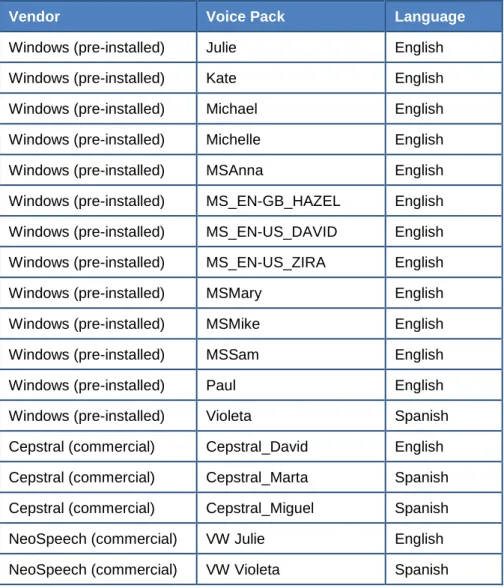
Table 7. Voice Packs Recognized by Secure Browsers—Windows
Vendor Voice Pack Language
Windows (pre-installed) Julie English Windows (pre-installed) Kate English Windows (pre-installed) Michael English Windows (pre-installed) Michelle English Windows (pre-installed) MSAnna English Windows (pre-installed) MS_EN-GB_HAZEL English Windows (pre-installed) MS_EN-US_DAVID English Windows (pre-installed) MS_EN-US_ZIRA English Windows (pre-installed) MSMary English Windows (pre-installed) MSMike English Windows (pre-installed) MSSam English Windows (pre-installed) Paul English Windows (pre-installed) Violeta Spanish Cepstral (commercial) Cepstral_David English Cepstral (commercial) Cepstral_Marta Spanish Cepstral (commercial) Cepstral_Miguel Spanish NeoSpeech (commercial) VW Julie English NeoSpeech (commercial) VW Violeta Spanish
Mac OS X
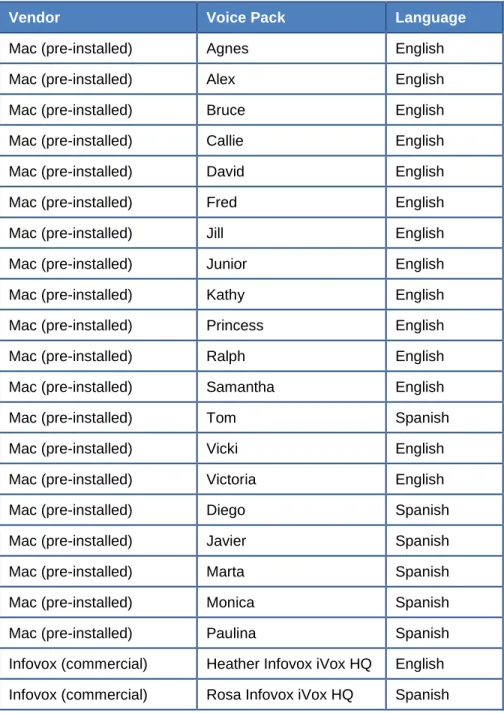
Table 8. Voice Packs Recognized by Secure Browsers—Mac OS X
Vendor Voice Pack Language
Mac (pre-installed) Agnes English
Mac (pre-installed) Alex English
Mac (pre-installed) Bruce English
Mac (pre-installed) Callie English
Mac (pre-installed) David English
Mac (pre-installed) Fred English
Mac (pre-installed) Jill English
Mac (pre-installed) Junior English
Mac (pre-installed) Kathy English
Mac (pre-installed) Princess English
Mac (pre-installed) Ralph English
Mac (pre-installed) Samantha English
Mac (pre-installed) Tom Spanish
Mac (pre-installed) Vicki English
Mac (pre-installed) Victoria English
Mac (pre-installed) Diego Spanish
Mac (pre-installed) Javier Spanish
Mac (pre-installed) Marta Spanish
Mac (pre-installed) Monica Spanish
Mac (pre-installed) Paulina Spanish
Infovox (commercial) Heather Infovox iVox HQ English Infovox (commercial) Rosa Infovox iVox HQ Spanish
Linux
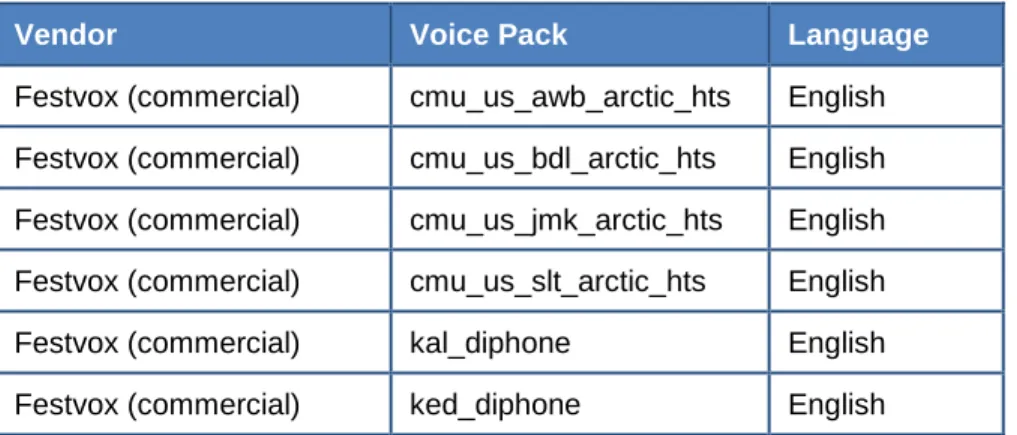
Table 9. Voice Packs Recognized by Secure Browsers—Linux
Vendor Voice Pack Language
Festvox (commercial) cmu_us_awb_arctic_hts English Festvox (commercial) cmu_us_bdl_arctic_hts English Festvox (commercial) cmu_us_jmk_arctic_hts English Festvox (commercial) cmu_us_slt_arctic_hts English Festvox (commercial) kal_diphone English Festvox (commercial) ked_diphone English
Appendix A.
Systems and URLs Provided by AIR
This appendix provides information about the URLs for each system that AIR provides.Non-Testing Sites
System URL
Portal and secure browser installation files oh.portal.airast.org
Single Sign On System oh.sso.airast.org
Test Information Distribution Engine oh.tide.airast.org Online Reporting System oh.airast.airast.org
Testing Sites
TA and Student Testing Sites
The Test Administrator and student testing sites use a cloud-based satellite system for optimal load balancing during testing. This includes the operational sites (TA Interface and Student Testing Site) and practice sites (TA Practice Site and Practice Test Site). Testing servers and satellites may be added or modified during the school year to ensure an optimal testing
experience. As a result, AIR strongly encourages you to whitelist at the root level. This requires using a wildcard.
System URL
Appendix B.
Technology Coordinator Checklist
You can use this checklist during review of networks and computers used for testing.Activity Target
Completion Date
Reference Verify that all of your school’s computers that
will be used for online testing meet the operating system requirements. 3–4 weeks before testing begins in your school Online System Requirements for Ohio Science and Social Studies Tests Verify that your school’s network and Internet
are properly configured for testing, conduct network diagnostics, and resolve any issues.
3–4 weeks before testing begins in your school
Network and Internet Requirements
Install the secure browser on all computers that will be used for testing.
3–4 weeks before testing begins in your school
Secure Browser Installation Manual
Enable pop-up windows and review software requirements for each operating system.
1–2 weeks before testing begins in your school
General Software Requirements
On Windows computers, disable Fast User Switching.
If a student can access multiple user accounts on a single computer, you are encouraged to disable the Fast User Switching function.
1–2 weeks before testing begins in your school
Disabling Fast User Switching
On Mac 10.7—10.10 computers, disable Spaces in Mission Control.
1–2 weeks before testing begins in your school
Mission Control
Install and verify any required text-to-speech software onto computers that will be used for testing. 1–2 weeks before testing begins in your school Text-to-Speech Requirements
On iPads, Androids and Chromebooks, complete the Launchpad step.
1–2 weeks before testing begins in your school
Secure Browser Installation Manual
On iPads, ensure that Guided Access is enabled and that TAs know how to activate it.
1–2 weeks before testing begins in your school
Enabling Guided Access
On Android tablets, ensure that the secure browser keyboard is enabled.
1–2 weeks before testing begins in your school
Enabling the Secure Browser Keyboard
Appendix C.
User Support
If this document does not answer your questions, please contact the Ohio Help Desk. The Help Desk will be open Monday–Friday from 7:00 a.m. to 5:00 p.m. (except holidays).
Ohio Help Desk
Toll-Free Phone Support: 1-877-231-7809 Email Support: [email protected]
If you contact the Help Desk, you will be asked to provide as much detail as possible about the issues you encountered.
Include the following information:
Test Administrator name and IT/network contact person and contact information
SSIDs of affected students
Results ID for the affected student tests
Operating system and browser version information
Any error messages and codes that appeared, if applicable
Information about your network configuration:
o Secure browser installation (to individual machines or network)