A Study of NoSQL and NewSQL
databases for data aggregation on Big
Data
ANANDA SENTRAYA PERUMAL MURUGAN
Master’s Degree Project
Stockholm, Sweden 2013
A Study of NoSQL and NewSQL databases
for data aggregation on Big Data
ANANDA SENTRAYA PERUMAL MURUGAN
Stockholm 2013
Master’s at ICT
Supervisor: Magnus Eriksson, Scania
Examiner: Johan Montelius, KTH
TRITA-ICT-EX-2013:256
Acknowledgements
This thesis project is undertaken in Scania IT Architecture office under the supervision of Magnus Eriksson and it is examined by Johan Montelius. First of all, I would like to thank Magnus and Åsa for having confidence in me and giving me this opportunity.
I would like to express great appreciation to my supervisor Magnus for his guidance and support during the project. He mentored me throughout the project with utmost
dedication and commitment. His profound experience and technical skills has helped to shape this thesis well. I’m grateful for his trust by providing room to work in my own way and to experiment with new tools. He worked with other teams for getting the necessary resources and infrastructure to carry out the thesis. Without him, I would not have been able to complete the thesis or report. He provided me valuable suggestions for the report.
I would like to offer my special thanks to Ann Lindqvist and Wahab Munir for their contributions. Ann and Wahab patiently answered all of our queries regarding the existing system. I’m particularly grateful for the help with infrastructure provided by Erik and his team. I wish to thank Anas for helping me with the tool for analyzing results. I would like to thank Åsa for providing me with resources. I must also appreciate help provided by other staffs in Scania.
I’m very thankful to Johan for agreeing to be my examiner and guiding the thesis in the right direction. Finally, I would like to thank my family for supporting me throughout my studies.
2
Abstract
Sensor data analysis at Scania deal with large amount of data collected from vehicles. Each time a Scania vehicle enters a workshop, a large number of variables are collected and stored in a RDBMS at high speed. Sensor data is numeric and is stored in a Data Warehouse. Ad-hoc analyses are performed on this data using Business Intelligence (BI) tools like SAS. There are challenges in using traditional database that are studied to identify improvement areas.
Sensor data is huge and is growing at a rapid pace. It can be categorized as BigData for Scania. This problem is studied to define ideal properties for a high performance and scalable database solution. Distributed database products are studied to find interesting products for the problem. A desirable solution is a distributed computational cluster, where most of the computations are done locally in storage nodes to fully utilize local machine’s memory, and CPU and minimize network load.
There is a plethora of distributed database products categorized under NoSQL and NewSQL. There is a large variety of NoSQL products that manage Organizations data in a distributed fashion. NoSQL products typically have advantage as improved scalability and disadvantages like lacking BI tool support and weaker consistency. There is an emerging category of distributed databases known as NewSQL databases that are relational data stores and they are designed to meet the demand for high performance and scalability.
In this paper, an exploratory study was performed to find suitable products among these two categories. One product from each category was selected based on comparative study for practical implementation and the production data was imported to the solutions. Performance for a common use case (median computation) was measured and compared. Based on these comparisons, recommendations were provided for a suitable distributed product for Sensor data analysis.
3
Table of Contents
Abstract... 2 List of Figures ... 5 Tables ... 5 1. Introduction ... 6 1.1 Scania AB ... 6 1.2 Keywords ... 6 1.3 Definitions ... 6 1.4 Background ... 7 1.5 Problem Statement ... 8 1.6 Method ... 8 1.7 Limitations ... 9 1.8 Related work ... 9 2. Theory ... 10 2.1 Current System ... 102.2 Optimization of Schema design ... 10
2.3 Ideal database properties ... 11
3. NoSQL databases ... 13 3.1 Column Families ... 13 3.2 Document Store ... 13 3.3 Key Value ... 14 3.4 Graph databases ... 14 3.5 Multimodel databases ... 15 3.6 Object databases ... 15
3.7 Grid and Cloud databases ... 15
3.8 XML databases ... 16 4. NewSQL databases ... 16 4.1 New databases ... 16 4.2 Database-as-a-Service ... 17 4.3 Storage engines ... 18 4.4 Clustering or Sharding ... 18 5. Comparative study ... 18
5.1 Comparison of NoSQL Databases – MongoDb, Hadoop, Hive ... 19
5.2 Comparison of NoSQL Databases – Pig, HBase, Cassandra and Redis ... 21
5.3 Comparison of NewSQL Databases – MySQL Cluster, NuoDB and StormDB .... 23
6. Polyglot Persistence ... 26
7. HBase ... 27
7.1 Overview ... 27
7.2 File System ... 28
4 7.4 Features ... 32 7.5 MapReduce Framework ... 33 7.6 Limitations ... 35 8. MySQL Cluster ... 36 8.1 Overview ... 36 8.2 Features ... 37 8.3 Limitations ... 39 9. Implementation ... 40 9.1 Algorithm ... 40 9.2 Schema design ... 41
9.3 MySQL Cluster implementation ... 42
9.4 HBase design and implementation ... 42
9.5 Tests ... 42 10. Results ... 43 11. Discussion ... 44 12. Conclusion ... 45 13. Future Work ... 46 14. Appendix ... 47 A. MySQL Cluster ... 47 B. HBase... 50 References ... 54
5
List of Figures
Figure 1 - Star Schema representation ... 10
Figure 2 - A Speculative retailer’s web application. ... 27
Figure 3 - HDFS Architecture. ... 29
Figure 4 - HBase Overview. ... 30
Figure 5 - An overview of MapReduce Framework. ... 34
Figure 6 - MySQL Cluster Architecture. ... 37
Figure 7 - Schema diagram of Solution ... 41
Figure 8 - Total number of median computations for HBase and MySQL Cluster. ... 43
Figure 9 - Execution time of Median Algorithm ... 44
Tables
Table 1 - Comparison of NoSQL Databases: MongoDB, Hadoop and Hive ... 21Table 2 - Comparison of NoSQL Databases: Pig, HBase, Cassandra and Redis ... 23
Table 3 - Comparison of NewSQL Databases: MySQL Cluster, NuoDB and StormDB .... 25
Table 4 – Data model HBase ... 31
6
1. Introduction
1.1 Scania ABScania is one of the World’s leading manufacturer of commercial vehicles
especially heavy trucks and buses, industrial and marine engines. Scania is also referred to as Scania AB and was founded in 1891. Scania has its headquarters and Research and Development operations in Sodertalje, Sweden. It has its production facilities in many countries in Europe. Scania also offers financial services and has a growing market in maintenance and service of trucks providing efficient transport solutions.[1][2]
Scania IT is an Information Technology (IT) subsidiary of Scania AB. It is responsible for providing IT services and products to address Scania’s business needs. It also develops, maintains and supports different transport solutions and applications used in Scania’s Vehicles.
1.2 Keywords
NoSQL, NewSQL, Data Analytics, Scalability, Availability, BigData.
1.3 Definitions
Data Aggregation
According to techopedia [3], “Data aggregation is a type of data and information mining
process where data is searched, gathered and presented in a report-based, summarized format to achieve specific business objectives or processes and/or conduct human analysis.”
Big Data
According to Gartner [4], “Big data is high-volume, high-velocity and high-variety
information assets that demand cost-effective, innovative forms of information processing for enhanced insight and decision making.”
NoSQL
NoSQL is a category of database that typically is schema free and does not follow
relational model. Most NoSQL data stores neither provide SQL query capability nor ACID compliant. They provide weaker consistencies and were developed to meet scalability and performance needs for handling very large data sets.
NewSQL
According to Matthew Aslett [5], “NewSQL is a set of various new scalable and high-performance SQL database vendors. These vendors have designed solutions to bring the
7 benefits of the relational model to the distributed architecture, and improve the
performance of relational databases to an extent that the scalability is no longer an issue.” Data warehouse
According to William H. Inmon, “Data warehouse is a subject-oriented, integrated, time-variant, and nonvolatile collection of data in support of Management’s decisions”.[6] Star schema
“In data warehousing and business intelligence (BI), a star schema is the simplest form of a dimensional model, in which data is organized into facts and dimensions.”
1.4 Background
The amount of data that modern IT systems must handle increases rapidly every year and traditional relational Databases are getting harder and harder to keep up.
Relational databases do not scale out very well and have to scale up to increase capacity. Additionally, if there are huge volumes of data in a relational database, it takes a lot of time for queries and data aggregation using business intelligence tools since the efficiency of indexes diminishes.[7]
Data Aggregation is a process in which data is collected and summarized into a report form for statistical analysis or ad hoc analysis.[8] A Relational database that is specifically designed for reporting and data analysis is called Data warehouse.
Big data is defined as massive volumes of structured or unstructured data that is difficult to handle and analyze using traditional databases.[9] Big data sizes are a constantly moving target, as of 2012 ranging from a few dozen terabytes to many petabytes of data in a single data set but what is considered "big data" varies depending on the capabilities of the organization managing the set. For some organizations, facing hundreds of gigabytes of data for the first time may trigger a need to reconsider data management options. For others, it may take tens or hundreds of terabytes before data size becomes a significant consideration.
There has been a lot of research on the scalability, availability and performance problems of databases. As a result, today there are systems designed from scratch to meet the above requirements such as NoSQL (Not only SQL) and NewSQL systems. NoSQL data stores are next generation databases that sacrifice consistency to scale out and address distributed, open-source, performance, and non-relational requirements.[10]
TheSensor data analysis project uses a data warehouse solution for online
8 for statistical analysis of historical data. These analyses and reports provide deeper insights into the system.
There are different database design models for data warehouse solution for instance - Star schema and Snowflake schema. Star schema is most commonly used when designing a data warehouse for very large data sets. It organizes data into fact tables and dimension tables. Fact table stores the actual quantitative data for example - values, number of units, etc. It references the dimension table using foreign key relationship. Dimension tables store the attributes about the fact table.[11] Star Schema is denormalized and fact table contains huge number of records and fields. It is designed in this manner since there are no
complications with Joins as in a relational database. This also helps in making queries simpler with good performance for this type of databases, so long as the data volumes are not too large.
1.5 Problem Statement
This project investigated NoSQL and NewSQL systems and evaluated how they would meet the high performance and scalability needs of the Sensor data analysis project at Scania. Data aggregation is an important functionality used in relational databases for business intelligence and analytics. For huge volumes of data, business analytics is time-consuming and memory intensive in traditional relational databases. So, distributed database needed to be evaluated to find out suitable system for handling humongous numerical data from sensors. Interesting databases were analyzed to find out if they can improve the performance of business analytics.
1.6 Method
This project used a triangulation approach by conducting study using both
Qualitative and Quantitative methods. Interesting distributed databases were identified and compared using a comparison table with qualitative description for each of the chosen properties by studying research articles and product documentation. Thus, this research method helped in identifying two most interesting databases for practical implementation. Secondly, Quantitative method was used for comparison of selected products by measuring the performance of the databases for a benchmark. This method was apt for comparison of two databases.
9
1.7 Limitations
This project was carried out for specific requirements of Sensor Data Analysis project and hence, the Scope of the Qualitative comparison of distributed databases was limited. All suitable databases were not taken into consideration for this study due to time limitation and only few interesting databases from each category were considered. Also for this reason, only two databases were selected for practical implementation.
1.8 Related work
Yahoo Cloud Serving Benchmark (YCSB) framework is a widely available, open source benchmark for comparing NoSQL databases. YCSB generates load and compares only read and write operations on the data. However, the performance of databases need to be compared for data aggregation. Also, YCSB used high-performance hardware. Though the framework is extensible, major changes were required for extending it to support data aggregation. This was beyond the scope of the thesis due to time constraints and hence, a simpler benchmark is developed for performance comparisons.
Altoros Systems performed a Vendor-independent comparison of NoSQL databases Cassandra, HBase, Riak and MongoDB. These comparisons were done for only four operations – read, insert, update and scan using YCSB.[12]
Paper [7] was a study of NoSQL databases to find out if NoSQL databases can replace traditional databases for data aggregation. Above paper [7] compares relational database and NoSQL database for aggregation which can be referenced but not used. Comparisons among NoSQL databases is required for the sensor data analysis project.
Paper [13] was a study of the sensor data analysis project for optimization of data warehouse solution conducted at Scania. Above paper [13] provided recommendations for architecture and design of data warehouse solution. This solution is adapted and
implemented in the project. However, there are challenges in this system which were investigated in this thesis.
Big data analytics is evolving and there are some systems that require realtime query results. Storm is a scalable, reliable and distributed real time computation system. It is used to perform realtime data analytics on unbounded streams. [14] An example use case is twitter where updates are rapid and realtime business intelligence is required. Sensor data problem does not require realtime data analytics since the writes are not very rapid. Also, ad-hoc analyses performed on a week old data is acceptable.
10
2. Theory
2.1 Current System
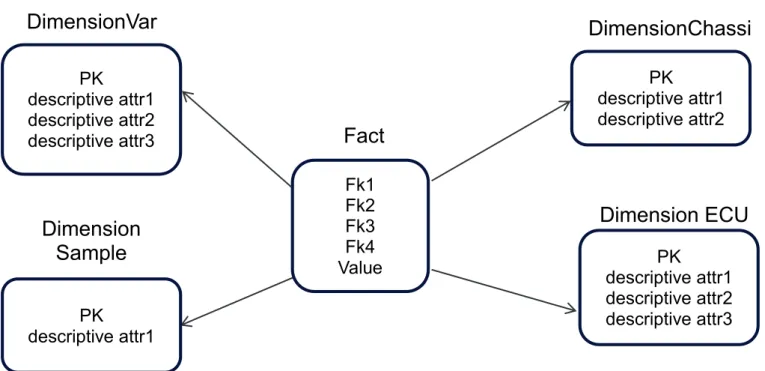
The existing system uses data warehouse solution for sensor data analysis. [13] The data is stored in Star Schema which is shown in Figure 1.
Figure 1 - Star Schema representation
Here, tables are organized into a fact table and several dimension tables. The fact table contains all the data values which are the quantitative measurements and links to the dimension tables. Dimension tables describe the data to allow meaningful analysis and are related to the fact table. In this system, fact table is a huge data set containing millions of rows.
2.2 Optimization of Schema design
In a relational database, table data is typically stored in local disk drives or network storage and the indexes in random access memory using B-Tree or hash tree. [15] The index provides quick access to data for read and write. The leaf nodes of the B-Trees have pointers to data in secondary memory. Sensor data variables are stored in fact table and attributes stored in dimension table. Each value of each attribute is stored in a separate row. In such a solution, there are three dimensions of growth namely – 1. Number of Vehicles grow, 2. Number of collected attributes grow and 3. Sampling rate grow by use of Telemetry. Star schema is suboptimal in this case and leads to exponential growth. Each
Dimension
Sample
PK descriptive attr1 descriptive attr2 descriptive attr3 PK descriptive attr1 descriptive attr2 descriptive attr3DimensionChassi
PK descriptive attr1DimensionVar
PK descriptive attr1 descriptive attr2Dimension ECU
Fk1 Fk2 Fk3 Fk4 ValueFact
11 snapshot of the sensor variable stores ‘N’ number of rows where ‘N’ denotes the length of the array.
There are a number of drawbacks with the above schema design. First of all, growth of data is rapid in three dimensions and will eventually lead to Scalability problems.
Secondly, reading data from one huge fact table can be very slow. This is because the indexes are also huge and query performance is not boosted by indexes. Thirdly, in a big table, rows will be spread out many disk blocks or memory segments. There is no
capability to store records of same variable together in a physical layout. If a variable is represented as a separate small table, it’s possible that they may be stored together in disk blocks. Also, indexing is quite fast for small tables. The entire table may be stored in memory thereby greatly increasing performance.
Optimal schema for a Big Data solution needs many number of small tables instead of a small number of huge tables. In the above case, if each sensor variable is stored in a separate table indexed by primary key, the database will have better performance for ad hoc queries. Partitioned table may give the same result. This is because the indexes are effective for small tables.
2.3 Ideal database properties
To define ideal properties for a perfect solution for Sensor data, it is necessary to understand the requirements of the system. In Scania, Sensor data is collected each time a Vehicle enters the workshop. A Vehicle has many control units and each control unit has many sensor variables. These control units accumulate value of the sensors. A variable can have scalar, vector or matrix data type. Each sensor variable can have different versions corresponding to different versions of control unit. Every time a control unit is replaced or upgraded, each of its sensor variables could change having fewer or more values. Thus a new version of each sensor variable is created for that control unit.
Sensor data is valuable for the company. They are used by BI Analysts to perform various analyses to get deeper understanding of Vehicle component’s performance,
lifetime, technical problems, etc. The System is used for performing ad hoc analyses on the historical data and to generate statistical reports. SAS tool is used as BI tool for generating reports. The analyses are performed on a separate Server which holds a read only copy of the data and hence the data is not realtime. The updates are performed on another Server which is periodically copied into the BI Server.
12 Existing system is analyzed to understand the performance or scalability issues. Future requirements of Sensor data project is gathered and analyzed. Considering the purpose of the System, usage, and future requirements, the following properties are identified as essential for a perfect solution.
● Scalability - The System should be able to scale-out horizontally by adding additional nodes with as close as possible to linear scalability.
● High availability - The system may be integrated with online applications. It will be a system running on a cluster of nodes (commodity hardware) and hence it is important to be available always and tolerate failure of individual nodes.
● Elasticity - Elasticity is the representation of a system under load when new nodes are added or removed. [7] If a system supports elasticity, then nodes can be added to running system without shutting it down and it will automatically balances the load. ● High read performance - The database should have high throughput for sequential
and random read operations.
● High performance for computations - The system should have high performance for computations such as calculating statistical median over the data set. Since the data will be distributed, it should be possible to run algorithms or stored procedures on the storage nodes locally to reduce required network bandwidth and to make optimal use of the CPU capacity in the storage tier.
● Low Complexity - The System should be easy to use and maintain by programmers through well documented APIs.
● Support data operations - The System should support create, read, and delete operations on the data.
● Support by vendors or open source communities - The System should be well documented and supported so that the database administrators and developers can get support for product usage, bugs in the product, etc.
● Support for Indexes - Indexing helps in fast retrieval of data. We could relax this criteria by designing a database that uses the primary index only if the system does not support secondary indexes.
● Support for Business Intelligence tools - The database should be integrated with BI tools to be able to generate statistical reports and graphs.
● Support for array or vector data type - It is desirable that the system support collections like array or vector data type. This could help in improving the
13 performance of reads by accessing whole array or vector at once embedded in an object and simplify programming.
● High throughput for bulk write or append for periodic updates
3. NoSQL databases
NoSQL is a collection of non-relational, typically schema-free databases designed from scratch to address performance, scalability and availability issues of relational databases for storing structured or unstructured data. There are different categories of NoSQL databases. [10]
3.1 Column Families
Google’s BigTable inspired a class of column oriented data stores. HBase, Cassandra, Amazon’s Dynamo, SimpleDB, Cloudata, Cloudera, Accumulo and
Stratosphere come under this category. [10] In traditional databases, if there are no values for columns, null values are stored. Null values consume space though less than normal data type. Column families have flexible number of columns in BigTable, and HBase. If there are no values for a column, no values need to be stored and thus avoiding null values. Hence for sparse data, they are efficient in usage of storage space. [16] In these databases, each row is uniquely identified by a key. Thus each row is a key value pair and each column is identified by the primary key and column family. Data is stored in a sorted and sequential order. When the data exceeds the capacity of a single node, it is split and stored into multiple nodes. The entire data set is in a single sorted sequence across nodes. Data replication is provided by underlying distributed file system which also provides fault tolerance of any storage nodes.
3.2 Document Store
Document stores denote a schema free storage where each document is uniquely identified by a key. Here documents represented semi-structured data type like JSON. Each document can be compared to a tuple in traditional relational databases. Document can contain data of different types and structure known as properties. A collection is comparable to a table in relational databases and contain a group of
14 be indexed on any of their properties. There are many databases that fall into this category – for instance MongoDB and Couch DB. [16]
3.3 Key Value
As the name suggests, this kind of databases have a set of key-value pairs where key is unique and identifies a value. They can be quite efficient because a value typically can be accessed in O (1) complexity similar to a Hash Map. There are three major types - 1. Key stores based on Berkeley DB, 2. Memcached API key stores and 3. Key value store built from scratch that do not belong to above two categories.
Berkeley DB has array of bytes for both keys and values. It does not have distinct definition for key and values. Key and values can be of any data type. These keys can be indexed for faster access. Memcached API has an in-memory storage of data identified by unique keys. Memcached API is quite fast for reads and writes and are flushed to disks for durability. Most key value stores provide APIs to get and set values. Redis is a highly available key-value data stores which stores the data in memory. It is more of a data structure server. The data types can be sets, maps, vectors and arrays. They provide rich APIs for storing and retrieving data.
Riak is a distributed key value data store which provides very fast lookups and is highly available. [17] It is written in Erlang and provides APIs in JSON. It can be quite powerful since it provides strong guarantees using vector clocks.[10]
Amazon’s DynamoDB is a highly available key value stores which provides reliability, performance and efficiency. Dynamo was built for high scalability and reliability needs of Amazon’s e-commerce platform. It is built on fast solid state disks (SSD) to support fast access to data. It supports automatic sharding, elasticity, and provisioned capacity.[18]
3.4 Graph databases
This category of databases uses graph structures to store data. They have nodes, edges and properties to represent data. Most graph databases do not have indexes because each node has pointer to adjacent element and hence provide faster access for graph-like queries. Real world objects such as Product ratings, Social networks can be easily designed using these databases and provide fast read or write access. There are several graph
15 popular graph database that is widely used to design, for instance product catalogs and databases which change frequently.
3.5 Multimodel databases
According to Matthew Aslett [5], these are the databases that are built specially for multiple data models. FoundationDb is a database that supports key-value data model, document layer and object layer. Riak is a highly available key value store where the value can be a JSON document. Couchbase database supports document layer and key-value data layer. OrientDB is a document sore which supports object layer as well as graph data layer.
3.6 Object databases
Databases such as ZopeDB, DB40, and Shoal are object oriented databases.
ZopeDB stores python objects. DB40 is a schema free object database that supports storage and retrieval of .Net and Java objects. Shoal is an open source cluster framework in Java. These databases provide efficient storage and retrieval of data as objects. However, they are not widely adopted because these databases are tied to object model of respective programming languages and lack standard query language like SQL. So they are dependent on specific language limitations which is a major drawback.
3.7 Grid and Cloud databases
Grid and Cloud databases provide data structures that can be shared among the nodes in a cluster and distribute workloads among the nodes. Hazelcast [19] is an in-memory data grid that provides shared data structures in Java and distributed cache. It also provides JAAS based security framework which secures read or write client operations and authenticates requests. Oracle Coherence is an in-memory distributed data grid and is used at Scania.
Infinispan is a highly available, scalable, open source data grid platform written in Java.[20] It supports shared data structure that is highly concurrent and provides distributed cache capabilities. It maintains state information among the nodes through a peer to peer architecture. GigaSpaces provides an in-memory data grid and a data store in the cloud through Cloudify. GigaSpaces supports NoSQL frameworks such as couchbase, Hadoop, Cassandra, Rails, MongoDB, and SQL frameworks such as MySQL in the Cloud. [21] It provides support for both private and public cloud.
16 GemFire is also an in-memory distributed data management framework which is scalable dynamically and gives very good performance. It is built using spring framework and provides low latency by avoiding delays due to network transfer and disk I/O. [22]
3.8 XML databases
XML databases either stores data in XML format or supports XML document as input and output to the database. If the data is stored in XML format, XPath and XQuery are typically used to query the data in the documents. These databases are also known as document-centric databases.
Some of the popular XML databases are EMC document xDB, eXist, BaseX, sedna, QizX and Berkeley DB XML. BaseX is a lightweight, powerful open source XML
database written in Java. It is fully indexed, scalable and provides support for version 3.0 of XPath or XQuery for querying. It has a client-server architecture and guarantees ACID properties for datastore. It can store small number of very large XML documents where each document can be several Gigabytes. eXist is an open source schema-free XML database which can store binary and textual data.
4. NewSQL databases
NewSQL databases address scalability, performance and availability issues of relational DBMS and provide full or partial SQL query capability. Most of them follow relational data model. There are four categories of NewSQL databases namely – 1. New databases, 2. Database-as-a-service, 3.Storage engines, and 4. Clustering or sharding.[23]
4.1 New databases
These are a kind of relational databases that are recently developed for horizontal scalability, high performance and availability. Some of the popular databases under this category are as follows – NuoDB, VoltDB, MemSQL, JustOneDB, SQLFire, Drizzle and Akiban Translattice. NuoDB is described in detail in the following section to give an idea about this category.
4.1.1 NuoDB
This is a scalable, high performance cloud data management system that is capable of being deployed in cloud or in data center.[24] It has a three tier deployment architecture. Cloud, data center or hybrid deployment form the first tier. Operating system such as
17 Linux, Windows and MacOS form the second tier. Third tier has NuoDB components, namely - Broker, Transaction Engine, Storage Manager (SM), and File system.
Each of the components is run as an in-memory process running on hosts. SM is responsible for persisting data and retrieving it. Broker is responsible for providing access to database for external applications. Transaction Engine is responsible for handling transactions. It retrieves data from its peers when required. So data is stored durably in SM and replicated to Transaction engine when needed. When a Transaction engine is created it learns the topology and acquires metadata from its peers. For scalability new NuoDB processes can be added. When a SM is added, it receives a copy of entire database for reliability and performance.
All client requests are handled by Transaction engine which runs a SQL layer. NuoDB also supports other frameworks such .Net, Java, Python, Perl and PHP. SM supports handling data in a distributed file system such as HDFS, Amazon S3 or SAN or regular file system. Since transaction handling is separated from data storage it is able to provide very good performance for concurrent reads and writes. An important feature of this product is that it is capable of providing realtime data analytics. Also it has capability to run in geographically distributed data center and hence it is possible to take application global.
4.2 Database-as-a-Service
Traditional DBMS are not suited to be run in a Cloud environment. So Database services emerged to address this issue and to adapt DBMS to be run on public or private cloud. These are the Cloud Database services which are deployed using Virtual machines. NuoDB, MySQL, GaianDB and Oracle database can be deployed in cloud. Another data model for database in cloud is Database-as-a-Service.
These solutions provide database software and physical storage with sensible out of box settings. No installation or configuration is required to start such a service which is an on-demand, pay-per-usage service. The Service provider is fully responsible for
maintaining the service, upgrading and administering the database.[25] For instance Microsoft SQL Azure, StormDB, ClearDB and EnterpriseDB belong to Database-as-a-service category. StormDB is described in detail to give an overview of this category.
4.2.1 StormDB
StormDB is a distributed database that is fully managed in cloud. It can be created and accessed as a service through a browser. It differs from regular cloud databases by
18 running the database instance on bare metal instead of running it in a virtual environment. This helps in providing scalability of the system. It has a feature called Massively Parallel Processing (MPP) through which it process even complex queries and data analytics over entire data set very quickly (in seconds). It is a relational database supporting high volume of OLTP reads and writes. It supports transaction handling and is ACID compliant. It is based on PostgreSQL and hence provides SQL interface. It also supports many other APIs such as .Net, Java, Python, Ruby, Erlang, C++, etc. There is no installation or deployment to be done by customers. StormDB instances can be created very easily and are fully managed by the Vendor. It has all the advantages of NewSQL databases and is also very easy to use.[26]
4.3 Storage engines
MySQL is an OLTP database that is fully ACID compliant and handles transactions efficiently. However, it has scalability and performance limitations. One solution to this problem is sharding of data but this may result in consistency issues and is complicated to handle at application level. When data is partitioned among servers, all the copies have to be maintained consistently and there may be complications while handling transactions. Hence alternative storage engines have been developed to address the scalability and performance problems. MySQL NDB Cluster is a popular storage engine that is being widely used today. Other storage engines are Xeround, GenieDb, Tokutek and Akiban. MySQL Cluster is described in detail in Section 9.
4.4 Clustering or Sharding
Some SQL solutions introduce pluggable feature to address scalability limitations. Some solutions shard data transparently to address scalability issue. Examples of this category are Schooner MySQL, Tungsten, ScaleBase, ScalArc and dBShards.
5. Comparative study
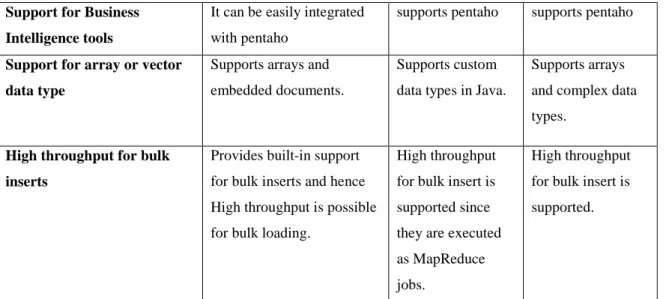
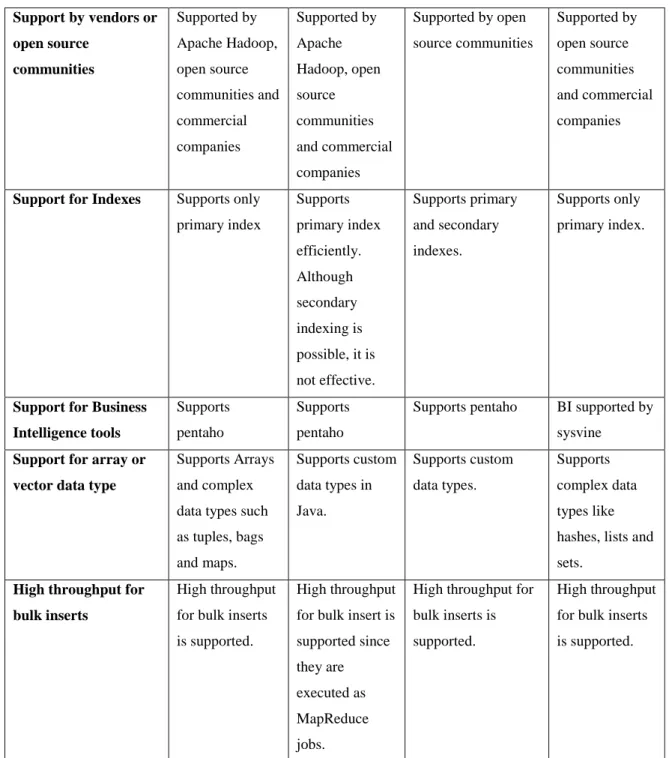
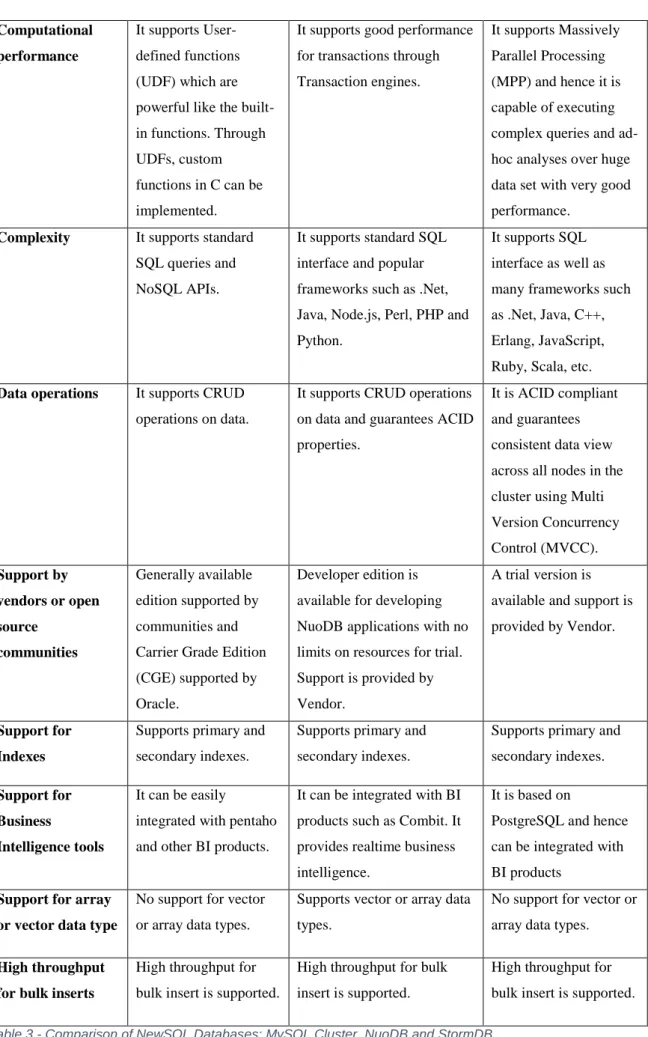
A Qualitative method is used to identify interesting products. Thus a study of different NoSQL and NewSQL products is carried out using research articles, academic papers, product documentation and community forums. A comparison of interesting NoSQL and NewSQL databases is carried out against desired properties for a storage solution. The comparison is listed in table below.
19
5.1 Comparison of NoSQL Databases – MongoDb, Hadoop, Hive
Criteria MongoDb Hadoop Hive
Description It is a document oriented data store designed to scale out.
It is an open source framework that supports processing of massive data sets using a distributed computational cluster. It is a data warehousing framework built on top of Hadoop.
Scalability It automatically distributes data and load across multiple servers.
Scales horizontally and supports auto sharding.
It scales linearly and supports auto sharding.
Availability Supports high availability through asynchronous replication High availability provided by Hadoop Distributed File System (HDFS) and YARN. High availability provided by HDFS.
Elasticity New nodes can be added or removed online. [27]
New nodes can be added or removed dynamically.
New nodes can be added or removed dynamically.
Read performance It supports high read performance through memory-mapped files.
It is not suited for random reads and low latency reads since each read operation is a scan It provides better read performance than Hadoop because of primary and secondary indexes.
20 over the whole data
set.
Computational performance It supports aggregation through MapReduce, rich queries and aggregation tools. But map reduce jobs are slow and should be executed as batch jobs in the background so that the results could be queried in real-time.
Supports aggregation through
MapReduce jobs which are run as batch jobs and do not provide realtime performance. Supports aggregation through SQL queries. These queries are converted into MapReduce jobs.
Complexity It provides a JavaScript shell to query and manipulate data in MongoDb server. It provides MapReduce APIs in Java. It provides an interface to C++ through Hadoop Pipes and to other languages through Hadoop Streaming.
Provides Hive Query language which is SQL like.
Data operations Supports CRUD (Create, Read, Delete and Update) operations on data.
Supports create, read and append operations on data.
Supports insert and read operations on data. There is no update or delete operation.
Support by vendors or open source communities
Support provided by 10gen and open source
communities. Supported by Apache Hadoop, open source communities and commercial companies Supported by Apache Hadoop, open source communities and commercial companies
Support for Indexes Supports index on any attribute and aggregation tools. It provides support for unique, compound and geospatial indexes. Supports only primary index. Supports primary and secondary indexes.
21
Support for Business Intelligence tools
It can be easily integrated with pentaho
supports pentaho supports pentaho
Support for array or vector data type
Supports arrays and embedded documents.
Supports custom data types in Java.
Supports arrays and complex data types.
High throughput for bulk inserts
Provides built-in support for bulk inserts and hence High throughput is possible for bulk loading.
High throughput for bulk insert is supported since they are executed as MapReduce jobs.
High throughput for bulk insert is supported.
Table 1 - Comparison of NoSQL Databases: MongoDB, Hadoop and Hive
5.2 Comparison of NoSQL Databases – Pig, HBase, Cassandra and Redis
Criteria Pig HBase Cassandra Redis
Description It is a scripting language designed to simplify data structures and MapReduce jobs. It is a distributed column oriented database designed to scale linearly. It is a distributed storage system designed to handle huge volumes of structured data. It is an in-memory key-value store that is extremely fast.
Scalability It processes huge volumes of data by simple programs. It scales out and supports auto sharding It supports linear scalability and auto sharding It scales incrementally and supports auto-sharding. Scalable but sharding has to be handled manually.
Availability High availability provided by HDFS. High availability provided by HDFS and Zookeeper. High availability is provided by gossip based membership protocol and failure detection module.
22
Elasticity New nodes can be added online but data will be distributed from the old nodes to the new nodes and it takes time before new nodes start serving requests.
When new nodes are added dynamically, there is no big data transfer from the old nodes to new nodes and hence the new node start serving requests immediately.
New nodes can be added online but data will be distributed from the old nodes to the new nodes and it takes time before new nodes start serving requests.[27]
Adding or removing nodes is complex and takes lot of time since hash slots will be moved around.
Read performance It is slower than Java MapReduce programs and hence performance is slower than Hadoop.
Rows are sorted by primary key and hence supports low latency for sequential and random reads. It uses in-memory structure called bloom filters which is like a cache and is checked first for read requests. Hence it provides good read performance.
It is more of a cache since it stores data in memory and hence it’s quite fast for random reads and writes. Computational performance Supports MapReduce functionality. Supports aggregation through MapReduce Jobs. Support for MapReduce is not native and is slower than Hadoop. Although it can be used along with Storm for real time computation. Provides fast real time analytics. Complexity It provides a level of abstraction through APIs and simplifies MapReduce programming. Provides a shell with simple commands to perform querying and manipulating data. Provides Cassandra Query Language (CQL), command-line interfaces and APIs.
Provides APIs but no ad hoc querying feature.
Data operations Supports create, read and append operations on data.
Supports create, read and append operations on data. Supports CRUD operations on data. Supports CRUD operations on data.
23 Support by vendors or open source communities Supported by Apache Hadoop, open source communities and commercial companies Supported by Apache Hadoop, open source communities and commercial companies Supported by open source communities Supported by open source communities and commercial companies
Support for Indexes Supports only primary index Supports primary index efficiently. Although secondary indexing is possible, it is not effective. Supports primary and secondary indexes. Supports only primary index.
Support for Business Intelligence tools
Supports pentaho
Supports pentaho
Supports pentaho BI supported by sysvine
Support for array or vector data type
Supports Arrays and complex data types such as tuples, bags and maps. Supports custom data types in Java. Supports custom data types. Supports complex data types like hashes, lists and sets.
High throughput for bulk inserts
High throughput for bulk inserts is supported.
High throughput for bulk insert is supported since they are executed as MapReduce jobs.
High throughput for bulk inserts is supported.
High throughput for bulk inserts is supported.
Table 2 - Comparison of NoSQL Databases: Pig, HBase, Cassandra and Redis
5.3 Comparison of NewSQL Databases – MySQL Cluster, NuoDB and StormDB
Criteria MySQL Cluster NuoDB StormDB
Description MySQL NDB Cluster is a storage engine designed to scale out
It is a relational database in cloud that is ACID compliant and provides SQL query capability.
StormDB is a Database Cloud running on bare metal unlike
24 with very good
performance.
databases which has a virtualization
deployment model.
Scalability Scales horizontally. Data is automatically partitioned among the storage nodes by built-in shardbuilt-ing
management system.
Scales out by adding more NuoDB processes. NuoDB process is an in-memory process that can be a Transaction engine, Storage manager or a Broker running on hosts in a data center or cloud. Scaling down is done by removing NuoDB processes.
It provides horizontal scalability.
Availability It has a shared nothing architecture and supports high availability through automatic synchronous replication.
Storage Managers persists data in disks using supported file system such as HDFS, Amazon S3 or Storage Area Network (SAN). Data is replicated where it is needed. Each new NuoDB process acting as Storage Manager has copy of the entire database for high availability and reliability.
It is a distributed relational database with a shared nothing architecture and has no single point of failure. Data is replicated to provide availability.
Elasticity It supports online scale out and the data will be automatically
distributed and load balanced with the newly added node.
Online Scale out is provided by adding new NuoDB process and scale in is provided by removing NuoDB processes.
This database runs on bare metal instead of Virtual Machines and provides elasticity by dynamically adding resources.
Read performance It supports high read performance by storing data in RAM and through Memcached APIs to cache and access data in RAM quickly.
Transaction engines and storage managers are separated which helps in simplified data management system. Good read
performance is provided by these in-memory processes.
It is a fully managed database cloud providing good performance for reads and writes.
25
Computational performance
It supports User-defined functions (UDF) which are powerful like the built-in functions. Through UDFs, custom functions in C can be implemented.
It supports good performance for transactions through Transaction engines.
It supports Massively Parallel Processing (MPP) and hence it is capable of executing complex queries and ad-hoc analyses over huge data set with very good performance.
Complexity It supports standard SQL queries and NoSQL APIs.
It supports standard SQL interface and popular frameworks such as .Net, Java, Node.js, Perl, PHP and Python.
It supports SQL interface as well as many frameworks such as .Net, Java, C++, Erlang, JavaScript, Ruby, Scala, etc.
Data operations It supports CRUD operations on data.
It supports CRUD operations on data and guarantees ACID properties.
It is ACID compliant and guarantees consistent data view across all nodes in the cluster using Multi Version Concurrency Control (MVCC). Support by vendors or open source communities Generally available edition supported by communities and Carrier Grade Edition (CGE) supported by Oracle.
Developer edition is available for developing NuoDB applications with no limits on resources for trial. Support is provided by Vendor.
A trial version is available and support is provided by Vendor.
Support for Indexes
Supports primary and secondary indexes.
Supports primary and secondary indexes.
Supports primary and secondary indexes.
Support for Business
Intelligence tools
It can be easily
integrated with pentaho and other BI products.
It can be integrated with BI products such as Combit. It provides realtime business intelligence.
It is based on
PostgreSQL and hence can be integrated with BI products
Support for array or vector data type
No support for vector or array data types.
Supports vector or array data types.
No support for vector or array data types.
High throughput for bulk inserts
High throughput for bulk insert is supported.
High throughput for bulk insert is supported.
High throughput for bulk insert is supported.
26 Among the databases, two most interesting databases are selected, one from each category for practical implementation and evaluation. The decision about interesting databases is made by giving more weightage to computational performance criteria and availability for practical implementation. Some of the NewSQL databases need to be purchased before any development can be done.
HBase stands out among the NoSQL databases because of following reasons – 1. It has tight integration with MapReduce framework and hence provides high performance for computations, 2. It provides high throughput for reads through caching and filters, and 3. It is available as open source and hence can be easily deployed without any licensing issues. Also, support is provided by open source communities.
MySQL Cluster is chosen among the NewSQL databases because of following reasons – 1. Community edition is available for development, 2. It provides good computational performance through UDFs and NDB C++ APIs.
6. Polyglot Persistence
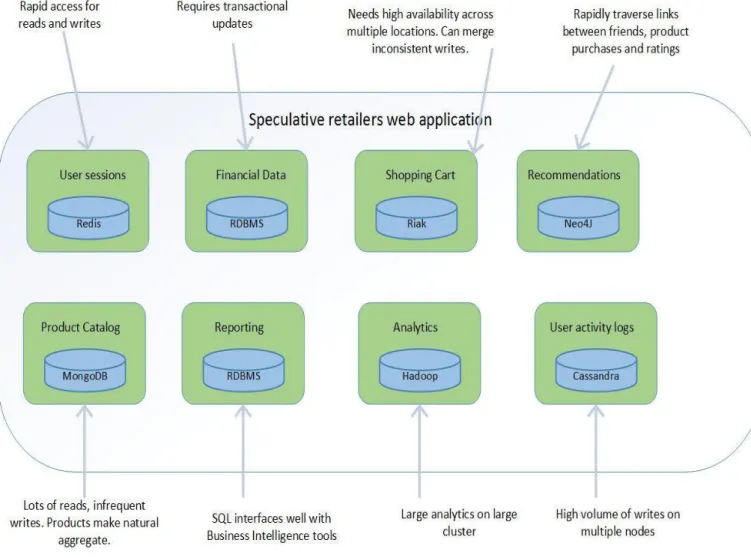
Each category of databases address a specific storage problem. No single storage solution can be a perfect solution for all use cases. There are limitations on each category. It is essential to understand the features and limitations of each database. According to Martin Fowler [28], a complex application requires a combination of database products to solve the storage problem. More than one database product is used to store and manipulate data. This is known as polyglot persistence. Figure 2 shows an example of polyglot
persistence. It shows a web application for retail management. The storage uses Apache Hadoop and Cassandra for data analytics and user activity logs respectively.
27 Figure 2 - A Speculative retailer’s web application.
*Adapted from Martin Fowler page [28]
7. HBase
7.1 OverviewHBase is a column family oriented data store designed to store very large tables. It is modeled after Google’s Bigtable. It is a multidimensional data store supporting
versioned data. It provides random read or write access to data. It is built for high
availability, scalability and good performance. Analytics on massive data sets is supported by HBase using Parallel programming model known as MapReduce framework. HBase does batch processing on massive data sets by pushing computations to the data nodes through MapReduce tasks.
28
7.2 File System
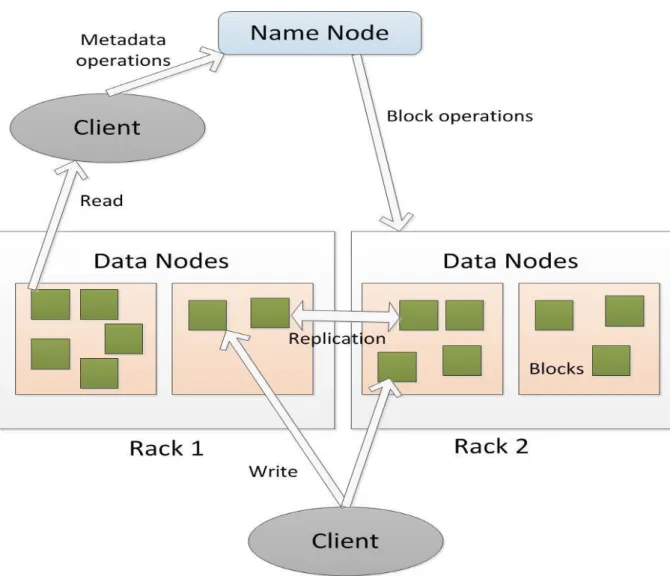
HBase requires a distributed file system storage for storing data and performing computations. Hadoop Distributed File System (HDFS) is the commonly used distributed file system for HBase in production. HDFS is designed for storing very large data sets. These files are primarily of type write once and read many times. Data is written at the end of the file and the file system doesn’t support modifications. HDFS stores information about the files called metadata in Name node. Application data is stored in data nodes.
When a client requests a data block, it is looked up in the Name node and redirected to the corresponding data node. The data node performs the function of retrieving and storing data blocks. The data nodes periodically update the Name node with metadata of data blocks it contains. This Meta data is persistently stored in a namespace image and edit log. If the Name node fails, the file system will be unstable. Hadoop provides fault
tolerance of Name node through a Secondary name node. This is a separate node which periodically merges its namespace image with the edit log. This eliminates the possibility of the edit log becoming too large. The Secondary name node also saves the merged namespace image. Recent versions of Hadoop provide YARN a resource manager which provides fault tolerance for Namenode. An overview of HDFS is pictographically
represented in the Figure 3.
Metadata is stored in memory in the Name node. The total number of files in file system is limited by the size of main memory in the Name node. Hence, the design supports storing small number of large files. Each file is divided into many data blocks and stored in a data node in the cluster. The data blocks are of fixed size. The data block is a unit of abstraction rather than a file. This makes the file system simple by dealing with replication or failure management. Replication of data blocks provide high availability in case of failure of any data node in the cluster. Each data block is larger in size than the usual disk block. It is because time to seek to start of the block will be significantly smaller than the time to transfer a data block. Hence data transfer of a large file will be at the disk transfer rate. [29]
29 Figure 3 - HDFS Architecture.
*This figure is adapted from HDFS Architecture guide [30]
HDFS can be configured to be rack aware. This means that each of the data nodes can be assigned to a rack and the Name node will be aware of a rack’s data nodes. Data locality is provided by rack awareness of HDFS. So when a client requests multiple data blocks, the blocks will be searched within data nodes of the same rack. This reduces network latency. Also, data blocks are replicated within a rack and also in a different rack. This is done to prevent data loss if all data nodes of a rack fails.
7.3 Architecture
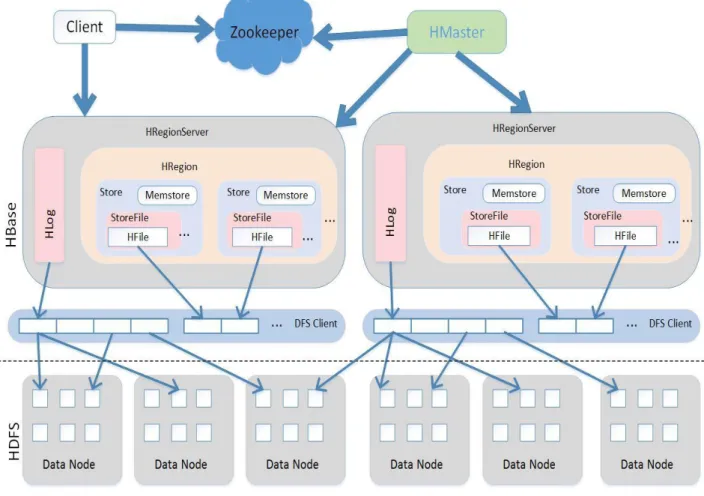
An overview of HBase is pictographically represented above. HBase consists of following major components - 1. Zookeeper, 2. HDFS, 3. Region Servers and 4. HMaster. Zookeeper is a node or group of nodes that manages the cluster. Zookeeper is a distributed
coordination service that is simple, fast and can be used as basis for constructing synchronization, naming and other services. It guarantees sequential consistency which means that updates will be applied in the order they were sent. It also provides reliability
30 and guarantees atomicity. HRegionServer performs low-level file operations. Sometime HMaster also performs these file operations. The primary purpose of HMaster is to assign regions to HRegionServer when HBase is started.
Figure 4- HBase Overview.
*This figure is adapted from HBase book [31]
HRegionServer creates HRegion objects which in turn opens Store Objects and StoreFiles. Each HRegion object correspond to a column family of a table. A StoreFile is an object containing the actual data known as HFile. A Store instances also contain Memstore instances. HLog is a write ahead log where all updates to the data is written to. This log file helps in failure management when the primary server goes down. In such a case, the log is consulted to merge and retrieve the latest version of the data which was not persisted. When a write request is sent to HRegionServer, it writes the data to HLog and to Memstore. Memstore is checked to see if it is full and if so, it is flushed to physical storage ‘HFile’. [31]
When a client requests data from HBase, three lookups are performed. First, the client sends request to Zookeeper which returns the location of System table that contains the Root region. Client looks up this Root region server to find out the server having the
31 Meta region of the requested row keys. This information is cached and performed only once. Then the client looks up this Meta region server to find out the region server that contains the requested row keys. Then the client directly queries this region server to retrieve the user table.
A background thread in HBase monitors store files so that the HFiles do not become too many in numbers. They are merged to produce few large files. This process is known as compaction. There are two types of compactions - minor and major. Major compactions merges all files into a single file whereas minor compactions merge the last few files into larger files.
While designing an HBase database, it is recommended to have few column
families typically 2 or 3. This is because flushing and compaction happens region wise. So if there are many column families, flushing and compaction will require a lot of I/O
processing. Also, if a column family has large amount of data while another column family has little data but both will be flushed if they are in the same region.
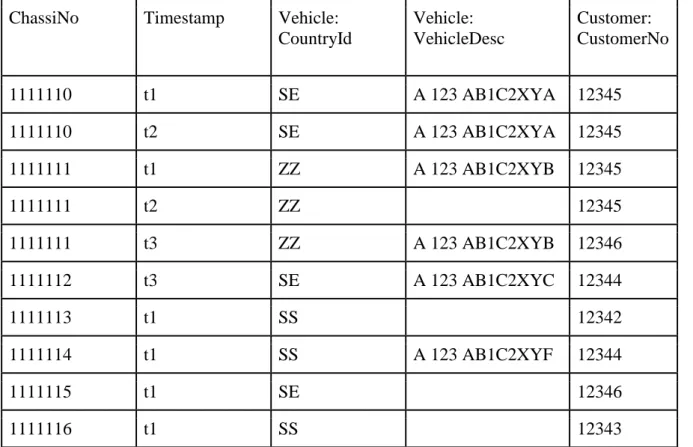
HBase has a data model where each cell is denoted by four qualifiers together - row key, column family, column qualifier and timestamp. Hence it is also known as
multidimensional sorted map. Data model is illustrated in an example below.
ChassiNo Timestamp Vehicle: CountryId Vehicle: VehicleDesc Customer: CustomerNo 1111110 t1 SE A 123 AB1C2XYA 12345 1111110 t2 SE A 123 AB1C2XYA 12345 1111111 t1 ZZ A 123 AB1C2XYB 12345 1111111 t2 ZZ 12345 1111111 t3 ZZ A 123 AB1C2XYB 12346 1111112 t3 SE A 123 AB1C2XYC 12344 1111113 t1 SS 12342 1111114 t1 SS A 123 AB1C2XYF 12344 1111115 t1 SE 12346 1111116 t1 SS 12343
32 With Column families a column can either have value or no value. Thus it saves space in storing null value for a column. This is significant in a massive data table where there is a huge number of null values. In the above example, vehicleDesc column does not have a value for some rows. Also same row key can have multiple versions based on timestamp as shown above.
7.4 Features
Major features of HBase is described below ● Caching
HBase provides LRU cache functionality known as block cache which caches frequently used data blocks. There are three types of block priority - 1. Single access, 2. Multiple access and 3. In-memory. When a block is accessed for the first time, it will be in 1st category and will be upgraded to 2nd category when it is accessed again. In-memory blocks will be kept in memory, set by database
administrators.
Block cache also caches catalog tables such as .META and .ROOT, HFile indexes and keys. Block cache should be turned off for Map reduce programs because when using the Map reduce Framework, each table is scanned only once. Also, block cache should be turned off for totally random read access. In other cases, block cache should be enabled so that the Region servers do not spend resources loading indices over and over. [32]
● Filters
In HBase, rows can be retrieved using scan functionality by column family, column qualifier, key, timestamp, and version number. A Filter will improve read effectiveness by adding functionality to retrieve keys or values based on regular expressions. There are many predefined filters and it is also easy to implement user defined filter by extending base filter class.
HBase provides Bloom filters for column families. Bloom filter is a functionality which checks if a specific row key is present in a StoreFile or not. There could be false positive where in a check returns true while the row key is not present in the StoreFile. This parameter can be tuned drastically reducing the time to seek a random row key.
● Autosharding
33 When the rows become larger than the configured maximum size, it is split into two regions. Each region is served by only one region server and a region server can serve many regions. When a region server serving a region becomes loaded, then the regions are moved between servers for load balancing. This splitting and serving of regions is known as Autosharding and is handled by framework. [31] ● Automatic failover for region server
when a region server fails, then the client requests are automatically redirected to other region servers serving the regions.
● Consistency
HBase guarantees some level of consistency. Updates made at row level are atomic. However, it does not guarantee ACID properties.
● MapReduce
HBase provides support for a MapReduce framework which is described in detail in the following section.
7.5 MapReduce Framework
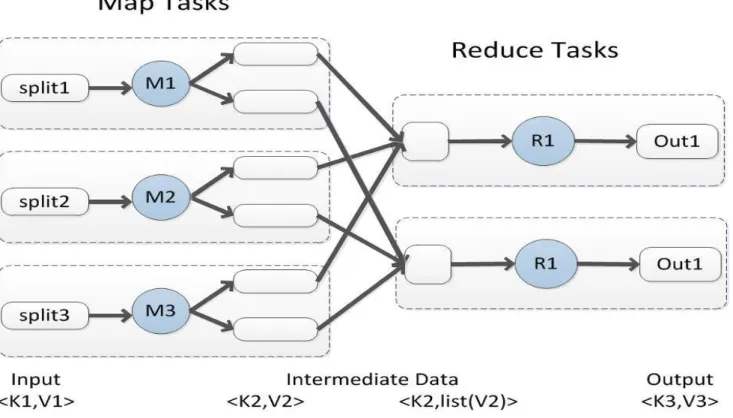
MapReduce is a simple but powerful parallel programming framework through which computations are performed locally on storage nodes. Since computations are performed locally, network latency for data transfer may be reduced. Also, the processing power on each of the storage nodes is utilized. Hence it has a capability to perform data analytics on very large data sets using commodity hardware. An overview of MapReduce framework is represented in Figure 5 - An overview of MapReduce Framework.
In MapReduce framework, the input is a very large data file or binary file which is split into parts. The input is split in such a manner to take advantage of the available number of servers and other infrastructure. MapReduce job is designed to scale
horizontally with addition of more servers. In this framework, there are two types of tasks - map tasks and reduce tasks. The purpose of a map task is to take an input split which can be a file split or table rows and transform them into intermediate key-value pairs. These key value-pairs are grouped using a sort-merge algorithm, shuffled and sent to the reducers. The purpose of reduce tasks are to aggregate the key-value pairs using user-defined reduce function and produce the results.
34 Figure 5- An overview of MapReduce Framework.
*This figure is adapted from Paper. [33]
According to Herodotos [33], there are five phases in map task - read, map, collect, spill, and merge. In the read phase, input split is read from HDFS and key-value pairs are created. In the map phase, user-defined map function is executed on the key-value pairs. In the collect phase, these intermediate key-value pairs are partitioned and collected into a buffer. In the spill phase, the intermediate values are sorted using combine function if specified and then they are compressed if this is configured. Output is written to file spills. Finally, file spills are merged into a map output file.
In reduce task [33], there are four phases - shuffle, merge, reduce, and write. In the shuffle phase, intermediate data from map tasks are transferred to reducers and
decompressed if required. Then the intermediate values are merged and a user-defined reduce function is executed to aggregate the key-value pairs that are written to HDFS. In HBase, there is a Master - Slave architecture. The job tracker acts as a Master and splits input data into many data splits and assigns them to task trackers based on data locality for map tasks. A task tracker takes the input split and maps the input values into intermediate value pairs. So a table input split is taken as input for map task and key-value pairs are output into a temporary file in HDFS. The location of these temporary files
35 are sent to a job tracker which in turn sends it to the scheduled task trackers responsible for the reduce task. These temporary files are transferred to corresponding reducers.
Job tracker monitors the task trackers and the task trackers send status to Job tracker. Job tracker runs backup tasks based on speculative estimation to provide fault tolerance of task trackers. The number of mappers and reducers can be configured using MapReduce API.
7.6 Limitations
● SQL
HBase does not provide support for SQL. Join queries are not supported. ● Consistency
HBase provides weaker consistency and is not ACID compliant. Updates are atomic at row-level.
● Indexing
HBase provides support only for primary indexes. In an HBase table, row key act as the primary index. HBase can be configured to support secondary index but it’s not very effective.
● Batch processing
HBase is designed for batch processing of analytics over a massive data set. It is not suited for real time queries. Also, it is not built for low latency random reads and writes.
● Complexity
HBase APIs are primarily in Java. Other clients are supported through gateways which are not of same class as Query languages supported by other NoSQL databases.
● MapReduce
MapReduce is not suited for all problems. For example, in problems where data has special properties like a pattern or if the data has relations with output of previous execution. For some parallel algorithms like depth first search for Dijikstra’s algorithm, MapReduce is not suitable.
36
8. MySQL Cluster
MySQL Cluster is a highly available database that can scale well for both reads and writes with good performance. It belongs to NewSQL category and is a relational database that is built ground up for high scalability. It is ACID compliant and provides support for SQL and indexes. It also supports access to database through NOSQL APIs, Memcached APIs and native APIs. It has a shared-nothing, distributed, multi-master architecture with no single point of failure. It is best suited for low latency access and high volume of writes. It can be an in-memory datastore for low-latency access or it can be configured to also use disk storage.
8.1 Overview
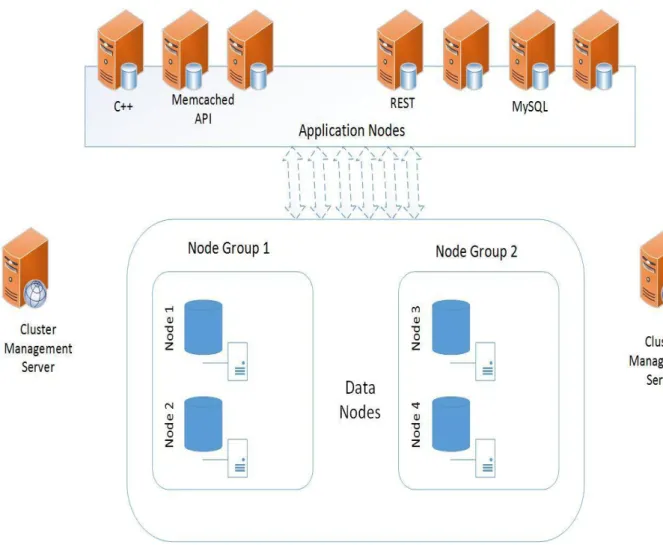
The architecture of MySQL Cluster is represented in Figure 6. There is two tiers of nodes - Storage tier and SQL Server tier. There is a cluster manager node which is
responsible for cluster management and configuration. The Storage tier contain data nodes which are responsible for data storage and retrieval. SQL Server nodes are the application nodes which provide access to data through SQL and NoSQL APIs like REST or HTTP, Memcached APIs, JPA or C++. [34]
Data nodes are organized into node groups. Data is automatically partitioned (Auto-sharding) by the database layer. The Data shards are stored in a data node and the
partitioning is based on hashing of primary key. Thus the data shards are distributed evenly using a hashing function thereby handling the load balancing of data nodes. The data shards are replicated in such a manner that it is present in data nodes of different node groups to prevent data loss when a node group goes down. Replication factor can be configured in the cluster manager node. Data replication provides high availability and fault tolerance.
When a read requests is sent from an application, it is handled by one of the
application nodes. The application node queries and retrieves the requested rows from data nodes. It is possible to skip SQL interface and directly access data as key-value pairs using native NDB C++ APIs. They provide ultra-fast access delivering low latency for real time applications. Thus MySQL Cluster is built mainly for such applications using in-memory storage. To provide durability, tables are persisted using logging and check-points to disk blocks.
37 Figure 6- MySQL Cluster Architecture.
*This figure is adapted from webpage [35]
When a write request is sent from an application, it is immediately persisted in the data node containing the values. The updates are then synchronously sent to all replicas. Since MySQL Cluster has a multi master architecture, it is possible that many masters try to update same row with different data. Conflict resolution in such cases is provided by framework. Users can choose a resolution type when such conflicts occur. MySQL Cluster supports 1. Timestamp based conflict resolution or 2. Epoch based conflict resolution. In an epoch based conflict resolution, the relative order of replication epochs is compared.[36]
8.2 Features
Major features of MySQL Cluster [37] is described below. ● Online Scaling
In MySQL Cluster, it’s possible to scale out (horizontal scaling) by adding more application nodes to access data. It automatically manages the scaling by sharing the same data view across all access instances. It is also possible to scale out data
38 layer by adding more data nodes. MySQL Cluster automatically re-shards the data and load balance the data nodes. This online scaling of MySQL Cluster is quite fast and hence it supports elasticity.
● Online Schema changes
MySQL Cluster supports online changes to schema using Alter table statement. Thus it is possible to add column, create index and drop index without taking the database offline.
● Real-time Analytics
MySQL Cluster has the storage in RAM and hence it is able to provide ultra-low latency for read and write requests. So it is able to provide real-time performance for data analytics.
● Support for SQL, NoSQL APIs
As discussed in previous section, MySQL cluster provides access to data through application nodes which can be MySQL Server or Servers supporting NoSQL APIs. Many complex queries and joins can be performed in NDB storage engine. Join query performance is dramatically improved through adaptive query localization where processing is pushed to storage tier.
New NoSQL APIs are being added. There is also native Memcached API and native C++ NDB API which directly access data structures as key-value pairs. ● Index
MySQL cluster provides support for primary and secondary index. ● ACID compliance
MySQL cluster is built for high volume transactions. Hence it is ACID compliant - a major advantage compared to most NoSQL databases.
● UDF
In MySQL Cluster aggregation can be performed using custom built user defined functions. UDF is written in C language and is quite fast since it directly accesses database’s data structures.
● Flexible and Configurable
MySQL Cluster has a variety of configuration parameters to tune it to get good performance.
Important Cluster configuration parameters are discussed below [34]. ● Multithreaded data nodes:
39 CPU cores are being utilized for parallel processing. It is recommended to set a parameter MaxNoOfExecutionThreads equal to number of CPU cores to efficiently utilize multithreaded storage nodes. It is also possible to bind data node threads to CPU threads using ThreadConfig.
● Connection pool:
When the application node connects to a data node it does through a single threaded connection. It is possible to parallelize the access by using multiple connections between application node and data node using connection pool parameter ( --ndb-cluster-connection-pool) in cluster configuration file.
8.3 Limitations
● Memory Use
MySQL Cluster has two types of settings for storage - 1. It can be in-memory datastore where data nodes store data in RAM and uses logs and checkpoints for durability, or 2. Disk storage where local storage of data nodes is made use of. MySQL Cluster gives low latency for reads and writes when it is used as in-memory datastore. However, the RAM requirements may be too expensive when scaling out.
● Massive volumes of data
MySQL Cluster is mainly designed for high volume OLTP and real-time
applications. It is not suitable for performing data analytics that spans whole data set of massive volumes of data. This is because there is no parallel programming framework like MapReduce that is being supported. However, it is possible to build a parallel algorithm using UDF, NoSQL APIs and Native C++ APIs.
● UDF
UDF is powerful but is dangerous since it can crash database server if memory manipulations is not properly done. So UDF can’t be used at application level. Rather they have to be used as one-time build functions which are not frequently changed.
● Range queries
In MySQL Cluster, for range queries sequential access of data is executed by NDB storage engine. It has performance issues for range scans which are being addressed in new releases.