Pyrex Journal of Educational Research and Reviews
Vol 2 (1) pp. 001-009 January, 2016
http://www.pyrexjournals.org/pjerr
Copyright © 2016 Pyrex Journals
Original Research Article
Teaching Millennials how to Study Under the 21
st
Century Sky
P Olszewski
Penn State Erie, the Behrend College, Erie, PA, USA.
Accepted 17
thJanuary, 2016
Each generation entering college has their own set of characteristics. The purpose of this article to introduce the
characteristics associated with the millennial generation and how they learn. In addition, we will examine key traits
among Millennials and how, by the teaching of study skills, can help students become better learners and thinkers.
Key words: Mathematics Education, Millennials, Multitasking, Study Skills.
INTRODUCTION
It has become clear, new generations of students are in our classrooms and our old ways of teaching are no longer suitable to serve today’s college students. The teaching methods we had twenty years ago are no longer the way today’s students are learning. This paper intends to answer the following questions: 1. How do today’s college freshmen study outside of class? 2. Does prompting students to reflect on their learning have a positive impact on learning outcomes? 3. Does teaching students discipline-specific learning strategies have a positive impact on learning outcomes? Student readiness for college has been discussed frequently at Penn State Behrend in the last few years. Faculty members across campus share the same observations that students 1. Don’t read or don’t comprehend well, 2. Don’t take notes, but ask professors for them, 3. Memorize isolated facts and consider it as learning, 4. Focus on the grade and try to shorten the process to get a good one; 5. Get frustrated when no good results are received quickly; 6. Think they are good at multitasking. There is a gap between how professors expect students to learn and how students actually learn. To close the gap, students have to first realize the differences and then take control of their own learning. Second, students have to be equipped with effective learning strategies. The proposed project examines the impact on learning outcomes by prompting students to reflect on how they learn and by explicit teaching learning strategies they can apply.
Part I History of Millennial Students
Millennials, or Generation Y, are those people who are born between the early 1980s to the early 2000s. At the moment, Millennials are either in high school, college, graduate school or are in the workforce. The Millennials are facing big
challenges both in school and in life. The average student loan for the class of 2010 is $25,000, the average credit card debt for those aged 20-29 is $1,800, the unemployment rate is 12.4% for those aged 18-29, and 60% of 18-34 years of age are not keeping a budget. The Millennials who graduate from college have a hard time finding work in this economy and if they find jobs, they are not for the long term. Many of the students I have seen in my classes are not prepared for the challenges after graduation. They are ill prepared for what is facing them, which is a tough job market, rising prices of just about everything, and poor judgment. The average debt for today’s Millennials is about $45,000. Do the Millennials have any understanding of how much and how long it will take to pay this debt off? Do Millennials have a clear understanding of what they want to do after graduation? From a college professor’s point of view, we assume students know how to study when first starting their college careers. The reality is, many students don’t know how to study. Transitioning from high school learning to college or university learning is a major jump and semester after semester, students either drop out, receive poor grades, don’t attend class, and don’t take school seriously. Today’s students are inundated with overwhelming distractions, which prevent them from deep study, creativity, and thinking. These distractions are impacting grades, attitude towards learning, and increasing the number of graduates who are not prepared for the real world. Many of my fellow colleagues have noticed students don’t know how to study and what it means to learn.
During the schooling years and while in college, millennial students are faced with many more distractions than previous generations had been faced with. They rely on the Internet to get information fast, don’t write letters, but emails instead, don’t use the phone, but text instead, and play video games instead
of being outdoors in the fresh air. Sitting in front of monitors and screens for long periods of time is the way of life for many of us these days. However, for the Millennials, born in the late 1990s onward, they have been exposed to this from childhood. Children as young as six have cell phones and are texting. The Internet has a wealth of information, which can be used in research and finding information quickly. We should all be thankful for such an invention and a mechanism for the enrichment of our lives. It is a wonderful educational tool if used and used correctly. Students can become self-sufficient researchers with all the tools and online resources at their fingertips. However, I can’t count how many times I have personally seen students in a lab, with three monitors facing them, one monitor is a project they are working on, another is on a social networking site, and the other is either their cell phone or other device, which prevents them from fully concentrating on their studies. In recent years, multitasking has been a topic of conversation. Due to our fast-paced society, we are all receiving information at a rapid rate from various sources. Millennials have grown up with this speed of information. They look at one screen, which maybe the computer for email (which may not be fast enough for them these days), then turn to their cell phone for texts, then Facebook, then their iPod, then iPad, the list goes on. In short, they are wired to this rapid and quick paced environment. Students believe they can perform multitasking; however, most aren’t good at it. Our brains aren’t designed to handle multiple tasks at once. Often times, when we attempt to multitask, we make mistakes. When we believe we are multitasking, the smallest of disruptions can cause us to lose our attention.
The Internet moves quickly. It gives us answers at the blink of an eye. Millennial students expect, like the Internet, to get answers fast and do as little work as possible to achieve their goals. However, learning takes time and patience. Writing papers takes several drafts to perfect. Education and learning should be a pleasurable process, which should never be rushed because there are deadlines to meet, or because one wants to finish something early to go out and party. This is how details are overlooked and one might miss on something important. With all these new technologies, are we as teachers, supposed to alter our lessons? Are we to design lessons that use phones, iPads, and video games just to keep students’ attention? With all of the national mathematics conferences I have attended over the last five years, some teachers are incorporating these technologies in their classes. However, I wonder if this is beneficial in the long run. Does this further isolate the student? Are the critical thinking skills harmed by this technology incorporated in the classroom? Most importantly, are we setting our expectations as high as we did before all the new modern technology came to the forefront? I believe students are as smart as they were before the millennial era. However, with the rapid advancement of technology, as good and beneficial as it has been, also has contributed and hurt students’ attention spans.
Students should be exposed to various types and forms of data. This way, students can develop, the earlier the better, diverse data extracting and reading skills needed for future schooling years and in life. Without the right knowledge and reading skills, data can be misinterpreted. We don’t and should not have students unable to read charts and graphs, as they may not make educational discussions in life. In order for the millennial generation and future generations to keep up with an ever-changing world, we should not, by any means, dismiss any part of old curriculums we had in the past but should expand on them. We need to teach students, using current real life examples, which they will remember and use in the future.
As we moved from generation to generation, from the Industrial Age to the new modern era of the Information Age, schools have been teaching students the same way. Classrooms have been set up in rows and the teacher did all the lecturing. Until recently, schools have been under the influence of TTWWADI, which stands for That’s The Way We’ve Always Done It. The world is constantly changing and often times, teachers cannot keep up with this change. As McMain, Jukes, and Kelly point out, “We cannot carry on preparing students for the farms and factories of yesterday while the world jumps to light speed with biotechnology, nanotechnology, neurotechnology, global high speed wired and wireless networks, and incredibly powerful personal portable devices. We strongly believe that schools must prepare kids for the world of tomorrow – the world they will spend the rest of their lives.” I agree on this point, however, lessons and the curriculums must be designed with the use of technology that will not further inhibit students to learn. Parents must take an active role to make sure students are on the right path to success.
When we think about our college years, we always remember going to class, listening through lecturers, performing labs, studying, and taking exams. This is how college operates because of TTWWADI. However, what we don’t think of is someone teaching us how to study when we were freshmen. It is assumed upon graduation from high school; one knows how to study and is ready for college studies. However, for many millennial students, this is not the case. I strongly believe there are big differences between high school level learning and college level learning and most graduating high school seniors have no understanding of how to study. As Kiewra and Jairam point out, “Many believe that college students should be expert learners; after all, they have practiced learning for a dozen or more years. In reality, 73% of college students report difficulties preparing for exams, and this percentage of reported study problems is consistent across college years. Research also confirms that college students employ weak strategies in the classroom and while studying. Those weak strategies include poor note taking, organizing ideas linearly, learning in a piecemeal fashion, and employing redundant strategies.”Many of my colleagues and I have noticed students don’t employ the study skills needed to be successful in college and beyond. I have noticed students don’t read or don’t comprehend well, don’t take notes, but ask professors for them, memorize isolated facts and consider it as learning, focus on the grade and try to shorten the process to get a good one, get frustrated when no good results are received quickly, and think they are good at multitasking. There is a gap between how professors expect students to learn and how students actually learn. To close the gap, students have to first realize the differences and then take control of their own learning. Second, students have to be equipped with effective learning strategies.In the spring 2012 semester, I attended a Schreyer Institute for Teaching Excellence conference hosted by Penn State titled, “Teaching Millennials: Engaging our Students with Instructional Strategies.” One of the topics discussed were exam wrappers. These are a series of surveys given to students after an exam or quiz to provide feedback as to how the exam or quiz went. Questions such as how the student thought they performed to how many hours they spent studying for the exam are normally the questions asked of the students. I wanted to take the exam wrappers, one step further and address the topics of how they study and ask probing questions to help them realize and motivate better study skills. My project examined the impact on learning outcomes by prompting students to reflect on how they learn and by explicitly teaching learning strategies they can apply
Table 1: Results of the American Freshmen National Norms for the time used for studying and personal use
< 6 hours/week studying and homework
< 3 hours/week reading for leisure
> 3 hours/week online social
> 6 hours/week working for pay
2010 201,818 students in 279 colleges 62.7% 74.5% 50.9% 42.1% 2011 203,967 students in 270 colleges 60.7% 76.2% 53.1% 39.5%
Part II: Teaching Millennials Effective Study Skills
In May 2011, the Schreyer Institute for Teaching Excellence awarded me a grant to help teach a group of students’ effective study skills. The project was designed to understand how current college freshmen study outside of class, what learning skills they lack, and whether it prompted reflection on learning or teaching how to learn would have a positive impact on the final course grade. The motivation for this study was in part of the result of the American Freshmen National Norms for the time used for studying and personal use. Table 1 outlining the trends for 2010 and 2011.
In addition, other motivation factors of this project were fourfold:
1. How do my students study?
2. What assumptions do they have for studying and being successful?
3. Are student studying effectively? 4. What can I do to help them? The three main research questions were:
1. How do today’s students study outside of class? 2. Does prompting students to reflect on their learning
have a positive impact on learning outcomes? 3. Does teaching students learning strategies have a
positive impact on learning outcomes?
Students in two sections of a general education math course, Math 34: The Mathematics of Money, served as treatment groups. Both sections were taught by me and the students had to complete three exams plus a comprehensive final exam. Immediately after Exam I, the classes took a survey posted on ANGEL consisting of questions that prompted reflection on how they learned the material. Below is a copy of the first exam wrapper.
Exam I Reflection
1. Did you think the exam fairly reflected the topics covered? Explain.
2a. After you have prepared for the exam, how many points out of 100 did you expect to earn?
2b. Now, after completing the exam, how many points out of 100 do you think you received?
3. Did you find Practice Exam I with the worked out solutions helpful/not helpful? If you used Practice Exam I to study, how did
you utilize it?
4. How did you study for the exam? Did you work alone? With others? Did you re-read class notes, rework homework problems,
work on additional problems, re-read the text? Make note cards? Highlight? Make formula sheet(s)? Please be VERY
specific.
5. What amount of time was spent preparing for Exam I from the following resources? Explain how exactly you utilized the selected resources. a. The text i. <15 minutes Explain: ii. 16-30 minutes iii. 31-45 minutes iv. 46-60 minutes v. 1 hour vi. 2-5 hours vii. >5 hours
b. Your class notes
i. <15 minutes Explain: ii. 16-30 minutes iii. 46-60 minutes iv. >1-2 hours v. >2 hours c. Your classmates i. <15 minutes Explain: ii. 16-30 minutes iii. 31-45 minutes iv. 46-60 minutes v. 1-2 hours vi. >2 hours d. Handouts i. <15 minutes Explain: ii. 16-30 minutes iii. 31-45 minutes iv. 46-60 minutes v. 1-2 hours vi. >2 hours e. Practice Exam I i. <15 minutes Explain: ii. 16-30 minutes iii. 31-45 minutes iv. 46-60 minutes v. 1-2 hours vi. >2 hours
6. How many day(s) in advance did you start reviewing for the exam?
i. 1 day ii. 2 days
iii. 3 days iv. 4 days v. >5 days
7. While you were preparing for Exam I, did you try to make connections between the textbook, your class notes, class examples, explanations given by your classmates, practice problems, etc.? How?
8. Describe your study environment: Where did you study? How long were you able to concentrate on preparing for Exam I without any other type of interruption? If you were handling other tasks while studying, what were the other tasks you were working on simultaneously? Please be VERY specific.
9. For Exam II, what three things do you plan to do differently or keep the same? Explain.
10. What can I, as your Professor, do to help you support your learning and preparation for Exam II?
After the results of Exam I was passed out to the classes, each class was given a presentation on effective study skills by two of our senior tutors. Each tutor talked to the students on their personal experiences on effective study skills. Presented in these sessions were the common misconceptions of learning: 1. Learning can happen fast, 2. Learning is to memorize isolated facts, 3. Innate talent decided what I’m good or not good at, and 4. I can multitask and learn well. Both of the senior tutors offered advice on how to take notes effectively by writing in your own words – paraphrase the meaning, the label notes with key concepts (tag them with keywords), and if performing problem solving, write down why the problem is solved in a certain way. Also addressed was the common theme among college students, cramming and the difficultly of making connections. The senior tutors offered advice on
asking yourself how many times a certain concept had appeared somewhere else, create a concept map, comparison table or diagram out of class notes. In addition, before major assessments, ask yourself questions: How does this fit into the class? And write your own exam questions by trying to get into the professor’s head. The effect of these prompted reflections and the study skill seminar, were inspected by analyzing Exam II scores. The following figure is the results along with what each student thought they would receive before and after taking Exam I. After the study skill session and the analysis was conducted, Exam Wrappers II and III were given to the students. Below are the other two surveys.
Exam II: Reflection
General Study Habits
1. Since Exam I, how do you prepare for each class? Do you do anything different than before Exam I?
2. Since Exam I, how often do you review the content covered in the lecture? How do you do that?
3. Since Exam I, how often do you take notes/highlight the readings in our textbook?
4. Since Exam I, do you go back to the problems in the text or problems done in class, cover up the solution and work out the problems on your own? Do you try other problems, either homework or non-homework problems?
5. Since Exam I, do you take any additional notes so that you know how to solve a problem?
6. Since Exam I, how often do you make connections between in-class examples, the homework, your notes, the handouts, the textbook, and what was covered in Exam I?
Figure 1: Exam I results, what students thought they would receive vs. actual score.
Exam Preparation
7. What amount of time was spent preparing for Exam II from the following resources? Explain how exactly you utilized the selected resources.
d. The text i. <15 minutes Explain: ii. 16-30 minutes iii. 31-45 minutes iv. 46-60 minutes v. 1 hour vi. 2-5 hours vii. >5 hours
e. Your class notes
i. <15 minutes Explain: ii. 16-30 minutes iii. 46-60 minutes iv. >1-2 hours v. >2 hours f. Your classmates i. <15 minutes Explain: ii. 16-30 minutes iii. 31-45 minutes iv. 46-60 minutes v. 1-2 hours vi. >2 hours d. Handouts i. <15 minutes Explain: vii. 16-30 minutes viii. 31-45 minutes ix. 46-60 minutes x. 1-2 hours xi. >2 hours e. Practice Exam II i. <15 minutes Explain: ii. 16-30 minutes iii. 31-45 minutes iv. 46-60 minutes v. 1-2 hours vi. >2 hours
f. Math tutors at the Learning Resources Center
i. 1 session Explain: ii. 2 sessions
iii. 3 sessions iv. 4 sessions v. 5 or more sessions
g. Visiting professor in office hours i. Once
Explain:
ii. Twice iii. Three times iv. Four times v. Five times or more
8. How many day(s) in advance did you start reviewing for the exam?
vi. 1 day vii. 2 days viii. 3 days ix. 4 days x. >5 days
9. Did you find Practice Exam II with the worked out solutions helpful/not helpful? If you used Practice Exam II to study, how did you utilize the worked out solutions?
10. Did you prepare for Exam II differently than preparing for Exam I? If yes, how differently?
11a. After you have prepared for the Exam II, how many points out of 100 did you estimate to earn?
11b. Now, after completing the Exam II, how many points out of 100 do you think you received?
11c. Do you think you scored better or worse on Exam II than Exam I? By how much?
12. What have you learned about your study habits based from your preparation for Exam I to Exam II?
13. For Exam III, what three things do you plan to do differently or keep the same? Explain.
14. What can I, as your Professor, do to help you support your learning and preparation for Exam III?
Exam III Reflection
1. Check all you have done to study Math 34 between Exam II and III:
A) I preview the content before classes.
B) When I take notes in class, I copy down the solution steps.
C) When I take notes in class, I also write down why the problem is solved this way.
D) If I have questions in class, I make sure they are written down.
E) I make sure that I find out the answers to my questions by asking my classmates or professor.
F) I review what was covered in class before doing homework problems.
G) I try to solve the example problems (either given by professor or in the textbook) on my own to see if I can do it without seeing the solutions.
H) I make sure that I complete the homework problems.
I) I revisit my mistakes and make sure I understand why it was wrong.
J) I explain to myself the solution steps while solving a problem.
K) I started preparing for Exam III earlier.
L) When I solve a problem in homework or in a practice exam, I think about how previously taught concepts would fit in.
M) When I see similar problems, I compare them and try to figure the differences.
2. List the most effective math learning strategies that you have learned this semester. You may refer to the list in the question above or write your own:
3. Check all strategies that you think are helpful in learning other courses in the future:
A) Preview the content before each class
B) When taking notes in class, copy down the solution steps.
C) When taking notes in class, also write down why the problem is solved this way.
D) If I have questions in class, make sure they are written down.
E) Make sure to find out the answers to my questions by asking my classmates or professor.
F) Review what was covered in class before doing homework problems.
G) Try to solve the example problems (either given by professor or in the textbook) on my own to see if I can do it without seeing the solutions.
H) Make sure that I complete the homework problems.
I) Revisit my mistakes and make sure I understand why it was wrong.
J) Explain to me the solution steps while solving a problem.
K) Started preparing for Exam III earlier.
L) Think about how previously taught concepts would fit in current problem solving.
M) Compare similar problems and see how they are different.
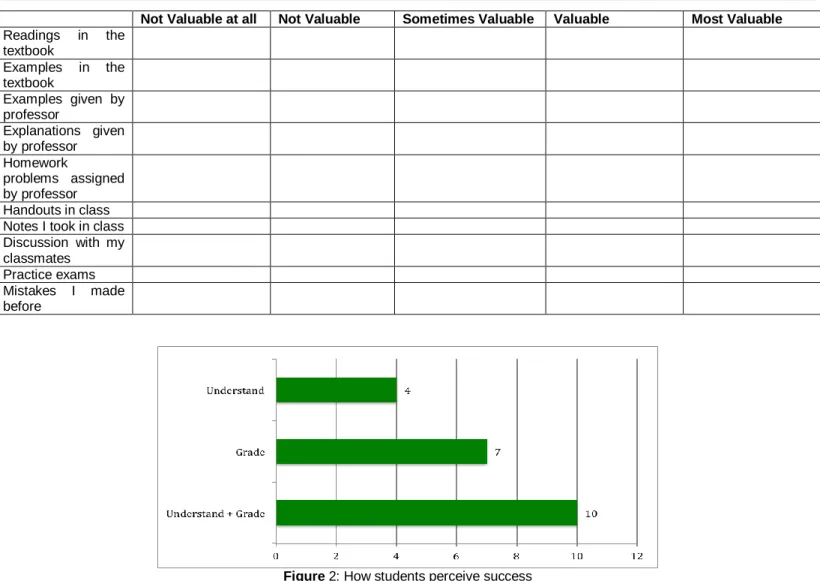
4. Rank how valuable the following resources are for you to make progress in Math 34 on a scale of 1 (Not valuable at all) to 5
(Most valuable):
5. Describe how your study habits have changed over the course of the semester. What have you learned about yourself in terms
of how you learn? Hint: what do you do the same, and what do you do differently now? How did you review the content
covered in the lecture at the beginning of the semester, and how do you do the review now? Are you taking/reading more
class notes now, or less?
6. When I tell myself “I have learned the concept” means “I am able to ___ the concept.”
A) Recite B) Present C) Apply D) Teach
7. When I tell myself “I am able to solve a problem on concept X” means “I am able to ___.“
A) Redo the same problem without any help
B) Solve a problem structured the same way but with different numbers
C) Explain to someone else who has trouble solving this particular problem
D) Solve a different problem on concept X in a different scenario
8. Looking back all the exams, we had in Math 22, among all the efforts I have made to do well in an exam, the one that has the most impact is _______.
A) The amount of time spent preparing for each exam prior to the exam
B) Whether I understand each class throughout the course
C) How well I understand the practice exam D) How many homework problems I completed 9. (Continued from last question) If none of the above, please list your own.
When performing the analysis after each exam wrapper, some interesting results came to the forefront. We outline them here. When asked how do the students study outside of class, 45.4% said they rely on intensive study sessions, 41% said they multitask while studying, 45.5% spend less than 6 hours per week on the class, 45.5% transcribe notes, and 50% said they match the same structure to match a formula for solutions and key words. In Exam Wrapper I, question 10 asked how students perceived success. The results are below in figure 2.
Not Valuable at all Not Valuable Sometimes Valuable Valuable Most Valuable Readings in the textbook Examples in the textbook Examples given by professor Explanations given by professor Homework problems assigned by professor Handouts in class Notes I took in class Discussion with my classmates
Practice exams Mistakes I made before
Figure 2: How students perceive success
After Exam I was administrated, I made a comparison between the mean and median scores of my classes in 2011 and 2012. I wanted to determine if using prompting students to reflect on their learning would have a positive impact on learning outcomes. The results were promising:
Table 2: 2011 and 2012 Exam I results
Exam I Grades Mean Median
2011 (60 students) 80.58 84
2012(22 students) 85.5 87
In addition, the results four weeks after Exam Wrapper I:
Table 3: 2011 and 2012 Exam II results
Exam II Grades Mean Median
2011 (60 students) 82.03 83 2012(22 students) 88.41 90
The most used study strategy before the senior tutors were brought in to teach the effective study skills were 77.3% transcribe notes, 72.7% solve example problems before seeing the solution, 72.7% explain to oneself solution steps, 68.2% learn from their own mistakes, and 68.2% compare differences. The results were what I was expecting as I see students having these study skills during group work in class, passing them by in the library, and by having one-on-one time during office hours. To determine if teaching students learning strategies have a positive impact on learning outcomes, I wanted the senior tutors to point out the common misconceptions of learning: Learning can happen fast, learning = memorization, multitasking, success, talent, efforts, and grades, how to take good notes, making connections between concepts, and the importance of practice. The following table shows a comparison between Exam III and the Final Exam between the two years. Exam III is out of 100 points and the Final Exam is out of 150 points.
Table 4: 2011 and 2012 Exam III results
Exam III Mean Exam III Median Final Exam Mean Final Exam Median
2011 (60 students) 72.61 76 99.87 99
2012(22 students) 81.36 82 119.5 117
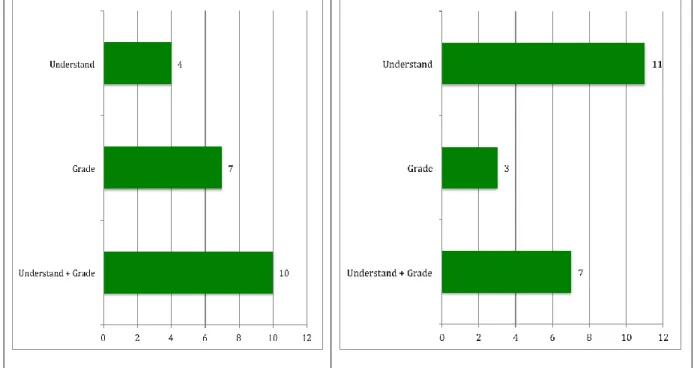
I also compared the results of the most-used study strategies after the study skill session.
Figure 3: Results after study skill lesson
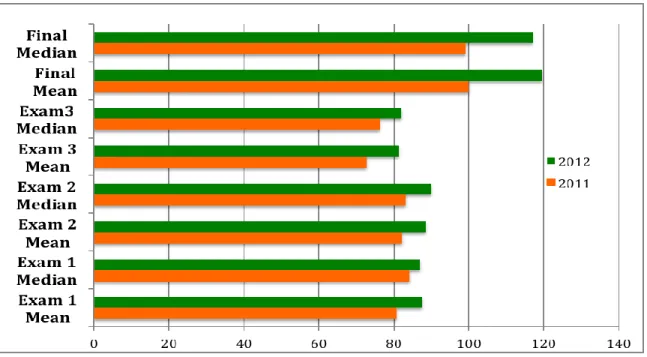
Towards the end of the semester, two key questions were asked on third Exam Wrapper, were the study skill session helpful, in which 81.8% said it was and what have you learned about your study habits, in which 72.7% said they needed improvement. The graph below shows the relationship between the two years and their overall exam scores.
Figure 4: 2011 and 2012 Exam results, means
This was a very promising result as the study skills and the question prompts on the exam wrappers helped. When asked about how students prepare for exams between Exam I and Exam III, the results were as follows:
Figure 5: Understanding vs. Grade
This chart above clearly shows the effects of the three exam wrappers, the question prompts, and the study skill lesson. There is a shift in studying in which students are realizing they must understand the concepts instead of focusing on memorizing and the outcome, which are grades. This was very refreshing for me to see and we; as instructors all want our students have the knowledge to be successful after graduation and to be globally competitive in the 21st century.
Final Thought
With all of these results, it shows that teaching students study skill was helpful for my students. They appreciated the senior tutor came in to provide the study skills needed to be successful. At the start of the semester, by and large, my students didn’t have the effective study skills needed to be successful. The knowledge of study skills was limited to what they were exposed to in high school, which are normally not enough to get the higher grades in college. By the end of the semester, my students were very thankful I took the time to teach them how to be successful. One student commented, “I make connections with examples, my notes (including the ones online) and class handouts a lot more and more frequently. I feel that it is necessary to do so more often since the material gets harder. I also do it more so I can feel better going into the exam and hope to do better with remembering and delivering.” Another student commented saying, “I do the practice exam's more than once prior to the exam. I review my notes at the end
of class. At the beginning I wouldn’t really take good notes, but now I do. I write down side notes explaining why something happened so that I understand it later.” This project was a very eye opening experience. Ever since I started teaching, I could see students had a difficult time with studying and didn’t know how to study for college assessments. With this endeavor, students not only learned the mathematics of money and effective study skills, but also learned about themselves and how to be all they can be.
REFERENCES
Black, Alison (2011). Gen Y: Who They Are and How They Learn. Retrieved from
http://www.isd300.k12.mn.us/tech_inte/soc_media/Resource%20Docume
nts/GenY-Who_They_Are_How_They_Learn.pdf
Kiewra, M. (2005). Learn how to study and soar to success. Upper Saddle River, NJ: Pearson Education, Inc.
McMain Ted, Jukes Ian, and Kelly S. Frank (2009). Teaching the digital generation, no more cookie-cutter high schools. Corwin Press. Pryor, J. H., DeAngelo, L., Palucki Blake, L., Hurtado, S., & Tran, S. (2011) The
american freshman: national norms for fall 2010. Higher Education Research Institute. Retrieved from
http://www.heri.ucla.edu/tfsPublications.php
Pryor, J. H., DeAngelo, L., Palucki Blake, L., Hurtado, S., & Tran, S. (2012) The american freshman: national norms for fall 2011. Higher Education Research Institute. Retrieved from
http://www.heri.ucla.edu/tfsPublications.php
Reis, R. (2012) Learning how to learn: metacognition in liberal education. Vol. 97, No. ¾ Liberal Education, Association of American Colleges and
Universities. Retrieved from
http://cgi.stanford.edu/~dept-ctl/tomprof/posting.php?ID=1168&search=
Roediger L. H. (2013). Applying Cognitive Psychology to Education: Translational Education Science. Psychological Science in the Public Interest.