HP ScanJet Pro 3500 f1 Flatbed Scanner
www.hp.com/support
HP ScanJet Pro 3500 f1 Flatbed Scanner
User Guide
Copyright and license
© 2015 Copyright HP Development Company, L.P.
Reproduction, adaptation or translation without prior written permission is prohibited, except as allowed under the copyright laws. The information contained herein is subject to change without notice.
The only warranties for HP products and services are set forth in the express warranty statements accompanying such products and services. Nothing herein should be construed as constituting an additional warranty. HP shall not be liable for technical or editorial errors or omissions contained herein.
Trademark credits
ENERGY STAR® and the ENERGY STAR® mark are
registered U.S. marks.
Microsoft®, Windows®, Windows® XP, and Windows Vista® are U.S. registered trademarks of Microsoft Corporation.
Table of contents
1 Product overview ... 1
Product views ... 2
Front view ... 2
Back view ... 2
Serial and product numbers ... 3
Control panel ... 4
Product specifications ... 5
Technical specifications ... 5
Supported operating systems ... 5
Product dimensions ... 5
Power consumption, electrical specifications and acoustic emissions ... 5
Operating environment range ... 6
Product hardware setup and software installation ... 7
Hardware setup ... 7
How to get software updates ... 7
Product features ... 8
Product Features ... 8
Scanner software (Windows) ... 9
HP Scan software ... 9
HP Scanner Tools Utility ... 9
HP TWAIN ... 9
Scanner software (OS X) ... 10
Sleep Mode and auto-off settings ... 10
2 Use the scanner ... 11
Load originals ... 11
Document loading tips ... 11
Supported paper types ... 13
Load paper in the Automatic Document Feeder (ADF) input tray ... 14
Introduction ... 14
Required guidelines before loading documents ... 14
Method to load documents ... 15
Load same-sized documents ... 15
Load documents on the scanner glass ... 17
Start a scan from the hardware ... 18
Scan from the front panel buttons ... 18
Use the scanning software (Windows) ... 18
Work with scan shortcuts ... 18
View scan shortcuts ... 19
Create scan shortcuts ... 19
Modify shortcuts (Windows only) ... 19
Scan by using the HP Scan software (Windows) ... 19
Scan to a picture (Windows) ... 19
Scan to a PDF (Windows) ... 20
Scan text for editing (OCR) (Windows) ... 20
Scan to Email (Windows) ... 20
Send to cloud (Windows) ... 20
Scan long or extra-long documents (Windows) ... 21
Detect multi-feeds ... 21
Everyday Scan ... 21
Automatically detect page size (Windows) ... 21
Automatically detect color (Windows) ... 21
Scan using text-enhanced black and white mode (Windows) ... 22
Automatically straighten scanned images (Windows) ... 22
Use the scanning software (OS X) ... 23
Scan documents (OS X) ... 23
Scan from other applications (OS X) ... 23
Scanning tips ... 24
Optimize scanning and task speeds ... 24
Scanning fragile originals ... 24
3 Care and maintenance ... 25
HP Scanner Tools Utility Maintenance tab (Windows) ... 26
HP Utility (OS X) ... 26
Clean the product ... 27
Clean the scanner glass ... 27
Introduction ... 27
Required items for cleaning ... 27
Clean the scanner glass ... 27
Clean the Automatic Document Feeder scanning strips ... 28
Introduction ... 28
Clean the scanning strips ... 28
Clean the paper path ... 29
Replace parts ... 31
Replace the separation rollers and cover ... 31
Replace the pick up roller module ... 33
Order maintenance and scanning supplies ... 34
4 Solve problems ... 35
Basic troubleshooting tips ... 36
Test the scanner ... 37
Reset the scanner ... 38
Scanner installation troubleshooting ... 39
Check the cables ... 39
Uninstall and then reinstall the HP ScanJet drivers and tools (Windows) ... 39
Power issues ... 40
Check that the scanner has power ... 40
Scanner will not turn on ... 40
Scanner keeps turning off ... 40
Paper jams ... 42
Clear jams from the scanner paper path ... 42
An item loaded in the scanner jams repeatedly ... 43
Paper feed issues ... 44
Paper jamming, skewing, misfeeds, or multiple-page feeds ... 44
Paper does not feed from the scanner ... 44
Originals are curling up in the scanner output tray. ... 44
Image quality problems ... 45
Scanned images are not straight ... 45
The scanned images have streaks or scratches ... 45
Scanned image is fuzzy ... 45
The scan is completely black or completely white ... 45
The bottom of the scanned image is cut off ... 45
Scanner operation problems ... 46
Connection issues ... 46
Check the USB connection ... 46
Buttons are not working properly ... 46
Scanner buttons are not working correctly ... 46
The LCD is having display issues or scanner buttons are not working as expected ... 47
Scanning performance issues ... 47
Scanner does not scan right away ... 47
Scanner scans only one side of a two-sided page ... 47
Scanned pages are missing at the scan destination ... 47
Scanned pages are out of order at the scan destination ... 47
Scan files are too large ... 47
Additional troubleshooting ... 49
Index ... 51
1
Product overview
This User Guide covers important information about the HP ScanJet Pro 3500 f1 flatbed scanner.
● Product views ● Product specifications
● Product hardware setup and software installation ● Product features
● Scanner software (Windows) ● Scanner software (OS X)
● Sleep Mode and auto-off settings
For more information, go to www.hp.com/support/. Click Troubleshooting. Enter the scanner name (HP ScanJet Pro 3500 f1 flatbed scanner), and then click Search.
HP’s all-inclusive help for this product includes the following:
● Install and configure
● Learn and use
● Solve problems
● Download software updates
● Join support forums
● Find warranty and regulatory information
Product views
This section describes the physical components of the HP ScanJet Pro 3500.
Front view
1
2
5
4
3
1. Paper guides 2. Document input tray 3: Output stopper 4. Document output tray 5. Control panelBack view
1
2
1. USB port 2. Power connector
Serial and product numbers
The serial and product numbers are located on the bottom of the scanner.
Control panel
Use the buttons on the control panel to start or cancel a scan, and to power the unit on and off.
OK 1 2
1 2
3 4
6 7 8
9
5
Callout Name Description
1 Tools/Maintenance 2 Back 3 Scroll down 4 Scroll up 5 OK Ok 6 Simplex scan 7 Duplex scan 8 Sleep/Power 9 Cancel
Product specifications
Technical specifications
Automatic document feeder specifications:
Name Description
Input tray capacity 50 sheets of 75g/m2 (20 lb)
Minimum paper size 148 x 51 mm (5.8 x 2 in) Maximum paper size 3100 x 216 mm (122 x 8.5 in) Minimum paper weight 45 g/m2 (12 lb)
Maximum paper weight 120 g/m2 (32 lb)
Minimum paper guiding space 51 mm (2 in)
Supported operating systems
Supported operating systems Windows 7 Windows 8 Windows 8.1 Windows 10 OS X El Capitan 10.11
Product dimensions
Table 1-1 Product dimensions
Product Height Depth Width Weight
HP ScanJet Pro 3500 f1 145 mm (5.7 in) 387 mm (15.2 in) 460 mm (18.1 in) 5.58 kg (12.3 lb)
Power consumption, electrical specifications and acoustic emissions
Power usage drops significantly while in Ready or Sleep mode, which saves natural resources and saves money without affecting the high performance of this product.
AC power FB scan Duplex ADF scan
300dpi 600dpi 300dpi 600dpi
AC110V 6.4 W 6.0 W 14.2 W 7.5 W
AC230V 6.8 W 6.3 W 12.4 W 8.4 W
Power Sleep mode Off
AC110V 1.28 W 0.055 W
AC230V 1.29 W 0.073 W
Operating environment range
This product is intended to be supplied by a Listed Power Unit, marked with LPS or Limited Power Source. The power supply is rated 100–240V~, and has a DC output of 32 Vdc, 1.56 A, 50 W.
Name Description
Temperature Operating the scanner: 10° to 35° C (50° to 95° F) Storage: -40° to 60° C (-40° to 140° F)
Relative humidity Operating the scanner: 15% to 80% non-condensing 10° to 35° C (50° to 95° F) Storage: up to 90% at 30° to 60° C (86° to 149° F)
Product hardware setup and software installation
Hardware setup
For basic setup instructions, see the Installation Guide that came with the scanner. For additional instructions, go to HP support on the Web.
Go to www.hp.com/support for HP's all-inclusive help for the scanner. Find the following support:
● Install and configure
● Learn and use
● Solve problems
● Download software updates
● Join support forums
● Find warranty and regulatory information
How to get software updates
For the latest software updates, see www.hp.com/support, select your location, click Drivers & Software, and then search on your product name or number.
Product features
Product Features
Resolution ● 1200 pixels per inch (ppi) for Flatbed scanning
● 600 pixels per inch (ppi) for Automatic Document Feeder scanning
Memory 512 MB
Environmental features ● By default, device enters Sleep Mode after 15 minutes of inactivity
● High content of recyclable components and materials
● ENERGY STAR® qualified
Paper-handling ● Document feeder: Holds up to 50 sheets of 75 g/m2 (20 lb)
paper
● Two-sided scanning: Two-sided documents scan in a single
pass
● HP EveryPage Ultrasonic: Detects when multiple pages
feed through simultaneously
Scanner software (Windows)
The HP ScanJet Pro 3500 comes with a variety of Windows scanning software and drivers, including HP Scan, ReadIris, CardIris, and PaperPort.
HP Scan software
Create, manage, edit, and use scan shortcuts by using HP Scan software.
HP Scanner Tools Utility
Use the HP Scanner Tools Utility to change the scanner's power management settings, and to find information about scanner settings, status, and maintenance.
HP TWAIN
HP TWAIN allows scanning with compliant scan software from other (non-HP) vendors. Not all TWAIN-compliant software works in the same way, so consult the software documentation for details on how to acquire scans.
Scanner software (OS X)
This scanner is compliant with Apple AirPrint-Scan functionality. Without installing any additional software, you can scan using Apple's Image Capture scanning application.
To take advantage of all features of your scanner, HP recommends installing the HP Easy Scan solution. HP Easy Scan includes the following:
● HP Easy Scan–scan documents and photos, and manage scan shortcuts.
● HP Utility–manage scanner settings.
Sleep Mode and auto-off settings
By default, the scanner will enter Sleep Mode after 15 minutes of inactivity, and will turn off automatically after two hours of inactivity to conserve power.
Windows: To change the default auto-off settings, complete these steps:
1. Start the HP Scanner Tools Utility by doing one of the following:
● Click Start, point to Programs or All Programs, point to HP, point to ScanJet, point to 3500 f1, and then click Scanner Tools Utility.
● On the Start screen, click to HP Scanner Tools Utility tile.
2. Click the Settings tab, and then select the appropriate sleep mode and auto-off settings.
● To specify the period of inactivity after which the scanner automatically turns off, select the appropriate value (1 hour, 2 hours, 4 hours, or 8 hours) from the Auto-Off: Turn off the scanner
after: drop down list.
OS X: To change the default auto-off setting use HP Utility.
1. Start HP Utility.
2. Click the Energy icon.
3. Select a Lamp Mode setting.
4. Select an auto-off time setting from the Automatically power off the scanner: drop down box.
2
Use the scanner
The following topics describe how to load and scan originals.
Load originals
The following topics describe how to load originals into the document feeder and on the scanner glass.
Document loading tips
● The maximum capacity of the document feeder is 50 sheets of 75 g/m2 (20 lb) paper. When using
heavier paper, the maximum capacity is decreased.
TIP: Use the lines on the input tray paper guides to help avoid exceeding the document feeder capacity.
● Be sure that the documents are within these guidelines:
Width: 51 mm to 216 mm (2 in to 8.5 in) Length: 148 mm to 3100 mm (5.8 in to 122 in) Weight: 45 gsm to 120 gsm (15 lb to 32 lb)
● Scanning the following types of documents might result in paper jams or damage to the documents.
Wrinkled or creased documents Curled documents
Torn documents Documents with paper clips or staples
Carbon paper Coated paper
Extremely thin, translucent paper Paper with adhesive notes or flags attached
Photos Overhead transparencies
Papers that are stuck together Paper where the toner has not fully dried, or with wet substances such as glue or correction fluid
● Smooth out any folds or curls in the documents before placing them into the feeder. If the leading edge of a document is curled or folded, it may cause a paper jam.
● To scan fragile documents (such as photos or documents on wrinkled or very lightweight paper), place the document on the flatbed scanner glass.
● Make sure that the hatch on the document feeder is securely latched.
● Adjust the paper guides to the width of the documents. Make sure that the paper guides touch the edges of the original. If there is any clearance between the paper guides and the edges of the documents, the scanned image might be skewed.
Supported paper types
Supported paper sizes for the automatic document feeder:
Name Description
Minimum paper size 148 x 51 mm (5.8 x 2 in) Maximum paper size 3100 x 216 mm (122 x 8.5 in)
Supported paper sizes for the flatbed scanner:
Name Description
Maximum paper size 297 x 215.9 mm (11.7 x 8.5 in)
Size and dimensions Flatbed scanner Automatic document feeder U.S.-Letter: 215.9 mm x 279.4 mm (8.5 inches x 11 inches) U.S.-Legal: 215.9 mm x 355.6 mm (8.5 inches x 14 inches) U.S.-Executive: 184.2 mm x 266.7 mm (7.25 inches x 10.5 inches)
ISO A4: 210 mm x 297 mm (8.3 inches x 11.7 inches) JIS B5: 182 mm x 257 mm (7.2 inches x 10.1 inches) ISO B5: 176 mm x 250 mm (7.0 inches x 9.9 inches) ISO A5:148 mm x 210 mm (5.8 inches x 8.3 inches) ISO A6:105 mm x 148 mm (4.1 inches x 5.8 inches)
Load paper in the Automatic Document Feeder (ADF) input tray
● Introduction
● Required guidelines before loading documents ● Method to load documents
● Load same-sized documents
Introduction
This document provides instructions on how to load same-sized and mixed-sized documents into the Automatic Document Feeder (ADF) input tray of an HP Scanjet flatbed scanner.
● Documents with the same paper size and width are same-sized documents.
● Documents with different paper width or length are mixed sized documents, for example, legal size, letter size, and a check.
Required guidelines before loading documents
Before loading the documents in the ADF input tray, make sure to follow these guidelines:
● Use the recommended paper type and size in the ADF input tray. Refer to the Supported paper types section for paper capacities and capabilities.
● Smooth any folds or curls in the pages to avoid paper jams.
● Fan through the pages to remove any staples, paper clips, or sticky notes.
Figure 2-1 Fan the pages of the document
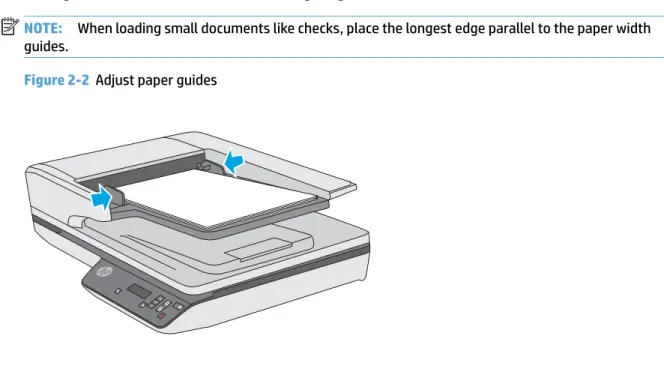
● Slide the paper guides to fit the width of the document. If there is any gap between the paper guides and the edges of the documents, the scanned image might be skewed.
NOTE: When loading small documents like checks, place the longest edge parallel to the paper width guides.
Figure 2-2 Adjust paper guides
Method to load documents
Determine the type of documents to load in the ADF input tray, and then use one of the following methods:
● Load same-sized documents
● Load documents on the scanner glass
NOTE: To scan fragile documents (such as photos or documents on wrinkled or very light paper), place the document face down on the scanning glass.
Load same-sized documents
Make sure to refer the section Required guidelines before loading documents, and then follow the following steps to load same-sized documents in the ADF input tray:
1. Tap the long edge of the pages on a flat surface, then rotate and tap the top edge of the document pages to align the edges of the document pages.
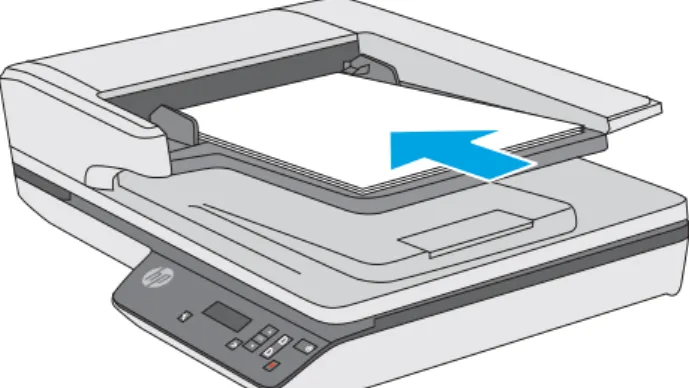
2. Load the pages with the face up and the top edge of the pages into the ADF input tray.
NOTE: Do not tap the edge of the document stack or drop the paper stack into the ADF input tray.
Figure 2-3 Load same-sized pages in the ADF input tray
3. Adjust the paper guides to the width of the document.
NOTE: Make sure not to push the paper guides so tightly as they bend the documents. The documents are now ready to be scanned.
Load documents on the scanner glass
1. Open scanner lid.2. Load the document on the scanner glass face down according to the indicators on the product.
3. Close the scanner lid. The document is now ready to scan.
Start a scan from the hardware
Scan from the front panel buttons
To scan using the front panel buttons, follow these steps:
1. Load the originals.
2. Use and to select the scan shortcut you want.
3. Press either the Scan Simplex ( ) button for one-sided scans or the Scan Duplex ( ) button for two-sided scans.
NOTE: If there is paper loaded in one source but not the other, the scanner will only scan from that source. For example, if there is paper loaded in the automatic document feeder but not on the scanner glass, the scanner will scan from the automatic document feeder.
Use the scanning software (Windows)
The following topics describe how to use the scanning software.
Work with scan shortcuts
Scan shortcuts provide a fast, efficient way to select the settings for frequently performed scanning tasks.
● Use HP Scan software to set up and modify shortcuts.
View scan shortcuts
To view existing scan shortcuts, open HP Scan. Existing scan shortcuts will display in a list to the left.
Create scan shortcuts
To create a scan shortcut, follow these steps:
1. Open the HP Scan Software.
2. Click Create New Scan Shortcut.
3. Enter a name for the new shortcut.
4. Choose to create the new shortcut from current settings, or a pre-existing shortcut.
5. Click Create.
6. Modify the settings for the new scan shortcut. Click More for more settings.
7. Click to the Save icon next to the name of the new shortcut in the shortcut list to save the modifications to the shortcut, or click the Undo icon to undo modifications.
Modify shortcuts (Windows only)
To modify a scan shortcut, follow these steps:
1. Open the HP Scan Software.
2. Select the shortcut to be modified from the list to the left.
3. Choose settings on the right side of the screen. Click More for more settings.
4. Click the Save icon to the right of the shortcut name to save changes.
Scan by using the HP Scan software (Windows)
1. Open the HP Scan Software.2. Select a scan shortcut, and then click Scan. Click Cancel to stop the scan.
Scan to a picture (Windows)
1. Load the document into the document feeder or place on flatbed scanner glass.
2. Open HP Scan Software.
3. Select Save as JPEG or Email as JPEG, and then click Scan.
-or-Choose any other scan shortcut, change the Item Type to Photo, select a picture file from the File Type drop down list, and then click Scan.
Scan to a PDF (Windows)
1. Load the document into the document feeder or place on flatbed scanner glass.
2. Open HP Scan Software.
3. Select Save as PDF or Email as PDF, and then click Scan.
-or-Choose any other scan shortcut and select PDF from the File Type drop down list, and then click Scan.
Scan text for editing (OCR) (Windows)
The scanner uses optical character recognition (OCR) to convert text on a page to text that can be edited on a computer. The OCR software comes with the scanner. For information about using the OCR software, see scan
text for editing in the online Help.
Scan to Email (Windows)
NOTE: To scan to email, make sure there is an Internet connection.
1. Load the document into the document feeder or on the flatbed scanner glass according to the indicators.
2. Open HP Scan Software.
3. Select Email as PDF or Email as JPEG, and then click Scan.
-or-Or, choose any other scan shortcut and select Email from the Send To drop down list, and then click
Scan.
Send to cloud (Windows)
NOTE: To scan to the cloud, make sure there is an Internet connection.
1. Load the document into the document feeder or place on flatbed scanner glass according to the indicators.
2. Open HP Scan Software.
3. Select Send to Cloud, and then click Scan.
Scan long or extra-long documents (Windows)
By default, the scanner automatically detects page size using the Auto Detect Size selection in the page size drop-down list.
For long or extra-long documents, select Long (8.5 x 34 inches) or Extra Long (8.5 x 122 inches) from the page size drop-down list in the scan shortcut settings.
NOTE: Only one page at a time can be scanned when using a long or extra-long page setting.
If the scanner is set to scan long or extra-long pages and a page jams, the entire page could be wrinkled as a result of the jam. Therefore, select scan shortcuts that specify long or extra-long pages only when scanning pages longer than 356 mm (14 in).
Detect multi-feeds
The multi-feed detection feature stops the scan process if it senses that multiple pages are fed into the scanner at one time. This feature is enabled by default.
Disabling this feature might be helpful when scanning:
● Multipart forms (a use that HP does not recommend).
● Documents which have labels or sticky notes attached to them.
NOTE: Use the TWAIN user interface to enable multi-feed detection when scanning from non-HP software.
Everyday Scan
The Everyday Scan shortcut allows users to define and save a scan shortcut for their everyday needs. The following Scan Shortcut Settings are customizable when the Everyday Scan shortcut is selected:
● Item Type
● Page Sides
● Page Size
● Color Mode
● Destination/File Type
Automatically detect page size (Windows)
The scanner is capable of automatically detecting page size using the Auto Detect Size option. When the Auto
Detect Size option is used, the scanned image is cropped to the size of the detected page and straighten any
skewed content.
NOTE: Use the TWAIN user interface to set crop options when scanning from non-HP scanning software. For information about the auto-detect page size settings, see the online help for the scanning software that you are using.
Automatically detect color (Windows)
Use this feature to reduce the size of the scanned file by only saving pages that contain color as color scans, and saving all other pages as black and white.
To automatically detect color in a scanned image, follow these steps:
1. Open the HP Scan Software.
2. Select a scan shortcut.
3. Click on the Color Mode drop down box, and then select Auto Detect Color.
4. To adjust the Auto Detect Color sensitivity and output mode settings, click More, select Image, and then click the Auto Detect Color drop down box.
NOTE: For information about the automatic color detection settings, see the online help for the scanning software that you are using.
Use the TWAIN user interface to automatically detect color when scanning from non-HP scanning software.
Scan using text-enhanced black and white mode (Windows)
Use this feature to enhance the scanned image when scanning black and white text. To use this feature, complete the following steps:
1. Open the HP Scan Software.
2. Select a scan shortcut.
3. Click More, select the Image tab, and then select Threshold.
4. Select Enhance Content, and then click OK.
Automatically straighten scanned images (Windows)
Windows: Use the Auto-Straighten feature to straighten content that is skewed relative to the page
dimensions in the source document. Use the Auto Detect Size feature to deskew page images that might have become skewed during the scanning process.
1. Open the HP Scan Software.
2. Select a scan shortcut.
3. Click More, select the Document tab, and then select Straighten Content.
Use the scanning software (OS X)
The following topics describe how to scan using the Apple Image Capture application. You may also use HP Easy Scan to accomplish these tasks.
Scan documents (OS X)
1. Place the document on the scanner glass or in the document feeder.
2. In the Applications folder, double-click the HP Easy Scan icon.
3. Confirm that this Scanjet XXX is the selected scanner.
4. Select a scan shortcut that reflects what you want to scan.
5. Click the Scan button.
6. Once all pages have been scanned, select the File > Save menu option and specify how and where the file is to be saved.
Scan from other applications (OS X)
An image can be scanned directly into any ICA-compliant application. In the application, look for options to import or acquire images from a scanner.
NOTE: The HP software does not support TWAIN scanning. If the application has import or acquire functions but your HP scanner is not listed, the application might only be searching for scanners that support TWAIN.
Scanning tips
Optimize scanning and task speeds
Several settings influence the total time for a scanning job. To optimize scanning performance, consider the following information.
● To optimize performance, make sure the computer meets the recommended system requirements. To view minimum and recommended system requirements, see www.hp.com, and then search for the scanner model plus the word specifications.
● Saving a scanned image to a searchable format (for example, searchable PDF) takes more time than saving to an image format because the scanned image is analyzed using Optical Character Recognition (OCR). Verify the need for a searchable output file before selecting a searchable scan format.
● Scanning at a higher resolution than necessary increases scanning time and creates a larger file with no additional benefit. If scanning at a high resolution, set the resolution to a lower level to increase scanning speed.
Scanning fragile originals
To scan fragile documents (such as photos or documents on wrinkled or very lightweight paper), place the document in face down on the flatbed scanner glass.
3
Care and maintenance
This section presents information about how to care for and maintain the scanner. For the latest maintenance information, see www.hp.com/support.
● HP Scanner Tools Utility Maintenance tab (Windows) ● HP Utility (OS X)
● Clean the product ● Replace parts
● Order maintenance and scanning supplies
HP Scanner Tools Utility Maintenance tab (Windows)
The Maintenance tab of the HP Scanner Tools Utility displays the scanner usage, maintenance history, and settings. The HP Scanner Tools Utility provides the ability to record scanner maintenance and change the setting for maintenance alerts.
For detailed information, see the HP Scanner Tools Utility Help.
HP Utility (OS X)
The Maintenance tab in HP Utility displays the scanner usage, maintenance history, and notifies the user when maintenance is due. The notification displays in HP Utility when the Maintenance tab is selected.
Clean the product
Occasional cleaning of the scanner helps ensure high-quality scans. The amount of care necessary depends on several factors, including the amount of use and the environment. Perform routine cleaning as necessary.
Clean the scanner glass
● Introduction
● Required items for cleaning ● Clean the scanner glass
Introduction
Clean the scanner glass periodically, including any time dust or debris is present.
Required items for cleaning
Make sure to have the following items before cleaning:
● Clean, lint-free or micro-fiber cloths
● Glass Cleaner or clean water
CAUTION: Do not use cleaners that contain abrasives, acetone, benzene, or carbon tetrachloride as these chemicals can damage the scanning glass.
Avoid using isopropyl alcohol as it can leave streaks on the glass.
Clean the scanner glass
To clean the scanning glass, follow these steps:
1. Lift up the document feeder.
2. Use a clean, lint-free cloth moistened with water or spray the glass cleaner on a clean, lint-free cloth, and then thoroughly clean the flatbed scanner glass.
CAUTION: Do not spray the glass cleaner directly on the scanner glass as this might cause permanent damage.
3. Dry the scanner glass with a dry, soft, lint-free cloth.
NOTE: Make sure to dry the scanner glass completely.
4. Turn on the scanner.
The scanner is now ready to use.
Clean the Automatic Document Feeder scanning strips
● Introduction
● Clean the scanning strips
Introduction
Clean both of the scanning strips periodically, including any time a scanned image has streaks.
Clean the scanning strips
To clean the scanning strip components, follow these steps:
1. Press the Power button to turn off the scanner, and then disconnect the USB cable and power supply from the scanner.
2. Lift up the document feeder.
3. Clean the scanning strips with a soft, lint-free cloth that has been sprayed with a mild glass cleaner.
CAUTION: Use only glass cleaner to clean the scanning strips. Avoid cleaners that contain abrasives, acetone, benzene, and carbon tetrachloride, all of which can damage the scanning strips. Avoid isopropyl alcohol because it can leave streaks on the scanning strips.
Do not spray the glass cleaner directly on the scanning strips.
4. Dry the scanning strips with a dry, soft, lint-free cloth. Wipe the strips of gray, reflective material on each strip.
5. Close the document feeder, reconnect the USB cable and power supply to the scanner, and then press the Power button to turn on the scanner. The scanner is now ready to use.
Clean the paper path
If scanned images have streaks or scratches, use an HP paper path cleaning cloth to clean the paper path. To clean the paper path, follow these steps:
1. Open the sealed HP paper path cleaning cloth container, starting at the notch. Take care not to tear the cleaning cloth.
2. Remove the cleaning cloth and unfold it.
3. Place the unfolded cloth into the document input tray.
4. Open the HP Scanner Tools Utility, and then click the Maintenance tab.
5. Under Clean Paper Path, click Clean to feed the cloth through the scanner.
CAUTION: Wait at least two minutes for the components to dry before proceeding to the next step.
6. Place up to five pages of printed paper in the scanner. Scan and view the results.
7. Under Record Cleaning Paper Path, click Record Cleaning to log this cleaning activity and update the paper path cleaning history.
Replace parts
Replacing parts when necessary helps ensure high-quality scans. Parts may need to be replaced when indicated by the Scanner Tools Utility, or if the scanner is not working correctly. The HP ScanJet Pro 3500 f1 ADF Roller Replacement Kit includes the following replacement parts:
● Roller cover
● Separation rollers
● Pickup roller module
The replacement kit also includes detailed instructions for replacing each of these parts.
NOTE: HP recommends replacing the pickup module and separation rollers every 100,000 scans. Windows: The HP Scanner Tools Utility can provide a reminder when service is needed, which depends on many conditions and might be sooner than this replacement interval.
Replace the separation rollers and cover
Replace the separation rollers under the following conditions:
● Windows: When the Maintenance Recommended dialog indicates they are due for maintenance.
● If the scanner experiences repeated document jams.
NOTE: The roller replacement kit is a consumable and is not covered under warranty or standard service agreements.
To replace the separation rollers, follow these steps:
1. Press the Power button to turn off the scanner, and then disconnect the USB cable and power supply from the scanner.
2. Open the document feeder hatch.
3. Squeeze the tabs on the sides of the roller cover, and then lift it up the roller cover to remove.
4. Remove and replace the rollers as described in the instructions included with the replacement kit.
5. Replace the roller cover, and then continue with replacing the pick up roller module.
Replace the pick up roller module
1. Squeeze the tabs on the sides of the roller cover, and then lower roller cover.
2. Remove the roller shaft from the holder, and then remove the roller module.
3. Replace the pickup roller module as described in the instructions included with the replacement kit.
4. Close document feeder hatch. Reconnect the USB cable and power supply to the scanner.
5. Press the Power button to turn on the scanner.
6. Windows: Update the scanner maintenance history.
● Open the HP Scanner Tool Utility.
● Under Record Replacement, click Record & Replacement to log this replacement activity and update the roller replacement history.
The scanner is now ready to use.
Order maintenance and scanning supplies
To order maintenance parts for the scanner, see the HP scanner parts Web site at www.hp.com/buy/parts.
4
Solve problems
This section contains solutions for common problems with the scanner.
For additional troubleshooting, see the Help for the HP scanning program being used.
Basic troubleshooting tips
Simple issues such as smudges on the scanning strips or loose cables can cause the scanner to produce fuzzy scans, operate in an unexpected manner, or fail to operate. Always check the following items when
encountering scanning problems.
● If scanning a document that will be analyzed using Optical Character Recognition (OCR), make sure that the original document is clear enough to be analyzed.
● Make sure that the USB and power cables are firmly seated in their respective connectors on the back of the scanner, and that the power cord is plugged into a working electrical outlet or surge protector.
● Make sure the scanner has not automatically powered off. If it has, press the Power button to turn on the scanner.
TIP: Change the auto-off setting by using HP Scanner Tools Utility (Windows) or HP Utility (OS X).
● Ensure that the scanner is receiving power.
— Check that the green LED on the power supply case is on.
— If the green LED is not on, ensure that power is available to the power outlet or surge protector that the power supply is plugged into.
— If power is available to the power outlet or surge protector but the green LED is still not on, the power supply might be defective. Contact www.hp.com/support for assistance.
● If a Scanner not found message displays when trying to use the scanner, turn off the scanner, wait 30 seconds, and then turn on the scanner. If the message still displays, the scanner may need to be reset.
● If the scanner is connected to the computer through a USB hub or through a USB port on the front of the computer, disconnect the scanner and then reconnect it to a USB port on the back of the computer.
● Windows: Make sure that the Scan button is enabled (see “Product accessibility” for more information).
● Turn off the scanner, wait 30 seconds, and then turn on the scanner.
● Make sure the document feeder hatch is closed.
● Restart the computer.
If problems continue, it is possible that the HP scanning software, firmware, or associated drivers are out of date or have become corrupted. See www.hp.com/support to locate software, firmware, and driver updates for the scanner.
Test the scanner
Follow this procedure to test the scanner:
1. Ensure that the power supply is securely connected between the scanner and a live electrical outlet or surge protector. Check that the green LED on the power supply case is on to verify that the power supply is functional.
2. If the power supply is connected to a surge protector, ensure that the surge protector is plugged into an outlet and turned on.
3. Press the Power button to turn off the scanner, disconnect the power supply from the scanner, and then turn off the computer to which the scanner is connected. Wait 30 seconds, reconnect the power supply to the scanner, press the Power button to turn on the scanner, and then turn on the computer.
4. Try to rescan.
Reset the scanner
The scanner may need to be reset under the following conditions:
● If an error message similar to Scanner initialization failed displays when trying to use the scanner.
● If a Scanner not found error message displays when trying to use the scanner and turning the power off for 30 seconds, and then back on, did not resolve the error.
To reset the scanner, follow these steps:
1. Close the HP Scan Software and HP Scanner Tools Utility, if they are open.
2. Press the Power button to turn off the scanner, and then disconnect the power supply from the scanner.
3. Wait 30 seconds.
4. Reconnect the power supply, and then press the Power button to turn on the scanner.
Scanner installation troubleshooting
● Check the cables
● Uninstall and then reinstall the HP ScanJet drivers and tools (Windows)
Check the cables
Cable type Action
Power cable The power cable is connected between the scanner and a power outlet.
● Ensure that the power cable is securely connected between the scanner and a live electrical outlet or surge protector.
● If the power cable is connected to a surge protector, ensure that the surge protector is plugged into an outlet and turned on.
● Press the Power button to turn off the scanner, and then turn off the computer. After 30 seconds, turn on the scanner and then turn on the computer, in that order.
USB cable The USB cable is connected between the scanner and the computer.
● Use the cable that was included with the scanner. Another USB cable might not be compatible with the scanner.
● Ensure that the USB cable is securely connected between the scanner and the computer. ● If the USB cable is connected to a USB port on the front of the computer, move it to a USB port
on the back of the computer.
For additional USB troubleshooting information, see www.hp.com/support, select your country/ region, and then use the search tool to find USB troubleshooting topics.
Uninstall and then reinstall the HP ScanJet drivers and tools (Windows)
If checking the scanner cable connections did not solve the problem, the problem might have occurred because of an incomplete installation. Try uninstalling and then reinstalling the HP ScanJet drivers and tools.
1. Press the Power button to turn off the scanner, and then disconnect the USB cable and power cable from the scanner.
2. On the computer, open Control Panel and use the Add/Remove tool (in Windows 7, Windows 8, Windows 8.1, and Windows 10 use the Programs and Features tool) to uninstall the following applications:
● HP ScanJet Pro 3500 f1 flatbed scanner
● HP Scan
3. Restart the computer.
4. Reinstall the HP ScanJet Drivers and Tools.
● Turn off the scanner, wait 30 seconds, and then turn on the scanner. The required software and drivers should install automatically.
● If the drivers and tools do not install automatically, install them from the HP scanning software CD.
5. Reconnect the USB cable and power cable to the scanner, and then press the Power button to turn on the scanner.
Power issues
Check that the scanner has power
The power cable is connected between the scanner and a power outlet.
● Ensure that the power cable is securely connected between the scanner and a live electrical outlet.
● If the power cable is connected to a surge protector, ensure that the surge protector is plugged into an outlet and turned on.
● Ensure that the scanner is receiving power.
— Check that the green LED on the power supply case is on.
— If the green LED is not on, ensure that power is available to the power outlet or surge protector that the power supply is plugged into.
— If power is available to the power outlet or surge protector but the green LED is still not on, the power supply might be defective. Contact www.hp.com/support for assistance.
If the problem persists after verifying the above items, follow these steps:
1. Press the Power button to turn off the scanner, and then disconnect the power supply from the scanner.
2. Wait 30 seconds.
3. Reconnect the power supply, and then press the Power button to turn on the scanner.
Scanner will not turn on
If the scanner will not turn on after pressing the Power button, check the following:
● The scanner may have been unplugged. Check to see that the power supply has not become disconnected from the scanner or unplugged from the power source.
● The power supply might not be working.
— Check that the green LED on the power supply case is on.
— If the green LED is not on, ensure that power is available to the power outlet or surge protector that the power supply is plugged into.
— If power is available to the power outlet or surge protector but the green LED is still not on, the power supply might be defective. Contact www.hp.com/support for assistance.
Scanner keeps turning off
By default, the scanner will enter Sleep Mode after 15 minutes of inactivity, and will turn off automatically after two hours of inactivity to conserve power.
Windows: To change the defaults, complete these steps:
1. Launch the HP Scanner Tools Utility.
2. Click the Settings tab, and then select the appropriate Sleep Mode and Auto-Off settings.
● To specify the period of inactivity after which the scanner goes into Sleep Mode, select 15 minutes or 59 minutes from the Sleep: Put the scanner to sleep after: drop-down list.
● To specify the period of inactivity after which the scanner automatically turns off, select the appropriate value (1 hour, 2 hours, 4 hours, or 8 hours) from the Auto-Off: Turn off the scanner
after: drop-down list.
OS X: Use HP Utility to change these defaults.
Paper jams
● Clear jams from the scanner paper path ● An item loaded in the scanner jams repeatedly
Clear jams from the scanner paper path
To clear a paper jam, complete these steps:
1. Remove any pages from the document feeder.
2. Pull up the document feeder hatch to open.
3. Remove the originals or any obstructions from the paper path.
4. Remove any visible debris (for example, paper, staples, or clips) from the paper path.
5. Inspect the rollers in the document feeder hatch, and remove any visible debris.
6. Remove any originals from output tray. Lift up input tray to check that there is no paper still inside the paper path. If there is still paper in the paper path, carefully pull the paper out.
7. Close the document feeder hatch.
8. Reload all originals in the document feeder and scan again.
An item loaded in the scanner jams repeatedly
● The item might not meet the guidelines for acceptable originals.
● The item might have something on it, such as staples or self-adhesive notes on the original that must be removed.
● Make sure the paper guides touch the edges of the original.
Paper feed issues
Paper jamming, skewing, misfeeds, or multiple-page feeds
● Scanning damp or wet pages can cause paper jams. Make sure that the pages being fed are completely dry (toner is dry, there are no wet substances such as glue or correction fluid).
● Check that all rollers are in place and that the roller door and document feeder hatch are closed.
● If the pages look skewed as they feed into the scanner paper path, check the resulting scanned images in the software to ensure that they are not skewed.
● The pages might not be placed correctly. Straighten the pages and adjust the paper guides to center the stack.
● The paper guides must be touching the sides of the paper stack to work properly. Please ensure that the paper stack is straight and the guides are against the paper stack.
● The document feeder or output tray might contain more than the maximum number of pages. Load fewer pages in the document feeder, and remove pages from the output tray.
● Clean the scanner paper path to help reduce misfeeds. If misfeeds still occur, clean the rollers. If misfeeds still occur, replace the rollers.
Paper does not feed from the scanner
Reload the pages into the document feeder, ensuring that they make contact with the rollers.
The document feeder hatch might not be securely latched. Open the hatch and then close it, pressing firmly on both sides to ensure the hatch is closed.
A problem with the scanner hardware might exist. Follow this procedure to test the scanner:
1. Ensure that the power supply is securely connected between the scanner and a live electrical outlet or surge protector. Check that the green LED on the power supply case is on to verify that the power supply is functional.
2. If the power supply is connected to a surge protector, ensure that the surge protector is plugged into an outlet and turned on.
3. Press the Power button to turn off the scanner, disconnect the power supply from the scanner, and then turn of the computer to which the scanner is connected. Wait 30 seconds, reconnect the power supply to the scanner, press the Power button to turn on the scanner, and then turn on the computer.
4. Try to rescan.
Originals are curling up in the scanner output tray.
Under dry conditions, lightweight originals such as those printed on carbonless copy paper may curl in the output tray. To minimize curl, flatten curled edges on the originals before placing them in the document feeder.
Image quality problems
Scanned images are not straight
● Verify that the document feeder guides are centered on the scanner and set to an appropriate width for the original being scanned. Make sure the paper guides touch the edges of the original.
● Windows: Use the Auto-Straighten feature to straighten content that is skewed relative to the page dimensions in the source document. Use the Auto Detect Size feature to deskew page images that might have become skewed during the scanning process.
The scanned images have streaks or scratches
For information on cleaning the scanner, see the Care and maintenance section of the User Guide.
● Check that the originals are clean and unwrinkled.
● Clean the scanner glass.
Scanned image is fuzzy
● Check for any obstructions in the scanner paper path and make sure the paper width guides are positioned appropriately. Try another scan.
● Verify that the document is not fuzzy.
The scan is completely black or completely white
● The item might not be placed correctly in the document feeder. Make sure that the item being scanned is placed face up in the document feeder.
● Windows: If scanning to a black and white image, make sure the black and white threshold is not set to either extreme . Setting the threshold to an extreme will result in an image that is all white or all black.
● OS X: If scanning to a text image using the Image Capture application, set Image Correction to Manual and use the Threshold slider bar to adjust the threshold.
The bottom of the scanned image is cut off
By default, the scanning software can scan media that is up to 356 mm (14 in) long.
Verify that the page size selected in the scanning software (or the scan shortcut selected) will accommodate the length of the document being scanned.
Scanner operation problems
● Connection issues
● Buttons are not working properly
● The LCD is having display issues or scanner buttons are not working as expected ● Scanning performance issues
Connection issues
Check the USB connection
Check the physical connection to the scanner.
● Use the cable that was included with the scanner. Another USB cable might not be compatible with the scanner.
● Ensure that the USB cable is securely connected between the scanner and the computer. The trident icon on the USB cable faces down when the cable is properly connected to the scanner.
If the problem persists after verifying the above items, try the following:
1. Do one of the following tasks depending on how the scanner is connected to the computer:
● If the USB cable is connected to a USB hub or a docking station for a laptop, disconnect the USB cable from the USB hub or the docking station, and then connect the USB cable to a USB port on the back of the computer.
● If the USB cable is directly connected to the computer, plug it into a different USB port on the back of the computer.
● Remove all other USB devices from the computer except for the keyboard and the mouse.
2. Press the Power button to turn off the scanner, wait 30 seconds, and then turn on the scanner.
3. Restart the computer.
4. After the computer has restarted, try using the scanner.
● If the scanner works, reconnect any additional USB devices one at a time; try the scanner after connecting each additional device. Disconnect any USB devices that prevent the scanner from working.
● Windows: If the scanner does not work, uninstall and then reinstall the HP ScanJet drivers and tools:
— HP ScanJet Pro 3500
— HP Scan
Buttons are not working properly
Scanner buttons are not working correctly
After each step, press the Scan button. to see if it is working correctly. If the problem persists, proceed with the next step.
1. A cable might be loose. Ensure that the USB cable and the power supply are securely connected.
2. Turn off the scanner, wait 30 seconds, and then turn the scanner back on.
3. Restart the computer.
4. If the problem still persists, there may be a problem with the control panel. Contact HP Support at
www.hp.com/support.
The LCD is having display issues or scanner buttons are not working as expected
The following symptoms indicate a problem with the scanner front panel.
● LCD issues: The display is blank, or part of the display content is missing.
● Button issues: Buttons are unresponsive, or the wrong action occurs when you press a button (for example, you get a single-sided scan when you press the Scan Duplex ( ) button.
● LED issues: LEDs are not working, or are staying in the wrong state.
If the scanner exhibits any of these problems, contact HP support at www.hp.com/support.
Scanning performance issues
Scanner does not scan right away
Make sure the document feeder hatch is closed, and that the scanner is turned on.
Scanner scans only one side of a two-sided page
Verify that the selected scan shortcut specifies two-sided scanning.
Scanned pages are missing at the scan destination
When scanning, pages that stick together are scanned as one item. Check to confirm that scanned pages are not stuck together.
Scanned pages are out of order at the scan destination
● Verify that the page order of the original document is correct before placing the document face up into the document feeder.
● Make sure that there are no staples, paper clips, or any other attached material (such as adhesive notes) that may cause the pages to feed incorrectly.
● Verify that pages are not stuck together.
Scan files are too large
● Most scanning software allows a smaller file size to be selected when selecting the output file type. For more information, see the Help for the scanning software being used.
● Verify the scan resolution setting (for more information, see the Help for the scanning software being using):
— 200 dpi is sufficient for storing documents as images.
— For most fonts, 300 dpi is sufficient for using optical character recognition (OCR) to create editable text.
— For Asian fonts and small fonts, 400 dpi is the recommended resolution.
Scanning at a higher resolution than necessary creates a larger file with no additional benefit.
● Color scans create larger files than do black and white scans.
● If scanning a large number of pages at one time, consider scanning fewer pages at a time to create more, smaller files.
Additional troubleshooting
Get telephone support for your country/region
Have the product name, serial number, date of purchase, and problem description ready.
Country/region phone numbers are on the flyer that was in the box with your product or at www.hp.com/support/
Get 24-hour Internet support, and download software utilities,
drivers, and electronic information www.hp.com/support/ Order additional HP service or maintenance agreements www.hp.com/support/
Index
A
Auto color detect 21
automatically detect page size 21
B
black scans
troubleshoot 45 blurry images 45 buttons
scanner control panel 4
C
cables
troubleshoot 39
capacity, document feeder 8 clean paper path 29 cleaning cloth 29 cloud, scan to 20 control panel locating 2 crooked images 45 customer support online 49 cut-off images troubleshoot 45 D detect multi-feeds 21 detect page size 21 display problems 47 document feeder capacity 8 load documents 17 tips on loading 11 drivers paper types 13 E extra-long-page support 21 F features
auto color detect 21 detect page size 21
extra-long-page support 21 long-page support 21 multi-feed detection 21 scan shortcuts 18
text-enhanced black and white mode 22
feeding problems 42 fragile items, scanning 24 fuzzy images 45
H
HP Customer Care 49
HP paper path cleaning cloth 29 HP Scan Extended
scan from 19
HP Scan Extended software about 9
HP Scanner Tools Utility Maintenance tab 26 uses for 9
HP TWAIN 9
I
input and output trays locating 2 install software troubleshoot 39 J jams troubleshoot 43 L LCD problems 47 long-page support 21 M maintenance
clean paper path 29 HP Scanner Tools Utility
Maintenance tab 26 manage power settings 40 media jams 43 misfeeds 44 not feeding 44 troubleshoot 44 misfeeds troubleshoot 44 multi-feed detection 21 multiple-page feeds 44 O
on/off button, locating 2 online support 49 order
roller replacement kit 31, 33 supplies 34
OS X software 10 output tray
locating 2
P
pages missing, troubleshoot 47 pages out of order 47
paper jams 43 misfeeds 44 not feeding 44 supported types 13 troubleshoot 44 ENWW Index 51
paper guides, locating 2 paper path clean 29 feeding problems 42 parts order 31, 33
power button, locating 2 power management 40 power supply troubleshoot cable 39 problems with LCD 47 product auto-off 10 Sleep Mode 10 product info 1 R replace roller 31
replace roller and separation pad 33 reset scanner 38 roller replace 31, 33 S scan feeding problems 42 files too large 47 fragile items 24
from HP Scan Extended 19 originals 17 scan shortcuts 18 scan to cloud 20 scanner control panel 4 reset 38 scanner software Mac 10 Windows 9 skewed images 45 Sleep Mode 10 software Mac 10 troubleshoot installation 39 uninstall and reinstall 39 Windows 9 speed troubleshoot 47 speed, troubleshoot 24 streaks troubleshoot 45 supplies order 34 support online 49 T technical support online 49
Text-enhanced black and white mode 22 troubleshoot basic tips 36 black scans 45 cables 39 check power 40 crooked images 45 cut-off images 45 feeding problems 42 fragile items 24 fuzzy images 45 installation 39 jams 43
large scan files 47 misfeeds 44 page order 47 pages missing 47 paper not feeding 44 power 40
reset scanner 38
scanning fragile items 24 speed 24, 47
streaks 45
two-sided scans 47
uninstall and reinstall software 39 white scans 45 troubleshooting buttons 47 display 47 LCD 47 turn on scanner troubleshoot 40 TWAIN 9 two-sided scans troubleshoot 47 U
uninstall and reinstall software 39
USB cable troubleshoot 39 W Web sites customer support 49 order supplies 34 replacement parts 31, 33 white scans troubleshoot 45 Windows software 9 52 Index ENWW
© 2015 HP Development Company, L.P. www.hp.com