CONTEXTUAL CONNECTIONS AMONG OBJECTIVES AND OBJECTS AT PRODUCT
MODEL DEFINITION
László HORVÁTH, Imre J. RUDAS, János F. BITÓ
Institute of Intelligent Engineering Systems, John von Neumann Faculty of Informatics, Óbuda University, H-1024, Budapest, Bécsi u. 96/b, Hungary, tel. +36-1-666-5524, e-mail: [email protected], [email protected], [email protected]
ABSTRACT
During the past decade, work of engineers has moved into integrated product modeling systems at the leading industries. In order to establish high level and comprehensive support of product related engineering activities, engineering software has been concentrated in product lifecycle management (PLM) systems. Product development applies object modeling techniques where objects, their parameters, and relationships with other objects are defined for very complex products. Product model increasingly serves as a medium in communication between engineers. This great achievement requires information about the background of decisions on the objects those are received by engineers who must coordinate new decisions with earlier ones. The authors of this paper proposed a new modeling method for the definition of the above background at the definition of product objects. Moreover, definition of product objects is done by human intent based control using the background definition. The new modeling is an extension to the current product modeling in industrial PLM systems. In this paper, the main process and the related model entities are introduced, explained ad discussed. The proposed modeling called as information content based modeling relies upon model entities for human intent, engineering objective, contextual connections, and decisions. It can be fully integrated with product modeling in current industrial PLM systems.
Keywords: Product development, product lifecycle management, product modeling, information content based product object definition, human-computer interaction, behavior based problem solving
1. INTRODUCTION
By the development of product model based engineering, integrated solutions comprise product information. Large models are developed with thousands of engineering objects and their relationships in models spaces. Structure of product includes wide variety of engineering objects such as mechanical, electrical, electronic, computer elements, software, analysis results, processes, equipment control programs, specifications, knowledge representations, etc.
The authors recognized that one of the problems with these systems is high number of engineering objects connected by high number of unorganized relationships [1]. Recent product models are inappropriate for deep consequence analysis in case of a new or a modified product model entity in the product model. The utmost purpose is better human control over parameters of engineering objects in model and simulation based product development.
In order to achieve a possible solution for the above problem, the authors introduced the concept of information content. In this concept, analysis and development for engineering object parameters and relationships in the current industrial product models are supported by human intent, engineering objective, contextual connection, and decision information content definitions [2]. The concept is originated from a representative analysis of product related problem solving purposed engineering modeling [3].
A new modeling method is based on the concept of information content for the definition of background at the definition of product objects. Definition of product objects is done by a human intent based control using the background definition. The new modeling can be
implemented as an extension to the current product modeling in industrial PLM systems. In this paper, the main process of the proposed modeling and the related model entities are introduced, explained ad discussed. The proposed modeling called as information content based modeling relies upon model entities for human intent, engineering objective, contextual connections, and decisions. It can be fully integrated with product modeling in current industrial PLM systems.
2. HUMAN INTENT BASED OBJECTIVES
Definition of engineering objects in product modeling extended by information content is summarized in Fig. 1. Engineering object definition process is controlled by authorized and responsible humans. Content is defined by the human as original or it is retrieved from generic object definitions. In order to organic integration in the product model under construction, generic object definitions must be contextual. Generic object definitions must be constantly developed during definition and capturing activities. At the same time, product development produces generalized and task specific object definitions. In this scheme, any object can be considered in the product model including knowledge, specifications, etc.
The extended product model is outlined in Fig. 2. The current product model is called by the authors as classical one. It includes engineering objects (EO) in a tree structure and a set of unstructured relationship definitions. PLM systems handle product structure graphs. Engineering objects are placed in different levels of product structure. In the proposed extension, information in the classical product model is organized in a multilevel structure in order to its better integration with multilevel model of information content [2].
Fig. 1 Definition of engineering objects
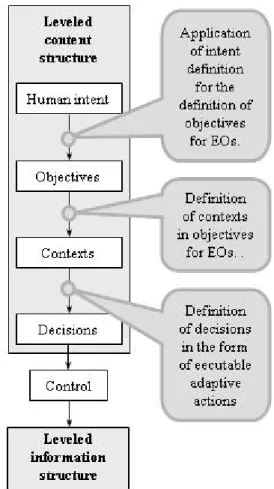
The leveled content structure is explained and discussed in [2]. Fig. 3 shows how activities connect levels of the content structure and develop human intent into decision level-by-level. Any object in the product model must serve definite engineering objectives according to the related human intent. Engineering objects are contextual so that objectives are also must be contextual. Considering contextual connections among engineering objects and engineering objectives, adaptive actions are generated as results of decision making. These adaptive actions must be suitable for control of parameters of engineering objects through the proposed leveled information structure.
Fig. 2 Extension of product structure by multilevel information and information content structures
One of the main features of the proposed method is that engineers are enforced to decision making on the basis of contexts. Any engineering object parameter is based on human intent. Ad-hoc and inappropriate definitions can not be included in the product model.
Fig. 3 Activities connecting levels of the content structure The proposed knowledge and practice based extension increases the capability of product model for the representation of human intent and other background definitions at decisions. This capability supports product model application for decisions at remote places where original decision-makers are not available. While contexts act as constraints, additional constraints are placed on attributes of engineering objects. Constraining has outstanding importance because results of product development are recorded in the form of contextual and other constraints, not to be changed accidentally or by incompetent persons.
3. SOME RELEVANT RESEARCH EFFORTS
Customization of products, the PLM paradigm, information modeling, design intent representation, knowledge definition, and product data management (PDM) are research areas those are in close connection with the proposed research.
In [4] redesign and design are extended for customization of products. During product development process, a change to one part of the product often results changes to other parts. An analysis of change behavior
based on a case study in rotorcraft design is introduced. Mathematical models were developed to predict the risk of change propagation in terms of likelihood and impact of change. Likely change propagation paths and their impact on the delivery of the product were analyzed.
Product lifecycle management (PLM) is considered by the author of the book [5] as a new paradigm to manage products all the way across their lifecycles in the most effective way. This book outlines a wide area of engineering activities including simulations that demand highly organized information system that can support integrated definition of product entities for lifecycle application.
Product model requires well-organized preparation by using of information modeling method due to the complexity of information. Authors in [6] describe a product information-modeling framework in order to support the full range of PLM information needs. It is intended to capture product, design rationale, assembly, and tolerance information to the full lifecycle. Semantic interoperability with next-generation PLM systems and capture the evolution of products and product families are also considered.
In [7] issues at capture, representation and retrieval of design intent are discussed, a definition for design intent is presented, and a context-based inference system is proposed to capture design intent from product data. Design space is defined on corporation level and design level. Authors of [8] emphasize importance of construction history, parameters, constraints, features, and other elements of design intent and suggest implementation of product model data exchange with the preservation of design intent, based on the use of newly published parts of the International Standard ISO 10303 (STEP).
Industrial product modeling systems offer essential knowledge definition and problem solving modeling capabilities as it is discussed in papers [9] and [10]. Rules define some entities or activities in the modeling process depending on well-defined circumstances. Checks recognize situations with different levels of severity. A reaction reacts to well-defined events by given activities in the modeling process. Parameters relations are reorganized into new categories. Rules, checks, formulas and other relations can be organized into relation sets. Parameters are optimized for minimum, maximum, etc. according to essential or user defined algorithms. An advanced modeling capability facilitates analyses for constraint satisfaction. Design of experiments capability allows for perform virtual experiments among others in order to find interactions between parameters and the most influential parameter.
Considering an engineering process centered concept, product data management (PDM) integrates and manages all the product objects. In [11], web-based PDM systems are reviewed. The PDM methodology is integrated with web architecture. Currently available PDM systems those have been integrated with web-technologies are reviewed. High importance of content based assistance in modeling of large scale systems is inevitable [12].
The above works are for partial solutions although they are well fit into the typical modeling based solutions in recent PLM technology. However, the main problem
emerges from poor model representation capability for engineering objectives and explained contextual definitions in order to make evaluation of decisions possible in coordination with other related decisions. 4. ENGINEERING OBJECTIVES
The proposed modeling is based on definition of engineering objectives in the context of human intent definitions, definition of contextual chains of engineering objectives, and definition of decisions on engineering objects in the context of engineering objectives.
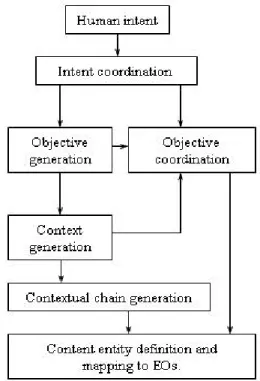
The same engineering object feature can be affected by different intents by different humans. Consequently, multiple intent definitions are to be coordinated. The problem and process of coordination was introduced in [1]. Intent based definition of engineering objectives for different engineering objects must be coordinated (Fig. 4). At the same time, concurrent intents may be resulted by concurrent engineering objectives for later decision. In the meantime, contextual objectives need definition of context as information content. Previously generated contents help coordination of objectives. Effect of an engineering object on other engineering objects propagates along chains. Consequently, decisions are well assisted by contextual chains. Content is defined in the form of appropriate model entities and mapped to relevant engineering objects.
Fig. 4 Engineering objectives and contextual chains Original and contextual objects are initialized and created in accordance with objective definition and coordination. Contextual chain management serves development of object chains and reveals propagation chains for product changes. Intent processing results knowledge for engineering objects and engineering objects are defined in the in context of previously recoded knowledge. Intent or selection among intent variants may
be changed during the lifecycle of a product. In this case, new information content must be generated for the new situation.
5. DECISIONS AND CONTEXTUAL CONTENT
SPACES
To this point in the processing of information content, human intent, engineering objective, and context definition entities have been generated and mapped to relevant engineering objects (Fig. 5). This is the basis of coordinated decision generation. Decision entities are also mapped to relevant engineering objects in order to control of the definition of engineering object parameters. Suitable connections to the leveled information structure assist this communication.
Fig. 5 Generation of decisions
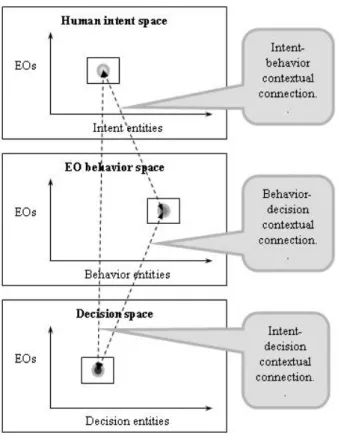
As it can be seen from the above discussion on the processing of information content, content levels are in mapping connection with engineering objects. This mapping is represented in spaces where intent, behavior, and decision entities are paired with engineering object entities in order to map the appropriate content entities (Fig. 6). Content entities can be arranged in chains in order to define contextual connections within intents, behaviors, and decisions. Other type of contextual connections is the inter-content definition. Inter-content definitions are shown in Fig. 6.
Fig. 6 Contextual content spaces
Engineering objective is represented by behavior of engineering object. For this purpose, an extended definition of behavior has been established. Examples for behavior are holding function of a part, heat resistance of a material of a part, and joint with specified degree of freedom of relative movements of given parts.
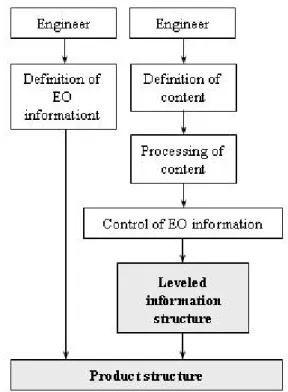
6. CONTENT ASSISTED DECISION MAKING It is important to say that purpose of information content is not a design automat but helping engineers at decisions for which they are authorized and responsible. A short comparison of modeling without and with information content is given in Fig. 7. Without information content definitions in the product model, engineer defines engineering object parameters and relationships directly for the product structure. In case of information based product modeling, human controls engineering object generation processes directly on a dialogue surface where those processes can be controlled by parameters of engineering objects. Content is not recorded in the product model.
In case of product modeling with information content, engineer defines content. Content is processed and the resulted adaptive actions are applied for the control of parameters and relationships at the definition of engineering objects. Dialogue surface for engineers is repositioned to definition of human intent. Intent of engineer for the modification of a base feature is recorded in the form of thinking process elements and interim decision points. In an exceptional process, engineer can intervene by completing other intent records. This bypass action is recorded and for the own risk of the engineer who is authorized to do it.
Fig. 7 Modeling without and with content
Fig. 8 Decision process
One of the most complex tasks at product modeling is decision making on attributes of engineering objects. The decision must be coordinated with related decisions considering all consequences on other engineering objects.
In the method proposed by the authors consequence analysis along contextual chains results executable or non-executable status of adaptive action representing an attempted decision (Fig. 8). In case of executable adaptive action, attributes and their relationships are defined for the related engineering objects including mapping to content in content spaces.
The consequence analysis for a change defined by an adaptive action as a result of a decision is outlined in Fig. 9. When approval is attempted to gain for a proposed decision, it is announced then change chains are generated along contextual chains in order to define a change affect zone. Following this, consequence changes and their intent breaking characteristics are revealed. Cooperating engineers must agree in chain changes otherwise the attempted changes can not be finalized and adaptive action relevant with the decision can not be considered as executable.
The decision level of information content should have the capability to record tracking chains. Otherwise, the main objective of transparent content at the application of product model entities would undoubtedly be failed.
Fig. 9 Analysis for consequences of changes
Adaptive actions act through content interface for the connection between information content based extension and current information based product modeling. An adaptive action definition can be applied on passive way or by application of planned analyses of behaviors. In this way, advanced simulations can be controlled by information content in current modeling systems. Experiment plans can be recorded as information content.
Extension of the current information based product model to information content requires advanced model creation such as developed during the STEP standardization efforts by the ISO Reference models and application protocols as they are specified by the STEP product model standard also can be applied at the
implementation of control at engineering object generation processes.
7. CONSIDERATIONS FOR APPLICATION
The proposed methodology for information content based product modeling together with the concept of information content and its connection with the currently prevailing industrial product modeling proved suitable for establishing a product modeling that has the capability for including, representing, and processing human intent. Implementation of the proposed methodology needs
• definition of new entities, their integration in current product model,
• definition of new modeling functions and procedures,
• solution for replacing human by information content based modeling procedures at the definition product engineering objects for product model, and
• elaboration a new interface between human and modeling procedures.
New entities are necessary to describe human intent, new concept for description as content, engineering objective as demanded behavior, contextual connection, change attempt, change chain, change affect zone, adaptive action, and content space in an extended product model. Moreover, the new leveled structure for information needs entities for
• identification, • application data,
• associative connection or relationship, • description, and
• representation, regarding engineering objects.
The applied software technology task gives fewer problems because software development tools and interfaces are available for advanced PLM systems. The proposed modeling is supposed to have strong application specific characteristics. When future development results in generalized modeling methods and model representations, a step-by-step integration into general purpose PLM systems is expected.
Research in the next future will be encountered for the coordinated definition of information content based model entities and modeling processes.
8. CONCLUSIONS
A contribution is intended by this paper in order to enhance model representations for the background of human decisions on engineering objects. The authors developed new concept, methodology and entity definitions for a modeling, where engineering objects are defined in the context of engineering objectives. Effects of a decision on other decisions are followed and checked by contextual chains. The conventional direct contextual definitions of engineering objects are extended by contextual engineering objectives. Definition of any engineering object must be in accordance with relevant engineering objectives those are in contextual connection with other engineering objectives for the definition of
other engineering objects. Because engineering objectives are generated in the context of human intent, a higher lever of human control on product definition can be realized by the proposed modeling.
ACKNOWLEDGMENTS
The authors gratefully acknowledge the grant provided by the NKTH-OTKA Fund for Research of the Hungarian Government. Project number is K 68029.
REFERENCES
[1] L. Horváth, I. J. Rudas, “Intelligent Human-Computer Communication of Engineers at Extended Companies,” in Journal of Advanced Computational Intelligence and Intelligent Informatics, Tokyo, Vol. 10, Issue 4, pp. 510-516 (2006).
[2] L. Horváth, “A New Method for Enhanced Information Content in Product Model,” in WSEAS Transactions on Information Science and Applications, ISSN 1790-0832, Vol. 5 No. 3, pp. 277-285 (2008).
[3] L. Horváth and I. J. Rudas, Modeling and Problem Solving Methods for Engineers, Elsevier, Academic Press, 2004, p. 330.
[4] P. J. Clarkson, C. Simons and C. Eckert, “Predicting Change Propagation in Complex Design,” Journal of Mechanical Design, Vol. 126, Issue 5, pp. 788-797 (2004).
[5] J. Stark, Product Lifecycle Management: 21st Century Paradigm for Product Realisation, Birkhäuser, 2004, p. 441.
[6] R. Sudarsan, S.J. Fenves, R.D. Sriram and F. Wang, “A product information modeling framework for product lifecycle management,” Computer-Aided Design, Volume 37, Issue 13, pp. 1399-1411 (2005). [7] G. R. Iyer, J. J. Mills, S. Barber, V. Devarajan and S.
Maitra, “Using a Context-based Inference Approach to Capture Design Intent from Legacy CAD,” Computer-Aided Design & Applications, Vol. 3, Nos. 1-4, pp 269-278 (2006).
[8] J. Kima, M. J. Prattb, R. G. Iyerc and R. D. Srirama, “Standardized data exchange of CAD models with design intent,” Computer-Aided Design, Vol. 40, Issue 7, pp. 760-777 (2008).
[9] B.-T. Lin and S.-H. Hsua, “Automated design system for drawing dies,” Expert Systems with Applications, Vol. 34, Issue 3, pp. 1586-1598, (2008).
[10] D. A. Guerra-Zubiaga, E. D. Ramòn-Raygoza, E. F. Rios-Soltero1, M. Tomovic and A. Molina, “A PLM Tools Taxonomy to Support Product Realization Process: A Solar Racing Car Case Study,” in book Product Realization, Springer US, 2008, pp. 1-26. [11] D. Tony Liu and X. William Xu, “A review of
web-based product data management systems,” in Computers in Industry, Vol. 44, Issue 3, pp. 251-262 (2001).
[12] L. Madarász, R. Andoga, L. Főző, T. Lazar, “Situational control, modeling and diagnostics of large scale systems,” in book Towards Intelligent Engineering and Information Technology, Springer, 2009, pp. 153-164.
Received December 3, 2009, accepted January 29, 2010 BIOGRAPHIES
László Horváth author received the M.Sc. degree in control of manufacturing processes and Ph.D. in modeling and computer aided development of industrial processes from the Budapest University of Technology and Economics (BME). He also received Ph.D. degree from the Hungarian Academy of Sciences. He is currently a full university professor at the Institute of Intelligent Engineering Systems, John von Neumann Faculty of Informatics, Óbuda University. His current research interests are intelligent modeling of products, human-computer interaction in engineering processes, and virtual spaces for engineers. He has authored and coauthored more than two hundred journal and conference papers in these areas. He is a senior member of IEEE.
Imre J. Rudas author graduated from Bánki Donát Polytechnic, Budapest in 1971, received the Master Degree in Mathematics from the Eötvös Loránd University, Budapest, the Ph.D. in Robotics from the Hungarian Academy of Sciences in 1987, while the Doctor of Science degree from the Hungarian Academy of Sciences in 2004. He serves as the Rector of Budapest Tech and Óbuda University from 2003. He is active as a
full university professor. He is a Fellow of IEEE, and served Senior Administrative Committee member of IEEE Industrial Electronics Society, member of Board of Governors of IEEE SMC Society. He is the Vice-President of IFSA, International Fuzzy System Association. He serves as an associate editor of some scientific journals, including IEEE Transactions on Industrial Electronics, member of editorial board of Journal of Advanced Computational Intelligence, member of various national and international scientific committees. His present areas of research activity are Computational Cybernetics, Robotics with special emphasis on Robot Control, Soft Computing, Computed-aided Process Planning, Fuzzy Control and Fuzzy Sets. He has published books, more than 400 papers in books, various scientific journals and international conference proceedings
János F. Bitó author graduated as physicist at the József Attila University, Szeged (Faculty of Natural Sciences) in 1958. In 1971 he received the degree of Doctor of Technical Science (D.Sc.), at the Hungarian Academy of Sciences, Budapest. From 2000 he is Professor at Péter Pázmány Catholic University, Budapest, Hungary. From 1999 Fellow grade Member of IEEE. He is owner of various awards such as Roland Eötvös Prize, 1991., Dennis Gabor Prize, l997; Arnold Ipolyi Prize, 2002, Living Legends Medal and Scroll of IBC, Cambridge, 2003. Areas of relevant scientific and technical experience are electron and plasma (discharge) physics, optical signal processing, optoelectronic sensors (integrated systems), ANN-based pattern recognition, process control, control strategies of robots, and systems based on fuzzy systems and ANNs. He is author of more than 260 scientific publications.