EVALUATING AND MODELING VIRTUALIZATION
PERFORMANCE OVERHEAD FOR CLOUD ENVIRONMENTS
Nikolaus Huber, Marcel von Quast
Chair for Software Design and Quality, Karlsruhe Institute of Technology, Am Fasanengarten 5, Karlsruhe, Germany [email protected], [email protected]
Michael Hauck
Forschungzentrum Informatik FZI, Karlsruhe, Germany [email protected]
Samuel Kounev
Chair for Software Design and Quality, Karlsruhe Institute of Technology, Am Fasanengarten 5, Karlsruhe, Germany [email protected]
Keywords: Virtualization, Modeling, Benchmarking, Performance
Abstract: Due to trends like Cloud Computing and Green IT, virtualization technologies are gaining increasing
impor-tance. They promise energy and cost savings by sharing physical resources, thus making resource usage more efficient. However, resource sharing and other factors have direct effects on system performance, which are not yet well-understood. Hence, performance prediction and performance management of services deployed in virtualized environments like public and private Clouds is a challenging task. Because of the large vari-ety of virtualization solutions, a generic approach to predict the performance overhead of services running on virtualization platforms is highly desirable. In this paper, we present experimental results on two popular state-of-the-art virtualization platforms, Citrix XenServer 5.5 and VMware ESX 4.0, as representatives of the two major hypervisor architectures. Based on these results, we propose a basic, generic performance predic-tion model for the two different types of hypervisor architectures. The target is to predict the performance overhead for executing services on virtualized platforms.
1
INTRODUCTION
In recent years, due to trends like Cloud Com-puting, Green IT and server consolidation, virtualiza-tion technologies are gaining increasing importance. Formerly used to multiplex scarce resources such as mainframes (Rosenblum and Garfinkel, 2005), nowa-days virtualization is again used to run multiple vir-tual servers on a single shared infrastructure, thus in-creasing resource utilization, flexibility and centrized administration. Because this technology also al-lows sharing server resources on-demand, it promises cost savings and creates new business opportunities by providing new delivery models, e.g., Infrastructure as a Service or Software as a Service.
According to the International Data Corpora-tion (IDC), 18% of all new servers shipped in the fourth quarter of 2009 were virtualized (IDC, 2010) and the server virtualization market is expected to grow 30% a year through 2013 (IT world, The IDG Network, 2008). However, the adoption of server virtualization comes at the cost of increased system complexity and dynamics. The increased
complex-ity is caused by the introduction of virtual resources and the resulting gap between logical and physical re-source allocations. The increased dynamics is caused by the lack of direct control over the underlying physi-cal hardware and by the complex interactions between the applications and workloads sharing the physical infrastructure introducing new challenges in systems management.
Hosting enterprise services on virtualized plat-forms like Cloud environments requires an efficient performance management strategy at the application level. Service-Level Agreements (SLAs), e.g., perfor-mance guarantees such as service response time ob-jectives, need to be respected. On the other hand, the target is to utilize server resources efficiently in or-der to save administration and energy costs. Thus, providers of virtualized platforms are faced with questions such as: What performance would a new service deployed on the virtualized infrastructure ex-hibit and how much resources should be allocated to it? How should the system configuration be adapted to avoid performance problems arising from chang-ing customer workloads? In turn, customers uschang-ing
virtualized resources are interested in a service’s per-formance behavior when, e.g., moving it to a Cloud Computing environment or when migrating it from one platform to another.
Answering such questions for distributed, non-virtualized execution environments is already a com-plex task (Menasc´e et al., 1994). In virtualized en-vironments, this task is even more complicated be-cause resources are shared. Moreover, since changes in the usage profiles of services may affect the en-tire infrastructure, capacity planning has to be formed continuously during operation. Proactive per-formance management, i.e., avoiding penalties by act-ingbefore performance SLAs are violated, requires predictions of the application-level performance un-der varying service workloads. Given that compu-tation details are abstracted by an increasingly deep virtualization layer, the following research questions arise: i) What is the performance overhead when vir-tualizing execution environments? ii) Which are the most relevant factors that affect the performance of a virtual machine? iii) What are the differences in performance overhead on different virtualization plat-forms? iv) Can the performance-influencing factors be abstracted in a generic performance model?
Previous work on performance evaluation of vir-tualization platforms focuses mainly on comparisons of specific virtualization solutions and techniques, e.g., container-based virtualization versus full virtu-alization (Barham et al., 2003; Padala et al., 2007; Soltesz et al., 2007; Qu´etier et al., 2007). Other work like (Apparao et al., 2008; Tickoo et al., 2009; Iyer et al., 2009) investigates core and cache contention ef-fects. (Koh et al., 2007) predict the performance infer-ence of virtualized workloads by running benchmarks manually. (Huber et al., 2010) propose an approach on a systematic and automated experimental analysis of the performance-influencing factors of virtualiza-tion platforms applied to the Citrix XenServer 5.5.
In this paper, we use the automated experimen-tal analysis approach from (Huber et al., 2010) as a basis. We extend this approach and evaluate its applicability to VMware ESX 4.0, another industry-standard platform with a different hypervisor archi-tecture (Salsburg, 2007). The main goal is to build a generic model which enables the prediction of per-formance overheads on different virtualization plat-forms. To this end, we evaluate various performance-influencing factors like scheduling parameters, differ-ent workload types and their mutual influences, and scalability and overcommitment scenarios on the two different types of hypervisor architectures. At the same time, we evaluate the portability of automated experimental analysis approach to other platforms.
Finally, we summarize the results of both case studies and formulate a basic generic model of the influences of various parameters on the performance of virtual-ized applications. This model shall provide the means for estimating the performance of a native application when migrated to a virtualized platform or between platforms of different hypervisor architectures. In ad-dition, this model can be used for capacity planning, e.g., by Cloud providers, to estimate the number of virtual machines (VMs) which can be hosted.
The contributions of this paper are: i) an in-depth experimental analysis of the the state-of-the-art Cit-rix XenServer 5.5 virtualization platform covering performance-influencing factors like scheduling pa-rameter, mutual influences of workload types etc., ii) an evaluation of these results on VMware ESX 4.0, another representative virtualization platform with a different hypervisor architecture, iii) an experience report on the migration of virtual machines and the automated administration of virtualization platforms, iv) a basic model capturing the general performance-influencing factors we have identified.
The remainder of this paper is organized as fol-lows. Section 2 provides an overview of the auto-mated experimental analysis we use. Additionally, it presents further experimental results on the Citrix XenServer 5.5. An evaluation of our results based on repeated experiments on VMware ESX 4.0 is given in Section 3. In Section 4, we present our performance prediction model. Section 5 discusses related work, followed by a conclusion and an outlook on future work in Section 6.
2
AUTOMATED EXPERIMENTAL
ANALYSIS
Because virtualization introduces dynamics and increases flexibility, a variety of additional factors can influence the performance of virtualized systems. Therefore we need to automate the experiments and performance analysis as much as possible. In this section we give a brief summary of the generic ap-proach to automated experimental analysis of virtual-ized platforms presented in (Huber et al., 2010). We briefly explain the experimental setup as well as the general process that is followed. Furthermore, we ex-plain the experiment types in more detail because they are used as a basis for our evaluation. We also sum-marize the previous results of (Huber et al., 2010) and enrich them with more more fine-grained results and analyses in Section 2.5.
2.1
Experimental Setup
The experimental setup basically consists of a Mas-terVMand acontroller. From a static point of view, the MasterVM serves as a template for creating multi-ple VM clones executing a benchmark of choice (see Section 2.4). It contains all desired benchmarks to-gether with a set of scripts to control the benchmark execution (e.g., to schedule benchmark runs). A sec-ond major part is the controller which runs on a ma-chine separated from the system under test. From a dynamic point of view, the controller clones, deletes, starts, and stops VMs via the virtualization layer’s API. Furthermore, it is responsible for collecting, pro-cessing and visualizing the results. It also adjusts the configuration (e.g., the amount of virtual CPUs) of the MasterVM and the created clones as required by the considered type of experiment.
2.2
Experiment Types
Several types of experiments are executed, targeted at the following categories of influencing factors: (a) virtualization type, (b) resource management con-figuration, and (c) workload profile.
For category (a), an initial set of experiments is executed to quantify the performance overhead of the virtualization platform. The number of VMs and other resource management-related factors like core affinity or CPU scheduling parameters are part of cat-egory (b). The influence of these factors is investi-gated in two different scenarios, focused on scalabil-ity(in terms of number of co-located VMs), and over-commitment (in terms of allocating more resources than are actually available). For scalability, one in-creases the number of VMs until all available physical resources are used. For overcommitment, the number of VMs is increased beyond the amount of available resources. Finally, for category (c) a set of bench-marks is executed focusing on the different types of workloads. For a more detailed description of the ex-periment types as well as a benchmark evaluation, we refer to (Huber et al., 2010).
2.3
Experimental Environment
We conducted our experimental analysis in two differ-ent hardware environmdiffer-ents described below. In each considered scenario Windows 2003 Server was the native and guest OS hosting the benchmark applica-tion, unless stated otherwise.
Environment 1: This environment is a standard desktop HP Compaq dc5750 machine with an
Athlon64 dual-core 4600+, 2.4 GHz. It has 4 GB DDR2-5300 of main memory, a 250 GB SATA HDD and a 10/100/1000-BaseT-Ethernet connection. The purpose of this environment was to conduct initial ex-periments for evaluating the overhead of the virtual-ization layer. This hardware was also used to run ex-periments on a single core of the CPU by deactivating the second core in the OS.
Environment 2: To evaluate the performance when scaling the number of VMs, a SunFire X4440 x64 Server was used. It has 4*2.4 GHz AMD Opteron 6 core processors with 3MB L2, 6MB L3 cache each, 128 GB DDR2-667 main memory, 8*300 GB of se-rial attached SCSI storage and 4*10/100/1000-BaseT-Ethernet connections.
2.4
Benchmark Selection
Basically, any type of benchmark can be used in the automated experimental analysis. Only the scripts to start and stop the benchmark and to ex-tract the results must be provided. For CPU and memory-intensive workloads, two alternative bench-marks have been discussed in (Huber et al., 2010): Passmark PerformanceTest v7.01(a benchmark used by VMware (VMware, 2007)) and SPEC CPU20062 (an industry standard CPU benchmark). Both bench-marks have a similar structure consisting of sub-benchmarks to calculate an overall metric. Bench-mark evaluation results in (Huber et al., 2010) showed that both Passmark and SPEC CPU show similar re-sults in terms of virtualization overhead. However, a SPEC CPU benchmark run can take several hours or even to complete. Since passmark has much shorter runs, the authors use Passmark in their experiments and repeat each benchmark run 200 times to obtain a more confident overall rating and to gain a picture of the variability of the results. In addition to Pass-mark, the Iperf benchmark3 is used to measure the
network performance. It is based on a client-server model and supports the throughput measurement of TCP and UDP data connections between both end-points.
2.5
Experiment Results
In (Huber et al., 2010), several benchmarks (CPU, memory, network I/O) were automatically executed
1Passmark PerformanceTest: http://www.passmark.
com/products/pt.htm
2SPEC CPU2006:http://www.spec.org/cpu2006/
to analyze the performance of native and virtualized systems. The results of a case study with Citrix XenServer 5.5 showed that the performance overhead for CPU virtualization is below 5% due to the hard-ware support. However, memory and network I/O vir-tualization overhead amounts up to 40% and 30%, re-spectively. Further experiments examined the perfor-mance overhead in scalability and overcommitment scenarios. The results for both the scalability and overcommitment experiments showed that the perfor-mance behavior of Citrix XenServer 5.5 meets the ex-pectations and scales very well even for more than 100 VMs. Moreover, the measurements showed that performance loss can be reduced if one assigns the virtual CPUs to physical cores (called core pinning or core affinity). For a detailed discussion of the previ-ous results, we refer to (Huber et al., 2010).
These previous findings are now extended by our more recent in-depth measurement results. At first, we compare the performance overhead of virtualiza-tion for different workload types. Second, we present performance overheads in scaled-up and overcommit-ment scenarios. Finally, we investigated the impact of network I/O in more detail.
Overhead of Virtualization In these experiments, we investigate the performance degradation for CPU, memory and I/O in more detail by looking at the sub-benchmark results of each benchmark metric. The new measurement results of Figure 1 depict the fine-grained sub-benchmark results for the Passmark CPU Mark results normalized to the native execu-tion. The results demonstrate that floating point op-erations are more expensive (up to 20% performance drop for thePhysicssub-benchmark) than the other sub-benchmark results. However, the overall perfor-mance drops are still in the range of 3% to 5%.
Total (CPU Mark) Integer Math
Floating Point Math
Find Prime
Numbers SSE Compression Encryption Physics String Sorting Legend
native (1 CPU core) virtualized (1 CPU core) native (2 CPU cores) virtualized (2 CPU cores)
nor malized 0.75 0.80 0.85 0.90 0.95 1.00 1.05 1.10
Figure 1: Sub-benchmark results of the Passmark CPU Mark metric.
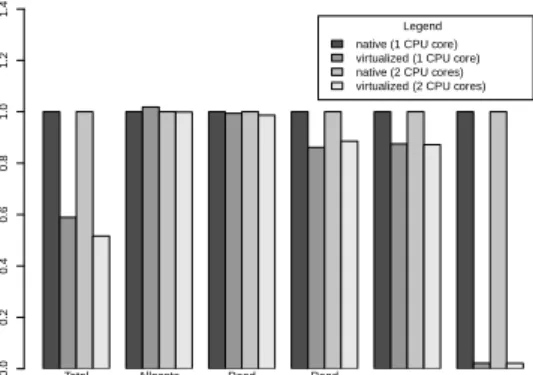
Looking at the fine-grained memory benchmark results depicted in Figure 2, one can see that for the memory-intensive workloads the main cause for the overall performance drop stems from the
alloca-tion of large memory areas. For theLarge RAM sub-benchmark, performance overhead is almost 97%. The problem was, that to replicate our VM template in the CPU overcommitment scenarios, we could only assign 256MB main memory to each VM because memory overcommitment is currently not supported by Citrix XenServer 5.5. However, when increasing this size to 3GB main memory in separate, indepen-dent experiment with one VM at a time, the perfor-mance overhead for large memory accesses is only 65% instead of 97%, which also improves the over-all memory benchmark results slightly. Hence, in-creasing memory allocation can significantly improve performance for memory-intensive workloads, espe-cially if expensive swapping can be avoided.
Total (Memory Mark) Allocate Small Block Read Cached Read
Uncached Write Large RAM
Legend native (1 CPU core) virtualized (1 CPU core) native (2 CPU cores) virtualized (2 CPU cores)
nor malized 0.0 0.2 0.4 0.6 0.8 1.0 1.2 1.4
Figure 2: Sub-benchmark results of the Passmark Memory Mark metric.
Finally, Figure 3 shows our results for disk I/O intensive workloads . With the Passmark Disk mark benchmark, we measured a performance overhead of up to 28%. A more detailed look at the benchmark results shows that most of the performance overhead is caused by sequentialreadrequests, which achieve only 60% of the native performance, whereas for
write request’s the performance overhead does not exceed 20%.
The performance increase for the random seek benchmark can be explained by the structure of the virtual block device, a concept used in Citrix XenServer 5.5 for block oriented read and write, min-imizing administration overhead and thus decreasing access times.
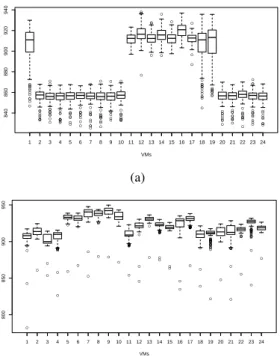
Scalability and Overcommitment Previous exper-imental results showed that the performance overhead can be reduced for CPU workload when using core affinity. The following more detailed measurements give more insights and explain why core affinity im-proves performance. Figure 4(a) shows the boxplot of 24 VMs simultaneously executing the CPU
bench-Total (Disk Mark) Sequential Read Sequential Write Random Seek (read/write) Legend native (1 CPU core) virtualized (1 CPU core) native (2 CPU cores) virtualized (2 CPU cores)
Subbenchmarks Festplatte (lokal)
nor malized 0.6 0.8 1.0 1.2 1.4
Figure 3: Sub-benchmark results for local disk access of the Passmark Disk Mark metric.
mark without core affinity. There are clearly two cat-egories of VMs, one category (1, 11-19) performing significantly different from the other (2-10, 20-24). This behavior is not observed with core affinity (see Figure 4(b)), when each VM is executed on a sep-arate physical core. This indicates that XenServer’s scheduler does not distribute the VMs on the cores equally. In general, it demonstrates that multicore en-vironments still are a challenge for hypervisor sched-ulers. In Section 3, we investigate if this effect is ob-servable on other hypervisor architectures, too.
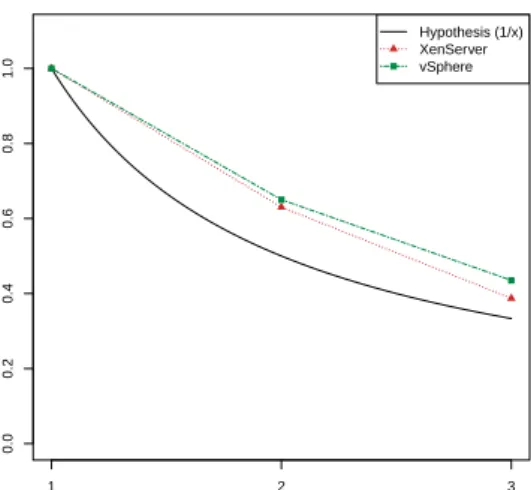
With core affinity enabled, for scalability and overcommitment the performance drops linear with the scaled amount of VMs and inversely proportional to the overcommitment factor, respectively. For ex-ample, assume c is the amount of physical cores. If provisioningx·camount of virtual CPUs, perfor-mance roughly drops by1xin each of our experimental environments (single core, dual core, 24 cores).
Network I/O We conducted further experiments with the network I/O benchmark Iperf to gain more insight on the performance overhead of XenServer’s credit-based scheduler and its performance isolation. More precisely, the goal of these experiments was to demonstrate how the additional overhead introduced by the hypervisor to handle I/O requests is distributed among the running VMs. To this end, we executed four VMs, two VMs running CPU Mark and two VMs withIperf. We pinned them pairwise on two physical cores, i.e., corec0 executed a pair of the CPU VM
and Iperf VM and a different available core cx the other pair. The CPU benchmark was executed on both VMs, simultaneously and the network I/O benchmark was started separately on one VM. This symmetric setup allows us to compare the results of VMs
exe-● ● ● ● ● ● ● ● ● ● ● ● ● ● ● ● ● ● ● ● ● ● ● ● ● ● ● ● ● ● ● ● ● ● ● ● ● ● ● ● ● ● ● ● ● ● ● ● ● ● ● ● ● ● ● ● ● ● ● ● ● ● ● ● ● ● ● ● ● ● ● ● ● ● ● ● ● ● ● ● ● ● ● ● ● ● ● ● ● ● ● ● ● ● ● ● ● ● ● ● ● ● ● ● ● ● ● ● ● ● ● ● ● ● ● ● ● ● ● ● ● ● ● ● ● ● ● ● ● ● ● ● ● ● ● ● ● ● ● ● ● ● ● ● ● ● ● ● ● ● ● ● ● ● ● ● ● ● ● ● ● ● ● ● ● ● ● ● ● ● ● ● ● ● 840 860 880 900 920 940 VMs CPU Mar k Rating 1 2 3 4 5 6 7 8 9 10 11 12 13 14 15 16 17 18 19 20 21 22 23 24 (a) ● ● ● ● ● ● ● ● ● ● ● ● ● ● ● ● ● ● ● ● ● ● ● ● ● ● ● ● ● ● ● ● ● ● ● ● ● ● ● ● ● ● ● ● ● ● ● ● ● ● ● ● ● ● ● ● ● ● ● ● ● ● ● ● ● ● ● ● ● ● ● ● ● ● ● ● ● ● ● ● ● ● ● ● ● ● ● ● ● ● ● ● ● ● ● ● ● ● ● ● ● ● ● ● ● ● ● ● ● ● ● ● ● ● ● ● ● ● ● ● ● ● ● ● ● ● ● ● ● ● ● ● ● ● ● ● ● ● ● ● ● ● ● ● ● ● ● ● ● ● ● ● ● ● ● ● ● ● ● ● ● 800 850 900 950 VMs CPU Mar k Rating 1 2 3 4 5 6 7 8 9 101112131415161718192021222324 (b)
Figure 4: CPU benchmark results for 24 VMs executed
without(a) andwith(b) core affinity.
cuted on c0 (where the Dom0 is executed) with the
results on the differentcorex.
+ ++ ++++++++++ + +++++++++++++ + ++++++++++ + +++++ + + +++ ++++++++++++++++++++++++++++++++++++++++++++++++ + + + 0 20 40 60 80 100 400 500 600 700 800 900
Network I/O performance effects
# Measurement
CPU Mar
k Rating
ooooooooooooo
o
oooooooooooooooooooooooooooooooooooooooooooooooooooooooooooooooooooooooooooooooooooooo
+ o
cpu mark measurements on corex
cpu mark measurements on core0
Figure 5: CPU benchmark results of two VMs executed on
core0 andcorexwhen network I/O is received by the VM
running oncorex.
One would expect that there is no performance ef-fect on the VMs running onc0when the Iperf VM on
V MA CPU CPU Mem CPU Mem Disk CPU Mem Disk
V MB CPU Mem Mem Disk Disk Disk Net Net Net
rA 46.71% 50.64% 50.33% 23.35% 24.82% 31.16% 52.88% 52.85% 3.07% rB 52.44% 45.93% 49.04% 1.49% -0.09% 45.99% 40.46% 42.18% 33.31%
Table 1: Mutual performance degradation for different workload types on Citrix XenServer 5.5.
cx executes network I/O. However, the results show that the performance of the VM running the CPU benchmark onc0drops up to 13% when the VM on
cxis executing the network I/O benchmark. Figure 5 depicts the CPU benchmark results of VMs executed oncore0(o) andcorex(+). The second VM oncorex receives the network load, hence the benchmark rat-ing of the VM sharrat-ing this core drops significantly. But also the benchmark rating of the VM oncore0
drops, although its paired VM is idle. Because VMs executed on other cores thanc0 did not exhibit this
behavior, this indicates that Dom0 mainly usesc0to
handle I/O. This causes a slight performance drop for VMs simultaneously executed onc0, i.e., about 1% on
average. However, this drop could further increase if further machines on other cores receive network load. We did not execute these scalability experiments as this would require further network interfaces to gen-erate network load on further Iperf VMs. However, this is an interesting question for future work as well as the question if this effect can be observed on other hypervisors too, which will be discussed in the fol-lowing section.
Mutual Influences of Workload Types Target of these experiments is to identify the mutual influences of VMs sharing their resources and serving different workload types. To this end, we pinned two VMs V MAandV MBon the same physical core other then core0 to avoid interferences with Dom0. Then, we
ran an experiment for each possible combination of benchmark types. As a result, we calculate the rel-ative performance drop asr=1−(ri/rs), where ri is the interference result andrs the result measured when executing the benchmark on an isolated VM. Table 1 summarizes the results for all combinations of workload types. Note that we did not run network vs. network experiments because a different hardware environment with additional hardware would have been required.
The results show that there are no significant mu-tual influences of CPU and memory intensive work-loads. The performance drop for both benchmarks is reasonably equal and the drop also fits the expec-tation that each VM receives only half of its perfor-mance compared to isolated execution. Explanations
are the similarity of both workload types in terms of the used resources (memory benchmarks require CPU as well) and the hardware support for CPU virtual-ization. An interesting observation is that the Disk benchmark is not influenced by other workload types except of when executed vs. the disk benchmark. This indicates that on Citrix XenServer 5.5, disk intensive workloads do not compete for resources of CPU and memory intensive workloads. This can be explained with the similar reason as for the virtualization over-head of the Disk mark result: the concept used in Cit-rix XenServer 5.5 for block oriented read and write to minimize administration overhead. With this concept, disk workload can be passed through without requir-ing major hypervisor intervention.
3
EVALUATION
To evaluate the validity of the conclusions from our analysis of XenServer on other hypervisor archi-tectures, we conducted the same experiments on an-other popular industry standard platform, VMware ESX 4.0, which has a different type of hypervisor ar-chitecture. This section compares the experiment re-sults of both platforms. We also provide a short ex-perience report on the portability of the automated experimental analysis approach, which is of general interest when migrating from one virtualization plat-form to another as well as for automatic administra-tion of virtualizaadministra-tion platforms.
3.1
Platform Comparison
The following discussion and comparison of the re-sults of our measurements on VMware ESX 4.0 has a similar structure as Section 2.5. However, because of unavailable driver support for the HP Compaq ma-chine (see Section 3.2), we were only able to install VMware ESX 4.0 and to conduct our experiments on the SunFire machine.
Overhead of Virtualization After repeating the experiments on VMware ESX 4.0, we calculate the relative delta between the two platforms as
V MwareESX4.0−CitrixX enServer5.5
V MwareESX4.0 . The results in
Ta-ble 2 show almost identical results for the CPU and memory benchmarks because both virtualization plat-forms use the hardware virtualization support. How-ever, for the I/O benchmarks, VMware ESX 4.0 per-forms better. The reason for this is that in Citrix XenServer 5.5, all I/O workload is handled by the separate driver domain Dom0, which is less efficient monolithic architecture of VMware ESX 4.0. Hence, it is important to distinguish these architectural differ-ences when generalizing the results for the I/O perfor-mance overhead.
Benchmark rel. Delta
CPU Mark 0.15% Memory Mark 0.19% Disk Mark 19.14% Iperf, outgoing 13.91% Iperf, incoming 15.94%
Table 2: Relative deviation of CPU, memory, disk I/O and network I/O benchmark results.
Scalability and Overcommitment Concerning the performance behavior of VMware ESX 4.0 when scaling up and overcommitting, respectively, we observe a similar trend to the one on Citrix XenServer 5.5. Figure 6 shows this trend for the over-commitment scenario. As one can see, both platforms behave similarly. The results for scalability are simi-lar with VMware ESX 4.0 performing slightly better. Another observation was that on VMware ESX 4.0, using core affinity did not result in any performance improvements. This indicates an improved hypervi-sor scheduling strategy which takes care of multicore environments and the cache and core effects observed in Section 2.5.
Network I/O Analyzing the results of the network I/O experiments repeated on VMware ESX 4.0 shows some further advantages of the monolithic architec-ture and that the concept of a separate management VM (Dom0) has a slight performance drawback. For example, we did not observe the effect of the Dom0 discussed in Section 3.1 (Network I/O). Hence, on VMware ESX 4.0, the additional overhead for I/O vir-tualization is distributed more evenly than in Citrix XenServer 5.5.
Mutual Influences of Workload Types We re-peated the same experiments to determine the mutual influences of workload types on VMware ESX 4.0. Table 3 lists the results. For CPU and memory in-tensive workloads, the observations are comparable
0.0 0.2 0.4 0.6 0.8 1.0 Overcommitment factor CPU Mar k Rating (nomr aliz ed) Hypothesis (1/x) XenServer vSphere CPU overcommitment 1 2 3
Figure 6: Performance behavior for CPU overcommitment for Citrix XenServer 5.5 and VMware ESX 4.0.
to the ones for Citrix XenServer 5.5: both workload types have a similar effect on each other caused by their similarities.
However, there is a big difference to Citrix XenServer 5.5 for disk intensive workload. For VMware ESX 4.0, we observe a high performance degradation of the disk workload independent of the other workload type. For example, if the disk bench-mark is executed with CPU or memory benchbench-mark, disk benchmark results drop almost 50%, whereas CPU and memory benchmark results suffer from only 10% and 20% performance loss, respectively. One ex-planation is that VMware’s virtual disk concept is dif-ferent from Xen and in this concept both VMs com-pete for CPU time assigned by the hypervisor, thus confirming the differences in both hypervisor archi-tectures. However, CPU and memory suffer from less performance degradation when running against disk workload than in Citrix XenServer 5.5.
3.2
Portability of the Automated
Analysis
The first problem when applying the automated ex-perimental analysis approach to VMware ESX 4.0 was that we could not install it on the HP Compaq machine because of the lack of driver support. Sup-porting only commodity hardware keeps the mono-lithic hypervisor’s footprint low. Because of Cit-rix XenServer 5.5’s architecture, further drivers can be easily implemented in the Dom0 domain while still keeping the hypervisors footprint small. Hence, we could not repeat the measurements for VMware ESX 4.0 on the HP Compaq machine. The next
chal-V MA CPU CPU Mem CPU Mem Disk CPU Mem Disk
V MB CPU Mem Mem Disk Disk Disk Net Net Net
rA 47.03% 46.64% 49.23% 10.02% 17.21% 44.53% 9.95% 35.32% 14.87% rB 48.21% 40.29% 51.34% 49.56% 45.53% 44.82% 65.02% 54.56% 32.74%
Table 3: Mutual performance degradation for different workload types on VMware ESX 4.0.
lenge we faced was that the VMs of VMware ESX 4.0 are usually intended to be managed via graphical ex-ternal tools, which hinders an automated approach. Fortunately, a special command line interface, which must be activated separately, can be used for automa-tion.
As both platforms support theOpen Virtualization Format (OVF)for virtual machines in theroy, port-ing the MasterVM should be easy. Although this standardized XML schema for OVF is in fact imple-mented on both platforms, they use a different XML tag semantic to describe the VM geometry (like its partitions etc.). Hence, the export of a VM from Citrix XenServer 5.5 to VMware ESX 4.0 works in theory, but practically only with additional tools and workarounds, involving manual XML editing.
Once migrated, one can reuse the concept of au-tomated experimental analysis and experiment types, but one has to adapt the scripts to the new API. For ex-ample, the credit-based scheduler parametercapacity is named differently on VMware ESX 4.0.
In summary, the concept itself is portable but re-quires some manual adjustments. This mainly stems from the fact that currently there is no standardized and working virtual machine migration mechanism across different virtualization platforms.
3.3
Summary
By migrating and repeating our automated analysis to VMware ESX 4.0, we were able to confirm the results for CPU and memory intensive workloads as well as the observed trends in the scalability and over-commitment scenarios. However, the experiments also showed that there are differences when handling I/O intensive workloads. In these scenarios, VMware ESX 4.0’s performance behavior and performance isolation is better. However, this product has high licensing costs. Moreover, it is intended for graphi-cal administration which makes automized adminis-tration more difficult.
4
MODELING THE
PERFOR-MANCE-INFLUENCING
FACTORS
Having analyzed two major representative virtual-ization platforms, we now structure the performance-influencing factors and capture them in a basic math-ematical performance model allowing one to predict the performance impacts of virtualized environments.
4.1
Categorizing the
Performance-Influencing Factors
This section categorizes the performance-influencing factors of the presented virtualization platforms. The goal is to provide a compact hierarchical model of performance-relevant properties and their dependen-cies. We capture those factors that have to be con-sidered for performance predictions at the applica-tion level, i.e., that have a considerable impact on the virtualization platform’s performance, and we struc-ture them in a so-calledfeature model(Czarnecki and Eisenecker, 2000). In our context, a feature corre-sponds to a performance-relevant property or a con-figuration option of a virtualization platform. The goal of the feature model is to capture the options that have an influence on the performance of the virtual-ization platform in a hierarchical structure. The fea-ture model should also consider external influencing factors such as workload profile or type of hardware. The model we propose is depicted in Figure 7.
The first performance-influencing factor is the vir-tualization type. Different techniques might cause different performance overhead, e.g., full virtualiza-tion performs better than other alternatives because of the hardware support. In our feature model, we distin-guish between the three types of virtualization: i) full virtualization, ii) para-virtualization and iii) binary translation. Furthermore, our experiments showed, that another important performance-influencing fac-tor is the hypervisor’s architecture. For example, a monolithic architecture exhibited better performance isolation.
Several influencing factors are grouped under re-source management configuration. First, the CPU
Virtualization Platform Binary Translation Para-Virtualization Full Virtualization Virtualization Type exclusive OR Legend inclusive OR Resource Management Configuration CPU Scheduling CPU Allocation Core Affinity Workload Profile I/O CPU Memory Network Disk CPU Priority Memory Allocation
Number of VMs Resource Overcommitment VMM Architecture Dom0 Monolitic e.g. cap=50 e.g. mask=1,2 e.g. vcpu=4
Figure 7: Major performance-influencing factors of virtualization platforms.
scheduling configuration has a significant influence on the virtualization platform’s performance and is influenced by several factors. The first factor CPU allocation reflects the number of virtual CPUs allo-cated to a VM. Most of the performance loss of CPU intensive workloads comes from core and cache infer-ences (Apparao et al., 2008). Hence, the second factor is core affinity, specifying if virtual CPUs of VMs are assigned to dedicated physical cores (core-pinning). The third factor reflects the capability of assigning different CPU priorities to the VMs. For example, the Xen hypervisor’s cap parameter or VMware’s lim-its and fixed reservations parameters are CPU pri-ority configurations. In addition, the level of re-source overcommitment influences the performance due to contention effects caused by resource shar-ing. Finally, the memory allocation and the number of VMs influence the resource management config-uration, too. Managing virtual memory requires an additional management layer in the hypervisor. The number of VMs has a direct effect on how the avail-able resources are shared among all VMs.
Last but not least, an important influencing fac-tor is the workload profile executed on the virtual-ization platform. Virtualizing different types of re-sources causes different performance overheads. For example, CPU virtualization is supported very well whereas I/O and memory virtualization currently suf-fer from significant performance overheads. In our model we distinguish CPU, memory and I/O intensive workloads. In the case of I/O workload, we further distinguish between disk and network intensive I/O workloads. Of course, one can also imagine a work-load mixture as a combination of the basic workwork-load types.
4.2
Performance Model
Based on the results of Section 2.5 and Section 3 we now propose a basic mathematical performance
prediction model (e.g., based on linear regression). We focus on the performance-influencing factors for which similar results were observed on the two virtu-alization platforms considered. These are the over-head for CPU and memory virtualization, the per-formance behavior in scalability scenarios and the performance behavior when overcommitting CPU re-sources. Our model is intended to reflect the perfor-mance influences of the factors presented in the previ-ous section. It can be used to predict the performance overhead for services to be deployed in, e.g., Cloud Computing or virtualized environments in general.
In our experiments, performance is measured as the amount of benchmark operations processed per unit of time, i.e., the throughput of the system. This is not directly transferable to system utilization or re-sponse times, as the benchmarks always try to fully utilize the available resources. Therefore, in the fol-lowing, we refer to throughput as the system perfor-mance. We calculate a performance overhead fac-tor owhich can be used to predict the performance pvirtualized=o·pnative, whereo can be replaced by a formula of one of the following sections.
Overhead of Virtualization The following basic equations allow to predict the overhead introduced when migrating a native system to a virtualized plat-form. These equations assume that there are no influ-ences by other virtual machines, which we consider later below.
For CPU and memory virtualization, we cal-culate the overhead factors ocpu and omem as 1−relative deviation100 using the measured relative devi-ation values. One can use our automated approach to determine these factors for any other virtualization platform to derive more specific overhead factors.
For I/O overhead, we recommend to measure the performance overhead for each specific virtualization platform using our automated approach because the
evaluation showed that there are significant differ-ences between different virtualization platforms and their implementations, respectively.
Scalability To model the performance-influence of scaling-up CPU resources, we use a linear equation. The performance overhead is defined asoscal=a+b· cvirt, wherecvirt is the number of virtual cores. The coefficientsaandbare given in Table 4. We distin-guish between scenarios without core affinity and sce-narios, where the virtual CPUs are pinned to the phys-ical cores in an equal distribution. These equations give an approximation of the performance degrada-tion when scaling-up which is independent of the vir-tualization platform. However, this approximation is only valid until you reach the amount of physi-cal cores available. The overcommitment scenario is modeled in the next section. Moreover, the coeffi-cients of determination show that the linear trend fits very well, except for the CPU with affinity scenario.
Scenario a b R2
CPU 1.008 -0.0055 0.9957 Memory 1.007 -0.0179 0.9924 CPU (w. affinity) 1.003 -0.0018 0.7851 Memory (w. affinity) 1.002 -0.0120 0.9842
Table 4: Coefficientsa,bfor the linear equations for CPU
and memory performance when scaling-up and the corre-sponding coefficient of determination.
Overcommitment When considering a scenario with overcommitted CPU resources, we can approxi-mate the performance overhead asooverc=1x, where x is the overcommitment factor. The overcommit-ment factor is determined by cvirt
cphy, the ratio of the
provisioned virtual corescvirt and available physical corescphy. Note that for CPU overcommitment this dependency between the performance overhead and the overcommitment factor is independent of the vir-tualization platform and the amount of executed VMs. Our experiments on two leading industry standard virtualization platforms demonstrated that the perfor-mance overhead simply depends on the ratio of virtual and physical cores. This dependency is valid at the core level, i.e., if you pin two VMs with one virtual core each on a single physical core, you experience the same performance drop.
5
RELATED WORK
There are two groups of existing work related to the work presented in this paper. The first group
deals with benchmarking and performance analysis of virtualization platforms and solutions. The second group is related to this work in terms of modeling the performance-influencing factors.
(Barham et al., 2003) present the Xen hypervisor and compare its performance to a native system, the VMware workstation 3.2 and a User-Mode Linux at a high level of abstraction. They show that the per-formance is practically equivalent to a native Linux system and state that the Xen hypervisor is very scal-able. (Qu´etier et al., 2007; Soltesz et al., 2007; Padala et al., 2007) follow similar approaches by bench-marking, analyzing and comparing the properties of Linux-VServer 1.29, Xen 2.0, User-Mode Linux ker-nel 2.6.7, VMware Workstation 3.2. and OpenVZ, another container-based virtualization solution. (Ap-parao et al., 2008) analyze the performance charac-teristic of a server consolidation workload. Their re-sults show that most of the performance loss of CPU intensive workloads is caused by cache and core in-terferences. However, since the publication of these results, the considered virtualization platforms have changed a lot (e.g., hardware support was introduced) which renders the results outdated. Hence, the results of these works must be revised especially to evaluate the influences of, e.g., hardware support. Moreover, the previous work mentioned above does not come up with a model of the performance-influencing factors nor does it propose a systematic approach to quan-tify their impact automatically. Such a generic frame-work to conduct performance analyses is presented in (Westermann et al., 2010). This framework allows adding adapters to benchmark, monitor, and analyze the performance of a system. The framework has been applied to the performance analysis of message-oriented middleware, however, the adapters currently do not support the analysis of performance properties of virtualization platforms or Cloud Computing envi-ronments.
The second area of related work is the model-ing of virtualization platforms or shared resources. (Tickoo et al., 2009) identify the challenges of mod-eling the contention of the visible and invisible re-sources and the hypervisor. In their consecutive work based on (Apparao et al., 2008; Tickoo et al., 2009), (Iyer et al., 2009) measure and model the influences of VM shared resources. They show the importance of shared resource contention on virtual machine per-formance and model cache and core effects, but no other performance-influencing factors. Another teresting approach to determine the performance in-terference effects of virtualization based on bench-marking is (Koh et al., 2007). They explicitly con-sider different types of workloads (applications) and
develop performance prediction mechanisms for dif-ferent combinations of workloads. Unfortunately, this approach is neither automated nor evaluated on differ-ent platforms.
6
CONCLUSION AND OUTLOOK
In this paper, we conducted fine-grained ex-periments and in-depth analyses of the Citrix XenServer 5.5 based on the results of (Huber et al., 2010). We migrated this approach to VMware ESX 4.0 and evaluated the validity of the previous findings. In summary, the results showed that CPU and memory virtualization performance behavior is similar on both systems as well as CPU scalability and overcommitment. However, the results also indi-cated a deviation when it comes to I/O virtualization and scheduling. In these cases, VMware ESX 4.0 provides better performance and performance isola-tion than Citrix XenServer 5.5. We evaluated the portability of the automated experimental analysis ap-proach. Finally, we presented a basic model allow-ing to predict the performance when migratallow-ing ap-plications from native systems to virtualized environ-ments, for scaling up and overcommitting CPU re-sources, or for migrating to a different virtualization platform. As a next step, we plan to study the perfor-mance overhead for mixed workload types and their mutual performance influence in more detail. In addi-tion, we will use our model as a basis for future work in the Descartes research project (Descartes Research Group, 2010; Kounev et al., 2010). For example, we will integrate our results in a meta model for per-formance prediction of services deployed in dynamic virtualized environments, e.g., Cloud Computing.
ACKNOWLEDGMENTS
This work was funded by the German Research Foundation (DFG) under grant No. 3445/6-1.
REFERENCES
Apparao, P., Iyer, R., Zhang, X., Newell, D., and Adelmeyer, T. (2008). Characterization & Analysis
of a Server Consolidation Benchmark. InVEE ’08.
Barham, P., Dragovic, B., Fraser, K., Hand, S., Harris, T., Ho, A., Neugebauer, R., Pratt, I., and Warfield, A.
(2003). Xen and the Art of Virtualization. In
Sym-posium on Operating Systems Principles.
Czarnecki, K. and Eisenecker, U. W. (2000). Generative
Programming. Addison-Wesley.
Descartes Research Group (2010). http://www.descartes-research.net.
Huber, N., von Quast, M., Brosig, F., and Kounev, S. (2010). Analysis of the Performance-Influencing
Fac-tors of Virtualization Platforms. InDOA’10.
IDC (2010). Virtualization Market Accelerates Out of the Recession as Users Adopt ”Virtualize First”
Men-tality. http://www.idc.com/getdoc.jsp?containerId
=prUS22316610.
IT world, The IDG Network (2008). Gartner’s data
on energy consumption, virtualization, cloud.
http://www.itworld.com/green-it/59328/gartners-data-energy-consumption-virtualization-cloud. Iyer, R., Illikkal, R., Tickoo, O., Zhao, L., Apparao, P., and
Newell, D. (2009). VM3: Measuring, modeling and
managing VM shared resources.Computer Networks,
53(17):2873 – 2887.
Koh, Y., Knauerhase, R. C., Brett, P., Bowman, M., Wen, Z., and Pu, C. (2007). An analysis of performance
in-terference effects in virtual environments. InISPASS.
Kounev, S., Brosig, F., Huber, N., and Reussner, R. (2010). Towards self-aware performance and resource
man-agement in modern service-oriented systems. InInt.
Conf. on Services Computing.
Menasc´e, D. A., Almeida, V. A. F., and Dowdy, L. W.
(1994). Capacity Planning and Performance
Model-ing - From Mainframes to Client-Server Systems. Padala, P., Zhu, X., Wang, Z., Singhal, S., and Shin, K. G.
(2007). Performance evaluation of virtualization
tech-nologies for server consolidation. HP Labs Tec.
Re-port.
Qu´etier, B., N´eri, V., and Cappello, F. (2007). Scalability
Comparison of Four Host Virtualization Tools.Jounal
on Grid Computing, 5(1):83–98.
Rosenblum, M. and Garfinkel, T. (2005). Virtual machine
monitors: current technology and future trends.
Com-puter, 38(5):39–47.
Salsburg, M. (2007). Beyond the Hypervisor Hype. In
CMG-CONFERENCE, volume 2, page 487.
Soltesz, S., P¨otzl, H., Fiuczynski, M. E., Bavier, A., and Peterson, L. (2007). Container-based operating sys-tem virtualization: a scalable, high-performance
al-ternative to hypervisors. SIGOPS Oper. Syst. Rev.,
41(3):275–287.
Tickoo, O., Iyer, R., Illikkal, R., and Newell, D. (2009). Modeling virtual machine performance: Challenges
and approaches. InHotMetrics.
VMware (2007). A performance comparison of
hy-pervisors. http://www.vmware.com/pdf/hypervisor
performance.pdf.
Westermann, D., Happe, J., Hauck, M., and Heupel, C.
(2010). The Performance Cockpit Approach: A
Framework for Systematic Performance Evaluations. InSEAA’10.