Validation of Synchronous Reactive Systems:
from Formal Verication to Automatic Testing
?Nicolas Halbwachs, Pascal Raymond fNicolas.Halbwachs,[email protected]
Verimag??, Grenoble { France
Abstract. This paper surveys the techniques and tools developped for
the validation of reactive systems described in the synchronous data-ow languageLustre[HCRP91]. These techniques are based on the
specica-tion of safety properties, by means ofsynchronous observers. The model-checkerLesar[RHR91] takes aLustreprogram, and two observers |
respectively describing the expected properties of the program, and the assumptions about the system environment under which these properties are intended to hold |, and performs the verication on a nite state (Boolean) abstraction of the system. Recent work concerns extensions towards simple numerical aspects, which are ignored in the basic tool. Provided with the same kind of observers, the toolLurette[RWNH98]
is able to automatically generate test sequences satisfying the environ-ment assumptions, and to run the test while checking the satisfaction of the specied properties.
1 Introduction
Synchronous languages [Hal93,BG92,LGLL91,HCRP91] have been proposed to design so-called \reactive systems", which are systems that maintain a perma-nent interaction with a physical environment. In this area, system reliability, and therefore design validation, are particularly important goals, since most reactive systems are safety critical. As a consequence, many validation tools have been proposed, which are dedicated to deal with systems described by means of synchronous languages. These tools either concern automatic verica-tion [LDBL93,DR94,JPV95,Bou98,RHR91], formal proof [BCDP99], or program testing [BORZ98,RWNH98,MHMM95,Mar98].
As a matter of fact the validation of synchronous programs, on one hand raises specic problems | like taking into account known properties of the envi-ronment | and on the other hand allows the application of specic techniques | since the programs to be validated are deterministic systems with inputs, in contrast with classical concurrent processes, which are generally modelled as non-deterministic and closed systems. Both for formal verication and for testing, the user has to specify:
?This work was partially supported by the ESPRIT-LTR project \SYRF".
??Verimag is a joint laboratory of Universite Joseph Fourier, CNRS and INPG
1. the intended behavior of the program under validation, which may be more or less precisely dened. In particular, it may consist of a set of properties, and, for the kind of considered systems, critical properties are most of the time safety properties.
2. the assumptions about the environment under which the properties specied in (1) are intended to hold. These assumptions are generally safety proper-ties, too.
In synchronous programming, a convenient way of specifying such safety prop-erties is to use \synchronous observers" [HLR93], which are programs observing the inputs and the outputs of the program under validation, and detect the violation of the property. Once these observers have been written, automatic validation tools can use them for
formal verication:
One can verify, by model-checking, that for each input ow satisfying the assumption, the corresponding output ow satisfy the property. In general, this verication is performed on a nite-state abstrac-tion of the program under vericaabstrac-tion.automatic testing:
The assumption observer is used to generate realistic test sequences, which are provided to the program; the property observer is used as an \oracle" determining whether each test sequence \passes" or \fails". In this paper, we present these approaches in the context of the declarative languageLustre[HCRP91]. A model-checker forLustre, calledLesar[RHR91], has been developped for long, and extended towards dealing with simple numer-ical properties. Two testing tools,Lutess[BORZ98] andLurette[RWNH98] are also available; here, we focus onLurette, which has some numerical capa-bilities.2 Synchronous Observers in LUSTRE
2.1 Overview of Lustre
Let us rst recall, in a simplied way, the principles of the language Lustre: A Lustre program operates on ows of values. Any variable (or expression)
x represents a ow, i.e., an innite sequence (x 0 ;x 1 ;:::;x n ;:::) of values. A program is intended to have a cyclic behavior, and x
n is the value ofx at the nth cycle of the execution. A program computes output ows from input ows. Output (and possibly local) ows are dened by means of equations (in the mathematical sense), an equation \x=e" meaning \8n;x
n= e
n". So, an equation can be understood as a temporal invariant.Lustreoperators operate globally on ows: for instance, \x+y" is the ow (x
0+ y 0 ;x 1+ y 1 ;:::;x n+ y n ;:::). In addition to usual arithmetic, Boolean, conditional operators | extended pointwise to ows as just shown | we will consider only two temporal operators:
{
the operator \pre" (\previous") gives access to the previous value of its argu-ment: \pre(x)" is the ow (nil;x0 ;:::;x
n 1
;:::), where the very rst value \nil" is an undened (\non initialized") value.
{
the operator \->" (\followed by") is used to dene initial values: \x->y" is the ow (x 0 ;y 1 ;:::;y n;:::), initially equal tox, and then equal toyforever. As a very simple example, the program shown below is a counter of \events": It takes as inputs two Boolean ows
\evt" (true whenever the counted \event" occurs), and \reset" (true whenever the counter should be reinitialized), and returns the num-ber of occurrences of \events" since the last \reset". Once declared, such a \node" can be used any-where in a program, as a user-dened operator. For instance, our counter can be used to generate an event \minute" every 60 \second", by counting \second" modulo 60.
node Count(evt, reset: bool) returns(count: int); let
count = if (true->reset) then 0
else if evt then pre(count)+1 else pre(count)
tel
mod60 = Count(second, pre(mod60=59)); minute = (mod60 = 0);
2.2 Synchronous Observers
Now, an observer inLustrewill be a node taking as inputs all the ows relevant to the safety property to be specied, and computing a single Boolean ow, say \ok", which is true as long as the observed ows satisfy the property.
For instance, let us write an ob-server checking that each occur-rence of an event \danger" is fol-lowed by an \alarm" before the next occurrence of the event \deadline". It uses a local variable \wait", trig-gered by \danger" and reset by \alarm", and the property will be violated whenever \deadline" occurs when \wait" is on.
node Property(danger, alarm, deadline: bool) returns (ok: bool);
var wait: bool; let
wait = if alarm then false else if danger then true else (false->pre(wait));
ok = not(deadline and wait); tel
Assume that the above property is intended to hold about a system S, computing \danger" and \alarm", while \deadline" comes from the environment. Obviously, except if S emits
\alarm" simultaneously with each \danger", it cannot fulll the prop-erty without any knowledge about \deadline". Now, assume we know that \deadline" never occurs earlier than two cycles after \danger".
node Assumption(danger, deadline: bool) returns (ok: bool);
let ok = not deadline or
(true->pre(not danger and
(true->pre(not danger))));
tel
(danger, alarm, ...) = S(deadline, ...); realistic = Assumption(danger, deadline);
correct = Property(danger, alarm, deadline); S
Assumption
Property
realistic
correct
Fig.1.Validation Program
2.3 Validation Program
Now we are left with 3 programs: the programS under validation, and its two observers, Property and Assumption. We can compose them in parallel, in a surrounding program called \Validation Program" (see Fig.1). Our verication problem comes down to showing that, whatever be the inputs to the validation program, either the output \correct" is always true, or the output \realistic" is sometimes false. The advantages of using synchronous observers for specication have been pointed out:
{
there is no need to learn and use a dierent language for specifying than for programming.{
observers are executable; one can test them to get convinced that the specied properties are the desired ones.Notice that synchronous observers are just a special case of the general tech-nique [VW86] consisting in describing the negation of the property by an automa-ton (generally, a Buchi automaautoma-ton), and showing, by performing a synchronous product of this automaton and the program, that no trace of the program is accepted by the automaton. The point is that, in synchronous languages, the synchronous product is the normal parallel composition, so this technique can be applied within the programming language.
3 Model-Checking
3.1 Lustre programs as state machines
Of course, aLustreprogram can be viewed as a transition system. All operators, exceptpre and->, are purely combinational, i.e., don't use the notion of state. The result of a -> operator depends on whether the execution is in its rst cycle or not: let init be an auxiliary Boolean state variable, which is initially true, and then always false. The result of apreoperator is the value previously taken by its argument, so eachpreoperator has an associated state variable. All these state variables dene the state of the program. Of course, programs that have only Boolean variables have nitely many states and can be fully veried by model-checking [QS82,CES86,BCM+90,CBM89]: when the program under verication and both of its observers are purely Boolean, one can traverse the
nite set of states of the validation program. Only states reached from the initial state without falsifying the output \realistic" are considered, and in each reached state, one check that, for each input, either \realistic" is false, or \correct" is true. This can be done either enumeratively (i.e., considering each state in turn) or symbolically, by considering sets of states as Boolean formulas.
3.2 Lustre programs as interpreted automata
Programs with numerical variables can be partially veried, using a similar ap-proach. We consider such a program as an intepreted automaton: the states of the automaton are dened by the values of the Boolean state variables, as above. The associated interpretation deals with the numerical part: conditions and actions on numerical variables are associated with the transitions of the automaton. An example of such an interpreted automaton will be shown in Sec-tion 4. If it happens that a property can be proved on the (nite) control part of the automaton, then it is satised by the complete program. Otherwise, the result is unconclusive.
3.3 LESAR
Lesar is a verication tool dedicated to Lustre programs. It performs the kind of verication described above, by traversing the set of control states of a validation program, either enumeratively of symbolically. More precisely, it restricts its search to the part of the program that can inuence the satisfaction of the property. This part, sometimes called the cone of inuence, can be easily determined, because of the declarative nature of the language: all dependences between variables are explicit. This is an important feature, since experience shows that, in many practical cases, the addressed property only concerns a very small part of a program: in such a case, Lesarmay be able to verify the property, even if the whole state space of the program could not be built.
4 Towards Numerical Properties
Only properties that depend only on the control part of the program can be veried by model checking. The reason is thatLesarcan consider as reachable some control states that are in fact unreachable because of the numerical in-terpretation, which is ignored during the state space traversal: some transitions are considered feasible, while being forbidden by their numerical guards. Let us illustrate this phenomenon on a very simple example, extracted from a subway speed regulation system:
A train detects beacons placed along the track, and receives a signal broad-cast each second by a central clock. Ideally, it should encounter one beacon each second, but, to avoid shaking, the regulation system applies a hysteresis as fol-lows: let#band#sbe, respectively, the current numbers of encountered beacons
Late EarlyLate OnTime
Init Early
Fig.2.Interpreted automaton of the subway example
and of elapsed seconds. Whenever#b #sbecomes greater 10, the train is con-sidered early, until#b #sbecomes negative. Symmetrically, whenever#b #s
becomes smaller than 10, the train is considered late, until#b #sbecomes positive. We only consider the part of the system which determines whether the train is early of late. InLustre, the corresponding program fragment could be:
di = 0 -> if second and not beacon then pre(di){1
else if beacon and not second then pre(di)+1 else pre(di);
early = false-> if di>10 then true
else if di<0 then false
else pre(early); late = false-> if di<{10 then true
else if di>0 then false
else pre(late);
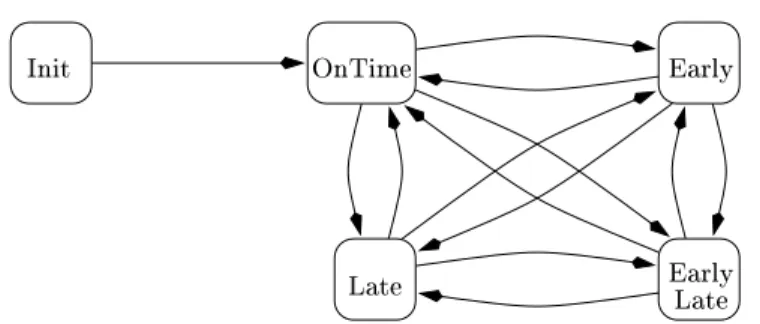
This program has 3 Boolean state variables: the auxiliary variable init (ini-tially true, and then false forever) and the variables storing the previous val-ues of earlyandlate. The corresponding interpreted automaton has the control structure shown by Fig 2, and, for instance, the transitions sourced in the state \OnTime" are guarded as follows:
g 1:di >10^di 10!Early g 3:di >10^di< 10!EarlyLate g 2:di 10^di< 10!Late g 4:di 10^di 10!OnTime Without any knowledge about numerical guards, the model-checker does not know that some of these guards (g
1 and g
2) can be simplied, nor that one of them (g
3) is unsatisable. This is why the state \EarlyLate" is considered reachable.
A transition the guard of which is numerically unsatisable will be called statically unfeasible. In our example, if we remove statically unfeasible transi-tions, we get the automaton of Fig. 3, where the state \EarlyLate" is no longer reachable. A simple way of improving the power of a model-checker is to provide
OnTime Init
Late Early
Fig.3.The subway example without statically unfeasible transitions
Late OnTime Early
Init
di0
10di10
di0
Fig.4.The subway example without dynamically unfeasible transitions it with the ability of detecting statically unfeasible transitions, in some simple cases. For instance, unfeasibility of guards made of linear relations is easy to decide1.
This is why Lesar has been extended with such a decision procedure in linear algebra: when a state violating the property is reached by the standard model-checking algorithm, the tool can look, along the paths leading to this state, for transitions guarded by unfeasible linear guards. If all such \bad" paths can be cut, the \bad" state is no longer considered reachable. This very par-tial improvement signicantly increases the number of practical cases where the verication succeeds.
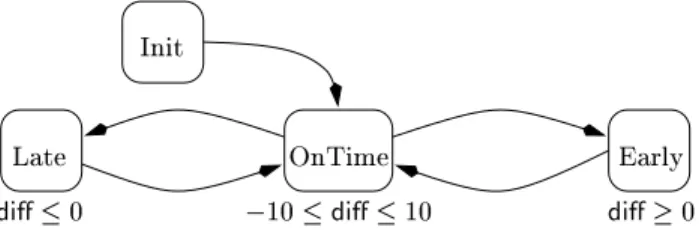
Of course, we are not always able to detect statically unfeasible transitions. Moreover, some transitions are unfeasible because of the dynamic behavior of numerical variables. For instance, in the automaton of Fig. 3, there are direct transitions from state \Early" to state \Late" and conversely. Now, these tran-sitions are clearly impossible, since di varies of at most 1 at each cycle, and cannot jump from being 0 in state \Early" to becoming < 10 in state \Late". Such transitions are called dynamically unfeasible. Detecting dynami-cally unfeasible transitions is much more dicult. We experiment \linear relation analysis" [HPR97] | an application of abstract interpretation | to synthesize invariant linear relations in each state of the automaton. If the guard of a transi-tion is not satisable within the invariant of its source state, then the transitransi-tion 1 at least for rational solutions; but since unfeasibility in rational numbers implies
is unfeasible. In our example, we get the invariants shown in Fig. 4, which allow us to remove all unfeasible transitions.
5 Automatic Testing
In spite of the progress of formal verication, testing is and will remain an important validation technique. On one hand, the verication of too complex systems | with too complex state space, or important numerical aspects | will remain unfeasible. On the other hand, some validation problems are out of the scope of formal verication: it is the case when parts of the program cannot be formally described, because they are unknown or written in low level languages; it is also the case when one wants to validate the nal system within its actual environment. So, verication and testing should be considered as complementary techniques. Moreover, testing techniques and tools should be mainly devoted to cases where verication either fails or does not apply. This is why we are especially interested in techniques that cope with numerical systems, that don't need a formal description of the system under test (black box testing), and the cost of which doesn't depend on the internal complexity of the tested system.
Intensive testing requires automation, since producing huge test sets by hand is extremely expensive and error-prone. Now, it appears that the prerequisite for automatic generation of test sets is the same as for verication: an automatic tester will need a formal description of both the environment | to generate only realistic test cases | and the system under test | to provide an \oracle" deciding whether each test passes or fails. In section 2, we proposed the use of synchronous observers for these formal descriptions. In theLurette[RWNH98] andLutess[BORZ98] tools, such observers are used to automatically generate and run test sequences. In this section, we explain the principles of this genera-tion.
The specic feature of reactive systems is, of course, that they run in closed loop with their environment. In particular, they are often intended to control their environment. This means that the current input (from the environment) may depend on the past outputs (from the system). In other words, the realism of an input sequence does not make sense independently of the corresponding output sequence, computed by the system under test. This is why, in our ap-proach, test sequences are generated on the y, as they are submitted to the system under test.
More precisely, we assume that the following components are available:
{
an executable version of the system un-der test, sayS. We only need to be able to run it, step by step.{
The observers A and P, respectively describing the assumptions about the environment and the properties to be checked during the test.S realistic correct P A i o
Moreover, the output \realistic" of the observerAis required not to depend instantaneously of the outputs \o" ofS. Since \o" is supposed to be computed from the current input \i", it would be a kind of causality loop that the realism of \i" depend on \o".
Basically, the tester only needs to know the source code of the observerA, and to be able to run the systemSand the observerP, step by step. It considers, rst, the initial state ofA: in this state, theLustrecode ofAcan be simplied, by replacing each expression \e
1 ->e
2" by \ e
1", and each expression \pre( e)" by \nil". After this simplication, the result \realistic" is a combinational expression of the input \i", say \b(i)". The satisfaction of the Boolean formulab(i) can be viewed as a constraint on the initial inputs to the system. A constraint solver | which will be detailed below | is used to randomly select an input vectori
0 satisfying this constraint. Now, S is run for a step oni
0, producing the output vectoro
0(and changing its internal state). Knowing both i
0and o
0, one can run A and P for a step, to make them change their internal state, and to get the oracle \correct" output byP. TheLustrecode ofAcan be simplied according to its new state, providing a new constraint on \i". The same process can be repeated as long as the test passes (i.e., P returns \correct= true"), or for a given number of steps.
The considered tools mainly dier in the selection of input vectors satisfying a given constraint. InLutess [BORZ98], one consider only purely Boolean ob-servers. A constraint is then a purely Boolean formula, which is represented by a Binary Decision Diagram. A correct selection corresponds to a path leading to a \true" leaf in this BDD. The tool is able to perform such a selection, ei-ther using an equiprobable strategy, or taking into account user-given directives. Lurette [RWNH98] is able to solve constraints that are Boolean expressions involving Boolean inputs and linear relations on numerical inputs.
Example: Let us illustrate the generation process on a very simple example. Assume S is intended to regulate a physical valueu, by constraining its second derivative. Initially, bothuand its derivative are known to be 0. Then, the second derivative ofuwill be in an interval [ ;+] around the (previous) outputx of S. An observer of this behavior can be written as follows:
node A (u, x: real) returns (realistic: bool); var dudt, d2udt2: real;
let
dudt = 0->(u { pre(u));
d2udt2 = dudt { pre(dudt);
realistic = (u=0)->((pre(x) { delta<=d2udt2)
and (d2udt2<=pre(x) + delta));
tel
At the rst cycle, the code ofAis simplied to
There is only one way of satisfying the constraint, by choosing u
0 = 0. The systemSis run for one cycle, with this input value, letx
0be the returned value. At the second cycle, we know that
pre(u)= 0; pre(dudt)= 0; pre(x)=x 0 So the code ofAis simplied to
dudt = u; d2udt2 = dudt; realistic = (x
0{delta
<=d2udt2) and (d2udt2<=x
o+delta); which gives the (linear) constraint x
0
u x
0+
. Assume the value u
1= x
0+
is selected, and provided toS, which returns some new valuex 1. At the next cycle, we know that
pre(u)=pre(dudt)=x 0+
; pre(x)=x 1 So, the code ofAsimplies to
dudt = u { (x
0+delta); d2udt2 = dudt { ( x
0+delta);
realistic = (x 1{delta
<=d2udt2) and (d2udt2<=x
1+delta) which gives the constraintx
1+ 2 x 0 ux 1+ 2 x 0+ 2 , and so on...
6 Conclusion
We have presented some validation techniques, which mainly derive from the specication of properties by synchronous observers. While not being restricted to synchronous models, this way of specifying properties is especially natural and convenient in that context, since the same kind of language can be used to describe the system and its properties.
Our presentation was centered on the languageLustre, but the techniques could be adapted to any synchronous language. Notice, however, that some ideas were directly suggested by the declarative nature ofLustre. For instance, syn-chronous observers were a natural generalization of the relations in Esterel, which are a way of expressing known implications or exclusion between input events. When transposed intoLustre, these relations are just special cases of invariant Boolean expressions. Generalized to any BooleanLustre expression, this mechanism provides a way of specifying any safety property. Also, in test sequence generation, the idea of considering an observer as a (dynamic) con-straint is especially natural when the observer is written inLustre, but can be adapted to any synchronous language.
References
[BCDP99] S. Bensalem, P. Caspi, C. Dumas, and C. Parent-Vigouroux. A method-ology for proving control programs with Lustre and PVS. InDependable Computing for Critical Applications, DCCA-7, San Jose. IEEE Computer Society, January 1999.
[BCM+90] J.R. Burch, E.M. Clarke, K.L. McMillan, D.L. Dill, and J. Hwang.
Sym-bolic model checking: 1020 states and beyond. InFifth IEEE Symposium
on Logic in Computer Science, Philadelphia, 1990.
[BG92] G. Berry and G. Gonthier. The Esterel synchronous programming lan-guage: Design, semantics, implementation.Science of Computer Program-ming, 19(2):87{152, 1992.
[BORZ98] L. du Bousquet, F. Ouabdesselam, J.-L. Richier, and N. Zuanon. Lutess: testing environment for synchronous software. In Tool support for Sys-tem Specication Development and Verication. Advances in Computing Science, Springer, 1998.
[Bou98] A. Bouali. Xeve: an Esterel verication environment. In Tenth Inter-national Conference on Computer-Aided Verication, CAV'98, Vancouver (B.C.), June 1998. LNCS 1427, Springer Verlag.
[CBM89] O. Coudert, C. Berthet, and J. C. Madre. Verication of synchronous sequential machines based on symbolic execution. InInternational Work-shop on Automatic Verication Methods for Finite State Systems, Greno-ble. LNCS 407, Springer Verlag, 1989.
[CES86] E. M. Clarke, E. A. Emerson, and A. P. Sistla. Automatic verication of nite-state concurrent systems using temporal logic specications. ACM TOPLAS, 8(2), 1986.
[DR94] R. De Simone and A. Ressouche. Compositional semantics of esterel
and verication by compositional reductions. In D. Dill, editor,6th Inter-national Conference on Computer Aided Verication, CAV'94, Stanford, June 1994. LNCS 818, Springer Verlag.
[Hal93] N. Halbwachs. Synchronous programming of reactive systems. Kluwer Academic Pub., 1993.
[HCRP91] N. Halbwachs, P. Caspi, P. Raymond, and D. Pilaud. The synchronous dataow programming language Lustre. Proceedings of the IEEE,
79(9):1305{1320, September 1991.
[HLR93] N. Halbwachs, F. Lagnier, and P. Raymond. Synchronous observers and the verication of reactive systems. In M. Nivat, C. Rattray, T. Rus, and G. Scollo, editors,Third Int. Conf. on Algebraic Methodology and Software Technology, AMAST'93, Twente, June 1993. Workshops in Computing, Springer Verlag.
[HPR97] N. Halbwachs, Y.E. Proy, and P. Roumano. Verication of real-time systems using linear relation analysis. Formal Methods in System Design, 11(2):157{185, August 1997.
[JPV95] L. J. Jagadeesan, C. Puchol, and J. E. Von Olnhausen. Safety property verication ofesterelprograms and applications to telecommunication
software. In P. Wolper, editor, 7th International Conference on Com-puter Aided Verication, CAV'95, Liege (Belgium), July 1995. LNCS 939, Springer Verlag.
[LDBL93] M. Le Borgne, Bruno Dutertre, Albert Benveniste, and Paul Le Guernic. Dynamical systems over Galois elds. InEuropean Control Conference, pages 2191{2196, Groningen, 1993.
[LGLL91] P. LeGuernic, T. Gautier, M. LeBorgne, and C. LeMaire. Programming real time applications withSignal.Proceedings of the IEEE, 79(9):1321{
1336, September 1991.
[Mar98] B. Marre. Test data selection for reactive synchronous software. In
DagstuhlSeminarReport 223: Test Automation for Reactive Systems -Theory and Practice, September 1998.
[MHMM95] M. Mullerburg, L. Holenderski, O. Maeis, and M. Morley. Systematic testing and formal verication to validate reactive programs. Software Quality Journal, 4(4):287{307, 1995.
[QS82] J. P. Queille and J. Sifakis. Specication and verication of concurrent systems inCesar. In International Symposium on Programming. LNCS
137, Springer Verlag, April 1982.
[RHR91] C. Ratel, N. Halbwachs, and P. Raymond. Programming and verifying critical systems by means of the synchronous data-ow programming lan-guageLustre. InACM-SIGSOFT'91 Conference on Software for Critical
Systems, New Orleans, December 1991.
[RWNH98] P. Raymond, D. Weber, X. Nicollin, and N. Halbwachs. Automatic testing of reactive systems. In19th IEEE Real-Time Systems Symposium, Madrid, Spain, December 1998.
[VW86] M. Y. Vardi and P. Wolper. An automata-theoretic approach to automatic program verication. InSymposium on Logic in Computer Science, June 1986.