Parent Involvement in Mathematics Education: Parents and Teachers Working Together to Improve Student Self-Confidence in Mathematics
Presented in Fulfillment of the Requirements for The Master of Education Degree in the
College of Education and Human Services Professions
By
James E. Monson II
University of Minnesota Duluth 2010
Committee Signature: Chair
Member
Dedication
This paper is dedicated to all the students I have had and will have in the future, who have taught me what it means to be a good educator; to my wife Amanda who stuck by me through my frustrations and accomplishments along the way; and my son James for not forgetting who I am when working late nights.
Acknowledgements
I have to thank Kim Riordan, Barb Johnson, Diane Rauschenfels and the rest of the UMD graduate program staff for all their help in the construction of this thesis
project. Without their help it would be no more than an idea in one mathematics teacher’s head.
I also must thank my family for sticking with me through the many late nights and Saturdays spent away from the family. Also a special thanks goes out to the schools that worked with me during the collection of data and the implementation of the daily assignment sheets. And my neighbors for the use of their Internet and the tremendous amount of time spent proofing my paper. Without all of these people, this thesis would not exist.
Abstract
Parent Involvement in Mathematics Education: Parents and Teachers Working Together to Improve Student Self-Confidence in Mathematics was a mixed methods research project involving four schools from two rural counties in east-central Minnesota. The purpose of the study was to test a theory of how parent involvement in math
education relates to students’ work ethic and confidence in math. It was a study that used pre- and post- questionnaires given to teachers, students, and parents/guardians along with a daily assignment sheet sent home over the duration of four weeks. The results looked for improvement in students’ self-confidence in mathematics through a supportive learning environment and time spent working on mathematics.
Table of Contents
Chapter One - Introduction... 1
Purpose of Study... 1 Background...2 Setting... 4 Assumptions... 4 Limitations... 5 Summary... 6
Chapter Two - Literature Review...7
No Child Left Behind: Rules for Parent Involvement... 8
Connection Between School and Home... 9
Types of Parent Involvement... 9
Constraints on Parent Involvement... 11
Positive Effects of Parent Involvement on Academics... 12
Negative Effects of Parent Involvement on Academics... 14
Glimpse into Elementary, Middle and High School... 14
Student Benefits...15
Focus on Math... 15
Teachers’ View of Parent Involvement...16
Examples of Teachers Getting Parents Invovled... 17
Framework and Theory... 18
Conclusion...19
Setting and Participants...21
Research Design...22
Data Analysis...24
Summary...24
Chapter Four- Results and Discussion...26
Educator Pre-Questionnaires...26 Student Pre-Questionnaires... 28 Parent/Guardian Pre-Questionnaires... 33 Educator Post-Questionnaires... 35 Student Post-Questionnaires... 37 Parent/Guardian Post-Questionnaires... 43 Conclusion...45
Chapter Five - Summary and Conclusions...46
Educational Implications... 46
Recommendations for Future Research...47
Conclusion... 49
References... 51
Table of Appendices Appendix A - Consent Letter From Schools...54
Appendix B - Parent Consent Form...55
Appendix C - Student Assent Form...57
Appendix D - Notification of IRB Status...59
Appendix F - Questionnaires...62 Appendix G - Daily Assignment Sheet...68
Chapter 1 Introduction
With the state and national standards putting tremendous pressure on today’s youth to be successful in math, what can parents and teachers do to help students reach these standards? Mathematics is a subject that has a strong emphasis for students to do well and according to Sheldon and Epstein(2005), “efforts to change mathematics education have positioned parents on the sidelines, leaving educators and other professionals to decide how mathematics learning should take place” (p. 196). This brings up a need to get the parents involved in math education, to get them working with teachers to achieve a common goal of student success in mathematics.
Purpose of the Study
The purpose of the study was to test a theory of how parent involvement in math education relates to students’ work ethic and confidence in math. The populations involved in the study were students enrolled in Algebra II/Advanced Algebra in high schools in two rural counties in east central Minnesota. After the first open-ended questionnaire the teachers and parents had a line of communication through the use of daily assignment sheets sent home for parents to sign. With the assignment sheets the parents were asked to provide a quiet place to do homework, positive encouragement towards learning math and answering/asking questions when needed. The teachers were asked to be available before and after school for 10 to 15 minutes to allow time for students to ask individual questions. After four weeks another set of questionnaires was administered to determine if students’ work ethic and math confidence had improved. At
this point in the research, the goal was to build a line of communication between parents and teachers to improve student work ethic and math confidence.
Background
Teachers have long been in support of parent involvement and giving suggestions for how parents can take part in their child’s mathematics education (Sheldon & Epstein, 2005). However, Fax and Chen (2001) found inconsistent operational definitions of parent involvement, which lead to inconsistent findings about the relationship between parent involvement and their child’s academic achievement. Sheldon and Epstein(2005) found, “teacher-designed interactive homework and mathematics materials for families and students to use at home were rated more positively for boosting students’ skills than were video tapes” (p.201). In addition, Gonzalez (2002) cited that parental support offers students a sense of security in an unpredictable world as students work on their self- development.
Patall, Cooper and Civey Robinson (2008) found “factors such as the type of involvement, the subject matter of the homework, the achievement outcome assessed, and the grade or abilities level of the student may all be variables that affect whether parent involvement in homework will positively influence achievement” (p. 1044). With all of the different variables, Hoover-Dempsey and Sandler (1995) suggest that parents who get involved in their child’s learning can lead to success in school. Deplanty, Coulter-Kern and Dochane (2007) mentioned that there are many constraints holding parents back from being involved in their child’s education, such as parents’ social networks and parents’ level of education. Bauch and Goldring (2000) found that teachers were more likely to be in contact with parents if teachers worked in a supportive environment. Similarly
Sheldon and Epstein (2005) stated, “school leaders for partnerships expressed high levels of confidence that family and community involvement activities can help improve
student learning and achievement in mathematics” (p. 204).
One finding Patall et al. (2008) mentioned was “ ... the significant positive correlation between parent involvement in homework and achievement for high school students” (p. 1090). Ma (1999) also commented that parental involvement in schoolwork helped with student performance and skill development. Parent involvement in
homework had a positive impact on homework completion by lessening student issues about doing homework (Patall et al., 2005).
According to Deplanty et al. (2007) parent-child conversations on the topic of education can have a positive impact on students’ academics and can improve behavior. In support, Gonzalez-Dehass, Willems and Doan Holbein (2005) found, “when parents show an interest and enthusiasm for what their children are learning, they provide a support system at home that buttresses the child’s academic learning and reinforces the value of schooling” (2005, p.111). Ma (1999) also states that a positive home
environment that stresses the importance of school and provides assistance and supervision has a positive impact on students’ academic lives. Overall, parent involvement has many constraints and styles, but researchers have found parent
involvement has a positive impact on student success. Much of the body of research that explains the importance of parent involvement does little to give examples of how to create parent involvement itself. Getting parents involved in children’s education is something that math teachers and schools need to address.
Setting
The research for this study was done in two rural counties in east central Minnesota, focused on parents and their students enrolled in Algebra II/Advanced
Algebra in the 2009-2010 school year. The age of the students being studied was between 114 and 18 years of age.
Assumptions
As a math teacher for two school districts in east central Minnesota, the reseacher has had several issues to deal with: the state and national standards that students need to reach in order to graduate, student resistance to learning mathematics, lack of parent involvement in academics, and lack of time to have adequate communication with parents. The standards seem to change every three years, increasing the amount of math students need to know to graduate and at what rate students have to learn math.
Attempting to help students change their negative attitudes about math is a daily challenge. In a seven year teaching career, parent teacher conferences have shown that fewer than 25 percent of parents attended, and the parents that attended mentioned that math was difficult for them or they had not done math for a long time. Finally, there is not enough time during the workday to contact all the parents and develop a plan to help their child succeed in math. It has been the researcher’s goal to improve students’ views of mathematics and have academic success in math.
Through experiences a gap appeared that needed to be filled. First, build a line of communication between parents and teachers that was adequate without the involvement of daily phone calls or emails. Second, the teacher should share information with parents on how to help their son/daughter succeed in math. Third, the teacher should be available
before and after school for students to receive extra help when needed. The goal in doing these three things was to improve students’ work ethic and confidence in math. What the researcher expected from parents was to allow for quiet work time; give their
son/daughter positive encouragement to finish their homework; and when needed, provide a ride to school or encouragement to ask the teachers questions right when the bus arrives at school. Expectation for teachers was to be available before and after school for 10 to 15 minutes for individual questions. With parents, teachers, and students
working as a team, it was felt that learning mathematics would become easier and success would follow.
In a review of literature it was found that parent involvement was important and had a positive impact on student academic success. What the researcher did not find was an example of how to get parents involved with students’ academics. There were several reasons why parents did not help their children with math or expect their children to do well in math. With the graduation standards in place there is a need to change student and parent attitudes towards math. Thus, the focus of this study was to determine if a line of communication improved student attitude toward math and overall work ethic.
Limitations
This study was conducted in small rural schools with graduation class sizes between 40 and 80 students. Within the schools there is very little ethnic diversity and a majority of the students come from lower to middle socioeconomic class homes.
Therefore, the results of this study may not be replicated in larger suburban schools with larger class sizes or students from a variety of ethnic or more diverse socioeconomic backgrounds.
Summary
The purpose of this study was to open a line of communication between parents and teachers to help improve student work ethic and confidence in math. It was
conducted in four schools from two rural counties in east central Minnesota. The underlying goal of the study was to create a team effort with students, parents and teachers working together to help students gain more confidence in mathematics. The theory that was used to reach this goal was for students to bring home daily assignment sheets for parents to sign to verify time spent on mathematics homework. This line of communication was designed to have an answer to the parents’ response, “I didn’t know my child had homework.” This line of communication between the teachers and parents might help students improve their work ethic, which in turn would improve their grade in math along with their self-confidence in math.
Chapter 2 Literature Review
Parent involvement in student education has been the focus of education reform for a long time. Gonzalez (2002) stated that parental involvement is the second largest issue for school improvement, following only lack of funding. Shirvani (2005) also mentioned that lack of parent involvement is one of the biggest obstacles that schools face. He found a comment from, “former President [George H.W.] Bush, in America 2000, mentioned that American parents are an important component of their children’s academic future success” (p.34). According to Bauch and Goldring (2000), “... parents are considered organizational ‘outsiders’ in relation to the school” (p.4). With this in mind, parents’ attitude toward the school is a connection to the attitude their child has about school (Shirvani, 2005).
The literature review contains different types of parent involvement discussed, such as Deplanty et al.’s (2007) research about the importance of parent involvement across their child’s entire educational career, especially during the adolescent years. A discussion on the positive and negative effects of parent involvement in education, which mostly focused on direct or indirect effect on grades is also included (Fehrmann, Keith & Reimers, 1987). According to No Child Left Behind law (NCLB) (2007), “if parents believe that their actions can make a difference, they are more likely to be involved” (p.6). In addition to these beliefs, there were also different ways for parents to get involved. According to Hoover-Dempsey and Sandler (1995) most parents get involved for three reasons: personal beliefs of their role in their child’s life, sense of efficacy, and opportunities and demands from the child and/or school.
Throughout the studies different methods of measuring student achievement are used, including GPA, individual class grades, standardized test, and more. Math was included in this literature review, since it was a major focus of most graduation standards presently. But according to Sheldon and Epstein (2005), “... efforts to change
mathematics education have positioned parents on the sidelines, leaving educators and other professionals to decide how mathematics learning should take place” (p. 196). One thing to keep in mind is that: “School and family are the two most important institutions that affect the development of children” (Ma, 1999, p. 60). The goal of this literature review is to discover some of the research and ideas that have been done about parent involvement, not to pinpoint the perfect type of parent involvement.
No Child Left Behind: Rules for Parent Involvement
NCLB has had a great impact on education today; it has identified many areas that need change (Patall et al, 2008). According to the Gifted Child Today (2007), NCLB has nine rules to help involve parents in education:
1. Write parent-involvement policies that are developed jointly with parents. 2. Hold an annual meeting to explain parent’s rights to be involved.
3. Write school-improvement plans that include strategies for parent involvement. 4. Spend around 1% of the districts money on engaging families.
5. Inform parents, in an understandable language, about the progress of their children and what they can do to help.
6. Notify parents if a teacher does not meet the federal definition of “highly qualified.”
8. Inform parents if a school is low performing and provide options for
transferring to a better performing school and free tutoring the following year. 9. Spread information about effective parent-involvement practices and help
schools with lagging parent-involvement programs, (p. 6).
In addition to NCLB, Hoover-Dempsey and Sandler (1995) came up with six levels of parent involvement: raising children, talking with families, volunteering, home-based learning, involving parents in school decision making, and collaboration in the community. There are many ways parents can get involved and how schools can get parents involved.
Connection Between School and Home
Historically teachers expect parents to bring children to school prepared to learn and support the choices the school makes (Bauch & Goldring, 2000). Also according to Halsey (2004), traditional parent involvement included raising money, chaperoning events, and attending school-sponsored events. These types of events only indirectly create a connection between the school and parents (Halsey, 2004). Gonzalez-DeHass et al., (2005) found, “...when parents are engaged as a resource for academic activities at home, the bridge between the school and home environments becomes more apparent” (p.118). Furthermore, the successful partnership between schools and parents takes on the challenge of getting the families involved that are hard to reach (Sheldon & Epstein, 2005).
Types of Parent Involvement
There are numerous ways parents can get involved in their child’s life and education. The definition that Gonzalez-Dehass et al., (2005) used was involvement with
children’s education as the focus. They went on to add more specific examples:
participating in parent-teacher conferences and/or interactions, participating in school activities and/or functions, engaging in activities at home including but not limited to homework, engaging in students’ extracurricular activities, assisting in the selection of student’s courses, keeping abreast of student’s academic progress, reaction to student’s academic grades, imparting parental values (Gonzalez- Dehass et al., 2005, p. 108).
In addition to Gonzalez et al’s (2005) definition of parent involvement, Ma (1999) said there are three types of involvement: behavioral (participation in school events), personal (cares about student’s life out of school), and intellectual (exposes their child to
intellectual concepts). Another view of parent involvement comes from Kaplan, D., Liu and Kaplan, H.(2001) who said that parents should become involved in students’ lives with positive attitude towards learning to build their child’s confidence and
encouragement towards academics.
Another form of parent involvement is modeling, showing one’s child the
importance of an education (Hoover-Dempsey & Sandler, 1995). In addition to modeling, reinforcement is another effective parent involvement technique, both positive and
negative reinforcement. A third type, according to Hoover-Dempsey and Sandler (1995), is interaction, both direct (factual for what they are learning) and indirect (support for school functions and activities). One more thing that Hoover-Dempsey and Sandler (1995) mentioned, “personal sense of efficacy for helping children succeed in school means that a parent believes that he or she has the skills and knowledge necessary to help his or her children,... and that he or she can find alternative sources of skill or
knowledge” (1995, p. 314). Therefore, parents who do provide support for children without becoming controlling, influence academic motivation in children (Urdan, Solek & Schoenfelder, 2007).
Of all the ways parents can get involved, the main focus of this literature review is parents’ involvement in homework. According to Fehrmann et al. (1987), parents who are involved in controlling time spent on homework versus watching TV increases student academic progress. Ma (1999) added to time spent on homework and TV, that modeling and encouraging promotes a good learning environment. Sheldon and Epstein (2005) said that getting involved in children’s homework allows parents and teachers to communicate, increases parent involvement, and helps to improve student academic achievement. According to teachers, the most important form of parent involvement is at home (Deplanty et al., 2007). Finally, Patall et al.,(2008) found, “the most commonly cited benefit of parent involvement is that it can be used to accelerate learning by
increasing the amount of time students spend studying and making homework study more efficient, effective, and focused” (p. 1040).
Constraints on Parent Involvement
Getting parents involved is not as easy as it seems, because parents have jobs, more than one child, different levels of education, and more. Hoover-Dempsey and Sandler (1995) found “parents’ time cut down sharply on the possibilities of their involvement in children’s education” (p. 318). In addition to time, there are scheduling conflicts and transportation issues that affect many parents (Gonzalez-Dehass et al., 2005). Another issue found by both Fehrmann et al.,(1987) and DePlanty et al. (2007) is that families’ socioeconomic status can affect the amount of parent involvement.
Sheldon and Epstein (2005) found three reasons why parents might not get involved with helping children with mathematics,
parents may not have the content knowledge or teaching skills needed to help their children ... changes in the way that mathematics is taught in school may result in parents’ confusion or resistance to some of the new or nontraditional aspects of their children’s mathematics school work ... teachers are not trained to teach adults how to work on mathematics with their children (p. 198).
A similar reason parents do not get involved is the pressure parents feel toward the expectations of them (Urdan et al., 2007). One more issue about parent involvement is students’ lack of interest (Gonzalez, 2002) and excuses: forgot my homework, refused to do homework, denied having homework, complained about homework, among others (Patall et al., 2008).
Positive Effects of Parent Involvement on Academics
One theoretical explanation of positive effects of parent involvement is that it allows children to build up cognitive skills that will help them succeed academically (Ma,
1999). Another explanation is students’ views of their parents’ expectations of their academic achievement is a highly motivating factor (Gonzalez-DeHass et al., 2005). Urdan et al. (2007) found that students became higher achievers in part to make parents proud and to be role models for younger siblings.
Students in some studies showed that intrinsic motivation is a key to academic success. Gonzalez-DeHass et al., (2005) indicated that “children’s intrinsic motivation is more positive when parents receive weekly communications from the teacher and when children see their parents involved in their education” (p. 111). Involved parents who do
not control their child, help the child build a strong self-concept and perform well in academics (Urdan et al., 2007). According to Deplanty et al. (2007) families that show support across their children’s lives have children that do well in school.
Many researchers have discussed that effect of positive parent involvement, but according to Hoover-Dempsey and Sandler (1995),
Effectively involved parents also offer children multiple instances of verbal persuasion, as they encourage children to put forth more and effective effort,
develop and explain limits and boundaries that encourage effective school work, and explain the importance of succeeding in school (p. 328).
In agreement, Fan and Chen (2001) had similar finding of parents’ aspiration as the strongest predictor for children’s academic success. Increasing parent involvement and support will help children build skill and knowledge (Hoover-Dempsey & Sandler, 1995). Another researcher, Gonzalez (2002), found that when parents get involved, children engage and perform better in school. She went on to say that it went across all four major subject areas: math, English, social studies, and science.
Research also discovered that parent involvement in homework has many positive effects on a child’s academic performance. In 1987 Fehrmann et al, noticed that students who spent more time on homework had higher grades. Similarly in 2008, Patall et al. found that setting rules about homework had the largest relationship for achievement; it allowed for students to engage in self-regulation, and led to a higher homework
Negative Effects of Parent Involvement on Academics
On the other hand, parents can go too far with their involvement to the point where it will have a negative effect on students. Gonzalez-DeHass et al., (2005) stated, “the more parents were involved in monitoring, enforcing, or helping with homework, the more students reported being extrinsically motivated and dependent on external sources for academic guidance and evaluation” (p. 110). Researchers also found that parent involvement that does not come by request of their child can be considered parental control and have a negative effect (Patall et al., 2008). Kaplan et al. (2001) had similar findings that too much parent involvement may cause pressure and children may rebel. Other research has found that extrinsic motivation can be associated with poorer academic achievement (Urdan et al., 2007). One last negative effect is that homework supervision alone is not a good indicator of parent involvement (Fan & Chen, 2001). Glimpse into Elementary, Middle and High School
Research has shown that personal engagement of parents has positive effects on students from elementary to high school (Shirvani, 2005). Fehrmann et al., (1987) found, “parental involvement effects seem especially stable at the elementary level” (p 331). Patall et al., (2008) had similar findings; “training parents to be involved in homework may result in a significant positive effect on achievement for elementary school students but not for middle school students” (p. 1062). According to Sheldon and Epstein (2005) parent beliefs about mathematics predict achievement in elementary and middle school. In the transition stage, younger students need parent involvement to help develop self- management and study habits (Patall et al., 2008).
In high school, students become more peer- oriented, independent, and less
interested in what parents believe (Hoover-Dempsey & Sandler, 1995). When researching the reason why students drop out of higher mathematics, Ma (1999) found that prior grades earned and negative attitudes are the largest influence for dropping out. Gonzalez- DeHass et al., (2005) found a positive view; “parental involvement is also positively related to high school students’ academic achievement, time spent on homework,
favorable attitudes toward school, and reduced levels of high school drop outs” (p. 100). On the other side of the spectrum, Hoover-Dempsey and Sandler (1995) mentioned that many students succeed in high school without parent involvement.
Student Benefits
Students agree that parent involvement helps them do better (Patall et al., 2008). Deplanty et al., (2007) discovered that “...parent involvement is a valuable component of any student’s education” (p. 361). When students receive encouragement from parents to spend more time on homework, it indirectly leads to better grades (Fehrmann et al., 1987). Gonzalez-DeHass et al., (2005) found that, “students whose parents are involved are more likely to take personal responsibility for their learning” and “are more likely to seek challenging tasks, ... and experience satisfaction in their school work” (p. 117 — 118). One other discovery Gonzalez (2002) made was that parent support can give adolescents a sense of security as they build their own identity.
Focus on Math
Mathematics has been the underlying focus for this literature review, due to the pressures of the state and national standards. Why do students dislike math and how can parents help children with math? Ma (1999) found, “... mathematics achievement has
traditionally emphasized psychological factors, such as students’ anxiety about learning mathematics and their attitude toward the subject” (p. 64). In addition, Sheldon and Epstein (2005) found four things that hold the United States back in math: curriculum and instruction, student attitudes, student readiness, and level of support from home. One explanation given by Patell et al. (2008) is that parents interfere with learning since their instruction can be different than the teacher.
Ways to support mathematics discussed by Sheldon and Epstein (2005) include having students and parents talk about math during homework and providing resources for parents to use at home. They also commented about having a meeting with the teacher, parent and counselor to receive training on how to help with math homework. Shirvani’s (2005) results stated, “compared with the control group, parents of the students in the experimental group were significantly involved and had more positive attitudes toward mathematics homework assignments” (p. 42). He also found that children from the experimental group had higher self-confidence in doing math. If something does not change students’ attitude toward math, students will be at a disadvantage to survive economically (Ma, 1999).
Teachers’ View of Parent Involvement According to Weaver (2001),
There is no official manual on engaging parents and community members, but there are effective strategies that can serve as a prescription for success in getting parents, especially hurried parents with little time and few resources, to
In an article by Keller (2008), Bill Simmer (a parent-relations consultant) said that parent involvement goes both ways: what can parents expect from the school, and what can the school expect from parents? An example of what teachers expect of parents is to make sure their children are ready to learn and support school decisions (Bauch & Goldring, 2000). Bauch and Goldring (2000) went on to state that teachers provide information to parents, but usually do not make first contact. One reason for this, according to Deplanty et al. (2007), is that teachers do not have the time. Another key aspect a teacher looks for in parent involvement is to make sure students complete their homework (Deplanty et al., 2007).
Examples of Teachers Getting Parents Involved
One thing teachers need to take into account is that what matters the most is how the students experience what we do (Kohn, 2008). Weaver (2007) mentioned that
educators should start the year saying, “team NEA [National Education Association], as we start a new school year, the message we must send to parents is that we can’t replace you, we can’t do it for you, but together, we can make a huge difference for your child” (2007, p. 9). Another thing Weaver (2007) mentioned is that we need to meet parents halfway to show our dedication to their child’s success. In Weaver’s (2007) article he tells a story of a teacher who battled a language barrier with parents by creating a “Books and Supper Night” to allow families to read and interact together. Keller tells a story of how “you have to be a bit of a risk-taker”(as cited by Keller, 2008, p. 3), explaining how a kindergarten teacher kept parent volunteers from just helping their own child, by keeping them moving around the room. Another example is an eighth grade teacher who has parents plan the end of the year party, and a band teacher looking for parents to get
involved in planning the band trip (Halsey, 2004). The last story is from the New York Times about a ninth grade English teacher who has created a blog that parents have to do as part of their child’s homework assignment (Kelley, 2007). There are many different ways teachers can get parents involved.
Framework and Theory
Throughout this literature review there have been a variety of studies that have been read and analyzed. Fan and Chen (2001) conducted meta-analysis of academic achievement and Patall et al. (2008) conducted meta-analysis of parent involvement in homework. Bauch and Goldring (2000) explored the organization of the relationship between parent and teacher. Ma’s (1999) study of why students drop out of higher mathematics used a panel study and student questionnaires that had an attitude scale of zero to nine in order to collect data. Sheldon and Epstein’s (2005) study “focus on results in math” used school surveys done with partnerships with Johns Hopkins University. Deplanty et al.’s (2007) study on perceptions of parent involvement started with focus groups, interviews, then created the survey, and even conducted a pilot study. Kaplan et al., (2001) “hypothesized that the extent to which parents feel positively or negatively about themselves regarding their attaining a certain level of education and the extent to which children are aware of these feelings affects children’s perceptions of their parents’ educational expectations” (p. 361). Hoover-Dempsey and Sandler (1995) asked the research question of why parents become involved, and kept two variables in mind: parent involvement and parent perspective. Shirvani’s (2005) quantitative analysis of a control and experimental group looking for evidence that parent involvement is positive. Fehrmann et al.’s (1987) path analysis connected variables related to parent involvement:
ethnicity, family background, gender, ability, parental involvement, homework, TV time, and grades.
Conclusion
Throughout this literature review there has been an emphasis put on the
importance of parent involvement. As Gonzalez (2002) stated, “when parents showed an interest in their child’s education by being actively involved, students were more likely to seek challenging tasks, persist through academic challenges, and experience satisfaction in their school work” (p. 133). Along the same lines, Hoover-Dempsey and Sandler (1995) discovered that parents support academic accomplishments and developing skills that allow for academic success. Researchers also came to the conclusion that parental involvement with encouragement and support showed high academic achievement (Fan & Chen, 2001). Patall et al. (2008) found students who do their homework do better academically, and parents who show concern and suggest or encourage students to increase their homework time can lead to higher grades (Fehrmann et al., 1987). The overall emphasis of this literature review is, “when parents were involved, students report more effort, concentration, and attention across four main subject areas: maths, English, social studies, and science” (Gonzalez-DeHass et al., 2005, p. 109). But on the topic of mathematics, Sheldon and Epstein (2005) found, “efforts to change mathematics education have positioned parents on the sidelines, leaving educators and other professionals to decide how mathematics learning should take place” (2005, p. 196). Throughout the literature review there has been positive support for parent involvement, but there were only a few studies on certain ways to create parent involvement. There is a need to research ways in which to get parents involved in mathematics education, to see
if parent involvement in mathematics education can build strong student work ethic and self-confidence in math.
Chapter 3 Methodology
The purpose of this research project was to determine if a line of communication between parents/guardians and mathematics teachers would have an impact on student self-confidence in math. It focused on getting past the issue of “I didn’t know my child had math homework” and student comment, “I don’t get it.” It aspired to minimize the occurrence of both of these situations.
This chapter contains information about the participants, the questions being asked, and how the information will be analyzed.
Setting and Participants
The participants in the research project were teachers, students and parents/guardians from four rural high schools from two counties in east-central
Minnesota. These particular schools were selected for their similarities: graduation size, location (proximity to the researcher), just off the same freeway, and only 40 miles separate the schools. They are all part of the same outside organizations, such as athletic conference and an assessment/evaluation group. Each participating school gave approval for the research project to be conducted within their school districts; see Appendix A for a sample letter.
Within the schools the students and parents/guardians were selected by the students’ enrollment in Algebra 2/Advanced Algebra course. This particular class was chosen because of the state and national standards emphasis on algebra and the passing of the MCA II graduation test. The age range of the students was between the ages of 14 and
of the student participants was 79 females to 55 males. All participants’ names were kept confidential, through the use of student ID numbers distributed by their classroom
teachers. The information disclosed in the research paper will not contain any direct information about participants involved. The participants were guaranteed confidentiality in order for them to be open and honest when they filled out the questionnaires. The consent form sent to participants is included in Appendix B and Appendix C.
The educators for this research project were selected because Algebra 2/Advanced Algebra is one of their assigned courses. There were six educators in all: four women and two men (one of which was the researcher). Four had more than 15 years of experience and two had less than 8 years of experience. The class sizes varied from 19 to 29 students per class. Identification information about the school or classroom teacher is not included in this research project to ensure the educators’ open and honest responses to the pre- and post-questionnaires.
In January 2010, the IRB: Human Subjects Committee at the University of Minnesota granted approval for this study as exempt from review under federal guidelines relating to collection of data within schools. See Appendix D for letter containing the IRB information.
Research Design
The research was completed in three stages: pre-intervention questionnaires, then a classroom intervention (daily assignment sheets), and following with a post-
intervention questionnaire. Each of the four schools was contacted in November 2009 by phone, followed by a letter and example of questionnaires. Email contact was used throughout the research project. The parents/guardians and students were contacted in
February 2010 by sending a letter and consent form home to parents asking them to be a participant in the research project. See Appendix E for letter to parents. At the same time the pre-questionnaires were administered. All questionnaires were filled out in the
comfort of the participant’s own home. This was to allow the participants not to have any outside influences affect how they answered the questions.
All questionnaires where designed using ideas from the text Research Methods in Education. (Cohen, L., Manion, L., & Morrison, K., 2009) All questionnaires had a disclaimer stating: “Please be as truthful as possible in completing this questionnaire. You do not need to write your name and no individuals will be identified or traced from this questionnaire, your confidentiality and anonymity are assured.” For examples of questionnaires see Appendix F. Each question had a distinct purpose for the research project. The questions were designed to inquire about: the students’ confidence and work ethic, how the parents/guardians interpreted student work ethic and got involved, and identified educator concerns prior to the use of the daily assignment sheet.
In four weeks that followed the pre-questionnaires, a daily assignment sheet was implemented; see Appendix G for the daily assignment sheet. The daily assignment sheet asked parents to sign and keep track of the amount of time the student spent working on mathematics homework and to help students develop questions when their son/daughter was struggling. The daily assignment sheet was designed to be a non-oral daily
communication between parents/guardians and teachers. The importance of the daily assignment sheet was that it allowed the parent/guardian and the classroom teacher to interact with each other without a large time commitment. After four weeks all participants were asked to fill out a post-questionnaire. These questionnaires had the
same questions as the pre-questionnaires, but asked if things had changed since implementing the daily assignment sheets.
Data Analysis
This research project was a mixed methods approach. It involved questionnaires that had questions that were easily analyzed using statistics and questions that looked for more in-depth feelings about the students’ confidence in math. Quantitative approaches included use of scales similar to a Likert scale when asking students and
parents/guardians to rate their confidence on a scale from one to five. The purpose for using the Likert scale was to find out how confident students were prior to the daily assignment sheet, and to see if the overall confidence had improved. These questions gave an answer to the research question: “Did students’ self-confidence improve due to the daily assignment sheets?” In addition, qualitative methods included asking why or what made them feel that way. These questions were designed to find out the reasons students had a certain confidence level. These questions were broken down into common themes constructed after the surveys were collected. The two types of questions allowed for a better understanding of how parent involvement affected student confidence in mathematics.
Summary
The data collected in both the pre- and post-questionnaires, along with the amount of time indicated on the daily assignment sheets, allowed for a variety of useful
information about how important parent involvement is in mathematics education. All of this information will explain if the daily assignment sheets improved students’
self-confidence in math. The data collected will be analyzed and discussed in the next two chapters.
Chapter 4 Results and Discussion
The purpose of this research project was to determine if a line of communication between parents/guardians and the mathematics teachers improved student work ethic and self-confidence in math. The location of the research was in four high schools from two rural counties in east central Minnesota. The participants were chosen because of their enrollment in Algebra2/Advanced Algebra at their respective schools. The grade levels of the participants was between 9th and 12th grade with ages between 14 and 18 years. Six educators (including the researcher) participated in the study, in addition to the students and parents participating. Four of the teachers had more than 15 years’
experience and two had less than 8 years’ experience.
There were 282 possible participants, but only 134 students and parents chose to partake in the research project. According to one educator the reason for the low
participation rate was due to the word choice of research/study in the letter to the parents. The educator mentioned that these words might have caused the parents to think that their son/daughter was being studied personally and not the line of communication. Another educator mentioned that the students who chose to participate were the students who already turned in their homework on a regular basis, and the ones who chose not to participate were the students who needed to participate the most. Both of these explanations could be the reason for the 48 percent participation rate in this study. Educator Pre-Questionnaires
The educator pre-questionnaires were to help separate what educators are currently doing to communicate with parents, what types of questions students ask,
reasons why students do not finish assignments, and what type of communication the educators currently use to connect with parents. This information allowed for some background into the differences that the educators had.
The first question the educators were asked was: “On average how many students come in before or after school to receive extra help or are looking for more clarification on a mathematical concept?” Three of the six teachers stated that they see more students during their prep period than before or after school. On average the educators saw four to five students per week before or after school. One educator indicated that he saw two to three students daily before or after school.
The second question was: “Can you describe some of the questions that students ask, when struggling with a mathematical concept?” Some examples of the questions are: “I don’t know what the questions is asking,” “I don’t get it,” and “I don’t know how to do it.” These are more statements than questions. Other examples were: “Which strategies should I use?”, “Can you check my work?”, “I don’t think this is right. What did I do wrong?”, and “Why?” None of the questions being asked prior to the assignment sheets, asked for further inquiring into mathematics except perhaps “Why?” A majority of the questions seem to be more focused on completing an assignment and getting to the next task or just stating the students’ frustrations.
The third question was: “What are the top three reasons that students give for not finishing an assignment?” After consolidating the educator responses, the top three reasons were as follows: “They didn’t have time/I had a lot going on,” “I didn’t get it,” and “The assignment was too long.” Other reasons that did not overlap were: “I forgot it
at home,” “I didn’t feel like it,” and “I didn’t do it. Why? Shoulder shrug.” These are some of the reasons the daily assignment sheets strived to eliminate.
The last question to the educators was: “What type of communication do you currently use to connect with parents?” The communication that the educators had in common were: quarter grades, parent-teacher conferences, and grades that are available online for parents to see. A majority of the educators used email or phone calls to parents, but some only did in response to the parents contacting them. One educator wrote, “They can’t help their kids with math so they ignore it”. This negative feeling can be related to what Kaplan (2001) found; “parents negative self-feelings may affect the nature of the parent-child interaction over homework, which also may affect the child’s academic performance” (p. 367). This shows that there is a need for a more effective and consistent form of communication between parents and educators.
Student Pre-Questionnaires
Of the 134 participants 55 students (41 percent) were male and 79 students (59 percent) were female. When asked questions pertaining to how much time the
participants spend working on mathematics outside of the classroom, 18 percent said less than five minutes, This response comprised 29 percent of the males but only ten percent of the females. A majority of the participants, 43 percent said more than 30 minutes working on homework outside of school, this comprised 42 percent of the males and 43 percent of the females. The rest of the participants mentioned spending somewhere between six and 30 minutes working on mathematics outside of class and nine percent did not respond. See Table 1 for more details.
Table 1
When looking at the results of the question, “Describe your study habits while working on mathematics?” student responses were broken down into common themes. The majority of the students described their study habits included location, music, TV, do not bring homework home etc. The most popular location was in their room 37 percent, which comprised 22 percent of the males and 47 percent of the females. This was followed closely by. at the kitchen table (17 percent), comprised of 20 percent of the males and 15 percent of the females. Twenty-two percent of students did not work on math outside of school, which comprised 36 percent of the males and 11 percent of the females.
In addition to location, listening to music was popular among 42 percent of the participants (31 percent of the males and 49 percent of the females). On the other side of the spectrum, 17 percent preferred to work with no noise distractions (20 percent of the males and 15 percent of the females). Other commonalities were: while watching TV (ten
percent), and with a group of friends and on the computer (with less than one percent). See Table 2 for more details.
Table 2
Study Habits
The next two questions were the focus of the study asking about the participant’s confidence working with mathematical concepts, beginning with their confidence inside the classroom. Less than one percent indicated not at all confident, none of whom were female. Just under ten percent felt they were a two on the scale from one to live (one being not at all confident and five being extremely confident), six percent of the males and 13 percent of the females. The most common reason for feeling this way was, “I am not very good at math/I do not get math” with 39 percent. The amount who felt confident (level three) with their math in the classroom was 28 percent of the participants (26 percent of the males and 29 percent of the females). Thirty-five percent stated their reasons as “sometimes I do not really understand the lesson.” Level four (pretty
of the females). Of this level, the most common reason (44 percent) was: “the teacher and classmates are there for help.” Twenty percent of the respondents felt extremely
confident working on the math in the classroom (26 percent of the males and 17 percent of the females). The top reason at 56 percent was: “math is my favorite subject/I
understand math.” Less than one percent did not respond to this question, none of whom were female. See Table 3.
The questionnaire then asked how confident the participants were working on mathematics outside the classroom. Just over eight percent indicated not at all confident (six percent of the males and ten percent of the females). The most commonly expressed reason was: “If I have a question, there is no one around to help” (45 percent). Just under
13 percent felt they were a two on the scale from one to five (16 percent of the males and 10 percent of the females). The most common reason for feeling this way again was: “If I have a question there is no one around to help” (65 percent). The number who felt
confident (level three) with their math outside the classroom was 41 percent of the participants, (35 percent of the males and 46 percent of the females). Forty-two percent
Student Confidence Level in the Classroom
stated their reason as: “if I have a question there is no one to help me.” Level four (pretty confident) included 22 percent of the participants,(23 percent of the males and 22
percent of the females) with 26 percent giving the reason of: “sometimes I have
questions.” Twelve percent that felt extremely confident working on the math outside of the classroom, (16 percent of the males and 9 percent of the females). The top reason at
13 percent was: “my teacher explained things well and I take good notes.” There was just under 4 percent who did not respond, the same percentage of males and females. See Table 4 for more information.
Table 4
Student Confidence Level Outside the Classroom
The next question was looking into the thought process of the participants as they worked through math problems that they struggled with. A majority of the participants
indicated the multi-step process they used; the results are a combinations of all the steps used by the participants. The top five steps the students used were as follows:
(1) Look at notes with 46 percent, (31 percent of the males and 57 percent of the females).
(2) Talk to teacher outside of class with 45 percent, (36 percent of the males and 51 percent of the females).
(3) Look at book examples with 40 percent, (38 percent of the males and 42 percent of the females).
(4) Call/ask a classmate with 37 percent, (35 percent of the males and 38 percent of the females).
(5) Ask parents for help with 20 percent, (22 percent of the males and 19 percent of the females).
Other methods used by the participants were: ask siblings, skip it/nothing, guess, and use the internet.
The last two questions asked the participants when they started to enjoy or dislike mathematics was thrown out due to inconsistent data. Participants stated: certain grade levels, when they had certain teachers, depending on the topics, class titles, when I cannot use a calculator, etc. There were too many gaps that needed to be filled by the researcher to make an accurate analysis about the group as a whole.
Parent/Guardian Pre-Questionnaire
The goal of the parent/guardian pre-questionnaire was to indicate what the parent/guardians’ views on the children’s study habits and how confident they were helping their son/daughter with mathematics. There were 133 parent/guardian
pre-questionnaires received out of 134 who chose to participate. The first question asked was how much time their son/daughter spent working on mathematics at home. There were similar results as the student pre-questionnaires with 16 percent spending less than five minutes and 31 percent spending more than 30 minutes. There also were 15 percent of parent/guardians who did not respond or did not know how much time their son/daughter spent working on homework.
The second question asked about their children’s study habits at home: location, music, no music, etc. The results were similar to the student pre-questionnaires, but the percentages were slightly different. According to the parents/guardians: 27 percent of students do homework in there rooms, 27 percent do homework at the kitchen table, 24 percent stated that their son/daughter does not work on math at home, 32 percent listen to music when working on homework and 17 percent have no noise distractions. These percentages varied slightly from the student response except for no noise distractions, which were both at 17 percent.
The next question inquired about how often their son/daughter asked for their help or opinion on mathematical concepts. Forty-two percent responded never and 32 percent indicated, not very often. On the other side of the spectrum, eight percent said
occasionally and seven percent responded frequently.
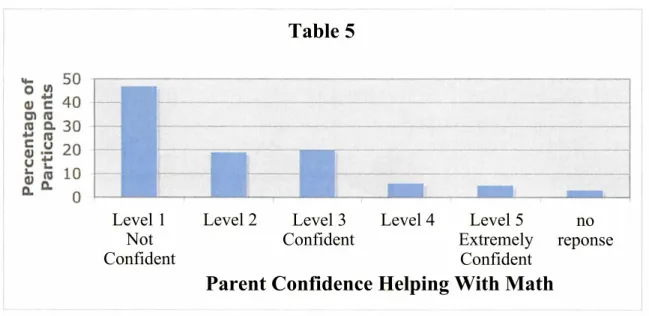
The last question looked at the confidence level of the parent/guardian when helping their son/daughter with mathematics. This question corresponds to the confidence level question asked to the students. Not at all confident (level one) was the most popular response with 47 percent of the parents/guardians. The highest percentage reason was “I never took Algebra” or “my son/daughter is farther along in math than I was,” with 24
percent. Slightly confident (level two) was at 19 percent with 44 percent of those
respondents stating the reason “math is/was not my greatest subject.” Twenty percent of the parent/guardians said they fell confident (level three) helping their son/daughter with math, indicating the reason (46 percent) that “the process has changed/math is taught differently.” Only six percent were level four and five percent felt extremely confident, with a majority stating that they have a math background. Only four percent of the parents did not respond. See Table 5 for more details.
Table 5
Level 1 Not Confident Level 2 Level 3 Confident Level 4 Level 5 Extremely Confident no reponseParent Confidence Helping With Math
Educator Post-Questionnaires
The post questionnaires were given after four weeks using daily assignment sheets as a line of communication between the parents and mathematics teachers. The purpose was to see if student attitudes changed about mathematics. According to 50 percent of the educators, the number of students they see before or after school stayed the same. One educator indicated that three students per week were coming in before school and about six per week after school. Another educator indicated that this was the hardest working group they have had, stressing how well they used their class time.
When asked if the questions they were being asked changed since implementing the daily assignment sheets, the most common response with 50 percent of the educators was that the questions had not changed. One educator said the students were not asking what assignment they were missing. Another educator said that the questions changed from, “how do you do this” to “how do you do number eight?” According to the educators, the assignment sheets had little or no effect on the type of questions that students asked.
Next the educators were asked if they noticed any change in students’ work ethic. One third of the educators thought there was no change in student work ethic. One
educator stated that the students who participated already had a good work ethic. Another educator went on to add that they did not think that anyone took the assignment sheets seriously. On the plus side, one educator mentioned that the students did have clearer expectations of deadlines. From the responses to this question it can be concluded that according to the educators the assignments sheets had little to no effect on student work ethic.
The next question had the educators look into the students’ overall attitude toward mathematics. According to 50 percent of the educators, they did not notice a change in student attitude. One educator indicated that they were still frustrated with students who give up too easily. One third of the educators indicated that student attitude changed somewhat, but did not give examples of how. One educator said that student attitudes fluctuated depending on the topic they are studying. Therefore, the assignment sheets had little to no effect on changing student attitudes towards math. This falls in line with Fax & Chen’s (2001) research mentioning that there is a positive relationship between parent
involvement and student success, but inconsistencies about how positive the relationship was.
When asked if the educators felt the assignment sheets were worthwhile, five out of six educators responded that they were not. Some of the stated reasons were: “I do not think the parents actually look at them (assignment sheets) closely,” “I do not think anyone took them seriously,” and “most students did not take them home on a daily basis.” One educator did mention that it would have been different if the students who needed it the most participated. From the results of the educator post questionnaires, it is a reasonable conclusion that in this situation the assignment sheets were not worthwhile. Student Post-Questionnaires
When looking through the student post-questionnaires, the participants dropped from 134 to 123 (38 percent males and 62 percent females). The answer to “how much time do you spend working on math homework outside of class?” was approximately the same. There were 16 percent spending less than five minutes (21 percent for males and
13 percent for females) and 26 percent spending more than 30 minutes (32 percent male and 22 percent female). There was one minor change from the pre- and post-
questionnaire: 22 percent of the students indicated that they spent between 26 and 30 minutes working on math homework (17 percent male and 25 percent female). This has improved from the pre-questionnaires of 10 percent of the students indicated that they spent between 26 and 30 minutes working on math homework, none of whom were male. It is safe to conclude that the amount of time spent on homework has gone down by a small margin. See Table 6 for more details.
Table 6
Amount of Time Spent on Math Homeowork
The next question asked students to explain how their study habits had changed since implementing the daily assignment sheets. The majority of students, 65 percent, said there was no change, (66 percent of males and 65 percent females). The next highest response was 13 percent who said they worked harder on math (13 percent of the males and 13 percent of the females). Another 12 percent said that the assignment sheets helped them stay on track (10 percent of males and 12 percent of the females). Therefore, it is safe to conclude that according to the students, the assignment sheets did not appreciably change their study habits. See Table 7 for more details.
Table 7
Have things Changed?
The next two questions were the focus of the study asking about the participant’s confidence working with mathematical concepts. The first question asked about
confidence inside the classroom. Just over four percent indicated that they were not at all confident (six percent of the males and three percent of the females). The highest
percentage reason (40 percent) was “math is difficult to understand.”
Just over seven percent felt they were a two on the scale from one to five, six percent of the males and eight percent of the females. The most common reason for feeling this way was: “I am not very good at math or I do not get math” with 44 percent.
The number who felt confident (level three) with their math in the classroom was 21 percent of the participants (19 percent of the males and 22 percent of the females).
Twenty-seven percent stated their reason was “the teacher and classmates are there to help.” Level four (pretty confident) included 37 percent of the participants, (38 percent of the males and 37 percent of the females) with 37 percent of those respondents giving the reason of: “the teacher and classmates are there for help.”
Twenty nine percent felt extremely confident working on the math in the
classroom (30 percent of the males and 28 percent of the females). The top reason at 71 percent was “the teacher and classmates are available for help.”
Less than two percent did not respond, none of whom were male. When
comparing the pre-questionnaires and post-questionnaires, one could conclude that more students thought that teachers and classmates were available for help, which increased some students' confidence level up to extremely confident. See Table 8 for more details.
Table 8
The next set of questions asked how confident the student participants were working on mathematics outside of the classroom. Just under ten percent indicated not at all confident (nine percent of the males and 11 percent of the females). The most
expressed reason (33 percent of these respondents) was: “I am not good at math.” Just over 12 percent felt they were a two on the scale from one to five (13 percent of the males and 12 percent of the females). The most common reason for this confidence level was; “if I have a question there is no one around to help” with 46 percent. The number
who fell confident (level three) with their math outside the classroom was 37 percent of the participants (34 percent of the males and 40 percent of the females). Thirty-eight percent stated the reason: “if I have a question there is no one to help.” Level four (pretty confident) included 27 percent of the participants, (31 percent of the males and 24
percent of the females) with 36 percent of these respondents giving the reason of: “I usually remember the process learned or I have good notes.” There was 11 percent who felt extremely confident working on the math outside of the classroom, (13 percent of the males and nine percent of the females). The top reason at 46 percent was: “I understand math or I like math.” Just over three percent who did not respond, the same percentage of males and females. When comparing the pre- and post-questionnaires, it is safe to say that the greatest increase was in level four with a five percent increase with a new reason “I usually remember the procedure learned or I have good notes.” See Table 9 for more details.
Post Student Confidence Outside of Class
The next question asked about the thought process of the participants as they worked through math problems that they struggled with. A majority of the participants indicated the multi-step process they used, the results are a combination of all the steps used by the participants. The top five steps the students used were as follows:
(1) Look at notes with 46 percent (29 percent of the males and 57 percent of the females).
(2) Talk to teacher outside of class with 46 percent (42 percent of the males and 47 percent of the females).
(3) Look at book examples with 36 percent (26 percent of the males and 43 percent of the females).
(4) Call/ask a classmate with 33 percent (38 percent of the males and 29 percent of the females).
(5) Ask parents for help with 15 percent (11 percent of the males and 17 percent of the females).
Other methods used by the participants were: ask siblings, skip it/nothing, guess, and use the internet. When comparing the pre- and post-questionnaires, the top five steps did not change.
The last question on the student post-questionnaire was “Did implementing the daily assignment sheets help improve your feelings toward mathematics?” “No” was the most common answer with 57 percent, (62 percent of the males and 55 percent of the females). The reasons for saying no were: I still feel the same (37 percent), It was a waste of time (17 percent), I have always disliked math (13 percent), I was confident in math already (13 percent), and 17 percent gave no explanation. There was 18 percent who were
neither yes or no (17 percent of males and 18 percent of females). The number one reason (55 percent of respondents) was that it helped with their organization skills. There were
19 percent of the respondents who indicated “yes” the assignment sheets were
worthwhile (19 percent of the males and 18 percent of the females). The most common reason among the respondents (39 percent) was “they keep me more organized.” Six percent of the participants did not respond to the question. From this data, the results are similar to the finding of the educators that the assignment sheets were not considered worthwhile.
Parent/Guardian Post-Questionnaire
The post-questionnaire data for the parent/guardian is flawed due to fewer post- questionnaires. The number of participants dropped from 133 to 79. One educator claimed that no parents filled out the post questionnaire.
The first question pertained to how much time their son/daughter spent working on math at home. The results were similar to the pre-questionnaires with: 11 percent spending less than five minutes, 29 percent spending more than 30 minutes, and 30 percent spending between 26 and 30 minutes. These are similar to the results that were found in the pre-questionnaires.
When asked if their students’ study habits had changed since implementing the assignment sheets, 63 percent said “no”, 18 percent said “yes,” 13 percent said “some,” and five percent had no response. The question pertaining to whether their
son’s/daughter’s view of mathematics had changed since they started using daily assignment sheets showed similar results to the study habits questions: 70 percent said “no,” 13 percent said “yes,” 12 percent said some, and five percent did not respond. It is
safe to state that the parents/guardians felt that the assignment sheets had little to no effect on students’ study habits or overall view on mathematics.
When asked again “how confident are you helping your son/daughter with their math,” the most common response was “not at all confident” (level one) with 45 percent. The highest percentage reason was “I do not remember much about math or math has changed” with 32 percent. Slightly confident (level two) was at 18 percent with 57 percent of the respondents stating “math is different from when I was in school.” Fifteen percent of the parents/guardians said they felt confident (level three) helping their son/daughter with math, with 18 percent indicating that math had changed. There are 13 percent that were pretty confident (level four), with 60 percent saying they enjoyed math. Only five percent felt extremely confident, with a majority stating they had a math background. Only four percent of the parents did not respond. The biggest change from the pre-questionnaires to the post-questionnaires was that the number of respondents in level four increased by seven percent. See Table 10 for more details.
Table 10
Post Parents Confidence Level When Helping with
Math
Conclusion
The results from the questionnaires and the implementation of the assignment sheets showed little to no effect on the student’s self-confidence in mathematics. The assignment sheets did not appear to change the students’ view or attitude about
mathematics significantly. The overall reaction from the students, educators, and parents was that the assignment sheets made little to no change on student attitude or work ethic, and the students and educators found the assignment sheets not to be worthwhile.