Web-based construction project management systems:
how to make them successful?
Pollaphat Nitithamyong*, Mirosl
C
aw J. Skibniewski
School of Civil Engineering, Purdue University, 550 Stadium Mall Drive, West Lafayette, IN 47907-2051, USA
Accepted 27 February 2004
Abstract
This paper describes research conducted at Purdue University on the identification of factors determining success or failure of web-based construction project management systems, particularly through the use of application service providers utilized by construction firms without in-house expertise to develop such systems for exclusive company use.
D2004 Elsevier B.V. All rights reserved.
Keywords:Web-based project management systems; Information technology; Internet; Extranet; Construction; World Wide Web; Internet portal
1. Introduction
The construction industry is fragmented due to the many stakeholders and phases involved in a construc-tion project. This fragmentaconstruc-tion has led to well documented problems with communication and infor-mation processing and has contributed to the prolif-eration of adversarial relationships between the parties to a project. This fragmentation is also often seen as one of the major contributors to low productivity in construction.
Information Technology (IT) is now routinely used in the construction industry as a tool to reduce some of the problems generated by fragmentation. The use of IT improves coordination and collaboration be-tween firms participating in a construction project,
leading to better communication practices. Its benefits include an increase in the quality of documents and the speed of the work, better financial control and communications, and simpler and faster access to common data as well as a decrease in documentation errors. IT spending in Architecture/Engineering/Con-struction (A/E/C) firms has increased significantly during the past few years [1], indicating that A/E/C firms are increasing their interests in IT applications to facilitate construction projects.
Among all IT applications, the Internet is the technology that best facilitates a collaborative work-ing environment in a construction project. Walker and Betts [2] postulated that the Internet, and more specifically the World Wide Web (WWW), will be the key to a change in global construction business in the near future and will impact professions, collaboration, and the construction business struc-ture. Its use as a communication medium can help information transfer occur faster and more effectively and enable new opportunities for the development of
0926-5805/$ - see front matterD2004 Elsevier B.V. All rights reserved. doi:10.1016/j.autcon.2004.02.003
* Corresponding author. Tel.: 742-2082; fax: +1-765-494-0644.
E-mail address:[email protected] (P. Nitithamyong).
distributed systems that can cross organization boundaries and provide a unique opportunity for teamwork and workflow automation. The Web can also overcome the incompatibilities of data formats through smart browsers and servers. Therefore, in-dependent project participants using different hard-ware platforms can share the same system over the Web [3]. As described in Skibniewski and Abduh
[4], the advantages of Web technologies in construc-tion can be broadly categorized into three areas: the support of relevant information services, communi-cation between project participants, and engineering and management computing.
Recently, a concept of how the Web and its associated technologies can be used to manage construction projects has been widely acknowl-edged by practitioners. This concept is often re-ferred to as a Web-based Project Management System (WPMS)1 and promises to enhance con-struction project documentation and control and to revolutionize the way in which a construction project team conducts business. WPMS is an elec-tronic project-management system conducted through the Extranet, which is a private network that uses Internet protocols to transmit information. The system is only accessible by a project team, but team members can be located in different organizations. It basically provides a centralized, commonly accessible, reliable means of transmitting and storing project information [5]. Project infor-mation is stored on the server and a standard Web browser is used as a gateway to exchange this information, eliminating geographic and boundary hardware platform differences. Fig. 1 illustrates the basic functional scheme of WPMS [7].
As pointed out by Mead [6], there are four general categories of construction project informa-tion that are normally carried out through WPMS: project, design, management, and financial informa-tion. Project information includes details about the project, such as project participants, project e-mail directory, project description, and a photo archive of the project’s progress. Design information
in-cludes any information generated by the design team, such as CAD drawings, specifications, clar-ifications and changes, and punch lists. Manage-ment information is developed by the project manager and includes meeting minutes, submittals and shop drawings, change order status logs, as-built drawings, requests for information (RFIs), requests for quotation (RFQs), contract status logs, safety information, daily logs, and project sched-ules. Financial information is developed by the accounting staff responsible for the project and includes cash flow, projections, requisition status, general ledger, and contract status reports.
As project information changes, the database on the server can be easily updated with new data. Members of the project team can then access the updated information via a digital user ID and pass-word from remote locations at any time, eliminating the problems that occur in linear communication schemes [8]. Since a closed network is used where no one is allowed to access the system without permission and everyone is identified (through an individual user ID and password), the system can automatically track who has seen what, and what comments or changes if any, they made. It is also possible to introduce a project hierarchy into the system, which allows documents or areas of the project to be restricted to only people at certain levels of responsibility, etc. Hence, the mistakes caused by poor communication and the delays due to the time it takes to move documents and people around for approvals and meetings would be minimized. WPMS is predicted to significantly improve the speed and quality of communication among project participants and promotes collaboration and coordination in con-struction projects [8,9].
Engineering News Record (ENR) in the United States reports that the number of A/E/C firms using WPMS has risen by 16% within the past 2 years[1]. It is also estimated that the number of A/E/C firms prepared to set up ‘‘virtual’’ project teams by using the WPMS concept is doubling every 6 months. Currently, there are three options in regard to WPMS implementation. The first option is to develop a cus-tomized WPMS in-house by hiring either a consulting company or programmers to create a system. The second is to develop a WPMS by purchasing commer-cial web-enabled packaged software and installing it on
1 Other names are also used to denote WPMS, including Document Management System, Project Extranet, Project Web, Project Bank, Project Specific Website, Document Pool, Project Information Management System, and Virtual Project.
a company’s internal server. Examples of this software include Microsoft Project 2002R from MicrosoftR,
P3e/ckand SureTrakkfrom PrimaveraR, Prologk
Project Pack from Meridian Project Systemsk, WebProjectkfrom NovientR, and TeamflowR7 from CFM. The third is to rent/lease a completely developed WPMS from an Application Service Provider (ASP) for a usage fee, which is normally charged per project, per the amount of computer storage space required, and/or per user. Examples of WPMS developed by ASPs include Buzzsawkby AutodeskR, Citadonk,
Constructw@reR, ProjectTalkkby Meridian Project
SystemsR (MPS), PrimeContractR by PrimaveraR,
Vieconk by BentleyR, VISTA 2020R by Market
Street TechnologiesR, Projectmatesk by
Systemat-esR, IronSpireR, Unifierk by SkireR,
Project-Grid.comk, BuildOnline.comR, e-Builderk, BIW
Information Channelk, ProjectVillagek, etc. Among these three options, the third, referred to hereafter as a ‘‘Project Management System-Applica-tion Service Provider (PM-ASP)’’, is becoming pop-ular because it requires minimal technical, financial, and human resources to develop and operate [8]. Since PM-ASP is outsourced to an ASP, it requires no effort to develop and maintain the system in-house, involves comparatively low initial investment and
overhead cost, and is convenient for keeping up with cutting-edge technology. Therefore, it is a viable solution for a small or mid-sized A/E/C firm that does not have enough resources to maintain an in-house IT department and/or a sophisticated networking infra-structure. In addition, PM-ASP is also capable of performing electronic commerce, such as online bid-ding and procurement, which are difficult to develop and conduct through an in-house WPMS. The number of A/E/C firms who are turning to PM-ASPs is growing rapidly. It is anticipated that the total spend-ing of A/E/C firms on PM-ASPs would reach US$1 billion by 2004 [10].
Although PM-ASP is a topic of increasing impor-tance to practitioners as well as researchers in con-struction, it is still relatively new and its optimal styles and extensions of use have not yet been thoroughly investigated. According to Kraker [11], there is still a debate among A/E/C firms whether or not to move permanently to PM-ASPs. Most compa-nies have used PM-ASPs either because their com-petitors are influencing them or they are being forced to adopt it by their clients [4,9]. Although several ASPs have claimed that their products are the only right solutions to the problems currently facing con-struction project management, these claims are
ally overestimated or unrealistic, aiming only at marketing purposes.
According to O’Brien [5], the apparent utility of PM-ASPs in construction is still not as attractive as was initially widely expected, and factors such as sociological and people issues require more attention as they greatly impact the system’s performance. Industry practitioners must consider not only the technology, but also give equal prominence to pro-cesses and people who are involved in the system in order to successfully embrace PM-ASPs and achieve business benefits [12 – 14]. It is evidenced that 80 – 90% of IT projects in general do not meet their performance objectives, with the main reasons not related to technical issues[15].
Nevertheless, technically related factors have of-ten gained sole atof-tention while nontechnical factors are considered separately, overlooked, or even ig-nored completely. Research studies conducted to date still either aim to solve the existing technical prob-lems of PM-ASPs or to introduce some new ad-vanced techniques to improve the current systems, ignoring the fact that technology push is not the only critical success factor for effective implementation of a new technology such as PM-ASP. Unlike other technologies, PM-ASPs are very much concerned with the exchange of information across the project life cycle. Their successful implementation therefore will not only require a state of readiness within one organization, but also within all organizations in-volved in the construction processes. This makes the successful implementation of PM-ASPs difficult to be planned and managed.
In order for a construction organization to suc-cessfully embrace PM-ASPs, factors such as tech-nology, process, people, procurement, legal issues, and knowledge management must be considered equally. Although there have been some studies conducted to identify factors that can foster the successful development and usage of PM-ASP in a construction project, all of them are still based solely on either individual case studies using interview techniques or anecdotal evidence provided by suc-cess stories reported in the trade press. There has been no empirical research to date on a large scale conducted on this topic, and it is obvious that a gap still exists in our understanding of what factors, technical and nontechnical, significantly affect the
performance of implementing PM-ASPs in construc-tion projects.
As the importance of PM-ASP concept increases, empirical research is needed to identify common factors across the systems and organizations that can lead to the successful implementation of PM-ASPs. The research agenda presented here can help identify these success/failure factors and their levels of impact, leading to productive ways of implementing PM-ASP in a construction project and thereby promote the possibility of successful widespread adoption of PM-ASPs in the construction industry.
In order to implement PM-ASP successfully in a construction project, careful planning and strategies are needed. Several opinions exist regarding PM-ASP implementation, e.g.
1. There are several attributes or measures that might be used to assess the performance of PM-ASP implementation in a construction project.
2. Various factors can contribute to the performance of PM-ASP implementation in a construction project. However, a single factor cannot govern by itself this performance. Interaction of these factors together drives the performance.
3. The success or failure of PM-ASP implementation may or may not directly affect the success of a construction project.
The aforementioned opinions would lead one to raise the following questions regarding PM-ASP im-plementation in a construction project:
1. What attributes or measures should be used to evaluate the performance of PM-ASP implemen-tation in a construction project?
2. What are the success/failure factors leading to the performance of PM-ASP, and how do they affect its performance?
3. Can these factors, if controlled, ensure the success of PM-ASP implementation in a construction project?
4. What are the relationships, if any, between the success or failure of PM-ASP implementation and construction project success?
This paper is based on research intended to provide answers to all of the aforementioned questions. An
attempt to answer these questions leads to the follow-ing objectives:
1. To define a set of measures that can be used to assess the performance of PM-ASP implementa-tion in a construcimplementa-tion project.
2. To identify factors leading to the performance of PM-ASP implementation in a construction project. 3. To examine the cause – effect relationships between the identified factors and the performance meas-ures.
4. To use the identified factors and their associated relationships with performance measures for infer-ence, deviation-cause detection, and improvement of PM-ASP implementation in a construction project.
5. To determine if the success or failure of PM-ASP implementation has any effect on the success of a construction project.
The results of this research can be beneficial to A/ E/C firms that are using or planning to implement PM-ASPs, and they may shed some light on unex-plained deviations in the performance of PM-ASPs. The users of such systems can better understand the important factors that need to be considered to ensure the success of PM-ASP implementation, and the benefits behind changes or improvements in areas of implementation related to critical success factors may increase the chances of successful PM-ASP applica-tions. In addition, the relationship between the success or failure of PM-ASP implementation and the success of a construction project can be better comprehended. Altogether, the results of this research can lead to an improvement of PM-ASP utilization, management, and more widespread acceptance of such systems in the construction industry.
2. Current business models of PM-ASPs
Within the past few years, over 200 ASPs with PM-ASPs focused on the construction industry have appeared on the market [16]. The total capital investment of these ASPs was estimated at US$2.5 billion, and their services and products could be broadly divided into the following three major categories [17].
2.1. Project Collaboration Network (PCN)
PCN focuses on facilitating construction project management. The system aims at sharing project-specific documents, communications, and workflow and serves as a repository for documents or as an online document management system for a project team. The common services include backing up files daily, keeping a document revision history, and track-ing who accesses files. PCN also offers online docu-ment viewing, online markup, and plotting. Various members of the construction team can upload or download drawings, and construction documents through PCN.
PCN is normally hosted on an ASP’s server. However, an A/E/C firm with multiple projects may choose to buy a PCN solution and install it on the company’s internal servers. The monthly cost for using PCN usually depends on the intensity of the usage of the database and/or the number of registered
Table 1
Examples of PCNs catering to the construction industry PCN service Company URL ActiveProjectk Framework
Technologies
www.activeproject.com Buzzsawk Autodesk www.buzzsaw.com BuildOnlinek BuildOnline.com www.buildonline.com CAM Consolek LoadSpring
Solutions
www.loadspring.com Citadon CWk Citadon www.citadon.com Constructw@rek Constructware.com www.constructware.com e-Builderk MP Interactive www.e-builder.net Edificium Edificium.com www.edificium.com MH2.com MH2 Technologies www.mh2.com OnlineBuildingskOnlineBuildings.comwww.onlinebuilding.com Paragonk Vianovus.com www.vianovus.com ProjectEDGEk Edgewater Services www.projectedge.com ProjectGrid.com ProjectGrid.com www.projectgrid.com Projectmatesk Systemates www.projectmates.com ProjectSolveR Company 39 www.projectsolve.com ProjectTalkk Meridian Project
Systems
www.projecttalk.com ProjectVillagek ProjectVillage.com www.projectvillage.com Tririga IBSk Tririga www.tririga.com Vieconk Bentley Systems www.viecon.com Vista 2000k Market Street
Technologies
www.marketstreet.com Web4Engineersk Web4 www.web4engineers.com 4Projectsk 4Projects www.4projects.com
users. Table 1 illustrates some currently available PCNs catering to the construction industry.
Besides the PCNs shown inTable 1, there are also some PCNs which are not tailored specifically for the construction industry, but A/E/C firms may use these services/products as well. Table 2 illustrates some examples of these nonspecific PCNs.
2.2. Project Information Portal (PIP)
PIP serves mainly the general information needs for the participants in a construction project. This infor-mation includes codes and permits, economic trends, product information, cost data, and project planning information that a project team might use throughout the life of a construction project. Most PIPs offer free
services to members since their major profits come from advertising, while others charge a monthly sub-scription fee. Table 3 illustrates examples of PIP currently available for the construction industry.
2.3. Project Procurement Exchange (PPE)
PPE aims to streamline the procurement cycle of construction materials and services. The system pro-vides electronic bidding and procurement services, which generally allow users to view online catalogs of products and services, transmit RFQs, exchange cost-related data, review work packages, and conduct bidding and procurement online. Table 4 illustrates some examples of PPE currently available for the construction industry.
Table 2
Examples of nonspecific PCNs
PCN service Company URL
@VIEWnet Atview www.atview.com eProject Enterprisek eProject www.eproject.com Intranets.com Intranets.com www.intranets.com Intra.netk Inclusion Technologies www.inclusion.net Project InVision.NETk Project InVision International www.smecorporation.com ProjectShare DNAk ProjectShare.com www.projectshare.com Share-A-Spacek Eurostep Group www.share-a-space.com WebWorkZonek SiteScape www.sitescape.com WelcomHomek Welcom.com www.welcom.com
Table 3
Examples of PIPs for the construction industry
PIP service Company URL
Akropolis.net Akropolis www.akropolis.net
4specs 4specs.com www.4specs.com
Biw.co.uk BIW Technologies www.biw.co.uk
BuildersPlanet.com BuildersPlanet.com www.buildersplanet.com
Building.com Building.com www.building.com
Buildingonline.com Buildingonline.com www.buildingonline.com
CMD First Sourcek CMD First Source.com www.cmdfirstsource.com
DesignArchitecture DesignArchitecture.com www.designarchitecture.com
e-idc.com e-idc.com www.e-idc.com
Handyman Online Handyman Online.com www.handymanonline.com
HomePro.com HomePro.com www.homepro.com
ImproveNetk ImproveNet.com www.improvenet.com
NationalContractors.com NationalContractors.com www.nationalcontractors.com
StartMyHome.com StartMyHome.com www.startmyhome.com
Table 4
Examples of PPEs for the construction industry PPE service Company URL
BuildPoint.com BuildPoint.com www.buildpoint.com Buildscapek Buildscape.com www.buildscape.com BidA/E/C.com BidA/E/C.com www.bidaec.com BidExpress.com Contractors Online www.bidexpress.com BidHostk eBid Systems www.ebidsystems.com Contractors
eSourcek
Contractors eSource
www.contractorsesource.com Cprojects.com Cprojects.com www.cprojects.com eu-supply.com eu-supply.com www.eu-supply.com PurchaseProk PurchasePro.com www.purchasepro.com TradePowerk TradePower www.trade-power.com
Currently, several ASPs are starting to use the above three major categories collaboratively in their business models. For example, Ironspirek (www.ironspire.
com), BricnetsR (www.bricsnet.com), and BIWR
Technologies (www.biwtech.com) have integrated PCN and PIP in their services. ConstructionSweetsk
(www.sweets.construction.com) has integrated PIP and PPE.HomeSpherek(www.homesphere.com) has
in-tegrated PCN and PPE. Some of them even provide a ‘‘Full-Service Portal’’ having all features offered by PCN, PIP, and PPE, which means that team members can track and manage project documents online, communicate and share information, search online catalogs for needed resources, and conduct electronic bidding and procurement. The goal of full-service portals is to satisfy every project-related need of the supply chain in a construction project [18]. Never-theless, features provided by full-service portals are still not fully integrated in one service package, and a company normally needs to pay additional fees to use all of the available features. Table 5 illustrates some examples of full-service portals currently avail-able for the construction industry.
According to a survey conducted by ENR, 80% of contractors and owners still use PM-ASP mainly for project collaborations, 25% for online purchase and sell products, 17% for bidding jobs online, and 13% for negotiating contracts. Another survey also showed that no single dominant PM-ASP exists in the A/E/C market[19]. Architecture and engineering firms are most likely to use online project collabo-ration, followed by general contractors, owners, and subcontractors, respectively [20]. Nevertheless, as more dot-com companies target the construction industry, it is predicted that US$141 billion, or 11%, of the US construction industry spending will be conducted online by 2004 [21].
3. Current features of PM-ASPs
Depending on the selected business model, the features supported by PM-ASP usually vary, but a list of current features that can be supported by PM-ASPs follows. However, considering the exponential rate of technological changes, this list may not be exhaustive as most ASPs are constantly trying to reshape themselves to meet customer demands, i.e., a feature offered one day may be changed, modified, or not available the next day. O’Brien [5] suggested that it is important for A/E/C firms to have a specific feature and think through how this feature would interact with the job tasks of project team members.
3.1. Document management
This feature establishes a single location to store general project-related files, such as project photos, contracts, drawings, specifications, cost data, etc. It allows team members to manage, track, and organize these files in a central location.
3.2. Project workflow
This feature allows team members to collaborate electronically using RFIs, change orders, field notes, correspondence, submittals, punch lists, daily logs, and standard or customized forms.
3.3. Project directory
This feature stores general information (phone number, address, and e-mail) of project team members in a central directory. Therefore, specific information for each project participant can be easily retrieved when needed.
3.4. Central logs and revision control
This feature allows team members to track who accessed files or downloaded a particular docu-ment, as well as when the file was edited and uploaded to the system. It also includes the use of digital signatures to identify and verify an indi-vidual before entering the data or transmitting information.
Table 5
Examples of full-service portals for the construction industry Portal service Company URL
Causeway Solutions
Causeway Technologies
www.causeway-tech.com CXkSolutions Aconex www.aconex.com e-Manage Netk Microlar Systems
Limited
www.microlar.com PrimeContractk Primavera Systems www.primecontract.com
3.5. Advanced searching
This feature allows team members to find docu-ments or specific details within docudocu-ments through the entire log. This is the key feature that enables users to locate documents more easily, compared with situations where files are located in different offices, on different servers, or scattered about on local computers.
3.6. Conferencing and white-boarding
This feature allows team members to share appli-cations and documents concurrently using the virtual whiteboard and to apply comments online. Theoreti-cally, a whiteboard and notes could also be saved and attached to other workflow forms such as RFIs.
3.7. Online threaded discussion
This feature is a communication tool similar to a newsgroup and e-mail that allows a ‘‘threaded’’ dis-cussion to take place online. It provides an open forum that displays a sequential record of messages
and responses about a particular topic. Team members post questions, responses, and comments and have a permanent record of the discussions and decision process surrounding an issue. For a sensitive topic, it can also be protected by a secured password.
3.8. Schedule and calendar
The calendar feature allows team members to coor-dinate project events or meetings in a centralized agenda. Team members can then copy events or meet-ings to their standard software, such as MicrosoftR
Outlook and EudoraR. The schedule feature allows team members to create project schedules online or to convert project schedules created by standard schedul-ing tools, i.e., MicrosoftRProject,PrimaveraP3e/ck,
andSureTrakkto an online working schedule. A view
of the bar chart and the capability of modifying information and assigning resources can also be done using the schedule feature. Alerts with direct links to the task in question are provided to team members having overdue items. The schedule feature can also be integrated with the calendar feature to quickly view milestones at a glance.
Table 6
Current features of selected PM-ASPs
Type of PM-ASP Example products Common features Document management Project workflow Project directory Central logs and revision control Advanced searching Conferencing and white boarding Threaded discussion Schedule and calendar Project Buzzsawk collaboration Citadonk network (PCN) Constructw@rek e-Builderk Project Talkk Project 4Specs.com Information Biw.co.uk
Portal (PIP) BuildingOnline.com
Project BidExpress.com
Procurement BuildPoint.com
Exchange (PPE) BidA/E/C.com
PCN + PIP BIW Technologies
IronSpire JobSitek
BricnetsR
PCN + PPE HomeSpherek
PIP + PPE ConstructionSweetsk
Full Service PrimeContractk
Portals (PCN + Causeway Solutions
3.9. Project camera
This feature allows a project team to monitor construction sites remotely using web-based cameras and transfer live photos of the job sites directly to their computers. These photos can then be used to share progress, resolve issues and questions, and minimize site visits.
3.10. File conversion
This feature supports file conversion to displayable formats to be shown through a web browser. It may also enable marking and adding notes for these con-verted files.
3.11. Printing service
This feature provides the ability to make hardcopy prints of online files, such as construction drawings and specifications and allows team members to send print orders to local reprographic printing centers. Most ASPs now offer tools to create print-ready letter-size and D-size hardcopies.
3.12. Website customization
This feature allows team members to modestly customize the browser interface to better suit the management needs. Users can lay out the project environmental tabs and menus and add a company logo to the interface.
3.13. Offline access
This feature allows team members to access the project databases when offline. It ensures that all participants can reliably access key data and get their job done, even when the Internet connection is slow, unreliable, or not available.
3.14. Messaging outside the system
This feature allows team members to send proj-ect information or files to an important participant, i.e., an owner ’s representative, who is not connected to the Internet, by the use of fax, Internet e-mail, or voice mail/pager notification to offline participants. Expanded features Project camera File conversion Printing service Website customization Offline access Messaging outside the system Wireless integration Archiving of project information Information service Financial service e-Bidding and procurement
3.15. Wireless integration
This feature allows team members to use wireless devices such as pagers, mobile phones, and Personal Digital Assistants (PDAs) to access the project infor-mation database. It may also allow team members to input or edit project information via wireless devices and transfer this information back to the centralized servers. This feature is very well suited for onsite personnel.
3.16. Archiving of project information
This feature allows a project team to copy the entire project database to a set of compact discs after the completion of a construction project, creating a comprehensive record of the entire project website with its associated databases and transaction logs. A project team thus can have all project records neces-sary for any disputes and the future operation and maintenance of the facility.
3.17. Information service
This feature includes product catalogs, a discussion forum, resource libraries, predefined links, and search engines. It basically helps team members locate need-ed resources and information, such as local consulting services and suppliers.
3.18. Financial service
It is normal in a construction project that a project team must secure financing before the project starts. This feature provides lenders the ability to collaborate with borrowers and suppliers in the sourcing, under-writing, closing servicing, analyzing, and securing of project loans.
3.19. E-bidding and procurement
Bidding and procurement processes typically in-volve issuing RFQs and responding to RFIs. This feature streamlines bidding and procurement process-es associated with the purchasprocess-es of equipment, spe-cialized materials, and services. Team members can issue RFQs, track all new and pending transactions, review and compare bids received from material or
service suppliers, and conduct e-procurement online. It may also facilitate transactions that require an exchange of information, such as design documents, drawings, and specifications.
Table 6 exhibits the features of some currently available PM-ASPs for the construction industry. The PM-ASPs listed in this table were selected as examples only, and the contents shown in the table may not reflect the current status of each PM-ASP.
4. Potential benefits of PM-ASPs
PM-ASPs offer A/E/C firms numerous advantages over the current inter-organizational information in-frastructure by providing access to project data and communication that is platform and application-inde-pendent. All that is required is Internet access and a Web browser. PM-ASPs are also location-independent since the systems can be accessed wherever there is Internet access and a Web browser. Communication can be either synchronous or asynchronous, and individuals can access project database anytime or multiple team members can collaborate in real-time.
In addition to enhancing communication and ac-cess to project information, PM-ASPs also provide several potential advantages over in-house WPMS. Following are some of the advantages repeatedly cited in literature.
4.1. Cost advantage
PM-ASPs use numerous centralized application servers and data warehouses instead of concentrating power in the desktop computer as is currently done. In this case, what is left on the user’s desktop is a stripped-down network computer that communicates with applications and data servers via the network. Experts predict that individuals and corporations will own very minimal software and will rent most of what they need from Internet Service Providers (ISPs) and other network operators [22]. Therefore, PM-ASPs potentially provide savings in time and resources compared to in-house solutions, which can be costly, time consuming, and maintenance-intensive, and many require a high degree of expertise by the system administrator and user to implement. A study of Internet-based groupware cited a return on investment
ratio of greater than 1000 to 1 [23]. The savings of using PM-ASPs in the construction industry could also be at a similar magnitude.
4.2. Outsourcing advantage
Although it is possible to develop an in-house WPMS that would have almost the same function-ality as PM-ASPs, there are many arguments against it. McFarlan[24]presented a model that helps firms understand when it is advantageous to outsource IT services, linking the IT outsourcing decision to the strategic impact of the existing information systems and the portfolio of applications the firm has under development. In highly competitive, transaction-in-tensive, knowledge-based industries like banking and insurance, both the information systems and the development portfolio play what McFarlan cat-egorizes as a strategic role. Outsourcing such a core process can lead to loss of critical competitive skills and of control of important proprietary information. On the other hand, in industries like large-scale process manufacturing or, in this case, the construc-tion industry, IT plays only a support role. It is much more of a commodity and hence, although necessary, it is not central to the firm’s competitive position. By this reasoning, many computing func-tions in the construction industry are good candi-dates for outsourcing.
There are several advantages to outsourcing por-tions of construction industry computing that mainly relate to scale. Small A/E/C firms, which make up the majority of the construction industry, are able to take advantage of sophisticated communications and com-puting software that they would otherwise be unable to afford. Even larger firms in the construction indus-try may have difficulty justifying the relatively high investment required to develop the functionality of WPMS. A number of currently available PM-ASPs are actually spin-offs from design and construction firms that saw an opportunity to take their in-house computing systems to scale.
4.3. Competition among IT professionals
The market for skilled programmers and IT pro-fessionals has become extremely competitive in the past several years. Recruiting and retaining high
quality IT personnel is increasingly difficult in all industries at a time when the rapid expansion of the Internet and the high-tech industry has created an extremely high demand for developers and other IT professionals. A report by the U.S. Department of Commerce predicted a shortage of IT workers be-tween 1995 and 2005[25].
In the construction industry, executives acknowl-edge that the market for IT workers has become ultra-competitive. They point to technology as magnet for young people[26]. Some A/E/C firms found that they must make a larger investment in IT to attract and retain talented young professionals. However, it will continue to be relatively difficult and expensive for A/ E/C firms to attract the best talent away from cutting-edge high-tech companies. PM-ASP providers, on the other hand, have better access to the latest technolog-ical developments in software and hardware, and more importantly, have better access to high-quality system designers and programmers.
4.4. ASP’s competition
A/E/C firms will also benefit from the intense competition in the PM-ASP market. As PM-ASP providers attempt to differentiate their products from those of their competitors, they continue to expand their internal feature packages and to develop linkages to important external software. These upgrades are incorporated on the PM-ASP provider’s central server, giving the client immediate access to new features with no need to purchase and install new versions or upgrades. Bjo¨rk [13] postulated that competition among PM-ASP providers will continue to drive down costs and enhance product quality and perfor-mance, translating into value for the construction industry.
5. Potential barriers to PM-ASP implementation
Besides the benefits that PM-ASPs may provide, some important barriers to implementation still exist and should not be overlooked. These barriers need to be addressed in order to increase public confidence in adopting PM-ASPs in construction projects. The lit-erature shows that these barriers include a wide range of issues that can be summarized as follows.
5.1. Difficulties in quantifying costs and benefits
It is difficult to persuade every organization par-ticipating in a construction project to make the nec-essary level of investment to fully implement a PM-ASP, which is due in part to the fact that there is still no reliable data on the economic impact of PM-ASPs for projects or firms [27]. The temporary nature of relationships in a construction project also provides little or nor incentive for investing in innovative technologies [28]. A/E/C firms have been slow to commit to the adoption of PM-ASPs on the mere suspicion that PM-ASPs reduce cost or improve overall project performance. Many of them are still taking a ‘‘wait and see’’ approach to the use of PM-ASPs until more definitive cost and benefit data are available[29,30].
5.2. System reliability
Ideally, a PM-ASP should be available to users at all time to ensure its high reliability. However, this is rarely the case [31]. When servers are down, users become disconnected and unable to work online. Data can also be lost if the system is not backed up or is improperly housed. With hundreds of new ventures competing for the industry’s attention, a PM-ASP provider may not be able to adequately take care of users’ needs or could even go out of business, leaving users without recourse in the middle of a project.
5.3. System security
System security is probably the most important issue considered by A/E/C firms when implementing PM-ASPs and e-commerce[28,31]. This issue is well founded, especially in the wake of recent, highly publicized ‘‘hacking’’ break-ins. A high-security PM-ASP is a system with low or no chance of unauthorized users or competitors accessing the sys-tem and data. Although most PM-ASPs currently employ a ‘‘user name and password’’ scheme to protect an unauthorized access to their sites, this scheme is too simple and still inadequate in satisfying the security requirements of electronic transactions in construction projects. Users still rely mostly on mu-tual trust between parties, as well as paper-based in
parallel when using this scheme[32]. This inadequacy has prevented the creation of complete confidence in the construction industry to adopt PM-ASPs[33].
5.4. Legal issues of electronic transactions
Although the existing legal environment may pro-vide essentially clear guidelines for construction prac-titioners to manage a contract in a paper-based environment, new collaborative tools such as PM-ASPs change the work method, making legal respon-sibilities in this new environment unclear[5]. In fact, an online contract enabled by PM-ASPs is still a new approach that may pose risks, particularly in the area of jurisdiction and enforcement. Since the Internet marketplace is global, e-commerce participants poten-tially are subjecting themselves to the laws of distant states and countries. A simple solution is to use the forum selection and choice of law provisions in online contracts. However, there is no guarantee that a court will always enforce such language [31].
5.5. Lack of software interoperability
An important inhibitor to the adoption of PM-ASPs is the technical difficulties caused by the incompatibility of systems [17,28,34]. Companies participating in a construction project usually deploy different software programs to manage their enter-prises, resulting in inter-organizational incompatibil-ity and creating an inherent barrier to information sharing when implementing a PM-ASP. Although this problem has been overcome by the adoption of common standards for the construction industry, such as IFC and aecXML, incompatibility often remains a problem in international transactions [35]. It is expected that a widespread adoption of PM-ASPs will be more likely when universal standards are defined and users are able to seamlessly share data between multiple systems.
5.6. Data ownership after project completion
The actual ownership and control of data after project completion is of considerable importance when implementing PM-ASPs. Although most ASPs allow project owners to archive the entire project record on CD-ROM after project
comple-tion, there is still debate on who should get copies of the project record and what information should be included or excluded from each party’s version
[31].
5.7. Internet access and bandwidth problems
Internet access is a prerequisite to the use of PM-ASPs. Although some government agencies and large A/E/C firms may have a high percentage of employ-ees having access to the Internet, most small and medium A/E/C firms still have little or no access. Moreover, most A/E/C firms still use dial-up modems to access PM-ASPs. A dial-up connection may be adequate to simple electronic communications such as e-mail, Internet Relay Chat (IRC), and newsgroup; however, it is not appropriate to convey large and complex project information, i.e., CAD drawings, or to process requests for large amounts of information online[36]. Although high-speed Internet connections (Digital Subscriber Lines (DSL), Integrated Services Digital Network lines (ISDN), cable modem, T1 or T3 leased lines, and wireless Internet access) may be available for A/E/C firms to use, these connections are still relatively expensive and may not be available in a particular geographic.
In addition to the above problems, several organi-zational or ‘‘people’’ barriers also significantly hinder the success of PM-ASP adoption. The literature repeat-edly reports that such organizational barriers encoun-tered in IT development projects are even more difficult to overcome than any other barriers[5,15,32,37 – 39]. Some of the organizational barriers specific to PM-ASP implementation are as follows.
5.8. Resistance to change
An information system implementation can cause considerable organizational change that people tend to resist [40]. Practitioners in the construction in-dustry generally resist change and need to know how to use a PM-ASP effectively or how the system can facilitate their work tasks. They usually require a road map to integrate a PM-ASP into their work prior to their acceptance of a new system. The likelihood of this resistance increases with the scope and magnitude of the changes that the system creates [41].
5.9. Password barrier
Most PM-ASPs use password protection as a key to allow users to access project information database. However, it is impractical to give everyone a pass-word. Therefore, a project team needs to define individuals who should have access to the system. This defined use creates a problem such that a system will not be used by all project members. Some participants who have access to the service may need to employ dual systems of electronic and traditional means of communication in order to deal with project members who do not have access to the system. This duplicative process may significantly undermine the effectiveness of PM-ASPs.
5.10. Density of communication channels
The density of communication channels in a con-struction project poses challenges for the use of a PM-ASP. Since other channels exist, it is easy for a project team member to bypass a PM-ASP with more familiar technologies such as a telephone, a mobile phone, a fax machine, and a beeper.
5.11. Team tools and problems of something for everyone
Most PM-ASPs have not been specifically designed to interact with the standard tasks of indi-vidual project team members. As a tool for the team, a PM-ASP offers a little something for everyone but is not a complete communications and information han-dling solution for anyone. This makes it harder for team members to integrate the system into their work and helps to explain the lack of creativity exhibited by users.
5.12. Collaborative maturity
Collaborative maturity represents the level to which team members are willing to work together and share information and experience to make the project succeed. It is suggested that the collaborative maturity of a team varies greatly. Currently, PM-ASPs are more useful to a team that possesses a high level of collaborative maturity. However, practitioners in the construction industry are still uncomfortable
giv-ing power away even within a team with a high degree of collaborative maturity.
6. The future of PM-ASPs
As demonstrated in the previous sections, PM-ASPs offer substantial benefits to A/E/C firms, but their implementation is still hindered by many barriers. Thus, an important question now is ‘‘What will be the future of PM-ASPs in the construction industry?’’.
The literature points out a trend toward the future market of PM-ASPs that is believed will be realized within the next few years. This trend can be summa-rized as follows.
The number of ASPs will decrease. A standard for features will be established. PM-ASPs will be easy to use and more integrated
with other systems than today.
The price will decrease.
Data security will become a major concern.
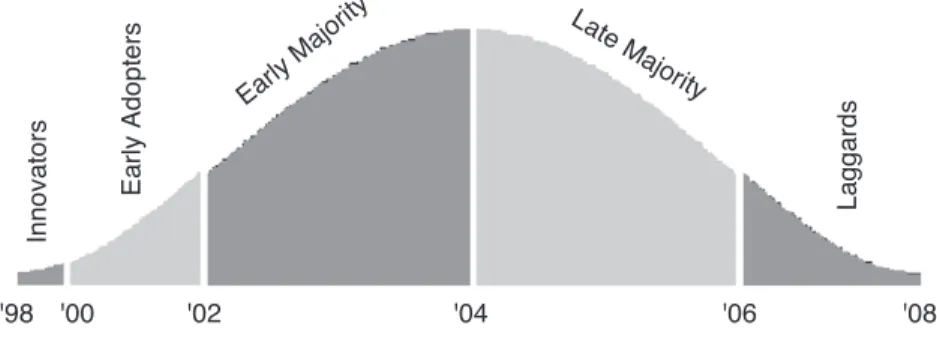
In terms of future use, Unger [42]suggested that the time frame for PM-ASP adoption in the construc-tion industry could be explained using Geoffrey Moore’s technology adoption curve as shown inFig. 2. Between 1998 and the end of 2001, the industry’s innovators and early adopters tested PM-ASPs and found them to be of significant benefit. From 2002 to the end of 2003, well-known construction companies started using PM-ASP on their major projects and began pushing PM-ASPs out to their business part-ners. Meanwhile, owners who had seen the results also started adopting PM-ASPs themselves and began
to specify the use of PM-ASPs in their contracts. Starting from 2004, small and medium A/E/C firms who can be regarded as a late majority will clearly see the benefits of PM-ASPs and will use PM-ASPs in all of their projects. A truly transformational new era of productivity in the construction industry will begin to unfold in this period.
7. Summary and conclusions
This paper presented the state-of-the-art of PM-ASPs for the construction industry, the current busi-ness models of PM-ASPs, and their supported fea-tures. Examples of systems currently available on the market were demonstrated. The potential benefits and impediments of PM-ASP implementation were also discussed, followed by a review of trends towards the future of PM-ASPs and some existing research related to PM-ASPs conducted by academia.
It can be concluded that PM-ASPs present signif-icant benefits to the construction industry, but their successful implementation is still hindered by barriers, for the most part nontechnical. Yet, research conducted to date still either aims to solve the existing technical problems of PM-ASPs or to introduce some new advanced techniques to improve the systems. Most of them ignore that technology push is not the only critical success factor for effective implementation of a new technology such as PM-ASP. Unlike other tech-nologies, PM-ASPs are very much concerned with the exchange of information across the project life cycle, and their successful implementation therefore will not only require a state of readiness within one organiza-tion but also within all organizaorganiza-tions involved in the
construction processes, which makes the successful implementation of PM-ASPs difficult to be planned and managed.
In order for the construction industry to success-fully embrace PM-ASPs, many factors such as technology, process, people, procurement, legal issues, and knowledge management must be consid-ered equally. Although there have been some studies conducted to identify factors that can foster the successful development and usage of PM-ASPs, all of them are still based on either individual case studies using interview techniques or anecdotal evidence provided by success stories reported in the trade press. There has been no empirical re-search on a large scale conducted on this topic. As the importance of PM-ASP concept increases, the authors have completed a major research effort to identify common factors across the systems and organizations that can influence the success/failure of PM-ASP implementation efforts. The results of this research will be made available in subsequent publications.
References
[1] M.C. Hurtado, New survey points to spending growth, Engi-neering News Record, vol. 246 (21), McGraw-Hill, New York, USA, 2003, pp. 21.
[2] D. Walker, M. Betts, Information technology foresight: the future application of the world wide web in construction, Proceedings of the CIB W78, IT for Construction Process Reengineering, Cairns, Australia, July 1997.
[3] E.M. Rojas, A.D. Songer, Web-centric systems: a new para-digm for collaboration engineering, Journal of Management in Engineering, vol. 15 (1), ASCE, New York, USA, 1999, pp. 39 – 45.
[4] M.J. Skibniewski, M. Abduh, Web-based project management for construction: search for utility assessment tools, Invited Keynote Paper, Proceedings of INCITE 2000, Hong Kong Polytechnic University, 17 – 19 January.
[5] W.J. O’Brien, Implementing issues in project web sites: a practitioner’s viewpoint, Journal of Management in Engineer-ing, vol. 16 (3), ASCE, New York, USA, 2000, pp. 34 – 39. [6] S. Mead, Project-specific intranets for construction teams,
Project Management Journal, vol. 28 (3), Project Management Institute, Pennsylvania, USA, 1997, pp. 44 – 51.
[7] M.J. Skibniewski, P. Nitithamyong, Web-based construction project management systems: practical advantages and disad-vantages, Invited Keynote Paper, Proceedings of 4th Interna-tional Conference on Construction Project Management: Remarking Construction in the Knowledge-Based Economy,
Nanyang Technological University, Singapore, 4 – 5 March, 2004.
[8] T. Thorpe, S. Mead, Project-specific web sites: friend or foe?
Journal of Construction Engineering and Management, vol. 127 (5), ASCE, NewYork, USA, 2001, pp. 406 – 413.
[9] P. Doherty, Site seeing, Civil Engineering, vol. 69 (5), ASCE, New York, USA, 1999, pp. 38 – 41.
[10] J.H. Follett, Build online, and they will come, CNR (2001 March 29).
[11] J.M. Kraker, E-construction project management—firms jock-ey for the lead in the race to go on line, Engineering News Record, vol. 245 (12), McGraw-Hill, New York, USA, 2000, pp. 65.
[12] M. Alshawi, B. Ingirige, Web-Based Project Management, A Report on Web-Enabled Project Management, University of Salford, UK, 2002, http://www.extranetnews.com/ web%20enabled%20project%20managment.pdf, as viewed on November 15, 2002.
[13] B.-C. Bjo¨rk, The impact of electronic document management on construction information management, Proceedings of the CIB W78 Workshop on Distributing Knowledge in Building, the Aarhus School of Architecture, Denmark, June 12 – 14, 2002.
[14] M. Alshawi, B. Ingirige, Web-enabled project management: an emerging paradigm in construction, Automation in Construction, vol. 12 (4), Elsevier, New York, USA, 2003, pp. 349 – 364.
[15] C. Clegg, C. Axtell, L. Damodaran, B. Farbey, R. Hull, R. Jones, J. Nicholls, R. Sell, C. Tomlinson, Information tech-nology: a study of performance and the role of human and organizational factors, Ergonomics, vol. 40 (9), Taylor & Francis, London, UK, 1997, pp. 851 – 871.
[16] C. Cyon Research, The List, The Extranet News, http:// www.extranetnews.com/the_list/thelist_keys.htm, as viewed on October 30, 2003.
[17] J. Bryant, J. Petre, Project Management in the Construction Industry, White Paper for the Construction Industry Adviso-ry Council (CIAC) (http://archnt2.tamu.edu/contech/finalj/ proj_man.html), as viewed on November 15, 2002 (2000). [18] B. Burchard, AEC project management online, CADalyst,
(2001 July) 13 – 19.
[19] R. Korman, T. Illia, Industry dot-coms march to slower, steadier pace, Engineering News Record, vol. 246 (23), McGraw-Hill, New York, USA, 2001, pp. 36.
[20] J. Wesek, V. Cottrez, P. Landler, A Benefits Analysis of Online Project Collaboration Tools Within the Architecture, Engineering, and Construction Industry, A White Paper Reported by PricewaterhouseCoopers (http://www.buzzsaw. com/content/customers/white_papers/roi_pwc.pdf), as viewed on November 15, 2002 (2000).
[21] B. Tedeschi, Construction heads into the internet age, New York Times (2000 February 21) C1.
[22] T. Eisenmann, S. Pothen, Application Service Providers, A class note prepared for Harvard Business School, Document number 9-801-310, January 8 (2001).
[23] I. Campbell, The Intranet: Slashing the Cost of Business, International Data, California, 1997.
[24] W. McFarlan, Information technology changes the way you compete, Harvard Business Review (1994 May – June) pp. 98 – 103 (Reprint No. 84308).
[25] A. Pincus, America’s New Deficit: The Shortage of Informa-tion Technology Workers, U.S. Department of Commerce, Washington, DC, 1997.
[26] M. Phair, Collaborative systems move closer, Engineering News Record, vol. 241 (2), McGraw-Hill, New York, USA, 1998, pp. 42 – 43.
[27] W. Back, K. Moreau, Information management strategies for project management, Project Management Journal, vol. 32 (1), Project Management Institute, Pennsylvania, USA, 2001, pp. 10 – 19.
[28] C.J. Anumba, K. Ruikarm, Electronic commerce in construc-tion—trends and prospects, Automation in Construction, vol. 11 (3), Elsevier, New York, USA, 2002, pp. 265 – 275. [29] P.S. Chinowsky, R.E. Goodman, Managing interdisciplinary project teams through the web, Journal of Universal Computer Science, vol. 2 (9), 1996, pp. 597 – 609.
[30] P. Bishop, Overview of e-construction project management, New Civil Engineer Plus, NCE, London, UK, 2001 June 5. [31] P.W. Berning, S. Coyne, E-commerce and the construction
industry: the revolution is here, Industry Reports Newslet-ters provided by the Construction Web Links (http://www. constructionweblinks.com/Resources/Industry_Reports_ Newsletters/Oct_2_2000/e-commerce.htm), as viewed on April 15, 2004 (2000).
[32] F. Pen˜a-Mora, K.K. Choudary, Web-centric framework for secure and legally binding electronic transactions in large-scale A/E/C projects, Journal of Computing in Civil Engineer-ing, vol. 15 (4), ASCE, New York, USA, 2001, pp. 248 – 258. [33] W.G. Krizan, eConstruction disputes: liability disclaimers lead way as digital age issues weigh in, Engineering News Record, vol. 246 (8), McGraw-Hill, 2001, pp. 41 – 45.
[34] O.O. Ugwu, C.J. Aumba, J.M. Kamara, Integration of
custom-er requirements with products and scustom-ervices on the intcustom-ernet, Proceedings of the UK National Conference on Objects and Integration for Architecture, Engineering, and Construction, Watford, UK, March 13 – 14, 2000, ISBN 1 86081 377 1, CRC Publishers, pp. 40 – 49.
[35] M. Morell, J. Ezingeard, Revisiting adoption factors of inter-organizational information systems in SMEs, Logis-tics Information Management, vol. 15 (1), Emerald, West Yorkshire, UK, 2002, pp. 46 – 57.
[36] W.J. Angelo, Broadband casts broad net over construction job-sites, Engineering News Record, vol. 246 (23), McGraw-Hill, New York, USA, 2001, pp. 41.
[37] M.J. Earl, Management Strategies for Information Technology, Prentice-Hall, Hemel Hempstead, Herts, 1989.
[38] K. Irani, J.-N. Ezingeard, R.J. Grieve, Integrating the costs of an IT/IS infrastructure into the investment decision making process, The International Journal of Technological Innova-tion, Entrepreneurship and Technology Management (Techno-vation), vol. 17, 1997, pp. 695 – 706.
[39] Z. Irani, J.-N. Ezingeard, R.J. Grieve, Investment justification of information technology in manufacturing, International Journal of Computer Applications in Technology, vol. 12, 1999, pp. 90 – 101.
[40] M.L. Markus, Power, politics, and MIS implementation, munications of the ACM, vol. 26 (6), Association for Com-puting Machinery, New York, USA, 1983, pp. 430 – 444. [41] P. Tait, I. Vessey, The effect of user involvement on system
success: a contingency approach, MIS Quarterly, vol. 12 (1), Society for Management Information Systems, Minne-sota, USA, 1988, pp. 91 – 108.
[42] Unger, The trend toward an internet-based communication standard in the A/E/C industry, A White Paper Provided by Constructware (http://www.constructware.com/Common/ Downloads/Standardization_White_Paper.pdf), as viewed on November 15, 2002 (2002).
![Fig. 1. Functional scheme of WPMS [7].](https://thumb-us.123doks.com/thumbv2/123dok_us/1565653.2710167/3.816.196.620.132.481/fig-functional-scheme-of-wpms.webp)