Accepted to the 5th Scandinavian Workshop on E-Government (SWEG-2008), Copenhagen Business School, February 4-5 2008
The evolution of a generic regulation model
for e-government development
Göran Goldkuhl
Department of Management and Engineering Linköping University &
Department of Informatics
Jönköping International Business School Sweden
e-mail [email protected]
Abstract
This paper presents a new theoretical model (the Generic Regulation Model - GRM) which is aimed for e-government development. This model has evolved through an action research project in e-government. The project has worked in the area of personal assistance to disabled persons. In this project there was a need to conceptualize the relations between different governmental agencies and the clients. As a response to this need a generic model and a situational model were developed. The new generic model (GRM) is theoretically based on another theoretic model (the Generic Exchange Model - GEM). GRM does not replace the GEM model. It is partially a specialisation of the GEM model and it is intended to be used in regulation contexts. A claim is that the GRM model is adequate in many e-government situations, since there is often some regulation issue at stake. The paper also gives an epistemological account of the evolution of the new GRM model. GRM is considered to be a practical theory and it has evolved through a practical inquiry (the action research project on personal assistance). The practical inquiry has included application of the GRM model (as a kind of empirical grounding) and also some initial theoretical grounding.
1 Introduction
1.1 Background
A great part of e-government development has its focus on public e-services for citizens. There is a rapid growth in the development and launching of new public e-services over the web to citizens. Such endeavours usually incorporate a 24/7-vision for governmental agencies. Citizens should always be able to reach, through the web, government agencies and also be served by them. For the development of public e-services there is a need for appropriate models for conceptualisation and guidance. Different generic models have been presented and used. There are stage models which describe different kinds of e-services and the expected line of evolution; e.g. Layne & Lee (2001), Hiller & Belanger (2001), Siau & Long (2005), Andersen & Henriksen (2006). There are also generic architectural models that describe e-services in relation to back-office IT e-services; e.g. Janssen & van Veenstra (2005), Evangelides (2004). Wimmer (2002) has treated the need for life event models in e-service development. There are also models for conceptualisation of the interaction between public agencies and citizens. The Generic Exchange Model (GEM) has been presented by Goldkuhl
& Röstlinger (2007) and Goldkuhl (2007). In this model, different interaction phases between government and citizens are described. In each phase, generic actions of each party are described as well. This model is proposed to be used a generic template and source of inspiration for specific e-service developments. Based on this generic model, situational models describing the public agency – citizen interaction in specific e-services can be created. The development of the generic model GEM was based on an earlier generic model concerned with business interaction; the business interaction & transaction model – BAT (Goldkuhl & Lind, 2004; Goldkuhl, 2006). One main purpose behind the creation of the Generic Exchange Model was the idea to get a generic interaction model that could be used for commercial as well as government settings (Goldkuhl & Röstlinger, 2007). The GEM model has been used in some empirical testing and it showed to be applicable (Goldkuhl, 2007).
The GEM model was later tried out in another case of e-service development; in a case concerning support and service for persons with certain disabilities. The application was however not straight forward in this e-service case. A need for an alternative model was discovered. Based on the GEM model, a new generic model was developed; the Generic Regulation Model (GRM). This model is especially adapted for e-government development. 1.2 Purpose
The purpose of this paper is to describe the development of the Generic Regulation Model and to show its use in a case study (an action research project) and to report some experiences from its uses. This work is part in a practice research tradition, with the ultimate purpose to contribute to governmental practices. There is a clear design orientation in the work. The research approach and its pragmatist bases will be further described in section 2 below.
The Generic Regulation Model conceptualizes regulation and the interaction between public agencies and citizens. This means that the paper deals with important aspects of e-government. The concept of regulation is thus investigated in relation to e-government. Regulation is defined as a relation between different practices; one regulating practice and one regulated practice. Regulation is also put in a clear legal context; as an application of certain laws in particular authority contexts. This means that the paper presents some theoretical and empirical grounding for the Generic Regulation Model. The paper also describes the meaning of generic model vs situational model and their respective uses in e-government development.
2 Research approach
An action research project has been conducted in the area of support and service for persons with certain disabilities. Two researchers have participated as analysts in a participatory design endeavour for developing work processes, e-services and other IT support. Representatives from 14 Swedish municipalities and the Swedish Social Insurance Agency (SIA) have participated actively in this project. This e-government project was initiated and managed by the “Platform for Co-operative Use” (Sambruk) – a Swedish non-profit organization which primarily supports collaborative e-government development projects in the Swedish public sector. Sambruk is a membership organisation and it consists of approximately 75 Swedish municipalities. It is a kind of “digital collaborative arrangement” (Haug, 2007).
Two researchers participated in the project as analysts/designers1. An action research approach was used in this study. The researchers combined the role of 1) change agents in the e-government project with 2) roles of observation, exploration and testing. This is typical in action research projects to combine a role of active change with a research focused role (e.g. Susman & Evered, 1978; Davison et al, 2004). The research can also be characterized as a practical inquiry, with objectives 1) to contribute to the actual local setting of this project as well as 2) to make general practice contributions. This latter objective means to create knowledge that is valuable for practical e-government in general. The concept of practical inquiry has been articulated in Goldkuhl (2007) and it is inspired by pragmatic philosophy (Dewey, 1938; Argyris et al, 1985; Cronen, 2001). One important aspect of practical inquiry is the use and development of practical theories (Cronen, 2001; Goldkuhl, 2007). Practical theories should help us to see things, aspects, properties and relations which otherwise would be missed. “Its use should, to offer a few examples, make one a more sensitive observer of details of action, better at asking useful questions, more capable of seeing the ways actions are patterned, and more adept at forming systemic hypotheses and entertaining alternatives” (Cronen, 2001, p 30). Practical theories should not only help us in observation and diagnosis, but should also be a companion in design issues. In such cases a practical theory becomes a design theory (Walls et al, 1992; Goldkuhl, 2004).
The Generic Exchange Model was used as a practical theory2 in the actual e-government study. As said above, a need was discovered to modify this model in order to better cope with the issues in the actual project. As a result, the Generic Regulation Model was developed as part of the practical inquiry. This new model was used in the e-government study. This entails also that the GRM model is one result from the practical inquiry. It is a general practice contribution from this study. This will be further elaborated in section 4.3 below.
The project started with a workpractice diagnosis investigating the current ways of performing the work. This included problem analysis, goal analysis and process modelling. New work processes were then designed together with the design of e-services and other IT support.
3 The Generic Exchange model
3.1 From BAT to GEM
The Generic Exchange Model was one of the practical theories that we, as action researchers, had in our “tool box” for this practical inquiry/e-government study. This model was judged appropriate to use in this case, since the workpractice comprised a lot of interaction between 1) the clients (disabled persons and their proxies) and 2) governmental agencies (the Social Insurance Agency and municipalities).
1 One of the participating researchers is the author of this paper. The other researcher is Jonas Sjöström. 2 Goldkuhl (2007) describes different constituents of a practical theory. A graphical model may be one part of
such a theory. There are other parts in a practical theory, as conceptualisations, patterns, normative criteria and design principles (ibid). I will talk about GEM and GRM as practical theories implying that there are other parts of the theories (than the models) which are not so well described in this paper.
The Generic Exchange Model and its development have been described thoroughly by Goldkuhl & Röstlinger (2007). I will give a brief overview over this model as a basis for the treatise of the new model GRM in section 4 below.
GEM was developed from the BAT model (e.g. Goldkuhl & Lind, 2004; Goldkuhl, 2006). GEM is a model describing the interaction between two parties. In a business setting the two roles are supplier and customer. In a more generalized perspective, the roles are producer and client. The model describes the interaction between client and producer; from the needs of a client until the delivery of something from the producer to the client and the subsequent assessments of this interaction. The essential idea behind GEM (and BAT) is to structure the process how a client and a producer come to an agreement about what to be done and how this agreement is fulfilled and realised.
BAT and GEM are models within the language action tradition1 (Winograd & Flores, 1986). These models emphasize the actions performed by each party and what kind of social relations (commitments and expectations) that are created through the different actions. The different actions are structured in generic phases consisting of exchanges. The language in the BAT model was originally business like. The GEM model (as a re-development of BAT) has borrowed parts of this terminology. Some terms have been changed to cover both a business and a government setting. Some terms have been kept from the BAT model since they are seen to hold generic meanings; as e.g. offer, order and product. Product is a generic concept covering both services and goods.
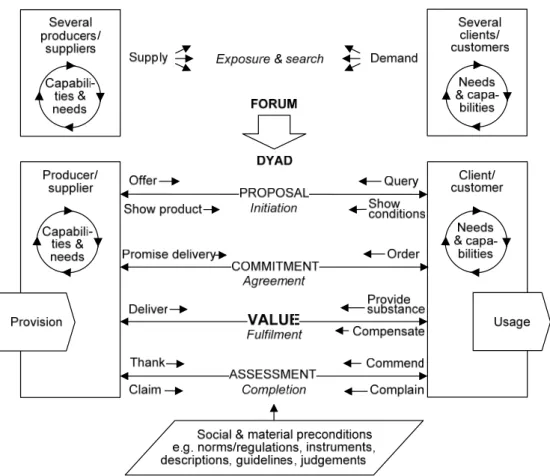
The GEM model (figure 1) is thus a dyadic model for describing the interaction between a client and a producer. The interaction is structured in four phases: 1) initiation, 2) agreement, 3) fulfilment and 4) completion. In each phase there may be exchanges. There are different exchange objects in each phase. In the initiation phase there may be exchange of proposals. There may be offers from the producer and questions from the client. The offers tell the clients what kind of products the producer can deliver. In the agreement phase there is an exchange of commitments. Orders and promises are exchanged. Through a delivery promise, the producer makes a commitment for future delivery. The client order (e.g. an application) is not just a request for a delivery. In some situations it also means a commitment for future payment (compensation). In this phase the parties may, through clarification and negotiation, come to an agreement about what product is requested.
In the third phase, the fulfilment phase, there will be an exchange of value. There is an exchange of products vs possible compensation. The producer delivers a product, which in a government setting may be a decision or a permit or some kind of medical or social care. The client may pay for the delivery. In this phase the parties fulfil their earlier commitments. The fourth phase is an assessment phase. Each party assesses the conducted interaction. Did it reach expectations? If not, this may be expressed as a complaint. Not all discontents may be expressed. Negative assessments may sometimes not be communicated. Positive assessments are not so often communicated, but sometimes there may be an expression of commendation.
1 The language action tradition builds on speech act theory; e.g. Searle (1969) and its emphasis that speech
(communication) is action. Other generic models within this tradition are Action Workflow (Medina-Mora et al, 1992) and DEMO (Dietz, 1999).
Figure 1. Generic Exchange Model – GEM (from Goldkuhl & Röstlinger, 2007)
These four phases form together a transaction (Lind & Goldkuhl, 2003; (Goldkuhl & Röstlinger, 2006). Transaction is thus a holistic notion that holds together the product with its preceding actions of offers, orders, delivery promises and also its subsequent actions of payment and assessments.
The dyadic exchange of a transaction is preceded by a preparatory phase where producers expose their possible supply and the clients expose their needs and demands in a mutual search process. The interactions between producers and clients are governed by norms (e.g. laws and other regulations) and instruments for interaction (as e.g. information technology). These governing objects are called infrastructure for exchange.
3.2 From generic model to situational model
One important idea behind using GEM as a basic theory-model in e-government projects is that it is valuable to clarify and reveal the essential interaction and transaction pattern between public agencies and citizens and not only the IT-mediated communication. What is done with support of IT in e-government is usually only part of a total workpractice and interaction logic. GEM can contribute to create situational models that visualize the overall interaction pattern. In Goldkuhl (2007) a case of e-services for municipal child care is described where the intended e-services are defined as parts of the total interactive process. A situational model describing the interaction between the municipality and the parents (as clients) was created with theoretical inspiration from the Generic Exchange Model (ibid).
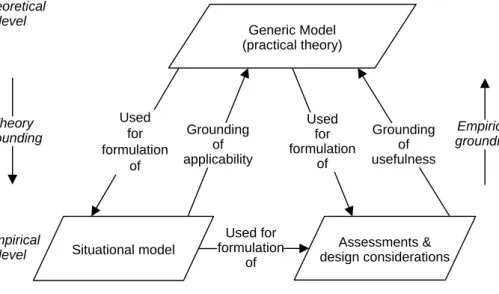
A generic model can thus be an inspirational basis for the development of situational models in a concrete project. A situational model describes some specific issue in a diagnosis/design endeavour. Such models are made based on a specific model notation (model language). If generic models (practical theories) are used as a basis, the creation of these situational models is also theoretically informed. The generic model will not only be used for formulation of a situational model, but also may be a basis for making diagnostic considerations and design proposals (figure 2).
The creation of a situational model can be used as an empirical grounding of the generic model. The formulation of a situational model (informed by the generic model) can serve as empirical grounding of the applicability of the generic model. The formulation of diagnostic assessments and design proposals can serve as empirical grounding of usefulness of the generic model. These different types of groundings are depicted in figure 2.
Generic Model (practical theory)
Situational model Assessments &
design considerations Theory grounding Theoretical level Empirical level Empirical grounding Used for formulation of Grounding of applicability Grounding of usefulness Used for formulation of Used for formulation of
Figure 2. The relation between generic model and situational model
4 The Generic Regulation Model
In this section I will describe the Generic Regulation Model and how it was developed during the action research project. I will start with a description of the needs for this type of new model in the project (section 4.1). The GRM model and its uses in the project will then be described (section 4.2). Some methodological reflections of the emergence of the model will be presented in section 4.3.
4.1 Needs for a new model
In Sweden, there is the Act concerning Support and Service for Persons with Certain Disabilities (LSS; SFS, 1993a) that regulates different types of services provided by the municipality to disabled persons. The intention of the law is to give support to disabled persons in their everyday life. One of the services regulated in LSS is personal assistance. Through the LSS act, these persons can obtain at most 20 hours personal assistance from the municipality or some other assistance provider. For more than 20 hours assistance per week, there is a need for an investigation and an allowance decision from the Social Insurance Agency. A municipality pays the first 20 hours and above that, the Social Insurance Agency
pays the allowance. This is regulated by a complementary law; the Act concerning Assistance Allowances (LASS; SFS, 1993b).
The referred project - an e-government initiative concerning decisions and compensations for personal assistance - was started due to the very cumbersome administration and needs for better quality in time and cost accounting. The two acts (LSS & LASS) have given rise to fairly complicated work processes and interaction patterns between different stakeholders. Early in the project, we recognised needs for clarifying descriptions of the overall interaction. Several co-work diagrams, theoretically based on the GEM model, were drawn in process modelling workshops. This modelling was performed as a joint task between the action researchers and the other project participants.
In this analysis and modelling, the Generic Exchange Model was used as a template for studying the interaction between the users of the assistance services (the disabled and their proxies), the Social Insurance Agency, the municipalities and other assistance providers. Different co-work diagrams (situational models) were created describing different interaction patterns. In order to arrive at a proper conceptualisation, there was a need to generalise these models into one single interaction model. When trying to create such a model, some conceptual confusion arose.
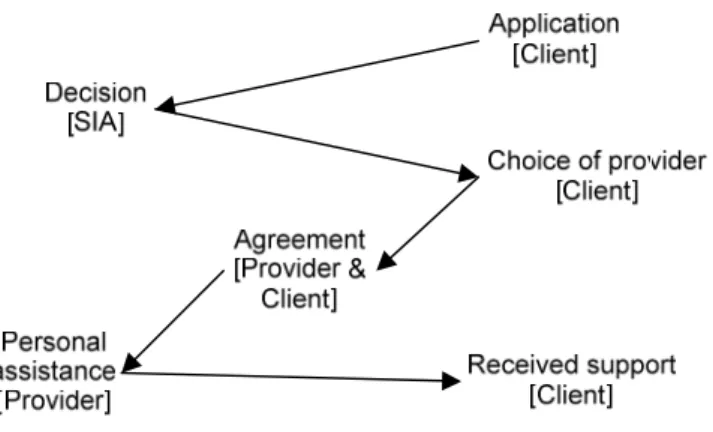
The GEM model structures the basic interaction between the producer and the client in generic phases and for each phase essential actions are conveyed. There are some essential acts to identify and describe. Important acts are the order from the client and the delivery promise and the delivered product from the producer. Such acts are nearly almost necessary to identify in modelling interactive practices between clients and producers. These acts are essential in a transaction between a producer and a client. What was the client order and the delivery promise and the delivered product in this case? A basic action patterns from the case is depicted in figure 3 as an illustration for this discussion. The client (or the proxy) makes an application directed to the Social Insurance Agency (if the needs are higher than 20 hours per week). A decision on assistance allowance is made by the Social Insurance Agency, i.e. what kind of service and how many hours per week. The client chooses then which provider to use for delivery of assistance services. The laws (LSS, LASS) give the client great power to choose a provider for personal assistance. It is possible to choose the municipality, or a cooperative or a company or even for the client to be an employer of personal assistants. The choice of provider and the accompanying agreement between the client and the provider are important acts. So is of course also the action of personal assistance by the provider directed towards the client. This is what the workpractice ultimately is aimed for, that the disabled will receive help and support.
From this analysis and model it is obvious that personal assistance is a main product. The actions before that can be seen as a part of a rather complicated contracting process (from application → agreement). First, there is a decision needed from SIA, and then there must be an agreement between the client and the provider. In this way to conceptualize the process, the SIA decision of assistance allowance is seen as a delivery promise. The assistance agreement between the assistance provider and the client comprises also a kind of delivery promise. It is a promise to deliver personal assistance in accordance with the SIA decision. The SIA decision cannot be interpreted as a delivery promise for a certain kind of personal assistance. It gives the client the right to obtain personal assistance of a certain amount, but it does not state anything about actual delivery and who will provide the service. The SIA decision is thus more of a “general delivery promise” and not a specific one as the provider’s.
Figure 3. Basic action pattern in the personal assistance case
The original characterisation of the SIA decision as a delivery promise was due to two other obvious characterisations; personal assistance as a product and the application as a client order. The SIA decision was seen as a response to the application (order) and it was a basis for the product of personal assistance. A delivery promise is usually a response to an order and it is a basis for the product. However, it is not fully correct to see the decision as a promise for the assistance product. The SIA decision is a promise to pay for personal assistance, not any promise to deliver any personal assistance. Such a promise is made by the chosen assistance provider. The SIA decision gives the client the right to “purchase” personal assistance from an assistance provider. This led to a re-conceptualisation of the SIA – client interaction. It was not seen as a contracting part of the personal assistance interaction process. It was seen as a full transaction of its own. The SIA decision was seen as the product of this interaction and transaction. The delivery promise in this transaction would be the confirmation from SIA to the client that the application is received and shall be handled; this act is however not showed in figure 3 above.
This led to a total re-conceptualisation of the personal assistance process. It was no longer seen as one transaction process, but instead two related transaction processes. The first transaction process (the application & decision process) will regulate the second process (the personal assistance process). This will be further described in the next section where the Generic Regulation Model is introduced.
4.2 GRM: Regulating practice vs regulated practice
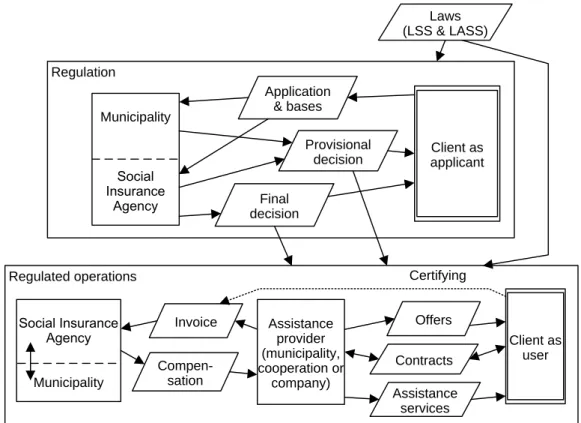
As a consequence of the needs and insights described above (section 4.1) we created one situational model describing the overall interaction pattern concerning personal assistance. This model (a co-work diagram) is presented in figure 4. It divides the total workpractice into two main parts; one regulating part and one regulated part. The regulating part is the application and decision process; and the regulated part is the personal assistance process. Each part forms a transaction following the Generic Exchange Model. As described above (section 4.1), we first treated, in the project, the whole interaction as one transaction. But later, we divided the total interaction into two related transactions as in figure 4. The transactions are related through the decision concerning personal assistance. This decision process is rather complicated and I will not give all details here, just mention that the municipality decides about personal assistance below 20 hours per week and the Social Insurance Agency decides above that amount. The allowance decision functions as the main boundary object between
the two transactions. It functions as a regulator of the personal assistance practice (the regulated operations). Laws (LSS & LASS) Regulation Municipality Social Insurance Agency Client as applicant Application & bases Provisional decision Final decision Regulated operations Assistance provider (municipality, cooperation or company) Client as user Contracts Assistance services Social Insurance Agency Municipality Invoice Compen-sation Certifying Offers
Figure 4. Co-work diagram (situational model) describing the overall interaction concerning personal assistance, based on the Generic Regulation Model
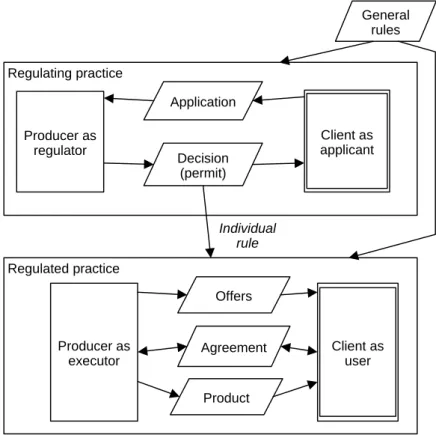
The creation of this particular model in the project was accompanied with theoretical reflections on different types of practices. The conceptualisation of two related practices through regulation seemed to be important. Actually this meant that a theoretical specialisation of the Generic Exchange Model emerged. Instead of one single transaction as in GEM, this new conceptualisation comprised two related transactions. One transaction is concerned with regulating, i.e. with a transaction ending with a formal decision as the product. This product (decision) acts as a specific rule for the other transaction, i.e. the regulated practice. These both interactive and transactional practices are regulated by some general rules. The second practice (the regulated practice) is regulated through these general rules and the specific rule (i.e. the decision from the regulating practice).
In the personal assistance case, the two acts (LSS, LASS) govern the two transactional practices. These legal acts define the roles of the Social Insurance Agency and the municipality in the application process. It is an obligation for these agencies to examine applications for personal assistance and make decisions. LSS and LASS contain, together with more detailed regulations, criteria for judgements of the applications. The allowance decision is used by the client to choose an assistance provider and to sign an agreement for delivery of assistance services. The SIA decision would not be valid and useful if it was not given a legal status through the legal acts of LSS and LASS.
The situational model of the case (figure 4) has been abstracted into a generalized model in figure 5. This follows the discussion above concerning two related practices. Each practice is a transactional practice consisting of a producer and a client. The first practice is the
regulating practice that has a producer with the right to issue specific rules. A specific rule is an authority decision - e.g. an issued permit - which is valid for an individual. Such specific rules rely on general rules, such as legal acts and other public regulations of general kind. The second practice is a regulated practice, in which the client uses the specific rule for certain purposes. General rules Regulating practice Producer as regulator Client as applicant Application Decision (permit) Regulated practice Producer as executor Client as user Agreement Product Individual rule Offers
Figure 5. Two transactional practices related through regulation (a special case of the Generic Regulation Model)
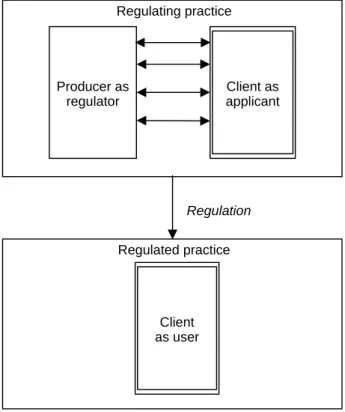
The model in figure 5 is an abstracted and generalized model. Although, this abstraction, it is not the generalized model concerning regulation. It is seen as an abstracted model, but a specialization of a generalized regulation model. These thoughts about conceptualisation and modelling of regulation was tested (during the project) on other regulation cases. It was tested on other governmental regulative decisions, such as building permits, food establishments permits and driver’s licences. Many, but not all such cases imply that the second practice is a transactional practice. For example, the use of a driver’s license is not conceived to be a transactional practice with both executor and user. A further generalization implies thus that the second practice should not be specified in any way. The first practice is specified to be transactional practice with the producer as a regulator and the client as an applicant. This generalized model is found in figure 6 and is conceived to be the Generic Regulation Model. Figure 5 is a special case of GRM, where the second practice is a transactional practice. The executor may be a governmental agency or it can be another type of actor due to the regulating circumstances.
The concept of regulation has here been associated with governmental authority and power. This can be seen as a narrow interpretation of ‘regulation’, since there are other actors engaging in regulation. There is a discussion concerning regulation and the involvement of different actors as regulators, which seems to be similar to the discussion concerning
government vs governance (Hay, 1995; Jessop, 1995). The actual case is probably a good example of this. The current praxis of personal assistance has actually evolved since legislation time of the two legal acts (LSS, LASS). There are certain issues in current praxis that the legislators obviously did not foresee when writing the law. These discrepancies have led to several assessment initiatives. One example is an audit by The Swedish National Audit Office (SNAO, 2004). There is also a current governmental investigation working (SOU, 2005, 2007) which will propose changes in the legislation. These changes seem to be of two kinds; to correct the observed dysfunctions in current praxis and to adapt the law to an evolved praxis which is valued positive. The actual project concerning personal assistance can also, partially, be seen as a response to this problematic evolution of interactive practices.
Regulated practice Regulation Producer as regulator Client as applicant Client as user Regulating practice
Figure 6. The Generic Regulation Model – two practices related through regulation
I have however chosen to use ‘regulation’ with a focus on governmental regulation, although I am aware of other coordinators and regulators as indicated above. There is a need to label this kind of exercise of authority that governmental agencies pursue. ‘Regulation’ is a response to this conceptual and terminological need. Future studies and uses of the Generic Regulation Model (including the regulation concept) will deliberate on possibly broader meanings of the regulation concept. The diagnosis and design interest in the actual case has guided this type of conceptualisation. ‘Regulation’ seems also to be used with this restricted meaning in e-government (e.g. Chen, 2002; Deakins & Dillon, 2002).
4.3 The evolution of GRM
The Generic Regulation Model has evolved as a practical theory in this project. I have described this evolution in sections 4.1-2 above. The discovered needs for conceptually improved models were described in section 4.1. In section 4.2, the generation of the new generic model and the accompanying situational model were described. I will now, in this
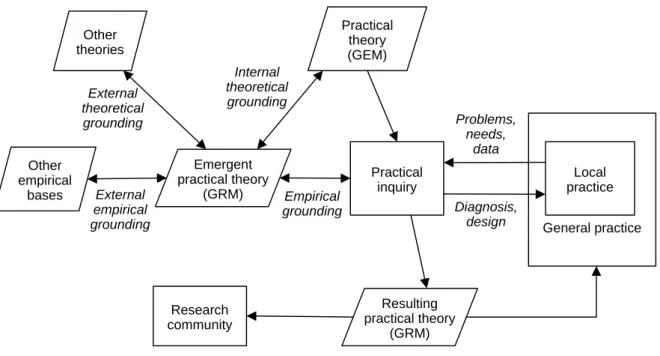
section, describe this development in more general terms; as an epistemological account. I will describe the development of GRM as an evolution of a practical theory through a practical inquiry. I refer back to section 2 for these concepts, which earlier have been elaborated in Goldkuhl (2007). Figure 7 gives an overview of this evolution.
Practical theory (GEM) Practical inquiry Local practice Emergent practical theory (GRM) Resulting practical theory (GRM) Other empirical bases Other theories Research community General practice Empirical grounding External empirical grounding External theoretical grounding Internal theoretical grounding Problems, needs, data Diagnosis, design
Figure 7. The evolution of GRM as a practical theory through the practical inquiry The action research project on personal assistance was a practical inquiry aiming at both local contributions (of diagnosis and design) and general practice contributions to e-government development. This practical inquiry used several practical theories and methods in the diagnosis and design process. One of these theories was the Generic Exchange Model (from Goldkuhl & Röstlinger, 2007). The use of this theory led to needs for a better adapted practical theory. This initiated the development of the Generic Regulation Model. GRM was an emergent practical theory during the practical inquiry. We did not only make a better situational model (as figure 4) in the project. We created a proper theoretical basis for this model. The situational model is theoretically based on the emergent theoretical model (GRM). The development of GRM was empirically inspired, but it also went through processes of theoretical reflection. I describe this as different grounding processes; theoretical vs empirical grounding and internal vs external grounding (Goldkuhl, 2004). The relations between the two generic models (GEM and GRM) were investigated and GRM was made congruent to GEM. GRM is partially conceived as a specialisation of GEM, which was described in section 4.2 above. I call this internal theoretical grounding since the two models belong to the same theoretical family. GRM was also checked with other examples of regulation as mentioned in section 4.2. These checks were not proper empirical investigations, but functioned as an obstacle against over-generalization in this single case. I call this external empirical grounding. There is a need for further empirical grounding in the future. The concept of regulation was studied, although not in any depth yet; confer discussion in section 4.2. I call this external theoretical grounding and there is definitely a need for further such grounding.
The situational model (figure 4) has played a pivotal role in the action research project. It has served as means to find proper delimitations of sub-areas in the project. We have used the model several times in discussions in the project and we also use it repeatedly in external
presentations in order to give the essentials of the practice in a short time. The model has been appreciated by the municipal participants and they asked early to get (an electronic) copy so they could show it when presenting the case for colleagues back home. The model played a vital role both in the diagnosis phase and the design phase of the project. This is just to give some evidence of the usefulness of the situational model (and GRM) in the project. It is beyond the scope of this paper to give any detailed account of its uses. I claim that the project give some empirical grounding of the applicability and usefulness of the Generic Regulation Model.
The practical inquiry has resulted1 in a new practical theory, the Generic Regulation Model, which has been presented in this paper. Figure 7 shows different roles of a practical theory in a practical inquiry. These different roles correspond to what Walsham (1995) writes about roles of theories in interpretive research: as an initial guide to design and data collection; as part of an iterative process of data collection and analysis; as a final product of research. GEM was an initial guide for practical inquiry. GRM emerged in an iterative process during the process and it is also seen as a final product from the research. There are slight differences to Walsham’s account. In practical inquiry, there is an emphasis that the theories should be used as instruments in the empirical part of the process; not simply as ways to structure data.
5 Conclusions
This paper has presented a new theoretical model (the Generic Regulation Model - GRM) which is aimed for e-government development. This model has evolved through an action research project in e-government. This new model is theoretically based on another theoretic model (the Generic Exchange Model - GEM). It does not replace the GEM model. It is partially a specialisation of the GEM model and it is intended to be used in regulation contexts, not in all possible exchange contexts. A hypothesis is that the GRM model is adequate in many e-government situations, since there is often some regulation issue at stake. I will conclude this paper with some summarizing propositions (assumptions and conclusions) concerning e-government and regulation:
• Governmental regulation can be divided into three practice levels: 1) legislation as general regulation, 2) application of legislation for issuing decisions (= individual rules), i.e. specific regulation, 3) application of general and individual rules in regulated practices. • The issuing of decisions/individual rules can be conceived as a transactional practice with
two interactive actors (producer as regulator and user as applicant).
• Authority decisions (like permits etc) are products from regulating practices.
• Governmental agencies can act as both regulators in regulating practices and as producers/executors in regulated practices.
The paper should also been conceived as an argumentation for giving the notion of regulation a central place in e-government, both in practice and in research. Regulation seems to be a distinguishing phenomenon in e-government in relation to e-commerce. The establishment of commercial agreements in business interaction is due to negotiations and mutual engagements and considerations of the two interacting parties. Regulations give one party in the transaction
a certain power and authority. This cannot be dismissed when approaching e-government as practice and research area.
References
Andersen, K V, Henriksen H Z (2006). E-government maturity models: Extension of the Layne and Lee model, Government Information Quarterly, Vol 23, pp 236–248
Argyris C, Putnam R, McLain Smith D (1985) Action science. Concepts, methods and skills for research and intervention, Jossey Bass, San Francisco
Chen H (2002) Digital Government: technologies and practices, Decision Support Systems, Vol 34, pp 223–227
Cronen V (2001) Practical theory, practical art, and the pragmatic-systemic account of inquiry, Communication theory, Vol 11 (1), p 14-35
Davison R M, Martinsons M G, Kock N (2004) Principles of canonical action research, Information Systems Journal, Vol 14, pp 65–86
Deakins E, Dillon S M (2002) E-government in New Zealand: The local authority perspective, International Journal of Public Sector Management, Vol 15 (5), pp 375-398
Dewey J (1938) Logic: The theory of inquiry, Henry Holt, New York
Dietz J (1999) Understanding and Modelling Business Processes with DEMO, Proc. 18th International Conference on Conceptual Modeling (ER'99), Paris
Evangelides A (2004) FRAMES – A Risk Assessment Framework for e-Services, Electronic Journal of e-Government, Vol 2 (1), pp 21-30, www.ejeg.com
Goldkuhl G (2004) Design theories in information systems – a need for multi-grounding, Journal of Information Technology Theory and Application (JITTA), Vol 6 (2), p 59-72 Goldkuhl G (2006) Action and media in interorganizational interaction, Communications of
the ACM, Vol 49 (5), p 53-57
Goldkuhl G (2007) What does it mean to serve the citizen in e-services? - Towards a practical theory founded in socio-instrumental pragmatism, International Journal of Public Information Systems, Vol 2007 (3), pp 135-159
Goldkuhl G, Lind M (2004) Developing e-interactions – a framework for business capabilities and exchanges, in Proc of the 12th European Conference on information systems (ECIS2004), Turku
Goldkuhl G, Röstlinger A (2006) Context in Focus: Transaction and Infrastructure in Workpractices, in Proceedings of the 4th
Intl Conference on Action in Language, Organisations and Information Systems (ALOIS-2006), Borås
Goldkuhl G, Röstlinger A (2007) Clarifying Government – Citizen Interaction: From Business Action to Generic Exchange, in Proceedings of the 4th Scandinavian Workshop on eGovernment, Örebro
Hay C (1995) Re-stating the problem of regulation and re-regulating the local state, Economy and Society, Vol 24 (3), pp 387-407
Haug A V (2007) Organisational impacts of ICTs: From hierarchy to markets and networks? The challenges of developing and managing digital collaboarative arrangements, Proceedings of the 4th Scandinavian Workshop on eGovernment, Örebro
Hiller J, Bélanger F (2001) Privacy strategies for electronic government, E-government series. Endowment for the business of Government, Pricewaterhouse Coopers, Arlington
Janssen M and van Veenstra AF (2005) Stages of Growth in e-Government: An Architectural Approach, Electronic Journal of e-Government, Vol 3 (4), pp 193-200, www.ejeg.com
Jessop B (1995) The regulation approach, governance and post-Fordism: alternative perspectives on economic and political change?, Economy and Society, Vol 24 (3), pp 307-333
Layne K, Lee J (2001) Developing Fully Functional E-government: A four-stage model, Government information quarterly 18(2): 122-136
Lind M, Goldkuhl G (2003) The constituents of business interaction - generic layered patterns, Data & Knowledge Engineering, Vol 47 (3), p 327-348
Medina-Mora R, Winograd T, Flores R, Flores F (1992) The Action Workflow Approach to Workflow Management Technology, In: Turner J., Kraut R. (Eds.) Proceedings of the Conference on Computer-Supported Cooperative Work, CSCW’92, ACM Press, New York
SFS (1993a) Lag om stöd och service till vissa funktionshindrade (LSS), Swedish Code of Statutes SFS 1993:387 [in Swedish]
SFS (1993b) Lag om assistansersättning (LASS), Swedish Code of Statutes SFS 1993:389 [in Swedish]
Siau K, Long Y (2005) Synthesizing e-government stage models – a meta-synthesis based on meta-ethnography approach, Industrial Management & Data Systems, Vol 105 (4), pp. 443-458
SNAO (2004) Personlig assistans till funktionshindrade, RiR 2004:7, The Swedish National Audit Office/Riksrevisionen, Stockholm [in Swedish]
SOU (2005) På den assistansberättigades uppdrag. God kvalitet i personlig assistans – ändamålsenlig användning av assistansersättning, Swedish Government Official Reports, SOU 2005:100 [in Swedish]
SOU (2007) Kostnader för personlig assistans. Skärpta regler för utbetalning, användning och återbetalning av assistansersättning, Swedish Government Official Reports, SOU 2007:73 [in Swedish]
Susman G I, Evered R D (1978) An assessment of the scientific merits of action research, Administrative Science Quarterly, Vol 23 (4) p 582-603
Walls J G, Widmeyer G R, El Sawy O A (1992) Building an information systems design theory for vigilant EIS, Information Systems Research, Vol 3 (1), pp 36-59
Walsham G (1995) Interpretive case studies in IS research: nature and method, European Journal of information systems, vol 4, p 74-81
Wimmer M A (2002) Integrated Service Modelling for Online One-stop Government, Electronic Markets, Vol 12 (3), p 149-156
Winograd T, Flores F (1986) Understanding computers and cognition: A new foundation for design, Ablex, Norwood