Simulative evaluation of security attacks
in networked critical infrastructures
Marco Tiloca1, Francesco Racciatti2, and Gianluca Dini2 1 SICS Swedish ICT AB, Security Lab
Isafjordsgatan 22, 16440 Kista (Sweden) [email protected]
2
Dept. of Ingegneria dell’Informazione, Univ. of Pisa Largo Lazzarino 1, 56100 Pisa (Italy)
[email protected], [email protected]
Abstract. ICT is becoming a fundamental and pervasive component of critical infrastructures (CIs). Despite the advantages that it brings about, ICT also exposes CIs to a number of security attacks that can severely compromise human safety, service availability and business in-terests. Although it is vital to ensure an adequate level of security, it is practically infeasible to counteract all possible attacks to the maxi-mum extent. Thus, it is important to understand attacks’ impact and rank attacks according to their severity. We propose SEA++, a tool for simulative evaluation of attack impact based on the INET framework and the OMNeT++ platform. Rather than actually executing attacks, SEA++ reproduces their effects and allows to quantitatively evaluate their impact. The user describes attacks through a high-level description language and simulates their effects without any modification to the simulation platform. We show SEA++ capabilities referring to different attacks carried out against a traffic light system.
Keywords: Security, attack simulation, OMNeT++, INET
1
Introduction
ICT is a fundamental component in monitoring and controlling critical infras-tructures (CIs) such as electricity, railway and traffic systems. CIs are essential in the proper functioning of our daily life and their security is extremely im-portant. In fact, a security infringement may have severe adverse consequences in terms of human being safety, service availability and business interests. In the past, CIs were somewhat secure as they had limited connectivity. However, the increased connectivity to the Internet and the corporate network, as well as This work was carried out during the tenure of an ERCIM “Alain Bensoussan” Fellowship Programme. The research leading to these results has received funding from theEuropean UnionSeventh Framework Programme (FP7/2007-2013) under
the use of commodity hardware, off-the-shelf protocols and software components make CIs no longer immune to cyber-security attacks.
In order to better understand the protection of CIs, it is important to analyze the security risks of such systems and develop appropriate solutions to protect them from malicious attacks. Unfortunately, addressing all the possible attacks is not viable, either from a practical or from an economical viewpoint. It is thus necessary to identify the attacks that have a more severe impact and focus on them. A possible approach to achieve this goal is viasimulation. Simulations are important due to the fact that it is impractical to conduct security experiments on a real system, because of the scale and the cost of implementing standalone systems, as well as the potential risk of system downtime. On the other hand, although well consolidated, an analytical approach based on system theory does not provide a complete modeling of the ICT infrastructure [13].
In this paper, we present SEA++, a simulation tool aimed at quantitatively evaluating the impact of security attacks against the ICT infrastructure of a CI. We consider both cyber and physical attacks, where the former are addressed to messages, whereas the latter are addressed to nodes composing the infrastruc-ture. A distinctive feature of our tool is that it allows us to simulate the effects of an attack by reproducing the events that the attack generates. This implies that we do not need to implement or port an attack, with clear advantages in terms of analysis time.
The tool is based on an off-the-shelf network simulator that we extend, but not modify, by integrating components for the processing of attack events. Good simulators are always the result of a large effort, and therefore any modification is preferably avoided. In particular, we use the INET Framework, an open-source model library for the OMNeT++ simulation environment, that contains net-working models including those for the Internet stack, wired and wireless link layer protocols, and mobility [1][2]. Finally, our tool is also flexible, in that it al-lows us to describe attacks by means of a simpleattack specification language. In order to simulate the effects of an attack, it is sufficient to provide a description of the events that it generates in that language.
The rest of the paper is organized as follows. In Section 2, we discuss related works. In Section 3, we illustrate the main concepts behind the simulation tools, briefly introduce the attack description language and sketch the simulator ar-chitecture. In order to show the tool capabilities and potentialities, in Section 4 we discuss a case study based on attacks against a traffic light control system. Finally in Section 5 we draw our conclusions.
2
Related work
A number of different approaches to attack impact analysis have been presented so far. For instance, [10][12][15] discuss analytical models aimed at detecting and contrasting attacks, and rely on simulation to validate their own correctness and efficiency. In [3], Gengeet al.presented AMICI, an assessment/analysis platform for multiple interdependent critical infrastructues. AMICI relies on simulation
for the physical system components and an emulation testbed based on Emulab to recreate cyber components [5].
Wang and Bagrodia proposed SenSec, a framework that simulates the oc-currence of security attacks in Wireless Sensor Networks (WSNs) by injecting events into real application simulators [14]. The framework NETA for simulation of communication network attacks based on INET has been presented in [7]. It relies on implementing attacker nodes, which can strike attacks when triggered at runtime through dedicated control messages. In [4], Queiroz et al. present SCADASim, a simulation tool to test the effect of attacks in SCADA systems.
Although it displays similarities with SenSec, NETA, and SCADASim, our simulation framework results more flexible and easier to use. In fact, SEA++ as-sumes that attacks have been successfully performed, and reproduces their ef-fects on the network and application, rather than their actual performance. Also, SEA++ does not require the user to implement or customize any component of the simulation platform. This is particularly important for two reasons. First, it allows us to use off-the-shelf simulators. Second, good simulators are always the result of many man-years effort and therefore any modification is preferably avoided. In [6], we have presented ASF++, a framework akin to SEA++ but especially targeted to WSNs. A prototype implementation is available at [8]. In contrast, SEA++ provides a simulation framework for a conventional networking setting.
3
SEA++: Simulative Evalution of Attacks
The tool SEA++ is composed of the following three components. First, an
At-tack Specification Language (ASL) which allows the user to describe an attack
to be evaluated, in terms of their practical and final effects. Second, anAttack
Specification Interpreter(ASI) that converts the attack descriptions into
configu-ration files for the attack simulation. Finally, anAttack Simulatorthat simulates the effects of specified attacks on the system under investigation, so making it possible to quantitatively evaluate their impact on the network and application. Practically, the user first describes the effects of attacks to be evaluated by means of the high-level Attack Specification Language. Such descriptions can possibly be stored for later reuse. After that, the user runs theAttack
Specifica-tion Interpreter, to convert the attack descriptions into an attack configuration
file, which is provided as input to the Attack Simulator. Finally, the user runs
theAttack Simulator and simulates the execution of the system affected by the
described attacks. Note that the user is not required to further implement or customize any component of theAttack Simulator, with particular reference to application and communication modules.
3.1 The Attack Specification Language
The high-levelAttack Specification Languageallows users to describe attacks to be evaluated. It is worth noting that here we are not interested in how an attack
can actually be mounted and carried out. Such an issue attains to thefeasibility
of the attack, i.e. the likelihood of a given threat to occur. Feasibility is the other dimension of risk assessment and is not the focus of SEA++. Instead, we are interested in evaluating theimpact of successful attacks, i.e. their resulting consequences on the system. Practically, we quantitatively evaluate the effects of successful attacks. To fix ideas, let us consider a deception attack such as message injection. Then, we are not interested in how the adversary can inject fake messages in the system or in reproducing the actual message injection. Instead, our goal consists in understanding and evaluating what are the final effects of such messages on the network and application, once they have been successfully injected.
From this standpoint, we assume that the successful execution of an attack produces a sequence ofevents that takes place atomically. The ASL consists in a collection ofprimitives that allow us to specify the sequence of events related to a given attack. Primitives are organized into two sets, as described below.
i) Node primitives, that account for physical attacks performed against nodes,
and allow us to describe alterations in node behavior. In particular, the node
primitives are:
– destroy(nodeID, t)removes nodenodeIDfrom the network at timet, prevent-ing it from takprevent-ing part in further communication.
– move(nodeID, pos, t)moves nodenodeIDto position posat timet.
ii)Message primitives, that account for cyber attacks, and allow us to describe
actions on network messages, including eavesdropping, altering, injection and dropping. In particular, themessage primitives are:
– drop(pkt)discards the packetpkt.
– create(pkt, fld, content, ...) creates a new packet pkt and fill its field fld
withcontent. A single invocation makes it possible to specify the content of multiple fields.
– clone(srcPkt, dstPkt)clones packetsrcPktinto packetdstPkt.
– change(pkt, fld, newContent)writes newContentinto fieldfldof packetpkt.
– retrieve(pkt, fld, var) copies the content of the field fld of packet pkt into variablevar.
– put(pkt, dstNodes, TX|RX, delay)puts packet pkteither in the TX or RX buffer of all nodes in thedstNodes list after a delaydelay.
The ASL provides additional statements that allow us to specify the occur-rence of a list of events described throughmessage primitives. For instance, the statement from T every P do {<list of events>} specifies that the list of events takes place periodically, with periodP, on the declared list of nodes since timeT.
Also, the ASL allows us to specify theconditional occurrence of events de-scribed throughmessage primitives, depending on specific conditions evaluated by nodes at runtime. For instance, the following statements specify that the list
of events takes place on the declared list of nodes if condition is evaluated as
TRUE.
from T nodes = <list of nodes> do { filter(<condition>) <list of events> }
By means of the statements shown above, the ASL makes it possible to describe even complex attacks in a concise although clear way. For instance, let us consider awormhole attack [11] starting at time 200 s, where node 9 tunnels MAC packets sent by node 5 to a remote area of the network containing nodes 10, 11 and 15. The attack can be described as follows:
dstList={10,11,15}; from 200 nodes = "9" do {
filter(MAC.source==5 and MAC.type==DATA) put(packet,dstList,RX,0);
}
Note that we have used thedot notationpacket.layer.field, in order to specify the field field of packet packet in the header of layer layer. It follows that the user must be aware of the actual specific network protocols that are adopted at each communication layer. Also, for each of them, the user must be aware of the packet header structure and fields, and the specific capabilities possibly offered by the simulation platform. For instance, the OMNeT++ platform [2] and the INET framework [1] considered by SEA++ provide a set of objects, namelydescriptors, which allow us to handle packets of a given communication layer and conveniently access their header fields.
3.2 The Attack Simulator
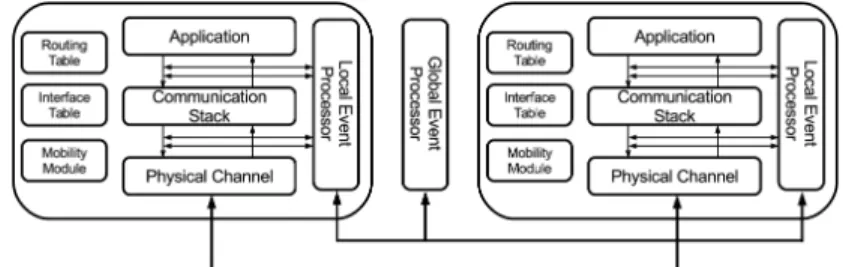
The Attack Simulator module considers every node as implemented by a
En-hanced Network Node module. The latter is in turn composed of anApplication
module, a Communication Stack module, and aLocal Event Processor (LEP) module. The Application module may be composed of different sub-modules modelling the actual node application. Similarly, theCommunication Stack mod-ule may include an arbitrarily complex combination of protocols for different communication layers, e.g. transport, routing and MAC. All sub-modules but LEP can be off-the-shelf.
The LEP module is responsible for the management of events related to attacks, and operates transparently with respect to the other components of
theEnhanced Network Node module. In particular, the LEP module intercepts
all application and network packets traveling through a node’s communication stack. Then, depending on the considered attacks to be evaluated, it can inspect and alter packets’ content, inject new packets, or even discard intercepted ones. Finally, the LEP module can also alter the node behavior at different layers, change its position in space, or even neutralize the node by making it inactive.
Fig 1. The Attack Simulator architecture
A system composed of multiple nodes is simulated by instantiating an
En-hanced Network Nodemodule for each node, and a singleGlobal Event Processor
(GEP) module that connects all theEnhanced Network Nodemodules with one another. In particular, the GEP module is separately connected with every LEP module, so allowing them to synchronize and communicate with one another in order to implement complex distributed attacks, such as a wormhole attack. Fig 1 depicts the architecture of theAttack Simulator component, with reference to a system composed of two interconnected nodes.
3.3 Prototype implementation for INET
We have implemented and released a prototype of SEA++. TheAttack
Specifi-cation Interpreter andAttack Simulator components are available at [9]. With
reference to Fig 1, as to theApplication andCommunication Stack modules we used INET [1], an off-the-shelf simulator for wired, wireless and mobile networks, based on the discrete-event simulation platformOMNeT++ [2].
In the original INET architecture, network nodes are composed of different sub-modules. Also, nodes comprise a full communication stack composed by a transport, routing and MAC layer. INET provides the implementation of differ-ent communication protocols for each of such layers, as well as differdiffer-ent network communication interfaces and physical channels. Thanks to the available com-munication stack, application running on the nodes can send/receive packets to/from the considered physical channel.
In our implementation of SEA++, we integrated the Local Event Processor and the Global Event Processor within the INET simulator. In particular, the Local Event Processor has been adapted to INET, in order to correctly manage simulation events and network packets. With reference to Fig 1, the Local Event Processor intercepts incoming and outgoing packets traveling through a node’s Communication Stack, between every pair of layers.
4
Case study: a traffic light system
In this section, we consider a traffic light application scenario, and use SEA++ to evaluate the impact of two security attacks. In particular, we refer to the
T-intersection depicted in Fig 2, including a secondary one-way road that inter-sects a main road. The vehicular traffic in the intersection is managed by means of three traffic lights, i.e. TL1 and TL2 on the main road, and TL3 on the sec-ondary road. We assume that a singleTraffic Controller node periodically sends control messages to the three traffic lights (every 2.5 seconds in our setting), with the intent to adapt their behavior to the experienced vehicular traffic. Fur-thermore, the three traffic lights periodically send a feeedback message to the Traffic Controller (every 0.2 seconds in our setting), reporting about the actual traffic light time experienced during the last time interval. So doing, the Traffic Controller can check the correct behavior of traffic lights, and possibly adjust them by means of additional control messages. We assume that the regular traf-fic light timing has a period of 10 seconds, and is set as{5s; 1s; 4s}. That is, the red light is on for 5 seconds, followed by the yellow light active for 1 second, after which the green light is on for 4 seconds before concluding the period. This is shown in the graph reported in Fig 2, where values 5, 0 and −5 stand for green light on, yellow light on and red light on, respectively.
(a)Example of traffic flow
-15 -10 -5 0 5 10 15 0 10 20 30 40 50 60 70 80 90
Traffic light timing
Time (s) TL3 behavior TL1, TL2 behavior
(b)Regular traffic light timing
Fig 2. Traffic light scenario
Hereafter, we consider an adversary who has managed to compromise the traffic light TL3, so being able to drop and alter feedback messages intended to the Traffic Controller. Also, the considered adversary is able to perform a number of attacks against the network. For instance, she can inject fake control messages intended to TL3. Having said that, the final goal of the adversary consists in altering the behavior of TL3, in order to create inconsistent traffic light configurations, which can be dangerous or prone to traffic stalemate, when both directions have red and green light, respectively. Besides, the adversary is insterested in concealing the effects of performed attacks to the Traffic Controller.
4.1 Attack impact and ranking
In the following, we consider two distinct attacks. In the first attack, namely
Injection, the adversary regularly injects faked control messages intended to
receiving a fake control message, TL3 sets the traffic light period to 6 seconds, and starts to observe a traffic light timing{2s; 2s; 2s}, i.e. 2 seconds are assigned to each one of the red, yellow and green light. We refer to different injection
periods, i.e. different time intervals between two consecutive transmissions of
fake control messages. Note that, upon receiving a genuine control message from the Traffic Controller, TL3 starts again the regular traffic light period of 10 seconds, according to the regular traffic light timing{5s; 1s; 4s}.
In the second attack, namelyBypass, TL3 ignoressomegenuine control mes-sages received from the Traffic Controller. Specifically, TL3 may bypass some control messages upon their reception, and instead set the traffic light period to 6 seconds and start to observe a traffic light timing {2s; 2s; 2s}. That is, 2 seconds are assigned to each one of the red, yellow and green light. We refer to different Bypass intervals, i.e. the number of control messages before the next one to be bypassed. Note that, in case a control message is regularly accepted and processed, TL3 starts again the regular traffic light period of 10 seconds, according to the regular traffic light timing{5s; 1s; 4s}.
In both attacks, TL3 keeps on regularly sending feedback messages to the Traffic Controller, although always specifying the expected regular traffic light timing, i.e. {5s; 1s; 4s}. As a consequence, the Traffic Controller is not able to recognize that the observed traffic light timing differs from the expected one.
-15 -10 -5 0 5 10 15 0 10 20 30 40 50 60 70 80 90
Traffic light timing
Time (s) Injection period: 1.0 s TL3 behavior TL1, TL2 behavior
(a)Injection attack
-15 -10 -5 0 5 10 15 0 10 20 30 40 50 60 70 80 90
Traffic light timing
Time (s)
Bypass interval: every 2 messages TL3 behavior
TL1, TL2 behavior
(b) Bypass attack
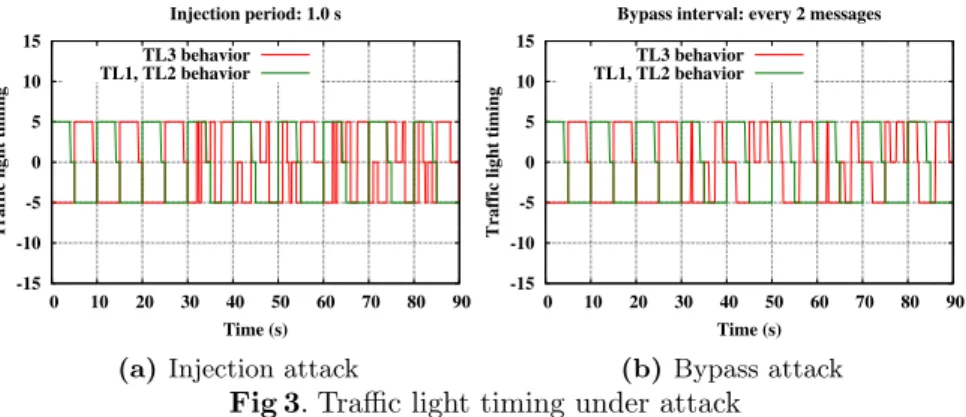
Fig 3. Traffic light timing under attack
Fig 3a and Fig 3b report the behavior of the traffic light system when the
Injectionattack or theBypassattack are performed. Specifically, Fig 3a considers
an Injection period of 1 s, whereas Fig 3b considers a Bypass interval of 2
messages. In both cases, the considered attack starts at timet= 30 s and is then performed throughout the simulation experiment. The two lines in the graphs depict the evolution of the traffic light configuration over time, separately for the main and the secondary road. Besides, every overlap of the two lines denote a misbehavior due to the considered attack, i.e. the occurrence of an undesired configuration.
Table 1 sorts the considered attacks according to their severity. In particular, attacks are sorted according to the amount of time that the system under attack experiences in a misbehavior state (see columnIncorrect). Results are expressed
Table 1. Attack ranking
Incorrect GG GY YY RR Correct Bypass (all messages) 51% 14% 17% 3% 17% 49% Injection (Period0.5s) 41% 11% 14% 3% 13% 59% Injection (Period1s) 36% 9% 12% 3% 12% 64% Injection (Period1.5s) 35% 9% 9% 3% 14% 65% Bypass (every 2messages) 24% 8% 8% 0% 8% 76% Bypass (every 3messages) 9% 1% 6% 0% 2% 91%
as the percentage of time when the system observes a given traffic light config-uration, while being under attack. In particular, the column Incorrect refers to all possible undesired configurations observed on the main and secondary road, i.e. Green-Green (GG), Green-Yellow (GY), Yellow-Yellow (YY) and Red-Red (RR). Separate results for each undesired configurations are reported in the rel-ative dedicated columns. Finally, theCorrect column refers to all possible licit configurations, i.e. Red-Green and Red-Yellow. We consideredInjection periods
0.5 s, 1 s and 1.5 s for the Injection attack, and Bypass intervals 1, 2 and 3 messages for theBypass attack.
As reported in Table 1, bypassing all control messages from the traffic con-troller results to be the most effective attack against the traffic light system. This suggests that this attack, especially when mounted at its maximum extent, is the one which deserves more to be addressed and counteracted. TheInjection
attack follows right after. In particular, as expected, the shorter the injection period, the more the attack is effective. Similarly, the Bypass attack is more effective when largerBypass intervals are considered.
5
Conclusions
We have presented SEA++, a tool for simulative evaluation of attack impact based on the INET framework and the OMNeT++ platform. SEA++ allows the user to describe cyber-physical attacks and quantitatively evaluate their effects on the network and application. SEA++ does not require the user to modify any component of the simulation platform. As a case-study, we have showed the use of SEA++ to evaluate the impact of two different attacks on a traffic light management application scenario. In future work, we will integrate additional off-the-shelf simulators (e.g., Castalia, Simulink) to apply SEA++ to more complex systems such as smart grids and industrial plants. Finally, we intend to introduce the node primitive disable which complements destroy and disables every application activity of a node.
Acknowledgments
This work was supported by the EU FP7 Project SEGRID (Grant Agreement no. FP7-607109), and the PRIN Project TENACE (n. 20103P34XC) funded by the Italian Ministry of Education, University and Research.
References
1. INET Framework - OMNeT++,http://inet.omnetpp.org/
2. OMNeT++ Network Simulation Framework,http://www.omnetpp.org/
3. B. Genge, C. Siaterlis and M. Hohenadel: AMICI: An Assessment Platform for Multi-domain Security Experimentation on Critical Infrastructures. In: Critical In-formation Infrastructures Security, Lecture Notes in Computer Science, vol. 7722, pp. 228–239. Springer Berlin Heidelberg (2013)
4. C. Queiroz, A. Mahmood and Z. Tari: SCADASim–A Framework for Building SCADA Simulations. IEEE Trans. on Smart Grid 2(4), 589–597 (December 2011) 5. C. Siaterlis, A.P. Garcia and B. Genge: On the Use of Emulab Testbeds for Sci-entifically Rigorous Experiments. IEEE Communications Surveys Tutorials 15(2), 929–942 (Second 2013)
6. G. Dini and M. Tiloca: ASF: an Attack Simulation Framework for wireless sen-sor networks. In: The 8th IEEE Intl. Conf. on Wireless and Mobile Computing, Networking and Communications (WiMob 2012). pp. 203–210 (October 2012) 7. L. S´anchez-Casado, R.A. Rodr´ıguez-G´omez, R. Mag´an-Carri´on and G. Maci´
a-Fern´andez: NETA: Evaluating the Effects of NETwork Attacks. MANETs as a Case Study. In: Advances in Security of Information and Communication Net-works, Communications in Computer and Information Science, vol. 381, pp. 1–10. Springer Berlin Heidelberg (2013)
8. M. Tiloca, A. Pischedda, F. Racciatti, G. Dini: ASF++, An Attack Simulation Framework. https://github.com/asfpp (2015)
9. M. Tiloca, F. Racciatti, G. Dini: SEA++, a tool for Simulative Evaluation of Attacks. https://github.com/seapp (2015)
10. T. Bonaci, L. Bushnell and R. Poovendran: Node capture attacks in wireless sensor networks: A system theoretic approach. In: The 49th IEEE Conference on Decision and Control (CDC 2010). pp. 6765–6772 (December 2010)
11. Y.-C. Hu, A. Perrig and D.B. Johnson: Packet leashes: a defense against wormhole attacks in wireless networks. In: The Twenty-Second Annual Joint Conference of the IEEE Computer and Communications (INFOCOM 2003). vol. 3, pp. 1976–1986 (March 2003)
12. Y.-L. Huang, A. A. C´ardenas, S. Amin, Z.-S. Lin, H.-Yi Tsai and S. Sastry: Un-derstanding the physical and economic consequences of attacks on control systems. International Journal of Critical Infrastructure Protection 2(3), 73–83 (2009) 13. Y. Mo, T. H.-J. Kim, K. Brancik, D. Dickinson, H. Lee, A. Perrig and B. Sinopoli:
Cyber-Physical Security of a Smart Grid Infrastructure. Proceedings of the IEEE 100(1), 195–209 (January 2012)
14. Y.-T. Wang and R. Bagrodia: SenSec: A Scalable and Accurate Framework for Wireless Sensor Network Security Evaluation. In: The 31st Intl. Conf. on Dis-tributed Computing Systems Workshops (ICDCSW 2011). pp. 230–239 (June 2011)
15. Y. Xu, G. Chen, J. Ford and F. Makedon: Detecting Wormhole Attacks in Wire-less Sensor Networks. In: Eric Goetz and Sujeet Shenoi (ed.) Critical Infrastructure Protection, Post-Proceedings of the First Annual IFIP Working Group 11.10 In-ternational Conference on Critical Infrastructure Protection. IFIP, vol. 253, pp. 267–279. Springer (March 2007)