Rev.1.0.8 FPSTM is a trademark of Fairchild Semiconductor Corporation.
Features
• Internal Avalanche Rugged Sense FET
• Consumes only 0.65W at 240VAC & 0.3W load with Advanced Burst-Mode Operation
• Frequency Modulation for EMI Reduction • Precision Fixed Operating Frequency • Internal Start-up Circuit
• Pulse-by-Pulse Current Limiting
• Abnormal Over Current Protection (AOCP) • Over Voltage Protection (OVP)
• Over Load Protection (OLP)
• Internal Thermal Shutdown Function (TSD) • Auto-Restart Mode
• Under Voltage Lockout (UVLO) • Low Operating Current (3mA) • Adjustable Peak Current Limit • Built-in Soft Start
Applications
• SMPS for VCR, SVR, STB, DVD & DVCD Player • SMPS for Printer, Facsimile & Scanner
• Adapter for Camcorder
Related Application Notes
• AN-4137, 4141, 4147(Flyback) / AN-4134(Forward)
Description
Each product in the FSDx0265RN (x for M, H) family con-sists of an integrated Pulse Width Modulator (PWM) and Sense FET, and is specifically designed for high perfor-mance off-line Switch Mode Power Supplies (SMPS) with minimal external components. Both devices are integrated high voltage power switching regulators which combine an avalanche rugged Sense FET with a current mode PWM control block. The integrated PWM controller features include: a fixed oscillator with frequency modulation for reduced EMI, Under Voltage Lock Out (UVLO) protection, Leading Edge Blanking (LEB), an optimized gate turn-on/ turn-off driver, Thermal Shut Down (TSD) protection, Abnormal Over Current Protection (AOCP) and temperature compensated precision current sources for loop compensa-tion and fault proteccompensa-tion circuitry. When compared to a dis-crete MOSFET and controller or RCC switching converter solution, the FSDx0265RN devices reduce total component count, design size, weight while increasing efficiency, pro-ductivity and system reliability. Both devices provide a basic platform that is well suited for the design of cost-effective flyback converters.
Notes:
1. Typical continuous power in a non-ventilated enclosed adapter with sufficient drain pattern as a heat sinker, at 50°C ambient.
2. Maximum practical continuous power in an open frame design with sufficient drain pattern as a heat sinker, at 50°C ambient.
3. 230 VAC or 100/115 VAC with doubler.
Typical Circuit
Figure 1. Typical Flyback Application
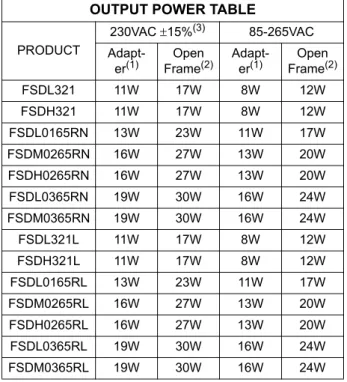
OUTPUT POWER TABLE PRODUCT 230VAC ±15%(3) 85-265VAC Adapt-er(1) Open Frame(2) Adapt-er(1) Open Frame(2) FSDL321 11W 17W 8W 12W FSDH321 11W 17W 8W 12W FSDL0165RN 13W 23W 11W 17W FSDM0265RN 16W 27W 13W 20W FSDH0265RN 16W 27W 13W 20W FSDL0365RN 19W 30W 16W 24W FSDM0365RN 19W 30W 16W 24W FSDL321L 11W 17W 8W 12W FSDH321L 11W 17W 8W 12W FSDL0165RL 13W 23W 11W 17W FSDM0265RL 16W 27W 13W 20W FSDH0265RL 16W 27W 13W 20W FSDL0365RL 19W 30W 16W 24W FSDM0365RL 19W 30W 16W 24W Drain Source Vstr Vfb Vcc PWM AC IN DC OUT Ipk
FSDH0265RN, FSDM0265RN
Internal Block Diagram
Figure 2. Functional Block Diagram of FSDx0265RN
8V/12V 2 6,7,8 1 3 Vref Internal Bias S Q Q R OSC Vcc Vcc IDELAY IFB VSD TSD Vovp Vcc Vocp S Q Q R R 2.5R Vcc good Vcc Drain Vfb GND AOCP Gate driver 5 Vstr ICH Vcc good VBURL/VBURH LEB PWM + -4 Ipk Freq. Modulation VBURH Vcc IBUR(pk) Burst Normal Soft Start
Pin Definitions
Pin Configuration
Figure 3. Pin Configuration (Top View)
Pin Number Pin Name Pin Function Description
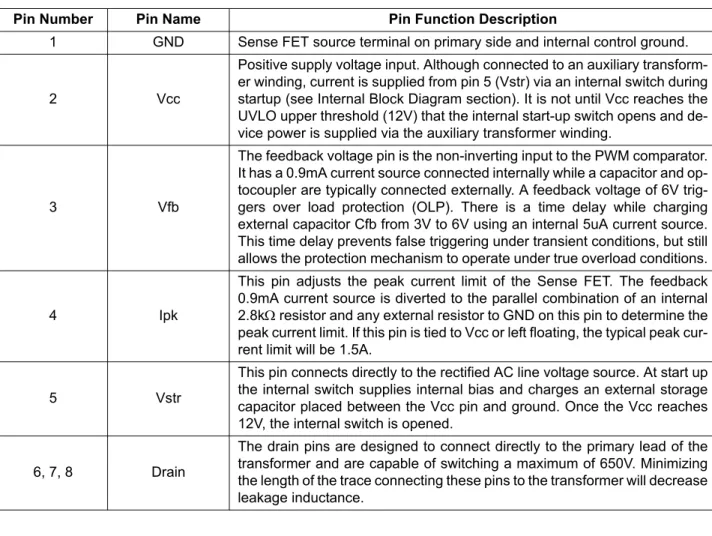
1 GND Sense FET source terminal on primary side and internal control ground.
2 Vcc
Positive supply voltage input. Although connected to an auxiliary transform-er winding, current is supplied from pin 5 (Vstr) via an inttransform-ernal switch during startup (see Internal Block Diagram section). It is not until Vcc reaches the UVLO upper threshold (12V) that the internal start-up switch opens and de-vice power is supplied via the auxiliary transformer winding.
3 Vfb
The feedback voltage pin is the non-inverting input to the PWM comparator. It has a 0.9mA current source connected internally while a capacitor and op-tocoupler are typically connected externally. A feedback voltage of 6V trig-gers over load protection (OLP). There is a time delay while charging external capacitor Cfb from 3V to 6V using an internal 5uA current source. This time delay prevents false triggering under transient conditions, but still allows the protection mechanism to operate under true overload conditions.
4 Ipk
This pin adjusts the peak current limit of the Sense FET. The feedback 0.9mA current source is diverted to the parallel combination of an internal 2.8kΩ resistor and any external resistor to GND on this pin to determine the peak current limit. If this pin is tied to Vcc or left floating, the typical peak cur-rent limit will be 1.5A.
5 Vstr
This pin connects directly to the rectified AC line voltage source. At start up the internal switch supplies internal bias and charges an external storage capacitor placed between the Vcc pin and ground. Once the Vcc reaches 12V, the internal switch is opened.
6, 7, 8 Drain
The drain pins are designed to connect directly to the primary lead of the transformer and are capable of switching a maximum of 650V. Minimizing the length of the trace connecting these pins to the transformer will decrease leakage inductance. 1 2 3 4 5 6 7 8 GND Vcc Vfb Ipk Vstr Drain Drain Drain 8DIP 8LSOP
Absolute Maximum Ratings
(Ta=25°C, unless otherwise specified)Note:
1. Repetitive rating: Pulse width is limited by maximum junction temperature 2. L = 51mH, starting Tj = 25°C
Thermal Impedance
(Ta=25°C, unless otherwise specified)
Note:
1. Free standing with no heatsink; Without copper clad.
/ Measurement Condition : Just before junction temperature TJ enters into OTP. 2. Measured on the DRAIN pin close to plastic interface.
3. Measured on the PKG top surface.
- all items are tested with the standards JESD 51-2 and 51-10 (DIP).
Characteristic Symbol Value Unit
Drain Pin Voltage VDRAIN 650 V
Vstr Pin Voltage VSTR 650 V
Drain Current Pulsed(1) IDM 8.0 A
Single Pulsed Avalanche Energy(2) EAS 68 mJ
Supply Voltage VCC 20 V
Feedback Voltage Range VFB -0.3 to VCC V
Total Power Dissipation PD 1.56 W
Operating Junction Temperature TJ Internally limited °C
Operating Ambient Temperature TA -25 to +85 °C
Storage Temperature TSTG -55 to +150 °C
Parameter Symbol Value Unit
8DIP
Junction-to-Ambient Thermal(1)
θ
JA 79.64 °C/WJunction-to-Case Thermal(2)
θ
JC 18.20 °C/WElectrical Characteristics
(Ta = 25°C unless otherwise specified)Note:
1. Pulse test: Pulse width ≤300us, duty ≤ 2%
2. These parameters, although guaranteed, are tested in EDS (wafer test) process 3. These parameters, although guaranteed, are not 100% tested in production
Parameter Symbol Condition Min. Typ. Max. Unit
SENSE FET SECTION
Zero-Gate-Voltage Drain Current IDSS
VDS=650V, VGS=0V - - 50 µA
VDS=520V, VGS=0V,
TC=125°C - - 200 µA
Drain-Source On-State Resistance(1) RDS(ON) VGS=10V, ID=0.5A - 5.0 6.0 Ω
Input Capacitance CISS
VGS=0V, VDS=25V, f=1MHz
- 550 - pF
Output Capacitance COSS - 38 - pF
Reverse Transfer Capacitance CRSS - 17 - pF
Turn-On Delay Time td(on)
VDS=325V, ID=1.0A
- 20 - ns
Rise Time tr - 15 - ns
Turn-Off Delay Time td(off) - 55 - ns
Fall Time tf - 25 - ns
CONTROL SECTION
Switching Frequency fOSC
FSDH0265R 92 100 108 KHz
Switching Frequency Modulation ∆fMOD ±2.0 ±3.0 ±4.0 KHz
Switching Frequency fOSC
FSDM0265R 61 67 73 KHz
Switching Frequency Modulation ∆fMOD ±1.5 ±2.0 ±2.5 KHz
Switching Frequency Variation(2) ∆fOSC -25°C ≤ Ta ≤ 85°C - ±5 ±10 %
Maximum Duty Cycle DMAX FSDH0265R 71 77 83 %
FSDM0265R 62 67 72 %
Minimum Duty Cycle DMIN 0 0 0 %
UVLO Threshold Voltage VSTART VFB=GND 11 12 13 V
VSTOP VFB=GND 7 8 9 V
Feedback Source Current IFB VFB=GND 0.7 0.9 1.1 mA
Internal Soft Start Time tS/S VFB=4V 10 15 20 ms
BURST MODE SECTION
Burst Mode Voltage VBURH - 0.4 0.5 0.6 V
VBURL - 0.25 0.35 0.45 V
PROTECTION SECTION
Peak Current Limit ILIM Max. inductor current 1.3 1.5 1.7 A
Current Limit Delay Time(3) tCLD - 500 - ns
Thermal Shutdown Temperature TSD - 125 140 - °C
Shutdown Feedback Voltage VSD 5.5 6.0 6.5 V
Over Voltage Protection VOVP 18 19 - V
Shutdown Delay Current IDELAY VFB=4V 3.5 5.0 6.5 µA
Leading Edge Blanking Time tLEB 200 - - ns
TOTAL DEVICE SECTION
Operating Supply Current (control part only) IOP VCC=14V 1 3 5 mA
Start-Up Charging Current ICH VCC=0V 0.7 0.85 1.0 mA
Comparison Between KA5x0265RN and FSDx0265RN
Function KA5x0265RN FSDx0265RN FSDx0265RN Advantages
Soft-Start not applicable 15ms • Gradually increasing current limit during soft-start further reduces peak current and voltage stresses
• Eliminates external components used for soft-start in most applications • Reduces or eliminates output
overshoot External Current Limit not applicable Programmable of
default current limit
• Smaller transformer
• Allows power limiting (constant over-load power)
• Allows use of larger device for lower losses and higher efficiency.
Frequency Modulation not applicable ±2.0KHz @67KHz ±3.0KHz @100KHz
• Reduces conducted EMI Burst Mode Operation not applicable Built into controller • Improves light load efficiency
• Reduces power consumption at no-load
• Transformer audible noise reduction Drain Creepage at
Package
1.02mm 7.62mm • Greater immunity to arcing provoked
by dust, debris and other contami-nants
Typical Performance Characteristics (Control Part)
(These characteristic graphs are normalized at Ta = 25°C)0.00 0.20 0.40 0.60 0.80 1.00 1.20 -50 0 50 100 150 T emp[℃] Normalized
Operating Frequency (Fosc) vs. Ta
0.00 0.20 0.40 0.60 0.80 1.00 1.20 -50 0 50 100 150 T emp[℃] No rm al ized
Frequency Modulation (∆FMOD) vs. Ta
0.00 0.20 0.40 0.60 0.80 1.00 1.20 -50 0 50 100 150 T emp[℃] N or m al ized
Maximum Duty Cycle (DMAX) vs. Ta
0.00 0.20 0.40 0.60 0.80 1.00 1.20 -50 0 50 100 150 T emp[℃] No rm al ized
Operating Supply Current (IOP) vs. Ta
0.00 0.20 0.40 0.60 0.80 1.00 1.20 -50 0 50 100 150 T emp[℃] No rm al ized
Start Threshold Voltage (VSTART) vs. Ta
0.00 0.20 0.40 0.60 0.80 1.00 1.20 -50 0 50 100 150 T emp[℃] No rm al iz ed
Typical Performance Characteristics
(Continued) 0.00 0.20 0.40 0.60 0.80 1.00 1.20 -50 0 50 100 150 T emp[℃] No rm al iz edFeedback Source Current (IFB) vs. Ta
0.00 0.20 0.40 0.60 0.80 1.00 1.20 -50 0 50 100 150 T emp[℃] No rm al ized
Peak Current Limit (ILIM) vs. Ta
0.00 0.20 0.40 0.60 0.80 1.00 1.20 -50 0 50 100 150 T emp[℃] No rm al ized
Start Up Charging Current (ICH) vs. Ta
0.00 0.20 0.40 0.60 0.80 1.00 1.20 -50 0 50 100 150 T emp[℃] No rm al iz ed
Burst Peak Current (IBUR(pk)) vs. Ta
0.00 0.20 0.40 0.60 0.80 1.00 1.20 -50 0 50 100 150 Temp[℃] N or m aliz ed
Functional Description
1. Startup : In previous generations of Fairchild Power
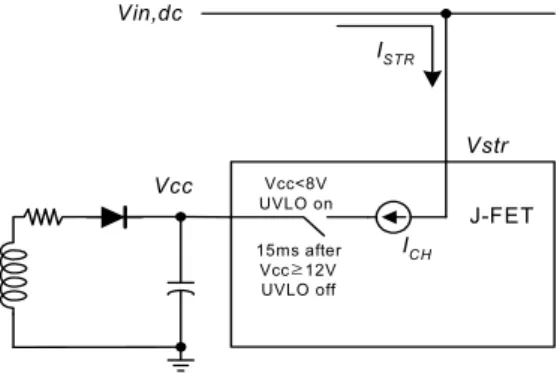
Switches (FPSTM) the Vstr pin had an external resistor to the DC input voltage line. In this generation the startup resistor is replaced by an internal high voltage current source and a switch that shuts off when 15ms goes by after the supply voltage, Vcc, gets above 12V. The source turns back on if Vcc drops below 8V.
Figure 4. High Voltage Current Source
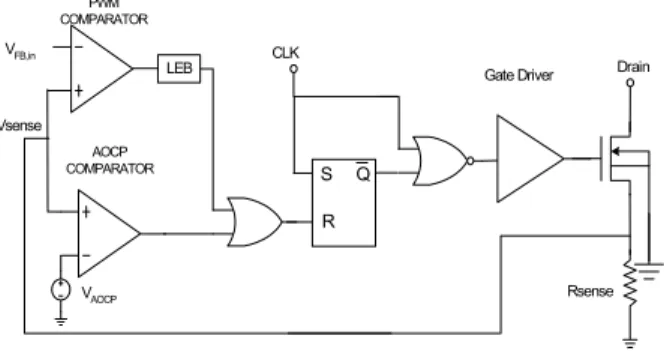
2. Feedback Control : The FSDx0265RN employs current
mode control, as shown in Figure 5. An opto-coupler (such as the H11A817A) and shunt regulator (such as the KA431) are typically used to implement the feedback network. Com-paring the feedback voltage with the voltage across the Rsense resistor plus an offset voltage makes it possible to control the switching duty cycle. When the KA431 reference pin voltage exceeds the internal reference voltage of 2.5V, the optocoupler LED current increases, the feedback voltage Vfb is pulled down and it reduces the duty cycle. This event typically happens when the input voltage is increased or the output load is decreased.
Figure 5. Pulse Width Modulation (PWM) Circuit
3. Leading Edge Blanking (LEB) : At the instant the
inter-nal Sense FET is turned on, the primary side capacitance and secondary side rectifier diode reverse recovery typically cause a high current spike through the Sense FET. Excessive voltage across the Rsense resistor leads to incorrect feedback operation in the current mode PWM control. To counter this effect, the FPS employs a leading edge blanking (LEB) cir-cuit. This circuit inhibits the PWM comparator for a short time (tLEB) after the Sense FET is turned on.
4. Protection Circuits : The FPS has several protective
functions such as over load protection (OLP), over voltage protection (OVP), abnormal over current protection (AOCP), under voltage lock out (UVLO) and thermal shut-down (TSD). Because these protection circuits are fully inte-grated inside the IC without external components, the reliability is improved without increasing cost. Once a fault condition occurs, switching is terminated and the Sense FET remains off. This causes Vcc to fall. When Vcc reaches the UVLO stop voltage VSTOP (8V), the protection is reset and
the internal high voltage current source charges the Vcc capacitor via the Vstr pin. When Vcc reaches the UVLO start voltage VSTART (12V), the FPS resumes its normal operation. In this manner, the auto-restart can alternately enable and disable the switching of the power Sense FET until the fault condition is eliminated.
4.1 Over Load Protection (OLP) :Overload is defined as
the load current exceeding a pre-set level due to an unex-pected event. In this situation, the protection circuit should be activated in order to protect the SMPS. However, even when the SMPS is operating normally, the over load protec-tion (OLP) circuit can be activated during the load transiprotec-tion. In order to avoid this undesired operation, the OLP circuit is designed to be activated after a specified time to determine whether it is a transient situation or an overload situation. In conjunction with the Ipk current limit pin (if used) the cur-rent mode feedback path would limit the curcur-rent in the Sense FET when the maximum PWM duty cycle is attained. If the output consumes more than this maximum power, the output voltage (Vo) decreases below its rating voltage. This reduces the current through the opto-coupler LED, which also reduces the opto-coupler transistor current, thus increasing the feedback voltage (VFB). If VFB exceeds 3V, the
feed-back input diode is blocked and the 5uA current source (I DE-LAY) starts to charge Cfb slowly up to Vcc. In this condition,
VFB increases until it reaches 6V, when the switching
opera-tion is terminated as shown in Figure 6. The shutdown delay time is the time required to charge Cfb from 3V to 6V with 5uA current source.
Vin,dc Vstr Vcc 15ms after Vcc≥12V UVLO off Vcc<8V UVLO on ISTR J-FET ICH 3 OSC Vcc Vcc 5uA 0.9mA VSD R 2.5R Gate driver OLP D1 D2 VFB Vfb 431 CFB Vo + -VFB,in
Figure 6. Over Load Protection (OLP)
4.2 Thermal Shutdown (TSD) : The Sense FET and the
control IC are integrated, making it easier for the control IC to detect the temperature of the Sense FET. When the tem-perature exceeds approximately 140°C, thermal shutdown is activated.
4.3 Abnormal Over Current Protection (AOCP) : Even
though the FPS has OLP (Over Load Protection) and current mode PWM feedback, these are not enough to protect the FPS when a secondary side diode short or a transformer pin short occurs. In addition to start-up, soft-start is also activated at each restart attempt during auto-restart and when restarting after latch mode is activated. The FPS has an internal AOCP (Abnormal Over Current Protection) circuit, as shown in Figure 7. When the gate turn-on signal is applied to the power Sense FET, the AOCP block is enabled and monitors the current through the sensing resistor. The voltage across the resistor is then compared with a preset AOCP level. If the sensing resistor voltage is greater than the AOCP level, pulse-by-pulse AOCP is triggered regardless of uncontrollable LEB time. Here, pulse-by-pulse AOCP stops the Sense FET within 350ns after it is activated.
Figure 7. Abnormal Over Current Protection (AOCP)
4.4 Over Voltage Protection (OVP) : In the event of a
mal-function in the secondary side feedback circuit, or an open feedback loop caused by a soldering defect, the current through the opto-coupler transistor becomes almost zero (refer to Figure 5). Then, VFB climbs up in a similar manner
to the over load situation, forcing the preset maximum cur-rent to be supplied to the SMPS until the over load protection is activated. Because excess energy is provided to the output, the output voltage may exceed the rated voltage before the over load protection is activated, resulting in the breakdown of the devices in the secondary side. In order to prevent this situation, an over voltage protection (OVP) circuit is employed. In general, Vcc is proportional to the output volt-age and the FPS uses Vcc instead of directly monitoring the output voltage. If VCC exceeds 19V, OVP circuit is activated
resulting in termination of the switching operation. In order to avoid undesired activation of OVP during normal opera-tion, Vcc should be properly designed to be below 19V. VFB
t 3V
6V
Over Load Protection
t12= CFB×(V(t2)-V(t1)) / IDELAY t1 t2 V t V V t V A I I t V t V C t DELAY DELAY FB ; 5 , ( ) 3 , ( ) 6 ) ( ) ( 2 1 1 2 12 = = = − = µ Vsense VFB,in Gate Driver Rsense CLK Drain VAOCP PWM COMPARATOR AOCP COMPARATOR LEB R S Q
5. Soft Start : The FPS has an internal soft start circuit that slowly increases the feedback voltage together with the Sense FET current after it starts up. The typical soft start time is 15msec, as shown in Figure 8, where progressive increments of the Sense FET current are allowed during the start-up phase. The pulse width to the power switching device is progressively increased to establish the correct working conditions for transformers, inductors, and capaci-tors. The voltage on the output capacitors is progressively increased with the intention of smoothly establishing the required output voltage. It also helps to prevent transformer saturation and reduce the stress on the secondary diode.
Figure 8. Soft Start Function
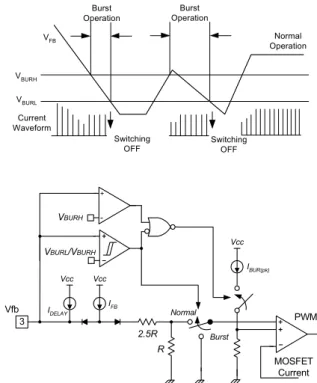
6. Burst Operation : In order to minimize power dissipation
in standby mode, the FPS enters burst mode operation. As the load decreases, the feedback voltage decreases. As shown in Figure 9, the device automatically enters burst mode when the feedback voltage drops below VBURH(500mV). Switching still continues but the current limit is set to a fixed limit internally to minimize flux density in the transformer. The fixed current limit is larger than that defined by VFB = VBURH and therefore, VFB is driven
down further. Switching continues until the feedback voltage drops below VBURL(350mV). At this point switching stops
and the output voltages start to drop at a rate dependent on the standby current load. This causes the feedback voltage to rise. Once it passes VBURH(500mV), switching resumes.
The feedback voltage then falls and the process repeats. Burst mode operation alternately enables and disables switching of the power Sense FET thereby reducing switch-ing loss in Standby mode.
Figure 9. Burst Operation Function
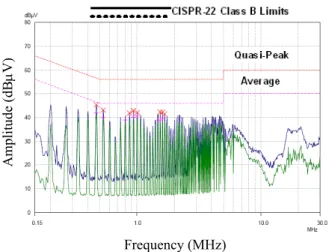
7. Frequency Modulation : Modulating the switching
fre-quency of a switched power supply can reduce EMI. Fre-quency modulation can reduce EMI by spreading the energy over a wider frequency range than the bandwidth measured by the EMI test equipment. The amount of EMI reduction is directly related to the depth of the reference frequency. As can be seen in Figure 10, the frequency changes from 65KHz to 69KHz in 4ms for the FSDM0265RN (97KHz to 103KHz for FSDH0265RN). Frequency modulation allows the use of a cost effective inductor instead of an AC input mode choke to satisfy the requirements of world wide EMI limits.
Figure 10. Frequency Modulation Waveform
1ms 15steps Current limit 0.68A 1.5A t Drain current VBURH Switching OFF Current Waveform Burst Operation Normal Operation VFB VBURL Switching OFF Burst Operation 3 Vcc Vcc IDELAY IFB R 2.5R Vfb VBURL/VBURH PWM + -VBURH Vcc IBUR(pk) Burst Normal MOSFET Current ts fs=1/ts 67kHz 69kHz 65kHz 4ms t Drain Current
Figure 11. KA5-series FPS Full Range EMI scan(67KHz, no Frequency Modulation) with DVD Player SET
Figure 12. FSDX-series FPS Full Range EMI Scan (67KHz, with Frequency Modulation) with DVD Player SET
8. Adjusting Peak Current Limit : As shown in Figure 13,
a combined 2.8kΩ internal resistance is connected to the non-inverting lead on the PWM comparator. A external resistance of Rx on the current limit pin forms a parallel resistance with the 2.8kΩ when the internal diodes are biased by the main current source of 900uA.
Figure 13. Peak Current Limit Adjustment
For example, FSDx0265RN has a typical Sense FET peak current limit (ILIM) of 1.5A. ILIM can be adjusted to 1A by
inserting Rx between the Ipk pin and the ground. The value of the Rx can be estimated by the following equations: 1.5A : 1A = 2.8kΩ : XkΩ ,
X = Rx || 2.8kΩ .
(X represents the resistance of the parallel network) Frequency (MHz) Amplitud e (dB µ V) Frequency (MHz) A m plitude (dB µ V) 3 Vcc Vcc IDELAY IFB 2kΩ Vfb PWM Comparator 4 Ipk 0.8kΩ Rx SenseFET Current Sense 900uA 5uA
Application Tips
1. Methods of Reducing Audible Noise
Switching mode power converters have electronic and magnetic components, which generate audible noises when the operating frequency is in the range of 20~20,000 Hz. Even though they operate above 20 kHz, they can make noise depending on the load condition. Designers can employ several methods to reduce these noises. Here are three of these methods:
Glue or Varnish
The most common method involves using glue or varnish to tighten magnetic components. The motion of core, bobbin and coil and the chattering or magnetostriction of core can cause the transformer to produce audible noise. The use of rigid glue and varnish helps reduce the transformer noise. But, it also can crack the core. This is because sudden changes in the ambient temperature cause the core and the glue to expand or shrink in a different ratio according to the temperature.
Ceramic Capacitor
Using a film capacitor instead of a ceramic capacitor as a snubber capacitor is another noise reduction solution. Some dielectric materials show a piezoelectric effect depending on the electric field intensity. Hence, a snubber capacitor becomes one of the most significant sources of audible noise. It is considerable to use a zener clamp circuit instead of an RCD snubber for higher efficiency as well as lower audible noise.
Adjusting Sound Frequency
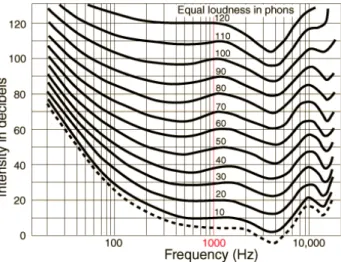
Moving the fundamental frequency of noise out of 2~4 kHz range is the third method. Generally, humans are more sensi-tive to noise in the range of 2~4 kHz. When the fundamental frequency of noise is located in this range, one perceives the noise as louder although the noise intensity level is identical. Refer to Figure 14. Equal Loudness Curves.
When FPS acts in Burst mode and the Burst operation is suspected to be a source of noise, this method may be help-ful. If the frequency of Burst mode operation lies in the range of 2~4 kHz, adjusting feedback loop can shift the Burst operation frequency. In order to reduce the Burst oper-ation frequency, increase a feedback gain capacitor (CF),
opto-coupler supply resistor (RD) and feedback capacitor
(CB) and decrease a feedback gain resistor (RF) as shown in
Figure 15. Typical Feedback Network of FPS.
Figure 14. Equal Loudness Curves
Figure 15. Typical Feedback Network of FPS
2. Other Reference Materials
AN-4134: Design Guidelines for Off-line Forward
Convert-ers Using Fairchild Power Switch (FPSTM)
AN-4137: Design Guidelines for Off-line Flyback
Convert-ers Using Fairchild Power Switch (FPS)
AN-4140: Transformer Design Consideration for Off-line
Flyback Converters using Fairchild Power Switch (FPSTM)
AN-4141: Troubleshooting and Design Tips for Fairchild
Power Switch (FPSTM) Flyback Applications
AN-4147: Design Guidelines for RCD Snubber of Flyback
AN-4148: Audible Noise Reduction Techniques for FPS
Typical Application Circuit
Features
• High efficiency (>76% at universal input)
• Low standby mode power consumption (<1W at 230Vac input and 0.5W load) • Low component count
• Enhanced system reliability through various protection functions • Low EMI through frequency modulation
• Internal soft-start (15ms)
Key Design Notes
• The delay time for over load protection is designed to be about 30ms with C106 of 47nF. If faster/slower triggering of OLP is required, C106 can be changed to a smaller/larger value(eg. 100nF for about 60ms).
• Using a resistor R104(3.3㏀) on Ipk pin (#4), the pule-by-pulse peak current limit level(ILIM) is adjusted to about 0.8A. • The branch formed by D103, C108 and R106 provides another ILIM adjustment having a negative slope to the input
voltage. The ILIM value decreases as the input voltage level increases.
1. Schematic
Application Output power Input voltage Output voltage (Max current)
DVD Player 13W Universal input
(85-265Vac) 3.3V (0.8A) 5.1V (0.4A) 12V (0.3A) 16V (0.3A) 3 4 C102 100nF AC275V LF101 55mH C101 100nF AC275V C103 47uF 400V R102 56kΩ C104 3.3nF 630V D101 UF 4007 IC101 FSDH0265RN C107 47nF 50V C106 47uF 50V D102 UF 4004 R103 5Ω 1 2 3 4 5 8 9 6 12 10 11 T101 EER2828 D203 EGP20D 470uFC205 35V C206 470uF 35V L203 10uH L207 4.7uH L206 4.7uH D204 EGP20D 470uFC207 35V C208 470uF 35V C214 1000uF 10V C213 1000uF 10V D207 SB360 D205 SB360 1000uFC209 10V C210 1000uF 10V R201 510Ω R202 R203 6.2kΩ C215 BD101 L205 10uH Vstr Ipk Vfb Vcc Drain GND 6 1 2 3 4 5 1 2 Drain Drain 7 8 16V R104 3.3kΩ R105 200kΩ R106 300kΩ D103 UF 4004 C108 1uF 100V C302 2.2nF 12V 5.1V 3.3V RT101 5D-9
2. Transformer Schematic Diagram
3. Winding Specification
4. Electrical Characteristics
5. Core & Bobbin
Core : EER2828 ( Ae = 86.66 mm2 ) Bobbin : EER2828 EER2828 N12V 1 6 7 8 9 10 11 12 N16V N5.1V N3.3V Np/2 Na 2 3 4 5 Np/2 6mm 3mm N16V N12V Na N5.1V N3.3V Np/2 Np/2
P in(S → F) W ire Turns W inding M ethod
Np/2 3 → 2 0.25φ ×1 50 C enter S olenoid w inding
Insulation : P olyester Tape t = 0.050m m , 2Layers
N3.3V 9 → 8 0.33φ ×2 4 C enter S olenoid w inding
Insulation : P olyester Tape t = 0.050m m , 2Layers
N5.1V 6 → 9 0.33φ ×1 2 C enter S olenoid w inding
Insulation : P olyester Tape t = 0.050m m , 2Layers
Na 4 → 5 0.25φ ×1 16 C enter S olenoid w inding
Insulation : P olyester Tape t = 0.050m m , 2Layers
N12V 10 → 12 0.33φ ×1 14 C enter S olenoid w inding
Insulation : P olyester Tape t = 0.050m m , 3Layers
N16V 11 → 12 0.33φ ×1 18 C enter S olenoid w inding
Insulation : P olyester Tape t = 0.050m m , 2Layers
Np/2 2→ 1 0.25φ ×1 50 C enter S olenoid w inding
Insulation : P olyester Tape t = 0.050m m , 2Layers
P in S p e c . R e m a r k
In d u c ta n c e 1 - 3 1 .4 m H ± 1 0 % 1 0 0 k H z , 1 V L e a k a g e 1 - 3 2 5 u H M a x . S h o rt a ll o th e r p in s
6. Demo Circuit Part List
Part Value Note Part Value Note
Resistor Inductor R102 56K 1W L203 10uH - R103 5 1/4W L205 10uH - R104 3.3K 1/4W L206 4.7uH - R105 200K 1/4W L207 4.7uH - R106 300K 1/4W Diode
R201 510 1/4W D101 UF4007 PN Ultra Fast
R202 1K 1/4W D102 UF4004 PN Ultra Fast
R203 6.2 K 1/4W D103 UF4004 PN Ultra Fast
R204 20K 1/4W D203 EGP20D PN Ultra Fast
R205 6K 1/4W D204 EGP20D PN Ultra Fast
Capacitor D205 SB360 Schottky
C101 100nF/275AC Box D207 SB360 Schottky
C102 100nF/275AC Box IC
C103 47uF/400V Electrolytic IC101 FSDH0265RN FPS™
C104 3.3nF/630V Film IC301 KA431(TL431) reference Voltage C106 47uF/50V Electrolytic IC302 FOD817A Opto-Coupler
C107 47nF/50V Ceramic
C108 1uF/100V Electrolytic Fuse
C205 470uF/35V Electrolytic FUSE 2A/250V C206 470uF/35V Electrolytic
C207 470uF/35V Electrolytic NTC
C208 470uF/35V Electrolytic RT101 5D-9
C209 1000uF/10V Electrolytic
C210 1000uF/10V Electrolytic Bridge Diode
C213 1000uF/10V Electrolytic BD101 2KBP06M 2N257 Bridge Diode C214 1000uF/10V Electrolytic
C215 100nF/50V Ceramic Line Filter
7. Layout
7.1 Top image of PCB
Package Dimensions
Package Dimensions
(Continued)LIFE SUPPORT POLICY
FAIRCHILD’S PRODUCTS ARE NOT AUTHORIZED FOR USE AS CRITICAL COMPONENTS IN LIFE SUPPORT DEVICES OR SYSTEMS WITHOUT THE EXPRESS WRITTEN APPROVAL OF THE PRESIDENT OF FAIRCHILD SEMICONDUCTOR CORPORATION. As used herein:
1. Life support devices or systems are devices or systems
which, (a) are intended for surgical implant into the body, 2. A critical component in any component of a life support device or system whose failure to perform can be
DISCLAIMER
FAIRCHILD SEMICONDUCTOR RESERVES THE RIGHT TO MAKE CHANGES WITHOUT FURTHER NOTICE TO ANY PRODUCTS HEREIN TO IMPROVE RELIABILITY, FUNCTION OR DESIGN. FAIRCHILD DOES NOT ASSUME ANY LIABILITY ARISING OUT OF THE APPLICATION OR USE OF ANY PRODUCT OR CIRCUIT DESCRIBED HEREIN; NEITHER DOES IT CONVEY ANY LICENSE UNDER ITS PATENT RIGHTS, NOR THE RIGHTS OF OTHERS.
Ordering Information
Product Number Package Marking Code BVDSS fOSC RDS(ON)
FSDM0265RN 8DIP DM0265R 650V 67KHz 5.0Ω
FSDH0265RN 8DIP DH0265R 650V 100KHz 5.0Ω
FSDM0265RL 8LSOP DM0265R 650V 67KHz 5.0Ω