Balanced Scorecard implementation and financial
effect from the perspective of the contingency theory:
Multiple-case study in Libya
Mohamed Hassan Albergley
Balanced Scorecard implementation and financial
effect from the perspective of the contingency theory:
Multiple-case study in Libya
Mohamed Hassan Albergley
School of Business
Accounting, Finance, and Economics
Submitted in Partial Fulfilment of the Requirements of the
Degree of Doctor of Philosophy, February 2018
Table of Contents: Table of contents………i List of tables……….….…viii List of figures………....…x List of abbreviations...xi Appendices………...………...………...xii Acknowledgments……….…xiii Declaration………...….….xiv Abstract……….……....…...…xv Chapter One: Introduction 1.1 Some contextual background...1
1.2 An overview of the study motivations...3
1.3 Study questions...6
1.4 Study objectives and brief insights into the study methods...6
1.5 Thesis structure...7
Chapter Two: Balanced Scorecard (BSC) 2.1 Introduction...10
2.2 Theory exploration of BSC literature………...10
2.2.1 BSC emergence and popularity………...10
2.2.2 BSC evolution and types ………...…….10
2.2.3 BSC components ………...…….11
2.2.3.1 BSC perspectives………..12
2.2.3.2 BSC strategic objectives and performance measures………...15
2.2.3.3 Cause and effect relationship………18
2.2.3.4 BSC targets and their applications………20
2.2.3.4.1 Setting targets for BSC measures………..21
2.2.3.4.2 BSC targets for initiative development and resources allocation……..21
2.2.3.5 BSC organisational alignment processes………..23
2.2.3.5.1 Top-level managers’ participation in developing BSC………..24
2.2.3.5.3 Cascading process of BSC……….…25
2.2.3.5.4 The process of linking BSC to the compensation system…….……….27
2.2.3.6 BSC feedback and organisational learning process………29
2.2.4 Benefits of BSC………...31
2.3 Discussion of BSC empirical studies………..…....…31
2.3.1 First dimension: previous studies’ interpretations of BSC concept…………...………..32
2.3.2 Second dimension: previous studies’ measurement of BSC……….…...33
2.3.3 Third dimension: previous studies’ findings on BSC practical implementation…...…..34
2.3.4 Fourth dimension: previous studies’ findings on BSC on benefits of BSC……...…….35
2.3.5 Fifth dimension: Previous studies’ geographic locations………...….36
Chapter Three: The contingency theory approach, the theoretical framework and propositions 3.1 Introduction………...45
3.2 Contingency theory approach………...45
3.2.1 The essence of the contingency theory………..…..46
3.2.2 The concept of fit in contingency studies………46
3.2.3 Organisational effectiveness concept………...48
3.2.4 Contingent variables in contingency-based studies……….49
3.2.4.1 Environment contingent variable………..49
3.2.4.2 Business strategy contingent variable………..….50
3.3 The effect of contingent variables on BSC………...53
3.3.1 The effect of environmental uncertainty on BSC………54
3.3.2 The effect of business strategy on BSC………..…….55
3.3.3 Discussion of contingency-based BSC empirical studies………56
3.4 The study theoretical framework and propositions………...63
3.4.1 The theoretical framework of the study………...62
3.4.2 Operational definitions of the study’s variables………..…63
3.4.2.1 Operationalising environmental uncertainty………...63
3.4.2.2 Operationalising the business strategy variable…………..………....63
3.4.2.3 Operationalising BSC variable………..….64
3.4.2.4 Operationalising organisational effectiveness………...….65
3.4.3.1 Propositions on the effect of environmental uncertainty on BSC
implementation………...66
3.4.3.2 Propositions on the effect of strategy on BSC implementation……...…..….76
Chapter Four: Research methodology 4.1 Introduction………..……....81
4.2 Study type and research approach………..………..81
4.3 Overview of study design………..………...84
4.4 Case definition ………...…..86
4.5 Selection Plan...89
4.6 Triangulation and data collection methods………..……….89
4.6.1 Interview method for data collection………..……….89
4.6.2 Documentary review and direct observation………...………..91
4.7 Study instrument………..……….91
4.8 The measurement of the study variables………..……….94
4.8.1 Measuring the environmental uncertainty………..……….94
4.8.2 Measuring the business strategy………..………95
4.8.3 Measuring BSC implementation………..………95
4.8.4 Measuring BSC financial effect………..……….96
4.9 Preparations prior to the fieldwork………..……….97
4.10 The fieldwork investigation………....………98
4.10.1 The preliminary fieldwork investigation………...98
4.10.2 The main fieldwork investigation………..………..100
4.10.2.1 The conducted interviews and their procedures ………...……….101
4.10.2.2 Documentary evidence and observations………..……….103
4.11 Data analysis……….104
4.11.1 Data reduction……….105
4.11.2 Data display……….106
4.11.3 Conclusion drawing/verification……….107
Chapter Five:
Within-case descriptive analysis
5.1 Case study one: CRM………...………110
5.1.1 Overview of CRM and its BSC adoption………...…….……..110
5.1.2 Contingent variables at CRM……….………111 5.1.2.1 Environmental uncertainty at CRM………..111 5.1.2.2 CRM’s business strategy………...112 5.1.3 CRM implementation of BSC………...……….…………112 5.1.3.1 CRM’s BSC perspectives……….………….112 5.1.3.2 CRM’s BSC performance measures……….114
5.1.3.3 CRM selecting basis of BSC measures……….…………116
5.1.3.4 Cause and effect relationship in CRM’s BSC……….…….….116
5.1.3.5 CRM’s BSC targets……….…….….117
5.1.3.6 Organisational alignment process in CRM’s BSC implementation………….….117
5.1.3.6.1 CRM top-level managers’ participation in BSC development…………117
5.1.3.6.2 BSC cascading in CRM………...118
5.1.3.6.3 BSC education and communication in CRM………...119
5.1.3.6.4 Linking BSC to the compensation system in CRM……….120
5.1.3.7 Organisational learning in CRM’s BSC………....………120
5.1.4 BSC influence on CRM financial performance……….121
5.2 Case study two: NIF…...……….125
5.2.1 Overview of NIF and its BSC adoption……….…………125
5.2.2 Contingent variables at NIF………...125
5.2.2.1 NIF’s environmental uncertainty and competitive strategy………125
5.2.2.1.1 Environmental uncertainty at NIF……….126
5.2.2.1.2 NIF’s business strategy………..126
5.2.3 NIF implementation of BSC………..127
5.2.3.1 NIF’s BSC perspectives………128
5.2.3.2 NIF’s BSC performance measures………129
5.2.3.3 NIF’s BSC strategic objectives (selection basis of BSC measures)……….130
5.2.3.4 Cause and effect relationship in NIF’s BSC……….131
5.2.3.6 Organisational alignment process in NIF’s BSC implementation………134
5.2.3.6.1 NIF’s top-level managers’ participation in BSC development...134
5.2.3.6.2 BSC cascading in NIF……….135
5.2.3.6.3 BSC education and communication in NIF……….136
5.2.3.6.4 Linking NIF’s BSC to the compensation system……….137
5.2.3.7 Organisational learning in NIF’s BSC………..139
5.2.4 BSC influence on NIF financial performance………...140
5.3 Case study three: ISC………...………..144
5.3.1 Overview of ISC and its BSC adoption...144
5.3.2 The contingent variables at ISC……….145
5.3.2.1 ISC’s environmental uncertainty and business strategy………...145
5.3.2.1.1 Environment uncertainty at ISC………..145
5.3.2.1.2 ISC business strategy………...146
5.3.3 ISC’s implementation of BSC………...147
5.3.3.1 ISC’s BSC perspectives………147
5.3.3.2 ISC’s BSC performance measures………149
5.3.3.3 ISC’s BSC strategic objectives (selectin basis of BSC measures)………...151
5.3.3.4 Cause and effect relationship in ISC’s BSC……….…………151
5.3.3.5 Targets of ISC’s BSC measures………154
5.3.3.6 Organisational alignment process in ISC’s BSC implementation………155
5.3.3.6.1 ISC’s top-managers’ participation in BSC development……….155
5.3.3.6.2 BSC cascading in ISC………..156
5.3.3.6.3 BSC education and communication in ISC……….158
5.3.3.6.4 Linking ISC’s BSC to the compensation system……….159
5.3.3.7 Organisational learning in ISC’s BSC………..……161
5.3.4 BSC influence on ISC financial performance………...163
Chapter Six: Comparative analysis of the study’s descriptive findings 6.1 Introduction……….166
6.2 Cross-case analysis relating to the study contingent variables………...166
6.3 Cross-case analysis relating to BSC implementation……….167
6.3.2 Cross-case analysis in relation to BSC performance measures……….171
6.3.3 Cross-case analysis in relation to the selection basis of BSC measures...174
6.3.4 Cross-case analysis in relation to BSC concept of cause and effect relationship……..175
6.3.5 Cross-case analysis in relation to BSC targets and their applications………...176
6.3.6 Cross-case analysis in relation to BSC organisational alignment processes………….178
6.3.7 Cross-case analysis in relation to BSC organisational learning processes………184
6.3.8 Concluding remarks towards answering the first research question ………...…186
6.4 Cross-case analysis relating to the financial effect of BSC, towards answering the second research question of the study………...189
Chapter Seven: Testing the study propositions 7.1 Introduction……….192
7.2 Testing the study propositions using the selection approach of fit ………....…………192
7.2.1 Testing the study propositions in CRM……….193
7.2.2 Testing the study propositions in NIF………195
7.2.3 Testing the study propositions in ISC………198
7.2.4 Concluding remarks of the propositions’ findings obtained from the selection approach of fit ………...201
7.3 Testing the study propositions using the interaction approach of fit………...……….202
7.3.1 Verifying the study propositions on the relationship between environmental uncertainty and BSC implementation based on the interaction approach of fit………..………202
7.3.2 Verifying the study propositions on the relationship between business strategy and BSC implementation based on the interaction approach of fit………..217
7.3.3 Other findings based on the interaction fit approach ………...………..………...224
7.5 Concluding remarks towards answering the third research question ………...…...226
Chapter Eight: Conclusion 8.1 Introduction……….229
8.2 Overview of the study……….229
8.3 The main findings of the study………..……….233
8.3.2 Findings relating to the financial effect of BSC implementation………...236
8.3.3 Findings relating to the role of the contingent variables in shaping BSC implementation and its financial effect ………...238
8.4 The study contributions and implications………...239
8.4.1 Theoretical contributions and implications in relation to BSC implementation……….239
8.4.2 Theoretical contributions and implications in relation to BSC effectiveness………..241
8.4.3 Theoretical contributions and implications in relation to the contingency theory………242
8.4.4 Methodological contribution………...…….243
8.4.5 Practical contributions and implications……….…...………...245
8.5 The study limitations………..………246
8.6 Future research directions………...247
List of Tables
Table 2.1: Examples of the strategic objectives, outcome measures, and driving measures in each
BSC perspective ………....…….16
Table 2.3: BSC empirical studies’ review………...…..38
Table 3.1: Attributes of Cost leadership, Differentiation, Focus strategies………53
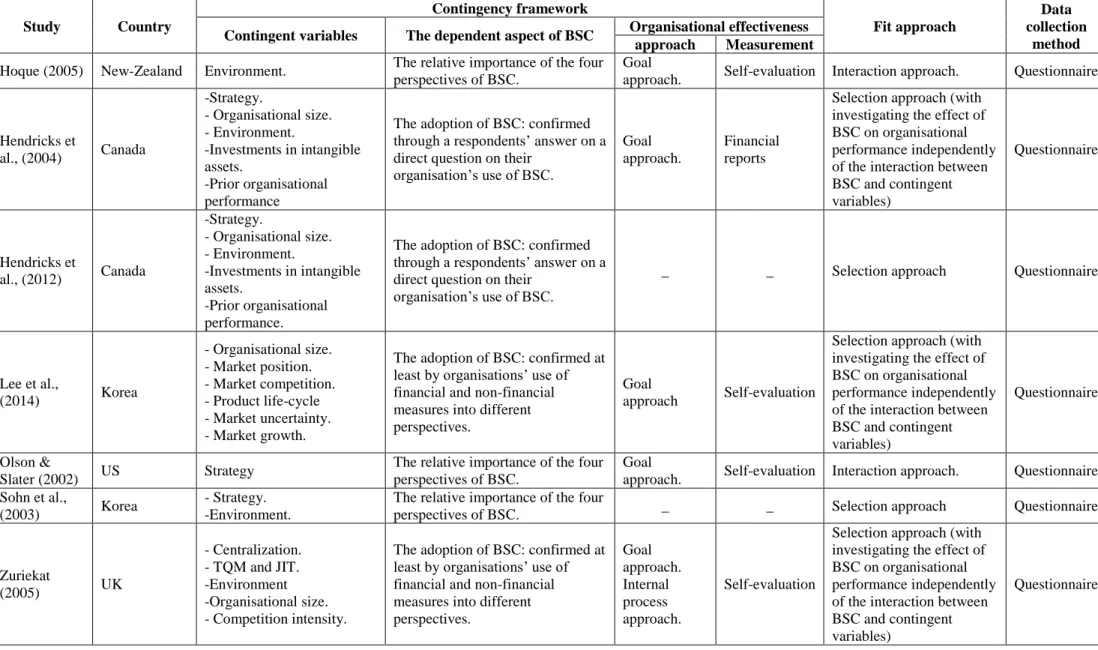
Table 3.2: The contingency based BSC studies’ review………...….59
Table 4.1 the documents reviewed and collected from the case studies………...103
Table 5.1: CRM environmental uncertainty (the change in environment, and the predictability of the change)………111
Table 5.2: CRM business strategy………112
Table 5.3: The perceived contribution of CRM’s implementation of BSC in improving its financial performance………...122
Table 5.4: Summary sheet relating to the study findings of CRM………...123
Table 5.5: NIF environmental uncertainty (the change in environment, and the predictability of the change)………126
Table 5.6: NIF business strategy………...128
Table 5.7: The perceived contribution of NIF’s implementation of BSC in improving its financial performance………..141
Table 5.8: Summary sheet relating to the study findings of NIF………..143
Table 5.9: ISC environmental uncertainty (the change in environment, and the predictability of the change)………145
Table 5.10: ISC business strategy……….146
Table 5.11: The perceived contribution of ISC’s implementation of BSC in improving its financial performance………..163
Table 5.12: Summary sheet relating to the study findings of ISC………165
Table 6.1: Contrast table relating to cases’ contingent variables of environmental uncertainty and business strategy………...166
Table 6.2: The outline of the study sub-questions in relation to its first main question………...168
Table 6.3: Contrast table relating to case studies’ BSC perspectives………...169
Table 6.4: Contrast table relating to case studies’ BSC measures………171
Table 6.5: Contrast table relating to case studies’ the selection basis of BSC measures………..174 Table 6.6: Contrast table relating to case studies’ adoption and implementation of BSC cause and
effect relationship concept………175
Table 6.7: Contrast table relating to case studies’ BSC targets and their applications………….177
Table 6.8: Contrast table relating to case studies’ BSC organisational alignment processes…...179
Table 6.9: Contrast table relating to case studies’ BSC organisational learning processes……..185
Table 6.10: Summary of the similarities and differences between NIF and ISC in relation to their implementation of BSC...187
Table 6.11: Contrast table relating to case studies’ BSC financial effect………..……...189
Table 7.1: Table 7.1: Pattern matching: CRM – Environmental uncertainty …………...193
Table 7.2: Pattern matching: CRM – Business strategy …………...…195
Table 7.3: Pattern matching: NIF – Business strategy …………...…196
Table 7.4: Pattern matching: NIF – Business strategy …………...………….197
Table 7.5: Pattern matching: ISC – Business strategy.………...……199
Table 7.6: Pattern matching: ISC - cost-leadership strategy.………...…………...200
Table 7.7: Summary of the propositions’ findings obtained from the selection approach of fit...…201
Table 7.8: Cross-case analysis in relation to the environmental uncertainty-based propositions ………...………..203
Table 7.9: Cross-case analysis in relation to the business strategy-based propositions ………...………...218
List of Figures
Figure 2.1: BSC strategy map……….19
Figure 3.1: Model A of the study theoretical framework………62
Figure 3.2: Model B of the study theoretical framework………...63
Figure 4.1: The descriptive analytic strategy procedures……….107
Figure 4.2: Pattern matching technique procedures………..108
List of abbreviations
BSC Balanced Scorecard
CRM The research code of case study one NIF The research code of case study two ISC The research code of case study three
PMS Performance Measurement System
SMS Strategic Management System
MCS Management Control System
Appendices
Appendix (A): Study instrument………...………...249
Appendix (B): Ethical Approval………...258
Appendix (C): CRM Company’s interviews………259
Appendix (D): NIF Company’s interviews………...260
Appendix (E): ISC Company’s interviews……...……….…………...261
Appendix (F): Validation of the translated material……….………262
Appendix (G): CRM BSC’s performance measures……….263
Appendix (H): NIF BSC’s performance measures……...……….…………...264
Appendix (I): ISC’s BSC’s performance measures……….……….266
Acknowledgement
First and foremost, I am grateful to Almighty Allah who gave me the strengths and patience to complete this study.
I wish to thank my distinguished supervisor, Professor Hassan Yazdifar, whom I am greatly indebted to him for his professional guidance and supervision. His kindness, humanity, encouragement, patience, invaluable suggestions and comments have been crucial in shaping and completing this thesis. I am indebted, too, to my Second supervisor, Dr Rasol Eskandari for his helpful remarks. My gratitude is also due to Shell, the director of PGR Research Support Office of the business school at Salford University, for her kind and continuous help to me throughout my study’s period.
I gratefully acknowledge the financial support given to me by the Libyan Ministry of Education, the Libyan Cultural Affairs Office in London, and Misrata University to which I belong. Very special thanks for all of them for giving me the opportunity to pursue my postgraduate study in the United Kingdom.
I would like also to extend my gratitude to everyone who participated in the fieldwork. And I gratefully thank my best friends Anwar Saeida, Ali Gerged, Alhassan Osman, and the others in Libya and UK for their active encouragement and support. I am grateful to all of them.
Last but not least, my sincere, great, and deep gratitude to my family. I am thankful and indebted to my parents, Hassan-Mohammed and Naeima, my aunt, Salma, and uncle, Emhimmed for their prayers, love, and continuous support. My wife, Mufida, sons, Hasan and Sulaiman, and lovely daughter, Naeima, I express may love to you, and I must acknowledge your encouragement and support to me during my study; I really appreciate your patience and apologise to you for being so busy with my research. My gratitude goes also to my sisters, brothers and the other members in my big family for their support. I owe a great deal to my family and I feel extremely proud in dedicating this piece of work to them with my love.
Declaration
No portion of the work referred to in the thesis has been submitted in support of an application
for another degree or qualification of this or any other university or other institute of learning.
Abstract
This study investigates how Balanced Scorecard (BSC) is implemented in practice and how affects an organisational financial performance. Drawing on the contingency theory, the study investigates the role of two main contingent variables (environmental uncertainty and business strategy) in shaping BSC implementation and financial effect. The study adopts a case study research with data collected from three Libyan for-profit manufacturing companies (CRM, NIF, and ISC). A total of 63 semi-structured interviews were conducted along with a documentary review and direct observation methods. The qualitative data was analysed using the descriptive analytic strategy, the theory-based pattern matching technique, and the cross-case analysis.
The findings indicate that, in practice BSC is implemented in different ways respecting both the adoption and the implementation of its components. The study found that there are differences between BSC organisations in terms of what components are adopted into BSC implementation. Some BSC organisations implement BSC partially by adopting certain BSC components in the way that represents BSC as a multidimensional performance measurement system (PMS), which consists exclusively of financial and non-financial measures grouped into different perspectives. By contrast, other BSC organisations implement BSC fully by adopting all BSC conceptual components in the way that represents BSC as a strategic management system (SMS), which consists of BSC perspectives, BSC strategic objectives and measures, BSC cause and effect relationship, BSC targets, BSC processes of organisational alignment and learning.On the other hand, the study found that, although some BSC organisations can have similarities on the components adopted into BSC implementations, they have different ways for developing and using each of the adopted components. Some of these ways are consistent with those defined by BSC inventors, while the majority are significantly different. In respect of the financial effect of BSC; the findings show that BSC implementation has different effects on an organisational financial performance - non-existent and a positively high - while the positively high financial effect is associated with implementing BSC as a fully developed concept (BSC as SMS).
Moreover, the study found that there is no role of the environmental uncertainty and business strategy in shaping the differences between BSC organisations in terms of what components are adopted into BSC implementation. Instead, the implementation of BSC that encompasses all the conceptual components of BSC (BSC as SMS) seems to fit the different values of each of those contingent variables. However, the two contingent variables appear to have an important role in determining the ways BSC components are developed and used, and hence, shaping the implementation of BSC and its financial effectiveness.
The study contributes to filling a knowledge gap in BSC literature concerning BSC practical implementation and financial effect. It also contributes to the contingency theory by extending its application from focusing on investigating the adoption rate of BSC to investigating the implementation of BSC and its financial effect. Moreover, the study provides practitioners with guides that assist them with implementing BSC in the way fits their organisation’s level of environmental uncertainty and type of business strategy, therefore enhancing their organisation’s financial effectiveness.
Chapter One:
Introduction
This chapter seeks to explain the rationale for undertaking the current study and to provide a general introduction of the thesis. It structured to contain six sections. Section 1.1 provides some contextual background of the study. Section 1.2 sheds lights on the motivations for undertaking this study. Section 1.3 poses the study questions. Section 1.4 presents the study objectives and provides a summary of the study methods. Section 1.5 presents the thesis structure.
1.1 Some contextual background:
Management control system (MCS) has its main role in steering an organisation towards achieving its goals (e.g. Jordão & Novas, 2013; Zheng, 2012; Al-dahiyat, 2003). However, given the change in the business environment1, the effectiveness of MCS in accomplishing its role has been severely criticised (e.g. Zheng, 2012; Davila et al., 2009; Daft, 2001; Smith, 1997; Kaplan, 1988). The main focus of MCS criticism was the sole reliance of the traditional MCS on the financial-accounting information; besides its cybernetic process of management2 (e.g. Chenhall, 2003; Ittner & Larcher, 2001; Bait-Elmal, 2000; Simons, 1995). The criticisms therefore were tailored back to highlight the inadequacies of performance measurement system (PMS), this system which represents a central mechanism of the accounting system and hence MCS (e.g. Marinho & Cagnin, 2014; Melnyk et al., 2014; Michel & Mari, 2013; Artz et al., 2012; Abushaiba & Zainuddin, 2012; Hitt et al., 2011; Kaplan & Norton; 2008; Garengo et al., 2007; Chenhall, 2005; Magretta & Stone, 2002; Oltey, 2001). Neely and Bourn (2000) emphasises that an inappropriate PMS leads to an ineffective control so, therefore it can destroy performance. Traditionally, organisations design their PMSs based solely on financial performance measures. This was appropriate while the financial perspective of performance was the single important perspective for controlling an organisation’s performance (e.g. Rylkova & Bernatik,
1 By contrast, today business environment is considered to be an unstable environment where customer demands are
diverse and changeable and the movements of competitors are unexpected (e.g. Daft, 2001; Donaldson, 2001).
2
The cybernetic process of management represents the process in which the standards are set by top management; communicated top down throughout an organisation and then the standards are monitored against the actual performance. Therefore, the feedback is observed and corrections are taken if there is a significant deviation (Chenhall, 2003; Simons, 1990; Jawarski, 1988).
2014; Niven, 2002; Kaplan & Norton, 1993). However, in today business environment an organisation is assumed to build its control in the way that captures the non-financial factors of its performance such as quality, innovation, lead time, employee competencies. As such factors become substantially important for organisation’s survival and success in today business environment (e.g. Svensson & Wagner, 2012; Daft, 2001; Kennerley & Neely, 2002). Consequently, PMS that evaluates just the financial perspective of an organisation’s performance becomes inadequate for an effective performance control and then for an organisation to survive and succeed in today business environment (e.g. Rylkova & Burnatik, 2014; Lau & Roopnarain, 2014; Kenneth & Wim, 2007; Niven, 2005; Neely et al., 2001; Kanji, 2002; Neely, 1999; Cross & Lycny, 1988). Specifically, the financial measures were criticized for their limitations including the deficiency of measuring intangible assets, the lack of the strategic focus and the predictive power, neglecting customer demands and the particular needs of each function within an organisation (e.g. Kenneth & Wim, 2007; Kanji, 2002; Norreklit, 2000; Neely, 1999; Ittner & Larcher, 1998; Johnson & Kaplan, 1987).
Hence, supplementing the financial measures with non-financial measures becomes a necessary requirement for evaluating and managing the different perspectives of an organisation’s performance (Rylkova & Burnatik, 2014; Fullerton & Wempe, 2009; Ittner et al., 2003a; Azofra et al, 2003; Medori & Steeple, 2000; Neely et al, 1996; Drucker, 1990). As a response of this requirement, various integrated PMS have been conceived such as Smart system (Cross & Lynch; 1988); Kanji Business Excellence Measurement System (KBEMS) (Kanji, 2002); Performance Prism system (Neely et al., 2001); Integrated Dynamic Performance Measures System (IDPMS) (Ghalayini et al, 1997), EFQM business excellence model (Westlund; 2001), and BSC (Kaplan & Norton, 1992). However, according to several PMS/MCS-based studies, BSC is deemed to be the most popular and important one (e.g. Simpson & Aboagye-Otchere, 2014; Janeš, 2014; Rigby & Bilodeau, 2011; Neely et al., 2001).
BSC as it was introduced by Kaplan and Norton in 1992 was about a multidimensional PMS that encompasses a set of financial and non-financial measures grouped into four perspectives, as an aim to overcome the inadequacy of the traditional PMS (e.g. Liu et al., 2014; Abdalkrim, 2014; Lee et al., 2014; Said, 2013; Barnabe` & Busco, 2012; Petera et al., 2012; Sawalqa et al., 2011; Bedford et al., 2008; Malmi, 2001; Hoque & James, 2000). However, since its introduction, BSC has being continuously evolved to encompass various other components towards becoming a more sophisticated strategic management system. This latter type of BSC extends beyond the
purpose of the performance measurement to seek several other managerial purposes including strategy clarification, strategic planning, strategy implementation, and an organisational alignment and learning (Kaplan & Norton, 1996a; 1996b, 1996c; 2000; 2001a; 2001b).
1.2 An overview of the study motivations:
The continuous evolution of BSC is considered to affect its concept in the way makes BSC an open concept that can be interpreted and implemented in different ways (Dechow, 2012; Soderberg et al., 2011; Čizmić & Crnkić, 2010; Lawrie & Cobbold; 2004; Braam & Nijssen, 2004). For examples, Lawrie and Cobbold (2004) assert that the substantial change in BSC concept occurred by the different publications of its inventors has significantly affected the way in which BSC is interpreted and described. Naro and Travaille´ (2011) further mention that in spite of its manifestation as a standardised model, BSC is more complexed model that allows different interpretations and implementations to emerge.
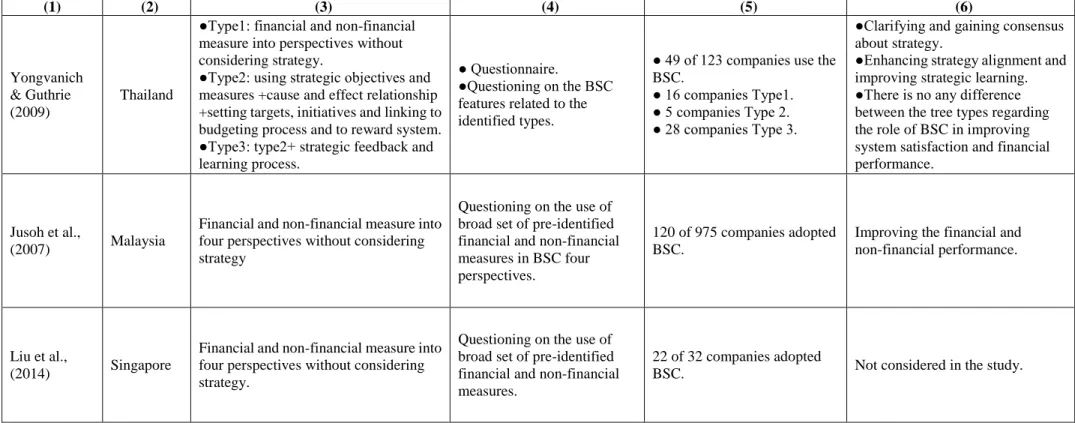
Providing this conceptual issue, many empirical studies were conducted to investigate BSC concept and its benefits. Nevertheless, a small number of these studies have provided empirical evidence on how BSC is implemented in practice. That is, based on the review of the literature, it has been found that the majority of BSC-based studies focused mainly on examining the extent to which organisations adopted BSC (BSC adoption rate) rather than investigating how BSC-adopter organisations implement the system (BSC implementation). In these studies, the adoption of BSC was confirmed either based on the respondents’ self-evaluation3 or an organisation use of financial and non-financial measures grouped into different performance perspectives (e.g. Islam & Tadros, 2012; Hendricks et al., 2012; Tanyi, 2011; Gosselin, 2011; Ismail, 2007; Hoque & James, 2000; Olson & Slater, 2002; Sohn et al., 2003). Other studies such as Soderberg et al., (2011), Yongvanich & Guthrie (2009), and Speckbacher et al., (2003), have taken further step by examining the adoption of different types of BSC among organisations. These studies found that organisations use different types of BSC considering the components organisations adopt into their BSCs. Although such studies give more insights into the different types of BSC used in practice, they do not provide much evidence on how these BSC types including their components have been implemented - developed and used - in practice.
3 This is through asking respondents through a questionnaire a single direct question regarding if their organisations
Otherwise, concerning the empirical investigation of BSC benefits; the majority of the previous studies have focused essentially on examining the subjective (non-financial) benefits of BSC implementation4 (e.g. Janota & Major, 2012; Soderberg et al., 2011; Sawalqa et al., 2011; Yongvanich & Guthrie, 2009Speckbacker et al., 2003). However, while enhancing an organisational financial performance is the ultimate goal of BSC (Kaplan & Norton, 1992; 1993; 1996a; 1996b; 1996c; 2000; 2001a), few studies have examined this ultimate goal. The findings of these studies are different. Where that, while studies such as Davis and Albright (2004) and Petera et al., (2012) find a significant positive effect of BSC on the financial performance, other studies such as Malmi (2001), Bedford et al., (2008) and Hendricks et al., (2004) do not find such positive financial effect; at the time that studies such as Ittner et al., (2003a) find that BSC can have a negative effect on the financial performance.
Here it is clear that even though there are many BSC-based studies, many questions regarding the practical implementation of BSC and its financial effect are still outstanding and need more investigation (e.g. Perkins et al., 2014; Simpson & Aboagye-Otchere, 2014; Kaplan, 2012; Dechow, 2012; Hendricks et al., 2012; Soderberg et al., 2011; Bedford et al., 2008; Davis & Albright, 2004; Ittner et al., 2003b; Speckbacher et al., 2003; Malmi, 2001). In this context, Kaplan (2012, p. 545) asserts that Norton and I recognize that the academic work remains to be done to understand the practical and theoretical implication of BSC innovation and hope that other academics will continue to participate in this research agenda. In turn, Hendricks et al., (2012) state that many further studies are motivated to investigate the implementation of BSC, since the majority of the previous studies have concerned essentially with examining the adoption rate of BSC not with how this system is implemented in practice. Furthermore, Simpson and Aboagye-Otchere (2014) assert that many BSC studies fall short to provide practical evidence on the implementation of BSC and the extent to which BSC becomes integrated as a routine practice within an organisation; thus further studies are required. With more focus on the potential benefits of BSC, studies such as Davis and Albright (2004), Perkins et al., (2014), Malmi (2001) have emphasised the necessity of conducting further study to understand the effect of BSC on an organisational performance in general and on the financial performance in particular.
4 BSC non-financial benefits are such as enhancing decision making process, prompting the performance
Furthermore, while further studies are required for investigating BSC implementation and its financial effect, many researchers have emphasised the need for conducting this investigation through considering organisational characteristics such as business environment and strategy. This is to provide in-depth insights and understanding of the practical implementation of BSC and how it can yield to higher performance effectiveness under certain circumstances (e.g., Liu et al., 2014; Simpson & Aboagye-Otchere, 2014; Janota & Major, 2012; Wu, 2012; Rompho, 2011; Soderberg et al., 2011; Bedford et al, 2008; Bukh & Malmi, 2005; Malmi, 2001). Soderberg et al., (2011) assert that further studies should investigate the implementations of BSC and its benefits with considering the different characteristics of different organisations. Malmi (2001, p. 216) asserts that “further studies are needed for identifying the organisational characteristics that might explain differences in the ways BSC is implemented. In fact, further studies will determine whether we can better explain the various uses of BSC by looking at organisational characteristics; or, does this present diversity of use reflect the development and dissemination of BSC inventors’ new ideas”. Bukh and Malmi (2005) in turn indicate that the way an organisation develops its BSC-including each BSC component- and the benefits from implementing BSC are expected to be contingent upon organisation’s contextual factors such as strategy and business environment; thus, studies should examine these relationships. Moreover, Janota and Major (2012) assert that considering organisational characteristics when investigating BSC implementation not just would result in adding to the theoretical development of BSC, but also would help organisations to avoid mistakes when implementing BSC.
Otherwise, since the lack of BSC-based study conducted in less developed countries especially in Arab countries such as Libya; many researchers have emphasised the necessity of examining BSC implementation in those countries. Therefore, expanding the contribution of study to involve further the context contribution by providing more information and details on how the relatively new management accounting systems such as BSC are implementing in less developed countries (e.g. Hoque, 2014; Liu et al., 2014; Said, 2013; Sawalqa et al., 2011; Khan et al., 2011; Yongvanich & Guthrie, 2009; Ismail, 2007).
Based on the previous discussion, it is clear that the gap between BSC concept and its practical implementation is much far to be filled. And this prompts many researchers to call for further empirical studies in the field of BSC, especially in less developed countries. This in turn motivates the current study to be conducted with an aim to contribute to filling the gap in BSC literature by providing empirical evidence from one of the less developed countries (Libya) on the following questions.
1.3 Study questions:
The study aims to answer the following questions: 1- How BSC is implemented in practice?
2- How does BSC implementation affect an organisational financial performance?
3- How important are organisational characteristics (contingent variables), in shaping the implementation of BSC and its financial effect?
1.4 Study objectives and brief insights into the study methods:
To answer the above questions, the study seeks to accomplish the following objectives:
1- Investigating the adoption and the implementation of each component of BSC in each studied company towards determining its entire implementation of BSC.
2- Identifying the change in the financial performance after implementing BSC in each studied company. And then, determine the perception of company’s members on the contribution of BSC implementation in creating that financial change.
3- Identifying the similarities and differences between the studied companies regarding their BSC implementation so, therefore, gaining a clear understanding of how BSC is implemented in practice.
4- Identifying the similarities and differences between the studied companies in terms of BSC financial effect so, therefore, obtaining a clear understanding of how BSC implementation can affect an organisational financial performance.
5- Defining each studied company in terms of the two main contingent variables of environmental uncertainty and business strategy.
6- Ascertain the influence of the contingent variables on BSC implementation therefore its financial effect through applying the theory-based pattern matching technique and cross-case analysis.
In order to achieve these objectives, a theory exploration of BSC literature is firstly conducted in order to provide a clear and complete picture of BSC conceptual components and their ways of
implementation (development and use). In addition, the study adopted the case study research applied in three case studies. The case study research is adopted in this study since its usefulness for providing an in-depth investigation and understanding of the concerned phenomenon in its real-word context (Yin, 2003; George & Bennett, 2005; Gerring, 2007), Moreover, this choice of applying a case study can be greatly justified by the emphasis of many researchers on the importance and the need of using such research approach for investigating the practical implementation of BSC (e.g. Hoque, 2014; Simpson & Aboagye-Otchere, 2014; Said, 2013; Hogue & James, 2000; Perkins et al., 2014; Agostino & Arnaboldi, 2012; Sawalqa et al., 2011; Othman et al., 2006). In this context, Said (2013) asserts that using a case study research rather than a survey-based research, which represents the prevailing feature of BSC-based studies, would provide a rich explanation and a depth understanding of the actual implementation of BSC. In addition, Simpson and Aboagye-Otchere (2014) mention that since the a case study research is very useful for theory confirming, enhancing internal validity and providing profound information on the object of study, there is a requisite need to investigate the practical implementation of BSC by using a case study research. Furthermore, Southern (2002) confirms that there is a need for a systematic comparison through conducting a case study research to investigating BSC concept. As this would provide valuable insights into how the implementation of BSC can differ among organisations and how the different BSC implementations can affect the gained benefits. He further indicates that investigating BSC in this way would allow more realistic classifications of BSC concept, which would be more than beneficial for predicting the value of BSC implementation.
1.5 Thesis structure:
In addition to this chapter, the thesis will include seven further chapters. Chapter Two is structured to contain two main sections. The main aim of the first section is to provide a theory exploration of the main subject of the study, BSC. It gives a description on BSC emergence, evolution, definitions, purposes and popularity. Furthermore, it defines BSC components that constitute its fully developed concept, and provides a depth and critical discussion of their development and use. Moreover, it clarifies the benefits of BSC implementation and its ultimate goal. Having that, the second section of Chapter Two reviews the empirical BSC studies and provides more clarification of the motivations underlying conducting the current study. Therefore, it provides the reasons for adopting the contingency theory as the main theoretical basis of the current study toward a depth discussion of the contingency theory framework in Chapter Three.
Chapter Three; the first main section of this chapter aims to provide insights into the contingency theory and its important role in explaining the different implementations of management accounting systems. In doing so, this section discusses firstly the principle of the contingency theory, the concept of fit and organisational effectiveness concept. The section further provides a detailed description of the two main contingent variables of environmental uncertainty, and business strategy. Following that, the second section of Chapter Three provides a focused review of the previous empirical studies addressed the relationships between the two contingent variables (environmental uncertainty and business strategy) and BSC towards identifying the gap in the contingency-based BSC literature. It therefore demonstrates how the current study can contribute in filling that gap. Having that, the third (final) section of this chapter is concerned with identifying the study theoretical framework, the operational definition of its variables, as well as developing the study propositions.
Chapter Four describes the methodology of the study. The chapter clarifies the study type and its research approach, gives an overview of the study design, defines the case definition and the case selection criterion, and illustrates the methods used in this study for data collection. Furthermore, the chapter goes to spot lights on the study’s instrument development and structure, and the measurement of the study’s variables. The chapter then clarifies the preparation arrangements undertaken prior to the fieldwork. Furthermore, it goes to demonstrate how the pre-set methodological plan was carried out in the fieldwork, what difficulties encountered and what outcomes obtained from the real implementation of this methodological plan. Moreover, the chapter demonstrates the three analytical strategies adopted for drawing and verifying the study findings (the descriptive strategy; the pattern matching technique through theory based analytical strategy; and cross-case analysis strategy).
Chapter Five presents the results of the descriptive analysis in relation to the first, second, and fifth objectives of the study, which aimed at determining the empirical pattern of BSC implementation, its financial effect, and the contingent variables in each case study. Chapter Six, it carries out the cross-cases analysis of the descriptive findings. This is towards providing answers to the first and the second questions of the study related to the practical implementation of BSC and its financial effect. Chapter Seven carries out the pattern matching technique analysis and cross-cases analysis to test the study propositions. This is towards answering the third question of the study related to identifying the role of the environmental uncertainty and business strategy contingent variables in shaping the implementation and the financial effect of BSC.
Finally, Chapter Eight gives an overview of the study, summarizes its main findings, contributions and implications, and discusses the study limitations and the potential directions of further studies.
Chapter Two: Balanced Scorecard (BSC) 2.1 Introduction:
This chapter provides insights into the concept of BSC and BSC empirical work. The chapter consists of three main sections. Section 2.2 provides a theory exploration of BSC literature aiming essentially at giving a clear picture of the types and the components that constitute the fully developed concept of BSC; besides clarifying the benefits of BSC implementation. Section 2.3 discusses the empirical studies on BSC, and therefore, identifies the gap in BSC empirical work, which the current study can contribute to filling in.
2.2 Theory exploration of BSC literature: 2.2.1 BSC emergence and popularity:
BSC was introduced by Robert S. Kaplan (professor of accounting at Harvard Business School), and David P. Norton (consultant in Nolan company). The first appearance of BSC was in Harvard Business School journal January-February 1992, within an article entitled (The Balanced Scorecard-Measures that drive performance). Since its emergence, BSC has engaged a considerable attention whether in practice or among academic research (Liu et al., 2014; Perkins et al., 2014; Giannopoulos et al., 2013; Islam & Tadros, 2012; Soderberg et al., 2011; Macnab, 2011; Khan et al., 2010; Speckbacher et al., 2003). Regarding this popularity of BSC, Speckbacher et al., (2003) asserts that a great deal of literature has been published on BSC as well as countless seminars and workshops have been dealing with this concept since its introduction. On the other hand, Marr (2010) asserts that about 50% of major organisations in The US, Europe and Asia are using BSC. More recently, Rigby & Bilodeau (2011) found that 54% of 1230 organisations worldwide have implemented BSC. This can be attributed to the assumed benefit of BSC which are discussed throughout this chapter.
2.2.2 BSC evolution and types:
Through a year-long research with 12 case studies companies, Kaplan and Norton (1992) devised BSC. In their first publication on BSC (The BSC-measures that derive performance), they explained that BSC was designed to focus the attention of top managers on a short-list of the critical indicators of the current and future performance (Kaplan & Norton 1992, p.71). That is,
the initial idea underlying the emergence of BSC is to encourage mangers to move from measuring an organisational performance relying solely on the financial measures toward using a set of financial and non-financial measures considering different perspectives of an organisational performance - financial, customer, internal business processes, and learning and growth perspectives (Lawrie & Cobbold, 2004; Perkins et al., 2014). Based on this, the initial concept of BSC takes its reputation among academics and practitioners as a multidimensional PMS that encompasses a set of financial and non-financial measures grouped into four different perspectives (e.g. Liu et al., 2014; Abdalkrim, 2014; Lee et al., 2014; Said, 2013; Petera et al., 2012; Sawalqa et al., 2011; Bedford et al., 2008; Malmi, 2001; Hoque & James, 2000). Malina and Selto (2001) describe the purpose of the initial type of BSC as to provide a comprehensive picture on the state of an organisational performance, in the way that resembles the dashboard of an automobile that shows speed, fuel level, coolant temperature, etc. (Malina & Selto, 2001). Afterwards, BSC has been cumulatively developed by the various text books and articles published by its inventors throughout the period from 1992 to 2008. This has resulted in upgrading BSC from a multidimensional PMS to a more sophisticated strategic management system. With its fully developed concept as strategic management system, Kaplan and Norton (1996b) emphasise that BSC is more than a PMS. It is a comprehensive framework for clarifying and translating strategy into operational terms; aligning organisation with its strategy, making strategy continual process, and mobilizing managers for change (Kaplan & Norton 1996b, 2001b). These multiple purposes underlying the evolution of BSC are accompanied by developing BSC to encompass various components, which are discussed next.
2.2.3 BSC components:
Given the continuous and the cumulative development of BSC, many researchers have emphasised the question that “what do constitute the fully developed concept of BSC? (e.g. Perkins et al., 2014; Hoque, 2014; Dechow, 2012; Naro & Travaille, 2011; Soderberg et al., 2011; Čizmić & Crnkić, 2010; Franco-Santos et al., 2007; Othman et al., 2006; Marr, 2005; Bukh & Malmi, 2005; Lawrie & Cobbold, 2004; Lawrie & Cobbold, 2004; Braam & Nijssen, 2004; Chenhall, 2003). In this context, Lawrie and Cobbold (2004) asserts that the substantial change in BSC concept occurred by the different publications of its inventors has significantly affected the ways in which BSC is defined in the literature. Moreover, Chenhall (2003) states that it is not obvious that how BSC can be considered and measured. Dechow (2012) in turn concludes that
“we see that BSC has been around “as new” for a very long time now, and actually longer than any other management concept known to date. More importantly, we now begin to see research that draws on notions, which the BSC literature has introduced, yet perhaps never really explained” (Chenhall, 2003, p.522).
Providing this issue, several researchers call for a more valid definition of BSC concept that captures all BSC developed components so, therefore providing a basis of a comprehensive and more precise investigation of BSC practical implementation (e.g. Chenhall 2003; Zuriekat, 2005; Dechow, 2012). To respond to this call, the researcher conducted a depth review of Kaplan and Norton publications on BSC (1992; 1993; 1996a; 1996b, 1996c; 2000; 2001a; 2001b; 2008) and the engaged studies such as (Perkins et al, 2014; Agostino and Arnaboldi, 2012; Soderberg et al, 2011; Bedford et al, 2008; Lawri and Cobbold, 2004; Speckbacher et al, 2003; Malmi, 2001). Based on this review, the conceptual components that constitute the fully developed concept of BSC is defined to include: BSC perspectives; BSC strategic objectives and performance measures; the cause and effect relationship; BSC targets and their applications (initiatives development and resource allocation); BSC organisational alignment processes including: top-level managers’ participation in BSC development, educating and communicating BSC, cascading BSC, and linking the compensation system to BSC; and finally BSC processes of organisational learning. These BSC components are discussed as follows.
2.2.3.1 BSC perspectives:
BSC complements the traditional financial perspective with three additional perspectives of customer, internal business processes, and learning and growth. These perspectives are considered to reflect the key important areas of performance which an organisation needs to master in today business environment (e.g. Speckbacher et al., 2003; Niven, 2002; Kaplan & Norton, 1992). The four perspectives of BSC are discussed as follows:
1) Financial perspective: The financial perspective represents the traditional perspective of measuring performance, and it is widely defined as being concerned with measuring the short-term financial achievements (e.g. Kenneth & Wim, 2007; Norreklit, 2000). However, taking account of the long-run performance, the financial perspective is maintained as an important perspective of BSC. It is considered to provide important measurement of how an organisational performance relating to the other BSC perspectives contributes overtime in improving the financial performance of an organisation and hence maximizing the value of its shareholders (e.g. Niven, 2002; Kaplan & Norton, 1992).
2) Customer perspective: The customer perspective is considered as the crucial perspective of BSC (Ivanov & Avasilcăi, 2014; Abdalkrim, 2014; Sawalqa et al., 2011; Chow et al., 1997). It is concerned with identifying customer demands and evaluating their level of satisfaction on the products and services provided by an organisation. Kaplan & Norton (1996a) explain that the customer perspective allows an organisation to evaluate whether their initiatives for creating values to its customer are successfully resulted in improving its performance evaluated through its customers’ eyes.
3) Internal business processes perspective: The internal business processes perspective concerns essentially with identifying and measuring the critical internal processes that are required for creating and delivering the specified value to an organisation’s customers and consequently maximize the value of its shareholders (Thompson & Mathys; 2008; Kaplan & Norton, 1996b). The internal processes fall into three subsequent stages; First, innovation process in which an organisation focus on searching the apparent and latent customer needs and developing solutions for these needs; Second, the operational process, in which an organisation creates and delivers its products and services to the market; Third, the post-sales process, in which an organisation serves its customer after the original sales process is completed (Sawalqa et al., 2011; Michalska, 2005; Chow et al., 1997; Kaplan & Norton, 1996c).
4) Learning and growth perspective: The learning and growth perspective is concerned with the ability of an organisation to utilise its intangible assets (i.e., employees) for enacting the innovation and the continuous improvement of its products and services (Khan et al., 2010; Hoque, 2004; Kaplan & Norton, 1996c, 1993, 1992). Niven (2002, p.16-17) considered the learning and growth as the roots of a tree that will ultimately lead through the trunk of internal processes to branches of customer results, and finally to the leaves of financial returns.
Theoretically, Kaplan and Norton (1996c) consider these four perspectives to be sufficient for viewing and monitoring the critical success factors of an organisation’s performance that create organisation’s competitive advantages and future financial success. However, against this presumed sufficiency of BSC four perspectives, several researchers have arose their concerns. For instance, Norreklit (2000) argues that BSC with its four perspectives lack the capability of monitoring the external environment (i.e. competition, technology development); therefore, they are incapable of enhancing an organisation’s ability to adapt the change in its environment, which is crucial for an organisational success. Similarly, Neely (2002) argues that BSC lacks the
comprehensiveness of viewing and managing an organisation performance, as it omits different performance perspectives including the environment perspective. Furthermore, others such as Akkermans and Oorschot (2005) state that if BSC is considered to reflect the relevant perspectives of an organisation’s business, then BSC perspectives should not be restricted to the initial four perspectives; rather than they should be expanded to involve all the stakeholders who represent the organisation’s business. They emphasise that BSC doses not consider the most important factors in the value chain which are employees and suppliers.
In relation to this issue; Kaplan and Norton (1996c) explain that while the factors related to the employee perspective are explicitly incorporated into the learning and growth perspective, other factors, if they are considered to be critical for an organisational business, can be similarly incorporated into the four BSC perspectives. Otherwise, they can be addressed within entirely new perspective but, in this situation an organisation needs to consider how this entirely new perspective can be integrated with the other BSC perspectives. Empirically, to the researcher’s best knowledge, there is only the study of Boulianne (2006) that examined explicitly this issue of BSC perspectives’ sufficiency and validity. This study showed that the four perspectives of BSC are sufficient (relevant and valid) to represent the most critical perspectives and factors of an organisational performance.
Other argument related to BSC perspectives is that, the relative importance of BSC perspectives. Kaplan and Norton devised the four perspectives of BSC to be used in a balanced way (Kaplan & Norton, 1992). This in which no perspective should be predominantly emphasised at the expense of the other perspectives when using BSC for planning and managing an organisation’s performance (Niven, 2002; Soderberg, et al., 2011; Kald & Nilsson, 2000). However, against this concept of balance, different researchers have expressed their concerns (e.g. Perkins et al, 2014; Schneiderman, 2001; Johanson, et al., 2006). For instance, Schneiderman (2001) emphasises that; BSC does not need to be used in balanced way; instead it needs to be used in an imbalanced way in order to accomplish its purpose of managing the most critical areas of performance (Schneiderman, 2001, p. 4). Empirically, to the researcher’s best knowledge, there are only the studies of Hoque (2005), Olson and Slate (2002), Sohn et al. (2003), and Jusoh et al. (2007), those concerned explicitly with investigating this issue of BSC perspectives. The findings of these studies are in contrary to the balance concept of BSC perspectives.
Based on the above discussion, it is notable that, although BSC perspectives are primary components of BSC, there are many concerns existent relating to their sufficiency and use, which prompt posing the following questions: What perspectives do organisations use into BSC? How do organisations use BSC perspectives; are they used in a balanced or an imbalanced way when planning and managing their performance?
2.2.3.2 BSC strategic objectives and performance measures:
From the above discussion, it should be clear that BSC perspectives are areas of performance that needed to be monitored and perhaps managed through using financial and non-financial measures. But, how these performance measures can be identified? Kaplan and Norton in their first writing on BSC demonstrated that: to put BSC into work, the performance measures in customer perspective should be firstly identified. This is through determining the measures reflecting the factors that are really matter to customer (time, quality, performance and services, and cost). Therefore, the internal business measures of BSC should be stemmed from the business processes that have the greatest impact on customer satisfaction. Following that, the measures in the learning and growth perspective should be set to evaluate an organisation ability of the continuous learning and development toward meeting customer demands. Having identified the performance measures in the non-financial perspectives of BSC, the performance measures for the financial perspective can be set to measure the financial outcomes of the operational performance in the three other BSC perspectives (Kaplan & Norton, 1992, p. 73, 75, 77).
However, in their later development of BSC into a strategic system; Kaplan and Norton (1996b) emphasised the importance of BSC measures to be derived from specified strategic objectives derived from a formulated strategy. That is, an organisation is assumed firstly to clarify its strategy, and then relying on it to specify strategic objectives for each BSC perspective. These strategic objectives in turn will be the basis for selecting the performance measures in each perspective (Kaplan & Norton, 1993; 1996a; 1996b; 1996c; 2000). Thus, the strategic objectives act as a bridge between an organisation’s strategy and performance measures. In other words, the strategic objectives will describe what an organisation must do to implement its strategy, while the performance measures will evaluate whether an organisation is meeting its strategic objectives and therefore implementing its strategy (Assiri, 2006; Niven, 2002). Several researchers have emphasised the importance of this strategic derivation of BSC measures (e.g. Rompho, 2011; Chavan, 2009; Jusoh et al., 2007; Ittner & Larcker, 1997). For instance, Ittner and Larcker (1997) emphasise that using BSC in the way that does not include linked strategic measures would deteriorate organisation’s performance.
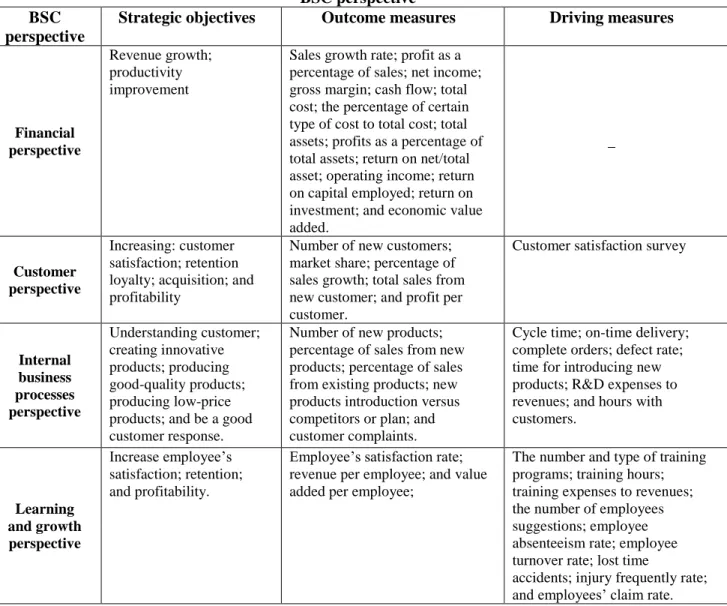
Concerning the types of BSC measures; BSC is supposed to contain various financial and non-financial performance measures including: (1) Outcome type of measures: those defined as lagging measures gauge the lagging outcome of organisational performance versus an organisation’s strategic objectives. (2) Driving type of measures, they are defined as ex-ant and unique for organisation’s particular strategy. They are assumed to provide timely measurement of the critical factors that drive the strategic objectives’ achievement. (3) External type of measures (i.e. customer satisfaction survey), this type of measures is consider as an important for getting timely evaluation from customers on the strategic competitive factors that an organisation decided to compete upon (Kaplan and Norton, 1996a; 1996b). See Table 2.1.
Table 2.1: Examples of the strategic objectives, outcome measures, and driving measures in each BSC perspective
BSC perspective
Strategic objectives Outcome measures Driving measures
Financial perspective
Revenue growth; productivity improvement
Sales growth rate; profit as a percentage of sales; net income; gross margin; cash flow; total cost; the percentage of certain type of cost to total cost; total assets; profits as a percentage of total assets; return on net/total asset; operating income; return on capital employed; return on investment; and economic value added. _ Customer perspective Increasing: customer satisfaction; retention loyalty; acquisition; and profitability
Number of new customers; market share; percentage of sales growth; total sales from new customer; and profit per customer.
Customer satisfaction survey
Internal business processes perspective Understanding customer; creating innovative products; producing good-quality products; producing low-price products; and be a good customer response.
Number of new products; percentage of sales from new products; percentage of sales from existing products; new products introduction versus competitors or plan; and customer complaints.
Cycle time; on-time delivery; complete orders; defect rate; time for introducing new products; R&D expenses to revenues; and hours with customers. Learning and growth perspective Increase employee’s satisfaction; retention; and profitability.
Employee’s satisfaction rate; revenue per employee; and value added per employee;
The number and type of training programs; training hours; training expenses to revenues; the number of employees suggestions; employee absenteeism rate; employee turnover rate; lost time
accidents; injury frequently rate; and employees’ claim rate.
These various types of BSC measures are considered to be very handful, since its assumed role in enabling managers to gain a holistic view on their organisation’s performance (Kaplan & Norton, 1992, 1996b). However, some studies consider the involvement of all these types of measures into BSC to be problematic and can cause a confusing and distracting effect, especially, related to its calculating process and dealing with its outcomes (e.g. Macnab, 2011; Braz et al., 2011; Ahn, 2001; Malina & Selto, 2001). On the contrary, Leauby and Wentzel (2002) state that organisation will not face problems on operating with many BSC measures, and some organisation use 70 to 80 performance measures in their BSCs. In this regard, Kaplan and Norton (1996b) assert that using many performance measures on BSC would not be a complicated for an organisation, as these measures are derived from a single corporate strategy.
Going back to this important point of the strategic derivation of BSC measures; although Kaplan and Norton as well as many BSC-based studies highlight the importance of this strategic derivation, it appears that there is still something unclear regarding its practical implementation (Thompson & Mathy, 2008). In this context, Kenneth and Wim, (2007) indicate that it is difficult for an organisation to start from its strategy to identify its strategic objectives if its strategy itself is not elaborately defined. In consistence, Dechow (2012) states that, in practice it does not appear that managers rely on their organisation’s exclusive strategy to specify their BSC measures; instead, they tend to use common measures in their BSC implementation. In turn, Ahn (2001) found that mangers use the strategic objectives given in the literature for determining their used BSC measures, instead of relying on their organisation’s strategy.
Other relevant issue is that the relative importance allocated to each type of BSC measures. That is, while Kaplan and Norton (1996b) emphasise that the outcome measures and the driving measures on BSC should be used in balanced way; different empirical studies have come with uncorroborated evidence to this concept of balance. For example, Lipe and Salterio (2000) and Kang and Fredin (2012) report that managers in their use of BSC tend to place more weight on the outcome measures, while neglecting or placing a little weight on the unique driving measures. Based on the above discussion, it is notable that the literature still has different concerns relating to BSC measures respecting their number, types, selecting basis and use; which prompt the following questions to be posed: How many performance measures do organisations use in their implementation of BSC? What types of performance measures organisations use in their implementation of BSC? How do organisations use the outcome and driving types of BSC, are they used in a balanced or an imbalanced way? How do organisations identify their performance measures of BSC; do they identify them based on specified strategic objectives?