Market Analysis and Statistics G00224675
Competitive Landscape: Modular Data Center
Solutions
Published: 23 March 2012
Analyst(s): Jeffrey Hewitt
A number of competitors offer noncontainer modular data center solutions
to provide increased installation, power, and cooling efficiencies for data
center infrastructure.
Key Findings
■ Modular data center solutions fall into three categories — modular data center components, data center containers, and noncontainer modular data center solutions.
■ Modular data center component solutions provide a more modular level of granularity than the data center container, and often are focused on rack or row-level installations.
■ Noncontainer modular data center solutions break the physical boundary limits of the physical data container shell to provide larger amounts of equipment support and provide easier access to hot and cold aisle areas within the prefabricated module.
Recommendations
■ Consider the wide array of value propositions that exist among modular data center
competitors when crafting competitive approaches to get the best returns from modular data center marketing efforts.
■ Consider the most popular and compelling reasons for deployment of a modular data center solution (e.g., speed of deployment of a data center, power savings, cooling efficiencies) when crafting appropriate value propositions.
■ Monitor the modular data center solutions market closely as it evolves because it is still in a relatively early stage at this juncture and changes in the competitive arena (e.g., mergers, acquisitions, competitors dropping out) and customer bases are likely to occur as the market matures.
Analysis...2
Competitive Situation and Trends...3
Market Players...4
Colt...4
Dell...5
Elliptical Mobile Solutions...5
Emerson Network Power...5
HP...5 IBM...5 IO...5 MDC Stockholm...6 Schneider Electric...6 SGI...6
The Future of Competition...6
Competitive Profiles...8
References and Methodology...13
Recommended Reading...13
List of Tables
Table 1. Modular Data Center Customer Situation Examples...4Table 2. Modular Noncontainer Data Center Solution Providers...9
List of Figures
Figure 1. Midsize to Large Data Center Site Projections...7Figure 2. Data Center Summit 2011 Modular Data Center Polling Results...8
Analysis
Modular data center solutions are building block solutions that consist of standardized sections or units that facilitate the physical build out of IT infrastructure. These modular approaches can be focused at the data center level or at a more granular level; the more granular approaches can go down to the rack level. Data center containers are a type of modular approach that is based on and housed within some size of a standard shipping container (most often 8 feet wide by 20 or 40 feet
A container approach has the advantage of a "shell" based on a shipping container, but that "shell" creates physical limits. Because of the limited space within a container, a hot/cold aisle approach within the container can create challenges with regard to accessing the equipment within the container. Container providers have developed different methods to address those challenges (e.g., equipment on rails, access to the hot aisle external to the container), but a modular approach that goes beyond the container shell provides a greater range of choices in dealing with power and cooling of the equipment involved.
Gartner has published a document that explores the container segment of the modular space (see "Competitive Landscape: Data Center Containers"). This research focuses on noncontainer-based modular approaches. Most of these newer modular approaches have evolved from data center container offerings and are designed to take the sectional approach to data center infrastructure to either a more-granular level or to a larger size level than what containers can provide.
Searches on gartner.com indicate that interest in modular solutions on the whole has eclipsed interest in data center containers (see "Search Analytics Trends: Gartner Clients Show Increased Interest in Modular Data Centers").
Competitive Situation and Trends
As the market for x86-based servers, storage and network equipment has grown, end users across a broad spectrum of vertical markets have been exploring ways to find more effective methods to install and manage data center equipment. Modular data center solutions represent one approach that is designed to increase installation and management efficiencies of data center hardware infrastructure. For example, a brick-and-mortar data center facility typically takes 18 months of planning and implementation to bring on line. Modular solutions can reduce the time that it takes to bring a functional data center online to weeks.
Conversely, there are reasons why modular data center approaches are not yet being universally adopted as a way to implement data center infrastructure. The additional space for equipment in existing brick-and-mortar facility that has been created through consolidation of hardware
infrastructure, and effective data center planning and space management on the brick-and-mortar level, represent two major inhibitors to modular data center implementations.
If we examine the market today, modular data center solutions are being used in three primary customer situations (shown in Table 1 in no particular order).
Table 1. Modular Data Center Customer Situation Examples
Customer Situation Compelling Reasons for a Modular Approach
Retrofit of older location — an organization has consolidated to one of its older data center locations and needs to retrofit the location to increase power/cooling efficiencies and optimize its IT equipment density.
A modular approach allows for a staged retrofit of a data center. Modular components can be installed in one designated section of the data center to optimize power to and cooling of the equipment within the modules. Modules can be added to more sections of the data center because growth requires the support of additional equipment at potentially increasing densities.
Modular from the "ground up" — an organization wants to plan and implement a new data center in a more effective, scalable and rapid manner, and in doing so reduces its overall capital costs.
Modular data centers allow for capital expenditure reduction through the use of standard components prebuilt at a factory location when compared with typical on-site build-out approaches. Modular data centers also allow for more phased approaches in terms of adding modules as well as planning/life cycles that can mirror the IT equipment itself (e.g., five years as opposed to the typical brick-and-mortar 10-year plan).
Optimize existing space — an
organization's existing data center has some limited available space, but its IT equipment requirements are increasing; there just isn't enough existing space to accommodate the needed hardware infrastructure.
A modular approach will support relatively high power/ cooling requirements in defined spaces. An available section of an existing data center can be used to add higher
densities of compute/storage/network equipment by using modular data center approaches.
Source: Gartner (March 2012)
Market Players
A number of providers compete in the modular data center market. These providers have come from a variety of markets that are adjacent to the modular data center space. Some are providers of data center infrastructure hardware, some are providers of various data center services, and some focus on the modular data center product itself as their core business. No matter what direction these providers come from, each has its own unique approach and position in the modular data center market. A broad cross section of the competitors has been selected for inclusion in this document, and is presented in alphabetical order.
Colt
Colt is a provider of an array of data center solutions and services across 21 countries in Europe. Colt focuses primarily on the financial services, legal, media, healthcare, and government vertical spaces.
Dell
Dell is a market leader in the hardware infrastructure portion of the data center space and has maintained a strong position in x86 server hardware since the market first developed. In addition, Dell has a broad product and service portfolio in the data center arena that includes storage, switch, and software elements through its own products as well as through partnerships.
Elliptical Mobile Solutions
Elliptical Mobile Solutions was founded in 2005. Of the providers covered within this document, Elliptical Mobile Solutions is unique in that it focuses on modular solutions at the most granular level — the rack itself.
Emerson Network Power
Emerson Network Power is a global provider of data center solutions and products that facilitate requirements such as reliable power, precision cooling, infrastructure management, and telecom connectivity. It has presence in 150 countries and has developed solutions through what it calls its 12 Centers of Expertise.
HP
HP is a global provider of data center hardware and facility infrastructure as well as hosting. HP also has a significant suite of software and service offerings in the data center space. Through the
Technology Services, Critical Facilities Services division, HP provides data center consulting design and build programs and services. It has the capability to combine data center infrastructure with hardware infrastructure to create total data center offerings, including modular solutions.
IBM
IBM is another worldwide leader in data center services and IT infrastructure. Although it has market-leading positions in server technologies such as mainframes and Unix-based servers, it has also brought hardware and software functionality from those platforms to its x86 rack-optimized and blade server designs. IBM's strong presence in large data center customers extends itself naturally to modular data center solutions through its Global Technology Services Site and Facilities Services, which design and build data centers.
IO
IO was founded in 2007 and offers premier data center services as a colocation provider.
Leveraging that experience, IO developed a Data Center 2.0 modular technology platform. These modular solutions can be delivered as "Data Center as a Service" and be rapidly deployed to customer sites anywhere in the world.
MDC Stockholm
MDC Stockholm provides a "ground-up" modular approach as a means to construct data centers in incremental steps. MDC Stockholm uses special 40-foot modules to house the data center
infrastructure, power and cooling equipment, with a separate interconnected "command module" as a part of its solution that is unique in design.
Schneider Electric
Schneider Electric is a global specialist in energy management providing EcoStruxure, an integrated system architecture unifying the management of building, security and power in the data center. Schneider Electric delivers high efficiency and availability of the Data Center Physical Infrastructure from the rack, to row, to room, and to building.
SGI
SGI has a history with its business, formerly known as Rackable Systems, of selling large numbers of similarly configured x86-based servers to service providers in the hyperscale/mega data center world. With a focus on the service provider space, and a strong legacy in the HPC world, SGI has a relatively natural fit into the modular data center arena.
The Future of Competition
A modular approach to building out new data centers is not likely to become the predominant approach during the next five years (in contrast to the typical brick-and-mortar approach). Despite not becoming the "first choice" for data center deployment for most of the market, modular approaches to data center builds are likely to grow, and this will produce increased competitive pressure. Because the need for rapid infrastructure deployment in relatively highly dense
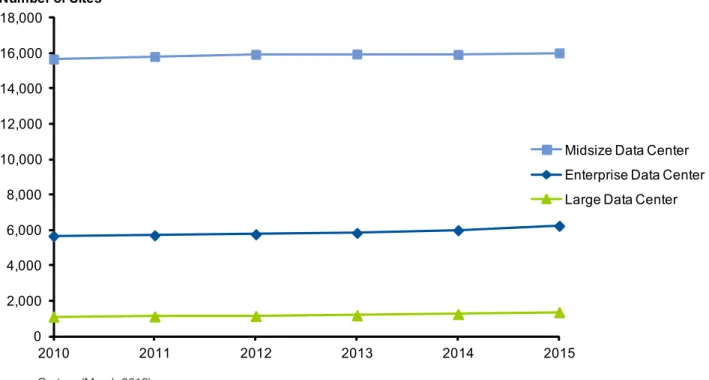
configurations with a focus on power/cooling efficiency is predominant in the mega/hyperscale data center market segments, modular approaches are likely to grow more significantly in this segment. The enterprise and midsize data center segments are candidates for modular approaches because of the same demand for better power/cooling approaches as data center infrastructure grows. Based on Gartner forecasts ("Forecast: Data Centers, Worldwide, 2010-2015"), midsize, enterprise, and large data centers are likely to grow to more than 26,000 facilities by 2015 (see Figure 1).
Figure 1. Midsize to Large Data Center Site Projections 0 2,000 4,000 6,000 8,000 10,000 12,000 14,000 16,000 18,000 2010 2011 2012 2013 2014 2015 Number of Sites
Midsize Data Center Enterprise Data Center Large Data Center
Source: Gartner (March 2012)
From the provider standpoint, the growth of these data centers around the world and the potential conversion of the square footage of existing facilities to modular approaches, provide the potential to sell adjunct equipment and services related to modular data center sales. This presents an expanding opportunity to reap the potential sales and margin rewards from a modular data center business. These potential profits also will add to increased competition in the modular data center arena as it grows. Positioning around power, cooling and installation speed will need to
demonstrate increasing efficiencies and more focused marketing messaging as this market continues to evolve during the next five years.
A poll taken at the Gartner Data Center Summit in December 2011 provides some indication of how the competitive dynamics will unfold in this market. Ninety-three respondents were asked from whom they would most likely buy a container or modular data center solution; their responses, by percent, are shown in Figure 2.
Figure 2. Data Center Summit 2011 Modular Data Center Polling Results 22 26 13 39 0 10 20 30 40 50 Compute/storage/network infrastructure provider (e.g., Cisco, Dell, HP, IBM, SGI) Providers of other data center infrastructure
and services (e.g., APC, AST, Emerson Network Power, IO)
A data center container/modular specialist (e.g., Datapod, Elliptical Mobile Solutions,
MDC Stockholm)
I would be willing to buy from any of these provider types at this time
Percentage of Respondents
Source: Gartner (March 2012)
These results suggest that while a significant percentage of modular data center solution buyers will be open to buy from an array of provider types, compute/storage/network infrastructure providers (e.g., Cisco, Dell, HP, IBM and SGI), and providers of other data center infrastructure and services (Schneider Electric, Emerson, and IO) have a slight edge in preference as a source for modular solutions over the data center modular specialists like Elliptical Mobile Solutions and MDC Stockholm. This suggests that the latter provider type will need to commit to some strong and effective marketing of their solutions if they are to overcome this potential preference deficit and make headway in the market as it evolves.
Competitive Profiles
Because the market for modular data center solutions is still in a relatively early phase and financial specifics for the modules are not broadly disclosed by providers, revenue characterizations among and across these providers is not likely to be valuable at this juncture. It is also possible in these early market stages that with a single significant customer, particularly for a relatively large data center project, a provider of modular data center solutions could surge ahead in a rapid way in relationship to its competitors.
The profiles of 10 competitors in the noncontainer modular data center market are shown in Table 2.
Table 2. Modular Noncontainer Data Center Solution Providers
Provider Market Overview General Product Strategy How This Provider Competes
Colt Colt has a significant customer base in Europe and offers solu-tions crafted for businesses from small to enterprise size across Europe. Examples of Colt services and solutions in-clude cloud, consulting, appli-cation hosting, networking, and security.
The Colt Modular Data Centers are available in building blocks of 500 square meters (or multiples of 125 square meters) with a 1.21 design PUE that can be stacked and fully built and staged at the Colt factory using standard components before being delivered and installed.
Colt focuses on power and cooling-efficient data centers that can be installed within four months in Colt-hosted facilities or customer sites. Colt in-cludes flexible placement with an array of options covering aspects like UPS, free cooling, security and fire suppression as a part of its value proposi-tion.
Dell Dell comes from a strong posi-tion as a global hardware and service provider. It offers an ar-ray of solutions and services to complement its hardware sales and facilitate sales, in particular segments such as mega/hyper-scale data centers.
Dell's Modular Data Center is positioned as an efficient, flexible and fast way to install data center equipment. The Dell Modular Data Center consists of an IT module, an Air-Handling (AHU) module and an optional power mod-ule. The IT module comes in 15- and 20-rack configura-tions, either single- or dual-rack row configuraconfigura-tions, and provides up to 40 kW per rack redundantly. The AHU module leverages free-air and augments cooling with sol-utions ranging from evaporative to DX or chilled water. The power module is configurable and houses any trans-formers or switchgear, and UPS; N, N+1 or 2N configura-tions are available. The IT, AHU and Power modules con-nect together to create the total Dell Modular Data Center solution. Modular Data Centers can be added to expand capacity as needed. Dell also offers consulting, installa-tion and commissioning, and warranty/repair services for their solution.
Dell positions its modular solutions as a cost-effec-tive alternacost-effec-tive to traditional raised floor data center projects. It offers free-air and evaporative cooling designs positioned to yield extreme efficiencies with PUE's below 1.1. Dell also points out that its modu-lar solutions can be installed in a variety of situa-tions, linked together for greater capacity if needed, and provide a working data center within 30 days.
Elliptical Mobile Sol-utions
Elliptical Mobile Solutions is a provider that focuses specifical-ly on modular solutions at the rack level.
Elliptical Mobile Solutions offers three different products in what it calls its Micro Modular Data Centers, providing functions and features that facilitate high-density data center infrastructure deployment in an array of environ-ments from data centers to closets to extreme conditions
Elliptical Mobile Solutions focuses on a more granu-lar level of modugranu-larization than other competitors noted here and touts the potential advantages of flexibility, scalability and cost-efficiencies for some customers when compared with more monolithic
cooling, warm-water cooling, fire suppression, security,
and mobility. provides the unique ability to cool IT equipment us-ing high temperature water. It is capable of attaining up to 40 kW completely redundant in that unit or 23 kW completely redundant using 85-degree water. Emerson
Network Power
Emerson Network Power has a broad portfolio of data center software, hardware and serv-ices, and it has modular data center solutions as a part of its offerings.
Emerson Network Power has developed several modular data center offerings in its Smart Solutions line and has varying value propositions for each. These solutions range in levels of modularity from row, to aisle, to room-based and containerized data center levels.
Emerson Network Power has several different mod-ular solutions including SmartRow, SmartAisle and SmartMod, each with its own specific positioning from speed of deployment, to optimal power/cool-ing integration, to space efficiency.
HP HP is a global provider of mod-ular data center solutions, pro-viding options in prefabricated configurations, custom modular brick-and-mortar and container solutions with its POD range.
HP's modular solution offer is composed of three compo-nents: HP POD, a container-based approach; HP Flexible DC, a prefabricated, capacity, mechanical and electrical menu-based configuration option; and custom brick-and-mortar modular data centers, incorporating multitiered hybrid design. The HP Flexible DC is a prefabricated data center where a menu option provides different load re-quirements in multiple data halls, as well as multiple choices of mechanical and electrical configurations. Each quadrant can accommodate from 500 to 15,000 kW, ex-pandable to 4 data halls with a maximum of 6 MW within one building presence. HP also offers custom, traditional brick-and-mortar data center with designed-in modulari-ty, which is based on its "Multi-tier Hybrid Design" ap-proach that identifies data halls or "pods" with varying levels of tiering to accommodate different levels of busi-ness systems' criticality.
HP positions Flexible DC as a hybrid between tradi-tional brick-and-mortar data centers and container solutions, positioned to provide the longevity of the former, with the deployment speed, capital and op-erational efficiency cost and energy efficiency gains more in keeping with the container market.
HP further positions its custom modular offer as be-ing in keepbe-ing with traditional methods, but through multitiering incorporates cost and flexibility gains that modularity brings, not normally associated with brick-and-mortar data centers.
HP also touts the fact that through having a choice of three approaches to data center modularity, when combined with its IT hardware offer, it is able to provide infrastructure convergence at all levels of the data center, not just IT, storage and networks. It claims it can look at a client's situation and deter-mine with them, neutrally, what is its best option because it has the coverage for all outcomes. IBM As a global provider of an array
of server, storage and network IT hardware, software and serv-ices solutions, IBM has a spe-cific organization focused on designing and building data
IBM offers its noncontainer modular approaches services under two primary nomenclatures: SMDC and EMDC. The SMDC is for midsize companies starting at 500 square feet and can be installed in a variety of locations. EMDC is designed for large enterprises starting at 5,000 square feet installation within a data center structure. IBM
IBM's designs data centers targeted to help cus-tomers with long-term unpredictability of IT demand and technology changes. They provide a flexible and cost-effective way to scale power, cooling, space and resiliency. IBM has modular data centers that are suitable for midsize clients with SMDC
val-cludes modular data center
sol-utions. technology at 35% lower costs and no disruption to oper-ations. terprises by deferring up to 50% of the capital andoperating costs compared with a traditional design. IO IO is a colocation provider that
has developed its own modular approach to its facilities. It has now taken that modular ap-proach out to the market as its own separate offering.
Invented and manufactured by IO, IO.Anywhere is the suite of modular products, which includes 100% of the critical infrastructure required including the module for the support of the data center hardware infrastructure equipment, an integrated power delivery system, and a modular cooling system. The IO.Anywhere base module measures 12 feet 8 inches high by 11 feet 8 inches wide and 42 feet 8 inches long.
IO markets its modular solutions by recommending that data center customers put their data center supporting infrastructure (in this case, the modules themselves) on the same depreciation and planning cycles as their data center hardware. IO suggests that by doing this, data center planning can align with the rest of IT planning, and then the supporting infrastructure can be replaced and upgraded in a timelier manner to take advantage of new and val-uable innovations.
MDC
Stockholm MDC Stockholm is a relativelynew player based in Sweden. It has developed a set of ground-up modular data center solu-tions in concert with Swedish Steel that it has started to mar-ket.
MDC Stockholm's modular offering consists of four main elements — a server module (can house up to 35-40U racks), a power module, a cooling module, and a com-mand module from which all can be managed. The first three modules mentioned are all based on a 40-foot mod-ule built out of solid armored steel (originally made for military use), and the command module is actually an in-flatable building that interconnects the other modules.
MDC Stockholm is focused on offering modular sol-utions as a complete alternative to traditional brick-and-mortar data centers. Imagine an interconnec-ted "ant farm" of various modules that can be in-stalled in about three months from date of order and expanded on with additional interconnected modules as needed.
Schneider
Electric Schneider Electric is a providerof an integrated system archi-tecture unifying the manage-ment of building, security and power in the data center includ-ing backup power products such as surge suppressors, UPS, power conditioning equip-ment, power management soft-ware, DC power systems, and precision cooling equipment.
Schneider Electric offers an array of combined modular solutions and services targeted at an array of data center environments from server rooms to the largest of data centers. Schneider Electric provides standardized com-ponents that facilitate a structured and repeatable ap-proach to building out a modular data center environ-ment. With Schneider Electric's Integrated Data Center Facility Module Architecture, modules in 500 kW (400 kW Chilled Air) are fully integrated for quick and easy deploy-ment of power and cooling capacity or redundancy.
Schneider Electric focuses on a key set of value propositions regarding its modular data center of-ferings. These include a 60% speed increase from design to deployment, based on modules built in factory while site work is being done; capital expen-diture savings of 10% to 20% through manufactur-ing efficiencies, integration of controls efficiencies, "rightsizing," and lower cost core and shell; and op-erating expenditure savings of 20% to 35% based on the use of economizers, integrated and tuned cooling controls, the avoidance of overbuilt capaci-ty, and higher equipment efficiencies.
data center offerings. SGI data center offerings include integra-ted storage, server, networking and software solutions based on its own products lines as well as third parties. SGI has in-stalled a number of remote Ha-doop and Cloud implementa-tions.
offers collaborative designs based on these base
compo-nents. tive cooling system option as a way to improve PUEwithin the modules. SGI provides worldwide sup-port and services, including site installation, cus-tomization, and remote monitoring.
EMDC = Enterprise Modular Data Center; PUE = power usage effectiveness (see Note 1 for a more detailed definition); SMDC = Scalable Modular Data Center; UPS = uninterruptible power supplies
References and Methodology
Information on modular data center solutions within this document was gathered through a number of sources. Provider interviews and presentations about their modular data center offerings together were one source of information. A second source was the website information that the providers offer on their modular data center approaches. Additional information has come from Gartner Events polling results.
Recommended Reading
Some documents may not be available as part of your current Gartner subscription.
"Competitive Landscape: Data Center Containers"
"Search Analytics Trends: Gartner Clients Show Increased Interest in Modular Data Centers" "Containers and Modules: Is This the Future of the Data Center?"
"Forecast: Data Centers, Worldwide, 2010-2015" Note 1 Definition of PUE
Power usage effectiveness represents a ratio of the power used by a data center to the power used by the servers, storage and networking equipment within that data center. The lower the number, the greater the efficiency, where a PUE score of 1 would mean that 100% of the power goes to running the server, storage and network equipment as opposed to a score of 2, which would mean that only 50% of the power coming into the data center goes to the IT load.
This document is published in the following Market Insights:
Computing Hardware WorldwideRegional Headquarters
Corporate Headquarters
56 Top Gallant Road Stamford, CT 06902-7700 USA
+1 203 964 0096
Japan Headquarters
Gartner Japan Ltd.
Atago Green Hills MORI Tower 5F 2-5-1 Atago, Minato-ku Tokyo 105-6205 JAPAN + 81 3 6430 1800 European Headquarters Tamesis The Glanty Egham Surrey, TW20 9AW UNITED KINGDOM +44 1784 431611
Latin America Headquarters
Gartner do Brazil
Av. das Nações Unidas, 12551 9° andar—World Trade Center 04578-903—São Paulo SP BRAZIL
+55 11 3443 1509
Asia/Pacific Headquarters
Gartner Australasia Pty. Ltd. Level 9, 141 Walker Street North Sydney
New South Wales 2060 AUSTRALIA
+61 2 9459 4600
© 2012 Gartner, Inc. and/or its affiliates. All rights reserved. Gartner is a registered trademark of Gartner, Inc. or its affiliates. This publication may not be reproduced or distributed in any form without Gartner’s prior written permission. The information contained in this publication has been obtained from sources believed to be reliable. Gartner disclaims all warranties as to the accuracy, completeness or adequacy of such information and shall have no liability for errors, omissions or inadequacies in such information. This publication consists of the opinions of Gartner’s research organization and should not be construed as statements of fact. The opinions expressed herein are subject to change without notice. Although Gartner research may include a discussion of related legal issues, Gartner does not provide legal advice or services and its research should not be construed or used as such. Gartner is a public company, and its