1
1117fd
TYPICAL APPLICATION
FEATURES
DESCRIPTION
800mA Low Dropout
Positive Regulators Adjustable
and Fixed 2.85V, 3.3V, 5V
The LT®1117 is a positive low dropout regulator designed
to provide up to 800mA of output current. The device is available in an adjustable version and fixed output voltages of 2.85V, 3.3V and 5V. The 2.85V version is designed specifically to be used in Active Terminators for the SCSI bus. All internal circuitry is designed to operate down to 1V input to output differential. Dropout voltage is guaranteed at a maximum of 1.2V at 800mA, decreasing at lower load currents. On chip trimming adjusts the reference/output voltage to within ± 1%. Current limit is also trimmed in order to minimize the stress on both the regulator and the power source circuitry under overload conditions. The low profi le surface mount SOT-223 package allows the device to be used in applications where space is limited. The LT1117 requires a minimum of 10μF of output capacitance for stability. Output capacitors of this size or larger are normally included in most regulator designs.
Unlike PNP type regulators where up to 10% of the output current is wasted as quiescent current, the quiescent current of the LT1117 fl ows into the load, increasing effi ciency.
Dropout Voltage (VIN – VOUT)
APPLICATIONS
n Space Saving SOT-223 Surface Mount Package n 3-Terminal Adjustable or Fixed 2.85V, 3.3V, 5V n Output Current of 800mA
n Operates Down to 1V Dropout
n Guaranteed Dropout Voltage at Multiple Current Levels n 0.2% Line Regulation Max
n 0.4% Load Regulation Max
n Active SCSI Terminators
n High Effi ciency Linear Regulators n Post Regulators for Switching Supplies n Battery Chargers
n 5V to 3.3V Linear Regulators
L, LT, LTC, LTM, Linear Technology, OPTI-LOOP and the Linear logo are registered trademarks of Linear Technology Corporation. UltraFast is a trademark of Linear Technology Corporation. All other trademarks are the property of their respective owners.
OUTPUT CURRENT (mA) 0 0 DROPOUT VOL TAGE (V) 0.2 0.4 0.6 0.8 1.0 1.4 100 400 600 800 1117 TA02 1.2 200 300 500 700 TJ = 25°C TJ = 125°C
INDICATES GUARANTEED TEST POINT 0°C ≤ TJ ≤ 125°C –40°C ≤ TJ < 0°C 18 TO 27 LINES 1117 TA01 10μF 110Ω 110Ω 110Ω 110Ω 4.75V TO 5.25V 22μF LT1117-2.85 IN GND OUT + +
2
1117fd
ABSOLUTE MAXIMUM RATINGS
Input Voltage Operating Voltage LT1117, LT1117-3.3, LT1117-5 ...15V LT1117-2.85 ...10V Surge Voltage LT1117, LT1117-3.3, LT1117-5 ...20V (Note 1) FRONT VIEW TAB IS VOUT IN OUT ADJ/GND ST PACKAGE
3-LEAD PLASTIC SOT-223 3 2 1
TJMAX = 125°C, θJC = 15°C/W
M PACKAGE 3-LEAD PLASTIC DD-PAK
FRONT VIEW 3 2 1 IN OUT ADJ/GND TAB IS VOUT TJMAX = 125°C, θJC = 10°C/W
PIN CONFIGURATION
ORDER INFORMATION
LEAD FREE FINISH TAPE AND REEL PART MARKING PACKAGE DESCRIPTION TEMPERATURE RANGE
LT1117CST#PBF LT1117CST#TRPBF 1117 3-Lead Plastic SOT-223 0°C to 125°C LT1117IST#PBF LT1117IST#TRPBF 1117I 3-Lead Plastic SOT-223 –40°C to 125°C LT1117CST-2.85#PBF LT1117CST-2.85#TRPBF 11172 3-Lead Plastic SOT-223 0°C to 125°C LT1117IST-2.85#PBF LT1117IST-2.85#TRPBF 1117I2 3-Lead Plastic SOT-223 –40°C to 125°C LT1117CST-3.3#PBF LT1117CST-3.3#TRPBF 11173 3-Lead Plastic SOT-223 0°C to 125°C LT1117IST-3.3#PBF LT1117IST-3.3#TRPBF 1117I3 3-Lead Plastic SOT-223 –40°C to 125°C LT1117CST-5#PBF LT1117CST-5#TRPBF 11175 3-Lead Plastic SOT-223 0°C to 125°C LT1117IST-5#PBF LT1117IST-5#TRPBF 1117I5 3-Lead Plastic SOT-223 –40°C to 125°C LT1117CM#PBF LT1117CM#TRPBF LT1117CM 3-Lead Plastic DD-PAK 0°C to 125°C LT1117CM-2.85#PBF LT1117CM-2.85#TRPBF LT1117CM-2.85 3-Lead Plastic DD-PAK 0°C to 125°C LT1117CM-3.3#PBF LT1117CM-3.3#TRPBF LT1117CM-3.3 3-Lead Plastic DD-PAK 0°C to 125°C LT1117CM-5#PBF LT1117CM-5#TRPBF LT1117CM-5 3-Lead Plastic DD-PAK 0°C to 125°C
Operating JunctionTemperature Range
C Grade ... 0°C to 125°C I Grade ...– 40°C to 125°C Storage Temperature Range ...–65°C to 150°C Lead Temperature ...(See Soldering Methods)
3
1117fdELECTRICAL CHARACTERISTICS
PARAMETER CONDITIONS MIN TYP MAX UNITS
Reference Voltage LT1117 IOUT = 10mA, (VIN – VOUT) = 2V, TJ = 25°C
10mA ≤ IOUT ≤ 800mA, 1.4V ≤ (VIN – VOUT) ≤ 10V l
1.238 1.225 1.250 1.250 1.262 1.270 V V Output Voltage LT1117-2.85 IOUT = 10mA, VIN = 4.85V, TJ = 25°C
0 ≤ IOUT ≤ 800mA, 4.25V ≤ VIN ≤ 10V 0 ≤ IOUT ≤ 500mA, VIN = 3.95V l l 2.820 2.790 2.790 2.850 2.850 2.850 2.880 2.910 2.910 V V V LT1117-3.3 IOUT = 10mA, VIN = 5V, TJ = 25°C 0 ≤ IOUT ≤ 800mA, 4.75V ≤ VIN ≤ 10V l 3.267 3.235 3.300 3.300 3.333 3.365 V V LT1117-5 IOUT = 10mA, VIN = 7V, TJ = 25°C 0 ≤ IOUT ≤ 800mA, 6.5V ≤ VIN ≤ 12V l 4.950 4.900 5.000 5.000 5.050 5.100 V V Line Regulation LT1117 LT1117-2.85 LT1117-3.3 LT1117-5
IOUT = 10mA, 1.5V ≤ VIN – VOUT ≤ 15V (Note 2)
IOUT = 0mA, 4.25V ≤ VIN ≤ 10V (Note 2)
IOUT = 0mA, 4.75V ≤ VIN ≤ 15V (Note 2)
IOUT = 0mA, 6.5V ≤ VIN ≤ 15V (Note 2)
l l l l 0.035 1 1 1 0.2 6 6 10 % mV mV mV Load Regulation LT1117 LT1117-2.85 LT1117-3.3 LT1117-5
(VIN – VOUT) = 3V, 10mA ≤ IOUT ≤ 800mA (Note 2)
VIN = 4.25V, 0 ≤ IOUT ≤ 800mA (Note 2)
VIN = 4.75V, 0 ≤ IOUT ≤ 800mA (Note 2)
VIN = 6.5V, 0 ≤ IOUT ≤ 800mA (Note 2)
l l l l 0.1 1 1 1 0.4 10 10 15 % mV mV mV Dropout Voltage IOUT = 100mA, 0°C ≤ TJ ≤ 125°C (Note 3)
IOUT = 500mA, 0°C ≤ TJ ≤ 125°C (Note 3)
IOUT = 800mA, 0°C ≤ TJ ≤ 125°C (Note 3)
1.00 1.05 1.10 1.10 1.15 1.20 V V V IOUT = 100mA, – 40°C ≤ TJ < 0°C (Note 3)
IOUT = 500mA, – 40°C ≤ TJ < 0°C (Note 3)
IOUT = 800mA, – 40°C ≤ TJ < 0°C (Note 3)
1.00 1.05 1.10 1.20 1.25 1.30 V V V Current Limit (VIN – VOUT) = 5V, TJ = 25°C 800 950 1200 mA
Minimum Load Current LT1117 (VIN – VOUT) = 15V (Note 4) l 1.7 5 mA
The l denotes the specifications which apply over the full operating temperature range, otherwise specifications are at TJ = 25°C.
LEAD BASED FINISH TAPE AND REEL PART MARKING PACKAGE DESCRIPTION TEMPERATURE RANGE
LT1117CST LT1117CST#TR 1117 3-Lead Plastic SOT-223 0°C to 125°C LT1117IST LT1117IST#TR 1117I 3-Lead Plastic SOT-223 –40°C to 125°C LT1117CST-2.85 LT1117CST-2.85#TR 11172 3-Lead Plastic SOT-223 0°C to 125°C LT1117IST-2.85 LT1117IST-2.85#TR 1117I2 3-Lead Plastic SOT-223 –40°C to 125°C LT1117CST-3.3 LT1117CST-3.3#TR 11173 3-Lead Plastic SOT-223 0°C to 125°C LT1117IST-3.3 LT1117IST-3.3#TR 1117I3 3-Lead Plastic SOT-223 –40°C to 125°C LT1117CST-5 LT1117CST-5#TR 11175 3-Lead Plastic SOT-223 0°C to 125°C LT1117IST-5 LT1117IST-5#TR 1117I5 3-Lead Plastic SOT-223 –40°C to 125°C LT1117CM LT1117CM#TR LT1117CM 3-Lead Plastic DD-PAK 0°C to 125°C LT1117CM-2.85 LT1117CM-2.85#TR LT1117CM-2.85 3-Lead Plastic DD-PAK 0°C to 125°C LT1117CM-3.3 LT1117CM-3.3#TR LT1117CM-3.3 3-Lead Plastic DD-PAK 0°C to 125°C LT1117CM-5 LT1117CM-5#TR LT1117CM-5 3-Lead Plastic DD-PAK 0°C to 125°C Consult LTC Marketing for parts specified with wider operating temperature ranges.
For more information on lead free part marking, go to: http://www.linear.com/leadfree/
For more information on tape and reel specifications, go to: http://www.linear.com/tapeandreel/
ORDER INFORMATION
4
1117fd Minimum Operating Current
(Adjustable Device) Short-Circuit Current Load Regulation
INPUT/OUTPUT DIFFERENTIAL (V) 0
0
MINIMUM OPERATING CURRENT (mA)
1 3 4 10 15 20 1117 G01 5 TJ = 25°C TJ = 125°C TJ = –55°C 2 INPUT/OUTPUT DIFFERENTIAL (V) 0 0
SHORT CIRCUIT CURRENT (A) 0.25
0.50 0.75 1.25 10 15 1117 G02 5 1.00 TJ = 25°C TJ = 125°C TEMPERATURE (°C) –50 –0.20
OUTPUT VOLTAGE DEVIATION (%) –0.15
–0.10 –0.05 0.10 50 75 125 1117 G03 0 0.05 0 –25 25 100
ΔILOAD = 800mA
PARAMETER CONDITIONS MIN TYP MAX UNITS
Quiescent Current LT1117-2.85 LT1117-3.3 LT1117-5 VIN ≤ 10V VIN ≤ 15V VIN ≤ 15V l l l 5 5 5 10 10 10 mA mA mA Thermal Regulation TA = 25°C, 30ms Pulse 0.01 0.1 %/W
Ripple Rejection fRIPPLE = 120Hz, (VIN – VOUT) = 3V, VRIPPLE = 1VP-P l 60 75 dB
Adjust Pin Current l 55 120 μA
Adjust Pin Current Change 10mA ≤ IOUT ≤ 800mA, 1.4V ≤ (VIN – VOUT) ≤ 10V l 0.2 5 μA
Temperature Stability 0.5 %
Long Term Stability TA = 125°C, 1000Hrs 0.3 %
RMS Output Noise (% of VOUT), 10Hz ≤ f ≤ 10kHz 0.003 %
Thermal Resistance (Junction-to-Case, at Tab) 15 °C/W
Note 1: Stresses beyond those listed under Absolute Maximum Ratings may cause permanent damage to the device. Exposure to any Absolute Maximum Rating condition for extended periods may affect device reliability and lifetime.
Note 2: See thermal regulation specification for changes in output voltage due to heating effects. Load regulation and line regulation are measured at a constant junction temperature by low duty cycle pulse testing.
Note 3: Dropout voltage is specified over the full output current range of the device. Dropout voltage is defined as the minimum input/output differential measured at the specified output current. Test points and limits are also shown on the Dropout Voltage curve.
Note 4: Minimum load current is defined as the minimum output current required to maintain regulation.
ELECTRICAL CHARACTERISTICS
The l denotes the specifications which apply over the full operating
temperature range, otherwise specifications are at TJ = 25°C.
5
1117fd
TYPICAL PERFORMANCE CHARACTERISTICS
LT1117 Ripple Rejection
LT1117 Ripple Rejection
vs Current Temperature Stability
Adjust Pin Current
LT1117-2.85
Load Transient Response
LT1117-5
Load Transient Response
FREQUENCY (Hz) 20 RIPPLE REJECTION (dB) 40 60 80 100 10 1k 10k 100k 1117 G04 0 100 90 70 50 30 10 CADJ = 200μF AT f < 60Hz CADJ = 25μF AT f > 60Hz IOUT = 0.5A (VIN – VOUT) ≥ VDROPOUT VRIPPLE ≤ 3VP-P VRIPPLE ≤ 0.5VP-P (VIN – VOUT) ≥ 3V
OUTPUT CURRENT (A) 0 0 RIPPLE REJECTION (dB) 20 30 50 80 100 0.2 0.4 0.6 0.8 1117 G05 10 40 60 70 90 VOUT = 5V CADJ = 25μF COUT = 25μF VRIPPLE ≤ 3VP-P fRIPPLE= 120Hz fRIPPLE= 20kHz VRIPPLE ≤ 0.5VP-P TEMPERATURE (°C) –50 –2.0
OUTPUT VOLTAGE CHANGE (%)
–1.0 0 2.0 0 50 100 150 1117 G06 1.0 –25 25 75 125 TEMPERATURE (°C) –50 0
ADJUST PIN CURRENT (μA) 20
50 100 0 50 100 150 1117 G07 80 –25 25 75 125 10 30 40 60 70 90 TIME (μs) 0 –0.5 LOAD CURRENT (A) 0.3 20 50 70 100 1117 G08 0.1 10 30 60 80 0 0.5 –0.2 0 0.2 –0.1 40 90
OUTPUT VOLTAGE DEVIATION (V)
CIN = 10μF COUT = 10μF TANTALUM VIN = 4.25V PRELOAD = 0.1A TIME (μs) 0 –0.5 LOAD CURRENT (A) 0.3 20 50 70 100 1117 G09 0.1 10 30 60 80 0 0.5 –0.2 0 0.2 –0.1 40 90
OUTPUT VOLTAGE DEVIATION (V)
CIN = 10μF
COUT = 10μF TANTALUM
VIN = 6.5V PRELOAD = 0.1A
LT1117-2.85
Line Transient Response
LT1117-5
Line Transient Response
TIME (μs) 0 3.25 INPUT VOLTAGE (V) 60 40 100 140 200 1117 G10 20 20 60 120 160 4.25 5.25 –40 0 40 –20 80 180
OUTPUT VOLTAGE DEVIATION (mV)
CIN = 1μF COUT = 10μF TANTALUM IOUT = 0.1A TIME (μs) 0 5.50 INPUT VOLTAGE (V) 60 40 100 140 200 1117 G11 20 20 60 120 160 6.50 7.50 –40 0 40 –20 80 180
OUTPUT VOLTAGE DEVIATION (mV)
CIN = 1μF
COUT = 10μF TANTALUM
6
1117fd 1117 BD01 – + THERMAL LIMIT OUT IN ADJGND FOR FIXED VOLTAGE DEVICE
7
1117fd
APPLICATIONS INFORMATION
The LT1117 family of 3-terminal regulators are easy to use. They are protected against short circuit and thermal overloads. Thermal protection circuitry will shut down the regulator should the junction temperature exceed 165°C at the sense point. These regulators are pin compatible with older 3-terminal adjustable regulators, offer lower dropout voltage and more precise reference tolerance. Reference stability over temperature is improved over older types of regulators.
Stability
The LT1117 family of regulators requires an output capacitor as part of the device frequency compensation. A minimum of 10μF of tantalum or 50μF of aluminum electrolytic is required. The ESR of the output capacitor should be less than 0.5Ω. Surface mount tantalum capacitors, which have very low ESR, are available from several manufacturers.
When using the LT1117 adjustable device, the adjust terminal can be bypassed to improve ripple rejection. When the adjust terminal is bypassed, the required value of the output capacitor increases. The device will require an output capacitor of 22μF tantalum or 150μF aluminum electrolytic when the adjust pin is bypassed.
Normally, capacitor values on the order of 100μF are used in the output of many regulators to ensure good load transient response with large load current changes. Output capacitance can be increased without limit and larger values of output capacitance further improve stability and transient response.
Protection Diodes
In normal operation, the LT1117 family does not need any protection diodes. Older adjustable regulators required protection diodes between the adjust pin and the output and between the output and input to prevent over stressing the die. The internal current paths on the LT1117 adjust pin are limited by internal resistors. Therefore, even with capacitors on the adjust pin, no protection diode is needed to ensure device safety under short-circuit conditions. The adjust pin can be driven, on a transient basis, ± 25V with respect to the output without any device degradation. Diodes between input and output are not usually needed. The internal diode between the output and input pins of the device can withstand microsecond surge currents of 10A to 20A. Normal power supply cycling can not generate currents of this magnitude. Only with extremely large output capacitors, such as 1000μF and larger, and with the input pin instantaneously shorted to ground can damage occur. A crowbar circuit at the input of the LT1117 in combination with a large output capacitor could generate currents large enough to cause damage. In this case a diode from output to input is recommended, as shown in Figure 1.
1117 F01 + + D1 1N4002 (OPTIONAL) CADJ 10μF R2 R1 COUT 150μF VOUT VIN LT1117 IN ADJ OUT Figure 1
8
1117fd
APPLICATIONS INFORMATION
Output Voltage
The LT1117 develops a 1.25V reference voltage between the output and the adjust terminal (see Figure 2). By placing a resistor between these two terminals, a constant current is caused to flow through R1 and down through R2 to set the overall output voltage. Normally this current is chosen to be the specified minimum load current of 10mA. Because IADJ is very small and constant when compared to the current through R1, it represents a small error and can usually be ignored. For fixed voltage devices R1 and R2 are included in the device.
1117 F02 R2 R1 VOUT VIN VREF IADJ 50μA LT1117 IN ADJ OUT
VOUT = VREF 1 + + IR2— ADJR2 R1
+
Figure 2. Basic Adjustable Regulator
Load Regulation
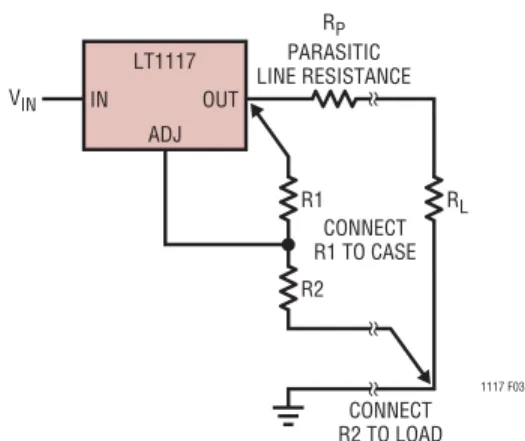
Because the LT1117 is a 3-terminal device, it is not possible to provide true remote load sensing. Load regulation will be limited by the resistance of the wire connecting the regulator to the load. The data sheet specification for load regulation is measured at the output pin of the device. Negative side sensing is a true Kelvin connection, with the bottom of the output divider returned to the negative side of the load. Although it may not be immediately obvious, best load regulation is obtained when the top of the resistor divider (R1) is returned directly to the output pin of the device, not to the load. This is illustrated in Figure 3. Connected as shown, RP is not multiplied by the divider ratio. If R1 were connected to the load, the effective resistance between the regulator and the load would be:
R R R R R P × P + = 2 1
1 , Parasitic Line Resistance
1117 F03 R2 R1 VIN RP PARASITIC LINE RESISTANCE RL CONNECT R1 TO CASE CONNECT R2 TO LOAD LT1117 IN ADJ OUT
Figure 3. Connections for Best Load Regulation
For fixed voltage devices the top of R1 is internally Kelvin connected, and the ground pin can be used for negative side sensing.
Thermal Considerations
LT1117 series regulators have internal thermal limiting circuitry designed to protect the device during overload conditions. For continuous normal load conditions however, the maximum junction temperature rating of 125°C must not be exceeded.
It is important to give careful consideration to all sources of thermal resistance from junction to ambient. For the SOT-223 package, which is designed to be surface mounted, additional heat sources mounted near the device must also be considered. Heat sinking is accomplished using the heat spreading capability of the PC board and its copper traces. The thermal resistance of the LT1117 is 15°C/W from the junction to the tab. Thermal resistances from tab to ambient can be as low as 30°C/W. The total thermal resistance from junction to ambient can be as low as 45°C/W. This requires a reasonable sized PC board with at least one layer of copper to spread the heat across the board and couple it into the surrounding air.
9
1117fd
APPLICATIONS INFORMATION
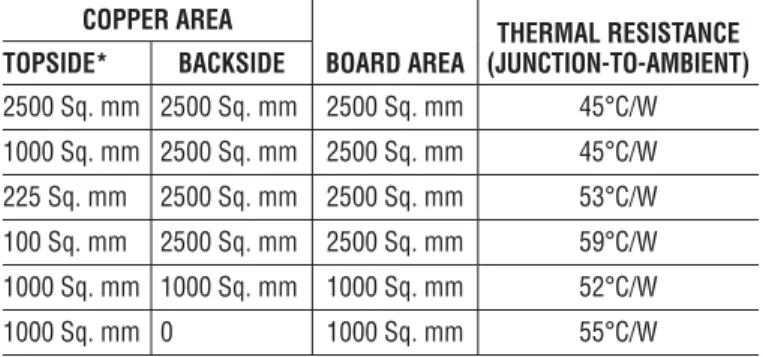
Experiments have shown that the heat spreading copper layer does not need to be electrically connected to the tab of the device. The PC material can be very effective at transmitting heat between the pad area, attached to the tab of the device, and a ground plane layer either inside or on the opposite side of the board. Although the actual thermal resistance of the PC material is high, the Length/ Area ratio of the thermal resistor between layers is small. The data in Table 1 was taken using 1/16" FR-4 board with 1oz. copper foil. It can be used as a rough guideline in estimating thermal resistance.
Table 1. COPPER AREA BOARD AREA THERMAL RESISTANCE (JUNCTION-TO-AMBIENT) TOPSIDE* BACKSIDE 2500 Sq. mm 2500 Sq. mm 2500 Sq. mm 45°C/W 1000 Sq. mm 2500 Sq. mm 2500 Sq. mm 45°C/W 225 Sq. mm 2500 Sq. mm 2500 Sq. mm 53°C/W 100 Sq. mm 2500 Sq. mm 2500 Sq. mm 59°C/W 1000 Sq. mm 1000 Sq. mm 1000 Sq. mm 52°C/W 1000 Sq. mm 0 1000 Sq. mm 55°C/W * Tab of device attached to topside copper
The thermal resistance for each application will be affected by thermal interactions with other components on the board. Some experimentation will be necessary to determine the actual value.
The power dissipation of the LT1117 is equal to: PD = ( VIN – VOUT )( IOUT )
Maximum junction temperature will be equal to:
TJ = TA(MAX) + PD (Thermal Resistance ambient))
Maximum junction temperature must not exceed 125°C.
Ripple Rejection
The curves for Ripple Rejection were generated using an adjustable device with the adjust pin bypassed. These curves will hold true for all values of output voltage. For proper bypassing, and ripple rejection approaching the values shown, the impedance of the adjust pin capacitor, at the ripple frequency, should be < R1. R1 is normally in the range of 100Ω to 200Ω. The size of the required adjust pin capacitor is a function of the input ripple frequency. At 120Hz, with R1 = 100Ω, the adjust pin capacitor should be >13μF. At 10kHz only 0.16μF is needed.
For fixed voltage devices, and adjustable devices without an adjust pin capacitor, the output ripple will increase as the ratio of the output voltage to the reference voltage (VOUT/VREF). For example, with the output voltage equal to 5V, the output ripple will be increased by the ratio of 5V/1.25V. It will increase by a factor of four. Ripple rejection will be degraded by 12dB from the value shown on the curve.
10
1117fdTYPICAL APPLICATIONS
1117 TA03 + R1 121Ω C2 100μF VOUT† VIN VOUT = 1.25V 1 +R2— R1 + C1* 10μF R2 1kNEEDED IF DEVICE IS FAR FROM FILTER CAPACITORS * † LT1117 IN ADJ OUT
( )
Adjusting Output Voltage of Fixed Regulators Regulator with Reference
121Ω 1% 100μF 5V VIN 10μF 365Ω 1% 1k 1k + + TTL 1117 TA04 LT1117 IN ADJ OUT 2N3904 Remote Sensing 1117 TA05 121Ω VIN RP (MAX. DROP 300mV) 10μF + + + + – 100μF 365Ω 100pF 5μF 25Ω 1k 25Ω VIN RL 7 2 3 4 8 1 6 LM301A OUTPUT 5V RETURN RETURN LT1117 IN ADJ OUT 100μF 5V TO 10V VIN > 12V 10μF 1117 TA06 10μF* 1k
* OPTIONAL IMPROVES RIPPLE REJECTION LT1117-5 IN GND OUT + + + 100μF 10V VIN > 11.5V 10μF 1117 TA07 5VOUT LT1029 LT1117-5 IN GND OUT + +
11
1117fd
TYPICAL APPLICATIONS
Battery Charger Battery Backed Up Regulated Supply
1117 TA08 VOUT VIN R1 IF RS 1.25V ADJ LT1117 IN OUT VOUT – 1.25V 1 +R2— R1 IF = –RS 1 +R2— R1 1 = –RS 1 +R2— R1
( )
ΔIF ΔVOUT( )
( )
100μF 5.2V LINE 5.0V BATTERY VIN 10μF 1117 TA09 50Ω SELECT FOR CHARGE RATE 6.5V 10μF LT1117-5 IN GND OUT LT1117-5 IN GND OUT + + +Improving Ripple Rejection Automatic Light Control
R1 121Ω 1% 5V VIN 10μF C1 10μF 150μF R2 365Ω 1% * C1 IMPROVES RIPPLE REJECTION. XC SHOULD BE
≈ R1 AT RIPPLE FREQUENCY 1117 TA10
LT1117 IN ADJ OUT + + + 10μF 1.2k 100μF 1117 TA11 LT1117 IN ADJ OUT + +
High Effi ciency Dual Supply
+5V 0.5A +VIN 10μF 1117 TA12 1N4002 470μF 10μF 1N4002 470μF MUR410 MUR410 MUR410 SWITCHING REGULATOR 470μF 3.3V OUTPUT (TYPICAL) –5V 0.5A FEEDBACK PATH LT1117-5 IN GND OUT LT1117-5 IN GND OUT + + + + +
12
1117fdTYPICAL APPLICATIONS
100μF 1117 TA13 D2 1N4002 1000μF MBR360 –5V 0.5A – + 2.4k 510k 1k 30k 20k* 30.1k* LT1004-2.5 10k 4700μF MDA201 + – (HEAT SINK) 2N6667 (DARLINGTON) L1 285μH 1/2 LT1018 100μF 1000μF MBR360 – + 2.4k 510k 1k 30k 20k* 30.1k* LT1004-2.5 10k 4700μF MDA201 + – (HEAT SINK) 2N6667 (DARLINGTON) L1 285μH 1/2 LT1018 D11 1N4002 5V 0.5A STANCOR P-8685 130VAC TO 90VAC * MDA L1 = 1% FILM RESISTORS = MOTOROLA= PULSE ENGINEERING, INC. #PE-92106 V+ V– LT1117-5 IN GND OUT LT1117-5 IN GND OUT Q1 + + + + + +
High Effi ciency Dual Linear Supply
Low Dropout Negative Supply
100μF VIN 1117 TA14 VOUT = –5V 10μF FLOATING INPUT LT1117-5 IN GND OUT + +
13
1117fd
PACKAGE DESCRIPTION
M Package 3-Lead Plastic DD Pak
(Reference LTC DWG # 05-08-1460) .050 (1.270) .143+.012 –.020
(
3.632+0.305–0.508)
.100 (2.54) BSC .013 – .023 (0.330 – 0.584) .095 – .115 (2.413 – 2.921) .004+.008–.004(
0.102+0.203–0.102)
.050 ± .012 (1.270 ± 0.305) .059 (1.499) .045 – .055 (1.143 – 1.397) .165 – .180 (4.191 – 4.572) .330 – .370 (8.382 – 9.398) .060 (1.524) TYP .390 – .415 (9.906 – 10.541) 15° .300 (7.620) .075 (1.905) .183 (4.648) .060 (1.524) .060 (1.524) .256 (6.502)BOTTOM VIEW OF DD PAK HATCHED AREA IS SOLDER PLATED
COPPER HEAT SINK
M (DD3) 0204 .420 .350 .565 .090 .070 .100 .420 .276 .325 .205 .080 .565 .090 .070 .100
RECOMMENDED SOLDER PAD LAYOUT FOR THICKER SOLDER PASTE APPLICATIONS RECOMMENDED SOLDER PAD LAYOUT
NOTE:
1. DIMENSIONS IN INCH/(MILLIMETER) 2. DRAWING NOT TO SCALE
14
1117fd ST Package
3-Lead Plastic SOT-223
(Reference LTC DWG # 05-08-1630)
PACKAGE DESCRIPTION
.114 – .124 (2.90 – 3.15) .248 – .264 (6.30 – 6.71) .130 – .146 (3.30 – 3.71) .264 – .287 (6.70 – 7.30) .0905 (2.30) BSC .033 – .041 (0.84 – 1.04) .181 (4.60) BSC .024 – .033 (0.60 – 0.84) .071 (1.80) MAX 10° MAX .012 (0.31) MIN .0008 – .0040 (0.0203 – 0.1016) 10° – 16° .010 – .014 (0.25 – 0.36) 10° – 16°RECOMMENDED SOLDER PAD LAYOUT
ST3 (SOT-233) 0502 .129 MAX .059 MAX .059 MAX .181 MAX .039 MAX .248 BSC .090 BSC
15
1117fd
Information furnished by Linear Technology Corporation is believed to be accurate and reliable. However, no responsibility is assumed for its use. Linear Technology Corporation makes no representa-tion that the interconnecrepresenta-tion of its circuits as described herein will not infringe on existing patent rights.
REVISION HISTORY
REV DATE DESCRIPTION PAGE NUMBER
D 4/10 Updated DD-Pak part markings in Order Information section and revised all other sections. 1 to 16
16
1117fd
Linear Technology Corporation
1630 McCarthy Blvd., Milpitas, CA 95035-7417
(408) 432-1900 ● FAX: (408) 434-0507 ● www.linear.com © LINEAR TECHNOLOGY CORPORATION 1993
LT 0410 REV D• PRINTED IN USA
RELATED PARTS
PART NUMBER DESCRIPTION COMMENTS
LT1118 Low IQ, Low Dropout, 800mA, Source
and Sink Regulators
Sources and Sinks Current, 600mA Quiescent Current, Dropout Voltage: 1V, SOIC-8 and SOT-223 Packages
LT1129 700mA Micropower Low Dropout Regulator
50μA Quiescent Current
LT1763 500mA, Low Noise LDO 300mV Dropout Voltage, Low Noise: 20μVRMS, VIN = 1.8V to 20V, SO-8 Package
LT1764, LT1764A 3A, Fast Transient Response, Low Noise LDO
340mV Dropout Voltage, Low Noise: 40μVRMS, VIN = 2.7V to 20V, TO-220 and DD
Packages “A” version stable also with ceramic caps LT1963, LT1763A 1.5A Low Noise, Fast Transient Response
LDO
340mV Dropout Voltage, Low Noise: 40μVRMS, VIN = 2.5V to 20V, “A” version stable
with ceramic caps, TO-220, DD, SOT-223 and SO-8 Packages LT1965 1.1A, Low Noise, Low Dropout Linear
Regulator
290mV Dropout Voltage, Low Noise: 40μVRMS, VIN: 1.8V to 20V, VOUT: 1.2V to 19.5V,
stable with ceramic caps, TO-220, DDPak, MSOP and 3 × 3 DFN Packages LT3021 500mA, Low Voltage, VLDO Linear
Regulator
VIN: 0.9V to 10V, Dropout Voltage: 160mV Typical, Adjustable Output (VREF = VOUT(MIN)
= 200mV), Fixed Output Voltages: 1.2V, 1.5V, 1.8V, Stable with Low ESR, Ceramic Output Capacitors 16-Pin DFN (5mm × 5mm) and 8-Lead SO Packages
LT3080, LT3080-1 1.1A, Parallelable, Low Noise, Low Dropout Linear Regulator
300mV Dropout Voltage (2-supply operation), Low Noise: 40μVRMS, VIN: 1.2V to 36V,
VOUT: 0V to 35.7V, current-based reference with 1-resistor VOUT set; directly parallelable
(no op amp required), stable with ceramic caps, TO-220, SOT-223, MS8E and 3 × 3 DFN-8 Packages; “-1” version has integrated internal ballast resistor
LT3085 500mA, Parallelable, Low Noise, Low Dropout Linear Regulator
275mV Dropout Voltage (2-supply operation), Low Noise: 40μVRMS, VIN: 1.2V to 36V,
VOUT: 0V to 35.7V, current-based reference with 1-resistor VOUT set; directly parallelable
(no op amp required), stable with ceramic caps, MS8E and 2 × 3 DFN-6 packages LTC3025-1, LTC3025-2,
LTC3025-3, LTC3025-4
500mA Micropower VLDO Linear Regulator in 2 × 2 DFN
VIN = 0.9V to 5.5V, Dropout Voltage: 75mV, Low Noise 80μVRMS, Low IQ: 54μA, Fixed
Output: 1.2V (LTC3025-2), 1.5V (LTC3025-3), 1.8V (LTC3025-4); Adjustable Output Range: 0.4V to 3.6V (LTC3025-1), 2mm × 2mm 6-Lead DFN Package
LTC3026 1.5A, Low Input Voltage VLDO Linear Regulator
VIN: 1.14V to 3.5V (Boost Enabled), 1.14V to 5.5V (with External 5V), VDO = 0.1V, IQ =
950μA, Stable with 10μF Ceramic Capacitors, 10-Lead MSOP-E and DFN-10 Packages