SLIS Connecting
Volume 7Issue 1SLIS Connecting Special Issue: British Studies Article 12
2018
SLIS Connecting Volume 7 Issue 1
Stacy Creel
University of Southern Mississippi, [email protected]
Teresa S. Welsh
University of Southern Mississippi, [email protected]
Follow this and additional works at:https://aquila.usm.edu/slisconnecting
Part of theArchival Science Commons,Collection Development and Management Commons, Information Literacy Commons,Scholarly Communication Commons, and theScholarly Publishing Commons
This Complete Issue is brought to you for free and open access by The Aquila Digital Community. It has been accepted for inclusion in SLIS Connecting by an authorized editor of The Aquila Digital Community. For more information, please [email protected]. Recommended Citation
Creel, Stacy and Welsh, Teresa S. (2018) "SLIS Connecting Volume 7 Issue 1,"SLIS Connecting: Vol. 7 : Iss. 1 , Article 12. Available at:https://aquila.usm.edu/slisconnecting/vol7/iss1/12
Special Issue: History of SLIS
Volume 4, Issue 2 Fall 2015
1952
SLIS Director’s Report
Teresa S. Welsh, Ph.D., Professor and Director Welcome, scholars, to a special issue of SLIS
Connecting on British Studies! Read the report on British Libraries, Archives, and Special Collections class offered each summer in London and the
selection of students’ British Studies research papers in this issue.
This spring and summer have been eventful. The Kaigler 2018 Children’s Book Festival, April 11-13, had a record year:
• About 1500 school children participated in a literacy event in Green Coliseum that featured USM Medallion winner Dave Pilkey. Each child received a Dog Man book, Captain Underpants red cape, and $15 gift certificate to purchase another book.
• Record crowd of more than 550 teachers, librarians, students, and scholars attended the Book Festival
• Inaugural film for the new Joe Paul Theater was
Captain Underpants: The First Epic Movie (2017), introduced by Dr. Joe Paul and Dave Pilkey.
Dr. Creel, Dave Pilkey, and Me
Kaigler Children’s Book Festival 2018
Upcoming Event:
SLIS faculty will be at the Mississippi Library
Association Conference, MSU Riley Center, Meridian, October 16-19. SLIS alums, students, and supporters are encouraged to register for the SLIS Alumni
Breakfast on Wednesday morning and to attend the
focus group session on Thursday morning.
LIS Conferences
SLIS was well-represented at the 10th Annual Qualitative and Quantitative Methods in Libraries Conference (QQML), May 22-25, in Chania, Crete. Five SLIS students and alums joined me in presenting at this diverse international conference.
A Few QQML18 Conference Attendees
Me, Kathy Rosa, Director, ALA Office of Research & Evaluation, and MLIS student Elizabeth Halberstadt,
QQML International Conference 2018, Chania, Crete Here’s to a great, productive 2018-19 school year! See the next few pages for a gallery of highlights from the Children’s Book Festival and ALA.
Note: Cover photo of the River Thames from the South Bank by Dr. Matthew Griffis.
Faye B. Kaigler Children’s Book Festival
University of Southern Mississippi, April 11-13, 20018
Rowell, USM Medallion Recipient Dave Pilkey, Dawn Smith, and Sarah Mangrum Kaigler Book Festival Literacy Event
More Scenes from the 2018 Kaigler Children’s Book Festival
American Library Association, New Orleans June 19 – 26, 2018
SLIS Student & Alumni Reception, Sheraton Hotel ALA Annual Conference, New Orleans, June 23, 2018
SLIS Students & Alumni Reception ALA Annual Conference, New Orleans
Spotlight – Faculty
Teresa Smith Welsh, M.L.I.S., Ph.D., is a native Mississippian who graduated summa cum laude from the University of Southern Mississippi with a B.A. in anthropology, a Certificate in Humanities, and minors in social studies and classical studies. While an undergraduate at Southern Miss, she
participated in British Studies for study-abroad credit, was a member of the Honors College as well as Phi Kappa Phi, Phi Theta Kappa, Lambda Alpha, Gamma Beta Phi, and Golden Key Honor Societies.
At the University of Tennessee, Knoxville (UTK), she had a year of graduate study in anthropology
including classes in mythology, classical archaeology, and forensic anthropology with Dr. Bill Bass (The Body Farm) before changing her major to LIS and earning an MLIS degree while working as an archival assistant on the Sen. Howard H. Baker papers. After graduating and working a few years at Oak Ridge National Lab in Laboratory Records, she returned to UTK to earn a Ph.D. in Information Sciences in 2002. As a graduate assistant, she taught an undergrad information literacy course and also worked as an assistant evaluation researcher on two telemedicine grants at the University of Tennessee Medical Center. She was awarded the Hilton A. Smith Graduate Fellowship as well as Best Technical Project Award and Best Doctoral Paper Award from the School of Information Sciences.
Dr. Welsh has taught at Southern Miss since summer 2003 and was awarded the College of Education and Psychology 2007 Excellence in Teaching Award. She is a Fellow of the Royal Geographical Society, has served on the UTK School of Information Sciences Advisory Board, and serves on the International Qualitative and Quantitative Methods in Libraries (QQML) Advisory Committee and International Scientific Committee.
Each May, Dr. Welsh participates in the Qualitative and Quantitative Methods in Libraries conference, a wonderfully diverse international conference of librarians, archivists, academics, researchers, and students from about 60 countries. In 2018, QQML met in Chania, Crete where three SLIS students and two alumni presented research. In 2019, the
conference will be held in Florence, Italy.
In addition to being published in scholarly journals and conference proceedings, Dr. Welsh has authored several book chapters and co-authored two books on information literacy. Teaching and research interests include information literacy, bibliometric research, spatial analysis, information retrieval, e-learning, museum studies, and archival studies.
Dr. Welsh became a full professor in 2014 and since July 2015, has served as Director for the School of Library and Information Science. Since 2007, she has taught a British Studies LIS summer course in London. In her private life, she is happily married to her best friend Bud, has two grown sons and five
grandchildren. She loves crossword puzzles, genealogy research, movies, and movie trivia. Favorite activities include travel, reading non-fiction and mysteries. She collects old cookie jars, old Coca-Cola trays, and handcrafted items.
Spotlight – Alum
Amed Demirhan holds a Master’s degree in Library and Information Science (MLIS) from Southern Miss (USM), an M.A in Dispute Resolution from Wayne State University, Detroit, and a B.A. in International Studies with a minor in Spanish (USM). He is fluent in his native Kurdish as well as in English, Swedish, Turkish, and functional in Spanish.
Demirhan worked in a joint academic/public library in Broward County, Florida (2001-06), and in 2006 become the founding Director of the University of Kurdistan Hawler Library in Kurdistan Federal Region of Iraq where he led in the establishment of the university library based on international standards. It was the first university library in Iraq with open stacks and perhaps the first library in Muslim Middle East with unrestricted Internet access.
In 2011, Demirhan became leader of the American University of Nigeria Library (AUNL), in Yola, Nigeria. In three years, library resources, services, and output strongly increased while cost decreased. AUNL received national and international recognition for these innovative and transformational changes. Demirhan, currently General Manager/Director of Barzani National Memorial, was invited by a leading businessman and grandson of Kurdistan National Hero Mustafa Barzani, His Excellency Sirwan Barzani, to lead in establishing the Barzani National Memorial Library, Museum, and associated services in
accordance with the best international practices in Barzan, Kurdistan, Iraq.
Demirhan has been active in the American Library Association (ALA) and other international library organizations and is currently serving on the ALA Training, Orientation & Leadership Development (TOLD) Committee, and several other committees. Demirhan has been publishing and presenting in professional organizations and universities locally and internationally. Since 2014, he has served on the Editorial Advisory Board for Advances in Library Administration and Organization.
A few highlights of his many recognitions include: • 2017 ALA John Ames Humphry/OCLC/Forest Press
Award for “extensive contributions to international librarianship”
• 2014 Library Journal “Mover & Shaker” award • 2013 feature in “University Libraries: 10 Global
Portraits,” The Guardian
www.theguardian.com/higher-education- network/blog/2013/aug/07/university-libraries-10-global-portraits
• 2013 ALA Presidential Citation for Innovative International Library Project (AUN e-Library) • 2012 named Best University Digital Library
Services in Nigeria, Committee of University Librarians of Nigerian Universities
• 2008 letter of appreciation and recognition from the Minister of Higher Education in Kurdistan Federal Region, Iraq, for contributing to library managers and staff training and higher education libraries development in the region.
• 2003 “SUNsational Team Award” from Broward County Library, Florida, presented for a significant contribution to improving library service or
Spotlight—Course
LIS 580/587 – British Studies
Southern Miss has one of the largest and oldest study-abroad programs in the U.S. A British Studies LIS class, British Libraries, Archives, and Special Collections, has been offered since 2007, and 212 students from 42 different universities in the U.S. and Canada have earned six hours of study-abroad credit. The largest class was in 2010, with 32 graduate students, two faculty and a GA (equivalent to two sections) and the smallest class was 10 graduate students in 2012 when the Olympics were in London. From 2007 through 2015, British Studies was
headquartered in a King’s College dorm near Waterloo Station during the month of July.
In 2016, British Studies moved to the University of Westminster Marylebone Hall (across from Madame Toussaud’s near Baker Street Station) during the month of June, a time with fewer tourists in London than in the peak season in July/August.
Some great new additions to the program for 2019: • Inclusion of month-long Oyster Travelcard for
unlimited transport via city bus or tube around London
www.londonpass.com/london-transport/travelcard-validity.html
• Students make their own arrangements (or opt-in for program-arranged flights from designated cities), which gives them the option to arrive in London before British Studies begins or stay after (the best option since students know their way around London and the U.K. by the end of the course).
Some great features still in place:
• While USM faculty lead the course, the onsite lectures and behind-the-scenes guided tours are conducted by wonderful, distinguished British librarians, archivists, and curators.
• The first two weeks have the heaviest schedule, but even then, students have time most
afternoons and evenings to explore on their own. There are designated independent study days to gather information for the blog and research paper, to explore London, and take day trips or weekend excursions.
The best parts of the course are the relationships that are formed. Typically, students arrive in London not knowing anyone else, even faculty and students from Southern Miss since our program is online. Each class is unique but each summer, strong friendships and professional relationships are formed during the month together in London through shared and memorable experiences.
To apply, go to https://studyabroad.usm.edu and click on Study Abroad Programs/British Studies. Since students earn credit, they are eligible to apply for student loans and scholarships. For more
information, click on the Finances & Scholarships link on the British Studies webpage.
Course Requirements and Schedule
Before leaving for London, students choose two books from a recommended list to read and write scholarly book reviews. While in London, students work on a blog to report and reflect on the sites we visit as well as other relevant sites they visit on their own. The other major assignment is a research paper and while in London, students have a topic approved and gather information. The final paper is due a few weeks after we return to the States. To see the British Studies student research papers published in refereed journals, see
ocean.otr.usm.edu/~w146169/mentorpubs.htm, as well as the four refereed British Studies papers published in this special issue of SLIS Connecting. Student Articles
Several students have published articles about their British Studies experiences:
• "Crossing the Pond: MLIS Students Researching in the U.K.," Open Shelf (March 2016) by Martha Attridge Bufton, University of Alberta.
• "A Study Abroad Adventure in London," SLISisten Up (August 2014) by Taylor Atkinson and Jessica Dai, University of South Carolina.
• "Librarians in London," ALA Student Voice (Fall 2009) by Lauren Dodd, University of Alabama. • "American Library Student Explores British
Libraries," International Leads (December 2009) by Nicole Powell, University of Missouri.
From the GA’s
Elaine, Rachel, Alex, SLIS alum Kathleen Lehigh with Dave Pilkey, 2018 Kaigler Children’s Book Festival
SLIS graduate assistants Alex Brower, Elaine Walker, Charlotte Roi, Rachel McMullen, and Daniel
Shemwell had a busy spring with recruitment activities and the Fay B. Kaigler Children’s Book Festival, April 11-13.
Alex and Rachel with Seymore Kaigler Children’s Book Festival 2018
Graduate Teaching Assistant Rachel McMullen
authored “Just Breathe: Being Mindful About Meditation Programs for Young Patrons,” ALA Programming Librarian (programminglibrarian.org) and was second author with Dr. Creel on “The 2014 Rainbow List: A Descriptive Study of the List and Ten Public Libraries’ Ownership,” The Journal of Research on Libraries and Young Adults, 9(1), July 2018.
Alex Brower and Rachel McMullen entered “The Missing Piece,” Edible Book Festival 2018, Southern Miss University Libraries, April 2.
Elaine with Salina Yoon Kaigler Children’s Book Festival 2018
Congratulations SLIS LIS Bachelor of Science Students
Maryanne Anthony, Library Assistant at Gulf Coast Research Lab Library, presented with Southern Miss University Libraries Staff Excellence Award.
Janae Barron, who lives in Montana, was awarded a 2018 internship at Farmleigh House Library, Dublin, Ireland, the official Irish State Guest House.
www.marshlibrary.ie/farmleigh-library/
Janae Barron, Sorting Archival Materials Farmleigh House Library, Dublin, Ireland
Phadre Hocker (LIS BS, 2017) was presented with the Anna M. Roberts Award for Scholarship, Service, Professionalism, USM College of Education & Human Sciences Awards Day, April 25th.
Congratulations SLIS MLIS Students
Casey Edwards is Acquisitions Specialist I, Southern Miss University Libraries, Hattiesburg, MS.
Amy Hamilton completed an archival internship, Metropolitan Museum of Art in New York, for a preservation project of press kits from 2005-2015. Ever McKinney completed an archival internship, National Archives and Records Administration, College Park, MD, for a Navy deck log and muster roll digitization project.
Charity Park is Digital and Special Collections
Librarian, Arkansas Tech University, Russellville, AR.
Emily Perez, Contestant on Jeopardy December 2017
Daniel Shemwell is Cataloging Specialist III, Southern Miss University Libraries, Hattiesburg, MS.
Kelly Thompson, Children’s Librarian, Harrison County Library System, was the recipient of Central
Mississippi Library Council’s $500 scholarship. Congratulations to 2018 SLIS Scholarship winners:
Mayfield Keyes Scholarships ($1,854.50) – Megan Lindsay, Autumn Donaldson
$500 SLIS Scholarship – Ever McKinney
$1,000 Wilson Foundation Scholarships – Kate Prendergast, Rachel McMullen
$500 Beta Phi Mu Scholarship – Elaine Walker.
Congratulations SLIS Alums
Nevin Alhaz Akaydin (MLIS, 2017) is Adult Services Librarian, Santa Clara City Library, Santa Clara, CA. Kim Belair (MLIS, 2010), Programming Librarian and Coordinator, Mesa Public Library Main Branch, Mesa AZ, is a member of the 2018 Cohort of the Mountain Plains Library Association Leadership Institute. Mary Rodgers Beal (MLIS, Archival Certificate, British Studies, 2015) is Talking Books Services Director, Mississippi Library Commission, Jackson, MS.
Hannah Berryhill (MLIS, 2018) is Director, Kemper Newton Regional Library System, Newton, MS. Rebecca Bickford (MLIS, 2016) is Library Associate, Mississippi State University Libraries, Starkville, MS. Heather Crump (MLIS, 2018) is Librarian/Media Specialist, Eakin Elementary School, Shelbyville, TN.
Emma Fontenot, MA, Political Science (Graduate Teaching Assistant, MLIS, 2017) is Social Sciences Librarian, University of Houston, TX.
Evanne Flanders (MLIS, 2017) is Special Needs Programming and Outreach Specialist, Madison County Library System, Canton, MS.
Joy Garretson (MLIS, 2014) is Director, Hocutt-Ellington Memorial Library, Clayton, NC.
Josh Haidet (MLIS, 2014) is director, Mid-Mississippi Regional Library System, Kosciusko, MS.
Amy Hamilton (MLIS, 2018) is Library Associate, Thomas J. Watson Library, Metropolitan Museum of
Art, New York.
Lauren Ashley Howell (MLIS, Archival Certificate, 2017), Metadata Librarian, George Mason University, Fairfax, VA, was presented the Warren Tracy Award for Professionalism, Scholarship, Service, USM College of Education & Human Sciences Awards Day, April 25th.
Corinne Kennedy (MLIS, 2013), Humanities Librarian, Mississippi State University, awarded a grant to attend NEH Institute for Advanced Topics in the Digital Humanities, “Textual Data and Digital Texts in the Undergraduate Classroom,” July 16 – 20,
Mississippi State University.
Elizabeth La Beaud (MLIS & Archival Certificate, 2016), Southern Miss Digital Lab Manager, named Assistant Director, Mississippi Digital Library. Briana Martin (British Studies, 2015; MLIS, 2017) is Research and Instruction Librarian, Colorado Christian University, Lakewood, CO.
Carrie Mastley (MLIS, Archival Certificate, 2018) is the project archivist, Mississippi State University, to process, arrange the Frank & Virginia Williams Collection of Lincolniana.
Abby Mayfield (MLIS, 2018) is Teen Services Librarian, Madisonville/Covington Public Libraries, St. Tammany Parish Library System, LA.
Leah Michelle Moore (MLIS, 2017) is Assistant Librarian, Holmes Community College, Grenada, MS. Preston Salisbury (MLIS, 2014) is Monographic Cataloger, Mississippi State University Library, Starkville, MS.
James Stephen Parks, J.D. (MLIS, 2013), State Law Librarian of Mississippi, appointed to the Depository Library Council of U.S. Government Publishing Office.
Ashley Roach-Freiman (MLIS, 2008) is Instruction Librarian, Christian Brothers University Plough Library, Memphis, TN.
Jessica Stauffer (MLIS, Archival Certificate, 2012) is Tech Services/Technology Librarian, Washington Public Library, Washington, NJ.
Stacie Taylor (MLIS, 2015) is Reference Librarian, Mobile Public Library, Mobile, AL.
James Thompson (MLIS, 2011) is Director of Library Services, Holmes Community College, Goodman, MS, and Vice President, Holmes County Chamber of Commerce.
Alum Publications, Presentations
Marilyn Brissett (MLIS, 2008), Elementary School Librarian, Virgin Islands, Session Chair, and Christina Garrett-Davis (MLIS, 2010), Elementary School Librarian, Virgin Islands, presented research on information literacy, Qualitative and Quantitative Methods in Libraries International Conference (QQML), Chania, Crete, May 22-25.
The Falling Between Us (2018), by Ash Parsons (MLIS, 1998), a 2016 PEN Literary Award winner, is a Junior Library Guild Selection. Ash presented
“Archetype: The God Particle of Creativity” workshop, Kaigler Children’s Book Festival, April 11, Hattiesburg.
John Zheng, Ph.D. (MLIS, 2001), Professor and Chair of English, Mississippi Valley State University, editor of Valley Voice: A Literary Review, published his fifth edited book, Sonia Sanchez’s Poetic Spirit Through Haiku (Lexington Books, 2017).
Faculty Publications – Presentations
Dr. Stacy Creel and Rachel McMullen, “The 2014 Rainbow List: A Descriptive Study of the List and Ten Public Libraries’ Ownership,” The Journal of Research on Libraries and Young Adults, 9(1), July 2018.
Dr. Matthew Griffis, “Cornerstones of Community: Segregated Public Libraries, Carnegie Philanthropy, and Houston’s Colored Branch, 1913-61,” Living Room Lecture Series, African American Library at the Gregory School, Houston Public Library, April 12.
Dr. Griffis participated in a panel, “News You Can Use: LB21 Early Career Development Grants,” American Library Association Annual Conference, New Orleans, June 24th.
Dr. Welsh, “SLIS Notes: Technical Knowledge and Skills,” Mississippi Libraries, 81(1), 13-14, Spring 2018.
Dr. Welsh, “SLIS Notes: Kaigler Children’s Book Festival, Information Literacy and Read Across America,” Mississippi Libraries, 80(4), 66-67, Winter 2017.
Dr. Welsh, Session Chair, Metrics: Bibliometrics, Scientometrics, Webmetrics, Altmetrics, and
presenter, “Information Literacy, Librarianship, and Social Justice: A Bibliometric Analysis of Scholarly LIS Literature,” Qualitative and Quantitative Methods in Libraries International Conference (QQML), Chania, Crete, May 22-25.
CRSW Exhibit
Dr. Stacy Creel, Dr. Nicolle Jordan reviewing testimonials
“What Were You Wearing” exhibit, sponsored by the USM Committee on Services and Resources for Women (CSRW) and the Shafer Center for Crisis Intervention, features representations of actual outfits worn by survivors of sexual assault as well as their stories. The outfits were donated by various student groups on campus to graphically illustrate the written testimonials
April is National Sexual Assault Awareness Month, and the campaign “What were you wearing? began at the University of Kansas as a way to combat the idea that a clothing choice could be the source of an assault. The title of the exhibit was inspired by the poem, “What I was Wearing,” by Mary Simmerling.
Visitors to the exhibit were invited to submit their own stories of sexual assault and 13 were collected in the first week alone.
Faculty Awards – Honors, Awards Dr. Catharine Bomhold is a Faculty Fellow in the ACUE (Association of College and University Educators) Faculty Development Institute.
Dr. Bomhold earned a Quality Matters (QM) Peer-Review Certificate for online courses; Dr. Griffis, Dr. Norton, Dr. Welsh, Ms. Whipple, and Dr. Yu earned a Quality Matters (QM) Rubric Certificate for online courses.
Jennifer Brannock and Dr. Griffis, awarded $890 Friends of University Libraries grant for “Open These Hallowed Doors: The Desegregation of Public
Libraries in the South,” a special event co-sponsored by the Southern Miss School of Library and
Information Science at the Library of Hattiesburg, Petal & Forrest County featuring distinguished scholar Dr. Wayne Wiegand, April 17, 2018.
LIS Student Associations News LISSA Update, Spring/Summer 2018 Charlotte Mona Roi, President
Rachel McMullen, Vice-President Keisha Coulter, Secretary
Tammy White, Webmaster
Mrs. Jessica Whipple, Faculty Advisor
S2S Rachel McMullen, Poet Laureate Tracy K. Smith ALA Conference, New Orleans
2018 ALA Annual S2S Participant As a member of USM’s Library and Information Science Student Association (LISSA), I had the opportunity to participate in ALA’s Student-to-Staff Program (S2S). Established in 1973, this annual program encourages ALA affiliated student chapters to nominate one student to work behind-the-scenes with ALA staff at each ALA Annual Conference. This includes attending meetings, programs, and other Annual Conference events as determined by an assignment to a division of ALA.
I was assigned to work with the Public Programs Office (PPO) which “promotes programming as an essential part of library service in all types of libraries” and “provides leadership, resources, training and networking opportunities to help
libraries serve their communities as cultural hubs and centers of lifelong learning”
(www.ala.org/aboutala/offices/ppo).
Under the PPO, I was required to attend various sessions and write up short articles/blog posts for Programming Librarian (programminglibrarian.org/), a website dedicated to providing resources, ideas, and professional development opportunities for any librarian tasked with planning and presenting cultural and community programs on behalf of their library. Given that my experience with library programming was somewhat limited, I was excited to learn all that I could about this invaluable dimension of
librarianship.
The sessions I attended were diverse and hands-on, giving me the chance to engage in activities that could easily be developed as programs for library patrons. For example, one of the sessions required that I participate in a conversation café
(www.conversationcafe.org/) dealing with the challenges related to serving small, mid-sized, and rural libraries. This method of communication provides a structure that encourages inclusive conversation while ensuring that all participants invest in the progression of ideas in a safe and empowering space.
I also attended a session entitled, “Program Speed Dating with the Programming Librarian Interest Group.” Hosted by Programming Librarian Interest Group members Janie Hermann at Princeton Public Library and Mallory Arents at Darien Library, this session packed a wealth of program ideas into only an hour and a half. In fact, I walked away with materials describing 15 engaging programs (e.g. http://programminglibrarian.org/programs/de-stress-doggos ) that could easily be implemented in almost any library with even the most limited of budgets. Not to mention the long list of personal notes I took throughout the session detailing ideas from other attendees.
Being surrounded by a lively bunch of programming librarians who were excited to revamp their program calendars inspired me to rethink how programs are conceived and exchanged among professionals in the field.
My experience as an S2S participant has helped to better recognize quality library programming as an expression of the library’s mission to uplift the community it serves, and as a result, I feel more excited than ever to one-day plan programs in service to my own community.
For more information on how to participate in this amazing program, see
www.ala.org/aboutala/affiliates/chapters/student/re sources/studenttostaffprogram.
To read one of the articles I wrote as an S2S participant, see
http://programminglibrarian.org/articles/just- breathe-being-mindful-about-meditation-programs-young-patrons
- Rachel McMullen, LISSA Vice-President LISSA broadcasts its meetings via Adobe Connect and meeting dates are announced via the SLIS listserv. You are invited to join our Facebook page:
www.facebook.com/southernmisslissa
Southern Miss Student Archivists (SMSA) Spring/Summer 2018
Rachel McMullen, President Elaine Walker, Vice-President
Jonathan Puckett, Secretary and Webmaster Dr. Cindy Yu, Faculty Advisor
SMSA membership is free and open to all students, alumni, faculty, and staff of the university who have an interest in archives and special collections. And of course, everyone is welcome to “like” our Facebook page: www.facebook.com/Southern-Miss-Student-Archivists-SMSA-203760579638985/.
SMSA President Rachel McMullen was one of three students chosen by Southern Miss Special Collections to curate a mini-exhibit of archival materials. Rachel’s exhibit, Elevating the Ignoble: The Southern
Cookbook as a Medium for Cultural Expression and Identity looks at “stereotypes of the American South in relation to culinary traditions.”
“Many of the stereotypes that are directed at the South’s culinary habits have helped lead a concerted effort to recapture Southern identity as it is harshly defined by curious spectators and concoct a new image by serving up seductive, distinctly Southern cuisine. The cookbooks included in this exhibit do just that by both embracing and celebrating the
misconceptions that plague the Deep South to redefine its eccentricities as endearing attributes worthy of the highest level of commemoration: a place at the table” (Brannock, 2018). The exhibit opened on April 19 in McCain Library 305 and will remain on display until February 2019.
Elevating the Ignoble: The Southern Cookbook as a
Medium for Cultural Expression and Identity Exhibit by Rachel McMullen
Council on Community Literacy and Reading Dr. Catharine Bomhold, Director Read Across America Day, March 3, 2018 On March 3rd, 2018 from 10 am until 2:00 pm the USM Council on Community Literacy and Reading and Pi Beta Phi presented Read Across America Day, Chain Park in Hattiesburg for children ages 0-7 and their families, featuring fun reading games and activities! Each child received free books for
participating and they had a bouncy house, literacy information for parents of very young children, and of course birthday cake!
Only $2 will buy a book for a child; $80 will sponsor a book walk with 2 deconstructed books.
If you would like to help, send a check made out to USM SLIS to:
CCLR/ Dr. Catharine Bomhold 118 College Drive, #5146
The University of Southern Miss Hattiesburg, MS 39406
Remembering a Visit to the World’s Oldest Carnegie Library
(Portions of the following appeared in slightly different form as “Searching for Carnegie,” in Mississippi Libraries 78(1), 4-9 and are reproduced here with permission.)
Matthew Griffis, Assistant Professor School of Library and Information Science The University of Southern Mississippi
Figure 1. Statue of Andrew Carnegie, Dunfermline Born in 1835, he would later be known throughout
the world as the “Patron Saint of Libraries.” Introduction
While preparing for my first experience as
co-instructor for SLIS’s British Studies Program in 2014, I
was told that students often consider the program one of the most unforgettable experiences of their university years. I never imagined it would also become one of the most unforgettable of my own academic career, but it did. That summer our class visited one of Dunfermline, Scotland’s most famous landmarks, the Carnegie Library of 1883. Originally a gift from steel mogul and philanthropist Andrew Carnegie—Dunfermline’s most famous native—the 130-year-old building was the first library Carnegie ever opened. And as such, the structure, which still operates as part of the town’s public library system, is the oldest surviving Carnegie library in the world Figures 2 – 9).
There was perhaps no greater stimulus to modern public library development than Carnegie’s library grant program, which funded the construction of over 2,800 libraries worldwide at the turn of the last century. In their day, Carnegie libraries were more than just charming buildings; they fueled a growing enthusiasm among the masses for the existence of free, tax-supported public libraries intended to enrich their parent communities—especially those for which no comparable institution had existed before.
Figure 2. Dr. Griffis at Library’s Front Door First Carnegie Library, Dunfermline
Figure 3. Students Explore the Library’s Exterior
In the foreground, original structure completed 1883; in the distance, extension constructed ca. 1914-21.
Figure 4. “Let There Be Light”
The library’s elaborate front entrance.
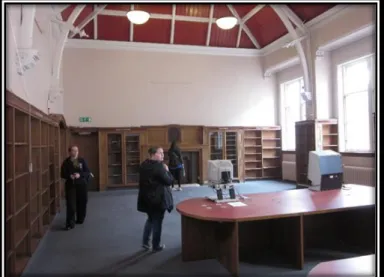
Figure 5. One of the Library’s Reading Rooms, cleared of books for the 2014 renovation.
Figure 6. Another Enchanting Book Room. Work in 1993 left much original millwork untouched.
Figure 8. Many of the First Modern Public Library Buildings were Designed like Small Cathedrals.
Their message: knowledge is sacred.
Figure 8. Dr. Griffis Examines Library Blueprints, originally drawn by architect J.C. Walker.
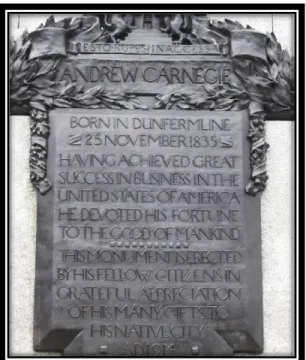
Figure 9. Tribute erected ca. 1914, during the first of three major renovation and expansion projects. Andrew Carnegie had always loved libraries: Born in 1835, Carnegie was the son of a handloom weaver. The family knew no life above hand-to-mouth poverty. Leaving Scotland in hopes of a better life, the Carnegies settled in Pittsburgh, where young Andrew was put to work in factories to help the family survive.
Lacking a formalized education, Carnegie sought his own through the connections he made in his
community. He borrowed books from his superiors, some of whom opened their private libraries to young workers in hopes of shaping young talent for their growing companies. Making his way up the ranks of several businesses, the young man had by his early twenties made his way through several
prominent positions in the telegraph and railroad industries and began investing his early wealth in manufacturing. By middle age, he had founded the Carnegie Steel Company in Pennsylvania and was poised to become one of the richest men of the modern age.
A longtime advocate of philanthropy, Carnegie sold his steel empire to J. P. Morgan in 1901 and
dedicated his efforts full-time to redistributing his wealth to causes he believed “advanced” society. He gave liberally to technical schools, concert halls, and other cultural and educational institutions.
However, Carnegie believed that free public libraries
were the “best” of all possible gifts for as long as they
existed anyone would have access to self-education. After funding the construction of several free libraries in Scotland in the 1880s, Carnegie funded several more in his Pennsylvanian steel towns in the 1890s. By the 1920s, his library program had produced over 2,800 public and academic libraries throughout the English-speaking world: 1,689 in the United States, 126 in Canada, and hundreds more across the UK, Australia, New Zealand, and parts of the West Indies. Though much has been published about Carnegie libraries in North America, relatively little work is available about Carnegie libraries elsewhere. These buildings are seldom seen outside their home countries.
Figure 10. Around the Corner, Down the Street Stands Carnegie’s birthplace, a little stone cottage
now part of Andrew Carnegie Birthplace Museum
Our tour, which was made possible by special arrangement with the Carnegie Library of Dunfermline, not only emphasized the value of studying library history as part of librarian education, it also served as an introduction, for some
participants, to the story of Carnegie libraries. Our visit was unforgettable, and though the Dunfermline library had been temporarily closed at the time for renovations, these photos nevertheless reveal its beauty and mystery.
The photos also document our visit to Carnegie’s birth house just around the corner, to which is now attached a museum that preserves and celebrates his life, work, and philanthropic legacy (Figures 10 – 12). (Photographs by Dr. M. Griffis and Dr. T. Welsh)
Figure 11. Dr. Griffis and Students Outside the Carnegie Museum’s Front Entrance
Figure 12. Plaque outside the Museum:
“Andrew Carnegie, millionaire and
philanthropist, was born in this cottage
Teresa S. Welsh, Ph.D.
British Studies Interview (Attridge Bufton, 2015) Interview by British Studies 2015 alumna Martha
Attridge Bufton, University of Alberta, for an article, "Crossing the Pond: MLIS Students Researching in the U.K." published in Open Shelf (http://open-shelf.ca/, March 2016), updated and used by permission. 1. Tell me about the British Studies Program at the University of Southern Mississippi (how long it’s been running, goals, structure).
The British Studies Program at The University of Southern Mississippi is one of the oldest and largest study-abroad programs in the country and celebrated its 40th year in 2015
(www.usm.edu/news/article/british-studies-program-begins-40th-year-registration-underway). The University is an accredited, Carnegie RU/H (Research University/Higher Research Activity), and our program is accredited by the American Library Association.
Before I taught LIS British Studies, it was taught by Dr. Joy Greiner - I believe the last time was in summer 1996. When I began preparing to teach the course in 2006, it had been 10 years since it was last taught. I first taught the course in 2007 (Figure 1) and 2016 was my 10th year. In many of these years, the LIS class has been the largest in British Studies, an average of 18 students per summer.
The goals of the program are:
1) to learn about historic and modern British libraries, archives, and special collections on-site from distinguished British librarians, archivists, and information specialists
2) to conduct research on an approved topic using primary sources and other resources available in the U.K. These two goals allow students to gain a general knowledge about the collections and operations of a variety of different libraries, archives, and collections and also become a subject specialist on a specific topic related to British libraries, archives, or collections.
Figure 1. Kings Cross Station, London British Studies 2007
Students earn 6 credit hours in British Studies LIS 580/587:
• LIS 580 class assignments include two scholarly book reviews from a list of recommended books and a journal (blog) of students’ experiences related to class on-site lectures/guided tours and selected visits on their own to sites of interest or sites related to their research.
• LIS 587 requires an in-depth research paper using the resources of metropolitan London and/or the United Kingdom. An approved problem statement and research questions are due while in London to guide research and data collection, then the completed research paper is submitted a couple of weeks after returning to the States.
Students and faculty are headquartered at university dorms in London and Edinburgh. Class visits include day trips to Oxford and Bletchley Part, required class visits to a variety of libraries, archives, and museums, and some optional visits to specialized sites of
interest. Students have time on their own, including some 3-day weekends and a mini-break of 4 days, to spend on research and to explore London and other nearby sites of interest such as Bath, Stonehenge, Winchester, or Brighton.
In 2016, there were several changes from past years. The program is now headquartered at a University of Westminster dorm, and the time frame will be during June 3 instead of July 3. Another change is that students are now furnished with an Oyster travel card for unlimited travel via tube and bus within London for one month.
Dr. Griffis and I have taught large classes together in 2014 and 2015 (Figure 2) but hope to teach in alternate summers at some time in the future.
Figure 2. Dr. Griffis, Dr. Welsh University of Oxford, 2015
2. What do you hope students take away from the program?
As an undergraduate, I had a British Studies study-abroad anthropology course on British culture and it was life-changing. Learning to find my way around London, one of the most sophisticated and
metropolitan cities in the world, walking in the footsteps of Shakespeare in Stratford-upon-Avon, then seeing a production of the Royal Shakespeare Company, was the experience of a lifetime. I grew up in a rural, sheltered environment and could only dream of seeing the world I read about in books. Actually experiencing this world gave me confidence to continue in academia and set me on a path that led to a Ph.D. and to participation in international conferences.
3. Tell me why you decided to open up the program to Canadian LIS students.
One unique feature of British Studies is that there are no out-of-state or out-of-country fees and it enriches the program to have geographic and cultural diversity among our students. We have always been open to having Canadian students but didn’t have the Canadian connections to market the program until Dr. Griffis joined our faculty, and we were very happy and excited to have our first two Canadians
participate in 2015.
4. What is an unexpected benefit of working
together, given that one of you is Canadian and the other is American?
I can only speak from my perspective but it was wonderful to have a colleague to share the workload as well as the adventure and to discuss issues as they arose. It was also great in that one of us could lead the way for the group on our excursions, and Dr. Griffis enjoyed that role, and I could bring up the rear with the slower ones, which I enjoyed. His
enthusiasm, encyclopedic knowledge, and joy in interacting with the students was both inspiring and gratifying. Lifelong bonds are created each summer among the students and between individual students and me so it was rewarding to share that with a colleague.
Figure 3. London Library British Studies Class of 2012
5. What are your “bests”? a. Best library experience
So many unforgettable experiences…. among the top: • seeing dear Mr. Joseph Wisdom each summer at
the St. Paul Cathedral Library and Kevin Mehmet at the British Library, Southern Miss SLIS alumna Nikki Haley (a law librarian in London), British Studies and Simmons College alumna Jessica Green, and lovely British friends Stephen Doerr, Dr. Peter Allen, Stephen Thornton, Andrew Wiltshire, and the distinguished British librarians and archivists who lecture to our students • learning the stories of George Mallory, Ernest
Shackleton, and Percy Fawcett at the Royal Geographical Society and seeing artifacts up close such as the brass instrument used by Darwin on the Beagle and iconic hats of Livingstone and Stanley (Figure 4)
www.rgs.org/about/our-collections/
Figure 4. Royal Geographical Society, London British Studies 2014
• visiting mysterious Rosslyn Chapel outside Edinburgh with a small group of students www.rosslynchapel.com/
• touching and turning the pages of a
Shakespeare’s First Folio with bare hands at the National Art Gallery (a rare treat)
• touching rare books such as canvas-covered medical book used aboard the HMS Bounty, a pirate’s journal, and a signal book with lead weights in its spine at Greenwich Maritime Museum
Figure 5. University of Oxford Christ Church Academic Library, British Studies 2011 • watching a student find the name of his
ancestors, a signer of the Declaration of Independence, listed in documents at Temple Church and Middle Temple Library indicating he was educated in law at Middle Temple in London www.akronlegalnews.com/editorial/18071 • seeing a student who was a passionate Tudor
scholar almost cry with excitement with the chance discovery of “Edward VI’s Devise for the Succession” letter hanging in a frame on the wall at Inner Temple Library
www.innertemplelibrary.org.uk/collections/manu script-collection/devise.htm
• observing a student who was passionate about Beowulf burst into tears upon viewing the original manuscript on display at the British Library
Treasure Room www.bl.uk/british-library-treasures
• watching a student who was a Bede scholar examine a medieval manuscript by Bede at the British Library (with special permission and signed forms) and helping to arrange an overnight visit to Durham for her and another student to see Bede’s tomb at Durham Cathedral and visit the Durham University Library.
www.durhamcathedral.co.uk/
b. Best place to eat in London– some favorites: • Original Hard Rock Café for burgers and fries • Gourmet Pizza on the South Bank of the Thames •St. Paul’s Cathedral Café and St. Martin in the
Fields Church Café, London
• Chinatown near Leicester Square (so many great restaurants)
• Hot chocolate at the British Library Cafe • Fish n’ chips and Sticky Toffee Pudding at Old
Bank of England Pub or Blackfriars Pub in London or Eagle and Child Pub, Oxford
• Chicken Schnitzel at the White Horse Pub, Oxford • Sitar Indian Restaurant on the Strand
• Afternoon tea at Fortnum & Mason and at the Royal Horseguards
• Caprini Italian restaurant on Waterloo Road (love the lasagna)
• Thames Indian restaurant on Waterloo Road •Deacon Brodie’s Tavern and Greyfriars Bobby’s
Pub in Edinburgh
• Elephant House Coffee Shop, Edinburgh (Figure 6).
Figure 6. Elephant House Coffee Shop Edinburgh, British Studies 2016 c. Best entertainment
• Royal Shakespeare Company at Stratford -upon-Avon and at the Globe Theatre
• British Theatre, especially Les Miserables, Mamma Mia, Let It Be, Million Dollar Quartet, Elephant Man, Rock of Ages, Lord of the Rings, Metropolis, Gaslight at the Old Vic, Nevermore at the Barbican Theatre.
Figure 7. National Archives of Scotland Edinburgh, British Studies 2013 d. Best place to walk
•Queen’s Walk along Thames South Bank
• From South Bank across Blackfriars Bridge, left on Fleet Street to the Strand
• Walk through the British Museum, particularly ancient Mesopotamian and Egyptian rooms • Path from Rosslyn Chapel to ruins of Rosslyn
Castle, Edinburgh
• Royal Mile from Edinburgh Castle to Holyrood Castle, then Holyrood Queen’s Garden
• Walk around Hereford Cathedral to see the Mappa Mundi and the Medieval Chained Library • Walk around Durham, Durham Cathedral,
Durham University Library
• Walks around Stonehenge, Winchester, Dover Castle grounds, and Canterbury.
Figure 8. Steps of Bodleian Library University of Oxford, British Studies 2012
Historic Pubs of London, Oxford, Edinburgh Teresa S. Welsh, Ph.D.
For centuries pubs have been places where friends and colleagues meet, a place where people gather to celebrate, play games, or relax. Many pubs offer accommodations as well as food and drink and in rural areas pubs often also serve as the local post office. The term “pub” (an abbreviation of “public house”) was popularized by the Victorians as they were a local gathering place in British communities and small towns, a tradition that continues today. The owner or manager (licensee) of a public house is known as the publican or landlord. Each pub
generally has its own group of regulars, people who drink regularly at their local. In many cases, it is the pub in their neighborhood, but some people choose their local for its proximity to work or friends, for availability of a particular ale, or darts team. Roman Tabernae to British Taverns
Inhabitants of Great Britain have been brewing and drinking ale since the Bronze Ages. The province of Britannia and its capital Londinium were ruled by the Romans almost 2,000 years ago. Romans were great builders of roads that connected tabernae, which served food, wine, and local ale. These tabernae
displayed vine leaves outside to advertise their trade. After the Romans left, alehouses became common, as ale was safer than water, which was becoming
increasingly polluted with an expanding Medieval population. In 1393, King Richard II ordered:
"Whosoever shall brew ale in the town with intention of selling it must hang out a sign; otherwise, he shall forfeit his ale." These signs were to make them easily visible to the mostly illiterate populace and to the king’s ale inspectors.
In Medieval times, many taverns were run by monks who offered travelers shelter, food, and drink. Monks grew barley in fields owned by monasteries and they brewed and sold ale as a funding source, so it was natural that they should also operate many of the taverns. Many historic British pubs are built on land that was once part of a monastery such as Blackfriars (Figure 1).
Figure 1. Blackfriars Pub (photo by T.S. Welsh, 2014)
Probably the most famous of the London inns was The Tabard, in Southwark, next to the George and Dragon. It was here Geoffrey Chaucer (c. 1345-1400)
began The Canterbury Tales:
In Southwerk at the Tabard as I lay Redy to wenden on my pilgrymage To Caunterbury with ful devout corage…
According to quotes attributed to English author and lexicographer Samuel Johnson (1709-1784):
No, Sir; there is nothing which has yet been contrived by man, by which so much happiness is produced as by a good tavern or inn. (Boswell, 1791, The Life of Samuel Johnson)
As soon… as I enter the door of a tavern, I experience an oblivion of care and a freedom from solicitude: when I am seated, I find the master courteous, and the servants obsequious to my call; anxious to know and ready to supply my wants: wine there exhilarates my spirits, and prompts me to free conversation and an
interchange of discourse with those whom I most love. (Hawkins, 1787, Life of Samuel Johnson)
Pubs on Fleet Street, London
The Old Cock Tavern, 22 Fleet Street, originally built before the 17th Century, was restored using historical photographs after a fire in the 1990’s. Samuel Pepys, Alfred Tennyson, and Charles Dickens were patrons (Figure 2).
Figure 2. Old Cock Tavern (photo by T.S. Welsh, 2013)
Punch Tavern, 99 Fleet Street has a unique decorated skylight and images of Punch & Judy, since it was the staff watering-hole of the satirical magazine Punch
and Punch and Judy shows were performed at nearby Ludgate Circus. Their cheddar fries are recommended (Figure 3).
Ye Olde Cheshire Cheese, Wine Office Court, 145 Fleet Street, well-known in the 17th century, was destroyed in the Great Fire of 1666 and rebuilt the following year. The pub's vaulted cellars are thought to belong to an earlier 13th century Carmelite Monastery. A portrait of one of the Cheese's most famous patrons, Dr. Samuel hangs on a far wall, and his chair set upon a shelf. Dr. Johnson, James Boswell, Voltaire, Thackeray and Charles Dickens (originally a Fleet St. journalist) drank here, and he referred to this pub in A Tale of Two Cities
(www.pubs.com).
Figure 3.Punch Tavern (photo by T.S. Welsh, 2013)
Old Bank of England Pub, 194 Fleet Street, has a reportedly grisly connection with the past - it is between the site of Sweeney Todd's barber shop and Mrs. Lovett's pie shop. Supposedly, the tunnels and vaults below the building were where Todd's victims were butchered before being cooked in Mrs. Lovett's pies. The Old Bank of England Pub is open weekdays but closed on weekends, and it is near the Royal Courts of Justice (Figure 4, Figure 5).
Figure 4.Old Bank of England Pub Interior (photo by T.S. Welsh, 2010)
Figure 5.Old Bank of England Pub Exterior (photo by T.S. Welsh, 2010)
Other Pubs of Interest in London (www.pubs.com) The Olde Ship British Pub & Restaurant, St. Mary Overie Dock, Cathedral Street, on South Bank of the Thames has great food and is next to a full-scale reconstruction of Sir Francis Drake's world-famous sailing galleon, the Golden Hind, a great photo op site that is open 7 days a week for self-guided tours (http://www.goldenhind.co.uk/).
St. Brides Tavern, located on a side street near Blackfriars, was originally opened for the workers on St. Bride’s Church, which was designed by Sir
Christopher Wren and re-built after the Great Fire of London in 1666. The spire of St. Bride’s was the inspiration for the tiered wedding cake (Figure 6, Figure 7).
Figure 6. St. Bride’s Tavern (photo by T.S. Welsh, 2011)
Figure 7. Pub Sign of St. Brides Church Spire, the inspiration for the tiered wedding cake
Sherlock Holmes Pub, 10-11 Northumberland Street, Westminster, near Charing Cross Station,
is a beautiful old pub that is full of Sherlock Holmes memorabilia. It’s a great place to visit or photograph (www.sherlockholmespub.com/) (Figure 8, Figure 9).
Figure 8. Sherlock Holmes Pub (photo by T.S. Welsh, 2009)
Figure 9. Sherlock Holmes Restaurant above the Pub (photo by T.S. Welsh, 2016)
… and if you are a Sherlock Holmes fan, complete the experience by visiting the Sherlock Holmes Museum at 221B Baker Street near the Baker Street Tube Station (www.sherlock-holmes.co.uk/) (Figure 10, Figure 11)
Figure 10. Sherlock Holmes Museum 221b Baker Street, London (photo by T.S. Welsh, 2009)
Figure 11. Sherlock Holmes Museum Visiting with “Dr. Watson” (2009) Ten Bells Pub, corner of Commercial Street and Fournier Street in Spitalfields has been here since at least 1752. Once known as “The Jack the Ripper” since many of his victims frequented it, the interior has a large sign listing the Ripper’s victims and they sell a variety of Jack the Ripper souvenirs
(www.jack-the-ripper-tour.com/locations/ten-bells-pub/).
Favorite Pubs, Oxford
The Eagle and Child Pub, dated to 1650 and known to locals as the “Bird and Baby,” was where “The
Inklings” J.R.R. Tolkien, C.S. Lewis, and other writers at Oxford frequently met for lunch to critique each other’s work (Figure 12, Figure 13).
Figure 12. The Eagle and Child Pub, Oxford Headquarters of “The Inklings”
(photo by T.S. Welsh, 2011)
Figure 13. Eagle and Child Pub “Inklings Corner”
(photo by T.S. Welsh, 2016)
Figure 14. White Horse Pub, Oxford (photo by T.S. Welsh, 2013)
The White Horse Pub, across from the University of Oxford Bodleian Library, was said to be a favorite of Winston Churchill. Recommended…. the crispy and delicious Chicken Schnitzel (Figure 14).
Favorite Pubs, Edinburgh, Scotland
Figure 15. Deacon Brodie’s Tavern, Edinburgh (photo by T.S. Welsh, 2013)
Deacon Brodie is thought to be the inspiration for Robert Louis Stevenson’s Dr. Jekyll and Mr. Hyde. Deacon Brodie, a seemingly respectable carpenter, was found that he led a double life and at night was a criminal and thief. He was hanged in 1788 (Figure 15). www.bbc.com/news/uk-scotland-31018496
Figure 16. Greyfriars Bobby’s Tavern, Edinburgh (photo by T.S. Welsh, 2013)
Greyfriars Bobby statue and Tavern, located near Greyfriars Kirkyard (graveyard) in Edinburgh, is named for an inspirational story of a small Skye terrier so devoted to his master that he would not leave his graveside. The story was subject of
numerous children’s books and a 1961 Disney movie. It is said to be good luck to rub the statue’s nose (https://scotlandwelcomesyou.com/greyfriars-bobby/) (Figure 16, Figure 17).
Figure 17. Greyfriars Kirkyard, Edinburgh (photo by T.S. Welsh, 2013)
Not exactly a pub but a favorite tea and coffee shop, The Elephant House, located just up the street from Greyfriars Bobby, claims to be “The Birthplace of Harry Potter,” a place J.R. Rowling frequented to stay warm while writing her first novel. Great hot
chocolate, pastries, soup, sandwiches, and a
wonderful view from the back windows of Greyfriars Kirkyard and Edinburgh Castle
(www.elephanthouse.biz/) (Figure 18, Figure 19).
Figure 18. The Elephant House, Edinburgh (photo by T.S. Welsh, 2008)
Figure 19. Edinburgh Castle, viewfrom The Elephant House rear window (photo by T.S. Welsh, 2009)
For more images of British Studies, go to
www.usm.edu/slis click on the Tower Bridge image then on “Scenes from British Studies.”
The Feminist Library: “History is Herstory, Too” By Lauren B. Dodd
British Studies Research Paper University of Southern Mississippi September 2009, Updated August 2018 Reader: Dr. Teresa Welsh
Figure 1. Outside of the Feminist Library (Photo by Lauren B. Dodd)
“History is Herstory, too.” –Author Unknown
“…without documents women have no history, and without history, women will be accorded little respect in the present or in the future[;]therefore collections of archives, family papers, oral histories, and artifacts should
be preserved to document and honor the contributions of women…” –Eva S. Moseley Introduction
The Feminist Library resides at 5 Westminster Bridge Rd, SE1, in the London borough of Southwark. According to their website, The Feminist Library: Archiving our herstories since 1975:
The Feminist Library is a large collection of Women's Liberation Movement literature based in London. We have been supporting research, activist and community projects since 1975. In 2015 The Feminist Library celebrated 40 years of archiving and activism. Totally volunteer-run, we have created and looked after one of the most important
collections of feminist material in all of the U.K., and provided an inspiring learning and social space for thousands of people. Premises Update: We are still in our current premises, but working hard towards securing a new home for the Feminist Library and will post a progress update soon. All the vital support of our volunteers, friends, and donors are much appreciated.
The Feminist Library is not a typical public library; it is an organization with roots in the historical revolution. Its history, services, and classification system are unique; its collection is irreplaceable.
Purpose of the Study
The purpose of this study is to document the history, resources, and organization of the Feminist Library in London, England.
Research Questions
R1. What is the history of the Feminist Library? R2. How is the library organized and staffed? R3. How is the collection currently funded? R4. What kinds of resources are in the Feminist Library’s collection?
R5. What services does the library offer, and who uses them?
Importance of the Study
Due to lack of a source of steady funding and high rent, the Feminist Library has been under threat of closure many times throughout its history, and has been forced to reduce services, hours, and even cease operation for prolonged periods of time. The library may soon cease to be a whole entity; in the near future, the collection may be split up and distributed to other libraries. Furthermore, while the library has received on-and-off attention in news and literature throughout its existence, no detailed studies of the library in recent years could be located at the time of the study.
This study aims to recognize the Feminist Library as an important historical organization for women’s studies and feminism that also holds contemporary significance, as well as an institution labeled “library” whose existence contains relevance for both library and information science researchers and archivists. Literature Review
Background of British Feminism
In order to understand the purpose and function of the Feminist Library and its collection, it is necessary to relate a brief overview of the history of the Second Wave feminist movement, particularly in Britain and London. While it is impossible to give an
all-encompassing definition of feminism due to the range of beliefs and activities among feminists, an
incredibly broad, inclusive version by Bouchier (1983) states, “Feminism includes any form of opposition to any form of social, personal, or economic
discrimination which women suffer because of their sex” (p. 2). Therefore, the feminist movement “includes all forms of collective action against such discrimination, from political organisation or cultural separatism” (Bouchier, 1983, p. 2).
The First Wave of feminism began in the 1830s, simmered when women achieved the right to vote in the 1920s, and subsequently produced the Fawcett Library, later renamed the Women’s Library in London in 1926. The radical Second Wave of feminism occurred around 1963, corresponding to
the publication of The Feminine Mystique by Betty
Friedan. Change and discontent were stirring beforehand, but the highly publicized, best-selling book examined and criticized the myth of the “happy housewife,” leaving women everywhere
contemplating their “ideal life” (Bouchier, 1983, p. 43). In 1966, Friedan and 300 charter members began the National Organization for Women, or NOW, in America.
Britain’s feminist movement was strongly influenced by the movements in America, France, and Germany, but it was revolutionary from the start and was viewed in socialist, Marxist terms. Many parties of differing levels of liberalism were formed. In early 1969, a loose collective of groups formed the London Women’s Liberation Workshop, which was open to all women regardless of political affiliation. At its peak in 1971, there were seventy small groups in The
Workshop, and its newsletter, Shrew, played an
influential role in the British movement, of which the first official gathering occurred in Oxford in 1970 (Bouchier, 1983). The conference set up the
Women’s National Co-ordinating Committee, which, as a starting point, detailed four demands: equal pay for equal work, equal opportunities and education, free contraception and abortion on demand, and free 24-hour childcare. The first public demonstration for the four demands was held in London in 1971, and “women, men, and children marched from Hyde Park to Trafalgar Square to present a petition to the Prime Minister” (Bouchier, 1983, p. 94).
The British movement primarily organized itself in small groups and women’s centres were created in England, Scotland, and Wales to combat small group isolation. These centres allowed women to
coordinate meetings, workshops, campaigns, and other projects. While some obtained council grants, some had no money and met in abandoned buildings; most women could not contribute much money, yet the movement grew without financial resources (Bouchier, 1983).
For the feminist movement to spread, there was a need for publications, and feminists began starting their own journals and newsletters instead of using male-controlled outlets. Some of the publications in
Britain included Shrew, Socialist Woman, Spare Rib,
Women’s Voice, and Sappho. Finally, in 1975, the academic interest in feminism led to the formation of the Women’s Research and Resources Centre in London, later known as the Feminist Library
(Bouchier, 1983). The first feminist journals in Britain appeared just a few years later. Thus, “every
significant aspect of the movement is recorded in print” (p. 103). While the movement certainly did not end here, the brief overview demonstrates that the Feminist Library was formed at a crucial time, documenting an incredibly powerful movement in history when it was needed the most, providing a safe environment for women to learn and research women’s issues.
Feminist Library Research
Literature about the Feminist Library, other than what was directly on the Web, such as the Feminist Library website and newsletters, was incredibly difficult to find, and indeed, what is out there is scarce. The oldest article found that was written exclusively about the Feminist Library was
McKibben’s 1991 brief piece, “The Feminist Library
and Information Centre,” for the journal New Library
World. The piece mentions that McKibben is a Feminist Library volunteer, but does not mention whether she is a librarian or library school student. Others studies related to the Feminist Library were unpublished theses mentioned in other sources, but
not available at the time of this study in WorldCat,
Dissertations and Theses database, or on the web, but only in their respective U.K. university libraries.
Two of these sources were both M.A. theses completed in 1992 at Sheffield University. “What is Feminist Library Policy?” by Sayers, focused on the Feminist Library’s organizational structure, and “The Feminist Library: A User Survey,” examined users’ perceptions of the Feminist Library. A summary of each of these theses’ main points is included in a 1995 article by Collieson and Follini on women’s studies and grassroots feminism that appears to be scholarly but does not include a bibliography. Therefore, it is similar to McKibben’s article in scope and the authors were also library volunteers; one is a librarian, and the other completed an M.A. in
Women’s Studies.
Ilett’s unpublished 2003 dissertation from Glasgow University on feminism and librarianship is often cited in Tyler’s 2006 dissertation, “A Library of Our Own: The Potential for a Women’s Library in Wales”
and appeared in WorldCat, but was only available at
the time of this study in the Boston Spa branch of the British Library, and presumably, Glasgow University Library. According to Tyler, Ilett conducted a study on three women’s libraries, one of which was the
Feminist Library, based on formal interviews of staff at each library.
Research on Other Women’s Libraries
It is important to frame the Feminist Library within the context of the literature of similar collections in the United Kingdom, or indeed, worldwide. Literature about other women’s libraries, collections, and archives exists and shares similarities with the information found about the Feminist Library.
Literature about women’s libraries is often difficult to find, as it is spread across many disciplines, not just library science or women’s studies (though those categories are rarely combined, except for discussion of women in librarianship and the influence of feminist thought on the profession) and the articles tend to be about individual collections, written by staff who work or volunteers there.
Hildenbrand’s 1986 work is an early example of comparative studies involving women’s collections in libraries and archives. It is primarily a resource that contains information on women’s collections within academic institutions, and details American