Dissertations 2018
Customers’ perceptions of service quality, using an
online reservation system, and online reviews
affecting intention to use the system to book a hotel
room
Mai Wu
Iowa State University
Follow this and additional works at:https://lib.dr.iastate.edu/etd
Part of theBusiness Administration, Management, and Operations Commons, and the Management Sciences and Quantitative Methods Commons
This Dissertation is brought to you for free and open access by the Iowa State University Capstones, Theses and Dissertations at Iowa State University Digital Repository. It has been accepted for inclusion in Graduate Theses and Dissertations by an authorized administrator of Iowa State University Digital Repository. For more information, please [email protected].
Recommended Citation
Wu, Mai, "Customers’ perceptions of service quality, using an online reservation system, and online reviews affecting intention to use the system to book a hotel room" (2018).Graduate Theses and Dissertations. 16490.
online reviews affecting intention to use the system to book a hotel room
by
Mai Wu
A dissertation submitted to the graduate faculty in partial fulfillment of the requirements for the degree of
DOCTOR OF PHILOSOPHY
Major: Hospitality Management
Program of Study Committee: Thomas Schrier, Major Professor
Young A. Lee Frederick Lorenz
Eric D. Olson Tianshu Zheng
The student author, whose presentation of the scholarship herein was approved by the program of study committee, is solely responsible for the content of this dissertation. The
Graduate College will ensure this dissertation is globally accessible and will not permit alterations after a degree is conferred.
Iowa State University Ames, Iowa
2018
DEDICATION
I would like to dedicate this dissertation to my angel, Chengxin (Krystal) Zhang. I am fortunate that you came into and enriched my life. I am thankful for the joy and luck you bring me.
TABLE OF CONTENTS
LIST OF FIGURES ... vi
LIST OF TABLES ... vii
ACKNOWLEDGMENTS ... ix
ABSTRACT ... xi
CHAPTER I. INTRODUCTION ... 1
Introduction ... 1
Background for Service Quality Research in the Hospitality Industry ... 1
Background for Technology Use in the Hospitality Industry ... 3
Background for Social Media in the Hospitality Industry ... 5
Problem Statement ... 6
Purpose of Study ... 8
Research Contribution ... 8
Definition of Terms ... 9
Chapter Summary ... 10
CHAPTER II. REVIEW OF LITERATURE ... 11
Introduction ... 11
Theories Related to Consumer Behavior in Hospitality and Tourism Research ... 11
Utility Theory ... 11
Theory of Reasoned Action ... 12
Theory of Planned Behavior ... 15
Motivation Theory ... 19
Judgment and Decision-making Theory ... 21
Customer Satisfaction Theories ... 23
Expectancy Disconfirmation Theory ... 23
Equity Theory ... 27
Attribution Theory ... 29
Information Technology Theories ... 34
Fishbein Model ... 35
TAM ... 37
Service Quality... 38
Perception of the Experience Using a System ... 44
Perception of Experience Using a System and Intention to Use the System ... 46
Mediating Effect of Perception of the Experience Using the System ... 47
Customer-Generated Online Review ... 49
Customer Online Review in the Hospitality Industry ... 57
Customer Satisfaction and Intention to Purchase ... 58
Amazon Mechanical Turk ... 58
Research Gap ... 59
Chapter Summary ... 60
CHAPTER III. METHODS ... 61
Introduction ... 61
Research Objectives ... 62
Pilot Study ... 63
Questionnaire Development... 63
Measurement Scales Development ... 65
Perceived Service Quality ... 65
Online Reservation System Experience ... 65
Other Customers’ Online Review ... 67
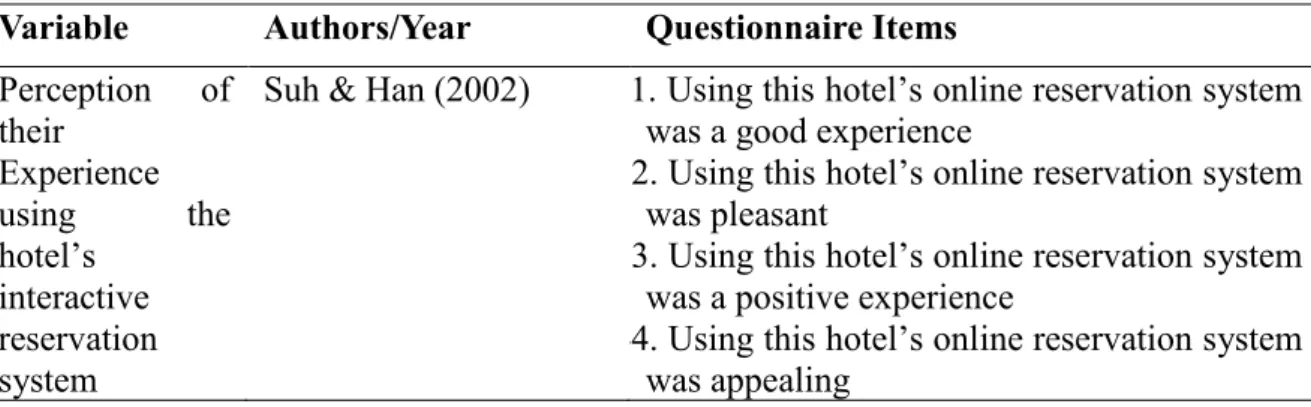
Customers’ Perception of their Experience Using a Hotel’s Online Reservation System ... 68
Satisfaction Regarding Hotel ... 69
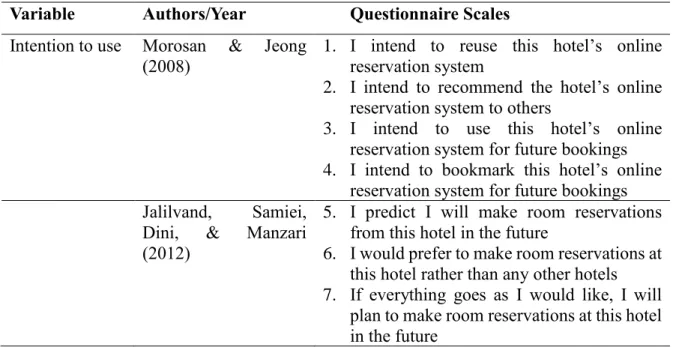
Intention to Use ... 70 Demographic Information ... 71 Data Collection ... 73 Data Screening ... 73 Data Analysis ... 74 Descriptive Statistics ... 74
Amazon’s Mechanical Turk (MTurk) ... 74
Structural Equation Modeling (SEM) ... 75
Reliability and Validity ... 76
Chapter Summary ... 77
CHAPTER IV. DATA ANALYSIS AND RESULTS ... 78
Introduction ... 78
Demographic Information ... 78
Descriptive Statistics ... 82
Initial Measurement Model ... 83
Reliability and Validity of the Initial Model ... 84
Structural Equation Modeling (SEM) of the Initial (Reduced) Model ... 86
Comparison Between Fully Recursive Model and Initial Model ... 90
Chapter Summary ... 94
CHAPTER V. DISCUSSION AND CONCLUSION ... 95
Introduction ... 95
Summary of Findings ... 95
Characters of Amazon Mechanical Turk Sample... 98
Theoretical Implications ... 99
Practical Implications... 101
Limitations and Recommendations for Future Research ... 104
An Exploratory Alternative Model ... 105
Reliability and validity of the Alternative Model ... 107
Structural Equation Modeling (SEM) for the Alternative Model ... 108
Discussion About the Exploratory Alternative Model ... 113
REFERENCES ... 116
APPENDIX A. SURVEY QUESTIONNAIRE ... 135
LIST OF FIGURES
Figure 1. Theory of reasoned action. ... 13
Figure 2. Theory of planned behavior. ... 16
Figure 3. Expectancy disconfirmation. ... 24
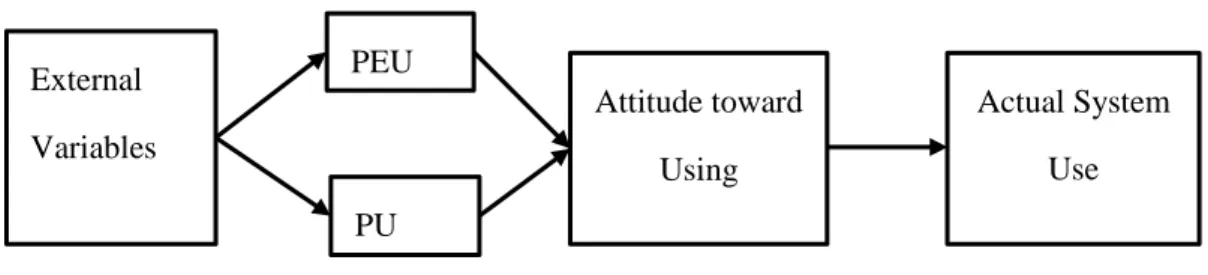
Figure 4. Technology acceptance model. ... 38
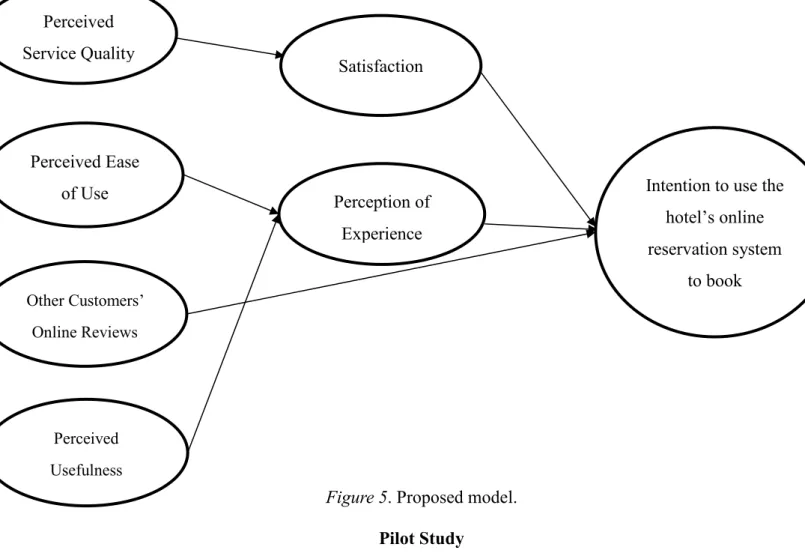
Figure 5. Proposed model. ... 63
Figure 6. Structural model with standardized regression coefficients. ... 87
LIST OF TABLES
Table 1. Comparison of Three EDT Models Longitudinally ... 26
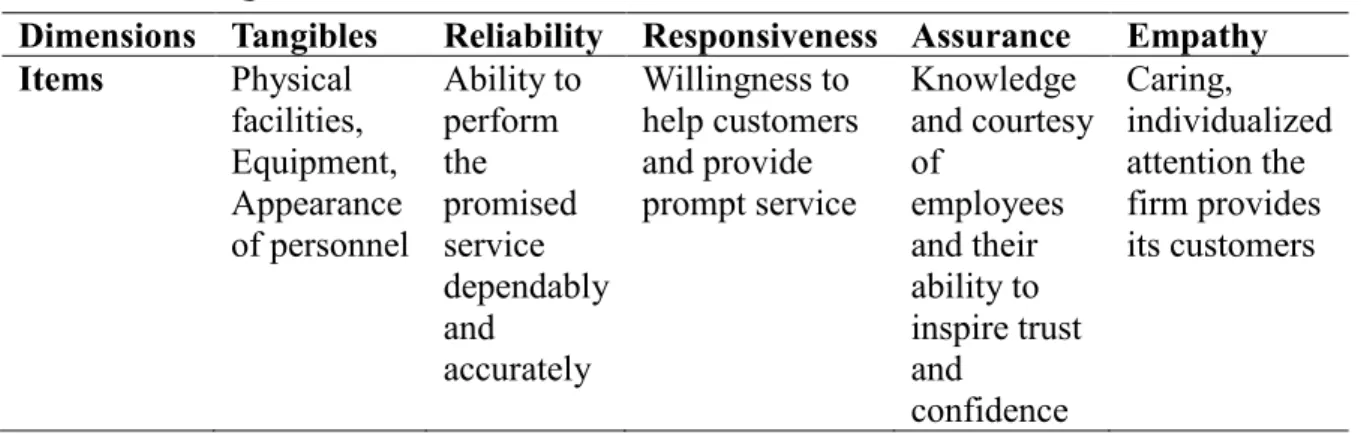
Table 2. SERVQUAL Dimensions and Items ... 41
Table 3. Previous Used Measurements of Customer Perceived Service Quality ... 44
Table 4. Measurement Items of Perceived Service Quality ... 65
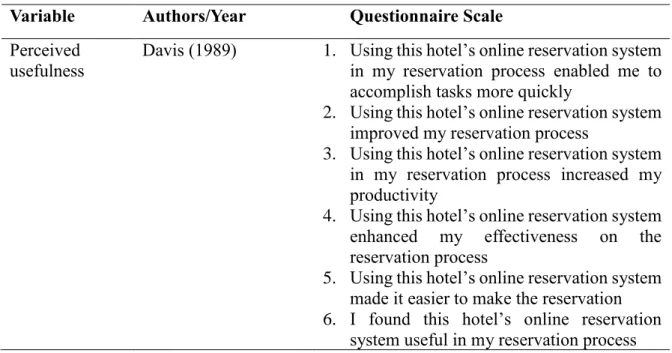
Table 5. Measurement Items of Perceived Usefulness ... 66
Table 6. Measurement Items of Perceived Ease of Use ... 67
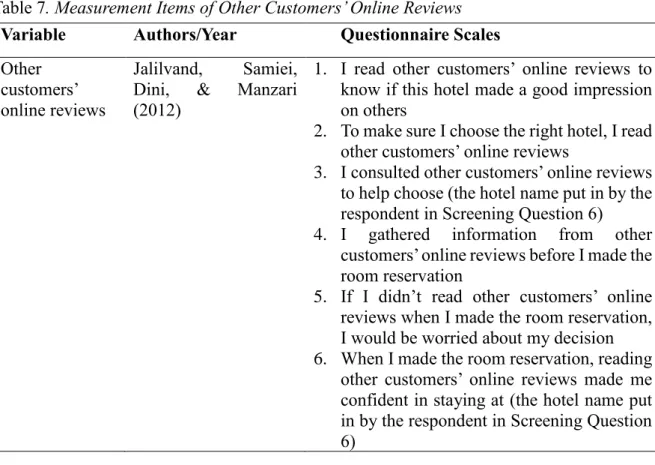
Table 7. Measurement Items of Other Customers’ Online Reviews ... 68
Table 8. Measurement Items of Customers’ Perception of their Experience Using a Hotel’s Online Reservation System ... 69
Table 9. Measurement Items of Customer Satisfaction Regarding a Hotel ... 69
Table 10. Measurement Items of Intention to Use a Hotel’s Online Reservation System to Make Room Reservations ... 71
Table 11. Measurement Items for Demographic Information ... 72
Table 12. Cut-Off Values for Goodness of Fit Indices ... 76
Table 13. Demographic Profile of the Respondents ... 79
Table 14. Summary of Travel and Booking Experiences ... 81
Table 15.Summary of Construct Reliability and Validity Evaluation ... 85
Table 16. Summary of Discriminant Validity Evaluation ... 85
Table 17. Heterotrait-Monotrait (HTMT) Ratio of Correlations ... 86
Table 18. Summary of the Results for Hypotheses Test ... 89
Table 19. Correlations Among Latent Variables for Initial (Reduced) Model ... 89
Table 20. Summary of Direct and Indirect Effects Results... 90
Table 21. 𝜒2 Comparison Between Initial Model and Fully Recursive Model ... 92
Table 22. Comparison Between Initial Model and Fully Recursive Model ... 92
Table 23. Correlations Among Latent Variables for Full Model... 92
Table 24. Standardized Factor Loadings in Each Indicator for Corresponding Latent Variables in Initial Model and Full Model ... 93
Table 25. Summary of Measurement Model Fit ... 107
Table 26. Summary of Construct Reliability and Validity Evaluation ... 107
Table 28. Heterotrait-Monotrait (HTMT) Ratio of Correlations for Discriminant
Validity ... 108
Table 29. Summary of the Path Coefficients and Significance Level ... 111
Table 30. Correlations Among Latent Variables for Alternative Model ... 111
Table 31. Summary of Direct and Indirect Effects Results... 112
Table 32. Standardized Factor Loadings in Each Indicator for Corresponding Latent Variables in Alternative Model ... 112
ACKNOWLEDGMENTS
At the very beginning of this dissertation, I would like to extend my sincere and heartfelt appreciation towards everyone who has assisted me in this endeavor. Without their active guidance, help, co-operation and encouragement, I would not have made headway in this project.
First, I would like to express sincere gratitude to my major professor, Dr. Thomas Schrier, for his continuous support of my PhD studies and related research, and his patience, motivation, and immense knowledge. His guidance helped me throughout the research and writing of this dissertation. I could not imagine finishing my degree without his mentoring in my study and life. I would also like to thank the rest of my committee: Dr. Fred Lorenz, Dr. Young A. Lee, Dr. Eric D. Olson, and Dr. Tianshu Zheng for their insightful comments and encouragement, and for the hard questions which incentivized me to widen my research from various perspectives.
My sincere thanks goes to my family, who provided me with great support throughout the whole process of my degree. I would like to thank my parents, parents in law, cousins, and grandparents for always being supportive, which enabled me to achieve my final goal. I send my deepest love and thank to my husband, Weitao Zhang, for the endless love and understanding you gave to me, which made me powerful in spite of the many sleepless nights working on this dissertation. I would also like to express my great appreciation for my newborn baby, our angel, Chengxin (Krystal) Zhang, for joining our big family and enriching our lives. I would not have finished this dissertation without any of you.
I would also like to thank my close friends, Xiaowei Xu, Yi Gong, Jing Yang, Xuefei Zhao, Yu-Chih Chiang, Yani Wei, Yi Luo, Ka Eun (Luna) Lee, Nishapat Meesangkaew, and Zahidah Latif for sticking with me during the long, but brilliant,
PhD journey. Thank you for your willingness to talk, listen, offer suggestions, and for always being there when I needed friends.
Last but not least, I would like to give my special thanks to Drs. Robert
Bosselman, Ann-Marie Fiore, Ching-Hui Su, Ellen McKinney, and Linda Neihm for working with me when I was a teaching assistant and research assistant, and for providing great opportunities for me to learn. I would also like to thank all the faculty members of the AESHM Department at Iowa State University. You made my PhD life wonderful and unforgettable.
ABSTRACT
Information technology transforms the way hospitality organizations do business. There are many areas during the hotel booking process that create moments of
satisfaction or dissatisfaction for customers. One of these areas is the ease of utilization of a hotel’s online reservation system.
It is important for hotel companies to ensure appropriate service is provided to customers and creates a positive customer experience; therefore, accurate and timely reservations are essential. The internet enables hotel customers to take full advantage of the immense amount of information available while they are booking a hotel online.
According to Castro and Custodio (2016), a hotel’s online reservation system has become a popular means for reserving hotel rooms. A hotel’s online reservation system enables hotel managers to manage the reservation process without manual efforts. Moreover, the online reservation system also improves the efficiency of the reservation process compared to booking via email or by phone. The hotel’s online reservation system also provides a direct way for hotels to monitor their revenue management (Hu & Gu, 2013). In addition, by booking a room through a hotel’s online reservation system, customers are assured about the availability of a room upon arrival at the hotel during their trip. The reservation is a commitment made by the hotel rather than a third-party business when the hotel accepts the reservation request via their online reservation system (Kasavana & Brooks, 1998). However, there is still a large portion of customers using other methods to book a hotel room, including through OTA websites, by email, by phone, or in person. Therefore, factors impelling customers to book directly through the hotel’s own reservation system turn out to be a substantial topic for hotel management. This study focuses on examining the factors
affecting customers’ intention to use a hotel’s online reservation system by combining previous theories and framework.
This study examines the elements impacting customers’ intentions to use a hotel’s online reservation system to make room reservations, including the customers’
perceptions of service quality, the experience of using the hotel’s online reservation system on its website, satisfaction regarding the hotel, perception of the experience using the online reservation system, and evaluation of other customers’ online reviews of a hotel.
Results from 848 online survey responses indicated customers intended to book through a hotel’s online reservation system due to favorable perceptions about the hotel’s service quality, positive experiences using the hotel’s online reservation system in terms of usefulness and ease of use, and good evaluations about other customers’ online reviews about the hotel. The findings proved the TAM was
successfully applied to the hotel industry to explain customer usage of a hotel’s online reservation system. It was also confirmed that perceived ease of use directly affected customers’ intentions to use a system only when the system was not
purchase-oriented. Customers’ evaluations about online reviews regarding the hotel affected their intentions to book through the hotel’s online reservation system by increasing the customers’ satisfaction level and perception of their experience using the system.
Contributions of this study were both theoretical and practical. First, this study provided insights into the perceived service quality-customer satisfaction-purchase intention link in a hotel’s online reservation system setting. Second, the results generalized the TAM for a hotel online direct sale scenario by examining the relationship among user acceptance of system and intention to use the system for purchase. Third, this study made the first attempt to combine intention for system
usage and intention to purchase and investigated in an online reservation system setting in hotel industry. Fourth, results suggested strategies to hotel practitioners for improving a hotel’s online reservation system in terms of ease of use and usefulness. Fifth, provided advice for hoteliers in improving online distribution strategies to take advantage of the customers’ adoption of the online reservation system as a reservation tool. Lastly, the results addressed the impact of online reviews generated by
customers on customer satisfaction regarding the hotel and perception of their experience using the hotel’s online reservation system.
CHAPTER I. INTRODUCTION Introduction
In recent years, the use of information technology, such as the internet, has transformed the way hospitality companies do business with customers. Commerce through the internet, or e-commerce, has grown at a tremendously high speed (Kim, Ma, & Kim, 2006). Pan, MacLaurin, and Crotts (2007) proposed online, user-generated reviews about travel destinations, hotels, and tourism services became important sources of information for travelers. Kim et al. (2006) additionally asserted the internet was an increasingly popular channel for hospitality customers to make reservations for future trips. According to Connolly and Olsen (2000), the reason for this trend was due to customers’ insistence upon ease of use, hassle-free service, and adequate information can obtained during their trip planning process. Customers were satisfied not only by the hotels good service quality, but also because of the ease of dealing with their hotel booking process through the hotel’s online reservation system (Sparks & Browning, 2011). This chapter provides background information in terms of service quality,
information technology, and social media in the hospitality industry. The purpose of this study is also stated at the end of this chapter.
Background for Service Quality Research in the Hospitality Industry
Levitt (1972) indicated service quality meant whether the service result was consistent with the established standards. Bolton and Drew (1991) indicated service quality described customers’ assessments of service superiority. Lehtinen and Lehtinen (1991) looked at service quality from the perspective of service, service delivery process, as well as function. He and Su (1995) demonstrated the stable and lasting influence of service quality on customer satisfaction.
Service quality has been considered the antecedent of customer satisfaction and behavioral intentions in hospitality organizations. Bigne, Sanchez, and Sanchez (2001) and Lee, Lee, and Lee (2005) proposed higher service quality results in both higher satisfaction and more positive behavioral intentions. Stevens, Knutson, and Patton (1995) argued, food, physical environment, and service were the three key attributes managers of hospitality organizations needed to recognize to determine how satisfied their customers were. All these attributes contributed to customers’ overall satisfaction with their
perceived service experience, resulting in intention to repurchase in the future. Moreover, Nam and Lee (2011) utilized a modified SERVQUAL scale and found three dimensions of service quality (i.e., intangibles, tangibles, food) had a positive impact on customer satisfaction with hospitality organizations. Parasuraman, Zeithaml, and Berry (1988) noted service quality results from comparing customer expectations of service with actual service performance. Moreover, Churchill and Surprenant (1982) addressed that customer satisfaction with services delivered depended on the gap between expectations of service and actual service received. In other words, service quality not only included the final result but also the means of service delivery.
As the internet develops, online shopping or hotel booking becomes part of customers’ daily life. Service organizations, such as retailing companies or hotel companies, are providing services to their customers not only in person, but also in the cyberspace. Online shopping enables anyone to access a virtual marketplace, where the content of a transaction is information about services or goods, and to interact with different systems and other people in a fast and convenient way (Hoffman & Novak, 1996). However, it is noted by Grönroos, Heinonen, Isoniemi, and Lindholm (2000) that not all companies have designed their online systems in a way that creates good customer appeal and maximizes customer benefits. Rust and Lemon (2001) propose services
provided through the internet are defined as “… providing a superior experience to consumers with respect to the interactive flow of information.” Normann (1992)
concludes that customers form an evaluation about a service based on whether the service provided meets their expected quality criteria. It is suggested by Grönroos et al. (2000) that the service quality perceived by customers in a physical marketplace are still valid for the virtual marketspace. The quality of customers’ experience from interacting with an online system offered by a company is essential, and a well-developed online system creates interest in the company and services or products it offers (Schwartz, 1997). Sivadas (1998) asserts a company with an online system for sales that provides good service or products promotes customers’ intentions to actually make purchases through the system. Grönroos et al. (2000) further notes customers’ perceptions of the quality of the service offered by a company with an online purchasing system leads to an outcome of using the system as a purchasing and consumption instrument. Therefore, marketers who wish to use an online system to provide services or products to customers should be aware of how customers perceive and assess the service.
Background for Technology Use in the Hospitality Industry
According to Oliveira and Martins (2011), information technology was widely considered to be an important tool in improving competition and the economic conditions of a country. Additionally, information technology was commonly agreed to significantly impact the productivity of a company who applied it. Likewise, Buick (2003) indicated information technology performed a dramatically fast increase in an expanding area. Traditionally, the hospitality industry often lagged other sectors in applying information technology due to the special characteristics of the hospitality and tourism industry. However, Buick (2003) also stated the situation has changed recently due to the economic recovery, which boosted the improvement of the hospitality industry. O’Connor and
Murphy’s (2004) study analyzed previous research investigating information technology themes in the hospitality and tourism area. The study reviewed previous papers published in a dozen hospitality and tourism journals. Their research showed previous research considering information technology in the hospitality industry focused on three areas: the effect of the internet on distribution, the effect of the internet on pricing, and the effect of the internet on customer-organization interactions. They concluded it was important for hoteliers to reconsider their selected distribution; and suggested a good strategy when choosing a proper distribution required knowing what to include in the channels. They also addressed customer ownership as a key point to a good strategy. In terms of pricing, O’Connor (2003) examined the behavior of chain hotel brands by revealing customers often sought multiple channels for the lowest price. It was revealed by O’Connor (2003) that hotel companies were more likely to choose multiple distribution channels and apply different prices for different channels. In conclusion, O’Connor indicated hotel companies did an overall poor job managing their distribution channels, therefore, it was necessary for hotel companies to implement better pricing policies to boost customers’ intentions to make reservations via brand websites. Lastly, in terms of the relationship between hotel customers and information technology, O’Connor and Murphy (2004) summarized the findings of previous research, and concluded information searching was one of the first stages in a customer’s decision-making process. Several previous studies examined the effects information technology had on hospitality customers’ decision-making behaviors.
Camison (2000) and Siguaw and Enz (1999) revealed that during recent years, the hotel industry was increasingly information-intensive. Furthermore, Law and Jogaratnam (2005) illustrated technology was functional in the hotel industry due to its role of making hotel employees more productive and performing better services to hotel customers.
Background for Social Media in the Hospitality Industry
Social media and Web 2.0 are two popular buzzwords, as well as technological concepts, that brought about pervasive changes in business-to-business communication, business-to-customer communication, and customer-to-customer communication (Kietzmann, Hermkens, McCarthy, & Silvestre, 2011). In the era of social media, the internet evolved from a broadcasting medium to a participatory platform that enabled users to become “media” themselves to collaborate and share information (Li & Wang, 2011; Thevenot, 2007). According to Bodnar (2010), more than 3 million photos were uploaded to Flickr, 5 million tweets, and a million new blog entries posted on Twitter and other blog sites every day. Obviously, these statistics reflected the increasing prevalence of social media in people’s daily lives. Furthermore, the “user democracy” culture and ability to share information by means of social media substantially changed information asymmetry and the bargaining power of customers.
As one of the two “mega trends” that significantly influence the tourism system (the other one being search engines (Xiang & Gretzel, 2010)), social media is widely adopted by travelers to search, arrange, share, and annotate their travel stories and experiences via blogs and microblogs (e.g., Twitter), online communities (e.g., Facebook), media sharing sites (e.g., Youtube), social bookmarking sites (e.g., Delicious), social knowledge sharing sites (e.g., Wikitravel), and other tools in a collaborative way. According to a report, more than one-third of all leisure travelers in the United Kingdom select their hotels on the basis of social media sites such as Tripadvisor (Koumelis, 2011).
Social media had the capacity to assist tourism and hospitality companies in engaging customers, increasing their online presence, and thereby resulting in greater online
revenues driven by user-generated content (Leung, Law, Van Hoof, & Buhalis, 2013). Wang and Fesenmaier (2004) stated social media was substantial for managing customer
relations with their unique ability of attracting customers via in-depth, focused, and member-generated content, engaging customers through social interactions, and retaining customers through relation building with other members. Likewise, Dellarocas (2003) indicated social media provided hotel companies an excellent opportunity to analyze comments on online communities, such as Tripadvisor, so hotel companies better understood what their customers liked and disliked about them and their competitors. Considering this rapidly growing trend and the potential benefits social media offered, numerous hotel and tourism businesses integratied social media applications into their websites to enhance customers’ travel information searching experiences (Fuchs, Scholochov, & Höpken, 2009; Sánchez-Franco & Rondan-Cataluña, 2010).
Considering the important role of social media in both travelers’ decision making as well as in tourism operations and management, a plethora of research on the application of social media in tourism and hospitality has been catalogued in referred journals (e.g., Chan & Denizci Guillet, 2011; Li & Wang, 2011; Noone, McGuire, & Rohlfs, 2011; Xiang & Gretzel, 2010).
Problem Statement
Perceived as a fast-growing business opportunity, the internet isviewed by many hospitality organizations as a creative and competitive marketing tool in offering room-related information and online transaction opportunities (Doolin, Bergess, & Cooper, 2002). However, hotels are still seeking an efficient way to persuade customers to make room reservations directly through a hotel’s online reservation system available on the hotel’s website, in spite of the growing online booking market. According to previous literature (Su, 2004), one of the biggest contemporary challenges of management in the hospitality industry is keeping customers satisfied. Moreover, customers’ perceived service quality and customer satisfaction are increasingly identified as key factors in the
battle for competitive differentiation and customer retention. Similarly, Ladhari (2009) asserts that superior service quality enables a hotel company to differentiate itself from its competitors, gain a sustainable competitive advantage, and enhance efficiency.
Meanwhile, online customers are also computer users as they perform all functions of traditional customers on a computer interacting with a system (Koufaris, 2002). Although previous research investigates how customers’ perceived service quality affects their satisfaction about a service provider, which in turn affects their intention to make purchases (Su, 2004); how users’ perceived ease of use and perceived usefulness of a system affect their intention to make purchases using that system (Suh & Han, 2002); and how customer-generated online reviews affect customers’ intention to purchase (Sparks & Browning, 2011), there is little research examining how these factors synchronously affect customers’ intention to make purchases in a hotel’s online reservation system setting. Therefore, this study combines all of these elements together, and examines how customers’ perceived service quality, customers’ perceived ease of use and perceived usefulness of a hotel’s online reservation system, and the customers’ assessment of other customers’ online reviews affect customers’ satisfaction regarding the hotel, their
perception of their experience using the hotel’s online reservation system, and their intention to use the system to book from the hotel.
Furthermore, it is important to fully understand the theoretical keystones that are considered the foundation of the current work before conducting the study. Therefore, the following sections put an emphasis on illustrating the theories related to general customer behaviors, as well as theories related to human-technology interaction in hospitality and tourism research fields.
Purpose of Study
The purpose of this study was to examine the elements impacting customers’ intention to use a hotel’s online reservation system to book from the hotel, including customers’ perceptions of service quality of the hotel, their perceived ease of use and usefulness of a hotel’s online reservation system, satisfaction regarding the hotel, perception of their experience using the hotel’s online reservation system, and their evaluation of other customers’ online reviews that they were exposed to while making decisions for booking a hotel room. Considering this purpose, the following research questions were developed for investigation in this study:
RQ1: What are the factors affecting customers’ intention to use a hotel’s online reservation system to book from the hotel?
RQ2: Do customers’ perceptions of the service quality of a hotel affect their satisfaction regarding the hotel?
RQ3: How do customers’ perceived usefulness of a hotel’s online reservation system affect their perception of their experience using the hotel’s online reservation system?
RQ4: How do customers’ perceived ease of use of a hotel’s online reservation system affect their perception of their experience using the hotel’s online reservation system?
RQ5: Do other customers’ online reviews matter to their decision-making process of booking a hotel room via its online reservation system?
Research Contribution
This study indicated how customers’ perceived service quality provided by a hotel, the perceived ease of use and usefulness of a hotel’s online reservation system, as well as how other customers’ online reviews affected customers’ satisfaction regarding the hotel, their perception of their experience using a hotel’s online reservation system, and their intention to use a hotel’s online reservation system to book from the hotel. Therefore, the
findings of this study provided an exploration of the application of the technology acceptance model (TAM) in an online reservation system scenario, where the research model was tested using structural equation modeling (SEM). The results of this study provided useful information for hotel managers regarding service-related aspects that could improve perceptions by customers. In addition, the results provided suggestions for improving the hotel’s online reservation system to make it more user-friendly and
encourage customers to book directly through the hotel’s own website instead of third party websites, or online travel agency (OTA) websites for example,. Moreover, the findings offered valuable suggestions on appropriately managing customers’ online reviews to boost positive customer experience.
Definition of Terms
Perceived Service Quality: A global judgment or attitude associating to the
superiority of a service, in which the customer compares his/her expectations with his/her perception of the service received (Grönroos, 1984; Zeithaml & Bitner, 2000).
Perceived Usefulness: “the degree to which a person believes that using a particular
system would enhance his or her job performance” (Davis, 1989, p. 320).
Perceived Ease of Use: “the degree to which a person believes that using a particular
system would be free of effort” (Davis, 1989, p.320).
Customer Online Review: Any positive or negative statement made by former
customers about a product or company, which is made available to a multitude of people and institutions via the internet (Litvin, Goldsmith, & Pan, 2008).
Customer Satisfaction: A psychological concept that engages the perceptions of
well-being and pleasure originating from customers’ obtaining what they expect from a product or service provided by a specific company (Pizam & Ellis, 1999).
Perception of the Experience Using a System: A person’s assessment and responses that result from the use or anticipated use of a system (Law, Roto, Hassenzahl,
Vermeeren, & Kort, 2009).
Intention to Use: A significant signal of whether customers are willing to remain with
or defect from a specific organization (Zeithaml, Berry, & Parasuraman, 1996).
Chapter Summary
This chapter provided background information for customers’ perceived service quality, the application of information technology in the hospitality industry, such as a hotel’s online reservation system, and customer-generated online reviews and their impact on customers’ intention to use the hotel’s online reservation system to make room reservations in the hospitality industry. The theoretical and practical contributions of this study were discussed, followed by an overview of the definition of the key terms
addressed in the framework of this study.
The following chapter will explore the existing theories related to customer behaviors in hospitality research and information technology in the hospitality industry. In addition, the following chapter illustrates what has been discussed in previous studies in the field of customer perceived service quality, customers’ perceptions of using a hotel’s online reservation system, and customers’ perceptions of previous customers’ online reviews and their impact on customer satisfaction, customers’ perception of their experience using a hotel’s online reservation system, as well as intention to use a hotel’s online reservation system to make room reservations from the hotel in a more detailed manner. Moreover, the constructs of the research framework and measurements for these constructs are explained by reviewing previous literature.
CHAPTER II. REVIEW OF LITERATURE Introduction
This chapter discusses previous research that provides evidence for the development of the hypotheses of this study. The literature review is organized in six major sections. The first section discusses theories associated with customer behavior in hospitality and tourism research. The second section summarizes theories related to customer satisfaction about companies or organizations that provide services. The third section summarizes theories related to information technology and customers’ perceptions of their experience using systems. The fourth section discusses theories related to perceived service quality. The fifth section talks about theories related to customer-generated online reviews. The last section summarizes the research gap investigated.
Theories Related to Consumer Behavior in Hospitality and Tourism Research
Consumer behavior has long been of interest to researchers in various areas. Starting approximately 300 years ago, Nicholas Bernoulli, John von Neumann and Oskar
Morgenstern began to explore the basis of consumer decision-making behaviors (Richarme, 2007).
Utility Theory
Among early work, the most prevalent model used was utility theory, which asserted consumers made purchase decisions on the basis of the outcome they expected from their purchase decisions (Bray, 2008). Fishburn (1970) proposed utility theory was based on consumers’ decision-making behavior. According to Zinkhan (1992), customers were considered ‘rational economic men’ (p.2), meaning a consumer had to be aware of all the available consumption choices, capable of properly rating each alternative, and available to choose the optimum course of purchase action. Similarly, Schiffman and Kanuk (2009)
pointed out that customers considered to be rational decision makers were only concerned about their own benefits.
Recent research on consumer behavior stated a wide range of factors affected customers’ purchase and decision-making behaviors due to the development of economy and the optimization of consumption environment. Therefore, customers established a broader range of desires such as recognition need, information search need, evaluation of alternatives, and building of purchase intention need, as well as the act of purchasing, consumption and finally disposal. Similarly, Simon (1997) suggested it was not realistic for consumers to make ‘perfect’ decisions (p.4) due to the lack of sufficient information, motivation, or time during their decision-making process. Simon (1997) further indicated that social relationships and values of products impacted consumers’ decision-making processes, preventing consumers from behaving as rational economic men. Simon (1997) further strengthened his point by establishing Herbert Simons satisficing theory,
illustrating consumers were more inclined to seek satisfactory, instead of optimum, choices during consumption activities.
Theory of Reasoned Action
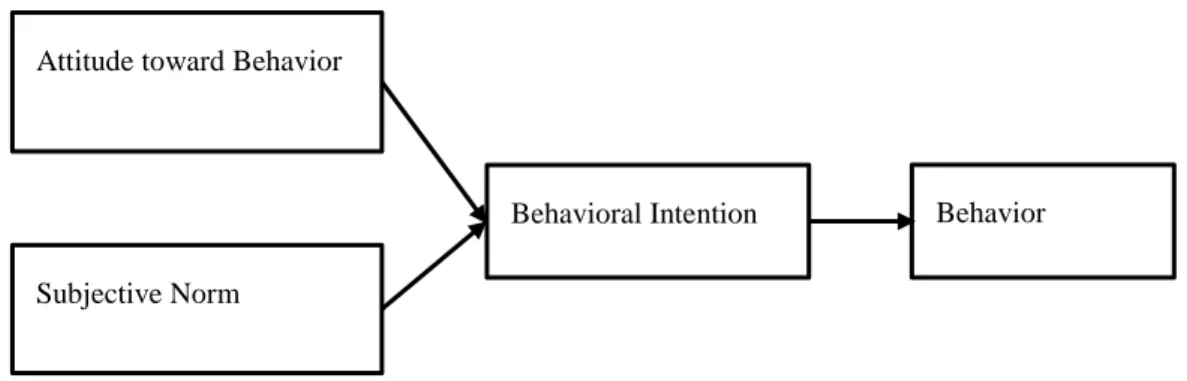
According to Fishbein and Ajzen (1975) and Chang (1998), the theory of reasoned action (Figure 1) argued a consumer’s behavior was influenced and even determined by the consumer’s behavioral intention, where behavioral intention was a function of ‘attitude toward the behavior.’ This attitude referred to the general feeling of
favorableness or unfavorableness for a behavior, and ‘subjective norm’ referred to the perceived opinion of other people associated to the behavior in question. Moreover, Fishbein (1980) stated that a consumer’s behavioral intention predicted “the performance of any voluntary act, unless intent changes prior to performance or unless the intention measure does not correspond to the behavioral criterion in terms of action, context,
time-frame and specificity” (p.66). Similarly, Hansen, Jensen, and Solgaard (2004) illustrated that the theory predicted consumers’ intention of certain behaviors through consumers’ attitude toward that specific behavior, instead of by consumers’ attitude toward the product or service provided in the consumption activity.
Figure 1. Theory of reasoned action.
Fishbein and Ajzen (1975) and Chang (1998) further surmised that the theory of reasoned action involved consumer behaviors over which the individual has control and were rational, volitional, and systematic behavior. In contrast, Sheppard, Hartwick, and Warshaw (1988) argued “actions that are at least in part determined by factors beyond individuals volitional control fall outside the boundary conditions established for the model” (p.326).
In practice, the theory of reasoned action is applicable to various research situations. For example, it can be applied to research where the target behavior is not completely under the subjects’ volitional control, and research in which subjects’ intentions are evaluated when it is impossible for them to have all of the necessary information to build a completely confident intention. Njite and Parsa (2005) conducted a study investigating factors that influenced internet purchasing for the hospitality and tourism industry using a model based on the theory of reasoned actions and explaining the influence of different factors. The respondents of the study survey indicated subjective norms and trust
Attitude toward Behavior
Subjective Norm
perceived by consumers had no significant influence on their intention to purchase. It was also suggested by Njite and Parsa (2005) that as demographics changed and access to the internet increased in the hospitality and tourism industry, trust perceived by customers and factors that affected their intention to purchase through the internet changed as well. Njite and Parsa’s study provided a framework that theoretically predicted consumer adoption of e-commerce by explaining customers’ intention to use internet technology for purchasing products and services in the hospitality and tourism industry.
However, one of the most vital limitations of the framework of this theory was it was established to cope with consumer behaviors rather than outcomes or events resulting from behaviors. As a result, Sheppard, Hartwick, and Warshaw (1988) asserted that behaviors at least partly determined by factors beyond individuals’ volitional control fell outside the boundary conditions developed for the framework. In other words, “whenever the performance of some action requires knowledge, skills, resources, or others’
cooperation, or necessitates overcoming environmental obstacles, the conditions of the model cannot be met” (p.326). Moreover, Sheppard, Hartwick, and Warshaw (1988) pointed out that two major potential problems arose when applying this framework to study goals for which attainment involved a degree of uncertainty. They mentioned the framework led to difficulties in terms of the power of the relationship between consumer intentions and performances due to a variety of factors in addition to one’s intentions affecting whether the expected consumption outcomes were acquired. This resulted in potential problems regarding the accuracy of predicting purchase outcomes from consumer intentions. Additionally, it was problematic to predict how consumers
determined their purchase intentions using this framework since there was no provision in the framework which concerned either the probability for failing to gain one’s goals or the results of such failure (Atkinson, 1958).
Therefore, theory of planned behavior was established as an extension of the theory of reasoned action due to the limitations of its framework.
Theory of Planned Behavior
Based on Petty, Unnava, and Strathman (1991), the most essential concern for researchers interested in consumer behavior was to predict how attitudes influenced consumer behavioral intentions.
Meanwhile, many other researchers suggested consumers’ attitudes toward the product or service they were going to purchase was more predictive of their actual purchasing behaviors in certain circumstances (Evans, Christiansen, & Gill, 1996; Njite & Parsa, 2005; Shim & Drake, 1990; Shim, Eastlick, Lotz, & Warrington, 2001).
To investigate the relationship between consumer’ attitudes toward the product and services they were going to purchase and their behavioral intentions, various of
theoretical frameworks were established. The best-known frameworks were the theory of reasoned action and the theory of planned behavior (Wen, 2009).
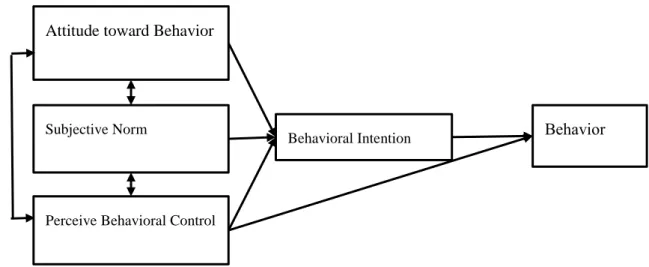
The theory of planned behavior (Figure 2) was first proposed by Ajzen (1991), who stated consumers’ intentions to perform various consumption-related behaviors were highly and accurately foreseen by attitudes toward the behavior, subjective norms, and perceived behavioral control. Consumers’ intentions, along with their perceived
Figure 2. Theory of planned behavior.
Ajzen and Fishbein (1980) and Fishbein and Ajzen (1975) argued the theory of planned behavior was considered an extension of the theory of reasoned action since it dealt with limitations of the framework of the theory of reasoned action over which people had incomplete volitional control. Likewise, Montano, Kasprzyk, Glanz, Rimer, and Viswanath (2008) stated the theory of planned behavior was considered an extension of the theory of reasoned action because it assumed the best predictor of a behavior was behavioral intention like the theory of reasoned action, but expanded its framework to include the construct of perceived control over performance of the behavior. Furthermore, Montano et al., (2008) asserted that as an extension from the theory of reasoned action, the theory of planned behavior emphasized theoretical constructs associated with
individual motivational factors and considered these determining factors to calculate the probability of performing a purchasing behavior.
Referring to Posthuma and Dworkin (2000), the additional construct included in the theory of planned behavior compared to the theory of reasoned action, was perceived
Attitude toward Behavior
Subjective Norm
Behavioral Intention Behavior
behavioral control and was defined as “the consumer’s subjective belief about how difficult it will be for that consumer to generate the behavior in question” (p.541). The concept of perceived behavioral control related to numerous research settings. For
example, Chang (1998) investigated the perceived behavioral control construct in a study predicting unethical behavior. More recently, Shim, Eastlick, Lotz, and Warrington (2001) included the perceived behavioral control in their research framework regarding
customers’ online pre-purchase intention.
Liao, Chen, and Yen (2007) established an integrated model designed to foresee and interpret an individual’s continued use of online services based on the expectation
disconfirmation model and the theory of planned behavior. The study revealed customers’ intention to purchase from online service environment was primarily based on customer satisfaction, perceived usefulness, and subjective norm as suggested by the theory of planned behavior. Koufaris (2002) established the expectation disconfirmation model that was utilized as an appropriate means to reflect customers’ repurchase intention via an information system because the functionalities of online services are fully based on the facilitations of information technologies. As an application of theory to practice, Bhattacherjee (2001) combined the technology acceptance model (TAM) with the expectation disconfirmation model to investigate the customers’ expectation of system-specific attributes on customer satisfaction and their intention to use the system. However, one of the downsides of the expectation disconfirmation model is that the framework does not extensively assess the effect of social norms and customers’ personal characteristics on an individual’s continuous consumption behavior (Liao et al., 2007). To overcome this shortcoming, the theory of planned behavior established proper extensions of the model to become a generic model widely used in explaining and analyzing
behavior suggests customer behavior was affected by their behavioral intentions and perceived behavioral controls. Meanwhile, customer behavioral intention was based on their attitude towards the behavior, subjective norm, and perceived behavioral control. Liao et al (2007) conducted a study investigating customers’ behavioral intention towards continued use of online services by establishing an integrated model, fully synthesizing the expectation disconfirmation model and the theory of planned behavior concepts in a supplementary way. According to Liao et al., (2007), the expectation disconfirmation model monitored the effect of customer satisfaction, while the theory of planned behavior was utilized for the purpose of reflecting the impact of personal characteristics and subjective norm. Furthermore, Liao’s (2007) study illustrated that subjective norm and perceived behavioral control were derived from the theory of planned behavior and explored the effects of normative beliefs in a social system and personal psychological status correspondingly. The results of the study suggested subjective norm and perceived behavioral control were both significant predictors of customers’ intention to repurchase services online. Liao’s study (2007) also revealed the variance explained in customer behavioral intention increased significantly by combining the theoretical constructs of the theory of planned behavior and the expectation disconfirmation model. The facts
indicated that combining the theory of planned behavior and the expectation
disconfirmation model helped increase the accuracy of an integrated model to predict as well as explain customers’ behavioral intention. In other words, the integrated model had a better explanatory power than other models based on the expectation disconfirmation model. In a practical perspective, Liao et al., (2007) suggested that since subjective norm within the theory of planned behavior proved to have significant impact on customers’ behavioral intentions, advertisements and promotional activities were applicable
study agreed with findings of Ajzen’s (1985, 1991) study of the theory of planned behavior, which stated “attitudes are determinants of behavioral intentions,” doubts still remained regarding the appropriateness of putting the findings of this theory into the hospitality and tourism industry.
Motivation Theory
Iso-Ahola’s motivation theory in the tourism context illustrated leisure travelers were motivated by two primary forces when participating in tourism and recreational activities. The two forces affected the individual leisure traveler’s consumption behavior
simultaneously (Ross & Iso-Ahola, 1991). One of the forces was personal/interpersonal escape, meaning people wanted to escape from troubles, personal problems, difficulties, failures, or the interpersonal world (e.g., coworkers, friends, family members) in their daily life through attending leisure activities (e.g., traveling to a tourism destination, staying in a resort on the beach, attending a banquet in a tourism destination). The other force was the personal/interpersonal seeking, meaning people sought psychological rewards from attending leisure activities as well as the desire to be involved in social contact through traveling. To investigate this theory, Ross and Iso-Ahola (1991) conducted a field study exploring the motivation and satisfaction dimensions of
sightseeing tourists using data collected on 10 tour buses in different tourism destinations. The results of the study revealed respondents reported their satisfaction with various perspectives of the tour, which corresponded to the motivation items they presented before experiencing the tour. Results indicated a considerable similarity between
motivation and satisfaction dimensions in terms of knowledge seeking, social interaction, and escape emerging as important motives and satisfaction factors. This similarity
resulted in a high overall satisfaction level with the tour reported by the travelers.
Moreover, the researchers found leisure travelers reported significantly higher satisfaction levels than travelers who came for a convention.
According to Ross and Iso-Ahola (1991), “motivation is the cognitive representations of future states” (p.227). Leisure travelers’ motivation emphasized the initiation of
behavior and was mainly a function of expectations toward the results of their future purchase behavior. As a result, motivation was measured through potential fulfillment, defined as a measurement of psychological outcomes after experiencing the products or services during the trip. Ross and Iso-Ahola (1991) further pointed out customer
behavioral intention was often, although not always, considered to produce customer satisfaction. Deci (1975) illustrated that a motivation was considered “an awareness of potential satisfaction in a future circumstance (e.g. future purchasing of hotel or other tourism products or services)” (p. 227).
Meanwhile, Snepenger, King, Marshall, and Uysal (2006) investigated Iso-Ahola’s theory under similar tourism and recreation experiences, in which the motivation dimensions were monitored using scenario-based data for sporting events, beaches, amusement parks, and natural parks. This empirical study aimed to implement
Iso-Ahola’s theory specifically within the hospitality and tourism circumstances. They used a scenario-based, repeated measure design to examine the objectives of the study. The findings of this study confirmed the existence of the four dimensions (i.e. personal escape, interpersonal escape, personal seeking, interpersonal seeking) proposed by Iso-Ahola (1982). Moreover, the results were consistent with that concluded by Iso-Iso-Ahola’s study; that personal escape, interpersonal escape, personal seeking, and interpersonal seeking all performed as salient intrinsic motivational drives for customer behaviors in the hospitality and tourism industry.
Judgment and Decision-making Theory
Abelson and Levi (1985) classified decision-making literature into three categories: structure versus process orientation, risk free versus risky choice models, and normative versus descriptive models. Risk-free decisions engaged in preferences, while risky decisions involved probabilities. A continuum of choice circumstances ranged from well-defined to ill-well-defined choice circumstances. Well-well-defined choice circumstances embraced both risky and risk-free decisions, whereas ill-defined choice circumstances only included risky decisions due to the uncertainty of the decision consequences. Sirakaya and
Woodside (2005) stated most customer decisions in the hospitality and tourism industry were considered ill-defined decisions according to the classification made by Abelson and Levi (1985). Moreover, the most important difference between normative and descriptive models was whether customers in the hospitality and tourism industry were seeking optimum decisions or solely looking for a satisfying outcome of the decision-making process.
Research regarding customer decision-making behavior advanced exponentially during the past three decades (Sirakaya & Woodside, 2005). Papatheodorou (2001) stated tourists’ behavior and decision-making had long been the central issue in the tourism management literature. A large amount of research attempted to explore the factors impacting travelers’ decision-making for choosing a travel destination to visit, as well as travelers’ intention to purchase products or services in the hospitality and tourism
industry (Wong & Yeh, 2009). In a study exploring travelers’ decision-making for tourism destinations, Wong and Yeh (2009) proposed travelers were affected by factors such as issues related to health, safety, time, expenditure, and travel distance (Bansal & Eiselt, 2004) during the decision-making process for future trip planning. Additionally,
quality of their future experience with the hotel or other tourism organizations, thus resulting in travelers’ hesitation in decision-making. Thunholm (2004) stated it was considered a decision-making style that travelers hesitated during trip planning process.
Sirakaya and Woodside (2005) asserted, that for the purpose of explaining a wider range of decision behavior across an expanded range of contexts, multiple decision theories needed to be used simultaneously. In other words, it was not probable to fit an individual decision-making process into a single decision-making theory.
They proposed two types of decision-making processes based on the extension of involvement, and classified customers’ decision-making processes in the tourism industry as high-involvement and extensive decision-making, the reason for which was the
relatively high costs both monetarily and non-monetarily involved in the decision-making process.
Woodside, MacDonald, and Trappey (1997) stated customers’ previous experience resulted in a more cursory information search, more confidence in the selection, and less perceived risk during customers’ decision-making process.
Stevenson, Busemeyer, and Naylor (1990) pointed out that judgment and decision-making theory consisted of a taxonomy of tasks, including prediction and forecasting, inference, and worth and preference judgments. Furthermore, prediction and forecasting indicated how individuals used current information to predict future events, such as predicting customers’ future purchasing decisions given the online reviews written by previous customers.
Inference referred to how individuals evaluated probabilities of events based on uncertain information. For instance, predicting customers’ trust towards a hotel brand based on their perceived quality of that hotel brand according to online reviews generated by previous customers. Finally, worth and preference judgments referred to how
individuals dealt with information to determine the value of an event or outcome. Under the current study conditions, it was described as the customers’ intention to purchase from a hotel in regard to their perception of the information provided by online reviews
generated by previous customers.
Customer Satisfaction Theories
A number of theories in the service field addressed customer satisfaction and service paradigm, which were used in many areas in the service industry to explain the
relationship between service quality and customer satisfaction with the service or products consumption experience. In general, the theories were categorized into three classifications: expectancy disconfirmation, equity, and attribution.
Expectancy Disconfirmation Theory
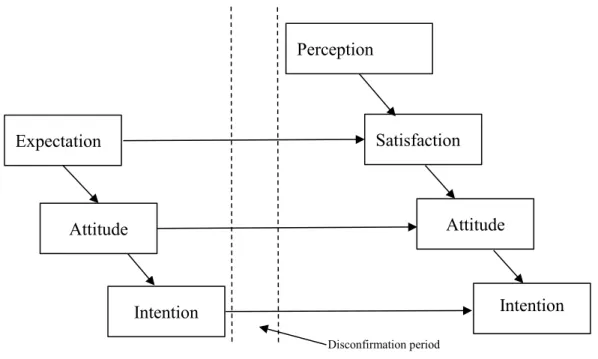
Oliver (1980) proposed a model that considered consumer satisfaction as a function of customer expectation and expectancy disconfirmation (Figure 3). Oliver (1980) further asserted that the effects of expectation and discrepancy perceptions were additive.
Moreover, Oliver (1980) suggested expectations created a cutoff point about which one made a comparative judgment.
In this situation, service results worsened when customers’ expectations were
considered a negative disconfirmation, which scored below the cutoff point; while service results better than customers’ expectations were assessed as a positive disconfirmation and scored beyond the cutoff point respectively.
Figure 3. Expectancy disconfirmation.
Expectancy disconfirmation theory measured customer satisfaction based on perceived quality of products or services (Elkhani & Bakri, 2012). Spreng, MacKenzie, and Olshavsky (1996) proposed an expectation disconfirmation model that explained the customer consumption decision in the post-purchase process and constantly dominated academic research and managerial practice. The application of the model clarified how customer satisfaction affected customer repurchase and loyalty. Based on the framework of the expectancy disconfirmation theory, customer satisfaction was the provision that determined customers’ intention to repurchase.
Oliver (1980) illustrated disconfirmation was defined as the inconsistency between customers’ pre-purchase expectation toward the product or service and the customers’ post-purchase performance after the consumption of the product or service. Moreover, various previous studies demonstrated the definition for expectation, which had three different types including the “will expectation, the should expectation, and the ideal expectation” (p.2807). According to Liao et al (2007), the “will expectation” referred to
Intention Attitude Expectation Satisfaction Attitude Perception Intention Disconfirmation period
the prediction of future performance as well as a customer’s faith in their post-purchase perception of the product or services. The “should expectation” referred to customers’ beliefs of situations in the next service encounter, which set up a normative standard for performance of the product or service consumption process. Finally, the “ideal
expectation” referred to the customers’ anticipation of the product or services in an ideal circumstance. Parasuraman, Zeithami, and Berry (1994) stated disconfirmation was assumed to be positively related to customer satisfaction only when customers’ perceived product or service performance was lower or the same as the “ideal expectations” based on the classic ideal view of the expectation confirmation model.
Liao’s study (2007) used perceived usefulness, perceived ease of use, perceived service quality, satisfaction, and intention to repurchase online services as measurements in the expectancy disconfirmation model. By combining the core of the expectancy disconfirmation theory and the theory of planned behavior, this study revealed customers’ intention to purchase online services repeatedly was significantly motivated by subjective norm and perceived behavioral control. Moreover, the results also showed customers’ behavioral intention was primarily based on satisfaction, which was predicted by disconfirmation in perceived service quality and expected service quality and perceived ease of use of the services or products consumed online. More specifically, the study indicated disconfirmation and perceived ease of use together explained 79% of the error variance in customer satisfaction, and suggested the core of the expectancy
disconfirmation theory was fully represented by the study framework.
Elkhani and Bakri (2012) reviewed the expectancy disconfirmation theory as a theory for measuring customer satisfaction utilizing perceived quality of products or services. Elkhani and Bakri (2012) further asserted the expectancy disconfirmation theory was based on the definition of cognitive dissonance theory. Consistent with previous
researchers, positive disconfirmation resulted in the customer’s satisfaction, while negative disconfirmation resulted in the customers’ dissatisfaction measured by the difference between customers’ expectation before actual purchase and the performance of the products or services they purchased. The development of the expectancy
disconfirmation theory experienced three phases (see Table 1), changing from the first EDT model (Oliver, 1980), to the EDT model that presented information satisfaction (Spreng, MacKenzie, & Olshavsky, 1996) to the desires and expectation disconfirmation model (Spreng & Page, 2003).
Table 1. Comparison of Three EDT Models Longitudinally
EDT Model Model Constructs Uniqueness
Oliver (1980) Expectation, Perceived
performance Disconfirmation Satisfaction
Measuring customer satisfaction through the difference between customers’ pre-purchase expectation and the actual performance of the
products or services Spreng, MacKenzie, and
Olshavsky (1996) Expectation, Perceived performance, Desires Desires congruency, expectation congruency Attribute satisfaction, information satisfaction Overall satisfaction
Satisfying the customers is not limited only to their expectation of products or services. Rather, satisfying customers from perceived information is the first step that can attract the
customers’ trust over offered products and services
Spreng and Page (2003) Expectation, Perceived
performance, Desires Disconfirmation Overall satisfaction
Proved that Perceived performance has direct impact on overall satisfaction
The three phases of evolution of the expectancy disconfirmation theory showed this model applied to various areas of study; however, the common theme among these models were they proved the expectancy disconfirmation theory to be good for investigating the relationship between customers’ pre-purchase expectation and their satisfaction after the purchase and adjusted to fit research in various fields.
According to Westbrook and Reilly (1983), Oliver’s (1980) conceptualization of the expectancy disconfirmation theory identified the influential character of customer
satisfaction, and the concept focused on customer’s experience perspective instead of the product or service perspective. However, Westbrook and Reilly (1983) further proposed the major weakness of the expectancy disconfirmation theory was its dependence specifically on the procedure determining customer satisfaction.
Equity Theory
Adam (1963) first proposed the equity theory, stating employees pursued the preservation of equity between the effort they put into their job and the outcome they gained from the job. The theory was widely used to explain employees’ perceived fairness and job satisfaction. The structure of equity in the workplace depended on the ratio of the input employees contributed to their job and the outcome they obtained. As the theory evolved, it was applied to a wider area and attempted to explain customer satisfaction in regards to their perceptions of fairness during service encounters (Oliver & Swan, 1989). Swan and Oliver (1989) conducted a study investigating customers’ perceptions of interpersonal equity and their satisfaction towards the service encounter using a field survey. In this study, automobile customers were asked to report their perceptions towards their inputs and outcomes from the service encounter, and their perceived inputs and outcomes of the salesperson during the encounter. Structural equation modeling with maximum likelihood estimation was utilized in conducting the data analysis, and results
showed fairness and advantageous inequity were the two advanced concepts in equity theory literature. They had different relationships with the input and outcome evaluations, with fairness mediating the effect of service encounter’s inputs and outcomes on customer satisfaction while the advantageous inequity does not. The equity theory suggested
customer satisfaction was achieved when customers considered their output-to-input ratio for the consumption of a product or service as being fair. Woodruff, Ernest, and Jenkins (1983) further pointed out customers’ perceived fairness during their consumption of a product or service derived from various factors including price, benefits, and time and effort during and prior to consumption. Y𝑢̈ksel and Y𝑢̈ksel (2005) stated the equity theory of customer satisfaction was different from other frameworks in this area because satisfaction was assessed, including consideration of other customers in a consumption encounter, as well as the outcomes of all customers who shared the same consumption experience with the customer under investigation. Regarding this distinguished theory characteristic, Erevvels and Leavitt (1992) further illustrated the equity theory offered a more ample depiction of customer satisfaction in consumption encounters that could not be investigated using traditional customer satisfaction frameworks. To be more specific about this statement, researchers also cited the equity theory was particularly useful in shaping consumption encounters where customer satisfaction with the other party was regarded as being a vital impact on the encounter.
Previous research also explored the equity theory specifically for the hospitality and tourism industry. Reisinger and Turner (1997) stated the equity theory in the hospitality and tourism industry suggested travelers evaluated their perceived outcome-to-input ratio to see if their input in the encounter was less than what they got out of the encounter. Moutinho (1987) further indicated satisfaction was “a mental state of being adequately or inadequately rewarded” (p.34). Likewise, Meyer and Westerbarkey (1996) illustrated the
outcome-to-input ratio was compared to the travelers’ perceived net gain of friends or family members who received the similar service offer. Fisk and Coney (1982) conducted a study using a role-playing method to examine whether travelers’ knowledge of other travelers receiving a better price and more acceptable boarding wait time impacted
travelers’ satisfaction with the airline company. They revealed that hospitality and tourism industry customers’ perception of equity performed by the companies were interpreted into satisfaction evaluation results and influenced their purchase expectations and intention to purchase in the future.
Goodwin and Ross (1992) mentioned the equity theory was limitedly applied to marketing research. Oliver (1996) indicated equity existed in the research field of
marketing and could be measured against “a continuum ranging from negative inequity to equity, to positive equity” (p.202). Oliver and Swan (1989) stated the equity theory and the attribution theory were considered determinants of customer satisfaction. However, the attribution theory proposed different perspectives of customer satisfaction than the equity theory.
Attribution Theory
The concept of attribution was first established by Heider (1944), who conducted a study investigating “how causal attributions influence the perception of the behavior of other persons” (p.358). Heider’s (1944) study built a foundation for the investigation of elementary factors of causal attribution in social perception due to the abstract nature of the material used in his experiment. In social psychology, attribution was defined as the process in which the causes of human behaviors were explained (Kelly, 1973). Bitner (1990) defined consumer attribution as “what people perceive to be the causes behind their own behavior, the behaviors of others, or the events they observe” (p.70).
Weiner et al. (1987) established an attributional framework of achievement
motivation. The framework was guided by the general cognitive approach, and was based on the assumption that beliefs about the causes of success and failure mediated between antecedent stimulus-organism transactions and ensuing achievement behavior. According to Weiner et al. (1987), the attribution theory was used more widely in investigating frameworks considering dissatisfied customers, or customers’ complaining behaviors, than frameworks regarding satisfied customers, or customers’ positive behaviors towards the product or services purchased. According to Folkes (1984), the framework established in Weiner’s study considered customers as rational in dealing with information related to products or services to explain the cause of a dissatisfying consumption encounter.
Moreover, Bitner (1990) argued the framework proposed in Weiner’s study suggested that when customers’ perception of the consumption experience about the product or service did not meet their expectation of that product or service prior to the consumption, the customers engaged in “an attribution process in order to make sense of what has occurred” (p. 79).
Bitner (1990) conducted a study investigating the preconditions and subsequent customers’ satisfaction level regarding service encounters, as well as a strategy to combine services to improve customers’ satisfaction level. This study improved
managerial understanding of customers’ assessments of the satisfaction level considering their experience with the service interaction. A framework of service encounter
evaluation, including consumer satisfaction, service marketing, and attribution theories, was established to conduct this study. The framework was partly used to examine the effects of physical surroundings as well as employee responses to attributions and satisfaction in a service situation. The framework of service encounter evaluation proposed in this study included three portions. The first portion of the framework