in Economics and
Development Studies
Department of Economics Padjadjaran University
Center for Economics and Development Studies, Department of Economics, Padjadjaran University Jalan Cimandiri no. 6, Bandung, Indonesia.
Factors Affecting Mudaraba
Deposits in Indonesia
Erna Rachmawati
Ekki Syamsulhakim
Department of Economics,
Padjadjaran University
August, 2004
No. 200404
Factors Affecting Mudaraba Deposits in Indonesia
By:
Erna Rachmawati and Ekki Syamsulhakim Affiliation:
Department of Economics and Development Studies Faculty of Economics
Universitas Padjadjaran, Indonesia Address:
Jl. Dipati Ukur No. 35 Bandung 40132, Jawa Barat, Indonesia Phone/Fax: +62-22-2509055
E-mail addresses: [email protected]
Abstract
The aim of this study is to figure out the factors affecting mudaraba deposits in Indonesia using a well known econometric’s cointegration method. It uses quarterly time series in the period of 1993 – 2003. Four variables, GDP, number of Islamic bank’s branch offices, profit sharing rate, and interest rate are thought to have influence on the volume of mudaraba deposits.
The cointegration test indicates that the number of Islamic bank’s branch offices and profit sharing rate are significantly affects the volume of mudaraba deposits in Indonesia in the long run, while GDP and interest rate are not.
It may be concluded that the volume of mudaraba deposits in Indonesia does not depend on income or interest rate, but depend on profit sharing rate and the number of branch offices of the Islamic commercial banks. This finding supported the view that depositors are attracted to put their money in Indonesian Islamic banks partly due to welfare maximisation reasons, not only because of their religious considerations. Moreover, in order to increase the volume of mudaraba deposits in Indonesia, it is suggested that more branch offices of Islamic commercial banks are built. Lastly, Indonesian Islamic commercial banks should also provide an optimal profit sharing rate in order to attract more depositors.
2
nd
Factors Affecting Mudaraba Deposits in Indonesia
Erna Rachmawati and Ekki Syamsulhakim Department of Economics and Development Studies
Universitas Padjadjaran, Indonesia
Introduction
Throughout the world, Islamic banks have been showing a considerable progress since the first Islamic bank in Egypt was established in 1963 (Haron and Ahmad, 2000; Muhamad, 2002, Djazuli and Janwari, 2002). At the present time, there are at least 170 Islamic banks including Islamic financial services in the world and the number is still growing (Muhamad, 2000).
In Indonesia, the first Islamic commercial bank, Bank Muamalat Indonesia, was founded in 1992 (Djazuli and Janwari, 2002, p. 62). After roughly 12 years of operating, Bank Muamalat Indonesia is now accompanied by another Islamic commercial bank, Bank Syariah Mandiri, and eight other Islamic banking units, which are Bank IFI, Bank Negara Indonesia, Bank Jabar, Bank Rakyat Indonesia, Bank Danamon, Bank International Indonesia, and Hong Kong Shanghai Banking Corporation (HSBC) (Bank Indonesia, 2004).
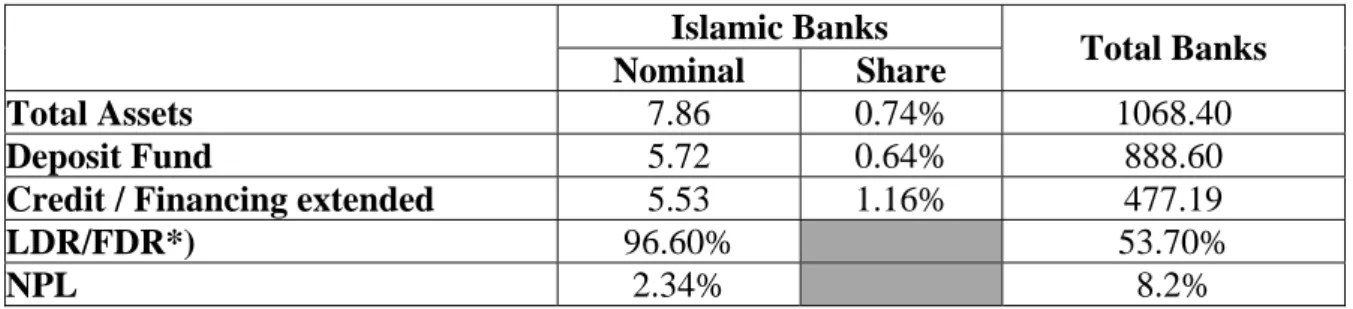
After several years of survival and fighting, Indonesian Islamic banks are still attempting to achieve a better position in the national banking industry. Recent figures from Bank Indonesia (2004) shows that the shares of Indonesian Islamic banks are still very low, with the shares of total assets and deposit fund are only less than 2% in December 2003, as can be seen in detail on table 1 below.
Islamic Banks
Nominal Share Total Banks
Total Assets 7.86 0.74% 1068.40
Deposit Fund 5.72 0.64% 888.60
Credit / Financing extended 5.53 1.16% 477.19
LDR/FDR*) 96.60% 53.70%
NPL 2.34% 8.2%
Table 1. Islamic Bank’s Share to All Banks (December 2003 Position) Source: Bank Indonesia (2004)
Nevertheless, the increasing number of Islamic commercial banks and Islamic banking unit in Indonesia has consequently been followed by an increase in the nominal volume of both mudaraba saving deposit and mudaraba investment deposit in the banks. According to Bank Indonesia, while in 1998 there was only one Islamic commercial bank in Indonesia with total volume of the deposits reached approximately IDR 463.45 billion, by the end of 2003 there were 2 Islamic commercial banks and 6 Islamic banking units with total volume of the deposits reached approximately IDR 6.62 trillion (Bank Indonesia, 2004).
It is generally acceptable that the volume of fund that depositors entrust in banks plays an important role as a source of funds to be utilised by investors (Haron and Ahmad, 2000). In
Islamic banks, there are several types of deposits that a depositor can obtain, but the types are not identical in different countries.1
In Indonesia, there are three types of deposits fund that are offered: wadiah currency account, mudaraba saving account, and mudaraba investment account. The composition of these accounts is illustrated on table 2 below.
Table 2. Composition of Deposit Fund of Islamic Banks (Million IDRs)
DEPOSIT FUND Jun 2003 Sep 2003 Nov 2003 Dec 2003 Jan 2004 Amount 387,316 602,950 546,857 637,478 664,621 Wadiah currency account Share 10.24% 12.98% 10.60% 11.14% 10.04% Amount 1,303,667 1,290,680 1,433,202 1,610,616 1,903,930 Mudaraba saving account Share 34.47% 27.78% 27.77% 28.13% 28.75% Amount 2,090,776 2,752,558 3,180,897 3,476,815 4,054,418 Mudaraba investment account Share 55.29% 59.24% 61.63% 60.73% 61.22% Total 3,781,759 4,646,188 5,160,956 5,724,909 6,622,969
Source: Bank Indonesia, 2004
It can be noticed from table 2 above that among the three types of deposits fund, mudaraba investment account has the biggest share (approximately 60%) of total deposit fund that can be collected by Islamic banks in Indonesia, whereas wadiah currency account has the smallest share (approximately 10%). It can also be seen from the table that in nominal terms, the volume of mudaraba saving account and mudaraba investment account has grown significantly from June 2003 to January 2004.
This paper investigates the factors influencing deposit fund, in particular mudaraba deposits in Indonesia. The paper is structured as follows. The following sub-section will discuss mainly about previous research on similar issue. Then, this paper will provide model specification, followed by a discussion on the estimation result. The concluding remarks will be presented in the last sub-section.
Literature Review
Economists, mainly conventional ones, believe that depositors are attracted to deposit their money in banks because of the opportunity cost of holding cash in hand is high when the interest rate is also high (Romer, 2001, p. 346; Athukorala and Sen, 2004, p. 498). This can easily be explained by the utility maximisation (cost minimisation) premise, as a depositor will choose an action that will maximise their welfare or satisfaction.
1
This is because in different countries, different principles are adopted by their Islamic banks. See Haron, S. (undated, available on http://www.kaau.edu.sa/CENTERS/SPC/Page-082.htm) for details.
2
2
nd
The question of whether depositors of Islamic banks are also motivated by the returns of the money has been recently answered at least by Gerrard and Cunningham (1997), Metawa and Almossawi (1998), Haron and Ahmad (2000), and Ghafur (2003).
Gerrard and Cunningham (1997) find that even in a country that is not a Muslim country like Singapore, muslims are still maintaining their beliefs so that they “would retain deposits within the Islamic banking movement, even if the Islamic bank at which they deposited their money made no profits in any one year” (Gerrard and Cunningham, 1997). However, they suggest that Islamic banks should aim for profit, because 20.7% of their Muslim respondents would withdraw their deposits if “an Islamic bank does not generate sufficient profits to enable a distribution to take place in any one year” (Gerrard and Cunningham, 1997).
Metawa and Almossawi (1998) come across a different conclusion from Gerrard and Cunningham (1997). Metawa and Almossawi (1997) conducted research in Bahrain, and find out that the bank selection decision by depositors is mainly religious-based, and then followed by rate of return. It may be said that in a country with most of the people embrace Islam such as Bahrain, rate of return is not the primary variable that influence the volume of deposits in its Islamic banks.
Then, Haron and Ahmad (2000), believes that depositors are still motivated by returns. Using an Adaptive Expectation Model (AEM), they find that depositors are indeed motivated by returns in Malaysia. Their estimation result shows that a one percent increase in the rate of profit given to the interest free deposits is seen to boost the total amount of this deposit by 71 million Malaysian Ringgit, and that interest rate of conventional bank have a negative relationship with deposits with Islamic banks, which means that a one percent increase in the interest rate of the conventional banks would reduce the level of interest free investment deposits by 65 milllion Malaysian Ringgit (Haron and Ahmad, 2000). This means that conventional banks are still a complement, rather than a substitute, in Malaysia. This finding is inconsistent with the one that is discovered by Metawa and Almossawi, even though both
researches are accomplished in Muslim countries.2 In their last sentences, Haron and Ahmad
(2000) states:
“…Muslim should be guided by Islamic doctrines when making their economic decision. These doctrines require that Muslims should not placed profit maximisation as the sole factor in establishing relationship with Islamic banks…” (Haron and Ahmad, 2000)
The study of whether depositors are motivated by rate of returns in one of Indonesia’s Islamic commercial bank, Bank Muamalat Indonesia, is conducted by Ghafur (2003). He follows Haron and Ahmad’s (2000) model, but instead of using an AEM, he uses an Autoregressive Distributed Lag (ADL) model. He argues that this model can capture lagged independent variables as well as lagged dependent variable in a more explicit form. He also claims that:
“The difference of Autoregressive Distributed Lag (ADL) model with other dynamic models such as Partial Adjustment Model (PAM) or Error Correction
2
Model (ECM) is that in ADL, no integration test is necessary to be done.”
(Ghafur, 2003, pp. 17)3
Moreover, Ghafur’s (2003) estimation result shows that the volume of mudaraba deposits at Bank Muamalat Indonesia is not influenced by rate of returns (profit sharing rate). Interestingly, the rate of interest does not have any influence on the volume of the deposits. Ghafur (2003) hence believes that returns is not the factor that attracts depositors to put their money at Bank Muamalat Indonesia. To some extent, his conclusion is analogous with Metawa and Almossawi’s (1998) conclusion.
Model Specification
In attempting to investigate factors that affects mudaraba deposits in Indonesia, this papers follows Haron and Ahmad’s (2000) model, but slightly modifies the model by adding one more variable, which is the number of branch offices of Islamic commercial bank in Indonesia. The argument is that, in Indonesian case in particular, more Islamic banks outlets would increase the possibility of a potential customer to indeed become a depositor of an Islamic bank.
The model is constructed as:
(
)
Muddep=Muddep PSrate, Intrate,GDP,Branch
where Muddep is mudaraba deposits, PSrate is profit sharing rate, Intrate is interest rate, GDP is Gross Domestic Product, and Branch is number of branch office of the Islamic commercial banks.4
It is expected that the higher the profit sharing rate, the higher the volume of mudaraba deposit, if Indonesians are following utility maximisation premise. In other words, it is the rate of returns, rather than religious arguments, which drives depositors to entrust their funds in Islamic banks. The data for this variable is obtained from Bank Indonesia.
Then, to investigate whether Islamic banks are substitutes, not complements of conventional banks, interest rate has been chosen as the variable that can explain such a question. If interest rate is positively related to mudaraba deposits, then Islamic banks can be said as acted as a substitute of conventional banks. In contrast, if interest rate is negatively related to mudaraba deposits, then Islamic banks in Indonesia are still complements of conventional banks.
Lastly, to examine the Marginal Propensity to Save (MPS) in Islamic banks, GDP has been used as another variable. The higher the coefficient of GDP, the higher the MPS in Islamic banks.
3
This statement needs to be clarified, as Johnston and DiNardo (1997) and Koop (2000) state that a spurious regression problem may occur in an ADL model, hence a cointegration test is necessary to be done (Johnston and DiNardo, 1997, pp. 259 – 265; Koop, 2000, pp. 109).
4
The data used in this paper is a quarterly data from 1993.I to 2003.IV. An interpolation method has been used to obtain a non-quarterly data, following Ghafur (2003).
4
2
nd
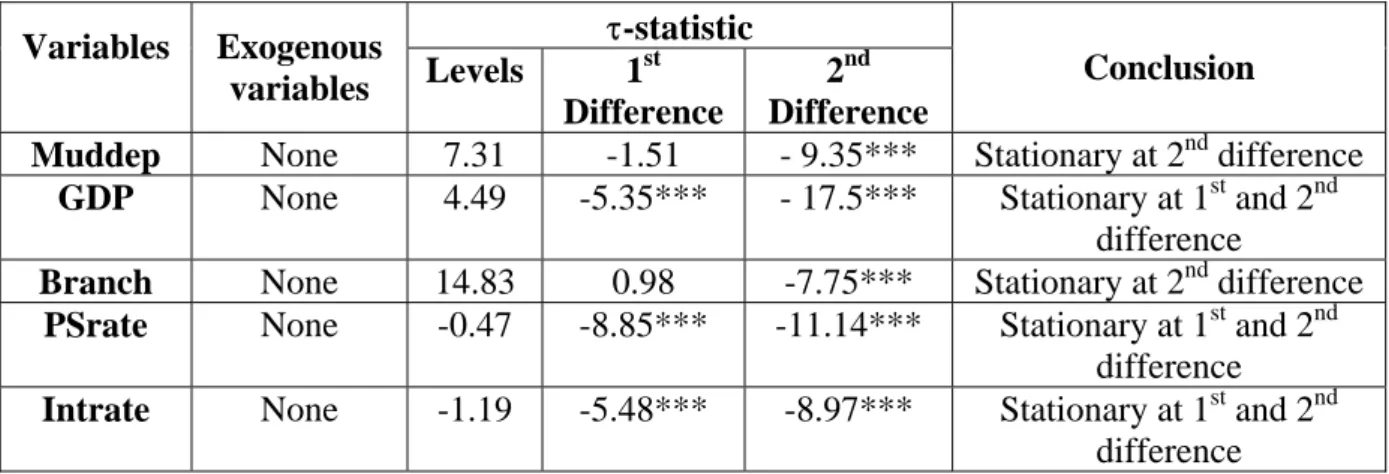
Different with Haron and Ahmad (2000) and Ghafur (2003), the above model is estimated using Ordinary Least Square method. Beforehand, the Augmented Dickey Fuller (ADF) test is conducted to find out whether the data is non-stationary, or in what order of integration the data is stationary. The result of the ADF test is shown on table 3 below.
τ-statistic Variables Exogenous variables Levels 1 st Difference 2nd Difference Conclusion
Muddep None 7.31 -1.51 - 9.35*** Stationary at 2nd difference
GDP None 4.49 -5.35*** - 17.5*** Stationary at 1st and 2nd
difference
Branch None 14.83 0.98 -7.75*** Stationary at 2nd difference
PSrate None -0.47 -8.85*** -11.14*** Stationary at 1st and 2nd difference
Intrate None -1.19 -5.48*** -8.97*** Stationary at 1st and 2nd difference
* significant at a=0.1; ** significant at a=0.05; *** significant at a=0.01
τ-critical values: Levels (0.1) = -1.6198; Levels (0.05) = -1.9486; Levels (0.01) = - 2.6188; 1st Difference (0.1) = -1.6199; 1st Difference (0.05) = -1.9488; 1st Difference (0.01) = - 2.6182; 2nd Difference (0.1) = - 1.6200; 2nd Difference (0.05) = - 1.9490; 2nd Difference (0.01) = - 2.6196
Table 3. ADF Test Result
The ADF test is conducted without incorporating either a constant or trend, because the behaviour of all data shows that a constant or a trend is insignificant. It can be seen that all of the variables are I(2) processes, so a cointegration test should be done to investigate whether there is a stationary linear combination among the variables to avoid the problem of spurious regression (Johnston and DiNardo, 1997, pp. 263; Koop, 2000, pp. 109 – 123; Rao, 1994, pp.2).
However, because the variables are I(2) variables, as has been discussed by Haldrup (1994), different types of cointegration might occur.
“Firstly, linear combination of I(2) variables can be I(1) or even I(0), and secondly, the possibility arises that some linear I(1) combinations cointegrate with differences of the I(2) processes.” (Haldrup, 1994, pp. 154)
Haldrup (1994) also shows the computed critical values for the cointegration ADF test with I(1) and I(2) variables.5
Then, the cointegration test is conducted for the I(1) and I(2) series through the residual based test for I(2) cointegration. First of all, levels regression on all variables is conducted. The residual of this regression is then tested using the residual based test for I(0) cointegration among the variables. The result of the regression is:
5
However, since Haldrup (1994) incorporates a constant in the cointegration regression, his calculated τ -statistics may not be best for this paper.
Equation (1)
Muddept = – 233467,5 – 0,004774 GDPt + 49237,68 Brancht + 53755,64 PSratet +
t-statistics (-1.350568) (-6.314877) (19.65086) (2.669632) 3948,818 Intratet
(1.532975)
F-statistics = 460.3415 DW statistics = 0.968449
R2 = 0.979259 Adj. R2 = 0.977132
Using the rule of thumb of checking spurious regression, it can be seen that the R2 values
exceeds the DW statistics. As noted by Johnston and DiNardio (1997, pp. 260 – 261) and
Gujarati (2003, pp. 807), if R2 is higher than DW, then the regression may be spurious.
Afterwards, the residual based test is conducted as follows:
∆ Ut = ρ Ut-1 + Ut
And the result is that
∆U t = -0.487177 U t -1
τ-statistics = - 3,690741
τ-critical (usual ADF, α=0.01) = - 2,619851
τ-critical (Haldrup, 1994, with m1=3 and m2=3, α=0.01) = - 5,540000
Interesting results have been shown by the test. Firstly, using the usual τ-critical value, it may be concluded that the regression is not a spurious regression, since the τ-critical is bigger than
the τ-statistics. However, if τ-critical of Haldrup (1994) is applied, then the conclusion is
different. Equation (1) is a spurious regression, so it supports the rule of thumb of spurious regression when R2 > DW statistics.
Then, to check the genuine relationship, a reparameterization of the cointegrating variables is
worth to undertake.6 The reparameteriation is accomplished by taking the first differences of
all the variables (Johnston and DiNardo, 1997, pg 275 – 279). The reparameterization result is
Equation (2)
∆ Muddept = 8105.073 – 0.003070 ∆GDPt + 41489.21 ∆ Brancht + 39917.48 ∆ PSrate +
t-statistics (0.212976) (-1.266957) (7.998604) (2.797496) 2088.885 ∆ Intratet
(0.562959)
6
As has been discussed on page 5 above, Haldrup (1994) has stated that there might exist a I(1) linear combination of I(2) differences. As an addition, Maddala also supported the idea of reparameterization, as he stated “…use the first difference form whenever d < R2…” (Maddala, 2001, pp. 232).
6
2
nd
F-stat = 17.14085 DW = 1.957221
R2 = 0,643405 Adj. R2 = 0,605868
The estimation of equation (2) shows that DW statistics is now less than R2, so there is a
strong possibility that the regression is not a spurious regression.
The result of the cointegration test of equation (2), using the residual based test is
∆U t = -1,061263 U t -1
τ-statistics = - 6,285198
τ-critical (usual ADF, α=0.01) = - 2,621185
τ-critical of Haldrup is not available for m2 = 4
Based on the residual test, using only usual ADF τ-critical value, equation (2) is not a
spurious regression.
To check the significancy of the coefficients of the variables in equation (2), a t-test is necessary to be done. The critical values of t-test for equation (2) is presented on table 4 below.7
Variables t-statistics Ho Conclusion Intercept 0,212976 Not Rejected Statistically insignificant
∆ GDP -1,266957 Not Rejected Statistically insignificant
∆ Branch 7,998604 Rejected Statistically significant at α=0.01
∆ PSrate 2,797496 Rejected Statistically significant at α=0.05
∆ Intrate 0,562959 Not Rejected Statistically insignificant Table 4. t-test statistics result
From the regression result of equation (2), it may be said that the change in the mudaraba deposits in Indonesia is influenced by the change in the number of branch offices of the Islamic commercial banks and the change of profit sharing rate, while a change in GDP and interest rate does not influence the change in mudaraba deposit.
From the estimation result, a 1 unit change in the branch office (if branch office of the Islamic commercial bank increase by 1 unit), it would improve the position of mudaraba deposits in Islamic commercial banks in Indonesia by 41,489.21 million Rupiahs. In addition, a 1% increase in profit sharing rate would increase the volume of mudaraba deposits in Islamic commercial banks in Indonesia by 39,917.48 million Rupiahs.
As has been argued by econometrician (Rao, 1994; Gujarati, 2003; or Koop, 2000), a cointegration can be regarded as a long run relationship. Hence, it can be said that, in the long run, depositors are indeed influenced by rate of returns of Islamic banks, as well as how accessible the banks are.
7
Other tests, such as F-test, multicollinearity test, and autocorrelation test have been conducted, and the results show that the model does not suffer from the problems.
Concluding Remarks
This paper has attempted to investigate the influence of GDP, number of branch offices, profit sharing rate, and interest rate of conventional banks, on the volume of mudaraba deposits in Indonesia. From the estimation, it may be concluded that there have been a long run relationship between the volume of mudaraba deposits and profit sharing rate and number of branch offices of Islamic commercial banks in Indonesia.
It can be said that, aside from religious considerations, in the long run, Indonesian depositors are indeed influenced by welfare maximisation premise, and accessibility of the Islamic commercial banks.
It can be suggested that, if the Islamic commercial banks would like to collect more funds, a competitive profit sharing rate (with regard to conventional bank’s interest rate) should be exercised, and more branch offices or outlets are built.
8
2
nd
References
Athokorala, P-C., and Kunal Sen, (2004), The Determinants of Private Saving in India, World Development Vol. 32 (3), pp. 491–503.
Bank Indonesia, (2004), Islamic Banking Statistics
Djazuli, H.A., and Yadi Janwari (2002), Ummah Economic Institution: An Introduction (in Indonesian), Rajawali Press
Ghafur, M., (2003), The Effect of Profit Sharing, Interest Rate, and Income on Mudaraba Deposits: Case Study of Bank Muamalat Indonesia (BMI) (in Indonesian), Journal of Islamic Economics Muamalah, Vol. 1, No. 1, pp 7.
Gerrard, P., and J. Barton Cunningham, (1997), Islamic Banking: A Study in Singapore, The International Journal of Bank Marketing, Vol 15 (6), pp. 204.
Gujarati, D.N. (2003), Basic Econometrics, 4th Ed., McGrawHill.
Haldrup, N. (1994), The asymptotics of single-equation cointegration regressions with I(1) and I(2) variables, Journal of Econometrics, Vol. 63, pp. 153 – 181.
Haron, S., and Norafifah Ahmad, (2000), The Effects of Conventional Interest Rates and Rate of Profit on Funds Depositsed With Islamic Banking System in Malaysia, Journal of Islamic Financial Services, Vol. 1, No. 4
Haron, S., (undated), A Comparative Study of Islamic Banking Practices, available on: http://www.kaau.edu.sa/CENTERS/SPC/Page-092.htm
Johnston, J., and John DiNardo (1997), Econometric Methods, 4th ed., McGrawHill
Koop, G. (2000), Analysis of Economic Data, John Wiley and Sons Maddala, G.S (2001), Econometrics, McGrawHill
Metawa, S.A. and Mohammed Almossawi, (1998), Banking Behaviour of Islamic Bank Customers: Perspectives and Implications, The International Journal of Bank Marketing, Vol 16 (7), pp. 299.
Muhamad (ed.), (2002), Sharia Bank: An Analysis of Strength, Weakness, Opportunity, and Threat (in Indonesian), Ekonisia
Rachmawati, E., (2004), An Analysis of Factors Determining Mudaraba Deposits on Islamic Bank in Indonesia Period 1993.I – 2003.IV Using Cointegration and Error Correction Mechanism Approach, Unpublished Bachelor’s Thesis, Universitas Padjadjaran
Rao, B. B. (1994), Cointegration For the Applied Economist, StMartin Press