Cranfield University
J. Satrijo Tanudjojo
Measuring Readiness to Implement Systems that Create,
Mobilise and Diffuse Knowledge
School of Management
Cranfield University
School of Management
Doctor of Business Administration
2006
J. Satrijo Tanudjojo
Measuring Readiness to Implement Systems that Create,
Mobilise and Diffuse Knowledge
Supervisor: Dr. Ashley Braganza Panel Chair: Prof. John Bessant Panel Member: Dr. Chris Morgan
Academic Year 2002 to 2006
This thesis is submitted in partial fulfilment of the requirements
for the degree of Doctor of Business Administration
© Cranfield University, 2006. All rights reserved. No part of this publication may be reproducedPUBLICATIONS
During the course of the research, presentation of the work and academic peer review took place through several channels. In the earlier stages of the research, during 2004, I presented the work to a Research Colloquium in the Cranfield School of Management.
The research and emergent findings were submitted to, accepted by, and presented through different academic conferences. A paper has been published in the Journal of Information and Knowledge Management in the September 2006 issue. Another paper has been accepted for publication in the Information Systems Journal.
Tanudjojo, S, Braganza, A (2003), ‘Knowledge Management: Practice, Discipline or Hype?’, Academy of Management Conference 2003, Seattle, USA.
Tanudjojo, S, Braganza, A (2003), ‘Technology mediated micro decision making in a technical delivery process: Towards a knowledge-based research agenda’,British Academy of Management Conference 2003, Harrogate, UK.
Tanudjojo, S, Braganza, A (2003), ‘Intranet and Knowledge Management: Putting the cart before the horse?’, 10th European Conference on Information Technology Evaluation, Madrid, Spain.
Tanudjojo, S, Braganza, A (2004), ‘Evidence-based attributes for effective Knowledge Management: A case study in an oilfield service company’, United Kingdom Association of Information System
Conference 2004, Scotland, UK.
Tanudjojo, S, Braganza, A (2004), ‘Shaping knowledge management for business results: In search of the critical attributes that enable the creation, mobilization, and diffusion of knowledge’, Academy of
Management Conference 2004, New Orleans, USA.
Tanudjojo, S, Braganza, A (2004), ‘Toward the Knowledge Management Readiness Model: Identifying a network of attributes’, British Academy of Management Conference 2004, St. Andrews, UK.
Tanudjojo, S, Braganza, A (2005), ‘Removing the clutters for efficient knowledge flow: evidence-based attributes enabling the creation, mobilization, and diffusion of knowledge’, 38th Annual Hawaii
International Conference on System Sciences, Hawaii.
Tanudjojo, S, Braganza, A (2005), ‘A Challenge for Innovation Exploitation: Developing Organizational Readiness for Managing Knowledge’, 6th International CINet Conference, Brighton, U.K.
Tanudjojo, S, Braganza, A (2005), ‘Results from an Empirical Study for Assessing Knowledge Management System Implementation’, Academy of Management Conference 2005, Hawaii.
Tanudjojo, S, Braganza, A (2005), ‘Developing Organisational Readiness for Managing Knowledge’,
British Academy of Management Conference 2005, Oxford, UK.
Tanudjojo, S, Braganza, A (2006), ‘Intranet and Knowledge Management: Putting the cart before the horse?’, Journal of Information and Knowledge Management, Vol. 5, No. 3, September, pp. 1-10. Braganza, A, Hackney, R, Tanudjojo, S, (Forthcoming), ‘Organizational Knowledge Transfer through Creation, Mobilization and Diffusion: a case analysis of InTouch within Schlumberger’, Information Systems Journal.
ABSTRACT
This thesis focuses on pre-conditions for organisations to implement knowledge management systems (KMS). Prior research suggests knowledge management (KM) is a capability and, as such, organisations need to know if they are ready to embark on KM initiatives that develop this capability. The findings of my research contend that measuring readiness is a prerequisite for implementing KMS holistically. I argue that effective KMS integrates the creation, mobilisation and diffusion stages of the knowledge life-cycle. Therefore, a system for gauging organisational readiness for KMS necessitates understanding the organisation’s inclination to create, mobilise and diffuse knowledge. Drawing from Socio-Technical Systems (STS) Theory, this study uses three dimensions, Infrastructure, Knowledge Structure and Knowledge Culture, to gauge each stage of the knowledge life-cycle. This study develops an instrument – the Knowledge Implementation Assessment Tool (KIAT) – to assess an organisation’s readiness for KMS. An organisation’s readiness can be said to increase as the measure on each dimension increases. In addition, this study found that structurally diverse Communities For Performance are needed to leverage Communities Of Practice in delivering direct business results, and that the implementation of KMS must be governed within and by cross-functional business processes.
The knowledge-based theory of the firm and the knowledge life-cycle theory provide a conceptual understanding that managing the creation, mobilisation and diffusion of knowledge can yield competitive advantage. Based on these theories, an in-depth case study was conducted in Schlumberger’s technical service delivery process. The study analysed the implementation and the use of InTouch, Schlumberger’s KMS. The case study was conducted using an Abductive research strategy. The Means-End Chain approach and its laddering technique were used to collect and analyse data to establish 35 attributes vital for the implementation of an effective KMS – one that brings beneficial results. These attributes form the basis for creating the readiness assessment instrument – KIAT.
A KMS implementation affects the social and technical aspects of an organisation. This study categorised the attributes along the three STS dimensions. The basis of the categorisation was the fit between each attribute and an STS dimension. The result is an assessment instrument to measure organisational readiness. The instrument, KIAT, consists of 50 factors to measure organisational readiness along the three STS dimensions for the creation, mobilisation and diffusion of knowledge.
KIAT is operationalised in three organisational cases in different industries and processes. This allowed the instrument to be refined and led to the development of procedures to apply KIAT. The cases suggest that KIAT provides useful insights to discover or confirm KMS readiness where a cross-functional business process is the unit of analysis.
The research contributes to research methodology in the KM field, as it is the first to use the Means-End Chain approach into knowledge management research by representing a hierarchy of organisational goals in a knowledge management initiative. For practitioners, my research makes two contributions. One, the KIAT readiness assessment instrument to diagnose their organisational readiness and take informed decisions. Two, the understanding of Communities For Performance. This study points the way for further research. This includes directions to explore the relationship between the levels of readiness and the effectiveness of KMS implementation, the relationship between organisations’ experience and their readiness, and the relationship between the dynamics of the KIAT Factors and organisational learning.
Keywords: Knowledge Management, Knowledge Management System, Knowledge Sharing, Means-End Chain, Laddering Technique, Socio-Technical System, Organisational Development
ACKNOWLEDGEMENTS
I confess that I often take things for granted when it comes to the person I love the most. The fact that Mayang, my wife, is always there when I need her, has contributed greatly to the achievement of my doctorate study. To her, I firstly dedicate my work.
Our eleven year only son, Benedict, has also been very patient in trying to be considerate when I could not play with him or assist him with his homework because I was busy doing my own study. At times, I became impatient to him when the pressure became high. To him, I secondly dedicate my work, with the wish that I may be an example for him to pursue higher professional and academic ambitions in his future for the benefit of mankind.
Undertaking a doctoral research is a major commitment. When this is concurrent with a full-time job the undertaking is significant. In the four years spent working on this research, I have discovered much that is new to me and a little that is new to the world. Along the way many people have assisted and supported me in this undertaking. Some warrant special mention. I would acknowledge the foremost contribution from Dr. Ashley Braganza, my supervisor, without whom there would be no thesis to read. His dedication, scholarship and direction for my work have not only been instrumental in bringing this work into reality, I regarded his guidance as a fundamental necessity. My panel chair, Prof. John Bessant, played a critical role in ensuring that I stayed on track and focused. The clarity of both his critiques and support is such that ambiguity became cleared. I learnt from him that clarity creates transparency. The panel member, Dr. Chris Morgan, stressed the importance of looking at things in a holistic way.
I also owe gratitude to the faculty members of Cranfield School Management, especially to Prof. Kim James who always makes herself available, listens, and tries her best to come up with solutions to issues. Prof. Richard Croucher who elaborately went through a painstaking path to ensure that his students understand and go through the research with his “Street-fighters Guide” to research. His genuine helping hands make me feel I can make it. I also thank Prof. Ann Huff who patiently provided critiques and guidance in the last stage of my study. Many more faculty members and staff have contributed to my doctoral study. It would take many pages to list them all with their contribution. However, I take this opportunity to thank Barbara Birtles for her continuous support as the programme administrator and to Anita Beal from the Cranfield library who tirelessly responded to my request for articles and books.
The research would not happen without the support from Schlumberger that allows me to conduct the research around InTouch. For this, I would like to express my thanks to Peter Day, Jim Donegan, Saad Bargach and Khem Mengrai. I also thank Marie-Odile Lavenant of AREVA, the company I currently work for, for her support to my study since I moved from Schlumberger to AREVA. My thanks also go to Power International, Friends Provident and Schlumberger LMS for participating in KIAT’s application within the organisations.
A research work almost never stands alone. It is related to many other previous, relevant works. This is definitely the case in my research. It is impossible to name all scholars and practitioners who have contributed to this piece of work. I pray for those who always strive for a better world to live in, as that is what we are created for.
TABLE OF CONTENTS
PUBLICATION ... iii
ABSTRACT ... v
ACKNOWLEDGEMENTS ... vii
TABLE OF FIGURES ... xiv
TABLE OF TABLES ... xvi
TABLE OF KEY TERMS... xviii
1 CHAPTER ONE: LINKING COMMENTARY ... 1
1.1 Introduction and Background of the thesis... 1
1.1.1 Key Concepts and the Business Issue ... 2
1.1.2 Gap in existing research ... 5
1.1.3 Towards Readiness Assessment Instrument... 7
1.1.4 The structure of this thesis... 8
1.2 The Research Questions and Project Structure... 9
1.2.1 Developing the research questions ... 9
1.2.2 Project structure... 9
1.3 Overview of the Research Design ... 10
1.3.1 Research Philosophy ... 11
1.3.2 The choice of Research Methods ... 11
1.4 Summary of Key Findings of the research ... 15
1.4.1 Attributes for effective implementation of knowledge management systems 15 1.4.2 Readiness Assessment is Essential... 15
1.4.3 A different type of knowledge community ... 18
1.4.4 Knowledge Management System brings important benefits to the firm 20 1.5 Contributions to Theoretical Knowledge ... 22
1.5.1 Knowledge Implementation Assessment Tool (KIAT)... 23
1.5.2 Managing the Creation, Mobilisation and Diffusion of Knowledge... 27
1.5.3 Communities For Performance... 32
1.5.4 Business Process and Structural Diversity in KMS Implementation ... 35
1.6 Contributions to Methodology ... 37
1.7 Contributions to Practice ... 38
1.7.1 Contribution of KIAT to practitioners... 38
1.7.2 Contribution of CFP to practitioners ... 40
1.8 Limitations and Further Research ... 40
1.8.1 Limitations of the research ... 40
1.8.2 Opportunities for Further Research ... 42
1.9 Chapter Summary... 44
2 CHAPTER TWO: LITERATURE REVIEW AND RESEARCH QUESTIONS.. 45
2.1 Introduction ... 45
2.2 Literature review ... 47
2.3 Knowledge, Knowledge Management, Knowledge Management System .... 48
2.3.1 Knowledge: Concept Underpinning ... 48
2.3.2 Knowledge Management in Organisations ... 55
2.3.3 Knowledge Management Systems ... 64
2.3.4 Summary... 67
2.4.1 Knowledge Management as a Capability ... 69
2.4.2 Capability and Organisational Readiness... 70
2.4.3 Summary and Discussion ... 71
2.5 Socio-Technical System ... 72
2.5.1 Socio-Technical System: the concept and the history... 72
2.5.2 Socio-Technical System for Knowledge Management ... 74
2.5.3 Summary and Discussion ... 76
2.6 Organisational Development (OD)... 77
2.6.1 Organisational Development Scope ... 77
2.6.2 Organisational Development: Definition and Processes ... 80
2.6.3 Summary and Discussion ... 82
2.7 Summary of the Literature Review ... 82
2.8 The Research Questions ... 84
2.9 Chapter Summary... 84
3 CHAPTER THREE: THE RESEARCH METHODS AND PROJECT STRUCTURE... 85
3.1 The Research Method... 85
3.1.1 The Research Strategy... 85
3.1.2 Case Method... 89
3.1.3 The researcher’s role ... 91
3.1.4 Choosing the research site ... 91
3.1.5 The Means-Ends Chain and its Laddering Technique ... 92
3.2 Triangulation ... 98
3.3 Project Structure ... 101
3.4 Chapter Summary... 102
4 CHAPTER FOUR: PROJECT ONE ... 103
4.1 Introduction ... 103
4.2 The Research Question and Method... 105
4.2.1 Research Question ... 105
4.2.2 The Research Site and the Unit of Analysis... 105
4.2.3 Data Collection and Analysis ... 106
4.2.4 Participant Observation ... 107
4.2.5 Pilot Study: Data Collection, Analysis, Results and Discussion... 108
4.2.6 Main Study Data Collection and Analysis ... 112
4.3 Complementing InTouch Study with CRM Study ... 115
4.4 Findings and Results of Project One ... 119
4.4.1 Creation, Mobilisation, and Diffusion of Knowledge Before InTouch 119 4.4.2 Creation, Mobilisation, and Diffusion of Knowledge After InTouch .. 119
4.4.3 The Implication Matrix and The Hierarchical Value Map (HVM)... 122
4.5 Discussions and Conclusions ... 125
4.5.1 Discussion of Attributes ... 125
4.5.2 Discussion on InTouch Operations and Communities ... 137
4.5.3 Discussion on the research methods... 137
4.5.4 Summary and Conclusion of Project One ... 138
5 CHAPTER FIVE: PROJECT TWO... 141
5.1 Introduction ... 141
5.2 The Research Question and Method... 143
5.2.2 Research Strategy and Technique... 143
5.2.3 Adapting STS dimensions to Project Two ... 144
5.2.4 Relationships: Attributes and the STS dimensions ... 146
5.2.5 Measuring Organisational Readiness for implementing KMS... 149
5.2.6 Structuring the Guidelines to operationalise the organisational readiness instrument ... 150
5.3 Findings and Results of Project Two... 151
5.3.1 The relationships between the attributes and the STS dimensions for the creation, mobilisation and diffusion of knowledge ... 151
5.3.2 KIAT: Knowledge Implementation Assessment Tool ... 177
5.3.3 Towards a Guideline to Operationalise KIAT... 177
5.4 Summary and Conclusions of Project Two ... 179
6 CHAPTER SIX: PROJECT THREE... 181
6.1 Introduction ... 181
6.2 Research Question and Positioning of Project Three ... 183
6.2.1 Research Question ... 183
6.2.2 Positioning Project Three ... 183
6.3 Research Methods ... 184
6.3.1 First Organisation Case: Power International... 187
6.3.2 Second Organisation Case: Friends Provident ... 189
6.3.3 Third Organisation Case: Schlumberger LMS ... 190
6.4 Findings, Results, and Discussions ... 193
6.4.1 Power International ... 193 6.4.2 Friends Provident... 198 6.4.3 Schlumberger LMS ... 202 6.5 Multi-case discussion ... 206 6.5.1 Operationalising KIAT... 206 6.5.2 KIAT Results... 208 6.5.3 KIAT Version 1.1... 210
6.6 Summary and Conclusions of Project Three ... 213
6.7 Linking Document and Thesis... 214
7 CHAPTER SEVEN: PERSONAL DEVELOPMENT... 215
REFERENCES ... 218
APPENDICES... 231
Appendix 1: Summary of the literature review ... 233
Appendix 2: Guideline for Interview Questions – Data Collection Instrument ... 234
Appendix 3: Socio-Technical System (STS) History and Developent... 235
Appendix 4: Implication Matrix from Project One ... 237
Appendix 5: The changes of the description from KIAT version 1.0 to version 1.1 .. 238
Appendix 6: THE KIAT INSTRUMENT ... 239 ATTACHMENT
1 CD containing the following files:
1. Electronic format of this thesis: Tanudjojo_Thesis_2006.doc 2. Tanudjojo_KIAT Version 1_1_Project3.xls
3. Tanudjojo_PI_GroupWork_Proj3.xls 4. Tanudjojo_PI_RW_Proj3.xls
6. Tanudjojo_FP_2_Project3.xls 7. Tanudjojo_FP_3_Project3.xls 8. Tanudjojo_FP_4_Project3.xls 9. Tanudjojo_FP_Comparison_Project3.xls 10.Tanudjojo_FP_GroupWork_Project3.xls 11.Tanudjojo_SLB LMS_BHA_Project3.xls 12.Tanudjojo_SLB LMS_GroupWork_Project3.xls 13.Folder: KIAT Application to Literature Cases
TABLE OF FIGURES
Figure 1-1: The focus, method, discipline and outcomes of Projects One, Two, Three 10
Figure 1-2: Example of Organisational Readiness presentation ... 17
Figure 1-3: Interaction of knowledge community members within InTouch ... 19
Figure 1-4: Readiness vs Complexity for KIAT Factors... 42
Figure 2-1: Number of articles related to knowledge management from ProQuest search ... 46
Figure 2-2: Number of articles related to knowledge management from EBSCO search . ... 46
Figure 2-3: A Taxonomy of Organisational Knowledge (Matusik and Hill, 1998:684) 51 Figure 2-4: Comparison of Hansen et al.’s and Birkinshaw and Sheehan’s knowledge management strategies... 57
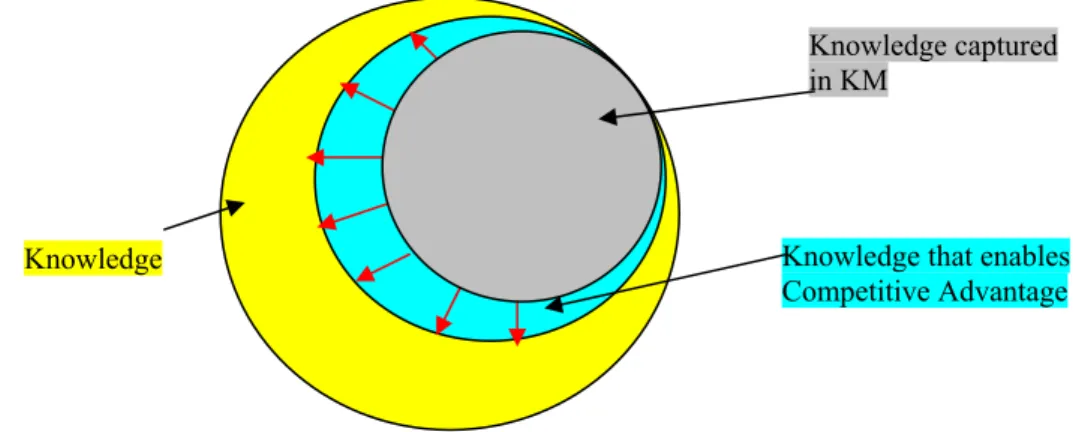
Figure 2-5: The conceptual inter-relationships of Knowledge, Knowledge that enables Competitive Advantage, and Knowledge captured in Knowledge Management... 63
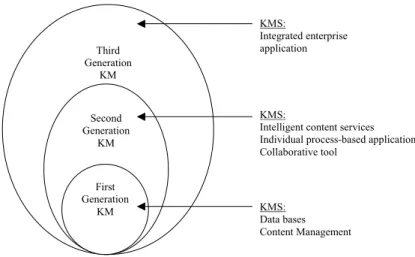
Figure 2-6: The three generations of knowledge management and the related knowledge management systems ... 67
Figure 2-7: Tacit and Explicit knowledge in the organisational knowledge creation and knowledge diffusion/application ... 69
Figure 2-8: A socio-technical perspective on Knowledge Management... 75
Figure 2-9: Organisational Development Process ... 81
Figure 3-1: Four philosophical paradigms suggested by Burrell and Morgan (1979) ...Error! Bookmark not defined. Figure 3-2: The Research Strategy and the Project Structure ... 90
Figure 3-3: Conceptual Means-End Chain model ... 94
Figure 3-4: The conceptual Means-End model representation for knowledge management... 98
Figure 4-1: The unit of analysis and the researcher’s position within the research ... 106
Figure 4-2: Graphical description of data analysis... 109
Figure 4-3: Examples of laddering from the InTouch study ... 110
Figure 4-4: Hierarchical Value Map from the pilot study... 110
Figure 4-5: Iterative nature of the data analysis ... 114
Figure 4-6: Comparison of InTouch users and CRM users... 117
Figure 4-7: The chain of information and knowledge flow prior to InTouch ... 119
Figure 4-8: InTouch links directly the field delivery site and the technology centres . 120 Figure 4-9: The final HVM of attributes, consequences and beneficial results, converging into Knowledge Creation, Knowledge Mobilisation, and Knowledge Diffusion... 121
Figure 5-1: Technique to find the structural relationships between the evidence-based attributes and the STS dimensions for knowledge management... 146
Figure 5-2: Technique to find the relationships between the (sub)attributes/factors and the knowledge creation, knowledge mobilisation and knowledge diffusion ... 148
Figure 5-3: Example of the results from an organisational readiness assessment instrument ... 149
Figure 5-4: The technique to structure the operational Guidelines of the organisational readiness instrument based on the Abductive research strategy ... 150
Figure 5-6: The outlined steps to carry out an interview or a group work... 178
Figure 6-1: KIAT in the OD process... 183
Figure 6-2: Multi-cases analysis... 185
Figure 6-3: KIAT reports from the interview with the service director ... 194
Figure 6-4: KIAT reports from the group work with six participants... 194
Figure 6-5: The knowledge management system for Power International: the process196 Figure 6-6: The initial perception of the director prior to operationalising KIAT vs. the KIAT Results... 197
Figure 6-7: KIAT reports from the individual work by the representative from the change management department ... 198
Figure 6-8: KIAT reports from the individual work by the representative from the finance department ... 199
Figure 6-9: KIAT reports from the individual work by the representative from the customer services department... 199
Figure 6-10: KIAT reports from the individual work by the representative from the sales and marketing department ... 199
Figure 6-11: KIAT reports from the group work with the three participants... 200
Figure 6-12: KIAT reports from the LMS Project Manager Mr. BHA... 203
TABLE OF TABLES
Table 1-1: Answers of the research to external scrutiny ... 13
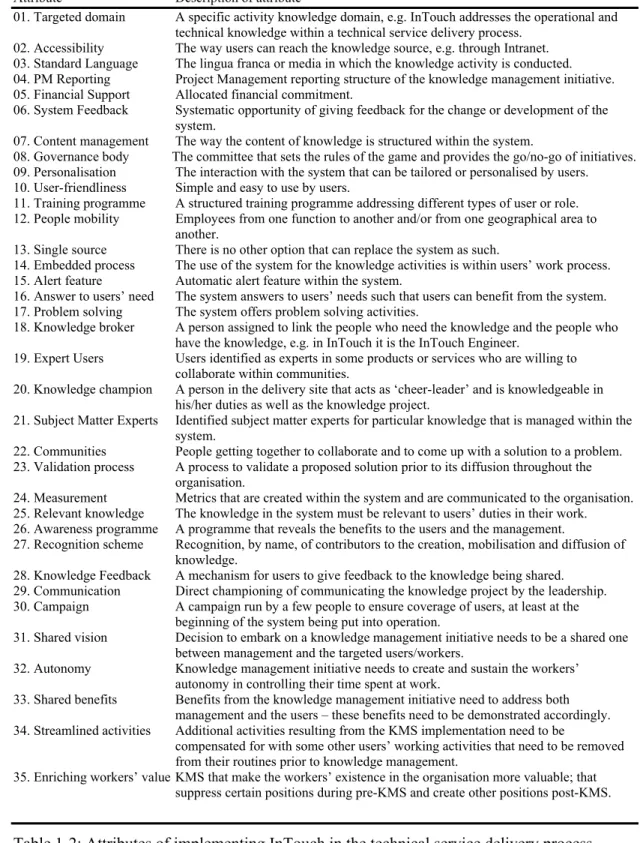
Table 1-2: Attributes of implementing InTouch in the technical service delivery process ... 16
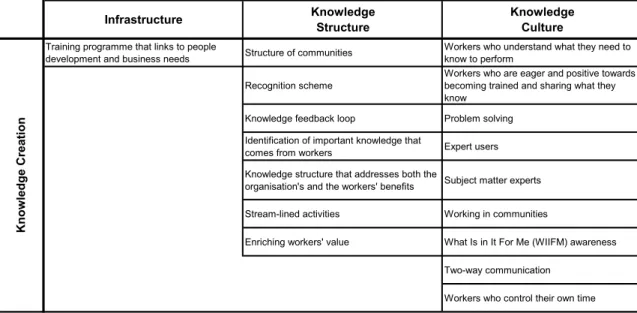
Table 1-3: Factors that significantly or completely affect the knowledge creation (KC) ... 29
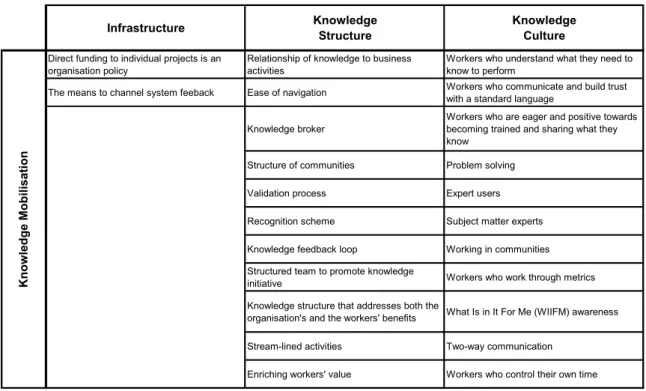
Table 1-4: Factors that significantly or completely affect the knowledge mobilisation (KM) ... 30
Table 1-5: Factors that significantly or completely affect the knowledge diffusion (KD) ... 32
Table 1-6: A snapshot comparison of CFP with other forms of organisation... 35
Table 2-1: Knowledge perspectives and the implication to knowledge management and knowledge management systems ... 53
Table 2-2: Turning tacit and explicit knowledge into competitive advantage from the perspective of two different theories of the firm. ... 54
Table 2-3: A snapshot comparison of CoP with other forms of organisation (Wenger and Snyder, 2000)... 59
Table 2-4: A comparison of the results of the work by Siemieniuch and Sinclair (2004) and Taylor and Wright (2004)... 71
Table 2-5: The three elements of a Network (adapted from Bressand & Distler, 1995) 74 Table 2-6: Characteristics in the development of OD - from Mukherji and Mukherji (1998) ... 79
Table 3-1: The logic of Blaikie’s (2000) four research strategies... 88
Table 3-2: Research strategies, objectives and questions (Blaikie, 2000) ... 89
Table 3-3: Comparison of the three systems in Schlumberger... 92
Table 3-4: Three research techniques for interpretive approaches... 93
Table 3-5: Techniques applied in the research to mitigate biases .Error! Bookmark not defined. Table 4-1: The data of the three pilot interviews... 108
Table 4-2: Attributes of InTouch in the technical service delivery process... 111
Table 4-3: Consequences – High level strategy elements of implementing InTouch.. 111
Table 4-4: Beneficial Results from InTouch ... 112
Table 4-5: List of interviewees for InTouch case... 113
Table 4-6: The interviewees for the complementary CRM case study ... 118
Table 4-7: Attributes of implementing InTouch in the technical service delivery process ... 124
Table 4-8: Consequences – High level strategy elements of implementing InTouch.. 125
Table 4-9: Beneficial Results from implementing InTouch... 125
Table 5-1: Socio-Technical Systems dimensions for Knowledge Management – Definitions ... 145
Table 5-2: Example of the analysis of the attribute Standard Language... 147
Table 5-3: Example of the analysis of relationships between factors and the stages of the knowledge life-cycle. ... 148
Table 5-4: Comparison of readiness Factors from Project Two and the previous works by Siemieniuch and Sinclair (2004) and Taylor and Wright (2004) ... 180
Table 6-2: Examples of verbatim from the Director and the KIAT Factors ... 188 Table 6-3: Participants from Friends Provident ... 189 Table 6-4: Participants of the group work from Schlumberger LMS ... 190 Table 6-5: Examples of verbatim from the LMS Project Manager and the KIAT Factors
... 192 Table 6-6: Variances of KIAT scores between the interview with the software director
and the group work with the six participants... 194 Table 6-7: Variances of KIAT scores between the interview with the project manager
and the group work with the four participants... 204 Table 6-8: List of Factors that are required for their descriptions and questions to be
modified... 211 Table 6-9: Factors that are identified to need revision from the FP group work ... 212 Table 6-10: List of Factors that are required for descriptions and questions to be
TABLE OF KEY TERMS
Attributes Practical items that the case study organisation actually created or where it took action when operationalising InTouch.
Business Process The coordination and integration of activities performed in different functions to create outputs that are of value to one or more stakeholders.
Competitive Advantage Competitive advantage is understood, in my research context, as quicker decision making in the field and a faster new product/service introduction, contributed by the capability of the firm that is not easily imitable.
Innovation Innovation refers to efforts to change products or processes based on new ideas.
InTouch InTouch is a registered name of the intranet-based Knowledge Management System that supports the worldwide technical service delivery process in Schlumberger.
.
Knowledge A fluid mix of framed experience, values, contextual information, and expert insight that provides a framework for evaluating and incorporating new experiences and information. In organisations, it often becomes embedded not only in documents or repositories but also in organisational routines, processes, practices, and norms
(from Davenport and Prusak, 1998).
Knowledge life-cycle Knowledge life-cycle theory suggests that knowledge goes through its creation, mobilisation, diffusion and commoditisation stages.
In this research the commoditisation stage is not included because this stage involves the public domain whereas my research focuses on the enterprise domain.
Knowledge Creation The stage of the knowledge life-cycle where knowledge starts out as a little more than an idea in someone’s head. At this stage, the idea may be rather abstract but coherent enough for testing.
Knowledge Mobilisation The stage of the knowledge life-cycle where an idea becomes more concrete and its broader value is established through continued testing and validation. The defining characteristic of this stage is that the originators share their
knowledge with people who make up part of a trusted community.
Knowledge Diffusion The stage of the knowledge life-cycle where a validated knowledge is available to anyone in the organisation who needs to use it.
Knowledge Management Organisational capability to create knowledge, mobilise and sustain it for continuous innovation and to diffuse it to the people who need the knowledge at the place where they need it and at the time when they need it.
Knowledge Management Information Systems that relate to Knowledge
Systems Management. They are tools to support the management of knowledge that employs Information Technology.
OD Interventions OD interventions are sets of structured activities in which selected organisational units engage in a sequence of tasks that will lead to organisational improvement.
Organisational Readiness The state of an organisation where the necessary preconditions to implement a knowledge management system are satisfied.
1
CHAPTER ONE: LINKING COMMENTARY
The last phase of an Executive Doctorate Study in Cranfield University requires me to write a linking commentary, which is a synthesis of the entire four year programme of research. This chapter is the linking commentary.
The linking commentary is structured as follows. It starts by describing the issues that my research addresses, identifying gaps in existing research, and by highlighting the key findings. It then proceeds to set out the research questions and the project structure to study each question. Then, an overview of the research methods is discussed. This is followed by a summary of the research key findings. Next, I elaborate this research’s contributions to theory, practice and methodology. The linking commentary closes with a discussion of the study’s limitations and recommendations for further research.
1.1 Introduction and Background of the thesis
Some organisations reap benefits from implementing knowledge management systems (KMS), but many more wonder what they need to do to benefit from KMS implementation (Majchrzak et al., 2004; Beccerra-Fernandez et al., 2004). Little is known as to what makes effective implementation of KMS that facilitates the creation, mobilisation and diffusion of knowledge. My research explores the factors for implementing KMS that brings beneficial results to organisations. Previous research indicates that organisational readiness plays an important role for the success of a KMS implementation. This research further seeks to provide a readiness measurement instrument, the Knowledge Implementation Assessment Tool (KIAT), incorporating knowledge life-cycle and socio-technical system theories. My research then tests KIAT in different business settings. Therefore, the nature of my research encompasses exploration and testing.
What is in a name?
KIAT stands for Knowledge Implementation Assessment Tool. The abbreviation “KIAT” has a meaning in itself in the Indonesian language (Bahasa Indonesia). Kiat, a noun, is a word in Bahasa Indonesia to express something intangible that a firm or an individual may own that will make the firm or the person in a stronger position, either in a business environment or in a battle field. In short, Kiat can mean competitive advantage. Assessing and addressing the readiness factors for an organisation to implement a knowledge management system will shape the organisation towards translating knowledge into competitive advantage.
Much of the literature addresses knowledge management as discrete activities, either knowledge creation (Un and Cuervo-Cazurra, 2004; von Krogh, 1998; Nonaka, 1991) or knowledge diffusion (Lesser and Storck, 2001; Storck and Hill, 2000). My research gives a different viewpoint leading to the argument that managing knowledge is an activity that goes across the stages of the knowledge life-cycle: creation, mobilisation and diffusion. KIAT measures the organisational readiness to create, mobilise and diffuse knowledge.
Furthermore, the results of the research show that the community within which knowledge activities take place does not correspond to the definition of Communities of Practice (COP). This leads to a finding that there may be another organisational form – Communities for Performance (CFP). The knowledge activities taking place in CFP produce direct beneficial results to organisations.
The initial empirical research was conducted in Schlumberger, an international oilfield organisation, with operations in more than eighty countries. InTouch, its intranet-based KMS, is the case for my study to construct KIAT. InTouch has won an award from Wharton Business School and Infosys Company as an effective knowledge management system implemented by Schlumberger in its technical service delivery process. The research applied the Means-End Chain approach with the Abductive research strategy. By incorporating Socio-technical system research for knowledge management into my research, KIAT was established. KIAT was then operationalised in three different processes within different organisations: Power International’s customer service delivery process, Friends Provident’s initiative to manage knowledge in the customer service process, and Schlumberger’s competency development process.
This thesis finds that (1) measuring readiness is a prerequisite for implementing KMS, (2) KMS implementation is effective when it integrates the creation, mobilisation and diffusion of knowledge; therefore, organisational readiness can be understood by gauging the readiness to create, mobilise and diffuse knowledge. The study further finds that (3) readiness to create knowledge increases as the measure of the infrastructure, knowledge structure, knowledge culture for knowledge creation increases, (4) readiness to mobilise knowledge increases as the measure of the infrastructure, knowledge structure, knowledge culture for knowledge mobilisation increases, (5) readiness to diffuse knowledge increases as the measure of the infrastructure, knowledge structure, knowledge culture for knowledge diffusion increases. The research also finds (6) Communities For Performance (CFP) that is different from Communities Of Practice (COP), and that (7) CFPs may be required to leverage COPs to deliver business results, (8) effective KMS implementation needs to be governed within and by business processes, (9) effective KMS implementation requires structurally diverse communities.
1.1.1 Key Concepts and the Business Issue Knowledge and Knowledge Management
Knowledge has long been recognised as a valuable resource for organisational growth and sustained competitive advantage (Bessant, 2003; Leonard-Barton, 1998; Drucker, 1995). Moreover, some researchers have argued that knowledge is an organisation’s most valuable resource because it represents intangible assets that are hard to imitate (Grant, 1996; Kogut and Zander, 1992). The knowledge-based view of the firm contends that knowledge created, mobilised, and diffused in social settings such as organisations, forms the basis for competitive advantage (Grant, 1996). Conventional economic resources such as land and capital arguably play a lesser role in an organisation’s quest to sustain competitive advantage as compared with its capability
to exploit knowledge (Kogut and Zander, 1992; Barney, 1991). Drucker anticipated that “the performance of an individual, an organisation, an industry, a country, in acquiring and applying knowledge will increasingly become the key competitive factor” (1995:236).
With the recognition that knowledge plays a critical role in the competitiveness of an organisation, consequently, it has drawn the attention of management teams of many organisations to how to manage knowledge. The subject of knowledge and how to manage it has grown in importance to practitioners who want to take advantage for business benefits and to academics to better understand the dynamics of knowledge interaction within organisations (Siemieniuch and Sinclair, 2004; Davenport et al., 2003; Birkinshaw, 2001).
Knowledge is differentiated from data and information, as Davenport and Prusak state, “knowledge is neither data nor information, though it is related to both, and the differences between these terms are often a matter of degree.” (1998:1). In the long tradition of Western epistemology, knowledge has been defined as ‘justified true belief’ (Nonaka and Takeuchi, 1995). Nonaka and Takeuchi (1995) argue that ‘knowledge is justified true belief’ gives an impression that knowledge is something objective, absolute and context-free; which, of course, is contrary to the fact that it is humans who hold and justify beliefs – knowledge cannot exist without human subjectivities and the contexts that surround humans. Since epistemologists spent centuries trying to understand what it means to know something, this thesis does not pretend to provide a definitive account. The literature indicates a number of knowledge’s essential characteristics: 1) knowledge is related to belief and commitment (Nonaka and Takeuchi, 1995), hence it is about meaning and can be intangible (Blair, 2002); 2) knowledge is dynamic and action oriented (Davenport and Prusak, 1998); 3) knowledge is about causal relationships (Sanchez, 2001a); 4) knowledge is contextual – it is a function of situation, experience, culture, and judgment (Davenport and Prusak, 1998); 5) knowledge is heuristic that enables a person to discover or learn something for him/herself (McInerney, 2002; Sanchez, 2001a); and 6) knowledge is a set of routines (Nelson and Winter, 1982).
One of the common themes emerging from the knowledge management literature suggests that knowledge management deals with knowledge activities with the objective to leverage the organisational knowledge for competitive advantage (Gupta and Govindarajan, 2000). At the heart of the knowledge management movement is the concept of the firm as a “social institution” (Birkinshaw, 2001; Tsoukas, 1994). The firm draws value from the employees within it and from its ability to harness their knowledge that then becomes organisational knowledge. But individuals also draw a value from the firm they work for – they learn from their colleagues and are able to accomplish tasks they could not do on their own (Kogut and Zander, 1992). The extent to which firms can bring both the knowledge they own, and the knowledge they can access, to bear on their ongoing activities can provide sources of competitive differentiation. Managing knowledge in an organisation, therefore, involves encouraging or persuading individuals to collaborate as well as capturing the knowledge to make it reusable and available for members of the organisation. Knowledge management is enacted when knowledge is created within the social network of the organisation, mobilised and validated within the knowledge communities and diffused throughout the organisation (Birkinshaw and Sheehan, 2002). Knowledge becomes available to those who need it at the place where they need it and at the time when they need it.
The knowledge management movement emerged in early 1990s following the growth of Information Technology (IT). It was soon acknowledged that knowledge management does not equate to implementing IT (Gold et al., 2001; Davenport and Prusak, 1998). Practitioners and academics argue that knowledge management is much more than technology. Knowledge management requires IT for its effectiveness. However, individuals interacting within the knowledge activities need social interaction – both for its own sake, and because it provides a powerful vehicle for learning (Brown and Duguid, 2001; Hansen and von Oetinger, 2001). At the heart of knowledge management are fundamental changes in the ways organisations operate and people behave (Birkinshaw, 2001). This argument has led academics and practitioners to look into how individuals create, mobilise and diffuse knowledge in Communities of Practice (COP).
A COP is a self-organised group of employees who share common work practices, interests, or aims (Wenger, 2000). COP has illuminated the understanding of how people interact that results in the creation, mobilisation and diffusion of knowledge, and that COP and information technology are complementary as demonstrated by Hansen et al. (1999) in their study of strategies in managing knowledge.
Birkinshaw and Sheehan (2002) suggest a knowledge life-cycle theory where knowledge goes through creation, mobilisation, diffusion and commoditisation stages. Furthermore, they argue that when implementing strategy for managing knowledge, an organisation needs to understand the life-cycle of the knowledge in question, and the appropriate tools and techniques needed to generate value from knowledge in each knowledge life-cycle stage. Four categories are recommended for consideration in each stage: informal systems for mobilising and sharing knowledge, information technology systems, human resources, and relationships with external parties.
Knowledge management requires IT to be effective (Birkinshaw and Sheehan, 2002; Davenport and Prusak, 1998). The development of IT for knowledge management, or Knowledge Management System (KMS) involves its use to facilitate social network interaction as well as content management. The recent development of KMS further includes the integration of different knowledge management initiatives within an organisation and between different organisations (for example Francis and Bessant, 2005; Cummings, 2004; Grant and Baden-Fuller, 2004). The KMS supporting this recent development may be tools such as Integrated Enterprise Applications. The objective is to optimise the different combination of existing knowledge management systems for the improved performance of certain alliances/partnerships or joint-developments (Grant and Baden-Fuller, 2004).
Challenges faced by practitioners and academics
Knowledge management has gone through different stages from its emergence in the early 1990s with different levels of acceptance and success in the business world. Gilmour (2003) describes frustration by claiming that US$4.5 billion was spent in 2003 in the USA on software and other technologies that are expected to foster knowledge sharing, without bringing the expected results. Yet certain firms have reported significant successes in implementing knowledge management (Hauschild et al., 2001; Davenport and Prusak, 1998) but many other firms show very few results from knowledge management. In other words, knowledge management promises much, but often delivers very little. Much research has been devoted to knowledge
management and there are no simple solutions to this challenge. A strand of the literature argues that core to the organisations’ inability to reap benefits from KMS implementation is the organisations’ unreadiness to implement KMS (Siemieniuch and Sinclair, 2004; Gold et al., 2001). My research is aimed at contributing to the measurement of organisational readiness to implement KMS that may bring beneficial results.
1.1.2 Gap in existing research
The promise and the reality of knowledge management
In a fast-moving and increasingly competitive world, a firm’s enduring source of advantage is its knowledge – the knowledge of its individual employees, and the knowledge that gets built into its structures and systems (Davenport et al., 2003; Birkinshaw, 2001). Despite the persistence of the phrase ‘knowledge management’ and the genuine feeling that knowledge management does refer to a new and legitimate practice, the problem remains that most companies struggle to implement KMS (Janz and Prasarnphanich, 2003; Cranfield University, 1998).
Several reasons have turned managers’ attention to knowledge management. Firstly, the realisation that it is necessary to capture individuals’ knowledge as they may leave for other organisations or retirement (Blair, 2002). Secondly, businesses require innovation where knowledge creation plays a fundamental role (Nonaka and Takeuchi, 1995). Thirdly, it is important that knowledge is made available to employees who need it where they need it and at the time they need it; knowledge is useful only, at least in business environments, when it can be translated into actions (Ghoshal and Gratton, 2002; Davenport and Glaser, 2002). In short, knowledge management promises 1) knowledge continuity within the firm, 2) a capacity for innovation, and 3) faster real-time diffusion of organisational knowledge across the geographical spread of the operations.
Beazley et al. (2003) contend that the management function has been redefined. According to them, for the first time in 100 years – since Henry Fayol described the five functions of a manager and the fourteen principles of management – a new function has emerged to alter the basic configuration of a manager’s responsibility, namely towards leveraging knowledge for the benefits of the organisation. “With knowledge as the new fulcrum on which organisational fortunes turn, preserving knowledge continuity has emerged as a basic management priority and, hence, a fundamental responsibility of management.” (Beazley et al., 2003:65). Very often knowledge ‘panic’ develops when someone – or some document – in the organisation holds knowledge, say for example, a new hire’s needs and nobody knows who has it or where to access the document (Blair, 2002; McInerney, 2002). Managing continuity of relevant knowledge can, therefore, provide a sustainable difference between competitor organisations, leading customers to select the organisation that can better manage continuity – in other words, continuity management provides competitive advantages (Beazley et al., 2003). Managing continuity turns out to be more complicated than suggested; employees are not eager to collaborate with each other or they may be concerned about their hierarchical position and status (Blair, 2002; Southon et al., 2002). The implementation of
continuity management requires overcoming cultural and structural barriers within the organisation.
It is acknowledged that innovative products and services are dependent on knowledge created within an organisation (Bessant, 2003; Leonard-Barton, 1998). Strategies for knowledge creation have become a popular area for scholars to study (Un and Cuervo-Cazurra, 2004). Nonaka and Takeuchi’s (1995) suggest that knowledge creation goes through a socialisation, externalisation, combination, and internalisation (SECI) mechanism which is an interplay between tacit and explicit knowledge. In order for the firm to become a knowledge system (Grant, 1996) the promotion of interactions among individuals who embody knowledge is required (Tsoukas, 1994; Polanyi, 1966). Whereas single individuals can create knowledge, and technology can facilitate the transfer of knowledge between individuals (Hansen and von Oetinger, 2001), a greater challenge for organisations is to promote social interactions that facilitate not only the transfer of explicit knowledge, but also the creation of both explicit and tacit knowledge (Nonaka and Takeuchi, 1995; Kogut and Zander, 1992). The extant literature has dealt with the strategic level, but more research is required as to how this can be implemented within an organisation (Grover and Davenport, 2001).
Plenty of knowledge management tools, powered by information technology and termed knowledge management system (KMS), have come into the market to diffuse knowledge across the globe (Alavi and Leidner, 2001). Investment has been poured into this technology with, in most cases, unsatisfactory results (Siemieniuch and Sinclair, 2004; Gilmour, 2003; Birkinshaw, 2001). Core to this problem is the assumption that knowledge management equals KMS investment. Where information technology can be a powerful engine for knowledge management, much more than technology needs to be considered.
Knowledge Management as a capability
Siemieniuch and Sinclair (2004) and Gold et al. (2001) suggest that knowledge management is an organisational capability. It is the capability to create knowledge, mobilise and sustain it for continuous innovation, and to diffuse it to the people who need that knowledge anywhere at any time. Gold et al. (2001) postulate that such capabilities are necessary pre-conditions for effective knowledge management to flourish. Siemieniuch and Sinclair (2004) emphasise that, as with any capability, organisations must be prepared for the introduction of knowledge management. They argue that looking into certain factors and developing those factors will lead to an effective deployment of knowledge management. My research is aimed at complementing the work of these scholars by providing an assessment instrument to measure organisational readiness to implement a knowledge management system to create, mobilise and diffuse knowledge.
The gap in the literature
The preceding discussion shows that the conceptual gap is a need to assess organisational readiness for knowledge management. This gap can be filled by an assessment method that enables organisations to gauge their readiness levels. This study is dedicated to developing such an instrument to fill in this gap. A three-staged
research programme was designed to achieve this objective. Section 1.2 describes the structure of this research programme.
1.1.3 Towards Readiness Assessment Instrument Attributes for operationalising knowledge management systems
Many leading thinkers fragment the management of knowledge into disconnected activities of knowledge creation (von Krogh, 1998; Nonaka, 1991) and knowledge diffusion (Lesser and Storck, 2001). This may be partly caused by the distinction made between tacit and explicit knowledge; ‘tacit’ being responsible for knowledge creation and ‘explicit’ being the way to diffuse knowledge for application. In practice, however, organisations implementing KMS cover the entire knowledge life-cycle from its creation to its diffusion. Therefore, understanding how to operationalise KMS should not focus solely on knowledge creation or knowledge codification/diffusion because they do not necessarily lead to improved performance, nor do they create value (Alavi and Leidner, 2001). Value is created only when knowledge is diffused throughout an organisation and applied where it is needed. I posit that turning knowledge into competitive advantage requires knowledge management that addresses the knowledge life-cycle: creation, mobilisation and diffusion of knowledge – and takes the interplay of tacit and explicit knowledge into consideration. Little is known empirically about how to operationalise KMS that support knowledge activities where members of the knowledge communities interact to create, mobilise and diffuse knowledge. This leads to the research subject to find empirically the attributes required for successful implementation of KMS in an organisation.
Organisational readiness for knowledge management
It has been suggested that organisations must prepare themselves prior to implementing KMS (Siemieniuch and Sinclair, 2004; Taylor and Wright, 2004). Developing an instrument that can be used to measure organisational readiness for implementing KMS will, therefore, contribute to the body of knowledge and the practice of knowledge management. Organisations that measure readiness at the start of a KM initiative can focus on those factors that will hinder or support the effective implementation of a KMS. Operationalising KMS often includes both the social and technical aspects of an organisation; therefore, measuring readiness can be approached from a Socio-Technical System (STS) perspective.
Pan and Scarbrough (1998) apply an STS approach to reveal the multi-layered nature of knowledge management systems. The socio-technical perspective adopts a holistic approach which highlights the interweaving of social and technical factors in the way people work (Pasmore et al., 1982). It also underlines the complex interactions which take place between the subjective perceptions of employees and the objective characteristics of work processes (Griffith and Dougherty, 2001; Mumford and Ward, 1966). The major implication of socio-technical analysis is the need to seek
the joint optimisation and parallel design of the social and technical subsystems within the organisation (Pasmore, 1995).
Assessment of Organisational Readiness and Organisational Development
French and Bell (1999) suggest that Organisational Development (OD) is very much related to organisational change and it addresses planned changes. In other words, OD is essentially an action-oriented programme based on valid information about the status quo, current problems and opportunities, and effects of actions as they relate to achieving goals. Diagnosis may form the start of OD to address a picture of the organisation as it is. French and Bell (1999) contend that diagnostic activities are necessary to know the state of the organisation and to allow a further development of certain aspects of the organisation.
What emerges from different OD definitions (see Chapter Two section 2.6.2) is that OD addresses change through social interaction between the organisation agents, and recently OD addresses the change related to technology. Implementing KMS to facilitate the creation, mobilisation and diffusion of knowledge involves changes in peoples’ behaviours. It also involves the organisation itself as a system – some jobs may need to be removed and others created, while some processes may need to be modified, suppressed or created. Consequently, assessing organisational readiness for knowledge management can be positioned within OD practices.
1.1.4 The structure of this thesis
This thesis is constructed and presented on the basis of the three major structured projects within the Cranfield Executive Doctorate Programme. This Chapter One: Linking Commentary serves as a synthesis of the findings from the three projects. It gives an overview of the background of the thesis, the research question and methodology, and the project structure. It presents the summary of the research’s key findings, the contributions of the thesis and the limitations. It further discusses the opportunities for further research. In the following chapter, Chapter Two: Literature Review and Research Questions, I present a detailed review of the knowledge management literature. A review of STS and OD literature is presented, in particular how STS and OD relate to my research and Research Questions are derived from the literature gap. In Chapter Three: The Research Methods, and Project Structure, I present the discussions of the choice of the research methods. This Chapter Three also discusses the details of how the three projects are linked structurally. In Chapter Four: Project One, I present the details of the work performed in Project One where the attributes responsible for effective KMS implementation are established. In Chapter Five: Project Two, I present the details of the Knowledge Implementation Assessment Tool (KIAT) construction. In Chapter Six: Project Three, I present the details of operationalising KIAT in three different organisations and the modification applied to the initial KIAT produced from Project Two. Chapter Seven: Personal Development
brings the thesis to a close with my personal development lessons learnt throughout the process of the Executive Doctorate Programme.
1.2 The Research Questions and Project Structure
1.2.1 Developing the research questions
From the discussion in the previous sections, providing a readiness assessment instrument to organisations is a need that may be addressed to contribute to academics and practitioners. My contribution is to the knowledge management literature and to the business world in this domain. The research questions (RQ) for the research programme are presented as follows:
RQ 1: What attributes enable the implementation of KMS for the
creation, mobilisation and diffusion of knowledge?
RQ 2: What factors and measurement scales constitute organisational
readiness for KMS implementation?
RQ 3: How can the organisational readiness assessment instrument
be operationalised in different business settings?
Chapter Two – the literature review – provides theoretical substantiation of these research questions.
This research aims at narrowing the “theory – implementation” gap, described in section 1.1.2, by examining how a knowledge management system is implemented in an oilfield services company: Schlumberger, in order to form a readiness assessment instrument, and by applying the readiness assessment instrument to different organisations and business settings to operationalise the instrument. Schlumberger manages knowledge within its technical service delivery process through a system called InTouch. This study examines the attributes in operationalising the system. Attributes are the practical items that the company actually creates that become features or where it takes action when operationalising InTouch. The study integrates the STS dimensions for knowledge management with the attribute findings to develop an instrument to measure organisational readiness for implementing KMS to create, mobilise and diffuse knowledge. As the instrument is created from a single business setting, it is then operationalised for its applicability in three different companies: Power International, Friends Provident, Schlumberger LMS.
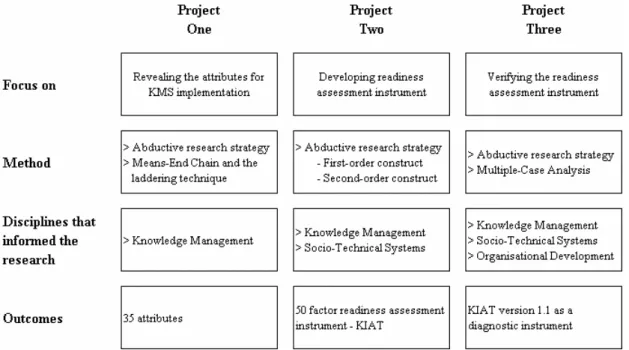
The three projects are structured to follow the three research questions outlined in the subsection 1.2.1. Projects One, Two and Three are designed to answer RQ1, RQ2 and RQ3 respectively. Figure 1-1 summarises the focus, the method, the disciplines that informed the research, and the outcomes of each project.
Figure 1-1: The focus, method, discipline and outcomes of Projects One, Two, Three
Project One was conducted to establish the attributes for an effective implementation of InTouch in Schlumberger. The Means-End Chain technique is used to produce the results in a Hierarchical Value Map (see Chapter Four: Project One, section 4.4.3). Data were collected from interviews with 19 Schlumberger employees from different organisational levels and different geographical locations.
Project Two led to the creation of the organisational readiness assessment instrument for implementing a knowledge management system. To achieve the objective of Project Two, the work of Pan and Scarbrough (1998) is integrated into the results from Project One. Their socio-technical system approach forms the basis for the analysis and presentation of KIAT (see Chapter Five: Project Two, section 5.3.1).
Project Three was conducted to operationalise the instrument created in Project Two. The instrument was applied to three different business settings in real cases and to two cases derived from literature. This allowed the instrument to be refined and led to the development of a Guideline to apply KIAT in other industries and processes (see Chapter Six: Project Three, section 6.5.3).
1.3.1 Research Philosophy
The research is based on a phenomenological approach. Informed by the interpretive philosophy, I take the realist position where common subjectivities of some respondents become objective realities. In other words, the research design data collection during the course of this study is from the perspective that reality is not objective and exterior, but is socially constructed and given meaning by people. Respondents express their views freely in their subjective context because reality is the product of individual cognition. Data, obtained from the respondents’ every day concept and meaning, are then processed with the realist approach in order to discover logical relationships within the data. Concepts should incorporate stakeholders’ perspective, generalisation through theoretical abstraction; sampling requires small numbers of cases chosen for specific reasons (Easterby-Smith et al., 2002; Burrell and Morgan, 1979).
Researchers have an underlying anxiety as to how the research will stand up to outside scrutiny. The technical language for withstanding external scrutiny includes terms such as validity, reliability and generalisability. For the phenomenological research approach, the validity of the research can be examined from the answer to the question “Does the study clearly gain access to the experiences of those in the research setting?”; its reliability can be examined from the answer to the question “Is there transparency in how sense was made from the raw data?”; and its generalisability can be examined from the answer to the question “Do the concepts and constructs derived from this study have any relevance to other settings?” (Easterby-Smith et al., 2002). The discussion in Chapters Three, Four, Five and Six addresses these questions. The summary can be tabulated in Table 1-1.
1.3.2 The choice of Research Methods
This research adopted an Abductive research strategy (Blaikie, 2000). The idea of abduction refers to the process used to generate social scientific accounts from social actors’ accounts; for deriving technical concepts and theories from lay concepts and interpretations of social life. As I intended to explore the field in order to build a theoretical organisational readiness assessment instrument, this strategy provides the greatest scope for exploring a phenomenon from the first hand account of people who have experienced the phenomenon to be investigated. It has the added advantage of providing researchers with a framework for collecting and analysing data from which to build conceptual instrument (Blaikie, 2000). It is flexible enough to be used with other data analysis techniques; in this study it is the laddering technique. The drawback of the Abductive strategy is the possible biased interpretation of the lay concepts projected by the respondents. This drawback can be overcome by using a technique referred to as “mirroring or reflecting” (Easterby-Smith et al., 2002; Easterby-Smith and Malina, 1999). This technique involves expressing in the researchers’ own words what the respondent has just said. This prompts the respondent to rethink his/her answer and reconstruct another reply that amplifies the previous answer. In practice, I use questions such as: “What you seem to be saying is ….”
The aim of the research is to construct an organisational readiness instrument based on an empirical study that may illuminate the attributes required for effective KMS implementation. A case study approach (Yin, 1994) was adopted for the research. Easterby-Smith et al. (2002) and Yin (1994) suggest that the definition of the unit of analysis is related to the way the initial research questions have been defined. Referring to the above-stated research questions the unit of analysis is where the creation, mobilisation and diffusion of knowledge take place. The unit of analysis of my research is an organisation’s business process. In the case of Schlumberger, it was the technical service delivery process; in the case of Power International, it was the customer service delivery process; in the case of Friends Provident, it was the customer service process; in the case of Schlumberger LMS, it was the competency development process.
I used a Means-End Chain model with its laddering technique to uncover the attributes that ultimately bring beneficial results. A Means-End Chain is a structure containing inter-connected meanings through which certain action attributes are seen as the means to an end (Baker, 2002). The model embodies the concept of levels of abstraction: 1) lower level attributes link with 2) higher level consequences which, in turn, link with 3) still higher level values. The laddering technique refers to the approach in data collection that forces respondents up a “ladder of abstraction”. Open-end questions are recommOpen-ended to encourage interviewees to give answers specific to their particular thoughts in their own way to ladder up the abstraction. Following Gutman (1997; 1982) I used the Means-End model to conceptualise the hierarchy of organisational goals in managing knowledge. My research uses the Means-End Chain model, integral to the laddering method, to focus attention on the linkages between: 1) activities 2) the consequences or outcome goals from certain activities and 3) benefits resulting from the outcome goals or consequences. Section 3.1.5 further explains the Means-End Chain model with its laddering technique.
Sample and Data Collection
A theoretical, rather than a statistical, sampling method (Eisenhardt, 1989) was used to choose the research subject. The criteria used to choose the research site were as follows: First, that the site manages the knowledge life-cycle at the level of business processes; Second, that knowledge is managed within communities; Third, that the system is operational and widely used, proved by some detailed facts or measures; Fourth, that knowledge management brings beneficial results to the organisation; Fifth, that the organisation has obtained recognition from practitioners and academics. Looking into three different processes in Schlumberger, detailed in Chapter Four, Schlumberger’s technical service delivery process fulfilled these criteria. This process addresses knowledge-intensive activities across all stages of the creation, mobilisation, and diffusion life-cycle.
The data gathering technique used was laddering – an in-depth interview technique. Each interview was guided by probing questions exemplified by the list of questions in Appendix 2. All interviews were recorded and transcribed. For Project One, a total of 19 interviewees included Schlumberger’s InTouch users, middle and top managers, the programme manager and team members of InTouch support. The data from the interviews were further used for Project Two. For Project Three, a total
of 7 respondents from Power International, 4 respondents from Friends Provident and 5 respondents from Schlumberger LMS were interviewed.
Scrutiny Questions Answers for this research Validity Does the the study clearly
gain access to the
experiences of those in the research setting?
19 interviewees were all actively involved in the research subject from different levels and different geographical locations. The researcher had extensive access to the required information (Research Project One and Project Two).
Respondents from Power International, Friends Provident and Schlumberger LMS were all actively involved in their knowledge management initiatives. Access was granted to the KM project teams by the KM project leaders (Research Project Three). Reliability Is there transparency in how
sense was made from the raw data?
In all three research projects an Abductive research strategy was adopted. The Means-End Chain approach with its laddering technique and the Hierarchical Value Map give transparency as to how the collected data were analysed (Project One). The categorisation of the one-to-one relationship between the Factors and the STS dimensions to construct KIAT was discussed in detail (Project Two).
In depth discussion for the individual case and multiple case analysis is presented (Project Three). Generalisability Do the concepts and
constructs derived from this study have any relevance to other setting?
The objective of the research’s Project Three is to address this specific question for generalisability.
Table 1-1: Answers of the research to external scrutiny
Data analysis
Emergent conceptual constructs were identified using an Abductive strategy (Blaikie, 2000). These conceptual constructs – referred to as second-order constructs – were derived from first-order constructs – which constitute participants’ social reality captured in the interview transcripts. Using content analysis, the structural relationships between specific attributes, consequences, and beneficial results – seen as a hierarchy of goals – are aggregated across interviewees in an asymmetric implication matrix (Reynolds and Gutman, 1988). Implication matrix is constructed through the laddering analysis of the interview data by counting the number of relationships. The implication matrix is then used to draw a hierarchical value map (HVM) as a means to illustrate the relationships among constructs. The results are presented in subsection 1.4.1, and the detailed explanation of the implication matrix and the HVM is presented in Chapter Four subsection 4.4.3.
Data analysis for Project Two and Three remains within the Abductive strategy with the first-order and second-order constructs. They are individually explained in Chapter Five and Chapter Six.
1.4 Summary of Key Findings of the research
1.4.1 Attributes for effective implementation of knowledge management systems
The study identified thirty five generic attributes essential to the creation, mobilisation and diffusion of knowledge. These attributes are discussed in Chapter Four: Project One, and the summary of the attributes is presented in Table 1-2 on the next page. The attributes are presented in the HVM format in Chapter Four and the results show the intricacy of implementing a system that enables the creation, mobilisation and diffusion of knowledge. The attributes are neither linear nor discrete and do not fit neatly into different stages of the knowledge life-cycle. There are interdependencies between the consequences, between the beneficial results, and across consequences and beneficial results.
1.4.2 Readiness Assessment is Essential Constructing Organisational Readiness Assessment
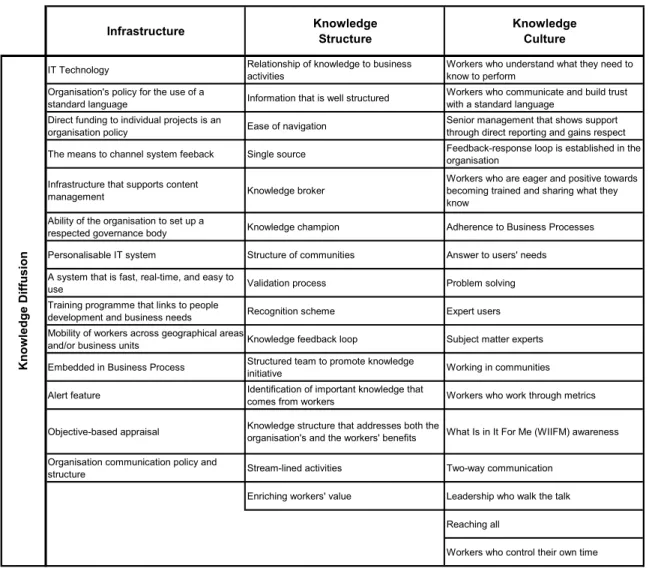
Thirty five attributes for effective implementation of a knowledge management system are established from Project One. One-to-one relationships between the attributes and the STS dimensions are sought to allow the construction of a readiness measurement instrument. The three STS dimensions are: Infrastructure, Knowledge Structure, and Knowledge Culture. The technique used to conduct this analysis is detailed in subsection 5.2.4. For each attribute, an in-depth analysis is made to search for any distinct sub-attributes that may relate directly to any one particular STS dimension. The analysis of the 35 attributes leads to 50 factors that each relates distinctly to one particular STS dimension. These 50 factors form the assessment tool for organisational readiness. Fourteen Factors have relationships with Infrastructure, sixteen Factors with Knowledge Structure, and twenty Factors with Knowledge Culture. Infrastructure is the physical and organisational structures, the policies and the technologies that are required for operationalising a system that facilitates the creation, mobilisation and diffusion of knowledge. Knowledge Structure is the formal structures, rules and facilitation for knowledge being exchanged, which govern the knowledge activities within the system between workers to create, mobilise and diffuse knowledge. Knowledge Culture is the social setting within which knowledge activities are performed. This culture is normally taken for granted as it is intangible – embedded in the daily routines and the social relations surrounding the work processes between workers in creating, mobilising and diffusing knowledge.
As knowledge management is a capability (Gold et al., 2001), and like any other capability, Siemieniuch and Sinclair (2004) contend that organisations need to be prepared for it. In other words, it is important for organisations to know their readiness prior to embarking on a knowledge management initiative. This study has established a Knowledge Implementation Assessment Tool (KIAT) with its fifty