Web Relation Extraction with
Distant Supervision
Isabelle Augenstein
The University of Sheffield
Submitted in partial fulfillment of the requirements for the degree of
Doctor of Philosophy
Acknowledgements
First and foremost, I would like to thank my PhD supervisors Fabio Ciravegna and Diana Maynard for their support and guidance throughout my PhD and their valuable and timely feedback on this thesis. I would also like to thank the Department of Computer Science, The University of Sheffield for funding this research in the form of a doctoral studentship. My thanks further goes to my thesis examiners Rob Gaizauskas and Ted Briscoe for their constructive criticism.
During my thesis I had a number of additional mentors and collaborators to whom I am indebted. I am grateful to Andreas Vlachos for introducing me to the concept of imitation learning and his continued enthusiasm and feedback on the topic. My gratitude goes to Kalina Bontcheva, for offering me a Research Associate position while I was still working on my PhD and supporting my research plans. I am thankful to Leon Derczynski for sharing his expertise on named entity recognition and experiment design. I further owe my thanks to Anna Lisa Gentile, Ziqi Zhang and Eva Blomqvist for collaborations during the earlier stages of my PhD. My thanks goes to advisors on my thesis panel Guy Brown, Lucia Specia and Stuart Wrigley, who challenged my research ideas and helped me form a better research plan. I also want to thank those who encouraged me to persue a research degree before I moved to Sheffield, specifically Sebastian Rudolph and Sebastian Pad´o.
My PhD years would not have been the same without colleagues, fellow PhD students and friends in the department. Special thanks go to Rosanna Milner and Suvodeep Mazumdar for cheering me up when things seemed daunting, and to Johann Petrak and Roland Roller for co-representing the German-speaking minority in the department and not letting me forget home.
Last but not least, my deep gratitude goes to my friends and family and my partner Barry for their love, support and encouragement throughout this not always easy process.
Abstract
Being able to find relevant information about prominent entities quickly is the main reason to use a search engine. However, with large quantities of information on the World Wide Web, real time search over billions of Web pages can waste resources and the end user’s time. One of the solutions to this is to store the answer to frequently asked general knowledge queries, such as the albums released by a musical artist, in a more accessible format, a knowledge base. Knowledge bases can be created and main-tained automatically by using information extraction methods, particularly methods to extract relations between proper names (named entities). A group of approaches for this that has become popular in recent years are distantly supervised approaches as they allow to train relation extractors without text-bound annotation, using instead known relations from a knowledge base to heuristically align them with a large textual corpus from an appropriate domain. This thesis focuses on researching distant super-vision for the Web domain. A new setting for creating training and testing data for distant supervision from the Web with entity-specific search queries is introduced and the resulting corpus is published. Methods to recognise noisy training examples as well as methods to combine extractions based on statistics derived from the background knowledge base are researched. Using co-reference resolution methods to extract rela-tions from sentences which do not contain a direct mention of the subject of the relation is also investigated. One bottleneck for distant supervision for Web data is identified to be named entity recognition and classification (NERC), since relation extraction meth-ods rely on it for identifying relation arguments. Typically, existing pre-trained tools are used, which fail in diverse genres with non-standard language, such as the Web genre. The thesis explores what can cause NERC methods to fail in diverse genres and quantifies different reasons for NERC failure. Finally, a novel method for NERC for relation extraction is proposed based on the idea of jointly training the named entity classifier and the relation extractor with imitation learning to reduce the reliance on external NERC tools. This thesis improves the state of the art in distant supervision for knowledge base population, and sheds light on and proposes solutions for issues arising for information extraction for not traditionally studied domains.
Contents
Contents i
List of Tables v
List of Figures vii
1 Introduction 1
1.1 Problem Statement . . . 1
1.2 Contribution . . . 4
1.3 Thesis Structure . . . 6
1.4 Previously Published Material. . . 6
2 Background on Relation Extraction 9 2.1 Introduction. . . 9
2.2 The Task of Relation Extraction . . . 10
2.2.1 Formal Definition. . . 10
2.2.2 Relation Extraction Pipeline . . . 10
2.2.3 The Role of Knowledge Bases in Relation Extraction . . . 12
2.3 Relation Extraction with Minimal Supervision . . . 15
2.3.1 Semi-supervised Approaches. . . 15
2.3.2 Unsupervised Approaches . . . 17
2.3.3 Distant Supervision Approaches . . . 18
2.3.4 Summary . . . 20
2.4 Distant Supervision for Relation Extraction . . . 21
2.4.1 Background Knowledge and Corpora. . . 21
2.4.2 Extraction and Evaluation of Distant Supervision Methods . . . 22
2.4.3 Distant Supervision Assumption and Heuristic Labelling. . . 23
2.4.4 Named Entity Recognition for Distant Supervision . . . 28
2.4.5 Applications of Distant Supervision . . . 29
2.5 Limitations of Current Approaches . . . 31
2.6 Summary . . . 32
3 Research Aims 35
3.1 Methodology Overview and Experiment Design . . . 35
3.2 Setting and Evaluation. . . 37
3.2.1 Setting . . . 37
3.2.2 Evaluation . . . 38
3.3 Selecting Training Instances . . . 39
3.4 Named Entity Recognition. . . 40
3.4.1 Named Entity Recognition of Diverse NEs. . . 40
3.4.2 NERC for Distant Supervision . . . 41
3.5 Training and Feature Extraction . . . 41
3.5.1 Training . . . 41
3.5.2 Feature Extraction . . . 42
3.6 Selecting Testing Instances and Combining Predictions. . . 43
3.6.1 Selecting Testing Instances . . . 43
3.6.2 Combining Predictions. . . 43
3.7 Summary . . . 44
4 Distant Supervision for Web Relation Extraction 45 4.1 Distantly Supervised Relation Extraction . . . 48
4.2 Training Data Selection . . . 49
4.2.1 Ambiguity Of Objects . . . 49
4.2.2 Ambiguity Across Classes . . . 49
4.2.3 Relaxed Setting. . . 50 4.2.4 Information Integration . . . 52 4.3 System. . . 53 4.3.1 Corpus . . . 53 4.3.2 NLP Pipeline . . . 54 4.3.3 Annotating Sentences . . . 56
4.3.4 Training Data Selection . . . 57
4.3.5 Models . . . 58 4.3.6 Predicting Relations . . . 58 4.4 Evaluation. . . 59 4.4.1 Manual Evaluation . . . 59 4.4.2 Automatic Evaluation . . . 59 4.5 Results. . . 60 4.6 Discussion . . . 64 4.7 Summary . . . 65
5 Recognising Diverse Named Entities 69 5.1 Introduction. . . 69
5.2 Related Work . . . 71
CONTENTS iii
5.4 Datasets and Methods . . . 72
5.4.1 Datasets. . . 72
5.4.2 NER Models and Features. . . 78
5.5 Experiments. . . 79
5.5.1 RQ1: NER performance in Different Domains . . . 79
5.5.2 RQ2: Impact of NE Diversity . . . 84
5.5.3 RQ3: Out-Of-Genre NER Performance and Memorisation . . . 86
5.5.4 RQ4: Memorisation, Context Diversity and NER performance . . . 90
5.6 Conclusion . . . 91
6 Extracting Relations between Diverse Named Entities 95 6.1 Introduction. . . 95
6.2 Background on Imitation Learning . . . 97
6.3 Approach Overview . . . 100
6.4 Named Entity Recognition and Relation Extraction. . . 101
6.4.1 Imitation Learning for Relation Extraction . . . 102
6.4.2 Relation Candidate Identification. . . 106
6.4.3 RE Features. . . 108
6.4.4 Supervised NEC Features for RE . . . 109
6.5 Evaluation. . . 110
6.5.1 Corpus . . . 110
6.5.2 Models and Metrics . . . 111
6.6 Results and Discussion . . . 113
6.6.1 Comparison of Models . . . 114
6.6.2 Imitation Learning vs One-Stage . . . 114
6.6.3 Comparison of Features . . . 115
6.6.4 Overall Comparison . . . 115
6.7 Conclusion and Future Work . . . 115
7 Conclusions 119 7.1 Conclusions . . . 119
7.1.1 Setting and Evaluation. . . 120
7.1.2 Selecting Training Instances. . . 121
7.1.3 Named Entity Recognition of Diverse NEs. . . 122
7.1.4 NERC for Distant Supervision . . . 124
7.1.5 Feature Extraction . . . 125
7.1.6 Selecting Testing Instances and Combining Predictions. . . 125
7.2 Future Work and Outlook . . . 127
7.2.1 Imitation Learning with Deep Learning . . . 127
7.2.2 Distantly Supervised Relation Extraction for New Genres . . . 128
7.2.3 Joint Learning of Additional Stages . . . 128
7.2.5 Differences in Extraction Performance between Relations . . . 129 7.3 Final Words . . . 130
List of Tables
1.1 Information about The Beatles in the knowledge base Freebase . . . 2
2.1 Comparison of different minimally supervised relation extraction methods . . . 20
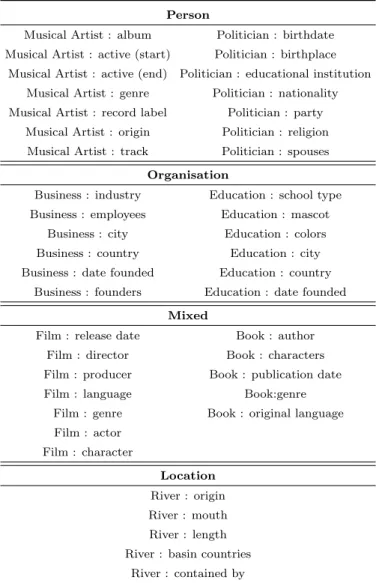
4.1 Freebase classes and properties/relations used . . . 54
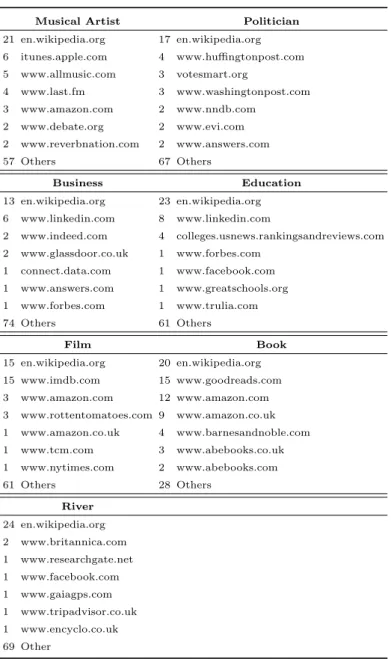
4.2 Distribution of websites per class in the Web corpus sorted by frequency . . . 55
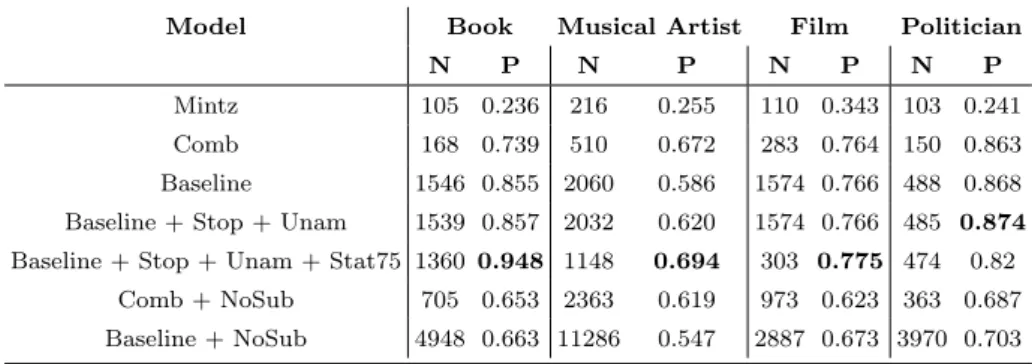
4.3 Manual evaluation results: Number of true positives (N) and precision (P) for all Freebase classes. . . 59
4.4 Training data selection results: micro average of precision (P), recall (R) and F1 measure (F1) over all relations, using theMultilab+Limit75integration strategy and different training data selection models. The estimated upper bound for recall is 0.0917.. . . 60
4.5 Information integration results: micro average of precision (P), recall (R) and F1 measure (F1) over all relations, using theCorefN+Stop+Unam+Stat75model and different information integration methods. . . 61
4.6 Co-reference resolution results: micro average of precision (P), recall (R) and F1 measure (F1) over all relations, using theCorefN+Stop+Unam+Stat75model and different co-reference resolution methods. . . 61
4.7 Best overall results: micro average of precision (P), recall (R), F1 measure (F1) and estimated upper bound for recall over all relations. The best normal method is theStop+Unam+Stat75 training data selection strategy and theMultiLab+Limit75 integration strategy, the best “relaxed” method uses the same strategies for training data selection and information integration andCorefNfor co-reference resolution. . 61
5.1 Corpora genres and number of NEs of different types . . . 74
5.2 Token/type ratios and normalised token/type ratios of different corpora . . . 75
5.3 NE/Unique NE ratios and normalised NE/Unique NE ratios of different corpora . 76 5.4 Tag density and normalised tag density, the proportion of tokens with NE tags to all tokens . . . 77
5.5 P, R and F1 of NERC with different models evaluated on different testing corpora, trained on corpora normalised by size . . . 79
5.6 P, R and F1 of NERC with different models trained on original corpora . . . 80
5.7 F1 per NE type with different models trained on original corpora . . . 81
5.8 Proportion of unseen entities in different test corpora. . . 84
5.9 P, R and F1 of NERC with different models of unseen and seen NEs . . . 85
5.10 Out of genre performance: F1 of NERC with different models . . . 87
5.11 Out of genre performance for unseen vs seen NEs: F1 of NERC with different models 88 6.1 Results for POS-based candidate identification strategies compared to Stanford NER108 6.2 Freebase classes and properties/relations used . . . 109
6.3 Relation types and corresponding coarse NE types . . . 110
6.4 Results for best model for each relation, macro average over all relations. Metrics reported are first best precision (P-top), first best recall (R-top), first best F1 ( F1-top), all precision (P-all), all recall (P-all), and all average precision (P-avg)(Manning et al., 2008). The number of all results for computing recall is the number of all relation tuples in theKB. . . 111
6.5 Results for best model for each relation. Metrics reported are first best precision (P-top), first best recall (R-top), first best F1 (F1-top), all precision (P-all), all recall (P-all), and all average precision (P-avg)(Manning et al., 2008). The number of all results for computing recall is the number of all relation tuples in the KB. The highest P-avg in bold. . . 112
6.6 Best feature combination for IL . . . 113
6.7 Imitation learning results for different NE and relation features, macro average over all relations. Metrics reported are first best precision (P-top), first best recall ( R-top), first best F1 (F1-top), all precision (P-all), all recall (P-all), and all average precision (P-avg)(Manning et al.,2008). . . 113
List of Figures
2.1 Typical Relation Extraction Pipeline . . . 11
2.2 LOD Cloud diagram, as of April 2014 . . . 14
2.3 Mintz et al.(2009) Distant Supervision Method Overview . . . 19
3.1 Overview of Distant Supervision Approach of this Thesis. . . 35
4.1 Arctic Monkeys biography, illustrating discourse entities . . . 46
5.1 F1 of different NER methods with respect to corpus size, measured in log of number of NEs . . . 82
5.2 Percentage of unseen features and F1 with Stanford NER for seen and unseen NEs in different corpora . . . 89
6.1 Overview of approach . . . 101
Chapter 1
Introduction
1.1
Problem Statement
In the information age, we are facing an abundance of information on the World Wide Web through different channels – news websites, blogs, social media, just to name a few. One way of making sense of this information is to use search engines, which locate information for a specific user query and sort Web pages by relevance. This still leaves the user to dig through several Web pages and make sense of overlapping, and sometimes even contradictory pieces of information.
These problems have partly been addressed by information extraction (IE), an area which aims at capturing central concepts in text, such as proper names or relations between them, and research in the area ofknowledge base construction and population, which aims at modelling and storing such world knowledge.
Both knowledge bases and information extraction methods can help to answer user queries more effectively. For instance, if a user query is to obtain the names of all albums by “The Beatles”, this information could already be stored in the knowledge base and then retrieved from there, or information extraction methods could extract this information from the Web. Table1.1 shows a portion of the information contained in the knowledge base Freebase (Bollacker et al.,
2008) about The Beatles. The header indicates that The Beatles have a unique identifier (mid), one or several types (here, Musical Artist) and several relations such as genres, place musical career began, albums or record labels.
Because it saves time and resources to retrieve common facts from knowledge bases, they have become a popular solution for Web search, e.g. Google uses the Google Knowledge Vault (Dong et al.,2014) to enhance search. Instead of manually populating knowledge bases, which can be very laborious and expensive, IE methods can then be used for automatic knowledge base population (KBP). Entities in knowledge bases can further be used for entity disambiguation and identification in unstructured text (Bunescu and Pas¸ca,2006;Mendes et al.,2011;Zheng et al.,2012). Relations in knowledge bases enable more complicated natural language processing tasks such as question answering (Yao and Van Durme,2014;Fader et al.,2014), also used in industry settings such as the IBM DeepQA question answering framework (Wang et al.,2012a).
The Beatles, mid: /m/07c0j, notable type: Musical Artist Relation Relation Value
Musical Genres Rock music, Pop music, Pop rock, Psychedelic rock Place Musical Career Began Liverpool
Albums Red Album, Something New The Beatles, Please Please Me, Let It Be Record Labels Capitol Records, Parlophone, Apple Records, EMI, MGM Records
Table 1.1: Information about The Beatles in the knowledge base Freebase
Early work in information extraction has focused on researching methods recognising proper names, i.e. named entities (NEs)such as names of politicians, for competitions including MUC ( Gr-ishman and Sundheim, 1995) or ACE (Doddington et al., 2004), which provided hand-labelled training data and fixed schemas to define what type of information to extract, similar to schemas in knowledge bases such as Freebase. As a result, many of those early information extraction methods weresupervised and required manually labelled data. With the emergence of the Web and more heterogeneous domains and types of text,unsupervisedmethods became popular, which do not require a fixed schema and thus do not make any strong assumption about the content of text (e.g.Etzioni et al.(2004)). Instead, they provide methods to group (“cluster”) similar infor-mation and to explore the resulting clusters. While unsupervised methods are useful for exploring information, they are not as useful for knowledge base population, where the goal is to extract information with respect to a schema.
A further approach for relation extraction called distant supervision combines the benefits of the two streams of information extraction approaches (Craven et al.,1999;Mintz et al.,2009). It is a weakly supervisedrelation extraction (RE)method which allows one to extract relations with respect to an existing schema, but does not require manually annotated training data. Instead, it requires a partly populated knowledge base already containing some examples for each relation, and a large corpus of the same domain. The approach both achieves state of the art results in recent evaluation campaigns (Surdeanu and Ji, 2014) and has been shown to be useful in an end-to-end real world setting (Dong et al.,2014).
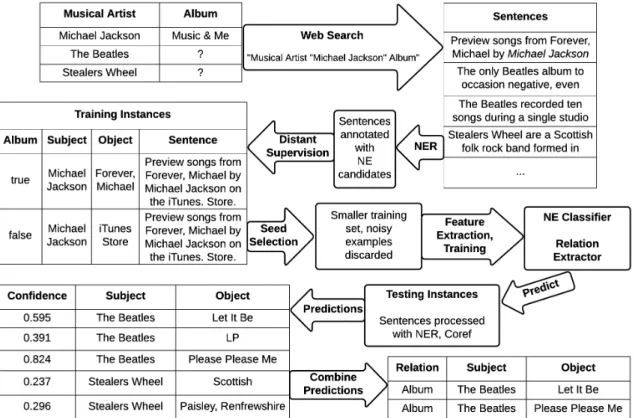
The approach relies on a heuristic labelling method to automatically generate training data for a supervised classifier: it finds sentences which contain two named entities which, according to the knowledge base, are in a relation, and assumes they are positive training data for that relation. If a sentence contains two NEs which are not in a relation according to the knowledge base, the sentence is used as negative training data. Assuming a partly populated knowledge base with the NE pair “The Beatles”, “Capitol Records”, which is an example for the relationMusical Artist: record label, Example 1.11 illustrates how a sentence can be annotated using the distant
supervision assumption. Example1.2further shows an ambiguous example, as explained later in this section, for which the distant supervision heuristic fails, here annotated correctly with the
1.1. PROBLEM STATEMENT 3
relationMusical Artist: album between the NEs “The Beatles” and “Let It Be”.
(1.1) In November 1963Capitol Records finally signed a contract withthe Beatles and announced plans to release the Beatles’ single ‘I Want To Hold Your Hand’ in December 1963 as well as their second album With The Beatles in January.
(1.2) Let It Be is the twelfth and final album byThe Beatles which contains their hit single ‘Let it Be’. They broke up in 1974.
An important characteristic of a successful knowledge base population method is to discover new facts with high precision, e.g. 0.9 or above (Dong et al., 2014). State of the art relation extraction methods from unstructured text do not achieve this performance, e.g. on the KBP 2014 slot filling challenge, the best system achieved a precision of 0.5540 at a recall of 0.2814 (Surdeanu and Ji, 2014). Currently it is difficult to achieve a successful knowledge base population method as described above; successful approaches such asDong et al.(2014) rely on combining different extraction methods, extract from several sources and adjust the confidence threshold for extraction. This thesis aims at researching a relation extraction approach from Web text which allows one to extract new facts with high precision and does not require any manually labelled data. To achieve this, several challenges distant supervision approaches face are discussed and addressed:
• One of the main challenges of distant supervision is that the heuristic for automatically anno-tating training data sometimes fails, which leads to noise. In Example1.2, the first mention ofLet It Be is an example for theMusicalArtist:album relation, whereas the second mention is an example of theMusicalArtist:track relation (see Table1.1). Using the distant supervi-sion assumption, both of those would be used as a positive example for MusicalArtist:track, although only one of them is a true positive. Using noisy training data like that results in a lower precision than using manually annotated training data. Thus, using methods for identifying such noise is crucial to improving precision of distant supervision approaches.
• A further restriction of distant supervision methods is that, at extraction time, only sentences which contain two named entities are considered candidates for extraction. This means that both subjects (e.g. “The Beatles”) and objects (“Let It Be”) of relations need to be referred to by the proper name in order to be a valid extraction candidate. However, authors do not write their articles in such a manner – they might mention the name of the subject in the first sentence and in following sentences refer to it with pronouns or nouns, e.g. “they” or “the band”. Ignoring this means potential new facts can be missed (Gabbard et al.,2011).
• When populating a knowledge base, evidence for the same facts may appear several times on different Web pages. This can be utilised to improve the overall precision of extractions. Intuitively, the more often the same information can be observed, the more likely it is to be true, and the more different sources it appears in, the stronger the evidence is. An-other challenge is therefore how to make use of this in order to improve distant supervision performance.
• A prerequisite for relation extraction is to recognise named entities which are potentially arguments of relations. Named Entity Recognition and Classification (NERC) for newswire text has been studied extensively, e.g. in the context of challenges such as MUC (Grishman and Sundheim,1995) or ConLL (Tjong Kim Sang and De Meulder, 2003) and off-the-shelf NERC tools tuned for specific training corpora are available as a result (Finkel et al.,2005). However, large hand-labelled NERC corpora are mostly available for the newswire genre and existing tools struggle to generalise over text from genres they were not trained on.
• A corpus of Web pages for relation extraction has the potential to be very diverse, spanning different domains and containing articles written by different authors. When named entity recognisers fail on such text, it would be useful to understand what the reason for that failure is. For example, is the main reason that named entities are not seen in the training set or that the context is very diverse? Such studies could help to inform how to better develop NERC methods for relation extraction from Web pages.
• Assuming existing NERC approaches fail for the Web genre, what could an alternative approach be? Ideally, a relation extraction approach should not be completely dependent on the performance of external tools such as 3rd party named entity recognisers and classifiers. Further, it is desirable to have a NERC approach which is robust across domains and genres does not require any additional manual annotation.
• Finally, in order to achieve high precision for distant supervision approaches from Web pages, it is important to have expressive features which can capture indicators for relations. Some features may be high-frequency, but low precision, i.e. they may appear in the context of specific relations very often, but may also appear often in other contexts. Other features can be the opposite, they do not appear often, but when they do, they are very good indicators for certain relations. A challenge is therefore to study and select the best combination of such features. Web pages also contain more than just unstructured text – they often contain markup such as hyperlinks and lists. The usefulness of those characteristics for relation extraction is studied in addition.
1.2
Contribution
This thesis presents novel methods to address the challenges described in the previous section. In more detail, the contributions of this thesis are as follows:
• Statistical methods for reducing noise in automatically generated training data for distant supervision, based on assessing the ambiguity of relation examples. Results show that those methods outperform a baseline method without filtered training data.
• Evaluating methods for extracting relations from sentences which do not contain a direct mention of the subject of the relation, and thus potentially discovering more new facts. Methods are based on existing co-reference resolution methods and additional co-reference resolution heuristics. Results indicate that, although extractions obtained via co-reference
1.2. CONTRIBUTION 5
resolution may be more prone to noise, they increase precision overall by providing more additional results which can be combined for knowledge base population.
• Evaluating methods for integrating extracted relations based on either integrating features of mentions across sentences and documents or integrating extractions post-hoc. Results show that integrating extractions post-hoc leads to a higher precision. Further, using statistics gathered from the knowledge base about the number of results per relation and subject entity and about which relations often have objects with the same surface form improves precision.
• Developing an entity-centric search-based approach for Web relation extraction with distant supervision which utilises a search engine to gather training data for relation examples given the subject of the relation and the relation name. The approach has the benefit that it is easy to find positive training examples in the resulting Web pages and negative training data can be sampled from the same Web pages.
• Studying reasons for poor named entity recognition and classification performance in dif-ferent genres. A quantitative analysis finds that one of the main reasons for low NERC performance is NEs which appear in the testing, but not the training set. Another reason is that NERC corpora for diverse genres are small and, because popular NEs change over time, it is difficult to maintain them. This impacts NER performance and in turn relation extraction performance, especially if off-the-shelf NER tools, which are tuned to perform well on newswire corpora, are used as a pre-processing step for relation extraction
• Proposing a joint approach for named entity recognition and classification and relation ex-traction based on imitation learning, a structured prediction method. This significantly outperforms distant supervision approaches with two off-the-shelf supervised NEC systems, Stanford NER and FIGER, one of which is trained on newswire, and the other one of which is trained on a very similar genre, Wikipedia.
• Evaluating and comparing different methods against a distant supervision approach with im-itation learning: distant supervision with off-the-shelf supervised NEC, as mentioned above, a relation exraction approach without NEC preprocessing, and a one-stage classification approach which aggregates named entity and relation features.
• Exploring and evaluating the effect of different named entity classification and relation ex-traction features, including Web features. Low-frequency high-precision features such as parsing features lead to higher average precision than high-frequency features such as the bag of context words. Web-based features, e.g. occurrence in a list or hyperlinks significantly improve average precision.
To summarise, the contributions of this thesis are to study methods for selecting training and testing data for Web-based distant supervision; to research reasons for NERC failure in diverse genres; and to propose a method for jointly learning a NERC and a RE which do not rely on manually labelled data.
1.3
Thesis Structure
The remainder of this thesis is structured as follows:
• Chapter 2 describes the task of relation extraction and the notion of knowledge bases. Different streams of research on relation extraction for knowledge base populatio without manually annotated data are described and compared and the choice of distant supervision as a research method is motivated. Existing work on distant supervision and its limitations are discussed in depth and the research presented in this thesis is motivated based on this analysis of the state of the art.
• Chapter 3describes the aims of the research conducted within the context of this thesis, as well as how the different contributions fit together to advance the state of the art in information extraction.
• Chapter 4describes experiments for reducing noise of heuristically labelled training data, for extracting relations across sentence boundaries with co-reference resolution, and methods for relation integration. It introduces the entity-centric search-based approach for distant supervision, which is also used for subsequent work. The chapter shows early results for how NER for distant supervision can be improved by using part-of-speech-based and Web-based heuristics in addition to preprocessing with Stanford NER and concludes that NERC is one of the bottlenecks for Web-based distant supervision.
• Chapter 5 describes a qualitative study, analysing reasons for failure of different existing NERC approaches in diverse genres. The chapter concludes with lessons learnt for NERC for Web-based distant supervision.
• Chapter 6 then proposes a solution for the problem of NERC for distant supervision. A novel method or distant supervision with imitation learning, which jointly learns models for NEC and RE. The approach is compared to distant supervision with supervised off-the-shelf NER approaches, as studied in Chapter 4. It further documents research on features for named entity and relation extraction, including Web features.
• Chapter 7summarises the work of this thesis and suggests future work directions.
1.4
Previously Published Material
The major research documented in this thesis has been published in conference proceedings and journals or is currently under review as follows:
• Parts of Chapter 3have been published in the proceedings of the 13th International Se-mantic Web Conference (Augenstein,2014a).
• Chapter4is based on publications at the third workshop on Semantic Web and Information Extraction at the 25th International Conference on Computational Linguistics (Augenstein,
1.4. PREVIOUSLY PUBLISHED MATERIAL 7
and Knowledge Management (Augenstein et al., 2014), and in the Semantic Web Jour-nal (Augenstein et al.,2016a).
• Chapter 5is based on work which is currently under review with the journal Information Processing & Management (Augenstein et al., 2015a).
• Chapter 6is based on a publication in the proceedings of the 20th Conference on Empirical Methods in Natural Language Processing (Augenstein et al.,2015b).
For the publications listed above, the first author proposed and conducted the experiments and was supported by the co-authors with discussions and guidance on the work as well as with feedback on the writing of the publications.
Other papers which have been published in the timeframe of this thesis and have served as motivation for some of the work presented in this thesis, though do not have any significant overlap with chapters in this thesis, are: Augenstein et al. (2013); Gentile et al. (2013); Zhang et al. (2013a,b); Blomqvist et al. (2013); Zhang et al. (2014, 2015); Derczynski et al. (2015a);
Chapter 2
Background on Relation
Extraction
2.1
Introduction
Information extraction is the process of extracting information and turning it into structured data, or also the activity of populating a structured knowledge source with information from an unstructured knowledge source (Gaizauskas and Wilks, 1998). The information contained in the structured knowledge base can then be used as a resource for other tasks, such as answering natural language queries or text mining. There are many different kinds of information which can be extracted, for example proper names and relations between them.
This chapter contains a description of the background and related work for relation extraction without manually annotated training data. First, an overview of the relation extraction task is given in Section 2.2, which defines relation extraction formally and describes a typical relation extraction pipeline. In Section 2.3, relevant research streams which fit the scope of the thesis, i.e. relation extraction methods for knowledge base population which do not require manual annotation, are described and the choice of research stream for the remainder of the thesis, distant supervision, is motivated. This is followed by a detailed survey of research on distant supervision with respect to 5 different aspects in Section 2.4. The chapter concludes with an analysis of research gaps in the state of the art. Since only relation extraction research streams that fit the scope of this thesis are described, existing work on two big research streams is not discussed, namely rule-based methods and supervised methods. For a survey on those and a comparison to the relation extraction research streams discussed in this thesis, the reader is referred toBach and Badaskar(2007).
2.2
The Task of Relation Extraction
2.2.1
Formal Definition
Relation extraction (RE) is defined as the task of extracting semantic relations between argu-ments (Bach and Badaskar,2007). Arguments can either be general concepts such as “a company” (ORG), “a person” (PER); or instances of such concepts (e.g. “Microsoft”, “Bill Gates”), which are called proper names or named entitites (NEs). An example for a semantic relation would be “PER founder-of ORG”, also written as “founder-of(PER, ORG)”. Semantic relations further contain predicates (e.g. “founder-of”), also sometimes called “properties”. Note that there is some degree of confusion in the field regarding the terms “relation”, “property’ and “predicate’. In this thesis, the terms “predicate” and “property” is used to refer to the name of the relation (e.g. “founder-of”), whereas the term “relation” will be used to refer to <subject, predicate, object>tuples. Conceptual knowledge as well as instance definitions and relations are stored in a knowledge base.
Formally, let concepts (also called classes) be defined as C, and instances of such classes, also called entities, asE. In this thesis, relations are extracted with respect to a knowledge base KB
such as Freebase (Yao and Van Durme, 2014), in which each concept c ∈C, each entitye ∈ E
and each propertyp∈P is considered a resourcer∈Rwith a unique identifier. Resources are a way of assigning a unique identifier to all things described in a knowledge base.
Concepts are named entity types; traditional coarse-grained types used are person (PER), organisation (ORG), location (LOC), date (DATE) and miscellaneous (MISC). In addition, each resource r ∈ R has a set of lexicalisations, Lr ⊂ L. Lexicalisations in the KB are typically represented as either a name or an alias, i.e. a less frequent name of a resource. As an example, the entity with unique Freebase identifierhttp://www.freebase.com/m/017nthas the name “Bill Gates”, aliases including “William H. Gates III”, and the coarse type /people/person. More details on knowledge bases are given in Section2.2.3.
Further, although relations can have more than two arguments, only binary relations or relations which can be expressed in binary form are considered here. For instance, “has siblings” can either be expressed as an n-ary relation with n+1 being the number of siblings, or as several binary relations (Surdeanu and Ji, 2014). In the TAC KBP 2014 Slot Filling challenge, these are called “list” relations, and are expressed as several binary relations. On the other hand, some relations are 3-ary or 4-ary because they contain a date and/or place as additional arguments, e.g. “PER married PER on DATE at LOC”. In that case the relation could not simply be expressed as several binary relations and all arguments past the second one would be disregarded for the purpose of relation extraction.
Binary relations consist of a subject (e.g. “Bill Gates”), a predicate (e.g. “founder-of”) and an object (e.g. “Microsoft”), i.e. they are represented as triples of the form (s, p, o)∈E×P×E.
2.2.2
Relation Extraction Pipeline
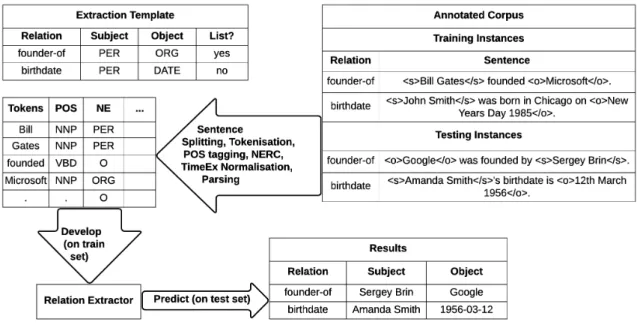
This subsection aims at describing a typical relation extraction approach. A graphical overview of such an RE pipeline is given in Figure2.1. Note that there are several variations of this approach,
2.2. THE TASK OF RELATION EXTRACTION 11
Figure 2.1: Typical Relation Extraction Pipeline
as described in the following chapters.
The input to the relation extraction task is usually a set of training documents, a set of testing documents and an extraction template. The extraction template defines which relations are to be extracted and how they are defined, i.e. how many arguments they have and what concepts those arguments belong to. For instance, “founder-of” is defined as a relation between a person (PER) and an organisation (ORG): founder-of(PER, ORG) and is a “list” relation, i.e. may have more than one object (founder) per subject and relation. Detailed NE types are not always given, e.g. the TAC KBP 2014 Slot Filling challenge does not provide the NE type of the object of the relation (Surdeanu and Ji, 2014). Next, the documents are pre-processed with several NLP steps to determine morphology, syntax and semantics of the sentence. These pre-processing steps aim at helping to “understand” text to facilitate the extraction of relations. One of the most important pre-processing steps is named entity recognition and classification (NERC), which is the task of recognising and assigning a type to proper names in text. This is because, as already mentioned in the previous section, relations are either extracted between named entities only or between a mixture of named entities and general concepts (“a person”). As an example, “Bill Gates” would be assigned the type “PER” and “Microsoft” the type “ORG”. Historically, the first series of NER evaluation efforts at the MUC conferences distinguished between the named entity types person (PER), location (LOC), organisation (ORG) and miscellaneous (MISC) (Grishman and Sundheim,1995), though depending on the extraction template, more fine-grained types (e.g. Politician, Film) may be used.
After pre-processing, the training set is used to develop relation extractors, after which they are applied to the test set to extract relations. If more than one relation per relation template is extracted, those extractions are validated. The definition of relations can help with this. For
instance, a company may have more than one founder, but every person only has two biological parents, which determines how many extractions per subject of each relation should be returned. The output of the relation extraction task is a set of annotated test documents (often called
sentence-level extraction) or a list of extraction triples (instance-level extraction). In case the output is a list of extractions, those can be used to populate knowledge bases. More details on knowledge bases and their role in the relation extraction task are explained in the next section.
2.2.3
The Role of Knowledge Bases in Relation Extraction
Knowledge bases are an integral part of the relation extraction process. They consist of a schema, sometimes also called extraction template, and data associated with the schema. The schema de-fines the structure of information, e.g. it might define that persons can be politicians or musicians, and that they have names and birthdates, politicians are in addition associated with a party and musicians play instruments in bands with other musicians. In other words, the schema defines
classes (e.g. Person), their subclasses (e.g. Politician) and properties (e.g. in-party). What is relevant for the task of relation extraction is that properties define what relations can hold be-tween instances of classes, whereas their classes restrict the types of the relations’ arguments. The data associated with the schema would then be examples of such politicians and musicians with their respective names, birthdates, parties, instruments and bands. The relation extraction process typically starts with such a schema and the goal is then to annotate text with relations, or to populate the knowledge base with information, i.e. extract and add data. The latter is called
knowledge base population (KBP)and has become popular, among other reasons, due to the TAC KBP series of challenges1. This series of evaluation efforts comprises several parts of the rela-tion extracrela-tion pipeline, including extracting relarela-tions (slot filling) (Surdeanu and Ji, 2014) and validating extractions (slot filler validation). For slot filling, the subjects of relations are already given and the task is then to find the objects of relations in a corpus.
Shared task evaluation efforts often use locally defined templates. However, with the rise of the World Wide Web and then the Semantic Web, Web-based publicly available knowledge bases also became popular for the KBP task (Ji and Grishman,2011; Mintz et al.,2009). Since this thesis focuses on such knowledge bases, this subsection contains background on the Semantic Web and Linked Data, the idea of interlinking data in different knowledge bases.
The Semantic Web
TheWeb of DataorSemantic Webis a global information space consisting of billions of interlinked documents. Certain Semantic Web standards have been developed by the World Wide Web Consortium(W3C)2which includeRDF andOWLto describe data andSPARQLto query data.
These standards can be used to describe the relationships between things, such as people, locations or organisations.
1http://www.nist.gov/tac/2014/
2.2. THE TASK OF RELATION EXTRACTION 13
A set of best practices for publishing data on the Web (also called theLinked Data principles) were outlined as follows by Tim Berners-Lee3:
1. Use URIs as names for things.
2. Use HTTP URIs so that people can look up those names.
3. When someone looks up a URI, provide useful information, using the standards (RDF, SPARQL).
4. Include links to other URIs so that they can discover more things.
There are two kinds of information which can be described. First, information about classes (e.g. artist, track) and their relationships (e.g. released-track). This kind of information is published as a schema. Second, information about instances of these classes (e.g. David Bowie, Changes) can be published in adataset. Note though that this is optional: some websites contain Semantic Web annotations, but do not publish them in a separate dataset.
While, for the purpose of relation extraction, schemas serve a similar purpose as locally defined templates (Section 2.2.3), there is a clear advantage in the way data is described (using URIs). Imagine a slot filling task, for which the subjects of relations are given and the goal is to extract values for the objects of those relations. Some of the subjects may be ambiguous and refer to many different real-world entities. This ambiguity may be across classes (a jaguar can be an animal or a car brand), or instances of classes may be ambiguous (there are many persons named John Smith). Especially for the latter, it is very useful to have URIs as input for each subject. For instance, if the task is to extract birthdates, the RE approach would be expected to return only one result per subject entity, but would likely find more than one for “John Smith”. If there are several URIs with the name “John Smith” in the knowledge base, the RE approach can make use of this information and return several results, or, if other information about persons named “John Smith” is already contained in the knowledge base, try to return the likely birthdate for that specific John Smith, based on that additional information.
More advantages of Semantic Web standards are clarified after taking a closer look at Linked datasets.
Linked Datasets
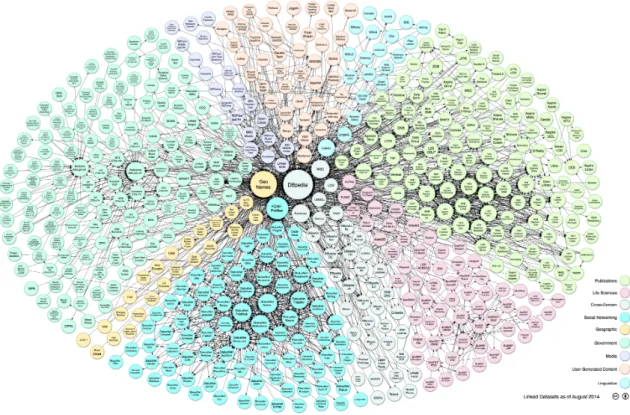
Since the vision of the Semantic Web was introduced, billions of triples in hundreds of interlinked datasets, describing instances of classes and relations between those instances, have been created. Some of those datasets are released publicly and are available to everyone, in which case they are referred to as Linked Open Data (LOD). To get a better idea of the nature and size of Linked Open Data, a visualisation of datasets and their links is shown in Figure2.2.
The figure shows that there are several cross-domain datasets, with DBpedia having the most links to other datasets and effectively functioning as a hub for Linked Data. Other prominent examples of cross-domain datasets include Freebase (Bollacker et al.,2008), Yago (Suchanek et al.,
2008), and Wikidata (Vrandeˇci´c and Kr¨otzsch, 2014) (not included in cloud diagram). Domain-specific datasets exist for several different domains: Governments release their data using Semantic
3http://www.w3.org/DesignIssues/LinkedData.html
Figure 2.2: LOD Cloud diagram, as of April 20144
Web standards, sciences make use of the technology to describe complex processes with ontologies, libraries and musea structure and release their data about books and artifacts, and media and social media providers enrich their Web sites with semantic information.
There are several strategies for creating Linked datasets: they can be created automatically from existing resources (DBpedia, Yago, WordNet (Fellbaum, 1998)), created collaboratively by a community (Freebase, Wikidata) or they can be created manually by domain experts (Mu-sicBrainz, UMLS). A very popular existing resource is Wikipedia, since it contains both text and also the most important facts for each page summarised in an infobox table, which can be converted into a stuctured data format very easily.
One relation extraction method, distant supervision (see Section2.3.3), relies to a large degree on both the schema and the data contained in Linked datasets. More details on which knowledge bases are used for distant supervision and why are given in Section2.4.1.
What is important to know for relation extraction is that information in different datasets is often interlinked. Some of them contain information about the same entities and to indicate this, links between datasets exist. This means relation extraction approaches which make use of information already contained in datasets (as becomes clear in Section 2.3 and Section2.4) can combine information from several datasets. More than that, there are also links on the schema level (e.g. the property “birthdate” in one schema may be linked to the property “born-on” in another schema, or the class “album” may be linked to the class “musicalbum”), which facilitates
2.3. RELATION EXTRACTION WITH MINIMAL SUPERVISION 15
combination of information in datasets, and also combination of extraction schemas even further. For instance, one schema may define that musical artists have birthdates, and another that they release albums. Those could then be combined for extracting both relations.
2.3
Relation Extraction with Minimal Supervision
Having seen how a typical relation extraction approach works, this section now details different relation extraction streams which are variations of the typical relation extraction approach de-scribed in the previous section. The research streams dede-scribed here are all the ones which fit the scope of this thesis, i.e. relation extraction methods for knowledge base population from text on Web pages which do not require any, or only very little, manual effort for training. Streams of approaches which fit this scope are semi-supervised bootstrapping methods, unsupervised / Open IE methods anddistantly supervised approaches5.
2.3.1
Semi-supervised Approaches
Semi-supervised or bootstrapping approaches were among the first machine learning based relation extraction approaches, prominent pioneers being DIPRE (Brin,1999) and Snowball (Agichtein and Gravano,2000). A description of DIPRE is now given, since subsequent approaches used a similar architecture.
Algorithm 1DIPRE (Brin,1999): extract(R,D)
while|R|< ndo O←findOccurrences(R, D) P ←generatePatterns(O) R←MD(P) end while return R
DIPRE consists of four simple steps (see Algorithm 1). The input to DIPRE is R, a set of 5
< s, o > tuples for the relation “PERSON author-of BOOK”, andD, a document collection, in this case the Web. The first step is to find occurrences of tuples on the Web. Next, patterns are generated. Third, pattern matches are generated;MD(p) is the set of tuples for which any of the patternsp∈P is matched on a Web page. This process is repeated untilnrelation occurrences are found.
This basic algorithm is used by almost all semi-supervised approaches, with slight variations. For instance, the input to the algorithm might be examples as well as extraction patterns or extraction rules. Also, matching of patterns can be handled in different ways, using exact or inexact matching. The most interesting part of the algorithm is how patterns are generated. In DIPRE, this is very basic: a pattern is created by grouping sentences for which the sequence of words between person and book match and for which person and book are in the same order. 5These methods are summarised here as “minimal supervision” methods, though there is no one agreed upon
Next, specificity is measured: if a pattern matches too many sentences and as a result specificity is above a manually tuned thresholdt, the pattern is rejected. If specificity is too low and only the same book is found with that pattern, the pattern is rejected too.
This already hints at one downside of bootstrapping approaches calledsemantic drift, which is their tendency to move too far away from Rand create patterns which express different, related relations, which often co-occur with the same entity tuples, e.g. for “author-of”, this could be “editor-of”.
Subsequently, bootstrapping models have been researched to improve on the DIPRE model. Prominent large-scale bootstrapping models include KnowItAll (Etzioni et al.,2004) and NELL ( Carl-son et al.,2010a).
KnowItAll (Etzioni et al.,2004) is a Web-scale information extraction system, which relies on the scale and redundancy of the Web to provide enough information and validate it. In contrast to DIPRE, it does not start with a single relation, but with several, and also contains methods for extending the extraction schema. KnowItAll consists of four modules: an extractor, a search engine interface, an assessor and a bootstrapping component. Theextractor component applies Hearst patterns (Hearst,1992) to extract instances for classes (this would be instances of books in DIPRE). Hearst patterns are lexico-syntactic extraction rules such as “NP1 is a NP2”, where NP2 is the name of a class such as “books”, and NP1 is the name of an instance of that class. Using the search engine interface, these patterns (with NP1 left blank) are then formulated as search queries to retrieve Web pages containing NP1. The component further contains relation extraction rules, e.g. “NP1 plays for NP2”, representing the relation “playsFor(Athlete, SportsTeam)”. Once all extraction rules are applied, extracted patterns are validated by the assessor. The assessor measures co-occurrence statistics of candidate extractions withdiscriminator phrases, which are highly frequent extraction patterns. This means for each search query, e.g. “Tom Cruise starred in X” the number of search results is recorded and the PMI (pointwise mutual information) of the entity, “Tom Cruise” and the pattern is computed. KnowItAll then uses bootstrapping in combination with the assessor to validate extractions: for each class, the 20 instances with the highest average PMI are retrieved. These are then used to train conditional probabilities for each extraction pattern. Negative instances are sampled from positive instances for other classes. The best 5 extraction patterns for each class are saved, the rest are discarded. A Naive Bayes classifier is then trained combining evidence from those 5 extraction patterns to classify if an entity, e.g. “Tom Cruise”, is an instance of a class, e.g. “actor”. Instead of just selecting the best extraction patterns once, a bootstrapping process can be used: once the best 5 extraction patterns are determined, those can be used to find a new set of instances with high PMI. To ensure high quality extraction patterns, incorrect instances are also removed manually. Etzioni et al. (2004) argue that their approach of using Web-based statistics is very useful to discard unreliable patterns; however, they do not measure specificity, asBrin (1999) does. Overall, however, their approach is much more extensible and relies on Web statistics and machine learning instead of just local statistics and patterns.
NELL (Carlson et al.,2010a) is a bootstrapping system that extracts information from the Web to populate a knowledge base and learns to extract information more accurately over time. Like
2.3. RELATION EXTRACTION WITH MINIMAL SUPERVISION 17
KnowItall, it is based on the hypothesis that the large amount of redundant information on the Web is a huge advantage for learning mechanisms. The main differences are that the bootstrapping component is more sophisticated and that NELL combines extractions from different sources on the Web: text, lists and tables. Similar to KnowItAll, it learns to extract which instances belong to which classes and which relations hold between instances of those classes. Information is extracted from unstructured information on the Web (i.e. text), as well as semi-structured data (i.e. lists and tables). Extractors are trained in concert using coupled learning based on CPL for free text and CSEAL for lists and tables (Carlson et al., 2010b). CPL, similarly to KnowItAll, relies on co-occurrence statistics between noun phrases and context patterns to learn extraction patterns. CSEAL uses mutual exclusion relationships to provide negative examples, which are then used to filter overly general lists and tables. In addition, NELL learns morphological regularities of instances and probabilistic Horn clause rules to infer new relations from relations it has already learnt. For learning morphological regularities, NELL uses acoupled morphological classifier (CMC). For each class, a logistic regression model is trained to classify noun phrases based on morphological and syntactic features (e.g. words, capitalisation, affixes, POS tags). The
Rule Learnerlearns probablistic Horn clauses to infer new relations from relations that are already present in the knowledge base.
The learning system starts with a knowledge base (123 classes, 55 relations, and a few instances for classes and relation triples) and gradually populates and extends it. After the extraction component has extracted a belief, the precision of the belief is evaluated by consulting external data resources or humans, promoting the most strongly supported beliefs to facts and integrating them into the knowledge base. For the following extraction steps, the extractor always uses the updated knowledge base. Carlson et al. (2010a) find that NELL allows one to extract instances and relation with a relatively high precision initially, and that the different extractors they use are complementary. However, one of their findings demonstrates a problem that is very typical of bootstrapping approaches: extraction precision declines over time. In their case it declines from 0.91 to 0.57 over the course of 66 iterations. They suggest that this could be solved by allowing a human to interact with the system during learning using active learning, which was then researched subsequently (Pedro and Hruschka Jr,2012).
2.3.2
Unsupervised Approaches
Unsupervised relation extraction approaches became popular soon afterwards with open infor-mation extraction systems such as TextRunner (Yates et al., 2007), ReVerb (Fader et al., 2011) and OLLIE (Mausam et al.,2012). Open information extraction is a paradigm to use simple and scalable methods to extract information which is not restricted beforehand. This is in contrast to semi-supervised approaches described in the previous section, which use pre-defined extraction schemas. Thus, Open IE can be seen as a subgroup of unsupervised approaches. For Open IE methods this means they have to infer entities, their types, and relations between entities from text. As for bootstrapping method, the first Open IE approach is now described to introduce the research stream, and shortcomings and improvements of subsequent research are pointed out.
It learns a Conditional Random Field (CRF) model for relations, classes and entities from a cor-pus using a relation-independent extraction model. First, it runs over the whole corcor-pus once and annotates sentences with POS tags and noun-phrase chunks. To determine whether a relation should be extracted or not, the system uses a supervised classifier. This supervised classifier is trained by parsing a small subset of the corpus and then heuristically labelling sentences as positive (trustworthy) and negative (not trustworthy) examples using a small set of hand-written rules. The classifier then makes the decision for unseen sentences based on POS tags instead of the parse tree, because it would be too expensive to parse the whole corpus. To resolve synonyms, TextRun-ner performs unsupervised clustering of relations and entities based on string and distributional similarity (Yates et al.,2007).
ReVerb (Fader et al.,2011) addresses two shortcomings previous Open IE systems have: inco-herent extractions and uninformative extractions. Incoinco-herent extractions occur when the extracted relation phrase has no meaningful interpretation. This is due to the fact that decisions in TextRun-ner are made sequentially. An example would be the relation “contains omits” which is extracted from the sentence “The guide contains dead links and omits sites.” To solve this, syntactic con-straints on which relations to extract are introduced. The first is that a relation phrase either has to be a verb (e.g. “invented”), a verb followed by a preposition (e.g. “located in”) or a verb followed by nouns, adjectives or adverbs and a preposition (e.g. “has atomic weight of”). Also, if there are multiple possible matches, the longest possible match is chosen. If adjacent sequences are found (e.g. “wants”, “to extend”), these are merged (e.g. “wants to extend”). Lastly, the relation has to appear between the two arguments in a sentence.
Uninformative extractions omit important information, e.g. for the sentence “Faust made a deal with the devil”, TextRunner would extract “Faust, made, a deal” instead of “Faust, made a deal with, the devil”. These can partly be captured by syntactic constraints; however, this may cause the extraction of overly-specific relations such as “is offering only modest greenhouse gas reduction targets at”. To tackle this, a lexical constraint is introduced. A relation has to appear with at least 20 distinct arguments in a sentence in order to be meaningful.
Although open information extraction is a promising research paradigm and it is possible to map clusters of relations to extraction schemas afterwards, it also provides an unneccessary restric-tion for the task of knowledge base popularestric-tion. Problems that ongoing research is addressing such as incoherent and uninformative extractions are issues which are less pronounced for bootstrapping methods, as introduced in the previous section.
2.3.3
Distant Supervision Approaches
Distant supervision is a method for automatically annotating training data using existing rela-tions in knowledge bases. The first approach was proposed by Craven et al. (1999) in 1999 as a method for knowledge base population for the biomedical domain, and was called “weakly la-beled”. Although results were promising, this approach did not gain popularity until 10 years later, whenMintz et al.(2009) coined the term “distant supervision”. The re-surfacing of these approaches may be partly due to the increasing availability of large knowledge bases on the Web.
2.3. RELATION EXTRACTION WITH MINIMAL SUPERVISION 19
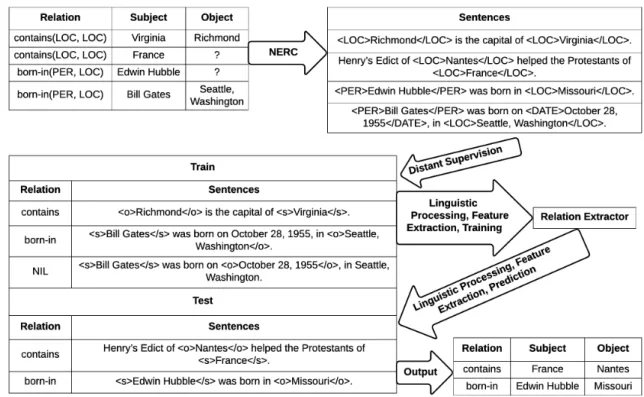
If two entities participate in a relation, any sentence that contains those two entities might express that relation.
How such an approach works in practice is visualised in Figure2.3. The input to the approach is a knowledge base, containing a set of classes and relations, instances of those classes and examples of those relations, and training and test corpora. The training corpus is preprocessed to recognise named entities, then searched for sentences containing both the subject and the object of known relations (e.g. “Virginia” and “Richmond” for the relation “contains(LOC, LOC)”). Sentences containing both the subject and the object of known relations are considered positive training data for the relation, others are negative training examples (NIL). A supervised classifier (e.g. Naive Bayes, SVM, MaxEnt) is then trained and applied to a test corpus. Overall, the learning process is the same as that for supervised learning, merely the training data labelling process is dif-ferent (automatic instead of manual). As such, the approach has all the advantages of supervised learning (high precision extraction, output with respect to extraction schema), and additional advantages since no manual effort is required to label training data. Extraction performance is slightly lower than for supervised approaches due to incorrectly labelled training examples. Im-proving the automatic labelling process has been the main focus of distant supervision research since, as a survey byRoth et al.(2013) outlines.
2.3.4
Summary
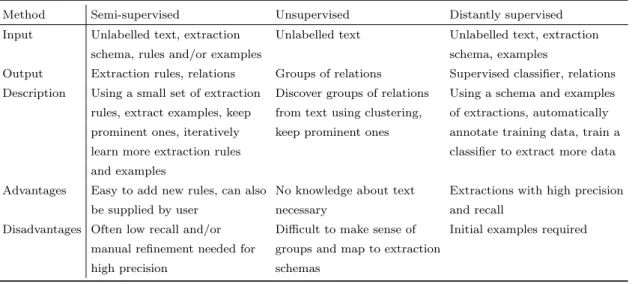
Table 2.1summarises the key points of the three types of minimally supervised approaches. All three different relation extraction streams have different advantages and disadvantages. They dif-fer with respect to how much initial input is required, if human intervention is required during the learning process and how suitable they are for knowledge base population. Semi-supervised / bootstrapping methods may only need a handful of initial examples, but as discussed in Sec-tion 2.3.1, the problem of semantic drift may require additional human intervention during the learning process. They are suitable for knowledge base population as extraction is performed with respect to an extraction schema. Unsupervised / Open IE approaches, on the other hand, do not require any input to start with. This means, however, that the output of such approaches is merely clusters of relations and there is no straightforward way of mapping them to an existing relation schema. Therefore, they are interesting for scenarios for which such an extraction schema is not available or for which the goal is to extend an extraction schema, but they are less suitable for knowledge base population. Lastly, distant supervision approaches require the most input out of the three methods initially, around 30 examples per relation at least. The abundance of such information on the Web in existing knowledge bases (see Section2.2.3) makes it possible to gather such information automatically and as such, they do not require human input. Because they then also use the schema associated with relation examples for training, they are very suitable for knowledge base population. Based on the analysis presented in this section, distant supervision was picked as the most suitable relation extraction approach given the research scope of this thesis. Note though that this does not mean distant supervision is the best possible relation extraction approach overall. If large quantities of manually labelled training instances are available, those might be more preferable than automatically labelled data. The next section now discusses the state of the art in distant supervision in more detail.
Method Semi-supervised Unsupervised Distantly supervised Input Unlabelled text, extraction Unlabelled text Unlabelled text, extraction
schema, rules and/or examples schema, examples
Output Extraction rules, relations Groups of relations Supervised classifier, relations Description Using a small set of extraction Discover groups of relations Using a schema and examples rules, extract examples, keep from text using clustering, of extractions, automatically prominent ones, iteratively keep prominent ones annotate training data, train a learn more extraction rules classifier to extract more data and examples
Advantages Easy to add new rules, can also No knowledge about text Extractions with high precision be supplied by user necessary and recall
Disadvantages Often low recall and/or Difficult to make sense of Initial examples required manual refinement needed for groups and map to extraction
high precision schemas
2.4. DISTANT SUPERVISION FOR RELATION EXTRACTION 21
2.4
Distant Supervision for Relation Extraction
As introduced in Section2.3.3, distant supervision is a relation extraction method which exploits existing examples in a knowledge base for automatically labelling training data. In this section, a detailed comparison of research on distant supervision is performed with regard to the key aspects in which they differ: what kind of background knowledge and corpora they use (Section2.4.1), how automatic labelling is performed (Section 2.4.3), how named entity recognition and classification for distant supervision is performed (Section 2.4.4), how relations are extracted and evaluated (Section2.4.2), and, lastly, what applications of distant supervision methods exist (Section2.4.5). Limitations of the state of the art in distant supervision are explained in Section2.5and the main findings are summarised in Section2.6.
2.4.1
Background Knowledge and Corpora
As mentioned in the last section, distant supervision approaches rely on a corpus and a background knowledge base to automatically label sentences in a corpus for training. Early approaches to distant supervision use a variety of different corpora and mostly small domain knowledge bases.
Craven et al.(1999) use the Yeast Protein Database (Hodges et al.,1998) and match it to abstracts of PubMed6 papers. Bellare and McCallum (2007) use BibTex citations and match them to the Cora data set7 containing computer science research papers. Wu and Weld (2007) and Wu
and Weld(2008) then extract information from Wikipedia and treat Wikipedia infoboxes as the corresponding knowledge base. Some later approaches also exist for domain-specific extraction, e.g. Roller and Stevenson (2014) use the biomedical knowledge base UMLS and the Medline corpus8.
Most subsequent approaches, however, use large cross-domain knowledge bases. The most commonly used knowledge base is Freebase (Bollacker et al., 2008), used byMintz et al. (2009);
Riedel et al.(2010);Hoffmann et al.(2011);Surdeanu et al.(2012) and others; some research (e.g.
Nguyen and Moschitti(2011a)) uses YAGO (Suchanek et al.,2008).
Freebase is a collaboratively created knowledge base, which has an extremely rich set of entities and relations, containing around 3 billion triples. Entities are organised in topics (e.g. music, book, media, people), which have associated classes (e.g. musical artist, politician). Entities are instances of one or more classes. Information in Freebase follows Semantic Web standards in that entities have unique dereferencable URIs and there are outward links to other data source. Knowledge in Freebase is partly imported from other sources9, e.g. MusicBrainz (Swartz, 2002)
or Wikipedia, the schema as well as the data are then edited by collaborators. The richness of the schema and the fact that data is edited to ensure higher quality and reduce redundancy make Freebase very suitable for distant supervision. As of April 2015, Freebase is being discontinued and transitioned to Wikidata (Vrandeˇci´c and Kr¨otzsch,2014).
The knowledge bases Wikidata, DBpedia (Bizer et al., 2009) and YAGO are all primarily 6http://www.ncbi.nlm.nih.gov/pubmed
7
http://people.cs.umass.edu/~mccallum/data.html 8http://mbr.nlm.nih.gov/Download/
based on Wikipedia and are thus multilingual. While DBpedia and YAGO are knowledge bases automatically constructed from Wikipedia, Wikidata is a collaboratively constructed knowledge base. The difference between DBpedia and YAGO is that, while DBpedia automatically converts Wikipedia infoboxes into a knowledge base and then interlinks it with other Linked datasets, YAGO re-uses WordNet for constructing its schema. YAGO2 (Hoffart et al., 2011) further uses hand-crafted patterns to reconcile duplicate relations, resulting in 100 relations, whereas DBpedia has many redundant and inconsistent relations. YAGO2 also normalises times and dates, which further facilitates automatic reuse. These additional efforts means YAGO and YAGO2 are poten-tially more suitable for information extraction purposes than DBPedia. YAGO2 consists of 120 million facts and is thus much smaller than Freebase; however, it has the advantages of integration with WordNet and time and date normalisation.
In addition to evaluation with Linked datasets as background knowledge, distant supervision has also been used as an approach to tackle the TAC KBP challenges (Surdeanu et al., 2010;
Angeli et al.,2014a; Roth et al., 2012, 2014) and has thus been evaluated on TAC KBP corpora using locally defined extraction templates. The system byRoth et al. (2014) even won the KBP challenge in 2014, which further strengthens the argument of distant supervision being a suitable approach for knowledge base population (Section2.3.4).
So far, YAGO has been used as a background knowledge base, but neither DBpedia nor Wikidata have been used. With Freebase being discontinued, this could possibly change10.
In terms of different corpora, as already mentioned above, PubMed abstracts and the Medline corpus have been used for the biomedical domain. Approaches evaluated in a cross-domain scenario mostly use Wikipedia (e.g. Yao et al. (2010); Takamatsu et al. (2012); Ling and Weld (2012)) or the New York Times corpus (e.g. Riedel et al. (2010); Yao et al. (2010); Hoffmann et al.
(2011); Ling and Weld (2012)). Recent approaches have also used a Web-based approach for acquiring training data (Dong et al.,2014;Vlachos and Clark,2014b), similar to semi-supervised Web-based approaches (Etzioni et al., 2004;Carlson et al.,2010a): Web pages are retrieved with queries containing the subject of a relation and the relation name, hoping that those pages then contain the object of the relation. However, while those approaches make use of text on Web pages, they do not make use of semi-structured content such as lists or tables like NELL (Carlson et al., 2010a) does, nor of HTML markup like Wikipedia-based approaches do (Wu and Weld,
2008;Ling and Weld,2012).
2.4.2
Extraction and Evaluation of Distant Supervision Methods
Distant supervision methods differ with respect to whether they perform sentence-level extraction or if they combine extractions for knowledge base population. Traditionally in the information extraction area, sentence-level extraction is prefered as it provides an estimation of performance independent of the number of or dependency between extractions. Gold standards such as the ACE corpus11 are annotated with entities and relations, and the task is to use one part of the corpus for training and reproduce the results on a held-out (test) part of the corpus. Measures
10https://plus.google.com/109936836907132434202/posts/3aYFVNf92A1 11https://catalog.ldc.upenn.edu/LDC2006T06