Wayne State University Dissertations
1-1-2016
Improving User Experience In Information
Retrieval Using Semantic Web And Other
Technologies
Erfan Najmi
Wayne State University,
Follow this and additional works at:https://digitalcommons.wayne.edu/oa_dissertations
Part of theComputer Sciences Commons
This Open Access Dissertation is brought to you for free and open access by DigitalCommons@WayneState. It has been accepted for inclusion in Wayne State University Dissertations by an authorized administrator of DigitalCommons@WayneState.
Recommended Citation
Najmi, Erfan, "Improving User Experience In Information Retrieval Using Semantic Web And Other Technologies" (2016).Wayne State University Dissertations. 1654.
by
ERFAN NAJMI DISSERTATION
Submitted to the Graduate School of Wayne State University,
Detroit, Michigan in partial fulfillment of the requirements for the degree of
DOCTOR OF PHILOSOPHY
2016
MAJOR: COMPUTER SCIENCE Approved By:
ERFAN NAJMI 2016
I would like to express my heartfelt gratitude to my PhD advisor, Dr. Zaki Malik, for supporting me during these past years. I could not have asked for a better advisor and a friend, one that let me choose my path, help me along it and has always been there if I needed to talk to a friend. I really appreciate all the time he spent and all the patience he showed towards me. Secondly I would like to thank my committee members Dr. Fengwei Zhang, Dr. Alexander Kotov and Dr. Abdelmounaam Rezgui for the constructive feedback and help they provided.
I thank Dr. Khayyam Hashmi, for all these years I knew I could count on you; when I needed someone to listen and understand, when I needed a friend to have my back, and when I needed a brother to help me stand.
Lastly, this whole journey would not have been possible without the support of my family, in particular my parents. Mom and Dad this one is for you. While thousands of miles away, you have always been with me.
Acknowledgements . . . ii
List of Tables . . . vii
List of Figures . . . viii
CHAPTER 1: BACKGROUND AND INTRODUCTION . . . 1
CHAPTER 2: RELATED WORK . . . 3
2.1 Semantic Web Overview . . . 3
2.1.1 RDF . . . 3
2.1.2 Ontologies . . . 4
2.1.3 SPARQL . . . 5
2.1.4 Other technologies . . . 6
2.2 Public Access Knowledge Bases . . . 7
2.3 Question Answering Related Work . . . 11
2.4 Upper Ontologies and Related Tools . . . 12
CHAPTER 3: QUESTION ANSWERING USING SEMANTIC WEB . . . 16
3.1 About Question Answering Systems . . . 16
3.2 Question Classification . . . 17
3.2.1 Factoids classification . . . 18
3.2.2 Keywords classification . . . 20
3.3 Query Translation . . . 20
3.3.1 Algorithm Expansion . . . 24
3.4 Finding the answer . . . 26
3.5 Experiments and Results . . . 27
CHAPTER 4: CONCEPTONTO . . . 31
4.1 Introduction . . . 31
4.3 Methodology . . . 34 4.3.1 Classes . . . 34 4.3.2 Properties . . . 36 4.4 Use Cases . . . 39 CHAPTER 5: CONCEPTRDF . . . 43 5.1 Introduction . . . 43 5.2 ConceptNet structure . . . 44
5.3 ConceptRDF conversion process . . . 47
5.3.1 Limitations . . . 49
5.4 Use cases . . . 52
CHAPTER 6: PRODUCT RANKING USING CUSTOMER REVIEWS . . . . 55
6.1 Introduction . . . 55
6.2 Data-set Preparation . . . 58
6.3 Sentiment Analysis . . . 61
6.4 Product Aspect Analyzer . . . 68
6.5 Brand Ranking . . . 73
6.6 Review Usefulness Analysis . . . 76
6.7 Product Ranking . . . 80
6.8 Experiments and Results . . . 82
6.8.1 Sentiment Analysis Experiment Result . . . 84
6.8.2 Product Aspect Analyze Experimental Result . . . 86
6.8.3 Review Helpfulness and Product Ranking Experiment Result . 87 CHAPTER 4: PRODUCT WEIGHTED TAXONOMY CREATION . . . 90
7.1 Introduction . . . 90
7.2 Related Works . . . 91 iv
7.4 Taxonomy Extraction . . . 96
7.4.1 Term Extraction . . . 98
7.4.2 Relation Discovery and Weighting . . . 100
7.5 Experimental Results . . . 104
CHAPTER 7: KNOWLEDGE HIERARCHY . . . 107
8.1 Introduction . . . 107
8.2 Approaches . . . 111
8.2.1 Singular Pointwise Mutual Information . . . 114
8.2.2 Online games . . . 118
8.2.3 Order of appearance . . . 121
8.3 Use-Cases and Further Motivation . . . 125
8.4 Discussion . . . 128
8.5 Experiments . . . 129
8.5.1 Approach 1: SPMI . . . 130
8.5.2 Approach 2: Online games . . . 133
8.5.3 Approach 3: Order of Appearance . . . 135
8.5.4 Approach Comparison and Results . . . 137
CHAPTER 8: CONCLUSIONS . . . 142
References. . . 161
Abstract . . . 162
Autobiographical Statement . . . 163
Table 2.1 RDF sample triple . . . 4
Table 2.2 Works in common sense knowledge retrieval . . . 10
Table 3.3 Question types and subtypes . . . 19
Table 3.4 Natural language query conversion into RFD . . . 27
Table 3.5 Question types and subtypes . . . 28
Table 4.6 ConceptOnto properties specification. . . 40
Table 6.7 Manual annotation result of a sample data-set . . . 64
Table 6.8 Shifters Table Sample . . . 66
Table 6.9 Neutral sentence classifier features . . . 67
Table 6.10 Polarity classifier features . . . 68
Table 6.11 Data-set overview . . . 83
Table 6.12 Content oriented products Sentiment Analysis . . . 84
Table 6.13 Sentiment Analysis experiment results . . . 85
Table 6.14 Neutrality and polarity classifier performance comparison . . 85
Table 6.15 Polarity classifier result comparison . . . 86
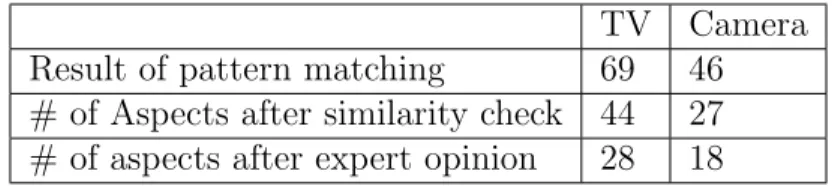
Table 6.16 Result of aspect analysis in TV and camera categories . . . . 86
Table 6.17 Sample of aspect weights in the TV category . . . 87
Table 6.18 Experiment result; 1, 3, 5 product recommendations . . . 88
Table 6.19 Correlation result for CAPRA compared to gold standard . . 88
Table 7.20 Data-set overview . . . 105
Table 7.21 NER approaches comparison . . . 105
Table 7.22 Samsung Galaxy S7 related topics . . . 106
Table 7.23 Dell XPS related topics . . . 106
Table 8.24 Data-set details . . . 130
Table 8.26 Share-a-fact participants statistics . . . 135
Table 8.27 Babies’ wisdom participants statistics . . . 135
Table 8.28 Order of facts for the concept apple. . . 138
Table 8.29 Concepts and correlation of approaches . . . 139
Table 8.30 Time consumption comparison of approaches (in seconds) . . 140
Figure 2.1 Sample RDF graph . . . 4
Figure 3.1 Query translation . . . 22
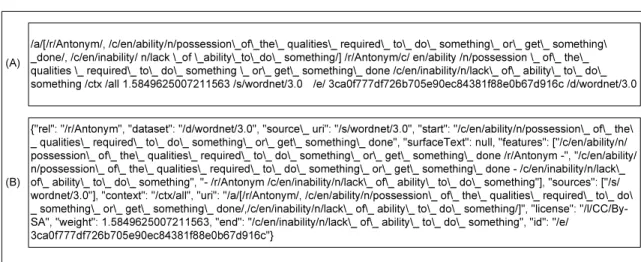
Figure 5.1 Sample line from ConceptNet data-set . . . 45
Figure 6.1 Sample Review . . . 57
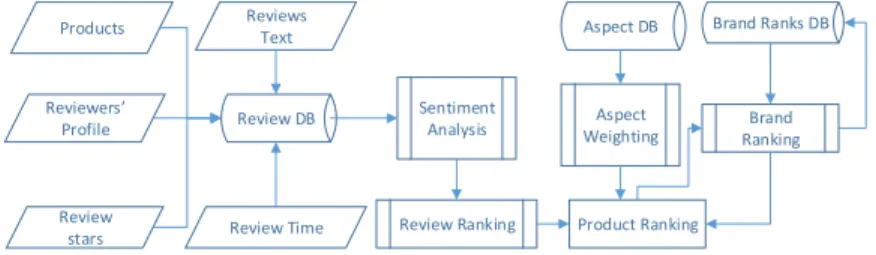
Figure 6.2 Product Ranking Process . . . 58
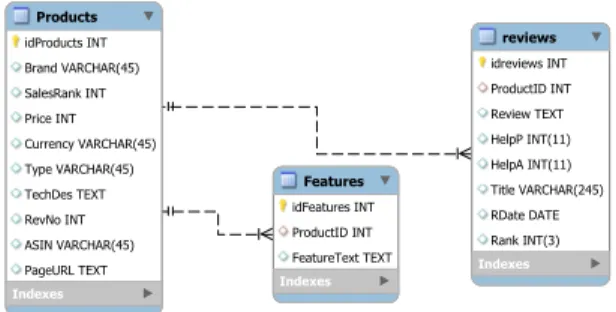
Figure 6.3 Products database ER diagram . . . 84
Figure 6.4 CAPRA performance, compared to similar works . . . 88
Figure 7.1 Dell XPS Taxonomy . . . 92
Figure 8.1 The knowledge hierarchy . . . 108
Figure 8.2 Graphical representation of a concept wisdom hierarchy . . . 112
Figure 8.3 SPMI variance and hit correlation . . . 132
Figure 8.4 Number of hits and correlation relation . . . 139
CHAPTER 1: BACKGROUND AND INTRODUCTION
The need to find, access and extract information has been the motivation for many different fields of research in the past few years. The fields such as Machine Learning, Question Answering Systems, Semantic Web, etc. each tries to cover parts of the mentioned problem. Each of these fields have introduced many different tools and approaches which in many cases are multi-disciplinary, covering more than one of these fields to provide solution for one or more of them. On the other hand, the expansion of the Web with Web 2.0, gave researchers many new tools to extend approaches to help users extract and find information faster and easier. Currently, the size of e-commerce and online shopping, the extended use of search engines for different purposes and the amount of collaboration for creating content on the Web provides us with different possibilities and challenges which we address some of them here.
In this work our goal is to implement a set of approaches to create a faster experience for users to access the information they need. We begin with describing our approach for Question Answering using Semantic Web technologies. For this purpose we require large semantic knowledge bases which are in specific formats. While there are some examples of large knowledge bases which are available in SW formats, there are some publicly available knowledge bases which do not have this format. Our next step is to start by creating an upper ontology and then use that ontology to convert a large common sense knowledge base to RDF. We later provide a more detailed description of the conversion of ConceptNet knowledge base to RDF format using the mentioned upper ontology.
Another part of our focus is on product suggestion for customers using product reviews. One can look at this work as a similar approach to Question Answering, but users instead of asking general question are asking about the best product they
can buy based on their criteria. This work itself consists of different parts such as Sentiment Analysis and Review Usefulness Analysis. The result of these different sections is summarized to provide users with an in depth ranking of products, both from a general user perspective and based-on user specific priorities.
When talking about products, we have to mention the importance of mi-croblogging Web sites such as Twitter and the effect they have on product sales and analysis. To analyze the vast amount of information available on these platforms, we create an approach to extract the related terms, and assign weights to them based on how much effect they have on the popularity of the product.
Finally, in a scenario that the user requires information about a concept we see a need to prioritize knowledge presented in different KBes based on general user opinions. The reasoning behind this proposition is that in many cases users do not want to see bulk of information related to a concept and they spend time to find the most interesting or popular fact. So we suggest a solution to provide the most needed piece of knowledge first. While we have many KBes presented in different formats, both in SW and other formats, there is no order in the knowledge. We propose that to convert this knowledge to wisdom we need an addition to this knowledge and discuss this approach in depth.
CHAPTER 2: RELATED WORK
2.1
Semantic Web Overview
World Wide Web (WWW) was created based-on the idea of interlinked web pages, providing human readable information to users. This human readability, while making it easier for users to read the information, is near impossible to be understood by machines. The growth of WWW presented a need to organize the information. First answers to this need was from search engines to create lists of desirable contents for users. While search engines have a long history on WWW, a structured idea of creating a machine readable backbone for Web was created and named Semantic Web (SW) in Berners-Lee et al. [2001].
The vision of SW is to provide a new approach to WWW to introduce intel-ligence and semantic, machine understandable meaning to it. To do so, there have been multiple technologies introduced over the years to help with this situation. In the following, we go over the main technologies, specifically the ones standardized by W3 consortium. The main goal of this section is not to describe the mentioned tech-nologies completely, but rather have an introduction to give readers a basic familiarity with the terminology which can be seen in the next sections.
2.1.1
RDF
RDF (Resource Description Framework) ( Lassila and Swick [1999]) is a model platform to represent information on the Web. Each record in RDF consists of three portions; Subject (Resource), Predicate (Property) and Object (Literal).
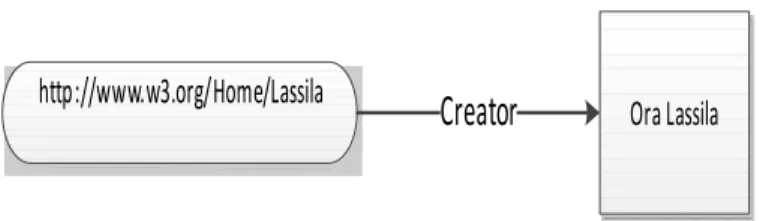
The subject identifies the resource the statement describes, the predicate is the property the statement wants to describe and the object is the value of the property. For example for the statement “Ora Lassila is the creator of the resource http://www.w3.org/Home/Lassila” the RDF triple is shown in Table 2.1 , visualized in Figure 2.1 and presented in XML/RDF format in the following:
Subject (Resource) http://www.w3.org/Home/Lassila
Predicate (Property) Creator
Object (literal) “Ora Lassila”
Table 2.1: RDF sample triple
<rdf:RDF> <rdf:Description about="http://www.w3.org/Home/Lassila"> <s:Creator>Ora Lassila</s:Creator> </rdf:Description> </rdf:RDF> 0000000000000000000000000000000000000000000000000000000000000000000000000000000000000000000000000000000000000000000000000000000000000000000000000000000000000000000000000000000000000000000000000000000000000000000000000000000000000000000000000000000000 0000000000000000000000000000000000000000000000000000000000000000000000000000000000000000000000000000000000000000000000000000000000000000000000000000000000000000000000000000000000000000000000000000000000000000000000000000000000000000000000000000000000 0000000000000000000000000000000000000000000000000000000000000000000000000000000000000000000000000000000000000000000000000000000000000000000000000000000000000000000000000000000000000000000000000000000000000000000000000000000000000000000000000000000000 0000000000000000000000000000000000000000000000000000000000000000000000000000000000000000000000000000000000000000000000000000000000000000000000000000000000000000000000000000000000000000000000000000000000000000000000000000000000000000000000000000000000 0000000000000000000000000000000000000000000000000000000000000000000000000000000000000000000000000000000000000000000000000000000000000000000000000000000000000000000000000000000000000000000000000000000000000000000000000000000000000000000000000000000000 0000000000000000000000000000000000000000000000000000000000000000000000000000000000000000000000000000000000000000000000000000000000000000000000000000000000000000000000000000000000000000000000000000000000000000000000000000000000000000000000000000000000 0000000000000000000000000000000000000000000000000000000000000000000000000000000000000000000000000000000000000000000000000000000000000000000000000000000000000000000000000000000000000000000000000000000000000000000000000000000000000000000000000000000000 0000000000000000000000000000000000000000000000000000000000000000000000000000000000000000000000000000000000000000000000000000000000000000000000000000000000000000000000000000000000000000000000000000000000000000000000000000000000000000000000000000000000 0000000000000000000000000000000000000000000000000000000000000000000000000000000000000000000000000000000000000000000000000000000000000000000000000000000000000000000000000000000000000000000000000000000000000000000000000000000000000000000000000000000000 0000000000000000000000000000000000000000000000000000000000000000000000000000000000000000000000000000000000000000000000000000000000000000000000000000000000000000000000000000000000000000000000000000000000000000000000000000000000000000000000000000000000 0000000000000000000000000000000000000000000000000000000000000000000000000000000000000000000000000000000000000000000000000000000000000000000000000000000000000000000000000000000000000000000000000000000000000000000000000000000000000000000000000000000000 0000000000000000000000000000000000000000000000000000000000000000000000000000000000000000000000000000000000000000000000000000000000000000000000000000000000000000000000000000000000000000000000000000000000000000000000000000000000000000000000000000000000 0000000000000000000000000000000000000000000000000000000000000000000000000000000000000000000000000000000000000000000000000000000000000000000000000000000000000000000000000000000000000000000000000000000000000000000000000000000000000000000000000000000000 0000000000000000000000000000000000000000000000000000000000000000000000000000000000000000000000000000000000000000000000000000000000000000000000000000000000000000000000000000000000000000000000000000000000000000000000000000000000000000000000000000000000 0000000000000000000000000000000000000000000000000000000000000000000000000000000000000000000000000000000000000000000000000000000000000000000000000000000000000000000000000000000000000000000000000000000000000000000000000000000000000000000000000000000000 ŚƚƚƉ͗ͬͬǁǁǁ͘ǁϯ͘ŽƌŐͬ,ŽŵĞͬ>ĂƐƐŝůĂ 0000000000000000000000000000000000000000000000000000000000000000000000000000000000000000000000000000000000 0000000000000000000000000000000000000000000000000000000000000000000000000000000000000000000000000000000000 0000000000000000000000000000000000000000000000000000000000000000000000000000000000000000000000000000000000 0000000000000000000000000000000000000000000000000000000000000000000000000000000000000000000000000000000000 0000000000000000000000000000000000000000000000000000000000000000000000000000000000000000000000000000000000 0000000000000000000000000000000000000000000000000000000000000000000000000000000000000000000000000000000000 0000000000000000000000000000000000000000000000000000000000000000000000000000000000000000000000000000000000 0000000000000000000000000000000000000000000000000000000000000000000000000000000000000000000000000000000000 0000000000000000000000000000000000000000000000000000000000000000000000000000000000000000000000000000000000 0000000000000000000000000000000000000000000000000000000000000000000000000000000000000000000000000000000000 0000000000000000000000000000000000000000000000000000000000000000000000000000000000000000000000000000000000 0000000000000000000000000000000000000000000000000000000000000000000000000000000000000000000000000000000000 0000000000000000000000000000000000000000000000000000000000000000000000000000000000000000000000000000000000 0000000000000000000000000000000000000000000000000000000000000000000000000000000000000000000000000000000000 0000000000000000000000000000000000000000000000000000000000000000000000000000000000000000000000000000000000 0000000000000000000000000000000000000000000000000000000000000000000000000000000000000000000000000000000000 0000000000000000000000000000000000000000000000000000000000000000000000000000000000000000000000000000000000 0000000000000000000000000000000000000000000000000000000000000000000000000000000000000000000000000000000000 0000000000000000000000000000000000000000000000000000000000000000000000000000000000000000000000000000000000 0000000000000000000000000000000000000000000000000000000000000000000000000000000000000000000000000000000000 0000000000000000000000000000000000000000000000000000000000000000000000000000000000000000000000000000000000 0000000000000000000000000000000000000000000000000000000000000000000000000000000000000000000000000000000000 0000000000000000000000000000000000000000000000000000000000000000000000000000000000000000000000000000000000 0000000000000000000000000000000000000000000000000000000000000000000000000000000000000000000000000000000000 0000000000000000000000000000000000000000000000000000000000000000000000000000000000000000000000000000000000 0000000000000000000000000000000000000000000000000000000000000000000000000000000000000000000000000000000000 0000000000000000000000000000000000000000000000000000000000000000000000000000000000000000000000000000000000 0000000000000000000000000000000000000000000000000000000000000000000000000000000000000000000000000000000000 KƌĂ>ĂƐƐŝůĂ
ƌĞĂƚŽƌ
Figure 2.1: Sample RDF graph
2.1.2
Ontologies
Ontologies add semantic meaning to SW. While RDF triples by themselves can be meaningless for humans, the ontologies provide background and meaning to vocabulary used in the triples. Two major technologies to present ontologies in SW are RDFS (RDF Schema)( Brickley and Guha [2004]) and OWL (Web Ontology Language)( Dean et al. [2004]). Both these languages provide tools to describe RDF triples and add meaning to the vocabulary used in them, but the type limit and other constraints RDFS has mostly caused replacing OWL in RDFS place.
We can divide RDFS to three main portions. These portions include classes, dividing each object to a class of objects, such as rdfs:Resource, rdfs:literal; Properties include specifications of objects, e.g. rdfs:range and rdfs:type; and Utility properties which includes rdfs:seeAlso and rdfs:isDefinedBy.
On the other hand, OWL consists of 3 sub-languages of OWL Lite, OWL DL and OWL Full. OWL Lite is mainly created for users needing classification of objects and simple constraints. OWL DL has all the tools provided in OWL but implements Description Logic to limit the use of different constraints. OWL Full is created to have some compatibility to RDFS. Hence, it allows different annotations which under OWL DL and OWL Lite are not allowed. Further information regarding the specification of OWL can be found in Bechhofer et al. [2004].
A comprehensive tutorial and how-tos for both these technologies presented in Allemang and Hendler [2011]. Also there are many ontologies available online for free to use in research and other uses. The two main used are Dublin Core ( Weibel et al. [1998]) and FOAF (Friend Of A Friend) (Brickley and Miller [2012]).
2.1.3
SPARQL
SPARQL (SPARQL Protocol And RDF Query Language)( PrudHommeaux et al. [2008]) is a query language over RDF data. SPARQL lets users query required and optional graph patterns along with their conjunctions and disjunctions. SPARQL also allows testing and constraining queries in a manner similar to RDBMS’s.
Following code shows a simple SPARQL query which returns country capitals in Africa.
PREFIX abc: <nul://sparql/exampleOntology#> . SELECT ?capital ?country
WHERE { ?x abc:cityname ?capital ; abc:isCapitalOf ?y. ?y abc:countryname ?country ; abc:isInContinent abc:Africa. }
2.1.4
Other technologies
Following we go over some of the other technologies in use in SW, shortly describe the technology and the need for each.
• Microformats: The need of SW to create parallel content to add semantic to
WWW has made its progress slow. Microformats are technologies to integrate semantic knowledge to general web pages created using current existing and dominant technologies (HTML and XHTML).The language created in accor-dance to main SW technologies such as RDF is RDFa ( Adida and Birbeck [2008]). On the other hand, Web Hypertext Application Technology Working Group (WHATWG) created Microdata as an addition for HTML5 to integrate metadata into HTML web pages. There are other technologies for integrating metadata for specific contents such as hCalender, integrating event information, hCard, contact information.
• Semantic Search Engines: This term can point to two different understanding,
first searching RDF or ontology documents and second make the search pro-cess semantically smarter. A good example of the first approach is Swoogle 1. This search engine searches ontologies, documents, terms and data published on the Web. For this process, it employs a system of crawlers to discover RDF documents and HTML documents with embedded RDF content. Swoogle rea-sons about these documents and their constituent parts (e.g., terms and triples) and records and indexes meaningful metadata about them in its database. For the second approach which is currently more dominant, major search engines on the Web have approached it from different perspectives. The two current major search engines have implemented different approaches to have smoother 1http://swoogle.umbc.edu/
search process for natural language searches such as in question answering
sys-tems. On the other hand some smaller search engines such as Lexxe 2 which
uses natural language processing to extract the information users are looking for. For example by searching keywords “color: camry” instead of searching for the keywords in Web page texts they look for different colors which have been mentioned alongside Toyota Camry. Other examples of semantic search engines include but not limited toYummly 3 for food and recipes andKosmix 4
(currently down).
2.2
Public Access Knowledge Bases
The use of information gathering in the logic based approach, specifically for computers, can be traced to “Advice Taker”, a theoretical system introduced in 1963 in the book “Programs with common sense”( McCarthy [1963]). The main goal of this project was to create a platform which led the computers learn and reason from their experiences, similar to humans.
Currently, the oldest active work in information gathering from common sense is Cyc (Lenat et al. [1985]). WhileCyc converted to commercialized product in 1994, there are free versions specifically created for researchers in OpenCyc and Research-Cyc. ResearchCyc provides access to the fullCyc knowledge-base underResearchCyc
licence. This version has more than 500000 concepts, nearly 5000000 facts and rules (called assertions inCyccontext) and more than 26000 relations. This release enables users to use CycL, the language generated for use of Cyc, and API to create any re-quired application. Also an ontology exporter is available to export specified portions of the knowledge base to OWL. On the other hand,OpenCyc, which is freely available
2http://www.lexxe.com/ 3http://www.yummly.com/ 4
to everyone, consists of more than 239000 terms and 2000000 concepts which is last updated in 2012.
Another significant work which functions as a bridge between dictionaries,
encyclopedias and common sense knowledge isWordNet(Fellbaum [1999]). WordNet,
started in 1985, is currently in version 3.1. Also the 3.0 version is available in RDF
which contains more than 155000 words. WordNet, other than providing synonyms,
antonyms, meronym and holonym, provides different senses for each word, creating a
hyper-linked network of words. Considering thatWordNet does not support different
languages, there have been works on a similar platform for European languages under
EuroWordNet(Vossen [1998]).
A similar work to WordNet but comparably newer is BabelNet(Navigli and
Ponzetto [2010]). BabelNet replacesWordNet’s senses and synsets with Babel synset. BabelNet’s latest release as of April 2014 is 2.0.1. There are a few points which makes BabelNet special compare to similar works. First, BabelNet consists of 50 languages (in October 2013). Second, it natively supports Lemon/RDF encodings. And finally it provides 7.7 millions images interlinked with the concepts in the data-set.
ThoughtTreasure(Mueller [1998]) was another work to gather common sense knowledge. The work on this approach started in 1993 and the support stopped in 2000 after the founder moved to IBM research to be part of the group which later
developed Watson. Final release of ThoughtTreasure has more than 27000 concepts
and 51000 assertions in English and French.
A specific case of common sense knowledge base is YAGO(Suchanek et al.
[2007]) started in 2008. While gathering information from Wikepedia, WordNet and
Geonames it has gathered more than 10 millions entities, 120 millions facts and 350000 classes in its current version (YAGO2) released in 2012. This knowledge base
has a comprehensive data on IsA taxonomy and schema which has been used as one of data sources for IBM Watson.
A different approach to information presentation is used inSenticNet(Cambria et al. [2010]) by providing pleasantness, attention, aptitude and polarity of phrases in [-1.1] range. The latest version of this knowledge-base, version 3.00, is currently in beta. We summarized the contribution and works in some of the knowledge bases specifically in common sense field in Table 2.2.
Approac h Y ear F ounded Y ear Stopp ed Data Av ail. to do wnload Notes MindPixel (Min [2005 ]) 2000 2005 1.4M no Evi 2005 2012 300M no, app a v ailable Bough t b Amazon 2012. F or-merly T rue Kno wlledge Probase (W u et al. [2012 ]) 2.7M no Belongs to Mi-crosoft, for in-ternal use Though tT reasure( Mueller [1998 ]) 1993 2000 27K concepts, 51K assertions no NELL (Carlson et al. [2010 ]) 2010 50M y es Nev er End-ing Language Learning (NELL) Op en Information Extraction (Bank o et al. [2007 ]) 15M y es F rom Clue W eb 99 data-set F reebase (Bollac k er et al. [2008 ]) 2007 2.5B+ facts, 43M+ topics y es RDF a v ailable. Go ogle b ough in 2010 UMBEL (UMB [2012 ]) 2008 2012 25K (based on their w eb site) y es Subset Op enCyc Y ago (Suc hanek et al. [2007 ]) 2008 10M en tities, 120M facts, 350K classes y es W ordNet 1985 155K w ords in V3.00 y es Bab elNet 2012 9M synsets, 50M w ord senses y es Researc hCyc 2012 50K concepts, 5M facts y es Bab elNet 2012 9M synsets, 50M w ord senses y es Sen ticNet 2010 y es On Sen timen Analysis OMCS (Singh et al. [2002 ]) 1999 1M+ no Used in Con-ceptnet T able 2.2: W orks in common sense kno wledge retriev al
2.3
Question Answering Related Work
The first automated QA system goes back to 1961 with a paper from Green et al Green et al. [1961]. But it is just by the recent advancements in different fields of data processing that we have started having a working, open domain QA system. The current works in this field divides and combines different research topics consisting of (but not limited to) Information Retrieval, Statistical (Ittycheriah et al. [2002]), Semantic Web and Artificial Intelligence. In this section, we provide a brief overview of some of the related literature (more in line with our work).
Question Classification is the first step in a QA system. The goal is to classify questions and find the type of the answer. A number of different approaches have been proposed in this regard. For instance in Hovy et al. [2001] questions are categorized to 94 different categories based on patterns found in the user queries. Ravichandran and Hovy [2002] introduces a similar approach where patterns in questions are gener-ated by using relgener-ated patterns in documents gathered from web. Similarly, machine learning is used in Zhang and Lee [2003]. Information Retrieval (IR) algorithms are compared and show that the best question classification result comes from Support Vector Machine (SVM). A recent approach for the problem of question classifica-tion is presented in Ray and S. Singh [2010], where WordNet University [2012] and Wikipedia Wikipedia [2012] are used to find patterns in the query to classify the questions.
Most of the QA techniques for semantic web (Lopez et al. [2005a], Cimiano et al. [2006], Wang et al. [2007a], Lopez et al. [2009], Tablan et al. [2007]) have a major ontology dependency. Some of them try to reduce the effect of this problem by using automated ontology finder. First problem with this approach is the amount of required resources, which may be minimal, based on the specifics of the domain. The
second problem is the time complexity of the ontology finding and matching, which is usually very expensive to implement at runtime. Also some of these approaches need specific customization for different domains which makes it impossible for them to be used by general users.
In Kauffmann et al. [2006], an approach has been introduced which answers
Wh- type (e.g., what, where, etc) questions based on a knowledge base. In this
approach, for the disambiquity of questions, the interface asks users for the precise question from the KB. When a KB is chosen, the RDF triples are loaded into a Jena model, using the Pellet reasoner to infer all implicitly defined triples and WordNet to produce synonym-enhanced triples. Pattern matching is then performed by searching for triples that include one of the nouns or verbs in the query. Another work more focused on finding the answers is presented in Unger et al. [2012], includes finding the answer using SPARQL (SPARQL Protocol and RDF Query Language) and creates different patterns to find the answer in RDF files from the Web. Similarly, in Bernstein et al. [2005] and Damljanovic et al. [2010] the user query is translated to what exists in the KB, questions are suggested using the user interests and the knowledge base. Users, generally want to directly find their answers without struggling with inputting extra information, our approach suggests a way, using answer types as a top level ontology, to provide the final answer without collecting extra information from users.
2.4
Upper Ontologies and Related Tools
As mentioned previously to map common sense to a logic based computer comprehensible format we need two tools. As such, we can divide the related work to this approach to two portions. One part is the works related to ConceptNet, creating a common sense knowledge base using different methods. And the second part is the works on defining relations and creating upper ontologies. The other field of
work which worths mentioning, but as there hasn’t been as many works in it we decided to not create a separate subsection for it, is the tools which has been used to create any of the works we mention in the following. These tools have been created to extract, gather and organize information from different resources. Each of these tools generally works with specific kind of resource. For example Reverb (Fader et al. [2011]) is focused on extracting information from web pages,Pellet (Parsia and Sirin [2004]) is a reasoner which can be used in Java or in softwares such as Protege (Noy et al. [2001]). Protege is a tool which provides the users with necessary instruments to create, understand and analyze ontologies and other SW resources.
An upper ontology is an ontology which describes different concepts in a gen-eral sense suitable for use in multiple fields. While the approach to upper ontologies has been controversial at best (Floridi [2008]), the need for an upper relationship management as backbone for any other ontologies and information presentation is generally acceptable and understandable. For this purpose, multiple organizations and research groups have generated different upper ontologies for different purposes. In the following, we shortly describe some of these works.
The Basic Formal Ontology (BFO) (Arp and Smith [2008]) is a small Upper ontology specifically designed for information retrieval, analysis and integration to scientific and other domains. The important consideration of this ontology is the lack of focus on physical and specific entities which makes it possible for the ontology to be used in many different fields. Majority of current practices of this ontology can be
found in biomedical and security ontologies. An example application ofBFO can be
seen in the Ontology for Biomedical Investigations (OBI) Brinkman et al. [2010].
Open Robots Common Sense Ontology (ORO) (Lemaignan et al. [2010]) is an
ontology created for use in AI and robotics with focus on properties. ORO has been
triple store, and Pellet for reasoning. The ontology has been maintained from 2008 to 2011. Considering the approach of this work, it is noteworthy that there are multiple parallel relations as data properties with binary range to create better environment for robotic data presentation.
Simple Knowledge Organization System (SKOS) (Miles and Bechhofer [2009]) is the W3 recommended approach to provide an easier migration path to convert data to RDF and other SW formats. It has been specifically created for conversion of
the-sauri, taxonomies, classification schemas and subject heading lists. Using the SKOS
primer we can identify 5 main components of SKOS definition. First, “Concept”
to present any unit of thought. Second, “Labels” to add description to concepts. To present the facts about concepts, a different component is used, which has logi-cal difference with labels, logi-called “Documentary Notes”. To describe and understand concepts further, “Semantic Relations” is used to connect the concepts and clarify their meaning. Finally, “Concept Schemas” is used to present the used vocabulary to describe the concepts.
One of the suggested ontologies by W3 is Dublin Core (Weibel et al. [1998]).
Dublin Core focuses on enabling ubiquitous access to cultural and scientific resources through galleries, libraries, archives and museums (GLAM). This goal is achieved by providing specific properties and classes suitable for this need such as language, license and publisher.
Talking about most acclaimed and used ontologies,Friend Of A Friend (FOAF)
(Brickley and Miller [2012]) has been a dominant ontology to present people and
or-ganizations since the beginning of the SW movement. The goal ofFOAF is to provide
a standard vocabulary for generating and presenting personal and organizational
in-formation such as name, address, email address in the SW format as part of WebID
To name some of the other ontologies widely used in different context, we
mention SIOC (Socially Interconnected Online Communities) to complement FOAF
to describe the products of forums, blogs mailing lists and wikis; GO
(GoodRela-tions) (Hepp [2008]) to describe products sold online; Music Ontology (Raimond et al. [2007]) to describe information related to music industry (not the music itself). While most mentioned works focus on general approach to infrastructural path to entity representation, there has been different tries to map human emotions to an
ontology. The two major works in this field are HEO (Human Emotion Ontology)
(Grassi [2009]) and Smiley ontology (Radulovic and Milikic [2009]). HEO mostly
focuses on emotions and emotion representations while Smiley generally presents ways to express emoticons by different metrics and descriptions.
Discussing upper and generally used ontologies, it is important to mention
Schema.org and the general acceptance of its different ontologies in SW community. Unfortunately the OWL version of the ontology on their web site is old and has not been maintained, but TopQuadrant has generated a new and reasoned version of the ontology in OWL format for public use. The ontology main classes are action (any action performed by and agent), creative work (any creative work in any field), data type (including basic data types such as integer), event (any event in any field), in-tangible (a class to cover many inin-tangible “things” such as quantities), medical entity (any entity related to medical field such as tests studies and devices), organization (covering different organizations), person (covering any person, dead, alive or even fictional), place (entities that have fixed, physical extension) and product (anything which is made available for sale).
CHAPTER 3: QUESTION ANSWERING USING SEMANTIC WEB
3.1
About Question Answering Systems
Automated QA systems can facilitate using semantic technologies to better cater towards the needs of the users. Current QA systems use a “search engine approach” where a user goes through multiple pages and filters them to find the answers s/he needs, in other word, it depends on user intelligence to find the answer. We argue that if QA systems are supported through semantic technologies, it can use machine intelligence to return the desirable result and hence improve user efficiency. In recent years, there have been multiple attempts to add this functionality to search engines Ko et al. [2010]. Some search engines like Google have implemented a QA system for simple questions, that searches for answers by parsing the search records and then ranking the answer. On the other hand search engines like ask.com keeps a repository of questions and answers shaped from user queries and experts answers.
The first approach lacks the deductive power to answer multi-level questions. For example it can easily answer the question: “Who is the president of United States?” but it cannot answer questions with two or more levels of deduction like “Where did wife of Barack Obama graduate from?”. It cannot conclude that the phrase “Wife of Barack Obama” refers to Michelle Obama so it has to look for where she has graduated from. Moreover this approach is computationally expensive, since it needs to crawl pages for specific answers and rank them at runtime. The second approach is limited by the number of questions and answers that are stored in the repository. Considering the growth rate of topics and questions on the Web, any repository cannot be expected to keep up with this growth.
In light of these issues, we need a solution that addresses two main concerns: First, it should be computationally inexpensive. Second, it should be able to keep up
with the growth of the Web and the ever-changing nature of information. The goal of this paper is to propose a new approach to enhance QA systems with semantics. We believe this approach can alleviate the current issues with QA systems. In terms of efficiency, searching for the answer in different scenarios, on the Web or in a knowledge base, is the most computationally expensive part of a question answering systems. We propose the use of RDF triples to reduce this efficiency bottleneck. By combining question types with RDF triples , we try to widen the grasp of our approach and make it ontology independent.
Question answering systems mostly consist of three main phases: Question Processing, Solution Access, and Solution Verification. In this paper we focus on the first phase i.e. question processing. Since we search for the answer in RDF files with the type and part of the query encoded in it, this greatly reduces the need for verification of the answer. The organization of this paper is as follows: In Section 2 we discuss the question classification problem. Section 3 presents our algorithm for translating the question to its RDF equal. In Section 4 we show how to find the answer in the RDF repository. Finally Section 5 presents our experimental results.
3.2
Question Classification
There are multiple ways to categorize questions. Many works try to be as specific as possible about getting the type of the answer, but since our main focus to find the answer is not a specific answer type, we can look at the problem from a more general perspective. There are many kinds of questions we can potentially consider, consisting of factoids, lists, definitions, hypothetical, causal, procedural and confirmation queries based on early Text Retrieval Conference (TREC) evaluation. We divide our classification procedure to two parts. For the first part we consider the factoids. This group is simpler to classify based on the question words in the query. In our work we parse the query for the limited set of the question words and if there is
one, it simplifies the solution as we describe in the next part. The second case of the classification is for the cases when we don’t have a complete question as the query. The most common case for this category is when the user only uses the keywords. The ontology which we use, consists of the basic types, as we use in the question classification. These types has been gathered from WordNet, general types in similar works and our experiments. Also we have added functionality to automatically choose possible type candidates and suggest them to the users.
When in the process of finding the type we find a type as our first result which is not in our typeset, we keep it in a database. We also keep the frequency that we have found this type in this database. If the frequency of a type passes a predetermined threshold we suggest this type as a new type to the system administrator. The reason that we don’t suggest this type to the end user is the need to keep a regular expression of the format of the type in our data set and the end user generally doesn’t have the expertise to put it in the system.
For noun we have the following types: Time, Event, Food, Body, Plant, Sub-stance, Artifact, Location, Person and Act. For verbs we use emotion, change, motion and consumption.
In the following, we provide details on these two classification categories.
3.2.1
Factoids classification
For category definition for factoids we extend the approach presented in Sing-hal et al. [2000] and expand it to meet our needs. The mentioned approach has the following basic types: people, locations, organizations, quantities, dates, and linear
measures. We combine the people and organization to one type. Furthermore, we
divide quantity type toage,distance and quantity.
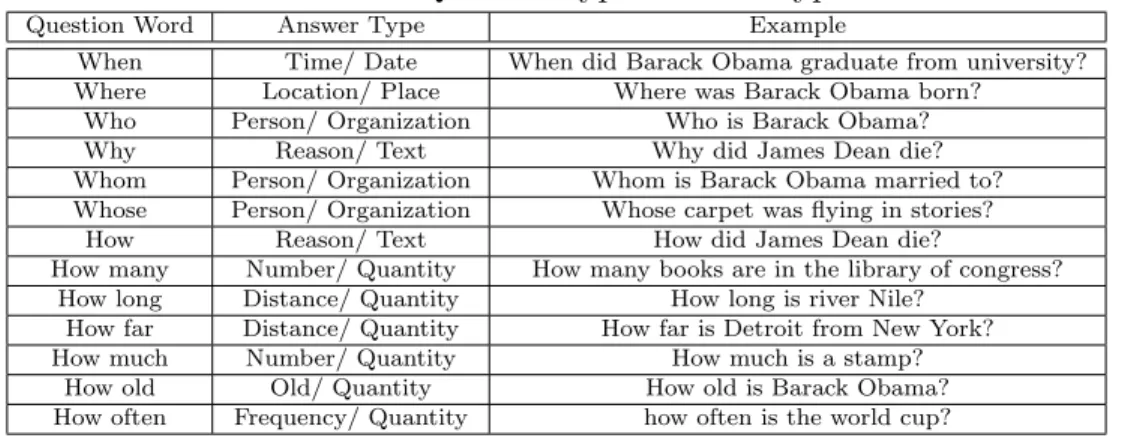
In our question classification algorithm, we categorize questions into two main and 12 sub-categories. For the first category, we considerTrue/Falsequestions. These
Table 3.3: Question types and subtypes
Question Word Answer Type Example
When Time/ Date When did Barack Obama graduate from university? Where Location/ Place Where was Barack Obama born?
Who Person/ Organization Who is Barack Obama?
Why Reason/ Text Why did James Dean die?
Whom Person/ Organization Whom is Barack Obama married to? Whose Person/ Organization Whose carpet was flying in stories?
How Reason/ Text How did James Dean die?
How many Number/ Quantity How many books are in the library of congress? How long Distance/ Quantity How long is river Nile?
How far Distance/ Quantity How far is Detroit from New York? How much Number/ Quantity How much is a stamp?
How old Old/ Quantity How old is Barack Obama? How often Frequency/ Quantity how often is the world cup?
questions check the truth value of a statement. This type of questions don’t have a question word at the beginning and we can always assign one of true or false values to them. As an example, the question “Is Barack Obama the president of United States?” starts with a to be verb and it’s answer is currently true. As these questions have a boolean answer, we classify all of them together as True/False type questions. The second type of the questions are considerably more complicated to
categorize. These questions begin with Wh- words and can have different kinds of
answers ranging from information and text to a single date. In Table 1 we categorize such questions to more specific subjects: We categorize theWh-questions into seven different categories. Six of these categories are simple Wh- words, the seventh one is
how which itself divides into six categories.
One special case is withHow, in our work we consider two different cases, if we have a noun right after how, we follow the procedure in the next section, otherwise
we consider the type Reason/Text. In the case of Which and What question words,
to find the type of the answer we follow the same procedure as the next section after removing the question word.
3.2.2
Keywords classification
We considered two different tools for this portion of our work. One possible approach we started with was Natural Language Parsers. After experimenting with different kinds of questions and different parsers we decided not to use NL parser for two main reasons. The first issue with these parsers is their time complexity. Their speed, compared to our whole process is considerably slower. The second issue with Natural Language Parsers happens when the user puts wrong grammar and/or just keywords. In this case the parsers cannot translate part of speeches correctly.
The second tool we used was N-grams. N-grams is considerably faster and better in understanding group of words. Also because N-grams use frequency of words in different contexts, for the new language phrases they return better results. In this paper we use Microsoft N-grams tool as our main decision maker to detect group of words.
The process of classification starts by defining group of words. We base our classification mainly on type of the noun. First, we look for the first group of words or the first noun. The type of the answer will thus be the type of the noun or group of words. We extract these types from WordNet. In case of group of words, there is a high possibility that we don’t find the type in WordNet. In this cases, if there is a single noun in the group of words, we consider the type of that noun as the type. However if there is no noun or multiple noun, we use pattern matching to create the RDF query of the form “Group of Words is a”. We look at the results and select the highest frequency “type” that we have in our types set.
3.3
Query Translation
The goal at this step is to convert the user query to an RDF tuple. The conversion simplifies our process toward creating the SPARQL to find the answer.
We divide our algorithm into two parts. The first part, the algorithm transfers the natural language query to a triple and in the second part we expand the algorithm further to incorporate complex question types.
We divide the possible user queries to 3 groups. In all the cases we use N-gram to find group of words. The other similarity in all the cases is the use of WordNet and English corpus to find the most frequent synonyms of the words. Our goal is to have verbs for predicate in the most possible cases. If what we find as predicate is not a verb we use the word definition and find the related verb from it as the predicate. To integrate all the created triples and queries with similar meaning together; we follow a two step procedure, first we look up the synonyms of the word from WordNet, at the second step we get the frequency of each of the synonyms from the Corpus of Contemporary American English (ENGLISH [2012]). This corpus data-set consists of 450 milions most common words in English with their frequencies. And then we store the triple with the new found term.
The first case of these three groups is when a user puts a complete query in the system. The user puts the complete question, with the correct grammar and dictation, e.g.,“When is Barack Obama Birthday?”. In this situation the query starts with a question word, i.e., What, Where, etc. or a to be verb. We can use the question word to decide on the type of the answer. The same situation happens with the queries which start with a question word but do not have other parts of the complete sentence except keywords. The last case is when the user just inputs the keywords without question words and the non-keywords in the query. The problem which arises in this situation is the possibility that we don’t have enough information to categorize the question. For example if the user query is stated as “Barack Obama born”, where the motive is to look for the day that Barack Obama was born, we will not have enough information from the query to return a date. On the other hand if the user inputs a
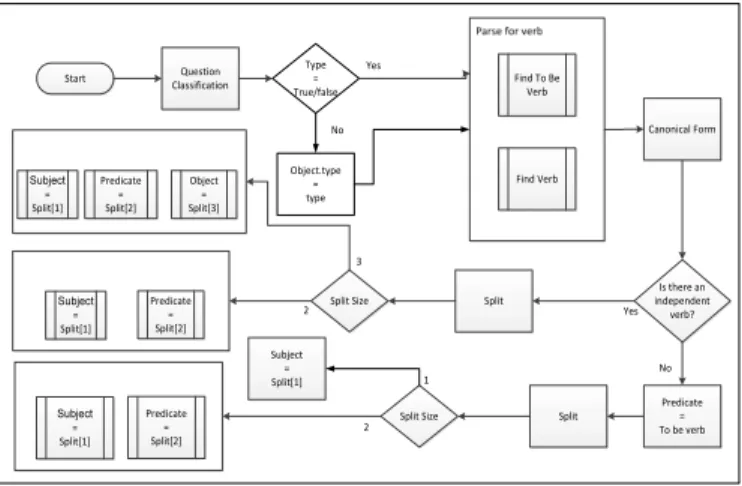
query like “Barack Obama Birthday” we can conclude that date should be retrieved. If after the classification we can’t finalize what type of information we are looking for, we create a general query and return all the related content to the query to the user. Question Classification Start Find To Be Verb Find Verb Canonical Form Is there an independent verb? Split Predicate = To be verb Yes No Split Split Size Subject = Split[1] Split Size Predicate = Split[2] Subject = Split[1] Predicate = Split[2] Subject = Split[1] Object = Split[3] 2 3 Type = True/false Object.type = type No Yes 1 Predicate = Split[2] Subject = Split[1] 2 1
Figure 3.1: Query translation
Figure 3.1 shows the process of creating a triple out of the user query. The
functionQuestionClassification()that is invoked in the first step of the flowchart
implements the classification we described in the previous section. We then assign the type we found to the object type if the type is nottrue/false. The next step finds both the to be verb and ,if there exists any, a normal verb in the query.
After detecting the verb in the question, we remove the wh- word and stop
words from the query. The goal here is to create a type of a canonical form for our query. Since many of the stop words can change the meaning of the query, we have to be careful about removing all the considerable stop words, specially when there are connecting group of words. The distinction between these two kinds of stop words can be made by analyzing the query using N-grams and separating words which are in the middle of nouns from the other type which are not connecting two or more nouns together. For example if we have the group of words “The united states of
America”, we remove the at the beginning and not of in the middle as it divides the two groups of nouns.
For the canonical form we perform the split operation in two different cases, one in case of a to be verb and one with normal verb. In both cases the next step is to run the split function. This function divides the query into groups of words based on the connection words and the relation of words together. The logic is similar to what we did to create the canonical form, i.e., find words which are not connected to
each other and split them. In to be case, depending on the number of groups we may
have subject and object or just the subject. In the latter case, we either have subject
and predicate or we may have all three parts of the triple.
The group of words that comes before the verb can be grouped together as a primitive form for our subject. The verb itself, which is the remaining part of the split, will be the primitive form for the predicate (and we have the type of object from the previous section). The specific steps for the example query “Where was Barack Obama born?” are then:
1. From the result of the previous section we know that the type of the answer we are looking for is “Loca-tion/Place”.
2. Looking for the verb in the question, which in this case is “born”.
3. Removing the Wh-word and any extra words in the query. The result is “Barack Obama born”.
4. Group words before the verb as subject which is “Barack Obama”
5. Group the verb as predicate which is “born”.
6. The triple is ready: {Barack Obama, Born, ? (Location/Place)}
For theTrue/False type of questions we adopt a slightly different approach as we only want to check the truthfulness of the query. In this case, we have all three parts of the RDF triple in the query. The sequence of steps is very similar to the
previous algorithm. We start by looking for the verb in the query. If we find another verb except the to be one, we go to the next step. If not, the to be verb is our final predicate.
For the case that we have another verb except the to be one, the first step is to remove the stop words. Then whatever comes before the verb is the subject and
whatever comes afterward is the object. When we have the second case, just one to
be verb in the query, we divide the remaining part of the query into two groups of
words. To find the connection between each group of words we look for transition words. When we have two nouns next to each other without a transition word in between, we can consider that part as the dividing point for the two words. The first group of words is the subject and the second group is the object of our triple. If we consider theto be verb as our predicate, we have all parts of the triple. We show how this procedure works on a sample question: “Was Barack Obama born in 1961?”
1. From the previous section we know that we are looking for a boolean answer for this question.
2. Looking for the verb in the question, which in this case is “born”.
3. Removing any extra words in the query. The result is “Barack Obama born 1961”.
4. Group words before the verb as subject which is “Barack Obama”
5. Group the verb as the predicate which is “born”.
6. The last part of the triple is “1961” as object.
7. Now the triple is ready for the next section: {Barack Obama, Born, 1961}
3.3.1
Algorithm Expansion
Currently the radius of support for the RDF repositories is not vast enough to answer the need of the general users. This section tries to improvise a solution for this problem. There are a lot of cases that two questions together are pointing to the same subject and can answer each others. To clarify this point we consider two sample
questions “Who is Barack Obama?” and “Who is the president of United States?”. In our algorithm the answer of one of these questions is the subject of the other one. So, from previous section for the first question the triple is {Barack Obama, is, ? (Person/Organization)} and for the second one it is {President of United States, is,
? (Person/Organization)}. We analyzed a number of different questions and found
that in many cases we can switch the place of object and subject in our triple and output both triples to the next section. With this approach we can create these two triples{? (Person/Organization), is, Barack Obama}and {? (Person/Organization), is, President of United States}. So, answer to one of the questions can solve the second question as well. Obviously we first look for an answer for the direct triple from the query and only if the answer cannot be found from it, we try the second query.
To make the triples more accessible and understandable we can consider the case where a query has a group of words pointing to an answer to another question, and as a result by answering that question we can make the original query shorter. We mentioned a sample of such questions in the introduction: “Where did wife of Barack Obama graduate from?”. In this case “Wife of Barack Obama” points to another question, by answering it we can make the original question simpler. There are two cases we consider regarding this issue. The first case we consider is if the group has the word of in it. We create a new triple that consists of word(s) after of
as subject and the word(s) before as predicate. For this case, the type of the object is as the type of predicate we just chose. To find the type we do the same as the
case of which question word before. The second case is when we have two questions
associate with each other in one question e.g., “who was the president who died in office”. Our approach to these questions is by dividing them in two parts and answer them separately. After finding the answer we look for the same answers for both questions and consider it as final answer for the query.
3.4
Finding the answer
To find the answer for the query, we will run the result of previous sections in the RDF repository. To bridge the RDF triple from the last section and repositories we use SPARQL query language.
The result of previous step divides the triples in two different cases. The first case is with Wh- questions. In this case, we have two parts of the RDF triple and the type of the third part. For instance, for the query: “When was Barack Obama born?” the result of Section 4 shows that the answer type is “Time/Date”. (The triple returned from the process in section 4 is {Barack Obama, born, ? (Time/Date)}). In this section, we create the following SPARQL query and run it in the RDF repository. Note that we get the basic type of the other parts of the triple from WordNet.
SELECT ?date
FROM <RDF repositorty.RDF> WHERE
{ <http://name#_Barack_Obama> act:born ?date. ?date rdf:type type:date. }
The result will return the object of the triple which is the answer for us, or will return nothing which shows we don’t have the answer for the query in the repositories. We return this part to the user as the final answer.
The second type of the question and results are “True,False” questions. The process from previous part showed the type of the answer as True or False and re-turned all three parts of the RDF triple from section 4. The goal here is to create as many RDF triples that are descriptive and short as possible.
We have to categorize all the connection words, connect them with one of the categories in our ontology. For example for “at” we need to connect it to location. Also the same applies for connection words between sentences, i.e., “Born in Honolulu,
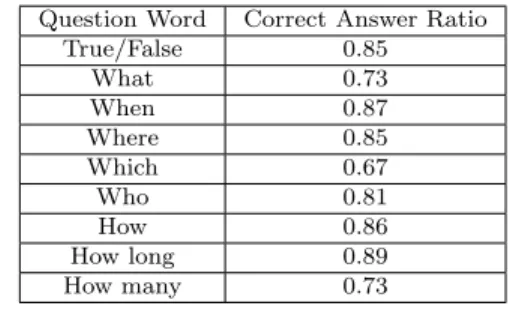
Table 3.4: Natural language query conversion into RFD
Question Word Correct Answer Ratio
True/False 0.85 What 0.73 When 0.87 Where 0.85 Which 0.67 Who 0.81 How 0.86 How long 0.89 How many 0.73
Hawaii, Obama is a graduate of Columbia University and Harvard Law School, where he was the president of the Harvard Law Review.”
3.5
Experiments and Results
We conducted experiments with a small data set to verify the applicability of our approach. For the first set of experiments we used top 50 queries for each category(i.e. 50 for what, 50 for when etc. ) of questions as retrieved from Google and used our algorithm to convert them into RDF triples. Table 3.4 shows the the results of our experiment.
We can see from the table above that our algorithm performs consistently good for all types of questions. However, Which type of questions are a little tricky to convert since they mostly have complex nouns and complex verbs. Similarly, for the How many type questions we mostly have a complex verb, such that one of them is mentioned as a part of the other one. Currently our approach cannot handle such relationships. Hence we have a low conversion rate for these types of questions.
For the second set of experiments we considered question subsets from Dataset [2004]. We compare the answers generated by our approach with the first answer retrieved from Google query. We took a sample data set from Data [2012]. We used the RDF triple generated for the query translation to find its answers both in the RDF files as well as search query in Google search engine. We used wikipedia as the information source for semantic serach for the experiments. We used 20 random
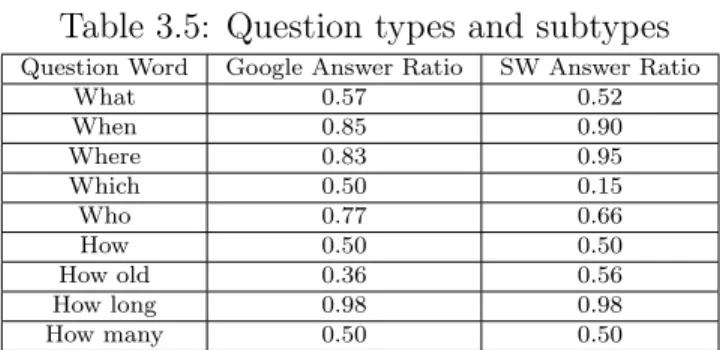
Table 3.5: Question types and subtypes
Question Word Google Answer Ratio SW Answer Ratio
What 0.57 0.52 When 0.85 0.90 Where 0.83 0.95 Which 0.50 0.15 Who 0.77 0.66 How 0.50 0.50 How old 0.36 0.56 How long 0.98 0.98 How many 0.50 0.50
questions of each type (as defined in table1) and repeated the experiment 10 times. Then we averaged out the numbers and the results of these experiments are presented below. Table 3.5 shows the results of our experiments.
We can see from the results that our techniques performs fairly good in com-parison to the Google search results. Our approach performs better than Google for
When, Where and How old types of question where as Google does a better job at
What, Which and Who types of question. Where as we see similar results for both
Google and our approach for How, How long and How many types of questions.
We can see from the results that the best solution was found for quantitative type questions. It is attributed to the fact that if an answer is found it is very probable that it will be a correct answer. Since a no-match found would be termed as an invalid answer. The text based answers had the minimum ratio for successful answers. The reason for the low score lies in the fact that our technique works of exact matching and the fact that for these types of questions we may have multiple answers and all of them could be valid/true. This makes it is very difficult to figure out the best answer for text based questions and makes it harder to put much confidence behind a possible answer candidate. Similarly we can see that number based answers i.e. when, how far etc did show better results. These results give us better insight into the semantic QA process. These limited sets of experiments show the applicability of our approach and serve as a proof of concepts for our solution.
Our proof of concept experiment run highlighted some of the problem points of our approach. The first one belongs to the semantic meaning of the combination of query words, for example the question “what is the biggest hit of Insane Clown Posse” we have to interpret the term ”biggest hit”. Now there could be multiple interpretations of the term biggest hit e.g. the biggest hit in terms of revenue or popularity or number of records sold etc. The missing information could be guessed using the heuristic measures base on frequency of words i.e. biggest hit is mostly associated with the number of albums sold. However this is not the semantic meaning of this combination of words hence this type of questions are difficult to answer. The second issue is when a question has a domain specific multi stage answer e.g. if we ask the question ”who discovered prions” in this case there is no single subject answer for this question since discovery of prion is attributed to three different stages. During the 1960s radiation biologist Tikvah Alper and mathematician John Stanley Griffith developed the hypothesis, Francis Crick recognized the potential importance of the Griffith protein-only hypothesis for scrapie propagation in his book and finally in 1982, Stanley B. Prusiner of the University of California, San Francisco announced that his team had purified the hypothetical infectious prion. Hence we can see a lot of domain specific knowledge is needed to construct answers for this kind of single questions. The third issue is with the questions of the type ”who was the lead singer of nirvana”. Our current approach of using N-grams will rank the N-gram lead singer as the most appropriate search tuple since it has a very healthy frequency. Although lead singer could be translated into singer by a human who knows the semantic rule that if there is only one singer in the band, then he/she should be the lead singer. But these types of domain specific rules do not exist for question answer systems. One of the approaches used to overcome this problem is to use the root of N-grams
being searched however this is computationally expensive and does not work in all cases.
CHAPTER 4: CONCEPTONTO
4.1
Introduction
In the beginning, the goal of World Wide Web was creating the most com-fortable presentation of information similar to books and catalogs. This approach was later followed by number of technologies, such as HTML and CSS, which made the transition of information to human friendly presentation possible. The exponen-tial expansion of World Wide Web introduced a new predicament to extraction of information from the Web. The advancement of search engines such as Yahoo at the time was a sign of this need. Overtime, researchers found out the main issue with the current form of the Web is the lack of understanding on part of machines on “common sense and knowledge” of humans. There have been two general approaches to solve this problem. One short term solution has been to use different algorithms on information retrieval and machine learning to retrieve the necessary data via a fringe understanding of information for machines. On the other hand, the conversion of information to a bridge format which is both understandable for machines and humans is a long term approach which has been chosen by many of the researchers in the field. Semantic Web (SW) is a general term used for many of technologies have been created for this purpose. The key stone for these technologies in this regard have been RDF and OWL for representing information.
The Semantic Web (SW) while comprehensive, needs a deep understanding of human common sense knowledge to understand basic information which seems prim-itive for most humans. As the base of human communication is relations between concepts, the first step to form this understanding is to create an ontology which maps basic human relations to different concepts while understanding some basic re-quirements of those relations. The field of Common sense conversion and common
sense knowledge bases follows different directions to map the relations and common knowledge to create the data-sets. Some works follow the manual information gath-ering approaches such as asking for data from users, and some other works are more focused on creating instruments to gather required information automatically.
Our analysis of different works in common sense knowledge retrieval and
pre-sentation has showed that ConceptNet (Liu and Singh [2004]) is one of the more
comprehensive and extended knowledge bases available for public use. Open Mind Common Sense knowledge-base was founded in 1999 based on simple information gathering approach from normal Web users to generate simple triples with over 30
basic relations. Later on, this work was expanded by the addition of WordNet and
Wikipedia. The generality of the presented knowledge, and the simplicity of the
re-lations and the information makes ConceptNet a formidable data-set for generation
and extraction of relations.
In this paper we introduce the process and steps of creation of ConceptOnto
to map the mentioned relations to their equivalent in OWL. The relations are based on the default relations ofConceptNet and addition of some equal or useful relations which we consider useful for an upper ontology with the focus on common sense. The ontology in OWL format is available for general use on our Web site5. InConceptOnto
our focus is readability for humans, maximizing the functionality while saving the generality of the ontology. Our goal in here is to present a through explanation of concepts and terms in our ontology so a general user can start implementing and using this ontology to create new SW data representations as needed. Throughout this presentation we have tried to consider the major points, however, we encourage and welcome any suggestion to improve the ontology.
The rest of this paper is organized as follows. First, we explain some of the terms used in this paper which need explicit explanation or needs further description based on the context. In Section 4.3 we describe the process and details of Concep-tOnto. Section 4.4 presents some of the fields which we believe can benefit from our work.
4.2
Term Definition
In different sections of this work there are a few concepts which need clari-fication. In the following we describe some of the terms which we believe are more helpful to follow the process and the logic behind parts of the process.
• Open World Logic: In the context of common sense knowledge, open world
logic means that every statement can be true unless the opposite is known as a fact. For example unless we specify that the location kitchen cannot be the same location as garage and car is in garage, then the reasoner cannot point out that the car is not in kitchen.
• Common Sense Knowledge Base: Representation of the knowledge that most
people generally possess, in a way understandable for intelligence programs which can use natural language or make inference about the world.
• Transitive Relation: A relation between two items is transitive when we can
conclude that if a is connected to b with this relation, and b is connected to c, then a is connected to c. For example “table isLocatedNear chair”, and “chair isLocatedNear TV”, then we can conclude that “table isLocatedNear TV”.
∀a, b, c∈X : (aRb, bRc)⇒aRc
• Symmetric Relation: A symmetric relation means that this relation holds for