Safe Generic Data Synchronizer
Pascal Molli, G´erald Oster, Hala Skaf-Molli and Abdessamad Imine
ECOO and CASSIS Teams - LORIA France{
molli,oster,skaf,imine
}
@loria.fr
May 15, 2003
Abstract
Reconciliating divergent data is an important issue in concurrent engineering, mobile computing and software configuration management. Actually, a lot of synchronizers or merge tools perform rec-onciliations, however, which strategy they apply ? is it correct ? In this paper, we propose to use a transformational approach to build a safe generic data synchronizer.
1
Introduction
Generally, users involved in mobile computing, collaborative computing, concurrent engineering work on replicates of shared data. They can make updates while working disconnected or insulated. This generates divergence on replicates that has to be reconciliated later.
Many systems exist today for reconciliating divergent data: file synchronizers, tools for PDAs, con-figuration management tools with merge tools, optimistic replication algorithms in databases, groupware algorithms in CSCW and distributed systems algorithms. However, an important issue is still open: what is a correct synchronization ? How to write a safe synchronizer ? In this paper, we propose to use the transformational approach[6, 23, 19, 22] as a theoretical foundation for a safe generic data synchronizer. This approach allows to define general correctness criteria for synchronizing any kind of data. To validate this approach, we developed a prototype that allows to synchronize with the same algorithm a file system and file’s contents for text files and XML files. The same correctness properties are ensured at all levels of synchronization. Of course, we can extend the prototype for more data types. I this paper, we present the transformational model and how we can use it for building a safe generic data synchronizer.
The paper is organized as follows: Section 2 details problems with actual synchronizers. Section 3 gives an overview of the transformational approach. Section 4 presents the generic integration algorithm. Section 5 and 6 details transformation functions for a file system and text files. Section 7 presents an example of integration on file system and Section 8 describes the S5prototype. Section 9 presents related works. The last section concludes with some points to future works.
2
Why a Safe Generic Synchronizer ?
Synchronization is a critical application. If safety is not ensured, users can loose data, or read inconsistent data and propagate inconsistencies. This can be dramatic in the context of distributed software engineering or mobile computing. What warranties are ensured by actual synchronizers ? Often, we can read simple slogans like ”non-conflicting updates are propagated to other replicates” [1]. So, what is precisely a conflict and what happens to conflicting updates ? For example, in a file system, if two users create concurrently a file with the same name, is it considered as a conflict or not ? If it is, the system will ask the user, to keep the old one or the new one. What is the good choice ? To be more general, what is the correct synchronization in this case ? What general properties should be ensured during a synchronization ?
If we investigate distributed systems like Coda[11], Bayou[13], Ficus[15], these systems allow users to work disconnected and use reconciliation procedures when people reconnect. Nice epidemic algorithms[13]
have been developed to propagate changes among replicates. Replicates are consistent if they all converge towards the same state. This means that a correct synchronization is a synchronization that ensures con-vergence. However, if we look carefully on how things work, conflicting updates are treated with ad-hoc merge procedures. If these procedures fail, then the conflict is delegated to an administrator in charge to solve the conflict. In this case, convergence in not reached until the administrator solves the conflict. We find similar approach in database systems [8]. If we use replication facilities of database systems, conflicts occur if two transactions working on two different replicates, update the same row at the same time. In this case, database systems [5] can use pre-defined merge procedures to achieve convergence. If convergence cannot be reached, conflicting updates are delegated to the database administrator. Is it really impossible to build a synchronizer that achieves convergence in all cases?
In configuration management[4, 7], divergence on data occurs when users work insulated in their workspaces. Reconciliation is performed when users update their workspaces. If conflicts occur on the file system, the system delegates conflict resolution to users. If conflicts are detected on files, the system calls specific merge tools associated to file types with all versions needed. If the merge tool detects more fine grained conflicts, it represents the conflict within the file and flags the file with a conflict tag.
The main objective of reconciliation in CM is more to avoid lost updates rather than to converge among workspaces. However, this tight cooperation between the CM systems and merge tools raises others prob-lems. Is it really different to merge a file system, a text file and a XML file ? If several merge tools are used each with its own policy of conflict resolution, what is the correctness of the whole synchronization ? The first question raises the problem of the existence of a generic synchronizer. The second question illustrates that if a generic synchronizer exists, then it will be easier to prove the correctness of a generic synchronizer rather than a set of specific synchronizers. Finally, if we make the hypothesis that a safe generic synchronizer exists, then it will give a framework to build the specific part dedicated to specific data.
In this paper, we propose to use the transformational approach as a theoretical foundation for building a safe generic synchronizer.
1. The transformational model gives a correctness criterion for synchronizing data. 2. The transformational algorithms can be adapted for building a generic synchronizer. 3. Transformation functions are developed for handling specific data types.
3
Transformational Approach
The model of transformational approach considers n sites. Each site has a copy of the shared objects. When an object is modified on one site, the operation is executed immediately and sent to others sites to be executed again. So every operation is processed in four steps: (a) generation on one site, (b) broadcast to others sites, (c) reception by others sites, (d) execution on other sites.
The execution context of a received operation opimay be different from its generation context. In this
case, the integration of opiby others sites may leads to inconsistencies between replicates. We illustrate
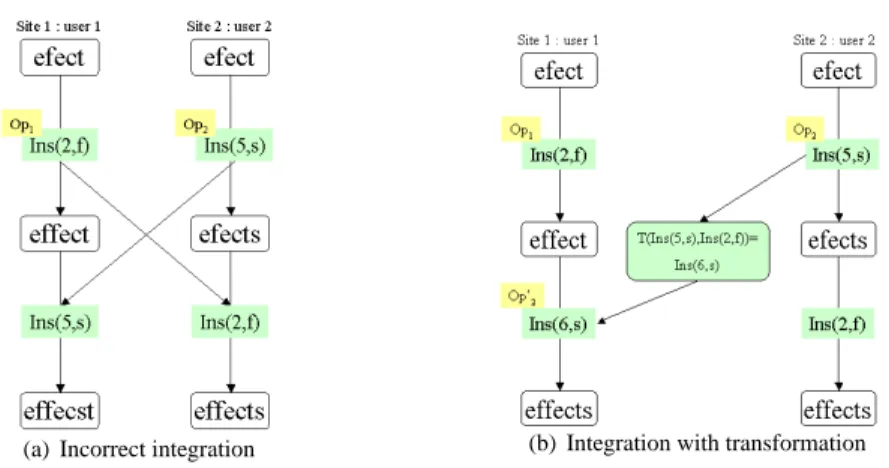
this behavior in figure 1(a). There are two sites site1 and site2working on a shared data of type S tring. We consider that a S tring object can be modified with the operation Ins(p,c) for inserting a character c at position p in the string. We suppose the position of the first character in string is 0. user1and user2generate two concurrent operations: op1 = Ins(2,f ) and op2 = Ins(5,s). When op1 is received and executed on site2, it produces the expected string ”effects”. But, when op2is received on site1, it does not take into account that op1has been executed before it. So, we obtain a divergence between site1and site2.
In the operational transformation approach, received operations are transformed according to local concurrent operations and then executed. This transformation is done by calling transformation functions. A transformation function T takes two concurrent operations op1and op2defined on the same state s and returns op0
1. op
0
1 is equivalent to op1 but defined on a state where op2 has been applied. We illustrate the effect of a transformation function in figure 1(b). When op2 is received on site1, op2 needs to be transformed according to op1. The integration algorithm calls the transformation function as follows:
T (( op2 z }| { Ins(5,s), op1 z }| { Ins(2,f ))= op0 2 z }| { Ins(6,s)
(a) Incorrect integration (b) Integration with transformation Figure 1: Integration of two concurrent operations
The insertion position of op2is incremented because op1has inserted an f before s in state e f ect. Next, op02 is executed on site1. In the same way, when op1 is received on site2, the transformation algorithm calls: T ( op1 z }| { Ins(2,f ), op2 z }| { Ins(5,s))= op0 1 z }| { Ins(2,f ) In this case the transformation function returns op0
1 =op1 because, f is inserted before s. Intuitively we can write the transformation function as follows
T ( I n s ( p1, c1) , I n s ( p2, c2) :− 2 i f p1< p2 t h e n r e t u r n I n s ( p1 , c1) 4 e l s e r e t u r n I n s ( p1+1 , c1) 6 e n d i f
This example makes it clear that the transformational approach defines two main components: the inte-gration algorithm and the transformation functions. The Inteinte-gration algorithm is responsible of receiving, broadcasting and executing operations. It is independent of the type of shared data, it calls transforma-tion functransforma-tions when needed. The transformatransforma-tion functransforma-tions are responsible for merging two concurrent operations defined on the same state. They are specific to the type of shared data (S tring in our example).
A more theoretical model is defined in [23, 19, 22, 21]. To be correct, an integration algorithm has to ensure three general properties:
Convergence When the system is idle (no operation in pipes), all copies are identical.
Causality If on one site, an operation op2 has been executed after op1, then op2 must be executed after op1in all sites.
Intention preservation If an operation opihas to be transformed into op0i, then the effects of op
0
ihave to
be equivalent to opi.
To ensure these properties, it has been proved [23, 19] that the underlying transformation functions must satisfy two conditions:
1. The condition C1defines a state equivalence. The state generated by the execution op1followed by
T (op2,op1) must be the same as the state generated by op2followed by T (op1,op2):
C1 : op1 ◦ T (op2,op1)≡op2 ◦ T (op1,op2)
2. The condition C2ensures that the transformation of an operation according to a sequence of concur-rent operations does not depend on the order in which operations of the sequence are transformed:
C2: T (op3,op1 ◦ T (op2,op1))=T (op3,op2 ◦ T (op1,op2)) In order to use the transformational model, we must follow these steps:
1. Choose a integration algorithm. Depending of the algorithm, C2maybe required or not on underlying transformation functions.
2. Define shared data types with their operations
3. Write transformation functions for all combination of operations. For example, on a string object with Ins(p,c), Del(p), we define T(Ins(p1,c1),Ins(p2,c2)), T(Ins(p1,c1),Del(p2)), T(Del(p1),Ins(p2,c2)), T(Del(p1),Del(p2))
4. Prove the required conditions on these transformation functions.
4
An Integration Algorithm For Synchronization
In order to use the transformational model, we adapt one existing integration algorithm and we write transformation functions for typed objects we want to synchronize.
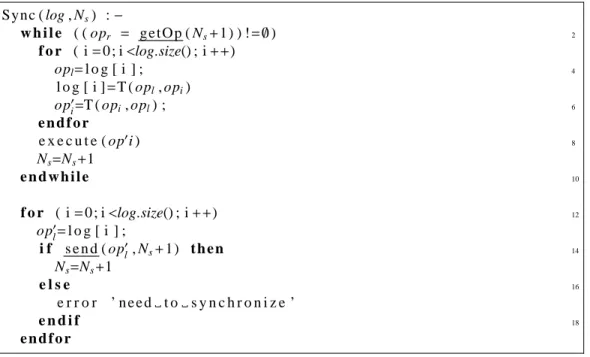
Sync ( log , Ns) :− 2 w h i l e ( ( opr = g e t O p ( Ns+1) ) !=∅) f o r ( i=0 ; i<log.size() ; i++) 4 opl=l o g [ i ] ; l o g [ i ]=T ( opl, opi) 6 op0i=T ( opi, opl) ; e n d f o r 8 e x e c u t e ( op0i ) Ns=Ns+1 10 e n d w h i l e 12 f o r ( i=0 ; i<log.size() ; i++) op0 l=l o g [ i ] ; 14 i f s e n d ( op0 l, Ns+1) t h e n Ns=Ns+1 16 e l s e e r r o r ’ n e e d t o s y n c h r o n i z e ’ 18 e n d i f e n d f o r
Figure 2: Generic synchronization algorithm
In the transformational approach, the integration algorithm has the responsibility of receiving, inte-grating, broadcasting and executing operations. Among existing algorithms, SOCT4[26] with its deferred broadcast, is the more suitable algorithm for our synchronization needs. SOCT4 is based on a continuous global order of operations and requires only C1to be verified by transformation functions. Each operation is sent with an unique global timestamp. An operation on a site S with a timestamp cannot be sent if all operations that precede it according to the timestamp order have been received and executed.
Synchronization algorithm is presented in figure 2. Synchronizing a site S takes two parameters: log and Ns. log is the sequence of operations executed locally since the last synchronization. Nsis an integer.
It contains the timestamp of the last operation received or sent by site s. We define two functions:
1. getOp( int ticket ) →op: retrieves the operation identified by the timestamp ticket. If no operation is available, getOp return∅
2. send(Operation op, int ticket ) →boolean: sends a local operation with the timestamp ticket. If ticket already exists, it means that a concurrent synchronization is in progress. In this case, the operation send returns false. The current state is not corrupted, it requires just to start again another synchronization.
site1 site2 op1 op3 op2 op4 s1=synchronize s2=synchronize s3=synchronize
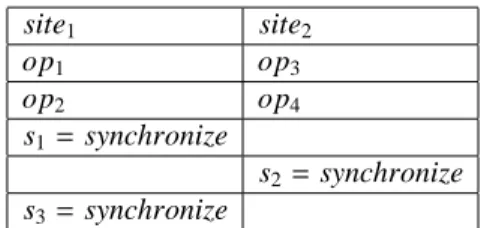
Figure 3: Scenario of integrations
Suppose we want to synchronize two sites as illustrated in figure 3. At the beginning, each site has Ns=0. site1performed two local operations op1,op2, and site2performed two concurrent local operations
op3,op4.
1. At point s1, site1synchronizes. It calls sync([op1,op2],0). There is no concurrent operation avail-able, so we just send op1,op2as is to site2. Now, Ns=2 on site1.
2. At point s2, site2 synchronizes by calling sync([op3,op4],0). The following transformation func-tions are called:
op0 1=T (op1,op3) op03=T (op3,op1) op00 1 =T (op 0 1,op4) op04=T (op4,op01) op0 2=T (op2,op 0 3) op003 =T (op03,op2) op00 2 =T (op 0 2,op 0 4) op004 =T (op04,op02)
op001,op002 are executed on site2. op100,op002 are sent to others sites. Now Ns=4 on site2.
3. At point S3, site1 synchronizes again by calling sync([],2). There is no more local concurrent operations, so remote operations are executed without transformation on site2and Ns=4.
4. After point s3, site1has executed the following sequence: op1
op2 op00
3 =T (T (op3,op1),op2) op004 =T (T (op4,op01),op02) and site2has executed the following equivalent sequence:
op3 op4 op00 1 =T (T (op1,op3),op4) op00 2 =T (T (op2,op 0 3),op 0 4)
This equivalence is ensured if transformation functions verify C1. It is clear in this example that conflicts detection and conflicts resolution are delegated to transformation functions. However, the problem is now simpler. A transformation function detects and resolves conflicts for one combination of two concurrent
operations defined on the same state. If one transformed operation has an effect on the next operation, the
cascading effect is handled by the integration algorithm.
This algorithm is a safe generic synchronizer if underlying transformation functions verify condition C1. It preserves convergence, causality and intention.
5
Transformation functions for a File System
The transformation functions are responsible for merging two concurrent operations defined on the same state. They are specific to the type of shared data. A transformation function T takes two concurrent operations op1and op2 defined on the same state s and returns op0
1. op
0
1 is equivalent to op1but defined on a state where op2 was applied. A transformation function detects and resolves all possibles conflicts between two concurrent operations. Condition C1ensures that all conflicts are resolved in the same way
in all sites. We define transformation functions for a file system and for each type of files. We limit our description to text files.
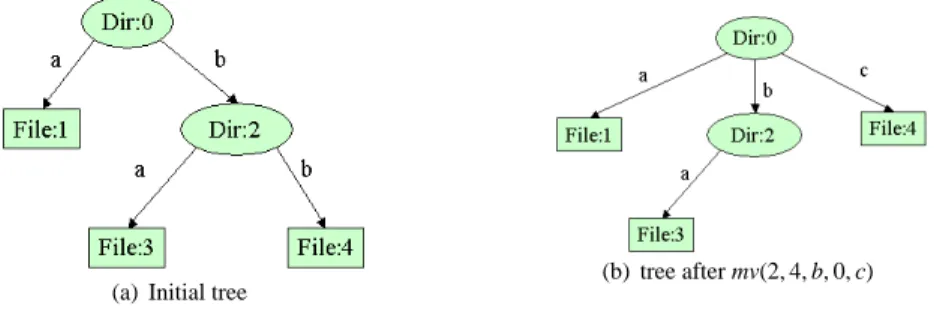
(a) Initial tree (b) tree after mv(2,4,b,0,c) Figure 4: File System representation
We consider a file system like a tree where nodes are directories and leafs are files. We define the following operations:
1. mf( int id , int pid , String name). m f stands for mkfile. It creates a file identified with a unique id . pid is the parent identifier. id is referenced with the name name in pid. m f has the following preconditions: id does not exist, pid exists and name is not used by pid.
2. md(int id , int pid , String name). md stands for mkdir. It creates a directory. In order to repre-sent the root of the tree, we consider that a unique identifier 0 exists and reprerepre-sents the root.
The sequence m f (1,0,a); md(2,0,b); m f (3,2,a); m f (4,2,b) builds the tree illustrated in figure 4(a): 3. mv(int pid1 , int id1 , String name1,int pid2 , String name2). Moves the object identified by id1 referenced in pid1 with name name1 under node identified by pid2 with name2. mv has the following preconditions: pid1,id1,pid2exist. id1is referenced with the name name1by pid1. name2is not used in pid2. If we apply mv(2,4,b,0,c) on the tree illustrated in 4(a), we obtain the state described in figure 4(b). We do not define the remove operation, we consider that removing is equivalent to moving a subtree to a directory representing the garbage.
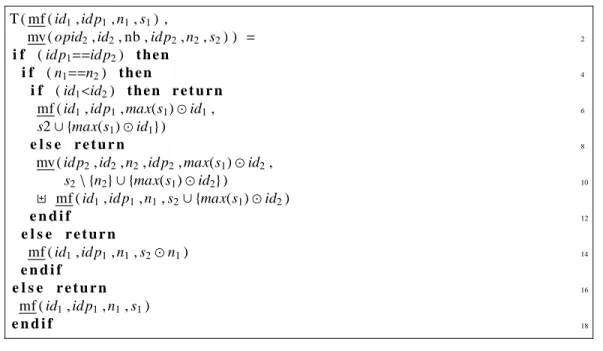
T ( mf ( id1, id p1, n1, s1) , mf ( id2, id p2, n2, s2) )= 2 i f ( id p1==id p2) t h e n i f ( n1==n2) t h e n 4 i f ( id1<id2) t h e n r e t u r n mf ( id1, id p1, max(s1)id1 , 6 s1∪ {max(s1)id1) e l s e r e t u r n 8 mv ( id p2, id2, n2, id p2, max(s2)id2,
s2\ {n2} ∪ {max(s2)id2})
10
| mf ( id1, id p1, n1, s2∪ {max(s2)id2}) e n d i f 12 e l s e r e t u r n mf ( id1, id p1, n1, s2∪ {n1}) 14 e n d i f e l s e 16 r e t u r n mf ( id1, id p1, n1, s1) e n d i f ;
Figure 5: transformation function for mkfile-mkfile
Writing correct transformation functions is complex. We have to preserve convergence by verifying condition C1and intention by computing equivalent operations. Our general strategy when writing trans-formation functions is to converge to a state in which conflicts are represented. A merge tool does the same
thing when it merges two files. For example, rcsmerge [24] handles an update conflict by producing the following output:
<<<<<<< testfile.txt
std::string LineReader::readLine() {
return std::read_line( cin ); }======= CString LineReader::ReadLine() { CString line; m_archive >> line; return line; }>>>>>>> 1.1.1.1.2.1
Users resolve the conflict by just editing the file. We apply the same principle for the file system. We handle conflicts on a file system by renaming files or directories involved in this conflict. For example, if two users create concurrently the same file in the same directory , we converge to a state where we have renamed one file. Users resolve the conflict by using the move operation.
T ( mf ( id1, id p1, n1, s1) , 2 mv ( opid2, id2, nb , id p2, n2, s2) ) = i f ( id p1==id p2) t h e n 4 i f ( n1==n2) t h e n i f ( id1<id2) t h e n r e t u r n 6 mf ( id1, id p1, max(s1)id1,
s2∪ {max(s1)id1}) 8 e l s e r e t u r n mv ( id p2, id2, n2, id p2, max(s1)id2, 10 s2\ {n2} ∪ {max(s1)id2}) | mf ( id1, id p1, n1, s2∪ {max(s1)id2) 12 e n d i f e l s e r e t u r n 14 mf ( id1, id p1, n1, s2n1) e n d i f 16 e l s e r e t u r n mf ( id1, id p1, n1, s1) 18 e n d i f
Figure 6: transformation function for mkfile-move
Figure 5 represents the transformation function for mkfile-mkfile. Renaming entries in a file system is a little tricky:
1. How to compute a new unique name in a directory ? In order to represent conflicts by renaming files or directories, we need to compute unique names within transformation function. This must be done using only the state informations where both concurrent operations are defined. Every operation modifying a directory provides the set of names contained in the directory after the execution of the operation. For example, on a directory identified by 1 and containing names{a,b,c}, the operation m f (2,1,d) is created with a fourth parameter s containing the set{a,b,c,d}. On this set, we define an extra operation max(s). It returns the name with higher lexicographical value. If we append id of the renamed object to max(s), we obtain a new unique name max(s)id.as the append operator. 2. which entry to rename ? In order to converge, we must make the same deterministic choice on all
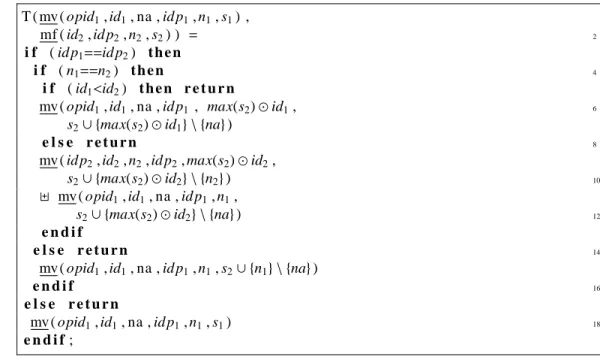
T ( mv ( opid1, id1, na , id p1, n1, s1) , 2 mf ( id2, id p2, n2, s2) ) = i f ( id p1==id p2) t h e n 4 i f ( n1==n2) t h e n i f ( id1<id2) t h e n r e t u r n 6 mv ( opid1, id1, na , id p1 , max(s2)id1,
s2∪ {max(s2)id1} \ {na})
8 e l s e r e t u r n
mv ( id p2, id2, n2, id p2, max(s2)id2,
10 s2∪ {max(s2)id2} \ {n2})
| mv ( opid1, id1, na , id p1, n1,
12 s2∪ {max(s2)id2} \ {na})
e n d i f 14 e l s e r e t u r n mv ( opid1, id1, na , id p1, n1, s2∪ {n1} \ {na}) 16 e n d i f e l s e r e t u r n 18 mv ( opid1, id1, na , id p1, n1, s1) e n d i f ;
Figure 7: transformation function for move-mkfile
creating the same file in the same directory, there are two cases: (a) we are transforming the operation with the least id (cf line 5 in figure 5). In this case, we just rename the file with max(s1)id1. (b) we are transforming the file with greatest id (cf line 8 in figure 5). In this case, we rename the least, and create the greatest without modifications. By this way, the transformation function returns a sequence of two operations.|is the sequence constructor.
Figures 6 and 7 describes transformation function for mkfile-move and move-mkfile. We use these functions in section 7.
The safety of the transformational approach relies on correctness of transformation functions. If trans-formation functions don’t verify C1then the integration algorithm ensures nothing. Proving condition C1 is error prone, time consuming and part of an iterative process. It is nearly impossible to do this by hand. We made the proof using the automatic SPIKE theorem prover [18]. The input of SPIKE is exactly the transformation functions written in this paper.
6
Transformation functions for text files
On a text file; we define the following operations:
1. ab(id1,s1,os1,v1). Adds a block of text v1 on the file identified by id1 at the insert point s1. os1 parameter is used to solve some false ambiguous conflicting situation [20]. It is the original insert point. when an operation ab is created, os1 =s1. If the operation is transformed, os1remains identical. In order to simplify the transformation functions, we use l1to represent the number of lines of block v1. id1and s1 have to exist.
2. db(id1,s1,ov1). Deletes the block of text ov1on file identified by id1at the delete point s1. l1is used to represent the number of lines of block ov1. id1and s1have to exist.
Figure 8 presents the transformation function for addblock-addblock. As for the file system, our gen-eral strategy for writing transformation function is to converge towards a state where conflicts are repre-sented. In case of conflict, we will produce a block of text containing the effects of both operations like rcsmerge[24]. Conflicts occur when the effects of two concurrent operations are overlapping. For example, a db operation can delete lines added concurrently by a ab operation. The overlapping between these two concurrent operations can be partial or complete.
T ( ab ( id1, s1, os1, v1) , 2 ab ( id2, s2, os2, v2) ) :− i f ( id1!=id2) t h e n 4 r e t u r n ab ( id1, s1, os1, v1) e l s e 6 i f ( s1<s2) t h e n r e t u r n ab ( id1, s1, os1, v1) 8 e l s e i f ( s1 > s2) t h e n r e t u r n ab ( id1, s1+l2, os1, v1) 10 e l s e i f ( os1 < os2) t h e n 12 r e t u r n ab ( id1, s1, os1, v1) e l s e i f ( os1 > os2) t h e n 14 r e t u r n ab ( id1, s1+l2, os1, v1) e l s e 16 i f ( v1 == v2) t h e n r e t u r n I d ( ab ( id1, s1, os1, v1) 18 e l s e r e t u r n db ( id2, s2, l2, v2) 20 | ab ( id1, s1, os1, v1v2) e n d i f 22 e n d i f e n d i f 24 e n d i f
Figure 8: Transformation function for addblock-addblock
For addblock-addblock, a conflict occurs only if both operations insert at the same line two different texts. In this case, we delete the block previously inserted and insert a new block containing both texts. If there is no overlapping, we just manage the insert point. The same strategy is applied for addblock-delblock in figure 9 and for delblock-addblock 10.
For space reasons, we don’t define transformation functions for delblock-delblock and move-move. All others transformation functions T (op1,op2) (for example T (op1=move,op2 =addblock)) return op1.
7
Example
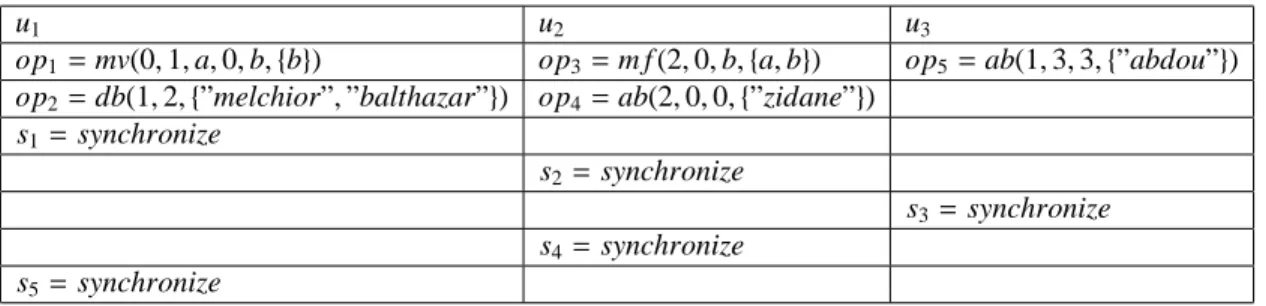
We suppose three users working concurrently on the same initial state: mf (1,0, a ,{a}) , ab (1,0,0,{” gaspard ”,” melchior ”,” balthazar ”}) .
T ( ab ( id1, s1, os1, v1) , db ( id2, s2, ov2) ) :− 2 i f ( id1 != id2) t h e n r e t u r n ab ( id1, s1, os1, v1) 4 e l s e i f ( s1<s2) t h e n 6 r e t u r n ab ( id1, s1, os1, v1) e l s e i f ( s1>s2+l2−1 ) t h e n 8 r e t u r n ab ( id1, s1−l2, os1, v1) e l s e 10 r e t u r n ab ( id1, s2, s2, ov2v1) e n d i f 12 e n d i f
Figure 9: Transformation function for addblock-delblock T ( db ( id1, s1, ov1) , ab ( id2, s2, os2, v2) ) :− 2 i f ( id1 != id2) t h e n r e t u r n db ( id1, s1, ov1) 4 e l s e i f ( s1 > s2) t h e n 6 r e t u r n db ( id1, s1+l2, ov1) e l s e i f ( s1+l1−1<s2) t h e n 8 r e t u r n db ( id1, s1, ov1) e l s e 10 r e t u r n db ( id2, s2, v2) | db ( id1, s1, ov1) 12 | ab ( id1, s1, s1, ov1v2) e n d i f 14 e n d i f
u1 u2 u3
op1=mv(0,1,a,0,b,{b}) op3=m f (2,0,b,{a,b}) op5=ab(1,3,3,{”abdou”})
op2=db(1,2,{”melchior”,”balthazar”}) op4=ab(2,0,0,{”zidane”})
s1=synchronize
s2=synchronize
s3=synchronize
s4=synchronize
s5=synchronize
Figure 11: Integration scenario
On this state, users produce concurrent operations described in figure 11. After the synchronization s5, all users observe the same state.
This scenario illustrates how the synchronizer handles conflicts between op1and op3and between op2 and op5. We describe now what happens for each synchronize command.
1. s1. At this point, there is no concurrent operation. Merge is straightforward. op1 and op2are just sent to the others sites.
2. s2. The synchronizer merges the sequence op1; op2 to the local log op3; op4. If we execute the integration algorithm described in figure 2, we obtain the following calls to transformation functions.
Operations Result op11=T (op1,op3) mv(0,1,a,0,b1,{b,b1}) op1 3=T (op3,op1) mv(0,1,b,0,b1,{b1}) |m f (2,0,b,{b,b1}) op21=T (op01,op4) mv(0,1,a,0,b1,{b,b1}) op1 4=T (op4,op 0 1) ab(2,0,0,{”zidane”})
op12=T (op2,op30) db(1,2,{”melchior”,”balthazar”}) op2
3=T (op
0
3,op2) mv(0,1,b,0,b1,{b1})
|m f (2,0,b,{b,b1})
op22=T (op02,op04) db(1,2,{”melchior”,”balthazar”}) op2 4=T (op 0 4,op 0 2) ab(2,0,0,{”zidane”})
3. For s3to s5, we re-execute the integration algorithm as for s2. After s5, each site has executed an sequence of operation equivalent to:
mf(1,0,a,{a}), 2 ab(1,0,0,{”gaspard”,”melchior”,”balthazar”}), op1=mv(0,1,a,0,b,{b}), 4 op2=db(1,2,{”melchior”,”balthazar”}), op23=mv(0,1,b,0,b1,{b1})|mf(2,0,b,{b,b1}), 6 op2 4=ab(2,0,0,{”zidane”}), op4 5=ab(1,2,2,{”>>”,”melchior”, 8 ”balthazar”,”=”,”abdou”,”<<”});
8
Implementation
S 5 is a web service of synchronization1. Users can register and create channels for synchronizing data. A
channel is queue of timestamped operations. Once a channel is created, channel registered users can create replicates on their local disks and start synchronizing. Figure 12 represents one channel with 3 replicates. This channel contains 262 operations. All the replicates are up-to-date.
Figure 12: S5 web client
We use diffalgorithms [3, 12] to detect changes since last synchronization. Diffalgorithm generates the local logs required by the integration algorithm.
We use S 5 for several month now, and we observed that the number of operations is growing fast. On some channels we have more than 4000 operations. An algorithm for compressing log of operations using the transformational approach has been developed in [17]. We plan to implement it in order to compress channels.
9
Related Works
Many tools exist in different research areas dealing with synchronizations. We compare our work with file synchronizers, PDAs synchronizers, configuration management tools, synchronization issues in distributed systems and replication in database systems.
File Synchronizer The overall goal of a file synchronizer is to detect conflicting updates and propagate non conflicting update. To achieve this goal, the semantic of the file system primitives must be well defined as in Unison [1]. However, this approach presents several drawbacks: (a) the approach is restricted to a file system. (b) Synchronization is often limited to two replicates. (c) Reconciliation is coarse grained. It does not attempt to synchronize files contents. (d) A general correctness criterion is not defined. (e) The system interacts with user each time a conflict is detected. If there are 100 conflicts, the system will interacts 100 times with the user. If we just make the comparison between S5 and this kind of synchronizers, S5 handles n replicates, ensures convergence, causality and intention preservation, synchronizes files contents, resolves automatically conflicts in all cases.
PDA synchronizer ActiveSync, HotSync, I-Sync are now largely used to synchronize data between a desktop computer and PDAs. These synchronizers allow to synchronize several kind of data like an address book, a calendar, tasks, notes , bookmarks, files . . .
However, this approach is an extension of the file synchronizer approach: it detects conflicting updates and propagates non conflicting updates. So we have exactly the same problems: no correctness criteria, problems with conflict resolution . . .
The genericity of transformational approach makes it easy to write such synchronizers. We can define a type calendar with three operations: AddRendezVous, RemoveRendezVous and UpdateRendezVous. Then we define all transformation functions and make the proof of the condition C1. The result is a safe synchronizer, ensuring convergence, causality and intention preservation.
CM and Merge Tools In Configuration Management Environments [2, 25, 4, 7] users can work in parallel, produce data divergence and reconciliate later using the copy-modify-merge paradigm. If we look closer on how things are done, we observe that reconciliation is done by tight cooperation between version manager and merge tools. (a) When a reconciliation is required (i.e. often when a user updates his workspace), version managers provides required version to merge tools [12]. Merge is done locally, in the workspace of the user. (b) Merge tools extracts from different versions, concurrent logs of operations using Diffalgorithms [3]. Of course, diffalgorithms are specific to data types. (c) Finally, concurrent operations are merged using ad-hoc algorithm specific to data types.
The transformational model is more general, more uniform, safer than this model. In this approach, each merge tool has its own merge algorithm. The software that merge two divergent file system trees is not the same as the software that merge two divergent text files. Maybe, they are not consistent together, they do not apply the same strategy.
In the transformational approach, the merge algorithm is shared by all transformation functions. It preserves Convergence, Causality and Intentions (CCI) if underlying transformation functions ensure condition C1. By this way, we can extend the synchronizer by adding new transformation functions without violating CCI properties.
Distributed systems Maintaining consistency of shared data is a big issue in distributed systems. Coda[11], Bayou[13], Ficus[15] allow users to work disconnected and use reconciliation procedures when people reconnect.
Bayou[13] first used an epidemic algorithm to propagate changes between weakly consistent replicates. When a conflict is detected, merge procedures associated with operations are executed. If the merge pro-cedure cannot find a solution, conflict resolution is delegated to users. Bayou use a total update ordering. Other systems [16] use a partial update ordering and then take advantages of update commutativity. Causal-ity is used to determine the partial ordering.
Distributed systems and transformational approach are similar in many points: both approaches detect conflicts, merge procedures and transformation functions looks identical, commutativity and condition C1 are quite similar and causality are used in both approaches. However, the transformational approach allows to transform operations. C1is some sort of ”transformational commutativity”. It allows to compute more complex state of convergence. Unlike merge procedures, transformation functions ensure convergence in all cases.
The IceCube [10] is a generic approach for reconciliating divergent data. IceCube does not define a general correctness criterion for synchronization but uses semantic constraints that the reconciliation algorithm has to preserve. IceCube considers two kind of constraints: (a) Static constraints can be evaluated without using the state of replicate. Commutativity of operations can be expressed has a static constraint. (b) Dynamic constraints can refer a state of replicates.
Basically, IceCube explores all possible combinations of concurrent actions. First, IceCube rejects all combinations violating static constraints. For the others, IceCube simulates integrations on replicates and reject combinations violating dynamic constraints. Resulting combinations are ranked and proposed to user.
This approach is interesting because, IceCube is looking for the combinations of concurrent operations that minimize conflicts of reconciliation. Maybe, on this point, transformational approach will not find the optimal reconciliation. On the other hand, IceCube has intrinsics drawbacks: (a) Combinatorial ex-plosion can occur during the first stage of reconciliation, even if static constraints restrict the number of possible schedules. (b) Constraints are specific to applications and have to be defined. (c) IceCube is inter-active, (d) IceCube does not transform operations. What happens if there is just two concurrent operations
mk f ile(”/a”) and mkdir(”/a”). All possible schedules are bad. In this situation, IceCube will just ask users
what it has to do as classical file synchronizer.
Database Systems Replication and database consistency has been investigated extensively [8, 14]. Replication conflicts can occur in a replication environment that permits concurrent updates to the same data at multiple sites. If two transactions working on two different replicates, update the same row at the same time, a conflict can occur.
Oracle[5] provides built-in resolution methods for resolving update conflicts. The “latest timestamp” value resolves a conflict based most recent update. the Additive method adds the difference of two conflicting “update value” operations to the current value. The “overwrite” method replaces the current value with the new value. Users can define their own conflict resolution methods. If convergence cannot be achieved then a notification is sent to the administrator. Some built-in resolution methods seem to preserve convergence but not for any kinds of conflicts (uniqueness and delete/update) and not for any configuration of repli-cates. Transformational approach is more general than replicates management in database systems. We can implement built-in or user defined resolution methods of Oracle as transformation functions and prove formally the convergence.
10
Conclusion and perspectives
Transformational Approach can be considered as a theoretical foundation for synchronizing data. We proposed a generic synchronizer ensuring convergence, causality and intention preservation. It relies on underlying specific transformation functions verifying condition C1. We wrote correct transformation functions for a file system, text files, XML files [9], String. . . . We validated our approach with the S5 prototype.
We have several research directions:
1. We want to develop transformation functions for handling more shared data types like database primitives, DTDs in XML. . .
2. We are currently building network of synchronizations. It implies that a single replicate can be synchronized with several timestampers. By this way, we can develop the dataflow part of a software process.
3. A lot of work has been done for undoing operations in real-time groupware[21]. It requires that at least transformation functions verifies condition C2. We have started to improve our transformation functions to handle the undo operation. This approach can be used as an alternative to compensation.
4. We are currently modifying the SPIKE theorem prover in order to build an integrated development environment for transformation functions. Within this environment a user enters functions like in this paper and calls the theorem prover like a compiler. If there are errors, the environment gives counter-examples immediately. We believe that this kind of environment can greatly improve the process of production of transformation functions.
References
[1] S. Balasubramaniam and Benjamin C. Pierce. What is a file synchronizer? In Mobile Computing and Networking, pages 98–108, 1998.
[2] B. Berliner. CVS II : Parallelizing software development. In Proceedings of USENIX, Washigton D. C., 1990.
[3] Sudarshan S. Chawathe and Hector Garcia-Molina. Meaningful change detection in structured data. In Proceedings of the 1997 ACM SIGMOD international conference on Management of data, pages 26–37. ACM Press, 1997.
[4] Reidar Conradi and Bernhard Westfechtel. Version models for software configuration management. ACM Computing Surveys (CSUR), 30(2):232–282, 1998.
[5] Dean Daniels, Lip Boon Doo, Alan Downing, Curtis Elsbernd, Gary Hallmark, Sandeep Jain, Bob Jenkins, Peter Lim, Gordon Smith, Benny Souder, and Jim Stamos. Oracle’s symmetric replica-tion technology and implicareplica-tions for applicareplica-tion design. In Proceedings of the 1994 ACM SIGMOD international conference on Management of data, page 467. ACM Press, 1994.
[6] Clarence A. Ellis and Simon J. Gibbs. Concurrency control in groupware systems. In SIGMOD Conference, volume 18, pages 399–407, 1989.
[7] Jacky Estublier. Software configuration management: a roadmap. In ICSE - Future of SE Track, pages 279–289, 2000.
[8] Jim Gray, Pat Helland, Patrick O’Neil, and Dennis Shasha. The dangers of replication and a solution. In Proceedings of the 1996 ACM SIGMOD international conference on Management of data, pages 173–182. ACM Press, 1996.
[9] Abdessamad Imine, Pascal Molli, G´erald Oster, and Micha¨el Rusinowitch. Development of transfor-mation functions assisted by a theorem prover. In Fourth International Workshop on Collaborative Editing, New Orleans, Louisiana, USA, November 2002.
[10] A. Kermarrec, A. Rowstron, M. Shapiro, and P. Druschel. The icecube approach to the reconciliation of divergent replicas. In Proc. of Twentieth ACM Symposium on Principles of Distributed Computing PODC, Newport, RI USA, August 2001., 2001.
[11] Puneet Kumar and M. Satyanarayanan. Flexible and safe resolution of file conflicts. In USENIX Winter, pages 95–106, 1995.
[12] Jonathan P. Munson and Prasun Dewan. A flexible object merging framework. In Proceedings of ACM CSCW’94 Conference on Computer-Supported Cooperative Work, Technologies for Sharing I, pages 231–242, 1994.
[13] Karin Petersen, Mike J. Spreitzer, Douglas B. Terry, Marvin M. Theimer, and Alan J. Demers. Flexi-ble update propagation for weakly consistent replication. In Proceedings of the 16th ACM Symposium on Operating SystemsPrinciples (SOSP-16), Saint Malo, France, 1997.
[14] Michael Rabinovich, Narain H. Gehani, and Alex Kononov. Scalable update propagation in epidemic replicated databases. In Extending Database Technology, pages 207–222, 1996.
[15] Peter L. Reiher, John S. Heidemann, David Ratner, Gregory Skinner, and Gerald J. Popek. Resolving file conflicts in the ficus file system. In USENIX Summer, pages 183–195, 1994.
[16] Yasushi Saito and Henry M. Levy. Optimistic replication for internet data services. In International Symposium on Distributed Computing, pages 297–314, 2000.
[17] Haifeng Shen and C. Sun. A log compression algorithm for operation-based version control systems. In Proceedings of IEEE 26th Annual International Computer Software and Application Conference (COMPSAC 2002), Oxford, England, august 2002.
[18] S. Stratulat. A general framework to build contextual cover set induction provers. Journal of Symbolic Computation, 32(4):403–445, 2001.
[19] Maher Suleiman, Mich`ele Cart, and Jean Ferri´e. Concurrent operations in a distributed and mobile collaborative environment. In Proceedings of the Fourteenth International Conference on Data Engi-neering (ICDE’98), pages 36–45, Orlando, Florida, USA, February 1998. IEEE Computer Society. [20] Maher Suleiman, Mich`ele Cart, and Jean Ferri´e. Serialization of concurrent operations in a distributed
collaborative environment. In Proceedings of the International ACM SIGGROUP Conference on Supporting Group Work : The Integration Challenge (GROUP’97), pages 435–445. ACM Press, November 1997.
[21] Chengzheng Sun. Undo as concurrent inverse in group editors. ACM Transactions on Computer-Human Interaction (TOCHI), 9(4):309–361, December 2002.
[22] Chengzheng Sun and David Chen. Consistency maintenance in real-time collaborative graphics edit-ing systems. ACM Transactions on Computer-Human Interaction (TOCHI), 9(1):1–41, March 2002. [23] Chengzheng Sun, Xiaohua Jia, Yanchun Zhang, Yun Yang, and David Chen. Achieving conver-gence, causality-preservation and intention-preservation in real-time cooperative editing systems. ACM Transactions on Computer-Human Interaction (TOCHI), 5(1):63–108, March 1998.
[24] Walter F. Tichy. RCS – A system for version control. Software–Practice and Experience, 15(7):637– 654, July 1985.
[25] Andr´e van der Hoek. International workshop on software configuration management (scm-10): new practices, new challenges, and new boundaries. ACM SIGSOFT Software Engineering Notes, 26(6):57–58, 2001.
[26] Nicolas Vidot, Mich`ele Cart, Jean Ferri´e, and Maher Suleiman. Copies convergence in a distributed real-time collaborative environment. In Proceedings of the ACM Conference on Computer Supported Cooperative Work (CSCW’00), Philadelphia, Pennsylvania, USA, December 2000.