The Domain Name System (DNS):
Security challenges and improvements
Richard John Matthew Agar
Technical Report
RHUL–MA–2010–03
31st March 2010
Department of Mathematics
Royal Holloway, University of London Egham, Surrey TW20 0EX, England
The Domain Name System (DNS):
Security challenges and improvements
Name: Agar, Richard John Matthew
Student Number: 100622219
Supervisor: Kenneth Paterson
Submitted as part of the requirements for the award of the MSc in Information Security at Royal Holloway, University of London.
I declare that this assignment is all my own work and that I have acknowledged all quotations from the published or unpublished works of other people. I declare that I have also read the statements on plagiarism in section 1 of the regulations governing examination and assessment offences and in accordance with it I submit this project report as my own work.
Signature:
2 ACKNOWLEDGMENTS
I would like to thank Professor Kenneth Paterson for his support, enthusiasm and encouragement with the research for this project and preparation of the report. I would also like to express my appreciation to the remainder of the academic staff at the Information Security Group at Royal Holloway who have lectured over the past year, all of you have helped indirectly by providing valuable knowledge and understanding that has helped me with this project and report. Finally I’d like to thank Elizabeth for her help, understanding and humour during this process.
3 TABLE OF CONTENTS
LIST OF FIGURES ... 6
LIST OF ABBREVIATIONS AND ACRONYMS ... 7
1. EXECUTIVE SUMMARY ... 9 2. INTRODUCTION ... 10 3. DNS OVERVIEW ... 11 3.1. DNS architecture ... 11 3.1.1. DNS domains ... 11 3.1.2. DNS zones ... 12 3.1.3. Resource Records ... 13
3.1.4. Resolvers and Nameservers ... 14
3.1.5. Availability and Performance ... 15
3.2. DNS query and response ... 16
3.2.1. DNS protocol ... 16
3.2.2. DNS request walkthrough ... 16
3.2.3. Structure of a DNS query and response ... 19
3.2.4. Validating a query response ... 21
3.2.5. Why glue records are important ... 21
4. OVERVIEW OF DNS SECURITY ISSUES ... 23
4.1. Services required from the DNS ... 23
4.2. DNS Traffic redirection ... 24
4.2.1. E-mail redirection ... 24
4.2.2. Nameserver redirection ... 24
4.2.3. WWW redirection ... 25
4.2.4. Mitigating DNS traffic redirection ... 25
4.3. Client and Server Issues ... 27
4.3.1. Client Issues ... 27
4.3.2. Client attacks enabled by DNS ... 28
4.3.3. Mitigating client issues ... 31
4.3.4. Server issues ... 33
4.3.5. Mitigating server issues ... 35
4
4.4.1. Domain hijacking ... 36
4.4.2. Typo-squatting ... 36
4.4.3. Mitigating DNS registration issues ... 37
4.5. DNS Denial of Service ... 38
4.5.1. DNS servers ... 38
4.5.2. Attacks against the Root and TLD servers ... 38
4.5.3. Mitigating DNS Denial of Service ... 39
5. CACHE POISONING ... 40
5.1. Difficulty of cache poisoning ... 40
5.2. The Kaminsky vulnerability ... 42
5.3. Mitigating the Kaminsky vulnerability ... 44
5.3.1. Short term solutions ... 44
5.3.2. Long term solutions ... 46
6. MITIGATING CACHE POISONING ... 47
6.1. DNSSEC ... 47
6.1.1. New RRs in DNSSEC ... 48
6.1.2. New flags in DNSSEC ... 50
6.1.3. EDNS0 support ... 51
6.1.4. DNSSEC algorithms ... 51
6.1.5. DNSSEC digests ... 52
6.1.6. Signing with DNSSEC ... 52
6.1.7. DNSSEC Chain of trust ... 53
6.1.8. DNSSEC keys ... 54 6.1.9. DNSSEC Issues ... 55 6.2. DNSCurve ... 56 6.2.1. DNSCurve algorithms ... 57 6.2.2. DNSCurve keys ... 57 6.2.3. DNSCurve communication ... 58 6.2.4. DNSCurve Issues... 59
6.3. Analysis of DNSSEC and DNSCurve ... 59
6.3.1. Trust model ... 60
6.3.2. Confidentiality ... 60
5
6.3.4. Availability ... 61
6.3.5. Summary ... 61
7. DNS AMPLIFICATION ATTACKS ... 63
7.1. DNS Amplification Attacks ... 63
7.2. DNSSEC and DNS Amplification Attacks ... 65
7.3. Mitigating DNS Amplification Attacks ... 66
8. PRACTICAL WORK ... 67
8.1. Practical example of a cache poisoning attack against NS records for an entire domain ... 67
8.1.1. Aim of the attack ... 67
8.1.2. Lab set-up... 67
8.1.3. Before the attack ... 68
8.1.4. Configuring the attack server... 68
8.1.5. Running the attack ... 69
8.1.6. After the attack ... 70
8.1.7. Analysis ... 70
8.2. Extending the cache poisoning attack to obtain and use SSL certificates... 70
8.2.1. Aim of the attack ... 70
8.2.2. Lab set-up... 70
8.2.3. Before the attack ... 71
8.2.4. Preparing for the attack ... 72
8.2.5. Running the attack ... 73
8.2.6. After the attack ... 73
8.2.7. Analysis ... 75
9. CONCLUSION ... 76
10. BIBLIOGRAPHY ... 79
6 LIST OF FIGURES Figure 1 – DNS domains ... 11 Figure 2 – DNS zones ... 12 Figure 3 – DNS walkthrough ... 17 Figure 4 – DNS query ... 19 Figure 5 – DNS response ... 20
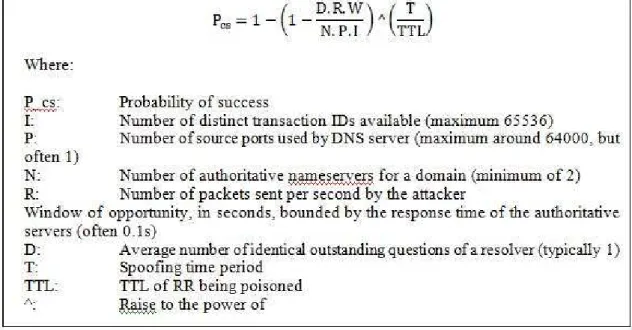
Figure 6 – Pre-Kaminsky spoofing probability formula ... 40
Figure 7 – Post-Kaminsky spoofing probability formula ... 43
Figure 8 – Signing RRs with DNSSEC ... 52
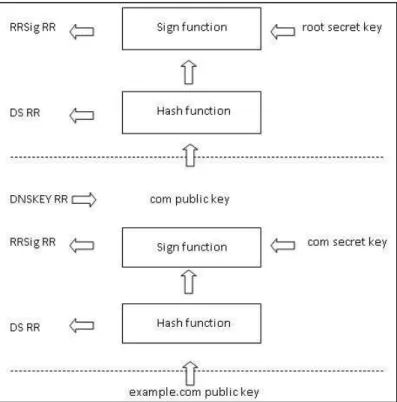
Figure 9 – Signing keys with DNSSEC ... 53
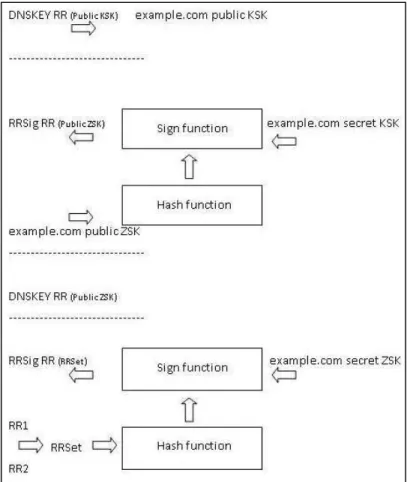
Figure 10 – ZSKs and KSKs in DNSSEC ... 54
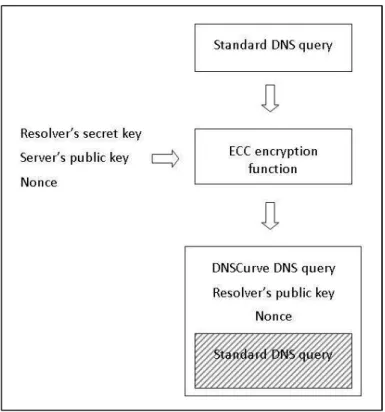
Figure 11 – DNSCurve outbound processing ... 58
Figure 12 – Basic amplification attack... 64
Figure 13 – Enhanced amplification attack ... 64
Figure 14 – Amplification attack using a botnet ... 65
Figure 15 – Cache poisoning attack lab ... 67
Figure 16 – Cache poisoning attack lab with SSL ... 71
Figure 17 – Web page from valid web server with SSL ... 71
Figure 18 – Certificate details from valid web server with SSL ... 72
Figure 19 – Web page from spoofed web server with SSL ... 74
7 LIST OF ABBREVIATIONS AND ACRONYMS
A DNS IPv4 address resource record.
AAAA DNS IPv6 address resource record.
AD DNSSEC Authentic Data, resource records that have been validated by a DNSSEC resolver.
BCP Business Continuity Planning.
BGP Border Gateway Protocol, a routing protocol.
BIND Berkley Internet Name Domain, an open source DNS server.
CA Certification Authority.
ccTLD country code Top Level Domain.
CD Checking Disabled, the CD bit indicates that the resolver is capable of validating DNSSEC resource records.
CNAME DNS Canonical Name resource record.
DLV DNSSEC Lookaside Validation.
DDOS Distributed DOS.
Dig Domain Information Groper.
Djbdns Daniel Bernstein’s DNS server. DNSCurve Link level protection for DNS.
DNSKEY DNSSEC public key record.
DNSSEC Domain Name System Security Extensions.
DO DNSSEC OK.
DOS Denial Of Service.
DS DNSSEC Delegation Signer resource record.
ECC Elliptic Curve Cryptography.
EDNS0 Extension Mechanisms for DNS.
FQDN Fully Qualified Domain Name.
HINFO DNS Host Info resource record.
ICANN Internet Corporation for Assigned Names and Numbers.
ISC Internet Systems Consortium.
KSK DNSSEC Key Signing Key.
MX DNS Mail Exchanger resource record.
NIST National Institute of Standards and Technology (US).
NS DNS Nameserver.
NSEC DNSSEC Next Secure resource record.
NSEC3 DNSSEC Next Secure 3 resource record.
8
OpenDNS A DNS service provider.
OPT Resource record used by EDNS0 to provide additional fields.
PTR Pointer to another part of the domain name space (used for mapping of IP addresses to names - reverse DNS).
RFC Request For Comments, Internet Engineering Task Force document.
RR DNS Resource Records.
RRSet DNSSEC resource record set, group of resource records of same type and host.
RRSIG DNSSEC signature of RRSet.
SOA DNS Start of Authority.
SRI Stanford Research Institute.
TLD Top Level Domain.
TSIG Transaction Signature.
TTL Time To Live.
TXT DNS Text resource record.
UltraDNS Organisation managing some of the uk authoritative nameservers.
WANem Wide Area Network Emulation software tool.
WPAD Web Proxy Auto Discovery.
ZSK DNSSEC Zone Signing Key.
9
1. EXECUTIVE SUMMARY
An analogy that is often used for the Domain Name System (DNS) is that it is the phonebook for the Internet. The DNS provides the mapping between the names that we use to identify applications, websites and e-mail recipients etc and the numerical addresses that are used by the components in networks. If an attacker can poison the DNS (i.e. make it return invalid information) then the user may unknowingly connect to the attacker’s service, rather than the correct one. The user may then be exposed to confidentiality, integrity and availability issues.
In July 2008, security researcher Dan Kaminsky disclosed a significant issue in DNS that allowed an attacker to be able to poison the DNS with information of the attacker’s choosing. Whilst this had always been possible, it was believed there was a narrow window of opportunity to attack, and that during that narrow window the possibility of a successful attack was very low. Dan Kaminsky showed that this was not the case; this report includes an analysis that shows an attack of 259 seconds duration has a 75% chance of success against vulnerable servers.
Weaknesses exist in client and server applications and operating systems, their configuration, procedures, people and the DNS protocol that allow a range of different factors that may cause confidentiality, integrity and availability issues to users and applications that rely on the DNS. This report provides an overview of related vulnerabilities and attacks, two of which are investigated in more detail; cache poisoning and amplification attacks (a type of denial of service attack).
DNS poisoning attacks can easily be conducted against servers not patched against the Kaminsky vulnerability. A tactical solution has been provided that makes these attacks harder, but still possible. A strategic solution is needed that provides a cryptographic response to cache poisoning. This report looks at two possible solutions to cache poisoning attacks: DNSSEC and DNSCurve, although neither provides the perfect solution.
The DNS is vulnerable to use in amplification attacks. The DNS can be abused to generate multi-gigabit attacks that can be used against any target to prevent legitimate use of resources at the target. Although DNSSEC provides protection against DNS poisoning attacks it does make amplification attacks easier.
10
2. INTRODUCTION
Computers communicate over a network using numerical addresses to identify endpoints and route data. Whilst computers find this ‘easy’, humans do not; we find it easier to remember names, such as rhul.ac.uk. In the early days of the ARPAnet (the network that eventually became the Internet) there was a small number of computers communicating. ARPAnet used a single file (hosts.txt) to map names to addresses, the Stanford Research Institute (SRI) managed the file; if any changes were required by users of the ARPAnet then these changes were submitted to SRI who updated the file once or twice a week. Any computer communicating on the network needed an up-to-date copy of the file, requiring an FTP download from SRI [LIU06].
As the number of hosts on the ARPAnet increased, the manual administration of the hosts.txt file became less manageable. More and more hosts were downloading the hosts.txt file causing resource issues at SRI. Additionally there was no authority responsible for assigning names, meaning that anyone could use any name, which caused name collisions that would disrupt traffic for both users of that name. Timely distribution of the new hosts.txt file became more difficult as the number of hosts grew, leading to inconsistencies in the files being used [LIU06].
Clearly a better system was needed at some point, and the DNS was developed to provide a more manageable solution to mapping names to addresses; however the hosts.txt file is still present in Operating Systems (OSs) today to allow local configuration of name to IP mapping.
The DNS is a distributed, scalable database that enables the Internet to operate as it does today. Websites, e-mail, instant messaging, distributed applications, e-commerce and many more applications depend on the DNS to be able to communicate. In our daily lives many of us have become dependent on these applications, and are therefore dependent on the DNS. It is not an overstatement to say that if the DNS were to fail, then the Internet would cease to operate as it does today.
11
3. DNS OVERVIEW
3.1. DNS architecture
This section is intended to provide a brief introduction to the DNS and appropriate background for the discussion later in this project report. The reader may wish to refer to other texts that cover the DNS in more detail, some of which are listed in the bibliography.
This section describes the architecture of the DNS; section 3.2 puts that together in the context of a DNS query and response walkthrough.
3.1.1. DNS domains
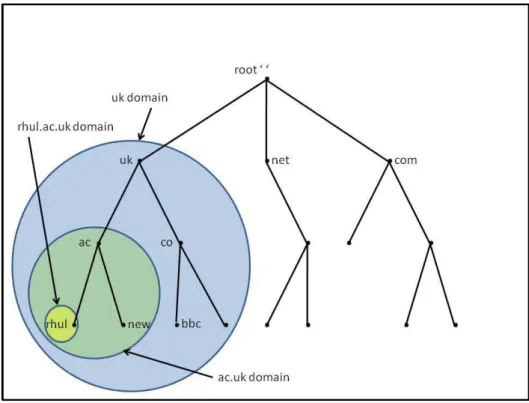
Figure 1 – DNS domains
The DNS is organised as an inverted tree (see figure 1). The root is at the top and has a null label; additional labels are at every point in the hierarchy (labels are used to name points on the tree). A domain is a point on the tree and is named by concatenating the different labels (separated by a ‘.’) towards the root, for example rhul.ac.uk. Every Fully Qualified Domain Name (FQDN) is the complete name comprising all labels and is unique in the DNS.
12
Figure 1 shows an example of the domain and sub domain structure of the DNS. The Top Level
Domains (TLDs) are classified as either generic TLDs (gTLDs) such as com and net, or country
code TLDs (ccTLDs) such as uk or fr. Below the top level domains we have second level domains such as ac.uk or co.uk; these second level domains are sub (or child) domains of their parent domains. A parent domain contains all of the sub domains beneath it in the hierarchy, as illustrated in figure 1, with the uk domain (shown in blue) containing the ac.uk domain (shown in green) containing the rhul.ac.uk domain (shown in yellow).
Not all domains contain sub domains, although all domains contain Resource Records (RRs); these RRs contain the information in the DNS and are discussed in section 3.1.3.
3.1.2. DNS zones
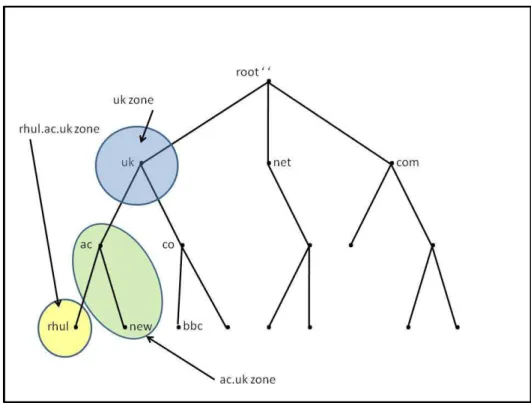
Figure 2 – DNS zones
In addition to domains, the DNS uses the concept of zones. Whilst a domain defines a position in the hierarchy, a zone defines an administrative boundary and contains the RRs in the DNS. RRs are stored in zone files (the files that store the RRs in a zone, see Appendix A for an example) on an authoritative nameserver (nameservers are programs that process queries and provide a response, an authoritative nameserver is a server that serves the authoritative RRs from a zone file
13
configured by the zone administrator) and are used to answer queries and allow navigation within the DNS. The left hand side of figure 2 illustrates three zones; rhul.ac.uk (shown in yellow),
ac.uk (shown in green) and uk (shown in blue).
Figure 2 shows that the ac.uk zone contains the ac.uk domain and the new.ac.uk domain, this means that the ac.uk zone holds administrative responsibility for both domains.
Figure 2 shows the rhul.ac.uk domain in a separate zone to the ac.uk domain; this is possible as
ac.uk has delegated administrative responsibility to rhul.ac.uk (referred to as delegation). Once
delegated the ac.uk zone will no longer contain RRs for the rhul.ac.uk domain, it will instead contain the RRs of the authoritative nameservers for rhul.ac.uk. The authoritative nameservers for the rhul.ac.uk zone will then need to contain the RRs for the rhul.ac.uk domain.
Delegation enables local control in the DNS allowing the administrators of a zone to manage their own RRs. It may seem natural for a 1 to 1 domain to zone relationship, however this may not be desirable. A new or small organisation may not have the required resources to administer its own zone, or an organisation requiring multiple domains may not wish to delegate administration.
3.1.3. Resource Records
A zone contains the RRs for the domain that it is authoritative for. RFC 1035 [MOC87b] defines the following resource record types:
A Address, the A record is an IP v4 host address.
CNAME Canonical name of an alias, used to reduce administration. Where there is more
than one hostname for a host the CNAME RR is used to point to the definitive hostname. If IP address changes are needed they are only needed to the single A record corresponding to the CNAME.
HINFO Host Info, identifies the CPU and OS used by a host. As this may be used by an
attacker conducting reconnaissance it should be used with care!
MX Mail Exchanger, used for delivering e-mail.
NS Nameserver, Authoritative name servers.
PTR Pointer to another part of the domain name space (used for reverse DNS -
14
SOA Start of Authority, the SOA record is mandatory for a zone and includes: The master nameserver for the zone.
The zone administrators e-mail address.
Time To Live (TTL) value (validity period in seconds).
Serial number – incremented when the zone data has been changed.
TXT Text, used for arbitrary data.
RFC 1886 [THO95] defined changes to the DNS for IPv6 and included:
AAAA Host address or addresses (IP v6).
The TTL value can be included in all RRs, but is mandatory in the SOA RR. If missing in an RR the value in the SOA is used. The TTL value is used to inform caching nameservers (also known as caches, are nameservers that serve a copy of the RRs from memory, see 3.1.4) how long RRs can be cached before they should be discarded. The TTL is a 32 bit number, with the value indicating the number of seconds to cache (giving a range from 0 [meaning don’t cache] to over 136 years) [MOC87a].
3.1.4. Resolvers and Nameservers
Resolvers are programs that are used to query for RRs. OSs, applications and nameservers
contain resolver code. In the case of a host machine a resolver is often referred to as a stub
resolver.
A nameserver can be an authoritative nameserver, or a caching nameserver. A caching nameserver is a server that accepts queries from resolvers, obtains the response from other nameservers (typically authoritative nameservers), then caches and serves those responses to the resolvers (typically stub resolvers). In this document we will use the term DNS server to refer to a nameserver that is not authoritative.
DNS queries can be iterative queries or recursive queries. An iterative query expects one of three responses from the nameserver; the RRs containing the answer to the query, the RRs of the authoritative DNS servers for the next domain down the DNS tree (allowing the resolver to query that server) or an error. A recursive query expects one of two responses from the nameserver; the
15
RRs containing the answer to the query, or an error. Open recursive servers are servers on the Internet that will respond to recursive queries from any host.
We will use both iterative and recursive nameservers in the DNS query walkthrough in 3.2.
3.1.5. Availability and Performance
Availability and performance are achieved by replication (the use of multiple nameservers) and caching.
Stub resolvers allow multiple DNS servers to be configured for availability and performance. The resolver regularly monitors the configured servers and determines the best server to use.
DNS servers are provided with the IP addresses of the DNS root servers; the root servers contain the root zone file, this contains the RRs of the authoritative nameservers of the TLDs. There are 13 IP addresses for the root servers (13 is the maximum number of RRs that will fit in a RFC 1035 [MOC87b] compliant DNS message); however there are many more root servers than this.
Anycast is used to replicate root servers across the Internet. With Anycast, a single IP address is
associated with multiple hosts (BGP is used to advertise the different routes, and route traffic to the best destination). Anycast increases the number of servers per IP address, for example the Internet Systems Consortium (ISC) operates the F root server (the root servers are named A through to M) in 46 separate locations across the globe using Anycast [ISC09a]. Some TLD and recursive servers also use Anycast, for example the UltraDNS managed uk authoritative servers and the OpenDNS servers (a DNS service provider).
RFC 1034 [MOC87a] requires that any zone be available from at least 2 nameservers (1 master and 1 or more slaves); this provides both resiliency and load sharing. Replication of RRs is achieved through the use of zone transfers to replicate the zone files from the master nameserver (where the zone file is created and updated) to the slave nameserver(s) for a given zone.
Resolvers and servers improve performance by caching RRs they have learned for the period stated in the TTL. If a server receives a subsequent query for information in the cache within the TTL then it is served directly, rather than triggering a request to another server. The administrator of a zone needs to find the correct balance between a low TTL (changes in the zone are replicated
16
more quickly, although there is more traffic to the authoritative nameserver) and a high TTL (changes in the zone are replicated more slowly, with less traffic to the authoritative nameserver).
3.2. DNS query and response
3.2.1. DNS protocol
RFC 1035 [MOC87b] allows the use of either UDP or TCP for DNS transport, it recommends the use of UDP for queries and TCP for zone transfers. This seems reasonable as a UDP based DNS query requires only two datagrams – one for the query and one for the response, whilst a TCP based DNS query requires seven datagrams, five to set up and tear down the session and two for the query and response. Zone transfers however tend to be large and infrequent, and benefit from the reliability of TCP.
RFC 1035 [MOC87b] requires that the DNS message header includes a transaction ID and defines it as:
‘A 16 bit identifier assigned by the program that generates any kind of query. This identifier is copied to the corresponding reply and can be used by the requester to match up replies to outstanding queries’.
In addition to providing answers to queries, DNS provides two ways to allow responding servers to include extra information; these are authoritative nameservers and additional records. The intent is that this extra information will assist the querying server and is used for supplying the names of authoritative nameservers and corresponding glue records. Glue records are records that provide the IP addresses of the nameservers in a query response (this is explained in 3.2.5).
3.2.2. DNS request walkthrough
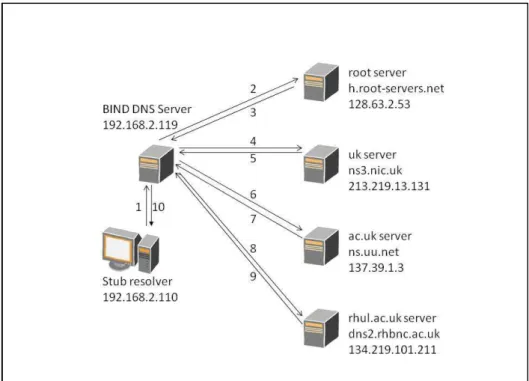
This section is a walkthrough of processing of a DNS query from a stub resolver, through its configured DNS server, and the iterative queries the DNS server sends to enable it to respond to the original query from the stub resolver. The queries and responses are shown in figure 3.
17
Figure 3 – DNS walkthrough
In this example the ICMP PING command was used on the stub resolver to trigger a query for
www.rhul.ac.uk. The process is as follows:
• An ICMP PING command for www.rhul.ac.uk is issued at the command prompt and calls the resolving function of the OS.
• The stub resolver checks in its local hosts.txt file to see if there is an entry for
www.rhul.ac.uk. If there is, then this will be used, the resolution process ends and the IP
address is returned to the calling application.
• The stub resolver looks in the local cache (if supported) to see if there is an entry there for
www.rhul.ac.uk. If there is then this will be used, the resolution process ends and the IP
address is returned to the calling application.
• The stub resolver sends a recursive DNS query for the A record for www.rhul.ac.uk to its DNS server (step 1 in figure 3) and waits for the response.
• The DNS server will check its cache to see if it has the A record for www.rhul.ac.uk. If it does and it is within TTL, it will return that record to the stub resolver and the resolution process ends; if not, it will start sending iterative queries to obtain the answer.
• The DNS server will look in its cache for authoritative servers as near to www.rhul.ac.uk as possible and send a query to one of those servers. In this example the cache of the DNS
18
server is empty, so it selects a root server (h.root-servers.net in this case) and sends an iterative query to it (step 2 in figure 3).
• The root servers are authoritative for all top level domains, so respond to a query for the A record for www.rhul.ac.uk with the records for the authoritative nameservers for uk (step 3 in figure 3). This includes the names of the nameservers and glue records. The DNS server caches these records for the duration of the TTL (2 days in this case) so they can be used for future queries and/or responses.
• The DNS server selects one of the uk authoritative servers (ns3.nic.uk in this case) and sends an iterative query to it (step 4 in figure 3).
• The uk authoritative server responds to the query for the A record for www.rhul.ac.uk with the records for the authoritative nameservers for ac.uk (step 5 in figure 3). This does not include glue records, so the DNS server puts the query for www.rhul.ac.uk on hold whilst it resolves the authoritative nameserver records (this is not included in this walkthrough for brevity). The DNS server caches these records for the duration of the TTL (2 days in this case) so they can be used for future queries and/or responses.
• The DNS server selects one of the ac.uk authoritative servers (ns.uu.net in this case) and sends an iterative query to it (step 6 in figure 3).
• The ac.uk authoritative server responds to the query for the A record for www.rhul.ac.uk with the records for the authoritative nameservers for rhul.ac.uk (step 7 in figure 3). This includes the name of the nameservers and glue records. The DNS server caches these records for the duration of the TTL (1 day in this case) so they can be used for future queries and responses.
• The DNS server selects one of the rhul.ac.uk authoritative servers (dns2.rhbnc.ac.uk in this case) and sends an iterative query to it (step 8 in figure 3).
• The rhul.ac.uk authoritative server responds to the query for the A record for www.rhul.ac.uk with the CNAME record for www.rhul.ac.uk (the RR contains nts22-fe.rhul.ac.uk) and the A record for nts22-fe.rhul.ac.uk (step 9 in figure 3). The DNS server caches these records for the duration of the TTL (1 day in this case) so they can be used for future responses.
• The DNS server can now respond to the original query from the stub resolver for the A record for www.rhul.ac.uk with the CNAME record for www.rhul.ac.uk ‘nts22-fe.rhul.ac.uk’ and the A record for nts22-fe.rhul.ac.uk (step 10 in figure 3).
This seems like a long process, and (in this case) it is. The dig (dig, or Domain Information Groper is a command line tool for obtaining DNS information) output shows a query time of 734 ms when using a server with an empty cache, however remember that the DNS server has learned
19
of many authoritative nameservers during this process and has cached their records in addition to caching the A and CNAME records for www.rhul.ac.uk. The next time (within the TTL) any client of the DNS server sends a query for the A record for www.rhul.ac.uk the DNS server will be able to respond directly (the dig output shows a query time of 1 ms). Any client of the DNS server sending a query for another host at rhul.ac.uk will only have to wait whilst the DNS server queries one of the rhul.ac.uk authoritative servers (as is the case for the other authoritative nameservers that the DNS server has learned).
3.2.3. Structure of a DNS query and response
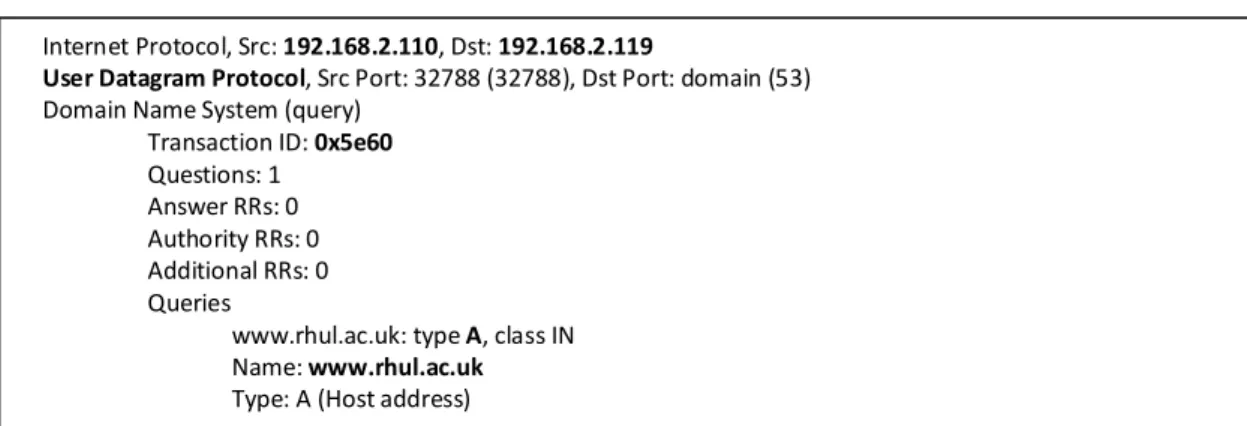
We will now look at the structure of a DNS query from the stub resolver (dig 9.4.2 on Fedora 7) and a DNS response from the DNS server (Berkley Internet Name Domain (BIND) 9.4.0-6 on Fedora 7), again for www.rhul.ac.uk. As the DNS server has cached records we will look at a single query and response. The query was captured using the Wireshark capture tool and is shown in figure 4.
Figure 4 – DNS query
We can see from this capture that a query was sent from the stub resolver at 192.168.2.110 to the DNS server at 192.168.2.119 in a UDP packet requesting the A record for www.rhul.ac.uk. It included a transaction ID of 0x5e60.
The response was captured using the Wireshark capture tool and is shown in figure 5.
Internet Protocol, Src: 192.168.2.110, Dst: 192.168.2.119
User Datagram Protocol, Src Port: 32788 (32788), Dst Port: domain (53) Domain Name System (query)
Transaction ID: 0x5e60
Questions: 1 Answer RRs: 0 Authority RRs: 0 Additional RRs: 0 Queries
www.rhul.ac.uk: type A, class IN Name: www.rhul.ac.uk
20
Figure 5 – DNS response
Internet Protocol, Src: 192.168.2.119, Dst: 192.168.2.110
User Datagram Protocol, Src Port: domain (53), Dst Port: 32788 (32788) Domain Name System (response)
Transaction ID: 0x5e60
Questions: 1 Answer RRs: 2 Authority RRs: 3 Additional RRs: 3 Queries
www.rhul.ac.uk: type A, class IN Name: www.rhul.ac.uk Type: A (Host address) Answers
www.rhul.ac.uk: type CNAME, class IN, cname nts22-fe.rhul.ac.uk Name: www.rhul.ac.uk
Type: CNAME (Canonical name for an alias) Time to live: 23 hours, 56 minutes, 3 seconds Primary name: nts22-fe.rhul.ac.uk
nts22-fe.rhul.ac.uk: type A, class IN, addr 134.219.202.248 Name: nts22-fe.rhul.ac.uk
Type: A (Host address)
Time to live: 23 hours, 56 minutes, 3 seconds Addr: 134.219.202.248
Authoritative nameservers
rhul.ac.uk: type NS, class IN, ns dns2.rhul.ac.uk Name: rhul.ac.uk
Type: NS (Authoritative name server) Time to live: 23 hours, 56 minutes, 3 seconds Name server: dns2.rhul.ac.uk
rhul.ac.uk: type NS, class IN, ns dns3.rhul.ac.uk Name: rhul.ac.uk
Type: NS (Authoritative name server) Time to live: 23 hours, 56 minutes, 3 seconds Name server: dns3.rhul.ac.uk
rhul.ac.uk: type NS, class IN, ns auth1.dns.rhul.ac.uk Name: rhul.ac.uk
Type: NS (Authoritative name server) Time to live: 23 hours, 56 minutes, 3 seconds Name server: auth1.dns.rhul.ac.uk
Additional records
dns3.rhul.ac.uk: type A, class IN, addr 134.219.101.212 Name: dns3.rhul.ac.uk
Type: A (Host address)
Time to live: 23 hours, 56 minutes, 3 seconds Addr: 134.219.101.212
auth1.dns.rhul.ac.uk: type A, class IN, addr 134.219.204.48 Name: auth1.dns.rhul.ac.uk
Type: A (Host address)
Time to live: 23 hours, 56 minutes, 3 seconds Addr: 134.219.204.48
dns2.rhul.ac.uk: type A, class IN, addr 134.219.101.211 Name: dns2.rhul.ac.uk
Type: A (Host address)
Time to live: 23 hours, 56 minutes, 3 seconds Addr: 134.219.101.211
21
We can see from this capture that a response was sent from the DNS server at 192.168.2.119 to the stub resolver at 192.168.2.110 in a UDP packet supplying the answers. The response also includes a transaction ID of 0x5e60 and authoritative nameservers RRs with corresponding additional (glue) RRs. All the supplied RRs have a TTL.
3.2.4. Validating a query response
When a response is received it needs to be validated; the following checks are performed in order [MOC87b]:
• The IP address and UDP ports match the query.
• The transaction ID matches the query.
• The query section in the query matches the query section in the response.
• Any additional RRs are in the same domain as the original query (this is referred to as being ‘in-bailiwick’).
The first response that passes these checks is deemed valid and accepted and any RRs are added to the cache. In this example all are correct, so the response is valid.
3.2.5. Why glue records are important
Glue records are required if trying to contact authoritative nameservers to resolve a name when the authoritative nameservers are in the same domain as the target name. For example if a DNS server needs to resolve the hostname www.example.com and the example.com nameservers are
ns1.example.com and ns2.example.com.
Without glue records the following will happen:
• The DNS server will ask the root servers for www.example.com.
• The root servers will tell the DNS server to ask the com servers.
• The DNS server will ask the com servers for www.example.com.
• The com servers will tell the DNS server to ask one of the example.com authoritative nameservers (ns1.example.com or ns2.example.com).
22
• The com servers will tell the DNS server to ask one of the example.com authoritative nameservers (ns1.example.com or ns2.example.com).
The DNS Server is not able to resolve www.example.com as it has no way to contact the
example.com authoritative nameservers.
With glue records the following will happen:
• The DNS server will ask the root servers for www.example.com.
• The root servers will tell the DNS server to ask the com servers.
• The DNS server will ask the com servers for www.example.com.
• The com servers will tell the DNS server to ask one of the example.com authoritative nameservers (ns1.example.com or ns2.example.com) and supply the glue records.
• The DNS server will ask (say) ns2.example.com for www.example.com.
• The ns2.example.com authoritative nameserver will reply with the requested RRs. The DNS Server now has the record it needs.
An alternative approach would be to host the example.com authoritative nameservers on a different domain, or even for changes to the protocol that would allow the NS records to be populated with IP addresses, rather than names.
23
4. OVERVIEW OF DNS SECURITY ISSUES
This section is intended to provide a brief overview of DNS security issues, sections 5 and 7 look into more detail at two specific DNS security issues: cache poisoning (introducing false information into a DNS cache) and amplification attacks (a type of Denial Of Service (DOS) attack using the DNS).
4.1. Services required from the DNS
DNS does not provide the following services:
• Data Origin Authentication.
• Data Integrity.
• Authenticated Denial of Existence (the ability to prove that a host, or domain does not
exist).
• Confidentiality.
These services were not considered design goals of DNS [MOC87a]; this is understandable as at the time the Internet was in its infancy and was only used by a relatively small group of trusted users. The threats that we are aware of today simply did not exist at that time. The absence of these services enables a number of attacks, either against the DNS, or using DNS to assist the attack.
The lack of data origin authentication and the use of UDP enable an attacker to create spoofed DNS query responses. Without data integrity an attacker can modify DNS query responses and the changes will not be detected. The lack of authenticated denial of existence enables an attacker to spoof, or modify DNS query responses to incorrectly indicate that a host does not exist.
If a resolver accepts any of these responses, then the DNS will become poisoned and any relying party may use an incorrect IP address to connect to a service, or may not be able to connect to the service.
24
As privacy becomes more important and the use of encryption for bulk traffic on the internet becomes more commonplace DNS traffic could be monitored to identify web use, confidentiality would restrict this monitoring to the DNS service provider.
4.2. DNS Traffic redirection
DNS redirection attacks rely on the attacker being able to poison the DNS with false information that an application then relies upon. If the attack goes unnoticed, the false DNS information will remain for the duration of the TTL, or until the cache is flushed. Types of redirection attack include the following:
• E-mail redirection.
• Nameserver redirection.
• WWW redirection.
Following these three redirection attacks we will look at mitigation options in 4.2.4.
4.2.1. E-mail redirection
With e-mail redirection, the victim (or victim’s SMTP server) receives a poisoned MX RR and connects to an IP address of the attacker’s choosing. The attacker’s server may take a copy of the e-mail and then forward the original e-mail (possibly after making modifications to the contents or adding malware) onto the intended destination. As the e-mail is delivered to the destination intended by the sender; this attack may go un-noticed for a long period of time. The vast majority of e-mail is neither encrypted nor integrity protected, e-mail is regularly used for sending confidential and/or sensitive information, meaning this attack could have a significant impact on the sender and/or the receiver.
4.2.2. Nameserver redirection
With nameserver redirection, a DNS server receives a poisoned NS RR. If this attack is successful, then all subsequent queries for any host in that domain (not cached and within TTL) will be sent to nameservers of the attacker’s choosing. If the attacker controls those nameservers he can choose how to respond to queries for any host in the entire DNS domain. For example, he may wish to redirect e-mail only between two organisations. To enable this he could respond with a false MX RR to queries from the IP addresses of a chosen organisation, whilst all other queries
25
could receive the correct MX RR. This would benefit the attacker as he would only receive e-mail from the target organisation, and the attack would be less likely to be discovered.
4.2.3. WWW redirection
With WWW redirection, the victim receives a poisoned A RR and connects to an IP address of the attacker’s choosing. This IP address will be hosting a spoofed website, and could be part of a Pharming attack to steal users’ credentials, or other confidential information. Alternatively, it could make it appear to visitors of the spoofed site that the real site had been hacked and defaced (as was the case for RSA Security in 2000).
Pharming attacks are used as part of identity theft to fool users into divulging credentials. For
example, the victim of a DNS poisoning attack may be a user of online banking. If he connects to what he believes to be his bank’s website and does not check for the presence of an SSL encrypted session, and then enters his credentials, the attacker can steal those credentials. Even users of one-time authentication could be victims if the attacker’s spoofed server acts as a proxy during the authentication phase; once the user has authenticated, the attacker has access to the victim’s account(s).
4.2.4. Mitigating DNS traffic redirection
As these redirection attacks rely on the ability to poison a DNS RR, any protection that mitigates poisoning will mitigate these attacks. These include:
• Disable Open Recursive DNS Servers.
• DNSCurve.
• DNSSEC.
• IP spoofing prevention.
• Secure client.
• Secure server.
• Training and awareness.
Disable Open Recursive DNS Servers
Open Recursive DNS servers are used in both cache poisoning and DOS attacks. Configuring these servers to only accept queries from known clients will reduce the likelihood of them being used in these attacks.
26 DNSCurve
DNSCurve provides link layer confidentiality and integrity protection for DNS messages. The resolver receiving a DNSCurve response can validate that the message has come from the peer server and has not been modified.
Domain Name System Security Extensions (DNSSEC)
DNSSEC provides a way to verify the origin and integrity of a RR using digital signatures on RRs. The resolver receiving a signed response can validate the signature back to a trusted public key. Currently DNSSEC is only deployed in a very small number of domains (.org, .se and .gov TLDs, but not all sub domains). For DNSSEC to be a success this needs to be expanded, both in the domains that sign their RRs, and in resolvers that are able to validate DNSSEC signed RRs.
IP spoofing prevention
Spoofed IP addresses would be significantly reduced if network providers validated that source IP addresses were correct for traffic originating on their network. This would reduce spoofed DNS messages by dropping datagrams with spoofed source addresses at the network ingress. An approach to this is discussed in RFC 2827 [FER00] and updated in RFC 3704 [BAK04]. For spoofing prevention to be successful this needs to be widely implemented.
Secure client
Hosts infected with malware are often used to launch various attacks, including Distributed DOS (DDOS) attacks. Users should follow best practices for OSs and applications with regard to configuration and security updates; additionally any host connecting to the Internet should be appropriately protected (see technical controls in 4.3.3). Many users run with admin rights (the default in Windows XP); this exposes them to additional risk. Accordingly users’ machines should run with the minimum required rights to perform their function. If followed, these measures will reduce the likelihood of a host being compromised and being used as part of an attack.
Secure server
Operators of (DNS) servers should ensure the security of their platforms. Following best practices for patching and hardening operating systems, DNS and other applications will reduce the likelihood of a server being compromised and being used in an attack.
27 Training and awareness
Training and awareness is an important factor for management, system administrators and users. Management need to understand the risks faced by the organisation so they can provide the resources required to ensure an acceptable level of risk. Administrators need to receive training to enable them to consider the security implications of the way they deploy and configure systems so they can apply appropriate safeguards; they also need to keep up-to-date with relevant developments. Users need to be aware of the policies, procedures and guidelines appropriate to their function; they also need to be aware of the way their actions can contribute to the security of their systems, and those of other users, and the effect that this can have on an organisation. The US National Institute of Standards and Technology (NIST) special publication 800-50 [WIL03] describes an approach to training and awareness programmes.
4.3. Client and Server Issues
4.3.1. Client Issues
Malware
Malware can modify the hosts.txt file or locally configured DNS servers. This change in DNS settings causes the client’s host to use DNS servers of the attacker’s choosing. Some examples are:
• The Trojan.Qhosts virus attacks Windows systems and makes changes to the Windows Registry to alter the DNS servers used for resolution, or to add entries to the hosts.txt file [HOL03].
• Variants of the DNS Changer Trojan have also been used to make changes to the DNS settings on both Apple Mac and Windows from either statically configured DNS settings, or those derived from DHCP [ZDR07] [ZEL06].
• Trojan.Flush.M installs a DHCP server on the compromised host that sends fake DHCP offers to other clients on the local network. The DHCP server offers include a valid IP address and gateway on the local network and DNS servers chosen by the attacker [CHI08].
In all of these attacks, the client will be able to use the network as normal; however, DNS queries will be sent to the attacker’s choice of DNS server and may provide false responses.
28 Vulnerable Application Software
Vulnerable client software can enable attacks against a client’s home or small business router [STA06] [OLI08]. These attacks identify the user’s router and attempt to connect with default passwords. If successful then changes are made to the router’s configuration, such as adding entries to the local hosts.txt file, changing the DNS servers it uses for resolving client queries, enabling remote management or to 'upgrade' the router to code modified by the attacker. This enables the attacker to perform Pharming attacks on all users of the local network (even those that are not vulnerable to the initial attack) and to remotely control the router.
Operating System
Vulnerabilities also exist in the stub resolver code included in OSs.
Various versions of Linux OSs (including Debian 2.2, RedHat 6.2, 7.0, 7.1, 7.2, 7.3 and SuSE 7.0, 7.1, 7.2, 7.3, 8.0) using resolver code derived from BIND have been vulnerable to buffer overflow attacks. These attacks could allow the attacker to execute code at the privilege level of the program making the query [MAN02].
Microsoft OSs (client and server) stub resolver code has also been vulnerable to remote code execution that could allow a remote, unauthenticated attacker to gain complete control of a system [MIC06] [PRU06]. Similarly Apple Mac OS X has been vulnerable to attacks allowing an attacker to execute arbitrary code with root privileges [GIO07].
4.3.2. Client attacks enabled by DNS
This section includes examples of some attacks that are enabled through the use of DNS:
• Application updates.
• Cache snooping.
• DNS rebinding attacks.
• Fast fluxing.
• Web Proxy Auto Discovery (WPAD).
Application updates
Many applications and OSs use DNS names to identify the IP addresses of their update servers. An attacker may wish to introduce false DNS information to prevent an application or OS from
29
updating itself, or with the intent of providing a false update if the connection or software binary is not authenticated.
If a host is unable to update its security applications and OS patches it will become more vulnerable to other attacks over time. An attacker could use this as part of a blended attack using exploits that the victim would not be vulnerable to if updates had been available.
McAfee Virex 7.0 for Apple MacOS X does not authenticate the connection to its update server, neither does it authenticate the binary. This is discussed a paper by Bellissimo, Burgess and Fu [BEL06], they were able to employ a DNS spoofing attack to use the Virex update manager to run arbitrary code with root privileges.
Cache snooping
Attackers can use this technique to identify if a DNS server holds specific RRs in its cache. For example if a DNS server does not hold the resource record for windowsupdate.com just after Microsoft have released patches then this may be an indication to an attacker that vulnerable hosts exist. Cache snooping relies on an organisation allowing its DNS server to be queried by the attacker, unless the attacker is an internal user the DNS server would need to be an open recursive server. An attacker conducting cache snooping simply needs to look at the time difference between 2 queries for the same RR, if the initial query takes significantly longer than subsequent queries this is an indication that the RR was not in the cache.
DNS rebinding
DNS rebinding attacks attempt to bypass a browser’s ‘same origin’ policy to allow an attacker to bypass perimeter security by using the browser as a proxy to launch scans and attacks [JAC09].
The attacker tricks the victim into browsing to a website that he controls (there are various ways to achieve this such as targeted e-mail, social engineering etc); this website hosts some malicious mobile code. When the site’s hostname is first resolved it will resolve to the public IP address of the website (the DNS record for that site will have a TTL value of 0 thus preventing caching). The user’s browser will download malicious mobile code.
30
Mobile code is usually isolated in a browser, the intent being it can only communicate with its source server, not any other resources, this is the ‘same origin’ policy and is controlled by hostname.
The attack code now aims to connect to internal resources; however it uses the previously resolved hostname. As the query response was not cached the hostname is again resolved, this time the attacker’s nameserver responds with an IP address chosen by the attacker (this will need to be addresses valid on the internal network of the victim). The attack code can then attempt to connect to services on the target network. As the hostname has not changed the ‘same origin’ policy allows this connection.
Multiple consecutive DNS requests can be sent to allow the attack code to systematically scan the private network. The attacker’s nameserver will alternate between its public IP and the next target IP address, allowing the malicious code to connect back to the attacker for more instructions, and then to other IP’s on the target network.
Fast fluxing
In attempt to reduce the effectiveness of some network security solutions Fast fluxing is used to frequently change the IP address of dubious websites (such as those used in rebinding attacks). Many compromised hosts are used to proxy connections between the requesting client and the attacker’s server. A subset of these compromised hosts is registered with dynamic DNS and a low TTL. At regular intervals the registered IP addresses are changed to a different subset complicating attempts to block access to these sites based on IP addresses alone [HOL08].
Web Proxy Auto Discovery (WPAD)
WPAD is a method used by browsers in a managed endpoint environment to automatically discover proxy servers. Browsers request a DNS lookup of the name wpad and download a file that contains configuration parameters of the proxy servers; the browser then uses these proxy servers [LIU09].
If the configuration of the host’s DNS network adapter allows search suffix to be modified (for example allowing the search suffix to be modified or obtained by DHCP – see the Malware section in 4.3.1) then the stub resolver on the host will append the suffix to queries for non qualified domain names, such as wpad.
31
For example if the attacker adds the search suffix of example.com the stub resolver will append
example.com to wpad and send a query for wpad.example.com. If the attacker controls the
nameservers for example.com he can resolve wpad.example.com and cause the browser to use his rogue proxy. The rogue proxy will now see all traffic and can redirect traffic for any site chosen by the attacker.
4.3.3. Mitigating client issues
The above client issues are mitigated by the following:
• Disable Open Recursive DNS Servers (see 4.2.4)
• Secure client
• Secure infrastructure
• Secure server
• Secure updates
• Technical controls
• Training and awareness (see 4.2.4)
Secure client
In addition to the mitigations in 4.2.4, the client can be better secured by regular reviews of the installed OS and applications to ensure that patches are applied where appropriate. Additionally the WPAD issue can be mitigated by ensuring that the network adapters don’t accept a DHCP issued search suffix. Some browsers use a technique called DNS pinning to reduce the effectiveness of DNS rebinding attacks by caching the server IP for a fixed duration, even if the RR TTL is set to 0.
Secure infrastructure
Ensuring that infrastructure, such as home/small routers are appropriately configured, can prevent their DNS configurations from being changed. Users should change passwords from the default, and should disable remote administration. Vendors should aim to provide products to be both useable and secure ‘out of the box’.
32 Secure server
In addition to the mitigations in 4.2.4, the DNS server can be configured to mitigate DNS rebinding attacks by preventing DNS responses from the Internet specifying internal IP addresses.
Web servers need to be regularly patched and configured securely to prevent an attacker using them for attacks such as DNS rebinding.
Secure updates
Where host software requires an update, this should be from a source that can be validated as trusted. To achieve this either the connection must be trusted, for example by using SSL with a valid certificate, or the update code can be signed to provide data origin authentication and detect modification. It should be remembered that these options do not guarantee that it is itself bug free or completely secure, such is the nature of software.
Technical controls
Technical controls provide a combination of prevention and detection of client issues. URL filtering solutions such as web proxies can alert users and administrators about web sites likely to contain malware, or be sources of attacks. Web proxies can also be configured to prevent users for accessing those sites. Some Web proxies can run mobile code in a sandbox to assess if they are safe enough to run on a client host. Content filtering solutions (such as antivirus scanning and intrusion detection/prevention) can be used to detect and/or prevent hosts from connecting to sources of malware, or to identify those that are already infected so remedial actions can be performed.
Some client applications can control the network access available to a host; for example applications exist that allow a host to detect if it is not on its usual network. If so it can apply a more restricted security policy, such as only allowing a VPN connection back to a corporate network and forcing all network traffic to use that connection.
These mitigation options are well suited to a managed environment. There are, however, an increasing number of controls available to the home user that provide additional, and often free, protection such as McAfee Site Advisor and BlueCoat K9 Web Protection.
33 4.3.4. Server issues
DNS servers at every level of the DNS hierarchy are subject to both availability and integrity issues [CRO04]. Availability includes issues such as software reliability, configuration errors, network problems and failure of the organisation responsible for the server. Integrity includes issues such as modifying, spoofing and poisoning.
Software reliability
A vulnerability was discovered in July 2009 that allows a remote unauthenticated attacker to crash a BIND server (BIND 9.4 before 9.4.3-P3, 9.5 before 9.5.1-P3, and 9.6 before 9.6.1-P1) by sending a specially crafted dynamic update message to a zone master server. Even servers not configured for dynamic updates are vulnerable. The exploit is triggered when a dynamic update message containing a record of type “ANY” is received and where at least one RR set for the fully qualified domain name exists on the server [DOR09] [ISC09b].
Microsoft DNS servers (Windows Server 2000, 2003 and 2008) have suffered from bugs that aided spoofing attacks through predictable transaction IDs making poisoning attacks easier [GIO09] [MIC09].
Configuration errors
In October 2008, the Measurement Factory estimated that there are 4,300,000 open recursive DNS servers on the Internet [TMF08]. These servers may be at increased risk of spoofing and poisoning attacks and can be used in DOS attacks. DOS attacks are discussed further in sections 4.5 and 7.
BIND is sensitive to changes in its configuration and zone files; a simple typing error in the options statement can cause the server to fail to start, or a typing error in the zone statement may cause the zone to fail to load [LIU06].
Zone files contain all the RRs for a zone and could therefore be useful information for an attacker conducting reconnaissance. A zone file may contain information useful in an attack, for example some organisations use ‘helpful’ names to identify the specific application running a service on a host. If an attacker is able to obtain a copy of the zone file he may be able to use this information to identify vulnerabilities and launch an attack.
34 Network problems
As DNS relies on ‘the network’, network problems and attacks may have detrimental effect on the availability the DNS service.
Nameserver organisation failure
Many organisations host nameservers on behalf of other organisations; this includes the root, TLD and authoritative nameservers. A failure of any of these organisations will affect the availability of the DNS, the higher up the hierarchy the more significant.
Spoofing
The lack of origin authentication enables an attacker to create a spoofed DNS message to provide false DNS information, or to use in DOS attacks. If an attacker is able to predict that a resolver will be issuing a query, he can poison DNS RRs of his choosing, assuming he can prepare a response that the requesting host will accept.
At first inspection the attacker has a 1 in 65,536 chance of guessing the transaction ID correctly (assuming the transaction ID is generated by a good random number generator); the attacker must also guess the responding authoritative nameserver (at least 2 per domain). Whilst these odds don’t seem good, this is per guess, and there are no limits on the number of spoofed responses the attacker can send. The attacker also has a head start; he can start sending the spoofed responses to arrive as soon as the server has sent the query, giving him a window of opportunity equal to the round trip time between the requesting host and the responding server.
Modifying
Of course, if the attacker has physical access to the network, he can be inline (perhaps using an ARP poisoning attack) and doesn’t need to guess as he can read the transaction ID directly from the query.
Poisoning
Assuming the attacker has been able to spoof or modify a DNS response, he can poison the cache of the server by modifying or adding RRs whilst specifying a long TTL to extend the period of the attack. Early versions of DNS server software trusted all information included in the additional records section. Unsurprisingly attackers used this section to poison any DNS record.
35
This was fixed in subsequent implementations by requiring that additional records be in-bailiwick.
4.3.5. Mitigating server issues
The above server issues are mitigated by the following:
• Availability.
• Disable Open Recursive DNS Servers (see 4.2.4).
• DNSSEC (see 4.2.4).
• IP spoofing prevention (see 4.2.4).
• Redirection mitigation (see 4.2.4).
• Secure infrastructure.
• Secure server configuration.
• Secure updates.
• Technical controls (see 4.3.3).
• Training and awareness (see 4.2.4).
Availability
Availability of critical components should be considered when designing systems; this is true for both the DNS and the network, as both rely on each other. Multiple DNS servers should be available, ideally on discrete network infrastructure; this should be applied to DNS Servers for internal resolution, and similarly for external resolution. For critical Internet-based services, an organisation may wish to use more than one service provider to host their zone file for external resolution. This would provide both hardware and organisational resiliency.
Secure infrastructure
In a managed environment, policies, procedures and guidelines should be followed to ensure that adequate protection is provided and where changes are required they are considered for approval and are documented. This will reduce the likelihood of server configuration errors.
36
In addition to 4.2.4 and 4.3.3 DNS servers allow access lists to be configured defining the servers that can request zone transfers [LIU06].
Secure updates
Vendors and open source developers should strive to consider security in the complete lifecycle of their products. Considering security requirements at all stages of the lifecycle is not only more effective at reducing security issues, it is also quicker and cheaper than fixing bugs once code has been developed.
4.4. DNS registration issues
4.4.1. Domain hijacking
Domain hijacking is wrongfully taking control of a domain from the registrant (the rightful holder). It is made possible due to shortcomings in the domain name registration and management processes, such as weak registrant authentication by registrars (the organisations completing registration). For example, attacks have been enabled as e-mail was considered an acceptable form of authentication for authorising domain transfers. Social engineering can play a part in an attacker hijacking a domain.
Domain hijacking can cause significant issues to the losing registrant [ICA05]. Attackers may wish to hijack a domain for the following reasons:
• Brand damage, leading to loss of business.
• Denial of Service.
• Espionage.
• Fraud - acting as a man-in-the-middle to steal credentials for financial sites.
• Theft for resale / extortion.
4.4.2. Typo-squatting
Typo-squatting (registering similar domains - www.gooogle.com for www.google.com for example) relies on users incorrectly typing domain names, or clicking on links in e-mails that appear to be correct. These domains will be run by the attacker and could be used for phishing.
37
The use of internationalised domain names (names that contain non ASCII characters) has made it easier for attackers to make a link (or even an SSL certificate if enrolment is automatic) appear to be valid for a site. For example Gabrilovich and Gontmakher were able to register the homographed domain name [GAB09]:
www.mi%d1%81r%d0%bes%d0%beft.com
When decoded by applications that support internationalised domain names (such as Firefox version 3.5.2) this is displayed as:
www.microsoft.com.
4.4.3. Mitigating DNS registration issues
The above DNS registration issues are mitigated by the following:
• Improved registrant authentication.
• Review of registrations.
• Training and awareness.
Improved registrant authentication
Registrant authentication should be improved to provide assurance that when changes are requested for a domain, the identity of the registrant has been validated. We have seen that e-mail can be intercepted using DNS poisoning; clearly, using e-e-mail for authentication does not provide appropriate assurance of identity.
Reviews of registrations
Where domains names are being registered that are similar to existing domain names, additional checks should be conducted to identify why a certain domain name is required, and if the name is clearly to be used for illegal activity, registration should be denied.
38
Training and awareness programmes should be run with registrar staff to ensure that they are aware of and comply with relevant policies and procedures. This should include identifying social engineering attempts.
4.5. DNS Denial of Service
4.5.1. DNS servers
DNS can be part of a denial of service attack as one of the following:
• Amplification attack.
• DNS used to enable a denial of service.
Amplification attack
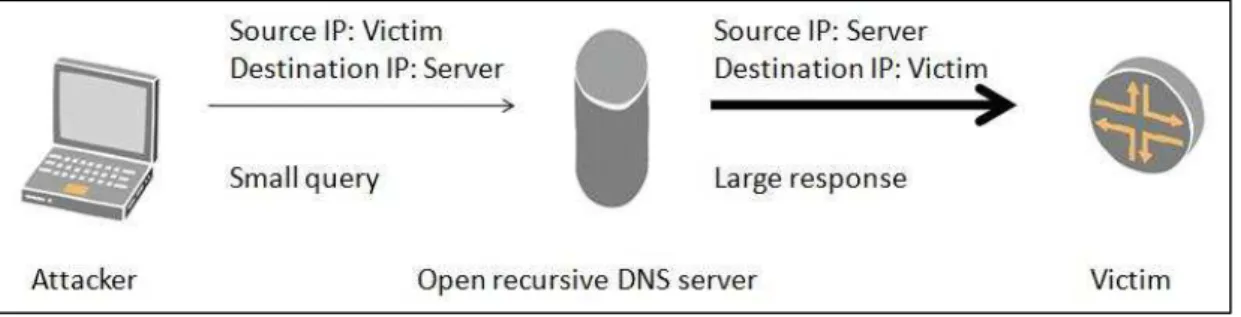
The use of UDP in DNS means that the attacker can use a spoofed source address for DNS queries. Servers receiving these queries (which are likely to be open recursive DNS servers) will process them and reply to the spoofed address. As DNS queries are small, the source of the query uses a correspondingly small amount of bandwidth; however, if the query is for a large record, then the size of the response sent to the victim can be much larger. This kind of attack can saturate the Internet access bandwidth of the victim and create a DOS for all services using the same access.
Amplification attacks are covered in more detail in section 7.
DNS used to enable a denial of service
If an attacker is able to somehow introduce false DNS information to an application that relies on DNS, then the attacker can cause a denial of service by preventing the application from connecting to the required service.
4.5.2. Attacks against the Root and TLD servers
A significant DOS attack against the root servers was launched on 22 October 2002; it was targeted against all 13 of the root server IP addresses simultaneously. The root servers continued to operate during the attack, although not all queries reached the servers due to network congestion caused by the increased traffic.
39
An amplification attack was launched against every server of one of the TLD operators on 5 February 2006 and 7-8 February 2006, fully saturating two thirds of the operators access circuits and partially saturating the remaining circuits [LIU06]. Analysis of the attack shows that the nameservers were significantly affected with 4 of the 6 not responding to more than 50% of queries during the attack on 5 February and 4 of the 6 not responding to more than 90% of queries during the attack on 7-8 February.
Analysis of an attack against the E, F and G root servers on 15 February 2006, shows that during the attack the E root server was not responding to more than 50% of queries, the G root server was not responding to more than 90% of queries, however the F root server was only slightly impacted.
A second significant denial of service attack against the root servers was launched on 6 February 2007, this time targeted against 6 of the root server IP addresses simultaneously. Again the root servers continued to operate during the attack; although the G and L root servers were badly affected, of those attacked the G and L servers were the only ones not to have deployed Anycast.
4.5.3.Mitigating DNS Denial of Service
The above DNS Denial of Service issues are mitigated by the following:
• Anycast.
• Disable Open Recursive DNS Servers (see 4.2.4).
• DNSCurve (see 4.2.4).
• DNSSEC (see 4.2.4).
• IP spoofing prevention (see 4.2.4).
• Secure client (see 4.2.4).
• Secure server (see 4.2.4).
• Training and awareness (see 4.2.4).