MIDDLESEX COMMUNITY COLLEGE
ACADEMIC PROGRAM REVIEW FOR
Graphic Design Associate Degree Program
2005 – 2006
Program Review Committee Margaret Swan
Art Department Chair
Jan Arabas
Associate Professor of Art and Design
Lorraine DeSouza
Graphic Design Support Specialist
Joe Eiler
Assistant Professor of Graphic Design
Margaret Rack
Assistant Professor of Art
Contributing Instructors Ed Fetter - Photography
George Herman - Drawing
Mary Hart - Graphic Design
Paul Light - Photography
Middlesex Community College Academic Program Review
Introduction
September 2006 will mark the tenth anniversary of MCC‟s Graphic Design Program, so it is only fitting that this would be the year to fully reflect on the evolution and future of the program. As an introduction to the program review, I have included a brief history of the beginnings of Graphic Design as a new career and transfer option for students interested in an art related field.
Funded by the Department of Education, I received a vocational education grant to pursue research in the field of graphic design in hopes of strengthening MCC‟s career-specific offerings. During the summer of 1995, I interviewed practicing professionals, acquired Department of Labor analysis of job trends and wages, ran focus groups, investigated existing baccalaureate and community college graphic design programs, researched the computer hardware and software needed, and began to develop a curriculum to be adapted to associate degree and certificate offerings.
Convinced by my report that graphic design was a viable major at Middlesex, the college funded consultant Claire Spellman, Bradford College design faculty and practicing professional, to help me, a sculptor with no graphic design experience, to design the curriculum. Claire also designed a four-color (expensive) brochure, which was that was sent to high schools, businesses, libraries, etc. and she was hired as a full-time faculty member. In addition to Claire, Lorraine DeSouza was hired full-time to set up and manage the new Mac Lab.
This entire program from research to implementation took place within a year‟s time. Having a ready audience of students in the Studio Art courses, five of which were to be the art foundation of the graphic design program, made this a natural transition. Many of the art students had an interest in graphic design, so the program grew quickly. The graphic design field was booming at this time and we had a number of older students who arrived at Middlesex motivated to pursue a career change in an exciting new field.
Section I: Data
The Institutional Research Office will provide a significant portion of the data. Your department is encouraged to request additional relevant information from Institutional Research and to develop and conduct alternative assessments as well. Some examples of assessments that the department may choose to implement are student focus groups and/or student surveys. Input from relevant internal groups such as Advising, Admissions, and/or connected departments will also be necessary. Please include a copy of the data from Institutional Research and all departmentally-developed surveys or focus questions in the Appendix of the review.
1. Please note important trends, patterns and issues that emerge through the enrollment, academic progress and retention data. (Data from Institutional Research Office)
When we started the program, there were two full-time professors, Claire Spellman in Graphic Design and myself in Studio Art, and around 20 part-time faculty. The program blossomed rapidly, particularly because we had a number of students majoring in Studio Art, which is similar to the foundation year
required by all majors in art programs, who were planning to transfer into a graphic design program. Because there are five required core art courses that are also requirements for Studio Art, we needed multiple sections of all of our course offerings, which created space and staffing problems. There were only one art studio and one Mac lab at the Bedford campus and there were only two full-time faculty serving as advisors to these specialized programs.
With these limitations, we actually had too many students in the Graphic Design Program and we were not interested in recruiting additional students. These students also needed lab time and support, which further exhausted our instructional capabilities. A second computer lab was allocated in 2000 and another studio space was opened in Fall 2004. With the addition of this space and the Federal Building Studio and the addition of two more full-time art faculty, the program has the room to grow and active recruiting is in progress. (See section #9)
The overall enrollment figures peaked in 2001 at 173 students and have declined over the last few years to 145 full-time students. Looking at the figures in
relation to age groups, there is a significant increase in students 20-21 and decreases in the 22-24 and 30-39 age groups. Some of these figures reflect the economy and trends in the graphic design field. When the program started in 1996, it was difficult to hire graphic design instructors, because they were flush with work. Our students were even finding paid internships, which is unheard of now. We had a large influx of students who were changing careers, which was evident by the many older female students who entered the program at that time.
The ratio of male to female students dramatically changed from 1999 to 2005. Female students were in the majority (78F – 62M) in the earlier years and during the subsequent years, their numbers have dropped while male students have increased (62F – 83M). In conjunction with this trend, there is a noticeable change in placement scores as well. In 1999 half of the students placed into remedial English classes and in recent years a majority of students have fallen into this category, with an alarming seventy five percent majority in 2004. The math scores have stayed constant with twice as many students placing into remedial math courses. The increase in under-prepared students hasn‟t had a significant effect on the grades of students in graphic design courses, but faculty and lab staff have worked harder and incorporated new teaching strategies to help these students succeed.
Although the number of full-time Graphic Design students has decreased, the Art Department is still offering the same number of sections except for upper level evening classes. Many Studio Art students and non-art majors are taking
Electronic Imaging (3-sections), Introduction to Computer Graphics (3-sections), and Graphic Design I (4-sections). In addition to these graphic design specific courses, there are also between 3 and 6 sections of the other required art courses in the program: Drawing I and II, Color and Design, Art Appreciation, and Photography I.
2. Please comment on significant information that emerges from the Student Transfer and Employment Follow-up data. (Data from Institutional
Research Office and Department Records)
The data is limited from graduate surveys, because the response rate is variable from year to year, ranging from 4 to 19 certificate and associate degree students. For this reason, the Art Department administers in house surveys and tries to record this information in our own database. This database was compromised when Darryl Benjamin left the college in the spring of 2005, so we are starting over again this year. The new database will help us to track students‟ internship, employment, and college transfer information.
The response rate was good in 2004 where 19 students responded to the
college survey. Over half of the associate degree students transferred to UMASS Lowell, where we have a articulation agreements for Studio Art and Graphic Design. Based on MCC‟s survey, it appears that half of our students transfer to Lowell every year. Other popular colleges include Art Institute of Boston, Salem State, and Framingham State.
Places of employment data are difficult to analyze, because the companies listed do not indicate the nature of the position. It would be beneficial to know if
alumni survey described in the next section gives more detailed employment data.
So far this year, there are three students who just landed full-time jobs by graduation. One of these students, who transferred her credits from UMASS Lowell‟s evening certificate program in Multimedia to our Graphic Design Associate Degree, is working at a design firm, where she is making $55,000 a year designing books for the US Open and the Super Bowl. Four other students were offered full-time jobs after completing their internships with the companies. Spring 2006 graduates will be attending Savannah College of Art, UMASS Lowell and Amherst, Salem State, and Framingham State College. Two of the
certificate graduates will be continuing at MCC to complete their associate degree. The graduate data indicates that continuing in the program has been a trend over the years. Students use the certificate as a starting point and realize that further study is needed to develop a professional portfolio.
The Art Department survey focuses on the intentions and future transfer plans of current students. This information is important for the department in terms of advising and planning curriculum that will meet transfer students‟ needs. Based on our survey question concerning transfer to a four year art or design program, more than 50 of the 96 respondents wrote yes, 23 wrote no, and 23 wrote maybe. We plan to meet these students‟ needs through the advising process to help them select courses that will transfer and to help the undecided to make informed decisions.
3. Please summarize findings from student surveys and/or student focus groups. (Data from surveys and/or questions developed by the
Department.)
The Art Department has administered several surveys that have helped to assess the needs, interests, and future plans of our Graphic Design, Studio Art, and non-major students enrolled in art and design classes. The first survey, that was included in the 1999 Studio Art Program Review indicated the rapid growth of the Graphic Design Program with 54 majors in relation to only 9 Studio Art Majors. The biggest student complaint at the time was the lack or studio space, which limited the number of sections offered and added to the chaos of too may media sharing one room. Since both Studio Art and Graphic Design majors share core art courses, the demand for more Drawing I and Color and Design courses was acute.
After the Graphic Design Program was well established and had graduated several classes of students, Claire Spellman sent a survey and an invitation to graduates for an alumni get-together in May of 2002. Twenty-nine students responded and most of them attended a Saturday afternoon reception. These
surveys or questionnaires had more open-ended questions and required
narrative responses that are difficult to tabulate; however, they provided valuable information.
Of course, the students who responded were the more successful graduates, but we were pleased that 22 of the 29 respondents had graphic design related jobs in print, web, multimedia, and marketing. Their entry-level salaries were in the $20-25,000 range and were currently making from about $25-35,000. Those working part-time in entry-level freelance positions were making $17 to $30 per hour.
Many of these students had continued their education by taking individual courses and certificates in Web Design and Multimedia Development. Four students had graduated with a BA in Graphic Design. A number of our early graduates were returning students, who already had bachelor‟s degrees, but they also indicated that they had enrolled in additional training after MCC.
Aware of the need for additional training in the workplace, many of the graduates indicated additional courses to include in the program. Almost all of them wrote that the program needed to offer a specific course in Photoshop. A large majority also highlighted the need for web and multimedia experience. Their comments spearheaded a change in program requirements, which is explained in question #16.
Most gratifying was that the graduates were thankful to the program for creating a “stepping stone” into their new careers. They also expressed their gratitude for the support they received from faculty and staff.
In preparation for the Graphic Design Program Review, the Art Department crafted a survey for our current students in December 2005. Of the 233
respondents, 65 were Graphic Design majors, 20 were Studio Art, and 108 were non-majors taking one class.
Curious about art and design majors‟ path to MCC, one of the questions asked how they had heard about the art programs. A third of the students had a friend or relative recommend the programs, followed by high school recommendations, and the others became acquainted by the website, catalog, and college visits. In concern for implementing informed student advising, several questions were posed to art and design majors about the advising process and their plans for transferring to a four-year art or design program. About 60 percent had met with their advisors and more than half indicated they were planning to transfer. Students who were not assigned art advisors were invited to leave their name and contact information. Twenty-five students left their names and a letter was sent to them to arrange an appointment. Six of those students met with an advisor in Bedford and Lowell.
The next category concerned design lab, darkroom and studio use outside of class. The art studios are not used that often; however, there is much demand for the Mac lab and the darkroom. Students rated the facilities favorably, except some found the Henderson Hall studio and the smaller Mac lab crowded.
Students overwhelmingly responded positively to the question about the help they receive from faculty and staff outside of class. Similar to the alumni survey, our current students also request a variety of more specialized computer classes in illustration, animation, advanced Photoshop and web design. There is also an interest in fashion and interior design, ceramics, and glass blowing. The Studio Art degree program provides them with the art core to transfer into these last few specialized disciplines.
Section II: Mission, Goals, and Target Population
Program faculty, staff and, where appropriate, students provide information for this section.
1. Does the program have a stated mission? If so, please state it. MCC‟s Graphic Design Program prepares students to transfer to a design program at a 4-year college and to obtain an entry-level position in the field. An emphasis on design fundamentals, technical skills, and a well-rounded
academic program provides students with the knowledge and experience to build a portfolio of high caliber projects. An internship in the field is included in the curriculum and gives students an opportunity to work in a professional setting.
2. What is the relationship of the program’s mission to the overall
mission of the College as adopted by the Trustees and approved by the BHE?
The Graphic Design Program mirrors MCC‟s mission to “provide a strong foundation for college transfer, employment, professional development and lifelong learning” by offering a Certificate and an Associate Degree in Graphic Design. The 29-credit certificate is designed for the working professional who wants to advance in the field or change careers. This option allows the student to focus intently on courses directly related to graphic design. The 63-credit
associate degree program offers a solid art and core curriculum foundation that prepares students for the workplace and/or transfer to a four- year school. The program also includes a 3-credit internship enabling students to work on “real” design projects in the workplace. Students are also offered the opportunity to take individual courses for personal enrichment and exploration.
The Art Department‟s dedication to student success is evident in the availability of Graphic Design Lab support and personalized advising. Design students have
access to the labs staffed by knowledgeable practitioners of the design software. All art and design students meet with a designated art faculty to plan their path at the college and beyond, ensuring that they are prepared to transfer or to enter the workplace.
3. Does the program satisfy a unique institutional goal? If so, please explain.
In addition to providing several pathways for students interested in graphic design, the program offers many opportunities for collaboration that are mutually beneficial to the design students and the college community. Graphic Design students have designed a myriad of printed promotional materials for groups on and off campus:
Theater posters
CD Covers – Carmen Rodriguez Peralta
T Shirts – No smoking campaigns, blood drives, radiology club Bumper Stickers - health groups
Art Announcements – Henderson Hall Gallery Brochures – academic programs
Publication Design – Middlesex Magazine
4. Based on a review of other college catalogs, list the colleges in our general area that have similar programs and comment on significant differences from the program we currently offer.
MCC and all of the community college graphic design programs in
Massachusetts have fashioned an Associate Degree curriculum that resembles an abbreviated version of a Bachelor of Fine Arts degree in Graphic Design. The community colleges emphasize foundation art courses, such as Drawing I and II, Color and Design, and Art Appreciation or Art History, and beginning design courses in the first year and the more advanced design courses follow. At the four-year colleges, students of all art disciplines share a common art core for the entire freshman year and begin their majors in their second year.
There is a strong belief that is evident in the course catalogs that a thorough understanding and experience with the fundamentals of art are essential in all art related fields, such as photography, web design, painting, and graphic design. The graphic design sequence of courses is also very similar among the
community colleges with an emphasis on print design and options to take a couple of courses in multimedia, web design, computer illustration, and animation.
requirements than MCC and another 77 credit program that includes the course requirements for the Transfer Compact. Both programs offer a six credit
concentration in either web design or multimedia design. Students also have two additional electives that can be selected from a list of fine art and graphic design courses. Greenfield‟s art programs are highly regarded by Mass College of Art, partly because the school has the most comprehensive art core, which is desirable for preparing a well-rounded transfer student.
The college art departments that offer web options are designing these programs from more of an art perspective rather than an emphasis on web technology as is the case at MCC. Students in the web programs are also required to take art and design courses as part of their training. MCC‟s Art Department will be offering a course in web design in the Fall of 2006, which could be taken as the one free elective in the Graphic Design Program or as a Humanities elective for students currently enrolled in Web Development. Graphic designers are more and more required to design projects for the web as this form of communication and advertising have dramatically grown over the last few years.
Another change in art departments is the changeover of wet labs to digital labs in photography. New programs like New England Institute of Art and programs with new facilities like Bunker Hill Community College have gone totally to digital photography. Traditional black and white photography is still highly regarded as a fine art form, but it is not as desirable for a graphic designer who is constantly manipulating digital images.
In Spring of 2007 MCC Art Department will be offering its first Digital Photography course. Although this will incorporate some of the skills of Electronic Imaging, it will emphasize the formal and expressive aspects of photography like Photography I. Graphic design students could choose this course in place of Photography I as part of their program requirements. One unusual observation in perusing the catalogs is the limited academic requirements in the programs. Some do not require any Social or Behavioral Sciences, others have minimal Math requirements, and several had no Art Appreciation or Art History classes, MCC‟s Graphic Design Program is more academically rigorous than most, except for Greenfield‟s 77 credit Transfer Compact program.
5. Is MCC‟s program intended to serve a special population or clientele? Please explain.
The Graphic Design Associate Degree program was designed to serve students who have an interest in design, but are not prepared or confident enough to apply to a four-year art school. Some of our students have well developed portfolios, but they need developmental work in reading, writing, and
mathematics in order to be accepted in a baccalaureate program. MCC is an excellent choice for these students because they can get college credits for their art courses while the get extra help with their academics from our effective developmental program,
The associate degree program also has a good mix of courses for students who plan to enter the workplace rather than transfer after graduation. General
education courses, art foundation classes, such as Drawing I and II and Art Appreciation, in conjunction with design and technical software courses provide students with a rounded background, which is essential for a graphic designer. Our Advisory Board often comments on the importance of the “whole person” when considering the qualifications of a graphic design candidate.
The program also offers courses, such as Electronic Imaging and Introduction to Computer Graphics that can serve as enriching electives for students in other degree programs and also meet the computer intensive value.
6. Are there plans to target this program to any new or different groups? Please explain.
For the most part, the associate degree program has been targeted to high school students in the Middlesex region. We have several articulation agreements with some of the technical high schools and the college's Open Houses attract high school seniors and their parents. More outreach is needed at the Lowell campus to recruit students to the computer design courses that are based in Bedford. Lack of transportation is the biggest obstacle, which could be overcome with van service between the campuses in the afternoon, when most of the three-hour classes are offered. All of the non-computer art courses are available in Lowell, as well as the entire academic core curriculum. Offering the computer courses in both locations would not enable us to build a large enough student body to support the enrollment of upper level graphic design courses. The Certificate in Graphic Design was originally intended to attract older students with previous college and life experience; however, it has served as a way to lure less successful high school students back to school through their interest in art. Art and design classes reinvigorate many of these students and their successes inspire them to persevere with their problematic academic areas with the help of supportive developmental programs and complete the associate degree.
7A. CAREER PROGRAMS - Please describe mechanisms or procedures currently in place to monitor changesin the job market and review the program’s currency and “fit” with the educational interests and needs in our region by:
a) Relevant external parties, such as advisory groups or speakers, corporations/agencies. (If there is an advisory committee in place, please attach names of members and indicate frequency of
meetings);
The Graphic Design Program is structured to provide an art/design foundation in the first year that is followed by more advanced design courses. Since an associate degree is limited in scope in comparison to a baccalaureate program, there are not many options in the program‟s design. Whether a student is going to pursue publication, package, or web design, there is a common core or art background that is essential to anyone involved in visual communication. Our Graphic Design Advisory Board consists of a variety of design professionals in print and web fields of design. Since the research phase of the program‟s design, the board has been helpful to give us an employer perspective. Each year that we meet, there is a common refrain concerning the need for good oral and written communication skills as one of the top priorities after a professional portfolio.
Determining the scope and caliber of the portfolio has been one of the most important contributions of the board, who participate in the portfolio review presentations of our graduates, They offer students other professional insights and enables board members to personally witness the success of our graduates. Board Members
Ruth Trussell- Communication Design Support, Massachusetts College of Art Jon Levangie – Art Director, Interactive Constructs, Inc., Boston
Jean Hammond – Jean Hammond Design, Bedford Brenda Loucks – MCC Dean of Publications
Margaret Swan – MCC Art Department Chair
Lorraine DeSouza – MCC Graphic Design Support Specialist Joe Eiler – MCC Assistant Professor of Graphic Design Lorraine DeSouza – MCC Graphic Design Support Specialist Jan Arabas - MCC Associate Professor in Art and Design
b) Relevant internal groups or individuals;
The art and design faculty are all working professionals in the field, which gives them a great deal of insight in the job market and needs in our region. Due to the number of part-time art and design faculty who work at MCC as well as other colleges, the art department also has direct experience with other educational approaches. There are 4 full-time and 20 part-time faculty who teach over a total of 60 sections in the art department.
c) Other populations (i.e., students, alumni, community members). The Art Department Survey administered to 275 students in December 2005 has been informative in better understanding the needs and interests of our current students. Most of our students selected MCC due to its location and low cost and they have had some previous art training in high school. Forty percent of our students are taking an art or design class as an elective rather than a major, which indicates the range of students we serve in the art classes.
Additional art courses that students would like to see offered at MCC included a host of various media, such as glass blowing and ceramics. However, a number of students mentioned more specialized software training in computer illustration, animation, advanced Photoshop, and web design.
The department has also had input from alumni through our outreach to them. In May of 2000 the department invited our graduates to a get-together to have them reconnect with one another by sharing portfolios and job and college experiences. With the invitation, we sent them a survey that asked about job placement, salary range, further education, and their feedback on their
experience at MCC in regards to their preparation for the real world. Questions pinpointed what was helpful, what was lacking, and how to improve the program and keep it up to date. These responses are woven into the program review. The program also benefits from the alumni who have stayed to work in the computer labs. In fact, all of the lab staff have been alumni. Several from our first graduating class are still working with our students. Their enthusiasm and commitment to the program have created a created a feeling of camaraderie and continuity.
8. Are there plans to change or add to strategies currently in place to assess the program’s fit with student interest and market demand?
The Art Department plans to continue relying on the Graphic Design Advisory Board, the design faculty, who are professionals in the field, the alumni, and our current students to keep the program up to date and marketable. To help reach a wider group of alumni, one of the computer lab staff will be contacting all of our graduates and asking them similar questions that were posed in the Spring 2002 survey.
9. Are program faculty currently working with the Admission Department to
recruit students into the program? What role(s) do they play? Based on the Art Department Survey, most students have heard about Middlesex from friends and family. Our most effective means of recruiting students is to strive to develop and maintain a high quality program, which will promote the program by word of mouth.
Visibility is enhanced by shows in Henderson Hall Gallery, where eight shows a year feature a wide range of media of professional and student work. Press releases in area papers highlight these shows, which increases visibility of art related pursuits at the college. This summer MCC art faulty have been invited to show at the Bedford Public Library and 14 instructors are participating. The Publications office sent a press release about the artists in relation to their teaching at MCC, which has heightened our profile in the surrounding communities. In conjunction with this show, there was an article with two photographs of faculty work in the North West Sunday Globe that reaches a large region of our service area. There was also an article with a color photograph in the Lowell Sun that reaches the many households as well. In addition to these articles, announcements with photographs were included in the hometowns of the individual artists. This one exhibition reaped community good will and highlighted the faculty and the art programs.
Over the last few years, Admissions has organized an Arts Open House to highlight the art, music, theater and communication majors at the college. Dovetailing with this event, the MCC Student Art Show receptions in Henderson Hall Gallery have been scheduled at the same time, so prospective students are able to view work from the classes and meet current students and faculty, This year the Graphic Design graduates set up their portfolios in the hallway and explained their work to visitors. Successful graduates are one of our best methods to recruit future students.
The Art Department hired Electronic Imaging instructor Jim Ricca to redesign the department website, which has just been completed and should be online this summer. The site features student work and profiles, video and images of students working in the studios and labs, and faculty contact information. As explained in the College Wide Recruiting Plan 2006-2007, more students are learning about colleges and their programs online and it is essential that the website conveys the vitality of the art and graphic design programs at MCC. Another method to increase recruitment is by establishing articulation
agreements with four-year colleges and exceptional high school programs. Although high school articulation has proved to be problematic in computer graphics classes, the department has granted credit to students for core art courses based on portfolio reviews. The Graphic Design Program has an articulation agreement with UMASS Lowell and is in the process of setting up one with The New England Institute of Art this summer. These agreements create pathways for our students that are highly desirable.
10. Are there additional recruitment efforts in which program faculty would like to be involved? Please be as specific as possible.
Joe Eiler, the new Graphic Design faculty member, has indicated that he would be happy to be involved in recruiting activities. Highly personable and
knowledgeable in the field, Joe would be an asset to recruiting new students in design from area high schools.
Section III: Curriculum
11. Please indicate below the major educational outcomes for students enrolled in this program, how each outcome is attained (i.e., through a specific named course, activity, or project) and how the attainment of each outcome is assessed. Five to ten major programmatic outcomes should be listed. If there is nothing currently in place that is intended to provide for the attainment of a particular outcome or to assess the extent to which the outcome has been realized, please leave the appropriate space blank. The “blanks” will help to identify areas that need further development. Student Outcome/Competency Strategies For Attainment of the Learning Outcome Assessment Criteria and Methods
What should the student be able to do?
(Performance/knowledge expectations for program graduates listed in
student outcome terms.)
What activities/
assignments will enable the student to achieve it? (If the strategy is
contained within a
particular course, please list the course first, with the relevant activity or activities listed next to each course.)
How do the instructor and student know that the competency has been achieved? How is the student‟s performance judged?
Competency #1:
Graduates of the Graphic Design Program use the creative process
to plan and execute their fine and graphic design work.
Course Strategy for Attainment Assessment of Technique
HU 2151
Graphic Design I
Multiple step projects, such as logo design, which requires a sequence of steps, such as word lists,
sketches, thumbnails, roughs, and final presentation.
This project unfolds over several classes, allowing time for review and feedback from instructor and other students in a series of critiques.
HU2410
Computer Graphics II
A comprehensive project that starts with sketches, thumbnails, color studies and research/planning to complete a project that incorporates logo, cover, collateral and
publication design. The project transitions from sketches, which are subject to peer review, through several developmental stages towards final production on a computer. Students are required to create a workbook from handouts, exams and the results of the abovementioned items, which record process and serve as reference tool
Each step is subject to peer review and approval of the instructor. Incremental steps and the workbook are part of the grading criteria.
HU 2121 &2122 Drawing I & II
Multiple gesture drawings are used to work out composition. Extended gesture is used to understand the basic form and relationship of parts to the whole. Sighting and
measuring are used to check observations.
The finished drawing is developed after a critique of observational drawing.
HU 2161 Photography I
Assignments investigate formal attributes of the photographic image. A series of steps and considerations, such as camera controls, framing, and vantage point are part of this creative process.
Individual assessment as well as group critiques addresses the execution of specific assignments. Instructor illuminates technical and formal components of images.
HU 2152
Graphic Design II
All aspects of the creative process are incorporated to plan and execute work. Thumbnails,
sketches, and final comprehensives are required for each project.
Group critiques reinforce the
process to help brainstorm ideas for improvement.
Competency #2:
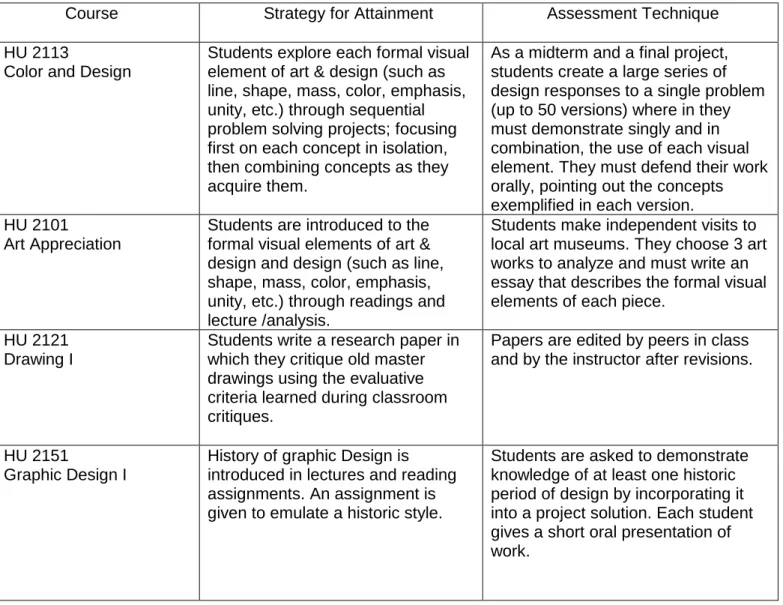
Graduates of the Graphic Design Program demonstrate their knowledge of the formal and expressive aspects of art.
Course Strategy for Attainment Assessment Technique
HU 2113
Color and Design
Students explore each formal visual element of art & design (such as line, shape, mass, color, emphasis, unity, etc.) through sequential problem solving projects; focusing first on each concept in isolation, then combining concepts as they acquire them.
As a midterm and a final project, students create a large series of design responses to a single problem (up to 50 versions) where in they must demonstrate singly and in combination, the use of each visual element. They must defend their work orally, pointing out the concepts exemplified in each version. HU 2101
Art Appreciation
Students are introduced to the formal visual elements of art & design and design (such as line, shape, mass, color, emphasis, unity, etc.) through readings and lecture /analysis.
Students make independent visits to local art museums. They choose 3 art works to analyze and must write an essay that describes the formal visual elements of each piece.
HU 2121 Drawing I
Students write a research paper in which they critique old master drawings using the evaluative criteria learned during classroom critiques.
Papers are edited by peers in class and by the instructor after revisions.
HU 2151
Graphic Design I
History of graphic Design is introduced in lectures and reading assignments. An assignment is given to emulate a historic style.
Students are asked to demonstrate knowledge of at least one historic period of design by incorporating it into a project solution. Each student gives a short oral presentation of work.
Competency #3:
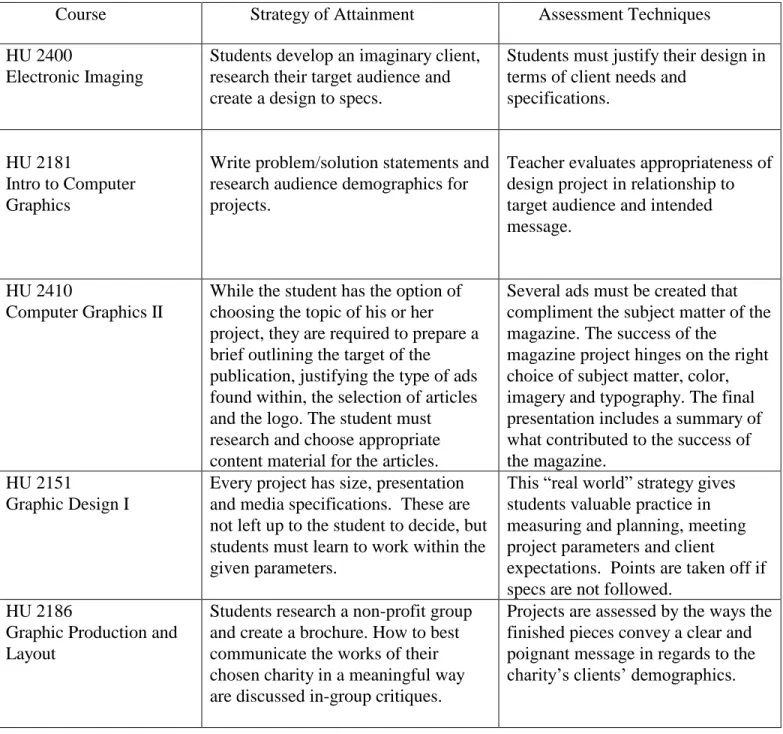
Graduates of the Graphic Design Program create effective visual communications that are responsive to the needs of clients and their targeted audience.
Course Strategy of Attainment Assessment Techniques HU 2400
Electronic Imaging
Students develop an imaginary client, research their target audience and create a design to specs.
Students must justify their design in terms of client needs and
specifications.
HU 2181
Intro to Computer Graphics
Write problem/solution statements and research audience demographics for projects.
Teacher evaluates appropriateness of design project in relationship to target audience and intended message.
HU 2410
Computer Graphics II
While the student has the option of choosing the topic of his or her project, they are required to prepare a brief outlining the target of the publication, justifying the type of ads found within, the selection of articles and the logo. The student must research and choose appropriate content material for the articles.
Several ads must be created that compliment the subject matter of the magazine. The success of the
magazine project hinges on the right choice of subject matter, color, imagery and typography. The final presentation includes a summary of what contributed to the success of the magazine.
HU 2151
Graphic Design I
Every project has size, presentation and media specifications. These are not left up to the student to decide, but students must learn to work within the given parameters.
This “real world” strategy gives students valuable practice in measuring and planning, meeting project parameters and client
expectations. Points are taken off if specs are not followed.
HU 2186
Graphic Production and Layout
Students research a non-profit group and create a brochure. How to best communicate the works of their chosen charity in a meaningful way are discussed in-group critiques.
Projects are assessed by the ways the finished pieces convey a clear and poignant message in regards to the charity’s clients’ demographics.
Competency #4 – Graduates of the Graphic Design Program articulate the concepts and theoretical ideas in graphic design and use these
ideas to evaluate their own work and others.
Course Strategy for Attainment Assessment Technique HU 2400
Electronic Imaging
Students participate in critiques of each project. During critique, student work is discussed in relation to graphic design history and also contemporary professional design.
Students write a design brief for each project in which they outline the main ideas used in the project and evaluate their use of those ideas.
HU 2410
Computer Graphics II
Students must comment on the
effectiveness of each other’s choice of type, imagery and layout choices as well as defend their own decisions.
Level of participation in class critiques is recorded and used in the grading criteria. HU 2152 Graphic Design II HU 2402 Typography HU 2186 Production and Layout HU 2414 Portfolio Preparation
All of the upper level Graphic Design courses expect students to be able to explain and defend their ideas and articulate their creative concepts. They also need to be able to give a rationale of their design choices and identify their target audience. Group critiques reinforce this important skill.
Students’ thoughtful participation in croup critiques is a component of their grade.
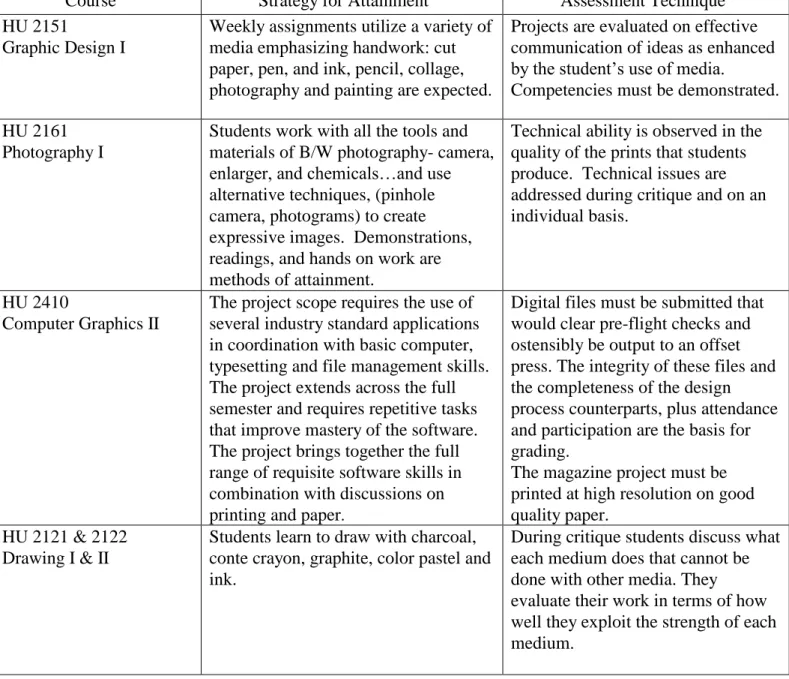
Competency #5 – Graduates of the Graphic Design Program are proficient with using a variety of art media and graphic design software.
Course Strategy for Attainment Assessment Technique HU 2151
Graphic Design I
Weekly assignments utilize a variety of media emphasizing handwork: cut paper, pen, and ink, pencil, collage, photography and painting are expected.
Projects are evaluated on effective communication of ideas as enhanced by the student’s use of media.
Competencies must be demonstrated. HU 2161
Photography I
Students work with all the tools and materials of B/W photography- camera, enlarger, and chemicals…and use alternative techniques, (pinhole camera, photograms) to create expressive images. Demonstrations, readings, and hands on work are methods of attainment.
Technical ability is observed in the quality of the prints that students produce. Technical issues are addressed during critique and on an individual basis.
HU 2410
Computer Graphics II
The project scope requires the use of several industry standard applications in coordination with basic computer, typesetting and file management skills. The project extends across the full semester and requires repetitive tasks that improve mastery of the software. The project brings together the full range of requisite software skills in combination with discussions on printing and paper.
Digital files must be submitted that would clear pre-flight checks and ostensibly be output to an offset press. The integrity of these files and the completeness of the design process counterparts, plus attendance and participation are the basis for grading.
The magazine project must be printed at high resolution on good quality paper.
HU 2121 & 2122 Drawing I & II
Students learn to draw with charcoal, conte crayon, graphite, color pastel and ink.
During critique students discuss what each medium does that cannot be done with other media. They evaluate their work in terms of how well they exploit the strength of each medium.
HU240
Electronic Imaging
Students practice a variety of Photoshop skills, including use of selection and masking tools, retouching and image adjustment tools, and
painting and editing tools. They learn to acquire and save images, create and manage files and prepare for print and web output.
The grading rubric reflects quality of work with each tools and procedure.
Competency #6:
Graduates of the Graphic Design Program complete a portfolio suitable for transfer or job application.
Course Strategy for Attainment Assessment Technique HU 2414
Portfolio Preparation
Students fine tune earlier projects and are assigned additional pieces to round out their portfolios.
Developing a professional resume is part of this process. Students
demonstrate in their formal portfolio presentations their finished design work and explain their concepts before a review panel.
The review panel consisting of design professionals, faculty, staff, and students evaluates the students’ portfolios and their presentations. An assessment form is distributed to the review panel, which is then shared with the presenting students.
HU 2400
Electronic Imaging
Students create final portfolio pieces suitable for inclusion in a design portfolio, including a postcard, poster, package and magazine advertisement.
An experienced and knowledgeable instructor identifies Photoshop pieces that demonstrate strong design skills.
HU 2152
Graphic Design II
More advanced and complex projects are assigned that convey students’ design and technical skills, which are desired by employers and four year colleges.
These projects are assessed using a grading rubric that reinforces the SLOs of the course.
HU 2161 Photography I
Through visual analysis and a selective editing process, students aim to create a coherent group of images. The instructor guides students to recognized consistencies developing in their work.
Students are asked to group images in a meaningful manner for critique. They are required to complete a cohesive body of work by semester’s end.
Competency #7:
Graduates of the Graphic Design Program communicate effectively orally and in written form.
Course Strategy for Attainment Assessment Technique HU 2101
Art Appreciation
In class writing, essay exams, papers, and class discussion are major elements of this writing intensive course.
Students are graded on the form and content of their writing. Classroom participation is a component of their grade.
HU 2121 & 2122 Drawing I & II
Students must defend work during critique. They write critical reviews of art exhibits and of artwork using standard art and design journal formats.
Grading is based on use of correct form, grammar and spelling,
thoughtful evaluation of the art, and use of the vocabulary of art and design.
HU 2400
Electronic Imaging
Students present final projects to the class, when they describe and defend design decisions. They write a design brief for each project that describes the client and target audience and explains why the design solution is appropriate.
Briefs are graded on clarity, spelling and grammar and use of the
vocabulary of design.
HU 2151
Graphic Design I
Creating a working knowledge of design theory through classroom exercises that employ specific principles. Encouragement of discussions revolving around design principles, their effect and
implementation.
Selecting students to speak about work in critique, and verbal evaluation of how well design principles are used.
HU 2414
Portfolio Presentation
Students practice their oral
presentation of their portfolio as if they are preparing for a college or job interview. Effective speaking skills are paramount for a graphic designer in order to make productive presentations.
The review panel mentioned in #5 helps to assess the students’
presentation skills in addition to the work being presented. .
Competency #8:
Graduates of the Graphic Design Program have met the requirements of the academic core and intensive values of the academic core and intensive values.
Course Strategy for Attainment Assessment Technique HU 2400
Electronic Imaging HU 2181
Intro to Computer Graphics
These required courses fulfill the Computer skills intensive value.
Students must demonstrate proficiency with the Macintosh computer and the Photoshop program to pass the course.
HU 2101
Art Appreciation
This course fulfills the Writing and Multicultural intensives.
Students produce a variety of types of writing- in class analyses, essay exams, and museum papers, which are graded for form and content. MA, SO, SC, EN
requirements
A well-rounded curriculum will help inform students to be able to design from a better understanding of the world around them.
These classes have their own set of assessment methods to ensure students have gained this knowledge.
12. Is there a desire to introduce any new or revised student outcomes for this program? Please specify the proposed or revised student outcome, the proposed or revised strategies for attainment of the learning outcome, and the proposed assessment criteria and methods.
The eight student outcomes listed are highly ambitious for students to fully realize in an associate degree program. The goal of the department is to
continually find ways to help students to meet these competencies with as much integrity as possible. Another major goal is to engage the many part-time faculty in the process on incorporating these strategies and criteria throughout the art curriculum.
After receiving assessment training at the college and working as a facilitator on Professional Day, I have been able to share the assessment materials and information with faculty during department meetings. Although many of the faculty intuitively understand these concepts, they will need further support to implement syllabi that incorporate student learning outcomes and support materials that provide concrete assessment information.
Joe Eiler created an effective assessment tool in his Graphic Design II class, which will be shared with the art faculty as they work on formalizing their syllabi with student learning outcomes and assessment techniques. Joe‟s project assessment sheet is included in the appendix.
13A. Using the chart below, please indicate the courses in your program that satisfy a core intensive. List strategies for attaining each intensive (i.e. through specific activities or projects) and describe how the learning of each will be assessed.
Intensive Value Program Course
Strategies for Attainment of Learning Outcomes Assessment Criteria and Methods 1. Multicultural Perspective and Global Understanding
Art Appreciation Students study the relationships of color symbolism in regards to cultural differences.
Students‟ papers are graded based on their ability to make thoughtful comparisons in regards to color‟s expressive and symbolic content 2. Written Communication
Art Appreciation In class writing, essay exams, papers, and class discussion are major elements of this writing intensive course.
Students are graded on the form and content of their writing. 3. Computer Literacy Intro. to Computer Graphics Electronic Imaging
The entire course revolves around learning QuarkXpress and Adobe Illustrator as the tools to create design. In addition to assessing students‟ designs for competency of the software programs, their files are also assessed to ensure good work habits. 4. Values, Ethics, or Social Policy 5. Impact of Technology, Environmental Issues, of Health
13B. Please describe any new efforts to incorporate intensive values into program requirements, or to ensure appropriate advising of elective courses.
Students in the Graphic Design Program have successfully met the core
curriculum intensive value requirements by a combination of courses within the program and the general education courses. Informed academic advising is the key to the fulfillment of these requirements.
Art Appreciation meets the Writing and Multicultural intensives and the
Introduction to Computer Graphics and Electronic Imaging meet the standards of Computer Literacy. The department is considering Graphic Production and Layout as a good candidate for the Impact of Technology intensive. However, most of the courses are art and design intensive and are not good candidates for additional intensive values. Graphic Design students are better served by taking philosophy, sociology, history, and science courses as an in depth way to meet these values. This reinforces the “whole person” concept, a requisite of a successful designer.
14. Please describe any interdisciplinary courses which are provided as an integral part of this program.
Although there are no formally attributed interdisciplinary courses in the Graphic Design program, there are many opportunities for students to experience the sharing of disciplines in projects like the Middlesex Magazine and other cooperative design opportunities. Middlesex Magazine is a group project produced by students in the Non-Fiction, Creative Writing, Studio Art, and Graphic Design classes. A team of graphic design students is responsible for designing the layouts of the articles, stories, and poems and following the publication to completion. In order for them to effectively design these layouts, the graphic design students have to be fully engaged with the content of the written pieces and work cooperatively with the student editors.
Designing an edition of 750 copies of a 40 paged magazine within a real budget, the graphic design students become involved in the business side of design as well. They learn cost and time saving measures that are similar to the constraints in the business design world. In addition to fully designing the magazine to be ready for press, the students visited the printing company while their magazine was being printed and witnessed the stresses and adjustments of the printing process. These types of experiences go far beyond the confines of an
interdisciplinary course.
A similar interdisciplinary approach is experienced in the design of two MCC theater posters each semester. The play director and publicity coordinator visit
read by the students before they work on their poster designs. Each student independently designs a striking poster based on the criteria presented by the theater staff. One of the posters is selected by the theater company and is professionally printed. Although only one poster is selected, all of the students have produced a well-developed poster design for their portfolios. Integrating literature into a design class is another example of the enrichment of
interdisciplinary projects.
15. Please comment on work-based learning opportunities with the program (i.e., coop, internships, service learning). What percent of program students participate in each of these activities? Indicate any problem being faced in incorporating work-based learning.
The capstone of the Graphic Design program is the 120-hour internship in a communication design organization. To prepare for the internship, students take Graphic Design Portfolio Preparation where they develop and assemble an entry-level portfolio demonstrating their abilities in design concept development and the requisite technical skills. They also learn appropriate presentation
techniques, produce a resume, and pass a portfolio review before interviewing at a professional design studio. The portfolio review is presented to a group of design professionals, the Graphic Design Advisory Board, faculty and students. After presenting in front of such a large and informed audience, the students find the interviewing process is much less stressful.
In order to obtain their internships, students meet independently with a Graphic Design faculty member who serves as the sponsor and liaison with a
representative from the company. The faculty sponsor suggests employment opportunities based on the strengths and interests of each student and helps the student develop a strategy to obtain an internship. Students are not handed a job, but instead learn the job-hunting process with the help of the faculty.
One of the essential requirements of the internship is that a design mentor at the company oversees the student‟s work and progress. The mentor submits an evaluation of the student upon completion of the internship. Students are required to keep a weekly log of their activities and present samples of projects on which they have worked to the faculty sponsor.
The internship experience has been an integral part of the design program. A number of students have obtained full-time jobs at the completion of their internship and others have had at least the opportunity to receive valuable experience that will help them to find another job.
16. Please comment on the scope and sequence of courses now in place. Is the flow and relationship of courses to one another satisfactory? Are there changes indicated, based upon program objectives and/or new needs identified through the assessment process?
In addition to the Liberal Studies academic requirements, The Graphic Design Associate Degree Program consists of a core of foundation art courses: Drawing I & II,
Color and Design Photography I Art Appreciation
The required Graphic Design courses include: Graphic Design I
Introduction to Computer Graphics, Typography
Electronic Imaging Graphic Design II
Graphic Production and Layout Computer Graphics II
Graphic Portfolio Preparation Graphic Design Internship Approved Elective
The assessment process has been ongoing since the inception of the program in 1996. The alumni survey in 2002 cemented the need to incorporate Electronic Imaging (Photoshop) into the program, which took the place of Advertising that students did not find essential to their evolution as graphic designers.
The 63-credit degree program has one elective, which is the only opportunity to tailor the program to students‟ particular interests in design. Some students have used the elective to take a web course and others have taken a required studio course for the transfer institution.
The assessment process has called into question how to incorporate a web or multimedia component into the program without shortchanging the art and print media core. The program was designed around print, but there could be a way to create a six-credit web or multimedia concentration like Greenfield Community College, which offers a 66-credit program.
Another issue that has arisen this year is that Joe Eiler has found that many students would benefit from a more advanced design class to build a more accomplished portfolio. He has accommodated these students with independent study in Graphic Design III. Since Joe has only been at the college for one year, the department should discuss these issues further before making any program requirement changes.
17. Please comment on the role of developmental courses in your program? Which ones are relied upon by significant numbers of students in the program, what conclusions are you able to draw about the impact of these courses on students‟ preparation levels?
Reviewing the writing and math placement test data, it is very apparent that half of the incoming Graphic Design students are under-prepared for college level courses. About half of the students place into Basic Writing and Fundamentals of Math, which means that they will be required to take three remedial courses in addition to their 63-credit program. Besides needing writing and math proficiency for their academic core courses, Graphic Design students need these basic skills to succeed in the art and design requirements as well.
From the outset of the program in 1996, our Graphic Design Focus Group stressed the importance of the “whole” person in the design field. Graphic designers often work as part of a team and good communication skills are
essential to their jobs. Designers need to have the ability to propose and defend their concepts to clients, which requires them to have full command of written and oral language skills.
In addition to these communication skills, Graphic Design students need reading and analytical skills in order to learn and understand the complex design
software programs that they will encounter in the field. They also need to learn “how to learn” skills to help them to solve technical problems they encounter in their design work at the college and beyond. Computer technology and software are constantly changing, so they will need to become independent problem solvers in order to function in an ever-changing world.
Basic mathematic skills are essential to a designer, who is involved in proportions, ratios, and other applied math concepts. The analytical skills of math aid in the process of solving many other problems that students will encounter in their design work.
18. Describe any plans to introduce new methodologies into required or elective courses.
In order to succeed in the design field, students need to use the creative process to plan and execute their fine art and graphic design work. This is the first
competency listed in our eight major educational outcomes. The creative process is an elusive and abstract concept to many students and can be
perplexing to seasoned designers as well. How to teach students to go beyond obvious solutions in their work is an age-old dilemma that educators continually question.
There are numerous techniques that involve brainstorming, thumb nail sketches, color studies, and comprehensives that lead to the final piece. The biggest problem is that many students do not have experience with a prolonged investigation into ideation and are easily satisfied by their first attempts. To help students learn to be actively engaged in the creative process in all of their classes, a group of Art and Design faculty has just completed a design process workbook that can be used as a guide to this process in all of the classes. It presents visual examples of the steps that lead to „the leap of the imagination‟ and carry out an idea to a fully realized conclusion. By reinforcing the creative process in all of the art and design classes, students will develop new work habits that will allow them to expand their ideas.
Seeing examples of art throughout time and cultures can initially inspire students in this process, so having a comprehensive databank of images is essential. This past year I investigated digital image resources and the MCC library now
subscribes to Artstor, a digital art image database of over 400,000 images. There are many viewing features to the program, such as split screens for comparisons, information pop ups with titles, etc., that enhance the
teaching and learning experience.
Next year I plan to connect students in all of my classes to my collection of images in Artstor in order for them to review artwork at home. The ability to add my own images of students‟ and other current work to the collection will enable me to introduce students to a richer art experience. There are many educational benefits to the resource that could add another dimension to the classroom and art faculty will be encouraged to use this resource once data projectors are installed in all of the studios.
19. Describe any new student assessment methods that have been implemented in any of the core program courses or in a general
programmatic way. If you are able to assess the effectiveness of such methods, please do so.
The most effective way to assess students in art and design classes is through their portfolio. The portfolio is a compilation of class work and homework
assignments that reflect students‟ insights understanding, and facility to convey their ideas in a particular medium. The portfolio is also the most important element in students‟ college and job applications.
In Art Appreciation and Art History course, emphasis is placed on the students‟ ability to apply acquired knowledge from viewing images, reading, lectures, and discussions to their experience of other works of art. Students are assessed by a series of in-class writing assignments that help to prepare them for the essays on their exams. They are also assigned museum project papers that help them to apply their newly acquired knowledge.
Section IV: Instructional Support
20. Please discuss the adequacy of the staffing level to teach and advise
for students enrolled in the program.
There are now 4 full-time and 20 part-time art faculty in the Art Department that support the program through core requirements and Graphic Design major courses. Although the ratio of full-time to part-time could be increased, the program is better staffed now than the previous program review.
Advising loads have been addressed by hiring a part-time instructor as an
advisor in Lowell and Joe Eiler and I have taken on extra advisees as part of our duties of our course release. If these numbers of advisees increase, another part-time advisor should be hired.
21. What specific support services and activities (i.e., tutoring, media, library, disabled student support, computer labs, service learning coordinator) does this program require? Please comment on the
availability and adequacy of these services (be specific about any current deficiencies or projected needs).
Full-Time Computer Lab Staff
Professional Support: One full time non-unit professional provides support services, managerial services of part time staff and general services to other departments, such as Publications that needs Macintosh support.
Part-Time Computer Lab Staff
Due to anxieties about technology, learning fears, inhibitions, and Disabilities, students require significant amount of support. The Requirement that they learn complicated software programs requires 64 hours per week of professional level tutorial support and
classroom assistance. Software and hardware is too expensive for many students making them dependent on lab facilities and support. In order to achieve this coverage and stay within hiring restrictions, Lorraine DeSouza has needed to hire 8 assistants. Work-study students have been problematic because they lack the necessary skills for the job. Keeping qualified people becomes challenging,
because of the pay rate of $12.50 to $13.13. Inordinate amounts of time are spent on managing so many people.
There is one level position paying $17.25 for intermittent technical Support assistant who aides in lab upgrades and system maintenance.
Darkroom Lab Monitor
The darkroom needs a Darkroom Lab Monitor, who is responsible for ordering the chemicals, maintaining, repairing, securing the equipment and helping students during open darkroom hours. Relying on a group of students, who each work a handful of hours has been problematic this year. Problems with attendance and th replacement of staff have been particularly difficult this year. It may be that students are hired for some of the lab hours; however, someone needs to be in charge. I would
recommend that the college hire someone for at least 15 hours a week to oversee the lab and a student for the extra hours.
22. How adequate and appropriate are program facilities and equipment? Please be specific about current deficiencies or projected needs.
Hardware/Software:
There are 18 student, one faculty and one staff seats in each of two classrooms. AR209 is the primary lab where students spend many hours working on assignments. AR210 is larger and provides a Paste
Up/Production space at the back of the room and a discussion area for critiques in the front. In addition, there is a small satellite lab in the Open Computer Lab that has 3 computers available, if both classrooms are busy.
Both rooms have ceiling mounted Dell Data Projectors. The quality of the projection is poor as the technology is insufficient for color critical
demonstrations. They should be replaced.
AR209 has computers that are six years old that need to be replaced. They have slow processors and insufficient storage capacity. Also in this room there are two servers. One is 6 years old the other one closer to 9 years old. The both need to be replaced. The approximate cost to upgrade is 60 thousand dollars.
Printers:
In AR209 there is a new Xerox Phaser7750 Color Laser Printer that should last at least another 4 years. There is so also an HP large format inkjet printer, approximately 3 years old that will not last longer than 2 years. Projected replacement cost is about $4,000.00.
AR210: There is a local inkjet printer attached to one computer and a failing laser Black and White printer that should be replaced with a color Laser Printer or a network large format inkjet printer. The cost is about $4000.
Scanners: Three scanners, all are capable of both flatbed and transparency scanning.
Facilities:
AR209: At 20 by 30 this room is too small. It is a very tight fit for 22 computers and 2 printers. Computer class instruction requires teaching assistants that have a hard time getting in and out of the rows to assist
students. There is no place to perform critiques. The heat from the computers makes the room too hot at times.
AR210: Is the right size, but it needs track lighting for the critique area. Network printers are installed in only one of these rooms. This means that if both classes are running at the same time that only one class has access to printers.
Just outside of both of the classrooms is a small common area with display cases and it is used for production and presentation activities. It also serves as study and lounge space. This space is essential to the program and should be dedicated and equipped for this purpose. The proximity of the design labs might be better situated near the other studios. The work that students do should begin its creative phase in a studio environment and end with messy presentation work that we are short of space for in Building One.
23. Are there unmet professional development needs of program faculty or staff? If so, please describe.
Professional development needs have been met by mini-grants and other college funding, as well as in-house workshops.
24. Describe the program budget if a specific one exists. How is it currently allocated among program expenditures?
Operating Budget:
After the first two or three years and the doubling of enrollment numbers, having started at $5000, it was realized that a dedicated budget was needed and the amount was doubled.
The current annual budget of approximately $12,000 is allocated under 4 or 5 object codes for hardware, small ticket items, repair and maintenance items, software, educational support materials, professional subscriptions studio equipment, general office supplies, and printer consumable items.
In FY06 we started using blanket accounts set up through Staples and GovConnection, which made the purchasing process much easier and responsive to the program.
25. Are there specific fiscal needs that have not been previously identified? If so, please specify them.
There is a need to provide services to alumni and students who are still in the program, but not taking courses that require a lab fee. Because retaining skill sets requires use and practice, students occasionally ask to continue to use the labs to keep newly acquired skills fresh.
A swipe card system that would deduct the cost of special paper and storage media as well as charging an access lab fee would help the department to be reimbursed for these expenses.