Copyright by Ying Li
The Report Committee for Ying Li
Certifies that this is the approved version of the following report:
Asset Liability Management in a Life Insurance Company
APPROVED BY
SUPERVISING COMMITTEE:
James W. Daniel
Suhas Sarathy Supervisor:
Asset Liability Management in a Life Insurance Company
by
Ying Li, B.A.
;
M.A.
Report
Presented to the Faculty of the Graduate School of The University of Texas at Austin
in Partial Fulfillment of the Requirements
for the Degree of
Master of Arts
The University of Texas at Austin
May 2010
Dedication
v
Acknowledgements
I would like to thank my supervisor Mr. Suhas Sarathy at American General Life Companies for his generous guidance and patient instruction during my internship with his team in cash flow testing. His suggestions and comments helped me greatly in writing this report.
I would also like to thank my professor and mentor Dr. James W. Daniel for his guidance and wisdom which I would benefit a lot in my future endeavor in the actuarial profession.
vi
Abstract
Asset Liability Management in a Life Insurance Company
Ying Li, M.A.
The University of Texas at Austin, 2010
Supervisor: James W. Daniel
Asset Liability Management is relevant to, and critical for, the sound management of the finances of any organization that invests to meet its future cash flow needs and capital requirements. For a life insurance company in particular, it is an important component of the actuarial work in the company. What an insurance company sells to customers is a promise. Cash flow testing is such a process of testing the insurance company’s ability to keep its promises.
The purpose of this report is to provide a brief introduction of the assets and liabilities of an insurance company and how cash flow testing is done in Prophet, an actuarial software used in the industry.
vii
Table of Contents
List of Figures ... viii
Chapter One Introduction ... 1
1.1 Nature of Insurance Companies ... 1
1.2 The Insurance Market ... 1
Chapter Two Risk Exposure for a life insurer ... 3
2.1 General Business Risk ... 3
2.2 Asset Default Risk ... 3
2.3 Mortality Risk ... 4
2.4 Interest Rate Risk ... 4
Chapter Three Asset Liability Management ... 6
3.1 Liabilities ... 6
3.2 Assets ... 6
3.3 Causes of Insolvency ... 7
3.4 Risk-based Capital ... 7
3.5 Cash Flow Testing Process ... 8
Chapter Four EPA Project: An Illustration of Asset Liability Modeling ... 10
4.1 Prophet: the Software Package for Asset Liability Modeling ... 10
4.2 The Goal of This Project... 10
4.3 The Process ... 11
4.4 The Result ... 15
Chapter Five Conclusion ... 16
Bibliography ... 17
viii
List of Figures
Figure 1: ALM Structure Before Change ... 12
Figure 2: ALM Structure After Change ... 13
Figure 3: Diagram View in Prophet ... 14
1
Chapter One: Introduction
1.1 Nature of insurance companies
An insurance company is just like any other financial firm, it assumes liabilities as their essential business. It transforms assets to meet special preferences of its customers. For example, banks create liquidity by enabling customers to exchange physical assets for cash. By the same token, insurance companies enable customers to spread risk and maximize return at a certain level of risk that is acceptable to customers. Meanwhile, insurance companies pool together people to make it more affordable for everyone who wants to transfer a certain risk. For example, ordinary people buy life insurance to transfer the financial risk upon the death of a family member who brings the major income to the family. The benefit paid by the life insurance may be a multiple of the annual salary of the insured, but the insurance company only charges a very low premium for providing the benefit. It is a result of spreading risk among a large number of people according to the law of large numbers.
1.2The insurance market
In the early 1990s, along with the fast growing real estate market, US government eliminated interest rate ceilings on mortgages and loans to give banks more incentive to lend money to low-income individuals and small to mid-sized enterprises. This resulted in higher return on investment but also more risky investment.
2
At the same time, the competition among life insurers has been fiercer than before. The restrictions on variable life insurance and annuities have been eased since early 90s, which opened up the variable insurance and annuities market and allowed more and more small life insurers to enter the market. More competition means lower premiums and requires better management of risk and liabilities.
3
Chapter Two: Risk exposure for a life insurer
2.1 General business risk
There are many general business risks that an insurance company may encounter, including mispricing of insurance products, lawsuits against the company or negative publicity that causes many policyholders to surrender their policies. A recent example would be the insurance giant -AIG. During September of 2008, when the frustrating news about the financial conditions of AIG came out and was all over the media, AIG policyholders all over the world were so afraid of not getting any benefit and of losing the premiums they paid that they rushed to surrender their policies. As a matter of fact, the insurance subsidiaries of AIG are strictly regulated by regulators and they remain very much in solvency and good shape. From this example, we can see how powerful media coverage is in terms of influencing people’s behaviors.
2.2 Asset default risk
Insurance companies invest their money in various types of assets to cover their liabilities. When an asset they own permanently loses value, we say the asset defaults. As a result, the company must reduce the value of the asset shown on its books. The capital is then reduced, which means the company needs more money to stay healthy.
Asset default risk is very complicated to analyze and predict. Insurance companies normally analyze default risk by looking at the ratings assigned to each of their assets by
4
rating agencies like S&P, Fitch and Moody’s. These rating agencies assign a rating from AAA to D to each asset, and insurance companies look at the historic default rates associated with each rating, along with historical transition rates from one rating to another.
For example, some assets may go from rating B to default resulting in a default loss. But even when the issuer of an asset goes bankrupt, the asset holder still gets something back. That is why we apply a recovery rate on default assets. Similarly, when assets go down to CCC-C, it is near default and we have to write down the values of those assets. We apply an impairment rate on those C rating assets and recognize it as impairment loss.
2.3 Mortality risk
For life insurers, mortality assumption is a major factor affecting the pricing of their life insurance products. They use different sources of mortality tables from historic studies. Some large insurance companies even make their mortality table based on the experience study of their past experience in underwriting and claims. Mortality risk may vary from countries to countries and from states to states. It also changes with economic conditions, medical practices and different lifestyles. Incorrect mortality assumption could result in death claims exceeding the anticipation in pricing and a shortfall in reserve.
5
Insurance companies often guarantee a higher interest rate to policy owners than what they can get somewhere else. To fund that promise, insurance companies invest in some long-term assets such as bonds that earn a higher return. What insurance companies make is the interest spread. But if the interest rate goes up, policy owners would be able to earn a higher interest rate elsewhere other than owning the insurance policy. At the same time, insurance companies are not able to match the new interest rate since they invest in long-term assets and cannot get out of them in such a short time. As a result, policy owners may decide to withdraw or surrender their policies and invest their money in other places. Meanwhile, the market value of the long-term investments would go down tremendously as a result of higher interest rates, which worsens the situation for insurance companies. Despite the serious consequences of the volatility of interest rates, there is not a perfect model to analyze and project the trend in interest rates. In the study of actuarial science, we have several models for short term interest rates such as Black-Derman-Toy binomial tree model, Vasicek model and Cox-Ingersoll-Ross model.
6
Chapter Three: Asset liability management
Asset liability management perceives the life insurance business from a macroscopic way. It looks at different lines of business in a life insurer and provides the framework to coordinate assets and liabilities and to formulate financial strategies to achieve certain corporate goals within the company.
3.1 Liabilities
The liabilities of a life insurer include a certain amount of benefits promised to pay out to policy holders and their beneficiaries, sometimes based on a promised rate of return on their investments and other obligations in an insurance contract. One characteristic of life insurance liabilities is that they are usually long-term. For example, a whole life insurance on a 30 year old individual would pay a certain benefit in the future upon the death of this 30-year-old. The insurance company may not expect to pay out such amount of money in the near future since they would expect this 30-years-old to live many years before he dies. This major characteristic, to a large extent, determines the type of investment strategy a life insurance company takes on.
3.2 Assets
Based on the characteristics of life insurance liabilities, most of a life insurance company’s assets would be invested in long-term fixed income assets such as bonds,
7
preferred stocks and mortgage loans. These assets promise to pay predetermined amounts of money at predetermined times, which works just fine as a tool to finance future liabilities. Meanwhile, there are state regulations on what types of assets an insurance company can invest in and how risky they can be. In addition, rating agencies and stock analysts look at the invested assets of an insurance company when they rate the company. More risky assets would bring negative impact on the rating of the company, which is not desirable at all. Based on my internship experience, many life insurance companies normally invest in AAA to BBB bonds, which are called investment grade bonds. It is also a state regulation that an insurance company cannot invest more than 20% of its assets in non investment grade bonds, i.e. the bonds from a rating category below BBB.
3.3 Causes of Insolvency
One major reason for insolvency would be inappropriate investment of assets such as investing in low rating bonds or commercial mortgages. The credit crisis in the financial market last year is a good example of bad investment and we got familiar with what is called “subprime loans”. Subprime loans became popular in the mid-1990s. in such loans, banks lend to low income individuals and small sized enterprises, which do not necessarily have the capability to repay the loans. For this kind of loans, there is no government guarantee and they are very difficult to sell.
8
Other causes for insolvency may be mispricing, inadequate financial reporting and insufficient liquidity. But once an insurance company becomes insolvent, usually it is the state regulator who takes over the company.
3.4 Risk-based Capital
The fundamental goal of asset liability management is to make sure assets at least match liabilities. But in general, a company needs assets to exceed liabilities by some margin in order to be healthy. The difference between assets and liabilities is what we call capital or surplus. The minimum level of capital needed is called required capital or risk-based capital. There is a risk-based capital model law that grants automatic authority to the state insurance regulator to take specific actions based on the level of impairment. If the capital of an insurance company is 30% below what is required (the RBC level), the state regulator would mandatorily take over the company. Insurance companies who invest in low risk assets would have a lower RBC requirement than those who invest in high risk assets.
3.5 Cash flow testing process
Cash flow testing is one way of doing ALM to simulate various scenarios and to perform projections of the amount and timing of future asset and liability cash flows in order to ascertain the ability of a block of assets to support a corresponding block of liabilities. The goal of cash flow testing is to determine whether the insurer can honor its
9
existing liability to policyholders without future capital injection under current projected conditions.
10
Chapter Four: EPA Project: An Illustration of Asset Liability Modeling
4.1 Prophet: the software package for asset liability modeling
Prophet is an enterprise-wide actuarial modeling system, which helps life, pension, property & casualty and other financial services companies in financial reporting and risk management. It enables profit testing, financial projections, reserving, financial reporting, asset liability modeling and stochastic modeling to be carried out within a single application. Each company's specific calculation requirements are implemented using a modular range of user-customizable standard libraries of actuarial formulas as a base.
4.2 The goal of this project
In prophet, we run asset products, liability products and global strategy product together in one structure. There is one type of assets called Mortgage-Backed Securities (MBS). MBS are very complex securities and the information of all MBS is kept in a database called Intex. Every time we run the structure, Prophet would read from Intex and doing all the calculations of these MBS assets is really slow, especially when we run a dynamic model. This tremendously slows down the cash flow testing process in Prophet. It takes 3 hours and 12 minutes (on my computer) to finish one run in Prophet. And every time we change any assumption like mortality table, we need to run the structure again. Prophet will run those MBS assets again, which is not necessary at all because changes in assumptions like mortality won’t change the assets.
11
Therefore, the idea is to first run these MBS assets outside the ALM model and get the results into an Externally Projected Asset (EPA) product. We would create an EPA product which can produce the identical results as we are running the Intex assets. In this way, we only need to run these MBS assets once, and next time when we want to run the structure, we can replace the MBS assets with the EPA product and it should save us a lot of time.
4.3 The process
There are two key tasks to achieve. First, as just mentioned, we need to run the MBS assets once and only once. The reason is that we need to get the results to create an EPA table, which is an Excel worksheet that contains the projection results of each MBS asset.
Second, we need to create an EPA product. I spent a lot of time doing this. This EPA product is supposed to produce the same results as we would get if we are running the intex assets. The way we check if the EPA product works is to compare the results we get from this EPA product with the results from the original Intex asset products. For those variables that don’t match between the two, we need to modify them.
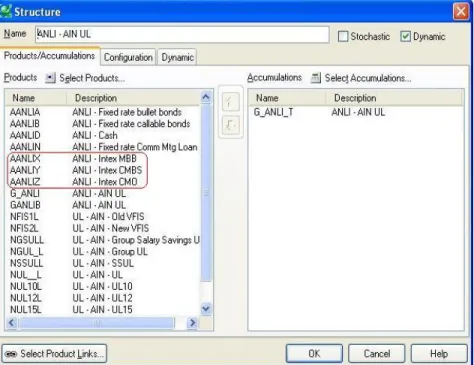
Here is an illustration of the global structure in Prophet. On the left are all the asset and liability products we are testing in this structure for one product line. The products that begin with “A” are the asset products and the ones that begin with “N” are liability products. I circled three asset products (AANLIX, AANLIY, AANLIZ) which are the
12
Intex assets that slow down the cash flow testing process in Prophet. We wanted to replace the three Intex assets with an EPA product called EINTXZ. All other things in this structure remain the same.
13 Figure 2: ALM Structure after change
It was a long process of testing and debugging. One major thing was to modify formulas for variables in EPA. The formulas in the EPA library did not work in the way we wanted and they gave us wrong numbers. The way I did it was to look at the diagram in the results file and traced down each problematic variable. In the diagram view, we can view all the dependencies between the variables and their values. The problem with one variable would eventually come down to one or more other variables. I then changed the formula for those variables until they produced the correct values. Here is an example of the diagram view in Prophet that I pulled out from Prophet official manual:
14 Figure 3: Diagram view in Prophet
As we can see, the screen is divided horizontally into three sections. The upper part gives us the variable dependencies. The middle part is the variable definition, which contains the formula for the variable shown. The lower part gives us the results values of the variables shown in the upper part.
4.4 Result
The result was very successful. The run time for the whole process was reduced to just 45 minutes.
15 Figure 4: Result comparison
16
Chapter Five: Conclusion
Asset-Liability Management is relevant to, and critical for, the sound management of the finances of any organization that invests to meet its future cash flow needs and capital requirements. For an insurance company in particular, it is an important component of the actuarial work in the company. What an insurance company sells to customers is a promise. Cash flow testing is such a process of testing the insurance company’s ability to keep its promises.
17
Bibliography
Altman, E.I. and Vanderhoof, I.T. 1996. The Strategic Dynamics of the Insurance Industry: Asset/Liability Management Issues. Irwin Professional Publishing.
Becker, D. 1998. "The Objective (Function) of Asset/Liability Management," Risks and Rewards. January.
Consiglio, A., F. Cocco, and S. Zenios. 2001. Asset and Liability Modeling for Participating Policies with Guarantees. The Wharton School, Philadelphia, PA.
David B. Atkinson and James W. Dallas, 2000. Life Insurance Products and Finance: Charting a clear course. Society of Actuaries.
Frank J. Fabozzi, 2005. The handbook of fixed income securities, 7th edition. McGraw-Hill.
18
Vita
Ying Li received her degree of Bachelor of Arts in English and International Studies from China Foreign Affairs University in Beijing, China in 2006. She received her Master’s Degree in Political Science from the University of South Carolina at Columbia in 2008. She joined the Actuarial Graduate Program at the University of Texas at Austin in Fall 2008 and interned at American General Life Companies in the summer of 2009.
Permanent address: 6219 Love Dr. Apt 2237, Irving, TX 75039 This report was typed by Ying Li.