Improved compatibility with knowledge sharing in cloud Environment
Anish .T.P
(St.Peters Engineering College Chennai, [email protected])
Abstract: Developments in computing are influencing several aspects of education. the aim of this paper is to assess the potential price of cloud computing as a platform for knowledge sharing. Specially, the paper can discuss however cloud computing is totally different from alternative forms of computing and what makes it distinctive. Similarly is that this, the potential blessings and drawbacks of mistreatment cloud computing as a platform for knowledge sharing is going to be printed. Finally, the necessities of implementing cloud computing are going to be mentioned, at the side of associate assessment of the challenges to implementation, and a few potential ways that to beat them. Providing knowledge sharing services employing a cloud-based platform will scale back prices, will be easier to take care of and update, and supply advantages to end users in terms of security and compatibility. However, cloud-based learning systems need quick and reliable web access, and problems close the safety of a cloud stay unclear.
Keywords: knowledge sharing, NIST, Cloud computing
1. Introduction
Technology is progressively getting used each within and out of doors the classroom. clasp new technologies and finding best ways in which of harnessing their edges is crucial to maximizing instructional outcomes. However, so as to realize edges from technologies it's important to possess An understanding of the advantages and disadvantages to their usage, in addition as guaranteeing that they're enforced in ideal ways in which. the most purpose of this text is to assess the potential for victimization cloud computing within the field of education, to look at potential
challenges to implementation, and description ways in which to overcome them.
The article begins with a short definition of learning and a summary of common learning theories.
Next, a definition is given for knowledge sharing, in conjunction with an overview of however it differs from traditional learning. Following this is often a short background on the use of technology within the field of education, and a lot of specifically on the emergence of cloud computing. The conception of cloud computing is then introduced in conjunction with its essential options and an overview of the various ways in which it is enforced. An assessment is then made from the benefits and drawbacks of cloud-based computing systems for knowledge sharing. Finally, the challenges of implementing cloud-based systems for knowledge sharing are highlighted, in conjunction with some recommendations to beat these challenges.
2. Defining Learning
The field of learning is filled with several theories, with several qualitative analyses back over sixty years.
However, the bulk of the presently in style theories square measure primarily based upon studies
that are conducted throughout the past twenty years. On the total, these theories will be categorized
into 5 main types: humanist, behaviorist, cognitive, social learning, and significant reflection. every orientation has its strengths and limitations, and there square measure some things once one theory might be a lot of applicable than
another [1]. Humanists hold the idea that folks have unlimited potential for development, which the tareget of learning is to fulfill one’s potential. Learning involves an energetic hunt for meaning, that is controlled by the
learners WHO apprehend their particular desires and goals. Educators ought to function facilitators of
learning, by serving to student’s learn the method of a way to learn and teaching them to self-discover
learning. ways that exemplify this approach embrace independent learning, and experiential
learning [1,2,7].
Behaviorists specialize in skills development and behavioral change. Learning is seen as
a amendment in open, noticeable behavior. The process of learning is seen as being controlled by stimuli in the external surroundings from educators and their info, and not by the scholars themselves. The educator’s role is to manage and management the educational surroundings by setting specific learning objectives then observation the learner’s progress. Behaviorism involves “Stimulus-Response” learning that is derived from Skinner’s “Reinforcement Theory.” ways that exemplify the behaviorist academic ways embrace games and simulations, reinforcement and incentives, and educational feedback [1]. psychological feature and creative person views of learning emphasize the importance of understanding the mental processes involved in learning from the learner’s perspective. in keeping with these views learning is seen as changes within the method within which the learner understands or organizes the weather of the surroundings, and changes within the behavior of the learner square measure deemphasized. The purpose of learning is seen because the acquisition of information, and the goal of educators is to make the best conditions for learning to occur. ways embrace the employment of metaphors, analogies and simile, unitization (presenting data in “chunks”), and concept mapping. Key figures during this field embrace Piaget, Bruner, and Bloom[1, 3].
Social learning theory integrates several of the concepts mentioned within the behavioral and psychological feature views of learning. It beliefs that learning may be a human process. Most of what folkslearen is thru observations and interactions with others in a social context. Focus is on the impact on people. In this theory the trainer may be a model (demonstrator) or identifies and provides effective models, additionally to facilitate social interactions. Samples of academic methods: Demonstrations and trials, apprenticeships, mentoring, tutorials, peer partnerships, on-the-job coaching [1].vital reflection theory focuses on vital reflection and capitalizing on learners’ expertise. In general, vital reflection involves the learner distinctive and evaluating the assumptions, beliefs and values that underlie his or her thoughts, feelings or actions. This ends up in a metamorphosis in however one appearance at the planet. The instructor’s role is that of vital analyst, stimulator of
critical reflection, and competitor of assumptions. the stress is on learner and pedagogue equality.
The pedagogue is at the same time teacher and learner. Samples of academic methods: Focus cluster inquiry, vital dialogue, imaging the longer term, reflective judgment, scenario building [1].
3.Defining knowledge sharing
According to [4] knowledge sharing could be a quick and economical thanks to unfold knowledge to learners in several components of the planet that gives the following definition of knowledge sharing: “Knowledge sharing uses the
Internet or alternative digital content for learning and teaching activities, which takes full advantage of recent instructional technology provided with a brand new mechanism of communication and resource rich learning atmosphere to attain a brand new method of learning”. In addition, knowledge sharing will considerably cut back the time learners spend on learning and it conjointly permits them to access a broader spectrum of learning materials in accordance with their individual competences and state of affairs while not the constraints of your
time and space.
In associate knowledge sharing state of affairs, the training supplier is separated from the learner by Net, and has less visibility of the method the learner is interacting with the tutorial atmosphere. The ability to adapt, realign, or modification the atmosphere is reduced due to this restricted visibility. It conjointly makes the tutorial content very important because the content is currently the sole differentiating issue between competitive knowledge sharing initiatives, assumptive there's a level taking pared in field in infrastructure for the availability of service over the internet [5-6].
4. The Emergence of Cloud Computing
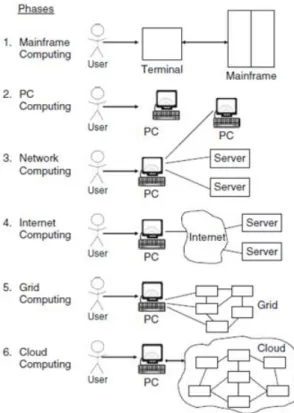
Computing may be seen as prying shows six stages distinct computing paradigms, that are dumb terminals connected to mainframes, personal computers, networking computing, Internet computing , grid computing, and cloud computing [12].As shown in Figure below, in stage 1, several users used dumb terminals to share giant and powerful mainframe computers. In stage 2, complete personal computers became powerful enough to satisfy the bulk of individuals desires. In stage 3, personal computers and servers were connected along through native area networks and order to pool resources and provides one another access to information on every laptop.
In stage 4, native space networks were connected to alternative native space networks forming a world network known as the net to modify remote applications and information to be accessed. In stage 5, grid computing enabled the sharing of computing resources and storage through a distributed grid system of computing. In stage 6, cloud computing emerged as a simple and scalable method of sharing resources on the internet [9,13].
4.1Essential Characteristics of Cloud Computing
When looking at these six computing paradigms, it's like cloud computing is solely a come back to the stage one mainframe computing paradigm. However, there are many key distinctions between these two. Mell and Grance [10] state the key characteristics of cloud computing as follows.
4.1.1.On-demand shopper access: the buyer will access computing facilities, like server time and network storage, whenever they're required mechanically while not the requirement for interaction with every service supplier. Broad access to network: Computing facilities are available over a network which will be accessed through thick or thin purchasers like sensible phones, tablets, laptops, and desktop computers.
4.1.2 Pooling of resources: The service provider’s resources are pooled employing a multi-tenant model to balance the loading between multiple shoppers. Completely different physical and virtual values that depend on the material resources are dynamically appointed and reassigned to optimize services consistent with shopper demand.
4.1.3. Versatile provision of services: Services is flexibly provisioned and free, mechanically, to scale and accommodates the levels of demand. For the client, the services offered typically appeare to be unlimited and might be accessed in any amount at any time.
4.1.4. Measure of services: Cloud systems utilize a metering capability to mechanically management and optimize the allocation of resources in accordance with the kind of service such as storage, and processing.
4.2. Cloud Computing Service Models
The National Institute of Standards and Technology’s (NIST) definition of a cloud outlines 3 ways to access a cloud, which are: software system as service, platform as a service, and infrastructure as a service [10].The most wide used type of cloud computing is software system as service. the explanation for its fashionable it's that it will support the delivery of advanced applications over the net, and provides reliable storage. A browser, like net soul, is used to access software system provided over the net. primarily, the end user purchases the correct to access a software system package and does not ought to be anxious concerning getting the underlying infrastructure to run that software system [14]. Platform as a Service (PaaS) provides customers virtual servers to run existing applications. Additionally, with PaaS new applications can be developed while not the requirement for maintenance or change of operative systems.
The underlying infrastructure is supported by PaaS that permits software system supplier to develop and deploy their software system while not having to stress concerning aspects like the operating system [15,8]. Infrastructure as a service provides virtualized servers, networks, storage, and system software system. associate IaaS service
permits several advantages to organizations and even has the potential to switch an entire data-center [14]. A cloud-based IaaS offer a good solution against the matter of the reliance on one server by providing multiple entry points application programming interfaces (API) as a service platform that allows information storage and retrieval from multiple points. Therefore, a failure at one point can be overcome by redirecting the request to a special point. [15]
4.3. Deployment Models
The National Institute of Standards and Technology’s (NIST) outlines four totally different models of readying for a cloud, which are public, community, private, and hybrid clouds. A public cloud includes services that square
measure accessible by all members of the overall public. Applications publically clouds are provided
by third parties on the cloud’s servers, storage systems, and networks. [15] . A community cloud is cloud infrastructure is associate infrastructure that's shared between many organizations with common issues, like security, from a selected community. The cloud may be hosted and managed internally or by a third-party. cloud [15]. a personal cloud is cloud infrastructure managed and hosted internally or outwardly by a third-party for one
organization. Non-public clouds are engineered for the exclusive use of 1 client, to modify them to
possess full management over their knowledge, increase the level of security, and assure quality of service [15]. A
hybrid cloud permits establishments to use a mixture of the antecedently mentioned readying models to
run associate application or system. For instance, a hybrid cloud will mix multiple public and personal cloud models.
4.4. The Advantages of Cloud Computing
There are several blessings offered by cloud computing [11] :
• Improved performance of PCs: once applications are accessed from a cloud, the computer has a lot of resources and it'll additionally stared-up up quicker and run quicker, as a result of there are less programs and processes loaded into memory. so a computer with less programs accessed regionally, can have higher performance.
• Lower maintenance issues: Cloud computing greatly reduces each hardware and software package maintenance for firms. The main reason is as a result of fewer servers are required by the companies. This lowers the time and expense for the upkeep of servers. Additionally, because the software package is keep within the cloud, IT staff has no software package to take care of or upgrade.
• Lower hardware necessities for users: The hardware requirements are abundant less as solely weak computers are needed to run most cloud computing web-based applications. This is as a result of the computer doesn’t want abundant process power or laborious disk space for applications that run within the cloud.
• IT Infrastructure prices are lower: For an outsized organization, fewer servers are required as applications and knowledge are keep within the cloud. Consequently, the organization will scale back prices by exploitation the power of the cloud to scale back the necessity for internal computing resources. It additionally permits firms to a lot of effectively meet their peak level necessities by exploitation the measurability of the cloud.
• Lower software package cost: a corporation will lower its prices of providing software package to its workers by avoiding the necessity to get software for each computer. Instead the corporate will pay for under their actual usage of a software package package over the cloud. This also reduces the prices of putting in and maintaining those programs on every desktop within the organization.
• multiplied computing power: A cloud automatic data processing system also permits a user to own access to fare more powerful computing resources as they need the ability of the complete cloud which may allow utilizing the ability of thousands of computers and servers. a lot of resource overwhelming tasks is also complete than with one desktop computer.
• Unlimited storage capacity: historically, the user was limited to the storage of one computer or server on a network. Whereas a cloud offers an virtually unlimited storage capability.
• Instant software package updates: With a cloud updates happen automatically, that avoids the necessity for the user or IT department to worry with change the software package in their organization.It additionally makes it a lot of possible that the users can have access to the latest software package version.
• Improved compatibility between operational systems: As the cloud is mechanically designed to run
multiple operational systems, the user will connect with the cloud and share documents with computers running Windows, Mac OS, Linux, or UNIX.
• multiplied knowledge security: knowledge during a cloud is mechanically duplicated therefore in contrast
to desktop computing, a laptop fucking in the cloud doesn’t destroy the information, which can still be obtainable from different PCs within the cloud. This reduces the necessity for backing up knowledge regionally, and ensures the safety of information within the event of viruses or maybe disasters like fires.
• Accessibility from a variety of devices: In today’s world where a vareiety of devices are accustomed connect
with the web like PCs, notebooks, sensible phones and then on, a further advantage of cloud computing is that you simply will use a variety of devices and even when you switch devices the cloud provides access to all or any your existing applications and documents you were accessing tho' a different device.
• Immovableness of documents: all of your documents are instantly available from where you're, as long as you have
got a web connection to the cloud. This removes the necessity to backup files and careries
around transportable hared-drives and similare.
• Easier cluster collaboration: With cloud computing, anyone anywhere with a web association will collaborate in real time. The technology permits multiple users to simply collaborate on documents and comes at constant time. It additionally permits individuals to collaborate on cluster come in numerous countries as simply as if they were within the same building.
The disadvantages of Cloud computing
The main drawbacks to cloud computing are as follows [11]:
• a web association is needed: Cloud computing requires a association to the web to access each applications and documents; while not a web association nothing is accessed, even your own files. This makes cloud computing
impossible for applications in areas wherever there's no or an unreliable web association.
• Low-speed connections limit accessibility: equally, a low-speed web association, for example in remote regions that solely provide dial-up services, cloud computing is commonly too slow or even not possible to run resource
intensive tasks. Web-based apps need plenty of information measure to transfer, as do massive files.
Therefore, cloud computing needs a stable and quick association to the web in any respect times.
simply as secure because the cloud is.If an unauthorized users gain access to the cloud they'll additionally have access to any confidential knowledge keep within the cloud.
5. Cloud Computing and Knowledge sharing
Several challenges face the economical readying of Knowledge sharing systems, and Dong, Zheng [16] and Aljenaa, Al-Anzi [17] provide some potential solutions that cloud computing offers to beat many of those as follows:
• Lack of a correct infrastructure: several organizations lack the proper infrastructure for adopting AN Knowledge sharing platform. A modern ascendible infrastructure is required because the creation of latest content that is usually made in multimedia system has high resource requirements for aspects like information measure and storage. [6, 18].Cloud technology will facilitate overcome these challenges because the centralized infrastructure of a cloud system reduces the necessity to repeat tasks in every and each faculty wherever the system is deployed reducing the value and time required to make the infrastructure. Secondly, once a cloud is running in a company, the deployment method is swift across the organization owing to lack of technical work to deploy the services in
individual faculties. The third advantage is that the lower value of hardware infrastructure in
individual faculties, as typically solely computers with low specifications, capable of running a browser, will be used.
• Lack of curriculum: the shortage of content that's able to be foreign into the Knowledge sharing system could be a common challenge that education establishments typically face. Ideally, this must be planned up-front in conjunction with issues of the infrastructure that is needed [17]. Cloud computing will enhance readiness in two key ways in which. the primary is by providing a simple to use platform for academics and students to access from anyplace there's a device with a web association. The second advantage is that by lowering
operation prices through cloud computing an organization will direct the saved cash towared the event
of a lot of in-house content or to buy content developed by other organizations [16].
• Lack of maintenance and technical support: once an Knowledge sharing system is established the info must be updated and the hardware and software system need routine maintenance. Many academic establishments don't have the competencies to support their own infrastructure and answer problems like network outages or security threats. Technical support time is reduced with a cloud based system as a result of cloud technology utilizes a centralized infrastructure approach that reduces the necessity to pay time on issues like service convenience, and application compatibility by providing and delivering services through a browser[19]
.
• Modification management: one in all the largest challenges of Knowledge sharing is to manage
the modification method inside the education organization, once moving to an internet platform. The change
affects all stakeholders of the organization, like the scholares,
educators, call manufacturers, content developers, and system support staff. thus forwarded coming up with is
crucial once implementing such a serious change[17]. the primary profit that clouds give to
the modification management method is that the faster pace of readying. With the employment of clouds the knowledge sharing system will be deployed and spread over the organization a lot of quickly, and folks area unit a
lot of
second profit relates to the convenience of access. Clouds alter wider accessibility as any system with internet access is in a position to access the educational platform. this permits educators and academics to own access to the educational platform from their home, which supplies them a lot of ability to check and use the system. Consequently, if longer is spent on the system the resistance to very are going to be reduced within the organization [16].
6.Conclusion
In conclusion, technology is getting used more and more by establishments to provide knowledge sharing services.
These establishments face a large challenges in implementing these systems like prices, a lack
of technical resources, and resistance by key stakeholders to the implementation of systems. Cloud-based learning systems are emerging as a gorgeous technique for providing knowledge sharing services. They can cut
back prices owing to lower needs of hardware and software, and fewer would like for on web
site maintenance. They’re conjointly
easier to deploy across multiple locations as they're centrally administered. They conjointly supply edges to finish users in terms of accessibility, security, and compatibility. However, the constraints of cloud-based learning systems are that a web affiliation is obligatory, low speed connections cut back the potency of the provision of knowledge sharing services, and problems encompassing the security of a cloud stay unclear. because the speed and stability of the Internet are continued to boost, it appears seemingly that the popularity of cloud computing for knowledge sharing can increase.
7.References
[1] Deshler, J.D., E. Kiely, Facilitating Adult Learning: Sourcebook & Leader’s Guide. 1995: Cornell University", Cornell Instructional Materials Service.
[2] Weinberger, L.A.,"Commonly held theories of human resource development", Human Resource Development International,1998. 1(1). pp. 75-93.
[3] Cross, J.,"An informal history of eLearning. On the Horizon",2004. 12(3). pp. 103-110.
[4] Liu, C.-H.,"The compareison of learning effectiveness betweentraditional face-to-face learning and e-learning among goaloriented users", in Digital Content, Multimedia Technology and its Applications (IDC), 2010 6th International Conferenceon. 2010. IEEE.
[5] Hamid, A.A.,"E-learning: is it the “e” or the learning that matters? The Internet and Higher Education", 2001. 4(3),pp. 311-316.
[6] Guoli, Z., L. Wanjun,"The applied researech of cloud computing platform arechitecture in the E-learning area", In Computer and Automation Engineering (ICCAE), 2010 The 2nd International Conference on. 2010. IEEE. [7] Petrina, S.,"Sidney Pressey and the automation of education", 1924-1934. Technology and Culture, 2004. 45(2): pp. 305-330.
[8] Downes, S.,"Feature: E-learning 2.0. Elearen magazine",2005. 2005(10): p. 1. [9] Furht, B.E., Aremando,"Handbook of Cloud Computing",2010: Springer. 634 p.
[10] Jena, Sudhir Kr, and K. C. Das. "Management of Information and Knowledge Centres in Cloud Computing Environment: Opportunities and Challenges." (2013).
[11] Micheal, M., Cloud computing: Web- based applications that change the way you work and collaborate online. 2009, USA: Que.
[12] Voas, J. and J. Zhang, Cloud computing:New wine or just a new bottle? , in IT Professional on the Web- IEEE. 2009, IEEE. p. 15-17.
[13] Strickland, J., How Cloud Computing Works. 2008, A discovery Company. [14] Law, M., Cloud Computing Basics. 2011: Hillcrest Media Group, Inc.
[15] Corrado, E.M. and H.L. Moulaison, Getting stareted with cloud computing : a LITA guide. 2011, New York: Neal- Schuman Pub.
[16] Dong, B., et al. An e-learning ecosystem based on cloud computing infrastructure. in Advanced Learning Technologies, 2009. ICALT 2009. Ninth IEEE International Conference on. 2009. IEEE.
[17] Aljenaa, E., F. Al-Anzi, and M. Alshayeji. Towareds an efficient e-learning system based on cloud computing. In Proceedings of the Second Kuwait Conference on e-Services and e-Systems. 2011. ACM.
[18] Kerres, M. and C.D. Witt, A didactical framework for the design of blended learning arerangements. Journal of Educational Media, 2003. 28(2-3): p. 101-113.