EHR Implementation with
Minimal Practice Disruption in
Primary Care Settings:
The Experience of
the Washington & Idaho Regional Extension Center
November 2012
Washington & Idaho
wirec
Authored by:
Jeff Hummel, MD, MPH Qualis Health
Seattle, Washington
Peggy Evans, PhD, CPHIT Qualis Health
Seattle, Washington
Table of Contents
Executive Summary . . . .3
Introduction . . . .4
Background . . . .4
Case Study Vignettes . . . .5
Table 1: The most common errors in EHR implementation contributing to practice disruption . . . .7
Leadership Issues . . . .8
Workflow Issues . . . .9
Provider Issues . . . .10
Training Issues . . . .10
Data Interface Issues . . . .11
User Interface Issues . . . .12
Summary . . . .13
Executive Summary
The US government has created financial incentives for healthcare organizations and eligible professionals to use electronic health record (EHR) systems in a manner that meets the Centers for Medicare & Medicaid Services (CMS) defined criteria for “meaningful use.” At the same time, experiences of larger delivery systems that have implemented EHRs indicate a variety of pitfalls associated with health IT adoption that may contribute to financial loss and practice disruption impacting patient care. The Regional Extension Center for Health Information Technology (REC) program is a federally-funded program administered by the Office of the National Coordinator for Health Information Technology (ONC). The REC program focuses on providing technical assistance for EHR implementation to small primary care practices, a group for which the health IT adoption experience has been less well understood. The Washington & Idaho Regional Extension Center (WIREC), a program of Qualis Health, has identified important patterns in implementation errors that result in financial loss, practice disruption and patient safety issues. In this white paper, we describe these errors and how they pertain to leadership, workflow, provider engagement, training, data interfaces and the user interface. For each category, we describe the errors in detail and recommend specific strategies that primary care practices of all sizes can use to minimize the risk of practice disruption and the associated costs.
What are Regional Extension Centers?
The Office of the National Coordinator for Health Information technology (ONC) funded 62 Regional Extension Centers (RECs) across the country to help more than 100,000 primary care providers adopt and use electronic health records (EHRs) and receive incentive payments through the Medicare and Medicaid EHR Incentive Programs for the “meaningful use” of their EHR systems.
REC services include outreach and education, EHR vendor support, workflow redesign assistance, change management support and other technical assistance for the successful implementation and utilization of health IT. In particular, the RECs focus on individual and small practices (fewer than 10 providers), federally qualified health centers, rural health clinics and other settings that predominately provide services to the underserved.
Introduction
Studies on electronic health record (EHR) implementation have documented the difficulty of the process (1, 2) such as the high costs, lowered productivity, disruption to patient care and dissatisfaction among staff. Yet most of the research on EHR implementation challenges comes from large organizations and/or academic institutions (3, 4). The Regional Extension Centers for Health Information Technology (REC) program has resulted in new insight into the specific challenges that smaller practices face when implementing an EHR (5). The experience of one such REC program, the Washington & Idaho Regional Extension Center (WIREC) is
documented in this paper.
WIREC is a program of Qualis Health, a nonprofit healthcare consulting organization. WIREC delivers health IT consulting services to over 3,300 primary care providers in the Pacific Northwest in more than 630 practice locations with an average of 4 providers per practice. By the third year of the grant-funded program WIREC had assisted 77% of its enrolled providers in fully implementing an ONC-ACTB certified EHR. Through these experiences WIREC has gained valuable insight into the factors determining the
success—or failure—of EHR adoption in small practices.
Background
EHR implementation is a complex orchestration of information technology and business process “system builds.” Successful implementation requires that end users understand each workflow, that all technology components work properly with the corresponding workflow and that each end user knows how to use relevant software components. However, the implementation timeline and focus are invariably technology-driven with go-live as the culminating event in which all EHR components are turned on, used simultaneously and expected to work properly. In reality, the implementation of EHRs in ambulatory clinics frequently follows the psychological roller coaster of the Gartner Hype-Cycle (6), in which unrealistic expectations reach a peak just prior to implementation. What follows is a “trough of disillusionment” and a recovery phase requiring hard work to understand how the technology best fits the users’ needs, all under the pressure of reduced productivity. A clinic can avoid the extremes of the Hype Cycle and have a more successful implementation by doing much of the same recovery work in advance including setting expectations, planning for change management, preparing workflow changes and avoiding common errors.
The vignettes on the following pages, assembled from the experiences of WIREC consultants, illustrate the factors that contribute to the success or failure of implementation.
Case Study Vignettes
Clinic A:Clinic A had difficulty choosing an EHR system largely because the vendor selection group lacked agreement about key workflows and organizational priorities. After finally selecting an EHR, the CEO of the organization and driver of the EHR adoption process appeared to lose interest and stopped attending planning meetings, delegating leadership tasks to a low-level aid. The providers, taking their cue from leadership, likewise disengaged from the planning process, not focusing on critical tasks that need to be completed in advance such as workflow redesign. The EHR vendor gave the clinic a list of tasks such as creating charting templates, order sets and diagnosis preference lists, however no one in the clinic took responsibility for making sure each task was understood and completed. Training took place one month before go-live and there was no additional reality-based training the week of go-live, which is a crucial period for training. The end result was that providers and staff were equally dissatisfied with the EHR and EHR implementation process.
Clinic B:
The two physicians who owned the clinic made the EHR selection decision without input from employees including other providers. The planning process was autocratic, leading to disengagement first by providers and then by other employees following their example. Decisions about placement of terminals and printers were made without input from the front line personnel who would be using the equipment. Several medical records clerks were assigned to scanning entire paper charts in preparation for the implementation, which diverted staff time from more important preparatory work, filled up valuable space on the server, and saved clinical information in a format that was difficult to access and impossible to search. There were several meetings to review workflow, but without a strong facilitator and organizational support the meetings usually lost focus. In order to reduce costs, a small number of non-provider clinic personnel were trained as EHR super-users and given responsibility for training the rest of the staff over several months before go-live, which was too early to be of real value. “Go-live” on the EHR was scheduled when one of the clinic owners and key advocate of the EHR implementation was on vacation and unable to address issues. All features of the EHR were turned on at once in a “big bang” approach. Providers were frustrated with the go-live process, complaining loudly in the hallways. Both staff and providers felt demoralized by the end of the implementation process.
Clinic C:
Clinic C had a senior physician whose role was the clinician champion for the EHR rollout. He led planning meetings and sent out weekly communications to all clinic staff setting expectations for how the practice would change. The clinician champion also engaged two other providers to endorse the EHR and assist with clinic change management processes. While still using paper charts, the clinic mapped and standardized key workflows to plan how the processes would work with the EHR. The EHR committee, led by these three physicians, met weekly to build templates, order sets and preference lists. After planning for the 100 most frequently used diagnoses at the clinic, they developed a process for setting up new tools after go-live. The clinic hired two employees to enter a limited set of key clinical information into the EHR data fields including medications and past medical history in the weeks before go-live. Ongoing training was required for both staff and providers. When the clinic finally started to implement the EHR, they went live with one team at a time, allowing ample time to address issues and solve problems as they emerged. On-site trainers focused their support on the team going live, but were also available to teams that had just completed implementation. The implementation was perceived as having gone smoothly, and the drop in productivity at any given time was comparable to having one or two providers on vacation.
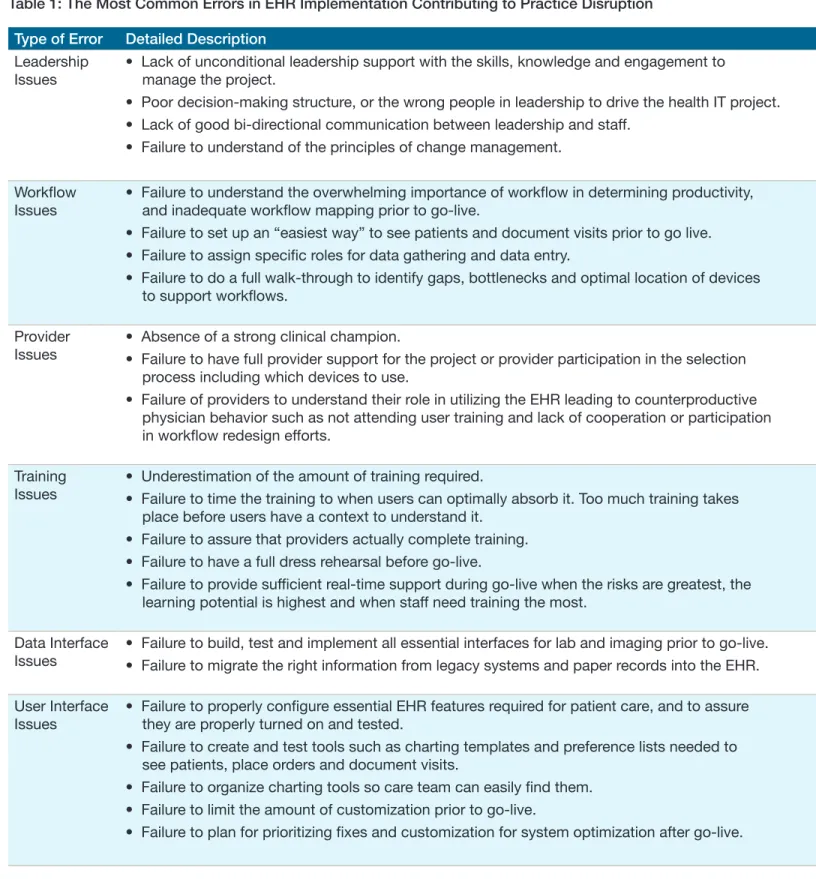
The vignettes described, which are based on the real-experiences of clinics, reveal patterns in EHR implementation that can result in either avoidable errors (Clinics A and B) or successful adoption (Clinic C). The WIREC team has seen these patterns repeatedly, albeit each clinic experiences the “pain” in somewhat different ways. Each error carries associated costs that reduce the likelihood of successful adoption, seriously jeopardize a medical practice’s financial viability and negatively impact patient care. The causes of practice disruption through implementation errors were organized into six categories that are not necessarily mutually exclusive as shown in the following table. The pattern suggests a set of strategies and resources to help clinics reduce practice disruption during EHR implementation.
Table 1: The Most Common Errors in EHR Implementation Contributing to Practice Disruption
Type of Error Detailed Description
Leadership Issues
• Lack of unconditional leadership support with the skills, knowledge and engagement to manage the project.
• Poor decision-making structure, or the wrong people in leadership to drive the health IT project. • Lack of good bi-directional communication between leadership and staff.
• Failure to understand of the principles of change management. Workflow
Issues
• Failure to understand the overwhelming importance of workflow in determining productivity, and inadequate workflow mapping prior to go-live.
• Failure to set up an “easiest way” to see patients and document visits prior to go live. • Failure to assign specific roles for data gathering and data entry.
• Failure to do a full walk-through to identify gaps, bottlenecks and optimal location of devices to support workflows.
Provider Issues
• Absence of a strong clinical champion.
• Failure to have full provider support for the project or provider participation in the selection process including which devices to use.
• Failure of providers to understand their role in utilizing the EHR leading to counterproductive physician behavior such as not attending user training and lack of cooperation or participation in workflow redesign efforts.
Training Issues
• Underestimation of the amount of training required.
• Failure to time the training to when users can optimally absorb it. Too much training takes place before users have a context to understand it.
• Failure to assure that providers actually complete training. • Failure to have a full dress rehearsal before go-live.
• Failure to provide sufficient real-time support during go-live when the risks are greatest, the learning potential is highest and when staff need training the most.
Data Interface Issues
• Failure to build, test and implement all essential interfaces for lab and imaging prior to go-live. • Failure to migrate the right information from legacy systems and paper records into the EHR. User Interface
Issues
• Failure to properly configure essential EHR features required for patient care, and to assure they are properly turned on and tested.
• Failure to create and test tools such as charting templates and preference lists needed to see patients, place orders and document visits.
• Failure to organize charting tools so care team can easily find them. • Failure to limit the amount of customization prior to go-live.
While the six errors listed in Table 1 are common, they are also avoidable through careful planning and measures described below.
Leadership Issues
Common ErrorsMost leadership problems stem from inadequate leadership support and failure to manage the EHR implementation project. This is often compounded by a lack of skills, knowledge, and understanding of change management principles. Frequently, smaller practices have instituted decision-making processes that lack structure including formal communications with staff. Leadership for EHR implementation can include a variety of personnel ranging from the CEO to clinic staff with a knack for project management, for example a medical assistant. Regardless of who plays a leadership role, the key concept is that those people must have organizational support, ability to remove barriers, strong framework for communications plans for all staff members and sufficient time allocated to lead the EHR project.
Recommendations
1. Leadership at the highest level (e.g., CEO) is responsible for establishing organizational aims for the EHR and assuring that the strategies to achieve those aims are executed at the highest governance level. This requires articulating a business case for clinical quality as well as allocating resources, removing barriers and fully engaging providers and patients.
2. Other more informal leadership, including clinician champions, can help build a shared understanding of the need to use information technology to measure and manage clinical quality. Clinician champions are essential for solidifying provider support based on an agreement for how the EHR will be used to improve patient care.
3. Leadership must develop a framework for clear and rapid communications about health IT priorities within the clinic, both for top-down as well as bottom-up communications. This may include, for example, weekly emails, all-staff meetings or a bulletin board in the break room to communicate with the staff about rapidly evolving situations.
4. Leadership’s role is to help the entire clinic
understand that they are embarking on continuous practice transformation that happens to involve technology, not a technology project that happens to involve healthcare.
5. Leaders must dedicate sufficient time to leading the EHR project. It is unrealistic to expect those in leadership positions to manage the EHR rollout as “one more thing” on their plates. The project lead, for example, should have at least half of his or her time devoted specifically to the EHR rollout.
Workflow Issues
Common ErrorsClinical personnel, including providers, often have little insight into the clinic’s workflows and the roles others play in care delivery. This blind spot results in inadequate planning for the most important determinant of successful implementation. Most organizations must go back after go-live to fix (i.e. standardize) workflows in an effort to recover from the resulting productivity drop. Without identifying a standardized best practice method to do the work, every user is left to struggle alone with a complex and confusing user interface without agreement on how information should be gathered, who should enter it and where it is entered. There is commonly a lack of agreement on how the information is processed and organized, and finally where in the workflow the information will be used and by whom. Performing a pre go-live “walk-through” to visualize how information flow integrates with workflow allows the team to optimize processes in advance. It also avoids improper placement of hardware including workstations, printers and scanners that can be costly, or impossible because of clinic layout to repair after go-live.
Recommendations
1. Clinics should map and standardize their key workflows before EHR selection, using what they learn to determine which EHR tools best support their workflows. If that pre-step has been missed, workflows should be mapped before EHR implementation. Relying on vendor-suggested standard workflows rarely works because the set-up of each practice is different and clinic personnel need a clear understanding of how the technology supports their own workflows. Workflows should be mapped and redesigned by the front line staff doing the work and should include both current processes as well as envisioned future processes. On-site walk-through exercises should be conducted to assure that devices are placed and the technology is configured to deliver the right information, formatted properly, to the right person at the right time.
2. Clinics should plan to spend additional time redesigning workflows after the EHR has been implemented as well as before implementation. In order for an EHR to increase efficiency, improve clinical care and enhance patient safety, clinic staff must understand how information is gathered and entered into the EHR, how information is processed and organized within the EHR, and where the information is used in the workflows to support the clinical decisions that affect patient care. After the EHR is implemented, it is common for there to be confusion about which staff should enter specific information, which data fields to use and where in the workflow data entry should happen. Once the optimal processes for integrating information and workflow have been determined, they must be communicated adequately to staff.
3. In general, data entry by providers should be confined to actual clinical decisions such as ordering tests, ordering medications or placing diagnoses on the problem list. Whenever possible, support staff should enter other data as appropriate given staff licensure. Even orders for medications and tests can often be “set up” by support staff using written protocols in which the provider pushes the button to place the order.
Provider Issues
Common ErrorsMany EHR implementation projects fail from
underestimating the importance of one or more strong clinician champions to serve as opinion leaders for providers in the clinic. The clinician champion must guide colleagues in understanding their roles in the implementation and enlisting their involvement in such complex tasks as EHR selection, workflow redesign, template development and quality improvement (7). Without a champion, dysfunctional physician behavior can easily undermine the project with negative messaging to staff, and, at its worst, it can result in “hijacking” the project through endless demands for poorly thought-out changes that delay implementation and prolong the stabilization period.
Recommendations
1. Identify one or two clinician champions and define their roles.
2. Work with the clinician champion(s) to engage providers early in the EHR selection and adoption process.
3. Focus on efforts to reduce waste and improve clinical outcomes using the early adopters to lead the effort. Enlist more reticent providers to review plans and point out what could go wrong.
4. Leadership must include the clinical champion(s) in tactical decisions to avoid common errors and make difficult judgment calls including how much optimization can reasonably be completed before go-live and what to delay until after system stabilization.
Training Issues
Common ErrorsVendors frequently limit training to didactic sessions organized by technology feature and taking place weeks before go-live. Clinics often underestimate the number of hours they need for training in efforts to reduce costs, or they may opt for over-the-phone (versus in person) training to avoid vendor travel costs. Providers often assume they can learn anything on the spot, and may skip aspects of training altogether. These patterns can all contribute to a dynamic in which clinics receive inadequate training, forego a full dress rehearsal and end up going live unprepared.
Recommendations
1. Help clinic leadership understand the importance of spending money to appropriately train staff. Consider a “train the trainer” approach, in which the vendor trains “super users” from the organization, who in turn, are responsible for coaching other staff.
2. Training should be as reality-based as possible. Providers learn by entering problem lists, medications, and preventive information on their own patients into the production EHR. In a test environment providers can use live patient simulations to document visits and place orders.
3. Consider going live with clinical support staff before providers, or hiring additional “training staff” so adequate support is available for providers during go live. Providers are juggling the most complex medical thought processes, multiple distractions and major time constraints while learning the most complicated and broadest scope of the EHR environment.
4. Practice each major workflow repeatedly just before and during go-live. Workflows to rehearse include rooming patients, ordering common tests or procedures (medications, imaging, blood work, injections, ECGs, referrals, etc), and end-of-visit scenarios.
Data Interface Issues
Common ErrorsEHRs must make it easier for care teams to find information. Failure to complete and adequately test data interfaces (e.g., lab, radiology) before go-live results in “work-arounds” that contribute to post-implementation costs by wasting valuable staff and provider time handling or looking for information needed at the point-of-care for clinical decision making. Additionally, errors or gaps in data migration from legacy systems or paper charts contribute to post implementation costs by: 1. Failing to capture data likely to be required for
clinical decisions such as old electrocardiograms and immunization data.
2. Storing important information in ways that make it difficult to find, such as scanning immunization records versus entering the data into discrete fields where the data can be found through a search or reporting function.
3. Wasting resources entering old information into the EHR that is unlikely to be used in the future such as old progress notes.
Recommendations
1. Do not go live without a fully functional lab interface. 2. Do not scan paper charts in their entirety. Judgment is required to determine what if anything to scan since scanned information in an EHR is difficult to find and unavailable for data processing.
3. Develop a data migration methodology based on specific information the new system will need (e.g. information to support prevention guidelines and metrics for chronic conditions) rather than trying to preload as much information from the old system as possible, much of which will be of limited value. Although somewhat controversial, some organizations report that having providers enter key data from paper records into the EHR can be an effective form of training prior to go-live (8). After go-live make the paper chart available for patient visits on a limited basis and design a workflow for care teams to enter the key information into the EHR.
4. Encourage providers to write 1-2 sentence summaries of chronic conditions including key milestones as a short abstract in the problem list instead of scanning old progress notes.
User Interface Issues
Common ErrorsEHR user interfaces are notoriously complex with many features essential to a visit crowded into small and overlapping spaces on the screen. Features that are not properly configured and thoroughly tested before go-live may require fixing afterwards at a far greater cost to the clinic. If a clinic does not set up an “easiest way” to conduct a visit with basic charting templates the result is an “everyone for themselves” approach that can spell disaster. Failure to set up preference lists for diagnoses, medications or tests leaves providers scrolling through pages of choices, which is time consuming, frustrating and error prone. Preparing information management tools before go-live to create a manageable starting point must be balanced against the risk of “over-customization” that can contribute to failure through delay and distraction.
Recommendations
1. Set up office visit templates for common types of visits and office-based procedures.
2. Make preference lists in the EHR with between 5 and 10 choices for diagnoses, medications, and orders for as many situations as possible before go live.
3. Make sure flow sheets are working for common vital signs such as blood pressure and weight, and for blood tests such as renal function, CBC and lipids. 4. For information management features that cannot
be done before go-live, create a plan for prioritizing fixes and customization.
Summary
Healthcare organizations of all sizes encounter major challenges in the course of EHR implementation. At its worst, these challenges result in wasted resources, frustrated or alienated providers, loss of confidence by patients and families and patient safety issues. The experience of the Regional Extension Centers has produced sufficient information to describe important patterns contributing to practice disruption that have emerged in smaller practices, many of which also apply to larger organizations.
Without strong and committed leadership to articulate a vision for change and engage clinician champions who can communicate their enthusiasm to staff, the risk of organizational failure is high. Without meticulous attention to optimizing critical workflows, creating information management tools to support them and creating a shared understanding of how information must flow to support clinical processes, front line caregivers risk becoming lost in the complexity of the EHR technology. Without heavy investment in training, rehearsal of critical steps and onsite support during and immediately after go-live, EHR implementation can degenerate into a chaotic and traumatic experience for providers, staff and patients alike. Finally, without properly working interfaces to lab and radiology, a clear plan to migrate patient data into the EHR and ensuring that each feature of the EHR is configured properly and tested prior to go live, staff will be left to devise inefficient workarounds that contribute to dissatisfaction with the EHR.
Practice disruption during EHR implementation causes increased waste that in addition to the financial impact can negatively impact care quality or endanger patient safety (9). Healthcare providers and office staff can be strong partners for successful implementation if they view the technology as a tool to make it easier for them do what they are already trying to do, which is get through their day with less wasted effort and take better care of their patients. Carefully executed EHR implementation, for all its challenges, is necessary for them to be able to do that.
About WIREC
Led by Qualis Health, WIREC provides vendor-neutral health IT consulting services related to the successful adoption, implementation, and utilization of EHRs for the purposes of improving care. We guide eligible healthcare professionals to achieve meaningful use of EHRs and qualify for Centers for Medicare & Medicaid Services (CMS) incentive payments. WIREC was selected through an objective review process by the U.S. Department of Health and Human Services’ Office of the National Coordinator for Health IT (ONC). WIREC serves as a direct pipeline to the national Regional Extension Center program, leveraging our connection to a national collaborative of RECs while bringing local expertise to support providers across the region with technical assistance for successful EHR adoption. For more information, visit www.wirecQH.org.
About Qualis Health
Qualis Health is a national leader in improving care delivery and patient outcomes, working with clients throughout the public and private sector to advance the quality, efficiency and value of healthcare for millions of Americans every day. We deliver solutions to ensure that our partners transform the care they provide, with a focus on process improvement, care management and effective use of health information technology. For more information, visit www.qualishealth.org.
This material was prepared by Qualis Health as part of our work as the Washington & Idaho Regional Extension Center, under grant #90RC0033/01 from the Office of the national Coordinator for Health Information Technology, Department of Health and Human Services.
References
1. Wang SJ, Middleton B, Prosser LA, Bardon CG, Spurr CD, Carchidi PJ, Kittler AF, Goldszer RC, Fairchild DG, Sussman AJ, Kuperman GJ, Bates DW. A Cost-Benefit Analysis of Electronic Medical Records in Primary Care.
Am J of Med. April 1, 2003; 114: 397-403.
2. Yoon-Flannery K, Zandieh SO, Kuperman GJ, Langsam D, Hyman D, Kraushal R. A Qualitative Analysis of an Electronic Health Record (EHR) Implementation in an Academic Ambulatory Setting. Informatics in Primary Care. 2008;16: 277-84.
3. Cheriff AD, Akshay GK, Qiu M, Cole CL. Physician Productivity and the EHR in a Large Academic Multi-specialty Group. Int J Med Informatics. April 2010; 79: 493-500.
4. Fleming NS, Culler SD, McCorkle R, Becker ER, Ballard DJ. The Financial and Nonfinancial Cost of Implementing Electronic Health Records in Primary Care Practices. Health Affairs. 2010; 30(3): 481-489.
5. Maxson E, Jain S, Kendall M, Mostashari F, Blumenthal D. The Regional Extension Center Program: Helping Physicians Meaningfully Use Health Information Technology. Ann Int Med. 2010; 153: 666-670.
6. Linden, A. and Fenn, J. 2003. Understanding Gartner’s Hype Cycles. Strategic Analysis Report R-20-1971.
30 May 2003. Gartner Research.
7. Reinertsen JL, Gosfield AG, Rupp W, Whittington JW. Engaging Physicians in a Shared Quality Agenda. IHI Innovation Series white paper. Cambridge, Massachusetts: Institute for Healthcare Improvement; 2007. (Available on www.IHI.org) accessed 10/6/11.
8. Egleson N, Kang JH, Collymore D, Esmond W, Gonzales L, Pong P, Sherman L. A Health Center Controlled Network’s Experience in Ambulatory EHR Implementation: Lessons Learned From Four Community Health Centers. JHIM. Spring 2010; 24(2): 28-33.
9. Menachemi N, Ford EW, Beitsch LM, Brooks RG. Incomplete EHR Adoption: Late Uptake of Patient Safety and Cost Control Functions. Am J. Med Qual. 2007; 22: 319-326.