IMF Bailouts and Moral Hazard
*Jong-Wha Lee Korea University and The Australian National University
and Kwanho Shin Korea University and Claremont McKenna College
Revised: September 2004
This version: December 2004
Abstract
This paper empirically investigates the extent of investor moral hazard associated with IMF bailouts by analyzing the responses of sovereign bond spreads to the changes in the
perceived probability of IMF bailouts of countries undergoing financial crisis. We do not find strong evidence that the extent of investor moral hazard changed after the non-bailout of Russia in August 1998 that signaled a modification to IMF intervention policy. In contrast, we find evidence that investor moral hazard is intensified for those countries that have stronger political connections to the IMF and that are thereby more likely to be bailed out by the IMF. This pattern prevailed even after the Russian crisis.
Keywords: IMF, moral hazard, sovereign bond spreads, international financial architecture
*The authors are grateful to Gordon de Brouwer, Thomas Willett and participants at the Workshop on East
Asia’s Strategy for Regional and Global Financial Cooperation, October 11, 2003, Seoul Korea, and at The East Asian Economic Association Meeting, November 13-14, Hong Kong for helpful comments. We would like to thank Jeromin Zettelmeyer for sharing his data.
I. Introduction
Over the last decade, the size and frequency of international financial disturbances has continued to increase and the role of the IMF as a “crisis manager” has expanded to meet these challenges. The IMF has mobilized ever-larger rescue packages and become more deeply involved in domestic macroeconomic policies and structural reform in developing countries.
While the IMF’s lending during the crises helps to avoid crashes, it is often claimed by critics that the Fund’s role of a “quasi-lender of last resort” through its repeated
intervention with large-scale financial support packages in the international financial markets creates moral hazard. The prospect of future IMF bailouts allows investors to lend excessively to member countries at interest rates that do not adequately reflect underlying risks and encourages borrowers to behave in imprudent ways.
The purpose of this paper is to assess the extent of moral hazard associated with IMF bailouts. To date, there have only been few formal empirical studies on the impact of IMF bailouts on moral hazard and their conclusions have been at best mixed (see the survey in section 2). This paper attempts to investigate the presence of investor moral hazard by empirically examining whether IMF bailouts encourage excessive risk taking by investors.
Our study builds on previous empirical literature, and in particular extends the framework of Dell’Ariccia et al. (2002). Dell’Ariccia et al. focus on events such as the Russian default that supposedly signaled major changes in the policy stances of the international financial institutions towards providing loans to crisis countries. If these events occur exogenously, then any change in the behavior of investors, reflected in
interests and bond spreads due to changes in perceived probability of bailout of crisis countries, will indicate whether moral hazard becomes aggravated or mitigated following the events. Dell’Ariccia et al. find some mixed evidence; namely that moral hazard prevailed before the Russian crisis but not in the relation with other events such as the Mexican and Asian crises.
An implicit assumption made by Dell’Ariccia et al. and in most other studies is that investor moral hazard is a phenomenon taking place across all emerging countries. We believe, however, that the degree of prevailing moral hazard might differ across countries depending on country specifics. Especially, if a selected group of countries are more likely to be bailed out by the IMF than other countries, then the moral hazard and any adverse effects from it would be concentrated within the group. In this paper we propose another test procedure that delves into this possibility. We find that the degree of investor moral hazard actually differs across countries. Especially, we find evidence that investor moral hazard is intensified on the countries that are more likely to be bailed out by the IMF. While the extent of investor moral hazard could change across all countries following the events that signal significant overall IMF policy modifications, the expected size of IMF bailouts determined by a member country’s political connections to the IMF and by various country characteristics plays an important role as well.
The remainder of the paper is organized as follows. In section II, we define the concept of moral hazard triggered by the IMF and survey the previous empirical studies on it. Section III introduces the test procedure and applies it to detect prevailing investor moral hazard across countries. Concluding remarks follow in Section IV.
II. IMF Lending and Moral hazard
1. The concept of moral hazard
Moral hazard is a term that originates from analyzing the effects of insurance. A typical situation is that when a person insures an asset, the insured may have less incentive to maintain the asset properly. This is because insurance reduces the incentives for the insured party to take preventive actions. Typically, the behavior of the insured is unobservable by the insurance company or too difficult to contract on directly.
In recent discussions on the role of the IMF and reforms toward a new international financial architecture, moral hazard has been a critical issue. The question is whether the availability of financial rescue from the international financial institutions like the IMF in the situation of crises encourages lenders and borrowers to behave irresponsibly in ways that may make a crisis more likely.
To the extent that the prospect of future IMF bailouts is like the provision of insurance to both borrowers and lenders, it reduces their motivations to take preventive actions. Anticipating that the perceived default risk associated with international lending is diminished, investors are likely to lend excessively to member countries at interest rates that do not adequately reflect the underlying risks. On the other hand, the expectation of IMF’s official rescue encourages debtors to behave in imprudent ways. Excessive international capital flows and imprudent domestic policies will likely increase the
probability of a crisis.
An IMF loan differs from an insurance contract in several aspects. Insurance contracts render permanent transfer of funds from the insurer to the insured on realization of the risk. In contrast, IMF financial support is not a permanent transfer and comes as a loan to be repaid with interest. Nevertheless, even if the transfer is temporary, the interest rate of IMF subsidized loans is much lower than the rate at which a country could borrow from private capital markets during a crisis. Hence, the “insured benefit” from the IMF lending might be sufficiently substantial to entail “debtor moral hazard”. From the perspective of investors, it is clear that IMF’s limited intervention does not provide a “complete guarantee” of the debt service. Nevertheless, the increased frequency and size of IMF financial support in recent years seem to indicate there exists a significant distortion of incentives to investors, which can cause “creditor moral hazard”.
Unlike insurance contracts, IMF lending helps to mitigate the “real hazard” of a crisis. The presence of short-term liquidity support from the IMF in the event of a
liquidity crisis can help to reduce the probability of runs on a country’s international reserve or currency. The IMF-supported programs might reduce the severity, such as output losses, of a financial crisis, and thus lead to improved prospects for honoring debt contract. However, by mitigating the real hazard of a crisis, IMF lending aggravates investor moral hazard. A decrease in perceived risk can lead investors to undertake riskier and larger-scale lending.
When IMF lending decreases real hazard and simultaneously increases moral hazard, separation between the two effects becomes a critical issue. For example, the
presence of IMF financial support can increase international lending to borrowers through a decrease in real hazard of a crisis or an increase in moral hazard, or both. This
complication makes it difficult to assess the net benefit of IMF intervention (Rogoff, 2002). The role of IMF lending on decreasing real hazard is clearly welfare-improving. If real hazard benefits outweigh moral hazard costs, then moral hazard in IMF loans would not be a big concern (Jeanne and Zettelmeyer, 2001).
2. Previous empirical literature
The central issue is whether the moral hazard supposedly caused by the IMF’s intervention is actually present and, if so, is quantitatively important. Kenneth Rogoff, the former director of the IMF’s Research Department, asks “where is the empirical evidence that moral hazard in IMF lending is important, at least in this crude form?” (Rogoff, 2002) The investigations into whether IMF financing leads to moral hazard encounter a number of difficulties. First, it is hard to measure moral hazard precisely. In general, we cannot directly observe the extent of ‘excessive’ risk-taking behavior of creditors and debtors that are induced by the IMF intervention. Second, it is difficult to separate the effects of IMF intervention from those of other factors. IMF intervention itself is an endogenous choice that depends on economic and political circumstances surrounding the global community as well as member countries. For example, the increased frequencies of IMF intervention, rather than being introduced exogenously, can be a response to an increased incidence of crisis. In order to disentangle the effects of IMF programs from those of other factors, we
have to compare the outcome with the presence of IMF support to the counterfactual event that would otherwise have occurred. It is difficult conceptually and practically to construct this counterfactual result. Considering these difficulties in the empirical practices, it is not surprising that there have been few systematic empirical studies.
Recently, there have been new developments of strategies to detect moral hazard.1 A number of recent empirical studies in this area, including Zhang (1999), Lane and Philips (2000), Kamin (2002), and Dell’Ariccia et al. (2002), investigate whether expectations of IMF intervention influence interest rates and bond spreads - which are measures of the change in perceived investor risk. The hypothesis is that an IMF loan decreases the downside risks of default and thus encourages investors’ reckless lending. Therefore, the increased IMF intervention should lower the equilibrium cost of borrowing between debtors and creditors. In addition, most recent studies focus on particular IMF (non)intervention events to get around the endogeneity of the IMF program. These studies focus on whether an
exogenous change in IMF’s lending practice induces changes in moral hazard behavior. The moral hazard behavior is easiest to detect when there are exogenous changes in the incentive schemes.
Zhang (1999) examines if the Mexican IMF packages in 1995 aggravated investor moral hazard. Since the spreads on emerging market bonds were actually lowered after the Mexican IMF packages, it was argued that investor behavior became less prudent because of raised expectation of bailouts for crisis countries in the future. Zhang formally tested this hypothesis by setting up an equation for bond spreads based on fundamentals
and international capital market conditions and including a post-Mexican dummy as an additional explanatory variable. He finds that the coefficient on the dummy variable is positive and insignificant and interprets that the observed decline in spreads is a reaction to the increased liquidity in international capital markets and improved fundamentals rather than being a consequence of moral hazard. Similarly, by comparing bond spreads over recent years after 1998 with those prior to the Mexican crisis, Kamin (2002) also finds that moral hazard has not been present in recent years. Lane and Philips (2000) broaden the cases and consider the behavior of spreads around the time of 22 IMF interventions in the 1990s. They find that few of these cases led to a significant decrease in spreads, which is considered as evidence against the presence of moral hazard.
On the other hand, there are a few studies that may support the presence of investor moral hazard. Eichengreen and Mody (2001), based on a huge number of primary-market bond spreads between 1991 and 1999, find that the presence of an IMF program
significantly increases the probability of bond issuance and lowers the spreads of the country with the program. They interpret this as evidence for the "catalyzing" effect of IMF programsbecause investors perceive conclusions of IMF programs as a commitment for reforms, and also suggest it can be reconciled with the investor moral hazard view.2 Dell’Ariccia et al. (2002) also examine if the IMF’s nonbailout of Russia in August 1998 decreased investor moral hazard. They find evidence that sovereign bond spreads in
2
Mody and Saravia (2003) show further results that the effect of IMF programs on bond issuance and spreads becomes insignificant for the countries with weak fundamentals such as export growth volatility, reserve-to-import ratio and debt-to-GDP ratio, or which have been in IMF programs for a number of years. This pattern of IMF program effects does not seem to match well with the moral hazard view. The
endogeneity problem of IMF programs seems to prevail more significantly in these studies which focus on all IMF program episodes instead of a more-exogenously-held event. See the discussions below.
emerging markets have risen in 1999 and 2000 compared to those in the pre-Russian crisis period, and conclude that investor moral hazard has been mitigated after the Russian debt crisis.3
In general, however, tests based on market spreads are subject to identification problems. As pointed out above, there is an intrinsic difficulty of disentangling the effects of the IMF interventions in question from those of other circumstances. For example, the IMF’s bailouts of East Asia in 1997 probably came together with the general reassessments of risks in emerging market economies, as investors realized that even countries with strong macroeconomic fundamentals were vulnerable to large-scale capital account crises due to investor panic or crisis contagion. Hence, the perceived risk must have increased, which tended to offset the reduction of market spread due to moral hazard. In addition, IMF interventions might help to mitigate the “real hazard” of a crisis. If this were the case, IMF supports encourage investors to lend more and debtors to borrow more, which could make it hard to isolate the effect of creditor moral hazard on market spreads. Moreover, the change in market spreads might reflect both the changes in investor moral hazard and debtor moral hazard. Changes in borrower moral hazard are in principle controlled by the change in country fundamentals. The expectation of financial rescue by the IMF
discourages debtors from behaving prudently, and is thereby likely to deteriorate country fundamentals. It is not clear that the empirical tests control all important country fundamentals in the specification.
3 Dell’Ariccia et al.’s approach is distinguished from most other studies in that they focus on the sensitivity of
spreads with respect to fundamentals rather than the level of spreads. See Section III for a more detailed explanation of their approach.
A few studies such as Kamin and von Kleist (1999) and Dell’Ariccia et al. (2002) attempt to isolate the investor moral hazard from other factors in influencing market spreads by examining changes in the sensitivity of spreads with respect to fundamentals, rather than changes in the level of spreads, before and after an IMF intervention. An increase in investor moral hazard implies that investors pay less attention to differences in country characteristics, thereby leading to smaller slope coefficients on country
fundamentals in the regressions for spreads. For example, Dell’Ariccia et al. (2002) find that the Russian default has increased the sensitivity with which spreads react to
fundamentals and conclude that investor moral hazard decreased after the Russian crisis. This type of test seems to isolate the effects of investor moral hazard from those of debtor moral hazard, by controlling the change in fundamentals and assessing the changes in slopes. In so far as mitigation of real hazard is solely reflected in a general decline in spreads and improvement in fundamentals, this approach can also disentangle the moral hazard effect from the “real hazard” effect of IMF interventions.
There are alternative approaches focusing on variables other than interest rates or market spreads. Haldane and Scheibe (2003) consider the effect of IMF loans on market capitalization of UK banks with significant exposures to emerging markets. A change in market valuation of the creditor banks is considered to capture the (unexpected) change in price incentives for creditors to engage in future risky lending to emerging market
economies that are expected to be subject to IMF intervention. Regression analysis shows that the market valuation of U.K. banks responds positively to major IMF loan packages. They interpret this finding as evidence for the existence of creditor moral hazard in the
sense that the increase in net worth of the banks can suggest an increase in potential risk-taking behavior, in response to large-scale IMF interventions.
Gai and Taylor (2003) investigate whether an increase in the availability of
financing under an IMF-supported program induced debtor behavior of risk-taking. They test if IMF program participation of member countries has varied with new policy measures such as Supplemental Reserve Facility (SRF) and New Arrangements to Borrow (NAB) that were designed to facilitate financial rescues. They find that the introduction of NAB and SRF has significantly increased the use of IMF resources, particularly by the debtor countries that are more ‘systematically important,’ that is, more susceptible to the risk of contagion. This framework has an advantage of avoiding the complexities posed by the use of asset prices by measuring debtor’s behavior directly. However, it is not clear that the introduction of NAB and SRF is purely an exogenous event. These financial facilities were introduced to provide larger-scale, short-term financing to mitigate the shock of a capital account crisis. Then, debtors might have realized the increase in perceived risk. That is, an increase in IMF program participation following the introduction of new policy measures can be a result of increased real hazard, rather than debtor moral hazard.
III. Empirical Test for Moral Hazard
In this section we introduce a new test procedure that builds on the work of Dell’Ariccia et al. (2002). Unlike their test statistics that focus on overall moral hazard irrespective of countries, our test procedure emphasizes that the degree of moral hazard prevailing might
differ across countries.
1. Setup of the model
We follow a setup similar to that used in Dell’Ariccia et al. that investigates how the existence of international financial institutions aggravates investor moral hazard. There are a number of risk-neutral lenders who make loans to debtor countries. There are only two states for the debtor countries: they suffer from a crisis or they do not. The
probability of a crisis for country i is denoted as θ( )xi which is expressed as a function of
a vector of observable country-specific fundamentals, xi. If a crisis occurs, a country can
default with probability, (1−λi). In other words, the lenders can recover the debt with the recovery rate, λi, even after the occurrence of the crisis. This is because the international
financial institution rescues the crisis country and pays back the debt on behalf of the crisis country.4 Note that we assume that the recovery rate varies across countries.
The introduction of insurance provided by the international financial institution is denoted as z. The provision of more insurance can be reflected in the setup through three different channels. First, it might affect observable fundamentals, i.e., xi =xi(z), and hence indirectly affect the crisis probability, i.e., θ(xi(z)). This channel represents debtor-country moral hazard in that as more insurance is provided, the debtor country may take more risky actions that deteriorate fundamentals and hence indirectly raise the
4
This is a strong assumption because international rescue packages do not invariably involve the bailout of the international investors. It was the tradition that the IMF did not lend to countries that were in default or arrears to their private investors. However the IMF changed its practices in the mid-1980s to formally adopt a policy that explicitly allowed it to lend to countries in arrears.
probability of the crisis. The second channel is a direct influence of the insurance on the probability of a financial crisis, i.e., θ( ( ), )x z zi . This direct channel is interpreted as real
crisis reduction due to the beneficial role of international crisis lending by preventing or mitigating a crisis. For example, as more insurance is provided, this increased safety net might reduce the probability of self-fulfilling runs on a country’s debt or currency. Alternatively, the international lending may provide the vulnerable country with the hard currency necessary to implement the domestic financial safety nets or prevent bank runs. Then the probability of a crisis alters independently of the changes in fundamentals.5 The third channel is through its influence on the recovery rate. As the international financial institution tends to bail out the crisis country more frequently, the probability of perceived recovery rate rises, i.e., λi(z) increases. While investor moral hazard refers to particular investor actions such as an increase in risky lending or a reduction in monitoring, data on investor actions are typically not available. However, since the increased recovery rate would have precisely this effect in the sense that it allows the investors to make more risky investments, this channel is often used to detect investor moral hazard.
Given this setup, we can easily relate the crucial parameters to the spreads of the risky lending rate of the debtor countries over the risk-free rate. Then, by analyzing how an introduction of more or less insurance provided by the international institution affects these spreads, we can indirectly infer the sense of moral hazard occurring to either investors or debtor countries.
5
Alternatively we could assume that the lessening of real hazard occurs through improvement of
fundamentals, in which case the distinction between debtor-country moral hazard and real hazard can be made by noting if fundamentals deteriorate or improve. Since we focus on investor moral hazard, we can safely ignore this alternative channel that may unnecessarily complicate the analyses.
For the risk-neutral investors, the ex ante gross lending rate to country i, Ri, is
determined such that expected repayment equals the risk free rate:
1 (1 ) f i i i R R θ λ = − − (1)
where Rf is the gross free interest rate. Then, the respective spread over the risk-free rate for country i is:
) 1 ( ln ln i i f i i R R s ≅ − ≅θ −λ (2)
where we make appropriate approximations, ln (1+ε) = ε.
Equation (2) shows that the spread is equal to the crisis probability, θi, multiplied by the perceived default rate, 1-λi. Thus, spreads of the lending rate over the risk-free
rate depend on two factors: the crisis probability and the recovery rate. These two factors are also related to the degree of moral hazard occurring to debtor countries and investors. Since changes in real hazard are also related to the crisis probability, under our assumptions, we focus on the behavior of the recovery rate so as to assess the degree of investor moral hazard. Concentrating on the direction of changes in spreads, however, cannot
unambiguously determine the presence of investor moral hazard. For example, if the degree of investor moral hazard increases (that is, λi increases), spreads decrease, reflecting that the risk premium required to investors decreases as the perceived likelihood of the international rescue increases. At the same time, if the degree of debtor-country moral hazard increases (θi increases), spreads increase, reflecting that the risk premium increases as the crisis probability increases. In an extreme case, the level of spreads does
not change if moral hazards that are greatly reinforced on both sides are exactly cancelled out. However, if there is no direct effect of international crisis lending on the real hazard of default, the direction of changes in the level of spreads can provide a clue to the
qualitative answer. For example, if the level of spreads increases, we can assure that the debtor country moral hazard dominates investor moral hazard and vice versa. However, even in this case, we cannot estimate the quantitative increase in the degree of moral hazard on either side because the alteration in spreads reflects the different degrees of moral hazards that are simultaneously working in the opposite directions.
In order to disentangle the factor of investor moral hazard, we note that in equation (2) the sensitivity of spreads to the crisis probability depends on the degree of investor moral hazard. As the degree of investor moral hazard increases (that is, λi increases), the coefficient of the default probability decreases. This is the idea pursued by
Dell’Ariccia et al. (2002) in focusing on the slope coefficient instead of the level of spreads in order to determine whether investor moral hazard increases or not. Since the slope coefficient is directly related to the recovery rate parameter (λ), its estimation can provide the quantitative estimate for the increase in the degree of investor moral hazard. This can be shown by expressing equation (2) as follows:
i i
i x u
s = β+ (3)
where the error term, ui, is explicitly added and θi is assumed to take a linear form and
be mingled into β.6
The vector of observable fundamentals, xi, appears directly and
6
reflects the risk factors that influence the crisis probability, θi. An increase in xi is
supposed to increase the risk factors. The slope parameter, β, is assumed to reflect the degree of investor moral hazard that influences the perceived default rate, 1-λi.
Dell’Ariccia et al.’s strategy is to estimate equation (3) before and after an event that changes the way international crisis lending is provided. If this change leads to a different degree of investor moral hazard, basically the slope parameter, β, will reflect this change. By estimating the slope parameter, they argue that any change in the degree of investor moral hazard can be detected. They take the Russian default as an event that signals that the perceived likelihood of future international crisis lending is lessened, while the Mexican and Asian crises are taken as events that signal the opposite. They consider an increase in β after the Russian crisis, that is, spreads becoming more sensitive to risk factors after less insurance is provided by the international financial institution, as evidence of investor moral hazard prevailing before the crisis. They also consider a decrease in β after the Mexican and Asian crises as evidence of investor moral hazard prevailing more afterwards. Their actual empirical results show evidence of investor moral hazard in the event of the Russian crisis but not in that of the Mexican and Asian crises.
We extend the basic setup of equation (3) by explicitly allowing the recovery rate to vary across countries. As will be explained in detail in the next subsection, the likelihood of receiving an IMF loan hinges on the member country’s political connections to the U.S. and other major shareholding countries of the IMF, as well as on various country characteristics. We will show that introducing the varying recovery rate greatly enhances
the fit of the equation.7
More importantly, relaxing the assumption of the constant recovery rate allows a new method of testing investor moral hazard. As the approval rate increases across different countries, since bailout is more likely, investors should be less sensitive to the risk factors if investor moral hazard prevails. Then investor moral hazard is detected by examining whether the slope coefficient of spreads also changes in line with the varying recovery rate. In other words, we can be assured that investor moral hazard prevails if the slope coefficient for countries more likely to be bailed out is lower than that for countries less likely to be bailed out. In fact, the different recovery rate across countries is
analogous to introducing events altering the overall likelihood of lending provided by the international financial institution. While existing studies including Dell’Ariccia et al. focus on an event that would alter the slope coefficient of all countries by changing the overall likelihood of lending, our test investigates if the slope coefficient varies across countries as the likelihood of lending differs across countries. Our slope test procedure is especially useful, as we can analyze the dataset for a relatively short time period that does not correspond to the event that alters the general atmosphere of the international lending. Furthermore, we do not need to worry about the possibility that the event may affect overall real hazard as well.
Our test procedure can also mimic exactly that used by Dell’Ariccia et al. For example, after an event alters the overall insurance provided by the international financial
7
Dell’Ariccia et al. actually show that even if they allow the recovery rate to depend on the fundamentals, under some circumstances, their proposition still follows. However, in our setup we allow the recovery rate to depend not only on the fundamentals but also on political connections to the IMF.
institution, the slope coefficient of every country changes. By comparing the slope coefficient for every country across before and after the event, we can also assess if the event affects the degree of investor moral hazard or not.
Our test procedure starts with the following modification of equation (3):8
i i i i i i i i x z u x x z u s = (β0 +β1 )+ = β0 + β1 + (4)
where the recovery rate is explicitly modeled to vary as zi changes across countries.
The parameter zi measures the likelihood of IMF bailouts for each country given the
country fundamentals. We derive the proxy for zi based on the recent work by Barro
and Lee (2004) that investigates how a country’s political connections to the IMF as well as other characteristics affect the probability and size of IMF lending. The parameter, zi, will be defined so that a country with higher zi is more likely to obtain IMF loans. Then
the evidence of investor moral hazard is detected by focusing on the slope coefficient ofxi.
For example, if investor moral hazard is aggravated, then the slope coefficient of xi will
be lowered in absolute value or equivalentlyβ1 will take a different sign fromβ0 so that
the slope coefficient, β0 +β1zi, decreases in absolute value (i.e., is less responsive to the country fundamentals) as zi rises.
9
The test of Dell’Ariccia et al. also implies that the estimate of β0 +β1zi, becomes smaller following an event that increases overall insurance
8 The model can be extended by allowing that the likelihood of IMF bailouts can have a direct effect on the
level of spread, independently from the effect on the slope coefficient. The specification can be expressed as,
i i i i i i x x z z u s = β0 + β1 +δ + (4)’
The main empirical results reported below hold true in this alternative specification.
9
While it is desirable to define all the risk factor variables, xi, consistently in such a way that a higher value implies a higher risk, some risk factor variables we use in the actual estimation are defined as they change inversely with the risk. In either case, however, a lower coefficient in absolute value implies less sensitivity to the risk factor.
provided by the international financial institution.
2. IMF Governance and Lending Decision
To introduce the varying recovery rate, it is essential to analyze the IMF decision process to provide loans to crisis countries. In fact, the decision on participation in an IMF program can be determined endogenously by various factors.10 The participation in an IMF program is a joint decision between a particular country and the IMF which requires the agreement of both. On the demand side, a country seeks IMF financial assistance when it faces certain economic difficulties. For example, a currency crisis induces countries to seek IMF financial support.
On the supply side, the decision of the IMF to provide loans depends on the current economic situation of the country and its past economic performance. The IMF evaluates the country’ economic circumstances in order to determine if a lending program is
warranted. The IMF also evaluates whether the country is committed to undertake any conditions that the IMF will impose.
Barro and Lee (2004) introduce another political-economy dimension of IMF decision-making, and show that a country’s political connections to the IMF affect the probability and size of IMF lending. They proxy the political connections by several institutional and geopolitical variables: the size of the country’s quota at the IMF, the size of the national staff at the IMF, and each member country’s economic and political
proximity to the major shareholding countries of the IMF, including the United States, France, Germany and the United Kingdom. The proximity variables are constructed based on patterns of voting in the U.N. General Assembly and bilateral trade flows.
Table 1 reports the estimation result, which is reproduced from the finding of Barro and Lee (2004, Table 3). The dependent variable is the ratio of approved IMF loans to GDP for country i, averaged over the five-year period 1975-79, 1980-84, 1985-89, 1990-94, or 1995-99. By taking account of the censoring of the dependent variable at zero, the Tobit model is applied to panel data for 130 countries over the five five-year periods from 1975 to 1999. The explanatory variables include country-specific economic factors that influence the existence and size of IMF loan programs such as the ratio of foreign reserves to imports, per capita GDP, total GDP, and per capita GDP growth rate. They are the values at the beginning of the period or an average over the previous five-year period. In addition, the regression includes the institutional and geopolitical factors that measure each country’s political-economy connections to the IMF. The regression also includes period dummies and a dummy for OECD membership. The regression result in Table 1 shows the significant influence of economic factors, as well as political and institutional factors, over the size of IMF lending. All of the political-economy variables are jointly statistically significant. More detailed discussion of the results is available in Barro and Lee (2004).
Based on the estimation result, we can construct the predicted value of the loan-size for the five-year period from 1995 to 1999. Table 2 reports the estimate for the predicted loan size based on the regression result in Table 1. This variable is constructed for
the 16 EMBI Global countries (EMBIG) included in our data set.11 Venezuela (1.23), Mexico (1.18), South Africa (1.15), Philippines (1.08) and Panama (1.07) comprise the group of the highest five countries, while Korea (0.48), China (0.66), Thailand (0.69), Argentina (0.73) and Brazil (0.78) are the lowest five countries.
3. Empirical test for investor moral hazard based on spreads
In the literature, two different sources for bond spreads are widely used: the launch spreads contained in Capital Data’s “Bondware” dataset and the secondary-market spreads included in J.P. Morgan’s Emerging Markets Bond Index (EMBI). While Capital Data’s “Bondware” dataset covers broadly 54 emerging countries, it contains primary spreads that are observed only at the time of issue. This creates a complicated problem because it constitutes a highly unbalanced panel. Since the decision of issuance is likely to depend on the factors that influence the level of spreads as well, a simple OLS estimation of spreads is vulnerable to a selection bias.12
On the other hand, the EMBI or the EMBI+ datasets cover only a small number of countries. A more recent dataset, EMBI Global, covers a much broader set of 18
emerging countries, but only for a much shorter period starting from January 1998. This dataset has an important advantage, however, because it consists of a balanced panel based on secondary market spreads at daily frequency. The instruments are mainly Brady bonds
11
Among the 18 countries considered in Dell’Ariccia et al., Bulgaria and Croatia are not included because some variables necessary to calculate the predicted values are not available.
12 Eichengreen and Mody (2004) get around this problem by employing a two-step equation of a sample selection model.
and Eurobonds, but a small number of trade loans and local market instruments are contained in the calculation of the weighted average index.
To avoid the complicated econometric issue, we have decided to choose the EMBI Global dataset for our empirical analyses. The major event during the coverage of the dataset is the Russian crisis. While Russia was widely believed to be “too big to fail,” somewhat surprisingly, the international community did not prevent the default. This can be interpreted to signal that the policy of international financial institutions changed to provide less support to crisis countries. A number of previous studies including
Dell’Ariccia et al. (2002) focus on this changing behavior of investors to compare moral hazard before and after the crisis.
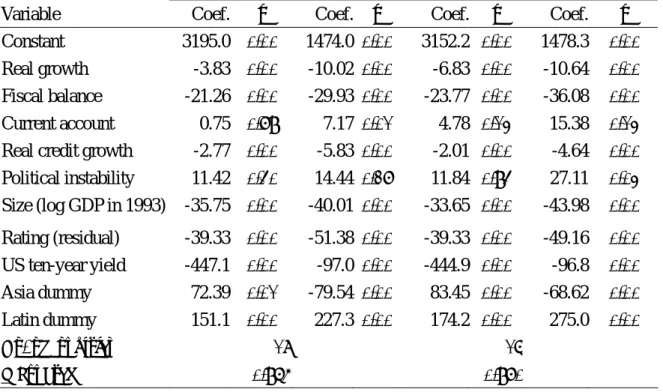
Following the Russian crisis, since a period of prolonged turbulence continued for a while, the period immediate after the crisis should be excluded from the post-crisis period for a fair comparison with the pre-crisis period. Otherwise, the estimated coefficients that are supposedly derived from a static model of stable relationship between spreads and fundamentals tend to be contaminated by the highly unstable turbulence period around the time of the crisis. One difficulty with this approach, however, is that there is no objective way to determine the exclusion period and an error in this determination may generate a biased result. To compare our empirical analyses with those of Dell’Ariccia et al., we follow their choice of the pre-crisis period from January to June 1998 and the post-crisis period from April 1999 to December 2000. The data frequency used is monthly. Before we present the results based on the test procedure devised in this paper, Table 3 shows pre- and post-Russian crisis regression results based on equation (3) that were
utilized by Dell’Ariccia et al. We choose the control variables that are used in the most preferred specification in Dell’Ariccia et al.13 The results under Sample 1 are based on the whole set of 18 emerging countries and are identical to those reported in Dell’Ariccia et al. Since our new test procedure requires the Barro-Lee index that is used as a proxy for zi,
our sample discards two countries, Bulgaria and Croatia, due to a lack of data involved with construction of the Barro-Lee index. For the comparison later, the results under Sample 2 are based on the set of 16 emerging countries only. However the two results are very similar and hence our explanations below can be applied to both results.
When the slope coefficients of the risk factors are compared between pre- and post-crisis regression results, although the magnitude of the change is not always statistically significant, the absolute value of most of the coefficients increases. Dell’Ariccia et al. (2002) take this finding as supporting evidence for the prevailing of investor moral hazard before the Russian crisis. However, the coefficients of some variables have the wrong sign, which makes the interpretation of their test results difficult. For example, the coefficient of current account surplus is positive, which implies that a country’s spread will increase if its current account surplus increases. However, if the crisis probability is inversely related to the volume of current account surplus, the coefficient should be negative. Another example is the coefficient of real credit growth, which is estimated to be negative in contradiction to the expectation.
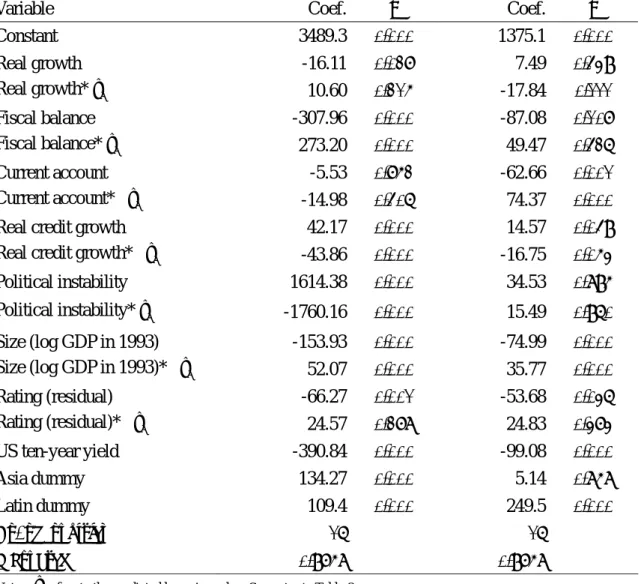
Now we switch to our preferred specification of equation (4) in which differences in the approval rate across countries are explicitly considered. Table 4 reports the
13 See table 5 in Dell’Ariccia et al. (2002). They selected this specification through a general-to-specific
estimation results. For each risk factor variable, the coefficient of the interaction term with the predicted loan-size is reported below it. In both columns of table 4, reporting pre- and post-crisis results, the Barro-Lee index is found to be quite relevant in determining spreads since, in most cases, the coefficients of the interaction terms are statistically very significant. Further, the coefficients of the variables with the wrong sign are converted into the right one; i.e., the coefficient of current account surplus becomes negative and that of real credit growth, positive. Thus the overall fit of the specification improves by adding up the interactive terms with the predicted loan-size variable. This is also confirmed by the fact that R2 is higher than before.
In the new specification, investor moral hazard is detected by assessing whether the slope coefficient of risk factors decreases in absolute value as zi increases. In other
words, if investors respond less sensitively to the risk factors of a country that is more likely to be bailed out by the IMF, we can be assured that investor moral hazard prevails. Since the slope coefficient is the sum of the coefficients of the risk factors and the
corresponding interaction term, an equivalent way is to check if the coefficient of the latter takes the opposite sign to that of the former.
As explained, our method has an advantage in that it can be applied to each sub-sample period separately. We first examine the regression results for the pre-crisis period. Column 1 depicts a general pattern that the coefficients of interaction terms take the
opposite sign from those of the corresponding risk factor variables, consistent with the assertion that investor moral hazard prevailed. The only exception is the current account for which the coefficient of the interaction term is statistically insignificant.
For the post-crisis period, while relatively more variables are not statistically significant, the same pattern emerges of the opposite sign between the coefficients of the risk factors and those of the corresponding interaction terms. For example, real growth, fiscal balance and political instability are not statistically significant. However, for other variables such as current account, real credit growth, and size variables that are statistically significant, we observe the same pattern as before. Hence, the overall evidence seems to support the hypothesis that bond spreads of a country which is more likely to be bailed out by the IMF tend to be less responsive to the country fundamentals. Thus, we can conclude that the moral hazard also prevailed even after the Russian crisis.
One of the main findings of Dell’Ariccia et al. is that moral hazard decreased in general after the Russian crisis. Do our analyses support this conclusion? This issue can be investigated by comparing the slope coefficients before and after the crisis. Since the value of the slope coefficients depends not only on the coefficients of the risk factors and the interaction terms, but also the actual value of zi, it is convenient to represent this
comparison for the range of the entire support of zi. When we compare the pre- and the
post-crisis periods for the risk factor, it is not always clear whether investor moral hazard has increased or not. For example, when we use the point estimates in column (1), the slope coefficients of real credit growth indicate that the slope (that is, the response of spread to credit growth) becomes uniformly larger in the entire support of zi after the crisis, demonstrating that investor moral hazard became less prevailing after the crisis. However, for the other variables, the changes in the slopes are ambiguous and depend on the value of zi.
Overall, our evidence indicates that the Russian default may not necessarily have decreased investor moral hazard. Instead, our evidence seems to suggest that, irrespective of the time period, investor moral hazard prevails in those countries that are more likely to be bailed out by international financial institutions such as the IMF.
V. Concluding Remarks
Ever since the large-scale IMF bailouts for Mexico in 1994 and East Asia in 1997-98, countless proposals for the “new international financial architecture” have been put forward.14 In line with this, attention has focused on how to change the role of the IMF to increase its effectiveness in managing financial crises and also on how to limit the moral hazard associated with IMF bailouts.
The increasing incidence of large-scale financial crises and the rapid global transmission of each crisis support the case for an international lender of last resort (ILLR) (Kindleberger 1989, Fischer 1999). The scale of capital outflows when a crisis breaks out has continued to increase in recent years, thereby substantially raising the cost of each crisis. The herd behavior exhibited by investors often triggers a severe liquidity crisis in a country. In this regard, an international institution such as the IMF can play a desirable role by
enabling an illiquid but solvent country to survive and by stemming the contagion of the crisis to neighbor countries.
However, expanding the role of the IMF as a stronger ILLR would undoubtedly
14 Refer to De Gregorio et al. (1999), Eichengreen (1999) and Park and Wang (2001) among others for the
create a large moral hazard problem, raising expectations of more frequent interventions by the IMF with a larger scale of financial support than at present. Such an increased-scale of IMF-led bailouts has certainly lead to excessive borrowing and lending. A large IMF could become more actively engaged in preventative monitoring and early supervision of financial activity, which might help to reduce the problem of moral hazard but cannot completely eliminate it.
Our empirical finding shows that investor moral hazard still prevails, even after the Russian default that supposedly signaled a different stance on IMF’s role as an ILLR. Hence, investments in countries that are likely to be excessive beneficiaries of the ILLR are subject to moral hazard behavior. Even if it were possible to succeed in reforming the general structure, the IMF would not be able to prevent its major shareholders, like the United States, from seeking to “bail-out” countries that have stronger political connections. This raises a concern that, as long as this favoritism continues, moral hazard may not be significantly mitigated.
Therefore, when we discuss the role of the IMF as an ILLR, the governance structure of the institution, and in particular the decision-making procedure with respect to the approval of rescue loans, should be critically examined. Otherwise, any attempt to promote the role of the IMF as an ILLR along the lines of current policy prescriptions is merely likely to heighten the moral hazard problem inherent in the system.
Private-sector involvement (PSI) has also been a hot issue in the recent discussions on the international financial architecture. In order to reduce creditor moral hazard, there have been suggestions of “bailing-in” the private sector, which implies that investors should
bear part of the burden. One proposal involves empowering the IMF to function as a sort of “international bankruptcy court” which can impose payment standstills (Krueger 2001). A payment standstill could compel creditors to act collectively in their best interests, and thus help to avoid a disruptive asset-grabbing race (Sachs, 1995). If the payment standstill scheme proves viable, the government and the IMF can declare debt standstill as an alternative to a large-scale loan for a country, particularly in a liquidity crisis.
In the recent discussion of PSI, its facilitation of orderly debt restructuring in the event of a crisis has been much emphasized, whereas its role in preventing moral hazard has received little consideration. PSI would help to mitigate the investor moral hazard associated with IMF bailouts. However, the current proposals for PSI would actually increase the moral hazard behavior from the debtor side.
Our empirical analysis focuses on moral hazard from the investor side. It remains an interesting and important issue as to whether the expectation of IMF bailouts encourages borrowing countries, especially those closely connected to the IMF, to behave imprudently or not. We plan to investigate this issue in future research.
References
Barro, R and Lee, J, 2004, 'IMF Programs: Who Is Chosen and What are the Effects?', Working Paper, Harvard University, forthcoming Journal of Monetary Economics. Bird, G. and D. Rowlands, 2001, “IMF Lending: How Is It Affected by Economic, Political
and Institutional Factors,” Journal ofPolicy Reform, 4, 243-270.
Bird, G., M. Hussain and J. Joyce, 2004, “Many Happy Returns? Recidivism and IMF,” Journal of International Money and Finance, 23, 231-51.
De Gregorio, Jose, Barry Eichengreen, Takatoshi Ito, and Charles Wyplosz, 1999, An Independent and Accountable IMF. Geneva, International Center for Monetary and Banking Studies and Center for Economic Policy Research.
Dell'Ariccia, G, Schnabel, I and Zettelmeyer, J, 2002, 'Moral Hazard and International Crisis Lending: A Test', IMF Working Paper No 02/181.
Dreher, Axel, “Does the IMF Cause Moral Hazard? A Critical Review of the Evidence,” Mimeo. 2004.
Eichengreen, Barry, 1999, Toward a New International Financial Architecture: A Practical Post-Asia Agenda Washington: Institute for International Economics.
Eichengreen, B. and Ashoka Mody, 2001, "Bail-Ins, Bailouts, and Borrowing Costs,” IMF Staff Papers 47: 155-187.
Eichengreen, B. and Ashoka Mody, 2004, "Do Collective Action Clauses Raise Borrowing Costs?". Economic Journal 114, 247-265.
Fisher, Stanley, 1999, "On the Need for an International Lender of Last Resort," Journal of Economic Perspectives. Vol.13, Issue 4.
Gai, Prasanna and Ashley Taylor, 2003, "International Financial Rescues and Debtor Country Moral Hazard," Bank of England, mimeo.
Haldane, A G and Scheibe, J, 2003, 'IMF Lending and Creditor Moral Hazard', Bank of England, mimeo.
Haldane, A and Taylor, A, 2003, 'Moral Hazard : How Does IMF Lending Affect Debtor and Creditor Incentives?', Financial Stability Review, June.
International Monetary Fund. 2003. "Collective Action Clauses: Recent Developments and Issues,” prepared by the International Capital markets, Legal and Policy
Development and Review Departments.
Jeanne, O and Zettelmeyer, J, 2001, 'International Bailouts, Moral Hazard and Conditionality', Economic Policy, October, 33, 409-432.
Kamin, S. B, 2002, 'Identifying the Role of Moral Hazard in International Financial Markets', Federal Reserve Board International Finance Discussion Paper No 2002-736.
Kamin, S B, and K. von Kleist, 1999, 'The Evolution and Determinants of Emerging Markets Credit Spreads in the 1990s,' BIS Working Papers No. 68.
Kindleberger, Charles P. 1989. Manias, Panics, and Crashes: A History of Financial Crises. New York: Basic Books.
Krueger, Anne O. 2001. "International Financial Architecture for 2002: A New Approach to Sovereign Debt Restructuring". National Economists' Club Annual Members' Dinner. American Enterprise Institute. (IMF homepage).
Working Paper No 00-168.
Mody, Ashoka, and Diego Saravia, 2003, “Catalyzing Private Capital Flows: Do IMF Programs Work as Commitment Devices,” unpublished manuscript.
Park, Yung Chul and Yunjong Wang, 2002, "What Kind of International Financial
Architecture for an Integrated World Economy?", Asian Economic Papers 1(1), 91-128.
Rogoff, Kenneth, 2002, “Moral Hazard in IMF Loans: How Big a Concern?” Finance and Development 39(3), September.
Sachs, Jeffrey, "Do We Need an International Lender of Last Resort?" mimeo., Harvard University 1995.
Zhang, X A, 1999, 'Testing for 'Moral Hazard' in Emerging Markets Lending', Institute of International Finance Research Paper No 99-1.
Table 1. Tobit Estimation of IMF Loan Size
Coefficient P-value
Per capita GDP growth rate -0.057 0.006
International reserves -0.122 0.003
GDP per capita 0.173 0.068
GDP per capita squared -0.0238 0.008
Log (GDP) 0.563 0.118
Log (GDP) squared -0.048 0.041
Group of advanced OECD countries -0.605 0.444
Log (IMF quota) 0.965 0.010
Log (IMF staff) 0.170 0.050
Political proximity to the U.S. -0.040 0.909
Political proximity to major European countries 0.849 0.055
Intensity of trade with the U.S. 0.185 0.005
Intensity of trade with major European countries
0.028 0.745
Number of observations. 613
Wald Chi-2(17) 28.98
P>Chi-2 0.035
Notes: The dependent variable is the ratio of IMF loan to GDP, averaged over the five five-year periods 1975-1979, 1980-1984,…,1995-1999. A Tobit model was applied to the panel data for these periods. Period dummies are included (not shown). Robust standard errors of the estimated coefficients are reported in parentheses. This result is reconstructed from Barro and Lee (2004, Table 3, Column 6). Please refer to their paper for a detailed discussion of the variables, the estimation technique, and the results.
Table 2. Estimated Size of IMF Lending, 1995-1999
Country Loan/GDP (%) Rank
Venezuela 1.23 1 Mexico 1.18 2 South Africa 1.15 3 Philippines 1.08 4 Panama 1.07 5 Morocco 0.97 6 Malaysia 0.92 7 Poland 0.89 8 Turkey 0.89 9 Peru 0.84 10 Colombia 0.83 11 Brazil 0.78 12 Argentina 0.73 13 Thailand 0.69 14 China 0.66 15 Korea, Rep. 0.48 16
Note: The estimates are the predicted value of the loan-size for the five-year period from 1995 to 1999, based on the regression results in Table 1.
Table 3. Spreads Estimation with the Constant Recovery Rate
Sample 1 Sample 2
Before crisis After crisis Before crisis After crisis
Variable Coef. p Coef. p Coef. p Coef. p
Constant 3195.0 0.00 1474.0 0.00 3152.2 0.00 1478.3 0.00 Real growth -3.83 0.00 -10.02 0.00 -6.83 0.00 -10.64 0.00 Fiscal balance -21.26 0.00 -29.93 0.00 -23.77 0.00 -36.08 0.00 Current account 0.75 0.79 7.17 0.01 4.78 0.13 15.38 0.13 Real credit growth -2.77 0.00 -5.83 0.00 -2.01 0.00 -4.64 0.00 Political instability 11.42 0.40 14.44 0.27 11.84 0.94 27.11 0.03 Size (log GDP in 1993) -35.75 0.00 -40.01 0.00 -33.65 0.00 -43.98 0.00 Rating (residual) -39.33 0.00 -51.38 0.00 -39.33 0.00 -49.16 0.00 US ten-year yield -447.1 0.00 -97.0 0.00 -444.9 0.00 -96.8 0.00 Asia dummy 72.39 0.01 -79.54 0.00 83.45 0.00 -68.62 0.00 Latin dummy 151.1 0.00 227.3 0.00 174.2 0.00 275.0 0.00 No. of countries 18 16 R Squared 0.965 0.970
Notes: 1) Estimated on pooled sample 1998:01 – 2000:12, excluding 1998:07 – 1999:03, and allowing for different coefficients for pre-and post-crisis periods. All estimations use robust stpre-andard errors.
2) Before crisis refers to the period of 1998:01 – 1998:06 3) After crisis refers to the period of 1999:04 – 2000:12
4) Sample 1 includes the full sample of 18 countries consisting of Argentina, Brazil, China, Colombia, Korea , Malaysia, Mexico, Morocco, Panama, Peru, Philippines, Poland, South Africa, Thailand, Turkey and Venezuela.. Sample 2 excludes two countries, Bulgaria and Croatia, due to the lack of the data involved with construction of the Barro-Lee index
Table 4. Spreads Estimation with the Varying Recovery Rate
Before crisis After crisis
Variable Coef. p Coef. p
Constant 3489.3 0.000 1375.1 0.000 Real growth -16.11 0.027 7.49 0.439 Real growth*zi 10.60 0.215 -17.84 0.111 Fiscal balance -307.96 0.000 -87.08 0.107 Fiscal balance*zi 273.20 0.000 49.47 0.426 Current account -5.53 0.752 -62.66 0.001 Current account* zi -14.98 0.406 74.37 0.000
Real credit growth 42.17 0.000 14.57 0.049
Real credit growth* zi -43.86 0.000 -16.75 0.053
Political instability 1614.38 0.000 34.53 0.895 Political instability*zi -1760.16 0.000 15.49 0.960 Size (log GDP in 1993) -153.93 0.000 -74.99 0.000 Size (log GDP in 1993)* zi 52.07 0.000 35.77 0.000 Rating (residual) -66.27 0.001 -53.68 0.036 Rating (residual)* zi 24.57 0.278 24.83 0.373 US ten-year yield -390.84 0.000 -99.08 0.000 Asia dummy 134.27 0.000 5.14 0.858 Latin dummy 109.4 0.000 249.5 0.000 No. of countries 16 16 R Squared 0.9758 0.9758