These materials are for nonprofit educational purposes only. Any other use may constitute copyright infringement.
Georgia
Standards of Excellence
Curriculum Frameworks
GSE First Grade
Unit 3: Operations and Algebraic Thinking
Mathematics GSE First Grade Unit 3: Operations and Algebraic Thinking Richard Woods, State School Superintendent
July 2016 Page 2 of 102 All Rights Reserved
Unit Three: Operations and Algebraic Thinking
TABLE OF CONTENTS (*Indicates a new addition)
Overview ...3
Standards for Mathematical Practice ...4
Standards for Mathematical Content ...4
Big Ideas ...5
Essential Questions ...6
Concepts & Skills to Maintain ...6
Strategies for Teaching and Learning ...6
Selected Terms and Symbols ...8
FAL ...9 Number Talks...9 Writing in Math...10 Page Citations ...11 Tasks ...12 *Intervention Table ...15
1. Developing Meaning Using Story Problems: Result Unknown ...17
2. Lots of Dots...24
3. What Numbers Can You Make ...30
4. Wheel Shop ...36
5. I Want Candy! ...45
6. Digging Dinosaurs ...54
7. Developing Meaning Using Story Problems: Change Unknown ...65
FAL ...72
8. Shape Pounds ...73
9. Fact Families to Ten...79
10.Developing Meaning Using Story Problems: Initial Unknown ...85
11.Domino Fact Family ...90
12.Candy ...96
13. Culminating Task : Atlanta Zoo ...99 ***Please note that all changes made will appear in green. IF YOU HAVE NOT READ THE FIRST GRADE CURRICULUM OVERVIEW IN ITS ENTIRETY PRIOR TO USE OF THIS UNIT, PLEASE STOP AND CLICK HERE: https://www.georgiastandards.org/Georgia-Standards/Frameworks/1st-Math-Grade-Level-Overview.pdf Return to the use of this unit once you’ve completed reading the Curriculum Overview. Thank you.
Mathematics GSE First Grade Unit 3: Operations and Algebraic Thinking Richard Woods, State School Superintendent
July 2016 Page 3 of 102 All Rights Reserved
OVERVIEW
In this unit, students will:
• Explore, understand, and apply the commutative and associative properties as strategies for solving addition problems.
• Share, discuss, and compare strategies as a class.
• Connect counting on to solving subtraction problems. For the problem “15 – 7 = ?” they think about the number they have to count on from 7 to get to 15.
• Work with sums and differences less than or equal to 20 using the numbers 0 to 20.
• Identify and then apply a pattern or structure in mathematics. For example, pose a string of addition and subtraction problems involving the same three numbers chosen from the numbers 0 to 20, such as 4 + 13 = 17 and 13 + 4 = 17.
• Analyze number patterns and create conjectures or guesses.
• Choose other combinations of three numbers and explore to see if the patterns work for all numbers 0 to 20.
• Understand that addition and subtraction are related and that subtraction can be used to solve problems where the addend is unknown.
• Use the strategies of counting on and counting back to understand number relationships.
• Organize and record results using tallies and tables.
• Determine the initial and the change unknown.
Students develop strategies for adding and subtracting whole numbers based on their prior work with small numbers. They use a variety of models, including discrete objects and length-based models (e.g., cubes connected to form lengths), to model add-to, from, put-together, take-apart, and compare situations. They will use these models to develop meaning for the operations of addition and subtraction and to develop strategies to solve arithmetic problems with these operations. Prior to first grade students should recognize that any given group of objects (up to 10) can be separated into sub groups in multiple ways and remain equivalent in amount to the original group (Ex: A set of 6 cubes can be separated into a set of 2 cubes and a set of 4 cubes and remain 6 total cubes).
Students understand connections between counting and addition and subtraction (e.g., adding two is the same as counting on two). They use properties of addition to add whole numbers and to create and use increasingly sophisticated strategies based on these properties (e.g., ―making tens) to solve addition and subtraction problems within 20. By comparing a variety of solution strategies, children build their understanding of the relationship between addition and
subtraction. (Ohio DOE)
The standard MGSE1.OA.3 expects teachers to use their understanding of the commutative and associative properties when teaching addition. The students are NOT expected to name or memorize these properties. First grade teachers are laying the foundation and building an understanding of these properties so that students can have formal discussions and utilize names of the properties in later grades.
Mathematics GSE First Grade Unit 3: Operations and Algebraic Thinking Richard Woods, State School Superintendent
July 2016 Page 4 of 102 All Rights Reserved
STANDARDS FOR MATHEMATICAL PRACTICE
The Standards for Mathematical Practice describe varieties of expertise that mathematics
educators at all levels should seek to develop in their students. These practices rest on important “processes and proficiencies” with longstanding importance in mathematics education.
Students are expected to:
1. Make sense of problems and persevere in solving them. 2. Reason abstractly and quantitatively.
3. Construct viable arguments and critique the reasoning of others. 4. Model with mathematics.
5. Use appropriate tools strategically. 6. Attend to precision.
7. Look for and make use of structure.
8. Look for and express regularity in repeated reasoning.
***Mathematical Practices 1 and 6 should be evident in EVERY lesson*** STANDARDS FOR MATHEMATICAL CONTENT
Represent and solve problems involving addition and subtraction.
MGSE1.OA.1. Use addition and subtraction within 20 to solve word problems involving situations of adding to, taking from, putting together, taking apart, and comparing, with
unknowns in all positions, e.g., by using objects, drawings, and equations with a symbol for the unknown number to represent the problem.1
Understand and apply properties of operations and the relationship between addition and subtraction.
MGSE1.OA.3. Apply properties of operations as strategies to add and subtract.2
Examples: If 8 + 3 = 11 is known, then 3 + 8 = 11 is also known. (Commutative property of addition.) To add 2 + 6 + 4, the second two numbers can be added to make a ten, so 2 + 6 + 4 = 2 + 10 = 12. (Associative property of addition.)
MGSE1.OA.4. Understand subtraction as an unknown-addend problem. For example, subtract
10 – 8 by finding the number that makes 10 when added to 8.
Add and subtract within 20
MGSE1.OA.5. Relate counting to addition and subtraction (e.g., by counting on 2 to add 2).
1 See Glossary, Table 1
2
Mathematics GSE First Grade Unit 3: Operations and Algebraic Thinking Richard Woods, State School Superintendent
July 2016 Page 5 of 102 All Rights Reserved
MGSE1.OA.6 Add and subtract within 20.
a. Use strategies such as counting on; making ten (e.g., 8 + 6 = 8 + 2 + 4 = 10 + 4 = 14); decomposing a number leading to a ten (e.g., 13 – 4 = 13 – 3 – 1 = 10 – 1 = 9); using the relationship between addition and subtraction (e.g., knowing that 8 + 4 = 12, one knows 12 – 8 = 4); and creating equivalent but easier or known sums (e.g., adding 6 + 7 by creating the known equivalent 6 + 6 + 1 = 12 + 1 = 13).
b. Fluently add and subtract within 10.
Work with addition and subtraction equations
MGSE1.OA.7 Understand the meaning of the equal sign, and determine if equations involving addition and subtraction are true or false. For example, which of the following equations are true and which are false? 6 = 6, 7 = 8 – 1, 5 + 2 = 2 + 5, 4 + 1 = 5 + 2.
The equal sign describes a special relationship between two quantities. In the case of a true equation, the quantities are the same.
MGSE1.OA.8 Determine the unknown whole number in an addition or subtraction equation
relating to three whole numbers. For example, determine the unknown number that makes the equation true in each of the equations 8 + ? = 11, 5 = □ – 3, 6 + 6 = Δ.
Represent and interpret data.
MGSE1.MD.4. Organize, represent, and interpret data with up to three categories; ask and answer questions about the total number of data points, how many in each category, and how many more or less are in one category than in another.
Big Ideas
• Students develop strategies for adding and subtracting whole numbers based on their prior work with small numbers.
• Students use a variety of models, including discrete objects and length-based models (e.g., cubes connected to form lengths), to model add-to, take-from, put-together, take-apart, and compare situations. They will use these models to develop meaning for the operations of addition and subtraction, and to develop strategies to solve arithmetic problems with these operations.
• Students understand connections between counting and addition/subtraction (e.g., adding two is the same as counting on two).
• Students use properties of addition to add whole numbers and to create and use increasingly sophisticated strategies based on these properties (e.g., “making tens”) to solve addition and subtraction problems within 20.
• By comparing a variety of solution strategies, students will build an understanding of the relationship between addition and subtraction.
Mathematics GSE First Grade Unit 3: Operations and Algebraic Thinking Richard Woods, State School Superintendent
July 2016 Page 6 of 102 All Rights Reserved
• Students think of whole numbers between 10 and 100 in terms of tens and ones (especially recognizing the numbers 11 to 19 as composed of a ten and some ones).
ESSENTIAL QUESTIONS
• How can we represent a set of objects using numerals?
• What happens when we join two quantities or take one from another?
• How can we find the total when we join two quantities?
• How can we find what is left when we take one quantity from another?
• How can we find the difference when we compare one quantity to another?
• How can we represent problem situations?
• What happens when we change the order of numbers when we add (or subtract)? Why?
• How can we show that addition and subtraction are related through fact families?
• How can we use different combinations of numbers and operations to represent the same quantity?
• How can we represent a number in a variety of ways?
CONCEPTS AND SKILLS TO MAINTAIN
• Represent addition and subtraction with objects, fingers, mental images, and drawings
• Solve addition and subtraction word problems
• Add and subtract within 10
• Decompose numbers that are less than or equal to 10 in more than one way
• Make a ten from any given number 1-9
• Fluently add and subtract within 5
STRATEGIES FOR TEACHING AND LEARNING Addition and Subtraction in Elementary School
• The strategies that students use to solve problems provide important information concerning number sense, and place value.
• It is important to look at more than the answers students get. The strategies used provide useful information about what problems to give the next day and how to differentiate instruction.
• It is important to relate addition and subtraction.
• Student created strategies provide reinforcement of place value concepts. Traditional algorithms can actually confuse the understanding of place value.
• Student created strategies are built on a student’s actual understanding, instead of on what the book says or what we think/hope they know!
• Students make fewer errors with invented strategies, because they are built on understanding rather than memorization.
Mathematics GSE First Grade Unit 3: Operations and Algebraic Thinking Richard Woods, State School Superintendent
July 2016 Page 7 of 102 All Rights Reserved
Students use various counting strategies, including counting all, counting on, and counting back with numbers up to 20. This standard calls for students to move beyond counting all and become comfortable at counting on and counting back. The counting all strategy requires students to count an entire set. The counting and counting back strategies occur when students are able to hold the start numberin their head and count on from that number
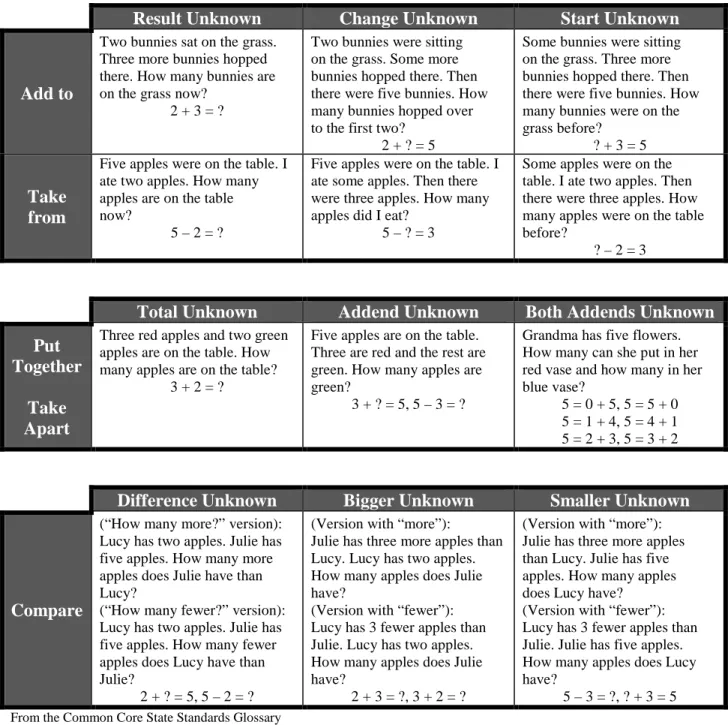
Table 1: Common addition and subtraction situations
From the Common Core State Standards Glossary
Result Unknown Change Unknown Start Unknown
Add to
Two bunnies sat on the grass. Three more bunnies hopped there. How many bunnies are on the grass now?
2 + 3 = ?
Two bunnies were sitting on the grass. Some more bunnies hopped there. Then there were five bunnies. How many bunnies hopped over to the first two?
2 + ? = 5
Some bunnies were sitting on the grass. Three more bunnies hopped there. Then there were five bunnies. How many bunnies were on the grass before?
? + 3 = 5
Take from
Five apples were on the table. I ate two apples. How many apples are on the table now?
5 – 2 = ?
Five apples were on the table. I ate some apples. Then there were three apples. How many apples did I eat?
5 – ? = 3
Some apples were on the table. I ate two apples. Then there were three apples. How many apples were on the table before?
? – 2 = 3
Total Unknown Addend Unknown Both Addends Unknown
Put Together
Take Apart
Three red apples and two green apples are on the table. How many apples are on the table?
3 + 2 = ?
Five apples are on the table. Three are red and the rest are green. How many apples are green?
3 + ? = 5, 5 – 3 = ?
Grandma has five flowers. How many can she put in her red vase and how many in her blue vase?
5 = 0 + 5, 5 = 5 + 0 5 = 1 + 4, 5 = 4 + 1 5 = 2 + 3, 5 = 3 + 2
Difference Unknown Bigger Unknown Smaller Unknown
Compare
(“How many more?” version): Lucy has two apples. Julie has five apples. How many more apples does Julie have than Lucy?
(“How many fewer?” version): Lucy has two apples. Julie has five apples. How many fewer apples does Lucy have than Julie?
2 + ? = 5, 5 – 2 = ?
(Version with “more”): Julie has three more apples than Lucy. Lucy has two apples. How many apples does Julie have?
(Version with “fewer”): Lucy has 3 fewer apples than Julie. Lucy has two apples. How many apples does Julie have?
2 + 3 = ?, 3 + 2 = ?
(Version with “more”): Julie has three more apples than Lucy. Julie has five apples. How many apples does Lucy have?
(Version with “fewer”): Lucy has 3 fewer apples than Julie. Julie has five apples. How many apples does Lucy have?
Mathematics GSE First Grade Unit 3: Operations and Algebraic Thinking Richard Woods, State School Superintendent
July 2016 Page 8 of 102 All Rights Reserved
For more detailed information about unpacking the standards, unpacking a task, math routines and rituals, maintenance activities and more, please refer to the Grade Level Overview document.
Fluency: Procedural fluency is defined as skill in carrying out procedures flexibly, accurately, efficiently, and appropriately. Fluent problem solving does not necessarily mean solving
problems within a certain time limit, though there are reasonable limits on how long computation should take. Fluency is based on a deep understanding of quantity and number.
Deep Understanding: Teachers teach more than simply “how to get the answer” and instead support students’ ability to access concepts from a number of perspectives. Therefore students are able to see math as more than a set of mnemonics or discrete procedures. Students
demonstrate deep conceptual understanding of foundational mathematics concepts by applying them to new situations, as well as writing and speaking about their understanding.
Memorization: The rapid recall of arithmetic facts or mathematical procedures. Memorization is often confused with fluency. Fluency implies a much richer kind of mathematical knowledge and experience.
Number Sense:
Students consider the context of a problem, look at the numbers in a problem, make a decision about which strategy would be most efficient in each particular problem. Number sense is not a deep understanding of a single strategy, but rather the ability to think flexibly between a variety of strategies in context.
Fluent students:
● flexibly use a combination of deep understanding, number sense, and memorization. ● are fluent in the necessary baseline functions in mathematics so that they are able to
spend their thinking and processing time unpacking problems and making meaning from them.
● are able to articulate their reasoning.
● find solutions through a number of different paths. For more about fluency, see:
http://www.youcubed.org/wp-content/uploads/2015/03/FluencyWithoutFear-2015.pdf and:
https://bhi61nm2cr3mkdgk1dtaov18-wpengine.netdna-ssl.com/wp-content/uploads/nctm-timed-tests.pdf
SELECTED TERMS AND SYMBOLS
The following terms and symbols are often misunderstood. This is not an inclusive list and items should not be taught in isolation. However, due toevidence of frequent difficulty and
Mathematics GSE First Grade Unit 3: Operations and Algebraic Thinking Richard Woods, State School Superintendent
July 2016 Page 9 of 102 All Rights Reserved
misunderstanding associated with these concepts, instructors should pay particular attention to them and how their students are able to explain and apply them.
The terms below are for teacher reference only and are not to be memorized by the students. Teachers should present these concepts to students with models and real life examples. Students should understand the concepts involved and be able to recognize and/or demonstrate them with words, models, pictures, or numbers.
• addition and subtraction within 5, 10, 20, 100, or 1000.
• additive identity property of 0
• associative property of addition
• commutative property
• computation strategy
• counting on
• number line diagram
• strategies for addition
http://www.corestandards.org/Math/Content/mathematics-glossary/glossary
FAL
The linked Formative Assessment lesson is designed to be part of an instructional unit. This assessment should be implemented approximately two-thirds of the way through this
instructional unit and is noted in the unit task table. This assessment can be used at the beginning of the unit to ascertain student needs. The results of this task should give you
pertinent information regarding your students learning and help to drive your instruction for the remainder of the unit.
SAMPLE UNIT ASSESSMENTS
Math Unit Summative Assessments were written by the First Grade Mathematics Assessment and Curriculum Team, Jackson County, Georgia. The team is comprised of first grade teachers and administrators whose focus is to provide assessments that address depth of knowledge and higher order thinking skills. These assessments are provided as a courtesy from the Jackson County School System as samples that may be used as is or as a guide to create common assessments.
NUMBER TALKS
In order to be mathematically proficient, today’s students must be able to compute accurately, efficiently, and flexibly. Daily classroom number talks provide a powerful avenue for developing “efficient, flexible, and accurate computation strategies that build upon the key foundational ideas of mathematics.” (Parrish, 2010) Number talks involve classroom conversations and discussions centered upon purposefully planned computation problems.
Mathematics GSE First Grade Unit 3: Operations and Algebraic Thinking Richard Woods, State School Superintendent
July 2016 Page 10 of 102 All Rights Reserved
In Sherry Parrish’s book, Number Talks: Helping Children Build Mental Math and Computation Strategies, teachers will find a wealth of information about Number Talks, including:
• Key components of Number Talks
• Establishing procedures
• Setting expectations
• Designing purposeful Number Talks
• Developing specific strategies through Number Talks
There are four overarching goals upon which K-2 teachers should focus during Number Talks. These goals are:
1. Developing number sense
2. Developing fluency with small numbers 3. Subitizing
4. Making Tens
Suggested Number Talks for Unit 5 are addition: counting all and counting on; doubles/near doubles; and making tens using dot images, ten-frames, Rekenreks, double ten-frames, and number sentences. In addition, Number Talks focusing on making landmark or friendly numbers; breaking each number into its place value; compensation; and adding up chunks are suggested. Specifics on these Number Talks can be found on pages 98-201 of Number Talks: Helping Children Build Mental Math and Computation Strategies.
WRITING IN MATH
The Standards for Mathematical Practice, which are integrated throughout effective mathematics content instruction, require students to explain their thinking when making sense of a problem (SMP 1). Additionally, students are required to construct viable arguments and critique the reasoning of others (SMP 2). Therefore, the ability to express their thinking and record their strategies in written form is critical for today’s learners. According to Marilyn Burns, “Writing in math class supports learning because it requires students to organize, clarify, and reflect on their ideas--all useful processes for making sense of mathematics. In addition, when students write, their papers provide a window into their understandings, their misconceptions, and their feelings about the content.”(Writing in Math. Educational Leadership. Oct. 2004 (30).) The use of math journals is an effective means for integrating writing into the math curriculum.
Math journals can be used for a variety of purposes. Recording problem solving strategies and solutions, reflecting upon learning, and explaining and justifying thinking are all uses for math journals. Additionally, math journals can provide a chronological record of student math thinking throughout the year, as well as a means for assessment than can inform future instruction.
The following website provides a wealth of information and grade specific activities for math journaling: http://www.k-5mathteachingresources.com/math-journals.html. Though this is not a free site, there are some free resources that are accessible.
Mathematics GSE First Grade Unit 3: Operations and Algebraic Thinking Richard Woods, State School Superintendent
July 2016 Page 11 of 102 All Rights Reserved
PAGE CITATIONS
Teaching Student-Centered Mathematics written by Van de Walle, Lovin, Karp, and Bay-Williams, has been recently revised. Page citation numbers may vary due to this change.
TASK DESCRIPTIONS
Scaffolding Task Tasks that build up to the learning task.
Constructing Task Constructing understanding through deep/rich contextualized problem
solving tasks.
Practice Task Tasks that provide students opportunities to practice skills and
concepts.
Culminating Task Designed to require students to use several concepts learned during the
unit to answer a new or unique situation. Allows students to give evidence of their own understanding toward the mastery of the standard and requires them to extend their chain of mathematical reasoning.
Formative
Assessment Lesson (FAL)
Lessons that support teachers in formative assessment which both reveal and develop students’ understanding of key mathematical ideas and applications. These lessons enable teachers and students to monitor in more detail their progress towards the targets of the standards.
3-Act Task A Three-Act Task is a whole-group mathematics task consisting of 3
distinct parts: an engaging and perplexing Act One, an information and solution seeking Act Two, and a solution discussion and solution revealing Act Three. More information along with guidelines for 3-Act Tasks may be found in the Guide to Three-Act Tasks on
Mathematics GSE First Grade Unit 3: Operations and Algebraic Thinking Richard Woods, State School Superintendent
July 2016 Page 12 of 102 All Rights Reserved
Task Name Task Type Content Standard Content Addressed Brief Description
Developing Meaning Using Story Problems: Result Unknown Constructing Task
Whole Group, Small Group, Individual
MGSE1.OA.1
Problem solving with the result unknown
Students will solve real world math problems using
addition and subtraction.
Lots of Dots
Scaffolding Task
Small Group/ Partners/ Individual
MGSE1.OA.3 MGSE1.OA.4 MCC.1OA.5 MGSE1.OA.6 Composing and decomposing of numbers
Students will practice finding sums, creating equations, expressions, and
the commutative property. What Numbers
Can You Make?
Constructing Task Small Group/ Partners/ Individual
MGSE1.OA.3 MGSE1.OA.4 MGSE.1.OA.5 MGSE1.OA.6 MGSE1.MD.4 Composing and Decomposing of numbers
Students will practice finding number combinations with like
sums.
Wheel Shop
Performance Task
Small Group/ Partners/ Individual
MGSE1.OA.2
MGSE.1.OA.5 Problem solving
Students will find combinations of numbers
for a given sum. I Want Candy!
3 Act Task
Large Group, Individual
MGSE1.OA.1 MGSE.1.OA.5 MGSE1.MD.4 Problem Solving, Composing and Decomposing of numbers
Students will solve real world problems. Digging
Dinosaurs
Performance Task Small Group/ Partners/ Individual
MGSE1.OA.1 MGSE1.OA.2 MGSE.1.OA.5
Problem solving Students will practice the flexible use of numbers.
Meaning Using Story Problems: Change Unknown
Constructing Task
Whole Group/ Small Group/ Individual
MGSE1.OA.1
Problem solving with the change unknown
Students will solve real world math problems using
Mathematics GSE First Grade Unit 3: Operations and Algebraic Thinking Richard Woods, State School Superintendent
July 2016 Page 13 of 102 All Rights Reserved
FAL Performance Assessment MGSE1.OA.1 FAL: Caterpillars and
Leaves
FAL
Shape Pounds
Constructing Task
Whole Group/ Small Group/ Individual
MGSE1.OA.7 MGSE1.OA.8
Writing numbers sentences with a shape representing
an unknown
Students will work with equality and understanding
of the equal sign. Fact Families
to Ten
Scaffolding Task Whole Group/ Small Group/ Individual
MGSE1.OA.3 MGSE1.OA.4 MGSE.1.OA.5 MGSE1.OA.6 Relating addition to subtraction
Students will practice fact families using cubes and
number sentences. Developing Meaning Using Story Problems: Initial Unknown Constructing Task Whole Group/ Small Group/
Individual
MGSE1.OA.1 Problem solving with the initial unknown
Students will solve real world math problems using
addition and subtraction.
Domino Fact Family
Practice Task
Individual
MGSE1.OA.6 Relating addition to subtraction
Students will construct Fact Families using
dominoes.
Candy Practice Task
Whole Group/ Small Group/ Partners
MGSE.1.OA.5
MGSE1.MD.4 Graphing
Students will create a graph and use the terms
most and least. Culminating Task : Atlanta Zoo Culminating Task Individual MGSE1.OA.1 MGSE.1.OA.5 MGSE1.OA.7 MGSE1.OA.8 MGSE1.MD.4
Problem solving, working with unknowns, writing
number sentences
Students will solve real world math problems
involving finding combinations of numbers
Mathematics GSE First Grade Unit 3: Operations and Algebraic Thinking Richard Woods, State School Superintendent
July 2016 Page 14 of 102 All Rights Reserved
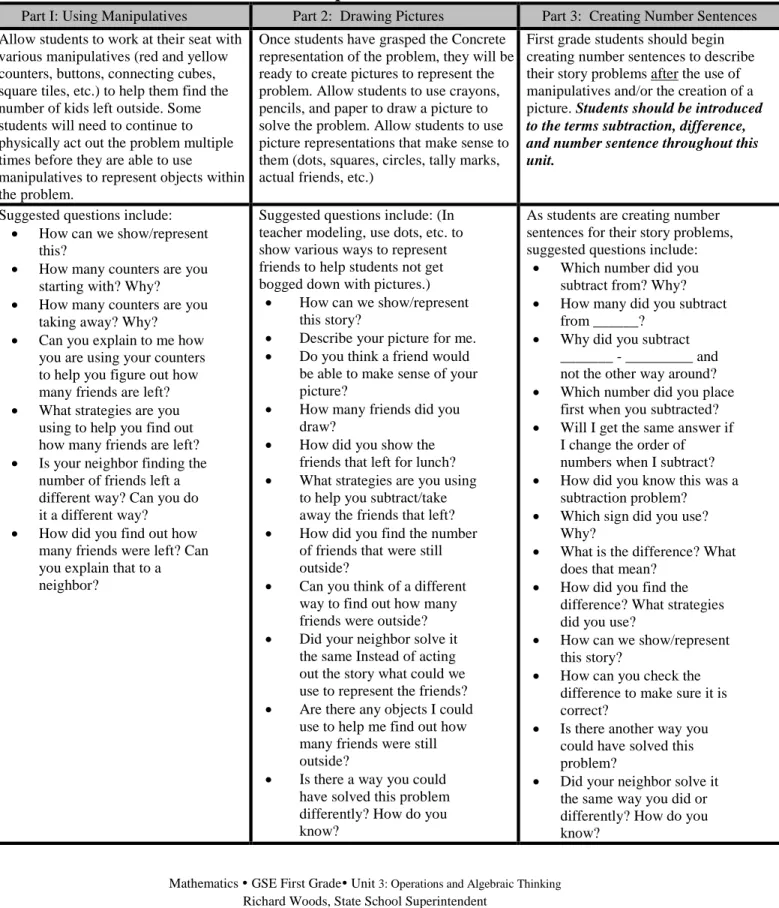
Table 2 Concrete, Representational, Abstract Chart (CRA)
Concrete Representational Abstract
Part I: Using Manipulatives Part 2: Drawing Pictures Part 3: Creating Number Sentences
S tage D es cr ip ti on
Allow students to work at their seat with various manipulatives (red and yellow counters, buttons, connecting cubes, square tiles, etc.) to help them find the number of kids left outside. Some students will need to continue to physically act out the problem multiple times before they are able to use
manipulatives to represent objects within the problem.
Once students have grasped the Concrete representation of the problem, they will be ready to create pictures to represent the problem. Allow students to use crayons, pencils, and paper to draw a picture to solve the problem. Allow students to use picture representations that make sense to them (dots, squares, circles, tally marks, actual friends, etc.)
First grade students should begin creating number sentences to describe their story problems after the use of manipulatives and/or the creation of a picture. Students should be introduced to the terms subtraction, difference, and number sentence throughout this unit. Sug g es te d Q ue st io ns
Suggested questions include:
• How can we show/represent this?
• How many counters are you starting with? Why?
• How many counters are you taking away? Why?
• Can you explain to me how you are using your counters to help you figure out how many friends are left?
• What strategies are you using to help you find out how many friends are left?
• Is your neighbor finding the number of friends left a different way? Can you do it a different way?
• How did you find out how many friends were left? Can you explain that to a neighbor?
Suggested questions include: (In teacher modeling, use dots, etc. to show various ways to represent friends to help students not get bogged down with pictures.)
• How can we show/represent this story?
• Describe your picture for me.
• Do you think a friend would be able to make sense of your picture?
• How many friends did you draw?
• How did you show the friends that left for lunch?
• What strategies are you using to help you subtract/take away the friends that left?
• How did you find the number of friends that were still outside?
• Can you think of a different way to find out how many friends were outside?
• Did your neighbor solve it the same Instead of acting out the story what could we use to represent the friends?
• Are there any objects I could use to help me find out how many friends were still outside?
• Is there a way you could have solved this problem differently? How do you know?
As students are creating number sentences for their story problems, suggested questions include:
• Which number did you subtract from? Why?
• How many did you subtract from ______?
• Why did you subtract _______ - _________ and not the other way around?
• Which number did you place first when you subtracted?
• Will I get the same answer if I change the order of numbers when I subtract?
• How did you know this was a subtraction problem?
• Which sign did you use? Why?
• What is the difference? What does that mean?
• How did you find the difference? What strategies did you use?
• How can we show/represent this story?
• How can you check the difference to make sure it is correct?
• Is there another way you could have solved this problem?
• Did your neighbor solve it the same way you did or differently? How do you know?
Mathematics GSE First Grade Unit 3: Operations and Algebraic Thinking Richard Woods, State School Superintendent
July 2016 Page 15 of 102 All Rights Reserved
INTERVENTION TABLE
The Intervention Table below provides links to interventions specific to this unit. The
interventions support students and teachers in filling foundational gaps revealed as students work through the unit. All listed interventions are from New Zealand’s Numeracy Project.
Cluster of Standards Name of Intervention
Snapshot of summary or
Student I can statement. . . Materials Master
Represent and solve problems involving
addition and subtraction Work with addition
and subtraction equations MGSE1.OA.1 MGSE1.OA.2 MGSE1.OA.7 MGSE1.OA.8
Make a Ten Further develop part/whole mental methods of making a ten Using Ten
Frames for the Strategy of Bridging to a ten
Mental math strategies of making a ten
A Square of
Circles Recall basic addition facts
Bridges
Recall addition and subtraction facts to 20
Comparisons
Recall addition and subtraction facts to 20
Number Cards Practice addition and subtraction facts
Pocket Facts Recall basic addition and subtraction facts
Adding and Subtracting with Counters
Solve addition problems to 20 by joining sets and counting all the objects.
What's Hidden
Solve subtraction problems from 20 by counting all the objects in their head.
Imaging with Tens Frames
Solve addition and subtraction problems to 20 by counting all the objects in their head.
MM 4-6
Adding and Subtracting with Counters
Solve addition problems to 20 by joining sets and counting all the objects
Mathematics GSE First Grade Unit 3: Operations and Algebraic Thinking Richard Woods, State School Superintendent
July 2016 Page 16 of 102 All Rights Reserved
Understand and apply properties of operations and the relationship between
addition and subtraction Add and subtract
within 20 MGSE1.OA.3 MGSE1.OA.4 MGSE1.OA.5 MGSE1.OA.6 Take Two
Use problem solving strategies to solve addition and subtraction problems
Represent and interpret data
MGSE1.MD.4
Playing
Favorites Pose, plan, analyze data
Greedy Cat Describe, sort, compare and display pictures of cats I Like Trucks Collect, analyze and report
information about favorites Not Enough
Drawers
Sort and analyze categories of clothes
Mathematics GSE First Grade Unit 3: Operations and Algebraic Thinking Richard Woods, State School Superintendent
July 2016 Page 17 of 102 All Rights Reserved
CONSTRUCTING TASK: Developing Meaning by using Story
Problems: Result Unknown
Return to Task ListApproximately 3 days
STANDARDS FOR MATHEMATICAL CONTENT
MGSE1.OA.1. Use addition and subtraction within 20 to solve word problems involving situations of adding to, taking from, putting together, taking apart, and comparing, with
unknowns in all positions, e.g., by using objects, drawings, and equations with a symbol for the unknown number to represent the problem.
STANDARDS FOR MATHEMATICAL PRACTICE
1. Make sense of problems and persevere in solving them. Students determine appropriate strategies to solve word problems.
2. Reason abstractly and quantitatively.
3. Construct viable arguments and critique the reasoning of others.
4. Model with mathematics. Students create drawings and other visual representations of numbers and word problems.
5. Use appropriate tools strategically. 6. Attend to precision.
7. Look for and make use of structure.
8. Look for and express regularity in repeated reasoning.
BACKGROUND KNOWLEDGE/COMMON MISCONCEPTIONS/COMMON MISCONCEPTIONS
The goal for this lesson is to expose students to real world problems, using the level of
understanding (concrete, representational, or abstract) that each student needs. (see CRA, Table 2 ) Addition and subtraction can be divided into four categories: join problems, separate
problems, part-whole problems, and compare problems (see Table 1 ). Within these four types of problems, most educators focus on addition and subtract when the result is unknown, this leads to the understanding that addition is “put together” and subtraction means to “take away”. This is a major misconception and limits the students’ understanding. One way to prevent development of this misunderstanding is to provide problem based story problems in which the students are attempting to solve not only for the result but also the change, and the initial.
Students should not complete a multitude of problems within one class period, rather they should work in depth with as few as one problem that they can know and understand completely.
Students do not need to know the names of the different types of problems but they should have experience in solving all of the different types. This lesson should not be looked at to be
completed in one session, these questions should be readdressed throughout this unit and continue throughout the mathematics curriculum across the year and grade levels.
Mathematics GSE First Grade Unit 3: Operations and Algebraic Thinking Richard Woods, State School Superintendent
July 2016 Page 18 of 102 All Rights Reserved
ESSENTIAL QUESTIONS
• What happens when we join two quantities or take one from another?
• How can we find what is left when we take one quantity from another?
MATERIALS • Paper
• Various Manipulatives (examples: counters, based ten blocks, arithmetic rack, etc.)
• Pencils
• Crayons
• Types of Problems (cut out)
• Fill the Tree Game
• Dice
• Small counters
GROUPING
Flexible Grouping (based on student needs) Depending on the story problem, this task could be solved with students working as a whole-class, small groups, or independently.
TASK DESCRIPTION, DEVELOPMENT AND DISCUSSION Part I
The teacher will tell a story similar to the one suggested and engage in conversation about the questions provided. Continue questioning as needed until the students can answer the questions and understand what is happening in the story.
Five friends are playing outside, five more join them.
• Will that make more or less friends playing together? How do you know?
• What can you do to figure out the total number of friends playing outside now? Later on, 3 friends had to go inside for lunch.
• How many did that leave playing outside?
• Are there more students inside or outside now? How do you know?
• What did you do to figure it out?
• How was that different from what we did at the beginning of the story, in other words, how did the “actions” for solving or thinking about the problem change?
Mathematics GSE First Grade Unit 3: Operations and Algebraic Thinking Richard Woods, State School Superintendent
July 2016 Page 19 of 102 All Rights Reserved
Part II
Sample problems have been provided. Copy the problems, cut them out to give to students and/or flexible groups. Each set can be done within small groups or within centers/work stations. The sample word problems are designed to give a conceptual understanding of addition and subtraction of two numbers. Students should explore these problems using the CRA model. Refer to the CRA table on page 15 for explanation and questioning.
• C- Concrete: Using Manipulatives (acting out)
• R- Representational: Drawing Pictures
• A- Abstract: Creating Number Sentences
“In the classroom, this approach is a facilitating framework for students to create meaningful connections between concrete, representational, and abstract levels of thinking and
understanding. Students’ learning starts out with visual, tangible, and kinesthetic experiences to establish basic understanding, and then students are able to extend their knowledge through pictorial representations (drawings, diagrams, or sketches) and then finally are able to move to the abstract level of thinking, where students are exclusively using mathematical symbols to represent and model problems.” Hauser , Jane. Concrete-representational-abstract instructional approach.
Suggestion for lesson pacing:
• Day one- Students will solve problems within small groups
• Day two- Students will solve problems within partners
• Day three- Students will solve problems independently
The problems listed below are examples from the four types of addition/subtraction problems. The numbers and topics of each problem can be adjusted based on the interest and ability of your students. All four types of problems should be focused in a variety of ways.
Join Problems:
When joining two quantities, three different amounts are used: the initial amount, the change amount, and the result amount (or whole). (VDW)
Example: The other day I saw 5 dogs chasing a ball in the park. Then, three more dogs came and joined them playing ball. How many dogs were playing in the park? 5+3=____
Separate Problems:
Within separate problems, your initial amount is the whole. This differs from a joining problem because within a joining problem your result is your whole. (VDW)
Example: Jack has 11 lizards in a cage. 4 escape. How many are left? 11- 4= ___
Part-Part-Whole is the combing of two quantities to create a whole. The combination can take place physically, or it can be asked to be completed mentally.
Example: Jessica has 7 nickels and 3 dimes. How many coins does Jessica have all together? 7+3=___
Mathematics GSE First Grade Unit 3: Operations and Algebraic Thinking Richard Woods, State School Superintendent
July 2016 Page 20 of 102 All Rights Reserved Comparing Problems:
Comparing problems do not focus on the operation, but rather the relationship between two quantities. This relationship can be stated or it can be implied by using terms of greater than or less than. (VDW)
Example: Sarah has 7 dogs. Katie has 12 dogs. How many more dogs does Katie have than Sarah? 12-7=____ or 7+___=12
Part III
Students will play “Fill the Tree” with a partner. Each group will need one game board, different color chips or counters for each player and a pair of 6-sided dice. Each player will determine the color chips or counters they will be. Player one will roll the dice, find the sum, and cover the sum with a chip or counter. Player two will repeat the process. Players will take turns until the board is covered. The player to cover the last spot wins. If a sum is already covered the player loses that turn.
FORMATIVE ASSESSMENT QUESTIONS
See suggested questioning located within task description and CRA Table.
DIFFERENTIATION Extension:
• Allow students to work with numbers larger than 20 without regrouping.
• Ask students to create and solve their own story problems.
Note: Students typically create addition problems. Check students’ problems to make sure they are creating subtraction problems too.
Intervention
• Allow students to work through the stages at a pace that is appropriate to their developmental level. This will provide students with the remediation they need to understand the concept of comparing numbers. Continue to allow them to work with manipulatives as much as needed. At times, partner them with students who are very articulate about their mathematical
thinking so they can hear (through conversations) how these students have made sense of the problems.
Mathematics GSE First Grade Unit 3: Operations and Algebraic Thinking Richard Woods, State School Superintendent
July 2016 Page 21 of 102 All Rights Reserved
Join: Result Unknown
The other day I saw 6 dogs chasing a
ball in the park. Then, seven more
dogs came and joined them playing
ball. How many dogs were playing
in the park? 6+7=____
There were three people
swinging on the swings. One
more person joined them. How
many children are on the
swings? 3+1=___
Separate: Result Unknown
There were thirteen chattering
monkeys. Five fell asleep. How
many monkeys are still chattering?
13-5=__
Pete has 20 mice in a cage. 12
escape. How many are left?
20-12= ___
There were eight bunnies at the pet
store. Three went home with a new
family. How many bunnies were
still at the pet store? 8-3=___
Today at lunch I had twelve
chicken nuggets on my tray. I
ate seven of my chicken
nuggets. How many did I not
eat? 12-7=___
Sarah and Katie had 15 gumballs.
Sarah ate 6 of the gumballs. How
many are left for Katie? 15-6=___
Mathematics GSE First Grade Unit 3: Operations and Algebraic Thinking Richard Woods, State School Superintendent
July 2016 Page 22 of 102 All Rights Reserved
Part-Part-Whole: Whole Unknown
Tony has 8 pennies and 5 dimes.
How many coins does Tony have all
together? 8+5=___
Cecil has 10 baseball cards and
Anthony has 8 baseball cards.
The boys put all their baseball
cards into one box. How many
baseball cards will be in their
box? 10+8=____
Compare: Difference Unknown
One litter has eleven kittens.
Another litter has six kittens. How
many more kittens does the first
litter have? 11-6=____ or 6+___=11
Pete has 9 mice. Max has 13
mice. How many more mice
does Max have than Pete?
13-9=____ or 9+___=13
In my bag of candy, I have thirteen
yellow candies and eight red
candies. How many more red
candies do I have than yellow
candies? 13-8=___ or 8+___=13
I picked some flowers for my
mother. I gave her twenty
daisies and fifteen roses. How
many more daisies did I give
her than roses? 20-15=___ or
15+__=20
Mathematics GSE First Grade Unit 3: Operations and Algebraic Thinking Richard Woods, State School Superintendent
July 2016 Page 23 of 102 All Rights Reserved
Fill the Tree
Materials: game board, different color chips or counters for each player, pair of 6-sided dice.
Number of Players: Two – both players will use one game board
Directions: Each player will determine the color chips or counters they will be. Player one will roll the dice, find the sum, and cover the sum with a chip or counter. Player two will repeat the process. Players will take turns until the board is
covered. The player to cover the last spot wins. If a sum is already covered the player loses that turn.
2
3 4 3
5 4 4 4 5
6 6 5 6 5 6 6
7 7 7 8 8 8 7 7 7
9 9 10 10 8 8 10 9 9
11
11
12
Mathematics GSE First Grade Unit 3: Operations and Algebraic Thinking Richard Woods, State School Superintendent
July 2016 Page 24 of 102 All Rights Reserved
Scaffolding: Lots of Dots Return to Task List Approximately 2-3 Days Adapted from NCTM Navigating Through Algebra K-2
STANDARDS FOR MATHEMATICAL CONTENT
MGSE1.OA.3. Apply properties of operations as strategies to add and subtract. Examples: If 8 + 3 = 11 is known, then 3 + 8 = 11 is also known. (Commutative property of addition.) To add 2 + 6 + 4, the second two numbers can be added to make a ten, so 2 + 6 + 4 = 2+ 10 = 12.
(Associative property of addition.)
MGSE1.OA.4. Understand subtraction as an unknown-addend problem. For example, subtract
10 – 8 by finding the number that makes 10 when added to 8.
MGSE1.OA.5. Relate counting to addition and subtraction (e.g., by counting on 2 to add 2).
MGSE1.OA.6 Add and subtract within 20.
a. Use strategies such as counting on; making ten (e.g., 8 + 6 = 8 + 2 + 4 = 10 + 4 = 14); decomposing a number leading to a ten (e.g., 13 – 4 = 13 – 3 – 1 = 10 – 1 = 9); using the relationship between addition and subtraction (e.g., knowing that 8 + 4 = 12, one knows 12 – 8 = 4); and creating equivalent but easier or known sums (e.g., adding 6 + 7 by creating the known equivalent 6 + 6 + 1 = 12 + 1 = 13).
b. Fluently add and subtract within 10.
STANDARDS FOR MATHEMATICAL PRACTICE
1. Make sense of problems and persevere in solving them.
2. Reason abstractly and quantitatively. Students determine different number combinations to find the sum and difference.
3. Construct viable arguments and critique the reasoning of others. 4. Model with mathematics.
5. Use appropriate tools strategically. 6. Attend to precision.
7. Look for and make use of structure. Students manipulate numbers to determine missing addend.
8. Look for and express regularity in repeated reasoning.
BACKGROUND KNOWLEDGE/COMMON MISCONCEPTIONS
First graders might have informally encountered negative numbers in their lives, so they think they can take away more than the number of items in a given set, resulting in a negative number below zero. Provide many problems situations where students take away
Mathematics GSE First Grade Unit 3: Operations and Algebraic Thinking Richard Woods, State School Superintendent
July 2016 Page 25 of 102 All Rights Reserved
all objects from a set, e.g. 19 - 19 = 0 and focus on the meaning of 0 objects and 0 as a number. Ask students to discuss whether they can take away more objects than what they have. (N.C. Dept. of Public Instruction)
ESSENTIAL QUESTIONS
• How are addition and subtraction related?
• How can we use different combinations of numbers and operations to represent the same quantity?
• How can decomposing a number help you?
MATERIALS
• Lots of Dots blackline master
• Copy one set of 6 ladybugs for each student
• Student math journals
• How Many Counters Game
• Small Counters
GROUPING
whole/partner/small group task
TASK DESCRIPTION, DEVELOPMENT AND DISCUSSION Part I
Students will explore finding sums, forming equations, expressions, and the Commutative Property.
Place the ladybugs (cut apart) in an envelope. Have the students count the number of dots on the ladybugs. Ask, “How many ways can you put the ladybugs together to make three, four, or five?” Discuss the different ways that the lady bugs can be put together and record the student’s responses on chart paper, as they record classmate responses in their personal math journals. Be sure to point out the variety of ways the students are coming up with. They may discover that one and two are the same as two and one. Encourage the discussion and allow students to create their own rule.
Continue by having them find as many number combinations for 6, 7, and 8 as they can. They will write expressions to match their number combinations. A possible solution might be: 7 is 3+4, 2+5, 1+2+4, 0+3+4, 0+2+5. End by having students write in their journal about the number 9.
Mathematics GSE First Grade Unit 3: Operations and Algebraic Thinking Richard Woods, State School Superintendent
July 2016 Page 26 of 102 All Rights Reserved
Part II
Begin to pose situations where dots are missing. For example, “All together the ladybugs have 4 spots. If one has 3 dots, how many does the other ladybug(s) have?” Record the equation 3+ ents with additional “missing dots” questions and have them = 4. Provide stud
record and solve the equations in their math journals.
Part III
Students combine envelopes of ladybugs to represent larger quantities. They will continue to write equations with and without missing dots. They will also have opportunities to put together more than two addends.
Part IV
Students should play the game, How Many Counters? This partner game was created to increase proficiency with number combinations. Students will need blank ten-frames, counters and a number cube. One player secretly arranges some counters on a ten-frame. The other player asks questions that can be answered “yes” or “no”, trying to gain enough clues to work out the arrangement of counters. For example: Is the top row full? Are there 8 counters? Is there an empty box in the bottom row? As players become more skilled, the number of questions can be counted. The player asking fewer questions wins.
FORMATIVE ASSESSMENT QUESTIONS
• Is there another way that you could make the number?
• How did you determine the missing addend?
• Are you sure that you have found them all? Why do you think so? How do you know?
• Did you identify any patterns or rules? Explain!
DIFFERENTIATION Extension
• Provide students with problems involving two expressions where one has a missing addend. For example: There were two windows with two ladybugs on each window. Both sets of ladybugs have the same number of spots. If one window has ladybugs with three spots and four spots, and the other window has one ladybug with 2 spots, how many spots does the other lady bug have? Write an equation to solve this problem.
Intervention
• Complete this task in a smaller setting. Students may work in pairs and the sum may not be greater than five. Gradually increase the sum until the concept is grasped.
Mathematics GSE First Grade Unit 3: Operations and Algebraic Thinking Richard Woods, State School Superintendent
July 2016 Page 27 of 102 All Rights Reserved
TECHNOLOGY CONNECTION
• https://play.dreambox.com/student/dbl/BuildEqualExpressionsWithSnapBlocksChall03?a type=1&back=http%3A%2F%2Fwww.dreambox.com%2Fk-8-math-lessonsstudents will use snap cubes to add/subtract
Mathematics GSE First Grade Unit 3: Operations and Algebraic Thinking Richard Woods, State School Superintendent
July 2016 Page 28 of 102 All Rights Reserved
How Many Counters?
Materials:
Blank ten-frames, one or more per player
Counters
A number cube
Players:
Two
Rules:
One player secretly arranges some counters on a
ten-frame. The other player asks questions that can be
answered yes or no, trying to gain enough clues to work
out the arrangement of counters. For example: Is the
top row full? Are there 8 counters? Is there an empty
box in the bottom row?
Variation:
As players become more skilled, the number of
questions can be counted. The player asking fewer
questions wins.
Mathematics GSE First Grade Unit 3: Operations and Algebraic Thinking Richard Woods, State School Superintendent
July 2016 Page 29 of 102 All Rights Reserved
Mathematics GSE First Grade Unit 3: Operations and Algebraic Thinking Richard Woods, State School Superintendent
July 2016 Page 30 of 102 All Rights Reserved
CONSTRUCTING TASK: What Numbers Can You Make?
Approximately 1 day Return to Task List
*Adapted from Developing Number Concepts, Addition and Subtraction
STANDARDS FOR MATHEMATICAL CONTENT
MGSE1.OA.3. Apply properties of operations as strategies to add and subtract.
Examples: If 8 + 3 = 11 is known, then 3 + 8 = 11 is also known. (Commutative property of addition.) To add 2 + 6 + 4, the second two numbers can be added to make a ten, so 2 + 6 + 4 = 2+ 10 = 12. (Associative property of addition.)
MGSE1.OA.4. Understand subtraction as an unknown-addend problem. For example, subtract
10 – 8 by finding the number that makes 10 when added to 8.
MGSE1.OA.5. Relate counting to addition and subtraction (e.g., by counting on 2 to add 2).
MGSE1.OA.6 Add and subtract within 20.
a. Use strategies such as counting on; making ten (e.g., 8 + 6 = 8 + 2 + 4 = 10 + 4 = 14); decomposing a number leading to a ten (e.g., 13 – 4 = 13 – 3 – 1 = 10 – 1 = 9); using the relationship between addition and subtraction (e.g., knowing that 8 + 4 = 12, one knows 12 – 8 = 4); and creating equivalent but easier or known sums (e.g., adding 6 + 7 by creating the known equivalent 6 + 6 + 1 = 12 + 1 = 13).
b. Fluently add and subtract within 10.
MGSE1.MD.4. Organize, represent, and interpret data with up to three categories; ask and answer questions about the total number of data points, how many in each category, and how many more or less are in one category than in another.
STANDARDS FOR MATHEMATICAL PRACTICE
1. Make sense of problems and persevere in solving them.
2. Reason abstractly and quantitatively. Students determine different number combinations to find the sum and difference.
3. Construct viable arguments and critique the reasoning of others. 4. Model with mathematics.
5. Use appropriate tools strategically. 6. Attend to precision.
7. Look for and make use of structure. Students manipulate numbers to determine missing addend.
8. Look for and express regularity in repeated reasoning. .
Mathematics GSE First Grade Unit 3: Operations and Algebraic Thinking Richard Woods, State School Superintendent
July 2016 Page 31 of 102 All Rights Reserved
BACKGROUND KNOWLEDGE/COMMON MISCONCEPTIONS
The goal of this activity is for students to understand number combinations. There may be multiple ways to represent a number, but listen for how the students explain themselves.
ESSENTIAL QUESTIONS
• How are addition and subtraction related?
• How can we use different combinations of numbers and operations to represent the same quantity?
• How can decomposing a number help you?
MATERIALS • Connecting cubes
• What Number Can You Make- Recording Sheet
• I Spy Addition- Game
• Deck of Playing Card
GROUPING
Depending on the story problem, this task could be solved with students working as a whole-class, small groups, or independently.
Mathematics GSE First Grade Unit 3: Operations and Algebraic Thinking Richard Woods, State School Superintendent
July 2016 Page 32 of 102 All Rights Reserved
TASK DESCRIPTION, DEVELOPMENT AND DISCUSSION Part I
Make 5 stacks of connecting cubes, each stack a different color and having no more than 5 cubes. Show your five stacks to the class and have them build the same stacks to match yours. For example:
“Build these stacks exactly like mine.”
yellow orange green blue red
The object of this activity is to find out which numbers it is possible for children to combine using these stacks singly and in combination. The students may use more than one stack to achieve their goal number, but they should not physically connect two stacks, nor should they disassemble a stack.
Once the group has built their five stacks, give them a number to create. Begin by asking them, “Can you pick up four?” Most of your students will achieve this by picking up the red stack. Then ask the students if there are any other ways that they can pick up four. You are looking for students to pick up more than more stack, such as the orange and blue stacks or the yellow and green stacks. Ask your students to show example how they know that they have picked up the correct number. This will help them to communicate their strategies and to reinforce the Standards for Mathematical Practice. Expected responses could be, “The yellow stack has two and the green stack has two. Two and two makes four cubes.
Continue this practice building other numbers, each time recording the number sentences on the anchor chart.
This activity can be done over and over using different combinations of stacks. Pose questions such as:
• What happens if you didn’t have a “one” stack?
• What would happen if all the stacks had the same number of cubes?
• What is the largest number we could make?
Mathematics GSE First Grade Unit 3: Operations and Algebraic Thinking Richard Woods, State School Superintendent
July 2016 Page 33 of 102 All Rights Reserved
Part II
Have the students repeat the activity using their five cube trains to make each of the
numbers from one to ten in as many ways as possible. However, this time, have them record their results by making a table on the “What Numbers Can You Make?” recording sheet. If they can’t make a particular number, they do not fill in anything for that number. If they can make the number, they record each combination they use to make it, example 2+3. Note that some combinations will be repeated if children have different colored trains of the same length.
Part III
Students should work with a partner to play, I Spy Addition to increase fluency with addition. Students will need a deck of playing cards, with face cards removed. Aces will count as 1. Arrange the cards face up in 5 rows with each row containing 8 cards. Player one will find a number combination and tell player two ONLY the sum. I spy two cards that add to 12. Player two looks for 2 cards next to each other, horizontally, vertically or diagonally that create a combination with the same sum that player one saw. It does not have to be the exact match that player one spotted, as long as the combination shares the same sum. If player two finds the combination, they get to pick up the cards. If player two cannot find the combination, player one gets to pick up the cards. As cards are picked up, the remaining cards are shifted to fill in the spaces. Play will continue until all that cards have been collected. The winner is the player with the most cards.
FORMATIVE ASSESSMENT QUESTIONS
• According to your graph, which numbers are you able to create the most ways? Why do you think that is?
• What number did you use often to construct larger numbers?
• Does your graph look like your neighbors? Why do you think?
DIFFERENTIATION Extension
• Have students work with more cube trains, giving them more variety in their number.
• Allow students to go above 10.
Intervention
• Have the students use a smaller number of cube trains. This will limit the variety of ways to create a number.
• Begin with only making combinations of numbers up to five. Back to Intervention Table
Mathematics GSE First Grade Unit 3: Operations and Algebraic Thinking Richard Woods, State School Superintendent
July 2016 Page 34 of 102 All Rights Reserved
Sum
Number Combinations
1
2
3
4
5
6
7
8
9
10
Mathematics GSE First Grade Unit 3: Operations and Algebraic Thinking Richard Woods, State School Superintendent
July 2016 Page 35 of 102 All Rights Reserved
I Spy Combinations - Addition Purpose:
The purpose of this activity is to help students develop fluent recall of number combinations to 20.
Number of Players:
2 Players
What you need:
• A deck of playing cards, with face cards removed. Aces will count as 1.
What to do:
• Arrange the cards face up in 5 rows with each row containing 8 cards.
• Player one will find a number combination and tell player two ONLY the sum. I spy two cards that add to 12
• Player two looks for 2 cards next to each other, horizontally, vertically or diagonally that create a combination with the same sum that player one saw. It does not have to be the exact match that player one spotted, as long as the combination shares the same sum.
• If player two finds the combination, they get to pick up the cards. If player two cannot find the combination, player one gets to pick up the cards.
• As cards are picked up, the remaining cards are shifted to fill in the spaces.
• Play will continue until all that cards have been collected.
• The winner is the player with the most cards.
Extension:
Mathematics GSE First Grade Unit 3: Operations and Algebraic Thinking Richard Woods, State School Superintendent
July 2016 Page 36 of 102 All Rights Reserved
Performance Task: Wheel Shop
Approximately 2 days Adapted from the Noyce Foundation Return to Task List
STANDARDS FOR MATHEMATICAL CONTENT
MGSE1.OA.1. Use addition and subtraction within 20 to solve word problems involving situations of adding to, taking from, putting together, taking apart, and comparing, with
unknowns in all positions, e.g., by using objects, drawings, and equations with a symbol for the unknown number to represent the problem.
MGSE1.OA.2. Solve word problems that call for addition of three whole numbers whose sum is less than or equal to 20, e.g., by using objects, drawings, and equations with a symbol for the unknown number to represent the problem.
MGSE1.OA.5. Relate counting to addition and subtraction (e.g., by counting on 2 to add 2).
STANDARDS FOR MATHEMATICAL PRACTICE
1. Make sense of problems and persevere in solving them. 2. Reason abstractly and quantitatively.
3. Construct viable arguments and critique the reasoning of others. Students defend their solution and analyzing a partner’s solution.
4. Model with mathematics. Students use drawings, equations, and written responses to solve problems.
5. Use appropriate tools strategically. 6. Attend to precision.
7. Look for and make use of structure.
8. Look for and express regularity in repeated reasoning.
BACKGROUND KNOWLEDGE/COMMON MISCONCEPTIONS
Provide opportunities for students to participate in shared problem-solving activities to solve word problems. Collaborate in small groups to develop problem-solving strategies using a variety of models such as drawings, words, and equations with symbols for the unknown numbers to find the solutions. Additionally students need the opportunity to explain, write and reflect on their problem-solving strategies. The situations for the addition and
subtraction story problems should involve sums and differences less than or equal to 20 using the numbers 0 to 20.
Mathematics GSE First Grade Unit 3: Operations and Algebraic Thinking Richard Woods, State School Superintendent
July 2016 Page 37 of 102 All Rights Reserved
ESSENTIAL QUESTIONS
• How do you determine a missing addend?
• How can we represent a group of objects with numbers?
• How can we show and explain our thinking?
MATERIALS
• Wheel Shop Pictures
• The Wheel Shop Recording Sheet
• Make Twenty Game
• Four sets of 0-20 Cards
GROUPING
small group/partners/individual
TASK DESCRIPTION, DEVELOPMENT AND DISCUSSION Part I
Gather all students to a common area. Ask, “What do we call this? (show a picture of a bicycle) How many wheels does a bicycle have? Who can show me how they know there are two wheels? What if I have two bicycles, how many wheels would I have?” Allow students to come up with an answer and share their strategies for determining the number of wheels.
Next, the teacher shows a picture of a go-cart, and asks, “What do we call this? How many wheels does a go-cart have? What if I had two go-carts?” Allow for responses and discuss the strategies used to determine how many wheels.
Part II – (student work sample below)
Using drawings, equations, and written responses, students work cooperatively or independently to solve.
The Wheel Shop sells bicycles and go-carts. Each bicycle has only one seat and each go-cart has only one seat. There are a total of 7 seats and 18 wheels in the shop.
How many are bicycles and how many are go-carts? Explain how you figured it out.
Mathematics GSE First Grade Unit 3: Operations and Algebraic Thinking Richard Woods, State School Superintendent
July 2016 Page 38 of 102 All Rights Reserved
Part III
Students should work with partners or within small groups of 4 to play Make Twenty Game. Groups will need 4 sets of 0-20 cards. Each player is dealt three cards and the rest of the cards are placed in a face down pile. The first player picks up a card from the pile and checks to see if he is able to make 20 and still discard one card. If he cannot, he discards a card (face up) and player two picks up a card from the face down pile or picks up the top card in the discard pile. The first player to make 20 wins.
FORMATIVE ASSESSMENT QUESTIONS
• How did you know the number of bicycles? Go-carts?
• What strategy did you use to determine this?
• Can you write an equation/number sentence to show your thinking?
Mathematics GSE First Grade Unit 3: Operations and Algebraic Thinking Richard Woods, State School Superintendent
July 2016 Page 39 of 102 All Rights Reserved
DIFFERENTIATION Extension
• To extend their thinking include a tricycle. There could be 5 seats and 19 wheels.
Intervention
• Provide students with the amount of bicycles and go-carts, and ask them to determine the number of wheels.
Mathematics GSE First Grade Unit 3: Operations and Algebraic Thinking Richard Woods, State School Superintendent
July 2016 Page 40 of 102 All Rights Reserved
Name:______________________ Date:__________________
The Wheel Shop
The Wheel Shop sells bicycles and go-carts. Each bicycle has only one seat and
each go-cart has only one seat. There are a total of 7 seats and 18 wheels in the
shop.
How many ar