University of Wollongong University of Wollongong
Research Online
Research Online
University of Wollongong Thesis Collection
1954-2016 University of Wollongong Thesis Collections
2016
Robust human computer interaction using dynamic hand gesture
Robust human computer interaction using dynamic hand gesture
recognition
recognition
Shuai Yang
University of Wollongong
Follow this and additional works at: https://ro.uow.edu.au/theses
University of Wollongong University of Wollongong
Copyright Warning Copyright Warning
You may print or download ONE copy of this document for the purpose of your own research or study. The University does not authorise you to copy, communicate or otherwise make available electronically to any other person any
copyright material contained on this site.
You are reminded of the following: This work is copyright. Apart from any use permitted under the Copyright Act 1968, no part of this work may be reproduced by any process, nor may any other exclusive right be exercised, without the permission of the author. Copyright owners are entitled to take legal action against persons who infringe
their copyright. A reproduction of material that is protected by copyright may be a copyright infringement. A court may impose penalties and award damages in relation to offences and infringements relating to copyright material.
Higher penalties may apply, and higher damages may be awarded, for offences and infringements involving the conversion of material into digital or electronic form.
Unless otherwise indicated, the views expressed in this thesis are those of the author and do not necessarily Unless otherwise indicated, the views expressed in this thesis are those of the author and do not necessarily represent the views of the University of Wollongong.
represent the views of the University of Wollongong.
Recommended Citation Recommended Citation
Yang, Shuai, Robust human computer interaction using dynamic hand gesture recognition, Doctor of Philosophy thesis, School of Electrical, Computer and Telecommunications Engineering, University of Wollongong, 2016. https://ro.uow.edu.au/theses/4769
Research Online is the open access institutional repository for the University of Wollongong. For further information contact the UOW Library: [email protected]
Robust Human Computer Interaction
using Dynamic Hand Gesture
Recognition
A thesis submitted in partial fulfilment of the requirements for the award of the degree
Doctor of Philosophy
fromUNIVERSITY OF WOLLONGONG
byShuai Yang
Bachelor of Engineering (Telecommunication)
School of Electrical, Computer and Telecommunications Engineering
Statement of Originality
I, Shuai Yang, declare that this thesis, submitted in partial fulfilment of the require-ments for the award of Doctor of Philosophy, in the School of Electrical, Computer and Telecommunications Engineering, University of Wollongong, is wholly my own work unless otherwise referenced or acknowledged. The document has not been submitted for qualifications at any other academic institution.
Signed
Shuai Yang July 13, 2016
Abstract
Hand gesture recognition has been applied to many fields in recent years, espe-cially in man-machine interaction (MMI) area, which is regarded as a more natural and flexible input than the traditional input, such as, mice and keyboard. Mi-crosoft Kinect camera has also drastically changed the world of human computer interaction based computer vision, due to its low cost and high quality of depth information for visual images. This has made the depth data to become common place at a very low cost allowing myriad of computer vision related applications including hand gesture recognition. Hand gesture recognition research suffered severely from the clutter and skintone regions in any background. With the avail-ability of depth information, background clutter and skintone regions which are not part of the hand gesture can be removed improving the performance of any classification strategy. In this thesis, an overview of hand gesture recognition research up to date is presented, which includes common stages of hand gesture recognition, common methods and technique of each stage, the state of the recent research and summaries of some successful hand gesture recognition models. This article also discusses a novel hand detection strategy based on Kinect camera by combining depth and colour image information. In the detection procedure, the Kalman filter is applied to tracking process to achieve a good detection result. The experiment results in chapter 3 show this detection method is reliable and
Abstract
stable in the clutter background, and works well in various light conditions.
Gesture recognition is an important and challenging task in the field of computer vision. Starting from the 3D shape of coding gestures, it puts forward a new kind of gesture recognition framework based on depth image. It extracts the space characteristics of a variety of 3D point cloud based on Kinect, including local principal components analysis on point cloud to get the histogram of main com-ponent, gradient direction histogram based on local depth difference and depth distribution histogram of local point cloud. Principal component histogram and gradient direction histogram effectively coding the local shape of gestures, depth distribution histogram compensates the loss of the shaping descriptor informa-tion. In this thesis, through preliminary training of random forest classifier to filter the characteristics, and characteristics with less influence on classification results are removed, thus the computational costs are reduced. The filtered character-istics are used for training of random forest classifier again to classify gestures. the experiment is carried on two large-scale gesture data sets,which is shown in this thesis, for more difficult ASL dataset, the proposed method has improved the recognition rate of 3.6% then the previous algorithm. This thesis shows a good prospect of hand gesture recognition based its high recognition accuracy and speed.
Acknowledgments
First of all, I would express my deepest gratitude to my supervisor, Dr. Prashan Premaratne, for his patient guidance, constructive suggestions and constant en-couragements through my studies. He is a very nice person, we talk about every-thing, research plan, experiments, thesis, even the life in future. Dr. Prashan has set a good example for me in both research and life.
Special thanks goes to my Co-supervisor Dr. Peter Vial, who gave me a lot of help with both my study and life. Thanks to my friends, Dr. Changlin Yang and Dr. HeWang, they offered many brilliant suggestions to me on my thesis. I wish they all the best.
Finally, I wish to express my sincere gratitude to my family for their great support and love throughout my life. Without their help, it is impossible for me to reach this stage.
Contents
Abstract II Acknowledgments IV Abbreviations XI 1 Introduction 1 1.1 Background . . . 11.2 Hand Gesture Recognition Overview. . . 3
1.2.1 Basic Hand Gesture Recognition Process . . . 7
1.3 Problem Space and Motivation . . . 12
1.4 Contributions . . . 14
1.5 Publications . . . 17
1.6 Thesis Structure . . . 19
2 Literature Review 20 2.1 non-vision Based Hand Gesture Recognition . . . 21
2.2 Vision Based Hand Gesture Recognition . . . 23
2.3 Computer Vision Based Hand Gesture Recognition . . . 23
2.3.1 Image Segmentation . . . 25
Contents
2.3.2.1 RGB space . . . 27
2.3.2.2 HSV (Hue, Saturation, Value) Space . . . 28
2.3.2.3 YCbCrspace. . . 29
2.3.2.4 Skin Colour Detection . . . 30
2.3.2.5 Depth Data . . . 32
2.3.3 Feature Extraction . . . 34
2.3.3.1 Feature Vectors . . . 34
2.3.3.2 Hu Moment Invariants . . . 36
2.3.4 Gesture Recognition . . . 38
2.3.4.1 HMM (Hidden Markov Model) . . . 38
2.3.5 Neural Network . . . 40
2.4 Hand Gesture processing and Tracking . . . 42
2.4.1 Mean shift algorithm . . . 43
2.4.2 Bayes Filter . . . 47
2.4.3 Particle Filter . . . 50
2.4.4 Depth Based Hand Tracking . . . 54
2.5 Hand Gesture Description and Recognition . . . 55
2.5.1 Static gesture description . . . 56
2.5.2 Dynamic gesture description . . . 59
2.5.3 Support Vector Machines . . . 61
2.6 Summary . . . 64
3 Robust Hand Gesture Detection by Fusion of Depth and Colour Infor-mation using Kinect 66 3.1 Depth Cameras Overview . . . 67
3.2 Characteristics of Kinect camera and calibration . . . 72
3.3 First time thresholding . . . 73
3.4 Overlapping depth image on colour image to remove the back-ground . . . 75
Contents
3.5 Total thresholding . . . 76
3.6 Morphological filtering for smooth edges . . . 76
3.7 Hand detection . . . 78
3.8 Conclusion . . . 80
4 Dynamic gesture recognition method of Kinect fusion fast entropy SVM 81 4.1 Problem and Motivation . . . 82
4.2 Multiple spatial characteristics . . . 83
4.2.1 Gestures character description . . . 83
4.2.2 Principal component histogram. . . 84
4.2.3 Depth distribution histogram . . . 85
4.3 Kinect data gesture recognition steps . . . 86
4.3.1 data acquisition . . . 86 4.3.2 Model building . . . 87 4.3.3 Smoothing . . . 90 4.4 Experiment. . . 91 4.4.1 Data Set . . . 91 4.4.2 Parameter Setting . . . 92 4.4.3 Experiments Results . . . 93 4.5 Conclusion . . . 96 5 Conclusion 97 References 100 Appendices 115
List of Figures
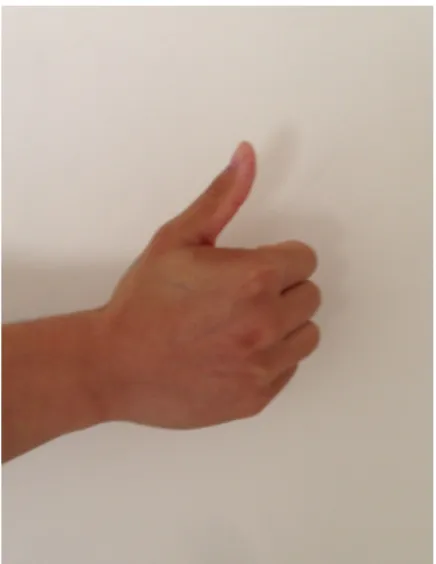
1.1 Static gestures . . . 4
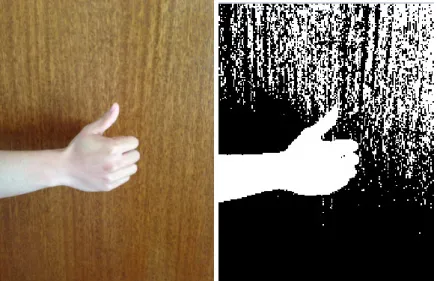
1.2 Dynamic gestures (use hand or finger to make a motion trajectory) 4 1.3 a simple segmentation process . . . 8
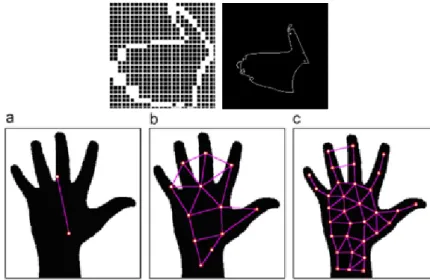
1.4 Three images are the results while using binary image, hand con-tours, and palm center feature extraction method, respectively. . . . 11
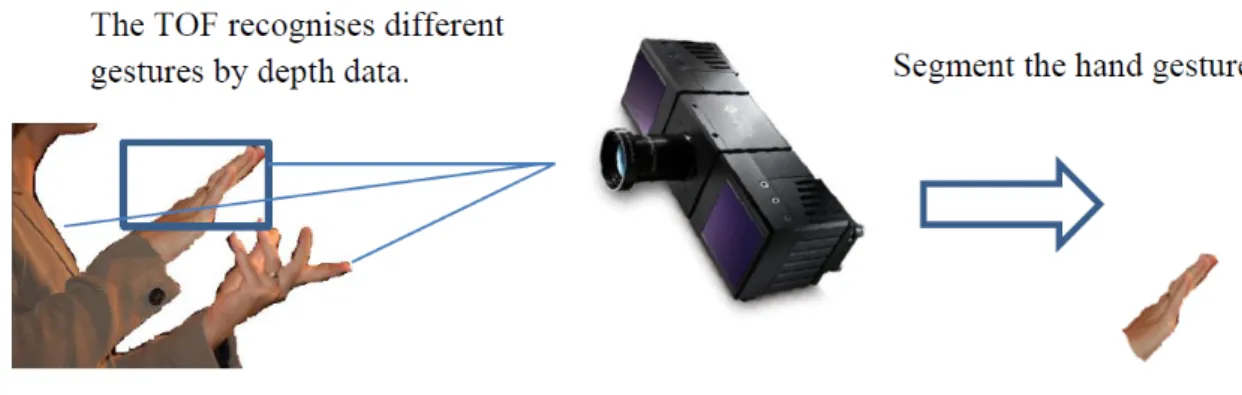
2.1 Time of Flight (TOF) camera . . . 20
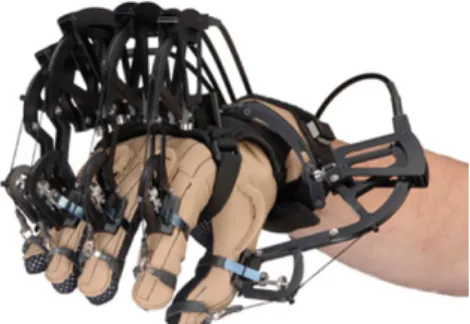
2.2 One typical data glove called Immersion CyberGrasp . . . 21
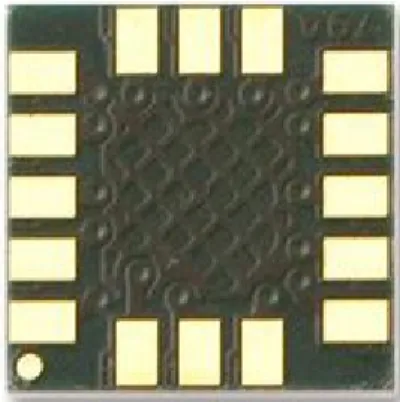
2.3 MEMS 3-axes accelerometer Source: http://au.element14.com . . . . 22
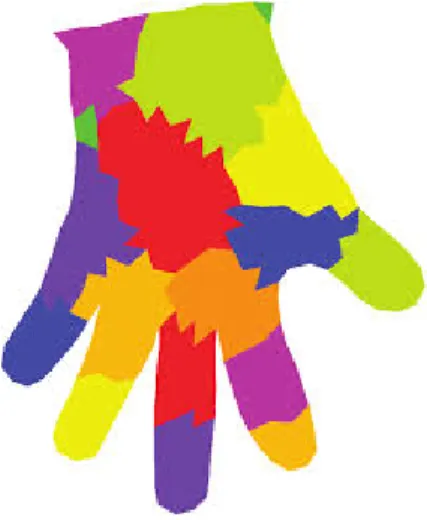
2.4 Colour Glove . . . 23
2.5 Vision- based hand gesture recognition system . . . 24
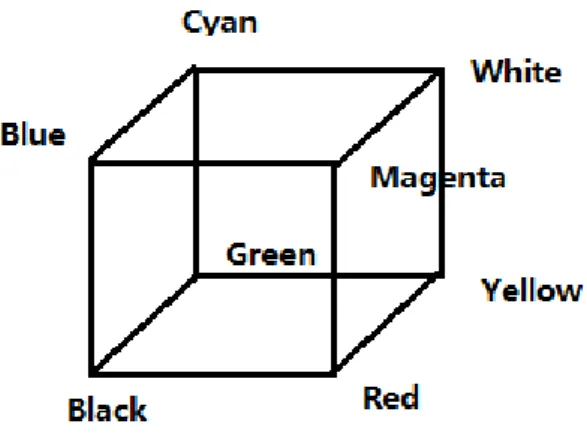
2.6 RGB colour space . . . 27
2.7 YCbCrspace . . . 29
2.8 new Time of Flight camera system. . . 33
2.9 Gesture recognition process . . . 38
2.10 the Hidden Morkov Model (HMM) example . . . 39
List of Figures
2.12 Hu moment invariants theory, as can be seen, no matter what kinds of translation, rotation or scale happen to the letter A, the moment
invariants of it keeps stable. . . 56
3.1 contact type device and vision based device . . . 67
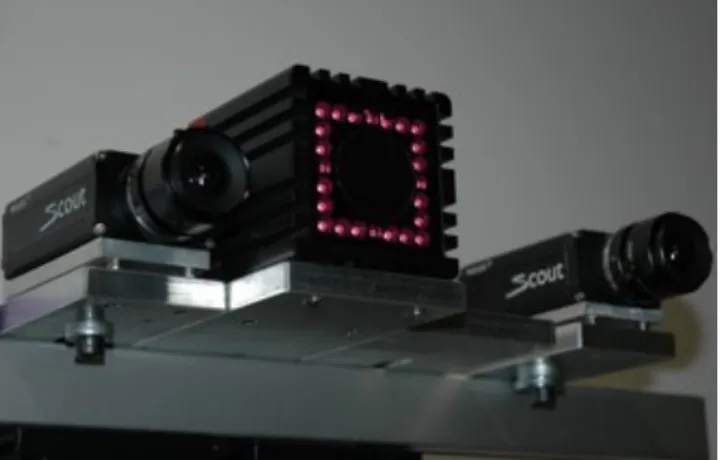
3.2 Kinect and Kinect 2 . . . 69
3.3 a colour image and the corresponding depth image . . . 72
3.4 original depth image and the depth image after the first time thresh-olding, the background had been removed . . . 74
3.5 Left image shows the result of fusion of depth and colour infor-mation after applying the threshold to image, only the skin colour area is kept, right image shows what the detected hand looks like after the final phase processing. . . 76
3.6 Left image shows the image expansion process from A to B,right image shows the image erosion process from A to B . . . 77
3.7 The four images show the performance of system . . . 80
4.1 Local characteristic description . . . 83
4.2 Reference letters . . . 88
4.3 Two different hand gestures capture methods . . . 89
4.4 MMC Hand Digits Dataset . . . 92
List of Tables
4.1 Recognition rate of each method used on MMC data set . . . 94
4.2 Recognition rate of each method used on ASL data set. . . 94
Abbreviations
2D 2 Dimensional
3D 3 Dimensional
ASL Australian Sign Language
ASL American Sign language
CMOS Complementary Metal-Oxide Semiconductor
COG Center Of Gravity
DTW Dynamic Time Warping
HCI Human Computer Interaction
HMI Human Machine Interaction
HMM Hidden Markov Model
HOG Histogram of Oriented Gradient
HSI Hue, Saturation, Intensity
HSL Hue, Saturation, Lightness
HSV Hue, Saturation, Value
ICP Iterative Closest Point
GM Gaussian Model
GMM Gaussian Mixture Model
GPDF Gaussian Probability Distribution Function
Abbreviations
MM Markov Model
MMC Managing Massive City
NN Neural Network
PDF Probability Distribution Function
RGB Red, Green, Blue
SDK Software Development Kit
SGONG Self-Growing and Self-Organized Neural Gas
TOF Time Of Flight
Chapter
1
Introduction
1.1
Background
Gesturing, in addition to speech, is an important facet of human communication. Gestures are a common aspect of communication for many individuals in their daily lives: military commanders issue orders through gesture, athletes issue and respond to gestures during sport, and gestures are essential modes of communi-cation in industries where speech is not possible (e.g., during operations that take place underwater.) For individuals with certain disabilities, gestures are the only available method of self-expression [1].
Alongside rapid advancements in computer and consumer electronics technolo-gies, telecommunications, and software applications in recent years, the first generation of human-machine interactions (e.g., the traditional keyboard, mouse, data gloves or other early haptic technologies,) have become increasingly ob-solete [2]. These types of contact devices tend to create unnatural experiences with the technology and may require that the user familiarise him or herself with rather complex input rules. In response to this issue, intelligent,
multimedia-1.1. Background
based human-computer interaction has emerged as a very popular research field within which human gesture recognition is a hot topic; research in this area re-lates to iPhone touch sensing, Kinect somatosensory gaming, and other consumer electronics which utilise hand gesture recognition technologies [3].
The main objective of intelligent human-computer interaction is to establish an intuitive, navigable, and interactive human-computer learning environment to which the user provides input easily and from which he or she receives the technologys output as desired [4]. Hand gestures, a basic biometrics feature, represent indispensable recognition technology for intelligent human-computer interaction.
Currently existing hand gesture recognition technologies are mainly hardware-based, i.e., dependent on sensors or visual information the former requires data gloves or other hardware devices, (inherently at the users inconvenience,) and is limited by cost and other unfavourable factors; the latter directly uses the human hand as an input device, and thus provides the user with a more natural, direct, and unconstrained human-machine interactive environment. Visual input to the system lends the user more freedom and rewards him or her with a relatively very realistic interaction experience, making visual hand gesture recognition a potentially very valuable technology.
In fact, visual hand gesture recognition technology is a very popular research topic. Significant achievements have been made in this field, but have been very hard-won due to the fact that gesture recognition research involves artificial intel-ligence, pattern recognition, probability statistics, computational linguistics [5], and other disciplines of computer vision, image processing, and analysis addi-tionally, each gesture itself is diverse, ambiguous, and unpredictable in both time and space. In short, hand gesture recognition is a challenging and
interdisci-1.2. Hand Gesture Recognition Overview
plinary endeavour, and a significant challenge for human-computer interaction developers.
1.2
Hand Gesture Recognition Overview
Any one hand gesture is practically impossible to define, as gestures differ in time and space and across different cultural backgrounds. Broadly speaking, any gesture is a conscious hand movement that includes motion of the fingers, palm and wrist intended to convey information. In the field of gesture recognition, gestures are considered to extend to the arms as well as the hands when used to produce a variety of postures or movements [6].
A computer or other machine which recognises human gestures is one that can be effectively controlled by the movement of the hands and arms of the user [7]. Gestures come naturally to human beings, as they are an important part of the way we communicate, so the use of gestures for human-computer interactions is very easy to learn. Ideally, users can command machines to complete complex tasks using a single posture or relatively simple, continuous, dynamic hand ges-tures. There are many ways to classify hand gesture recognition, several of which are discussed individually below [1].
1. Static gesture recognition and dynamic hand gesture recognition.
Performing a gesture is an active process which takes place over some amount of time, but a hand posture is presented instantly accordingly, hand
1.2. Hand Gesture Recognition Overview
gesture recognition can be considered either static or dynamic. Static ges-ture recognition instantly synthesises the relative position of the hands and arms at a given time point, dynamic gesture recognition reads the changing positions of the hands and arms over a certain continuous time frame [8]. The figures below show static gestures (Fig. 1.1) and dynamic hand gestures (Fig. 1.2).
Figure 1.1: Static gestures
1.2. Hand Gesture Recognition Overview
2. Non-vision based hand gesture recognition and vision based hand gesture recognition.
Gesture recognition image acquisition methods likewise can be divided into two categories: motion-sensor-based gesture recognition, and vision-based gesture recognition. Motion-sensor-based systems include contact devices such as mice, styluses, and data gloves [9]. The advantages of device-based gesture recognition systems is touch pads or software algorithms can be in-tegrated to make the system nearly universally applicable; but such systems cannot recognise nuanced finger movements, (in addition to the added in-convenience for the user, as discussed above.) The data glove gesture recog-nition system, for example, uses motion sensors to monitor movements and time information of several points on the device; real-time gesture recog-nition is thus possible due to high input speed, high recogrecog-nition rate, and three-dimensional response to the human hand in space. The gloves are cumbersome and expensive, however, and altogether not appropriate for the typical consumer.
Vision-based gesture recognition systems typically involve several pro-cesses: image acquisition and pre-processing, gesture segmentation, ges-ture modelling, and gesges-ture recognition [10]. Hand gestures are input to a camera which checks, tracks, and analyses the gestures, after which the as-sociated machine reads the gestures from the camera frame to define certain features.
According to said features, the system then selects the appropriate classifica-tion of the gesture to define it appropriately. Static gesture recogniclassifica-tion reads only one image and does not require trajectory information to extract its
1.2. Hand Gesture Recognition Overview
features, while a full sequence of gestures must be read including tracking and segmenting the frames as necessary to realise dynamic gesture recogni-tion. extraction of features does not include trajectory informarecogni-tion. System-generated descriptions ultimately drive the specific applications which are controlled by the gestures [1].
Hand gesture recognition requires minimal user training; ideally, the machine reads users intention automatically to complete the communication between itself and the user seemingly instinctively. Hand gesture recognition, (which, again, is a quite popular research area,) can be expected to have a more extensive range of applications in coming years mainly in the following aspects.
In virtual environments
The hand gesture recognition system is, in effect, an interactive device which can be used to simulate and control complex processes such as virtual manufacturing and assembly [11], driving training, product design, and even virtual training for complex processes such as surgery.
In multimedia user interfaces
Hand gesture recognition applications also are daily consumer goods which can be built into a variety of smart devices to enhance user experiences, such as TV controllers [12], robotics, and small remote aircraft and other toys. Intelli-gent human-computer interaction systems are also commonly understood to rep-resent next-generation mobile communications equipment in cars, homes, and workplaces.
In sign language applications
Communication typically occurs silently in the human-computer interaction in-terface, which may benefit humans who communicate silently, e.g., through sign
1.2. Hand Gesture Recognition Overview
language. Hand gesture recognition systems also may serve as a bridge between sign language speakers and non-speakers, allowing signers to speak with others using an electronic device in other words, a portable, unobtrusive, and practically infinitely knowledgeable translator.
1.2.1
Basic Hand Gesture Recognition Process
The process through which a computer vision-based system recognises hand ges-tures can be divided into four stages [13]. In the first stage, one or multiple cameras obtain image data, then according to the data model, check for hand gesture input data in the stream. Once the computer detects that a hand gesture is present, segmentation is employed to derive the posture only and remove any background; the posture information is then used employed in the feature extrac-tion stage, where it is classified appropriately (i.e., the ultimate goal of the gesture recognition process). During the identification or classification stage, according to the model parameters, the system classifies the hand gestures as-received to generate the appropriate description. Finally, based on said description, the sys-tem drives the specific application per the users request.
1. Hand Gestures Segmentation
The smooth surface of the human hand readily creates highlights and shad-ows under any light source; this characteristic plus background interference leaves no particularly efficient way to manually segment gestures from the background. There are several currently existing approaches to gesture seg-mentation, however, including changing the contrast between the hand and
1.2. Hand Gesture Recognition Overview
the background (through gloves or environmental backdrops, for example,) which can work but at the expense of limiting the freedom of hand move-ments [1]. A simple hand gesture segmentation is shown below in Fig. 1.3.
Figure 1.3: a simple segmentation process
Hand gesture databases can also be built to include different time, shadow, angles, and luminance conditions to match the input hand gestures with a variety templates, but this method is quite time-consuming [14]. Contour tracking, a common method based on Snake model hand gesture segmen-tation, applies the Snake model to track the movement and sophisticated shape changes of the object (i.e., the hand) by exploiting the relation
be-1.2. Hand Gesture Recognition Overview
tween the background noise and contract ratio. The background difference method, i.e., background subtraction, can eliminate background images to make the target image more clear, but results in substantial error if a pixel corresponding to the background image and hand gesture space is located in the same target point. The colour model which works based on skin colour information can also be used to separate hand gestures from the background by placing the image of the hand in appropriate colour spaces. This method was explored extensively by previous researchers Chai and Nagan [15], and Habili and Lim [16].
2. Hand Gestures Modelling
Currently existing gesture modelling methods fall into two categories: the first based on the gesture modelling performance, and the other based on 3D modelling.
Performance-based gesture modelling analyses the performance character-istics of the images of hand and arm movements in a sequence to build a gesture model. This category includes a few subcategories: These include the use of grey scale images to build the hand gesture model, the use of whole hand information, or the use of the movement image as simply a template. Hand and arm gestures can also be used to establish a deformable template model comprised of a collection of certain points on the body contour this method can provide difference symbol points to create approximate hand gesture contours. Image attributes, including the outline of the properties extracted from the image, image moments, eigenvectors, and regional char-acteristics of the image histogram parameters can also be utilised to establish the gesture model.
1.2. Hand Gesture Recognition Overview
The 3D information-based approach aims to perfectly restore the 3D infor-mation associated with the original, natural hand movement as-performed by the user [17]. The performance-based approach discussed above can-not restore the 3D hand movement information, but instead creates a 2D projection of the 3D hand movement, and hence inherently loses a part of the gesture information. In practical applications, 3D gesture modelling requires more parameters and comes with higher computational complex-ity than performance-based modelling [18]; further, the feature extraction process can cause distortion of the model parameters, so to ensure relatively simple calculations and high system identification efficiency, most gesture recognition models are designed based on hand movement performance.
3. Hand Gesture Feature Detection
The gesture feature detection process involves both locating and extract-ing certain features of gestures, and relevant approaches to the process can be divided into three categories: colour-based locating, movement based locating, and multi-mode locating technologies. The multi-mode locating approach is also called multi-cue locating [19], as it combines colour, move-ment, and other visual cues as its target as opposed to a single target cue. The parameters and basic elements of any of these computation models are similar regardless of which approach is utilised all are intended to detect hand gesture features, of course and typically target a combination of grey scale images, binary images (Upper left image in Fig. 1.4), boundaries, contours (Upper right image in Fig. 1.4 ), finger position and palm center (Lower image in Fig. 1.4).
1.2. Hand Gesture Recognition Overview
Figure 1.4: Three images are the results while using binary image, hand contours, and palm center feature extraction method, respectively.
4. Hand Gestures Recognition
Gesture recognition involves classifying the point or trajectory in the model space to a certain subset of the space. The hand gesture recognition pro-cess, as mentioned above, can be either static or dynamic: static recognition identifies postures and associates them with meaning, while dynamic recog-nition also recognises the trajectory of postures and motions and associates them with meaning.
Static gestures are relatively simple and distinguishable. In a sense, static gesture recognition matches the gesture to the existing template with no relation to the time or time frame in which the gesture was made. Static hand gesture recognition is strongly dependent on hand feature extraction, including image attributes such as contour, margin, image moments, image feature vectors, histogram regions, and others [1]. The main approaches to static gesture recognition include the elastic graph matching method,
1.3. Problem Space and Motivation
Hausdorffdistance template matching, and others based on statistical and neural network methods.
Dynamic gesture recognition requires that temporal and spatial information be gathered in addition to the users hand and arm positions. The vast ma-jority of dynamic gestures in the parameter space occur on a track: Different users perform gestures at different speeds, creating a non-linear wave track on the timeline. Many researchers have addressed the issue of eliminating these non-linear dynamic fluctuations. According to different treatments on the timeline, the existing dynamic gesture recognition technologies can be divided into three categories: Hidden Markov Model (HMM) recognition, Dynamic Time Warping (DTW) recognition, and the timeline compression approach [20].
1.3
Problem Space and Motivation
Hand gesture recognition has been applied in the human-computer interaction (HCI) field for some time [21], particularly as a method of communication for sign language speakers [22]. Compared to traditional HCI inputs such as keyboards and mice, hand gestures are more natural and flexible; they represent considerable potential in terms of digital control, real-time input, and communication among users with certain disabilities [23]. In recent years, vision-based hand gesture recognition techniques have grown increasingly popular compared to contact-type techniques, which can diminish hand movement flexibility. The rapid and extensive development of many hardware devices, such as smart phones, has allowed computer vision the opportunity to play an important role in HCI [24].
1.3. Problem Space and Motivation
Though the research on vision-based hand gesture recognition has been extensive and many valuable achievements have been made, to date, the reliability and practicality of these hand gesture recognition systems are still problematic. The biggest challenge in advancing the field lies in reliably tracking hand movements in order to fully recognise dynamic gestures under complex lighting conditions and background clutter, as mentioned above. Among the wide variety of vision-based hand gesture recognition methods, some can achieve very good recognition rates in certain restrictive environments, but may not be applicable yet to real-world situations. Remaining challenges include the correct segmentation of input images, proper feature extraction, and quick and accurate gesture classification.
Background interference which occurs during the segmentation process, such as lighting, brightness, similar colours, overlapping areas, or similar objects in the background, can generate very divergent segmentation results. The human eye is able to distinguish foreground and background very easily while machines simply cannot; if the machine does not have a sufficient recognition rate (i.e., one comparable to the human eye,) and very fast reaction speed, the application will be restricted considerably. For ordinary web cameras, for example, segmentation results tend to be poor due to issues with colour-based, motion-based, and depth-based information extraction [25].
There are many other issues yet to be solved in terms of the applicability of these technologies. For one, the gesture model must first be established appropriately before proper gesture identification is possible, and there currently exists no per-fect method of doing so. The conversion from 3D gestures to 2D images, further, may tax the systems computation ability. Also, as discussed above, the system must locate and track trajectories correctly to realise dynamic gesture recogni-tion, which represents a quite complex process [26]. An appropriate recognition
1.4. Contributions
model also must have sufficiently high recognition efficiency without unnecessary computation complexity, (i.e., high reaction speed,) to be practically useful.
In fact, dynamic hand gesture recognition is especially problematic and especially in terms of recognition rate. Motion blur and quiescent camera conditions pose problems: the first occurs while tracking a dynamic gesture in motion, mainly due to energy accumulation in the imaging process, and the second is caused by the movement of the camera itself during the process of filming [27]. Changes in target size, which occur when the distance between the hand and camera changes continuously, can also create changes in the tracked target gesture and thus de-viation in the tracking results. Environmental factors, (e.g., light, background colour, and skin colour,) can also cause interference which directly affects track-ing accuracy or even lead to tracktrack-ing failure. Speed changes or rapid changes in the direction of movement can cause the subsequent frame to be predicted inaccurately. Most tracking algorithms fail to meet real-time requirements; stable and accurate algorithms generally have high complexity that is not suited to the real-time requirements of a practical tracking algorithm. Gesture occlusion is also a problem due to the natural motion of the hand, certain gestures inherently include partial occlusion which affects the systems recognition accuracy [26].
1.4
Contributions
In this thesis, all the above problems are carefully addressed. The main contribu-tions, in terms of algorithms developed to address these problems, the details of the said contributions are as follows.
1.4. Contributions
Hand gesture recognition has been applied to many fields in recent years, espe-cially the HCI field, as it is considered a more natural and flexible manner of input than traditional devices. My thesis includes an overview of hand gesture recog-nition research to date, including the common stages of hand gesture recogrecog-nition, common methods and techniques employed in each stage, the state of the recent research, and summaries of a few relatively successful hand gesture recognition models. There also is a compulsory description of the concept of hand gesture recognition, which includes key points on static and dynamic gesture recognition, remaining challenges to further development of these technologies, comments on each stage of the recognition process, and the drawbacks and advantages of each mainstream hand gesture recognition system.
Overlapping skin colour areas, such as an arm and face in the same input im-age, sizable affect the recognition rate of vision-based hand gesture recognition systems. Because these recognition systems generally use colour modelling meth-ods to classify the foreground and background, neighbouring pixels with similar colour in any space are placed into one category. As discussed above, there are ways to minimise skin colour area interference (wearing gloves, etc.) but they are not particularly user-friendly. This thesis outlines a relatively simple method of eliminating skin colour area overlapping which relies on camera depth to accu-rately classify the foreground and background without colour interference. The associated algorithms, the colour model thresholding strategy (or depth distribu-tion histogram,) require a relatively pure environment to gather useful gesture information and segment input images accurately; this unfortunately means a high level of computation and time consumption.
This thesis explores a thresholding strategy that the author believes can solve the above problem. Specifically, the algorithm was designed to allow the hand gesture system to achieve accurate segmentation relatively quickly and at the cost
1.4. Contributions
of relatively little computation complexity.
In this thesis, the author outlines a model which integrates depth and colour information to segment necessary gestural information step-by-step, where each step contains a few (fairly simple) restraints. The main idea of the proposed approach is the use of a colour modelling method to roughly define the gesture area, followed by the use of depth information to distinguish the skin colour or noise areas, and finally the colour model again to accurately determine the gesture area. Simulation results showed that this method uses less time and less complex computation to achieve accurate segmentation outputs compared to traditional methods.
A key assumption of hand gesture recognition is that the system is able to directly realise gesture segmentation. To relax this assumption, in this thesis, the author shows that the proposed step-by-step process eliminates the need to directly define the gesture area, which achieves a corresponding output that allows the system to accurately detect hand gestures.
To solve the recognition problem, the author proposes a Kalman-filter-based fu-sion of depth and colour information to overcome the restraints typically present in the hand gesture recognition environment. This robust system employs the colour model with depth information as input and segmentation methods, then the Kalman filter as a hand gesture detection tool. Assisted by the Kalman fil-ter, the system can detect input gestures by predicting the next movement from the previous movement; this reduces recognition failure when any parts of the input gesture frames are lost, and forward-senses the data until coverage and connectivity are guaranteed.
1.5. Publications
algorithm developed for hand gesture recognition through which depth infor-mation helps the user to interact with the system even in a high-interference environment. Simulation results showed that this robust system can work un-der different environments, as it is strongly tolerant of noise, complex lighting conditions, and background clutter.
Kinect technology is also applied to the proposed system to enhance gesture recog-nition rate, specifically, a centralised algorithm is presented which allows Kinect to function correctly within the whole HCI environment and to take advantage of its high reaction speed and accurate sensor (which includes depth information.) Due to the low cost and intuitiveness of Kinect, this system is also affordable and user-friendly to implement.
To summarise, the proposed gesture recognition method works based on multiple spatial characteristics obtained through Kinect sensor data and elegant algorithms which synthesise said data. A principal component histogram and gradient direc-tion histogram describe the shape of gestures in different scales, and a depth dis-tribution histogram embodies the depth disdis-tribution of the gestures. Accordingly, the author calculated the importance of certain gestures through the preliminary training of random forests and filtered characteristics in an experiment on two large-scale gesture data sets. The results showed that compared to pre-existing gesture recognition algorithms, the integrated hand gesture recognition method proposed in this thesis effectively improves gesture recognition effects.
1.5
Publications
1.5. Publications
1. S. Yang, P. Premaratne, P. Vial and Q. AlshebaniRobust hand gesture detection by fusion of depth and colour information using kinect, Computer Modeling and New Technologies, Vol 18(12B) 127-132, 2014.
2. S. Yang, P. Premaratne and P. Vial. Hand gesture recognition: An overview, 5th IEEE International Conference on Broadband Network and Multimedia Technology (IC-BNMT 2013), pp. 63-69., 2013.
3. S. Yangand P. Premaratne. Dynamic gesture recognition method of Kinect fusion fast entropy SVM,under review
4. P. Premaratne, S. Yang, Z. Zou and N. Bandara. Dynamic Hand Gesture Recognition Framework, Intelligent Computing Methodologies, Springer In-ternational, pp834-845, 2014.
5. P. Premaratne,S. Yang, P. Vial and Z. Iftikhar. Dynamic Hand Gesture Recogni-tion using Centroid Tracking, Intelligent Computing Theories and Methodolo-gies, Lecture Notes in Computer Science, Springer International, pp623-629, 2015.
6. P. Premaratne, S. Yang, P. Vial and Z. Iftikhar. Centroid Tracking Based Dy-namic Hand Gesture Recognition using Discrete Hidden Markov Models, Neuro-computing Journal, Accepted the final version in March 2016.
7. Q. Al-shebani, P. Premaratne, P. Vial and S. Yang. The Feasibility of Imple-menting a Face Recognition System Based on a Gabor Filter and Nearest Neighbor Techniques, FPGA Device for Door Control Systems. Journal of Computers, 10-2. pp115-129, 2015.
8. Z. Iftikhar, P. Premaratne, P. Vial andS. Yang. Robust Segmentation of Vehicles under Illumination Variations and Camera Movement, Accepted for Springer Lecture Notes in Computer Science, 2015.
1.6. Thesis Structure
1.6
Thesis Structure
1. Chapter 2. This chapter includes a literature review of existing hand gestures recognition approaches in both conventional static gestures recognition and dynamic gestures recognition.
2. Chapter 3. This chapter proposes the fusion algorithm to detect hand gestures using depth and colour information.
3. Chapter 4. This chapter presents the fast entropy SVM algorithm to address the dynamic hand gesture problem,
4. Chapter 5. This chapter concludes the thesis, and provides a summary of research outcomes .
Chapter
2
Literature Review
This chapter reviews prior works on hand gesture recognition. The focus will be on state of art of basic and latest hand gesture recognition model, the description also includes some new hand gesture devices, such as Time of Flight (TOF) camera (shown in Fig. 2.1)and Kinect.
2.1. non-vision Based Hand Gesture Recognition
2.1
non-vision Based Hand Gesture Recognition
According to different approaches of acquiring hand gesture information, hand gesture recognition can be divided into two groups; one is non-vision based recognition, such as data gloves, shown in Fig. 2.2, and another is vision based recognition. As hand is a deformable object, it cannot be represented by one simple model, besides, human hand tracking and recognition are easily influenced by environment factors such as, luminance, colour and so on, so many previous research are about non-vision based recognition, especially on data glove devices [28].
Figure 2.2: One typical data glove called Immersion CyberGrasp
Data glove (Shown in Fig. 2.2) is a multi-function Virtual-Reality (VR) device comprising of many sensors on the glove. Through software mapping, the glove can reach into the computer to move, clutch and rotate the virtual objects. The latest release of this product is capable of registering finger bends for each finger. The glove accurately transmits hand gesture to the computer in real time, and then receives feedback from virtual environment to the operator. It provides the user a direct and universal human-computer interaction mode [28].
2.1. non-vision Based Hand Gesture Recognition
sensor, MEMS 3-axes accelerometer (shown in Fig. 2.3 ) [29] to recognise seven hand gestures that includes up, down, left, right, tick, circle and cross. The hand motions are captured by the accelerometer in three vertical directions and then the data were transferred to a computer via Bluetooth. Before features extraction process, the system will segment the hand gesture from the input data. Because of the complexity of the gestures from different people, an 8 digit sign sequence is extracted as common features using the accelerometer. The system recognises gestures by comparing the templates in the database.
Figure 2.3: MEMS 3-axes accelerometer Source: http://au.element14.com
This method has two constraints, one is this system requires people to wear sen-sors sacrificing natural feeling of hand gestures; another is that this system strikes a balance between accuracy and number of gestures by resorting to only seven gestures. Because it is only based on the MEMS accelerometers, the accuracy is acceptable when the database is small. If this system is trained on more hand gestures, the accuracy would decrease due to erroneous classification. The exper-iment shows the recognition rate of this model is 95.6%, the recognition of each gesture range from 91%-100%.
2.2. Vision Based Hand Gesture Recognition
2.2
Vision Based Hand Gesture Recognition
In recent years, more and more research has concentrated on vision based hand gesture recognition. Compared to non-vision based recognition (data glove or electro-magnetic waves etc.), as contact type devices reduces the flexibility of hand movements, vision based recognition are more natural and comfortable for the user. Based on the data glove and electromagnetic waves, researchers devel-oped a new kind of colour glove (also called colour makers) (in Fig. 2.4) [30]and one non-contact optical sensor chip used for hand gesture recognition.
Figure 2.4: Colour Glove
2.3
Computer Vision Based Hand Gesture
Recogni-tion
Getting a computer to accurately interpret a human hand gesture or posture is a non-trivial task. With the rapid development of computer hardware, the computational ability of a computer has achieved tremendous growth over the last
2.3. Computer Vision Based Hand Gesture Recognition
decade. This has facilitated a computer to be used for HCI giving people freedom to naturally and flexibly input information. In the latest research, computer vision-based hand gesture recognition plays a very important role in the human computer interaction (HCI) area [31].
A computer vision-based hand gesture recognition system can be divided into four parts (Fig. 2.5) [1]
Figure 2.5: Vision- based hand gesture recognition system
First stage uses one or multiple cameras to obtain image data, and then according to the data model, check the input data stream if it has hand gesture information. Once the computer detects that a hand gesture is present, segmentation is used to derive the posture only removing any background. This is then used for fea-ture extraction stage which will be used for classification as the final goal of the process. During identification or classification stage, according to parameters of
2.3. Computer Vision Based Hand Gesture Recognition
the model, system classifies the received hand gestures to generate hand gesture description. Finally, based on the description, the system drives the specific ap-plication.
2.3.1
Image Segmentation
Image segmentation is the first step of hand gesture recognition; it aims to isolate the hand gesture from the input image. The segmentation methods are mainly depended on skin colour detection or grey scale (colour or depth) information. It has been very well established that skin segmentation can be better performed on
HSVorYCrCbcolour space [32] [33].
2.3.2
Colour Space Model
This feature has played a larger role in the detection of gestures, often through the clustering of a depth threshold can easily distinguish the approximate area of gesture. In this regard, the main research questions focus on how to determine the depth of the initial gesture depth threshold and clustering. Gaussian model(GM) is a very important continuous probability distribution function in mathematics, physics and engineering and other fields which describes an aggregate value of a single distributed random variables. It uses a Gaussian Probability Density Function (GPDF) (normal distribution curve) to accurately quantify things [34]. Using a number of formalised Gaussian probability density functions based on a mathematical model finally formed. A GM was usually classified to single Gaussian model and Gaussian Mixture Model (GMM) depending on the number of Gaussian probability density function used in the model [35].
2.3. Computer Vision Based Hand Gesture Recognition
Typically using three relatively independent components describes the colour, fea-ture vector consists of three separate components of the composition constitutes a further three-dimensional vector space, which is the colour space.
However, from a different perspective, you can find three different components to describe the colour, so it can produce different colour spaces, but the object itself is being described and as unique.
These describe methods represent different perspectives on the same object. Ac-cording to the representations of each individual component, colour space can be divided into three categories [10], first colour space, that the three components represent some independent colour perception, according to a variety of different combinations may represent colour perception, such asRGB(red,1reen,blue),CMYK
and CIEXYZ, etc. Second, the colour, the light separate space, i.e. repre-sented by a luminance component, two component represents the colour, such as
YUV, YCrCb, L∗a∗b, L∗u∗v. Third, the intensity, saturation, hue, colour space
type, which was used to describe the colour saturation and hue perception, the colour space based on human perception of colour to distinguish, it is more in line with people’s intuitive sense, so it was also known as perceptual colour system, such asHSI,HSL,HSV and LCH.
In the current gesture recognition system, various colour spaces are used. This section from the three types of colour space, respectively, to select the most com-monly used, namely, RGB,YCrCb,HSV colour space, and then compare these three colours in the colour space of cohesion, a non-skin colour separability of other indicators performance under the final decision to use the gesture segmen-tation of the colour space.
2.3. Computer Vision Based Hand Gesture Recognition
2.3.2.1 RGB space
Visual trichromatic theory was put forward by the Young in 1809 (Fig. 2.6), the main argument is the human retina contains a red, green and blue sensitive cones, different colours reflect different wavelengths, and different wavelength cone cells of the retina influence also vary [36].
Figure 2.6: RGB colour space
When the cone cells of the different information transfer to the central nervous system, humans have a sense of a certain colour.
Due to technical limitations, early visual trichromatic theory can only stay in the hypothesis stage. Later, with the development of science and technology, the doctrine has been confirmed by many experiments [36].
Currently using a very wide range of RGB colour space is the basis of visual trichromatic theory, the colour space by the superposition of red, green and blue
2.3. Computer Vision Based Hand Gesture Recognition
colours generates almost all colour which human beings can perceive.
2.3.2.2 HSV (Hue, Saturation, Value) Space
HSV colour space has been devised to interpret the way humans describe colour. Hue refers to different colours (such as red, green), S refers to saturation (for instance, the difference between deep blue and light blue), andV refers to value (also considered as brightness). To represent the image accurately with intuitive values, HSV colour space was widely used for image segmentation. Assume the (r,1,b) are the coordinates of red, green and blue respectively. The values are from 0 to 1 [37]. Maxrepresents the maximum value amongr,1andb. Minrepresents the minimum value among ther,1andb. Thehmeans the hue angle (between 0-360),
Smeans the saturation, and then these parameters can be calculated as follows.
h= 60∗ 1−b
max−min +0 i f max=r and 1≥b
60∗ 1−b
max−min +360 i f max=r and 1<b
60∗ b−r
max−min +120 i f max=1
60∗ r−1
max−min +240 i f max=b
(2.1) s= max−min max =1− min max otherwise 0 i f max=0 (2.2) v=max (2.3)
Mokhtar M. Hasan et al. proposed a new system to achieve higher segmentation accuracy rate, which is based on HSV colour space method. This system divided
2.3. Computer Vision Based Hand Gesture Recognition
the input image into blocks to extract features. The basic concept is to find the proper block number to achieve the high performance of segmentation rate. They considered all blocks from 1x1 up to 23x23 block size [32].
2.3.2.3 YCbCrspace
YCbCr is also a widely used colour space method during image segmentation
(shown in Fig. 2.7). Yrepresents luminance. CbandCr represent blue-difference
and red-difference chroma components respectively [38]. RGB values can be transformed toYCbCrcolour space as follows.
Y Cb Cr = 16 128 128 + 65.481 126.553 24.966 −37.797 −74.203 112 112 −93.786 −18.214 R G B (2.4) Figure 2.7: YCbCrspace
Shuying Zhao et al. proposed an improved algorithm of hand gesture recog-nition for intricate background. This paper illustrates the segmentation method based on YCbCr colour space, and also compared four segmentation methods,
2.3. Computer Vision Based Hand Gesture Recognition
HSV,YCbCr,Nr1r and Nr11. Then authors built a model using Gaussian
distribu-tion. This model is highly capable of rejecting the effect of near-skin colour objects [39].
2.3.2.4 Skin Colour Detection
The skin colour detection techniques are commonly based on thresholding tech-niques. According to different areas where the threshold value is obtained, the segmentation method can be divided into two groups, one is the threshold value only used in one region and the other is the threshold value used in the whole image.
The threshold value is used to classify the points which have similar features on the image into the same class [40]. Assume input image is f(x,y), the output is f0
(x,y), the threshold is T, the segmentation process using threshold can be described using the following formula:
f0(x,y)= a1 f(x,y)<T a2 f(x,y)≥T (2.5)
The threshold-based segmentation process finally produces two value images. The features of the image is usually the colour, grey scale or other (X factor, such as, one particular characteristic) information of the image. Assume the threshold is described as follow:
2.3. Computer Vision Based Hand Gesture Recognition
WhenT=T(G(x,y)), it means the threshold is only related to the grey scale of the isolated image.
When T = T(G(x,y),X(x,y)), which means the threshold will be decided by the grey scale and other characteristics.
WhenT=T(C(x,y),G(x,y),X(x,y)), implies that the threshold will be decided by the position, grey scale and other characteristics.
Because the input hand gestures are flexible and complicated, there is no universal method that can be applied to all gesture segmentation process. Much research has been conducted to find a proper threshold to get a good segmentation results.
Luigi Lamberti et al. proposed using colour glove to recognise hand gestures. During the segmentation process, authors choose the least computationally com-plex segmentation method, the thresholding - based method. The basic concept is to classify pixels into different (seven) classes by using different thresholds. But the authors did not reveal the details as to how they set up thresholds [41].
E. Stergiopoulou et al. proposed a neural network shape fitting technique to recognise hand gestures. Authors usedYCbCrcolour space to segment the hand
region. The thresholding selection is discussed in detail. They further drew up a map of the chrominance of skin colour by using a training set, while the training set includes several images about white hand poorly illuminated, white hand well illuminated and black hand well illuminated. They determined range ofCb and
Cr values which is narrow and are very consistent with the existing data. It can
2.3. Computer Vision Based Hand Gesture Recognition
2.3.2.5 Depth Data
After capturing the image, the input image should be segmented, in order to obtain the gesture. The common methods of hand gesture segmentation are colour limitation or skin colour detection. The colour limitation method usually limits the environment by wearing coloured markers or using a fixed colour background. This approach leads to inflexibility of hand movements. However, it has much higher recognition accuracy. Skin colour detection method can directly separate the skin colour area from the input image, but it will be easily affected by the complex background and poor illumination. Besides, hand and face or other similar colour parts cannot be overlapped [43] [44].
Availability of depth information of image objects can overcome these difficulties easily. The grey scale of the pixel in depth image is only related to the distance between surface plane and camera, so the grey scale will not be affected by space colour, illumination and other colour factors. Besides, combining value of grey scale with horizontal and vertical coordinates, in a certain space, can be used to represent the 3D coordinates of an object. In other words, the depth data can be used for gesture recognition in 3D space.
In 1990s, the development of time of flight (TOF) (Fig. 2.8) camera resulted in measuring the depth information of an object by calculating the time of light flying.
Compared to the traditional 2D camera, TOF can easily determine background and foreground. It has unique advantages in target recognition and tracking. But TOF camera also features high price and low resolution.
2.3. Computer Vision Based Hand Gesture Recognition
Figure 2.8: new Time of Flight camera system. Source: http://lttm.dei.unipd.it/nuovo/research/ToF.html
In 2010, Microsoft developed the somatosensory peripheral 3D camera Kinect for Xbox 360. It uses structured light coding techniques to obtain the depth information from the captured image. Kinect includes one RGB camera, one infra-red camera and one infra-red emitter. The emitter can send infra-red laser, when the laser irradiates the coarse objects, it will form highly random diffraction spots, called laser speckle. The laser speckle will result in different patterns from different imaging distances. When the laser speckle irradiates the entire space, the whole image pixels are tagged. The infra-red camera is used to transmit received tags to the internal graphic processor unit [45]. This module produces the depth image with a resolution up to 640*480 and a low price. Besides, because of the additional graphic processor, it does not need too much computation ability of a computer. This has lead researchers to use Kinect for hand gesture recognition research [46].
K.K. Biswas proposed gesture recognition using Microsoft Kniect [47]. The Kinect produces depth images of subjects (this is grey scale image). This grey scale image is used for isolating the hand region from the input image by using auto thresholding method. According to the depth histogram, the threshold is set to be the first fall down point which is the valley after reaching the first peak.
2.3. Computer Vision Based Hand Gesture Recognition
2.3.3
Feature Extraction
The features are the useful information that leads to classification. Some features have properties of invariance. Rotation, scale or translation. Illumination diff er-ences will not lead to misclassification. The features are extracted from the hand posture once it is isolated using image segmentation.
2.3.3.1 Feature Vectors
Good feature vector would be paramount for good classification. For this reason, much research is focused on forming effective features vectors. Features vector of the segmented image can be extracted in different ways according to particular application. Some methods used the shape of hand such as hand contour and silhouette, while others used fingertips position, palm center, etc. A common method extracts the feature vector by dividing the segmented image into fixed block size and each block represents the brightness value in the image [48]. Many experiments were applied to decide the proper block size that can achieve good recognition rate. In practical applications, it cannot be guaranteed that the image will not have translation, scale and rotation. These factors will highly affect the recognition accuracy.
Rajesh et al. proposed a skin colour based method (L∗a∗b∗ Colour Space) to
isolate the hand gesture from the input image [50]; each hand gesture is centered to extract features. These features used to mark and count peaks and valleys of
2.3. Computer Vision Based Hand Gesture Recognition
each gesture. Meanwhile the system divides input image into sixteen parts to find positions of peaks and valleys. They combine number of Peaks and Valleys with its position of a gesture in the image to recognise the American Sign Language [49]. The recognition method is neural network. This method has one constraint, the hand should be well placed with proper ankle, but it does not require wearing colour gloves or sensor gloves. The test result shows this method can reach 100% recognition rate when applied to American Sign Language.
Hamid A. Jalab et al. proposed an algorithm to recognise static gestures us-ing wavelets [51]. Moreover, it implemented a feed-forward three-layer neural network with back propagation training algorithm during recognition process. Compared to the traditional Fourier methods, the wavelets-based algorithm has advantages in discontinuities of a signal. But this model is only applicable to static gestures. The experimental test result shows the classification accuracy of 97% (one hundred and twenty gestures have been trained and sixty gestures are used for testing).
A. Malima et al.proposed a fast algorithm for robot control [52]. Authors used a fast algorithm, which can recognise a series of gestures applied for a robot control application. This system consists of hand region segmentation stage (skin detec-tion method), locating the fingers stage (count the number of farthest distance between palm centre to finger point) and gestures classification stage. However, there are two prominent constraints in this system; when the system counts the number of fingers, it cannot differentiate different gestures with the same number of fingers, and moreover, this system can only be used for postures.
2.3. Computer Vision Based Hand Gesture Recognition
2.3.3.2 Hu Moment Invariants
The conception of moment invariants was proposed by Hu. Hu proposed 7 famous invariant moments which have been used in many image classification approaches, especially image comparison [53] and matching [54]. Seven invari-ant moments are extracted from an image which is not affected by translation, scale or rotation. Our research team has effectively used this approach for many classification problems in the past [55]. Equations 7-13 are the well-known Hu moments, which is a set of seven moment invariants are derived from the second order and third order moments[56].
θ1 =η20+η02 (2.7) θ2 =(η20−η02)2+4η211 (2.8) θ3 =(η30−3η12)2+(3η21−η03)2 (2.9) θ4 =(η30+η12)2+(η21+η03)2 (2.10) θ5 =(η30−3η12)(η30+η12) (η30+η12)2− 3(η21+η03)2 +(3η21−η03)(η21+η03) 3(η30+η12)2− (η21+η03)2 (2.11) θ6 =(η20−η02)[(η30+η12)2−(η21+η03)2]+4η11(η30+η12)(η21+η03) (2.12)
2.3. Computer Vision Based Hand Gesture Recognition θ7 =(3η21−η03)(η30+η12) (η30+η12)2−3(η21+η03)2 −(η30−3η12)(η21+η03) 3(η30+η12)2− (η21+η03)2 (2.13)
Hu completed the 7 depend invariant moments theoretical framework. J. Flusser think the low order moment invariants includes most useful data [73], but the high order needs more calculation, so it will be affected by the noise. Hence, generally, TheI1,I2,I3,I4are the most widely used features in hand gesture recognition area.
ηpqare the normalised central moments, which can be calculated as:
ηpq = Upq/U
0
00 (2.14)
r = [ (p+q)/2 ]+ 1 and p+q =2,3, ... (2.15)
There are further improvements to the basic Hu moments as reported by [57]. The major difference in this approach is to use contour invariant moments.
Lihong Li et al. proposed a system on pattern recognition, which has a high recognition rate by using discrete moment invariant algorithm. The basic idea of this algorithm is to combine the original moment invariants with contour moment invariants. The experimental result shows the recognition rate of the system can achieve over 98% [57].
2.3. Computer Vision Based Hand Gesture Recognition
2.3.4
Gesture Recognition
Recognition of hand gesture is the last stage of the hand gesture recognition system. After modelling and analysis of the input image, the system starts to recognise the gesture. Recognition process is affected by the feature extraction method and classification algorithm. Statistical tools are usually used for gesture classification. Neural network has been widely applied in the field of hand gesture extraction and recognition. In figure 2.9 shows the basic recognition process. Before the recognition stage, the system should be trained with enough data so that a new feature vector can be classified with good accuracy.
Figure 2.9: Gesture recognition process
2.3.4.1 HMM (Hidden Markov Model)
Up to now, many methods have been applied in hand gesture recognition area. As the dynamic hand gesture can be treated as the continuous motion on time period, HMM can also be used in hand gesture recognition, which is becoming popular.
2.3. Computer Vision Based Hand Gesture Recognition
A HMM is a Markov Model (MM) with hidden parameters, which used the hidden parameters to ensure the state. The variants resulted from states transitions are visible. However, each state cannot be visible; each potential output has a probability distribution. Hence, the sequence of output includes the hidden information of the sequence of state.
In the context of hand gesture recognition area, a HMM can be shown as in figure 2.10. X1 to Xi represent the input states, which includes a set of hand
positions in each state. TheTab, Tbarepresent the state transitions, which means
the probability of transferring from one state to another state. The Y1 to Yi
represent the corresponding outputs, which include one specific posture or one gesture. The database of HMM has many samples per single gesture, the relation between the number of samples and the accuracy is directly proportional and between number of samples and the speed is inversely proportional.
Figure 2.10: the Hidden Morkov Model (HMM) example
Byung-woo Min et al. proposed a system of hand gesture recognition using HMM. They used 8 digit code to represent feature vectors. Each state is characterised by two sets of probabilities, a transition probability and either a discrete output prob-ability distribution or a continuous output probprob-ability density functions. They set the number of states for recognition by counting the number of different states included in one gesture. In their work, a 4 - state HMM was used for hand gesture
2.3. Computer Vision Based Hand Gesture Recognition
recognition [58].
2.3.5
Neural Network
Neural Networks have been designed to mimic how neurons behave in human body (fig. 2.11). The artificial Neural Networks as they are known for self-learning and high anti-noise ability. Techniques based on Neural Networks have been widely applied in the field of hand gesture recognition.
Figure 2.11: the structure of Neural Network (NN)
Nodes are the basic units in the neural network, the weight is the basic parameter between nodes (also called value vector). The above chart shows the simplest neural network. Assume the input areX1,X2, ,Xk, the value vector between
in-put layer and hidden layer isWih, the input from input layer to the hidden layer is:
Input =
h
X
i
WihXi (2.16)
2.3. Computer Vision Based Hand Gesture Recognition Wmi = f( m X m−1 WihXk+θIi), i=i,2, ... (2.17)
Then the output of the hidden layer can be calculated as follows.
Output=
k
X
i
WimXk (2.18)
If the output is not exactly the same with results, the system will turn to operate reversely, it means the error signals will be returned along the original link to repeatedly change the coefficients of all layers until the actual output is corre-sponding to the input.
E. Stergiopoulou et al. proposed neural network shape fitting technique to recog-nise hand gestures [42]. Authors use YCbCr colour space to segment the hand
region. TheSGONGnetwork is applied to get the hand shape, then three features are obtained; Palm region, Palm center, and Hand slope. It calculates the Center Of Gravity (COG) of the segmented hand and the distance from the COG to the farthest point in the fingers, and extracted one binary signal (1D) to estimate the number of fingers in the hand region. While the characteristics of palm are ex-tracted, combine with the computation, the hand gesture can be identified. Simei et al. proposed a method of using boundary histograms and neural net-works on static gestures [59]. The feature extraction method results in a good recognition performance and leads to the significant reduction of processing time. They use boundary histograms to reduce the effects of rotation and deformable shape of the gestures. In their work, authors illustrated a new fast search start point algorithm for the boundary, which has a rotational invariance property. In the experiments, this model was tested using 26 postures of American Sign Lan-guage. The recognition rate directly depends on the number of histograms and
2.4. Hand Gesture processing and Tracking
histogram resolution. This method is only used for posture recognition.
2.4
Hand Gesture processing and Tracking
Colour is one of the basic physiological phenomenon of human vision, colour vision is the result of environment, interaction between light and the human brain. Colour perception is part of basic research of the visual system. It has close relation with cognitive science, physiology and information sciences. So colour science is a highly cross-defined disciplines. In the colour study area, biologists hope that through the study of visual information process to understand the process that information are indicated in human brain. On the other hand, in the field of computer vision, the researcher are trying to establish the representation and processing model of colour vision by using the human brain visual process model to finally do the visual information segmentation, tracking and recognition, and ultimatel