S
earch
-
based
U
nit
T
est
G
eneration
S
earch
-
based
U
nit
T
est
G
eneration
for
E
volving
S
oftware
J
osé
C
arlos
M
edeiros de
C
ampos
Scientific supervision by
Dr. Gordon Fraser, The University of Sheffield, UK Dr. Rui Abreu, Instituto Superior Técnico, Lisboa, PT
In partial fulfillment of requirements for the degree of
Doctor of Philosophy
The University of Sheffield Faculty of Engineering Department of Computer Science
between and . This work was funded by the Department of Com-puter Science of The University of Sheffield as a doctoral scholarship.
“Search-based Unit Test Generation for Evolving Software”
A B S T R A C T
Search-based software testing has been successfully applied to gen-erate unit test cases for object-oriented software. Typically, in search-based test generation approaches, evolutionary search algorithms are guided by code coverage criteria such as branch coverage to generate tests for individual coverage objectives.
Although it has been shown that this approach can be effective, there remain fundamental open questions. In particular, which crite-ria should test generation use in order to produce the best test suites? Which evolutionary algorithms are more effective at generating test cases with high coverage? How to scale up search-based unit test generation to software projects consisting of large numbers of compo-nents, evolving and changing frequently over time? As a result, the applicability of search-based test generation techniques in practice is still fundamentally limited.
In order to answer these fundamental questions, we investigate the following improvements to search-based testing. First, we propose the simultaneous optimisation of several coverage criteria at the same time using an evolutionary algorithm, rather than optimising for indi-vidual criteria. We then perform an empirical evaluation of different evolutionary algorithms to understand the influence of each one on the test optimisation problem. We then extend a coverage-based test generation with a non-functional criterion to increase the likelihood of detecting faults as well as helping developers to identify the loca-tions of the faults. Finally, we propose several strategies and tools to efficiently apply search-based test generation techniques in large and evolving software projects.
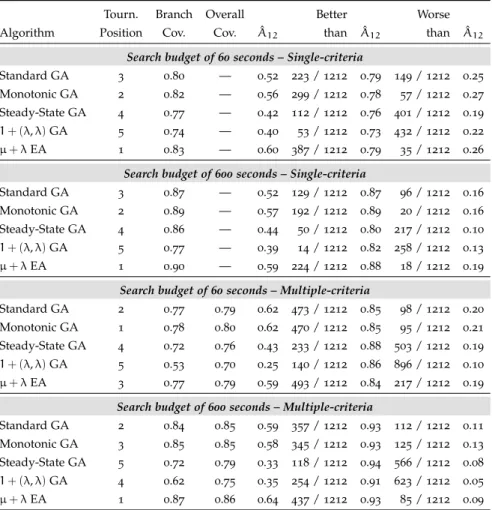
Our results show that, overall, the optimisation of several cover-age criteria is efficient, there is indeed an evolutionary algorithm that clearly works better for test generation problem than others, the ex-tended coverage-based test generation is effective at revealing and lo-calising faults, and our proposed strategies, specifically designed to test entire software projects in a continuous way, improve efficiency and lead to higher code coverage. Consequently, the techniques and toolset presented in this thesis — which provides support to all con-tributions here described — brings search-based software testing one step closer to practical usage, by equipping software engineers with the state of the art in automated test generation.
P U B L I C AT I O N S
The material presented in this thesis have been published in peer review symposiums or conferences.
[T1] José Miguel Rojas, José Campos, Mattia Vivanti, Gordon Fraser, and Andrea Arcuri. “Combining Multiple Coverage Criteria in Search-Based Unit Test Generation”. Search-Based Software Engineering: 7th International Symposium, SSBSE 2015, Bergamo, Italy, September 5-7, 2015, Proceedings. Ed. by Márcio Barros and Yvan Labiche. Best Paper with industry-relevant SBSE results. Cham: Springer International Publishing, 2015, pp.93–108.isbn:978-3-319-22183-0.
[T2] José Campos, Yan Ge, Gordon Fraser, Marcelo Eler, and An-drea Arcuri. “An Empirical Evaluation of Evolutionary Algo-rithms for Test Suite Generation”. Proceedings of the 9th Inter-national Symposium Search-Based Software Engineering (SSBSE). Ed. by Tim Menzies and Justyna Petke.Distinguished Paper Award. Cham: Springer International Publishing,2017, pp.33– 48.isbn:978-3-319-66299-2.
[T3] José Campos, Rui Abreu, Gordon Fraser, and Marcelo d’Amorim. “Entropy-based Test Generation for Improved Fault Localization”. Proceedings of the 28th IEEE/ACM Interna-tional Conference on Automated Software Engineering. ASE’13. Sil-icon Valley, CA, USA: IEEE Press,2013, pp.257–267.isbn:978 -1-4799-0215-6.
[T4] José Campos, Andrea Arcuri, Gordon Fraser, and Rui Abreu. “Continuous Test Generation: Enhancing Continuous Integra-tion with Automated Test GeneraIntegra-tion”. Proceedings of the29th ACM/IEEE International Conference on Automated Software En-gineering. ASE ’14. Vasteras, Sweden: ACM, 2014, pp. 55–66. isbn:978-1-4503-3013-8.
[T5] José Campos, Gordon Fraser, Andrea Arcuri, and Rui Abreu. “Continuous Test Generation on Guava”.Search-Based Software
Engineering:7th International Symposium, SSBSE2015, Bergamo, Italy, September5-7,2015, Proceedings. Ed. by Márcio Barros and Yvan Labiche. Cham: Springer International Publishing,2015, pp.228–234.isbn:978-3-319-22183-0.
[T6] Andrea Arcuri, José Campos, and Gordon Fraser. “Unit Test Generation During Software Development: EvoSuite Plugins for Maven, IntelliJ and Jenkins”.2016IEEE International Confer-ence on Software Testing, Verification and Validation (ICST). Apr. 2016, pp.401–408.
Arcuri. “EvoSuite at the SBST Tool Competition”. Proceed-ings of the 10th International Workshop on Search-Based Software Testing. SBST ’17. Buenos Aires, Argentina: IEEE Press, 2017, pp.39–41.isbn:978-1-5386-2789-1.
In addition to the above list of research papers published during the PhD programme of study, I have also published the following papers, the work of which does not feature in this thesis.
[O1] Ermira Daka, José Campos, Gordon Fraser, Jonathan Dorn, and Westley Weimer. “Modeling Readability to Improve Unit Tests”.Proceedings of the 2015 10th Joint Meeting on Foundations of Software Engineering. ESEC/FSE2015.ACM SIGSOFT Dis-tinguished Paper Award. Bergamo, Italy: ACM,2015, pp.107– 118.isbn:978-1-4503-3675-8.
[O2] Ermira Daka, José Campos, Jonathan Dorn, Gordon Fraser, and Westley Weimer. “Generating Readable Unit Tests for Guava”. Search-Based Software Engineering: 7th International Symposium, SSBSE 2015, Bergamo, Italy, September 5-7, 2015, Proceedings. Ed. by Márcio Barros and Yvan Labiche. Cham: Springer International Publishing,2015, pp.235–241.isbn:978 -3-319-22183-0.
[O3] Spencer Pearson, José Campos, René Just, Gordon Fraser, Rui Abreu, Michael D. Ernst, Deric Pang, and Benjamin Keller. “Evaluating and Improving Fault Localization”.Proceedings of
the 39th International Conference on Software Engineering. ICSE ’17. Buenos Aires, Argentina: IEEE Press, 2017, pp. 609–620.
isbn:978-1-5386-3868-2.
[O4] Sina Shamshiri, José Campos, Gordon Fraser, and Phil McMinn. “Disposable Testing: Avoiding Maintenance of Gen-erated Unit Tests by Throwing Them Away”.2017IEEE/ACM 39th International Conference on Software Engineering Companion (ICSE-C). May2017, pp.207–209.
A C K N O W L E D G E M E N T S
This thesis would have not been possible without the support of sev-eral people. The following lines are dedicated to all of them. First of all, I wish to express my gratitude to my supervisors Gordon Fraser and Rui Abreu for their support, advice, and patience throughout my time in academia. Special thanks are due to my collaborators An-drea Arcuri, José Miguel Rojas, Mattia Vivanti, Marcelo d’Amorim, Marcelo Eler, and Yan Ge. I am also very thankful to Sina Shamshiri, Mathew Hall, David Paterson, Tom White, Nasser Albunian, Ermira Daka, and Abdullah Alsharif for their support, their friendship, and for the many enjoyable moments we spent together.
I will be eternally grateful to my family, in particular to my parents and my sister, for their unconditional love and for encouraging me all the way. I hope you can forgive me for not being there when you needed me, but I was pursuing the dream we all started to pave years ago. My fellows in Portugal, “Os Sardas”, thank you for the lovely time we had every time I visited myhome sweet home. Finally, I would like to thank my life partner and my bestie, Sandra (aka“Flor”). You are the best friend and partner I could have ever asked for. Thank you so much for your love, endless support, and patience during all these years.
C O N T E N T S 1 i n t r o d u c t i o n 1 1.1 Motivational Example . . . 2 1.2 Problem Statement . . . 5 1.3 Contributions . . . 6 1.4 Thesis Outline . . . 7
1.5 Origin of the Chapters . . . 8
2 l i t e r at u r e r e v i e w 11 2.1 Software Testing . . . 11
2.1.1 Concepts & Definitions . . . 12
2.1.2 Evaluating the Effectiveness of Testing . . . 12
2.1.3 Automated Test Generation . . . 14
2.2 Random Testing . . . 15
2.2.1 Adaptive Random Testing . . . 16
2.2.2 Effectiveness of Random Testing . . . 18
2.3 Symbolic Execution for Software Testing . . . 19
2.3.1 Dynamic Symbolic Execution . . . 21
2.4 Search-Based Software Testing . . . 23
2.4.1 Representation . . . 25
2.4.2 Random Search . . . 26
2.4.3 Local Search Algorithms . . . 26
2.4.4 Global Search Algorithms . . . 28
2.4.5 Fitness Functions . . . 30
2.4.6 Seeding . . . 36
2.4.7 Enhancing Search-based Software Testing with Symbolic Execution . . . 36
2.5 Regression Testing . . . 37
2.5.1 Test Case Minimisation, Selection, and Prioriti-sation . . . 38
2.5.2 Test Suite Maintenance . . . 40
2.5.3 Test Suite Augmentation . . . 40
2.5.4 The Oracle Problem . . . 41
2.6 The EvoSuite Unit Test Generation Tool . . . 42
2.7 Summary . . . 43
3 c o m b i n i n g m u lt i p l e c ov e r a g e c r i t e r i a i n s e a r c h-b a s e d u n i t t e s t g e n e r at i o n 47 3.1 Introduction . . . 47
3.2 Whole Test Suite Generation for Multiple Criteria . . . 50
3.2.1 Fitness Functions . . . 51
3.2.2 Combining Fitness Functions . . . 54
3.3 Experimental Evaluation . . . 54
3.3.1 Experimental Setup . . . 55
3.4 Related Work . . . 62 3.5 Summary . . . 62 4 a n e m p i r i c a l e va l uat i o n o f e v o l u t i o na r y a l g o -r i t h m s f o -r t e s t s u i t e g e n e -r at i o n 63 4.1 Introduction . . . 63 4.2 Empirical Study . . . 65 4.2.1 Experimental Setup . . . 65 4.2.2 Parameter Tuning . . . 67 4.3 Experimental Results . . . 70
4.3.1 RQ1 – Which evolutionary algorithm works best when using a test archive for partial so-lutions? . . . 70
4.3.2 RQ2 – How does evolutionary search compare to random search and random testing? . . . 72
4.3.3 RQ3– How does evolution of whole test suites compare to many-objective optimisation of test cases? . . . 73 4.4 Related Work . . . 75 4.5 Summary . . . 76 5 e n t r o p y: a n o n-f u n c t i o na l c r i t e r i o n t o i m p r ov e t h e d i a g n o s t i c a b i l i t y o f au t o m at i c a l ly g e n e r -at e d u n i t t e s t s 77 5.1 Introduction . . . 77 5.2 Background . . . 78
5.2.1 Spectrum-Based Fault Localisation (SBFL) . . . 79
5.2.2 Candidate Generation . . . 80
5.2.3 Candidate Ranking . . . 81
5.3 Entropy as a Non-Functional Criterion for Automated Test Generation . . . 83
5.3.1 Estimating Entropy: Coverage Density Fitness Function . . . 85
5.3.2 Integrating Coverage Density in Evolutionary Algorithms . . . 87
5.4 Empirical Study . . . 88
5.4.1 Experimental Setup . . . 88
5.4.2 Coverage Density Tuning . . . 94
5.4.3 RQ1– Can optimisation of entropy improve the fault detection ability of automatically gener-ated tests? . . . 96
5.4.4 RQ2– Can optimisation of entropy improve the fault localisation ability of automatically gener-ated tests? . . . 97
5.4.5 RQ3 – Does optimisation of entropy affect the coverage achieved or the number of automati-cally generated tests? . . . 99
c o n t e n t s xv
5.6 Summary . . . 101
6 c o n t i n u o u s t e s t g e n e r at i o n: e n h a n c i n g c o n t i n -u o -u s i n t e g r at i o n w i t h a-u t o m at e d t e s t g e n e r at i o n103 6.1 Introduction . . . 103
6.2 Testing Whole Projects . . . 106
6.2.1 Simple Budget Allocation . . . 107
6.2.2 Smart Budget Allocation . . . 108
6.2.3 Seeding Strategies . . . 110
6.3 Continuous Test Generation (CTG) . . . 111
6.3.1 Budget Allocation with Historical Data . . . 111
6.3.2 Seeding Previous Test Suites . . . 112
6.4 Empirical Study . . . 113
6.4.1 Experimental Setup . . . 114
6.4.2 Testing Whole Projects . . . 120
6.4.3 Continuous Test Generation . . . 123
6.5 Related Work . . . 128 6.6 Summary . . . 129 7 u n i t t e s t g e n e r at i o n d u r i n g s o f t wa r e d e v e l o p -m e n t: e v o s u i t e p l u g i n s f o r m av e n, i n t e l l i j a n d j e n k i n s 131 7.1 Introduction . . . 131
7.2 Unit Test Generation in Build Automation . . . 133
7.2.1 Integrating Generated Tests in Maven . . . 133
7.2.2 Generating Tests with Maven . . . 134
7.3 IDE Integration of Unit Test Generation . . . 137
7.4 Continous Test Generation . . . 139
7.4.1 Invoking EvoSuite in the Context of CTG . . . . 139
7.4.2 Accessing Generated Tests from Jenkins . . . . 140
7.5 Lessons Learnt . . . 142
7.5.1 Lightweight Plugins . . . 143
7.5.2 Compile Once, Test Everywhere . . . 146
7.6 Summary . . . 147
8 c o n c l u s i o n s & f u t u r e w o r k 149 8.1 Summary of Contributions . . . 149
8.1.1 Optimisation of Multiple Coverage Criteria . . 149
8.1.2 Evolutionary Algorithms for Test Suite Generation150 8.1.3 Diagnostic Ability of Automatically Generated Unit Tests . . . 150
8.1.4 Continuous Test Generation . . . 150
8.1.5 The EvoSuite Toolset . . . 151
8.2 Future Work . . . 151
8.2.1 Coverage Criteria . . . 151
8.2.2 Hyper-heuristics Search Algorithms . . . 152
8.2.3 Oracle Problem . . . 152
8.2.4 Scheduling Classes for Testing . . . 153
A C R O N Y M S
LOC Lines of Code . . . .82
MBD Model-Based Diagnosis . . . .80
MHS Minimal Hitting Set . . . .80
SBSE Search-Based Software Engineering . . . .23
SBST Search-Based Software Testing . . . .15
GA Genetic Algorithm . . . .28
WTS Whole Test Suite . . . .25
CUT Class Under Test . . . .51
CTG Continuous Test Generation . . . .105
SE Symbolic Execution . . . .19
DSE Dynamic Symbolic Execution . . . .15
RT Random Testing. . . .15
ART Adaptive Random Testing. . . .16
RRT Restricted Random Testing . . . .16
ART-B Adaptive Random Testing by Bysection . . . .17
ART-BR Adaptive Random Testing by Bysection with Restriction .17 ART-RP Adaptive Random Testing by Random Partitioning . . . .17
D-ART Distance-based Adaptive Random Testing . . . .19
ARTOO Adaptive Random Testing for Object-Oriented . . . .18
SPD Symbolic Program Decomposition . . . .20
RWset Read-Write set . . . .20
SDSE Shortest-Distance Symbolic Execution . . . .21
CCBSE Call-Chain-Backward Symbolic Execution . . . 21
AVM Alternative Variable Method . . . .37
EAs Evolutionary Algorithms . . . .25
SBFL Spectrum-Based Fault Localisation . . . .79
HGS Harrold-Gupta-Soffa . . . .38
1
I N T R O D U C T I O N
“The majority of catastrophic software failures can easily be prevented by performing simple testing.”
— Yuan et al.,2014[1]
T
he idea of a having a mechanical machine executing a list of instructions, i.e., an algorithm, was first outlined by Ada Love-lance in the19th century for theAnalytical Engineinitially invented by Charles Babbage. Around 100years later, but before the invention of digital computers, Alan Turing [2] first proposed the theory of a com-puter program. However, a comcom-puter program as we currently know it — a collection of programmed instructions stored in the memory of a digital computer — was first written by Williams [3] in1948to cal-culate the highest factor of the integer 218. Before that, the very first electronic devices were rewired in order to be “reprogrammed”. Ten years later, the word software was first introduced by John Tukey [4] in1958to describe a computer program.Since then,softwarehas helped humankind at achieving goals that would not have been possible without it. For instance, the software in the Lunar Module of Apollo 11 mission helped Neil Armstrong to land on the Moon; while, Curiosity, a car-sized robotic rover, has been exploring the planet Mars since 2012. Software also allows us to automate some of our daily activities, such as bank transactions, or to communicate with anyone anywhere. However, as the develop-ment of software still remains a manual activity, errors (that could lead to extremely dangerous situations for people) are involuntarily made. In 2017, Equifax, one of the largest credit reporting agencies in the US, reported that the records of 143million users, i.e., names, social security numbers, credit card numbers, were stolen due to a vulnerable version of an external software they were using. Recently, the Health and Safety Executive ministry of the United Kingdom re-ported that, due to a software bug, thousands of medical scans such as X-Rays and ultrasounds might be incorrect and could have led to misdiagnoses, and therefore to a wrong type of treatment. Last year, the autopilot installed in a Tesla car may have caused the death of a human driver because “it was unable to recognise the white side of the tractor trailer, that had driven across the car’s path, against a brightly lit sky”.
How can we, as software developers, ensure the correctness of our own software?
Good practices on software engineering suggested a process named
software testing to validate and verify the correctness of the soft-ware [5]. Validation aims to determine whether developers have built the correct software according to the user requirements — does the software do what it is supposed to do? On the other hand, verifi-cation aims to determine whether developers have built the software correctly — does the software correctly do what it has been specified? However, as famously stated by Dijkstra [6], “testing can be used to show the presence of bugs, but never to show their absence!”. The reason behind his claim is that exhaustively testing a software is not feasible as the different number of inputs or configurations to execute a software could be extremely large or even infinite. Thus, to increase the confidence in the correctness of software (however not to prove it), testing aims to detect as many errors as possible (ideally, as soon as possible).
The increasing number of incidents due to software bugs over the years has raised software testing to become one of the most important aspects of the software development process. This however comes at a significant cost, making testing also one of the most expensive parts of the development lifecycle. It has been estimated that50% of the to-tal cost and time to develop software is fully dedicated to software testing [5]. Mostly, because (i) assessing whether a piece of software performs correctly could be extremely complex, and (ii) software test-ing is traditionally a manual process which is subject to incomplete-ness and further errors.
1
.
1
m o t i vat i o na l e x a m p l e
One of the most popular open-source Java libraries on GitHub is Google Guava1
. It provides additional features to Java programs such as new collection types like multimap, APIs for concurrency, string processing, etc. In version20, a new package calledgraphwas added to Guava. The graph package provides graph-structured data which could be used to model, for example, airports and the routes between them. A common graph is composed by nodes, and edges. Each edge connects nodes to each other. By default, three types of graphs can be created: the commonGraph(in which each edge is an anonymous con-nection between two nodes),ValueGraph(each edge is represented by a value), andNetwork(each edge is an unique object).
On August 23rd of 2017 an issue related to class ValueGraph of the graph package was reported [7] (Figure 1.1 illustrates the life cycle of the issue reported). The method reported as likely faulty
wasedgeValueOrDefaultof ConfigurableValueGraphclass (which is
a sub class of ValueGraph). According to its documentation, “If there
1 At the time of writing this thesis, Google Guava project on GitHub https:// github.com/google/guavahad more than20,000stars.
1.1 m o t i vat i o na l e x a m p l e 3
is an edge connecting nodeU to nodeV, method edgeValueOrDefault
returns the non-null value associated with that edge; otherwise, it returns a defaultValue.“. For instance, assuming there are two nodes “A” and “B” connected by an edge (“A” to “B”) with a value
of 5, edgeValueOrDefault(A, B, 10) returns 5. On the other hand,
edgeValueOrDefault(B, A, 10) returns the defaultValue (i.e., the
third parameter, 10) because, however, there is one edge connecting both nodes, its direction is from “A” to “B” and not “B” to “A”. When performing a code refactoring on the July13th2017a bug was intro-duced. After the refactoring,edgeValueOrDefault(B, A, 10)started to returnnullrather than the value10. However, Guava’s developers only realised that41days later. On October 5th of2017,85days after the bug was introduced and 44 days after being reported, the issue was fixed by the patch in Listing 1.1 [8]. It is worth noting that al-though the manually-written test cases fully exercise the code before and after the refactoring, the bug was not detected when introduced.
Listing1.1: Fix for Guava issue #2924.
--- guava/src/com/google/common/graph/ConfigurableValueGraph.java @@ 11d3683..a8f4ebc @@
public V edgeValueOrDefault(N nodeU, N nodeV, @Nullable V defaultValue) {
checkNotNull(nodeU); checkNotNull(nodeV);
GraphConnections<N, V> connectionsU = nodeConnections.get(nodeU); - return connectionsU == null
- ? defaultValue
- : connectionsU.value(nodeV);
+ V value = (connectionsU == null) ? null : connectionsU.value(nodeV); + return value == null ? defaultValue : value;
} First version of graph package 28th Oct 2016 5th Oct 2017 23rd Aug 2017 13th Jul 2017 Bug introduced Bug reported Bug fixed 44 days 259 days 41 days 85 days Figure1.1: Life cycle of Guava issue #2924.
Could Guava’s developers have fixed it earlier?
When the package graph was first introduced on Guava (on Oc-tober 28th of 2016) it was accompanied with a set of test cases to verify the new functionalities and also to guard the code against po-tential future bugs. However, despite the fact that the accompanied
manually-written set of test cases fully exercise the package graph
when first introduced, they did not exercise it with the right inputs, i.e., they were not able to detect the bug #2924.
Automating the creation of test cases offers several benefits over manually writing the test cases. It is computationally cheap to auto-matically generate test cases, and they are often more complete as they are generated in systematically way. Automatic test generation is a two step process: 1) generation of test data, i.e., inputs to exer-cise the software, and 2) generation of test oracles (also known as assertions) to verify whether the execution of the test data reveals any fault. Several techniques for test data generation have been pro-posed in the literature, includingrandomtesting, in which a software is executed with randomly generated inputs,symbolic-executionwhich explores control/data-paths of the software, and search-based testing in which efficient meta-heuristic search algorithms are used to gen-erate test cases that resemble manually written tests (i.e., few short tests that exercise most of the code under test) are the most popular ones. The generation oftest oraclesis by far a much more challenging task, as without a formal specification of the software, it is not possi-ble to automatically determine its correct behaviour. For this reason, automatic test generation is typically used in a regression scenario. That is, test data is generated to exercise the current version of the program, and test oracles are generated according to its current be-haviour. These tests can then be used after performing modifications to the software, for example, to check whether a change lead to some undesired side-effects, i.e., to the introduction of a bug. Hence, would automatically generated tests have been able to detect Guava’s issue? EvoSuite[9], the state of the art tool on automatic test generation, is a search-based tool that uses a search-based algorithm to automat-ically generate test suites which aim at maximising code coverage of Java classes. If EvoSuitehad been applied to Guava project right af-ter the first version of class ConfigurableValueGraph, it would have automatically generated39test cases, one of which is reported in List-ing 1.2.
Listing1.2: Automatically generated test case that reveals Guava issue #2924.
@Test(timeout = 4000)
public void test34() throws Throwable {
NetworkBuilder<Object, Object> network0 = NetworkBuilder.directed(); ConfigurableMutableValueGraph<Presence, Object> graph0 = new
ConfigurableMutableValueGraph<Presence, Object>(network0); Presence presence0 = Presence.EDGE_EXISTS;
graph0.addNode(presence0); Object obj0 = new Object();
Object obj1 = graph0.edgeValueOrDefault(presence0, presence0, obj0); assertSame(obj0, obj1);
1.2 p r o b l e m s tat e m e n t 5
This test case creates a graph with a single node and then evaluates the outcome of function edgeValueOrDefault. As by default there is an edge connecting any existing node to itself with a nullvalue, the method edgeValueOrDefault returns obj0 (as it is supposed to ac-cording to its documentation). However, when bug #2924 was intro-duced, this test case would have failed because, rather than return-ingobj0, methodedgeValueOrDefaultwould have returnednull. At this point, a developer would have had to inspect test case “test34”
(which is only7 lines long) in order to understand whether the test is revealing a bug or it is obsolete (e.g., if the specification of a re-quirement has changed). In this case, the test case would have not been considered obsolete and it would have indeed revealed the bug introduced. Therefore, the answer to the question “Could Guava’s de-velopers have fixed it earlier?” is yes. If they had used a tool such as EvoSuiteto automatically generate test cases for the package graph, they would have been able to detect the bug right when it was intro-duced without having to manually write any test case.
1
.
2
p r o b l e m s tat e m e n t
Test cases for object-oriented programs (e.g., Guava library described in the previous section) are programs themselves. Each test is a se-quence of program invocations which create and manipulate objects to exercise and test the correctness of a particular behaviour of the program under test (e.g., test case in Listing1.2). Despite the number of test generation techniques proposed in the literature, search-based testing has been the most successful technique at generating tests for object-oriented programs. However, there are a number of open prob-lems that need to be addressed in order to improve the effectiveness and efficiency of search-based test generation (in particular, when applied on programs that are, typically, developed continuously). In summary, the main issues addressed by this thesis are:
– As software testing can only show the presence of bugs but not their absence, ideally, automated test generation techniques should explore different properties of the software under test as much as possible in order to find those bugs. However, auto-mated test generation techniques in the literature are mostly guided by a single coverage criterion, i.e., branch coverage. Which other coverage criteria can be explored? How can a search-based algorithm efficiently optimise several coverage cri-teria simultaneously?
– Genetic algorithms are the most common search-algorithm used in search-based software testing. However, there is a large num-ber of other search-based algorithms that are also suitable for automatic test generation. Which search-based algorithm works
best at generating unit tests for object-oriented software pro-grams?
– Although a bug can only be detected by a test case if and only if it exercises the faulty code, only optimising test cases for code coverage might not be enough, as the faulty code needs to be covered with the right input in order to trigger the faulty be-haviour. Which non-coverage criteria can be optimised to im-prove the ability of automatically generated test cases at detect-ing and finddetect-ings faults? How can a search-based algorithm be extended to optimise coverage and non-coverage criteria at the same time?
– The current literature on automatic test generation makes the assumption that each component of a software program (e.g., a class in Java) is tested independently and in isolation. However, a software is usually composed by thousands of components, each depending on another and evolving over time. Consider-ing a software program and its evolution as a whole, which components should be subjected to test generation? In which order are components tested? How much time can be allocated to test each component?
– Although several automated test generation tools have been pro-posed in the literature, there is still a lack of adoption from practitioners. Which development environments are worth to integrate automated test generation techniques? Which chal-lenges are faced when integrating automated test generation techniques into developers’ processes?
1
.
3
c o n t r i b u t i o n s
In this section we outline the five main contributions of this the-sis. The first three contributions correspond to the application of search-based test generation on a single version of a software pro-gram, and the last two contributions are based on the integration of automatic test generation techniques in a continuous testing scenario.
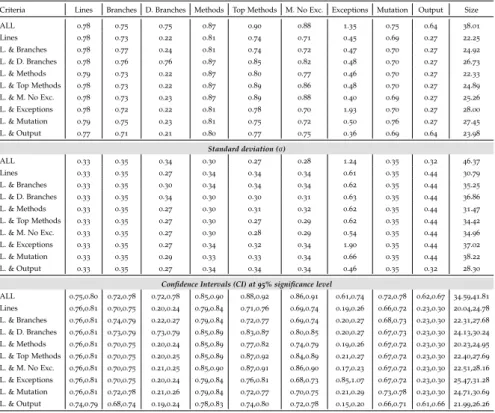
Multiple Coverage Criteria. Our first contribution is mainly moti-vated by the fact that most literature on automated test generation is guided by a single coverage criterion, i.e., branch coverage. As the optimisation of a single criterion may not exhibit other properties of the software under test, we define five coverage criteria, and extend search-based test generation to optimise the combination of those five in addition to the ones commonly used in the literature (i.e., statement and branch coverage, and weak mutation).
1.4 t h e s i s o u t l i n e 7
Evolutionary Algorithms for Test Suite Generation.Despite the fact that a simple genetic algorithm can achieve good results on average, many other evolutionary algorithms are suitable for test generation. We perform an empirical evaluation of six evolutionary algorithms and two random approaches at optimising a single criterion (i.e., branch coverage) and at optimising several criteria (i.e., the criteria defined in the previous contribution).
Diagnostic Ability of Automatically Generated Unit Tests. As stated by our first contribution, other properties (and not just branch coverage, or not even just coverage criteria but also non-functional criteria) of the software program may be explored in order to exhibit properties developers would desire, e.g., ability to automatically find faults. We propose a non-functional criterion to improve the effectiveness of coverage-based unit tests at detecting and localising faults. We integrate it on the most effective evolutionary algorithm found by our second contribution.
Continuous Test Generation. A typical automated unit test genera-tion technique targets one component of a software program (e.g., a class in Java) at a time. A class, however, is usually part of a software project consisting of many more classes which are subject to changes over time. We introduce Continuous Test Generation (CTG), which includes automated unit test generation during continuous inte-gration. CTG offers several benefits over traditional test generation approaches: first, it answers the question of how much time to spend on each class; second, it helps to decide in which order to test them. Finally, it answers the question on which classes test generation should be applied.
The EvoSuite Toolset.In order to improve the integration of the Evo -Suite test generation tool into the development process of software engineers, we present a set of new plugins for Maven, IntelliJ IDEA, and Jenkins; and we also report the challenges arisen when develop-ing those plugins.
1
.
4
t h e s i s o u t l i n e
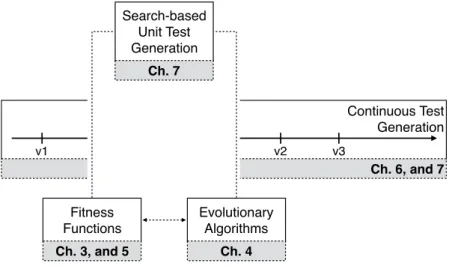
This thesis is structured as follows. First, the state of the art on soft-ware testing and on automatic test generation is reviewed in Chap-ter 2. Then, the five contributions described in the previous section are presented in detail in five chapters. The research topic(s) that each chapter contributes to is shown in Figure1.2.
The first three chapters focus on automatic test generation for a sin-gle version of a software under test. Chapter 3 proposes the optimi-sation of several coverage criteria for test generation. Chapter4
eval-uates which evolutionary algorithm works best for test generation. Chapter5presents a non-functional criterion which aims to improve the diagnostic ability of a coverage based test generation approach.
Chapters6 and 7 are devoted to the application of automatic test generation on software that evolves over time. Chapter 6 introduces the concept of continuous test generation and describes several ap-proaches to efficiently apply automatic test generation on every itera-tion of software that is, typically, developed continuously. Chapter 7 describes the development of three new plugins for the state of the art tool on automatic test generation, i.e., EvoSuite, which aim to reduce the gap between what tools are proposed by researchers and what is actually used by practitioners in industry. It also discusses lessons learnt when developing and evaluating these plugins in practice.
Finally, Chapter8 presents our final conclusions and discusses po-tential directions for future work.
Continuous Test Generation Ch. 6, and 7 v1 v2 v3 Fitness Functions Search-based Unit Test Generation Evolutionary Algorithms Ch. 7 Ch. 3, and 5 Ch. 4
Figure1.2: Thesis outline.
1
.
5
o r i g i n o f t h e c h a p t e r s
Besides Chapters 1, 2 and 8, each chapter of this thesis is based on at least one paper published in a peer review symposium or interna-tional conference. The following list summarises these publications per chapter.
Chapter 3 is based on a paper published in the proceedings of the 7th International Symposium on Search-Based Software Engineering (SSBSE),2015[10].
Chapter 4 is based on a paper published in the proceedings of the 9th International Symposium on Search-Based Software Engineering (SSBSE),2017[11].
1.5 o r i g i n o f t h e c h a p t e r s 9
Chapter 5 is based on material published in the proceedings of the 28th IEEE/ACM International Conference on Automated Software Engineering (ASE),2013[12].
Chapter 6 is based on a paper published in the proceedings of the 29th ACM/IEEE International Conference on Automated Software Engineering (ASE), 2014 [13]; and it is also based on a paper pub-lished in the proceedings of the 7th International Symposium on Search-Based Software Engineering (SSBSE),2015[14].
Chapter 7 is based on a paper published in the proceedings of the IEEE International Conference on Software Testing, Verification and Validation (ICST), 2016 [15]; and and it is also based on a paper published in the proceedings of the 10th International Workshop on Search-Based Software Testing (SBST),2017[16].
2
L I T E R AT U R E R E V I E W
In this chapter we survey the most relevant concepts and works re-lated to the contributions of this thesis. We first introduce software testing, then we review the state of the art techniques on automated test generation and automated regression testing.
2.1 Software Testing . . . 11 2.2 Random Testing . . . 15 2.3 Symbolic Execution for Software Testing . . . 19 2.4 Search-Based Software Testing . . . 23 2.5 Regression Testing . . . 37 2.6 The EvoSuite Unit Test Generation Tool . . . 42 2.7 Summary . . . 43
2
.
1
s o f t wa r e t e s t i n g
“Software testing is the process of operating a system or component under specified conditions, observing and recording the results, and making an evaluation.”
— IEEE Std.610.12-1990[17] Despite the variety of different software development processes such as the waterfall model or agile, there is one activity that is shared by all of them,software testing. Software testing is conducted by develop-ers to check the correctness and completeness of the code they wrote, and to guard it against future regression faults. However, as the soft-ware cannot be exhaustively tested in general, it can never show the absence of faults (as claimed by Dijkstra [6] in1972). Thus, the main goal of software testing is to find as many faults in the software as possible.
Software testing has become such an important piece of software development process, that it is commonly estimated that half of the total cost/time to develop a software program is dedicated to testing & debugging [5]. The reason is that, although it is very common to use automated tools to execute test cases, such test cases are commonly hand-written which is a tedious and error prone task. Automating the creation of such test cases offers several benefits, however it also raises some issues that would have to be addressed in order to be useful to use those tests. On one hand, automation could reduce the cost/time of the testing process, and it could also create a much more complete
set of test cases (as they would be systematically generated). On the other hand, there are two main issues that need to be considered when generating test cases automatically: 1) test data (which inputs should be used to exercise the software under test?), and2)test oracle (does the execution of the test reveal any fault?).
In the following sections, we describe the concepts and definitions in software testing, and how to measure the quality of a test suite. Then, we survey the state of the art techniques on automated test generation.
2.1.1 Concepts & Definitions
Atest suiteis a collection oftest casesfor a target software under test which comprises a set of methods or functions, each of which consists of a list of statements. Each statement can be a conditional statement (e.g.,if), a method call or aregularstatement. A conditional statement results in two branches depending on the evaluation of its predicate. A test case is an executable function which sets up a test scenario, calls some methods/functions in the software under test, and checks that the observed behaviour matches the expected one — typically by using test oracles also known as assertions. For simplicity, a test case can be regarded as a sequence of calls to methods of the software under test. Executing a test case yields an execution trace, i.e., a se-quence of executed statements which can either end normally with a regular statement, or with an uncaught exception. If the execution of a test case does not match the expected behaviour it can indicate a defectin the software under test. A defectis a flaw, or imperfection in the software under test, such as an incorrect design, algorithm, or implementation. It is also known as a fault or bugand it is typically identified when a test case throws anerroror afailure. Anerroris a dis-crepancy between the intended behaviour of a system and its actual behaviour inside the system boundary. Afailureis an instance in time when a system displays behaviour that is contrary to its specification.
Throughout this thesis we may use the terms test suite and suite interchangeably, in which case we normally intend the former. More-over, we may use the terms test and test case interchangeably, in which case we normally intend the latter. Furthermore, we may use the terms faultandbugto refer to a defect, andfailure to refer to both cases oferrorsandfailures.
2.1.2 Evaluating the Effectiveness of Testing
Due to the large number of parameters or configurations to test a software program, it is infeasible (in practice) to test all possible com-binations. So, when should we stop testing? Which parameters or configurations are more adequate, e.g., more likely to reveal faults?
2.1 s o f t wa r e t e s t i n g 13
In order to answer these questions, several techniques to measure the quality of test cases have been proposed [18]. The two most common techniques arecoverage analysisandmutation analysis.
2.1.2.1 Coverage Analysis
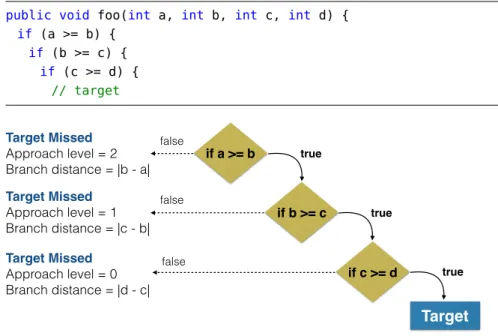
Coverage analysis is a deterministic technique which uses coverage criteria to evaluate whether there is at least one test case exercis-ing each pre-defined coverage target. Each target is commonly rep-resented by a single statement, branch, or condition in the software. For instance, the statement coverage criterion requires all statements in the software to be executed by at least one test. Branch coverage cri-terion requires all branches in the software to be satisfied at least once during testing. For example, the software under test in Listing 2.1 is fully covered at branch level if, one of the sub-conditions on line 2is evaluated as true, and if both sub-conditions on line 2are evaluated as false by at least one test case. However, for this particular software under test, just exercising one of the conditions to satisfy the branch may not be enough to cover the faulty code (i.e., a < c). Conditional coverage criterion, on the other hand, requiresallsub-conditions in a conditional statement to be satisfied at least once during testing. For example, to fully satisfy conditional statement on line 2, both sides of each sub-condition have to be satisfied by at least one test case — a total of four test cases, assuming one test case per side of each
sub-condition.
Listing2.1: Motivational example for the evaluation of the effectiveness of software testing.On line2there is a fault, instead of a < c it should be read
b < c.
1 public boolean foo(int a, int b, int c) { 2 if (a > b || a < c) { /* FAULT */ 3 return true; 4 } 5 return false; 6 } 2.1.2.2 Mutation Analysis
The purpose of software testing is to find faults in the software. How-ever, as the location of those faults is usually unknown (otherwise they would have been fixed), the effectiveness of test cases at detect-ing potential faults is, typically, measured on artificial faults. These faults (also known as mutants) are small syntactic variations created by applying mutation operators to the original code. Typically, muta-tion operators only replace relamuta-tional operamuta-tions, modify condimuta-tional statements, or delete statements [19]. For example, supposing the original program described in Listing 2.1, a single mutant could be created by changing a > b to a < b on line 2. A mutant is killed if
there is at least one test case that reveals the changed behaviour, i.e., its outcome is different when executed on the mutated and original program. Otherwise, the mutant is consideredalive. The effectiveness of a test suite is measured by the ratio (also known asmutation score) of the number of mutants which are killed by the test suite / total number of mutants.
Although mutation analysis has been used in several testing sce-narios such as test generation [20], regression testing [21, 22], fault localisation [23], etc., several limitations are still a barrier for muta-tion testing techniques being adopted in practice. For instance, the efficiency of mutation testing. Mutants can be automatically and sys-tematically created [24, 25], however, each mutant requires the exe-cution of all test cases. That is, given a large software program for which thousands of mutants can be created, executing all test cases against each mutant would be extremely expensive. A recent study conducted by Pearson et al. [23] on the effectiveness of coverage-based and mutation-coverage-based fault localisation techniques, reported that, experiments with mutation-based techniques took more than100,000 CPU hours to complete. To alleviate this limitation several approaches have been proposed to reduce the number of mutants, for example, by identifyingredundantmutants [26] — semantically equivalent vari-ations of the original software. However, the identification of redun-dantmutants is an undecidable problem [27].
As mutants have been using as a proxy to real faults, one might ask whether test suites that are effective at detecting mutants are also effective at detecting real faults [28]. A recent study conducted by Just et al. [29] compared the effectiveness of manually written and auto-matically generated test cases at detecting real faults and mutants. They found that for the majority of faults there is a correlation be-tween detecting real faults and mutants. For a large sample of those faults for which such correlation did not exist, stronger or new muta-tion operators are required.
2.1.3 Automated Test Generation
Software testing is still the most effective approach at ensuring a soft-ware program does what it was designed for. However, manually writing test cases is an error prone and time consuming task. To re-duce this cost, researchers have devised approaches to automate the generation of test cases.
Some of the proposed approaches assume the existence of a formal model of the software (e.g., UML [30]), and many other popular ap-proaches require only source code. To generate test cases from source code, the simplest approach is to do so randomly[31]. This approach can produce large numbers of tests in a short time, and the main in-tended usage is to exercise generic object contracts [32, 33] or code
2.2 r a n d o m t e s t i n g 15
contracts [34]. Approaches based on symbolic execution have been popularized byDynamic Symbolic Execution (DSE)[35], which system-atically explore paths from a given entry point of the program under test. Generating tests that resemble manually written tests (i.e., few short test cases with high coverage) is commonly done using Search-Based Software Testing (SBST). When applyingSBSTfor test generation, efficient meta-heuristic search algorithms such as genetic algorithms are used to evolve sequences of method calls with respect to a certain set of criteria, e.g., coverage [36].
2
.
2
r a n d o m t e s t i n g
The most naïve test generation technique is Random Testing (RT). In RT, the software under test is exercised with randomly [31] gen-erated inputs from the whole input domain of the software, and its observed output. Due to its simplistic nature, RT can be applied in practice with litter overhead and it has been widely used to, for ex-ample, exercise generic object contracts [32, 33], code contracts [34], unexpected security problems [37], and to reveal failures in several software systems [35,38]. However, there are some disagreements be-tween researchers and practitioners on the coverage and effectiveness achieved by RT techniques on test generation [5, 39, 40]. The main point of criticism among researchers is the lack of a strategy to gener-ate inputs, asRTtechniques do not take into account any information about the software under test [5], i.e., in theory, every test input in the input domain has the same probability of being selected. For example, consider the code under test in Listing2.2. The probability of the con-ditional statementif (x == 10)being satisfied is1in232(assuming
xis a32-bits value), which illustrates the limitation ofRTapproaches.
Listing2.2: Motivational random testing example adapted from Godefroid et al. [37].
public String returnTen(int x) {
if (x == 10) {
return "Six"; /* FAULT */ } else {
return "Other number"; }
}
The technique proposed by Pacheco et al. [33] (and the accompa-nied tool named Randoop [41]) is slightly different from the pure random technique described above. Randoop is a feedback-oriented technique which explores the execution of tests as they are created to avoid generating invalid inputs. First, it generates a sequence of meth-ods calls (each one selected at random), and methmeth-ods arguments from previously created sequences. Then, it executes a sequence in order
to provide feedback to the test generator, e.g., to avoid generation of tests that lead to runtime exceptions or to generate assertions that could trigger future changes. It has been shown [33] that Randoop is able to generate tests that are able to detect previously-unknown errors (not found by pure random techniques) in widely used Java libraries. However, the large number of test cases generated by ran-dom testing techniques (including Randoop) may limit their adoption in practice. As executing, evaluating, and maintaining such tests can become impractical over time.
2.2.1 Adaptive Random Testing
Based on the assumption that inputs that could trigger a failure are lo-calised on continuous regions [42–45] of the input domain, Adaptive Random Testing (ART) was first proposed by Chen et al. [46] as an enhanced alternative to RT. The idea behind ART is that if any pre-viously generated input have not revealed the failure, new inputs should be widely spread across the input domain to increase the like-lihood of covering likely faulty areas.
Several approaches have been proposed onART. For instance, the approach proposed by Chen et al. [47] starts by generating a single random test input and adds it to a pool of test inputs. Then for each test input in the test pool, it generates a set of k (recommended value is k =10) random test inputs. Thekiinput with the highest euclidean distance to all previously selected test inputs (i.e., the ones in the test pool) is selected and added to the pool of test inputs. The main disadvantages of this approach are: 1) the size of the pool of test inputs could grow out of hands, and2) the euclidean distance could be very expensive to calculate for a large pool of test input.
Chen et al. [48] described the input domain as an m-dimensional hyper-cube and generated inputs that are evenly-spaced as mathe-matical possible across the input domain. Due to the limited number of inputs their approach generates on each iteration [48], it can only be applied on problems with a finite number of dimensions [49]. Al-though previous studies [48, 50] showed that their approach could produce better test inputs thanRT, there is little evidence that it could perform better than any otherARTapproach [51].
Restricted Random Testing (RRT) proposed by Chan et al. [52] is an
ARTapproach thatexcludesareas of the input domain. RRTstarts by randomly generating a test input from the entire input domain (for example, test input t1 in the left side of Figure 2.1) and creating an exclusion region around t1. Then, new test candidates are generated,
for example, c1 andc2. However, as they are in an exclusion region, both are discarded. If a test candidate is successfully generated out of an exclusion region (e.g., c3), it becomes a valid test input (e.g.,
2.2 r a n d o m t e s t i n g 17
region is to small, similar test inputs could be generated. On the other hand, if an exclusion region is too large, similar inputs would never be generated and the total number of inputs that could be explored would be limited. It is worth noting that outside of exclusion regions candidates are selected with the same probability.
c3
•
t1 c2•
t1•
t1•
t2 c1 c1 c2Figure2.1:RRTexample adapted from Liu et al. [53].
In order to verify whether a new candidate is inside/outside of an exclusion region, RRT approach measures the euclidean distance between the new candidate and all test inputs previously selected, which could be very time consuming for a large number of test in-puts. To reduce this computational overhead, approaches such as mir-roring [54] and forgetting [55] have been proposed. In the mirroring approach, ART is just applied to a sub-domain and then test inputs are mirrored to other sub-domains. In theforgettingapproach, only a constant number of previously generated test inputs (and not all of them) are considered when evaluating new ones.
Similar to the idea of partitioning the input space, Chen et al. [56] proposed two other approaches: Adaptive Random Testing by Bysec-tion (ART-B) and Adaptive Random Testing by Random Partition-ing (ART-RP). As in a typicalARTapproach,ART-BandART-RPfirst generate a random test input from the entire input domain (accord-ing to a uniform distribution). Then, the ART-Bapproach bisects the input domain into two (in the case of two-dimensional input domain) equal-sized partitions (see Figure 2.2). Any following test candidate can only be selected as a valid test input, if it is in the empty partition (which does not contain any previously generated test input) rather than from the whole input domain. On the other hand, the ART-RP
approach partitions the input domain at the selected test input and the following test candidates can only be selected if they are from the empty partition (see Figure 2.3). The generation of test inputs stops when a termination condition is met, e.g., there are no more partitions to explore.
The issue shared by both ART-B and ART-RP approaches is that all test inputs from an empty partition have the same probability of being selected. Therefore, test inputs that are close to previously gen-erated inputs could be selected, which could decrease the effective-ness of the tests [57]. To address this issue several approaches based on localisation of previously selected test cases have been proposed. For instance, Adaptive Random Testing by Bysection with
Restric-•
t1 c2•
t1•
t1•
t2•
t3 c1•
t2Figure2.2:ART-Bexample adapted from Liu et al. [53].
•
t1 c2•
t1•
t1•
t2•
t3 c1•
t2Figure2.3:ART-RPexample adapted from Liu et al. [53].
tion (ART-BR) [58] approach introduces a restriction which prevents test candidates that are near in the input domain to a previously se-lected partition or test input, of being sese-lected (similar to the RRT
approach proposed by Chan et al. [52]).
Opposite to previous approaches, Tappenden et al. [49] applied an evolutionary search algorithm to find a new test input that maximises the minimum distance from all previously generated test inputs. The evolution is guided by a distance-based fitness function, e.g., the eu-clidean distance.
Ciupa et al. [59] appliedARTon object-oriented programs instead of numeric ones and proposed an approach named Adaptive Random Testing for Object-Oriented (ARTOO) software. In their approach the distance between objects is the combination of elementary distance (the distance value for primitive/reference types, e.g., levenshtein dis-tance for string attributes), type disdis-tance (the path length to any sim-ilar ancestor, and the number of their attributes/methods), and field distance (the distance value to other objects). ARTOO uses the av-erage distance between objects rather than the maximum minimum distance as typically used by ARTtechniques. Although it has been shown that ARTOO does not generate as many test inputs as RT, it requires more time to detect failures than RT[59]. Lin et al. [60] also proposed an approach to generate test inputs for object-oriented pro-grams named ARTGen. ARTGencreates a pool of objects and bound-ary values of the input space, and then usesARTto select objects from the pool.
2.2.2 Effectiveness of Random Testing
Although random testing approaches have been studied in detail, there are different conclusions in the literature about the
effective-2.3 s y m b o l i c e x e c u t i o n f o r s o f t wa r e t e s t i n g 19
ness of it. Thayer et al. [39] argued thatRT should be recommended as a fundamental step of the testing process, however Myers et al. [5] stated thatRTis the poorest test input methodology.
Mak [61] compared RT and ART in terms of number of test in-puts required to detect the first failure, and concluded that ART is able to detect the first failure with 30% (occasionally 50%) less test inputs. Although ART may be quicker or require less test inputs to detect the first failure than RT, ART requires more computational time and memory because the additional task of generating test in-puts evenly spread across the input domain [49,56,62,63]. An empir-ically study conducted by Mayer et al. [64] confirmed that although Distance-based Adaptive Random Testing (D-ART) andRRT are the most effectiveARTapproaches, their runtime may become extremely long. More recently, Arcuri et al. [65] reported that although ART could perform better than RT, the chance of finding faults with ART
is less than1%.
In the next section we survey another testing technique which rather than generating random inputs to explore a program under test, it generates specific inputs to exercise a given path of the pro-gram.
2
.
3
s y m b o l i c e x e c u t i o n f o r s o f t wa r e t e s t
-i n g
Symbolic Execution (SE) is a program analysis approach that executes a software program with symbolic values instead of concrete inputs (as the approaches discussed in Sections2.2and2.4), and represents the values of program variables as symbolic expressions [66].SE ap-proaches proposed in the literature have been successful at finding subtle bugs in several NASA’s projects [67], at testing newly-modified source code [68,69], at automated debugging [70], and in many other areas [71,72].
To better understand howSEworks, consider the following snippet of code:
1 public void foo(int x) { 2 int y = x * 3; 3 if (y == 42) { 4 System.out.println("GOOD"); 5 } else { 6 System.out.println("BAD"); 7 } 8 }
In an execution with concreteinputs, foowould be called with a con-crete value (e.g., 7). Then, y would get the result of multiplying 7 by 3, i.e.,21. As 21 is not equal to 42, the condition on line 3 would
be evaluated as false, and therefore the execution would print the word “BAD”. In a symbolic execution, foo would be called with a symbolic value (e.g., β). The execution then proceed with the multi-plication and assignsβ×3toy. Therefore, the condition to be evalu-ated on line 3is no longer if (y == 42) butif (β × 3 == 42). At this point in the execution,β could take any value. To solve the con-straint β × 3 == 42, i.e., to generate two values such that each one could satisfy each outcome of the expression (i.e., true and false), constraint solvers such as Z3 [73] are usually used. For this particu-lar example, the value 14 would make the condition to be evaluated as true, and any other value would make the condition to be evalu-ated asfalse. Therefore,SEhas explored all feasible paths of this toy example. However, the number of paths in a program can grow expo-nentially with respect to the size of the program — a problem known as path explosion — or with the presence of loops (where the num-ber of possible iterations could make the numnum-ber of paths infinite). Therefore, applying traditionalSE approaches to real and large soft-ware programs can become impractical [71,72]. Nevertheless, several approaches have been proposed to address this issue and we explore them in the following.
Boonstoppel et al. [74] proposed an approach called Read-Write set
(RWset) which discards paths that will produce the same result (i.e.,
paths that cover the same basic blocks) as any previously explored path.RWsettracks all reads and writes of all variables in order to be able to detect that the suffix of a path, i.e., the remainder steps of a path can be determined and are equivalent to a suffix of a previously explored path. In such case, the execution is considered redundant and the path is pruned.
Majumdar et al. [75] argued that generating test cases for one in-dependent variable at a time could eliminate the test combination of every single input, and therefore, reduce the number of paths needed to explore the program under test. To achieve this, their approach computes the control and data dependencies between variables. Paths with the same trace are considered redundant and pruned.
Santelices et al. [76] presented an approach named Symbolic Pro-gram Decomposition (SPD), in which symbolic execution is just per-formed in a group of paths (known as path families), i.e., paths that have the same control and data dependencies. Similarly, Qi et al. [77] proposed an approach to group program paths based on the pro-gram output. In their approach, paths are considered equivalent if the output is affected when: 1) statements of control dependencies are executed, and 2) statements of potential dependencies are not ex-ecuted. The main difference between Santelices et al. [76] and Qi et al. [77] approach is the precision of each one. The approach proposed by Santelices et al. [76] uses a static analysis which over-approximates (i.e., precision is sacrificed) the exploration of path families. On the
2.3 s y m b o l i c e x e c u t i o n f o r s o f t wa r e t e s t i n g 21
other hand, the approach proposed by Qi et al. [77] uses a dynamic analysis which under-approximate the exploration of relevant slices.
Ma et al. [78] proposed an approach to automatically find a pro-gram execution (i.e., path) that is able to reach a particular target goal (e.g., statement). They proposed two strategies: Shortest-Distance Symbolic Execution (SDSE), and Call-Chain-Backward Symbolic Ex-ecution (CCBSE). SDSE can be described as a top-bottom strategy. It executes the program symbolically, and uses a distance metric to guide the symbolic exploration through the control-graph to a partic-ular target. This means that during the symbolic execution, the path with the shortest distance to the target goal is always selected. On the other hand, CCBSEcan be described as a bottom-top strategy. It starts at the target goal and goes backwards until it finds a feasible path from the start of the program.
2.3.1 Dynamic Symbolic Execution
Approaches based on symbolic execution heavily rely on the pre-cision of the underlying constraint solver to generate concrete in-puts. However, symbolic values related to native code, third-party libraries, or just too complex symbolic constraints may not be han-dled by the underlying constraint solver, which can lead to an in-complete execution of a path as the effect of that code would be completely ignored [79]. To address this issue, Dynamic Symbolic Execution (DSE) [35] (also referred as concolic execution [80]) has been proposed. InDSE, the program under test is simultaneously ex-ecuted with concrete and symbolic values, and when symbolic values can not be handled by any underlying constraint solver (e.g., Z3[73]), they are replaced with concrete values.
A popular variant to apply DSE is to manually write a parame-terised unit test as an entry function, and then to explore the paths through a program by deriving values for the parameters of the parameterised test [81]. Or use randomly generated test inputs to explore as many paths as possible, and then apply DSE to cover the paths that were not covered by any randomly generated test in-put [82].
Godefroid et al. [37] presented an approach which applies SE on
fuzz testingcontext. Their approach executes the program with an ini-tial input and it creates the iniini-tial path constraint. Then, instead of just expanding one path constraint using depth-first search (to expand the first constraint) or breadth-first search (to expand the last constraint) as usually done bySEtechniques, their approach attempts to expand all constraints at once. Hence, maximising the number of inputs gen-erated in each symbolic execution.
Babi´c et al. [83] proposed an approach to automatically prioritise in which order paths should be explored. Their approach can be
de-scribed in three main steps. First, a static and dynamic analysis is performed by executing a set of existing tests to identify indirect jumps in binary files. Second, it creates a control-flow graph of the program under test and identifies possible vulnerabilities based on loop pattern heuristics and out-of-bound accesses. Third, it executes the program under test with symbolic values and generates concrete values that are able to trigger the vulnerabilities identified in the pre-viously steps. The effectiveness of their approach highly depends on the initial set of tests.
Anand et al. [79] proposed a technique called type-dependence analysis which performs static analysis to identify areas of the pro-gram under test that could not be executed symbolically. A report of those problematic parts (accomplished with some context infor-mation) is then provided to the developer, so that he or she can im-prove the program under test by performing the suggested changes. Similarly, Anand et al. [84] proposed an approach calledheap cloning which identifies the areas of the code that introduce imprecision in a symbolic execution, e.g., when executing native code. Their approach creates two heaps (“concrete heap” and “symbolic heap”) for the same program, each with a copy of all program’s objects. During the execution of the program, objects in the “concrete heap” are up-dated when native code is execute, objects in “symbolic heap” are updated when code of the program under test is executed. Thus, the side-effects of native code that introduced imprecision could be auto-matically identified by simply comparing both heaps.
To reduce the number of paths explored by aDSEtechniques due to loops in the program under test, Godefroid et al. [85] proposed an approach to summarise a loop body during a symbolic execution. For instance, to cover statement abort1in Listing2.3(line9),x has to be greater than zero and c equal to 50. To cover statement abort2 (on line16),xshould be zero, andcequal to xi (wherexi is the iterated value of x). Then, and based on this information, Godefroid et al. [85]’s approach summarises the variables that are modified within loop by a constant value, by creating the precondition (x > 0) and the postcondition ((x = 0) ∧ (c = xi)). Assuming the underlying constraint solver can handle these pre/postconditions, the number of paths to test would be reduced.
Listing2.3: Motivational symbolic execution example adapted from Gode-froid et al. [85].
1 public void foo(int x) { 2 int c = 0; 3 int p = 0; 4 while (true) { 5 if (x <= 0) { 6 break; 7 } 8 if (c == 50) {
2.4 s e a r c h-b a s e d s o f t wa r e t e s t i n g 23 9 abort1(); /* FAULT 1 */ 10 } 11 c++; 12 p = p + c; 13 x--; 14 } 15 if (c == 30) { 16 abort2(); /* FAULT 2 */ 17 } 18 }
Saxena et al. [86] also proposed an approach to reduce the overhead of loops onDSEtechniques. In their approach, for each program loop an extra symbolic variable is used to count the number of times a loop is executed. Then, static analysis is performed to analyse the relations between that symbolic variable and the values of the variables of the program under test. The main difference between both works is that, the one proposed by Godefroid et al. [85] analyses loop’s structure
on the fly without using any other tools, as opposed to the approach proposed by Saxena et al. [86] which detects the loop’s structure using static analysis.
Although, overall, SE/DSE approaches can effectively generate high-coverage tests, they may not scale to complex programs (i.e., programs with a large number of paths) or object-oriented programs (for which a sequence of statements is require to invoke and interact with the program, rather than just optimising input values to cover specific paths). In the following section we survey search-based soft-ware testing approaches which have been successfully applied to the test generation problem [87,88].
2
.
4
s e a r c h
-
b a s e d s o f t wa r e t e s t i n g
Although the term Search-Based Software Engineering (SBSE) was first introduced by Harman and Jones in2001[89] as the application of meta-heuristic search algorithms to address software engineering problems [90–93], the first application of optimisation techniques is commonly attributed to the work proposed by Miller et al. [94] in 1976. Miller et al. [94] used numerical optimisation techniques to gen-erate floating point test data to cover paths of a software program. Since then, the application of meta-heuristic search algorithms to soft-ware testing — known as Search-Based Softsoft-ware Testing (SBST) [95] — has become the most successful and popular area ofSBSE [88]. In
SBST, test cases (or only test inputs) represent the search space of a meta-heuristic search algorithm and they are typically optimised for structural criteria [36,87,96–100]. However, other criteria such as functional and non-functional requirements [101, 102], mutation [20, 103], and exceptions [104–106] have been also explored [88].
Earlier works on structural testing aimed to automatically gener-ate test data (i.e., numeric inputs) for procedural code [87, 88]. For instance, in the work proposed by Korel [97] the software under test is instrumented and first executed with random inputs. If, by chance, the chosen path (previous selected by a software tester) is fully cov-ered, the test inputs are saved. Otherwise, branch distance is com-puted at the point where the execution diverges from the desired path, and a local search algorithm is applied to find alternative inputs that could satisfy that particular branch while at the same time pre-serving the coverage until that point. Xanthakis et al. [96] proposed a similar approach. In their work the selected path is first explored by a random search approach and all branch predicates are extracted. Then, a search algorithm is applied in order to satisfyallbranch pred-icates at the same time.
To alleviate the effort of manually selecting program paths (which could be very time consuming, in particular for complex programs), Korel [107] proposed a goal-oriented technique. Instead of selecting a program path, the developer only has to select a target goal, for example, a statement. Then, their technique uses the program’s con-trol flow to filter out non-relevant branches (the ones that the search does not need to satisfy to reach the target goal). Finally, they apply a search algorithm to generate inputs that satisfy all relevant branches. Pargas et al. [99] proposed a control oriented technique which aims to cover specific structural points (e.g., a statement) by maximising the number of executed control dependent nodes (i.e., the nodes a structural point depends on). A test input that executes more control dependent nodes of a structural point, should be closer to reach it. However, no guidance is provided to the search on how close a test input is to cover a node.
Later works on structural testing have aimed to automatically gen-erate test cases (i.e., sequences of method calls) for Object Oriented (OO) software [87]. Note that, due to the nature of OO paradigm (e.g., inheritance and polymorphism, object parameters may have to be in a particular state in order to be able to cover the target goal, etc), testing OO software could be more complex than testing procedural programs [108,109]. In such scenario, a test case is no longer a simple set of values but rather a much more complex sequence of method calls and their respective parameters.
The first attempt to test OO software with meta-heuristic search al-gorithms was proposed by Tonella [36]. Their approach uses a genetic algorithm to generate targeted test cases for each individual target goal (e.g., branch). Custom evolutionary operators (i.e., crossover and mutation) are applied to evolve individuals. At the end, all generated test cases are combined into a single test suite. Although effective, their approach may not scale for software with a large number of target goals, as the number of test cases may grow with the increase
2.4 s e a r c h-b a s e d