1
Patriotic Hackers
Steven Wood
A thesis submitted in fulfilment of the requirements of the
Manchester Metropolitan University for the degree of Master of
Science (by Research)
2017
Faculty of Business and Law
Manchester Metropolitan University
2
Declaration
No portion of the work referred to in this dissertation has been submitted in support of an application of another degree or qualification of this or any other university or other Institute of learning.
Steven Wood 20/09/2017
3
Acknowledgements
I would like to thank Professor Dominic Medway for his boundless support and encouragement throughout my studies. I am also thankful to Robert Hegarty and Philip Scown for their backing to the project.
I am also indebted to the participants of my interview groups for giving up their time and sharing their knowledge and contribution to this research project.
I would also like to thank my wife, Jane, and my sons Harrison and Alexander for tolerating their husband and father throughout the whole process. Without their endless support, my studies would have come to naught.
4
Abstract
Patriotic hackers are a group who have not been widely studied. However, their presence in cyberspace during a conflict or crisis escalates matters and can have harmful consequences. Together with their use of advanced cyber weapons, the implications of their actions need to be better recognised and understood.
Utilising current academic and non-academic literature, alongside interviews with industry experts and the author’s own field diary, this study aimed to critically evaluate the current use of patriotic hackers.
In conclusion, contributions to both theory and practice have been made. A theoretical model for patriotic hacking has been developed to aid further research. The advice offered to organisations is not to waste resources preparing for a patriotic hacker attack but rather to work with governments to more effectively respond. Additionally, it is recommended that new, international treaties are required to discourage the use of patriotic hackers, and to attempt to prevent cyber weapon proliferation. Such treaties are required to prevent escalation during crises and to secure the advantages that cyberspace offers to society.
5
Contents
Patriotic Hackers ... 1 Declaration ... 2 Acknowledgements ... 3 Abstract ... 4 1. Introduction ... 7 1.1. Aim ... 9 1.2. Objectives... 91.3. Research impact on practice of management ... 9
2. Literature review ... 10
2.1. Introduction ... 10
2.2. Definitions and typology ... 10
2.3. Anonymous – prototypical hacktivists ... 13
2.4. Cyberwar ... 14
2.5. The law with regard to cyberwar ... 19
2.6. Patriotic hackers and cyber militias ... 21
2.7. Summary ... 23 3. Methodology ... 24 3.1. Introduction ... 24 3.2. Secondary research ... 24 3.3. Primary research ... 25 3.3.1. Interviews ... 25 3.3.2. Field diaries ... 26 3.3.3. Thematic analysis ... 27 3.4. Limitations... 28 3.5. Ethics ... 28 3.6. Summary ... 29 4. Report of interviews ... 30 4.1. Background of respondents ... 30 4.2. Report of interviews ... 30 4.3. Summary ... 34 5. Field diaries ... 36
5.1 Informal discussion with a hacker... 47
6. Secondary research findings – FBI statistics ... 49
7. Discussion of research findings ... 51
6
7.2. Current state of research into patriotic hacking ... 51
7.3. Toolkits and techniques ... 54
7.4. Motivations of individuals involved in patriotic hacking ... 56
7.5. The effectiveness of patriotic hacking in cyber warfare ... 57
7.6. The future role of patriotic hackers in cyber conflict ... 59
7.7. Summary ... 60
8. Conclusion ... 61
8.1. Introduction – The Aim ... 61
8.2. Meeting the objectives ... 61
8.2.1. Objective 1 - Analyse the current state of research into patriotic hacking ... 61
8.2.2. Objective 2 - Determine the toolkits and techniques the hackers use, highlighting the flaws, strengths and weaknesses ... 62
8.2.3. Objective 3 - Explain the perceived motivations of individuals involved in patriotic hacking 62 8.2.4. Objective 4 - Assess the effectiveness of patriotic hacking in cyber warfare ... 63
8.2.5. Objective 5 - Discuss the future role of patriotic hackers in cyber conflict ... 63
8.3. Summary ... 64
8.3.1. Contributions to theory ... 64
8.3.2. Contributions to practice ... 66
8.4. Recommendations for further study ... 66
9. Glossary ... 67 10. References ... 68 11. Appendices ... 75 11.1. Appendix I ... 75 11.2. Appendix II ... 87 11.3. Appendix III ... 93 11.4. Appendix IV ... 102 11.5. Appendix V ... 110 11.6. Appendix VI ... 111 11.7. Appendix VII ... 117 11.8. Appendix VIII ... 118 11.9. Appendix IX ... 120
7
1.
Introduction
The world of the 21st Century is one that will be increasingly wired, with the domain of computer communication across the internet becoming paramount. Whilst many in developed economies may be familiar with using smartphones and tablets, the advent of the Internet of Things (IoT) means that connected devices will become even more commonplace throughout the entire world (Weissman, 2015; Eddy, 2015) . Cyber security has long been recognised as crucial by policymakers, industry and academics (UK Government, 2015). However, as people’s fridges, televisions, cookers, heating systems and other household appliances become connected to the network, the scope of the cyber domain becomes that much greater. Additionally, warehouse equipment, office machines and factory devices are become connected to the internet in greater numbers. CNI (Critical National Infrastructure) which includes Nuclear Power Stations, Traffic Light Control Systems, Hospital Equipment, and the financial sector, etc. is exposed to this paradigm shift (Weissman, 2015; Eddy, 2015).
A survey for Business Intelligence in 2014 asked executives to answer questions about the Internet of Things (Weissman, 2015) and found that the greatest barrier to further investment is security. Whilst business executives were already concerned about disruptive and costly hacks, the general public was also becoming more concerned. The Dyn/Mirai attacks of late 2016 demonstrated why the public and policy makers should have concern (Etherington and Conger, 2016). Such attacks established that you do not have to own an IoT device to suffer the consequences of insecure devices. The scope for attack is increasing; the IoT market is expected to hit $7.3 trillion by 2017. In a survey by Trend Micro (Eddy, 2015), the majority of respondents thought their information would be sold by companies for unknown purposes. Despite this, Eddy (2015) confirms that a large majority said they would plan on continuing to use smartphones, tablets and smart home devices. This shows the conflict between ease-of-use and security concerns that is already present in the public.
Additionally, the sensitivity of IoT data, e.g. medical devices, presence detection by thermostats etc. causes additional concern. Smartphone data is typically about the digital world, IoT data is about the physical world.
This cyber environment, especially via IoT, is growing larger and more complex as the century continues and gives hackers a broader landscape to operate in and target. However, society has been exposed to hacks since arguably 1903 when the first ‘hack’ took place (Marks, 2011). Criminal gangs have been using the internet for criminal behaviour since at least the 1990s, with the level of computer skills a key factor in their involvement in cybercrime (Sela-Shayovitz, 2012). One of their favoured attack methods is phishing; a social engineering method to get people to do something they should not – often initiated by an email (Mansfield-Devine, 2013). The number of phishing attacks made against the public has risen considerably and is now considered ubiquitous (Raether, 2008). One of the reasons given for this is that the human element in technology is considered to be the weakest link. There will always be a technical arms race between the attacker and the defender, but the human element remains constant and is therefore attractive to hackers (Mansfield-Devine, 2013).
Another form of online delinquency is hacking and is older than the internet. It has been found that low self-control and deviant peer associations can lead to hacking (Holt et al, 2012). However, when hacking is combined with political activism it becomes hacktivism - a portmanteau of hacking and activism. According to Denning (2015), hacktivism has now become commonplace and activists operate all over the globe; both in democratic societies and more authoritarian regimes. Denning (2015) states that hacktivism began in the late 1980s; antinuclear protesters in Australia launched a computer worm against NASA in 1989. By the mid-1990s, Distributed Denial of Service (DDoS) had been added to be hacktivists toolbox. This is where an attacker takes advantage of security
8
vulnerabilities to use an innocent partie’s computer to attack another computer. The attacker can then force the computer to send spam to particular email addresses or to send large amounts of data to a website. The attack is "distributed" because the attacker is using multiple, distributed computers to instigate the denial-of-service attack (McDowell, 2009). Hacking has become very popular for activists and malware authors and/or crackers alike due to its lack of geographic boundaries, ease-of-use and the limited responses law enforcement agencies can react with (Denning, 2015).
A closely linked group, but with differing viewpoints, are the patriotic hackers who, when under greater organisation, can form what are called cyber militias. The type of warfare used by them is highly asymmetric. One definition of patriotic hackers is "…someone who, with the agreement of their government or without the agreement of their government, is carrying out malicious IT acts on behalf of their country” (respondent D from section 4.2). The rise of patriotic hackers has come later than that of hacktivists but, as opposed to hacktivism, is a poorly researched area (Dahan, 2013). It is this group that this study shall focus upon. However, the wider context of hacktivists, cyberwar and the law relating to it must also be discussed to place things in the correct context.
Against the backdrop of increased interconnectedness, the spectre of cyberwar, criminality and other forms of conflict rises. The general public is gradually becoming more aware of the importance of personal security on the web (Eddy, 2015); but is less likely to be aware of cyberwar and the actors involved in it, let alone the possible repercussions to themselves of such a conflict.
Cyberwar is “any virtual conflict initiated as a politically motivated attack on an enemy's computer and information systems” as given by the techopedia online dictionary. Giesen (2013: 66) pleads for a more restrictive definition with “Cyberwar… can only take place between two or more states”. The codification of cyberwar is troubling for lawmakers and academics alike; its amorphous nature, hidden operatives and lack of respect for territorial boundaries make it challenging to define. Chayes (2015) attempts to pin down what constitutes a state act of aggression in cyberspace; in doing so they give credence to NATO’s Tallinn Manual and its own attempts at definition. With the
repercussions that may come to pass if a state was found to be responsible for a cyber attack, nations have found other ways to act in the use of proxies. Such proxies are often patriotic hackers. The senior Whitehouse advisor, Richard Clarke, does not believe a cyberwar has happened yet, but he does believe its inevitable (Anon, 2016a). Meanwhile, NATO’s Sarin Ducaru states that a cyberwar against one of its members does not automatically trigger Article 5 - the general NATO call-to-arms. However, he adds that any retaliation need not be constrained to cyberspace; it may involve a military response (Anon, 2016b).
The lag between new forms of cyber attack and relevant legal frameworks is another troubling aspect of cyberwar. Whilst lawmakers struggled to keep up, Giesen (2013) believes a superpower may be partially to blame. Giesen suggests that the USA is reluctant to agree new, multilateral agreements on cyberwar conduct due to its primacy in cyber offensive capability; his thinking is that the USA does not wish to constrain itself. The exploits of the Equation Group, believed to be part of the NSA (National Security Agency), give this thinking some credence (Menn, 2015). What is clear is that some of the weapons developed to fight a cyberwar have leaked into the public domain, to the general detriment of society (Thomson, 2017).
9
1.1.
Aim
The aim is to:
Critically evaluate the current use of patriotic hacking
1.2.
Objectives
The objectives are to:
• Analyse the current state of research into patriotic hacking
• Determine the toolkits and techniques the hackers use; highlighting the flaws, strengths and weaknesses
• Explain the perceived motivations of individuals involved in patriotic hacking • Assess the effectiveness of patriotic hacking in cyber warfare
• Discuss the future role of patriotic hackers in cyber conflicts
1.3.
Research impact on practice of management
It is expected that the impact of this research will be the improvement in awareness of patriotic hackers in the practice of management. The research, whilst providing rich insights, will give IT and security managers the opportunity to improve defences against the cyber weapons found during the research. An understanding of the tools and techniques used by hackers will also benefit the same managers by allowing them to better prepare defences. Theoretical knowledge on patriotic hackers will be increased and premises will be made with a view to defining concepts; this will aid further research.
10
2.
Literature review
2.1.
Introduction
The project undertook an extensive literature review to find any relevant reading on the subject of patriotic hacking. This review considered the potential limitations of a study into patriotic hacking, what research in the area needed to occur, and how much empirical evidence on the subject is already out there. The literature review utilised journal articles, books, conference papers, web blogs and other relevant discourses. The literature was critically evaluated, and a discussion made on areas for further research. The following issues were identified in respect of the research area: • Confusion – i.e. contradictory evidence
• Neglect – i.e. little robust research
• Alternative perspectives – i.e. other scenarios which may have indirect relevance and/or implications for the subject of patriotic hacking
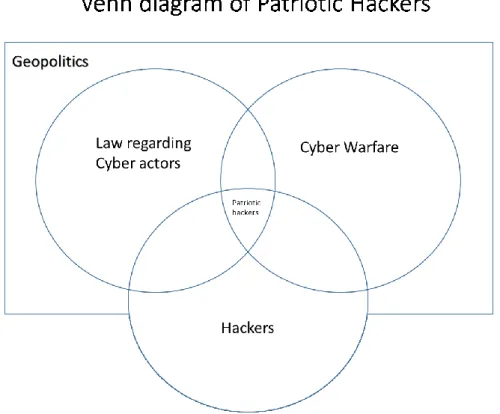
The aim places the literature review in the following context: Figure 1 Venn diagram
2.2.
Definitions and typology
Attempts have been made to document the different kinds of malfeasant behaviour that goes on in the web, with authors such as Ashenden (2011) stating the importance of doing so for public engagement.
Seebruck (2015) attempted a typology in a paper and gave the following: coders, hacktivists, cyber warriors, criminals, insiders, crowdsourcers, novices and punks. The latter two groups work on the web for recreation. The criminals operated for profit and the coders for prestige. Under the ideology
11
banner sat the hacktivists and cyber warriors. The final group were defined as operating for revenge and incorporated both the crowdsourcers and insiders.
Borghard and Lonergan (2016) define three types of non-state actors in the cyber domain: alliances, mercenaries and proxies. Alliances are defined here as associations between the state and a
collection of individuals. Mercenaries are cyber warriors for hire. The final one, proxies, is where a state may pass cyber weapons to a group of non-state actors to act on their behalf politically. Borghard and Lonergan’s (2016) typology of proxies is shown in a table 1 below:
Table 1: Proxy typology
Individuals or small, unorganised groups
Organised groups
Political ends Patriotic hackers, hacktivists, cyber terrorists
Cyber armies or militias
Economic ends Geeks Criminal collectives
Additionally, but not shown above, ‘moonlighters’ may flit between each unit as and when the money dictates.
Denning (2000), argued that patriotic hacking is covering state on state conflict with the perpetrators of the cyber attacks being citizens and expatriates rather than governments. This definition implies that these acts only take place when a conflict or war between nation states is going on. Other authors regard this as too simplistic and believe that it can happen outside of a full conflict (Ottis, 2011).
Ottis (2011) has developed a model for classifying non-state actors in cyberspace. Three different kinds of models for volunteer based cyber militias are: the Forum, the Cell and the Hierarchy. They all have the ability to use cyber attacks in order to achieve political goals. The Forum can be considered an ad hoc militia who meet in an online place and assume roles in an upcoming
campaign. Such roles could be trainer, malware provider, a temporary leader etc. It is easy to bring together and usually disbands once the immediate objective is gained.
The Cell is more organised, with individuals more likely to know each other whilst remaining anonymous to the outside world. The Cell moves in time with the ebb and flow of the associated conflict and can remain in place a long time. The set-up is resistant to infiltration as everyone knows one another but can be restricted on scalability. That is, there are only so many hackers with the necessary skills willing to perform politically minded attacks.
The Hierarchy is again more organised with a definite structural that is recognisable in traditional warfare models. There is a clear chain of command and it can be retained even in peacetime. They are, however, vulnerable to changes in public mood which may lead to curtailment of funding and possibly disbandment.
As one moves from Forum to Cell to Hierarchy the complexity, level of command and control, together with sophistication, increases. From a traditional military perspective, this seems desirable. However, with the increased command and control also comes less reactivity; the Hierarchy takes a lot longer to form than a simple structure like the Forum. It is likely that the Hierarchy model is the one most nation states would like their cyber militias to form yet, in principle, all three models could be used to support the cyber capability of the state (Ottis, 2011).
12
Authors sometimes conflate the terms hacktivists and patriotic hackers. This is true for Owens et al. (2009) themselves in their paper “Technology, Policy, Law, and Ethics Regarding U.S. Acquisition and Use of Cyberattack Capabilities”. Denning (2015) also conflates them, whilst Borghard and Lonergan (2016) and Seebruck (2015) argue that they are very different kinds of cyber actor. Furthermore, Aschmann et al (2015) claims that patriotic hackers and online religious fanatics can be given the general term of cyber warrior. This is counter to other definitions by Denning (2015) and Borghard and Lonergan (2016) who do not conflate these two groups. Meanwhile, Kshetri (2013) fuses a definition of patriotic hackers with cyber criminals. He argues that, in China, many so-called patriotic hackers are motivated by financial gain. He adds that, if this is true, then they cannot be considered patriotic hackers but merely cyber criminals.
Patriotic hackers have ties of allegiance towards their home country (either nationality or ethnicity) and conduct cyber attacks against whom they perceive to be the enemy of their country (Barata, 2015). Such hackers often serve state interests despite having no official link with them, as President Putin has recently argued whilst discussing Russian hacker incursions into foreign elections (Hille, 2017). Putin was quoted as saying “…hackers are free people like artists” and that they were involved in a “… justified fight against those speaking ill of Russia”. Barata (2015) argues that a patriotic hacker is one driven only by political ends rather than, for example, religious ones. Dahan (2013) defines them as parochial, self-identifying by their nationalism and patriotism, being to the right of the political spectrum and with little cohesive ideology. Worrying, Dahan (2013) also states that patriotic hackers set out with the intention to cause maximum damage in any conflict.
As can be seen above, there are multiple definitions of a patriotic hacker.
The definition of non-state actors, such as patriotic hackers, in the cyber world pose problems to easy characterisation. Initial United States thinking on non-state actors engaging in online conflict would have had them characterised as terrorists. This simple definition quickly breaks down when a detailed look at each of the actors online is made (Borghard and Lonergan, 2016). Russian mafia and Asian triad activity online is now recognised as being in the realm of cyber criminals, and not
terrorist activity. Indeed hacktivists, patriotic hackers and other online activists who conduct activities online may be in breach of various laws and regulations; however, these do not fit easily under either under terrorist or criminal denominations. Some authors have tried to define the actors by their intended targets e.g. Critical National Infrastructure. Again this quickly becomes
problematic, for example a lot of the critical infrastructure in advanced Western countries is privately owned. Is an attack against these an act of terrorism or an act of corporate espionage/ sabotage? Another problem with this approach is the fact that in kinetic warfare, critical
infrastructure is often targeted and is regarded as an act of war, not of terrorism (Borghard and Lonergan, 2016). Kenny (2015) concurs that equating cybercrime, hacktivism or cyber warfare to cyber terrorism is not useful.
Robinson et al (2015) state that any comprehensive definition of cyberspace itself reflects its four constituent parts: it is an operational space, it is information based, it is a natural domain and its interconnectedness. Robinson et al (2015) further define it as a global domain within the
information environment, using information technologies to exchange, exploit, modify, store and create information using the electromagnetic spectrum. This definition is adopted by this paper. Cyberwar, and cyber warfare, are a commonly used terms in the mainstream media yet there are multiple definitions within literature. Alford (2001) defined cyberwar as something states engaged with to advance a national agenda and is executed against software controlling processes. However, this definition does not take into account religious beliefs or ideologies that are occasionally the aim
13
of modern warfare (Robinson et al, 2015). Another definition comes from Carr (2012) who contends that cyberwar is the art of fighting without fighting, with an aim of defeating an opponent with no blood spilt. This must be questioned on the basis that cyberwar can target CNI, which could lead to loss of life, as Colarik and Janczewski (2011) stress. A definition put forward by Cornish et al (2012) stated that cyberwar can be between states or between non-state actors and that its effects can be imprecise and unpredictable. This definition highlights the fact the actors such as patriotic hackers can be involved in cyberwar and that such a conflict may target elements other than that intended, with unforeseen consequences. Robinson et al (2015) give a simpler definition as “cyberwar occurs when a nation state declares war, and where only cyber warfare is used to fight the war”. They segregate the terms cyberwar and cyber warfare, with the latter being able to be conducted without necessarily leading to full cyberwar. They also define cyberwar in a way that means as soon as kinetic force is used then it becomes a ‘normal’ war, not a cyberwar. Robinson et al’s definition, rejecting that cyberwar and cyber warfare are synonyms, is one that we shall use.
2.3.
Anonymous – prototypical hacktivists
Although hackers are often alone with their computers, they nonetheless habitually belong to larger communities (De ´cary-He ´tu et al, 2012). Anonymous is one such community and is an online anarchist collective that first emerged in 2003 on the website known as ‘4chan’. The group was set up as a discussion place for like-minded individuals to discuss means of online protest. Anonymous became more widely known in 2008 after an attack on the Church of Scientology. Typically, this hacktivist group came into being when a network of individuals with the same beliefs came together. They were driven by a sense of mischief and the culture of intervening in the affairs of other people (Olson, 2013). The path of individual activists coalescing into the collective “Anonymous” is
described by Cavelty and Jaeger (2015) and contends that its creation and operation pose a threat to state power. One of the main aims of the collective appears to be challenging states’ desire for unrestrained surveillance. Campaigns against surveillance are thus conducted and pose questions relating to a nation state’s agency and legitimacy. This leads credence to the idea put forward by Olson (2013) that the collective was anarchist in nature.
While some individuals were politically minded, a lot more of the participants were simply cyber bullies, who wanted to waste an evening having fun at other people’s expense (Olson, 2013). These divergent aims could never be fully reconciled within Anonymous. From Anonymous came a smaller group, LulzSec; according to Olson (2013) a less serious and more comedic chapter, and possibly an attempt to reconcile these differences. It should be noted though, jokey demeanour or not, that LulzSec went on to attack the USA’s National Crime Agency and the FBI.
When a particular cause aroused interest, Anonymous discussed targets, their vulnerabilities and possible methods of attack (for an example, see figure 8 in section 5). Such methods of attack include DDoS, website defacement and the exfiltration/ leaking of sensitive or embarrassing information (Buchan, 2016). During the armed conflict between Israel and Hamas in 2014,
Anonymous used cyber attacks against Israel. Their status, as civilians in an armed conflict, is a grey area in international law. It can be argued that Anonymous violated international humanitarian law by targeting civilian as well as military sites in Israel. This ambiguity could mean that civilian protest groups, organised online, could become targets for reprisals by a victim state's military. Whilst the Tallinn Manual suggest ways of dealing with this behaviour within international law, it is not binding and further work on codification of cyber conflict is urgently required (Denning, 2015).
14
The main difference between hacktivists such as Anonymous and patriotic hackers is that the former are driven by the defence of a social issue (i.e. targets of their hacking activities are violating certain social issues) whereas the latter are driven by patriotic concern. Indeed, hacktivists often attack their own country if they believe they are violating a certain social issue (Barata, 2015). Hacktivists tend to be international and cosmopolitan in outlook and set out to do minimal damage with often
humorous attacks (Dahan, 2013). They have been widely researched (Coleman, 2014; Parmy, 2013) and their methods, psychology and the effectiveness of their hacking activities have all been considered. Conversely, a patriotic hacker is more likely to be nationalistic and parochial. Patriotic hackers are usually volunteers (though some are coerced into action) who engage in Cyber activities on behalf of their nation state, with or without the state’s tacit approval (Dahan, 2013; Kesan and Hayes, 2012; Ottis, 2010).
2.4.
Cyberwar
Whilst the actions of criminals and disillusioned individuals is widely understood by the public, the online actions of nation states is less well understood. However, it has been widely studied by academics, lawmakers, humanitarian organisations and military theorists (Droege, 2013; Fisher, 2011; Pool, 2013; Barata, 2015). Chen (2010) has argued that the era of cyber warfare began with the advent of Stuxnet, a particularly sophisticated worm with a very specific choice of target. This target was a programmable logic controller made by Siemens and was significant as it was used in nuclear plants in Iran and, specifically, was part of the Uranium enrichment centrifuges.
Knopova and Knopova (2014) have stated that Stuxnet is one of the best examples of malware using a zero day vulnerability. The interesting side story is that the Siemens equipment was allegedly sold to the Iranians by the Italians on the black market in breach of the sanctions in place. It was
compromised because it could, therefore, not be updated. A windows vulnerability was used, but the payload that targeted the Step7 software could only be developed by a complicit insider from Siemens, or someone in their supply chain. Additionally, Stuxnet was widely believed to have been initiated due to the efforts of the Equation group (Menn, 2015).
However, it also showed the problem of developing cyber weaponry such as Stuxnet. This worm was the product of the United States of America Equation Group and Israeli computer experts working together between 2005 and 2009, with a specific aim – that of targeting Iran’s nuclear program. They did not plan on something that would spread chaotically all around the world, but one which would have a very clear target. In that aim they succeeded. However, Knopova and Knopova (2014) state that the development of this weapon led to variants of it i.e. the Flame, Gauss and DuQu malwares (Hejase et al, 2015) that damaged the USA’s allies e.g. South Korean banks. This
demonstrates the possible boomerang effect of cyber weapons. An additional example is the recent ‘WannaCry’ virus outbreak that has been alleged to have come from stolen Equation Group cyber weapons (Thomson, 2017). One author goes further by quoting a source who states that the Equation Group developed malwares were “100 per cent” the work of the USA’s intelligence agencies (Fox-Brewster, 2015). The WannaCry virus was quickly followed up by the NotPetya
ransomware outbreak, developed from similar code. Knopova and Knopova (2014) conclude that the new cyber weapons being developed represents a paradigm shift in warfare; they also conclude that a worldwide conflict between two countries with equally developed systems has not happened yet as the results would be grave and would therefore be very visible.
The notorious insecurity of the Internet of Things, combined with its widespread adoption, means a much wider scope for malicious actors in cyberspace to try and attack. With network controlled valves operating in the nuclear industry and on things like gas pipelines, respirators in hospitals and
15
switches on the electrical grid, the list of targets has never been so broad (Kesan, 2011). However, a more optimistic view is taken by some commentators, “Squirrels have taken down the power grid more times than hackers have, which is zero” (Scharf, 2015, p323). In a similar vein, Kenney (2015) contends that despite the concerns raised by the advent of Stuxnet and similar viruses/worms, the necessary skills and knowledge to exploit them and to take down a nation’s critical infrastructure, are not widely dispersed within the non-state cyber community. He explains that the real threat from terrorism online is in the ability to widely reach out to different communities and to attempt to recruit them using the web’s forté; instant communications over large geographical distances
(Kenney, 2015). Scharf (2015, p325) comments that Stuxnet “may have been the first ethical weapon ever created” as it only ever targeted exactly what it was designed for with no risk of damaging similar equipment in places other than Iran. However, the fact that it was further developed into Flame and Gauss means this position is contentious.
After Stuxnet, four significant cyber attacks against nation states were recorded. These were against Estonia in 2007, Lithuania and Georgia in 2008 and Kazakhstan in 2009 (Henry et al., 2010; Hejase et al., 2015). It is significant that the cyber attack that took place in Estonia in 2007 involved patriotic hackers (Michael et al., 2010). The first of these, Estonia, can be considered as a leader in
information technology, with a high percentage of the local population using the digital economy. Indeed, Estonia has been rated first out of 28 European countries for e-governance (anonymous, 2016a). The ex-president of Estonia, Toomas Ilves, however, recognises this as a double edged sword. With the population using things like a digital signature, which has proved very popular, and with the country’s infrastructure now hooked up to the network, this has meant that the country is open to disruption from a cyber attack. Indeed in the recent past, patriotic hackers from Russia have attacked the country’s infrastructure.
Cyber attacks are now thought to be commonplace (Michael et al, 2010) and range from many nuisance attacks to major disturbances that can threaten to destabilise nation states e.g. cyber attack on the Ukrainian power grid in January 2017. Additionally, during a cyber attack, digital information could be destroyed, exploited or corrupted and Rege (2014) gives this type of attack the denomination Digital Information Warfare.
Some of the key states with known cyber offensive capabilities include the United States of America, the United Kingdom, Russia, China, Bangladesh, North Korea, Pakistan, India, Syria and Iran
(Tennant, 2009; Aschmann et al, 2015). They have been called cyber superpowers. However, cyber capability development are not just limited to these powers but to all modern countries of the globe. For example, Kostyuk (2014) debates the capabilities of the Czech Republic in dealing with any cyber attack. They conclude that smaller nations should cooperate more with their allies to defend
themselves against cyber attack from the superpowers. However, it is not just smaller powers who are concerned. Americans, according to a poll conducted in 2014, were more afraid of cyber attack than North Korean or Iranian nuclear weapons, Chinese/Russian authoritarianism or climate change (Scharf, 2015).
Although Russia is considered heavily involved in cyber attacks (Henry et al., 2010) various authors also raise concern about China. The Economist (2013) maintains that China's current hacking armies are so brazen in their attacks that they simply do not care if they get caught. The conclusion is that there is no penalty from carrying out such attacks. This deduction is given extra weight by the work of Gutmann (2010). Certainly, companies and Non-Governmental Organisations (NGO’s) working in China are very careful not to directly criticise the Chinese Government; they do not want their operations curtailed by the state. It is believed that Chinese hackers have attacked Google, The International Olympic Committee, the World Anti-doping Agency and numerous environmental
16
NGOs (The Economist, 2013). Some hackers have declared that they have acted patriotically in conducting these attacks, however, The Economist (2013) states that the Chinese government is actually behind them. Their interpretation is that it certainly seems that having patriotic hackers fighting for you gives the government carte blanche to avoid international laws. One of China's first hacking groups (The Green Army) came to the attention of the Chinese police; yet instead of being shut down, the police utilised them for their expertise. It is now believed that the People's Liberation Army (PLA) have a cyber command and control department, PLA Unit 61398, which incorporates hundreds if not thousands of hackers (McMillan, 2013). The exact reason for the increased use of cyber attacks by the Chinese is not known, however, it can be extrapolated from recent events. The USA's use of technology in the war in Iraq has had a major impact on Chinese thinking; they now believe that the only way to win a future war between superpowers is if they establish information superiority (Thomas, 2008). Chinese digital assault on the West has given further credence by Gutmann (2010) in his paper describing the USA’s attempts at moderating Chinese hacks. Operation Aurora, Chinese hacks of over 30 western companies during 2009, was put forward as evidence enough of Chinese intentions; conversely the USA’s secret service hacks were not mentioned. Chinese control of patriotic hackers is an interesting side note mentioned by Gutmann (2010). However, there are at least two sides to this story; as of 2014, the USA was spending “up to 4 times as much on cyber offence than on cyber defence” (Scharf, 2015, p323).
The USA's and China's relationship with regard to cyberspace is of strategic importance; a great deal of tension has been generated by perceived actions in this domain (anonymous, 2016c). The main charge is that Americans think the Chinese are conducting industrial espionage using the Internet. Numerous security firms, such as Crowdstrike, have reported abundant incidents of espionage that can be traced back to hackers based in China. In the USA, during 2014, 97% of the Fortune 500 companies were aware that they’d been hacked – Scharf (2015) suggested that the remaining 3% had also been hacked but did not yet know it. Scharf also suggested that Initial thinking in Western countries was that China would not and could not be stopped from pursuing industrial espionage. However, Barack Obama's government in the United States challenged this assertion and began to make headway against Chinese hacking. They began this in 2013 by stating to the Chinese Premier that these continued hacks were damaging the bilateral relationship (Knake and Segal, 2016).
Additionally, in 2014 the Federal Bureau of Investigation indicted five Chinese army hackers; this was seen as an attempt by the USA’s government to ratchet up the attribution of any espionage. This was followed up in 2015 by the administration signing an executive order to allow for economic sanctions against companies benefiting from ill-gotten gains using cyber espionage. The Chinese government responded by agreeing to investigate cybercrimes at the behest of the USA’s government (Knake and Segal, 2016). Following on from this for Chinese government also made similar agreements with other western countries such as the United Kingdom. Critics of the deals were sceptical that the Chinese government would cease its cyber activities; previous attempts at reining them in have come to naught (Knake and Segal, 2016).
It has been argued that China, since signing these deals, has attempted to downgrade its own cyber criminals. Whilst some cyber security companies have reported a decline in Chinese cyber attacks, e.g. FireEye, others were more sceptical. For example, Crowdstrike have not detected any
appreciable slowdown in activity. With a new USA government now in place, commentators are concerned that China may backslide on previous agreements. Continued vigilance and engagement by the new administration would need to be enacted to increase the chances of China sticking to its commitments (Knake and Segal, 2016).
17
China’s involvement in cyber espionage has also been forensically investigated. Informed sources now talk of a complicated ecosystem of cyber espionage which is multi-layered, highly distributed and difficult to unpick (Deibert and Rohozinski, 2010). Deibert and Rohozinski demonstrate that such systems require expertise and effort to be able to uncover where they originate from. They have shown that the theft of classified and sensitive documents from Indian officials and the office of the Dalai Lama can be traced back to the People's Republic of China. However, they caution that you can not necessarily infer that the Chinese government were behind such attacks, as the attackers’ methods involve routing through various servers all over the world – it might still be someone other than the Chinese who launched the attack. Another finding was that Indian officials were
compromised by actions taken in a visa office in Afghanistan; this demonstrates the complex nature of the information security challenge – it is without borders. While Chinese Government
involvement cannot be ruled in or out, the findings do point to individuals residing in China and being active members of underground hacking communities (Deibert and Rohozinski, 2010). In response to Western, and particularly the USA, political pressure China has attempted to change the narrative that it is in an irresponsible and dangerous hacker nation (Iasiello, 2016). One way it tried to do this was by arresting hackers that had been identified by the USA and, therefore, proving it could be a responsible partner inside cyber law enforcement. Iasiello (2016), however, suggests this is mere window dressing and is in fact part of China's ‘Three Warfares’ articulated in their 12th Five Year Plan. The three elements are legal, psychological and media manipulation. These were a bid to influence international relations and forestall any economic sanctions against them in response to their continued hacking. Iasiello’s findings support the views expressed earlier by Mattice (2013) where Chinese hacking was considered the USA’s greatest national security threat. Gompert and Libicki (2014) stress that offensive cyber capabilities are inherently exacerbators of crisis instabilities around the globe. Their argument is based on cyber attacks being: short lived, difficult to duplicate, having ambiguity of results, an ambiguity of purpose and the ability to be initiated without senior political knowledge. They conclude that such properties are a particular concern with regard to the geopolitical instability between the USA and China.
Whilst the actions of China have been excising the USA and Indian governments in particular, military experts are troubled by how cyberwar will play out. Concerns over how future cyberwar may escalate, be terminated or may lead to kinetic warfare was expressed by Owens et al (2009). Historically, the USA has always sought to have dominance in military matters – but this is much harder to attain in cyberspace with nations beginning with a level playing field. Defending against cyber attack is challenging, with a wealth of targets available. As cyber attack is not constrained by geographical distances, defending all possible targets is problematic. In regular warfare you concentrate defence on the points closest to the enemy; in cyberspace everywhere is close to the enemy (Tennant, 2009).
In future conflict, it is anticipated that cyber armies will fight alongside kinetic forces as an
integrated part of the military structure (Aschmann et al., 2015). Additionally, it is thought that both state and non-state actors will be present on the battlefield. There are various non-state cyber militias currently in active online service; examples include forces such as the Bangladesh cyber army and the K9 network cyber army (USA affiliated). Cyber armies will be expected to take part in both offensive and defensive action. Offensive action includes proactive and reactive offence using worms, viruses and other cyber weapons. Defensive roles include ensuring the internet security of key targets and running network scans etc. to try and spot hidden enemies (Aschmann et al 2015).
18
How cyberspace and the combatants within it fit into conventional military thinking has been puzzling military theorists for the past decade. Originally, and certainly in the United States, cyberspace was thought of as a physical domain, similar to the domains of air, space, land and sea (Butler, 2013). Butler also demonstrates that the thinking was that cyberspace would be co-opted into the Electro Magnetic Spectrum (EMS) and would therefore sit alongside radio waves, lasers and microwaves. This approach quickly ran into difficulties; for example, if radar is included then why not sonar? Military thinking in the United States has now moved away from attempting to neatly fit cyberspace into one of the existing domains. Current military thinking is that cyberspace is unique and the physical methods of Information Systems are superficial. Its logical and virtual nature are its defining characteristics. This is important for several reasons; it means that cyberspace with its own domain has become as important as an aspect of military thinking as more traditional, physical based domains. Secondly, the existing models of attack and defence (attack to be met by an organised defence) no longer exist. A cyber attack happens at the speed of light and organised defence against an attack in a reactive manner simply will not work. Organised defence can only have been done in advance of an attack. Everything else is retrospective and whilst not unimportant, e.g. a patching service to prevent a similar attack, it does not constitute a defence in kinetic terms. The unique nature of cyber warfare therefore means established methods of waging war do not apply; a new doctrine is needed for future cyber conflict (Butler, 2013).
Henry et al. (2010) hope that a framework for cyber deterrence is possible for the United States and its allies. They hope that these will promote greater cooperation internationally, and therefore prove a deterrent to cyber adversaries. Henry et al. (2010) and Kan (2013) maintain that improved cyber policies are essential to prevent a ‘digital Pearl Harbour’, i.e. a cyber attack having similar
repercussions to the Pearl Harbour attack of 1941 that brought the USA into World War II. It has been argued that, in contrast to conventional warfare, deterrence doesn't work very well in cyber warfare (anonymous, 2016d). The main reasons for this are, firstly, that every countries network is different, and proving an attack against country A does not necessarily mean that a similar attack could work against country B. Secondly, demonstrating your prowess by annihilating the cyber equivalent of an uninhabited Island is not possible (anonymous, 2016d). The possibility that cyber attacks may fail without being detected increases the likelihood of their use as precursors to kinetic conflict (Gompert and Libicki, 2014). An unnoticed, failed attack costs little; encouraging states to think of them as low risk weapons. The ex-leader of Estonia, however, believes that it is possible to have a credible cyber deterrent and cites the USA as an example of having this (anonymous, 2016a).
The abilities of cyber ‘superpower’ armies and possible constraining influences on them is much discussed by legal experts. A NATO manual (The Tallinn Manual) laying out the rules of engagement for cyber warfare, allied to the Geneva Convention, was prepared in 2009 (Schmitt, 2009). However, this document has not yet been adopted internationally (Aschmann et al, 2015).
In a recent interview with the assistant secretary general for security at NATO (Sorin Ducaru), it has emerged that cyberspace is now recognised by NATO as an independent operational domain in much the same way as land, sea and air (anonymous, 2016b). This recognition of the importance of cyberspace means that NATO can better manage the resources allocated to defend this domain. It also means NATO can now develop policy, doctrine and training whilst also pushing for international law to catch up on developments in cyberspace. The issue of activating Article 5 (an attack on one is an attack on all and all must come to the attacked nation’s defence) is an interesting one and the assistant Secretary General would not confirm that a cyber attack would necessarily trigger it. They indicated that the specific political context of the attack would need to be taken into account in
19
much the same way that other forms of kinetic attack are. Thus, NATO’s stance on cyber attack fits in with in its wider doctrine of its defensive mandate. There are no hints from the interview that the more aggressive, proactive or pre-emptive forms of cyber warfare was being contemplated e.g. using proxy forces.
Nonetheless, one of the particular challenges around attribution when cyber attack is to take place is the propensity for some states to use proxy forces e.g. patriotic hackers. Combined with current gaps in international law, this makes the use of proxy forces in cyber attack attractive to nation-states. Various frameworks have been suggested to try and assist with attribution. One of these frameworks suggests that there is a much narrower window for state-sponsored action than conventional wisdom implies (Cantil, 2016). It suggests that where the proxy forces are unskilled or broadly in opposition to the nation-state then their use as proxy forces is unlikely. Conversely, where proxy forces are either highly skilled or very supportive of the sponsoring state, then their use is much more attractive. The framework also suggest that states with unsophisticated cyber capabilities are more likely to engage with proxy forces to pursue a cyber campaign against an enemy. The author also argues that the use of such a framework would mean that fewer false positives in attribution would be made.
A final point, made by Scharf (2015), was that cyberwar is coming and, technologically speaking, nations will not always be able to defend themselves. Therefore, nations should focus on their citizens being psychologically resilient, so that individuals and organisations are prepared for when cyberwar occurs and defences are breached.
2.5.
The law with regard to cyberwar
Pool (2013) states that whilst an applicable legal regime needs to be crafted for future cyberwars, the rules over what constitutes a cyber attack need first to be discussed internationally. Once the definition of a cyber attack is enshrined in international law, then a framework to govern future cyber conflicts can be made (Pool, 2013; Kirsch, 2012). Pool (2013) also establishes that Western democracies may find common ground with more authoritarian states when discussing an
information war. However, other problems exist; the difficulty of attribution during a cyber attack (Pool, 2013; Sample, 2013) and the unknown consequences of such an attack. Addressing these problems will require International cooperation, possibly involving a global network that can easier pinpoint attack origins, and further treaties. They conclude that without developments in
international law, the technology that has been such a boon to humanity may well end up being its bane (Pool, 2013).
Kesan (2011) and Kirsch (2012) argue that self-defence in cyberspace is a necessity and can be justified under existing laws. Kesan (2011) further suggests that counter-striking is also justifiable to protect critical infrastructure of both nation-states and corporations. Kesan and Kirsch add that to keep within the current laws, the principles of mitigation need to be followed. A DDoS attack originating from a ‘zombie’ botnet maybe one example where a mitigative counterstrike is permitted. However, Kesan (2011) recognised that innocent third-parties may be harmed when conducting such a strike. They ask that the legal foundations be solidified to provide cover for such actions, with liability rules provided to protect innocent third-parties.
With regard to irregular cyber forces and attribution, Barata (2015) argues that nation-states have some control over patriotic hackers. Conversely, Beech (2013) suggests that they often act without the knowledge of the nation they are protecting, which makes attribution problematic.
20
Additionally, Barata (2015) demonstrates in his paper the ambiguity within the United Nations Charters with respect to cyber attack and whether it is permissible or not. An example area in the Charter is in respect to the use of force and its comparison in normal kinetic warfare. How and when does a cyber attack bridge the threshold of the use of force? Consequently, Barata (2015) expects that patriotic hackers are often used to avoid international law. By allowing or empowering such hackers to attack an enemy, they can bypass the laws governing nation states. Barata (2015) also argues that the difference between unorganised individuals acting in a patriotic manner, and those that are state-sponsored, must be defined in law to help combat their use.
Moreover, as an example, the effects of the attacks against Estonia in 2007 were out of all proportion to the cause. The events that precipitated the crisis was the moving of Soviet war memorials. This minor action offended the sensibilities of Russian patriotic hackers, which led to serious repercussions for the country of Estonia (Kozlowski, 2014). Therefore, Barata (2015) suggests that there is an urgent necessity for cyber warfare to be legally regulated.
Questions arising from cyber conflict are fairly fundamental: what constitutes an attack? At what point are you allowed to use self-defence? And at what point does an attack fall under the United Nations Security Council, chapter VII (the sanction of military action to return peace)?
Chayes (2015) demonstrates that what some people call a cyber attack are in fact just forms of commercial espionage and therefore should not be a prelude to a full war. Repeated attacks on banks all over the world, combined with cyber attacks on state infrastructure e.g. nuclear power plants, are, however, blurring the lines between criminal activity and outright war (Chayes, 2015; Kan, 2013).
International law when applied to the cyber security space has been found to be limited and authors argue that it needs to be strengthened (Droege 2013; Kirsch, 2012). As a result, humanitarian organisations, such as the Red Cross, have become interested in cyber warfare and its effects upon civilians. Droege (2013) states that existing humanitarian law is not sufficient to protect civilians from the effects of cyber warfare. Droege (2013) then argues that when military and civilian infrastructure overlap and are not easily distinguishable, then one of the basic tenets of a just war, that of protecting the civilian population where possible, becomes difficult to do.
Chayes (2015) also illustrates the point that many governments are not willing to self-limit their own cyber attack potential as it may be too politically damaging to do so. This is given additional weight by the findings of Barnhill (2016), who concurs that there is a disincentive for those in power to accept cyberwar norms and their restraints. It may take a disaster in their own cyber sphere,
possibly involving loss of life, before politicians feel compelled to act. However, nuclear arms control negotiations may be seen as a framework for getting cyber weapons agreement between the superpowers (Chayes, 2015). Torturous and long, international negotiations were needed to bring these treaties into being, and yet they prove that, with enough political will, superpowers will sign up to controlling weapons of global significance. Cyber weapons obviously fall into this
categorisation (Chayes, 2015).
If such treaties follow the same path as the nuclear proliferation treaties then agreements between nation states on the reduction and control of cyber weapons will eventually emerge. This should prevent them falling into the hands of non-state actors e.g. terrorists, hacktivists and patriotic hackers (Chayes, 2015). Such treaties will take a long time to draft, gain agreement and ratify – but what can be done in the short term? Chayes (2015) suggests that, initially at least, a code of conduct between nations may help signal the shift in thinking about cyberwar and the weapons used in it.
21
Once enough nations sign up to this code of conduct, the direction of travel will become apparent to all and encourage more and more nations to sign up (Chayes, 2015). Denning (2015) further
illustrates the challenges for international law as most cyber attacks fall below the required level of the use of force. A follow-up to the Tallinn Manual was proposed to help answer these challenges. However, the Tallinn manual was drafted by legal expert at the behest of NATO yet, when
completed, NATO’s most powerful member said they would not be bound by it; this was, of course, the USA (Scharf, 2015).
2.6.
Patriotic hackers and cyber militias
Patriotic hackers have been mentioned in texts from the beginning of the century. Following the 2001 attack on the twin Trade towers, USA patriotic hackers defaced Arabic websites (anonymous, 2003). These attacks, however, were not welcomed by the state that they were defending i.e. the USA. Karatzogianni (2012) argues that forthcoming cyberwars will be waged principally by non-state actors e.g. hacktivists and patriotic hackers. To illustrate this, he points out that patriotic action by hackers has taken place in numerous incidents in the past two decades. Some of these incidents occured in the Middle East e.g. between Palestinian and Israeli hackers at the time of the Second Intifada (Dahan, 2013). Additionally, the Palestinian – Israeli conflict of 1999/2000 was conducted primarily by patriotic hackers from the two opposing sides and mirrored the unrest going on in the physical world (Allen, 2003). The two main types of attacks made in the conflict were DDoS and website defacement; typical tools used by patriotic hackers.
Other conflicts have even occurred between two superpowers, China and the USA. Two examples are the colliding military aircraft in 2001 and the accidental bombing of the Chinese embassy in Belgrade in 1999; following both incidents patriotic hackers attacked the cyber presence of the opposing countries (Owens et al., 2009).
There are both benefits and disbenefits to the use of proxy forces e.g. patriotic hackers, by nations inside conflicts. One of the chief benefits of them is that the state can act at a remove and therefore make it difficult for them to be a justifiable target of any retributive action. However, some of the dangers of using these actors in this way are that things can escalate beyond the state’s control, and indeed, the cyber weapons may be turned upon the state themselves (Borghard and Lonergan, 2016).
In a discussion on hackers’ effectiveness, Bibighaus (2015) argues that cyberwar is subject to Power-Law randomness and not the usual Gaussian distribution – this implies that outliers are much more important than the average. Thus, one especially gifted cyber warrior is worth far more than a thousand average ones. This has implications for patriotic hackers and their effectiveness; it is quality not quantity that matters.
The growth and capability of China's cyber capabilities has led to alarm in some of the USA’s quarters. One report argues that cyber warfare is now integrated into the formal order of battle of the military forces of China (Henry et al, 2010). In addition to these formal institutions, China makes use of patriotic hackers. Henry et al (2010: 150) illustrate this with “most of the USA’s serious computer incidents in 2007 were from Chinese patriotic hackers”. They also noted that the Red Hacker Alliance counted 300,000 members back in 2006. Again, the lines between cybercrime and cyber warfare are blurred, with the state making use of patriotic hackers and cyber militias who are all too willing to fight for their country. In 2011, it was estimated that the cost of cyber security was around $200 billion a year for the United States alone (Fisher, 2011). The USA believe that a large number of these attacks originate from within China. Interestingly, it may also be a Pandora's box
22
that the Chinese government have opened by supporting the hackers - over 250 million people in China were victimised online by such groups in 2011/12 (Beech, 2013).
Patriotic hackers are occasionally used internally as well as externally. In Russia in 2012, contested local elections lead protesters to mobilise online. Patriotic hackers, with or without state sanction, launched cyber attacks against the protesting parties’ online presence. These were resisted in part by the local Anonymous chapter, hence neatly showing the difference between hacktivists and patriotic hackers (Lysenko and Endicott-Popovsky, 2013). Additionally, whilst patriotic hackers are represented as the foot soldiers in a cyberwar, Anonymous and similar hacktivist groups are not fighting a war, but are in a perpetual struggle for hegemony (Barnard-Wills, 2011).
Another country involved in conflict, the Syrian government, is suspected of active support for patriotic hackers with the collection of cyber warriors known as the Syrian Electronic Army (SEA). Al-Rawi (2014, p427) stated that they are used by the Baath government of Syria as an “online public relations tool” to protect and further their own interests, using Cyber weapons provided by the state. Cyber weapons are relatively low cost and easy to use. This makes them very attractive to states and non-state actors for cyber conflicts. The patriotic hackers in Syria, called the SEA, are thought to be used to steal information from opposition groups, to launch website hacks and to generally try and cultivate an image of a sophisticated regime. Al-Rawi (2014) commented that their use would be similar in other totalitarian regimes, such as North Korea.
Another authoritarian country, China, has repeatedly stated that information superiority is required before any future kinetic conflict. As such, China has integrated cyber warfare into the People's liberation Army (PLA); it can also call upon thousands of patriotic hackers to assist in the cause (Chansoria, 2012).
Two hacker groups based in Russia have become well known and are considered Advanced Persistent Threats (APT’s). They go by the denominations ‘Cozy Bear’ and ‘Fancy Bear’; and both have been linked to Russia's highly capable intelligence services (Alperovitch, 2016). Crowdstrike, an internet security company, investigated these cyber actors when breaches were made to the USA’s Democratic Party’s files in 2016. Crowdstrike believes these cyber gangs are too sophisticated, with superb trade craft and excellent operational security, to not be part of a nation’s state apparatus. The choice of target is telling as well, as the USA elections in 2016 were of high interest to the Russian state. The technique both groups used to infiltrate a network were based around spearphishing campaigns; this allowed a wide range of implants to be placed on the opponent’s network. These include software called a RAT (Remote Access Tool) which utilises the HTTP protocol for command and control (Alperovitch, 2016). Whilst these two groups are closely linked to state security apparatus, they can be called patriotic hackers.
The motivation of patriotic hackers is not found within the literature with the exception of Dahan (2013) who states that they are willing to act criminally out of a sense of patriotism; he doesn't believe they have any manifesto or ethic beyond that of nationalism. Motivations for other hacker types, however, can be found. Jordan (1998; p768) commentated that hackers often acted out of boredom claiming that “…offline life is boring compare to the thrill of hacking”. Jordan also
suggested that curiosity and the thrill of the illicit were additional powerful motivations, whilst Holt and Kilger (2012) suggested that individuals must simply desire to express themselves online to have motivation to hack. Meanwhile, Steinmetz and Gerber (2015) suggest that concern for privacy laws is a possible motivator for some hackers.
23
2.7.
Summary
The threat of cyber warfare has increased with the combination of the advent of the IoT, the failings of international laws and the increasing use of non-state actors as proxies for national forces. One of these proxies are patriotic hackers; not always controlled by their host nations and able to use current cyber weapons when affiliated more closely to the host’s security apparatus. Direct studies about patriotic hackers are few and far between, Dahan (2013) being one notable exception. As such, the literature had to be studied to find more oblique references to them. It transpires that they are an emerging threat in cyberspace, which itself is becoming ever more widespread and important to society.
To summarise, patriotic hacking, as opposed to hacktivism, is a poorly researched area (Dahan, 2013), yet its importance to nation states (Deibert and Rohozinski, 2010) and the risk of further escalation means additional research would be valuable in assessing its impacts on future conflicts in cyberspace.
24
3.
Methodology
3.1.
Introduction
To ensure that the study could be repeated if needed a discussion of the techniques employed to fulfil the aims and objectives was necessary (Marshall, 2002). The selection of data collection methods depended on both the type of information required and the nature of the enquiry (Bell, 2006). The choice of a method is based on what type of information is sought, under what circumstances and from whom, agreed Robson (2006).
Various research methods were available, comprising of primary and secondary research areas, and these were analysed to ensure the correct methods were chosen. Two secondary research methods were considered relevant to the study; a literature review and cyber crime statistics gathered from the Internet. The literature review allowed the identification of relevant literature pertaining to previous, current and future work in the field whilst establishing the research need. The cyber crime statistics were gathered from the Federal Bureau of Investigation (FBI) and helped with context setting. Although some quantitative data was collected, the research project overall was focused on qualitative data collection.
Many different primary, or empirical, data collection methods were assessed. These consisted of interviews, questionnaires, focus groups, observations and feel diaries. The interview, observations and field diary research methods were chosen ahead of the questionnaires and focus groups. The latter two were discounted as they were deemed to be less relevant and useful to this particular project. It was felt that a focus group of hackers or cyber security experts would not be practical and using questionnaires would not elicit the detailed narrative that multiple, comprehensive interviews would.
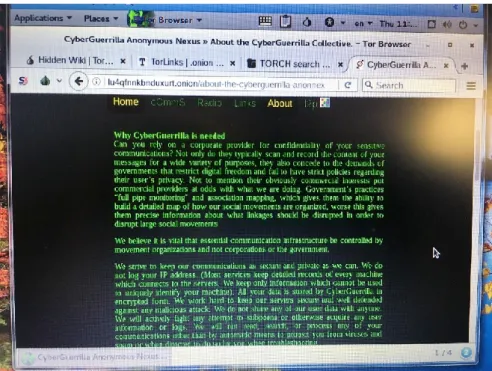
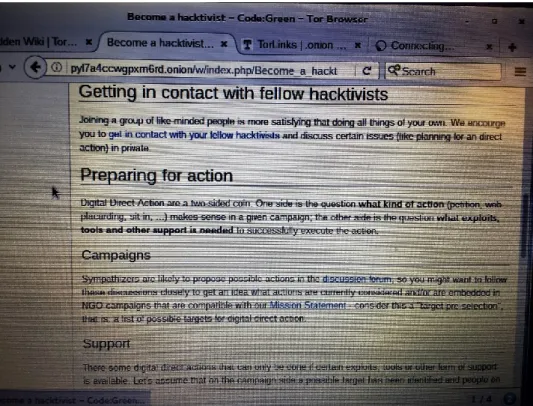
An auto-ethnographic approach was taken throughout the project’s course and this yielded the field diary; this recounted online and off-line interactions by the researcher with members of the hacker community and allowed interpretations to be translated. The individuals involved in these
interactions were anonymised in these notes for purposes of their confidentiality. There were several methodological challenges in this netnography of accessing hackers on the Dark Web (a part of the Deep Web) and these are detailed in section 3.3.2.
3.2.
Secondary research
It was necessary to establish current knowledge in the chosen field and leverage any other research pertinent to the study (Bell, 2006). Denscombe (2002: 54) concurs “the literature review paves the way for research”. Blaxter et al (2002) comment that it forms a base from which a further study can arise. Blaxter et al (2002) also state that the literature review can ensure mistakes made previously can be avoided in any further study. The literature review also helped identify and clarify which research methods best supported the research aims (Davies, 2007). Additionally it was important to be critical of existing work when summarising so that values could transcend subject matter
divisions, as noted by Blaxter et al (2002). Robson (2002) and Bell (2006) state the importance of precisely and clearly referencing any materials used. In the case of this research project, the Harvard referencing system was used.
To assist with context setting, secondary data was collected from the FBI via the IC3 (Internet Crime Complaints Centre) report for 2016. This is discussed in chapter 6.
Objective 1, analyse the current state of research into patriotic hacking, was achieved by conducting a thorough literature review. This was mostly achieved by using the information within academic
25
literature; however, this was supported by reviews of personal websites, blogs and some non-academic articles such as books and newspaper reports.
The other objectives were achieved by combining pertinent information from the literature review with collaborating information from the empirical data collection. Thus, the literature review only partially satisfied these objectives, though it remained an important part.
Where any conflicts arose between the primary and secondary research these were highlighted and discussed further.
3.3.
Primary research
3.3.1.
Interviews
Interviews are considered the ‘gold standard’ of qualitative research (Barbour, 2003) and can give both verbal and non-verbal in-depth information. They are considered ‘gold standard’ because the “elicitation of employee stories may give not only strategists and managers but also the employees telling their stories a deep, contextual, and particular understanding of organizational behaviour” (Kryger, 2017: 2). Fowler and Mangione (1990:11) describe an interview as a “conversation with a purpose” whilst Barbour (2013:132) describes them as an “intense exchange which is seldom seen outside therapy”. This intensity allowed full and frank interviews to be held with the respondents which elicited interesting information. There are variations in how interviews are conducted, primarily around structure and technique. A successful interview depends on the selection of the correct structure (Fowler and Mangione, 1990). The simplicity of the interview is discussed by Kvale (1996), which implies speed, whilst Gillham (2000) argues that it can carry a heavy time penalty to fully plan, execute and analyse an in-depth interview. This planning of an interview must be carefully done to ensure appropriate information is gathered.
Barbour (2013:120) describe a semi-structured interview technique as “crucial as it refers to the capacity of interviews to elicit data on perspectives of salience” and Robson (2006) concurs. However, Gillham (2000) suggests that interviews need to be structured, otherwise a full disclosure of the anticipated data can be missed. Bell (2006) counters this by extoling the ability of a semi-structured interview in allowing the interviewer and interviewee to talk freely and in-depth. Barbour (2013) stresses that piloting of interviews can be effective in ensuring the correct questions are covered by each respondent. The thinking of Barbour (2013), Robson (2006) and Bell (2006) informed this study. Hence, a semi-structured interview approach was taken and used its first interview as a pilot. It then adjusted the topics for subsequent interviews.
Robson (2006) states that audio recording is particular effective for interviews; it allows the interviewer to fully concentrate on the subject whilst ensuring transcription errors are kept to a minimum. It was therefore decided to audio record each interview in this study, with the agreement of each interviewee having been given.
The interview participants were chosen to ensure that they could give insight to the subject matter, whilst also being available when required – their backgrounds are covered in section 4.1. Random sampling was not used as the research was generalising to a theory not a population.
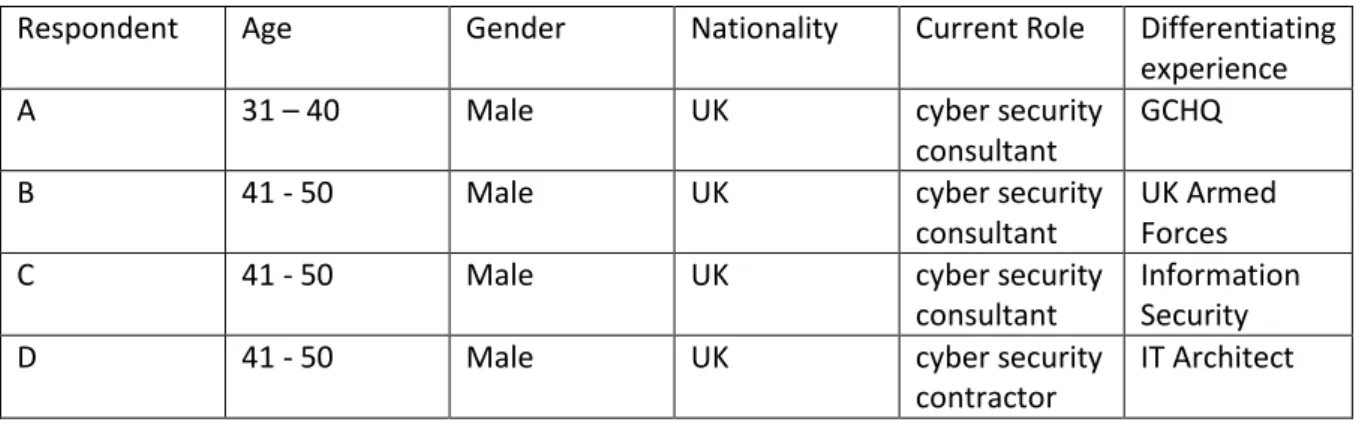
Semi-structured interviews were carried out between February and May 2017 with four
respondents. Two of these interviews were done face-to-face, the other two over the telephone. All were recorded by an audio device. The background of the respondents is shown in table 2 in chapter 4.1. Two of the participants were informally approach by the researcher; they were known to the author due to his previous work in cyber security. The other two became available after following
26
leads from one of the initial participants i.e. snowball sampling. Snowball sampling uses the method where participants’ referrals to new prospects add value as the trust and obligation relationship between the identified person and the referrer means a suitable candidate is more likely to be found (Noy, 2008). It is, however, liable to various forms of bias which need to be carefully mitigated. The key bias of associating with very similar people needs to be recognised when using this method. Prior to each interview, the respondents were given an interview consent form, a list of themes for conversation and a participant information form. These can be found in appendices V, VII and VIII respectively. Whilst the respondents were given a list of starter themes, it was emphasised that it was just a guide and additional topics of interest was actively encouraged.
3.3.2.
Field diaries
The act of researching intimate moments in partakers’ lives can be challenging for academics who seek to understand hard to reach groups, such as hackers (Alaszewski, 2006). To counter this, social researchers have encouraged the idea of field diaries as a method for recording the events of daily life (Harvey, 2011). Diaries can collect qualitative data as part of a multi-method approach, in this research case alongside interviews. Additionally, field diaries can be used to provide additional insight and context to a study (Barbour, 2013). Whether they are unstructured or structured, they can provide additional topics to explore during the interview process.
For the purposes of this study, a field diary was kept using an auto-ethnographic approach. This comprise