Chapter 1
Software Test and Analysis in
a Nutshell
Before considering individual aspects and techniques of software analysis and testing, it is useful to view the “big picture” of software quality in the context of a software development project and organization. The objective of this chapter is to introduce the range of software verification and validation (V&V) activities and a rationale for selecting and combining them within a software development process. This overview is necessarily cursory and incomplete, with many details deferred to subsequent chapters.
1.1
Engineering Processes and Verification
Engineering disciplines pair design and construction activities with activities that check intermediate and final products so that defects can be identified and removed. Software engineering is no exception: Construction of high-quality software requires comple-mentary pairing of design and verification activities throughout development.
Verification and design activities take various forms ranging from those suited to highly repetitive construction of noncritical items for mass markets to highly cus-tomized or highly critical products. Appropriate verification activities depend on the engineering discipline, the construction process, the final product, and quality require-ments.
Repetition and high levels of automation in production lines reduce the need for verification of individual products. For example, only a few key components of ucts like screens, circuit boards, and toasters are verified individually. The final prod-ucts are tested statistically. Full test of each individual product may not be economical, depending on the costs of testing, the reliability of the production process, and the costs of field failures.
Even for some mass market products, complex processes or stringent quality re-quirements may require both sophisticated design and advanced product verification procedures. For example, computers, cars, and aircraft, despite being produced in se-ries, are checked individually before release to customers. Other products are not built
in series, but are engineered individually through highly evolved processes and tools. Custom houses, race cars, and software are not built in series. Rather, each house, each racing car, and each software package is at least partly unique in its design and functionality. Such products are verified individually both during and after production to identify and eliminate faults.
Verification of goods produced in series (e.g., screens, boards, or toasters) consists of repeating a predefined set of tests and analyses that indicate whether the products meet the required quality standards. In contrast, verification of a unique product, such as a house, requires the design of a specialized set of tests and analyses to assess the quality of that product. Moreover, the relationship between the test and analysis results and the quality of the product cannot be defined once for all items, but must be assessed for each product. For example, the set of resistance tests for assessing the quality of a floor must be customized for each floor, and the resulting quality depends on the construction methods and the structure of the building.
Verification grows more difficult with the complexity and variety of the products. Small houses built with comparable technologies in analogous environments can be verified with standardized procedures. The tests are parameterized to the particular house, but are nonetheless routine. Verification of a skyscraper or of a house built in an extreme seismic area, on the other hand, may not be easily generalized, instead requiring specialized tests and analyses designed particularly for the case at hand.
Software is among the most variable and complex of artifacts engineered on a reg-ular basis. Quality requirements of software used in one environment may be quite different and incompatible with quality requirements of a different environment or ap-plication domain, and its structure evolves and often deteriorates as the software system grows. Moreover, the inherent nonlinearity of software systems and uneven distribu-tion of faults complicates verificadistribu-tion. If an elevator can safely carry a load of 1000 kg, it can also safely carry any smaller load, but if a procedure correctly sorts a set of 256 elements, it may fail on a set of 255 or 53 or 12 elements, as well as on 257 or 1023.
The cost of software verification often exceeds half the overall cost of software de-velopment and maintenance. Advanced dede-velopment technologies and powerful sup-porting tools can reduce the frequency of some classes of errors, but we are far from eliminating errors and producing fault-free software. In many cases new development approaches introduce new subtle kinds of faults, which may be more difficult to reveal and remove than classic faults. This is the case, for example, with distributed software, which can present problems of deadlock or race conditions that are not present in se-quential programs. Likewise, object-oriented development introduces new problems due to the use of polymorphism, dynamic binding, and private state that are absent or less pronounced in procedural software.
The variety of problems and the richness of approaches make it challenging to choose and schedule the right blend of techniques to reach the required level of quality within cost constraints. There are no fixed recipes for attacking the problem of verify-ing a software product. Even the most experienced specialists do not have pre-cooked solutions, but need to design a solution that suits the problem, the requirements, and the development environment.
Basic Questions 5
1.2
Basic Questions
To start understanding how to attack the problem of verifying software, let us consider a hypothetical case. The Board of Governors of Chipmunk Computers, an (imaginary) computer manufacturer, decides to add new online shopping functions to the company Web presence to allow customers to purchase individually configured products. Let us assume the role of quality manager. To begin, we need to answer a few basic questions:
• When do verification and validation start? When are they complete?
• What particular techniques should be applied during development of the product to obtain acceptable quality at an acceptable cost?
• How can we assess the readiness of a product for release?
• How can we control the quality of successive releases?
• How can the development process itself be improved over the course of the cur-rent and future projects to improve products and make verification more cost-effective?
1.3
When Do Verification and Validation Start and End?
Although some primitive software development processes concentrate testing and anal-ysis at the end of the development cycle, and the job title “tester” in some organizations still refers to a person who merely executes test cases on a complete product, today it is widely understood that execution of tests is a small part of the verification and vali-dation process required to assess and maintain the quality of a software product.
Verification and validation start as soon as we decide to build a software product, or even before. In the case of Chipmunk Computers, when the Board of Governors asks the information technology (IT) manager for a feasibility study, the IT manager considers not only functionality and development costs, but also the required qualities and their impact on the overall cost.
The Chipmunk software quality manager participates with other key designers in the feasibility study, focusing in particular on risk analysis and the measures needed to assess and control quality at each stage of development. The team assesses the impact of new features and new quality requirements on the full system and considers the con-tribution of quality control activities to development cost and schedule. For example, migrating sales functions into the Chipmunk Web site will increase the criticality of system availability and introduce new security issues. A feasibility study that ignored quality could lead to major unanticipated costs and delays and very possibly to project failure.
The feasibility study necessarily involves some tentative architectural design, for example, a division of software structure corresponding to a division of responsibility between a human interface design team and groups responsible for core business soft-ware (“business logic”) and supporting infrastructure, and a rough build plan breaking
the project into a series of incremental deliveries. Opportunities and obstacles for cost-effective verification are important considerations in factoring the development effort into subsystems and phases, and in defining major interfaces.
Overall architectural design divides work and separates qualities that can be verified independently in the different subsystems, thus easing the work of the testing team as well as other developers. For example, the Chipmunk design team divides the system into a presentation layer, back-end logic, and infrastructure. Development of the three subsystems is assigned to three different teams with specialized experience, each of which must meet appropriate quality constraints. The quality manager steers the early design toward a separation of concerns that will facilitate test and analysis.
In the Chipmunk Web presence, a clean interface between the presentation layer and back end logic allows a corresponding division between usability testing (which is the responsibility of the human interface group, rather than the quality group) and verification of correct functioning. A clear separation of infrastructure from business logic serves a similar purpose. Responsibility for a small kernel of critical functions is allocated to specialists on the infrastructure team, leaving effectively checkable rules for consistent use of those functions throughout other parts of the system.
Taking into account quality constraints during early breakdown into subsystems allows for a better allocation of quality requirements and facilitates both detailed design and testing. However, many properties cannot be guaranteed by one subsystem alone. The initial breakdown of properties given in the feasibility study will be detailed during later design and may result in “cross-quality requirements” among subsystems. For example, to guarantee a given security level, the infrastructure design team may require verification of the absence of some specific security holes (e.g., buffer overflow) in other parts of the system.
The initial build plan also includes some preliminary decisions about test and anal-ysis techniques to be used in development. For example, the preliminary prototype of Chipmunk on-line sales functionality will not undergo complete acceptance testing, but will be used to validate the requirements analysis and some design decisions. Ac-ceptance testing of the first release will be based primarily on feedback from selected retail stores, but will also include complete checks to verify absence of common secu-rity holes. The second release will include full acceptance test and reliability measures. If the feasibility study leads to a project commitment, verification and validation (V&V) activities will commence with other development activities, and like develop-ment itself will continue long past initial delivery of a product. Chipmunk’s new Web-based functions will be delivered in a series of phases, with requirements reassessed and modified after each phase, so it is essential that the V&V plan be cost-effective over a series of deliveries whose outcome cannot be fully known in advance. Even when the project is “complete,” the software will continue to evolve and adapt to new con-ditions, such as a new version of the underlying database, or new requirements, such as the opening of a European sales division of Chipmunk. V&V activities continue through each small or large change to the system.
What Techniques Should Be Applied? 7
Why Combine Techniques?
No single test or analysis technique can serve all purposes. The primary reasons for combining techniques, rather than choosing a single “best” technique, are
• Effectiveness for different classes of faults. For example, race conditions are very difficult to find with conventional testing, but they can be detected with static analysis techniques.
• Applicability at different points in a project. For example, we can apply inspec-tion techniques very early to requirements and design representainspec-tions that are not suited to more automated analyses.
• Differences in purpose. For example, systematic (nonrandom) testing is aimed at maximizing fault detection, but cannot be used to measure reliability; for that, statistical testing is required.
• Trade-offs in cost and assurance. For example, one may use a relatively expen-sive technique to establish a few key properties of core components (e.g., a se-curity kernel) when those techniques would be too expensive for use throughout a project.
1.4
What Techniques Should Be Applied?
The feasibility study is the first step of a complex development process that should lead to delivery of a satisfactory product through design, verification, and validation activ-ities. Verification activities steer the process toward the construction of a product that satisfies the requirements by checking the quality of intermediate artifacts as well as the ultimate product. Validation activities check the correspondence of the intermediate artifacts and the final product to users’ expectations.
The choice of the set of test and analysis techniques depends on quality, cost, scheduling, and resource constraints in development of a particular product. For the business logic subsystem, the quality team plans to use a preliminary prototype for validating requirements specifications. They plan to use automatic tools for simple structural checks of the architecture and design specifications. They will train staff for design and code inspections, which will be based on company checklists that identify deviations from design rules for ensuring maintainability, scalability, and correspon-dence between design and code.
Requirements specifications at Chipmunk are written in a structured, semiformal format. They are not amenable to automated checking, but like any other software ar-tifact they can be inspected by developers. The Chipmunk organization has compiled a checklist based on their rules for structuring specification documents and on expe-rience with problems in requirements from past systems. For example, the checklist for inspecting requirements specifications at Chipmunk asks inspectors to confirm that each specified property is stated in a form that can be effectively tested.
specifications, source code, and test documentation. Most source code and test docu-mentation inspections are a simple matter of soliciting an off-line review by one other developer, though a handful of critical components are designated for an additional review and comparison of notes. Component interface specifications are inspected by small groups that include a representative of the “provider” and “consumer” sides of the interface, again mostly off-line with exchange of notes through a discussion service. A larger group and more involved process, including a moderated inspection meeting with three or four participants, is used for inspection of a requirements specification.
Chipmunk developers produce functional unit tests with each development work assignment, as well as test oracles and any other scaffolding required for test execution. Test scaffolding is additional code needed to execute a unit or a subsystem in isolation. Test oracles check the results of executing the code and signal discrepancies between actual and expected outputs.
Test cases at Chipmunk are based primarily on interface specifications, but the ex-tent to which unit tests exercise the control structure of programs is also measured. If less than 90% of all statements are executed by the functional tests, this is taken as an indication that either the interface specifications are incomplete (if the missing cover-age corresponds to visible differences in behavior), or else additional implementation complexity hides behind the interface. Either way, additional test cases are devised based on a more complete description of unit behavior.
Integration and system tests are generated by the quality team, working from a catalog of patterns and corresponding tests. The behavior of some subsystems or com-ponents is modeled as finite state machines, so the quality team creates test suites that exercise program paths corresponding to each state transition in the models.
Scaffolding and oracles for integration testing are part of the overall system archi-tecture. Oracles for individual components and units are designed and implemented by programmers using tools for annotating code with conditions and invariants. The Chipmunk developers use a home-grown test organizer tool to bind scaffolding to code, schedule test runs, track faults, and organize and update regression test suites.
The quality plan includes analysis and test activities for several properties distinct from functional correctness, including performance, usability, and security. Although these are an integral part of the quality plan, their design and execution are delegated in part or whole to experts who may reside elsewhere in the organization. For example, Chipmunk maintains a small team of human factors experts in its software division. The human factors team will produce look-and-feel guidelines for the Web purchasing system, which together with a larger body of Chipmunk interface design rules can be checked during inspection and test. The human factors team also produces and executes a usability testing plan.
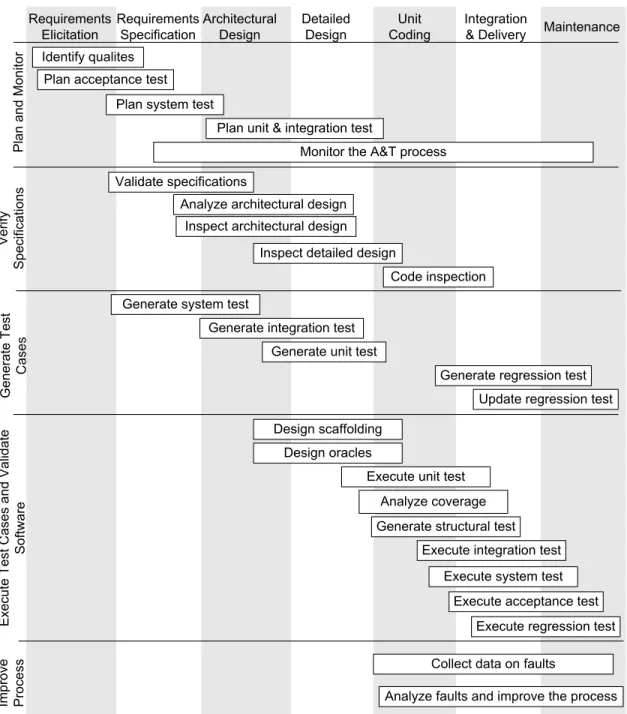
Parts of the portfolio of verification and validation activities selected by Chipmunk are illustrated in Figure 1.1. The quality of the final product and the costs of the quality assurance activities depend on the choice of the techniques to accomplish each activity. Most important is to construct a coherent plan that can be monitored. In addition to monitoring schedule progress against the plan, Chipmunk records faults found during each activity, using this as an indicator of potential trouble spots. For example, if the number of faults found in a component during design inspections is high, additional dynamic test time will be planned for that component.
What Techniques Should Be Applied? 9 Requirements Elicitation Requirements Specification Architectural Design Detailed Design Unit Coding Integration
& Delivery Maintenance
Plan and Monitor
Veri
fy
Sp
ecificatio
ns
Execute Test Cases and Validate
Sof tw a re Gen era te Test Cases Im pr ove Pr
ocess Analyze faults and improve the process
Collect data on faults
Execute regression test Execute acceptance test Execute system test Execute integration test Generate structural test
Analyze coverage Execute unit test Design oracles
Design scaffolding
Update regression test Generate regression test Generate unit test
Generate integration test Generate system test
Code inspection Inspect detailed design
Inspect architectural design Analyze architectural design Validate specifications
Monitor the A&T process Plan unit & integration test
Plan system test Plan acceptance test Identify qualites
1.5
How Can We Assess the Readiness of a Product?
Analysis and testing activities during development are intended primarily to reveal faults so that they can be removed. Identifying and removing as many faults as possible is a useful objective during development, but finding all faults is nearly impossible and seldom a cost-effective objective for a nontrivial software product. Analysis and test cannot go on forever: Products must be delivered when they meet an adequate level of functionality and quality. We must have some way to specify the required level of dependability and to determine when that level has been attained.
Different measures of dependability are appropriate in different contexts.
Avail-∆dependability
∆availability abilitymeasures the quality of service in terms of running versus down time; mean time between failures (MTBF) measures the quality of the service in terms of time
∆MTBF
between failures, that is, length of time intervals during which the service is available.
Reliability is sometimes used synonymously with availability or MTBF, but usually
∆reliability
indicates the fraction of all attempted operations (program runs, or interactions, or sessions) that complete successfully.
Both availability and reliability are important for the Chipmunk Web presence. The availability goal is set (somewhat arbitrarily) at an average of no more than 30 minutes of down time per month. Since 30 one-minute failures in the course of a day would be much worse than a single 30-minute failure, MTBF is separately specified as at least one week. In addition, a reliability goal of less than 1 failure per 1000 user sessions is set, with a further stipulation that certain critical failures (e.g., loss of data) must be vanishingly rare.
Having set these goals, how can Chipmunk determine when it has met them? Mon-itoring systematic debug testing can provide a hint, but no more. A product with only a single fault can have a reliability of zero if that fault results in a failure on every exe-cution, and there is no reason to suppose that a test suite designed for finding faults is at all representative of actual usage and failure rate.
From the experience of many previous projects, Chipmunk has empirically deter-mined that in its organization, it is fruitful to begin measuring reliability when debug testing is yielding less than one fault (“bug”) per day of tester time. For some appli-cation domains, Chipmunk has gathered a large amount of historical usage data from which to define an operational profile, and these profiles can be used to generate large, statistically valid sets of randomly generated tests. If the sample thus tested is a valid model of actual executions, then projecting actual reliability from the failure rate of test cases is elementary. Unfortunately, in many cases such an operational profile is not available.
Chipmunk has an idea of how the Web sales facility will be used, but it cannot construct and validate a model with sufficient detail to obtain reliability estimates from a randomly generated test suite. They decide, therefore, to use the second major ap-proach to verifying reliability, using a sample of real users. This is commonly known as
alpha testingif the tests are performed by users in a controlled environment, observed
∆alpha test
by the development organization. If the tests consist of real users in their own envi-ronment, performing actual tasks without interference or close monitoring, it is known asbeta testing.The Chipmunk team plans a very small alpha test, followed by a longer
∆beta test
ac-How Can We Ensure the Quality of Successive Releases? 11
celerate reliability measurement after subsequent revisions of the system, the beta test version will be extensively instrumented, capturing many properties of a usage profile.
1.6
How Can We Ensure the Quality of Successive
Releases?
Software test and analysis does not stop at the first release. Software products of-ten operate for many years, frequently much beyond their planned life cycle, and un-dergo many changes. They adapt to environment changes—for example, introduction of new device drivers, evolution of the operating system, and changes in the underly-ing database. They also evolve to serve new and changunderly-ing user requirements. Ongounderly-ing quality tasks include test and analysis of new and modified code, reexecution of system tests, and extensive record-keeping.
Chipmunk maintains a database for tracking problems. This database serves a dual purpose of tracking and prioritizing actual, known program faults and their resolution and managing communication with users who file problem reports. Even at initial release, the database usually includes some known faults, because market pressure sel-dom allows correcting all known faults before product release. Moreover, “bugs” in the database are not always and uniquely associated with real program faults. Some prob-lems reported by users are misunderstandings and feature requests, and many distinct reports turn out to be duplicates which are eventually consolidated.
Chipmunk designates relatively major revisions, involving several developers, as
“point releases,” and smaller revisions as “patch level” releases. The full quality pro- point release patch level release
cess is repeated in miniature for each point release, including everything from inspec-tion of revised requirements to design and execuinspec-tion of new unit, integrainspec-tion, system, and acceptance test cases. A major point release is likely even to repeat a period of beta testing.
Patch level revisions are often urgent for at least some customers. For example, a patch level revision is likely when a fault prevents some customers from using the software or when a new security vulnerability is discovered. Test and analysis for patch level revisions is abbreviated, and automation is particularly important for obtaining a reasonable level of assurance with very fast turnaround. Chipmunk maintains an
extensive suite ofregression tests. The Chipmunk development environment supports regression test
recording, classification, and automatic re-execution of test cases. Each point release must undergo complete regression testing before release, but patch level revisions may be released with a subset of regression tests that run unattended overnight.
When fixing one fault, it is all too easy to introduce a new fault or re-introduce faults that have occurred in the past. Chipmunk developers add new regression test cases as faults are discovered and repaired.
1.7
How Can the Development Process Be Improved?
As part of an overall process improvement program, Chipmunk has implemented a quality improvement program. In the past, the quality team encountered the same
defects in project after project. The quality improvement program tracks and classifies faults to identify the human errors that cause them and weaknesses in test and analysis that allow them to remain undetected.
Chipmunk quality improvement group members are drawn from developers and quality specialists on several project teams. The group produces recommendations that may include modifications to development and test practices, tool and technology sup-port, and management practices. The explicit attention to buffer overflow in networked applications at Chipmunk is the result of failure analysis in previous projects.
Fault analysis and process improvement comprise four main phases: Defining the data to be collected and implementing procedures for collecting it; analyzing collected data to identify important fault classes; analyzing selected fault classes to identify weaknesses in development and quality measures; and adjusting the quality and de-velopment process.
Collection of data is particularly crucial and often difficult. Earlier attempts by Chipmunk quality teams to impose fault data collection practices were a dismal fail-ure. The quality team possessed neither carrots nor sticks to motivate developers under schedule pressure. An overall process improvement program undertaken by the Chip-munk software division provided an opportunity to better integrate fault data collection with other practices, including the normal procedure for assigning, tracking, and re-viewing development work assignments. Quality process improvement is distinct from the goal of improving an individual product, but initial data collection is integrated in the same bug tracking system, which in turn is integrated with the revision and config-uration control system used by Chipmunk developers.
The quality improvement group defines the information that must be collected for faultiness data to be useful as well as the format and organization of that data. Par-ticipation of developers in designing the data collection process is essential to balance the cost of data collection and analysis with its utility, and to build acceptance among developers.
Data from several projects over time are aggregated and classified to identify classes of faults that are important because they occur frequently, because they cause particu-larly severe failures, or because they are costly to repair. These faults are analyzed to understand how they are initially introduced and why they escape detection. The im-provement steps recommended by the quality imim-provement group may include specific analysis or testing steps for earlier fault detection, but they may also include design rules and modifications to development and even to management practices. An im-portant part of each recommended practice is an accompanying recommendation for measuring the impact of the change.
Summary
The quality process has three distinct goals: improving a software product (by pre-venting, detecting, and removing faults), assessing the quality of the software product (with respect to explicit quality goals), and improving the long-term quality and cost-effectiveness of the quality process itself. Each goal requires weaving quality assurance
How Can the Development Process Be Improved? 13
and improvement activities into an overall development process, from product incep-tion through deployment, evoluincep-tion, and retirement.
Each organization must devise, evaluate, and refine an approach suited to that or-ganization and application domain. A well-designed approach will invariably combine several test and analysis techniques, spread across stages of development. An array of fault detection techniques are distributed across development stages so that faults are removed as soon as possible. The overall cost and cost-effectiveness of techniques depends to a large degree on the extent to which they can be incrementally re-applied as the product evolves.
Further Reading
This book deals primarily with software analysis and testing to improve and assess the dependability of software. That is not because qualities other than dependability are unimportant, but rather because they require their own specialized approaches and techniques. We offer here a few starting points for considering some other important properties that interact with dependability. Norman’sThe Design of Everyday Things
[Nor90] is a classic introduction to design for usability, with basic principles that apply to both hardware and software artifacts. A primary reference on usability for interactive computer software, and particularly for Web applications, is Nielsen’sDesigning Web Usability[Nie00]. Bishop’s textComputer Security: Art and Science[Bis02] is a good introduction to security issues. The most comprehensive introduction to software safety is Leveson’sSafeware[Lev95].
Exercises
1.1. Philip has studied “just-in-time” industrial production methods and is convinced that they should be applied to every aspect of software development. He argues that test case design should be performed just before the first opportunity to execute the newly designed test cases, never earlier. What positive and negative consequences do you foresee for this just-in-time test case design approach?
1.2. A newly hired project manager at Chipmunk questions why the quality manager is involved in the feasibility study phase of the project, rather than joining the team only when the project has been approved, as at the new manager’s previous company. What argument(s) might the quality manager offer in favor of her involvement in the feasibility study?
1.3. Chipmunk procedures call for peer review not only of each source code module, but also of test cases and scaffolding for testing that module. Anita argues that inspecting test suites is a waste of time; any time spent on inspecting a test case designed to detect a particular class of fault could more effectively be spent in-specting the source code to detect that class of fault. Anita’s project manager,
on the other hand, argues that inspecting test cases and scaffolding can be cost-effective when considered over the whole lifetime of a software product. What argument(s) might Anita’s manager offer in favor of this conclusion?
1.4. The spiral model of software development prescribes sequencing incremental prototyping phases for risk reduction, beginning with the most important project risks. Architectural design for testability involves, in addition to defining testable interface specifications for each major module, establishing a build order that supports thorough testing after each stage of construction. How might spiral development and design for test be complementary or in conflict?
1.5. You manage an online service that sells downloadable video recordings of classic movies. A typical download takes one hour, and an interrupted download must be restarted from the beginning. The number of customers engaged in a download at any given time ranges from about 10 to about 150 during peak hours. On average, your system goes down (dropping all connections) about two times per week, for an average of three minutes each time. If you can double availability or double mean time between failures, but not both, which will you choose? Why?
1.6. Having no a priori operational profile for reliability measurement, Chipmunk will depend on alpha and beta testing to assess the readiness of its online pur-chase functionality for public release. Beta testing will be carried out in retail outlets, by retail store personnel, and then by customers with retail store per-sonnel looking on. How might this beta testing still be misleading with respect to reliability of the software as it will be used at home and work by actual cus-tomers? What might Chipmunk do to ameliorate potential problems from this reliability misestimation?
1.7. The junior test designers of Chipmunk Computers are annoyed by the proce-dures for storing test cases together with scaffolding, test results, and related documentation. They blame the extra effort needed to produce and store such data for delays in test design and execution. They argue for reducing the data to store to the minimum required for reexecuting test cases, eliminating details of test documentation, and limiting test results to the information needed for gener-ating oracles. What argument(s) might the quality manager use to convince the junior test designers of the usefulness of storing all this information?