Discussion Papers In Economics
And Business
Graduate School of Economics and
Osaka School of International Public Policy (OSIPP)
Osaka University, Toyonaka, Osaka 560-0043, JAPAN
Eigenvector Procedure based on Weighted Preference Flows
in Multicriteria Outranking Analysis
Santha Chenayah
Eiji Takeda
August 2005
この研究は「大学院経済学研究科・経済学部記念事業」
基金より援助を受けた、記して感謝する。
Graduate School of Economics and
Osaka School of International Public Policy (OSIPP)
Osaka University, Toyonaka, Osaka 560-0043, JAPAN
Eigenvector Procedure based on Weighted Preference Flows
in Multicriteria Outranking Analysis
Santha Chenayah
Eiji Takeda
Eigenvector Procedure based on Weighted Preference Flows
in Multicriteria Outranking Analysis
Santha Chenayah
Faculty of Economics and Administration, University Malaya
50603 Kuala Lumpur, Malaysia
and
Eiji Takeda
Graduate School of Economics, Osaka University
Toyonaka, Osaka 560-0043, Japan
Abstract
The outranking analysis has been frequently used to deal with the complex decisions involving qualitative criteria and imprecise data. So far, various versions of ELECTRE have been proposed for ranking alternatives in the outranking analysis. Among others, ELECTRE III has been widely used. A distillation procedure using a qualification index is proposed to rank alternatives from the valued outranking relation. A weakness of ELECTRE III, however, is to involve the arbitrariness in the selection of the discrimination threshold function for the distillation procedure.
On the other hand, various variants of PROMETHEE are also proposed for the outranking analysis. PROMETHEE intends to be simple and easy to understand. A deficiency of PROMETHEE is that it does not take into account the preference intensity of alternatives in the in-preference flow and out-preference flow for each alternative.
We propose a new preference ranking procedure based on eigenvector using the “weighted” in- and out-preference flows of each alternative in the outranking analysis. The basic idea of the procedure proposed here is that it should be better to outrank a “strong” alternative than a “weak” one and, conversely, it is less serious to be outranked by a “strong” alternative than by “weak” one in a PROMETHEE context. It has a completely different interpretation with the AHP (Analytic Hierarchy Process) since the components of the valued outranking relation matrix are neither ratios nor reciprocal as in the AHP.
Keywords: Multiple criteria analysis; PROMETHEE; ELECTRE; Valued outranking relations
1
Introduction
The outranking analysis has been frequently used to deal with the complex decisions involving qualitative criteria and imprecise data (see, Bana e Costa, 1990, Roy,1996; Roy and Vanderpooten,1997; Roy and Vincke,1984; Vincke,1992;Larichev and Olson,2001). So far, various versions of ELECTRE (ELimination Et Chix Traduisant la REalit´e) have been proposed for ranking alternatives in the outranking analysis. Among others, ELECTRE III is very familiar and has been widely used (see, Roy,1996; Rogers, Bruen and Maystre, 2000; Pomerol and Romero, 2000). A distillation procedure using a qualification index is proposed to rank alternatives from the valued outranking relation. A weakness of ELECTRE III, however, is to involve the arbitrariness in the selection of the discrimination threshold function for the distillation procedure.
On the other hand, various variants of and PROMETHEE (Preference Ranking Organization METHod for Enririching Evaluations) have also been widely used for the outranking analysis (Brans and Vincke, 1985; Brans and Mareschal,1992; Brans,Vincke and Mareschal, 1986; Pomerol and Romero, 2000; Albadvi,2004). PROMETHEE intends to be simple and easy to understand. PROMETHEE is based on the positive (out-) and negative (in-) preference flows for each alternative in the valued outranking relation to derive the ranking of alternatives. The positive flow is expressing how much an alternative is outranking the other ones, and the negative flow how much it is outranked by the other ones. Based on the preference flows, PROMETHEE I provides a partial preorder. PROMETHEE II is also introduced to obtain a complete preorder by using a net flow, though it loses much information of preference relations (Brans, Vincke and Mareschal, 1986). A deficiency of PROMETHEE is that it does not take into account the preference intensity of alternatives in the in-preference flow and out-preference flow for each alternative.
We propose a new preference ranking procedure based on eigenvector using the “weighted” in- and out-preference flows of each alternative in the outranking analysis. The basic idea of the procedure proposed here is that it should be better to outrank a “strong” alternative than a “weak” one and, conversely, it is less serious to be outranked by a “strong” alternative than by “weak” one in a PROMETHEE context. It has a completely different interpretation with the AHP (Analytic Hierarchy Process) since the components of the outranking relation matrix are neither ratios nor reciprocal as in the AHP (see Saaty,1990). Macharis et al (2004) discussed the strengths and weaknesses of PROMETHEE and AHP. And recommendations are formulated to integrate into PROMETHEE a number of useful AHP features, especially a tree-like structure similar to the one found in AHP and the determination of weights. They, however, didn’t suggest the preference ranking based on the eigenvector in a PROMETHEE context. Thus, this new procedure differs from the AHP and the approach adopted by Macharis.
analysis with the simple preference flows. In section 3, we shall generalize the simple preference flows and introduce the weighted preference flows in a PROMETHEE context. It is shown that the preference ranking procedure based on the weighted preference flows yields the eigenvalue problem. A rationale of the eigenvalue approach is provided in the theorem. Concluding remarks are given in the final section.
2
Preference Flows in a PROMETHEE Context
Let us consider the set Aofnalternatives:
A={a1,a2, . . . ,an}.
Letg1, g2, . . . , gmbem-criteria. Thus, each alternativesaiis characterized by a multiattribute outcome denoted
by a vector
(g1(ai), g2(ai), . . . , gm(ai)).
The valued outranking relation is constructed from the notions of quasi-criterion and pseudo-criterion. In partic-ular, PROMETHEE constructs it using a preference function which represents the decision maker’s preference for an alternativeai with regard toaj. Several types of preference functions are considered for the criteria such
as usual criterion, quasi-criterion, criterion with linear preference, level criterion, pseudo-criterion with linear preference and indifference area, and Gaussian criterion (see, Brans and Vincke, 1985 and Brans, Vincke and Mareschal, 1986). To be more precise, let
Pk(ai,aj) =f[gk(ai)−gk(aj)]
be the preference function associated with the criterion gk(·). Asf(·), six types of functions are proposed to
cover most of the cases in practical applications. Then, the valued outranking relationπ(ai,aj) ofai overaj
is defined as the weighted sum of the preference functionsPk: π(ai,aj) =
X
k
Pk(ai,aj)wk,
where wk is a weight for criterion k. Thus, π(ai,aj) represents the intensity of the preference of ai over aj
for all the criteria: the closer to 1, the greater the preference. From a valued outranking relation, a valued outranking graph with nodes signifying alternatives and arcs (ai,aj) having values π(ai,aj) is depicted.
Then, the preference out-flow and preference in-flow of each nodeai are respectively defined by
φ+(ai) = X j π(ai,aj), (1) φ−(ai) = X j π(aj,ai). (2)
The out-flow and in-flow induce respectively the following complete preorders,
aiP+aj if and only ifφ+(ai)> φ+(aj),
aiI+aj if and only ifφ+(ai) =φ+(aj).
aiP−aj if and only ifφ−(ai)< φ−(aj),
aiI−aj if and only ifφ−(ai) =φ−(aj).
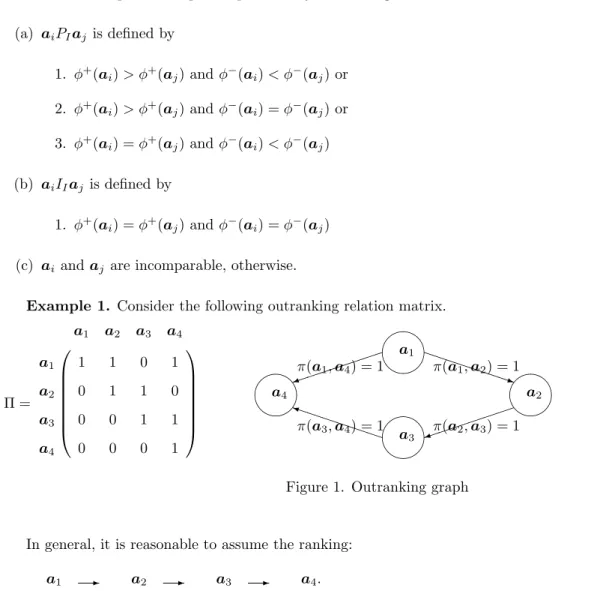
PROMETHEE I provides a partial preorder by considering the intersection of these two complete preorders: (a) aiPIaj is defined by 1. φ+(a i)> φ+(aj) andφ−(ai)< φ−(aj) or 2. φ+(ai)> φ+(aj) andφ−(ai) =φ−(aj) or 3. φ+(a i) =φ+(aj) andφ−(ai)< φ−(aj) (b) aiIIaj is defined by 1. φ+(ai) =φ+(aj) andφ−(ai) =φ−(aj)
(c) ai andaj are incomparable, otherwise.
Example 1. Consider the following outranking relation matrix.
Π = a1 a2 a3 a4 a1 1 1 0 1 a2 0 1 1 0 a3 0 0 1 1 a4 0 0 0 1 a1 a2 a3 a4 π(a1,a4) = 1 π(a1,a2) = 1 π(a3,a4) = 1 π(a2,a3) = 1 P P P P P P q ) ) P P P P P P i
Figure 1. Outranking graph
In general, it is reasonable to assume the ranking:
a1 - a2 - a3 - a4.
In fact, ELECTRE III derives the same ranking as above. Employing PROMETHEE I, however, we have the following ranking:
a1 - {a2,a3} - a4
3
Weighted Preference Flows in a PROMETHEE context
We now introduce the “weighted” preference (out-) flows.
λψ+(ai) = n
X
j=1
π(ai,aj)ψ+(aj), i= 1,2, . . . , n, (3)
whereλis a constant andψ+(a
j) is the strength of preference ofaj.
This implies that it should be better to outrank a “strong” alternative than a “weak” one. Similarly, we define the weighted preference (in-) flows
λψ−(ai) = n
X
j=1
π(aj,ai)ψ−(aj), i= 1,2, . . . , n. (4)
which implies that it is less serious to be outranked by a “strong” alternative than by “weak” one. In what follows, with no loss of generality, letψ+(ai) (ψ+(ai)) be normalized such that
max j ψ +(a j) = 1 max j ψ −(a j) = 1 .
Thus, using the weighted preference flows yields the eigenvalue problem:
Πψ+=λmaxψ+ ψ−Π =λmaxψ−, (5)
where Π = (π(ai,aj)) andψ+= (ψ+(ai)), (ψ−= (ψ−(ai))),is the right (left) eigenvector associated with the
maximum eigenvector λmax of Π.
We have a well-known (see, for instance, Saaty, 1990, p. 170)
Lemma (Perron). Let Π be any positive square matrix. Then
1. Πhas a real positive simple eigenvalue λmax whose modulus exceeds the moduli of all other eigenvalues.
2. The eigenvector ofΠ corresponding to λmax has positive components and is essentially (to within
multi-plication by a constant) unique.
In what follows, to assure that the eigenvectorsψ+= (ψ+(a
i)) andψ− = (ψ−(ai)) corresponding to the
maximum eigenvalue of any valued outranking relation Π have positive components, for the sake of calculation, we replaceπ(ai,aj) = 0 byπ(ai,aj) =εwhereεis a sufficiently small positive number.
In the example 1, we have
ψ+= ψ+(ai) = ( 1 0.06 0.003 0.0002 ) and ψ−= ψ−(ai) = ( 0.0002 0.003 0.06 1 ),
whereε= 0.0001.
The ranking is
a1 - a2 - a3 - a4
Consider a special outranking relation Π withπ(ai,aj) = 1 orεfor anyai,aj.
Let us define, for any ai,aj,
aiPaj if and only ifπ(ai,aj) = 1 and π(aj,ai) =ε,
aiIaj if and only ifπ(ai,aj) = 1 and π(aj,ai) = 1.
Then Π is referred to as a complete preorder if
(a) for anyai,aj,one and only one of the following relations holds: aiPaj, ajPai, oraiIaj.
(b)P is asymmetric and transitive
(c)I is an equivalent relation(i.e., reflexive,symmetric and transitive).
As is well-known, conditions (a),(b) and (c) hold if and only if there exists a value functionv(aj) on a finite
set Awhich represents the decision maker’s preferences, that is, for anyai,aj,
aiPaj if and only ifv(ai)> v(aj),
aiIaj if and only ifv(ai) =v(aj).
As a rationale of the eigenvector approach, we have
Theorem. If the outranking relation Π = (π(ai,aj))is a complete preorder, ψ+(·) and −[ψ−(·)] are the
value functions, that is,
aiPaj if and only ifψ+(ai)> ψ+(aj), ψ−(ai)< ψ−(aj) , aiIaj if and only ifψ+(ai) =ψ+(aj), ψ−(ai) =ψ−(aj) .
Proof: See Appendix.
Example 2. Consider the following special valued outranking relation matrix.
a1 a2 a3 · · · an a1 1 θ θ · · · θ a2 (1−θ) 1 θ · · · θ a3 (1−θ) (1−θ) 1 · · · θ .. . ... ... ... . .. ... an (1−θ) (1−θ) (1−θ) · · · 1
ψ+ = ψ+(ai)= 1, 1−θ θ 1n , 1−θ θ n2 , . . . , 1−θ θ n−n1! ψ− = ψ−(ai) = 1−θ θ n−n1 , 1−θ θ n−n2 , . . . , 1−θ θ n1 ,1 ! . λmax= 1 +θ 1−θθ 1 n+θ 1−θ θ n2 +· · ·+θ 1−θ θ n−n1
From this, the ranking is:
a1→a2→ · · · →an, if 1 2 < θ <1, {a1,a2, . . . ,an}, ifθ= 1 2.
Example 3. (A valued outranking relation without discordance) (Table 3 in Brans et al. 1986).
a1 a2 a3 a4 a5 a6 a1 1 0.296 0.250 0.268 0.100 0.185 a2 0.462 1 0.389 0.333 0.296 0.500 a3 0.236 0.180 1 0.333 0.056 0.429 a4 0.399 0.505 0.305 1 0.223 0.212 a5 0.444 0.515 0.487 0.380 1 0.448 a6 0.286 0.399 0.250 0.432 0.133 1 We get ψ+= ψ+(ai) = ( 0.533 0.873 0.593 0.763 1.000 0.704 ), and ψ−= ψ−(ai) = ( 0.984 1.000 0.894 0.953 0.498 0.978 ).
From this, the partial preorder is given by:
a2 a5 3 Q Q Q s a3 - a1 a4 - a6 Q Q QQs
Though, when constructing the outranking relations, PROMETHEE does not take discordance into account (see Keyser and Peeters, 1996), since the concept of discordance plays the important role in the outranking analysis, let us consider the outranking relation involving the discordance index.
Example 4. (A valued outranking relation with discordance)
criteria C1 C2 C3 C4 weight (wi) 0.3 0.3 0.3 0.1 alternatives a1 15 25 40 20 a2 10 20 30 70 a3 8 15 25 130 a4 5 10 20 90
Let threshold valuespi (preference),qi (indifference) andvi (veto) of each criterionCi be: C1 C2 C3 C4
pi 1 1 1 1 qi 0 0 0 0 vi 100 100 100 100
Then a valued outranking relation is:
a1 a2 a3 a4 a1 1 0.9 ε 0.9 a2 0.1 1 0.9 0.9 a3 0.095 0.1 1 1.0 a4 0.086 0.1 ε 1 We have ψ+= ψ+(ai)= ( 1.000 0.760 0.422 0.189 ) and ψ−= ψ−(ai) = ( 0.183 0.353 0.372 1.000 ) Thus, the ranking by the eigenvector procedure is:
a1 - a2 - a3 - a4
a1 -a2
HHj
a3 * a4
We employed the distillation method in ELECTRE III in which a discrimination threshold function is set at the following:
s(λ) = 0.3−0.15λ.
Then, we have
a1 - a2 - a3 - a4
which is the same as the eigenvector procedure.
4
Concluding Remarks
We have proposed a new eigenvector procedure based on the weighted preference in-flows and out-flows in the outranking analysis. The eigenvector procedure is easy to understand and calculate. Various numerical examples suggest that PROMETHEE I, ELECTRE III and the eigenvector procedure have the same or almost the same results in valued outranking relations without discordance and that the eigenvector procedure gives results that are closer to ELECTRE III than PROMETHEE in valued outranking relations with discordance. However, further properties specifying the strengths and weaknesses of the eigenvector procedure remain to be explored.
Appendix
Proof of Theorem:
From (3), we have for anyai,aj, λmax`ψ+(ai)−ψ+(aj)´=
n
X
k=1
(π(ai,ak)−π(aj,ak))ψ+(ak) (6)
Note that, for anyai,aj, one and only one of (i)aiPajor (ii)ajPai or (iii)aiIajholds.
We shall prove, ifaiPaj, thenψ+(ai)> ψ+(aj).
FromaiPaj, we get
π(ai,aj) = 1 andπ(aj,ai) =ε (7)
It follows from the reflexivity ofI that
From (7) and (8), we have
π(ai,aj) =π(aj,aj), (9)
π(ai,ai)> π(aj,ai). (10)
For anyak(k6=i, j;k= 1,2, . . . , n), we have eitherajPak orakPajorajIakexclusively.
(a) IfajPak, thenaiPak asP is transitive. That is,
π(ai,ak) =π(aj,ak) = 1. (11)
(b) IfakPaj,then
π(aj,ak) =ε. (12)
Sinceπ(ai,ak)≥ε, we have from (12)
π(ai,ak)≥π(aj,ak) =ε. (13)
(c) IfajIak, thenaiPak. Thus, we have
π(ai,ak) =π(aj,ak) = 1. (14)
From (9), (10), (11), (13) and (14), we have
π(ai,ak)≥π(aj,ak), k= 1,2, . . . , n, (15)
and
π(ai,ai)> π(aj,ai). (16)
Since, by Lemma,λmax>0 andψ+(ak)>0,k= 1,2, . . . , n, it follows from (6),(15) and (16) that ψ+(ai)> ψ+(aj).
Thus, it is shown that
ifaiPaj, thenψ+(ai)> ψ+(aj) (17)
Similarly, we have
ifajPai, thenψ+(aj)> ψ+(ai) (18)
Finally, let us assume (iii)aiIaj. It follows that
π(ai,aj) =π(aj,aj) = 1, (19)
π(ai,ai) =π(aj,ai) = 1. (20)
For anyak,(k6=i, j;k= 1,2, . . . , n), we have eitherajPakorakPaj orajIakexclusively.
(a) IfajPakthenaiPak. Therefore,
(b) IfakPaj, thenakPai. Thus
π(ai,ak) =π(aj,ak) =ε. (22)
(c) IfajIak, thenaiIak by the transitivity ofI. Thus we have
π(ai,ak) =π(aj,ak) = 1. (23)
From (19) through (23) we have
π(ai,ak) =π(aj,ak), k= 1,2, . . . , n.
It follows from (6) that
ifaiIaj, thenψ+(ai) =ψ+(aj). (24)
Since, for anyai,aj, one and only one of the following three cases;aiPaj orajPaioraiIajholds, we have
aiPaj if and only ifψ+(ai)> ψ+(aj),
aiIaj if and only ifψ+(ai) =ψ+(aj).
In a similarly way, we have
aiPaj if and only ifψ−(ai)< ψ−(aj),
aiIaj if and only ifψ−(ai) =ψ−(aj).
which ends the proof.
References
[1] Albadvi, A., 2004, Formulation national information technology strategies: A preference ranking model using PROMETHEE method,European Journal of Operational Research,153, 290-296.
[2] Bana e Costa, C.A. (ed.), 1990, Readings in Multicriteria Decision Aid, Springer-Verlag ,Berlin,Heidelberg,New York.
[3] Brans,J.P., Vincke,Ph., 1985, A preference ranking organization method: The PROMETHEE method,Management Science,31, 647-656.
[4] Brans,J.P., Vincke,Ph, Mareschal,B., 1986, How to select and how to rank projects: The PROMETHEE method for MCDM,European Journal of Operational Research,24, 228-238.
[5] Brans,J.P., Mareschal,B., 1992, PROMETHEE V: MCDM problems with addtional segmentation constraints, INFOR,30, 85-96.
[6] Keyser,W.De., Peeters,P., 1996, A note on the use of PROMETHEE multicriteria methods, European Journal of Operational Research,89, 457-461.
[7] Larichev,O.L.,Olson,D.L.,2001,Multiple Criteria Analysis in Strategic Siting Problems, Kluwer Academic Publish-ers, Dordrecht,Boston,London.
[8] Macharis,C., Springael, J., Brucker, K., and Verbeke,A., 2004, PROMETHEE and AHP: The design of opera-tional synergies in multicriteria analysis. Strengthening PROMENTHEE with ideas of AHP,European Journal of Operational Research,153, 307-317.
[9] Pomerol,J-Ch., Barba-Romero,S., 2000, Multicriterion Decision in Managemnt: Principles and Pratice, Kluwer Academic Publishers, Boston.
[10] Rogers,M., Bruen,M., Maystre,L.-Y., 2000,ELECTRE and Decision Support, Kluwer Academic Publishers, Boston, Dordrecht, London.
[11] Roy,B., 1996, Multicriteria Methodology for Decision Aiding, Kluwer Academic Publishers, Dordrecht, Boston, London.
[12] Roy,B.,Vanderpooten,D 1997, An Overview on The European school of MCDA: Emergence, basic features and current works,European Journal of Operational Research 99, 26-27.
[13] Roy,B., Vincke,Ph., 1984, Relational systems of preference with one or more pseudo-criteria: Some new concepts and results,Management Science,30, 1323-1335.
[14] Saaty,T.L., 1990,The Analytic Hierarchy Process, RWS Publications, Pittsburgh.