Philip R. Lane
Institute for International Integration Studies and Economics Department, TCD; and CEPR
Gian Maria Milesi-Ferretti
International Monetary Fund and CEPR
This draft: January 9, 2003 Abstract
In recent decades, foreign assets and liabilities in advanced countries have grown rapidly relative to GDP, with the increase in gross cross-holdings far exceeding the size of net positions. Moreover, the portfolio equity and FDI categories have grown in importance relative to international debt stocks. In this paper, we describe the broad trends in international financial integration for a sample of industrial countries, and seek to explain the cross-country and time-series variation in the size of international balance sheets. We also examine the behavior of the rates of return on foreign assets and liabilities, relating them to ‘market’ returns . * Prepared for the IMF’s Third Annual Research Conference, November 7-8 2002. Mathias Hoffmann and Charles Larkin have provided helpful research assistance. We thank Hélène Rey, Bob Flood, and our discussant Charles Engel for insightful comments, Hali Edison for the data on stock market capitalization, Michelle Hassine for countless clarifications on balance of payments data, Ben Lockwood for the data on corporate tax rates, and Ladan Mahboobi of the OECD for help with the privatization data. Lane's work on this paper has been supported by the IIIS and is also part of a research network on ‘The Analysis of International Capital Markets: Understanding Europe’s Role in the Global Economy’, funded by the European Commission under the Research Training Network Programme (Contract No. HPRN–CT–1999– 00067). Part of this paper was written while Lane was a visiting scholar in the Research Department of the IMF.
International financial integration is increasing. Capital account restrictions have been
lifted in many countries, other barriers to investing overseas are also being dismantled, and
the level of activity in international financial markets has increased markedly over the last
decades. This paper studies the dynamics of international financial integration using data
on the level and composition of foreign assets and liabilities for a set of industrial
countries. More specifically, we do the following:
1. Characterize the salient features of the increase in international financial integration
during the past two decades;
2. Relate the growth in foreign asset and liability positions to potential “drivers” of
integration (lifting of policy restrictions, increases in goods trade and output per capita, domestic financial developments, privatization programs, tax policy);
3. Study the behavior of rates of return on external assets and liabilities and relate them to
differences in portfolio composition.
With regard to the first point, we address several questions. Has the composition of
country portfolios systematically changed over time? To what degree does the increase in
external assets and liabilities reflect valuation effects due to the stock market boom of the
1990s? What are the relative contributions of valuation changes (such as stock market and
currency fluctuations) and new capital flows in determining gross international investment
positions?
With regard to the second point, we ask whether the time series and cross-sectional
patterns in the levels and composition of cross-holdings can be systematically related to
factors such as the increase in world trade in goods and services and rising income levels,
as well as to “policy events” such as capital account liberalization; privatization programs;
With regard to the third point, we have documented in previous work the existence of
substantial differences in rates of return on external assets and liabilities across countries
(Lane and Milesi-Ferretti, 2002a and 2002b). For example, rates of return on assets have
systematically exceeded those on liabilities for the US, so that the US investment income
position stayed positive for a number of years even when the net foreign asset position had
turned negative.
Rates of return matter since they are the channel through which international investment
positions provide risk sharing. The associated international transfers also are important in
determining the trade balance and the real exchange rate. Moreover, the dynamics of asset
and liability stocks depend on capital gains and losses in addition to new capital flows.
This is especially important for countries holding large portfolio equity and FDI portfolios that may take most of their returns in the form of capital gains, which do not affect
investment income flows, rather than yields (which do). In this paper, we study the dynamic behavior of rates of return, the links between rates of return on the international
investment position and various financial market returns, and the inter-relations between
domestic and foreign real rates of return and real exchange rate fluctuations.
This work has clear relevance for policymakers. Stocks of foreign assets and liabilities
represent an important global linkage—shocks in country A have an impact on country B
via revaluation and other wealth effects. This will be stabilizing to the extent that the
international balance sheet hedges domestic risks, but potentially raises volatility if
external investments leverage domestic positions. In addition, identifying the sources of
the growth in world asset trade can contribute to an understanding of its sustainability and
likely future trends. In this regard, growth that is related to the once-off elimination of
of activity. In contrast, growth that is linked to positively-trending variables such as output
per capita and goods trade can be predicted to continue into the future.
In our previous work, we have explored the determinants of net foreign asset positions
along the time series dimension (Lane and Milesi-Ferretti 2002a). However, we have
largely examined other components (e.g. debt-equity ratios for foreign liabilities) in a
purely cross-sectional manner (Lane and Milesi-Ferretti 2001a, 2001b). Lane (2000)
provides some evidence on the change in gross cross-holding positions over time for the
OECD countries but does not try to explain the panel dynamics. The available time series
data have increased substantially in recent years, with countries now reporting data on
their external portfolios in much greater detail.
In terms of empirical work on international financial integration, some other authors have looked at related questions. Bekaert and Harvey (2000) have attempted to date the
integration of emerging market stock exchanges into the global market, using an asset price model. Henry (2000), Levine et al. (2000), Edison et al (2002), Edison and Warnock
(2002) and O’Donnell (2002), amongst others, have looked at the impact of international
financial integration on various indicators. Obstfeld and Taylor (2002) provide a wide-ranging historical overview, including analysis of the long-run changes in gross asset
trade. For Europe, Adam et al (2002) explore a wide range of measures of international
financial integration. Finally, we note that such a study of the “growth in world asset
trade” is complementary to the recent literature on the growth in world trade (Hummels et
al 2001, Yi 2003).
The empirical literature on the rates of return earned on foreign assets and liabilities is
very small. Bond (1977), Sorensen and Yosha (1998) and Lane (2001) study the behavior
of investment income flows but not the contribution of capital gains and losses, while
portfolio equity holdings in international risk sharing. Lane and Milesi-Ferretti (2002a,
2002b) provide some initial evidence on the behavior of overall rates of return.
The plan for the rest of the paper is as follows. We discuss data issues and capture some
basic facts about our data in Section 2. We examine the determinants of variation in the
scale of international financial integration in Section 3. We turn to examining rates of
returns and yields on foreign assets and liabilities in Section 4. Section 5 offers some
conclusions.
II. DATA ISSUES AND BROAD TRENDS
We study international financial integration using data on countries’ portfolios of external
assets and liabilities—the so-called International Investment Position (IIP). These data summarize total holdings by domestic residents of financial claims on the rest of the
world, and nonresidents’ claims on the domestic economy. Following the methodology of
the Balance of Payments Manual 5 (IMF, 1993), external liabilities are divided into five main categories: foreign direct investment (FDI), portfolio equity investment, portfolio
debt investment, other investment, and derivatives. Assets are instead divided into six
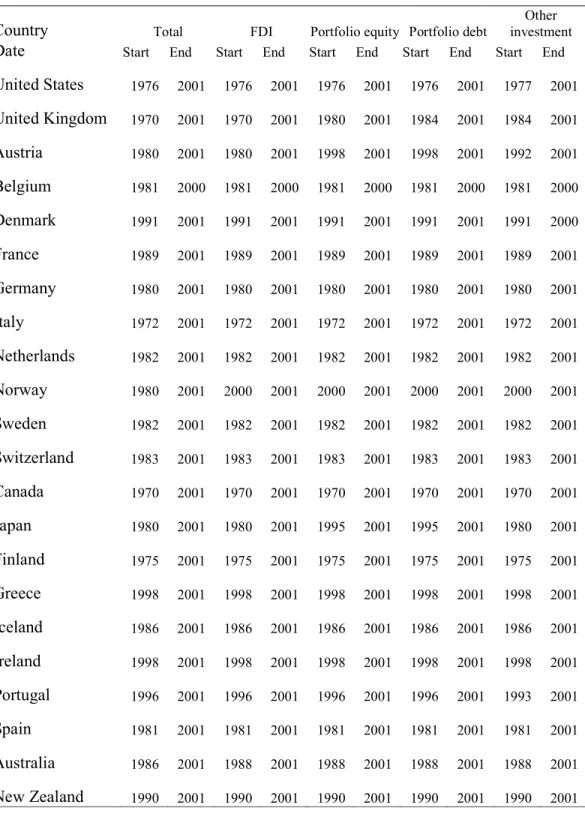
categories: the same five as liabilities, plus official reserves. Table A1 summarizes country
and period coverage for the main categories of external assets and liabilities. The main
data source is the International Monetary Fund’s Balance of Payments Statistics, but we
also made use of data from national sources. A data appendix describes data sources in
A. Data Issues
The methodologies used to construct data on external assets and liabilities can differ both
across and within countries. For the purpose of cross-country comparisons, one
particularly important factor in this regard is the methodology used to estimate the stock of
FDI and portfolio equity investment, and in particular whether these stocks are evaluated
at book or market value. Only few countries (United States, France, and Sweden) provide
estimates of the stock of FDI both at book and market value.1 Other countries provide only
one set of FDI estimates, most at book value (Australia and Netherlands use market
value). For portfolio equity investment, most countries provide estimates at market value (Canada, which uses book value, is the exception). Generally, book value estimates
understate the market value of the underlying assets and liabilities.
With regard to the time series dimension, problems can arise because of within-country
changes in the classification of certain types of assets or liabilities. For example, for the
earlier years of the sample portfolio debt investment holdings are included in other investment holdings in the United Kingdom. More generally, the breakdown of external
assets and liabilities between different categories is available only partially, especially for
the earlier years of the sample.
When studying individual the dynamics of external holdings and rates of return, we have
strived to use a data set as homogeneous as possible, taking into account both structural
breaks and methodological differences in the calculation of assets and liabilities.
1 The United States provides estimates of FDI abroad and in the US at historical cost,
current cost, and market value. For a discussion of the impact of different FDI valuation methods, see Pratten (1992) on the United Kingdom, and Eisner and Pieper (1991) on the United States.
Nevertheless, heterogeneities in the data unavoidably remain—as we proceed, we point
out the implications of such data problems for our analysis.
B. Broad Trends
A summary volume-based measure of international financial integration is
( it it) it it FA FL IFIGDP GDP + = (1)
where FA and FL refer to the stocks of aggregate foreign assets and liabilities,
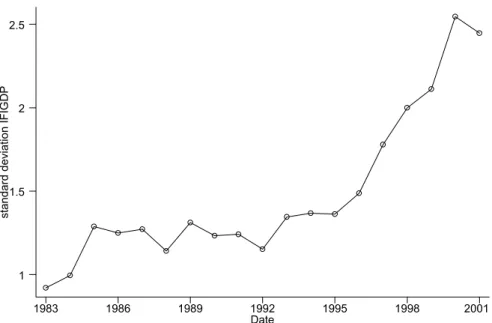
respectively.2 Figure 1 plots the evolution of this ratio over the period 1984-2001 for a set
of industrial countries. This ratio has increased by 250 percent over this period, with a
marked acceleration during the 1990s.3 This increase in financial linkages has not been
uniform across countries: Figure 2 shows a rise in dispersion in this ratio across countries
over this interval.
Since international trade in debt instruments may be driven by special factors, we also
consider an equity-based measure
( it it it it)
it
it
PEQA FDIA PEQL FDIL
GEQGDP
GDP
+ + +
= (2)
where PEQA (L) and FDIA (L) are the stocks of portfolio equity and FDI assets
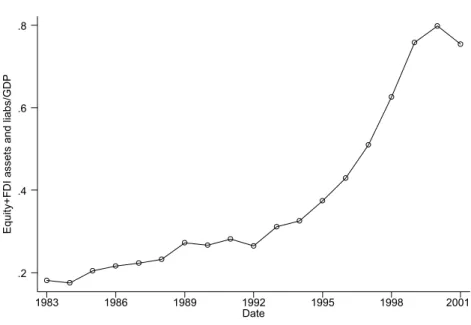
(liabilities). In other words, GEQGDPis an indicator of the level of equity (portfolio and
FDI) cross-holdings. Figure 3 shows that the growth in this ratio has been even more rapid
than for IFIGDP—it more than tripled over 1983-2001.
2 See also Lane (2000a) and Obstfeld and Taylor (2002). The latter discuss the relative
merits of this indicator versus other price-based measures of integration, as do Adam et al (2002).
One possible reason for this rise in international financial cross-holdings is the increase in
international trade, which has also been substantial in recent decades. However, Figures
2.4 and 2.5 show clearly that the increase in financial openness dwarfs the increase in
goods’ trade. Figure 4 shows theIFIand GEQ measures as ratios to exports plus imports
rather than GDP (IFITRADE GEQTRADE, ). Both ratios show substantial increases over
the period: in the aggregate, international asset trade has grown far more rapidly than
goods trade by this measure. Figure 5 illustrates that this finding holds at the individual
country level, by showing the relation between the percentage change in the financial
openness to GDP ratio and the percentage change in the trade openness to GDP ratio
during the period 1991-2001. Only for Canada (which measures portfolio equity at book
value, and therefore underestimates external assets and liabilities) and Japan trade
openness has increased more than financial openness.
In theory, international financial integration may simply reflect financial deepening: in
industrial countries, financial assets and liabilities increased much faster than GDP over
the past two decades, and the share of external assets and liabilities in total financial
holdings may thus have remained unchanged. Unfortunately the availability of financial
balance sheets is limited, both along the cross-sectional and the time-series dimension. 4
Nevertheless, available data for the United Kingdom (since the early 1980s) and Belgium
and Italy for the second half of the 1990s shows clearly an increase in the ratioof external
financial holdings over total financial holdings (Figure 6). Another piece of evidence
suggesting that increased international financial integration is more than the reflection of
financial deepening comes from data on portfolio equity holdings. Figure 7 shows that the
4 Kraay et al (2000) calculate a measure of national net wealth, using estimates of physical
capital stocks. However, measuring gross assets and liabilities is a yet more onerous task. See also Obstfeld and Taylor (2002).
ratio of portfolio equity holdings by foreigners to stock market capitalization has increased
over the past 10 years. Note that this ratio underestimates the increase in foreign equity
holdings because it excludes the “controlling shares” of companies that are classified as
FDI.
In a similar vein, we next investigate the degree to which the value of international
portfolios is related to the boom in equity valuations during the 1990s, rather than an
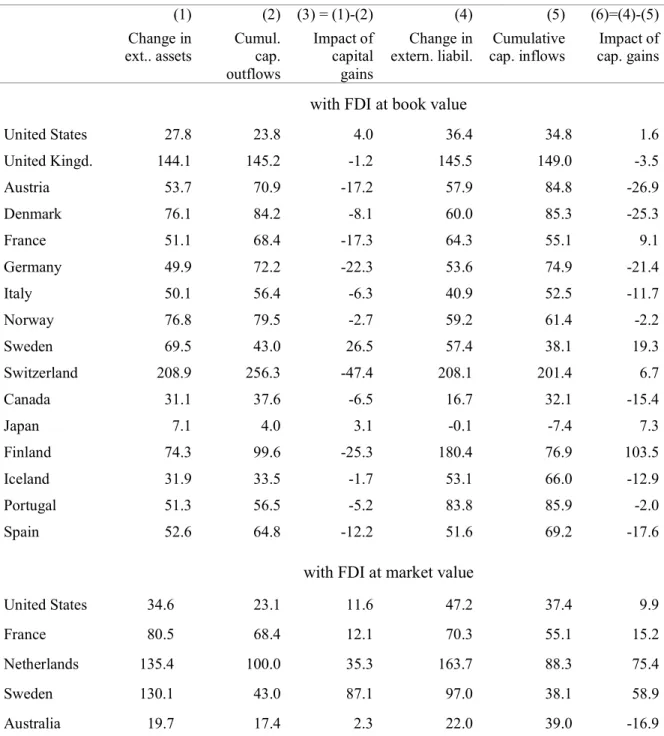
increase in capital flows. Table 1 reports the change in external assets and liabilities
between end-1995 and end-2000 (as a ratio of GDP in 2000), cumulative capital outflows
and inflows during the same period, and, as residual, the part of the change in the external
position not explained by capital flows. The table shows clearly the remarkable increase in
the size of country external portfolios, and the magnitude of the underlying gross capital flows. The increase in external diversification is particularly high in financial centers such
as Switzerland and the United Kingdom, and small open economies such as the
Netherlands and Scandinavian countries, and is much faster than in previous years. Indeed,
compared with the previous 5-year period (1990-95), gross capital flows more than
doubled, both in absolute terms and as ratios of GDP.
A second notable fact is the importance of capital gains and losses in explaining the
dynamics of the external position. These are primarily due to exchange rate fluctuations
and changes in stock market values, which were substantial during this period. In our
sample, a remarkable case is Finland, where the increase in the market value of its equity
liabilities (in particular Nokia, a stock widely held by non-residents) implied an increase in
external liabilities unexplained by new inflows of over 100 percent of its GDP. The impact
of capital gains and losses on the net external position, which can be derived by
subtracting column (6) from (3), is even more substantial (in relative terms) than the
III. ANALYSIS OF INTERNATIONAL INVESTMENT POSITIONS
This section discusses theoretical determinants of international financial integration, and
conducts a simple econometric analysis aiming at identifying the key factors driving
international asset trade.
A. Conceptual Issues
A natural benchmark in thinking about the level of international asset cross-holdings is the
allocation that would hold under complete global financial market integration with no
cross-border transactions costs. In such a world, each country would hold a very high level
of foreign assets and liabilities, in line with full diversification. As a crude approximation,
a country representing 1 percent of the world endowment would hold 99 percent of its
wealth overseas and, in turn, 99 percent of its domestic tradable assets would be held by
foreigners.5
Although the world is still far from this idealized state, it is logical to relate the
cross-country and time series variation in international portfolios to the corresponding dispersion
in the (implicit and explicit) barriers to full integration and in the gains to international
diversification. The level of international asset trade will also depend on the ‘tradability’
of domestic assets: factors that reduce domestic transaction costs also facilitate
cross-border asset trade.
Martin and Rey (2000, 2001) provide theoretical models that address some of these issues.
In their framework, investors are risk averse, the number of financial assets is endogenous,
5 See Obstfeld and Rogoff (1996, Chapter 5) for a textbook review of the theory of
assets are imperfect substitutes, and cross-border asset trade entails transactions costs.
Under these assumptions, a reduction in international transactions costs stimulates an
increase in the demand for (and supply of) assets and an increase in asset prices, leading to
higher cross-border diversification.
As such, our empirical strategy is to identify a set of country characteristics that may
influence the benefits to and costs of international asset trade. Most obviously, we
consider the impact of controls on cross-border capital movements. If controls are binding,
the level of international asset cross-holdings should increase if the capital account is
liberalized.
Second, we investigate the connection between trade in goods and services and trade in
assets. Goods trade may matter for several reasons. First, much goods trade directly entails corresponding financial transactions (e.g. trade credit and export insurance). Second,
following Obstfeld and Rogoff (2000), there is a close connection between the gains to international financial diversification and the extent of goods trade: trade costs create an
international wedge between marginal rates of substitution and hence limit the gains to
asset trade. Third, goods trade and financial positions are jointly determined in some situations, as is often the case with FDI, given the importance of intra-firm intermediates
trade. Finally, openness in goods markets may increase the willingness to conduct
cross-border financial transactions, reducing financial home bias (a ‘familiarity’ effect).6
Income per capita may also influence the propensity to engage in international asset trade.
To the extent that higher income per capita is associated with lower risk aversion and
international investments are perceived as riskier than domestic alternatives, it may also
raise international asset trade. If participation in foreign asset markets involves fixed costs
6For Ireland, Honohan and Lane (2000) show that the bilateral pattern of goods trade
(e.g. learning costs), this may provide another reason why international cross-holdings
might rise with income levels. The Martin-Rey framework also naturally delivers such a
positive relation.
The size of the domestic financial sector plausibly facilitates international asset trade in
several ways.7 Domestic financial intermediaries that also distribute international assets
offer a local channel by which investors can gain foreign exposure. Exposure to domestic
financial markets may also increase the desire for international diversification. On the
liability side, an extensive financial infrastructure is attractive to foreign investors.
However, a substitution effect may also operate: by necessity, domestic agents will have to
invest on foreign markets if the domestic financial sector is underdeveloped. The quality
of domestic financial regulation may also be important: foreign investors will stay away from markets that do not protect their interests.
Tax policy may also influence the level of international cross-holdings. Firm assets may be shifted to countries with low corporate income tax rates. Moreover, such a regime will
also attract international financial intermediaries engaged in offshore financial
transactions. In addition, at a household level, high tax rates on investment income will stimulate the growth of offshore savings vehicles, if overseas investments can be more
easily hidden from domestic tax authorities.8
These factors may not have uniform effects on the different components of the
international balance sheet. For instance, if the greatest barriers to trade have been with
7 At this point, we are not attempting to establish lines of causality: some other studies in
fact have tried to make a link running from external liberalization to domestic financial development. See, for example, Klein and Olivei (2000).
8 See also Grilli (1990). This can directly create two-way financial trade if foreign loans
can be raised on the back of these offshore assets. For instance, such round-tripping was popular in Ireland during the 1980s.
respect to more complex and riskier assets (ie portfolio equity and FDI), then we may
expect that cost-reducing steps have a larger impact on these components.
B. The Empirical Specification
In line with the discussion in the previous subsection, we attempt to empirically identify
the factors underlying the changing scale of international financial integration over time
and across countries. Given the lack of firm theoretical priors and the sparse prior
literature, this is intended to be an exploratory exercise.
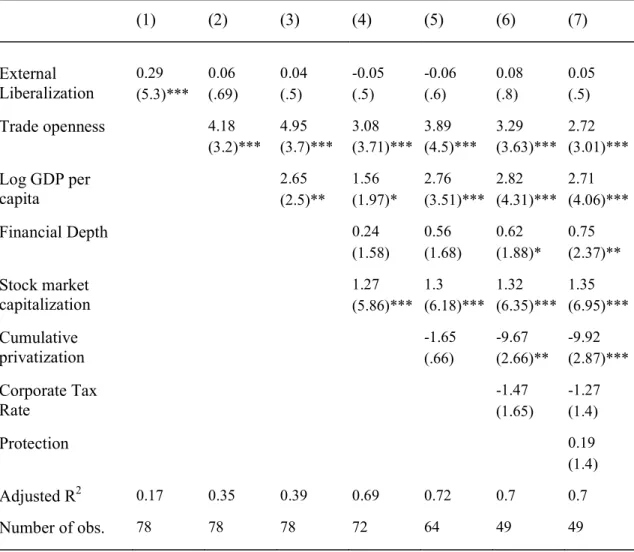
We construct a panel data set for 18 OECD countries over 1978-2001 and consider averaged data over six time periods: 1978-81, 1982-1985; 1986-1989; 1990-1993;
1994-1997; and 1998-2001. The basic panel specification in Table 2 is
(IFIGDPit) α γi *Xit β* ( )Zit εit
∆ = + + ∆ + (3)
where we relate the growth in international financial integration to a set of country- and
time-varying determinants X Zit, it. We first difference the data to take into account the
non-stationarity of the levels of IFIGDPand some of the regressors.9 We allow for a
country-specific intercept, to allow for country-specific trends in the level of financial
integration. 10 Accordingly, we conduct fixed-effect least squares estimation (with
White-corrected standard errors).
We begin in Table 2 by examining IFIGDP. In Table 3, we restrict attention to the
volume of asset trade in portfolio equity and FDI (GEQGDP). Finally, in Table 4 we
examine the determinants of the composition of international balance sheets, as measured
9 That is, we look at the change in the average value of IFIGDPbetween 1978-81 and
1982-85.
by the shares of equity instruments (both portfolio and FDI) in foreign assets and liabilities
(GEQSHARE).
The first variable we include in the list of regressors is a capital account liberalization
index EXTLIB. It is the period-average value of an index of capital account restrictions,
ranging from 0-4, with a score of 4 indicating complete liberalization. It is based on data
constructed by Grilli and Milesi-Ferretti (1995) and updated by Mody and Murshid
(2002).11 To allow for gradual adjustment in stocks to the lifting of controls, we lag this
variable in the regressions: the average value in 1978-81 is used for the time period
1982-85 and so on.
Our second regressor is trade openness, defined as the sum of exports plus imports relative
to GDP (TRADE).12 Our third regressor, the (log) level of GDP per capita, is included to
allow for a systematic relation between cross-border financial activity and the level of
development. We also consider three indicators of domestic financial development, potentially an important factor in driving international asset trade: the ratio of liquid
liabilities to GDP (FINDEPTH); the ratio of stock market capitalization to GDP
(STKCAP); and the ratio of cumulative privatization revenues to GDP (CUMPRIVAT).13 The latter is included to address whether the sale of state-owned assets has been an
11 Edison and Warnock (2002) construct a capital controls measure based on restrictions of
access to equity holdings, but this is designed for emerging market economies rather than the industrial economies in our sample.
12 The theory discussed in the previous section indicates that there should be a direct
relation between trade and financial integration. At a bilateral level, it is interesting also to consider the extent to which ‘gravity’ equations explain financial trade as compared to goods trade. See Portes and Rey (2002) and Devereux and Lane (2003) on the
determinants of bilateral financial flows.
13FINDEPTH is drawn from Beck et al (1999); STKCAP was kindly provided by Hali
important driver of international financial integration.14 All of these variables are in the set
it
Z and are included in the specification in first differences.
For a subset of fourteen countries, we also explore the role played by corporate tax
policies, by including in the regression a measure of the average effective corporate
income tax rate (TAXRATE).15 A favorable tax regime may stimulate FDI flows and also
encourage financial transactions between host and parent companies: this variable is also
first differenced. Finally, we also include a dummy variable for the introduction of insider
trading laws (PROTECTION).16 The insider-trading variable, which is entered in levels, can proxy for the extent and quality of regulation of the domestic financial system.
Finally, we have also explored (but do not report) the impact of some other potential
determinants, such as country size and telecommunications infrastructure: the former was always insignificant and did not alter the other results; the latter data are available for only
a small number of countries.
C. Results
Table 2 shows the results in explaining ∆IFIGDP for a range of specifications. In column (1), we just include the EXTLIB variable: it is positive and significant but explains only a
small fraction of the variation in gross asset trade. Once we include other regressors,
EXTLIB no longer has independent explanatory power.
14 If a privatized state firm is floated on the domestic stock market, it will be picked up by
the STKCAP variable. However, private sales to foreign investors would not be captured in that index.
15 This variable is constructed by Devereux, Lockwood, and Redoano (2002) and
Devereux, Griffith and Klemm (2002).
16 This dummy variable is developed by Bhattacharya and Douak (2000) and Bekeart et al
We add TRADE to the specification in columns (2)-(7): it is positive and highly significant
throughout, and it improves the overall explanatory power substantially. The average
TRADE coefficient of 3.7 in columns (2)-(7) indicates a strongly leveraged association: a
10 percentage point increase in the trade to GDP ratio is associated with a 37 percentage
point increase in IFIGDP.
In columns (3)-(7), we add GDP per capita to the set of regressors. It enters positively and
is highly significant across the specifications: a one percent increase in GDP
raisesIFIGDPby 2.5 percentage points on average.
We add FINDEPTH and STKCAP to the set of regressors in columns (4)-(7). The point
estimate for FINDEPTH is always positive and is marginally significant in column (7),
while STKCAP is quite important throughout: there is a strong positive correlation
between an open capital account and a large domestic stock market. The overall
explanatory power of the specification rises to 0.69 once these variables are included. In
part, of course, there is a mechanical relation in that rising stock market indices increase
both STKCAP value and the value of foreign equity liabilities in IFIGDP.
The cumulative privatization variable actually enters with a negative sign in columns
(5)-(7), and is significant in the latter two regressions. This suggests that privatization may
actually lead to a substitution away from foreign assets, which is especially plausible if the
privatization process favors domestic investors.
The TAXRATE variable is included in columns (6)-(7), at the cost of a reduction in the
number of observations. It turns out to be unimportant in explaining variation in the level
of international financial integration. In addition, the PROTECTION variable is not
significant in column (7).
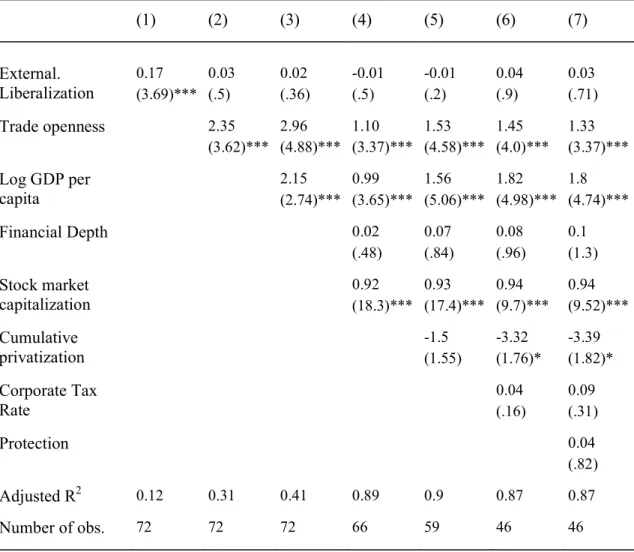
We turn to the measure of cross-border equity holdings GEQGDP in Table 3. These are an
median value rising from 0.16 in 1982-85 to 0.36 in 1998-2001. Column (1) shows that
EXTLIB has some limited explanatory power in explaining GEQGDP, but its individual
significance is lost in columns (2)-(7). As in Table 2, TRADE is always highly significant:
moving from column (1) to column (2) also increases explanatory power from 0.12 to
0.31. The average point estimate for TRADE is now 1.8, about ½ of its size in Table 2.
Again, higher output per capita is significantly associated with an increase in external
equities cross-holdings across columns (3)-(7).
Explanatory power sharply rises to 0.89 in column (4) once domestic financial market
variables are included. STKCAP continues to exert a very strong positive influence: a 10
percentage point increase is associated with a 9.2-9.4 percentage point increase in
GEQGDP. The smaller point estimates as compared to Table 2 indicates that a higher
value of STKCAP is also associated with a rise in debt cross-holdings. As in Table 2, the
coefficient on CUMPRIVAT is negative, while neither TAXRATE nor PROTECTION are important. Overall, countries less open to trade, with shallow domestic financial markets,
and large-scale privatization activities have smaller international cross-holdings.
We turn to the equity share in total external holdings (GEQSHARE) in Table 4. 17 The results here are generally weaker than for the aggregate volume measures in Tables 2 and
3. Not surprisingly, STKCAP again exerts a significantly positive influence; the overall explanatory power also rises from 0.19 to 0.53 once the financial variables are included.
Another other notable finding is that FINDEPTH exerts a significantly negative influence
on the equity share: a reasonable interpretation is that FINDEPTH disproportionately increases international trade in debt instruments. Finally, columns (6)-(7) show that
17 In results not reported, and available upon request, we also examined separately the
equity ratios for the asset and liability sides of the international balance sheet, and the ratio of portfolio equity liabilities to domestic stock market capitalization. For the latter, an increase in goods trade is associated with a rise in the ratio.
CUMPRIVAT has a significantly positive impact on GEQSHARE: the contrast with the
result in column (5) is entirely driven by the change in sample size, due to the lack of tax
data for some countries.18
In summary, this section has investigated the covariates of the growth in international
financial integration. We have shown that variables such as trade openness, GDP per
capita, and stock market capitalization are quite successful in ‘explaining’ the variation
over time in the degree of international financial integration. Clearly, a future goal is to
better establish lines of causality between these variables and our measures of external
financial activity.
IV. ANALYSIS OF RATES OF RETURN
In this section, we investigate the rates of return earned on foreign assets and liabilities.
First, we describe the broad patterns in the data. Second, we ask whether the rates of return
on foreign assets and liabilities are well tracked by various market indices.19 Third, we examine whether the pattern of international investment indeed contributes to risk
diversification. Finally, we explore the co-movement between local and foreign real rates
of return and real exchange rates.
18 These are Denmark, Norway, Switzerland, Iceland, Australia, and New Zealand. 19 For instance, if a country allocates its equity investment across countries in proportion
to relative stock market capitalizations, the rate of return on foreign equity assets would just follow a global market index.
A. Conceptual Issues
Consider the ex-post real return (on foreign assets or liabilities) in domestic currency and
in US currency. For country i, these are statistically linked by the rate of bilateral real
appreciation vis-à-vis the US
1 (1 US) (1 )* it it it it rer r r rer− + ≡ + (4) where US( ) it it
r r is the real return in US dollars (domestic currency) and rer is the bilateral
CPI-based real exchange rate between the domestic currency and the US dollar. Let us
consider the determinants of local currency real returns. Statistically, the aggregate return
on the (asset or liability) position is a weighted sum of the returns on the various
components of the investment position20
it ij ijt
j
r =
∑
ω r (5)It follows that the aggregate rate of return depends on (i) the returns in each investment
category; and (ii) the proportions invested in the different components. We can model the
former as depending on some common country component, plus an idiosyncratic factor to
the extent that the investment pattern deviates from overall market patterns
*
ijt ijt ijt
r =r +
µ
(6)For example, the return on portfolio equity liabilities will equal the return on the domestic
stock market index if foreign investors just ‘hold the market’ but will differ if foreign
investors choose a different portfolio composition.21 Similarly, the return on foreign
20 In this setup, we assume time-invariant weights for convenience.
21 One could in turn attempt to model the overall domestic return in a given asset category
as a function of national macroeconomic variables. See Barro and Sala-i-Martin (1991) for an illustration with respect to interest rate determination.
portfolio equity assets will deviate from the return on a ‘global’ stock market index to the
extent that a country pursues an idiosyncratic investment strategy for the foreign
component of its portfolio.
In addition, we consider the co-movement between the rate of return on foreign assets and
various domestic financial returns
* ijt
FA M
i ikt ijt
r =
α β
+ r +ν
(7)If β =1, holding foreign assets provides no diversification against fluctuations in domestic financial returns. The weaker is the positive co-movement, the greater is the
scope for risk-sharing.22
Third, we consider the relations between domestic- and dollar-based ex-post real returns
and the real exchange rate. Go back to an approximation of the identity (4)
US
it it it
r = +r drer (8)
where drerit is the rate of real appreciation vis-à-vis the US. If returns were entirely driven
by ‘domestic’ factors (orthogonal to exchange rate movements), the domestic real return
and the real exchange rate would be uncorrelated and real exchange rate movements
would fully pass through into dollar real returns. If instead returns were entirely driven by
‘external’ factors, the correlation between the dollar real return and the real exchange rate
would be zero and real exchange rate movements would fully pass through into domestic
real returns.23
22 If markets are not integrated, a low co-movement in returns may simply reflect the
absence of common pricing factors. We checked our results using only a shorter sample of more recent data and the findings were broadly similar.
23 An interesting general question, which is outside the scope of this paper, is how real
exchange rate movements influence ex-post returns. (Of course, in terms of ex-ante returns, expectations of real exchange rate movements will drive a wedge between domestic and foreign returns but this link may be broken by ex-post shocks.) The relation depends on whether returns on assets/liabilities are primarily based on domestic or
B. Data Issues on Rates of Return
In previous work (Lane and Milesi-Ferretti 2002a, 2002b) we documented the importance
of differences in rates of return for explaining the dynamics of net external positions.
Three basic stylized facts emerged from the analysis: first, rates of return on both assets and liabilities tended to be high, easily exceeding countries’ growth rates; second,
cross-country differences in rates of return were substantial, and third, some countries exhibited
substantial differences between returns on external assets and liabilities. One classical example is the United States, which according to IIP data has been a debtor country since
1989, but its investment income position turned negative only in 1998.
In this section, we attempt to explain the behavior of the rates of return on foreign assets
and liabilities. We use IMF balance of payments statistics data on interest earnings and
payments on external holdings, together with data on international investment positions
and on capital flows, to construct measures of yields and rates of return on external assets
and liabilities as well as, where possible, on their sub-components. We then assess the
degree to which these yields and returns can be explained by ‘market’ rates of return,
which we construct using information on the composition and geographical allocation of
external assets and liabilities.
external factors. The mechanics are most direct in the case of an unindexed nominal asset, where the impact of exchange rate movements on ex-post returns depends on whether it is denominated in domestic currency or foreign currency. Similarly, the domestic currency return on an unhedged foreign currency nominal asset or liability is negatively related to real appreciation. For positions denominated in domestic currency, there is no mechanical relation. On the one side, real appreciation may proxy for good fundamentals (if not captured elsewhere in the regression) and so be associated with high domestic currency returns; real appreciation also boosts profits by lowering the costs of imported inputs if these are priced in foreign currency. On the other hand, real appreciation may reduce returns by a loss of competitiveness, or by lowering the terms of trade if local currency pricing in good markets prevails.
Let investment income receipts in US dollars related to asset-type X in year t be
X t
IC (where IC stands for income credit) and investment income payments be X t
ID (where
ID stands for income debits). We define the US dollar yield on assets as
1 X X t t t IC yc XA− = and
the yield on liabilities as
1 X X t t t ID yd XL−
= , where XA(XL) are the country’s stocks of external X-type assets and liabilities, respectively.
The year t capital gain on asset X is given by the difference between the change in the
stock of X between t and t-1 and the underlying flow x during year t, divided by the initial
stock of X: 1 1 X t t t t t XA XA xa kc XA − − − − = and 1 1 X t t t t t XL XL xl kd XL − − − −
= . Finally, the nominal rate of return on assets is X (1 x)(1 X) 1 t t t ic = +yc +kc − , and on liabilities (1 )(1 ) 1 X x X t t t
id = +yd +kd − . Real yields and real rates of return are obtained by deflating nominal US dollar returns by the US rate of inflation. Nominal and real rates of return in
domestic currency are obtained using the same methodology, but with all variables
measured in domestic currency.24
The data difficulties in undertaking this type of study are substantial. These relate in
particular to measurement error problems for balance-of-payments-derived yields and
rates of return, and to lack of information concerning the currency composition of external
assets and liabilities. We discuss these difficulties in turn.
Measurement error problems in deriving yields and rates of return from balance of payments data can arise from several sources:
24 Stocks are converted into domestic currency using the end-of-period exchange rate and
flows using the period-average exchange rate, following the balance of payments convention.
• Re-classification of external assets and liabilities items between different categories. For example, in Swedish data for 1997 securities issued abroad by
residents—previously recorded as other investment liabilities—were re-classified
as portfolio debt liabilities.
• Recording of interest receipts and payments in balance of payments accounts. For example, several countries classify investment income data in only two categories,
FDI and “other,” where the second category also includes income on portfolio
assets. In addition, in a few countries interest receipts and payments appear to be
overestimated for some years. 25
• Valuation of FDI and portfolio equity holdings. Most countries record FDI stocks at book value, but a few use market values. Using the former will imply in general
higher FDI yields (because the outstanding stock of assets is smaller) but lower
capital gains. The problem for the valuation of portfolio equity assets and liabilities
is less severe, because most countries record these stocks at market value (the
exception being Canada).
• Breaks in the data series for the variables used in the calculations. These breaks may relate to changes in the methodology of estimation (for example, from book to
market value).
25 These problems, which seem to affect gross rather than net investment income flows,
may relate to the recording of receipts and payments associated with derivatives’
operations or with nonresident transactions. These entail higher recorded interest receipts and payments, classified in either the portfolio or the ‘other investment’ categories. Examples include the data for Denmark (1991-1997), France (1990-1993), and Japan (1991-1995).
Problems in constructing “benchmark” portfolios arise because of the scarcity of data on the currency composition of external portfolios, as well as on the geographical
allocation of external assets. 26 In general, constructing benchmark yields and rates of
return is easier for external liabilities than it is for external assets. For example, domestic
stock market returns provide a reasonable benchmark for returns on portfolio equity
liabilities. Benchmark yields and returns on debt instruments are more difficult to
construct, in the absence of information on the currency of denomination. Taking into
account these constraints, we have proceeded as follows.
• For portfolio equity liabilities, we use as a benchmark for returns (measured in US$) the total returns index from the domestic stock market, constructed by
Morgan Stanley Capital International (MSCI).
• For portfolio equity assets, we make use of two alternative indices.
a) The MSCI world stock price index—a valid proxy for capital gains if all
countries allocate their external equity holdings in shares reflecting the world
portfolio. Clearly this index cannot contribute to explaining cross-country
heterogeneity in rates of return on portfolio equity assets, except for countries
with a significant weight in the world index, such as the United States, the
United Kingdom, and Japan.
26 Significant progress in this area has been made in recent years. For example, the 1997
IMF Portfolio Survey provides data on the geographical allocation of portfolio investment assets for 29 countries. A new, more comprehensive survey is currently being conducted. Also, countries such as Australia, Sweden, and the United States provide data on the currency composition of external holdings.
b) The weighted average of stock returns on individual markets, as reported by
MSCI, where the weights reflect the country’s allocation of portfolio equity
assets reported in the IMF 1997 Portfolio Survey.
• For FDI liabilities, we use the same indices as for equity liabilities.
• For FDI assets, we construct the rate of return by using a weighted average of stock returns on individual markets, where the weights reflect the geographical allocation
of FDI assets as reported by the OECD.
• For debt liabilities, which include portfolio debt and other investment, we use domestic bond returns from Global Financial data. We also compare yields with
domestic short-term and long-term interest rates (from the OECD database).
• For debt assets, we construct several indices:
a) A weighted return and yield on a foreign bond portfolio, where weights are
obtained from the 1997 IMF Portfolio Survey, bond returns from Global
Financial Data, and interest rates from the OECD.
b) A weighted yield on a foreign debt portfolio, where weights are obtained from
BIS data on the geographical allocation of bank assets, and interest rate data
are from the OECD. With the BIS data, we are also able to take into account
the fraction of foreign loans that are denominated in domestic currency versus
foreign currency.
These indices can help us shed light on the degree to which rates of return and yields on
external assets and liabilities can be explained by market developments and investment
patterns. Obviously, even if the rate of return on individual asset categories, such as debt
and portfolio equity, were the same for all countries, cross-country differences in overall
rates of return may still arise because of differences in the composition of country
at the beginning of this section is the increasing importance of portfolio equity and FDI
stocks in international portfolios. The increase in world stock market values during the
1990s has implied substantial capital gains and rates of return on these assets, thus
potentially explaining the high measured rates of return on external assets and liabilities.
Differences in countries’ external holdings of equity-type instruments can also account for
cross-country heterogeneity in rates of return.
Finally, differences between yields on external assets and external liabilities can be due to
the different weight in the two categories of equity-type instruments. Most of the return on
equity and FDI instruments comes through capital gains, and yields are relatively small.
However, investment income flows (that enter in the current account) include only yields,
but do not include capital gains. As a result, ceteris paribus yields on external assets will tend to be higher in countries with more debt-type instruments in their portfolio.27 A
corollary of this observation is that the current account is becoming less and less indicative of changes in countries’ external position, since it ignores such valuation changes.
C. Empirical Specification
In order to understand the time-series behavior of rates of return on foreign assets and
liabilities, we consider the specification
* ijt
BOP M
i ijt ijt
r =α γ+ r +ε (9)
where
α
i is a country fixed effect, BOP ijtr is the rate of return on a given category of the
international investment position, as calculated from the balance of payments data and M ijt
r
27 For example, Italy is a creditor country where investment income payments are higher
than receipts. This is accounted for by the fact that Italy’s external assets have a larger share of equity-type instruments than Italy’s external liabilities.
is an estimated rate of return on some observable market portfolio.28
As was outlined in the previous subsection, we consider two market portfolios in tracking
the returns on foreign portfolio equity assets: (a) the MSCI world stock return index; and
(b) an index based on the portfolio weights reported in the 1997 IMF Portfolio Survey.29
We use the national domestic stock market return index in tracking the rate of return on
foreign portfolio equity liabilities.
To explain the rate of return on FDI assets and liabilities, we again use the MSCI return
indices. For FDI assets, we also use partner countries’ stock market returns weighted using
relative shares in overseas FDI positions, as reported in the OECD International Direct
Investment Statistical Yearbook. We report results separately for countries reporting FDI
at book and at market value, and we expect stock market return indices to do a better job in the latter case.
We aggregate data from the portfolio bond and other debt categories into a single
aggregate rate of return on debt. As explained in the previous subsection, for foreign debt
assets we consider a weighted index of bond returns, based on bond holdings as reported
in the 1997 IMF Portfolio Survey, with bond returns on ten-year government bonds taken from Global Financial Data.
We also consider the yields on the debt component. For the yield on debt assets, we
consider two sets of portfolio weights: (i) bond weights from the IMF portfolio survey;
28 The equation allows for a non-unitary coefficient on the market return index, since the
market return and the omitted idiosyncratic element may be correlated.
29 For US and UK, we use the MSCI indices that exclude these countries respectively.
With respect to the IMF Portfolio Survey, we calculate portfolios on the basis of
investment positions in six major markets: the US, the UK, Japan, France, Germany and Italy. These portfolio shares only refer to end-1997: we make the heroic and obviously imperfect assumption that these weights are good indicators for the other years in our sample.
and (ii) weights based on the geography of cross-border bank assets, taken from the BIS.30
We use long-term interest rates, based on OECD data—results are analogous if we use an
average of short- and long-term rates. For debt liabilities, we track yields and returns with
the long-term domestic interest rate and the domestic bond return, respectively.31
We also investigate whether the returns on foreign assets provide diversification against
variation in domestic financial returns. The specification is
, * ijt BOP FA M i ikt ijt r =α β+ r +ε (10) where , ijt BOP FA
r is the return on some category of foreign assets and M ikt
r is the return on
some category of foreign liabilities.
Finally, we address the relation between rates of return and real exchange rate movements.
As discussed in the previous subsection, the co-variation between real returns in home
currency and foreign currency depends on their correlations with real exchange rate
fluctuations. For this reason, we report these correlations32
( , US); ( , ); ( US, )
it it it it it it
r r r drerus r drerus
ρ ρ ρ (11)
D. Results
As a prelude to the investigation of returns on individual investment categories, we first
show that the aggregate returns on foreign assets and liabilities depend on the composition
of the international balance sheet between equity- and non-equity components. Figures 8
30 For the latter, we know the relative proportions of lending in domestic currency versus
other currencies. Accordingly, the yield on foreign assets depends on the domestic interest rate and on the weighted average of foreign interest rates.
31Since some debt liabilities are contracted in foreign currencies, this will be an imperfect
approach. Of course, this consideration is much more important for emerging market economies, not included in this paper.
32 This approach is simplified by the assumption that dollar real returns are a good
and 9 plot average returns and the share of equity in the external portfolio over 1997-2001
for a cross-section of countries. In both cases, the figures show a strongly positive relation
between the equity share and the average return—a larger equity share is associated with a
higher return. Second, in terms of data properties, we record in Figures 10 and 11 that
returns are substantially more variable than yields for both foreign assets and liabilities,
providing the example of the United States—plots for other countries are similar.
In term of time-series behavior, Tables 5A and 5B report fixed-effects regressions over
1983-2001 for the specification given in equation (9), for foreign assets and foreign
liabilities respectively.33 Columns (1) and (2) of Table 5A consider the returns on portfolio
equity foreign assets. The MSCI world return index explains the dynamics of these returns
quite well. Adjusting for geographical differences in overseas investment patterns (column 2) does not improve performance. A possible explanation is that the geographical weights
are based on end-1997 positions, and therefore this index may be compromised due to time-varying portfolio weights; in addition, foreign investors may hold equity baskets in a
given country that differ in composition from its broad market index.
Columns (3)-(4) repeat these exercises for returns on FDI assets at book value, and columns (5)-(6) for returns on FDI at market value. Again, the explanatory power of the
MSCI index is as good as the geographically-weighted index—as expected, both track
returns on FDI at market value much better than returns at book value. Column (7) shows
that the weighted foreign bond return explains about ¼ of the overall variance in debt asset
returns. Both weighted interest rate measures track the yield on foreign debt assets quite
closely (columns 8 and 9).
33 The countries are Australia, Canada, Finland, Germany, Italy, Japan, the Netherlands,
Portugal, Spain, Sweden, Switzerland, the United States, and the United Kingdom. Canada was dropped from the equity regressions, since it measures its foreign equity assets only at book value. Other countries were excluded due to data limitations.
We turn to the returns on foreign liabilities in Table 5B. Column (1) shows that the return
on foreign portfolio equity liabilities co-moves strongly with the domestic stock market
index return and this specification has high explanatory power. This close relationship is a
demonstration of international risk sharing in action: selling shares to foreign investors
hedges the risk of fluctuations in domestic equity returns. Once again, the domestic stock
return explains returns on FDI at market value (column 3) much better than returns on
book-value FDI (column 2). In regard to debt liabilities, domestic bond returns explain
over ⅓ of returns on debt liabilities (column 4), and the yield on foreign debt liabilities is
well tracked by domestic interest rates (column 5).
The analysis of returns on foreign assets is further extended in Table 6 by comparing
returns on foreign assets to domestic market returns. We consider the aggregate return on foreign assets in columns (1)-(2). The first specification shows that the return on foreign
assets positively and significantly co-varies with the domestic stock market, but the elasticity is quite low and the explanatory power limited. Hence, holding foreign assets
provides some diversification against fluctuations in the local stock market. Column (2)
shows that the domestic bond return is also positively correlated with the aggregate return on foreign assets, but with an elasticity well below ½, which is again consistent with a
diversification contribution from foreign assets.
We turn to the subcomponents of the overall foreign asset position in columns (3)-(5).
Column (3) shows that domestic stock returns are significantly positively correlated with
returns on foreign portfolio equity assets (there is a substantial global component to stock
market performance) but the point estimate of only 0.4 again signals the benefits from
diversification. The correlations between returns on foreign portfolio equity assets and
domestic debt (column 4), foreign debt assets and domestic debt (column 5), and yields on
Finally, we turn the relation between domestic- and foreign-currency ex-post real returns
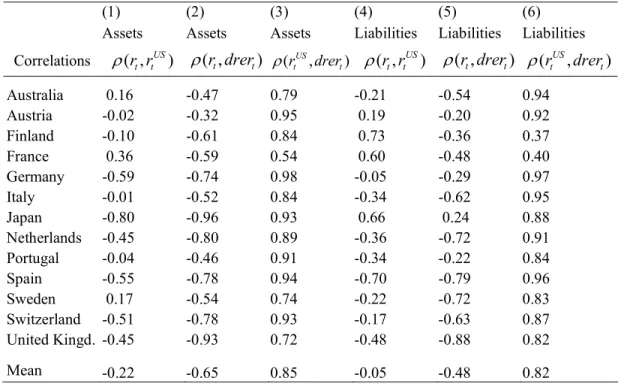
and exchange rates in Table 7. In column (1), we report the correlations between
domestic- and foreign-currency real returns on aggregate foreign assets. The mean
correlation is actually negative: an increase in the local-currency real return is typically
associated with a fall in the dollar real return, demonstrating the importance of exchange
rate shifts in de-linking real returns across countries. As shown in column (2), domestic
real returns are lower during periods of real appreciation. As noted earlier, this could be
due to several mechanisms but is consistent with the returns on at least some foreign assets
being driven by external factors. Column (3) shows a very strong positive correlation
between dollar real returns on foreign assets and the real exchange rate, suggesting that at
least some of the returns on foreign assets are driven by domestic factors.
The correlation patterns on the foreign liability side are shown in columns (4)-(6). As
shown in column (4), there is essentially no correlation between domestic and dollar real returns on foreign liabilities. The negative (positive) correlation between domestic (dollar)
returns and the real exchange rate is also very high, in line with the pattern on the foreign
asset side, and is consistent with a role for both foreign and domestic factors in determining returns on foreign liabilities.
In summary, this section has provided an exploratory analysis of rates of return and yields
for foreign assets and liabilities. Market indices co-vary significantly with these returns,
but for certain asset categories there are substantial unexplained residuals. More precise
information on cross-border investment patterns would be helpful in this regard.
International cross-holdings appear to provide diversification against fluctuations in
domestic market returns. Finally, the dynamics of real exchange rates imply that the
V. CONCLUSIONS
Our goal in this paper has been to highlight some empirical features of the growth in
international cross-holdings of foreign assets and liabilities. In addition to describing the
broad trends, we have identified growth in goods trade and stock market capitalization as two key co-variates of the growth in the scale of international balance sheets. Sorting out
the lines of causality among these variables provides challenges for both theoretical and
empirical researchers.
We have also analyzed the properties of the rates of return on foreign assets and liabilities.
The standard modeling assumption of a common ‘world interest rate’ on international investments is not supported by the data, which show rates of return varying over time and
across asset classes. Better information on the composition of international portfolios
would allow a more detailed investigation of this topic but we believe that the
international investment position data provides a useful and fresh perspective on the
international diversification literature. The study of higher-frequency data on rates of
return would also be useful in modeling the international transmission of business cycle
VI. REFERENCES
Adam, Klaus, Tullio Jappelli, Annamaria Menichini, Mario Padula and Marco Pagano
(2002), “Analyse, Compare, and Apply Alternative Indicators and Monitoring
Methodologies to Measure the Evolution of Capital Market Integration in the European Union,” mimeo, University of Salerno.
Barro, Robert and Xavier Sala-i-Martin (1991), “World Real Interest Rates,” NBER
Macroeconomics Annual 1990, Cambridge, MA: The MIT Press.
Beck, Thorsten, Asli Demirgüç-Kunt and Ross Levine (1999), “A New Database on
Financial Development and Structure,” mimeo, The World Bank.
Bekaert, Geert, and Campbell Harvey (2000), “Foreign Speculators and Emerging Equity
Markets,” Journal of Finance 55, 565-613.
Bekaert, Geert, Campbell Harvey and Christian Lundblad (2001), “Does Financial
Liberalization Spur Growth?,” NBER Working Paper 8245.
Bhattacharya, U. and H. Daouk (2000), “The World Price of Insider Trading,” mimeo,
Indiana University.
Bond, Marianne (1977), “A Model of International Investment Income Flows,”
International Monetary Fund Staff Papers 23, 344-379.
Devereux, Michael B. and Philip R. Lane (2003), “Understanding Bilateral Exchange Rate
Volatility,” Journal of Internat. Economics, forthcoming.
Devereux, Michael P., Rachel Griffiths and Alexander Klemm (2002), “Corporate Income
Tax Reforms and International Tax Competition,” Economic Policy 35, October.
451-95.
Devereux, Michael P., Ben Lockwood and Michela Reodano (2002), “Do Countries
Edison, Hali and Frank Warnock (2002), “A Simple Measure of the Intensity of Capital
Controls,” Journal of Empirical Finance, forthcoming..
Edison, Hali, Ross Levine, Luca A. Ricci and Torsten M. Sløk (2002), “International
financial integration and economic growth,” Journal of International Money and
Finance 21 no. 6 (November), 749-776.
Eisner, Robert and Paul J. Pieper (1991), ‘Real Foreign Investment in Perspective,’ Annals
of the American Academy of Political and Social Sciences 516, July, 22-35.
Grilli, Vittorio (1990), “Financial Markets,” Economic Policy 8, 387-421.
Grilli, Vittorio and Gian Maria Milesi-Ferretti (1995), “Structural Determinants and
Economic Effects of Capital Controls,” International Monetary Fund Staff Papers
42 no. 3, September 1995, 54-88.
Henry, Peter Blair (2000), “Stock Market Liberalization, Economic Reform, and
Emerging Market Equity Prices,” Journal of Finance 55, April, 529-64.
Honohan, Patrick and Philip R. Lane (2000), “Where Do the Irish Invest?,” Irish Banking
Review, Autumn, 12-23.
Hummels, David, Joshi Ishii and Kei-Mu Yi (2001), “The Nature and Growth of Vertical Specialization in World Trade”, Journal of International Economics 54, 75-96.
International Monetary Fund (1993), Balance of Payments Manual 5, Washington, DC:
International Monetary Fund.
International Monetary Fund, Balance of Payments Statistics.
Klein, and Giovanni Olivei (2000), “Capital Account Liberalization, Financial Depth, and
Economic Growth,” mimeo.
Kraay, Aart, Norman Loayza, Luis Serven and Jaume Ventura (2000), “Country
Lane, Philip R. (2000), “International Investment Positions: A Cross-Sectional Analysis,
Journal of Internat. Money and Finance 19(4), August, 513-534.
Lane, Philip R. (2001), “Do International Investment Income Flows Smooth Income?,”
Weltwirtschaftliches Archiv 137, 714-736.
Lane, Philip R. and Gian Maria Milesi-Ferretti (2001a), “The External Wealth of Nations:
Measures of Foreign Assets and Liabilities for Industrial and Developing Nations,”
Journal of International Economics 55, 263-294.
Lane, Philip R. and Gian Maria Milesi-Ferretti (2001b), “External Capital Structure:
Theory and Evidence,” in Horst Siebert (ed.), The World’s New Financial
Landscape: Challenges for Economic Policy, Berlin/Heidelberg: Springer-Verlag.
Lane, Philip R. and Gian Maria Milesi-Ferretti (2002a), “Long-Term Capital Movements,” in (B. Bernanke and K. Rogoff, eds), NBER Macroeconomics Annual 2001,
Cambridge, MA: MIT Press.
Lane, Philip R. and Gian Maria Milesi-Ferretti (2002b), “External Wealth, The Trade
Balance, and The Real Exchange Rate,” European Economic Review 46 (June),
1049-71.
Levine, Ross et al. (2000), “Finance and Sources of Growth,” Journal of Financial
Economics 58, 261-300.
Martin, Philippe and Hélène Rey (2000), “Financial Integration and Asset Returns,”
European Economic Review 44, 1327-1350.
Martin, Philippe and Hélène Rey (2001), “Financial Supermarkets: Size Matter for Asset
Trade,” mimeo, Princeton University.
Mody, Ashoka and Antu P. Murshid (2002), “Growing Up with Capital Flows,”
Obstfeld, Maurice and Kenneth Rogoff (1996), Foundations of International
Macroeconomics, The MIT Press, Cambridge, MA.
Obstfeld, Maurice and Kenneth Rogoff (2001), “The Six Major Puzzles in International
Macroeconomics: Is There a Common Cause?,” in (B. Bernanke and K. Rogoff,
eds), NBER Macroeconomics Annual 2000, Cambridge, MA: The MIT Press.
Obstfeld, Maurice and Alan M. Taylor (2002), “Globalization and Capital Markets,”
NBER Working Paper 8846, March.
O’Donnell, Barry (2002), International Financial Integration and Economic Performance,
PhD Dissertation, Trinity College Dublin.
Portes, Richard and Hélène Rey (2002), “The Determinants of Cross-Border Equity
Flows: The Geography of Information,” mimeo, Princeton University.
Pratten, Cliff (1992), Overseas Investments, Capital Gains and The Balance of Payments,
Research Monograph no. 48, London, UK: Institute for International Affairs. Sorensen, Bent E. and Oved Yosha (1998), “International Risk Sharing and European
Monetary Unification,” Journal of International Economics 45, 211-238.
Sorensen, Bent E., Oved Yosha and Yi-Tsung Wu (2002), “Home Bias and International Risk Sharing: Twins Separated at Birth,” mimeo, Tel Aviv University.
Yi, Kei-Mu (2003), “Can Vertical Specialization Explain the Growth of World Trade?,”