David G Mayes – Maria J Nieto – Larry Wall
Multiple safety net regulators and
agency problems in the EU:
is Prompt Corrective Action
a partial solution?
Bank of Finland Research
Discussion Papers
Suomen Pankki Bank of Finland P.O.Box 160 FI-00101 HELSINKI Finland + 358 10 8311 http://www.bof.fi
Bank of Finland Research
Discussion Papers
7
•
2007
David G Mayes* – María J Nieto** – Larry Wall***
Multiple safety net regulators
and agency problems in the EU:
is Prompt Corrective Action
a partial solution?
The views expressed here are those of the authors and do not necessarily reflect those of the Banco de España, the Bank of Finland, the Federal Reserve Bank of Atlanta or the Federal Reserve System.
* University of Auckland and Bank of Finland, P.O. Box 160, 00101 Helsinki, Finland. E-mail:
** Banco de España, Alcalá 48, 28014 Madrid, Spain. E-mail: [email protected].
*** Federal Reserve Bank of Atlanta, 1000 Peachtree Street N.E. Atlanta, Georgia 30309-4470 (USA). E-mail: [email protected].
The authors thank George Benston and Robert Eisenbeis, for helpful comments on a preliminary draft as well as the participants in the Conferences held at the LSE Financial Markets Group on Prompt Corrective Action & Cross-Border Supervisory Issues (London, 20 November 2006) and at Banco de España organized by the European Central Bank and the Center for Financial Studies (Madrid, 30 November and 1 December, 2006).
http://www.bof.fi ISBN 978-952-462-358-2 ISSN 0785-3572 (print) ISBN 978-952-462-359-9 ISSN 1456-6184 (online) Helsinki 2007
Multiple safety net regulators and
agency problems in the EU:
is Prompt Corrective Action a partial solution?
Bank of Finland Research
Discussion Papers 7/2007
David G Mayes – María J Nieto – Larry Wall Monetary Policy and Research Department
Abstract
Prompt Corrective Action (PCA) provides a more efficient mechanism for dealing with problem banks operating in more than one European country. In a PCA framework, a bank’s losses are likely to be substantially reduced. This reduction in the losses to deposit insurance and governments will improve the problem of allocating those losses across the various insurance schemes and make it less likely that any deposit insurer will renege on its obligations in a cross-border banking crisis. This paper explores the institutional changes needed in Europe if PCA is to be effective in resolving the cross-border agency problems that arise in supervising and resolving cross-border banking groups. The paper identifies these changes starting with enhancements in the availability to prudential supervisors of information on banking groups’ financial condition. Next, the paper considers collective decision-making by prudential supervisors with authority to make discretionary decisions within the PCA framework as soon as a bank of a cross-border banking group falls below the minimum capital standard. Finally, the paper analyses the coordination measures that should be implemented if PCA requires the bank to be resolved.
Keywords: banking supervision, European Union, Prompt Corrective Action JEL classification numbers: G28, K23, F20
4
Ratkaiseeko ripeän korjaustoimenpiteen periaate
monen valvojan turvaverkkoon liittyvät
agentuuriongelmat Euroopan yhteisössä?
Suomen Pankin keskustelualoitteita 7/2007
David G. Mayes – María J. Nieto – Larry Wall Rahapolitiikka- ja tutkimusosasto
Tiivistelmä
Useassa Euroopan maassa toimivat ongelmapankit voidaan hoitaa tehokkaasti ri-peään korjaustoimenpiteeseen perustuvan toimintamekanismin avulla. On toden-näköistä, että tällaisen toimintamekanismin avulla pankkien tappioita pystytään vähentämään merkittävästi. Talletusvakuutusjärjestelmälle ja veronmaksajille aiheutuu vähemmän kustannuksia, mikä osaltaan helpottaa näiden kustannusten jakamista eri vakuutusjärjestelmien kesken ja myös nostaa yksittäisen talletus-vakuuttajan kynnystä kieltäytyä vastaamasta sitoumuksistaan useaa maata koette-levassa pankkikriisissä. Tässä tutkimuksessa tarkastellaan niitä Euroopassa vaadit-tavia institutionaalisia muutoksia, joiden ansiosta ripeän korjaustoimenpiteen periaate olisi tehokas usean maan alueella toimintaansa harjoittavien pankkien valvonnassa ja uudelleenjärjestelyyn liittyvien agentuuriongelmien ratkaisemises-sa. Tämä tutkimus selvittää näitä muutoksia korostamalla aluksi pankkiryhmien taloudellista tilaa koskevan informaation merkitystä vakausvalvonnasta vastaavien viranomaisten kannalta. Tämän jälkeen työssä tarkastellaan vakausvalvojien kol-lektiivista päätöksentekoa. Valvojilla oletetaan olevan harkintavalta ripeän korjaustoimenpiteen edellyttämiin päätöksiin heti sen jälkeen, kun useassa maassa toimivan pankkiryhmän yksittäisen pankin vakavaraisuus heikkenee alle vaaditta-van vähimmäistason. Tutkimuksessa tarkastellaan vielä lopuksi viranomaisten koordinaatioon liittyviä toimenpiteitä, jotka tulisi toteuttaa, jos ripeän korjauksen toiminta edellyttää pankin asettamista selvitystilaan tai sen sulkemista.
Avainsanat: pankkivalvonta, Euroopan yhteisö, ripeä korjaustoimenpide JEL-luokittelu: G28, K23, F20
Contents
Abstract...3
Tiivistelmä (abstract in Finnish) ...4
1 Introduction ...7
2 Supervisory discretion and cross-border banking ...8
3 Structured Early Intervention and Resolution / Prompt Corrective Action as a limit on prudential supervisors’ discretion...13
4 A Prompt Corrective Action for Cross-Border Banking Groups in the EU...16
4.1 Assuring accurate and timely information of banking groups financial condition ...16
4.2 Co-ordination of PCA disciplinary measures short of resolution...18
4.3 Coordination of resolution...22
4.3.1 Recapitalizing a cross-border banking group in the absence of PCA ...23
4.3.2 Resolution of a cross-border banking group under PCA ...25
5 Conclusion...27
References...29
1 Introduction
Large pan-European and regional banks are developing in the European Union (EU). However, the existing institutional framework for dealing with cross border crisis has thus far largely neglected the coordination among prudential supervisors, deposit insurance regulators and reorganization authorities that is needed in an explicit drive to try to ensure the minimization of the potential loss to the taxpayer. Indeed, the present safety net framework across borders not only does not have minimization of taxpayers losses as a goal, but has embedded in it incentive conflicts that are likely to increase taxpayer losses substantially.
Academics and policy makers alike have made proposals on how to reform the EU safety net in order to reduce the problems of asymmetric information and create an incentive compatible regulatory structure. However, most of these proposals have focused on mechanisms to reduce asymmetric information between prudential supervisors and central banks, and much less attention has been paid to mechanisms to align the incentives among prudential supervisors and between them and deposit insurance and resolution authorities.
The importance of this topic was recognized by the European Shadow Financial Regulatory Committee, which devoted its very first report (ESFRC, 1998) to a proposal for dealing with problem banks, in which it recommended establishing a Structured Early Intervention Resolution (SEIR) regime that called for predictable supervisory action for undercapitalized banks culminating in the withdrawal of the bank’s charter before its regulatory capital reaches zero. More recently, the ESFRC (2005) argued that implementation of a version of SEIR called Prompt Corrective Action (PCA) in each individual Member State would contribute to host country supervisors’ confidence in their banks’ home country supervisors. Benink and Benston (2005) also propose SEIR as a mechanism for protecting deposit insurance funds and taxpayers from losses in the EU, as part of a more broad based regulatory reform. Along similar lines, Mayes (2004) proposes intervention at prescribed benchmarks (ideally above economic insolvency) as a means of offering a plausible policy for coping with the exit of banks whose failure poses systemic risks in the EU.
While PCA is, in our view, one reasonable approach, two issues should be addressed before it could be used to set minimum standards in Europe. First, PCA was designed to work with the institutional structure of US bank regulation. Nieto and Wall (2006) identify several institutional changes that would be needed in European bank regulatory institutions in order for PCA to be effective (described in the second section of this article). Second, PCA was designed to reduce principal-agent problems in a purely domestic setting where the supervisor as agent is ultimately accountable to his principal, the voters and taxpayers. Although the basic structure of PCA would be helpful in an international setting,
8
explicit consideration of cross-border issues would make PCA more effective in addressing the principal-agent problems that arise from the supervision of a cross-border banking group.
The focus of this paper is on making PCA more effective for cross-border banking groups in the EU.1 We take as given that all Member States have adopted a uniform system of PCA that complies with the requirements set out by Nieto and Wall (2006). In recognition of the political problems in implementing an EU-level supervisor, we take as granted the existing supervisory and other regulatory institutions in the EU to the extent feasible. However, in some cases we identify gaps between what exists and what is needed for effective prudential supervision, deposit insurance and reorganization of cross-border banking groups that can only be covered by substantial changes to existing legislation in the Member States. While we believe the general approach to disciplining large cross-border banking groups advocated in this paper provides the best opportunity for an effective system in the absence of EU-level institutions, this paper does not consider the desirability of EU-level institutions and arrangements should they become politically feasible.
The paper is organized as follows. The first section analyzes the potential problems with the current institutional framework of bank supervision. The second section evaluates the potential contribution of adopting a PCA type regime in setting minimally acceptable supervisory responses. As the second section discusses, PCA was developed for banks operating in the US and, as such, does not address some important cross-border concerns. Thus, the third section considers additional measures that may be taken to supplement PCA and make it more responsive to cross-border issues. After the last section concludes, an Appendix develops several scenarios that highlight the differences between the current European situation and a Europe that had adopted PCA and authorized colleges of the relevant supervisors to make any discretionary decisions required under PCA.
2
Supervisory discretion and cross-border banking
Cross-border groups increasingly operate as integrated entities with provision of services, such as risk management, liquidity management, data processing, and loan evaluation, each centralized in one part of the group (though not all services are necessarily centralized in the same country). They often do not have a neat structure of a parent and free-standing locally incorporated subsidiaries, but a
1 The related question of the relationship of the bank supervisor to the lender of last resort when
dealing with cross-border banking groups is also important but it is beyond the scope of this paper. See Repullo (2004), and Kahn and Santos (2002, 2004).
complex interweaving of branches and subsidiaries that cannot survive on their own. In this context, bank supervisory structures must also be structured for efficient cross-border operations. The need for efficient cross-border prudential supervision implies someone has to be clearly responsible, they need a clear objective whose attainment can be transparently and objectively assessed and, most importantly, it needs the tools and powers to undertake the tasks efficiently and effectively in practice and in prospect. This has long been recognized in the work of the Basel Committee of Banking Supervisors (Basel Core Principles for Effective Banking Supervision, 1997).2 Some authority has to take the lead, normally one in the ‘home’ country where the bank or holding company is headquartered, and the other, ‘host’ country authorities have to co-operate with them and with each other if the system is to work. Moreover, since there are multiple authorities in each country, whose range of powers and competences often do not match, this coordination is very difficult to achieve.3 Each country remains responsible for its own financial stability, yet, where there are large cross-border institutions such stability will depend on the actions of the authorities in other countries. In a crisis, national authorities will tend to put their own national interests first, so any process of recognition of international claims in advance needs to be very carefully structured so that the joint actions match an agreed means of addressing and, where necessary, trading off the possibly conflicting interests of the countries involved.4
2 The Basel Core Principles for Effective Banking Supervision have been revised in 2006.
3 This mismatch of responsibilities relates to the different financial sectors – insurance, banking,
securities markets – to the different functions – prudential supervision, deposit insurance, crisis resolution – and to the powers each holds under the variety of legal and regulatory systems that currently exist.
4 If there is a threat to the financial system as a whole from bank failure or distress, countries tend
to permit special measures to be taken, as in the case of the systemic risk exemption in the United States (Mayes, 2006a).
10
Table 1. Supervision, deposit insurance and resolution authorities’ jurisdiction in the EU
Prudential
Supervisor1 Deposit insurance Regulators2 and winding-up Reorganization
authority3 Banks locally incorporated Parent banks authorized in home country Home country authorizing parent bank
(consolidated supervision – solvency)
Home country Home country
Subsidiaries of parent banks headquartered
and authorized in another EU country
Home country authorizing parent bank
(consolidated supervision – solvency) Host country authorizing the subsidiary (‘solo’ basis)4
Host country Host country
Branches
Branches of banks headquartered and authorized in other
EU country
Home country of head office (consolidated supervision – solvency) Host country5 (liquidity) Home country (possibility of supplementing the guarantee by host country )6 Home country
1Directive 2006/48/EC of the European Parliament and of the Council of 14 June 2006 relating to
the taking up and pursuit of the business of credit institutions (recast). Official Journal of the European Communities 30 June 2006. L 177.
2Directive 94/19/EC of the European Parliament and of the Council of 30 May, 1994 on
deposit-guarantee schemes. Official Journal of the European Communities 31 May, 1994, No. L135/5 and Directive 97/9/EC of the European Parliament and the Council of 3 March 1997 on investor-compensation schemes. Official Journal of the European Communities 3 May 1997 No. L 84/22.
3Directive 2001/24/EC of the European Parliament and of the Council of 4 April on the
reorganisation and winding up of credit institutions. Official Journal of the European Communities 5 May, 2001. L125.
4 Directive 2006/48/EC of the European Parliament and of the Council of 14 June 2006 relating to
the taking up and pursuit of the business of credit institutions (recast) Art. 44 ‘(It) shall not prevent the competent authorities of the various Member States from exchanging information in accordance with this Directive and with other Directives applicable to credit institutions. That information shall be subject to the conditions of professional secrecy.’
5Directive 2006/48/EC of the European Parliament and of the Council of 14 June 2006 relating to
the taking up and pursuit of the business of credit institutions (recast) (art. 43.1): ‘(It) shall not affect the right of the competent authorities of the host Member State to carry out, in the discharge of their responsibilities under this Directive, on the-spot verifications of branches established within their territory.’
6Directive 94/19/EC of the European Parliament and of the Council of 30 May, 1994 on
deposit-guarantee schemes. Official Journal of the European Communities 31 May, 1994. L 135. (art. 4). ‘…Admission shall be conditional on fulfillment of the relevant obligations of membership, including in particular payment of any contributions and other charges.’
The present structure of supervision, deposit insurance coverage and bank resolution in the EU largely follows the legal structure of banking groups. As shown in Table 1, prudential supervision, deposit insurance and resolution are generally the responsibility of the regulators of each country in which a bank is incorporated. The principal exceptions are that: (1) the home country supervisor of a bank parent will exercise supervisory authority over a bank subsidiary
incorporated in another country through its supervision of the consolidated group and the home country supervisory may be the sole prudential supervisor if the host country supervisor of the subsidiary delegates its responsibility,5 and (2) the host country deposit insurer of a branch may supplement the coverage provided by the insurer of the home country of the bank to bring it up to the host country’s level.
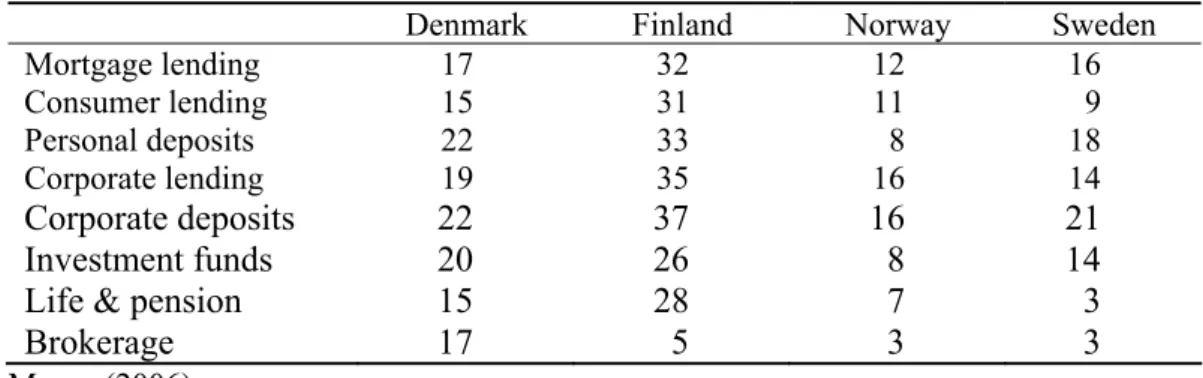
The problem with supervising banking groups as collections of separate legal banking charters is that the legal approach does not reflect how these organizations function in practice. A well-known example of cross-border banking regional integration is Nordea (see Table 2), which is currently organized in the form of subsidiaries that operate with a highly integrated operation. This is set to go further if Nordea changes to a branch structure across the whole region under the European Companies Act, as currently planned. Indeed such a change in Nordea would make its legal form a much closer match to the actual structure of its current operations. It is actually an illusion that many subsidiaries can somehow be cut off from their parent in the event of difficulty and asked to function on their own, with or without statutory management (Mayes, 2006). As Schmidt Bies (2004) puts it: ‘entities can be created within the structure of the group to transfer and fund assets (that) may or may not be consolidated for accounting purposes, depending upon their structure.’ (p. 1). The idea that the various deposit insurers or supervisors can take independent decisions to minimize their losses in these circumstances is thus not realistic.
5 This delegation is contemplated in Article 131 of the Directive 2006/49/EC of the European
parliament and of the Council of 14 June, 2006 on the capital adequacy of investment firms and credit institutions (recast) (Official Journal of the European Union L177/201 30 June, 2006) so called Capital Requirements Directive CRD. In addition, according to Article 44, the home country authorities are responsible for the prudential supervision of consolidated banking groups including bank subsidiaries and affiliates in other Member States (Directive 2006/48/EC of the European Parliament and of the Council of 14 June 2006 relating to the taking up and pursuit of the business of credit institutions (recast)).
12
Table 2. Nordea; Market share in Nordic countries (%)
Denmark Finland Norway Sweden
Mortgage lending 17 32 12 16 Consumer lending 15 31 11 9 Personal deposits 22 33 8 18 Corporate lending 19 35 16 14 Corporate deposits 22 37 16 21 Investment funds 20 26 8 14
Life & pension 15 28 7 3
Brokerage 17 5 3 3
Mayes (2006)
The interdependence of prudential supervision of banks operating across borders creates a principal-agent relationship between the society (voters and taxpayers) of one country as principal and the various supervisors of the rest of the banking group as the agents.6 The delegation approach has also been used recently to debate financial supervisory issues (Bjerre-Nielsen, 2004). The standard set of principal agent problems are made substantially worse when some of the principals have no direct authority over the agent, as when supervisors in one country may expose the taxpayers in another country to losses. The problem is that the agent’s incentives will be to follow the goals of the principal that has some direct authority over the agent. That is, when conflicts arise among the principals, the supervisor (agent) is likely to follow the perceived interests of their own country’s government and voters (principle). Eisenbeis and Kaufman (2006) describe the agency problems and conflicts of cross-border banking in general and, in particular, in the EU.
6 See Alessina and Tabellini (2004, 2005) for a discussion of the conditions for the delegation of
3
Structured Early Intervention and Resolution /
Prompt Corrective Action as a limit on
prudential supervisors’ discretion
SEIR was first laid out by Benston and Kaufman (1988) as a means of minimizing deposit insurance losses by requiring a series of mandatory supervisory interventions as a bank’s regulatory capital ratio falls.7 One way that this proposal could work is illustrated in Table 2 of Benston and Kaufman (1988, p. 64), in which they propose that banks be placed in one of four categories or tranches: 1) ‘No problem’, 2) ‘Potential problems’ that would be subject to more intensive supervision and regulation, 3) ‘Problem intensive’ that would face even more intensive supervision and regulation with mandatory suspension of dividends and 4) ‘Reorganization mandatory,’ with ownership of these banks automatically transferred to the deposit insurer. Although the deposit insurer would assume control of the bank, Benston and Kaufman (1988, p. 68) ordinarily would have the bank continue in operation under the temporary control of the FDIC or be sold to another bank, with liquidation only as a ‘last resort’. The deposit insurer would remain at risk under SEIR, but only to the extent of covering losses to insured depositors. However, Benston and Kaufman did not expect such a takeover to be necessary, except when a bank’s capital was depleted before the supervisors could act, perhaps as a result of a massive undetected fraud. Because the bank’s owners would realize that the supervisors were mandated to take over a bank while it was solvent (3 per cent market value of capital-to-asset ratio under the SEIR proposal), the owners had strong incentives to recapitalize, sell, or liquidate the bank rather than put it to the FDIC.8
A version of SEIR was adopted under the title prompt corrective action (PCA) with the 1991 passage of the Federal Deposit Insurance Corporation Improvement Act (FDICIA) as shown in Table 3. PCA deals with prudential supervisors’ agency problem by first allowing and then requiring specific intervention by the supervisory authorities on a timely basis.
7 See Benston, G J and Kaufman, G G (1988). For a discussion of the intellectual history of PCA
see Benston, G, and Kaufman, G (1994).
8 Table 2 in Benston and Kaufman (1998) gives ‘Illustrative Reorganization Rules’ with
mandatory reorganization at a 3 per cent market value of capital-to-asset ratio. However, the text talks about the possibility that this ratio should be revised upwards.
Table 3.
Mandatory and discretionary provisions prompt correctiv
e action Capita l R atios Ris k-Bas ed Cap ital Lever age Categor y Mandator y Provisions Discretion ar y Pr ovisions Total Tier 1 Ratio W ell Cap ita lized No capi tal distr ibution or pay m ent of man agement fees th at would cause th e bank to become undercap italized >10% >6% >5% Adequately capi tal ized 1. S am e as wel l capi tal ized >8% >4% >4% Undercapitalized 1. Capital d ist
ributions and manag
ement fees suspended 1. Requ ire re cap ital iz ation b y issuing c apit al or s elling to an-other f irm <8% <4% <4% 2. Capita l r estora ti on plan 2. Restr ict ing tra nsactions wi th af filia tes
3. Asset growth res
tricted 3. Re str icting r ates on new depos its 4. Prior approval f or branch
ing, acquisitions, and
n ew lin es of business 4. Restr icting asset growth 5. No brokered dep osits 5. Restr ict ing Ac tivit ies 6. Improving management b y rep lacing dir ectors or managers 7. Prohibit d
eposits from Corresp
ondent b
anks
8. Requ
iring
prior approval for
capital d istributio n b y bank holding company 9. Requ iring Div estitur e Significan tly Un -dercap ita liz ed 1. S am e as Unde rcapi tal ized <6% <3% <3% 2. At least on e o f the 9 d iscretion ar y provisions u nder Un-dercap ita liz ed. P res um ption in f avor of (1) (required capital issuance only ), (2), and (3) . 3. S enior offi cer com pens ation r es trict ed Critic all y Undercapi tal iz ed 1. An y action au thorized for sign ific antl y undercap italized banks <2%** 2. Pay m ents on subordinated d ebt prohibited* 3. Conservatorsh ip or r eceivership within 90 d ay s* * Not requ ired if cer tain cond itio ns are m et ** Tang ible equ ity only Note, this is a ge neral sum m ar y o f PCA onl y. Oth er par ts of
the US Code may
also im pose lim its b ased on a b ank’s cap ita l cat ego ry .
Whereas SEIR sketches out how supervisors would respond to a drop in capital adequacy, PCA provides a list of actions the supervisors may take and another set of actions the supervisor must take to further the goals of PCA (minimizing losses to the deposit insurance fund). While PCA reduces supervisory discretion as a bank’s capital level falls, supervisors retain substantial discretion over almost all banks. Even the ‘mandatory provisions’ often include a significant element of supervisory discretion. For example, while an undercapitalized bank must submit a capital restoration plan, the supervisors have discretion over whether the plan will be approved as ‘acceptable’.
PCA may appear to be simply a set of supervisory corrective measures that should be taken as a bank’s capital declines that any country could easily adopt. However, PCA is unlikely to work as intended if a country has not accepted PCA’s underlying philosophy or lacks the necessary institutional prerequisites. Focusing specifically on the EU, Nieto and Wall (2006) identify three important aspects of the philosophy underlying PCA: (1) ‘that bank prudential supervisor’s primary focus should be on protecting the deposit insurance fund and minimizing government losses’, (2) ‘that supervisors should have a clear set of required actions to be taken as a bank becomes progressively more undercapitalized’, and (3) ‘that undercapitalized banks should be closed before the economic value of their capital becomes negative’. The four institutional prerequisites identified are: (1) supervisory independence, and accountability; (2) adequate authority, (3) accurate and timely information; and (4) adequate resolution procedures. They find that European countries currently comply with these institutional requirements to varying degrees.
The adoption of a version of PCA would provide the EU with a set of minimum supervisory responses to violations of the Capital Requirement Directive (CRD).9 The definition and level of the capital ratios that would trigger mandatory supervisory action and eventually intervention is a relevant subject that is beyond the scope of this paper. Moreover, the original PCA was designed to address principal-agent problems in the supervision in the US and does not explicitly contemplate the complications introduced by cross-border banking groups. A number of authors discuss the merits of adopting PCA in the EU, including in some cases the recognition of the gains from using PCA in supervising cross-border groups. However, none of these authors (Nieto and Wall, 2006; Benink and Benston, 2005; Mayes, 2004) and policy analyst recommendations (ESFRC, 2005) explicitly consider the changes needed in the EU if PCA is to be effective in resolving the cross-border agency problems that arise in supervising cross-border banking groups.
9 Directive 2006/49/EC of the European parliament and of the Council of 14 June, 2006 on the
capital adequacy of investment firms and credit institutions (recast). Official Journal of the European Union L177/201 30 June, 2006.
16
4
A Prompt Corrective Action for Cross-Border
Banking Groups in the EU
Banks operating under PCA can fall into one of three categories: (1) adequate capital, (2) undercapitalized but still having a good chance of rebuilding its capital, and (3) sufficiently undercapitalized that the bank should be placed into resolution to minimize the losses. Cross-border banking groups that are being supervised by national banking supervisors introduce additional supervisory challenges in each of these three categories. The following subsections consider those challenges and recommends additions and modifications of PCA adopted with the 1991 passage of the FDICIA to address the challenges of cross-border groups in the EU.
4.1
Assuring accurate and timely information of banking
group’s financial condition
In order for bank supervisors to use their powers effectively, they must have an accurate understanding of the bank’s and banking group’s financial condition. A potential problem for a prudential supervisor of a cross-border banking group is that of determining the status of those parts of the group outside its supervisory control.
The need for information sharing among the supervisors is recognized in the CRD, Article 132, which establishes that the:
competent authorities shall cooperate closely with each other. They shall provide one another with any information which is essential or relevant for the exercise of the other authorities’ supervisory tasks under this Directive. In this regard, the competent authorities shall communicate on request all relevant information and shall communicate on their own initiative all essential information. […] Information shall be regarded as essential if it could materially influence the assessment of the financial soundness of a credit institution or financial institution in another Member State. In particular, competent authorities responsible for consolidated supervision of EU parent credit institutions and credit institutions controlled by EU parent financial holding companies shall provide the competent authorities in other Member States who supervise subsidiaries of these parents with all relevant information. In determining the extent of relevant information, the importance of these subsidiaries within the financial system in those Member States shall be taken into account.
This obligation for information expands to encompass also:
(c) adverse developments in credit institutions or in other entities of a group, which could seriously affect the credit institutions; and (d) major sanctions and exceptional measures taken by competent authorities in accordance with this Directive, including the imposition of an additional capital charge under Article 136 … .
These provisions for information sharing have also been strengthened with the adoption of Pillar 3 of the new Capital Accord.10 For example, banks are required to report the total and Tier 1 capital ratios for the consolidated group and for significant bank subsidiaries. In this case, the host supervisors of the subsidiaries could use this information (that would be reflected in a market indicator) as justification for triggering consultations with the home country supervisor and/or for undertaking a special examination of the banking group.11
While the information sharing mandated by the CRD should provide national supervisors with the information they need, ad hoc sharing on a banking-group by banking-group basis is likely to be inefficient and leave room for gaps in information sharing. Mayes (2006b) and Vesala (2005) advocate the establishment of a common data base. At a minimum this data base should contain quarterly consolidated financial statements from all insured banks and their nonbank corporate parents (when one exists) that is available to all bank supervisors and ideally these financial statements would be publicly available.12 Additionally, there would be some merit in establishing a data base with confidential supervisory information and analysis would also be available to the appropriate national supervisory agencies to assist all prudential supervisors in understanding the condition of the group as a whole and its relationship to the bank they each supervise. The European Central Bank (ECB) or the Committee of European Banking Supervisors (CEBS) could harbour that database. In the case of the ECB, this responsibility would be consistent with article 105.5 of the EC
10 Pillar 3 aims to encourage market discipline by developing a set of disclosure requirements
which will allow market participants and foreign supervisors to assess relevant pieces of information on the scope of application, capital, risk exposures, risk assessment processes, and hence the capital adequacy of the institution. Since domestic supervisors typically request additional information from the banks it is unlikely that this public disclosure will be thought sufficient.
11 The required level of disclosure is both limited in its relevance and its timeliness (Mayes, 2004).
Mayes (2004) believes that the requirements fall well short of what has been required of banks in New Zealand since 1996, where disclosure statements are required quarterly to reveal peak exposures and where bank directors are legally liable for their accuracy.
12 The US has long required its banks and bank holding companies to file standardized reports of
income and condition with their federal supervisor. These reports have been made publicly available for well over a decade, and are currently available at zero marginal cost on the Internet.
18
Treaty: ‘the ESCB shall contribute to the smooth conduct of policies pursued by the competent authorities relating to the prudential supervision of credit institutions and the stability of the financial system.’ This proposal would also require modification of the professional secrecy imposed by article 44 of the Directive 2006/48/EC of the European Parliament and of the Council of 14 June, 2006 relating to the taking up and pursuit of the business of credit institutions (recast).13
Nieto and Wall (2006) note that the enforcement of PCA depends on the accuracy of reported capital adequacy ratios. They survey several studies suggesting that market signals, primarily subordinated debt spreads, provide useful information about banks’ financial conditions and that in some cases these signals have proven more accurate than the banks’ reported Basel I capital ratio. These studies (eg, Sironi, 2001; Evanoff and Wall, 2002; Llewellyn and Mayes, 2004) show that the information is sufficiently reliable for use as a failsafe mechanism to identify critically undercapitalized organizations. We concur that the use of such market risk measures would provide a valuable supplemental measure for PCA.
Supervisors, though have been reluctant to use market signals to determine the capital category of banks operating under PCA. A less controversial and perhaps easier approach to implement would be to use market-risk measures as triggers for closer supervisory scrutiny of a bank. These measures could include subordinated debt spreads and other measures such as the pricing of credit derivatives, or equity based measures, such as Moody’s KMV Expected Default Frequency. The measures could be used informally by individual supervisors to trigger closer scrutiny of the various parts of the group. The use of such market measures would be consistent with Pillar 2 of the new Capital Accord, which requires supervisory review of bank’s reported capital adequacy and with Pillar 3, which seeks to encourage market discipline. Market risk measures could further be used to trigger a mandatory meeting of the college of supervisors (discussed in subsection 4.2) to review the group’s condition and, when appropriate, for triggering a coordinated special examination of the banking group.
4.2
Co-ordination of PCA disciplinary measures short of
resolution
Although PCA reduces supervisory discretion, some element of discretion is inevitable. While a supervisor can be compelled to employ some measures, the choice of what limits the risk best and reduces any impending loss is bound to be substantially case specific. For example replacing existing management, might be
essential to restore the banks’ financial health in some cases, but counterproductive in other cases.14
The existence of supervisory discretion raises the possibility of a supervisor taking or failing to take a variety of actions that are harmful to the overall banking group but which yield net benefits to the supervisor’s particular country. For example, a supervisor could impose draconian limitations on a bank that is small relative to its financial system, even though the bank provides valuable services to the rest of the group elsewhere. Alternatively, a supervisor may forbear from disciplining or closing a bank that has a large presence in its country. Such forbearance could take the form of a supervisor accepting inadequate capital restoration plans and imposing only the minimum disciplinary measures required under PCA, even though additional measures are likely to be necessary to rebuild the bank’s capital. The consequences could be that weakness at the group level that would adversely impact subsidiaries (even the banking systems) in other countries and may substantially raise the cost of resolving the group should it become insolvent.
The EU has some mechanisms that could be extended to provide an element of coordination in the use of discretionary measures. The CRD provides for some coordination of banks supervision and allows for the delegation of some supervisory responsibilities to another Member State’s prudential supervisor. Article 131 establishes that:
in order to facilitate and establish effective supervision, the competent authority responsible for supervision on a consolidated basis and the other competent authorities shall have written coordination and cooperation arrangements in place. Under these arrangements additional tasks may be entrusted to the competent authority responsible for supervision on a consolidated basis and procedures for the decision making process and for cooperation with other competent authorities, may be specified. The competent authorities responsible for authorizing the subsidiary of a parent undertaking which is a credit institution may, by bilateral agreement, delegate their responsibility for supervision to the competent authorities which authorized and supervise the parent undertaking so that they assume responsibility for supervising the subsidiary in accordance with this Directive. Thus, the CRD provides for a general mechanism of coordination and cooperation among supervisors and it also envisages a stronger form of coordination, which is the possibility that the host supervisor of a subsidiary may delegate its
14 As noted in the introduction, this analysis assumes the adoption of a uniform system of PCA by
all EU countries so that the authorities in each of the EU countries would have a similar if not identical range of powers. Currently this is far from the case and, although the toolkit may be similar, what can or must be done in each circumstance varies considerably.
20
responsibility to the home country prudential supervisor of the subsidiary’s parent.
The primary problem with using the authority provided by the CRD is that delegating supervisory responsibility to the home country supervisor of the parent bank is likely to worsen the principal-agent conflict between the parent’s supervisor as agent, and the subsidiary’s country’s taxpayers and voters, as principal. The parent’s supervisor would be responsible for the impact of its supervisory action on the deposit insurance fund and possibly the financial stability of the host country of the subsidiary, but the parent’s supervisor would not be directly accountable to the host country government and the taxpayers, thus increasing the agency problem.
Another mechanism for coordinating discretionary PCA actions would be the creation of a college of the prudential supervisors of the banks in the group. The college would be fully compatible with Article 129 of the Directive 2006/48/EC of the European Parliament and of the Council of 14 June, 2006 relating to the pursuit of the business of credit institutions (recast), which envisages the cooperation of the consolidating supervisor with the competent authorities of the subsidiaries.15 The coordination mechanisms could be merely advisory, leaving the final decision up to the national supervisors of each bank, or it could be binding upon the members. In some cases allowing each supervisor to take disciplinary action is likely to be acceptable, especially if the action would be unlikely to have adverse consequences on other group members. However, leaving the final decision in the hands of each bank’s national supervisor would probably not result in effective coordination to the extent that different supervisors reach different conclusions about the appropriate actions either because they have different incentives or because they have reached different judgments. Thus, for an effective implementation of a PCA policy as a coordination mechanism between supervisors, a better solution would be to give the authority to take discretionary actions that will be binding on all prudential supervisors in the college (see Appendix for a description of different scenarios of collegial binding decision). The idea behind such a grouping is that the supervisors can become in some sense jointly responsible for the actions the group takes. In such a case it may then be easier to agree to remedial actions and even burden sharing in the event of loss.
Ideally, a college of supervisors for each cross-border banking group should be formed before the need arises to invoke PCA’s disciplinary provisions. However, the formation of a college with authority to make discretionary decisions within the PCA policy framework should be mandatory as soon as a bank owned by a cross-border banking group falls below the capital standard.16
15 L 177/48 Official Journal of the European Union of 30 June, 2006.
16 There is a clear complexity if responsibility for ongoing supervision and resolution (whether or
The formation of the college does not mean that decisions will always be made in a timely and harmonious fashion. Even the best of colleges is likely to be an inefficient mechanism for addressing most issues that require consultation or negotiation with the banking group. For example, if a cross-border banking group with capital below the minimum capital requirements is required to develop a capital restoration plan that is acceptable to its supervisors, having the bank negotiate the plan with each of the college members would be slow and inefficient. Where such consultation or negotiation is required, a better alternative would be for the committee to select one supervisor as the primary contact with the bank.17 The role of the college would then be to review and approve the contact supervisor’s agreement with the bank.
For a variety of reasons, a college of supervisors may at times find reaching a decision difficult. One way of forcing timely action would be for PCA to establish a presumption that a certain action will automatically be effective say 30 days after a bank violates one of the PCA triggers, unless the college determines that taking the action will not further the purposes of PCA. Similar provision is envisaged in Article 129 of the Directive 2006/48/EC of the European Parliament and of the Council of 14 June, 2006 relating to the pursuit of the business of credit institutions (recast), which foresees that the consolidating supervisor will decide in a time framework in the absence of a joint decision. This would prevent a subset of the college from using committee deliberations to stall effective action. Additionally, the colleges may somewhat reduce the scope for relatively unimportant disagreements to stall decision making by specifying in advance that the college will follow decision rules that give greater weight to the judgments of supervisors of the larger banks in the group and the supervisors from countries where the banking group is systemically important.
Although a college provides a mechanism for all affected Member States to have a voice in the corrective measures’ decision taken under PCA, the college does not completely solve the agency problem caused by the mismatch between supervisory powers and supervisory accountability to voters. Giving each country’s supervisor a say in a coordinating college is not equivalent to the power that the supervisor would have to protect its country’s interests as it could with a purely domestic bank. However, the inability of supervisors in each country to have the same control as they would over a purely domestic group is an unavoidable consequence of groups operating as integrated entities in more than one Member State. Corrective measures taken (or left untaken) will have sometimes different consequences for different countries.18 The best that can be
17 Ordinarily the contact would be the parent’s supervisor unless the problems are focused in
particular subsidiaries or markets.
18 Giving every supervisor a veto over taking an action would not prevent problems if failure to act
22
said is that a college structure will typically provide better representation of each of the affected countries than would a system that gives all of the power to a single supervisor, hence, reducing the agency problem by increasing supervisor’s accountability to the government and the tax payer.
4.3
Coordination of resolution
PCA requires timely resolution, which is to say it sets a hard boundary which, when crossed by the bank, requires that the bank be forced into resolution.19 Timely resolution of banks can enhance financial stability in a variety of ways. First, the lack of a deposit insurance subsidy to risk taking and the threat of losing the bank’s charter may deter the bank from taking excess risk. If problems should arise, the bank has an incentive to quickly rebuild its capital or sell itself to a stronger bank before the supervisors must withdraw the bank’s charter.20 Moreover, timely resolution should reduce or eliminate the losses to be borne by depositors, the deposit insurer and any non-subordinated creditors and depositors.21 This reduction in expected losses reduces the incentive of depositors and other non-subordinated creditors to run on a failing bank. Further, the reduction in expected losses to deposit insurers reduces the problem of allocating those losses across the various insurance schemes and reduces the probably that a deposit insurer would renege on its obligations. In a PCA cum closure rule at a positive level of regulatory capital, losses will be by definition smaller than in the absence of PCA to the extent that deposits would be backed by assets of at least the same market value, except in the case of rapid decline in asset value, massive fraud or inadequate monitoring by the regulatory agencies.
If this hard boundary is to be credible, Nieto and Wall (2006) argue that it must be accompanied by a credible process for resolving insolvent banks,
veto over failing to act would not help if taking a given action would have large adverse consequences for some countries.
19 SEIR calls its lowest category ‘mandatory reorganization’. Banks in PCA’s ‘critically
undercapitalized’ category are to have a receiver or conservator appointed within 90 days unless the supervisor can show that another action would better meet PCA’s goal of minimizing deposit insurance losses.
20 Kane, Bennett and Oshinsky (2006) find evidence that distressed banks are more likely to
recapitalize or sell themselves in the period after the adoption of PCA than in a prior period.
21 Losses to non-subordinated creditors would necessarily be zero if banks are closed with positive
levels of regulatory capital and accurate measures of the liquidation value of the bank were used to calculate the bank’s regulatory capital. More generally, the realized value of a closed bank’s portfolio may be negative due to errors in measuring portfolio values (including errors due to fraud) and possible losses resulting from the supervisors assuming control of the bank (that is, the loss of some going concern value). Nevertheless, the losses, if any, borne by the creditors and deposit insurer would almost surely be substantially less if banks are closed at positive values of measured economic capital than if the banks are not closed until after their book value of capital became negative.
particularly. Without a credible process for resolving banks, especially banks whose operation is important to the financial system, the supervisors are more likely to exercise forbearance than to implement timely closure.
In the EU, there is no a framework of commonly accepted standards of bank resolution practice there is no common definition of bank insolvency nor a fully-fledged single legal framework or a common decision-making structure across Member States. Hadjiemmanuil (2004) argues that a single pan-European legal and administrative framework for bank resolution is not only still lacking, but also it is unlikely to emerge in the foreseeable future. As a result, bank resolution procedures largely depend on national laws, which often fail to meet many of the requirements for a credible, efficient resolution system. Even if consideration is limited to the requirements for a large domestic bank group operating in a single country, most EU countries lack an adequate system. Nieto and Wall (2006) highlight two requirements that are generally not met by EU national resolution systems: (1) the need for special bankruptcy provisions for banks in which a banking authority is given authorization to create and operate a ‘bridge’ or similar bank,22 and (2) a requirement that depositors be provided prompt access to their funds. These weaknesses in most EU national resolution systems are likely to give policymakers little choice but to recapitalize a large, banking group, even if it is deeply insolvent.
Additional problems arise if the failing banking group operates across borders and needs to be recapitalized or resolved. Goodhart and Schoenmaker (2006) focus on the issues associated with recapitalizing a distressed bank that operates in two or more Member States, many of which have parallels to the issues likely to arise when a cross-border bank is forced into resolution.23 The following subsection summarizes their key findings and the next subsection discusses how the issues would be addressed in a PCA framework.
4.3.1 Recapitalizing a cross-border banking group in the absence of
PCA
The withdrawal of the charter of a cross-border banking group, especially a large group, could have severe adverse consequences for the financial stability of one or more Member States. Given the limitations of other existing EU resolution options, the only option that is likely to forestall financial instability may be for
22 In the US the most obvious way to do this in the case of a large bank is to form a ‘bridge bank’,
which is a national bank newly chartered by the Comptroller of the Currency under the control of the FDIC.
23 Goodhart and Schoenmaker (2006, p. 37) note that early closure of a bank as provided for by the
US version of PCA would ‘reduce the problem’. Their focus on recapitalization presumably reflects their views about the political viability of adopting PCA in Europe for the foreseeable future rather than its economic merits.
24
the affected Member States to recapitalize the bank at taxpayer expense. However, disagreements about whether a bank should be recapitalized and, if so, how the burden should be apportioned are likely to delay action until the market losses confidence in the bank.
By the time confidence is lost, the time for organizing a recapitalization will be very short (likely only a few hours) and the costs of recapitalization are likely to be a substantial fraction of the bank’s assets. Without any ex ante agreement on sharing the cost of recapitalization, the country most affected may be forced to decide whether to bear all of the recapitalization cost or to let the bank be forced into bankruptcy proceedings where liquidation is possible. While this may be the largest country, this is by no means certain. Nordea, for example is more important in Finland than it is in the home country, Sweden. Small countries may simply not have the resources for such a recapitalization and will hence be forced into having the crisis.
An alternative to negotiating an agreement during a crisis would be for an ex ante agreement on burden sharing involving the various national ministries of finance. There are several ways in which such an ex ante agreement could be structured. Goodhart and Schoenmaker (2006) recommend that all countries in which the bank operates share the burden according to some measure of the operations that the bank has in their country, assets being their preferred measure. However, obtaining agreement on any single measure (a proxy) for a fair distribution may be difficult. For example, assets may not be a good proxy for the real and financial impact of a bank’s failure. Such impact may depend, for example, on the structure of the local deposit market or on the bank’s role in the country’s securities and derivatives markets.
It is also not clear how decisions would be taken. Access to pubic funds is presumably a matter for the relevant ministries of finance. However, ministries of finance would no doubt want to be advised by supervisors, deposit insurers and central banks. Whether they should all sit round the table or whether different parties should meet for different purposes during the process of managing the problems is an open issue. Goodhart and Schoenmaker (2006) recommend that all three parties from each of the countries being there in addition to EU level representation from the Committee of European Banking Supervisors (CEBS), the European Central Bank, ECOFIN and the European Commission, subject to a ‘de minimis’ threshold of 5 per cent of the group’s assets and 15 per cent of the country’s banking assets.
4.3.2 Resolution of a cross-border banking group under PCA
A version of PCA that was effective for groups operating only in one country would by itself substantially reduce the problems of resolving a large cross-border banking group. PCA provides for early resolution (charter withdrawal) before a bank can incur losses substantially in excess of its regulatory capital.24 At best, such a PCA would give supervisors time to organize an orderly resolution of a problem bank because it would result in the bank’s charter being withdrawn while creditors were confident the bank had sufficient assets to honor their claims. More likely, given the US experience, some bank runs will occur because at least some uninsured creditors are likely to take losses in bank resolutions and will act to protect themselves. However, even if market participants control the timing of the bank resolution, PCA will still reduce the problems of resolving a failing banking group. PCA’s requirement that bank charters be withdrawn at positive values of bank’s regulatory capital should substantially reduce the losses to taxpayers and significantly reduce any conflicts over how best to share the burden. The losses may even be sufficiently low so that they can be absorbed by the banking industry through payments to their deposit insurer.
The first part of cross-border resolution version of PCA would require that that the parties to the process start meeting as soon as there is an indication of a problem and no later than when a bank falls below the minimum capital standard required by the CRD. When a bank falls below its minimum capital requirements, market participants are likely to start looking for signals that its resolution is imminent and that they should cut their credit exposure to the distressed bank. The formation of the college long before resolution becomes likely would allow all concerned safety net regulators to plan for the possibility that the bank will need to be recapitalized or resolved, without sending the signal that the supervisors consider such action likely.
The resolution college will need to reflect the views of most, if not all, of the participants as noted in the Goodhart and Schoenmaker (2006) proposal. Even if the bank is closed without any losses to the taxpayer, at least some finance ministries/national central banks may need to advance funds to the deposit insurer to cover the insurer’s share of the losses, in part because some deposit insurers collect funds on an ex post basis. In theory, such support by national governments is limited by the Directive 94/19/EC on deposit insurance, which discourages governments from providing funding to their deposit insurer and support by the central bank is limited by EC Treaty (article 101). In practice, these restrictions may not prove viable given the importance of giving depositors immediate access to their funds discussed in Nieto and Wall (2006) and the limited funds available
24 Such a PCA would include a credible resolution mechanism, as advocated by Nieto and Wall
26
to many deposit insurers. The burden sharing proposals of Goodhart and Schoenmaker (2006) implicitly recognize this possibility.
While the resolution committee cannot know for certain whether or how much losses will be incurred in resolving the bank, there could be disagreements about how to share any costs that do arise. One method of allocating the losses, if any that do occur would simply be to assess for each insurer the amount needed to cover losses to insured depositors in the bank or banks covered by the insurer. The losses allocated under this procedure, however, will depend in part on the gains from keeping the banking group together so that the group retains any going concern value and so that the group can be sold to its highest value. However an ex ante agreement on burden sharing may turn out to be more workable in practice, as suggested by Goodhart and Schoenmaker (2006).
It is likely that the balance of interests needed to be taken into account in deciding whether to intervene will also be appropriate for decision-making about the subsequent resolution of the bank. The fact that a bank had to be put into resolution suggests that a quick sale of the entire group is unlikely. The group is likely to have arranged such a sale before resolution, if that were possible. Thus, the resolution of almost all large cross-border groups is likely to involve their being operated as some equivalent of a bridge bank (or bridge banking group) pending the return of its assets to the private sector. Someone will have to have managerial authority over the bank and in almost all cases the home country supervisor will be the logical party to appoint the new management. The bank’s management should be overseen by a board with representatives from all of the affected Member States, perhaps reduced by the same de minimis rule used before the bank went into resolution. This function can be performed by the resolution college. Whether each nation needs to be represented by its banking supervisor, its ministry of finance and its national central bank may depend on the circumstances. If the respective national ministries of finance or national central banks are not making an important contribution to the resolution, they should probably be dropped from the oversight board to help keep the size of the board manageable.
The conflicts between different stakeholders will not end after the formation of a bridge bank.25 The managers and overseers of the bridge bank will have a variety of decisions to make that could provoke sharp controversies. One such decision is where the banking group should continue lending and where it should reduce or stop lending. Those countries and industries facing reduced lending may be concerned about the impact of the cuts on their domestic economic activity. However, having the bank continue to lend to loss-making geographical areas and
25 The same sorts of conflicts are likely to occur under the current system if the national ministries
of finance decide to recapitalize a distressed bank. To the extent the various ministries hold a sizeable part of the bank’s stock, they will likely expect to participate in the decisions of the bank before privatization and also in the decisions on how best to privatize the bank.
industries is likely to provoke concerns from some college members about the likely losses to the bank. Another potentially controversial decision is that of closing some branches and subsidiaries. The managers may also recommend these closures to improve the efficiency of the surviving organization. Again, those Member States that face the cuts may view the situation differently from those that are concerned about further losses. A third potential source of controversy is the weight given to various considerations when the group’s assets are returned to the private sector. Many on the board of the bridge bank (formerly resolution college) will likely favour accepting the highest bid for the group (or parts of the group) but others on the board may want to include other considerations, such as any labour force reductions planned by the prospective acquirers, or keeping the national charter of the bank. Our preference would be to focus on minimizing the expected cost of resolution, with governments finding other, more transparent vehicles used when required to obtain their other objectives. Alternatively, governments could be given the option of having the banking group continue to make loans or keep loss making subsidiaries open or both, provided that a subset of the governments agree ex ante to absorb the losses.
5 Conclusion
PCA was designed to improve the prudential supervision of banks in the US, most of which operate in a single market. An EU version of PCA could also improve the prudential supervision of banks operating in more than one Member State. However, to be as effective as possible, the EU version should address a number of cross-border issues that are compatible with the existing decentralized structure of the EU safety net.
Bank supervisors need to understand the overall financial condition of a banking group and its various individual banks if they are to effectively anticipate problems and take appropriate corrective measures. The EU could use PCA to enhance the availability of information to prudential supervisors as well as supervisor’s use of market information. Availability could be improved by enhancing information sharing requirements on individual bank’s financial condition as a part of the adoption of PCA. The use of market based risk measures could be mandated in the supervisory process. At a minimum, this would include requiring additional examinations of banking groups whose reported capital exceeds minimum required levels but which are identified as high risk by financial markets and mandating that the relevant banking supervisors meet to share their evaluations of the group.
PCA reduces supervisors’ ability to exercise forbearance, but it by no means eliminates supervisory discretion. Supervisors retain substantial discretion in their
28
implementation of PCA so long as a bank’s regulatory capital exceeds the critical level at which it is forced into resolution. If the consequences of bank supervision in one country can have large consequences for the group’s banks in other countries, then deciding how best to exercise this discretion should be decided by the supervisors of all the banks (or at least all of the significant banks) in a collegial format. However, even if a satisfactory means of deciding what to do can be implemented, the actual powers of supervisors in the EU are not identical. Some may not be able to implement the actions others wish to vote for. Hence, effective implementation would require as a precondition that prudential supervisors be given the same authority to take the corrective measures in PCA (Nieto and Wall, 2006).
Finally, should a bank that is part of an integrated cross-border banking group reach the point where PCA mandates resolution, its resolution could have implications for a number of Member States. The timing of the resolution is unlikely to remain in the supervisor’s hands, so the process of making these decisions needs to begin before markets perceive that the bank must be resolved. The parties from each country that will play a role in the resolution (the banking prudential supervisor, the ministry of finance and the national central bank) should begin planning for the resolution with the appropriate EU institutions and the ECB no later than the time the bank first falls below the minimum capital adequacy requirements set in the CRD. In a PCA cum closure rule at a positive level of regulatory capital, losses would be zero to the extent that deposits would be backed by assets of at least the same market value.26 In almost all cases, the best resolution of a large cross-border bank will involve the creation of the equivalent of a bridge bank or bridge banking group. This would require special bankruptcy provisions for banks in the EU. A number of additional decisions will then be needed as to how to run the bridge bank(s) until its assets are returned to the private sector as well as decisions about how best to return the assets to private owners. Thus, on-going oversight of the bridge bank should be provided by a board with safety net regulators from all of the affected Member States (banking prudential supervisor, ministry of finance and national central bank), perhaps reduced by the same de minimis rule used before the bank went into resolution.
26 Of course, losses could be greater than zero to the extent that that asset values were not properly
measured (for example, as could happen in the case of fraud or inadequate monitoring by supervisors) or the asset values rapidly decreased in value after resolution.
References
Alesina, A – Tabellini, G (2004) Bureaucrats or Politicians? CEPR Discussion Paper Series, WP n. 5242.
Alesina, A – Tabellini, G (2005) WhyDo Politicians Delegate? NBER Working Paper Series, WP n. 11531.
Basel Committee on Banking Supervision (1992) Minimum Standards for the Supervision of International Banking Groups and their Cross-border
Establishments’. Basel, July.
Benink, H – Benston, G J (2005) The Future of Banking Regulation in
Developed Countries: Lessons from and for Europe. Mimeo.
Benston, G J – Kaufman, G G (1998) Risk and Solvency Regulation of
Depositor Institutions: Past Policies and Current Options. New York:
Salomon Brothers Center, Graduate School of Business, New York University.
Benston, G – Kaufman, G (1994) The Intellectual History of the Federal
Deposit Insurance Corporation Improvement Act of 1991. In Kaufman, G
G (ed.) Reforming Financial Institutions and Markets in the United States, 1–17. Boston: Kluwer.
Bjerre–Nielsen, H (2004) The Financial Regulatory and Supervisory
Authority: A Principal and an Agent. The Danish Financial Services
Authority (mimeo).
Eisenbeis, R A – Kaufman, G G (2006) Cross Border Banking: Challenges for Deposit Insurance and Financial Stability in the European Union (mimeo).
European Shadow Financial Regulatory Committee (ESFRC, 1998) Dealing with
Problem Banks in Europe. Statement No. 1, Centre for Policy Studies, 22
June, p. 30.
European Shadow Financial Regulatory Committee (ESFRC, 2005) Reforming
Banking Supervision in Europe. Statement No. 23 Frankfurt am Main, 21
30
Evanoff, D D – Wall, L D (2002) Subordinated Debt and Prompt Corrective
Regulatory Action. In Prompt Corrective Action in Banking: 10 Years Later.
Edited by Kaufman, G, 53–119. This book is volume 14 of Research in Financial Services: Private and Public Policy published by JAI.
Garcia, G – Nieto, M J (2005) Banking Crisis Management in the European
Union: Multiple Regulators and Resolution Authorities. Journal of
Banking Regulation Vol. 6, No 3, 215–219.
Goodhart, C A E – Schoenmaker, D (2006) Burden Sharing in banking crisis in
Europe LSE Financial Markets Group. Special Paper Series No. 163
September 2005.
Hadjiemmanuil, C (2004) Europe’s Universalist Approach to Cross-Border
Bank Resolution Issues. Paper presented at the Federal Reserve Bank of
Chicago Conference on Systemic Financial Crises: Resolving Large Bank Insolvencies, September 30-October 1.
Khan, Ch. M – Santos, J A C (2002) Allocating Lending of Last Resort and
Supervision in the Euro Area. In (Alexander, V and Melitz, J and von
Furstenberg, G M eds.) Monetary Union: Why, How, and What Follows?, chapter 19, London, Oxford University Press.
Khan, Ch. M – Santos, J A C (2005) Allocating Bank Regulatory Powers:
Lender of Last Resort, Deposit Insurance and Supervision. European
Economic Review, Vol. 49, Issue 8, 2107–2136, 31.
Kane, E J – Bennett, R L – Oshinsky, R (2006) Evidence of Improved
Monitoring and Insolvency Resolution under FDICIA. (mimeo)
LaBrosse, J R – Mayes, D G (2006) Promoting Financial Stability through Effective Depositor Protection: The Case for Explicit Limited Deposit
Insurance. Ch 1 in Campbell, A and LaBrosse, J R and Mayes, D and Singh,
D (eds.), Deposit Insurance, Basingstoke Palgrave-Macmillan (forthcoming). Llewellyn, D – Mayes, D G (2004) The role of market discipline in handling
problem banks. In Kaufman, G G (ed.), Market Discipline in Banking:
Theory and Evidence, Amsterdam: Elsevier, 183–210.
Mayes, D G (2004) Getting the Best out of Basel II for the European Banking
System. In The New Basel Capital Accord and the Future of the European
Mayes, D G (2006a) Bridge Banks and the Lender of Last Resort/Systemic
Risk Exemption. Conference on International Financial Stability:
Cross-Border banking and National Regulation, Federal Reserve Bank of Chicago, October 5-6.
Mayes, D G (2006b) Financial Stability In A World Of Cross-Border Banking: Nordic And Antipodean Solutions To The Problem Of
Responsibility Without Power. Journal of Banking Regulation, Vol. 8 (1),
20–39.
Mayes, D G (2006c) Cross-border Financial Supervision in Europe: Goals
and Transition Paths. Sveriges Riksbank Economic Review, 2/2006, 58–89.
Mishkin, F S (2005) How Big a Problem is Too Big to Fail? NBER working paper 11814, December.
Nieto, M J – Wall, L D (2006) Preconditions for a Successful Implementation of Supervisors’ Prompt Corrective Action: Is there a Case for a Banking
Standard in the EU? LSE Financi