IEL / ETM Case Study Series
XENO MOUSE PATENT PORTFOLIO ANALYSIS
No. 02/12
Division of Engineering & Technology Management (D-ETM) Institute of Engineering Leadership (IEL)
i
MT5001 IP Management
Group 8
Liu Qian (HT093126A)
Ma Yu (HT093156X)
Mu Jun (A0077634X)
Zhou Minzi (HT070396M)
Executive Summary
Monoclonal antibodies (abbreviated mAbs) are laboratory-produced, monospecific antibodies that are the same because they are made by identical immune cells that are all clones of a unique parent cell. Monoclonal antibodies therefore can be used for treatment of cancers, transplant rejection reduction, and autoimmune diseases by specifically binding to target cells. The new generation of technologies for generating antibodies from mice, including XenoMouse, which was a unique strain of transgenic mice, was capable of producing therapies which were delivered to be more effective and well tolerated by humans.
In the second part of this paper, we aim to find out the core patents related to XenoMouse which was fully owned and developed by the biotech company, Abgenix. In order to achieve this goal, we design a patent search strategy based on Thomson Innovation platform. This strategy attempts to narrow the search scope step-by-step by using a variety of categorizing and filtering skills such as IPCs classification, text clustering, country code filter and etc.
i
CONTENTS
LIST OF FIGURES ... III LIST OF TABLES ... V
INTRODUCTION ... 1
XenoMouse ... 1
Immune System, Antigen & Antibody ... 2
Monoclonal Antibodies ... 3
Company History ... 10
CHAPTER 1 PATENT LANDSCAPE AND PORFOLIO ANALYSIS ... 12
1.1 Step One: Abgenix Patent Landscape & Portfolio Investigation ... 13
1.2 Step Two: Categorization and Analysis of Top 20 IPCs ... 15
1.3 Step Three: Analysis of the Patents under the Xenotechnology-related IPCs ... 17
1.4 Step Four: Identification and In-depth Analysis of the XenoMouse-related Patents... 18
1.5 Step Five: Identification of the Patents Filed in the U.S. ... 21
1.6 Step Six: Identification of the Core Patents related to XenoMouse ... 22
1.7 Conclusion ... 25
CHAPTER 2 COMPETITORS’ PATENT ANALYSIS ... 28
2.1 Competitor search ... 28
2.2 Patent portfolio analysis of main players in mAb industry... 32
2.2.1 Patent search strategy ... 32
2.2.2 Overview of the distribution of main players’ applied patents. ... 32
2.2.3 Themescape map analysis ... 34
2.2.4 Conclusion of patent portfolio analysis of main players ... 39
2.3 Comparison of Abgenix and Medarex Patent Portfolio ... 40
2.3.1 Medarex and HuMAbMouse ... 40
2.3.2 Overview of transgenic animal and mAb preparation technology ... 41
2.3.3 MAbs patent portfolio analysis of Abgenix and Medarex ... 42
2.3.4 Comparison conclusion ... 47
CHAPTER 3 TECHNOLOGY VALUATION ... 48
3.1 Market Identification & Analysis ... 48
3.1.1 The Market Value Chain ... 48
3.1.2 Core Business of Abgenix ... 50
3.2 Patent Valuation ... 52
3.2.1 Key Patents Analysis ... 52
3.2.2 Cost Approach ... 54
ii
3.2.4 Market Approach ... 58
3.2.5 Conclusion ... 59
CHAPTER 4 IP DISPUTES ... 61
4.1 Battle for the Transgenic Mice Technology ... 61
4.1.1 Owners of XenoMouse and HuMAb-Mouse Technologies ... 62
4.1.2 Details of the Dispute ... 63
4.1.3 Outcome of the Dispute – Cross-license and Settlement Agreement... 64
4.2 Proposed Reason for Payment in the Settlement ... 65
4.2.1 Quality Patents of Medarex ... 66
4.2.2 Quality Patent of Abgenix ... 68
4.3 Consequence of the Settlement ... 69
CHAPTER 5 IP STRATEGY ... 71
5.1 IP Strategy Review ... 71
5.1.1 Commercialization of the XenoMouse Technology ... 71
5.1.2 IP Strategies ... 72
5.2 Recommendations ... 73
iii
List of Figures
Figure 1. “Meet XenoMouse” ... 2
Figure 2. Antigen & Antibody ... 3
Figure 3. Monoclonal Antibody Production ... 5
Figure 4. Monoclonal Technology Evolution ... 8
Figure 5. History of Xeno Mouse ... 11
Figure 6. Paten Search Flow ... 13
Figure 7. Abgenix’s Patent Application Trends ... 14
Figure 8. Top Countries Where Abgenix Filed Patents ... 14
Figure 9. Top 20 IPCs Covering Agbenix’s Patents ... 16
Figure 10. Classification of the Top 20 IPCs ... 17
Figure 11. Patent Allocation (Keyword: transgenic mouse) ... 19
Figure 12. Patent Allocation (Keyword: human monoclonal antibodies) ... 20
Figure 13. Patent Allocation (Keyword: xenomouse) ... 20
Figure 14. Patent Allocation (Keyword: transgenic mouse +human monoclonal antibodies + xenomouse) ... 20
Figure 15. Themescape Map for 372 Patents Most Relating to Xenomouse ... 21
Figure 16. US Patent 5,939,598 Forward Citation ... 22
Figure 17. US Patent 5,916,771 Forward Citation ... 23
Figure 18. Disclosed Information Regarding the XenoMouse Key Patents ... 24
Figure 19. Patent Family Member Record of US 66571038 ... 25
Figure 20. XenoMouse-related Patent Application Trends ... 26
Figure 21. Monoclonal Antibodies Developed from the XenoMouse Platform ... 27
Figure 22. FDA approved drug search interface ... 29
Figure 23. Drug information given by FDA website ... 29
Figure 24. Patent search strategy of each main player’s mAb patent portfolio ... 32
Figure 25. Distribution of the applied patents by country ... 33
Figure 26. Comparison of the number of each player’s applied patents and patent family ... 33
Figure 27. Themescape map of main players ... 34
Figure 28. Themescape map marked with technologies ... 35
Figure 29. Enlarged view of the upper left conner ... 35
Figure 30. Celltech’s technological strength ... 36
Figure 31. Protein Design Labs’ technological strength ... 36
Figure 32. Protein Design Labs’ technological strength ... 37
Figure 33. Cambridge Antibody technology’s technological strength ... 37
Figure 34. Medarex’ technological strength ... 38
iv
Figure 36. Potential battle ground of the main players ... 39
Figure 37. Main steps of making transgenic mice and related IPC ... 42
Figure 38. Main steps in mAbs preparation and related IPC ... 42
Figure 39. Patent breakdown by publication years ... 43
Figure 40. Themescape map of Abgenix and Medarex ... 44
Figure 41. technological advantages of Abgenix ... 44
Figure 42. technological advantages of Medarex ... 45
Figure 43. Categorization of key IPC numbers ... 45
Figure 44. patent breakdown by transgenic mice related IPC ... 46
Figure 45. Patent breakdown by mAb preparation related IPC ... 46
Figure 46. The market value chain ... 49
Figure 47. The financial status of Abgenix ... 51
Figure 48. Statements of operations (Annual Report 2005) ... 55
Figure 49. Balance sheets (Annual Report 2005) ... 59
Figure 50. Owners of the Transgenic Mice Technology ... 62
Figure 51. Details of the Dispute ... 63
v
List of Tables
Table 1. Glossary of mAb terms ... 7
Table 2. Feature Comparison ... 9
Table 3 Patent Search Strategy ... 12
Table 4. Technology Categories Based on the IPCs Classifications ... 18
Table 5. Top 3 Patents with the Most Family Members Among the 76 US Patents ... 23
Table 6. Drug Information of FDA approved mAbs ... 31
Table 7. Number of each player’s applied patents and patent families ... 33
Table 8. Summary of the Themescape map analysis ... 40
Table 9. FDA approved products of Abgenix and Medarex ... 47
Table 10. Historical R&D expenditures ... 55
Table 11. Existing candidate antibodies... 57
Table 12. Discounted cash flow (in million USD) ... 58
Table 13. Extracts of claims for Medarex’s patents ... 67
Table 14. Extracts of claims for Abgenix’s patents ... 68
1
Introduction
XenoMouse
“Meet XenoMouse” headlined the piece from the Abgenix information kit. (see 錯誤! 找
不到參照來源。) If ever there was a mouse worth meeting, XenoMouse was probably it.
While Lee Majors played bionic man, Steven Austin, in the popular Six Million Dollar
Man television series in the 1970s, XenoMouse could well be termed the “Three Billion
Dollar Mouse”. XenoMouse lived at Abgenix in Fremont, California, just across the Dunbarton Bridge from Silicon Valley’s famed Highway 101. Before some products based on the genetically engineered XenoMouse reached the market, it has become
the source of the company’s near $3 billion market capitalization of March 31, 2000.
The product of a seven-year, $40 million research and development effort, XenoMouse
was a unique strain of transgenic mice capable of producing antibodies potentially
useful in the treatment of human disorders including cancer, transplant rejection, and
inflammation. The idea of using mice to produce antibodies for treating human
diseases dated back to the 1970s; but only recently had therapies based on this
approach passed the rigorous safety and efficacy tests necessary for regulatory
approval. Many industry observers were now predicting an “antibody wave” as genomics research identified thousands more possible disease targets for antibody
therapy. And, the new generation of technologies for generating antibodies from mice,
including XenoMouse, was capable of producing therapies which were delivered to be
more effective and well tolerated by humans. Major pharmaceutical and biotech
2
Figure 1. “Meet XenoMouse”
Immune System, Antigen & Antibody
An antibody is a protein developed by the immune system. When a foreign substance
(an “antigen”) enters the body, the immune system is responsible for helping to eliminate antigens such as infectious organisms by producing an antibody to fight that
antigen. The antibody binds to the antigen, neutralizing it and preventing it from
reacting with normal cells. The antibody production capability of a human is limited
however. First, even when “normal” it cannot generate antibodies to its own tissues
which are multiplying out of control – as is the case with cancer. Second, an
3 Antibodies are typically made of basic structural units—each with two large heavy chains and two small light chains. Though the general structure of all antibodies is very
similar, a small region at the tip of the protein is extremely variable, allowing millions of
antibodies with slightly different tip structures, or antigen binding sites, to exist. This
huge diversity of antibodies allows the immune system to recognize an equally wide
variety of antigens. Antigen binding sites are the essential parts of antibodies where
antibodies recognize and combine with antigens. The process of combination with
antigen is also termed “neutralization”. If an antibody can neutralize an antigen well, this antibody is considered to have high “affinity”. Different antibodies have different binding sites structure and therefore one kind of antibody is simply able to recognize
and neutralize the corresponding kind of antigen. This characteristic of antibodies is
described as “specificity” (see 錯誤! 找不到參照來源。).
Figure 2. Antigen & Antibody
Monoclonal Antibodies
4 Monoclonal antibodies (abbreviated mAbs) are laboratory-produced, monospecific
antibodies that are the same because they are made by identical immune cells that are
all clones of a unique parent cell. Monoclonal antibodies mimic the antibodies human
body naturally produces as part of human's immune system's response to germs,
vaccines and other invaders. Given almost any substance, it is possible to create
monoclonal antibodies that specifically bind to that substance. Monoclonal antibodies
therefore can be used for treatment of cancers, transplant rejection reduction, and
autoimmune diseases by specifically binding to target cells.
2. General Method to Produce Monoclonal Antibodies
A general method to produce monoclonal antibodies is a process by which large
quantities of antibodies (targeted against a particular antigen X) can be produced.
A mouse is immunized by injection of an antigen X to stimulate the production of
antibodies targeted against X. The antibody forming cells are isolated from the mouse's
spleen.
Monoclonal antibodies are produced by fusing single antibody-forming cells to tumor
cells grown in culture. The resulting cell is called a hybridoma.
Each hybridoma produces relatively large quantities of identical antibody molecules. By
allowing the hybridoma to multiply in culture, it is possible to produce a population of
cells, each of which produces identical antibody molecules. These antibodies are called
"monoclonal antibodies" because they are produced by the identical offspring of a
single, cloned antibody producing cell.
Once a monoclonal antibody is made, it can be used as a specific probe to track down
5
Figure 3. Monoclonal Antibody Production
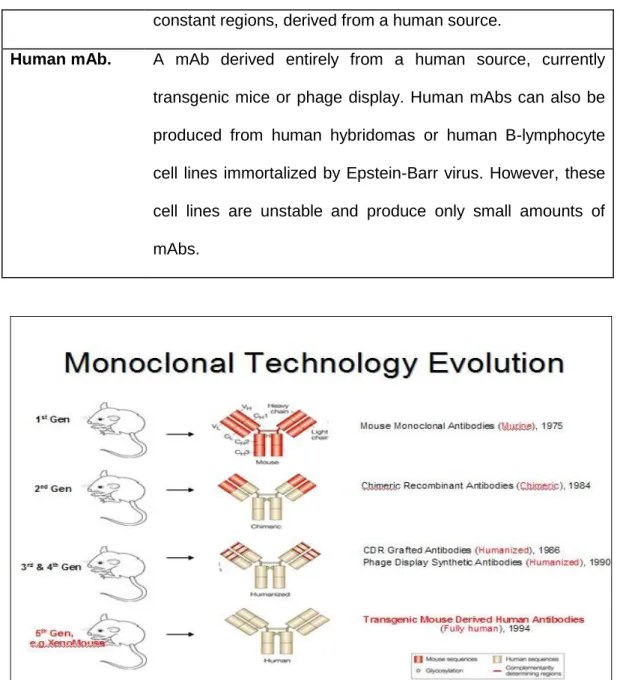
3. Monoclonal Technology Evolution
The original method for production of mAbs involved fusing mouse lymphocyte and
myeloma cells, yielding murine hybridomas (see 錯誤! 找不到參照來源。). The first
report describing the preparation of hybridomas came from the UK’s Medical Research Council Laboratory of Molecular Biology (Cambridge) in 1975. However, the impact of
the new method was not immediate. The initial procedure was unreliable; as protocols
were improved and materials were shared among laboratories, the technology filtered
into the scientific community. Notably, the hybridoma technique was never patented.
Therapeutic murine mAbs entered clinical study in the early 1980s, but problems with
lack of efficacy and rapid clearance due to patients’ production of human anti-mouse antibodies (HAMA) became apparent. These issues became driving forces for the
6 evolution of mAb production technology: the potential utility of therapeutic mAbs was
obvious, but the initial execution was unsatisfactory.
Attempts were made to increase efficacy and decrease immunogenicity through two
parallel paths: production of mAb chimeras derived from both human and mouse DNA,
and production of fully human mAbs. In the case of chimeric mAbs, genetic engineering
techniques were used to replace the murine Fc region with one of human sequence.
The second avenue involved applying immortalization methods and hybridoma
techniques to human cells.
Surprisingly, the chimeric mAbs have proved to be superior to the early human mAbs— replacement of the murine Fc region was sufficient for improving efficacy and reducing
the HAMA response for at least some products. In fact, five chimeric mAbs are now
marketed in numerous countries as treatments for a variety of diseases.
The fault of the early human mAbs lay not necessarily in themselves, but in the
production method. Establishment of human hybridomas and the production of
sufficient amounts of human mAbs from human cell lines proved to be difficult.
Nevertheless, one human anti-endotoxin IgM mAb, nebacumab (Centoxin;Centocor,
now a wholly owned subsidiary of Johnson & Johnson, New Brunswick, New Jersey)
was briefly marketed for septic shock and Gram-negative bacteremia outside the
United States in the early 1990s, but was with-drawn for safety reasons likely specific
to the indication and mechanism of action rather than the type of mAb.
Chimeras were not the only possible result of mAb genetic engineering, though. Soon
7 perception of risk associated with the presence of murine protein sequence inexorably
drove the technology from the murine products toward humanized ones, bypassing the
chimeras, though the ultimate goal was an efficient production method for fully human
mAbs. The development of phage display technology and transgenic mice in the early
1990s provided the desired methods, but realization of the goal was delayed until the
end of the decade because of disputes over patents on the technologies.
Advancements in genetic engineering techniques have finally provided the long-sought
human mAbs, and have also opened the door to the study of varied mAb fragments,
including single-chain variable fragments and antigen-binding fragments. However,
even mAb fragments are complex molecules, and a variety of factors must be
considered (for example, specificity or avidity) before one is selected as a clinical
candidate. Increased control over the design of these molecules might increase the
rate of success in the future.
Table 1. Glossary of mAb terms Murine (mouse)
mAb.
Murine (mouse) mAb. A mAb derived entirely from mice,
specifically murine hybridomas generated from the fusion of
mouse myeloma and mouse B-lymphocyte cells.
Chimeric mAb. A mAb constructed from variable regions derived from a murine source and constant regions derived from a human
source.
Humanized mAb.
A mAb constructed with only antigen-binding regions (also
called complementarity-determining regions or CDRs) derived
8 constant regions, derived from a human source.
Human mAb. A mAb derived entirely from a human source, currently transgenic mice or phage display. Human mAbs can also be
produced from human hybridomas or human B-lymphocyte
cell lines immortalized by Epstein-Barr virus. However, these
cell lines are unstable and produce only small amounts of
mAbs.
Figure 4. Monoclonal Technology Evolution
4. Comparison of Monoclonal Antibodies
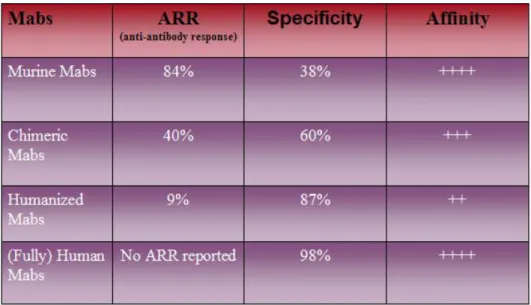
Before development of human mAbs, three problems plagued the effectiveness of the
mAbs.
9 When the potentially therapeutic antibody was entered into the human body, the mouse
protein in the antibody caused it to be recognized as foreign and the body immediately
began to try to reject it. Consequently, the mAbs would have to be re-administered
frequently to have therapeutic effect. (This anti-antibody phenomenon is also called
“ARR”.) In many cases, the ARR response prevented the mAbs from having the desired effect and induced allergic reactions.
(2) Specificity – meaning a kind of mAb binds to only the one particular kind of antigen it is targeted against.
(3) Affinity – the mAb binds tightly so that it can neutralize the antigen.
On the other hand, the above three factors are often used as three parameters when
evaluating the effectiveness of the mAbs. The comparison results are shown below.
10 Compared to other kinds of mAbs, the fully Human mAbs are obviously the most ideal
antibody drugs for treatment with the least side effects.
XenoMouse Technology Strength
XenouMouse-derived mAbs can produce fully human mAbs with high affinity and high
antigen-binding specificity.
Compared to conventional mouse approaches, XenoMouse promised:
(1) Longer lasting therapeutic effects as the body did not attempt to eliminate the drug
(2) Fewer unwanted side effects
(3) Faster product development time as no time was needed to humanize the
antibody produced.
Company History
A former subsidiary of JT America and Cell Genesys formed Xenotech, an equally
owned limited partnership, in 1991. When Cell Genesys created Abgenix in 1996 as a
wholly owned subsidiary, Cell Genesys assigned its interest in Xenotech to Abgenix. JT
and its subsidiaries invested more than an estimated $40 million in the creation of
XenoMouse technology.
In 1997, Abgenix paid $47 million to JT America for a 50 percent interest in Xenotech
L.P., an equally owned limited partnership between the two companies that created the
XenoMouse. Abgenix also will pay $10 million as compensation to Japan Tobacco, Inc.
(JT) to relinquish certain option and license rights it is currently entitled to. The
11 In 2006, Amgen Inc., the world's biggest biotechnology company merged Abgenix Inc.
for $2.2 billion in cash, acquiring full ownership of its XenoMouse technology.
12
Chapter 1
PATENT LANDSCAPE AND PORFOLIO ANALYSIS
In this part, we aim to find out the core patents related to XenoMouse which
was fully owned and developed by the biotech company, Abgenix. In order to
achieve this goal, we design a patent search strategy based on Thomson
Innovation platform. This strategy attempts to narrow the search scope
step-by-step by using a variety of categorizing and filtering skills such as IPCs
classification, text clustering, country code filter and etc. (see Table 3)
Table 3 Patent Search Strategy
To clarify the whole search process, we follow the six steps illustrated in the
patent search flow chart below. (see
Figure 6.)
13
Figure 6. Paten Search Flow
1.1 Step One: Abgenix Patent Landscape & Portfolio
Investigation
The research on the XenoMouse started from 1991 and was fully acquired by
Abgenix later on. This company was eventually purchased by Amgen in 2006.
Accordingly, we initially conduct patent search under the applicant/assignee’s
name of Abgenix by expanding the application year from 1978 to 2010 in order
to fully cover all the Abgenix’s patents because monoclonal antibodies
technology originated from 1970’s. From the application trends chart (see 7), it
is obvious that Abgenix filed most patent applications during the period from
2002 to 2006.
14
Figure 7. Abgenix’s Patent Application Trends
Among the top five publishing countries, the U.S. and the EP have the largest
proportions (U.S. 21% and EP 16%, respectively) and therefore the U.S. and
the EP should be considered as the most important two regions where Agnenix
sought patent protection (see Figure 8). Also, Abgenix is a US-based biotech
company and therefore we determine to focus on analyzing the Abgenix’s filing
records in U.S. in the following steps.
15
1.2 Step Two: Categorization and Analysis of Top 20 IPCs
In this step, we aim to categorize Abgenix’s whole patent portfolio into several
technological areas so that we are able to identify the XenoMouse-related one
where the key patents associated with XenoMouse are most likely to exist.
Meanwhile, we also have obtained the information disclosed from the Abgenix’s
annual report of YA 2002, stating that this company’s business involves two
segments: XenoMouse technology (i.e. Xeno-technology to produce
XenoMouse) and XenoMouse-driven mAbs technology (i.e. technology to
produce XenoMouse-driven monoclonal antibodies). Hence, the whole patent
portfolio composed of the 1069 patents can accordingly be segmented into two
categories: Xenotechnology-related and Antibodies-related.
Firstly, we shortlist the top 20 IPCs from the Top IPCs chart (see Figure 9 ). By
searching the corresponding interpretations associated with the IPCs from
WIPO website (http://www.wipo.int/classifications/ipc/ipc8/), all the definitions of
the 20 IPCs can be generally divided into two parts according to the Abgenix’s
two business segments: Xenotechnology-related IPCs (highlighted in orange
color) and Antibodies-related IPCs (highlighted in blue color). (see Figure 10)
While the Xenotechnology-related IPCs does not necessarily refer to the
XenoMouse production patents (i.e. the method or process to produce
XenoMouse), because some of patents under this category may also be linked
with the antibodies production technology (i.e. using XenoMouse to produce
antibodies), the XenoMouse production patents must, to the contrary, be totally
covered under the Xenotechnology-related IPCs. Therefore, we decide to put
16
the emphasis on the patents under the Xenotechnology-related IPCs, which are
expected to include the core patents associated to XenoMouse.
17
Figure 10. Classification of the Top 20 IPCs
1.3 Step Three: Analysis of the Patents under the
Xenotechnology-related IPCs
In the Step Three, the 1069 patents are further categorized into two groups
under the two IPCs segmentations, among which 564 patents are discovered to
be filed under the Xenotechnology-related IPCs through Thomson IPC filtering
18
search. Therefore these 564 patents are regarded as Xenotechnology-related
patents. (see Table 4)
Table 4. Technology Categories Based on the IPCs Classifications
IPC Number
IPC Classifications
Technology Categories
A01K067027
Breeds of Animal
Xenotechnology-related Patents (564)
C12N00115,C12N00119,C1
2N00121,
C12N000510,C12N001502,
C12N001509, C12N001513,
C12N001585
Genetic Engineering
A61K003800, A61K0039395
Medical Preparations
for Drugs
A61P002900,A61P003500,A
61P003700, A61P004300
Drugs
Antibodies-related
Patents
C07K001600,C07K001618,C
07K001624, C07K001628
Antibodies
C12P002108
Preparation of mAb
1.4 Step Four: Identification and In-depth Analysis of the
XenoMouse-related Patents
In the previous step, we find out 564 patents falling within the field of
Xenotechnology, which would be very helpful to conduct the
XenoMouse-19
related patent search in a narrower scope. Besides, referring to the relevant
technical information from other academic papers and Abgenix’s company
information, we finally conclude that the key technologies are most related to
the transgenic engineering technology as well as the monoclonal antibodies
preparation technology. We also conduct the text clustering of the 564
Xenotechnology-related patents on Thomson Innovation platform, because this
kind of textclustering function is useful to identify the keywords. However, this
textclustering function is unable to guarantee the accurate keywords. Besides,
we referred to the relevant published academic papers introducing mAbs
preparation method and eventually decided to select the three keywords -
Xenomouse, Human Monoclonal Antibodies and transgenic mouse
- which
are the most relevant to the XenoMouse patents.
Subsequently, we move on to the Thomson Innovation Search by adopting the
three key words individually and extract a total number of 372 patents from the
XenoMouse-related patents, which cover the three keywords separately. ( see
Figure 11, Figure 12, Figure 13 and Figure 14)
20
Figure 12. Patent Allocation (Keyword: human monoclonal antibodies)
Figure 13. Patent Allocation (Keyword: xenomouse)
Figure 14. Patent Allocation (Keyword: transgenic mouse +human monoclonal antibodies + xenomouse)
21
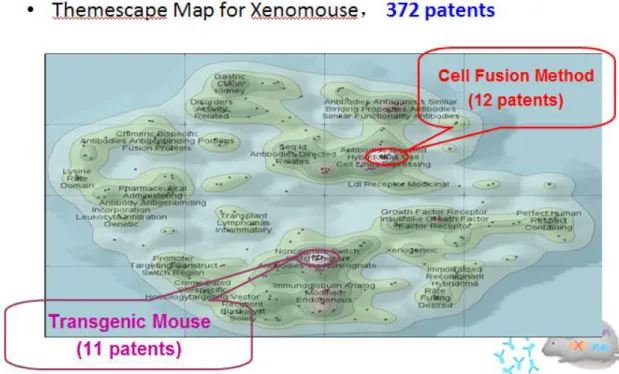
In the themescape map of the 372 patents (see Figure 15), we further discover
two white areas where the cell fusion method and the transgenic mouse are
covered by the most amounts of filing patents (11 patents and 12 patents,
respectively). The two topics of transgenic mouse and cell fusion method will
then be employed as important clues to convince the core patents we define in
the Step Six.
Figure 15. Themescape Map for 372 Patents Most Relating to Xenomouse
1.5 Step Five: Identification of the Patents Filed in the U.S.
The 372 XenoMouse-related patents are filtered by country code, among which
there are 76 patents filed in the US. This is a simple but a meaningful step, by
which we narrow the search scope from the aspect of territory and therefore are
able to identify the core patents filed in the targeted market – the U.S. market.
22
1.6 Step Six: Identification of the Core Patents related to
XenoMouse
In this step, Citation Mapping and Patent Family Analysis are adopted to
analyze the 76 patents filed in the U.S. In the process of searching the first
generation
forward
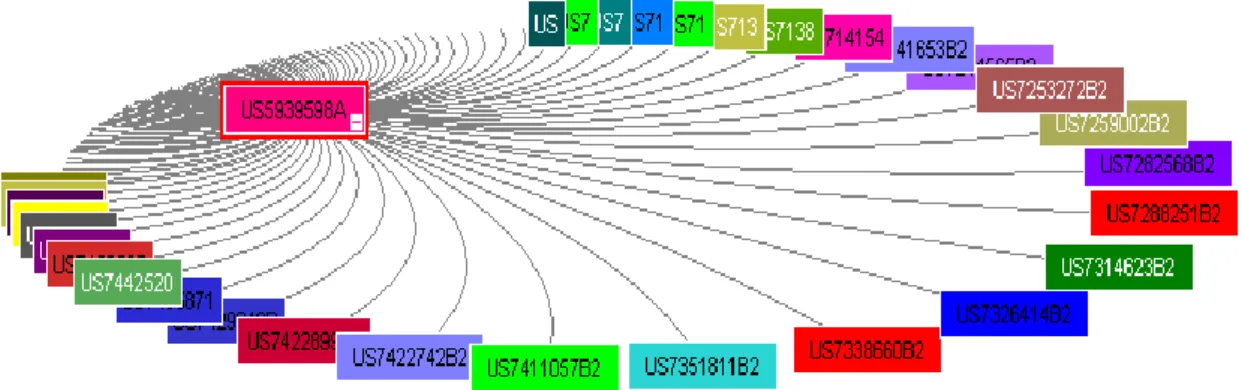
citation records, US 5,939,598 and US 5,916,771 outstand
with the most forward citation records which are 136 and 76 records,
respectively (see Figure 16 and Figure 17). In the patent family analysis
approach, US 5,939,598 and US 6,657,103 are found to include the most patent
family members (see Table 5)
Figure 16. US Patent 5,939,598 Forward Citation
23
Figure 17. US Patent 5,916,771 Forward Citation
Patent
INPADOC Family
DWPI Family
US
5,939,598
109
37
US 6,657,103
109
37
US
5,916,771
18
19
Table 5. Top 3 Patents with the Most Family Members Among the 76 US Patents
Three core patents are identified as follows:
US 5,939,598 Method of making transgenic mice lacking endogenous
heavy chains
US 5,916,771 Production of a multimeric protein by cell fusion method
US 6,657,103 Human antibodies derived from immunized xenomice
To prove that we have reached the right core patents, we also search some
published information on the Internet. In the paper “Abgenix Receives
XenoMouse Patents” published in September 1999, both US 5,939,598 and US
5,916,771 patents were released as the most important two patents related to
24
Abgenix’s XenoMouse (see Figure 18). The US 5,939,598 entitled “Method of
Making Transgenic Mice Lacking Endogenous Heavy Chains” covers a key step
used in the generation of the transgenic mice that Abgenix uses for the
production of fully human antibodies. Meanwhile, as a second granted US
patent in the same year, US 5,916,771 entitled “Production of a Multimeric
Protein by Cell Fusion Method” disclosed a new technique for the generation of
antibody-producing cell lines. Both of the two patents are also proved to be
involved in the most two important areas
– “transgenic mouse and cell fusion
method” – which we conclude in the 372 XenoMouse-related patents (see Step
Four)
25
Further, Abgenix released a newest patent filed in the U.S. of US 6,150,584 on
the company’s website in January 2001. This patent entitled “Human Antibodies
from Immunized Mouse” covers transgenic mice with certain specific genetic
modifications allowing them to produce fully human antibodies. US 6,150,584
and US 6,657,103 which is considered as the core patents in our analysis result
are two individual patents, but they actually are highly interrelated because they
are involved in the same patent family (see Figure 19). Therefore, it is
concluded that US 6,657,103 should be the right core patent in Abgenix’s
XenoMouse patent portfolio.
Figure 19. Patent Family Member Record of US 66571038
1.7 Conclusion
From the chart of the “XenoMouse patent application trends” (see
Figure 20), we
can see that the XenoMouse technology itself has experienced a whole
26
development process from the embryo stage to the mature stage. Accordingly,
only a limited number of XenoMouse patents are expected to occur in the future.
While the antibody companies which produce mAbs products from the
XenoMouse platform are anticipated to file more and more XenoMouse-driven
antibodies patent applications later on. (see Figure 20)
27
Figure 21. Monoclonal Antibodies Developed from the XenoMouse Platform
In the case of conduction patent search, THOMSON INNOVATION is an
effective patent analysis tool, especially when you have poor technical
knowledge about the search area. However, simply using THOMSON
INNOVATION is not sufficient. Besides, in order to catch the core patents, you
are advised to meet the following conditions:
Basic technical knowledge, which you can acquire from other variety of
sources, such as Internet, company publications and etc;
Proper strategies to enable you to narrow the search scope and finally
reach the right patents; and
Full use of functions enclosed in Thomson Innovation, which can be helpful to
narrow the search scope and identify the core patents accurately.
28
Chapter 2
Competitors’ Patent Analysis
Main players in mAbs industry were found by searching FDA website followed by
google searching of related patent owners. Each player’s mAbs patent portfolio was generated by Thomson innovation with the help of key IPC numbers. After comparing
Themescape map, each player’s technological technology was identified. Medarex who also grasped the transgenic animal technology and produced human monoclonal
antibodies, was considered as Abgenix’ main competitor. The comparison of Medarex’
HuMAb Mouse technology and Abegnix’ XenoMouse technology was done after
reviewing the process of making transgenic mouse and monoclonal antibody
preparation. Both Themescape map analysis and IPC comparison showed that
Abgenix grasped more comprehensive transgenic technology, however, Medarex has
more mAbs drug candidates owning to its better antibody preparation technology.
2.1 Competitor search
We defined “competitors” as entities that own the patents of producing therapeutic
monoclonal antibodies. As the competitors of Abgenix, an entity should firstly produce
“therapeutic mAbs”, secondly, it should own the patents.
It took us a long time to search the real competitors.
Our first strategy was logging into Thomson Innovation, using key words “monoclonal
29 given. The main reason is in addition to therapeutic use, many mAbs are for in vitro
diagnostic use which is out of the therapeutic arena. Another key word “therapeutic”
has little help to filter out the unwanted result.
Therefore we used our second strategy, search the FDA (U.S. Food and Drug
Administration) approved mAb drugs and try to find the patent owner. The link is as
follows:
http://www.accessdata.fda.gov/scripts/cder/drugsatfda/index.cfm?fuseaction=Search.A ddlsearch_drug_name
Figure 22. FDA approved drug search interface
30 We chose option C (Figure 22 ) since we did not know the drug name or the application
number. All FDA approved drugs were listed by quarter. In this list with drug name and
active ingredients, we can easily find monoclonal antibodies by searching the active
ingredients with the suffix “mab”. After clicking in, we can get the details of the related drug information (Figure 23), including brand name, company name, and the original
approval data which were what we wanted. However, patent information didn’t show here.
A good tool to search patent information for a FDA approved drug is FDA’s orange book, which lists approved drug products with therapeutic equivalence evaluations and
the drugs’ related patents. However we could not find any mab drugs patent information from here. We suspect the reason is the pharmaceutical-related patents
are allowed in FDA’s Orange Book Only if they’re “composition” or “method of use” patents. Almost all mab patents are “process patents”, which cover methods for making the drug compounds and are not allowed to be listed in the Orange Book.
Then we switched to the powerful google search. By inputting drug brand name and
31
Table 6. Drug Information of FDA approved mAbs
We summarized the searching result in
Table 6
which is sorted by approval year, from1986 to 2010. The column “ Source ” shows the degree of the humanization of the
antibodies. A trend can be identified that the approved antibodies are more and more
like human antibodies. The drug owners include big names in pharmaceuticals such as
Roche, Novartis, GSK, health care companies like Johnson & Johnson and Abbott, and
integrated biotech companies such as Genetech and Amgen. However, these
companies are not the patent owner of the mAb producing technology, they just got the
license from smaller entities to use their mAbs producing technology or developed
mAbs. These smaller entities include Celltech, Protein Design Labs, Cambridge
32
2.2 Patent portfolio analysis of main players in mAb industry.
2.2.1 Patent search strategy
We use Thomson Innovation to search each main player’s mAb patent portfolio. The searching strategy is as follows:
Step 1, use name of assignee and application year 1975 to search for each player’s
patent information after 1975, which a year before the application of the first mAb
patent.
Step 2, list top 20 IPC number of each main player and compare them to get the key
IPC numbers for mAb producing.
Step3, filter the result of step 1 with key IPC numbers gotten by step2.
Step4, combine the result of step 3 so that further analysis can be done.
This strategy was summarized in figure 24.
Figure 24. Patent search strategy of each main player’s mAb patent portfolio
2.2.2 Overview of the distribution of main players’ applied patents.
The total number of applied patent of the main players is 3531, listed in 408 IPADOC
33
Table 7
. From figure 25 we can see that most of these patents are filed in Europe, WIPO, Australia and the USA. Figure 26 shows that the application champion isCellTech, followed by Medarex. Abgenix is the forth, filed 564 mAbs related patents.
Table 7. Number of each player’s applied patents and patent families
Figure 25. Distribution of the applied patents by country
34
2.2.3 Themescape map analysis
We generated the Themescape map (Figure 27) by using English abstract and claims.
Figure 27. Themescape map of main players
We figured out the relationship between the labeled areas and mark the area of similar
technologies with the same color (Figure 28). Orange is chimeric technology, which
can produce chimeric antibodies; Blue is CDR grafted technology generating
humanized antibodies; Red is phage display, can produce fragment, humanized or
human monoclonal antibodies; Purple is transgenic technology, can also produce
human mAbs. We zoom into the left upper region (Figure 29) for it’s a little comfusing. In this region the center is related to transgenic animal technology, however the
product is not fully humanized. The around is humanized monoclonal antibodies which
35
Figure 28. Themescape map marked with technologies
Figure 29. Enlarged view of the upper left conner
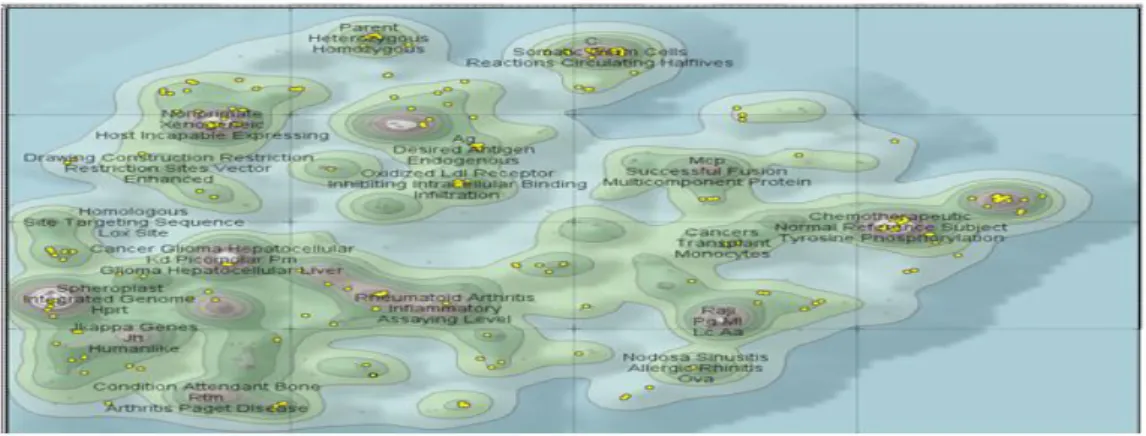
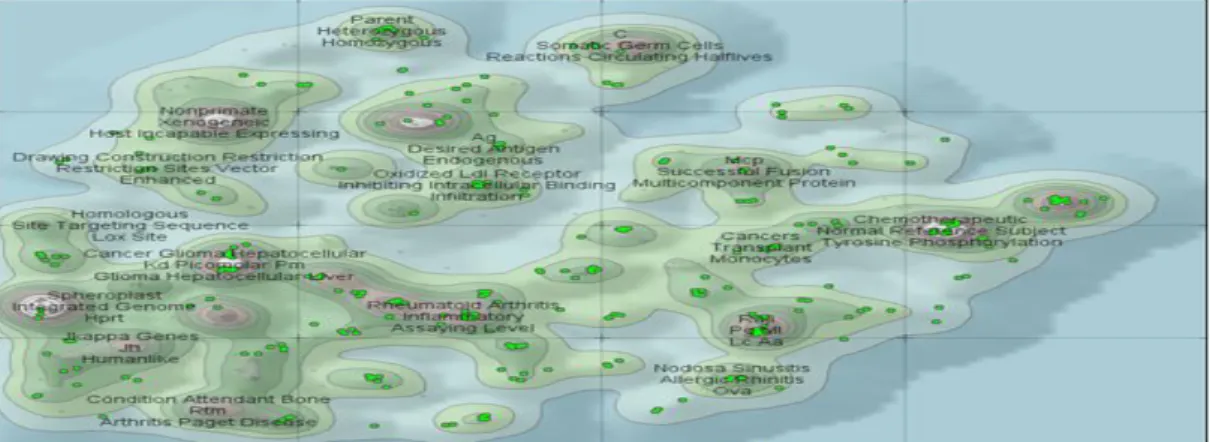
Then we overlapped the marked layer with the Themescape map of each main player
to find its technological strength. The results are shown in figure 30 to figure 35.
Celltech is good ate chimeric technology and CDR grafted technology, so is Protein
Design Labs. Cambridge Antibody Technology is engaged in Phage Display
Technology. Medarex’ main business is based on transgenic animals while it also has the CDR grafted technology. Abgenix grasps similar technologies as Medarex.
36
Figure 30. Celltech’s technological strength
37
Figure 32. Protein Design Labs’ technological strength
Figure 33. Cambridge Antibody technology’s technological strength
The red spots represent patents applied by Protein Design Labs. None of them is in the Transgenic Animals region, so we can get to the conclusion that PDL doesn’t grasp the transgenic animal technology.
38
Figure 34. Medarex’ technological strength
Figure 35. Abgenix’ Technological Strength
The combined distribution map of each main player’s technology is shown in Figure 36. In this map, two most competitive battle grounds are highlighted, both of which are
related to diseases instead of technologies. The one at the upper right region is
Inflammatory Bowel Disease, which means many products of the main players are
targeted to this disease. The lower battle dose not point to a specific disease, but a
39 by the mAbs drug. It reflects a common IP strategy in pharmaceutical industry. Before
developing a drug, the companies will acquire the IP around the disease target of the
drug to avoid future litigation and block the competitors.
Figure 36. Potential battle ground of the main players
2.2.4 Conclusion of patent portfolio analysis of main players
Based on the above analysis, we get the following
Table
. Comparing with table 6 , webelieve that tough the total number of application patents is less than Celltech, PDL
has the Prior. CAT’s phage display technology can produce human monoclonal antibodies, however, its process needs lots of manipulation, and not broadly accepted.
Both of Medarex and Abgenix are good at the transgenic animal technology, so a
40
Table 8. Summary of the Themescape map analysis
2.3 Comparison of Abgenix and Medarex Patent Portfolio
2.3.1 Medarex and
HuMAbMouse
Medarex Inc. is a biothechnology company focusing on the discovery, development,
and potential commercialization of fully human antibody-based therapeutics for cancer
and other serious diseases. The engine driving the pipeline to develop fully-human
antibodies is one strain of transgenic mice, named HuMAB Mouse[1]. HuMAB Mouse
was created by Genepharm in mid 1990’s. Medarex acquired Genepharm in 1997 and transferred its main business to the Human mAbs development and production soon
after the acquisition. In 2009, Medarex was merged by Britol-Myers Squib for 12.4
41
2.3.2 Overview of transgenic animal and mAb preparation
technology
At present, almost all commercialized mice produced human mAbs are generated by
neither Xeno Mouse or HuMab Mouse. Before comparing these two mice, we review
the whole process of transgenic animal technology and mAbs preparation.
To get a transgenic mouse that can generate human antibodies, we need to change
the mouse gene that controls generation of mAbs into human gene [3]. This process is
called gene recombination, listed under IPC C12N15. The method to introduce human
gene into the mouse is called gene transfer, filed in IPC C12N1 and C12N5. The
procedure of breeding the mouse, hybridizing them and keeping the strain are also
essential, and the related patents are listed in IPC A01K067027.
After creating the mouse strain that can produce human mAbs, we can start the
process of mAbs preparation. The whole process is listed under IPC A61K and C12P.
42
Figure 37. Main steps of making transgenic mice and related IPC
Figure 38. Main steps in mAbs preparation and related IPC
2.3.3 MAbs patent portfolio analysis of Abgenix and Medarex
43 When set collections to search in Thomson innovation, we chose “select all”, and “also search DWPI fields for selected collections”. Then we filtered the result with assignees to get each companies patent portfolio. Since both of these two companies focus on
producing human mAbs by transgenic mice, all of their patent portfolio should be taken
into consideration.
The total number of applicated patents of Abgenix and Medarex is 597 and 1155
respectively. Figure 39 shows the patent breakdown by publication years. We can see
that before Abgenix’ acquisition by Amgen, there is no big difference between the numbers. After that, Medarex filed a high number of patents, while Abgenix’ number of published patents drop down which cause the gap. In 2009, Medarex was acquired,
and the number dropped sharply.
Figure 39. Patent breakdown by publication years
The Themescape map (Figure 40) of the two companies is generated by using English
44
Figure 40. Themescape map of Abgenix and Medarex
We highlighted Abgenix’ advantages in figure 41. Abgenix filed more patents in gene recombination and gene transfer which are related to transgenic mouse developmet.
The main target of its candidate drug is Growth Factor.
Figure 41. technological advantages of Abgenix
Medarex has more antibody structure related patents (Figure 42), and the vectors for
protein expression which means it is good at preparing mAbs. One of its main drug
45
Figure 42. technological advantages of Medarex
2.3.3.2 IPC comparison
We also do the IPC comparison of these two companies. Each company’s top IPCs are listed and categorized into two groups, the transgenic mice-related group and
antibodies-related group. See figure 43
46 Figure 44 ows Medarex and Abgenix patent breakdown by transgenic mice related IPC.
Abgenix grasps more comprehensive transgenic technology, which means it is quite
probable that Xeno Mouse has more human gene than Medarex, so is more like
human than HuMab Mouse in generating antibodies.
Figure 44. patent breakdown by transgenic mice related IPC
Figure 45 shows antibody-related IPC comparison of these two companies. We can
see that Medarex filed more patents in both antibody preparation and produced mAbs.
Therefore, Medarex has better antibody preparation technology than Abgenix and
produced more mAbs. The consequence is Medarex has more drug candidates.
47
2.3.4 Comparison conclusion
After the above comparison, we got the following conclusion,
Abgenix grasps more comprehensive transgenic technology.
XenoMouse is more like human than HuMAb Mouse in generating antibody.
Metorex has better antibody preparation technology.
Medarex has more mAb drug candidates.
Table 9. FDA approved products of Abgenix and Medarex
The list of FDA Approved mAb drugs shows that Abgenix achieved FDA’s approval earlier than Medarex, in 2006, its panitumumab, mark trade Vertibix is the first murine
produced human mAbs that got this approval. But 3 years later, based on its larger
pool of candidate drugs, Medarex got 4 approvals in just one year. One year later,
another Abgenix mAb got FDA approval. The fighting between the two mice is still
48
Chapter 3
Technology Valuation
In this chapter, market value of the XenoMouse technology will be assessed. The
valuation is performed retroactively as at year 2006, which is the date before Abgenix
being acquired by Amgen. Both cost approach and income approach are used to
determine the value of the technology. This value is then reviewed and justified with
reference to the acquisition transaction. Since acquisition, no further technical or
financial data of Abgenix are publicly available as the company has become an integral
part of Amgen.
3.1 Market Identification & Analysis
Before actually assessing the value of the technology, it is important to have a study of
the big picture of the whole market value chain and to identify the position in this value
chain where the company lies in and where its technology is applicable to.
3.1.1 The Market Value Chain
It is well appreciated that there is an extremely long and complicated process from the
discovery of a disease to the availability of any medicine in market for the
pharmaceutical industry. This process may take years to decades, even with the state
49 A typical flow of this process is shown in the market value chain of the Figure 46 below.
Such a process normally starts from “target discovery” and “target validation”, where a variety of virus that may cause the disease is studied ant the actual disease causing
virus is to be identified.
Figure 46. The market value chain
Once the disease causing virus is identified, significant R&D efforts are put for creating
effective antibodies. Various technologies for creating antibodies are available as
discussed in the previous chapters. Obtaining an effective antibody represents a
significant breakthrough as this antibody will become the active ingredient of the drugs
that will be eventually produced. This process is technology intensive and the
Market of Abgenix
(These areas are dominated by a few large pharmaceutical firms likePfizer, Amgen, GSK, etc)
Abgenix
XenoMouse
Technology
$
50 effectiveness of the final drug products are directly determined by the antibody created
in this process.
However, creation of antibody is still a very early stage of drug development. The
antibody has to go through preclinical trials and clinical trials in order to satisfy various
stringent requirements of government authorities, such as Food and Drug
Administration (FDA) of the US. Any side effects have to be observed and reviewed for
obtaining the government approval, and thus this preclinical and clinical development
process may take a few years to complete, which also requires enormous amount of
financial investment.
Even if government approval is successfully obtained, this is followed by process and
manufacturing developments for economically producing the drugs that will be
eventually available on market. An even greater amount of investment is necessary in
this stage. It has been so expensive that this is only affordable to a few large
pharmaceutical firms, like Pfizer, Amgen, GSK, etc.
Therefore, the stages after the creation of antibody are dominated by these few
companies.
3.1.2 Core Business of Abgenix
Apparently, creation of antibodies has been the core business of Abgenix, with the
utilization of its XenoMouse technology. With this technology, the company has
successfully created many antibodies against various targets for several companies as
51 It is true that there are higher profit margins downstream the market value chain. A
significantly higher prospect of return comes together with correspondingly significantly
higher amount of investment. Stronger skills in the preclinical and clinical development
would make Abgenix a stronger partner, which however, represents greater financial
risks.
In fact, Abgenix did try to move downstream in obtaining FDA approval over
panitumumab, which is created using its XenoMouse technology. An implication of
such a move is clearly shown in the following Figure, where the company start to suffer
a huge amount of loss annually since 2002.
-$250 -$200 -$150 -$100 -$50 $0 $50 $100 2005 2004 2003 2002 2001 2000 1999 1998 1997 1996 1995 1994 1993
Rev ($ mln) Net Inc ($ mln)
Figure 47. The financial status of Abgenix
By the end of year 2005, the year before being acquired by Amgen, the company has
52 background of the acquisition transaction, but does not in any sense reflect the value of
its XenoMouse technology, which will be assessed in the following section.
3.2 Patent Valuation
As discussed in the previous chapters, the company holds thousands of patents
globally. It will be impractical to assess the value of each single one of them individually.
Thus, the valuation is performed at the macroscopic level over the entire patent
portfolio that covers the XenoMouse Technology. Both cost approach and income
approach are used for the valuation.
3.2.1 Key Patents Analysis
The previously identified key patents are now to be analyzed in more detail as follows:
1. US 5,939,598
Publication Date: 1999-08-17 ;
Filing Date: 1992-07-30;
Title: Method of making transgenic mice lacking endogenous heavy chains
Scope: The method covered by the patent enables generation of 100% human
antibodies by preventing expression of mouse antibody genes, so that they can be
functionally replaced with human antibody genes, leaving intact the rest of the mouse
immune system.
This is one of the most fundamental patent of Abgenix' XenoMouse technology to
generate human antibodies by making use of the mouse immune system to respond to
53
2. US 5,916,771
Publication Date: 1999-06-29;
Filing Date: 1996-10-11;
Title: Production of a multimeric protein by cell fusion method
Scope: The method covers a technique for the generation of antibody-producing cell
lines. The method produces a multimeric protein from a hybrid cell formed from the
fusion of two or more cells, each of which cell is engineered to express one component
of the multimeric protein, as well as a method for screening for successful fusion of the
cells to produce a desired hybrid cell. This method is widely applicable to the
production of proteins having two or more components.
3. US 6,657,103
Publication Date: 2003-12-02;
Filing Date: 1997-09-04
Title: A method for producing a human IgM comprising a nonchimeric variable region
Scope: The method covers a technique to produce human antibodies by immunizing a
transgenic nonhuman animal with the desired antigen. The modified animal produces
B-cells which secrete immunoglobulins with fully human variable regions, instead of
endogenous antibodies. The antibodies produced include fully human antibodies and
can be obtained from the animal directly, or from immortalized B-cells derived from the
animal. Antibodies with fully human variable regions against a specific antigen can be
prepared by administering the antigen to a transgenic animal which has been modified
to produce such antibodies in response to antigenic challenge, but whose endogenous
loci have been disabled. Various subsequent manipulations can be performed to obtain
54 In summary, these key patents have covered the fundamental aspects of the
XenoMouse technology, for production of XenoMouse to methods of producing
antibodies (protein or IgM) based on the XenoMouse. They are not limited to any
particular type of diseases or antibodies, and the relevant technology is a platform
technology in general that can be used to produce a variety of antibodies
This platform technology would be particularly valuable because it opens the
opportunity of producing a great variety of possible antibodies for different diseases. In
terms of IP valuation, this XenoMouse technology could much more valuable than the
IPR embodied in any particular type of antibody produced.
3.2.2 Cost Approach
In general, there are two types of cost approach: historical cost approach and
replacement cost approach. Historical cost approach calculates the accumulated R&D
cost in realizing the current IP; and replacement cost approach estimates the cost
necessary to develop any replacement IP.
Both methods are inherently problematic. Assuming that the cost of IP is equal to the
historical cost realizing the current IP would mean that there is zero income for any
R&D investment what ever the IP it produces, if any. However, due to the exclusive
nature of IP, a truly replacement IP may not exist even for an independently developed
new technology because the new technology may likely still be covered by the original
patents if well drafted.
55 Nonetheless, calculation of the historical R&D expenditures occurred in realizing the IP
is more practical, and this could provide a useful indicator. The annual R&D
expenditures can be obtained from the public available annual reports of the company,
for example, the consolidated statements of operations from the Annual Report 2005.
Year ended December 31, 2005 2004 2003
Revenues:
Contract revenue 18,346 15,752 13,014
Contract manufacturing revenue — 1,695 —
Total revenues 18,346 17,447 13,014
Operating expenses:
Cost of goods manufactured — 2,227 —
Research and development 137,016 124,440 94,321 Manufacturing start-up costs 18,339 25,430 72,473 Amortization of identified intangible assets, related to research and
development 4,573 6,465 7,190
General and administrative 22,287 27,271 30,209 Impairment of identified intangible assets 25,000 17,241 1,443
Restructuring and other 15,506 — —
Total operating expenses 222,721 203,074 205,636 Loss from operations (204,375 ) (185,627 ) (192,622 ) Other income (expenses):
Interest and other income (expense), net 14,241 5,382 9,953 Interest expense (15,205 ) (7,233 ) (5,784 ) Impairment of investments (1,616 ) — (7,892 ) Total other expenses (2,580 ) (1,851 ) (3,723 ) Loss before income tax expense (206,955 ) (187,478 ) (196,345 )
Foreign income tax expense — — 84
Net loss (206,955 ) (187,478 ) (196,429 ) Basic and diluted net loss per share (2.30 ) (2.11 ) (2.23 ) Shares used in computing basic and diluted net loss per share 89,887 88,710 87,930
CONSOLIDATED STATEMENTS OF OPERATIONS (in thousands, except per share data)
Year ended December 31, 2005 2004 2003
Revenues:
Contract revenue 18,346 15,752 13,014
Contract manufacturing revenue — 1,695 —
Total revenues 18,346 17,447 13,014
Operating expenses:
Cost of goods manufactured — 2,227 —
Research and development 137,016 124,440 94,321 Manufacturing start-up costs 18,339 25,430 72,473 Amortization of identified intangible assets, related to research and
development 4,573 6,465 7,190
General and administrative 22,287 27,271 30,209 Impairment of identified intangible assets 25,000 17,241 1,443
Restructuring and other 15,506 — —
Total operating expenses 222,721 203,074 205,636 Loss from operations (204,375 ) (185,627 ) (192,622 ) Other income (expenses):
Interest and other income (expense), net 14,241 5,382 9,953 Interest expense (15,205 ) (7,233 ) (5,784 ) Impairment of investments (1,616 ) — (7,892 ) Total other expenses (2,580 ) (1,851 ) (3,723 ) Loss before income tax expense (206,955 ) (187,478 ) (196,345 )
Foreign income tax expense — — 84
Net loss (206,955 ) (187,478 ) (196,429 ) Basic and diluted net loss per share (2.30 ) (2.11 ) (2.23 ) Shares used in computing basic and diluted net loss per share 89,887 88,710 87,930
Year ended December 31, 2005 2004 2003
Revenues:
Contract revenue 18,346 15,752 13,014
Contract manufacturing revenue — 1,695 —
Total revenues 18,346 17,447 13,014
Operating expenses:
Cost of goods manufactured — 2,227 —
Research and development 137,016 124,440 94,321 Manufacturing start-up costs 18,339 25,430 72,473 Amortization of identified intangible assets, related to research and
development 4,573 6,465 7,190
General and administrative 22,287 27,271 30,209 Impairment of identified intangible assets 25,000 17,241 1,443
Restructuring and other 15,506 — —
Total operating expenses 222,721 203,074 205,636 Loss from operations (204,375 ) (185,627 ) (192,622 ) Other income (expenses):
Interest and other income (expense), net 14,241 5,382 9,953 Interest expense (15,205 ) (7,233 ) (5,784 ) Impairment of investments (1,616 ) — (7,892 ) Total other expenses (2,580 ) (1,851 ) (3,723 ) Loss before income tax expense (206,955 ) (187,478 ) (196,345 )
Foreign income tax expense — — 84
Net loss (206,955 ) (187,478 ) (196,429 ) Basic and diluted net loss per share (2.30 ) (2.11 ) (2.23 ) Shares used in computing basic and diluted net loss per share 89,887 88,710 87,930
CONSOLIDATED STATEMENTS OF OPERATIONS (in thousands, except per share data)
Figure 48. Statements of operations (Annual Report 2005)
The historical annual R&D expenditures from 1991 to 2005 are shown in the following
table (million USD). Summation of the numbers gives the valuation of the IP portfolio,
the total R&D cost of $585 million.
56
3.2.3 Income Approach
The income approach assesses the total values of future income derived from assets.
The further cash flows or royalty revenues are summed up using discounted cash flow
method similar to equity valuation. It may be either future income acquired by utilizing
the IP assets, or future saving of cost that would otherwise occur.
The standard formula for calculating the present value (PV) discounted cash flow is
used:
where,
PV: present value of the patent
FCF: future cash flow / assumed royalty revenue
r: discount rate
N: number of years
The further income revenue method is adopted here as the technology would likely to
be licensed many clients for different antibody candidates. It would be inconvenient for
the application of royalty saving method which requires calculating royalty payable from
each potential client for each antibody candidate.
From publicly available information, we identified the following facts useful for the
valuation. As at year 2006, there are 12 candidate antibodies have advanced into
57 offered $51 million per candidate; and the most fundamental patent is valid till 2010,
thus having a valid period of 6 years (2006-2012). The value of the portfolio may de
reduced considerably once the dominant fundamental patent is expired without adding
new patents.
Table 11. Existing candidate antibodies
Some reasonable assumptions are also made: there are a growing number of
candidate antibodies each subsequent year (12, 14, 16, 18 and 18); the same price for
subsequent candidate antibodies will be offered; a discount rate r=12% taking from the
industrial rate of 10-15%; and 25% of the revenue is owing to the patent portfolio.
A table of discounted cash flow based on the above facts and assumptions is produced
below. Finally, the total value of the patent portfolio is at least about 850 million US
58
Table 12. Discounted cash flow (in million USD)
Year Candidates Cash Flow ($) IP Cont ($) NPV ($)
2006 12 612 153 153 2007 12 612 153 137 2008 14 714 179 142 2009 16 816 204 145 2010 18 918 230 146 2011 18 918 230 130 Total 853
3.2.4 Market Approach
The market approach tries to evaluate the IP based on the transaction price of IP in a
similar technology area. However, this approach is very rarely suitable because of the
inherent difficulties in applying the method. For example, what is considered a similar
technology and how similar do they need to be. Even if the similar technology can be
identified, the transaction price of IP (not the whole business) is seldom available.
Thus, this approach is not applied to here. Incidentally, we note that the main
competitor Medarex (HuMAb-Mouse) was acquired two years later for 2.4 billion (Cf 2.2
billion of Abgenix). The transaction of Abgenix may possibly be considered as a
reference for this approach for the valuation of Medarex, which would still be quite
59
3.2.5 Conclusion
In summary, we have assessed the value of the patent portfolio relating to the
XenoMouse technology of Abgenix using both cost approach and income approach.
The two different approaches have resulted in a total value of $585 million and $850
million, respectively.
We also checked the financial reports of Abgenix for confirmation. Surprisingly, we note,
from the balance sheets of the Annual Report 2005, that the value of all identified
intangible assets is merely around $60 million and $30 million for years 2004 and 2005,
respectively, which are significantly lower.
December 31, 2005 2004 ASSETS
Current assets:
Cash and cash equivalents 31,447 148,929 Marketable securities 301,375 267,400 Interest receivable 3,037 2,370 Accounts receivable 4,831 5,729 Prepaid expenses and other
current assets 12,837 11,088 Total current assets 353,527 435,516 Property and equipment, net 197,598 223,004 Long-term investments — 23,300 Goodwill 34,780 34,780 Identified intangible assets, net 30,437 60,010 Deposits and other assets 33,936 36,108 650,278 812,718
December 31, 2005 2004 ASSETS
Current assets:
Cash and cash equivalents 31,447 148,929 Marketable securities 301,375 267,400 Interest receivable 3,037 2,370 Accounts receivable 4,831 5,729 Prepaid expenses and other
current assets 12,837 11,088 Total current assets 353,527 435,516 Property and equipment, net 197,598 223,004 Long-term