V´ıctor Soto Mart´ınez
Submitted in partial fulfillment of the requirements for the degree
of Doctor of Philosophy
in the Graduate School of Arts and Sciences
COLUMBIA UNIVERSITY
2020Identifying and Modeling Code-Switched Language
V´ıctor Soto Mart´ınez
Code-switching is the phenomenon by which bilingual speakers switch between multiple languages during written or spoken communication. The importance of developing lan-guage technologies that are able to process code-switched lanlan-guage is immense, given the large populations that routinely code-switch. Current NLP and Speech models break down when used on code-switched data, interrupting the language processing pipeline in back-end systems and forcing users to communicate in ways which for them are unnatural.
There are four main challenges that arise in building switched models: lack of code-switched data on which to train generative language models; lack of multilingual language annotations on code-switched examples which are needed to train supervised models; little understanding of how to leverage monolingual and parallel resources to build better code-switched models; and finally, how to use these models to learn why and when code-switching happens across language pairs. In this thesis, I look into different aspects of these four challenges.
The first part of this thesis focuses on how to obtain reliable corpora of code-switched language. We collected a large corpus of code-switched language from social media using a combination of sets of anchor words that exist in one language and sentence-level language taggers. The newly obtained corpus is superior to other corpora collected via different strategies when it comes to the amount and type of bilingualism in it. It also helps train better language tagging models. We also have proposed a new annotation scheme to obtain part-of-speech tags for code-switched English-Spanish language. The annotation scheme is composed of three different subtasks including automatic labeling, word-specific questions labeling and question-tree word labeling. The part-of-speech labels obtained for the Miami Bangor corpus of English-Spanish conversational speech show very high agreement and
language modeling. For the first task, we proposed a state-of-the-art approach to part-of-speech tagging of code-switched English-Spanish data based on recurrent neural networks. Our models were tested on the Miami Bangor corpus on the task of POS tagging alone, for which we achieved 96.34% accuracy, and joint part-of-speech and language ID tagging, which achieved similar POS tagging accuracy (96.39%) and very high language ID accuracy (98.78%).
For the task of language modeling, we first conducted an exhaustive analysis of the relationship between cognate words and code-switching. We then proposed a set of cognate-based features that helped improve language modeling performance by 12% relative points. Furthermore, we showed that these features can also be used across language pairs and still obtain performance improvements.
Finally, we tackled the question of how to use monolingual resources for code-switching models by pre-training state-of-the-art cross-lingual language models on large monolingual corpora and fine-tuning them on the tasks of language modeling and word-level language tagging on code-switched data. We obtained state-of-the-art results on both tasks.
List of Figures v
List of Tables vi
Chapter 1. Introduction 1
Part I Automatic Collection and Annotation of Code-Switched Data 7
Chapter 2. Collecting Code-Switched Data from Social Media 8
2.1 Introduction . . . 8
2.2 Related Work . . . 9
2.3 Anchoring Methods . . . 12
2.4 Data Collection . . . 14
2.5 Crowdsourcing Language Tags . . . 15
2.6 Evaluation . . . 17
2.6.1 Data Assessment . . . 17
2.6.2 Language Identification . . . 21
2.7 Conclusions . . . 24
Chapter 3. Crowdsourcing Part-of-Speech Tags for Code-Switched Data 25 3.1 Introduction . . . 25
3.2 Related Work . . . 27
3.3 The Miami Bangor Corpus . . . 28
3.4 Annotation Scheme . . . 29
3.4.1 Automatically Tagged Tokens . . . 29
3.5 Results . . . 36
3.6 Conclusions . . . 38
Part II Part-of-Speech and Language Modeling of Code-Switched Data 40 Chapter 4. Joint Part-of-Speech and Language ID Tagging for Code-Switched Data 41 4.1 Introduction . . . 41
4.2 Related Work . . . 43
4.3 Recurrent Neural Networks and LSTMs . . . 45
4.4 A Model for Neural Part-of-Speech Tagging . . . 46
4.5 Datasets . . . 47
4.5.1 Wall Street Journal Corpus . . . 48
4.5.2 Universal Dependency Corpora . . . 49
4.6 Methodology . . . 49
4.7 Experiments & Results . . . 50
4.7.1 WSJ results . . . 50
4.7.2 Universal Tagset Baseline . . . 51
4.7.3 Miami Bangor Results . . . 52
4.7.4 Comparison to Previous Work . . . 54
4.8 Error Analysis . . . 55
4.9 Conclusions . . . 56
Chapter 5. Lexical, Syntactical and Conversational Factors in Code-Switching 58 5.1 Introduction . . . 58
5.2 Related Work . . . 59
5.3 Data . . . 60
5.6 Code-Switching and Entrainment . . . 68
5.7 Conclusions . . . 70
Chapter 6. Improving Code-Switched Language Modeling Using Cognate Features 71 6.1 Introduction . . . 71 6.2 Related Work . . . 72 6.3 Data . . . 74 6.4 Feature Engineering . . . 74 6.4.1 Feature Extraction . . . 74 6.4.2 Feature Normalization . . . 75
6.4.3 Statistical Relationship between Code-switching and Cognate Features 76 6.5 Factored Language Models . . . 77
6.6 Experiments & Results . . . 79
6.7 Cross-Lingual Feature Transfer . . . 82
6.7.1 Data Collection for English-French Code-Switched Sentences . . . . 83
6.7.2 Experiments . . . 84
6.8 Conclusions . . . 86
Chapter 7. Cross-Lingual Language Modeling Pre-Training for Code-Switching 87 7.1 Introduction . . . 87
7.2 Background . . . 88
7.2.1 Sequence-to-Sequence Models and Transformers . . . 88
7.2.2 Language Modeling Pre-training . . . 90
7.3 Datasets & Pre-Processing . . . 93
7.4 Pre-Training Cross-lingual Language Models . . . 94
7.5 Fine-Tuning: Language Modeling . . . 95
7.6 Fine-Tuning: Word-Level Language Identification . . . 96
Part III Conclusions 99 Chapter 8. Conclusions 100 8.1 Future Work . . . 102 Part IV Bibliography 103 Bibliography 104 Part V Appendices 121
Appendix A. Disambiguation Task for Specific Tokens 122
A.1 List of Disambiguation Questions for English Tokens . . . 122 A.2 List of Disambiguation Questions for Spanish Tokens . . . 137
Appendix B. Question Tree for Part-of-Speech Tagging Disambiguation 158
B.1 Question Tree for Spanish Tokens . . . 158 B.2 Question Tree for English Tokens . . . 160
Appendix C. List of Automatically Tagged Words 165
C.1 List of Automatically Tagged Words in English . . . 165 C.2 List of Automatically Tagged Words in Spanish . . . 166
Appendix D. List of Manually Tagged Words 167
D.1 List of Manually Tagged Words in English . . . 167 D.2 List of Manually Tagged Words in Spanish . . . 168
Figure 2.1 Word-level language annotation crowdsourcing task. . . 16 Figure 3.1 Example of part-of-speech annotation task using the English
Question Tree task. . . 35 Figure 3.2 Example of part-of-speech annotation task using the Spanish
Question Tree task. . . 35 Figure 4.1 Example of an English-Spanish code-switched sentence annotated
with part-of-speech tags. . . 42 Figure 4.2 Joint part-of-speech and language ID tagging model. . . 47
Table 2.1 Code-switched sentence detection performance using Anchoring. . . 13 Table 2.2 Crowdsourced annotations for the Anchored Twitter corpus. . . 17 Table 2.3 Code-switching statistics for the EMNLP 2016 Workshop and
Anchored Twitter datasets. . . 18 Table 2.4 Language composition of the EMNLP 2016 Workshop and Anchored
Twitter datasets. . . 19 Table 2.5 Types of code-switching in the EMNLP 2016 Workshop and
Anchored Tweets datasets. . . 20 Table 2.6 Word-level and sentence-level language tagging performance
measured in accuracy and f1-score on the Anchored Tweets dataset and
EMNLP 2016 dataset. . . 20 Table 2.7 Word-level and fragment-level language tagging performance
measured in accuracy and f1-score on the subset of code-switched
fragments of the Anchored Tweets dataset and EMNLP 2016 dataset. . . 21 Table 3.1 Number of tokens annotated with POS tags per task on the Miami
Bangor corpus. . . 30 Table 3.2 Accuracy and Agreement measurements per annotation task on the
Miami Bangor corpus. . . 37 Table 3.3 Voting split per annotation task on the Miami Bangor corpus. . . 38 Table 3.4 Recall per part-of-speech tag and annotation task. . . 39 Table 4.1 Corpora and splits used for part-of-speech tagging experiments. . . . 48 Table 4.2 Bi-LSTM POS tagging performance for models trained on Universal
Dependency corpora. . . 51
Table 4.4 Language ID tagging accuracy by the Bi-LSTM model split by
training and testing corpora. . . 54 Table 4.5 Error analysis metrics for the taggers trained UD EN, UD ES, UD
EN&ES and the Miami Bangor corpus. . . 55 Table 5.1 Contingency table for code-switching and cognates at the utterance
level on the Miami Bangor corpus. . . 62 Table 5.2 Contingency table for code-switched words split in words preceding a
cognate and words not bordering a cognate on the Miami Bangor corpus. 62 Table 5.3 Contingency table for code-switched words split in words following a
cognate and words not bordering a cognate on the Miami Bangor corpus. 63 Table 5.4 Contingency table for code-switched words and words that follow a
cognate on the Miami Bangor corpus. . . 63 Table 5.5 Contingency table for code-switched words split in words that follow
a cognate and words that precede and follow a cognate on the Miami
Bangor corpus. . . 64 Table 5.6 Contingency table for code-switched words and cognate words on the
Miami Bangor corpus. . . 64 Table 5.7 χ2 test results of statistical relationship between code-switching and
part-of-speech roles. . . 65 Table 5.8 Analysis of relationship between code-switching and every
part-of-speech tag. . . 66 Table 6.1 Partition of Miami Bangor corpus used for Language Modeling
experiments. . . 74 Table 6.2 Kruskal-Wallis test results of statistical significance between
code-switching and cognate-based features. . . 78 Table 6.3 Test set perplexity of Factored Language Models trained on word
trigrams and language identifiers and part-of-speech tags. . . 79
Table 6.5 Test set perplexity of Factored Language Models using a combination of two or the three cognate-based features. . . 81 Table 6.6 Test set perplexity of FLMs using cognate flags, LID and
part-of-speech tags plus one set of one, two, or three cognate-based features. 82 Table 6.7 Size of the Strong Anchor and Weak Anchor wordlists for English
and French. . . 84 Table 6.8 Number of sentences retrieved from the Hansard corpus by Common
Words and Weak Anchoring methods, along with the percentage of
sentences that are code-switched. . . 84 Table 6.9 Test set perplexity of Factored Language Models on the Hansard corpus. 85 Table 7.1 Wikipedia distribution of latest articles in English, Spanish and French. 93 Table 7.2 OPUS UN distribution of parallel sentences from UN transcripts in
English-Spanish, English-French and Spanish-French. . . 93 Table 7.3 Test perplexity by the pre-trained cross-lingual language models (XLM). 95 Table 7.4 Fine-tuned XLM code-switched language models performance. . . 96 Table 7.5 Fine-tuned XLM language taggers performance. . . 97
First and foremost, I would like to thank my advisor Professor Julia Hirschberg. When I first met Julia, I was a masters student trying to convince her to take me on for a research project on emotion detection. I am so thankful she took that chance on me. Since that day, working with her has been a privilege. Julia has been an exemplary advisor and mentor, and a constant source of scientific knowledge, encouragement and support. I can only aspire to be as good a researcher, advisor and colleague as her in the future.
Special thanks goes to my dissertation committee members Mona Diab, Kathleen McK-eown, Smaranda Muresan and Andrew Rosenberg for accepting to be part of the committee and graciously lending their time to review this thesis. Their observations and feedback have made my research and this thesis better.
I am very grateful to the whole Computer Science department at Columbia University. Thanks to Jessica Rosa, Elaine Roth, Maria Joanta, Rob Lane, Daisy Nguyen and Lester Mau for so much administrative support and help throughout the years.
I want to thank every member of the Speech Lab for these years of research talks, incisive feedback and conversations: Daniel Bauer, Nishi Cestero, Erica Cooper, Bob Coyne, Sarah Ita Levitan, Rivka Levitan, Gideon Mendels, Rose Sloan, Morgan Ulinski, Ismael Villegas, Laura Willson, Shirley Xia, Brenda Yang, Michelle Levine, Svetlana Stoyanchev and so many more, thank you!
I was lucky to spend three summers at Google doing research in the Speech group. I would like to thank Pedro Moreno and Fran¸coise Beaufays for giving me the opportunities to join their teams in New York City and Mountain View, respectively. I also want to thank Olivier Siohan, Fadi Biadsy and Daan Van Esch for their technical support and research guidance during my summers at Google.
I am incredibly thankful to “la Caixa” foundation for awarding me the fellowship that
and IARPA Material programs. Similarly, I would like to thank Google for the support provided for research on code-switching through a Google research award.
I am very grateful to all my friends for their continuing support throughout all these years. Back in Spain, I want to thank Bea, Dani, Alberto, Jesus, Jorge O., Nacho, Paya, Diego, Fer, Irene, Jorge G., Juanma, Silvana and Oscar. In New York, I want to thank Uri, Anna, Avner, Bea, China, Diana, Elvira, Evita, Ferran, Karl, Lexi, Matt, Marta, Merche, Michael, Nick and Pilar. And of course my volleyball Riots: Byron, Cam, Erik, Felipe, Italo, Jeff, Juan, Marty and Ruben. Every moment with you guys has helped me keep my sanity.
Finally, this thesis is dedicated to my family: to my parents Rosa and Juan, and my siblings Lorena and Alejandro. Moving to New York from Madrid and you all to start an academic career has been the hardest thing I have ever done. I have missed you more than words can say, but I am so thankful for the infinite source of love and support that I have received from across the Atlantic. Without you, this thesis would not have been possible. Gracias.
Chapter 1
Introduction
Linguistic code-switching is the alternation between multiple languages during written or spoken communication. Code-switching is widely regarded as a functioning form of com-munication in multilingual communities and should not to be confused with other forms of bilingualism like the use of loanwords or calques, interlanguages or pidgin languages. It is characterized by the following features: speakers are fully fluent in both languages; speakers have a sense of judgment over what is grammatically admissible and what is not; and code-switched utterances are produced without hesitation.
Code-switching can occur at different linguistic levels. At the phrase level, code-switching can be inter-sentential, when it occurs across the limits of a sentence or utterance (e.g. “Where is she? No te ha llamado a´un?”); or intra-sentential when the switch occurs within the boundaries of the utterance (e.g. “Aparcar el coche took me forever”).
At the morphology level, code-switching can happen when the language switch happens from one morpheme onto another. For example, the word “oetverkocht” (sold out) is formed by the Dutch lexeme “verkocht” (sold) and the Limburgish morpheme “oet” (out). Similarly, switching can happen at the syntactical level when a syntactic structure from one language is used in another. For example, “Ll´amame de vuelta” (Call me back) in American Spanish, which follows a syntactic structure that is not native to Spanish. Code-switching also has effects on several aspects of speech production; for example some studies on voice onset time have shown a wide range of effects between monolingual and bilingual adult speakers. In this thesis, we will focus on lexical code-switching, when the switch occurs
at the word level (“His favorite course is matem´aticas”). More specifically we focus on intra-sentential lexical code-switching.
Code-switching is a pervasive phenomenon in multilingual communities. It is used for pragmatic purposes, such as style-shifting between topics [Milroy and Gordon, 2003], or used in specific situations [Beebe, 1981]. It can also be used to signal social identity or to mark social belonging to two different groups [Woolard, 1998]. Other theories suggest that code-switching is not only used to reflect social situations, but to create them too [Auer, 1984]. Given how prevalent code-switching is as a communicative resource, the importance of developing NLP technologies for code-switched data is immense. In the US alone there is an estimated population of 56.6 million Hispanic people [US Census Bureau, 2014], of which 40 million are native speakers [US Census Bureau, 2015]. In India, it is estimated that 26% of the population (more than 314.9 million people) is bilingual, according to the 2011 census [Ministry of Home Affairs, Government of India, 2011]. Most of these speakers routinely code-switch.
One of Artificial Intelligence’s ultimate goals is to enable seamless natural language interaction between artificial agents and human users. In order to achieve that goal, it is imperative that users be able to communicate with artificial agents as they do with other humans. In addition to such real time interactions, code-switched language is also pervasive in social media [David, 2001; Danet and Herring, 2007; C´ardenas-Claros and Isharyanti, 2009]. So any system which attempts to communicate with these users or to mine their social media content needs to deal with code-switched language.
However, despite the continually growing importance of code-switching, very little re-search has been done to develop NLP approaches to code-switched language. Code-switching presents serious challenges to all language technologies, including part-of-speech tagging, parsing, language modeling, machine translation, and automatic speech recognition, since techniques developed on one language quickly break down when that language is mixed with another.
In our opinion there are main four challenges to developing code-switched models: 1. Code-Switched Corpora: the lack of sufficiently large code-switched corpora is
to building generative language models that can later be fine-tuned for downstream tasks.
2. Linguistic Annotations for Language Tasks: supervised learning algorithms need linguistic annotations to train machine learning models on. These annotations are very expensive to obtain and often required highly-skilled or trained annotators to produce them. For code-switched language, the annotators are further required to be bilingual, making the collection even more expensive and difficult.
3. Leveraging Monolingual and Parallel Corpora: there is a wealth of monolingual, and to a lesser extent, parallel corpora waiting to be exploited for code-switching tasks. These resources can be incorporated in the form of pre-trained word embeddings or language models, and how to fine-tune such models to best exploit their potential on code-switched data is a key challenge.
4. Incorporating Existing Knowledge about Code-Switching: although code-switching has been mostly ignored by the computational linguistics community, there has been a large amount of work from linguists, including work on syntactical con-straints to code-switching and how switches are triggered. Incorporating such knowl-edge in machine learning models could help boost performance.
Most of the research efforts on code-switching from the linguistics community have been focused on two goals: a) finding constraints in the way monolingual grammars interact with each other to produce well-formed code-switched speech and b) designing methods to build code-switching grammars from monolingual grammars. The following are the three most important theories that aim to describe the structure of code-switching.
1. Asymmetry: [Joshi, 1982] introduced the notion of asymmetry in code-switching, referring to one language dominating another and supplying the morpho-syntactic framework for the bilingual clause. The dominant language is identified as the Matrix Language (ML) and the other is the Embedded Language (EL). Joshi [1982] proposed a framework where there are just two separate monolingual grammars, the ML gram-mar GM L and the EL grammar GEL, and a control structure that allows shifting
control from the ML to the EL (XM L → XEL, for a non-terminal X), but not vice
versa.
2. Matrix Language Frame model: Myers-Scotton [1997] further developed Joshi’s ideas into the Matrix Language Frame (MLF) model, which defines three different con-stituents in a code-switched clause: ML islands that are made of ML morphemes and under the control of ML grammar; EL islands that are well-formed according to the EL grammar but are inserted into a ML frame; and Mixed Constituents ML+EL which include morphemes from ML and EL. In the MLF model, the ML and EL are identified empirically following these two principles: ‘The Morpheme Order principle’, which states that the morphemes contained in a mixed constituent must follow the order of the ML; and ‘The System morpheme principle’, which states that all system morphemes contained in a mixed constituent must come from the ML.
3. Linear Order Constraints: Sankoff and Poplack [1981] rejects the idea of asymmetry and instead postulates two linear order constraints. The “Equivalence Constraint” postulates that a switch must occur where both languages share the same word order, before and after the switch. The “Free Morpheme Constraint” states that in order for a switch to occur between a free and a bound morpheme, the bound morpheme must be phonologically integrated into the language. In [Sankoff and Poplack, 1981], the authors propose an approach to building a new code-switched grammar Gcs that
subsumes two monolingual grammars G1 and G2. This approach adds rule R from grammarGi toGCS if its equivalent rule R0 inGj fulfills the equivalence constraint:
that every pair of output symbols in Gi maintain order in Gj. If that is not the
case, a modified version of the rule is added toGCS such that the out-of-order output
symbols be expanded into lexical items fromGi.
4. The Generative Grammar model proposed by [Woolford, 1983] follows a similar scheme to Poplack’s grammar building process [Sankoff and Poplack, 1981], with the difference that no rules are altered in any way. Phrase structure rules are drawn freely from both grammars during the construction of constituent structure trees, but the lexicon of each grammar is limited to filling only those terminal nodes created by rules drawn
from the same language. In the case that there are rules common to both languages, such rules belong simultaneously to both languages and lexical items can be freely drawn.
Meanwhile, the computational linguistics community has mainly focused on the prob-lems of word-level language identification, part-of-speech tagging, and applying existing machine learning methodology to leverage existing monolingual resources. Those contribu-tions will be reviewed in the pertinent Chapters throughout this thesis.
In this thesis, we address different aspects of the four main challenges described above. The first part of the thesis focuses on how to obtain and annotate code-switched data. In Chapter 2 we propose a method to detect code-switching in sentences that we term “anchoring”. We use this method to collect a corpus of more than 8,000 tweets which we annotate with word-level language identifiers, and we show that the corpus has a high degree of bilingualism, shows diverse types of switching, and helps yield state-of-the-art word-level identification performance. Chapter 3 proposes a crowdsourcing scheme to obtain part-of-speech tags for English-Spanish code-switched text. The scheme is divided into tasks that include automatic labeling, word-specific questions, and a disambiguation question-tree task. We adapt a previous approach designed for English and adapt it to the code-switched setting and expand it for the Spanish language.
The second part of the thesis focuses on the tasks of part-of-speech tagging, word-level language identification and language modeling. In Chapter 4, we propose a bidirectional LSTM model to perform part-of-speech and simultaneous part-of-speech tagging and lan-guage identification. We test the models on the Miami Bangor corpus of conversational speech and show that our models are superior to previous state-of-the-art models on code-switched language, and are also competitive on monolingual corpora. Chapter 5 presents an exhaustive statistical analysis on the relationship between code-switching and cognate words, part-of-speech roles and entrainment, on the largest corpus used to date for such analysis. We prove and disprove certain aspects of the Clyne’s triggering hypothesis. Fol-lowing from that research, in Chapter 6 we propose a set of cognate-based features that capture orthographic, phonetic and semantic similarities between cognate pairs and use them on the task of language modeling. The cognate-based features show perplexity
im-provements similar to those obtained by manually labeled gold features like part-of-speech tags and language identifiers. Furthermore, we show that these features can be used across (similar) language pairs. In Chapter 7 we present ongoing work on how to pre-train cross-lingual language models on large collections of monocross-lingual corpora and fine-tune them for the tasks of word-level language identification and language modeling for code-switched data. Finally, we present our conclusions in Chapter 8.
Part I
Automatic Collection and
Chapter 2
Collecting Code-Switched Data
from Social Media
2.1
Introduction
In this Chapter, we address the problem of mining code-switched data from the web. The task of finding code-switched data is of key importance. Real examples of code-switching are needed to train statistical machine learning models for both unsupervised and supervised learning. However, very little code-switching corpora exist from which researchers can train them and the question of how to acquire code-switched data from web and social media resources automatically and accurately remains largely unaddressed.
Finding real examples of code-switching in large streams of data, like social media platforms or the world wide web is extremely challenging for a variety of reasons. Classifying a sentence as switched requires accurate word-level language identification, or a code-switching point detection algorithm that would need to be trained on specific language pairs. Existing language identification algorithms work well at the document, paragraph and even sentence level, but underperform at the word level. At the same time, performing word-level language identification on large collections of corpora to find examples of code-switching is extremely expensive.
In this Chapter, we introduce three simple and computationally cheap methods to find-ing code-switchfind-ing in large collections of data. Our methods make use of “anchor words”,
which are defined as words that can only exist in one language from a large pool of languages, and also sentence-level language identifiers.
We apply our method to Twitter data. Twitter data has been mined extensively for many Natural Language Processing and speech tasks [Mendels et al., 2015; Kouloumpis
et al., 2011] as one of the only major platforms that provides an API for data collection. From Twitter, we collected a set of more than 43,000 tweets. We obtained language identi-fiers for a subset of 8,000 tweets using crowdsourcing with high inter-annotator agreement and accuracy. We validated our Twitter corpus by comparing it to the Spanish-English corpus of code-switched tweets collected for the EMNLP 2016 Shared Task for Language Identification, in terms of switching rates, language composition and amount of code-switch types found in both datasets. We then trained language taggers on both corpora and showed that a tagger trained on the EMNLP corpus exhibits a considerable drop in accuracy when tested on the new corpus and a tagger trained on our new corpus achieves very high accuracy when tested on both corpora.
The remainder of the Chapter is organized as follows. In Section 2.2 we give an overview of previous work on the topic of finding and collecting code-switched data. In Section 2.3 we present our anchoring method for retrieving code-switched tweets. Section 2.4 provides the details of our Twitter collection pipeline. Section 2.5 describes the language identification (LID) task we used to crowdsource the word language tags for the data collected. In Section 2.6.1, we compare the corpus we acquired using this method with a corpus of tweets that was collected for the EMNLP 2016 Shared Task for Language Identification in code-switched (CS) Data. We compare them in terms of the amount of bilingualism they contain and their code-switching rate – i.e., how frequently writers switch their language in the corpus. In Section 2.6.2 we train and test language ID taggers on our corpus and the Workshop corpus and compare their performance. Finally, we present our conclusions in Section 2.7
2.2
Related Work
In the past few years there have been increasing efforts on a variety of tasks using code-switched data, including part-of-speech tagging [Solorio and Liu, 2008b; Vyas et al., 2014;
Jamatiaet al., 2015; AlGhamdiet al., 2016], parsing [Goyalet al., 2003], language modeling [Franco and Solorio, 2007; Li and Fung, 2012; Adel et al., 2013b,a; Li and Fung, 2014], code-switching prediction [Solorio and Liu, 2008a; Elfardy et al., 2014], sentiment analysis [Vilares et al., 2015; Lee and Wang, 2015] and even speech recognition [Ahmed and Tan, 2012; Lyudovyk and Pylypenko, 2014].
The task that has received most of the attention has been Language Identification on code-switched data, thanks in part to the First and Second Shared Tasks on EMNLP 2014 and 2016 [Solorio et al., 2014; Molina et al., 2016]. Many of the current state-of-the-art models for Language Identification perform sequence labeling using Conditional Random Fields [Al-Badrashiny and Diab, 2016] or Recurrent Neural Networks [Jaechet al., 2016b]. In the 2016 Shared Task the best performing system on the MSA-DA dataset used a combination of both [Samih et al., 2016] on top of word and character-level embeddings, and the best performing system on the ES-EN dataset used logistic regression [Piergallini
et al., 2016] and character n-gram features.
On the task of finding and collecting code-switched data from the web, which is the focus of this Chapter, C¸ etinoglu [2016] obtained a corpus of German-Turkish tweets by automatically computing dictionaries of pure German and Turkish from a million Turkish, German and English tweets. They subsequently used those dictionaries to automatically tag ten million Turkish tweets from which they obtained 8,000 potentially code-switched tweets which they manually filtered down to 680.
Samih [2016] obtained a corpus of forum posts written in MSA and the Darija Dialect following this iterative process: they first started with a list of 439 words exclusive to Darija which they used to retrieve forum posts that contained one of the exclusive words; they then added all the words from the retrieved posts to the list of Darija words. They repeated the process until the corpus reached a certain size. The authors do not target MSA language explicitly during this iterative process under the assumption that MSA is ubiquitous in written Arabic. They obtained a corpus of 223K tokens with 73.9% of code-switched forum posts.
Barman et al. [2014] used a group of university students as data source to find code-switched media. They found a Facebook group and 11 Facebook users from which they
collected 2,335 posts and 9,813 comments. Vyaset al.[2014] collected almost seven thousand comments from 40 manually selected code-switched Facebook posts from three celebrity pages and the BBC Hindi news page. Finally, Jamatia et al. [2015] collected tweets and Facebook posts from a University billboard page, although it is unclear if they specifically targeted code-switched content or not.
The organizers of the EMNLP Shared Tasks on Language Identification in code-switched Data followed a semi-automatic approach. For the first Shared task, code-switched data was collected for the pairs Spanish-English (ES-EN), Mandarin-English (MAN-EN), Nepali-English (NEP-EN) and Modern Standard Arabic-Dialectal Arabic (MSA-DA). The social media sources they targeted were Twitter for all language pairs and Facebook for NEP-EN and blog comments for MSA-DA. For Twitter, their approach consisted in first locating code-switchers and then collecting their posts and posts from their followers and/or fol-lowees. For ES-EN, they located a subset of code-switchers by querying the Twitter API with frequent English words, and restricted results to tweets identified as Spanish by Twit-ter from users based in Texas and California. For NEP-EN, they started from a group of acquaintances that were known to code-switch and then identified their followers and follow-ers of their followfollow-ers that they found were code-switchfollow-ers too. For Mandarin-English, they started by looking at the most followed Twitter users in Taiwan. They then added those users that they manually checked were code-switchers to their pool, and repeated a similar process on their followees. For MSA-DA, they seeded the search with text from Egyptian public figures. For the Second Shared task the language pairs were ES-EN and MSA-DA. For ES-EN they restricted the search of code-switchers to those based in New York and Mi-ami and seeded the search from local radio station accounts. Again, they continued looking for followers and followees of the radio stations that tweeted code-switched messages. For MSA-DA, the same collection method from the 2014 Shared Task was reused.
All of these approaches to code-switched data collection, except [Samih, 2016], rely on manual inspection to some degree in order to either add a user to the code-switcher pool or select a post for collection. In the next section we introduce a fully automatic approach to finding and collecting code-switched data that is not dependent on manually curating lists of users.
2.3
Anchoring Methods
We define an anchor as a word which belongs to only one language from a large pool of languages. The motivation behind using anchor words stems from a simple rule that we impose to detecting code-switched sentences: “A sentence is code-switched in L1+L2 if and only if it contains at least one anchor from language L1 and at least one anchor from languageL2, and contains no anchors from any other language from the pool of languages
L.”
The set of anchor words for a language Li is computed as the set difference between its
word lexicon V(Li) and the union of all other lexicons in the language pool:
AnchorSet(Li) =V(Li)\ ∪j!=iV(Lj) (2.1)
Note that the identification of the anchor sets for a given language pair depends upon the monolingual corpora used.
We can relax the definition of anchors in two different ways. First, in the context of detecting L1+L2 language, we say a word is a “weak anchor” if it is seen in monolingual
L1 corpora, and never seen in monolingualL2 corpora. Second, querying the Twitter API with every possible pair of one Spanish and one English anchor is unproductive because there are billions of possible queries and most of them would have no results. To avoid this problem we relaxed the definition of code-switching to: “a sentence is code-switched if and only if it is predicted to be L1 by a monolingual automatic Language Identification program and contains at least one weak anchor from theL2 anchor set.” With this new rule we require only one anchor from one of our language pair plus language id results favoring the other member of the pair. We note that the definition of weak anchors closely resembles the definition of blacklisted words used by Tiedemann and Ljubeˇsi´c [2012], although their application was to discriminate between a set of very similar languages (Serbian, Croatian and Bosnian).
Using these definitions, we performed a preliminary study on the task of classifying an utterance as monolingual or code-switched on the EMNLP 2016 Shared Task Corpus of Spanish+English tweets. Details of the collection and contents of that corpus were given in Section 2.2. We computed the anchors for Spanish and English from the Leipzig corpora
Collection (LCC), released 2007 to 2014 [Goldhahnet al., 2012]. The LCC is a collection of corpora for a large set of languages from comparable sources (e.g. Wikipedia, news articles, websites). We computed the word lexicon of every language in the corpus from the news dataset for that language, and then we computed the anchor list first following equation 2.1. Words that contained numbers or tokens from a list of 31 punctuation tokens were discarded. In total the language pool contained 134 languages. The Spanish anchor set contained 50.68% of the words from the Spanish word lexicon and the English anchor set contained 54.37% of the words from the English lexicon. In both cases, this is one of the smaller percentages from the pool of 134 languages. In comparison, German, French and Italian kept 79.01, 59.67 and 62.94% of their lexicons, while other languages like Chinese and Japanese kept 93.40 and 72.18%.
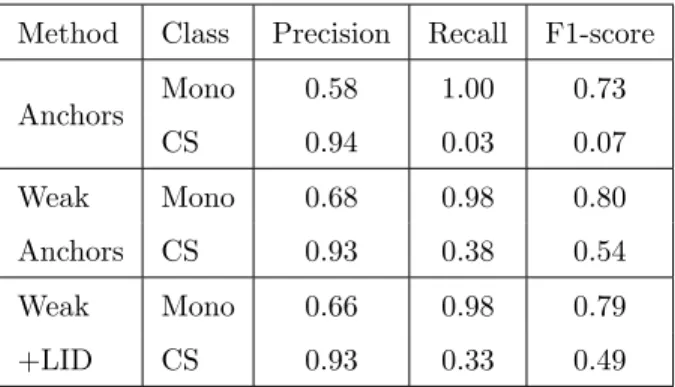
Table 2.1 shows Precision, Recall and F1-Score results on the task of classifying a tweet as code-switched (CS) or monolingual (mono) for the strong definition of anchors, weak anchors and the weak anchor + LID approach. We report results on the test partition of the EMNLP 2016 Shared Task Corpus. The language ID used is langid.py [Lui and Baldwin, 2012].
Method Class Precision Recall F1-score Anchors Mono 0.58 1.00 0.73 CS 0.94 0.03 0.07 Weak Mono 0.68 0.98 0.80 Anchors CS 0.93 0.38 0.54 Weak Mono 0.66 0.98 0.79 +LID CS 0.93 0.33 0.49
Table 2.1: Code-switched sentence detection performance using Anchoring: Strong Anchors, Weak Anchors and Weak Anchors with Language ID.
The top subtable from Table 2.1 shows the results we obtained for this task using our strong definition of anchor. Not surprisingly, we achieved very high precision, but very low recall. High precision and low recall is a secondary effect from the restrictiveness of the definition of anchor set and code-switched sentence, since anchors are not defined exclusively
in terms of L1 and L2, but from a large pool of languages. This means that the words in the anchor set are most likely to be very low-frequency words. Furthermore the fact that a sentence must have at least one anchor from both languages and none from all the other languages, guarantees that much of the data will be rejected as not code-switched even when bilingual speakers of the languages in question would agree that it is.
The middle subtable from Table 2.1 shows the results on the task using weak anchors as defined above. At the expense of 0.01 absolute precision points, recall is improved by almost 0.35 points.
The bottom subtable of Table 2.1 shows results using weak anchors and Language Id. Although with this method the recall drops 0.03 points with respect to the weak anchors, we achieve the advantage of being able to reduce the number of queries we need for the collection, and make the search less restrictive. In the next section of the Chapter we use weak anchors with the Language ID restriction to collect code-switched tweets.
2.4
Data Collection
We used Babler1 [Mendels et al., 2016] to collect code-switched data from Twitter. Babler is a tool designed for harvesting web-data for NLP and machine learning tasks. Babler’s pipeline is launched by querying a seed words∈Susing Twitter’s API. The tweets retrieved by the query are later processed and passed through a set of filtering rules R which are predefined for the task. Tweets were not selected or filtered based on time period, topic, genre, dialect, and so on.
Following the definition of “weak anchor plus Language Id” given in section 2.3 we used the “weak” anchors to seed the Twitter API and the filtering rules R to enforce the LID restriction. To further reduce the number of required queries we also sorted our “weak” anchors by frequency. The weak anchors were computed from the GigaCorpus dataset of Broadcast News data. R uses Twitter’s LID to only allow tweets that were seeded from a Spanish anchor and classified as English or vice versa. Although we required the Twitter API to return only exact matches to our seed terms, we found that in fact Twitter performs
1
stemming.
Our method differs from the prior art in two aspects. First, we derive our word lists from non-noisy pure monolingual corpora which reduces the risk of including out-of-language tokens. Second, instead of performing local filtration our method is implemented based only on API calls thus increasing our potential dataset to every public tweet available. Overall we collected 14,247 tweets that were seeded from Spanish weak anchors and classified as English by the Twitter API and 28,988 tweets that were seeded from English weak anchors and classified as Spanish.
2.5
Crowdsourcing Language Tags
While we designed our data collection pipeline to save only code-switched tweets, we next needed to test this, as well as to obtain manual annotations for our language modeling research.
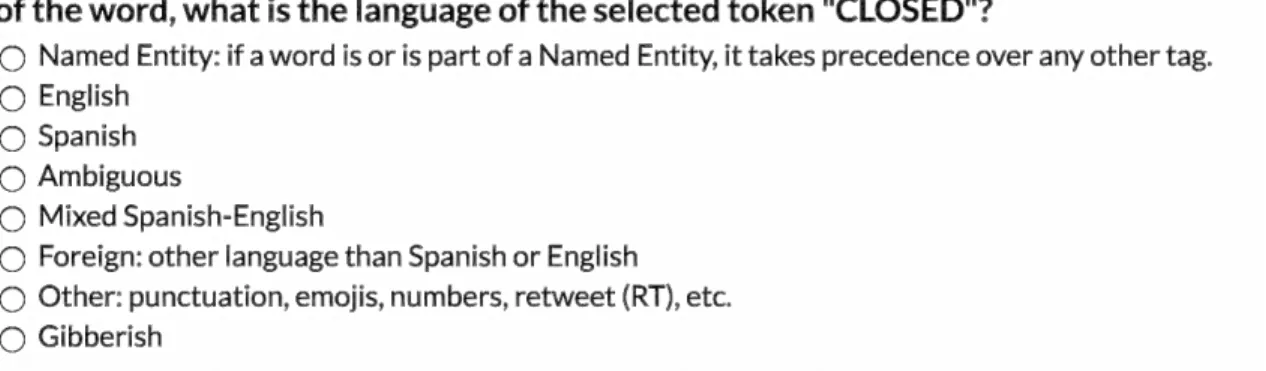
From the more than forty-three thousand tweets that were collected, we randomly chose a subset of 8,285 tweets for our “Anchored” tweets corpus 2. We crowdsourced language tags for every word in our Anchored tweet dataset. Each word was tagged as English (EN), Spanish (ES), Ambiguous between English and Spanish (AMBIG), Mixed English-Spanish (MIXED), Named Entity (NE), Foreign Word (FW), Other (OTHER) and Gib-berish (UNK). “Named Entities” were defined as single proper names or part of a name or title that referred to persons, places, organizations, locations, brands, goods, initials, movie titles and song titles. A word is to be tagged as “Ambiguous” when it can be used in both English and Spanish, but there is not enough context to decide its use in the current tweet. A word is to be tagged “Mixed” when the word does not exist in Spanish or English, but consists of a combination of elements from both, e.g. the word “ripeado” which contains the English root “rip” and the Spanish morpheme “-ado”. The category “Other” is to be used to tag punctuation, numbers, emoticons, retweet symbols, and other non-lexical items. Finally the “Gibberish” category is for tokens whose meaning cannot be identified.
2All the anchor wordlists, tweet IDs and their crowdsourced language tags are publicly available in http://www.cs.columbia.edu/~vsoto/files/lrec_2018_package.zip
Figure 2.1: Word-level language annotation crowdsourcing task. Figure shows the interface on Crowdflower.
We used the guidelines designed for the annotation of the EMNLP 2016 Shared Task dataset, with some minor changes, including a large number of examples per language tag, and reminders to the annotators throughout the instructions and question statements that a) hashtags were to be tagged with the language tag of the words in the hashtag, and b) Named Entities had precedence over any other language tag; since these were the test questions they had the most difficulty with in our initial test.
We used Crowdflower to crowdsource language tags for our tweets. An example of the task our workers were asked to complete can be seen in Figure 2.1. Our workers were pre-screened using a quiz of twenty test questions. If three or more test questions were missed during the initial quiz, the worker was denied access to the task. Furthermore, workers were required to be certified for the Spanish language requirement in Crowdflower. Only workers from Argentina, Canada, Mexico, Spain, U.K. and U.S.A. were allowed access to the task. The task was designed to present 20 questions per page plus one test question used to assess workers’ performance. When a worker reached an accuracy lower than 85% on these test questions, all their submitted judgments were discarded and the task made
Lang Tag #Tokens Avg. Conf ES 40,208 0.97 EN 30,372 0.93 AMBIG 919 0.55 MIXED 129 0.54 NE 15,260 0.88 FW 1,815 0.77 OTHER 1,994 0.80 UNK 546 0.59
Table 2.2: Number of tokens and average confidence per Language ID tag from the crowd-sourced annotations for the Anchored Twitter corpus.
subsequently unavailable. Every set of 19+1 judgments was paid 1 cent (USD).
In total, we collected three judgments per token. The average inter-annotator agreement was 92.33% and the average test question accuracy was 91.1%. These metrics demonstrate that the crowdsourced language labels are of high-quality. For every token for which we crowdsourced a language tag, Crowdflower computes the confidence on the language tag as the level of agreement between all the contributors that predicted that language tag weighted by the contributors’ trust scores. The language tag with highest confidence is then chosen as aggregated prediction. Table 2.2 shows the average confidence per language tag across all tokens. It can be seen that workers struggled the most when tagging words as Mixed, Ambiguous or Gibberish.
2.6
Evaluation
2.6.1 Data AssessmentGiven the crowdsourced LID labels, we can assess the quality of the retrieved anchored tweets by computing their degree of bilingualism and how frequently code-switching occurs within them. We compare these measures to the EMNLP 2016 CS Shared Task corpus [Molina et al., 2016].
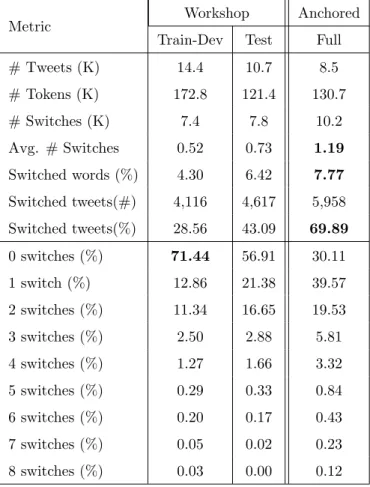
Metric Workshop Anchored Train-Dev Test Full # Tweets (K) 14.4 10.7 8.5 # Tokens (K) 172.8 121.4 130.7 # Switches (K) 7.4 7.8 10.2 Avg. # Switches 0.52 0.73 1.19 Switched words (%) 4.30 6.42 7.77 Switched tweets(#) 4,116 4,617 5,958 Switched tweets(%) 28.56 43.09 69.89 0 switches (%) 71.44 56.91 30.11 1 switch (%) 12.86 21.38 39.57 2 switches (%) 11.34 16.65 19.53 3 switches (%) 2.50 2.88 5.81 4 switches (%) 1.27 1.66 3.32 5 switches (%) 0.29 0.33 0.84 6 switches (%) 0.20 0.17 0.43 7 switches (%) 0.05 0.02 0.23 8 switches (%) 0.03 0.00 0.12
Table 2.3: Code-switching statistics for the EMNLP 2016 Workshop and Anchored Twitter datasets. The bottom subtable shows the percentage of tweets that containN code-switches.
The train and dev tweets from the 2016 Shared Task were the train and test sets from the 2014 Shared Task [Solorioet al., 2014], whereas the test split was collected specifically for the 2016 task. The collection schemes used in 2014 and 2016 were explained in detail in Section 2.2. Table 2.3 provides the overall statistics describing this corpus in comparison to ours. We report the train-dev and test splits of the EMNLP 2016 Workshop Shared Task corpus separately since they were collected using different methods. As can be seen in Table 2.3, our subset of 8,525 tweets had an average of 1.19 code-switches per tweet, with 7.77% of words in a tweet being followed by a switch. 69.89% of our tweets contained at least one or more switches. In comparison, the Workshop corpus had an average of 0.61 code-switches per tweet, with 5.17% of tokens followed by a switch. Only 34.75% tweets contained at least one switch. The test set of the Workshop corpus shows greater degrees
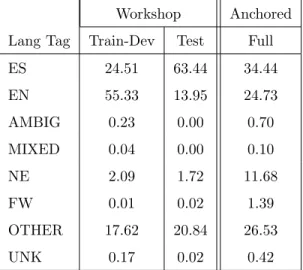
Workshop Anchored Lang Tag Train-Dev Test Full ES 24.51 63.44 34.44 EN 55.33 13.95 24.73 AMBIG 0.23 0.00 0.70 MIXED 0.04 0.00 0.10 NE 2.09 1.72 11.68 FW 0.01 0.02 1.39 OTHER 17.62 20.84 26.53 UNK 0.17 0.02 0.42
Table 2.4: Language composition for the EMNLP 2016 Workshop and Anchored Tweets datasets. Amounts are shown in percentages, at the token level.
of bilingualism and a better switching rate: Test corpus tweets averaged 0.73 code-switches per tweet, with 6.42% of tokens followed by a switch and contained 43.09% code-switched tweets overall. Based on these metrics alone, it would appear that our anchoring method improves over the earlier approach considerably.
Table 2.4 shows the language composition of the three datasets: Workshop training-dev, Workshop test, and the full Anchored dataset. From this table we can see that the train-dev portion of the workshop corpus has a majority (>55%) of English words, while the test split contains a large majority of Spanish words (>63.44%), perhaps due to seeding the collection of tweets on Spanish-language Radio accounts and followers/ees. In comparison, the Anchored corpus is more balanced, with 34.44 and 24.73% of Spanish and English tokens. It also has a higher rate of Named Entities and Other tokens. We believe this is due to the updated annotation guidelines that emphasized the subtleties involved in annotating Named Entities and Other tokens. While Table 2.4 compares the corpora by language composition, Table 2.5 examines the corpora by type of switch. The most frequent switch across datasets is Spanish to English (ES-EN), followed by English to Spanish (EN-ES). These account for 63.53%, 74.04% and 52.67% of switches for the Workshop Train-Dev, Workshop Test and Anchored datasets respectively. The next most common type of switch is an English word followed by a sequence of Other tokens and a Spanish word (EN-Other-ES), or Spanish
Workshop Anchored Switch Type Train-Dev Test Full ES EN 32.06 45.68 29.81 EN ES 31.47 28.36 22.86 EN Other+ ES 15.99 12.28 14.83 ES Other+ EN 15.16 11.05 10.86 ES NE+ EN 1.44 0.99 4.06 EN NE+ ES 0.91 0.36 2.45
Table 2.5: Types of code-switching in the EMNLP 2016 Workshop and Anchored Tweets datasets. TAG+ indicates a sequence of one or more occurrences of that language tag.
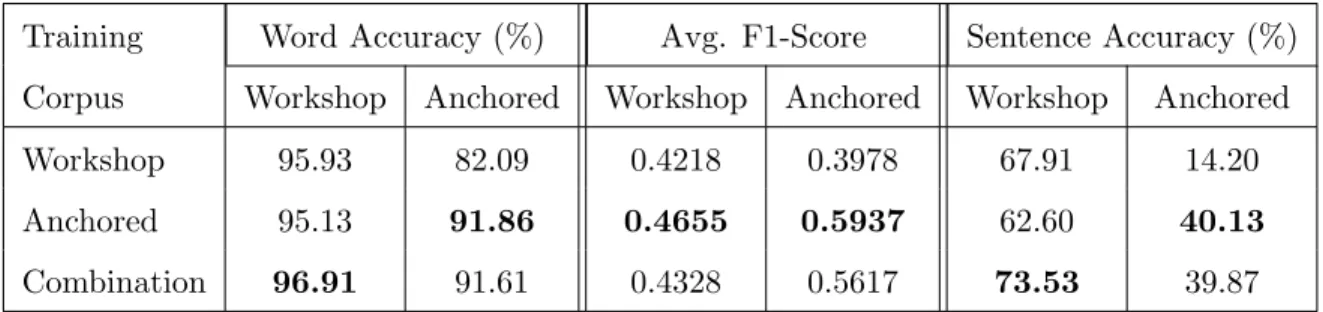
Training Word Accuracy (%) Avg. F1-Score Sentence Accuracy (%) Corpus Workshop Anchored Workshop Anchored Workshop Anchored Workshop 95.93 82.09 0.4218 0.3978 67.91 14.20 Anchored 95.13 91.86 0.4655 0.5937 62.60 40.13
Combination 96.91 91.61 0.4328 0.5617 73.53 39.87 Table 2.6: Language tagging accuracy (left) and average f1-score (center) at the word level and language tagging accuracy at the sentence-level (right) for each training and testing combination.
followed by Other and then English (ES-Other-EN). These make up for 31.15%, 23.33% and 25.69% of the switches. Note that this type of switch can be indicative of inter-sentential code-switching if the Other token is a punctuation mark (like ‘!’ in “Holaaaa mis ni˜nos bellos!!! I love you guys”) or it can be indicative of intra-sentential code-switching if the other token is a Twitter mention, a quote, and so on (e.g “En cuestiones de Rock ‘n’ Roll I am pretty crossover”). Overall, the typing distribution is more balanced in the Anchored dataset, whereas the Workshop test set has a significant majority of ES – EN switches, due perhaps, again, to the way the collection of tweets was seeded.
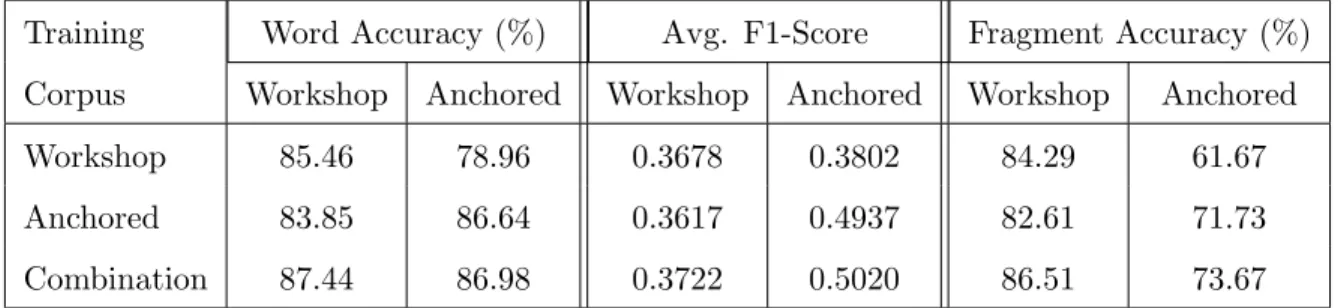
Training Word Accuracy (%) Avg. F1-Score Fragment Accuracy (%) Corpus Workshop Anchored Workshop Anchored Workshop Anchored Workshop 85.46 78.96 0.3678 0.3802 84.29 61.67 Anchored 83.85 86.64 0.3617 0.4937 82.61 71.73 Combination 87.44 86.98 0.3722 0.5020 86.51 73.67 Table 2.7: Language tagging accuracy (left) and average f1-score (center) at the word level and language tagging accuracy at the fragment-level (right) for each training and testing combination on the subset of code-switched fragments.
2.6.2 Language Identification
Our second evaluation of the accuracy of our corpus consists of training and testing Lan-guage ID taggers on the new dataset and comparing its performance to a tagger trained on the Workshop data. We made use of a high-performing classification model from Jaech et al. [2016b]. The model did well on the English-Spanish code-switching 2016 Shared Task, especially considering that it was one of only two models that did not use external resources for training [Molina et al., 2016]. The same model did well on a sentence level language identification task [Jaechet al., 2016a].
We summarize the model architecture and its motivation here. For a full description see [Jaechet al., 2016b]. The model is a hierarchical neural model with one level that operates on character sequences to build a representation for each word and a second level that operates on the sequence of word representations to predict the language tag for each word. In the first level, the model uses convolutional neural network layers to do a soft-version of n-gram matching. The output of this layer is a feature vector that provides a useful signal for the language of each word because languages tend to differ in their character n-gram distributions. The second level of the model is a bidirectional LSTM that takes as input the feature vectors from the previous layer and outputs the predicted tag for each word. The use of the LSTM allows the model to incorporate evidence from tokens far away in the word sequence.
was replaced with an LSTM that has coupled input and forget gates for a 25% reduction in the parameters in the bi-LSTM and a corresponding improvement in speed of computation [Greffet al., 2017]. Operating on the word-level representations allows the LSTM to predict the correct tag for words whose language is ambiguous from just the character-level feature vectors based on the fact that adjacent words are more likely to belong to the same language. We tuned the model hyper-parameters by training and testing on the train and dev splits of the Workshop dataset, effectively making the task more difficult for the model trained on the Anchored corpus. Table 2.6 shows the word-level and sentence-level accuracy and the average F1-score of the language ID tagset for each training/testing combination.
First, we trained our tagger on the Workshop data (Workshop Model, in Table 2.6) and observed that its performance on the Workshop test set is similar to that reported for this model in the Shared Task (95.93%). The performance of this tagger however sees a big drop of performance on word-level accuracy and sentence-level accuracy when tested on the Anchored test set. This demonstrates that a tagger trained on a corpus comprised of majority of monolingual sentences, with a lower degree of bilingualism and switching rates, has some difficulty generalizing to a more balanced corpus like the Anchored Tweets Corpus.
Second, we partitioned the Anchored corpus into train and test by randomly choosing 1,500 tweets for the test set and leaving the rest for training. We trained a new tagger on the Anchored dataset with the same hyper-parameter settings as the Workshop tagger and report its test performance on Table 2.6 as Anchored tagger. We observed that the performance of this model on the Workshop data is very good, despite the difference between the two datasets: the word-level accuracy only decreases by 0.8% accuracy points with respect to the Workshop model, whereas the sentence-level accuracy decreases by 5.31% points. However the F1-score value sees a relative improvement of 10.36%, which indicates that the new corpus is more similar to the Workshop test split than the Workshop train-dev split. The Anchored-trained tagger achieves 91.86% word-level accuracy on its own test set, with 0.5937 average F1-score value and 40.13% sentence-level accuracy. These results indicate that a tagger trained on the anchored corpus is able to generalize quite well on the same corpus, although overall the classification task is harder than on the Workshop
corpus: the best word-level and sentence-level accuracies in the Workshop test set are much higher than in the Anchored test set.
Finally, we trained a tagger on a combination of the Workshop and Anchored training sets. This combined tagger achieves the best word-level accuracy on the Workshop corpus (96.91%) as shown in the last row of Table 2.6. Similarly the combined tagger also achieves the best sentence-level accuracy on the Workshop test set (73.53%).
Overall, the Anchored tagger achieves the best results on the Anchored test set for every metric (91.86% word-level accuracy, 0.5937 average f1-score and 40.13% sentence-level accuracy), despite being trained on much less data (the anchored train set has 7,025 tweets, the workshop train set has 11,400 tweets and the combined train set has 18,425 tweets). It also achieves the best average f1-score on the Workshop test set (0.4655). The Combination tagger achieves the best word-level and sentence-level accuracy on the Workshop test set (96.91% and 73.53% respectively).
We next examine the performance of the three taggers on the subset of code-switched segments present in each test set in Table 2.7, where we define a code-switched segment as the minimal span of tokens where a point code-switch occurs. Notice that a segment can be longer than two tokens if there is a Named Entity, Other, Mixed or Ambiguous token in between. For example, from the sentence “I watched The Godfather y me encant´o”, the code-switched segment would be “watched The Godfather y” where “The Godfather” is a Named Entity.
From this table we can see that, in fact, taggers have most difficulty tagging words that occur in the context of a code-switch, since the accuracy of all three models on both test subsets of code-switched segments suffers a steep decline for the results shown for the complete test set in the left subtable of Table 2.6. In the case of the Workshop tagger, its accuracy has relative changes of -10.91 and -3.81% on the full workshop and anchored test sets respectively. The Anchored model sees even larger relative decreases of -11.86 and -5.68%. In comparison, the Combination model has the smallest relative decreases in accuracy, with -9.77 and -5.05%. The same trends can be observed for the average F1-Score and the fragment-level accuracy metrics.
followed by the Anchored model, which always gets better metric values on its own test set and achieves similar metric values on the Workshop test set when compared to the Workshop tagger. Notice though that the Anchored model was trained on less than 40% of the number of tweets in the Combined train set.
2.7
Conclusions
In this Chapter we presented a method that made use ofanchoring and monolingual Lan-guage ID for detecting code-switched text. We relaxed strict anchoring constraints to query the Twitter API and retrieved code-switched tweets. We crowdsourced language tags for the tokens of 8,285 tweets and found that almost 70% of the collected tweets were indeed code-switched. These tweet exhibit a relatively balanced amount of Spanish and English text and a high amount of code-switching per tweet. The average number of code-switches per tweet in the corpus is 1.19 switches while 7.77% of the tokens are followed by a code-switch. These numbers compare favorably to the 2016 EMNLP Workshop Shared Task Code-Switched Twitter corpus, which was obtained with a different and more labor-intensive method. We evaluated the quality of our new Anchored corpus by training state-of-the-art language taggers and showed that a) a tagger trained on the original Workshop corpus exhibited a more considerable drop in accuracy when tested on the Anchored corpus; and b) a tagger trained on the Anchored corpus achieved very good accuracy on both test corpora. These results show great promise for automatic collection of other code-switched corpora for use in training language models and for other NLP and speech tasks.
Chapter 3
Crowdsourcing Part-of-Speech
Tags for Code-Switched Data
3.1
Introduction
High-quality linguistic annotations are extremely valuable for any NLP task, and perfor-mance is often limited by the amount of high-quality labeled data available. However, little such data exists for code-switching. In this Chapter, we describe crowdsourcing universal part-of-speech tags for the Miami Bangor Corpus of Spanish-English code-switched speech. With the advent of large scale machine learning approaches, the annotation of large datasets has become increasingly challenging and expensive. Linguistic annotations by domain experts are key to any language understanding task, but unfortunately they are also expensive and slow to obtain. One widely adopted solution is crowdsourcing. In crowdsourcing, naive annotators submit annotations for the same items on crowdsourcing platforms such as Amazon Mechanical Turk and Crowdflower. These are then aggregated into a single label using a decision rule like majority vote. Crowdsourcing allows one to obtain annotations quickly at lower cost. It also raises some important questions about the validity and quality of the annotations, mainly: a) are aggregated labels by non-experts as good as labels by experts? b) what steps are necessary to ensure quality? and c) how does one explain complex tasks to non-experts to maximize output quality? [Callison-Burch and Dredze, 2010].
The task of crowdsourcing part-of-speech tags is challenging insofar as part-of-speech tagsets tend to be large and the task is intrinsically sequential. This means that workers need to be instructed about a large number of categories and they need to focus on more than the word to tag, making the task potentially longer, more difficult, and thus, more expensive. More importantly, even though broad differences between part-of-speech tags are not hard to grasp, more subtle differences tend to be critically important. An example would be deciding whether a word like ”up” is being used as a preposition (”He lives up the street”) or a particle (”He lived up to the expectations.”)
We present an annotation scheme for obtaining part-of-speech (POS) tags for code-switching using a combination of expert knowledge and crowdsourcing. Part-of-speech tags have been proven to be valuable features for NLP tasks like parsing, information extraction and machine translation [Och et al., 2004]. They are also routinely used in language modeling for speech recognition and in the front-end component of speech synthesis for training and generation of pitch accents and phrase boundaries from text [Tayloret al., 1998; Taylor and Black, 1998; Zenet al., 2009; Hirschberg, 1990; Wattset al., 2011].
We split the annotation task into three subtasks: one in which a subset of tokens are labeled automatically, one in which questions are specifically designed to disambiguate a subset of high frequency words, and a more general cascaded approach for the remaining data in which questions are displayed to the crowd-source worker following a decision tree structure. Each subtask is extended and adapted for a multilingual setting and the universal tagset. The quality of the annotation process is measured using hidden check questions annotated with gold labels. The overall agreement between gold standard labels and the majority vote is between 0.95 and 0.96 for just three labels and the average recall across part-of-speech tags is between 0.87 and 0.99, depending on the task.
The rest of the Chapter is organized as follows. Section 3.2 presents a summary of related work on crowdsourcing linguistic annotations and more specifically part-of-speech tags. Section 3.3 gives an overview of the Miami Bangor corpus, which we obtain annotations for. This corpus will be used throughout the rest of this dissertation. Section 3.4 explains our annotation scheme in detail. Section 3.5 shows our results and finally, Section 3.6 presents out conclusions.
3.2
Related Work
There is a large body of work on the topic of crowdsourcing linguistic annotations for lan-guage corpora. In [Snowet al., 2008] the authors crowdsourced annotations in five different NLP tasks. To evaluate the quality of the new annotations they measured the agreement between gold and crowdsourced labels. Furthermore, they showed that training a machine learning model on the crowdsourced labels yielded a high-performing model. Callison-Burch [2009] crowdsourced translation quality evaluations and found that by aggregating non-expert judgments it was possible to achieve the quality expected from non-experts. In [Hsuehet al., 2009] crowdsourcing was used to annotate sentiment in political snippets using multiple noisy labels. The authors showed that eliminating noisy annotators and ambiguous exam-ples improved the quality of the annotations. Finin et al.[2010] described a crowdsourced approach to obtaining Named Entity labels for Twitter data from a set of four labels using both Amazon Mechanical Turk and CrowdFlower. They found that a small fraction of workers completed most of the annotations and that those workers tended to score highest inter-annotator agreements. Jha et al. [2010] proposed a two-step disambiguation task to extract prepositional phrase attachments from noisy blog data.
The aggregation scheme is a key component in a crowdsourcing task. Majority voting is widely used but is sensitive to noisy labels. In [Hovy et al., 2013] the authors proposed MACE (Multi Annotator Competence Estimation), an aggregation scheme based on item-response models. MACE learns to identify which annotators are trustworthy and predict correct labels. Similarly in [Rodrigues et al., 2014], a Conditional Random Field (CRF) is used for situations where multiple annotations are available but not actual ground truth. The algorithm proposed there was able to simultaneously learn the CRF parameters, relia-bility of the annotators and the estimated ground truth.
Previous research has tackled the task of crowdsourcing part-of-speech tags. The authors in [Hovyet al., 2014] collected five judgments per word in a task which consists of reading a short context where the word to be tagged occurs, and selecting the part-of-speech tag from a drop-down menu. Using MACE [Hovy et al., 2013] they obtained 82.6% accuracy and 83.7% when restricting the number of words to be tagged using dictionaries. In his M.S. thesis, Mainzer [2011] proposed an interactive approach to crowdsourcing
part-of-speech tags, where workers are assisted through a sequence of questions to help disambiguate the tags with minimal knowledge of linguistics. Workers following this approach for the Penn Treebank Tagset [Santorini, 1990] achieved 90% accuracy.
In this Chapter, we propose to adapt the monolingual annotation scheme from [Mainzer, 2011] to crowdsource Universal part-of-speech tags in a code-switching setting for the Miami Bangor Corpus. Our main contributions are the following: finding mappings to the univer-sal part-of-speech tagset, extending a monolingual annotation scheme to a code-switching setting, creating resources for the second language of the pair (Spanish) from zero and creating a paradigm that others can adopt to annotate other code-switched language pairs.
3.3
The Miami Bangor Corpus
The Miami Bangor corpus is a conversational speech corpus recorded from bilingual Spanish-English speakers living in Miami, FL. It includes 56 files of conversational speech from 84 speakers. The corpus consists of 242,475 words (transcribed) and 35 hours of recorded conversation. 63% of transcribed words are English, 34% Spanish, and 3% are undeter-mined. The manual transcripts include beginning and end times of utterances and per word language identification.
The original Bangor Miami corpus was automatically glossed and tagged with POS tags using the Bangor Autoglosser [Donnelly and Deuchar, 2011a,b]. The autoglosser finds the closest English-language gloss for each token in the corpus and assigns the tag or group of tags most common for that word in the annotated language. These tags have three main problems: they are unsupervised, the tagset used is uncommon and not specifically designed for multilingual text, and often the autoglosser does not disambiguate between predicted tags (e.g. the Spanish token “s´ı” is simultaneously tagged as “yes.ADV.[or].himself.PRON”, where “yes” and “himself” are the English glosses and “ADV” and “PRON” their part-of-speech tags). To overcome these problems we decided to a) obtain new part-of-part-of-speech tags through in-lab annotation and crowdsourcing and b) to use the Universal Part-of-Speech Tagset [Petrovet al., 2012].
be-cause it was designed with the goal of being appropriate to any language. Furthermore, it is useful for crowdsourced annotations because it is much smaller than other widely-used tagsets. Comparing it to the Penn Treebank part-of-speech tagset [Santorini, 1990; Marcus et al., 1993], which has a total of 45 tags, the Universal part-of-speech tagset has only 17: Adjective, Adposition, Adverb, Auxiliary Verb, Coordinating and Subordinating Conjunction, Determiner, Interjection, Noun, Numeral, Proper Noun, Pronoun, Particles, Punctuation, Symbol, Verb and Other. A detailed description of the tagset can be found
inhttp://universaldependencies.org/u/pos/.
3.4
Annotation Scheme
The annotation scheme we have developed consists of multiple tasks: each token is assigned to a tagging task depending on word identity, its language and whether it is present in one of three disjoint wordlists. The process combines a) manual annotation by computational linguists, b) automatic annotation based on knowledge distilled from the Penn TreeBank guidelines and the Universal Tagset guidelines, and c) and d) two language-specific crowd-sourcing tasks, one for English and one for Spanish. The pseudocode of the annotation scheme is shown in Algorithm 1.
Table 3.1 shows the number and percentage of tokens tagged in each annotation task (second and third column) and the percentage of tokens that was annotated by experts in-lab, either because it was the manual task or because there was a tie in the crowdsourced task. In the next subsections we explain in detail each one of the annotation blocks. All the wordlists and sets of questions and answers mentioned but not included in the following sections are available in Appendices A, B, C, and D.
3.4.1 Automatically Tagged Tokens
For English, the Penn Treebank Annotation guidelines [Santorini, 1990] instructs annotators to tag a certain subset of words with a given part-of-speech tag. We follow those instructions by mapping the fixed Penn Treebank tag to a Universal tag. Moreover we expand this wordlist with a) English words that we found were always tagged with the same Universal
Algorithm 1:Pseudocode of the annotation scheme.
1 function RetrieveGoldUniversalTag (token, lang, tag);
Input: A wordtoken, lang ID lang and POS tag tag
2 if IsInUniqueLists(token, lang) then
3 return RetrieveAutomaticTag(token, lang); 4 else if IsInManualAnnotationList(token, lang)then 5 return RetrieveManualTag(token, lang);
6 else
7 utag= Map2Universal(token, lang, tag); 8 if IsInTSQList(token, lang) then
9 utags = TokenSpecificQuestionTask(token,2); 10 else
11 utags = QuestionTreeTask(token, lang,2); 12 return MajorityVote([utag, utags]);
Task # Tokens % Corpus % by Experts
Automatic 156845 56.58 0.00 Manual 4,032 1.45 1.45 TSQ 57,248 20.65 0.93 English QT 42,545 15.34 0.32 Spanish QT 16,587 5.98 0.08 Total 277,257 100 2.78
tag in the Universal Dependencies Dataset and b) low-frequency words that we found only occur with a unique tag in the Bangor Corpus. Similarly, for Spanish, we automatically tagged all the words tagged with a unique tag throughout the Universal Dependencies Dataset (e.g. conjunctions like ‘aunque’, ‘e’, ‘o’, ‘y’, etc.; adpositions like ‘a’, ‘con’, ‘de’, etc.; and some adverbs, pronouns and numerals) and low frequency words that only occurred with one tag throughout the Bangor corpus (e.g. ‘aquella’, ‘tanta’, ‘bastantes’, etc.).
Given the abundance of exclamations and interjections in conversational speech, we collected a list of frequent interjections in the corpus and tagged them automatically as INTJ. For example: ‘ah’, ‘aha’, ‘argh’, ‘duh’, ‘oh’, ‘shh’. Finally, tokens labeled as Named Entities or Proper Nouns in the original Miami Bangor Corpus were automatically tagged as PROPN.
3.4.2 Manually Tagged Tokens
We identified a set of English and Spanish words that we found to be particularly challenging for naive workers to tag and which occurred in the dataset in such low frequency that we were able to have them tagged in the lab by computational linguists. Note that a question specific to each one of these tokens could have been designed for crowdsourced annotations the way it was done for the words in section 3.4.3.1. The majority of these are tokens that needed to be disambiguated between adposition and adverb in English (e.g.‘above’, ‘across’, ‘below’, ‘between’) and between determinant and