Determinants of Internal Audit Effectiveness
in State-Owned Enterprises (SOEs) in Ghana
Alhassan Musah
1, Erasmus Dodzi Gapketor
2, Fred Kwesi Anokye
3Abstract: The study examined factors that determine internal audit effectiveness among SOEs in Ghana. The study was conducted in response to various scandals among Ghanaian SOEs and the lack of empirical studies on determinants of internal audit effectiveness that can deal with these problems. The study specifically examined the respondent’s perception about the impact of factors such as; competence of internal audit unit, size of internal audit unit, relation between interna l and external auditors, management support for internal audit function, and independence of internal audit unit on internal audit effectiveness among SOEs in Ghana. The surveyed internal auditors, accountants and management of these sampled SOEs in Ghana. The results of the study showed that management support for internal audit function is the most significant determinants of internal audit effectiveness. The study also revealed that size of internal audit unit, competence of internal audit staff, independence of internal audit unit as well as good relationship between internal and external auditors were significant determinants of internal audit effectiveness. The study apart from contributing to the non-existent literature on the subject matter in Ghana, also serve as guidance to policy makers on critical areas to address to ensure affective internal au dit in SOEs in Ghana.
Keywords: internal audit effectiveness; SOEs; Ghana
1. Introduction
There has been consistent and growing concern with regards to efficient and transparent public financial management especially in state-owned enterprises (Onumah & Yao Krah, 2012). Recent scandals such as the alleged $72 million spent by Social Security and National Insurance Trust (SSNIT), GH¢150,000 bribery allegation against National Lottery Authority, Corruption allegation against management of ADB bank and many more financial scandals that have hit many SOEs in Ghana. The numerous financial scandals in most state-owned enterprises in Ghana attest to the fact that there are weaknesses in the effectiveness of their internal audit. Internal audit has been defined as an independent and objective activity that provides assurance and insurance to an organization with regards to the degree of control held over operations (Institute of Internal Auditors, 1999). Internal audit supports the organization to achieve its objectives by a systematic and methodical evaluation of the risk management, control and management of the entity’s processes and by making proposals on how to strengthen their effectiveness (Daniela & Attila, 2013). According to Alzeban & Gwilliam (2014), the traditional role of internal audit has focused on monitoring internal controls and ensuring financial compliance. They further argue that modern internal audit function has grown significantly towards risk management and a wider consulting role in organizations. More recently, the role of internal audit has evolved, undergoing two major changes (Dittenhofer, 2001; Van Gansberghe, 2005; Arena et al., 2006). On the one hand, the corporate scandals which provoked world-wide concern with corporate governance focused new attention on internal audit as one of the mechanisms designed to
1 E-mail: [email protected]. 2 E-mail:[email protected]. 3 E-mail: [email protected].
secure accountability. In this respect, boards and audit committees (AC) started to look at internal auditors as a possible answer to external demands to ensure the alignment of the interests of management with other stakeholders (Spira & Page, 2003). On the other hand, internal audit has developed a stronger operational orientation, expanding its area of involvement beside financial compliance to include risk management (Asare, 2009) and important operational areas, such as technology and projects (KPMG, 2009). Internal auditors started to challenge management and act as a catalyst for improvement, using their knowledge of risk and control to enhance business practices (Arena & Azzone, 2009; Haron et al., 2010; Lenz & Hahn, 2015). This evolution has been particularly evident in private companies, where the establishment of internal audit often happened in response to corporate governance scandals. However, there have been significant changes even among public organizations (Sarens, 2009). In many countries, public administrations refocused internal audit function from financial and compliance issues to performance issues even though this trend is more pervasive in the private sector than the public sector (Alzeban & Gwilliam, 2014).
Previous studies report that there are limited studies on internal audit as compared to external audit (Alzeban & Gwilliam, 2014; Mihret & Yismaw, 2007). Alzeban & Gwilliam (2014) posits that the measurement of Internal Audit Effectiveness (IAE) is critical to the understanding of the factors that influence internal audit quality and effectiveness. Extant literature used different approaches to measure internal audit effectiveness and the factors that influence them. Some of these studies examined internal audit function using compliance with International Standards for the Professional Practice of Internal Auditing (IASPPIA) (Baharud-din et al., 2014; Fadzil et al., 2005; Spraakman, 1997; Lenz & Hahn, 2015). Recent studies such as Alzeban & Gwilliam (2014) and Alzeban & Sawan (2013) argue that the approach of using compliance with IASPPIA to measuring internal audit effectiveness has been criticised for over-relying on the execution of procedures and does not take into consideration the outcome with respect to requirements of principal stakeholders. Some studies measured IAE by examining the internal audit functions’ ability to satisfy the needs of stakeholders (Cohen & Sayag, 2010; Frigo, 2002; Ziegenfuss, 2000). The above studies assumed that stakeholders’ satisfaction of internal audit function in the organization is the best measure of its effectiveness. Other studies focused directly on the extent to which internal audit function recommendations are implemented as a measure of its effectiveness (Dellai & Omri, 2016; Arena & Azzone, 2009; Mihret & Yismaw, 2007; Sawyer, 1995; Van Gansberghe, 2005). In the midst of the several approached to measuring IAE, Dittenhofer (2001) posits that the adoption of a broader scope that include the capacity of internal audit function to provide compare achievement of their auditees goals and objectives and to recommend solutions upon the realization of the objectives. Such an approach requires that all aspect of the organizations operations where the internal audit function has influence including their performance should be examined (Alzeban & Gwilliam, 2014). This study in the midst of the above recommendation adapted the measure proposed by Alzeban & Gwilliam (2014) in their study in Saudi Arabia which include: the unit ability to plan, their ability to improve organizational productivity, their ability to implement internal audit recommendations, their ability to evaluate the consistency of results with set objectives and targets, their ability to evaluate and enhance risk management, their ability to monitor and evaluate internal control systems, make recommendations for the competence of internal auditors, the size of internal audit function, relationship with external auditors etc. The study extends previous studies measure of IAE by not only examining the quality of IAE by auditees management, but by including internal auditor themselves. Various studies have examined some of these factors in different context especially in Europe, America, Australia, Asia and to some extent Africa (Alzeban & Gwilliam, 2014). However, the literature explored shows that no
study has examined these factors in the Ghanaian context. The limited studies in the Ghanaian context on internal audit have examined challenges of internal audit function in the Ghanaian public sector (Ankrah, 2016; Onumah & Yao Krah, 2012). Also, majority of the studies used external auditors’ perception to examine internal audit effectiveness with limited attention on other stakeholders including internal auditors themselves. The study therefore examines the factors that affect the effectiveness of the internal audit function within the State-owned enterprises in Ghana.
The research is important because it takes into consideration one of the essential arrears in corporate governance, internal audit. Internal auditing has enormous benefits to managers but unless they are effective, their presence in the organisation would be less useful (Van Gansberghe, 2005; Haron et al., 2010). This study seeks to provide an all-inclusive analysis of factors responsible for the effectiveness of internal audit function and the various measures they are taking to avert adverse factors affecting them. In this regard, the study goes beyond previous studies that rely on compliance with IASPPIA to measuring internal audit effectiveness but develop more comprehensive questions that address the needs of all stakeholders.
Policy makers in the Ghanaian state-owned enterprises would find the findings of the study very valuable as the finding reveals factors that can enhance the effectiveness of internal audit.
Although there have been previous studies in this area of internal audit, the researcher’s checks reveal little work on the subject matter within the sub Saharan Africa and most importantly Ghana. This research will therefore add to the existing literature on internal audit.
2. Literature Review and Hypothesis Development
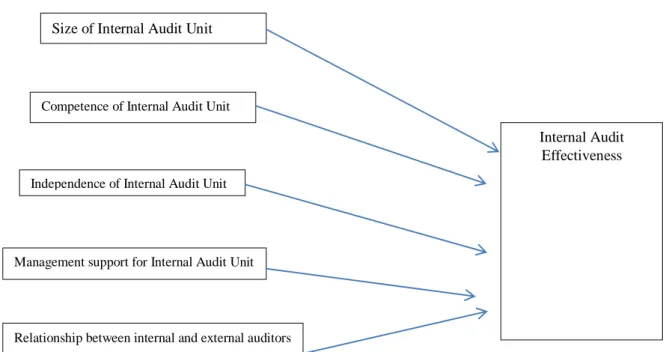
Onumah & Yoa Krah (2012) in their study about the barriers to effective internal audit of Ghanaian public sector entities reported that the scope of internal audit activities was limited to pre-audit of payment vouchers. The study further revealed that internal audit in the Ghanaian public sector has been hampered by factors such as low professional proficiency of internal auditors; lack of management ownership and support for internal audit activities, lack of budget authority of the internal audit units and weak functioning of audit committees. The choice of hypothesis was based on both previous academic literature and authoritative professional organizations. Recently, Ankrah (2016) examined similar issue in the Ghanaian public sector and reported similar results. Shamsuddin et al. (2015) argues that the agency theory is the best theoretical foundation for internal audit function in every organization. The fundamental assumption of the agency theory is a separation of powers between management and owners (Fama & Jensen, 1983). Workers in the state-owned enterprises in Ghana are agents of the owners (government acting on behalf of the people of Ghana) who might be motivated by self-interest. Internal audit is one of the mechanisms to reduce the agency conflict and ensure that managers work in the best interest of the owners. The study after reviewing various literatures on the topic from various contexts adopted factors espoused by Alzeban & Sawan (2013) and Alzeban & Gwilliam (2014) as the potential determinants of IAE in the Ghanaian state-owned enterprises. These studies identified five factors perceived as relevant to IAE: competence of the internal audit staff, size of the IAD, relationship between internal and external auditors, management support for the internal audit, and independence of the IAD. Prior studies on these factors and how they affect internal audit effectiveness have been presented below. Figure 1 below present a conceptual framework of the factors mentioned above.
Figure 1. Conceptual framework for the study Source:Alzeban & Gwilliam (2014) 2.1. Size of Internal Audit Unit
The size of internal audit department has been identified key determinants of internal audit effectiveness especially in larger organizations (Alzeban & Gwilliam, 2014). The internal audit department needs to be staffed with the right numbers so they can perform all their responsibilities appropriately. The unit has the responsibility to draw management attention to any inadequate resources by way of staffing to ensure they are addressed. Appropriate number of internal auditors must be employed and trained on an on-going basis to assure continued professional competence. Extant literature on IAE argues that internal audit effectiveness is higher if the organization has sufficient internal audit personnel. For instance, Onumah & Yao Krah (2012) found inadequate staffing as one of the barriers to effective internal audit function in Ghana. In a similar study, Ali et al. (2007) reported that shortage of qualified staff was the severest problem facing local government bodies in Malaysia. Ahmad et al. (2009) revealed that respondents ranked small number of internal auditors as the most important factor affecting internal audit effectiveness in Malaysian public sector. Also, Brierley et al. (2003) found that internal audit departments were significantly understaffed in the Sudanese public sector, limiting the staff’s ability to execute their duties. Other studies found a significant association between the size of internal audit staff and internal audit effectiveness (Mihret & Woldeyohannis, 2008; Mulugeta, 2008). Based on the above findings the study hypothesizes that: H1. A higher perception of internal audit effectiveness is associated with a larger internal audit department
2.2. Competence of IAD
One of the main barriers affecting the proper functioning of internal auditors in the Ghanaian public sector is the lack of competent and skilled auditors (Onumah & Yoa Krah, 2012). Baharud-din et al. (2014) argues that competency of staff relates to their ability to perform a task creditably which is
Internal Audit Effectiveness Size of Internal Audit Unit
Competence of Internal Audit Unit
Independence of Internal Audit Unit
Management support for Internal Audit Unit
contingent upon educational level, professional experience and the continuing professional development of the staff. Standard setters have also emphasized the need to have qualified, experienced and competent staff for audit roles (Alzeban & Gwilliam, 2014). Al-twaijry et al. (2004) posit that competence is used as one of the main indicators of reliance on the work of the internal auditors by external auditors. Previous studies have found that competence of internal audit personnel is associated with internal audit effectiveness (Ali et al., 2009; Al-Twaijry et al., 2004; Felix et al., 2001; Maletta, 1993). In the South African public sector, Schyf (2000) identified a number of obstacles affecting internal audit performance, including a lack of internal audit competencies. Similar results were obtained in other studies in developing countries. These studies suggested that the internal audit staff lacked adequate educational qualifications and that insufficient continuous professional training was available to enable them to upgrade their skills. Against this background, the following hypothesis is formulated:
H2. A higher perception of internal audit effectiveness is associated with greater competency of the internal audit staff.
2.3. Independence of Internal Audit
Independence is at the heart of the accounting profession but is most significant for auditors. Even though independence of auditors is synonymous with external audit, Alzeban & Gwilliam (2014) states that standard setters as well as professional bodies have placed more significance on independence of the internal audit function even though they are employees of the organization. The independence of internal audit department has been identified as one of the most important ingredients of an effective internal audit function (Baharud-din et al., 2014; Mutchler, 2003; Ahmad et al., 2009; Al-Akra et al., 2016). Dellai and Omri (2016) posit that even though very few studies have examined internal auditor and internal audit effectiveness, these studies have reported a positive relationship between them. Other studies have also reported a positive association between the independence of internal audit function and IAE (Hung & Han, 1998; Soh & Bennie, 2011; Alzeban & Gwilliam, 2014; Dellai & Omri, 2016). These arguments lead to the following hypothesis:
H3: A higher perception of internal audit effectiveness is associated with greater independence of the internal audit.
2.4. Management Support for Internal Audit
Top management support is very critical for the proper functioning of the internal audit department (Dellai & Omri, 2016). Internal auditing definitions encompass good governance which depends to a large extent on the professionalism of top management to ensure effective internal audit function (Alzeban & Gwilliam, 2014; Carcello, 2015). With the support of top management, internal auditors can obtain sufficient resources to execute their duties and responsibilities, and the internal audit function can employ qualified staff and provide continuous training and development (Alzeban & Sawan, 2013; Cohen & Sayag, 2010). Onumah and Yao Krah (2012) reported that one of the barriers to effective internal auditing in the Ghanaian public sector is lack of management support. Previous studies have argued that management support is very crucial for the objective of the internal audit department to be achieved. For instance, Ahmad et al. (2009) found that management support was the second most important determinant of IAE within the Malaysian public sector, after sufficiency of the auditing staff. Mihret & Yismaw (2007) found management support as the most important factor influencing IAE. Alzeban & Gwilliam (2014) also reported similar findings in their study of Saudi Arabian public sector. Based on the above discussion, the fourth hypothesis is formulated as:
H4. A higher perception of internal audit effectiveness is associated with management support for internal auditing.
2.5. Relationship between Internal and External Auditors
Studies have shown that internal auditors’ relationship with external auditors is as important to ensure that the benefits accrue to the organization and external stakeholders (Alzeban & Gwilliam, 2014; Alzeban & Sawan, 2013). Relationship between internal and external auditors could be in the form of joint planning and exchange of information, opinions, and reports to facilitate higher-quality audits and prevent unnecessary duplication of work. Accounting and professional standards acknowledges the address the relationship between internal and external auditors. For instance, ISPPIA on coordination between the two suggests that coordination should include sharing information and coordination of activities. This includes developing and maintaining a professional relationship between the respective audit parties, which consequently assists internal auditors in achieving their objectives and providing better service to the company. From the external auditors’ perspective, the information provided by the internal auditor likely assists in providing a higher-quality audit opinion and possibly one delivered with greater resource efficiency in circumstances where the external auditor is able to rely on work carried out by the internal auditor. Academic studies indicate that appropriate cooperation increases the economy, efficiency, and effectiveness of audits and helps management provide a high-quality public service (Alzeban & Gwilliam, 2014). Research has shown that lack of coordination between internal and external auditors is a major factor impairing the quality of both forms of audit in the public sector in developing countries (Brierley et al., 2001). The arguments presented above leads to the fifth hypothesis, which is formulated as follows:
H5. A higher perception of internal audit effectiveness will be related to a closer relationship between internal and external auditors.
3. Methodology
The study employed the survey approach. Survey approach is chosen for this study because it provides direct evidence concerning respondents’ perceptions and experiences with implementing internal audit. The population of the study include state-owned enterprise in Ghana. Stratified sampling method was used to divide them base on some indicators such as firm size; international operations; listing; and risk profile. After which purposive sampling method was used to select the companies and the respondents within the companies. In all 25 state-owned enterprises were sampled for the study. These SOEs operates in different sectors such as manufacturing, energy, petroleum, financial and insurance services etc.
Data was collected from mainly primary source. Primary data was collected by the administration of questionnaires. In all, 150 questionnaires were distributed but only 110 were retrieved representing 73% response rate. However, due to non-responses of some questions the final questionnaire that were analysed for the study were 100. Most questions required the participant to mark the extent of their
agreement or disagreement with a statement using a five-point Likert scale (1 = Strongly Disagree, 5=
Strongly Agree. Data collected was analysed quantitatively by the use of Ordinary least squares (OLS) multiple regression. It also used to estimate the magnitude of the effect of the five factors identified above (the independent variables) on IAE (the dependent variable). The unit of analysis was the
organization, with responses from managers and internal auditors. The basic OLS regression model was:
Where IAE = perceived internal audit effectiveness; COMP = competence of the Internal audit unit (training and experience); SIZE = size of the Internal audit unit; RELEX = relationship between internal and external auditors; MSUP = management support for internal auditing; IND = independence of the Internal audit unit.
The independent variables were measured by collating and aggregating internal auditor and management responses to the questions within the questionnaire.
The competence of the internal audit department competence was measured by four indicators: educational qualifications, professional qualifications, work experience in the field of internal auditing, and continuous development (average annual training hours).
The size of the internal audit unit is measured by the number of internal auditors employed within it. The relationship between internal and external auditors is measured by a number of proxies: attitude towards external auditors; co-ordination, including discussing mutual interests; discussion of the audit plan; external auditors’ reliance on the work of the internal audit; frequency of meetings; sharing working papers; and management’s promotion of the relationship between these two groups.
Management’s support for internal auditing (MSUP) was measured by a number of indicators: supporting internal audit to perform its duties and responsibilities, involvement in the internal audit plan, reports on the work of the internal audit team being delivered to the management, management’s response to internal audit reports, and the resources of the internal audit department.
The independence of the IAD (IND) was measured by items such as: the level of independence, reporting level, direct contact with the board and senior management, conflicts of interest, interference, unrestricted access to all departments and employees, appointment and removal of the head of internal auditing, and performance of non-audit activities.
4. Results and Discussions of Findings
4.1. Respondents’ Personal and Professional Demographics Table 1. Respondents characteristics
Respondents Profile Frequency %
Gender
Male 70 70
Female 30 30
Number of years in organization
1 to 5 Year 16 16 6 to 10 Years 44 44 11 to 15 Years 30 30 15 to 20 Years 10 10 20 Years + 0 Respondents Background Internal Auditors 56 56 Management 20 20 Accountants 24 24 Level of Education
Secondary and A level
HND/Diploma 20 20
Masters 16 16 Professional qualification 36 36
Auditing work experience
<1 year 6 6
1–<5 years 34 34
5–<10 years 40 40
10–<15 years 12 12
15 years or more 8 8
Annual training hours
No training <20 6 6 21–40 24 24 41–80 40 40 81–120 20 20 More than 120 10 10
Internal Audit courses
None 40 40
One course 50 50
Two courses 10 10
Three courses
Four or more courses
Number of internal auditors
1–5 20 20
6–10 50 50
11–15 10 10
16–20
More than 20
Source: Field data, 2017
The responses as summarised in table shows that majority of respondents were males (70%) which confirms the research findings that the accounting profession is made dominated in most part of Africa. The result however is contrary to findings of similar study Baharud-din et al. (2014) in Malaysia where females dominated a sample of internal auditor and accountants used for the study. On the years of experience in the respective organization where respondents were sampled for the study, the results from table 1 shows that majority of them had worked for at least 6 to 10 years (44%) followed by 11 to 15 years (30%). The results shows that respondents have enough knowledge on the workings in their respective organizations and could provide the needed responses for the study. On their level of education, majority of respondents (64%) had a degree whiles 24% in addition to either a degree or master had professional accounting qualification. The results affirm the earlier assertion that respondents were knowledgeable enough to provide the needed responses for the study. Apart from the number of years with their respective organizations, the study also examined the number of years of respondents in any auditing related field. The results to the above in table 1 show that the average years of experience of respondents in auditing is 5 to 10 years (40%).
On whether respondents had undergone any internal audit course organized by their organization, majority of respondents (80%) had not undertaken any such training in their organization with only 20% who had the privilege of such experience.
The average internal auditors in the sampled organization is 6 to 10 staff (50%) while organizations with the largest number of internal audit staff is 11 to 15 (10%).
4.2. Descriptive Statistics on Components of Independent Variables
The section presents mean responses from each of the questions posed under the variables examined for the study which include; relationship between internal and external auditors, management support for internal audit function and independence of internal audit. Each variable had a number of sub-questions where respondents were asked to choose from a score of 1 to 5 the extent to which they
agree with the statement. The mid-point is 3 meaning more than half agree with that statement. The level of variations in the responses were also presented in the standard deviation from each responses analysed.
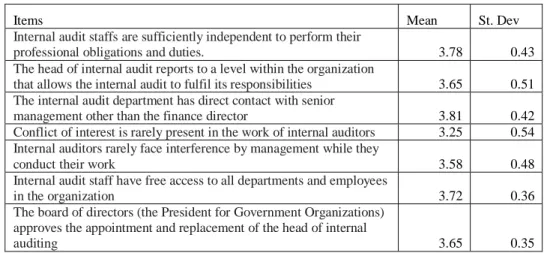
Table 2. Independence of internal audit function
Items Mean St. Dev
Internal audit staffs are sufficiently independent to perform their
professional obligations and duties. 3.78 0.43
The head of internal audit reports to a level within the organization
that allows the internal audit to fulfil its responsibilities 3.65 0.51
The internal audit department has direct contact with senior
management other than the finance director 3.81 0.42
Conflict of interest is rarely present in the work of internal auditors 3.25 0.54
Internal auditors rarely face interference by management while they
conduct their work 3.58 0.48
Internal audit staff have free access to all departments and employees
in the organization 3.72 0.36
The board of directors (the President for Government Organizations) approves the appointment and replacement of the head of internal
auditing 3.65 0.35
Source: Field data, 2017
The means of all the questions relating to the independence of internal audit function in the sampled organization shows an overall average of 3.64. This suggests that, the internal audit units have the needed independence to function effectively. The result is consistent with the findings of Alzeban & Gwillian (2014) study on internal audit effectiveness in Saudi public sector.
Table 3. Relationship with external auditors
Items Mean St. Dev
External auditors are friendly and supportive 3.98 0.75
External auditors have a good attitude towards internal auditors 3.85 0.82 External auditors are willing to give internal auditors an opportunity to explain their concerns 3.65 0.65 External and internal auditors consult on the timing of work in which they have a mutual interest 3.45 0.74
External auditors discuss their plans with internal audit 2.85 0.72
External auditors rely on internal audit work and reports 3.25 0.81
External and internal auditors meet on a regular basis 3.45 0.65
External and internal auditors share their working papers 2.58 0.75
Senior management helps to promote effective co-operation between internal and external audit 3.58 0.76 Source: Field data, 2017
The average means score for the variables that examined the relationship between internal auditors of the sampled firms and their external auditors are 3.40. The result shows that on average internal auditors has good relationship with their external auditors. The variable with the highest mean score is 3.98 which represent the friendliness of external auditors in their interaction internal auditors. The variable with least is external auditors sharing working papers with internal auditors by external auditors. The results show that more respondents were not sure whether internal auditors share their working papers with internal auditors even though they agree that external auditors are willing to explain concerns raised in the course of their audit work with internal auditors (3.65).
Items Mean St. Dev Senior management supports internal audit to perform its duties and
responsibilities 3.95 0.65
Senior management are involved in the internal audit plan 3.90 0.75
Internal audit provides senior management with sufficient, reliable and
relevant reports about the work they perform and recommendations made 3.85 0.64
The response to internal audit reports by the senior management is
reasonable 3.80 0.68
Internal audit department is large enough to successfully carry out its
duties and responsibilities 3.90 0.72
Internal audit department has sufficient budget to successfully carry out its
duties and responsibilities 2.85 0.56
Source: Field data, 2017
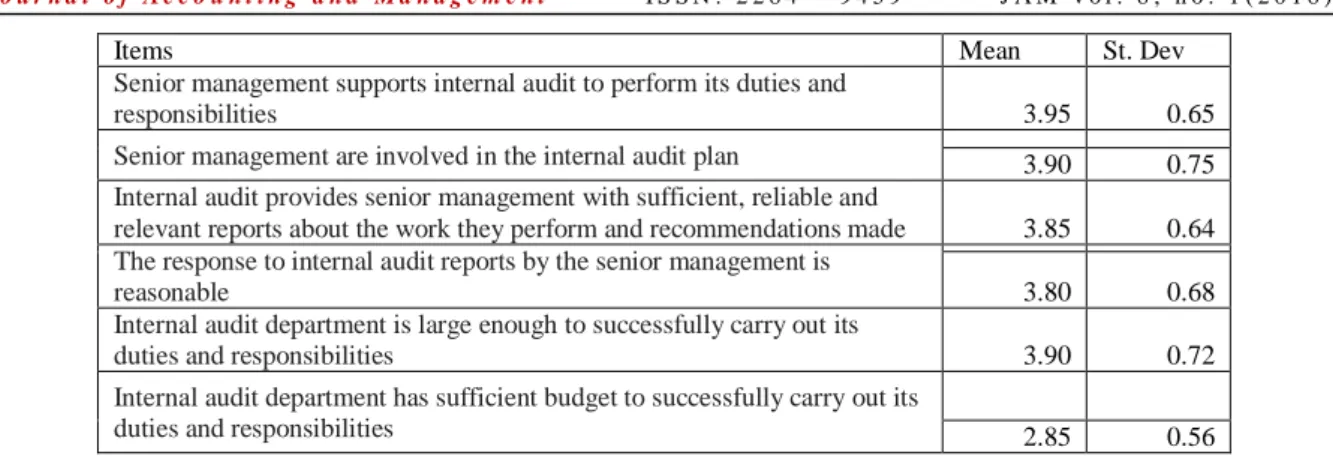
The total average score showing the extent of management support for internal audit function is 3.37. The result shows that internal audit function of the sampled organization has good support from management for their work. The variable with the highest mean score is 3.95 which states that management support internal audit staffs in the performance of their duties and responsibilities. The responses with the least mean (2.85) which relates to the question on whether internal audit function have the needed budgetary support to carry out their mandate.
Table 5. Internal audit effectiveness
Items Mean St. Dev
Internal audit improves organizational performance 3.12 0.68
Internal audit reviews organizational programmes to determine whether results are consistent with objectives
and goals 3.25 0.71
Internal audit determines the adequacy and effectiveness of the firm’s internal control systems 4.25 0.35 Internal audit reviews the accuracy and reliability of financial reports 3.95 0.45 Internal audit reviews compliance with procedures, policies and plans as well as regulations 3.8 0.54 Internal audit reviews the firm’s compliance with laws and regulations 3.98 0.63 Internal audit reviews economical and effective use of the firm resources 2.95 0.78 Internal audit makes recommendations for the improvements of internal control systems 4.1 2.35
Internal audit improves organizational productivity 3.1 0.71
Internal audit develops appropriate annual audit plans 2.85 0.82
Internal audit recommendations are implemented timely 3.65 0.45
Internal audit provides adequate follow-ups to ensure that the right action is taken 3.45 0.59 Source: Field data, 2017
The effectiveness of internal audit showed an average mean score of 3.54. The variable with the highest mean score is 4.25 which relate to the statement that internal audit determines the adequacy and effectiveness of internal controls. This was followed by internal audit makes recommendations for the improvement of internal control systems. In the nutshell, all the questions that had direct relation with internal control systems had a higher mean score which is consistent with the core mandate of internal audit department.
Table 6. Reliability of independent and dependent variables
Variable No. of Items Cronbach’s Alpha
Independence of internal audit 7 0.722
Management support for internal audit 6 0.835
Relationship between internal and external auditors 9 0.731
Auditors competence 4 0.778
Internal Audit effectiveness 11 0.880
The Cronbach’s alpha was used to determine the extent to which the items under each variable are associated for which items are maximally correlated with one another and minimally correlated with
other variables. The results from table 5 show that the items reliability in measuring each variable is high.
4.3. Correlation Analysis
The study first used the Pearson correlation matrix to establish the relationship between the dependent variable of internal audit effectiveness (IAE) and the various variable of competence of internal audit department (IAD), size of internal audit department (SIZE), relationship between internal and external auditor (RELEX), management support for internal auditor (MSUP), and independence of internal auditor (IAD).
Table 7. Correlation matrix showing relationship between dependent and independents variables
IAE COMP SIZE RELEX MSUP IND
IAE 1 COMP 0.69** 1 SIZE 0.69** 0.52 1 RELEX 0.53** 0.45 0.19 1 MSUP 0.66** 0.47 0.48 0.4 1 IND 0.48* 0.25 0.26 0.21 0.38 1
*** Significant at 1%, **Significant at 5%, * significant at 10%
The results of the correlation analysis from table 7 shows that competence of internal audit department has a positive and significant relationship with internal audit effectiveness at a 5% significance level. This means that any negative factor that affected these factors will give a significant change in the effectiveness of internal audit department. The results is consistent with the findings of Baharud-din et al. (2014) and Alzeban & Gwillian (2014). Krisnamoorthy (2002) concluded that even though the competence of internal audit department is positive and significantly associated with internal audit effectiveness but the question as to which variable among internal audit competence have also come up which in their opinion, no attempt should be made to rank factors that determine competence of internal auditor unit.
The second variable, size of internal audit department is also positively associated with internal audit effectiveness at 5% significance level. The results suggest that more staff at the internal audit department of the organization ensures that they are able to perform their functions relating to monitoring and implementing internal controls.
The third variable the relationship between internal and external auditors also showed a positive and significant relationship with internal audit effectiveness (0.47) at 5% significance level. The results show that cordial relationship between internal and external auditors improves the effectiveness of the internal audit unit of the firm.
The fourth variable management support for internal audit department has a positive and significant association with internal audit effectiveness at 5% significance level. The coefficient of the variable is the highest with 0.66 suggesting that management support for a firm internal audit unit is very critical for its effectiveness in carrying out its mandate. The results corroborate with the findings of Baharud-din et al. (2014) who argued that management support for internal audit is the most important determinants of internal audit effectiveness.
The last variable independence of internal audit department is also positively associated with effectiveness of internal control unit at 10% significance level. The results suggest that internal audit department need its independence in order to be effective in carrying out its mandate.
4.4. Regression Analysis between Dependent Variable and Independent Variables Table 8. Regression Results
Variable Coefficient std. Error t-value
COMP 0.201* 0.074 2.702 SIZE 0.213*** 0.064 3.352 RELEX 0.116** 0.057 2.021 MSUP 0.262*** 0.075 3.507 IND 0.162** 0.074 2.197 CONST 0.551 0.265 2.082 R2 0.65 Adjusted R2 0.63 F 27378 P- value 0
*** Significant at 1%, **Significant at 5%, * significant at 10%
The regression results from the table 8 shows an adjusted R-square of 63% which suggest that the independent variables can explain 63% of the changes in the dependent variable. The probability of the F-statistic is also significant at 1% significance level meaning that the model is well fit.
The results from the regression analysis confirm the correlation analysis and shows that competence of internal audit department (COMP) is positively associated with internal audit effectiveness (IAE) at 10% significance level. Competence which was measured by qualification of internal auditors as well as working experience improves the perception of internal audit effectiveness. On the relationship between internal and external auditors (RELEX), the results show a positive and significant association with effectiveness of internal audit (IAE) at 5% significance level. The results show that internal auditors as well as management believe that a good relationship between internal and external auditors enhance internal audit effectiveness.
The size of internal audit department (SIZE) is positively associated with internal audit effectiveness at 1% significance level. The results support the argument that the higher the number of internal audit staff, the more effective the perception of internal audit in an organization.
The next variable management support for internal auditing (MSUP) revealed a positive relationship with internal audit effectiveness at 1% significance level. The results show that management support for internal audit function increases the perception of internal audit effectiveness among state-owned enterprises in Ghana.
The last variable independence of internal audit department (IND) also showed a positive association with internal audit effectiveness (IAE) at 5% significance level. The results support the view that the independence of internal audit department is critical for the effective workings of internal audit department.
Overall, the results support hypothesis H1 TO H5 which argues for a positive significant relationship between the independent variables and internal audit effectiveness.
4.5. Discussion of Findings on Factors That Influence Internal Audit Effectiveness
The correlation and regression results confirms hypothesis one which argues that there is greater competence of internal audit staff (COMP) is related to higher perception of internal audit effectiveness among state-owned enterprises in Ghana. Competency is the ability of an individual t o perform a job or task properly, being a set of defined knowledge, skills and behaviour. In order to achieve competency, various types of training and development should be provided to internal
auditors. A competent internal auditor will have all the skill necessary to produce a good audit report. The result is consistent with the finding in previous studies in other jurisdiction (Baharud-din et al., 2014; Alzeban & Gwillian, 2014; IIA, 2006; Al-twaijry et al., 2004; Krishnamoorthy, 2002). The results also confirms argument by standard setters that the competence of internal audit staff who have the required knowledge and skills as well as experience enhances the effectiveness of internal auditing in any organization. The result also confirms the fact that the effectiveness of internal audit function and process depend largely on the competence and know-how of internal audit personnel in the organization. The result supports hypothesis H1 and this indicates that when heads of internal auditors and their staff who involve in the internal audit activities collectively possess the necessary educational background, knowledge, skills, training and supervision, they will be more likely to conduct their internal audit activities properly.
The results also revealed that the size of internal audit function contributes significantly towards internal audit effectiveness. This result supports hypothesis H2 and is the second highest contributor to internal audit effectiveness among state-owned enterprises in Ghana. The result is consistent with previous studies by Gronewold and Heerlein (2009) and Sarens and Abdolmohammadi (2007). The finding indicates a positive relationship between internal audit size and internal audit effectiveness, suggesting internal auditing as an important monitoring mechanism in reducing internal agency problems. The result is also consistent with the findings of other previous studies on these two variables (Alzeban & Gwillian; 2014; Ahmad et al., 2009). Other studies have reported that inadequate staffing at internal audit unit of various organizations affected their ability to deliver on their core mandate (Mihret & Woldeyohannis, 2008; Mulugeta, 2008; Bierley et al., 2003). The results confirms the assertion that internal audit unit of any organization should be maintained with adequate staff to ensure they are able to properly monitor and review internal control system and their effectiveness. The next variable (RELEX) which examined the perception of respondents with regards to the relationship between internal and external auditors in internal audit effectiveness also showed a positive and significant association and confirms hypothesis H3. Brierley et al., (2001) had identified the absence of collaboration between internal and external auditors as a major limiting factor affecting the efficiency and effectiveness of internal audit function in the public sector.
The results show that greater coordination between internal and external auditors will improve the effectiveness of internal audit function state-owned enterprises in Ghana. This implies that coordination between internal and external auditing work is essential because it can ensure adequate coverage, reduce duplication of work and it will assist internal auditors in their planning of future internal audit work. The researchers emphasized that the success of the audit as a whole is dependent on the collaboration of the internal and external auditors. The greater the level of trust and respect between both parties, the greater the amount of reliance the external auditors can place on the internal audit department. The result is also consistent with the results of Alzeban & Gwillian; (2014) on Saudi public sector.
The next variable (MSUP) management support for internal audit function was the most significant contributor to internal audit effectiveness and consistent with previous studies like Alzeban & Gwillian; (2014) and Alzeban and Sawan (2013) who all reported MSUP as the most significant contributor to internal audit effectiveness. The result also confirms hypothesis H4 which states that management support is associated with higher perception of internal audit effectiveness. Management support is the most influencing factor among the factors that contribute to the variation of quality audit work and this obviously crucial factor to the effective internal audit function (Baharud-din et al.,
2014). The finding is consistent with Cohen & Sayag (2010) who found that the support of management is the most crucial to the operation and success of internal auditing. It may even be that all the other determinants of internal audit effectiveness are derived from the support of top management, given that hiring proficient internal audit staffs, developing career channels for internal audit staff, and providing organisational independence for internal audit work are all results of decisions made by top management. Collaboration of internal auditors with managers in addressing problems and threats is crucial to improve business processes, efficiency and effectiveness because critical issues can be solved in a timely manner (Arena et al., 2006).
The last variable independence of internal audit function was positively associated with internal audit effectiveness and confirms hypothesis H5. For both external and internal auditors, their independence from those whom they audit is crucial for the success of their function. For internal auditors, it is more difficult to achieve independence because they are actually “employees of the organization” they audit (Ali et al., 2007). The result shows that internal auditors need their independence from management to be able to carry out their work effectively. The independence of internal auditors is usually difficult to determine as they are internal employees of the organization. However, the results of this study as well as previous studies (Alzeban & Gwillian, 2014; of Brierly et al., 2003) shows that the independence of internal audit function is necessary for the effective running of internal audit function. The independence of internal auditor affects the internal audit effectiveness as the auditors face dilemma on whether being independent and objective in doing their duty although they might face problems with the management of the organization.
The internal auditor effectiveness is very much affected by the independence of internal auditors. If the internal auditors were not independent, the report they produce will be biased which in turn is useless in improving the accountability and transparency of the public sector as a whole. The objective and independent report produced by the internal auditor is one of the main keys to prevent scandals and frauds happening in the public sector especially state-owned enterprise who enjoy some autonomy in their operations.
5. Conclusion
This study explores internal and external factors influencing effectiveness of internal audit effectiveness among state-owned enterprises in Ghana. The findings of the study reveal that independence of internal audit department, competency of internal audit staff, size of internal audit department, coordination between internal and external auditors and top management support for internal audit work have positive influence on effectiveness of internal audit. Other factors such as competence level of internal audit staff positively affected internal audit effectiveness. As such, it is essential for related parties especially the management to focus on the important factors so that effectiveness of internal audit will be accomplished. This is because improvement in effectiveness of internal auditing is crucial in improving the monitoring and supervision of financial management of state-owned enterprises in Ghana. The findings from this research were supported by the earlier studies such as Zulkifli Baharuddin (2014); Sayag (2010); George et al. (2015); Alzeban & Gwilliam (2014); Angus Okechukwa Unegbu and Mohamad Isa Kida (2011) as far as the Competency of internal auditors is concern. These researchers found that internal auditors can effectively carry out their duties if there are enough internal auditors who possess the required competencies. In terms of management support to internal auditors, again Zulkifli Baharuddin (2014) and Sayag (2010) share the
similar findings with this study. Both researchers found that management support is most crucial to the operation and success of internal audit. George et al. (2015) and Alzeban & Gwilliam (2014) also argued that there is positive associated between management supports and internal audit effectiveness. As for the Independence of the internal auditors, previous studies such as Sayag (2010); George et al. (2015); Alzeban & Gwilliam (2014) and Zulkifli (2014) support this study’s findings. For example, Sayag (2010) found that “Greater organizational independence will be related to auditing effectiveness”. Meanwhile, Zulkifli (2014) supports the statement that independence and objectivity are closely related to internal audit effectiveness.
The findings provide information that is potentially helpful to auditing profession, management, audit committees/boards of directors and regulatory bodies in identifying the key factors that contribute to the improvement of the effectiveness of internal audit. Given the importance of internal audit in the corporate governance, it is interesting to examine, in future researches, the impact of other mechanisms of corporate governance on the internal audit effectiveness such as the audit committee, external audit and ownership structure. Furthermore, future research could use larger sample size and design a scale for measuring the effectiveness of internal auditing.
References
Ahmad, N.; Othman, R.; Othman, R. & Jusoff, K. (2009). The effectiveness of internal audit in Malaysian public sector.
Journal of Modern Accounting and Auditing, 5(9), p. 53.
Al-Akra, M.; Abdel-Qader, W. & Billah, M. (2016). Internal auditing in the Middle East and North Africa: A literature review. Journal of International Accounting, Auditing and Taxation, 26, pp. 13-27.
Ali, A.M.; Gloeck, J.D.; Ali, A.; Ahmi, A. & Sahdan, M.H. (2007). Internal audit in the state and local governments of Malaysia. Southern African Journal of Accountability and Auditing Research, 7(1), pp. 25-57.
Al-Twaijry, A.A.; Brierley, J.A. & Gwilliam, D.R. (2004). An examination of the relationship between internal and external audit in the Saudi Arabian corporate sector. Managerial Auditing Journal, 19(7), pp. 929-944.
Alzeban, A. & Gwilliam, D. (2014). Factors affecting the internal audit effectiveness: A survey of the Saudi public sector.
Journal of International Accounting, Auditing and Taxation, 23(2), pp. 74-86.
Alzeban, A. & Sawan, N. (2013). The role of internal audit function in the public sector context in Saudi Arabia. African Journal of Business Management, 7(6), p. 443.
Ankarah, L.M. (2016). The role of internal audit regime in Ghana: towards improved governance and accountability, International Conference on Management, Communication and Technology (ICMCT) May.
Arena, M. & Azzone, G. (2009). Identifying organizational drivers of internal audit effectiveness. International Journal of Auditing, 13(1), pp. 43-60.
Arena, M.; Arnaboldi, M. & Azzone, G. (2006). Internal audit in Italian organizations: A multiple case study. Managerial Auditing Journal, 21(3), pp. 275-292.
Asare, T. (2009). Internal auditing in the public sector: Promoting good governance and performance improvement.
International Journal on Governmental Financial Management, 9(1), pp. 15-28.
Baharud-din, Z.; Shokiyah, A. & Ibrahim, M.S. (2014). Factors that contribute to the effectiveness of internal audit in public sector. International Proceedings of Economics Development and Research, 70, p. 126.
Baharud-din, Z.; Shokiyah, A. & Ibrahim, M.S. (2014). Factors that contribute to the effectiveness of internal audit in public sector. International Proceedings of Economics Development and Research, 70, p. 126.
Brierley, J.A., El; Nafabi, H.M., & Gwilliam, D.R. (2001). The problems of establishing internal audit in the Sudanese public sector. International Journal of Auditing, 5(1), pp. 73-87.
Cohen, A. & Sayag, G. (2010). The effectiveness of internal auditing: an empirical examination of its determinants in Israeli organisations. Australian Accounting Review, 20(3), pp. 296-307.
Daniela, P. & Attila, T. (2013). Internal audit versus internal control and coaching. Procedia Economics and Finance, 6, pp. 694-702.
Dellai, H. & Omri, M.A.B. (2016). Factors affecting the internal audit effectiveness in Tunisian organizations. Research Journal of Finance and Accounting, 7(16), pp. 208-211.
Dittenhofer, M. (2001). Internal auditing effectiveness: an expansion of present methods. Managerial Auditing Journal, 16(8), pp. 443-450.
Fama, E.F. & Jensen, M.C. (1983). Separation of ownership and control. The journal of law and Economics, 26(2), pp. 301-325.
Felix Jr, W.L. & Gramling, A.A. (2001). The contribution of internal audit as a determinant of external audit fees and factors influencing this contribution. Journal of Accounting Research, 39(3), pp. 513-534.
Frigo, M.L. (2002). A balanced scorecard framework for internal auditing departments. Institute of Internal Auditors Research Foundation.
Getie Mihret, D. & Zemenu Woldeyohannis, G. (2008). Value-added role of internal audit: an Ethiopian case study.
Managerial Auditing Journal, 23(6), pp. 567-595.
Gronewold, U. & Heerlein, A. (2009). The staff capacity of the internal audit function of German corporations. In midyear meeting of the auditing section of the American accounting association.
Hanim Fadzil, F.; Haron, H. & Jantan, M. (2005). Internal auditing practices and internal control system. Managerial Auditing Journal, 20(8), 844-866.
Haron, H.; Daing Nasir Ibrahim, D.; Jeyaraman, K. & Hock Chye, O. (2010). Determinants of internal control characteristics influencing voluntary and mandatory disclosures: A Malaysian perspective. Managerial Auditing Journal, 25(2), pp. 140-159.
Hung, J.H. & Han, H.L. (1998). An empirical study on effectiveness of internal auditing for listed firms in Taiwan. Retrieved November 4, 2016, fromhttp://ww w3. bus. osaka-cu. ac. jp/apira98/archives/pd. Internal Institute of Auditing.
Institute of Internal Auditors (IIA). (1999). Definition of Internal Auditing, Online. Available.
Lenz, R. & Hahn, U. (2015). A synthesis of empirical internal audit effectiveness literature pointing to new research opportunities. Managerial Auditing Journal, 30(1), pp. 5-33.
Maletta, M.J. (1993). An examination of auditors' decisions to use internal auditors as assistants: The effect of inherent risk.
Contemporary Accounting Research, 9(2), pp. 508-525.
Mihret, G. D., & Yismaw, W. A. (2007). Internal audit effectiveness: an Ethiopian public sector case study. Managerial Auditing Journal, 22(5), pp. 470-484.
Mulugeta, S. & Gebrehiwot, G. (2008). Internal audit: reporting relationship in Ethiopian public enterprises. Doctoral dissertation, M. Sc. Dissertation.
Mutchler, J.F. (2003). Independence and objectivity: a framework for research opportunities in internal auditing. Research Opportunities in Internal Auditing, pp. 231-268.
Onumah, J.M. & Yao Krah, R. (2012). Barriers and catalysts to effective internal audit in the Ghanaian public sector. In
Accounting in Africa. Emerald Group Publishing Limited, pp. 177-207.
Sarens, G. (2007, April). The agency model as a predictor of the size of the internal audit function in Belgian companies. In
Presentation at the 30th Annual Conference of the European Accounting Association, Lisbon, pp. 25-27.
Sarens, G. (2009). Internal auditing research: Where are we going? Editorial. International Journal of Auditing, 13(1), pp. 1-7.
Shamsuddin, A. (2014). Factors that determine the effectiveness of internal audit functions in the malaysian public sectors.
Soh, D.S. & Martinov-Bennie, N. (2011). The internal audit function: Perceptions of internal audit roles, effectiveness and evaluation. Managerial Auditing Journal, 26(7), pp. 605-622.
Spira, L.F. & Page, M. (2003). Risk management: The reinvention of internal control and the changing role of internal audit.
Accounting, Auditing & Accountability Journal, 16(4), pp. 640-661.
Spraakman, G. (1997). Transaction cost economics: a theory for internal audit? Managerial auditing journal, 12(7), pp. 323-330.
Van der Schyf, D.B. (2000). Obstacles in establishing and operating a public sector internal auditing function in a developing country: The South African experience. Meditari: Research Journal of the School of Accounting Sciences, 8(1), pp. 145-181.
Van Gansberghe, C.N. (2005). Internal auditing in the public sector: a consultative forum in Nairobi, Kenya, shores up best practices for government audit professionals in developing nations. Internal Auditor, 62(4), pp. 69-74.
Xiangdong, W. (1997). Development trends and future prospects of internal audit. Managerial Auditing Journal, 12(4/5), pp. 200-204.