Modeling for part-based visual object
detection based on local features
Von der Fakult¨at f¨ur Elektrotechnik und Informationstechnik
der Rheinisch-Westf¨alischen Technischen Hochschule Aachen
zur Erlangung des akademischen Grades eines Doktors
der Ingenieurwissenschaften genehmigte Dissertation
vorgelegt von
Diplom-Ingenieur
Mark Asbach
aus Neuss
Berichter:
Univ.-Prof. Dr.-Ing. Jens-Rainer Ohm
Univ.-Prof. Dr.-Ing. Til Aach
Tag der m¨undlichen Pr¨ufung: 28. September 2011
Diese Dissertation ist auf den Internetseiten der
Shaker Verlag
Aachen 2011
Aachen Series on Multimedia and Communications Engineering
Volume 8
Mark Asbach
Modeling for part-based visual object detection
based on local features
The Deutsche Nationalbibliothek lists this publication in the Deutsche Nationalbibliografie; detailed bibliographic data are available in the Internet at http://dnb.d-nb.de.
Zugl.: D 82 (Diss. RWTH Aachen University, 2011)
Copyright Shaker Verlag 2011
All rights reserved. No part of this publication may be reproduced, stored in a retrieval system, or transmitted, in any form or by any means, electronic, mechanical, photocopying, recording or otherwise, without the prior permission of the publishers.
Printed in Germany. ISBN 978-3-8440-0581-3 ISSN 1614-7782
Shaker Verlag GmbH P.O. BOX 101818 D-52018 Aachen Phone: 0049/2407/9596-0 Telefax: 0049/2407/9596-9 Internet: www.shaker.de e-mail: [email protected]
vii
Acknowledgements
Few dissertations have been written by eremites contemplating a scientific subject solely on their own, and certainly this book is not one of those rare exceptions. Over the last years I had the opportunity to meet great people with great ideas that profoundly influenced and sharpened my grasp of computer vision and machine learning problems. Moreover I have collected significant debts during the writing of this thesis, that I want to acknowledge here.
First of all, I would like to thank everyone at the Institute of Communications Engineering—and in particular my supervisor Prof. Dr.-Ing. Jens-Rainer Ohm—for the open, supportive and friendly atmosphere. You have made this work possible. Additional thanks go to the many friends who discussed the diverse aspects of my research with me, debated science and life in general, and who encouraged me to keep going all the way through. Finally, I want to express my gratitude to my colleagues at Fraunhofer IAIS for inspirational talks and discussions.
No matter how much effort put into it, this work will doubtlessly contain flaws, omissions and over-simplifications, that I take full responsibility for. Still, I hope that the presented thoughts and experiments might serve as a little piece of jigsaw in the understanding of object detection.
Contents
1 Introduction 1
1.1 The need for object detection . . . 1
1.2 Motivation for part-based approaches . . . 2
1.2.1 Effects of deformation and pose variation . . . 2
1.2.2 Biological motivation . . . 3
1.3 Research question . . . 4
1.4 Contribution of this thesis . . . 4
1.4.1 Semi-supervised identification of the object parts . . . 5
1.4.2 Generic feature extraction . . . 5
1.5 Organization of this thesis . . . 6
2 State of the art 7 2.1 What is object detection? . . . 7
2.2 Performance measures for object detection . . . 7
2.3 Object detection algorithms . . . 9
2.3.1 Segmentation-based approaches . . . 10
2.3.2 The sliding window approach . . . 11
2.3.3 Historical examples of the sliding window approach . . . 12
2.3.4 Boosted cascade of simple features . . . 12
2.3.5 Part-based approaches . . . 13
2.4 Local image features . . . 16
2.5 Performance evaluation of face detection algorithms . . . 18
2.5.1 Evaluation data for part-based approaches . . . 21
2.5.2 Databases used here . . . 22
3 Part-based object detection using local image features 24 3.1 Image model . . . 26
3.2 Object model . . . 28
3.2.1 Local appearance classification . . . 29
3.2.2 Generation of object hypotheses from parts . . . 30
3.2.3 Geometry classification . . . 33
4 Application to human faces 37 4.1 Dataset preparation . . . 38
4.2 Deriving object parts . . . 41
4.2.1 Sensitivity to object features . . . 41
4.2.2 Distribution of feature locations . . . 43
Contents ix
4.3 Learning local appearance . . . 48
4.3.1 Estimation of achievable classifier performance . . . 50
4.3.2 Training setup for boosted cascades . . . 52
4.3.3 Classifier performance on training set . . . 54
4.4 Learning geometry . . . 56
4.4.1 Finding the transformation matrix . . . 56
4.4.2 Verifying the model on the training set . . . 58
4.4.3 Finding optimum thresholds . . . 59
4.5 Performance on training set . . . 60
4.5.1 Number of parts per model . . . 60
4.5.2 Number of Gaussian mixture components . . . 61
4.5.3 Number of parts per constellation . . . 61
5 Experimental validation 64 5.1 Results on the BioID database . . . 65
5.2 Results on the AR face database . . . 66
5.2.1 Results on artificially occluded faces . . . 66
5.2.2 Results on faces occluded by sunglasses or scarfs . . . 68
5.3 Results on the MPEG-7 VCE dataset . . . 69
5.4 Influence of the error measure . . . 69
5.5 Discussion . . . 72 6 Conclusion 75 6.1 Summary . . . 75 6.2 Conclusions . . . 76 6.3 Outlook . . . 77 A Databases 79 A.1 AR face database . . . 79
A.1.1 Downloaded archives . . . 80
A.1.2 Duplicate images . . . 80
A.1.3 Missing images . . . 81
A.2 BioID database . . . 81
A.2.1 Downloaded archives . . . 82
A.3 MPEG-7 VCE dataset . . . 83
A.3.1 Downloaded data . . . 83
Glossary 87
Acronyms 89
Bibliography 91
1
Chapter 1
Introduction
1.1 The need for object detection
Content-based search and retrieval are still unsolved problems for multimedia data. As opposed to textual information, no generic methods exist to directly search audio and video content. Multimedia search engines and asset management systems rely to a large extent on textual queries requiring that all data is already annotated. The problem with textual annotations is that at the time on annotation, the subsequent queries are unknown, so that an annotator oftentimes produces descriptions that do not fit to the queries issued later on. Searches fail if a query term has not been added to the annotation because the annotator used a synonym instead. They fail in the opposite way if the same term has been applied with a semantically different meaning. This typically happens with homographs like “tire” or “desert”. While it is possible to represent synonyms and homographic heteronyms with ontology database, they only shift the underlying problem from annotation to ontology creation: the requirements of all subsequent queries have to be predicted at the time of ontology creation. Instead, direct processing of non-textual content should allow for more comprehensive as well as more accurate results than relying on annotations.
Today, computer vision and image understanding are still restricted to either very basic characteristics of media—color histograms, motion activity, etc.—or tailored to special domains like visual inspection of specific products. The lack of general methods to deduce meaningful (high-level) properties from low-level visual features is called the“semantic gap”. Object detection is one of the most promising ways to bridge this gap, but it has to be freed from restrictions in terms of media properties and object types.
In recent years, object detection algorithms have already become robust to variations regarding lighting and scale of the depicted objects. Still algorithms are needed that are resilient to varying pose, geometric deformation, and occlusion. A promising approach is based on splitting objects into smaller parts that are considered rigid themselves, while allowing for variation in geometric arrangement. Suchpart-based object detectionrequires to identify useful parts, to describe their appearance, and to model their arrangement. Face detection is an instructive test case for object detection algorithms, because human faces form an object class that has two important properties: a) There is significant
variability between individual faces, partially resulting from deformation. b) Humans excel at recognizing faces, so the results of detection algorithms can be easily judged.
1.2 Motivation for part-based approaches
Part-based object detection offers good prospects for typical object detection problems. A direct motivation is the way occlusion effects holistic and part-based object detectors. Images of natural scenes oftentimes contain objects that are not fully visible, because they are partially covered by other objects. Also, objects are sometimes cropped at the image boundary. Figure 1.1 shows an example from the UIUC Image Database for Car Detection [Agarwal et al., 2004] that contains cropped cars and cars partially occluded by a parking meter. The author’s personal photo collection contains typical examples of faces occluded partially by sunglasses, hands, or other people.
(a)UIUC cars database (b)The author’s personal photo collection
Figure 1.1:Examples for occluded or cropped objects
Holistic approaches cannot detect an object, if a certain fraction of the object area is occluded or has been cropped away. The holistic object detection process works by rating the similarity of an image region to a learned template. It cannot distinguish a missing or occluded object part from a dissimilarity of the whole region to the template, because it has no information on the locality of a dissimilarity inside the region under considera-tion. In contrast, part-based object detection approaches evaluate the similarity of image regions to each part of the object separately and are able to detect the associated object, as long as at least one part is fully visible in the image.
1.2.1 Effects of deformation and pose variation
Another reason for applying part-based object detection methods originates from the observation that most deformed objects still can be decomposed into largely rigid parts that show fewer deformation. Not only does this observation hold true for images of objects that are actually deformed in the real world, but it also applies to rigid 3D objects whoseimages are deformed by perspective transformation onto the 2D image plane, i.e., objects depicted in a different pose.
Figure 1.2 illustrates this effect with two images of the same person, one with an upright, frontal face, and one with the head put back. The facial area of the upright face is nearly
1.2 Motivation for part-based approaches 3
(a)frontal face (b)perspective distortion
Figure 1.2:Example for scale dependent effect of deformation (personal photo collection)
square, while for the perspective distortion, it is vertically compressed—to holistic clas-sification algorithms, these two faces look very different. Accordingly, a holistic detector trained for one pose would not detect the other one.
If we zoom into the object and compare eye regions only, perspective deformation is hardly noticed so both regions can be rigidly registered. Further zooming into the cor-ner of the eye increases the effect. These local structures are more stable under defor-mation and pose variation, an insight that led to the development of local image fea-ture detectors. They have been successfully applied to wide-baseline stereo matching—a field of research that prominently deals with problems of deformation and pose variation [Tuytelaars and Van Gool, 2000].
1.2.2 Biological motivation
Humans are able to detect objects in images with a high degree of occlusion. Also, biological vision systems are tolerant to deformations. Both observations can be explained by the hypothesis that the human visual system relies to some extent on part-based object detection schemes. A recent publication in the field of cognitive neuroscience shows evidence for this assumption [Sagiv and Bentin, 2001].
Sagiv and Bentin conclude that sketches and schematic drawings of faces might be detected only because of part-based mechanisms. These part-based mechanisms typically also apply to real, i.e., photographically realistic faces, when holistic processing fails1, for example, on faces turned upside-down. This suggests that machine vision might also benefit from part-based approaches.
1To be exact, Sagiv and Bentin state that holistic face processing—when successful—preempts
process-ing of facial parts in the human brain. In other words: processprocess-ing of object parts is probably done always, but slower and overruled if holistic detection results spring up earlier.
1.3 Research question
The current state of the art in object detection and especially face detection still is a holistic method, known as the “boosted cascade of Haar-like features” approach. It is computationally efficient and achieves high detection rates on natural images. However, it is not able to detect objects under considerable pose variation, deformation, or occlusion. Many authors believe that part-based object detection could overcome this limitation and therefore, several part-based approaches have been proposed in the literature. Unfortu-nately, the published detection rates of these part-based methods do not clearly exceed those of the best holistic approaches.
A potential reason for this discrepancy between the expected advantages of part-based ob-ject detection and lower detection rates is the fact, that no closed-form solution exists that allows to algorithmically derive the decomposition of an object into its parts. Currently, algorithm designers have to specify the number, locations, and extents of object parts. Because no measure exists to quantify the appropriateness of a chosen decomposition for a given object class, manually generated object models might patently be sub-optimal. In this thesis, the question is investigated, how the parts of a part-based object detector can be automatically inferred and if a part-based object detector derived this way is able to achieve detection rates that can compete with the current state of the art in holistic object detection.
1.4 Contribution of this thesis
As the previous sections explained, there are good reasons to assume that part-based object detection approaches could overcome the limitations of holistic algorithms. On the downside, no analytical method exists so far, to identify the parts of a part-based object model.
This thesis introduces a novel method to derive part-based object models solely from training data and evaluates it on the example of human faces. The method discussed here automatically establishes the number as well as the locations and extents of the object parts from sample images. This is possible by employing a semi-supervised machine learning technique on local image features to detect clusters of feature locations that are subsequently used as parts of the object model.
Local image features allow for a sparse description of image contents and have been suc-cessfully used for wide-baseline stereo matching, image categorization, and object tracking. In addition to enabling automatic identification of model parts, local image features allow for two unique properties of the resulting part-based object models:
• The object detection process can be split into an initial, generic, and a subsequent, object-specific, part.
• When the same image data is searched for multiple, different objects, the results of the generic step can be reused, reducing computational load.
1.4 Contribution of this thesis 5
1.4.1 Semi-supervised identification of the object parts
Current state of the art object detectors rely on machine learning algorithms that are trained on a set of positive examples depicting the object plus negative examples to be distinguished from. A human operator marks the actual objects on the positive images, typically by specifying bounding boxes. Afterwards, an algorithm identifies the visual features that discriminate image areascontainingthe object from areas that do not. This is a common procedure to train machine learning algorithms and is directly implemented by sliding window approach, a typicalholisticobject detection method.
Part-based object detection concepts described in the literature, however, require addi-tional human knowledge: a designer makes a decision about number and locations of the object parts. Instead of just marking the object area, all parts must be explicitly labeled in the training data. This not only increases the amount of manual preparation before an object detector can be trained, it also requires that the human designer knows the optimal decomposition. This thesis introduces a method to deduce the number of parts, their locations, extents, and orientations by unsupervised learning on the basis of training data. As with holistic object detection approaches, a human operator only has to mark a bounding box in the training data.
In case of a non-rigid object class (i.e., objects that exhibit deformation), the proposed method compensates for deformation by using additional control points on the training data. These control points do not mark the object parts, they just serve as the vertices of a polygon mesh used for normalization. Since human intervention is needed to mark the control points on the training data, the model identification is not strictly unsupervised. Therefore, the author proposes to call it“semi-supervised”identification of object parts.
1.4.2 Generic feature extraction
In conventional object detection, a large part of the overall processing time is spent on image areas that actually do not contain the object that is searched for. To reduce processing time, it is of prime importance to discard image regions early that certainly do not contain the object. More processing power can be spent on ambiguous image areas. This can be achieved by using a cascade of classifiers in which each stage rejects a certain fraction of image areas that cannot contain the object for sure while the rest proceeds to the next stage. Only areas containing the object therefore have to pass all stages. In this thesis, such a cascaded classifier is trained for each object part that has been identified by semi-supervised learning. In the literature, classifier stages are trained one after another by bootstrapping. Our novel idea is to understandlocal feature extraction
as the first classifier stage of a cascade: the saliency of local image regions is used to discard all image regions that contain little structure. Regions with high saliency are kept as regions of interest (ROIs) and can be seen as the output of a first,generic classifier stage.
Because the local feature detection is not object specific, its output can be reused when the same image data is searched for different object types. It also allows splitting the object detection task between two parties, one that has access to the image data and can
extract the generic local image features, and one that has access to a specifically trained object detector, receiving only the ROIs as input, but not the original images. This opens up new fields of application, for example in cases where business models prohibit sharing image contents between a content owner and a second party providing search and retrieval services.
1.5 Organization of this thesis
This thesis is organized as follows: first some fundamental definitions are given and the current state of the art is described in chapter 2. Based on the introduced algorithms, chapter 3 shows how part-based models can be used for object detection using local image features. The proposed method is then used in chapter 4 to identify the number, locations and extents of local image features that best describe human faces. A resulting part-based object detector is thoroughly evaluated in chapter 5 and compared to the state of the art in face detection. Finally, chapter 6 gives a summary and a conclusion.
7
Chapter 2
State of the art
This chapter introduces definitions and basic ideas in computer vision, machine learning, and their application to object detection. Its purpose is not only to describe the starting point for the design of the object detection algorithm proposed in the following chapters, but also to introduce technical terms used in this thesis. Basic principles are not ex-plained in detail—for in-depth discussion the reader is referred to the relevant textbooks [Bishop, 2006, Duda et al., 2001].
2.1 What is object detection?
The author proposes the following definition that is used throughout this thesis:
Object detection is a process that extracts from a single, two-dimensional image a list of all objects of a given class and provides their spatial arrangement.
This definition is imprecise in that it does not define what exactly a spatial arrangement is. A simple algorithm might only be able to deduce coarse locations and sizes of up-right rectangles (bounding boxes) that contain the individual objects. More sophisticated algorithms provide information on the exact object boundary, in-plane orientation, 3D orientation, or even a parametric description of an object’s geometry.
The definition given above is nevertheless precise in that it clearly states, what object detection is not. For example, if an algorithm relies on the a-priori assumption, that an image contains exactly one object, it does not perform object detection according to the definition given above. Its operation may be described as mere object localization. Object detection also must not be confused with object recognition, the latter denoting the discrimination between different instances or exemplars of the same object class.
2.2 Performance measures for object detection
The previous section qualitatively defined object detection. In practice, a quantitative measure is needed, to evaluatehow wellan algorithm solves an object detection problem. In the context of machine learning, the performance of an algorithm is assessed by man-ually annotating a dataset with expected results, called ground truth, and processing the dataset with the algorithm under consideration.
The algorithmically obtained results and the ground truth are juxtaposed, forming a con-fusion matrix. Figure 2.1 shows the concon-fusion matrix for a binary classification problem. The four entries of the confusion matrix are termed “true positives” (T P), “false positives” (F P), “true negatives” (T N), and “false negatives” (F N).
Hypothesized class Y N p n P N Column totals: True class False Positives True Positives True Negatives False Negatives
Figure 2.1:Confusion matrix for a binary classifier [Fawcett, 2006]
Sometimes, it is desired to derive a single measure summarizing all entries of the confusion matrix. The Machine Vision Glossary of Terms [Kohavi and Provost, 1998] mentions
accuracyand the so-calledF-measure/F1-scorethat are also found in Figure 2.1.
Usually, classification algorithms can be adjusted by means of a threshold to accommodate for the bias of the dataset (e.g., unequal number of positives and negatives) or the nature of the problem (cost of false positives vs. cost of false negatives). The full performance of an algorithm is therefore easier to understand if different points of operation are evalu-ated. It is a common practice to use receiver operating characteristics (receiver operating characteristics) graphs that plot true positive rate versus false positive rate spanning the entire range from minimum false positive rate—typically accompanied by a very low true positive rate—to maximum true positive rate that usually comes at the cost of a high false positive rate. A perfect classifier reaches a true positive rate of 1.0 with 0.0 false positive rate.
But ROC graphs do not fit the nature of object detection problems: If the number of negatives cannot be quantified, a problem is better described asretrieval problemthan as
classification problem. In object detection, there is an infinitely large number of locations (given sub-pixel coordinates) where no object is present in an image. Also, it can be assumed that the number of correct detections is very small compared to the number of tested samples. Both facts render ROC curves less useful for describing object detection. Thus, rather than calculating true positive rate vs. false positive rate, object detection results are better visualized by graphing precision versus recall [Davis and Goadrich, 2006, Manning et al., 2008]. A perfect object detector achieves a recall of 1.0 with 1.0 precision. When evaluating algorithm performance using any of the measures given above, it is crucial to ensure that the data used for testing does not contain samples that have been used for training the algorithm. This allows comparing the error made by a trained model on its training data (resubstitution error) with the error made on unknown data, in order
2.3 Object detection algorithms 9 to get an estimate of the generalization performance. Cross-validation is usually used as a best practice to implement this idea.
The following review of object detection algorithms from the literature reveals that many publications did not adhere to the evaluation best practices given above, which reduces the validity of many published performance results, especially for the part-based object detection algorithms described in subsection 2.3.5.
2.3 Object detection algorithms
Over time a multitude ways emerged to hierarchically categorize object detection algo-rithms [Yang et al., 2002, Hjelmas and Low, 2001]. Many categorizations have been ob-soleted by new object detection algorithms that did not fit into the old categories. Some category names have also been proven not to be very precise, with the result that differ-ent authors define iddiffer-entical category names with contradictory meanings. For example, the term “feature-based” is sometimes used to describe part-based approaches as opposed to holistic ones. In other publications it is used for derived image features likes edges or gradient histograms as against plain intensity values—both in the context of holistic object detection schemes. Other authors use it as an opposite to approaches based on the sliding window approach detailed in subsection 2.3.2. In this thesis, it is primarily used in the context of “local image features” that are described in section 2.4.
Because of such ambiguity in terms, nohierarchical categorization of object detection is given in this thesis. Instead, the following sections review algorithms sorted into three major groups, depending on the way how candidate regions for an object are identified in the image:
• segmentation-based approaches,
• approaches using the sliding window principle, • part-based approaches.
Independent from this coarse categorization, the following set of key properties is used to describe each object detection algorithm:
• Generality: Is the algorithm restricted to a certain type of objects, e.g., faces, or will it work on arbitrary object classes?
• Learning method: Is human knowledge exploited in the design phase or is the algo-rithm purely based on machine learning?
• Amount of training data: How many positive and negative samples are needed for training, if any?
• Detail of ground truth: What is the necessary detail of training data annotations? Some algorithms just need sample images containing the object type to learn some-wherein the area, some need rectangular bounding boxes around the training sam-ples, some need detailed meshes marking subregions, and others need 3D models.
2.3.1 Segmentation-based approaches
Segmentation-based object detection methods calculate the likelihood, that the a given pixel belongs to the object searched for. The resulting probability density map is seg-mented and regions with a sufficiently high probability density are chosen as candidates for the object area (Figure 2.2).
Figure 2.2:Luminance component (left), skin probability map (center) and results of binary segmentation (right) [Menser and Wien, 2000]
The pixel-wise likelihood is typically deduced from color or texture and can be learned by supervised machine learning approaches or defined as an analytical formula. Examples for this approach are skin color models for face detection: Menser and Wien deduce the color model from the spectral reflectance of hemoglobin, analytically modeled as Gaussian distribution in an appropriate color space [Menser and Wien, 2000]. A mixture of Gaussians can as well be exploited and combined with the knowledge that eyes and the mouth are not skin-colored [Hsu et al., 2002]. This method only needs positive samples of skin-colored pixels to learn mean and variance of the Gaussian.
Alternative methods rely on histogram back-propagation, learned from example regions [Bradski, 1998]. Histogram-based approaches are not restricted to skin color and have also been used to detect and track balls in robot soccer or body parts [Allen et al., 2004]. Typically, positive and negative sample regions are needed, but the number of training samples is generally moderate.
Segmentation-based approaches do not exploit structural information present in the image. Therefore, they are inherently tolerant to rotation, scale and deformation. The drawback, however, is that not all sources of information are exploited, which has an impact on detection performance. Skin color for example does not solely exist on facial areas. The discrimination between faces and other body parts like hands has to be based on the shape of the extracted segments [Menser, 2003].
Menser shows that, for the same reason, segmentation-based approaches often fail if mul-tiple objects overlap and blend into one big segment in the probability density map. Because of their moderate detection performance, segmentation-based approaches have been superseded with the sliding-window principle, which will be discussed in the follow-ing section.
2.3 Object detection algorithms 11
2.3.2 The sliding window approach
Instead of calculating the probability of a single pixel belonging to an object area, an object detection algorithm can examine the probability that a region under consideration depicts a complete object. Such a detector has to invoke a classifier on all possible object positions in the given image, consequently scanning it in the case of non-parallel processing.
To make provision for varying object sizes, this full search for object positions is extended to an image pyramid (see Figure 2.3). Rotation invariance usually requires rotated versions of the pyramid or the classifier. To establish deformation tolerance or allow for out-of-plane rotation, even more variants of the classifier must be applied.
384 x 286
320 x 238
266 x 198
Figure 2.3:A rectangular classifier of fixed size is shifted step by step over an image taken from the BioID database [BioID GmbH, 2009]. Then the image is scaled down by a given factor and the process is repeated.
The sliding window approach can be tuned by adjusting the step size in the discrete sam-pling of position, size and rotation. A large step size requires a classifier that is tolerant to small misalignments, because an object might not be sampled at the perfect position. Small step size, on the other hand, dramatically increases the number of classifier invo-cations and raises the probability of double detections where multiple adjacent loinvo-cations, scales or orientations trigger a positive classification. Table 2.1 gives an impression of the number of sampling positions for a typical image from a webcam scenario.
Scale Pixels Invocations
0 1 2 … 11 Total 1.0 384 x 286 22352 1.2 320 x 238 14832 1.44 266 x 198 9711 … … … 7.43 50 x 37 18 62550
Table 2.1:Number of classifier invocations for an image pyramid with the scale factor 1.2, a classifier of 32×32 pixels and a step size of 2 pixels.
2.3.3 Historical examples of the sliding window approach
Sliding window approaches differ significantly in the design of the actual classifier used. A simplistic approach might solely compare the gray values of a given region to an aver-age facial region (a so called “template”) or to a couple of samples. Unfortunately, this approach is sensitive to misaligned regions. Exploiting the correlations between all pixels of a face region remedies this to some extent. One of the first approaches to model these facial statistics was the Eigenface method [Turk and Pentland, 1991]. Using a set of face samples, it learns a subspace-projection matrix by principal component analysis (principal component analysis). Candidate regions are projected into the lower dimensional “face space” before being fed to an actual classifier.
Based upon this work, Zhao et al. proposed to combine PCA with linear discriminant analysis (linear discriminant analysis), which is able to identify PCA dimensions that are statistically significant for the discrimination between faces and non-faces or even different persons [Zhao et al., 1998]. The combination of PCA and LDA for face detection has been named “Fisherfacesmethod” by other authors, because precisely, Zhao et al. use Fisher discriminants, an enhanced version of LDA. The method is primarily applied to face recognition while it still can be used as a more stable detection algorithm.
Approaches on the basis of templates, Eigenfaces, and Fisherfaces have also been applied to classification in the frequency domain of local image regions. Several combinations of such linear subspace transformation and frequency domain preprocessing variants to-gether with a K-nearest neighbors classifier (K-nearest neighbors classifier), support vec-tor machine (support vecvec-tor machine) or neural network classifier have been proposed [Rowley et al., 1998, Schneiderman and Kanade, 2000, Yang et al., 2002].
Because these methods do not exploit any special characteristics of human faces, they are applicable to any other object class, as long as it is rigid.
Though performing rather differently, all of the above mentioned methods are subject to the same restrictions of the sliding window approach: A large number of candidate regions has to be classified, only few of which actually contain the object. Moreover allowing tolerance to scale, rotation, etc. usually leads to more complex classifier designs or lower detection performance.
2.3.4 Boosted cascade of simple features
A special case of the sliding window approach has been motivated by Viola and Jones [Viola and Jones, 2001]. While object detection can be expressed as a classification prob-lem, it has the noteworthy property of a theoretically unlimited number of negative clas-sification results, as there is no finite number of image locations and scales that do not contain the object. This has been discussed in the context of performance measures already in section 2.2.
The sliding window approach discretizes the number of image locations, though. Still, Viola and Jones found that the imbalance between the few candidate regions that contain the object versus the majority of regions that do not contain it can be exploited. They proposed a cascade of increasingly complex classifier stages. Those regions that actually
2.3 Object detection algorithms 13 do NOT contain the object to be detected drop out of the processing pipeline at an early stage. The most processing power is therefore invested into only those regions that really result in a positive outcome.
Each stage of the cascade is trained to reject a fixed fraction of the negatives amongst its input while passing on nearly all positives. Both target values are ensured during the training phase by constructing a strong classifier from an arbitrary number of weak classifiers through boosting [Freund and Schapire, 1995].
The reasons for success of the Viola and Jones’ work are two-fold: first, the immense gains in speed for extracting features of image patches—provided by a clever image rep-resentation combined with very simple features that resemble Haar wavelets—allows for evaluating a large number of features. Second, structuring a classifier as a boosted cas-cade of simple classifiers allows to shift the operating point in terms of complexity vs. accuracy. The resulting object detector outperforms all previous approaches in terms of classification performance as well as speed.
An enhanced version of this detector introduces a few additional wavelet shapes and has been extensively evaluated by Lienhart et al. [Lienhart et al., 2002]. Also, it is possible to replace the original “Haar-like” features with other simple but fast to extract features like local binary patterns (local binary patterns) [Ahonen et al., 2006].
Because of its performance in terms of speedand accuracy, boosted-cascade approaches have since been used for face parts like eye-pairs or mouths as well [Ichikawa et al., 2006, Ichikawa et al., 2008]. An open source implementation of the variant by Lienhart et al. is available as part of the Open Computer Vision library (Open Computer Vision Library) and is used in this thesis. Its main drawback is that because of the high-dimensional feature space, a very large number of training samples is required.
2.3.5 Part-based approaches
It has been reported that part-based approaches to face recognition outperform holis-tic approaches [Heisele et al., 2001a, Heisele et al., 2001b]. Heisele et al. trained part-based and holistic detectors on synthetic views of faces generated from a 3D model and tested detection and recognition on a subset of the CMU PIE database, using an SVM classifier on image intensities. In the meantime, Viola and Jones showed that a boosted-cascade object detector outperforms such SVM-based algorithms for object de-tection [Viola and Jones, 2001]. The boosted cascade classifier has, however, not been directly compared in a part-based versus holistic setup.
Part-based models known from the literature typically rely on knowledge-based selec-tion of the parts that make up an object [Leung et al., 1995, Yow and Cipolla, 1997, Hamouz et al., 2005, Xu et al., 2008]. It is hard to prove that a given choice of parts is most appropriate for an object class, but objective criteria are desired to deduce part locations and extents. Heisele et al. introduce a method to automatically estimate the best size of the object parts around manually defined fiducial regions [Heisele et al., 2001b]. Other authors propose to find part locations by thinning out a rectangular grid of possible locations based on a significance criterion [Zafeiriou et al., 2007].
An interesting approach to select object parts in a strictly unsupervised scenario has been presented by Weber et al. [Weber, 2000, Weber et al., 2000]. The authors cluster the appearance of local image features and then iteratively find a model that best represents global geometry and local photometry. Model learning however requires data that contains objects in similar geometric arrangement and position. Because of the complexity of the part selection procedure as well as the detection scheme chosen by Weber, it is restricted to a small (<6) number of parts.
Walker et al. demonstrated facial feature selection from a saliency map. Their focus was on finding good features to track though, and the idea of saliency is therefore defined with respect to saliency amongst facial features (as compared with saliency in the whole image) [Walker et al., 1999].
A selection of part-based face models from the literature is shown in Figure 2.4. With the exception of the approaches described by (b) Weber and (d) Walker, all models are composed from parts that were defined by human algorithm designers. Interestingly, the model automatically generated by Walker’s approach shows feature locations that are similar to those, chosen by human designers for the other approaches.
(a)Heisele et al. (b)Xu et al.
A B C D (c)Weber 1 2 3 4 5 7 8 9 10 11 12 14 15 16 20 21 22 23 24 6 13 17 18 25 19
(d)Walker et al. (e)Hamouz et al.
Figure 2.4:Illustrations of part-based face models: (a) 14 rectangular components [Heisele et al., 2001b], (b) 6 rectangular components [Xu et al., 2008], (c) 4 affine invariant regions [Weber, 2000], (d) tracked features [Walker et al., 1999], (c) 10 feature locations [Hamouz et al., 2005]. Images taken from cited publications.
Only a fraction of the part-based face models cited above was proposed for object detection in terms of the definition given in section 2.1 and very few have been thoroughly evaluated according to evaluation criteria as described in section 2.2. An overview of the reported algorithm performance is given in Table 2.2 and discussed in the following:
Authors Results Dataset # Faces # Persons Type Cross Validation Leung et al., 1995
Yow and Cipolla, 1997 Weber et al., 2000 Heisele et al., 2000
86%-95% recall (?) private 150+180 18 localization n.n.
85% recall, 75% precision private 110 10 detection n.n.
94% accuracy private n.n. 1 categorization yes (disjunct image sets)
90% recall, 86% precision CMU test set 1 507 130 detection yes
Table 2.2:Comparison of reported performance for part-based face detection algorithms
Leung et al. present a localization scheme that estimates the most likely position, scale, and orientation of a face under the premise that exactly one face is visible in a frame. The algorithm is evaluated on two small image sequences that are not publicly available and, apparently, the same images were used for training and testing. The exact evaluation
2.3 Object detection algorithms 15 procedure is not reported and the authors summarize imprecisely that they “found the performance to be 95%” when taking out images with large rotation. Cited performance results, therefore, cannot be transferred to the datasets used for this thesis.
Yow and Cipolla also report performance numbers without specifying the evaluation pro-cedure. They achieve a number of 93 true positives (TPs) and 31 false positives (FPs) on a private dataset with 100 images, where 90 images contain one face and 10 images contain two faces each. Apparently, training and testing were conducted on the same dataset, which does not test generalization performance. The authors report that they could not provide evaluation results on the known CMU dataset [Rowley et al., 1998], as that dataset contains mostly small faces “(less than 60×60 pixels)” that cannot be detected by this part-based approach which is consistent with the findings in this thesis (refer to subsection 2.5.1).
Walker et al. did not present a face detector but a tracking scheme and therefore do not present comparable results. They, however, also provide numbers on a single, private dataset only.
Weber et al. do not evaluate their classifier on a detection task but on image categorization: their goal is to classify if an object is present in an image, or not. Two private databases— one containing faces, the other containing cars—were used for training. Testing was performed on a similar but disjunct dataset. For this task, they report a classification accuracy of 94%.
Heisele et al. only present object detection results in a (not peer-review) technical re-port [Heisele et al., 2000], measured on a subset of the CMU dataset. A different dataset was used for training that does not contain any of the persons in the test set. Their part-based approach is different from other part-based methods discussed here, as they actually implement a sliding-window object detector but localize the best positions of 14 object parts inside of each sub-window. Consequently, the authors show ROC curves on classified sub-windows instead of recall-precision curves for faces. From these curves, one point of operation is separately noted in a table of results and compared with pre-existing work. The table shows 90% recall at 86% precision which outperforms earlier SVM-based face detectors but remains slightly below two older holistic object detec-tors [Schneiderman and Kanade, 1998, Roth et al., 2000].
Hamouz et al. demonstrate localization only as they require that exactly one object is present in an image. They train and evaluate their algorithm on three publicly available face databases, but no clear description of the cross-validation setup is given. They evaluate the localization performance using relative eye coordinates, a measure also used in this thesis.
Zafeiro et al. apply a part-based model to face verification. Their approach presumes that exactly one face is present on an image and the task is to discriminate between different individuals. The presented training and evaluation procedures are sound and adhere to established protocols for the publicly available XM2VTS database [Messer et al., 1999] and Color FERET database [Phillips et al., 2000]. So, although Zafeiro et al. show an interesting, alternative, approach to automatically deduce facial feature locations, this part-based object model has not been evaluated for its performance on an object detection task and is therefore hard to compare with the work presented in this thesis.
Xu et al. do not evaluate detection performance as their algorithm relies on the holistic boosted cascade detector contained in OpenCV. A part-based model is only used as a second step to locate facial features on the already detected frontal faces and to finally reconstruct the depicted face with the object model. The authors evaluate reconstruction performance in comparison to an active appearance model (active appearance models), so again, no object detection results are available that could be compared to the approach presented here. Moreover, the dataset was constructed from subsets of several publicly available datasets, but the exact composition is not clarified.
While delivering promising results, no method has been presented so far that outperforms the best holistic face detectors. The lack of standard databases and publicly accepted evaluation procedures restricts comparability of the different approaches. Furthermore, in contrast to holistic methods, no established generalization of part-based object detection algorithms exist. For holistic object detection, research can concentrate on finding new image descriptions on one hand and designing better classifiers on the other hand whereas for part-based object detection an additional manyfold of decompositions into parts is discussed. The author concludes, that the object detection performance of part-based algorithms can only be sustainably promoted by exploring methods to solve the problem of model decomposition into parts.
2.4 Local image features
Local features are inherently invariant to geometric deformation and pose of a surround-ing object. In addition, scale and rotation invariance can be easily achieved as well. This makes local image features an ideal tool for building a part-based object detection algo-rithm. However, the selection of discriminative feature locations and local descriptions is a complicated task that has not been generally solved. Features must possess the dis-criminative power to differentiate between object parts and cluttered backgrounds. They also have to generalize over all possible instances of a given object type.
A wide range of mathematical criteria has been proposed in literature to divide an image intosalient regions and irrelevant remainder. Standard procedures like theHarris cor-ner detector [Harris and Stephens, 1988],F¨orstner operator [F¨orstner and G¨ulch, 1987] orGood features to track [Shi and Tomasi, 1994] aim at localizing the location of salient regions in (x, y) coordinates. For scale-invariance, some of these algorithms have been extended to work on image pyramids [Mikolajczyk and Schmid, 2004]. Also, inherently scale-invariant approaches like wavelet-based saliency detectors [Loupias et al., 2000] ex-ist.
The ground-breaking publication on SIFT by Lowe has extended scale-selection by local orientation selection and provided a fast approximation of the Laplacian image pyramid [Lowe, 2004]. With SURF [Bay et al., 2006], a computationally more affordable solution based on integral images and Haar-like features (motivated by the work of Viola and Jones) exists. A possible further extension is the estimation of the affine shape of the lo-cal regions [Mikolajczyk and Schmid, 2004] which should principally allow for view-point invariance of local regions, but has been reported to have a negative impact on robust-ness of the extraction process [Lowe, 2004, Bay et al., 2006]. Tuytelaars and Mikolajczyk
2.4 Local image features 17 published a comprehensive and detailed analysis of popular local image feature detectors [Tuytelaars and Mikolajczyk, 2008].
While quantitative evaluations exist that give a hint on the performance of the competing designs [Mikolajczyk and Schmid, 2004] for image registration, the results thereof can-not be transferred to object detection directly. Evaluations on object class recognition [Mikolajczyk et al., 2005] give some insight into generalization ability, but lack details on localization quality. Also, single classification decisions based on the full set of features for one image leave the additional complexity aside that originates from the possibility of having multiple objects per image.
Thus, further on, chapter 4 compares several local image feature detectors with respect to the object detection method presented in this thesis. Methods that do not consider local orientation have been combined with the dominant orientation selection method proposed by Lowe [Dork´o, 2005].
Interestingly, the principle of local feature detection is comparable to thesliding window approachin object detection: Square regions of a fixed size are sampled over a grid on a scale-space pyramid. If a region complies with a saliency criterion, it is “detected” as a local image feature. Since the same location (x, y) may appear salient on different scales, most algorithms apply a dominant scale selection to remove unwanted duplicates. For all resulting features in scale-space, dominant orientation selection is applied. Depending on the algorithm, multiple orientations can be assigned to a single region.
As soon as a list of quadruples (x, y, s, θ) representing all interesting locations of an image has been determined, corresponding descriptions of the local photometric appearance have to be extracted. While the interpretation ofx,yandθis straightforward, the scalesof the local (blob- or corner-like) structure has to be multiplied with a scaling factor to define the support region (see Figure 2.5).
(a)DoG / SIFT (b)Harris (c)Hessian (d)LoG (e)SURF
Figure 2.5:Support regions of 20ssize, shown for the output of different interest point detectors on a Gaussian blob.
The definition of a support region is necessary because the local features themselves carry no visual information other than conforming to the local feature definition. They are typically just corners or blobs, while the surrounding region must carry all information that allows for the registration or classification of a local image feature. Typically, lo-cal features lo-calculated on different images of the same object do not result in perfect point correspondences, but show small errors in location, scale and size. Using a support region that is significantly larger than the local feature itself, therefore, is necessary to ensure that there is enough overlap between corresponding regions to compensate for such misalignment errors.
In the literature, different values for the relative size of the support regions can be found: • SIFT uses histograms
“sampled over a 4×4 grid of locations, with a sample spacing 4 times that of the pixel spacing used for gradient detection” [Lowe, 1999]
which seems to correspond to a 16×16 pixel area relative to a scale ofs= 1.0. • PCA-SIFT uses a
“41 ×41 patch at the given scale, centered over the keypoint, and rotated to align its dominant orientation to a canonical direction.” [Ke and Sukthankar, 2004]
• Mikolajczyk and Schmid state that
“the measurement region is three times larger than the detected region. This factor is used for all scale and affine detectors. [...] In all experiments, this size [of the extracted patch, A.N.] is arbitrarily set to 41 pixels.” [Mikolajczyk and Schmid, 2005]
They explicitly state that this is similar to the works of Ke and Sukthankar, al-though for PCA-SIFT the extent of the local image region relative to the scale of the detected feature seems to be somewhat bigger.
• For the SURF descriptor, image patches are used that have a size proportional to 20 pixels at the scale of the detected region:
“For the extraction of the descriptor, the first step consists of constructing a square region centered around the interest point, and oriented along the orienta- tion selected in the previous section. [...] The size of this window is 20s.” [Bay et al., 2006]
Among the descriptions cited above, the definition of Bay, Tuytelaars, and Van Gool [Bay et al., 2006] seems to be the most precise. Also, it seems to be a compro-mise between the smaller regions of SIFT and the larger regions of PCA-SIFT. For both reasons, a size of 20swas used in this thesis for the algorithm proposed in chapter 3.
2.5 Performance evaluation of face detection algorithms
This thesis proposes a part-based object detection method that is applied to human faces in chapter 4. As described already in section 2.2, the detection performance of an algorithm is usually presented in the form of precision-recall graphs, calculated from true positive detections, false positive detections, and the number of objects in the ground truth. To discriminate between true and false positive detections, a measure is needed for the validity of an object detection result. Related to face detection, Hjelm˚as and Low stated [Hjelmas and Low, 2001]:“As shown [...], it is not easy to evaluate and compare current algorithms. The MIT and CMU datasets provide some basis for comparison, but since there are no standard evaluation procedures or agreements on the number of faces in the dataset, it is hard to draw any conclusions. There is a need for an
2.5 Performance evaluation of face detection algorithms 19 evaluation procedure for face detection algorithms similar to the FERET [...] test for face recognition.”
To this date, the situation did not change much. Evaluation metrics as well as suitable datasets are still missing. Moreover, publications typically lack detailed descriptions of the evaluation procedure which could compensate for missing standard procedures. For generic object detection, several publications give recommendations for evaluation procedures [Mariano et al., 2002, Wolf and Jolion, 2006]. These publications focus on bounding boxes as descriptions for ground truth and detection results, which might be due to the background of the evaluation competitions in document analysis. As of 2007, the PASCAL visual object classes challenges include a task using bounding boxes and a second task using pixel-wise segmentation as ground truth [Everingham et al., 2005]. The research program “Video Analysis and Content Extraction (VACE)” lead to the develop-ment of the “Framework for Performance Evaluation of Face, Text, and Vehicle Detection and Tracking”, also using bounding boxes [Kasturi et al., 2009]. Kasturi et al. justify this choice as follows:
“When generating the reference annotation, we adopted a bounding-box ap-proach for marking object locations. This was done because a landmark-based approach was felt to be too algorithm specific.”
The argumentation seems questionable as the authors note that they observed during annotation that “there was also a surprising amount of subjectivity in determining the spatial bounds of a complex object such as a person or a vehicle.” And although the an-notation contains bounding boxes with an orientation, only area overlap of these oriented rectangles with the object detection results is calculated as a performance measure. None of these frameworks is therefore suitable to evaluate the quality of the orientation or scale assignment of an object detection algorithm.
In 2001, Hjelm˚as et al. observed:
“However, accurate detection of facial features such as the corners of the eyes and mouth is more difficult, and this is still a hard problem to solve.” This has been detailed by Messer [Messer et al., 2004]:
“What is clear from these results is that accurate localisation is critical to verification performance and still needs to improve to match the performance provided by a manual operator.”
Messer et al. deduce this clearly from the results of a face verification competition that evaluated the performance of six different algorithms on (a) manually registered faces and (b) automatically detected faces. As expected, all recognition algorithms performed significantly worse when relying on automatic face detection. These findings are con-sistent with theBioP I study conducted by the German Federal Office for Information Security (BSI) that evaluated commercially available face recognition systems for photo IDs [Breitenstein and Niesing, 2004].
Of course, with algorithms like AAMs [Cootes et al., 2001] or Elastic Bunch-Graph Match-ing [Bolme, 2003] it is possible to refine the localization of facial features if confident initial localization and orientation are given. Since detection performance for upright, frontal faces has improved substantially in the last years, automatic detection and recognition of
upright, frontal faces is now possible and for this setup the focus of research has shifted from detection towards recognition. For example, Huang et. al. proposed a dataset for face recognition that contains more than 13.000 images of about 1500 celebrities that have been found by the Viola-Jones face detector [Huang et al., 2007]. In contrast to upright, frontal faces, however, no solution exists for the localization refinement of general object detection results. The same applies to substantially rotated or occluded faces.
Landmark-based annotation and evaluation is a possible solution to evaluate localiza-tion quality with respect to scale and orientalocaliza-tion. Contrary to the assumplocaliza-tion of Kas-turi et al˙, the author of the thesis believes that landmark-based evaluation does not need to be algorithm specific. It is rather object-class specific: Jesorsky et al. pro-posed to use the deviation of eye locations as a measure for correct detection of human faces [Jesorsky et al., 2001]. The maximum distance of one of the detected eye locations to the known eye locations is divided by the distance between the known eye locationsCr
andCland called the “relative eye position error”deye:
deye=max(d|| l, dr)
Cl−Cr||. (2.1)
The authors declare a detection result valid, if its relative eye position er-ror is smaller than 0.25. Other authors employ a different threshold like 0.3 [Cristinacce and Cootes, 2004]. Moreover, Cristinacce and Cootes extended this measure from eye positions to a set of 17 fiducial points. At first, this seems like a suitable general-ization, allowing to apply the measure to any object class. Unfortunately, no meaningful normalization exists for an arbitrarily selected set of landmarks, so eye distance was used again as the denominator.
While thresholding the landmark misplacement is a very simple and yet effective mea-sure, it has also been criticized for not allowing different penalties on location, rotation and scale deviations [Popovici et al., 2004]. It has further been claimed, that no suit-able measure exists at all to assess the validity of a detection. Instead, authors should directly evaluate face detection algorithms together with the targeted face recognition algorithms [Rodriguez et al., 2004]. The latter is, however, not possible for general object detection.
In addition to the question, which localization accuracy will be considered a correct de-tection, there is no standard in how to deal with duplicate detections. If an algorithm outputs multiple detections that all lie within the accuracy threshold of a single face of the ground truth, they could be counted as a single correct detection. On the other hand, some authors state, that duplicate elimination is part of the detection process and each further detection should be counted as a false positive [Everingham et al., 2006]. Finally, there is no standard on how to implement cross-validation (see section 2.2). For datasets that contain multiple images of the identical object or person, there is a funda-mental difference between separating the data based on random image numbers or based on persons. The BioID face database, for example, contains a varying number of images per subject [BioID GmbH, 2009]. To use cross-validation for an estimation of detector generalization ability, it would be useful to separate the dataset with respect to persons, but then it is questionable how to cope with subsets containing only two or six images.
2.5 Performance evaluation of face detection algorithms 21
2.5.1 Evaluation data for part-based approaches
Although face detection is one of the major research topics for a couple of years now, there are few available datasets that can be used for the evaluation and comparison ofpart-based
algorithms. This is because part-based face detection requires a significantly higher image resolution than holistic approaches. In addition, it is necessary to have accurate ground truth, i.e., facial parts or fiducial points have to be marked. While manual annotation of such facial geometries could be done ex post for any dataset already published, ground truth that assigns images to individual persons is crucial for cross-validation as described above.
While a small number of facial databases is available with sufficient resolution and initial annotation [Gross, 2005], there has not been a standard for which fiducial points should be marked. Only in 2001, Jesorsky, Kirchberg and Frischholz first published an article on face detection [Jesorsky et al., 2001] that changed the picture: they presented the BioID face detection database [BioID GmbH, 2009] that includes eye coordinates.
Later, additional markup became available for the BioID database, that contains 20 manually selected fiducial points. This markup had been introduced by the FGnet project of the European Working Group on face and gesture recognition [Crowley, 2002]. The BioID database with the FGnet markup scheme has been used in several publica-tions [Wang et al., 2004, Hamouz et al., 2005, M¨onich, 2005, Zhan et al., 2007]. FGnet has made markup available for additional databases, however, with a different set of fiducial points. The AR face database [Martinez and Benavente, 1998] has been marked with 22 points, slightly differing from the scheme used for the BioID database. Sample images with the different markups applied are depicted in Figure 2.6.
(a)FGnet 20 pts markup (b)FGnet 22 pts markup
Figure 2.6:Markup schemes with fiducial points [Crowley, 2002]
Still, comparison of published results remains cumbersome as the exact identity of cited datasets is questionable. An overview paper by Gross, for example, contains incorrect in-formation regarding the number of subjects and the total number of images present in the AR face database [Gross, 2005]. In addition, the AR face database as downloaded on 2009-08-19 contains duplicate images and misses images that should be present compared to
the database description on the corresponding website [Martinez, 2009] (see Appendix A for details). It remains unclear, if other publications citing the AR face database had access to the complete dataset or if results were obtained with a version identical to the one used here. Furthermore, it is also unclear how missing images and duplicates were handled.
2.5.2 Databases used here
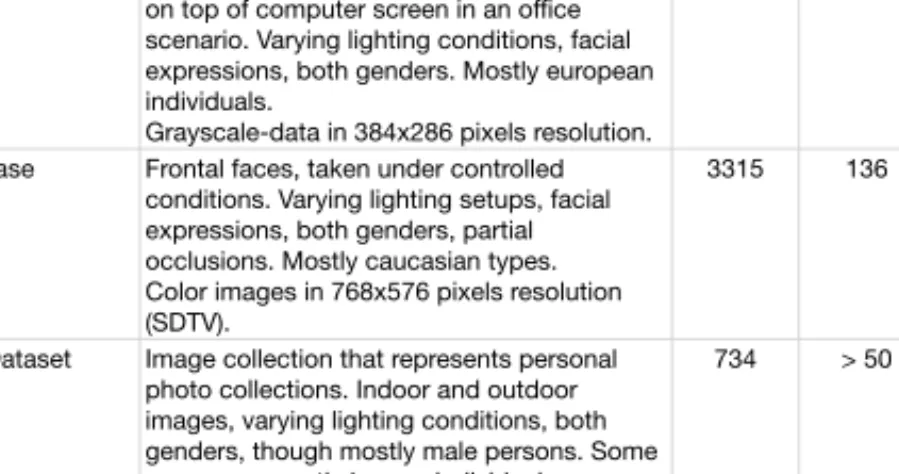
Three publicly available1 datasets are used for the experiments of this thesis. Their characteristics can be summarized as follows:
• TheAR Face Database [Martinez and Benavente, 1998] consists of so called mug shots taken in a controlled environment. All subjects are positioned on the same spot relative to the camera, looking directly into the camera under controlled lighting conditions. The background is formed by a dark blue curtain and there are no occlusions. Fiducial points corresponding to the FGnet 22 pts markup are publicly available and the database is clearly separated into individuals.
• The BioID Face Database [BioID GmbH, 2009] resembles an authentication sce-nario. It contains web camera images showing people in an office that look into the camera from different positions and distances. There are no occlusions and every image depicts exactly one person. All images are taken indoors with uncontrolled lighting (luminescent tubes on the ceiling). FGnet 20 pts markup is publicly avail-able for a subset of the images, but the dataset unfortunately consists of a varying number of images per person and images are not assigned to individuals. Because only 23 individuals are present in the dataset, it has been manually separated by the author of this thesis.
• TheMPEG-7 VCE [Bober and Kim, 2006] is an assembly of personal digital pho-tos collected from employees of companies enrolled in MPEG. The images show a varying number of individuals, most of them looking into the camera. Backgrounds vary from office interiors to outdoor scenes and several images were even taken in the dark with camera flash on. Different camera models were used to take the im-ages. Some images are blurred, some over- and some underexposed. All images from the folder “Face-CE testset resized” that show one to three faces were used for this evaluation. No ground truth is available for this dataset, so fiducial points have been manually added at the Institute of Communications Engineering. Due to the substantial number of individuals depicted, a separation into persons was impossible.
From AR over BioID to MPEG-7 VCE the recorded scenarios become more realistic but also increasingly difficult. Detailed information on the data can be found in the overview table Table 2.3 and in Appendix A. Moreover, section 4.1 describes, how the fiducial-points markup is used for dataset preparation.
2.5 Performance evaluation of face detection algorithms 23
Name Description # faces # persons face size
BioID Face Database V1.2 Represents an access control scenario where persons have been recorded by a webcam on top of computer screen in an office scenario. Varying lighting conditions, facial expressions, both genders. Mostly european individuals.
Grayscale-data in 384x286 pixels resolution.
1520 23 100x158
(average) 63x98
(min)
AR Face Database Frontal faces, taken under controlled conditions. Varying lighting setups, facial expressions, both genders, partial occlusions. Mostly caucasian types. Color images in 768x576 pixels resolution (SDTV).
3315 136 242x311 (average) 200x242 (min) MPEG-7 VCE Dataset Image collection that represents personal
photo collections. Indoor and outdoor images, varying lighting conditions, both genders, though mostly male persons. Some european, mostly korean individuals. Color images, moderately JPEG compressed, 800x600 pixels.
734 > 50 112x152 (average) 23x26
(min)
Chapter 3
Part-based object detection using local
image features
When children are taught to find faces in picture books, they learn that faces consist of parts like “eye”, “mouth”, or “nose” and that those parts need a specific spatial relationship to form a valid face. Similarly, the underlying idea of part-based object detection is that objects consist of a discrete set of object parts, where each part has a distinct appearance and the parts are spatially arranged in a known geometry.
The aim of this thesis is to model object detection as generic and basic as the formula-tion given above. The algorithm proposed in this chapter relies on only one addiformula-tional assumption, namely that there exists a universal way to also decompose any image into parts. This assumption allows to split the object detection process into two phases: first, the image is decomposed intogeneric parts without knowing which kind of objects we want to detect. Afterwards, aspecificobject detector is fed with the image parts only in order to detect and locate the object that it was trained for.
If multiple, different object detectors are applied to the same image, the intermediate decomposition result can be reused, saving processing time. The decomposition into generic parts also enables splitting the object detection process between two parties, one with exclusive access to the original image (possibly a content-owner) and one with access to a trained object detector (probably a customer or a broker), exchanging only the extracted image parts.
The idea of exchanging an intermediate extraction result—that we could call the “descrip-tion” of an image—originally motivated the creation of the MPEG-7 multimedia content description interface [Manjunath et al., 2002]. MPEG-7 has been successfully applied to audio classification in the past [Allamanche et al., 2001]. Unfortunately, the available descriptors only allow for the description of spatio-temporal segments that have already been identified as regions of interest. Of course, in analogy to the sliding window approach introduced in subsection 2.3.2, every possible object location in an image can be described to later perform object detection on descriptions. The dimensionality of video material, however, would result in an enormous amount of intermediate description data. During the last years, several variants of local image features have become popular for tasks like image registration, retrieval, and classification as well as wide-baseline matching. Their elementary and object agnostic formulation nourishes the belief, that local image
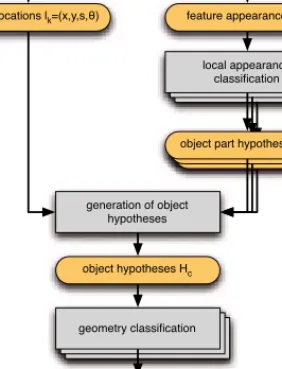
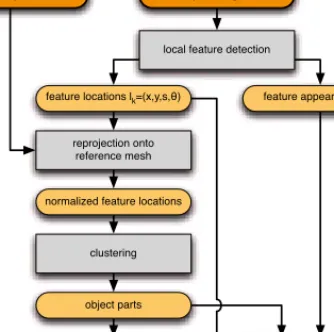
25 features represent generic regions of interest that can be used for object detection. The present chapter shows how a part-based object detector can be applied to local image features and introduces a mathematical description of all steps of the object detection process depicted in Figure 3.1.
geometry classification geometry classification local appearance classification local appearance classification feature locations lk=(x,y,s,θ) feature appearances ak
local appearance classification
generation of object hypotheses input image
local feature detection
object hypotheses Hc
geometry classification
detected objects
object part hypotheses Hp object part hypotheses Hp object part hypotheses Hp
Figure 3.1:Flow diagram of the object detection process
First, the input image is decomposed according to the image model described in sec-tion 3.1 and its local features—consisting of feature locasec-tions and feature appearances— can be used as an input to our object detector. Local appearance classifiers described in subsection 3.2.1 are used to match local appearances in the image to the parts of the object model. These object part hypotheses are then assembled to object hypotheses as described in subsection 3.2.2. Finally, as described in subsection 3.2.3, geometry classifiers determine which object hypotheses have a plausible spatial layout. The result is a set of detected objects.
For the scope of this chapter, the part-based object model itself is assumed to be preex-isting and a fictional, simplified model for human faces is used for illustration purposes. The actual derivation of an object model from training data for human faces is described in chapter 4.
3.1 Image model
To describe an image, we use the local features approach. Hereby, we assume that an image can be decomposed into a set
F={f0,f1, ...,fK−1} (3.1)
of K square regionsfk (called “local image features”) that consist of a location lk in
scale-space and an appearanceak:
fk= [lk,ak]. (3.2)
E
![Figure 2.4: Illustrations of part-based face models: (a) 14 rectangular components [Heisele et al., 2001b], (b) 6 rectangular components [Xu et al., 2008], (c) 4 affine invariant regions [Weber, 2000], (d) tracked features [Walker et al., 1999], (c) 10 featu](https://thumb-us.123doks.com/thumbv2/123dok_us/381335.2542180/24.892.217.676.553.671/illustrations-rectangular-components-heisele-rectangular-components-invariant-features.webp)